Take Your Time

If I could pick the time I would live in, I would go back a hundred years, and live then. I would be born in 1874, and would now be in 1916. That would be my time.

I decided this a while ago, when I realized that all of my professional aspirations would have served me just as well in the early 20th century, if not better than now. As a schoolteacher then, I wouldn’t have been paid much better than now; but I would have gotten more respect, I think. And I could have paddled my students when they made me mad. More importantly, being a professional writer was, I think, easier then, as there were more people who read, and thus more room for people who wrote. I would be happy continuing on with teaching if I could also have my work published and purchased and read, and I think that would have been simpler back then. There’s also nothing that would have stopped me from owning a shop that sold books and coffee in 1916.

But there are other factors that keep adding to this. I’m healthy, so I don’t care much about the loss of modern medicine; I hate driving fast and I’m not a fan of flying – but I love trains and I would love to take a ship to Europe or the Caribbean. I actually like wearing suits, especially with vests, and hats; though I admit the nonexistence of air conditioning would be tough. I don’t use the telephone very much; I prefer letters. I’ve actually tried to get people to join a written correspondence with me, but nobody keeps it up.

Nobody has time.

I would like to have time.

That’s the main thing, actually. I mean, sure, I like writing on a computer. I like video games. I enjoy having reliable electric power, and recorded music, and broadcast television, and things made out of plastic. Knowing what I know about politics and history, I would not want to live through the World Wars or the Great Depression or the epidemics of influenza and typhoid and smallpox. Though I do wish that the wackiest political candidate now was Teddy Roosevelt, with all his crazy ideas about national parks and the value of exercise. I could not imagine my life without my wife, and if I were alive a century ago, she would not be; if she were, her life would be far more miserable, as a woman without equal rights, or the opportunity to get into art school and do what she loves (though knowing my wife, she would have found a way even back then to be an artist). And of course, she probably would have died in childbirth, as most women did, and I would give anything up to be sure that didn’t happen, including living today in this loud, fast, illiterate world.

But if we can step away from that reality – and since we are talking about traveling in time, we’d better – and just talk about the general shape of life, then yes, an argument could be made for the late 19th/ early 20th century over the 20th/21th. (A note: my word processing program didn’t recognize “21st” as a designation requiring the letters be turned into superscript; but “21th” was no problem. Technology.) And it’s largely because of time and speed. Here – I’ll try to keep it short, so it doesn’t take too much of your time.

I like to take my time. I like moving slowly, and being thorough. Even in the video games I enjoy, I prefer the ability to wander around and explore, the opportunity to re-do a task until I get it right, the power to decide when I go on to the next challenge; I prefer long strategy games and life simulation games because of that. I love puzzles. I like reading books more than short stories, though I enjoy reading an entire newspaper or magazine. I prefer walking or riding my bike over driving. I like the opportunity to think while I am doing other things, and so I like activities that I can pause to consider. It’s the biggest problem my students have with me as a teacher: we take forever to get through a piece of literature, because I’m constantly stopping them to talk about what we just read. They want to get through stuff, and I want to understand every little bit of it.

But that’s also what makes me a good teacher. And it’s what makes me a good writer, and a good reader/reviewer: I take my time. I think about things as I go. I don’t write a lot of drafts for most of my work, but it’s because I think about everything I’m going to say before I say it, and then while I’m writing it. I’ve been thinking about the general shape of this piece for a couple of weeks now, though it has morphed from a screed about Harambe memes, to a rant about Twitter, to this. Which I have started, stopped, and restarted once already.

I can go fast. And I can see the appeal of it. I’ve mowed a lawn using both a push mower and a motorized one, and the push mower is far more annoying; I was only able to do it because I could have music piped directly into my ears through an MP3 player or a radio with headphones. I love being able to write these pieces and then put them instantly in front of a potentially world-wide audience. I do like microwaves and hot water heaters and instant coffee machines.

But generally speaking, the appeal of going fast is to have more time for other things; and if those things are made to go fast as well, then life becomes one frantic screaming headlong tumbling rush. We turn into Alice falling down the rabbit hole: out of control, no idea which way is up or how much time is actually passing, and we never touch the sides, nor reach bottom. We get lost in the chaos, without anything to hold onto. There has to be something that we take slowly, something that we enjoy spending as much time as possible doing; then there is a reason to get through the rest of the day quickly, in order to spend more time doing that one slow thing. The problem with our modern world is that we seem to not have that slow thing, most of us: most of my students, children of their time, simply spend many many hours doing quick things: they scroll through Facebook and Twitter and Instagram; they text and chat and IM constantly; they play videogames all day long, frequently hopping between two or three different games at the same time, playing simultaneously on the computer and on the phone; they spend hours watching videos, everything from full-length movies to six-second Vines. While they are scrolling and chatting and playing games. They spend so much time doing things quickly that everything feels rushed, everything feels late, everything is done at the last minute and under high pressure. They don’t even take the time to sleep.

I would rather sleep. I would rather wait for things – give me a book, or a piece of paper and a pen, and I can wait forever. And in terms of doing things quickly to get to other things, I’d rather not do those things at all. My goal in life is not to accomplish everything when I am young so that I may have a long quiet time at the end of my life; my goal is to avoid or eliminate all of the things I don’t want to do, so I can spend all of my life doing things I want. I haven’t been able to do that yet. But I’m still working on it. I think I’m making progress. Slowly.

I’m not very good at going fast. So I do have a Twitter account, and I do Twit (If it was Tweeter, then the verb would be Tweet; but it’s Twitter. Hence.), and I enjoy it; but not enough. I only Twit once a day or so, most days, and so I don’t get a lot of followers. The same goes for this blog: I can’t find a subject worth talking about at length every day, and I don’t like posting short quick things, and so I don’t get a lot of followers. But that’s okay: because I would rather have readers. I would rather post something at length once a week or so, that a dozen or so people actually read, than post a new sentence every hour and have ten thousand people scroll past it and smile when they do. I’d rather have comments than likes. I’d rather have people come back to read more of my writing than have a post of mine go viral. Don’t get me wrong, I like the likes, and I’m grateful that there are people who think me interesting enough to actually follow on this blog or on Twitter; but if I could trade all of that for some published work, or a weekly column, even if it was in a small newspaper or magazine, I would do it in a heartbeat.

There: that’s something I would do quickly.

I had an interesting week on Twitter, which was part of the impetus for this blog. I live-Twitted several cracks about the debate between Clinton and Trump on Monday night, and that was fun. I do have some followers, mostly my students, and they get a huge kick out of me being on Twitter – which is an ego boost, I will readily admit. Though it sort of freaks me out that the response can sometimes be instantaneous: I have one student that, when she likes or retwits my twits, she does it within a minute of my posting it. It makes me nervous: because sometimes the speed of something like Twitter leads to bad judgment, or truly terrible typos and Freudian slips and malapropisms that may never be lived down. As we learned from the 3am version of Mr. Trump this past week, as well. I’ve been badly burned by my rapid writing, because the posts that nearly got me stripped of my license to teach in Oregon were done without much forethought, in the heat of the moment, and that ended up badly; too, the actual report that led to my blogs being discovered came from a Facebook post. So social media makes me nervous. I like the ability to write what I want to say, and then step back and think about whether it is a good idea to say it or not; there’s a blog post about Hillary Clinton sitting on my computer, where it will stay, because writing it got me too annoyed and I turned much too insulting. But there are no drafts for Twitter. I post things, and I have deleted things after I posted them; but if they already got retwitted, then it’s too late.

Then on Wednesday, one of my favorite authors, Christopher Moore, twitted a Trump joke: “Yo daddy so orange, they push his face in the dough to make jack-o-lantern cookies.” And I quickly twitted back “Yo daddy so orange they use his dandruff to make Tang.” I was ecstatic when I saw Mr. Moore liked and retwitted my post. For a moment I thought it might go viral, or that I’d get a whole swath of new followers; but really, the excitement was that Christopher Moore, whose writing and especially whose humor I have tremendous respect for, liked my joke. That was nice. So on Friday, when I saw one of my favorite comedians, Patton Oswalt, twitting back and forth with several other people about the Alt-Right version of Star Wars – jokes about the Sand People being illegal immigrants and Han Solo not being a real hero because he was captured, and so on – I thought of a good one, and I twitted it to Mr. Oswalt. Hoping for the same response.

But I didn’t get it, because, it turns out, someone else had twitted the same joke (Darth Vader: “You know, if Leia wasn’t my daughter, I’d probably date her”) ten minutes before I did. That person got hundreds of likes and retwits; I got none.

That’s too fast. In ten minutes, my joke went from funny and appreciated, to derivative and ignored. In other words, to make that joke and be successful at it, I would have had to be ten minutes faster – most easily accomplished by obsessively following Twitter feeds and looking at trends and hashtags. But that is not something I want to do. I don’t want to spend hours jumping from thought to thought to thought, cudgeling my brain into coming up with something funny or interesting, in less than 140 characters (Because you have to leave room for the hashtag!), faster than other people can come up with it. If I was already famous then I would have an instant audience and I could twit things at my leisure that they might appreciate; but then I run the risk of twitting idiocy and having all of my followers instantly know about it and spread it all over the twitterverse. Like Mr. Trump. Or Jaden Smith.

I would rather take my time. I would rather think of something original to say, or create a new perspective on an old problem, than follow trends. Particularly because: had I been the one who came up with the joke ten minutes earlier, and gotten the likes and retwits, I would have been forgotten ten minutes later, when the next person thought of the next funny joke. I don’t want to be that fast, and I don’t want to be forgotten that soon.

I think that’s the impetus behind the Harambe memes. Now, to be clear: while some memes are funny, I generally can’t stand them. They represent the lowest common denominator, which is why they spread so widely and catch on so quickly. Sometimes they’re genuinely funny – like some twits in the twitterverse – and frequently they are cute, because cute is one of the lowest common denominators; but they are always the worst form of the argument, when they are about serious topics, and they are always reductive and simplistic and generally obnoxious to one group or another. My favorite use of memes is in messing with my students: because they don’t expect me, their middle-aged English teacher, to use memes, so when I do, there’s a disconnect that I find more amusing than the meme. But for most meme-people, the humor is unpredictable: it’s impossible to say which meme will catch on and which will not. There are people whose lives online revolve around making memes; some of them are good at following and capitalizing on trends; some are good at making trends; all of them are stuck in an endless cycle of rapidity, catching onto jokes that rise and fall in instants, and the fame that comes with originating the joke following the same arc. A year or two ago it was a frog on a unicycle with the tagline, “Here comes dat boi – Oh shit waddup!”

Then it was another frog – no reason in the meme world – named Pepe, with a depressed look in his half-lidded eyes and his downward curving lips (He has had a recent resurgence when it came to light that Pepe is now popular with those who make vile racist memes, because they dress Pepe up as the minority they wish to denigrate. Yup. Funny stuff.).

 We have also gone through a caveman Spongebob, several images from a video of Shia Lebeouf, far too much of the wrestler John Cena, and recently a strange obsession with Rick Harrison, the star of Pawn Stars.

At one point it was Harambe. The gorilla in the Cleveland zoo who grabbed and held a child who got into his enclosure, and was shot and killed by zookeepers trying to protect the boy. It was a sad story that rapidly caught the attention of the country, particularly online, because it hit so many buttons: children’s safety and violence and the treatment of animals.

Harambe memes caught on partly because the biggest audience for memes is teenagers, and teenagers revel in mocking other people who take things too seriously, which is how the outcry over Harambe was seen – people weren’t concerned with the Syrian refugee crisis, or about the murders of African-Americans committed by police officers, they were concerned with the death of one gorilla – and partly because one meme-creator had an idea: a stupid and crude and absurd idea; and so of course, that’s the one that caught on. The idea? Men flashing their genitals as a tribute to the gorilla. The tagline was “Dicks Out For Harambe.”

Yeah: it’s kind of funny. Put in the right absurd context – a job interview, a political appearance, a Christmas special – the absurd notion is amusing. Because it touches on a taboo that people often find absurd anyway, the issue of public nudity, and also touches on the absurd obsession that most men have with their own genitalia, it got even more traction. And it had its usual run as the most popular meme of the moment. I’m sure whatever meme-maker came up with the line had a sharp uptick in followers or likes or reposts, and I’m sure he or she (Probably he) was gratified and possibly enriched by the increase in ad revenue. The popularity has ended now – thankfully – and I rarely see “dicks out” jokes any more. There was a brief resurgence when another great ape, the gorilla Bantu, died owing to a mistake in a medical procedure, but the slogan “Balls Out for Bantu” was apparently too derivative even for meme-fans, and it never caught on the same way. One of my former students twitted a picture to me, of a poster that some (probably apocryphal) English teacher had on a classroom wall that showed a gorilla’s face and the slogan “Books out for Harambe,” which he said I should put on my wall, but when I told him that there wasn’t enough No in the world (A dick joke AND a meme joke? Oh, sign me up!), another of my students took my side: evidence that the meme is largely dead. When even teenagers don’t think you’re funny any more, there’s no place left for you in the meme world.

But I still see Harambe memes. Now they have changed. Now they are about the gorilla being remembered; now the absurdity is in someone crying over the idea that Harambe’s death will be forgotten. Again, mocking people for taking things too seriously, or at least the wrong things too seriously – but now it is without the lowest common denominator. No dicks in this joke. So this one is less absurd, which makes me question why it is so popular.

So I wonder: how much do people who make memes, who spread memes, worry about the thought of being forgotten? How much of this latest spurt of temporary fame is about this genuine fear? In a world where the attention span covers approximately six seconds or so, where this week’s star is the “Damn, Daniel” guy and next week’s star is Rick Harrison and the “Damn, Daniel” guy is gone from people’s memories forever – what is the point of trying to reach the top? The second you do, you fall right back off, and you probably never make it back up again.

That’s exactly what I’m talking about. (And I realize now that I have gone on longer than I intended; I would apologize, but I’m never actually sorry for using a lot of words) When life is about going as fast as possible, then life, too, goes as fast as possible – which is really damn fast. And that may be exciting, but it also gets us to the end before we know it. And whatever that end is, whether it is obscurity or nothingness or even eternal paradise: it won’t be exciting, and it won’t be fast.

I would rather write than trend. I would rather be read than laughed at. I would rather read and consider than get through things. I would like to take my time.

I Hear You.

Hear Me Now: This is What I've Always Wanted to Say Poetry by [Watson, Lisa]

Hear Me Now: This Is What I’ve Always Wanted to Say Poetry

by L.S. Watson


I’ve always been amazed by poetry. (Well, once I started understanding it, that is.) I have no ability to write it, at all. For me, words come in sentences and paragraphs, not lines and stanzas; and what’s worse, they come in enormous torrents: I never use just one word when twenty or fifty will do the same job.

So when I find a poet, like L.S. Watson, who has a remarkable ability to use one word to say many things, I have to just stop and admire. And in that momentary pause, I hear what she says.

I do wish there were more words in one way: this little book, Hear Me Now, is too short. I enjoyed it and I wanted it to keep going. It hooked me right from the start; the first two poems, “Ashes” and “Dancing with Raindrops,” are on facing pages, and show two opposite sides: “Ashes” is about the ugliest side of humanity, our penchant for mindless destruction; and “Dancing with Raindrops” is about the indescribable beauty of short, sudden moments, like bursts of wonder, that come at us sometimes when we’re not expecting them and we need to pay attention, or we miss them. Putting these two against each other heightens the impact of each, as the beauty of nature makes it sadder that men destroy it – but that just means we have to look even harder for the beauty.

The book is like that: I have read it twice, and I expect to read it more, particularly “To Whom It May Concern,” “A Thought,” “The Fight,” and “America, the Free.” There are also several poems about heartbreak that I could not relate to quite as closely, and three that showed me the impact of loss on the poet, “Freddie,” “Mother and Father” and my favorite of these, “Share a Memory.” But my favorite poem in the book is “Imperfections.” I love the message and I love the last two lines especially.

The ending lines are frequently used to maximum impact. Watson’s poems are fairly short, usually one stanza, though that stanza often fills the page and runs over onto the next; the lines are short, often just one or two words. She uses rhyme frequently – which, if there is anything that I didn’t love about this book, it was that; I am less fond of rhyming couplets than Watson – and the short lines and the rhyme force maximum attention onto the specific words used, particularly at the end of the poem, which sometimes – as in “Share a Memory” – falls like a hammer, like a thunderbolt. Or like a dancing raindrop.

Suffice it to say, this is a good book of poems; short, like the poems, but strong, like the poems. I recommend it.

Book Review: Henrietta Lacks

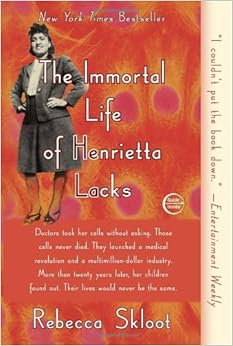
The Immortal Life of Henrietta Lacks

by Rebecca Skloot

I liked this book. I didn’t love it.

Which leaves me a little puzzled as to why this book did quite so well as it did. I mean, it’s popular science, so it makes an otherwise esoteric subject – in this case, the intertwined subjects of cellular research and medical ethics – more accessible to people; that, it does remarkably well. Skloot humanizes Henrietta Lacks, whose tissue was used to start the HeLa line of cells, which have been in constant and widespread use in medical research since the 1950’s when the cells were first collected, without Mrs. Lacks’s informed consent. The book is very good at helping us to understand the woman and her family and the impact that the medical research community had on them.

However, it doesn’t do a terribly good job of explaining the impact the Lacks family – or at least Henrietta – had on medical research. Which feels like a missed opportunity.

It’s an interesting story at the start: Mrs. Lacks had an aggressive form of cervical cancer, and was treated for free at Johns Hopkins Medical Center. The treatment, appropriate at the time, is horrifying to think of now; not much less horrifying is the idea that as part of it, doctors took tissue samples from Mrs. Lacks, one from a healthy spot on her cervix and one sample from the actual tumor, without informing Mrs. Lacks why they would be doing so. The sample from her tumor turned out to be the perfect cellular replicator, and it became a standard research tool over the next several decades; any time anyone needed some cells, they just had to order some HeLa samples from one of the several businesses that eventually made a fairly sizable profit from – well, from farming cells from Mrs. Lacks’s sample. The HeLa cells were used in all kinds of things from polio vaccine research to the Human Genome project; the science and the scientists behind it were the most interesting part of the book, at least for me. The woman herself died from her cancer, leaving behind a husband and five children; none of them had any idea that their mother had been turned into a medical experiment.

But from there, the story sort of goes off the rails. It’s understandable, because Henrietta Lacks died in the 50’s, and so cannot be a part of the current story; Skloot goes to the next best source: the Lacks family. And she tries very hard to humanize them, to allow us to understand how they feel knowing that their mother was used to supply labs with human cellular material for research, for profit, for decades after her death. The problem is that the Lacks family is kind of freaky.

I don’t mean to cast aspersions; anyone coming in to probably any family to get to know us and talk to us would likely have a strange view of the family; especially if the topic is, “So did you know that thousands of scientists have used cells grown fro your mother’s tumor in experiments?” But the Lacks family, while I sympathize with their situation, was hard to relate to. They are strangely religious, for one (At least more religious than me, which on a scale of 1-10 would be “Nuh-uh”), and have some ideas about their mother living on through her cells that I couldn’t relate to. They switch between wanting to get their share of the money made from their mother, since they all live in some level of poverty and ill health, and just wanting their mother recognized for her vital contributions to medical science, to wanting all of the doctors to pay for what they did. It made me jump around from agreeing with them to raising an eyebrow, and so it made them seem strange, to me. Then I felt guilty (still do) about finding the family strange. The biggest factor is that the family is just – kind of strange. They are entirely standoffish half of the time, and the other half of the time, they are breaking down in tears or erupting in anger, or in gales of laughter. Maybe it was just the way it was written, focusing on the most dramatic moments in what was actually a long period of research for this author, but the whole family seemed manic to me.

Then there was one other issue: I read this book because it was featured in the Engage NY curriculum, which the school where I teach has informally adopted as – well, they’re not rules so much as “guidelines.” The curriculum is online, free, and incredibly detailed and extensive. It also annoys me endlessly because it uses almost exclusively excerpts. The students don’t actually read Romeo and Juliet, for instance; they read a few key scenes and speeches, and analyze those bits. The analysis is great, but I’m a literature teacher: which means I want my students to read literature. You know, to the end of the story. One exception to the excerpt rule is – The Immortal Life of Henrietta Lacks. The students read the whole thing in 10th grade as a jumping-off point for a research project. And I saw this (I should note that I may have misunderstood the curriculum map, and this novel is also excerpted; that makes more sense, but I think it said the whole book.) and thought, “Well, if they’re not going to read all of Shakespeare, but they DO read all of Skloot, this must be the best book ever!”

It’s not. It’s pretty good. But it’s no Shakespeare. And in terms of actually teaching this book, there is some cussing and language, and a fairly graphic scene of child molestation, so I wouldn’t recommend it. If it was brilliant, the scenes could be taken out or glossed over; but it’s not brilliant enough to fight over.

All in all, I’d rather read Frankenstein.

What Happened Yesterday

I’ll tell you what should have happened yesterday: nothing. It was a half-day for me at work, while the students (the juniors and seniors, at least) had a workshop on college and financial aid. My wife and I had a pretty good lunch (Better for me than her – Whole Foods burritos>Whole Foods sandwiches, it turns out) and an excellent dinner (Oregano’s pan pizza>anything to be found in Whole Foods), and a nice relaxing afternoon. We drank coffee. I read a book. She organized her studio more, and then worked on a drawing. We took our dog Samwise for a pleasant walk, and I got to spend a nice hour with our cockatiel, Duncan, as he climbed around on my shoulders and whistled happily and chewed on pieces of paper, while I played silly video games. We watched a little TV, and then went to bed, and slept well.

What we didn’t do yesterday was: wake our children; bathe our children; dress our children; feed our children; drop off our children; pick up our children; entertain our children; discipline our children; argue with our children; have the traditional “Go to bed!” fight with our children; clean up after our children; or worry about our children. Or any of the thousand and one things that parents do every day with and for their children. (Including love their children, play with their children, and be proud of their children and amazed by their children.) We did none of that yesterday, and we will do none of it today, and none of it tomorrow.

Because, you see, my wife and I have no children. As should be clear, this is by choice: had we wanted children, we would have children, because, as gets pointed out to me every single time I say that my wife and I have no children, it is possible to adopt children. (Have you ever gotten so tired of hearing an obvious point made that you just can’t summon the energy for sarcasm any more? Well: if you have children, then probably, yes.) We have not adopted children because we do not want children. She has never wanted children, and has known this from a young age; she told me very early on in our relationship – around the third date or so – that she would never want children, and if I did, then we should go our separate ways. As you can tell, I did not choose children over the love of my life.

My feelings about children have historically gone like this:

Stage 1. I am a child, and I don’t like it very much. Sure, my mom makes grilled cheese for me whenever I want it, but I also have to eat broccoli, go to school where the other kids pick on me, and deal with my parents when they are mad at me or disappointed in me – but when I’m mad at them or disappointed in them, I have to deal with it myself, because I have to learn patience. I get to have toys but they don’t do what they did in the commercial, and I am forced to participate in activities I really don’t like, like team sports. Because they are good for me.

Stage 2. I am a young adult, sexually active and terrified of the idea of children, because I don’t want to give up my plans and my dreams just because I get a girl pregnant. I am also aware that, while sex is a whole lot of fun, the young women with whom I have all this fun are really not people I would want to spend my life with, or raise children with. I ignore the fear and the awareness of reality in order to continue enjoying sex because I, like every other teenaged boy, am a moron.

Stage 3. I meet the love of my life. Pretty much from the first moment, I am aware that this is the best and most wonderful woman I have ever encountered. This is the woman I want to spend my life with. She is, literally, everything I have ever wanted in a partner. And she presents this fact to me: I can have her, or I can have children, but I cannot have both. I choose her.

Stage 4: I am happy with my choice.

That’s it. Notice there is no point where I hold a child and realize that this is the thing that would give my life meaning, as it has given meaning to others’ lives. (I have held a child. Once. I thought, “Man, this thing is small. I better not drop it.”) Notice there is no point where I spend lots of time with little children and realize how awesome they are. Notice there is no point where I think that my sacred duty to God and the human race is to go forth and multiply. Notice there is no point when I know that I must produce an heir to carry on my name and my legacy. This moment in Stage 3 where my love presents me with this choice? It took me about fifteen seconds. (I have gone back and thought about it since, and it has never taken me more than about fifteen seconds to confirm my choice.) It was not a difficult choice. There was nothing on the other side to balance it. I have never had a desire to have children, and I feel no loss for not having had any. None at all. Not ever.

I have been open and honest about this for years, now. I talk to my students about myself and my life, and they quite naturally ask if I have children, and I say “No.” Over the years I have learned to say it with a shudder and a frightened look. Not because I am actually afraid of having children; I have been told quite frequently that I would be a good father, and I would. I’d be a miserable father, but I’d be good at it. (Like teaching. Except it would never, ever end.) I’ve learned to say it with a shudder and a look of terror because then my students don’t pursue the topic. In the beginning when I’d simply say, “No,” I would be forced into this conversation:

“Are you going to have any?”

“No.”

“Why not?”

“I don’t want them.”

“Does your wife want them?”

“Even less than I do.”

“What if you change your mind?”

“I won’t.”

“What if she changes her mind?”

“She won’t.”

Two possibilities now.

Possibility #1:

“What if it happens by accident?”

“It won’t.”

“But what if it did?”

“It won’t.”

“How can you be sure?”

“I’m sure.”

“But you can’t be sure!”

“I’m sure.”

“But what if it did?”

Continue until I get exasperated and explain that I have 100% medically induced assurance that there will be no accidental pregnancy in my marriage; or until I tell students to stop prying this far into my personal life. (I had this conversation several times, and never did the person arguing – almost always a girl, usually one of the ones that desperately wanted to be a mother – realize that they were asking me either, “Do you have sex with your wife, and if so, how?” or “Would you and your wife be willing to abort a fetus in order to maintain your childless state?” Never did they think, “Maybe this is too personal a topic.” No, they just wanted to know what I would do if we had an accidental child. Really, they wanted to hear me say, “Then we’ll have a baby and we’ll love the baby because BABIES!” Though I will say that I have told my more recent students about these past conversations, and several of them have been appalled that a student would try to pry this far into my personal life, particularly my marriage and sex life.)

Possibility #2:

Student gives me a knowing look that is so annoying that, even as a pacifist and a professional educator who would never inflict harm on a student, still makes me want to punch them right in the eye, repeatedly. Student says, “You’ll change your mind.” Student nods and smirks smugly. I roll my eyes or heave a sigh and move on, slowly unclenching my hands.

(In both of these possibilities, at some point, someone will point out, “You know, you can adopt children.”)

So now, rather than go through these conversations any more, I bug my eyes out, curl my lips in horror, and say, “Oh God, no!” when they ask idly if I have children. Or if I’m feeling less dramatic, I simply say, “Nope, and I don’t want any. I don’t like children.” My students are generally puzzled as to why I would become a teacher, then, but there are several reasons, which I have explained in the past in various ways: one, I really like English; two, I teach high school and generally don’t think of them as children; three, I don’t have to take my students home with me at the end of the school day. It has gotten easier over the years as I have moved out of the most common child-bearing years, though I expect I will still have to say these things for as long as I keep teaching and talking about myself; and I expect I will still get some students – usually girls – who act as though this is a sad state of affairs, who think that I am missing out. But then, teenagers are self-centered, and judge other people only from an egocentric point of view: because I want children, they think, everyone must want children. That’s why Teenaged Me couldn’t understand why everyone didn’t like Metallica and Alice in Chains.

No, wait – I still don’t understand that.

But I do understand why not everyone would want to be a high school teacher, and not everyone would want to live in Tucson, and not everyone would want to have pets, or play video games, or keep a blog. Those are my choices, not everyone’s. I get it. No problem.

So here’s the thing that did happen yesterday. A friend of mine posted a status on Facebook that read, “I’m getting a pet monkey!” No way! I thought. Several other people had commented to the same or similar effect, and so I wrote, “It’s not real unless there are pictures. Or poop in your hair. Or, preferably, both.” Because I’m a smartass, and my friend is a smartass, and I wasn’t really sure this was true – but as another friend of ours posted, “If this was anyone else, I’d call bullshit.” The monkey-getting friend is fearless enough, and unusual enough, to get an actual pet monkey. And she doesn’t usually lie or pull tricks.

But she was tricking us this time. Shortly after I commented, I got a personal message from her that read (and I apologize for spoiling the gag), “Hi! Since you commented or liked my last status you have to pick from one of the following and post it as your status. This is the 2016 Breast Cancer Awareness game. Don’t be a spoil sport. Pick your poison from one of these and post it as your status. 1. Just found a squirrel in my car! 2. Just used my kids to get out of a speeding ticket. 3. How do you get rid of foot fungus? 4. All of my bras are missing! 5. I think I just accepted a marriage proposal online?! 6. I’ve decided to stop wearing underwear. 7. It’s confirmed I’m going to be a mommy/daddy. 8. Just won a chance audition on America’s got talent! 9. I’ve been accepted on master chef.10. I’m getting a pet monkey! Post with no explanations. Sorry, I fell for it too. Looking forward to your post. Don’t ruin it. (Don’t let the secret out). And remember it’s all for 2016’s Breast Cancer Awareness.

Dammit! I thought. Suckered me! But I liked the joke. I decided to play along, though I don’t normally do these chain things. I looked through the options, smirked especially at #7, and then went with “I’ve decided to stop wearing underwear.”

But then I thought about it. The point was to get a response, right? The biggest response possible, the largest number of people commenting or liking the post? Everyone who knows me knows that I don’t have children; everyone who has known the adult me knows that I don’t want them. Every single one of my former students, who make up the majority of my Facebook friends, knows my feelings about children. There is not a single class that has not heard me say, several times, that I don’t ever want to have children of my own. (I didn’t think about the fact that my own childhood friends only knew me in Stage 1 or Stage 2, and so may not be aware of my current feelings on the matter; ditto with people I’ve known more casually, like former neighbors. But there aren’t that many of them on my friends list, anyway.) So if I posted the thing about being a daddy, they’d all be confused, right? They’d be curious? They’d comment on the post. I should do that one.

I thought about it. I also thought about doing the America’s Got Talent one, because lots of people know I sing and rap and do goofy voices and such. But finally, I decided that #7 would be the funniest. So I deleted the status that said I had given up underwear, and posted, “It’s confirmed. I’m going to be a daddy.”

I won’t say all Hell broke loose, because it didn’t happen quickly; but over the course of the day, Hell overflowed its banks and flooded around me. And, what’s much worse, it flowed around my wife. I made another mistake in thinking she would think it was funny and I didn’t tell her what I had done, nor ask her if she was okay with it; I let her find the status on Facebook without warning. And so her reasonable and correct response was to comment, “What the fuck?” She actually thought that I had discovered, when I went out that morning to check on our sulcata tortoise Neo, a clutch of tortoise eggs; exactly this thing happened with our iguana Carmine, on the day she became Carmelita (Those were iguana eggs, though, not tortoise eggs. Just to be clear.). I admit that I was annoyed by that response, because I thought she had ruined the gag, and now, with my wife commenting “WTF?” (And then adding a second comment after we spoke that read, “Okay, now I get it. Had me worried, there.”), I thought everyone would know that the status wasn’t real, and no one would comment, and I wouldn’t get to pass on the gag to anyone.

I was wrong. Again. Because by yesterday afternoon, I had received 64 likes/reactions, and a dozen or so comments. Some of the reactions were surprise, but most were likes or loves. Some of the comments were, “Say what, now?” or “You got a new pet?” but many of them were, “Congratulations! You’ll be a great dad.” And to my great regret, my wife got four personal messages from various people offering her more personal congratulations. (At least one of those, who knows my wife well enough to have discussed the issue with her, offered them tentatively, and was relieved to hear that it wasn’t true.)

Why do I regret that? Because I know what my wife has been through over the years as a result of her conscious decision never to be a mother. Whatever grief I have gotten from students, or from other adults (far less frequent), or from my parents, she has gotten a thousandfold. Because she is a woman, and therefore, she is the one who is supposed to want children. That’s what she’s for, our society seems to think. I think my parents, who never-not-once spoke to me about children when I was a child or a young adult, just expected my future wife-person to be the one to convince me that I should have children; they were a bit shocked when they learned that my choice of wife-person would not come with grandbabies. My wife, like every other intentionally childless woman, has dealt with a lifetime of questioning, and interrogation, and nagging and pestering and prodding and invading. She has suffered disapproval, and disappointment, and pity, and even contempt. And even though I knew about all of that, and am indirectly the source of some of it because my parents want to be grandparents and blame her because they are not (Even though I have a brother – and isn’t the eldest son the one responsible for production of heirs? I’m supposed to be the dissolute black sheep, dammit!), I still chose to post that I was a daddy, rather than saying I was commando for life. That’s why it was an idiotic thing to do, and why I call the slow flood of reactions to this little joke a mistake. I shouldn’t have done it. I’m sorry for it.

But I have to say this: it wasn’t all my fault. I shouldn’t have used that joke, but all of you people need to stop doing this. Just stop.

Stop thinking that children are the greatest blessing that ever came, or ever will come, into every person’s life. If they were in your life, that’s fine, congratulations; but there is no reason to assume that is true for everyone.

Stop thinking that a woman’s primary role in life is to become a mother: a woman’s primary role in life is to be herself.

Stop thinking that a woman without children is less of a woman, or is somehow fundamentally unhappy or unfulfilled because she has no children. People are different, including women. We are capable of being happy even without making use of every single one of our organs. Do you think someone is fundamentally less human because they had their appendix removed? No? Then stop thinking it just because she may have a uterus that has never carried a child to term. And by the way, do you pity me because my testicles have never produced a child, and therefore the organs that apparently make me a man have never been used for their single intended purpose? No? Then why pity my wife?

Stop pitying people who do not have children. We are not sadder because of that. You may pity people who wanted to have children but couldn’t, but anyone who has never had a child chose not to – because it is possible, it turns out, (Who knew?) to adopt a child, which means childlessness is a choice. Choice makes us human and independent; not pitiable.

Stop thinking that everyone’s life is made better by children just because yours was. Stop thinking that everyone needs to have children in order to have a purpose, or a sense of accomplishment or fulfillment, or that everyone needs to know the love of a child to understand love, just because those things were true for you. That’s the way that children think.

Stop thinking that people need to have children in order to leave a legacy after we die. My legacy will be my writing. It will be my only legacy, because any people I made would be their own people, not extensions of me; what an egocentric thought, to believe that you live on in your children.

Stop thinking that people need to have children in order to have someone to take care of us when we are old. My wife and I will take care of each other, and should I have to go on alone, I will take care of myself. When I can no longer take care of myself, I will die. Which is where I am heading, anyway.

Stop asking people when they will have children, why they don’t have children, why they don’t want children. You don’t hear that people are having children and then ask, “Why?” now do you? When you hear that people have children, do you ask, “When will you be getting rid of them, after college or when they turn 18?”

Stop thinking that a person’s fecundity is public business. It never ceases to amaze me that people will ask complete strangers about their pregnancies. Especially that thing where people actually put their hands on a strange woman’s abdomen if said abdomen happens to be distended by a pregnancy; think about what would happen if you did that to a woman who wasn’t pregnant. Like if you asked if someone was going to lunch, and then put a hand on their stomach and said, “Going to fill this up?” HOW FREAKING WEIRD IS THAT? Why does anyone ever think it’s okay in the case of pregnancy? And again, ever grabbed the woman’s husband’s penis and asked, “And is this the organ that made that baby?”

Stop believing that I need congratulations, or that you should be happy for me, should I ever produce offspring.

And I will stop joking about doing so.

(A final note: I hope it has been clear throughout this blog that I have avoided, or at least tried to avoid, telling people with children that they have made the wrong choice. When I myself do not know their lives and do not have direct experience with their life experiences, particularly the choice to have children, presuming that I could tell people that they should have made a different choice would be absurd. I sincerely hope that no one, with or without children, has been offended by what I have written here.

But if you have been: good.)

Book Review: Japanese Steampunk

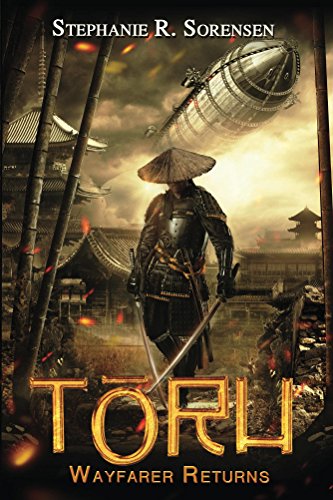
Toru Wayfarer Returns

by Stephanie R. Sorensen


(Full disclosure: I was invited to review this book and given a free copy so I could do so.)

Do you prefer ninjas, or pirates? How about history, or steampunk?

Here’s an idea: why not have both?

Okay, strictly speaking this isn’t a novel about either ninjas or pirates; it’s a story about Japan’s “opening” to the west when Commodore Perry of the U.S. Navy sailed into Edo Harbor in 1853 and threatened and insulted the Japanese into negotiating with him, or else face bombardment from his entire fleet, which he brought back in 1854. Japan was unprepared for this aggression, the country having been isolated and controlled by the Tokugawa Shogunate for the past two and a half centuries: their military was still mostly medieval, and could not fight back against modern warships, steamships, cannons, and rifle-carrying Marines.

But what if? What if Japan had found a way to be ready for that attack? What if the nation, alerted to the threat of the West by the actions of the British in opening and conquering China and India, had modernized and industrialized? What would have changed in world history if Commodore Perry had found the harbor blocked, and armed, the Japanese a growing world power, perhaps even a legitimate threat to the US?

I’ll tell you what: that would be a story worth reading.

And so it is. Stephanie Sorensen has found just what the alternate historian needs: a critical moment when world events went in this direction instead of that, and then thought of a way to make it go that way. The change is in one man (as history’s pivotal moments so often are): Himasaki Toru, a fisherman with something of a mysterious past, who is lost in a storm and rescued – by an American whaling ship. Toru spends two years in America, and while there, he realizes that the US, with its military and economic might, and its brash disregard for the slow grinding of polite diplomacy, could pose a threat to his motherland. A faithful son of Japan, Toru has only one choice: break the Shogun’s law that bans anyone from entering Japan from the West on pain of death, and find a way to convince his nation to adopt Western technology and industry so that when the US comes, Japan would be ready.

It’s an impossible task, made even more so by the fact that Toru is only a peasant, a fisherman; no nobleman, no daimyo, no samurai would ever listen to one such as he, let alone the entire nation. But only the efforts of the entire nation, working in concert, can possibly give Japan the chance to meet the West’s incursions from a position of strength. Toru works with the weapons he has: his intelligence and his passion; the books and machines he purchases in the West and tries to smuggle back into Japan; and a rebel’s greatest weapon: luck. Toru is lucky that the lord whose domain he lands in, Lord Aya, is himself unconventional, made so by his unconditional love for his unconventional only child – his beautiful daughter Masuyo. With luck, and with the help of Lord Aya and Masuyo, maybe Toru can save his country.

I liked this book. I mentioned pirates and ninjas above because this book combines some of the best features of both: Toru is a rebel, though one with a good heart and good intentions; he breaks the rules because he has to, to succeed. Like a pirate. Masuyo does this even more, as she refuses to meekly accept the role of women in her culture; she uses her brains and her courage to help Toru in his task, and takes her place in the forefront of this revolution against the status quo.

As for ninjas – well, the story is set in 19th century Japan. There are ninjas. There are samurai, and swordfights, and honor. And then, because it is steampunk, there are trains, and telegraphs, and Babbage Difference Engines, and dirigibles painted like dragons, powered by steam engines, swooping down out of the sky to awe and terrify allies and enemies alike.

Honestly, Sorensen, who has a background in Japanese and Asian culture and studies, does a better job with the Japanese aspects than the steampunk aspects; the steampunk isn’t bad, but it isn’t really the focus. The focus is on the culture of the Shogun’s Japan, and how change could come to such a rigid and traditional culture, and what would happen when that change did come. As a novel of alternate history, this is a good book. As a steampunk book? It’s okay. The dirigibles are really cool. The writing is generally good, though not spectacular. The industrialization of Japan within the timeline and despite the cultural roadblocks requires some suspension of disbelief, but I thought the political interactions were well done, both within Japan and then between Japan and the US.

But anyone interested in Japan, in samurai, in traditional cultures, or in the clash between tradition and modernity – you should read this book. And the sequels, when they arrive. And anyone who likes a well-written story of one man struggling both for and against society, anyone who is interested in the struggle to break out of a rigid class system and become more than the role created by one’s birth, you should read the book, too.

Oh – and if you like romance, there’s some of that, too.

Overall, I recommend it.

Take luck!

I’m feeling lucky.

This morning, when I put cream into my coffee, I managed to get in just the right amount so that, when I stirred it, none slopped over the side. I’ve been failing at that recently. So this success must be a good sign of more success to come.

When I opened my laptop, there were cookie crumbs inside. Definitely a good omen. Cookies make everything better, and clearly, my laptop held onto that tiny bit of cookie just to make me smile, to remind me that there is humor everywhere, and sometimes, I get to see it. When I’m lucky.

We just moved into our new house, and while we were still in the preparation stage, we were coming over here every day after work, dropping off some things because this house is quite close to the school where we teach, and also watering the new sod we put in as a food source for our tortoise Neo. And there was a dove that had a nest in the eaves of our carport. At first, we weren’t sure she was alive, because she didn’t move much and never flew away when we drove in with our noisy people-carrying-machine; but we did see her little head tilt this way and turn that way, and so we realized that this was, in fact, a real dove that lived in our new carport. This is, for us, a lovely thing (even though – or perhaps partly because – my father’s response was “Hm. Doves’re dirty birds.” So sad.) because we cherish life, and want to keep others’ lives safe and comfortable whenever we can. So we greeted the dove every time we came, and tried not to move too quickly or make too much noise.

And then, the morning after the first night we stayed here, we heard a terrible thump. We ran to the back door and looked out, and indeed, the dove had flown into the window. We have no idea why: the window is small, and was covered with blinds on the inside, and the carport is completely open on one side. Perhaps the dove was scared by something coming into the carport and tried to escape; perhaps she had been sitting so still in her nest in the first place because she was hurt and trying to recover, and her first attempt at flight was ruinously bad. Maybe she just got caught in a bad crosswind that came up at just the wrong moment: just bad luck. All we knew was, there she lay, twitching and bleeding on the ground. Her head seemed twisted to the side, the blood coming from the top of her wing. We went away, unable to watch her suffering; I came back and checked, and she was lying still but for the tip of her tail, which still drifted up and down gently, like a leaf in the wind, like the line of light on an EKG as it shows the last beats of a dying heart. I walked away again, hoping she would die soon.

Trying not to think of this as an omen. But how could I not? Here we were moving into a new house, and the original resident was dying on the concrete in front of me. Surely we had somehow disturbed her. Maybe she was trying to escape the fate of losing her private nesting ground to loud, obnoxious humans. Maybe Nature was trying to tell us something.

But then, Toni came to me. “The dove’s still alive. She’s sitting up.” “What?!” I jumped up, went to the window — and indeed, the dove was now sitting upright, head on straight, looking around, still with blood on her wing. We put a towel into a box and I got some gloves, so we could pick her up and make her comfortable, at least; we had to do what we could for our neighbor. We went out the door, moving quickly but gently, trying not to scare her.

She took off. Flew around the carport, and then off into the bushes nearby. Later that day, she returned to her nest in the eaves; we put out some food and water, and left the towel in the box in case she needed it. But we were happy: because now it was a good omen. She was the dove that lived. So that must mean our new house was willing to accept us.

The dove left, a day or two later. Hasn’t come back.

What kind of omen is that?

Last night, a week after moving in, we were coming back from a celebratory dinner – celebratory because yesterday we finally finished moving out of and cleaning up our old rental – and as we turned into the driveway, I saw something perched on one of the rocks at the end of the driveway. As we drove by, it took off and flew. But it wasn’t the dove: it was an owl. A large and magnificent owl. It flew to our mailbox and perched there, not moving, for the next half hour, at least.

So is that an omen?

Did that owl eat the dove?

So are we welcome here, or not? Teiresias, the blind prophet from Sophocles’s Oedipus cycle, reads the actions of birds in order to know the future (He has a servant describe them to him; one of the earliest examples of an author making a great symbolic statement and then having to come up with some ridiculous bullshit to make it work. “You say he watches the birds to see the omens? But I thought he was blind, and could only see the future clearly.” “Uhhhh – there’s a servant who describes them. Yeah, that’s it. A servant. So anyway…”); what would he make of this chain of events?

We had Chinese food for that celebratory dinner, and of course I had a fortune cookie. My fortune said, “Next week, green will be a lucky color for you.” Okay. Thanks. Though I’m not sure what that signifies. Is it about money? Should I wear green? Will that create good luck for me? Should I look for things that are green, that I can take as signs, so I can find luck?

And is it going to be good luck, or bad luck?

I wanted to write that I don’t believe in luck. That’s what I meant to say. I was trying to think of a good insight for this blog, something about how luck is mostly a misunderstanding of probability, that we underestimate the chances of certain events happening, and overestimate the chances of others; that confirmation bias makes us believe we are seeing a correlation when really we’re just noticing things that fit into our beliefs (“Every time I see something green, something lucky happens!” Right: because you’re looking for green things, and when you see one, you look around for something lucky. And it’s most likely something like “Hey, I didn’t trip and fall into that cactus patch! Thanks, Good Green Luck!”). I was going to write something about the multiverse, about the infinity of possibilities that we live in, and how the particular reality we are in doesn’t show great good luck: it’s just one of uncountable alternatives, most of which are not lucky at all. There’s a great short story that I am currently hurting my students’ brains with, called “The Garden of Forking Paths,” by Jorge Luis Borges, about how reality forks as it moves into the future, creating alternate realities where things are different, sometimes coming back together as two different causes have identical effects; in the story, when this truth is pointed out the main character imagines a forest of ghosts: versions of himself and his interlocutor, living slightly different lives, some where they are friends, some where they never meet. Then the protagonist goes on with the reality he is currently living, and he shoots the other man dead. It’s a story about coincidences, and how there really aren’t any; it’s just that in the infinity of possibilities, some of the forking paths into the future seem highly unlikely, only because we don’t see the others. The chances of this one thing happening may be a million to one: but if slightly different versions of you are walking on all million-and-one paths, one of those versions will seem incredibly lucky. The others? Probably won’t even notice. I mean, do you know how many chances you have had to win the lottery? How many times you could have played and the machine would have spat out a winning ticket, just for you? Somewhere in the multiverse, that’s happened.

That’s luck. So I believe. It’s only a lack of awareness of the other instances.

Good. That feels insightful. Certainly more so than freaking astrology, which I learned was bullshit when I was told that my star sign (The uncomfortably named Cancer, which I can’t believe is still accepted blithely; because the people who follow astrology believe in signs and omens, right? SO WHY THE HELL DO THEY NOT INSIST THEIR STAR SIGN NOT BE NAMED AFTER THE MOST DEADLY DISEASE OF OUR AGE? Can you imagine if one of the signs was named “Gangrene?” Or “Sucking Chest Wound?” [To be fair, they did try to change the name at one point, but they tried to change it to “Moonchildren.” Oh, please. That’s the worst King Crimson song. Should have gone with Crimson Kings.]) showed that I was a romantic introvert, a person with overpowering emotions, who therefore drew into his “shell” to protect himself from the harshness of the world. Sure, kind of accurate. Except my brother is also a Cancer, and he is logical, extroverted, and entirely free of romanticism. So apparently Cancers are romantic introverts except when they’re not. Very handy.

So I’ll write about that. About how luck is simply one possibility that occurs, and we attach more meaning to it than we should. We almost won the lottery once, you know. Picked five of six numbers, and the sixth was – no joke – one off, a 2 when I picked a 3. If I had picked a 2, we’d have won $42 million. Since I picked 3, we won $1300. Was that good luck? Or bad luck? I know which it felt like, which it still feels like. Feels like the universe was screwing with me. Like I’m doomed to come close, but never quite reach the ultimate success.

But at the same time, I feel very lucky. Because there is one way that I feel like I have achieved the greatest of glories: in my marriage. A long series of unlikely events led me to a specific place and time where I met my wife. Who is my perfection. She is my ideal beauty, my ideal partner, my better half, my best friend, my soulmate. She is all those things, and somehow I was lucky enough to find her and capture her attention, because somehow, against all odds, I am all those things to her. (Okay, maybe not ideal beauty: she swoons whenever she sees old pictures of Chris Cornell. And rightly so. But I’m close to ideal, and that’s good enough. Still lucky.) And our paths happened to cross, and we were both single at the time, even though she had just before sworn off of long-term relationships. Lucky. And because despite my star sign, I have not yet developed a fatal cancer. (You want me to knock on wood right now, don’t you? Admit it.) Because I have been able to find my way through life to where I am right now, in this lovely new house, typing on my trusty laptop, while my dearly beloved dog dozes beside me. (Pause for petting.) I don’t think I live in the greatest country in the world, but it is a good country. And I don’t think I live in the best time in history, but it is a good time. I’m a lucky man, living a lucky life. Except for that whole Can’t-get-my-books-published-and-so-my-life’s-dream-remains-unrealized thing. But hey, at least I have this blog, right? And some people read it, and even like it. I’m very lucky.

I can’t escape that feeling, or using that word for it. Because really, luck is just a name for something we notice, but can’t explain. We like to think we can control it, summon the good kind when we need it and banish the bad kind to some dark dimension or shadow realm where it oozes around looking for someone on whom it can inflict suffering – just so long as it isn’t me! – but the truth is, we just notice it sometimes but not others. I notice my luck in discovering my life’s love; maybe I don’t notice my luck in avoiding a serial killer who almost chose me but not quite. Or, more realistically, I don’t notice my luck in being the inheritor of a planet, set in the Goldilocks orbit where liquid water and a stable atmosphere are possible, where the dominant species was wiped out by an asteroid impact that was just large enough to kill them but not large enough to kill my ancestors or to scour the Earth free of life. Still there; still lucky; but we don’t notice.

I only notice how lucky I am that I can listen to my wife’s heart beating.

If I was a religious man, I would call it a blessing; if I was more prosaic I would call it coincidence; I think I may actually prefer the term “luck.” It’s just a word, after all. What matters is the noticing.

The noticing is always what matters.

Then, this morning, even though my love told me I should write, I read instead, because I wasn’t sure how I wanted to end this particular ramble. And then my book – the good and fascinating Toru: Wayfarer Returns by Stephanie R. Sorensen (Review forthcoming) – gave me this, as the epigram to one chapter:

“To a brave man, good and bad luck

are like his right and left hand.

He uses both.”

– St. Catherine of Siena

Yes. Luck may be luck or fortune or fate or chance or a forking path or an iteration in the multiverse or a glitch in the Matrix; or it may be nothing at all.

What matters is what we do with it.

Good luck.

I’m back.

So first, I have to do this:

It’s been awhile.

(Now I have to do this:)

So here’s what happened.

First off, I got rejected again. This time by a small publisher, in the same city where I live. The publisher does mostly nautical fiction, action/adventure on the high seas, but they were looking to get into more fantasy stuff, as well. One of my finished books is a serial adventure about a 17th-century Irish pirate who travels unintentionally through time, with his ship and crew, to 2011. I could not think of a more perfect opportunity for them to expand into fantasy while still keeping their nautical theme and also supporting local writers; and I felt like this was the best opportunity I’ve had to get published, because it was a small press and because everything fit so well. I had visions of my book being picked up by a major house, like Stephen King’s Carrie; I had more reasonable visions of going to local book stores and fairs and shilling for my book, because that’s where I found this place, at a booth at the Tucson Festival of Books. I was going to be on the way. I sent them a query and they were interested; I sent them some chapters and they liked them; I sent them the whole book – and they forgot about me. Four weeks went by, six, eight, ten, twelve; finally I wrote them to ask what was what, and they rejected the book. They had sent it to one of their readers, and he had said it needed more action and less talking.

Okay, I know that I’m biased because I wrote the thing. But seriously: did that guy even read it? It’s nothing but action. The first chapter is the pirate’s realization that something is wrong, that he has come to a place he doesn’t understand; his first assumption is that he is in Hell. The second and third chapters are a long chase scene leading to that place, complete with a sea battle with cannons blazing and muskets barking and men dying. The next few chapters are about the pirates discovering a lavish beach house on the coast of Florida, where they end up, and assaulting it, pirate-style. And so on: the pirates mutiny and maroon their captain; they kidnap a carpenter from Home Depot and raid a Piggly-Wiggly; the captain gets into a feud with a Miami street gang. Forty chapters, and there are maybe five that don’t have an action scene.

So naturally, when they rejected the book (And offered to connect me with a content editor who could help me change everything I wrote so that other people would like it more), I assumed that the problem was me. That, in fact, I suck at writing. That my idea of action is not exciting, that I use too many words, that I don’t know what I’m doing, and that I’m not good enough to get published. Of course I had that same idea the whole time I was waiting for their reply, because after about four or six weeks, when they didn’t contact me to say that they were going to publish the book and they wanted me to come in so they could meet me; the rejection was just the final confirmation that I can’t write. That everything I’ve been working for these last twenty years was hopeless, because I’m not good enough to succeed. That’s what I thought. Of course.

Then there was this argument. A friend of mine, a former colleague that I always felt close to because I thought we shared the same ideas about teaching and society and the vital importance of critical thought and rational discussion, came sniping at me and my other friends on Facebook. He was picking a fight about the Second Amendment – this was just after the Pulse massacre in Orlando, and as usual, the gun control memes were making the rounds before they went back into their Tupperware to keep fresh for the next post-massacre discussion – and he was really shitty to people who had commented on an anti-Second Amendment video I had posted on my Facebook page. I went after him for his mistreatment of my friends who were strangers to him, and he defended his shittiness by claiming that they were so painfully ignorant that they were a genuine danger to our society, as was anyone who tried to criticize the right to bear arms. At the same time (Coincidence? Not a chance.), he posted a long rant on his page about how the quality of discourse in our society has collapsed, and now all we do is bark slogans at each other, while waving the flags of our teams – Red and Blue, meaning Republican/Conservative and Democrat/Liberal. He challenged everyone who saw themselves as a Liberal to a debate on the issue, a debate that would go on indefinitely until one person was convinced and both sides actually agreed.

I took the challenge. I am a liberal, and generally a Democrat, though mostly by default, for lack of better, more Progressive candidates to support and because the people on the Red team are fucking nuts. I have, in the past, argued for gun control and the repeal of the Second Amendment, though I am still torn on the issue; basically I think that guns are twisted machines of death, and no one should want them; but I also think that no rational person would ever drink alcohol to excess, smoke cigarettes, or drive fast, and I am generally aware that people should make their own decisions on those things – which leads me to think that maybe people should make their own decisions about guns. Guns are different because of the harm they cause to those other than their possessors; but there are better ways to reduce gun violence, particularly the end of the drug wars and real attempts to solve the economic injustices in society. So my point is that while I do oppose guns and think the Second Amendment is foolishness that has exacerbated the problem, I am also open to the possibility that I am wrong, that the right to bear arms is important and should remain, and that we should try for more practical reductions of gun violence without futzing with the Constitution.

I’ve always had great respect for this man and his knowledge and his ideas, and I wanted to know what he had to say. If anyone was going to convince me that I had the wrong stance on guns, it was this guy, I thought. So I got into the argument.

And here’s how it went. I posted an opening statement that explained why I believed that the Second Amendment is ineffective in what I thought was its purpose: that is, providing citizens the ability to be safer, and acting as a check on government power through the threat of violent revolution. I described how the Amendment made sense at the time it was written, but doesn’t now; not only because the guns have gotten too powerful to be reasonably considered safer in civilian hands than out of them, but also because the government has in no way been checked by the fear of violent revolution: government power has expanded and continues to expand, and the people with the guns are easy to placate by allowing them to keep their guns – while also turning the military into a force that no civilian population could hope to oppose. I also stated that the one source of real power was the will of the people acting in concert, and that the means still exist for peaceful revolution, and that therefore the Constitutional Amendment that protects us from tyranny is the First, not the Second.

My opponent argued that the Constitution was the perfect document, the only hope in a doomed world of barbarians and idiots, and then stated that anyone who tries to change the Constitution was one of those barbarous idiots, an ignorant child who would kill us all with his meddling. He used a colonizing spaceship as his metaphor: the Constitution was the control system, the Amendments ten golden wires, and a child yanked on them without knowing what he was doing and the ship exploded, obliterating everyone on board. He didn’t explain exactly how the Constitution was the one thing keeping us safe, nor how the Second Amendment was the linchpin holding the Constitution together; he simply presented this as the truth: touch the Second Amendment and we all die.

Then, according to the debate format that he created, we asked each other questions. He asked me a half a dozen, and then I asked him a half a dozen, and then he started asking me again.

And that went on for about three weeks. During which time, I realized that everything he was saying was condescending and obnoxious, that his entire stance seemed to be that I just didn’t know what he knew and therefore I was wrong (Which is an ad hominem logical fallacy, if we want to get specific; it doesn’t matter if I’m ignorant, it matters if your argument can hold water by itself. My ignorance of your argument doesn’t disprove my argument; only your argument can do that.), and that, no matter how much I asked, no matter how hard I pushed, he was not willing to actually explain his reasoning until, as he put it, we had gone through a whole lot of “necessary work” to get me into the proper mindset. He said that my stance was based on a faulty epistemological understanding, and he needed to change that. He wouldn’t explain how it was wrong; he just set about trying to manipulate me, through leading and obtuse questions, to the mindset where I was prepared to accept his truth as such.

When I complained about this, asking and then insisting that he simply lay out his argument rather than trying to manipulate me in this way, he said something interesting. “My goal is to change the way you think,” he said. “Everything I do is designed with that end in mind. I’m not trying to argue with you, I’m trying to change you. If you aren’t intending the same thing, an attempt to change the very way I think about the world, then why are you in this argument?”

So I quit. And it still sticks in my craw that I did, because I never actually got to the meat of his argument, never got to see the rationally explained opinions of this guy that I had had respect for. But I did not want my mindset changed, not through manipulation: every time he asked a question, I was immediately resistant: Why is he trying to get me to say this, I would think, and then I would try to find a way to slip out of what I thought was a noose, and I’d qualify and hedge every answer I gave. Which I’m sure was annoying for him, too. I could not handle his condescending attitude, either: because his basic policy was, “I know everything, you know nothing, and when I have deigned to grant you the benefit of my wisdom, you will be better for it. Now shut up and do what you’re told.” But most importantly, I realized: that is not why I entered into the argument. I really just wanted to hear his side. I didn’t care very much about changing his mind – certainly not so deeply that I was willing to plan a grand design whereby I would slowly erode his epistemological understanding of the universe in order to fill the void with my own ideas.

The whole thing was deeply depressing for me. First of all because after I quit, he crowed about his victory; which made me think that he hadn’t ever wanted to have a genuine argument, he just wanted to win, and one way to win an argument is to be such a prick that your opponent surrenders, which is exactly what happened. So I feel as though I can’t help but lose all respect for him, and now I have lost what I thought was a friend—but probably wasn’t, because he set me up to be his patsy in the first place, which shows that actually he never was a friend, which is worse because it makes me an iddiot for years, not just for entering the debate. (This is all speculation, because we’ve had no interaction since the debate; I unfriended him the minute I surrendered, and he probably thinks I’ve thrown a hissy fit over losing, and maybe I have. But that’s not less depressing.)

But secondly, it was depressing because I have always thought of myself as good at arguing: it was one of the reasons I started blogging in the first place, because I hope to be able to influence others and change the world in a positive way, by persuading people of what I see as the truth, or at least opening a rational dialogue. But if arguing, genuinely arguing, is an attempt to change the other person’s very mindset through whatever means are necessary – and I teach argument, and that is precisely what it is – then not only do I suck at arguing, but I don’t want to be good at it. I don’t want to manipulate someone’s very paradigm, I just want to make them think about another aspect of things they maybe haven’t considered. In which case – why am I blogging? If it’s not to argue and help change the world, then what’s the point? I’m not amusing enough to be comic relief from the daily grind, and I’m not a reputable expert in anything; I can’t offer a teacher’s insight into the world of education because I can’t write about my students or anything negative about school without getting in trouble. I can write book reviews, but that’s about it.

And my writing isn’t that good anyway, right? My book got rejected again. My writing is boring. Of course.

So I stopped writing blogs. It was easy: the stats on this blog showed that I got more likes and follows from the book reviews than from my essay posts; and the sometimes funny stuff I post gets ten times the views of anything else. Nobody wants to read my thoughts. Nobody wants to hear my arguments. It’s fine: I have books to write, and a life to live, with all the usual business and busy-ness that entails.

But here’s the problem. I have a lot to say. I have a lot of opinions. My wife, whom I love more than anything and who I hope feels the same about me, and if so I’d like to keep that love, doesn’t want to hear me rant about things that don’t concern her. Things that actually matter to me do concern her, but things like how annoyed I am by Harambe memes or what I think of omens and luck signs and astrology are not matters of importance, and therefore she’s reduced to saying “Mmm-hmm” while she focuses on something important, generally her art. And while I enjoy ranting to my students, that isn’t my job, and therefore I have to limit the time I spend doing that, as I would watch how long I spent at the watercooler gossiping. Maybe there are people who could waste all day every day in doing nothing, but I think my job is important and I want to do it well. Therefore I can’t say everything I want to say. I also have to watch myself with my political opinions, because I don’t want to offend or upset or unduly influence my students.

School has been back in for a month, now, and the pressure has been building. Partly because I haven’t been writing at all, which does strange things to me; but mostly because there are now several things that have made me react, but about which I haven’t been able to talk.

And then this week I realized: what matters is speaking out. What happens after that doesn’t matter. It doesn’t matter if I’m terrible at arguing: I’m good at discussing, and the goal I actually want to strive for is the raising of the level of discourse, getting people to discuss matters in a rational and peaceful way; whether they are convinced of the rightness of my opinion afterward doesn’t matter. It doesn’t matter if no one reads these essays. What matter is that I write them. It matters that I publish them because that is the most important part of the writing process, actually presenting your words to someone else. But how many people read them, like them, care about them – none of that matters.

Because I cannot control anyone else; only myself. I am not responsible for anyone’s reactions to my work; I am only responsible for my work. And for me, that has to include essays. Essays that are too long, essays that are too personal, essays that are occasionally unnecessarily angry and perhaps even profane. That’s who I am, and that’s what I do.

And it’s high time I got back to doing it.

So here I am, world. Back again on my soapbox, ranting at passersby who won’t thank me for the manic spittle I spray at them. (Sorry; got a little on you, there.) You don’t have to stop, you don’t have to read, you don’t have to respond, though you are welcome to do all three, if you wish. I will keep writing book reviews, and I will try to post funny stuff when I can. And I will also be writing whatever I want to write, because that’s the only way to be what I am.

I’m a writer. And a writer writes, always.

How Peculiar!

This is Hugh. Hugh rocks.

Miss Peregrine’s Home for Peculiar Children
Hollow City
Library of Souls

by Ransom Riggs
These three books make up one story, so I thought I’d just combine the review into one, now that I’ve read all three.

Before I say anything else, let me say this: I read all three books in a row, and didn’t get tired, or bored, or annoyed with the story or the characters or the writing. Since I generally have to space out my series reading with other books in between, this is a very good sign.

And indeed, these are very good books. It’s a type of fiction which I love: fantasy that is mixed into the modern world, like Harry Potter’s secret world of wizarding, like most urban fantasy and paranormal books, with hidden or open worlds of supernatural creatures. This particular series has sort of an X-Men flair: there are people hidden amongst us who are . . . peculiar. They have strange powers and abilities, some physical, some psychic, some essentially magical. They hide because they are often persecuted for their strangeness, and also because they are being hunted: by monsters.

The special twist in these books is that the author, whether prior to writing these or as part of writing them, dove into the world of found photographs. And believe me: it’s a good twist. I have rarely seen a better connection between images and text, other than in graphic and illustrated novels. The remarkable thing about these photographs is that they are found, some by the author himself, more by a group of collectors who shared their prizes with him.

The photos are all old, I assume at least a century or so; many of them have that solemn I-can’t-smile-because-this-image-takes-thirty-minutes-to-capture feel to them, though many others are  instants that could not have been held for that long. Most of the images chosen for this book were doctored, but not by the author; the original photos were doctored, either in the composition or in the developing process. The doctoring generally isn’t terribly realistic, a truth the main character actually comments on when he first finds some of the photos, which then appear in the book and confirm what the narrator says; but it is, I have to say, enormously fun to think that the photos are real, and that rather than camera tricks, they are depicting people who are, quite simply, peculiar. As I said, it’s a good twist, and it improves the books, overall. There are some photos that were clearly chosen because they were interesting or they spoke to the author for some reason, and some of these have to be really pretty bent and folded and spindled to fit them into the narrative; there are others that are just thrown in for the sake of including the image, and so the characters pass by these scenes while traveling, or one of them mentions somebody they knew once, whose photo then appears. It does get a wee bit cheesy at times. But the photos are unfailingly interesting, and where they are used to give visuals that play a direct or important role in the story, they really add another dimension that most novels don’t have. It’s cool. (All three cover images are these found photographs, so you can see what I’m talking about. All three of those images are part of the story.)


(Warning: Spoilers Ahead)

Book I: Miss Peregrine’s Home for Peculiar Children

This one takes too long to get to the good stuff. But taken as the first part  of a trilogy, it’s not bad at all — think of it like The Fellowship of the Ring, with a whole lot of traveling and getting to know something of the world the books are set in, and then it isn’t so bad. We are introduced to Jacob Portman, the hero and narrator of the series, and his family. The short version of his family is that his grandfather is awesome, and the rest of them kind of suck. Including Jacob, who is spoiled and self-pitying in the beginning.

But, it turns out, Jacob’s grandfather was connected to the world of the peculiar, and when he dies in strange circumstances, Jacob, after much hemming and hawing and puttering around (Too much, really; this is where the taking-too-long-to-get-to-the-good-stuff happens), finds his way to the peculiar world. Where he discovers several important things. First is that peculiars live in time loops, which are single days that repeat endlessly; time loops are difficult to get into and thus excellent protection. They are created and maintained by a special sort of peculiar called an ymbryne, in this case the titular Miss Peregrine. The second is that the peculiars live in these loops largely because they are being hunted by terrible creatures called the Hollowgast. Finally, number three: the fact that Jacob can get himself into this time loop proves that he, too, is peculiar, as his grandfather was, because this particular loop was the one that sheltered his grandfather sixty years ago when he was a young peculiar on the run.

Once we get into the peculiar world, the book takes off. There is intrigue, there is action, there is even romance, though it is more than a little creepy in this book because Emma, the young peculiar beauty who falls for Jacob, was once in love with Jacob’s grandfather. Because she has never left the time loop, she hasn’t aged, but the characters talk about how much Jacob looks like his grandfather, and that is clearly the beginning of Emma’s feelings for him. Jacob notes this, but then blows it off because Emma is really hot. And, well, okay, I was a teenaged boy once and I agree that the creepiness wouldn’t stop him; but it’s still weird to think about.

The book ends on a serious cliffhanger, which was something of a problem for me because I actually bought and read this a few years ago, and was irritated by the ending; but now that the other two are published and available, the ending of this one isn’t a problem. Because we can go straight to:


Book II: Hollow City

There are some parts of this book that are fantastic. Most of it takes place in London in 1940, during the Blitz, and those scenes and descriptions are wonderful. The characters from Miss Peregrine’s Home, now that they have left their time loop on their quest (the cause and goal of which I don’t want to give away; basically they are trying to save someone), become fully fleshed out and fascinating characters; there are several other characters  encountered along the way who are also extremely interesting, particularly Addison, the talking peculiar dog. I thought including peculiar animals was an excellent choice, though the emu-raffe was one of those uncomfortable stretches based entirely on a particularly funky photograph. The Hollowgast are very much at their scariest in this book, both the more monstrous creatures that do the actual hunting and killing of peculiars and the ones who are able to blend into human society and use it to their advantage — in this case, infiltrating the military of both England and Germany, and using the war as a cover to track down the peculiars. The action in the book is non-stop, and generally well-done; it gets perhaps a little too breathless at times, when the characters comment about how exhausted they are and yet go on to fight and run and fight and run for another few chapters; but it’s a fast read because of this.

The not-great parts are the scenes with the gypsies, who felt badly shoehorned into the story partly because the author had a whole set of photographs he wanted to use, none of which fit into the narrative very well, and partly because gypsies are awesome. And I agree, they are awesome, but they are not well done in this book.

And I hated the ending. There’s a twist, and it’s a heck of a surprise, but it isn’t a good surprise. The bad guys make out too well in this novel as a whole, and I didn’t like it.

You know, it really is a lot like The Lord of the Rings, because The Two Towers, like Hollow City, is the darkest book, where the bad guys seem to be winning pretty much all the way through.  (Though there’s a great scene when the good guys win, just like  Helm’s Deep: all I’ll say is, Hugh rules.)

But I will also say this: the development of Jacob’s peculiar gift is outstanding, both in this book and in the next. Well, at least the first half of the third book. Before it all goes weird.


Book III: Library of Souls

The ending of the second book is also a cliffhanger, but don’t worry; this book is the end, and wraps up the whole tale.

Unfortunately, it doesn’t do it very well.

Most of the book is great: the Devil’s Acre is the best setting in the whole series, and the way the characters get there and make their way through it was some of the best reading in all three books.

But then there were some real let-downs.

The characters do manage to get into the stronghold of the Hollowgast, and while getting in there is suitably difficult, as soon as they are in, it’s like the bad guys just disappear: the characters are able to roam around at will, finding their friends, freeing them, having really no trouble at all as they actually reach the goal of the quest that started in the first book. It’s a terrible anti-climax, honestly.

Then things get good again, because Jacob turns out to be a royal-class, no-holds-barred badass, and the way his power makes him a badass, and the way he discovers it, and especially the way he uses it, are all completely awesome. Best fight scene in the whole series, right there, and it’s not a short one.

But then it all goes south. Completely. We find out the reason for the Hollowgast’s attempts to wipe out all peculiars, and it’s not the reason we thought, not exactly; and the real reason is really pretty stupid. You see, the Hollowgast were once peculiars, but an experiment in which they attempted to make themselves immortal/all-powerful went wrong (And I just have to say: sci-fi/fantasy people have to stop using the Tunguska blast as a reference point. Seems like every series I read that can fit the timeline has to throw it in there. “And they tried to do some huge ritual, but it all went wrong  — and there was an explosion in Siberia in 1906 that was heard around the world!” Yeah, okay. Move on. Somebody use Krakatoa or something, please?) and turned them into monsters. Cool. I like that. But at the end of this book we find out that the experiment was actually a trick, and the real thing that was being sought by the leaders of the Hollowgast-to-be is just — well, dumb. It’s a dumb idea, and the idea that this thing still exists but isn’t in use, and the idea that Jacob is the key to making it work and that it somehow ties into his peculiar ability but how exactly is never explained, and the way the bad guys get to the final scene and what happens there? All bad. Really. None of it is good.

It’s as if Frodo and Samwise get to Mount Doom, and they find out that Sauron is actually just Gollum in a cloak and a fireproof hat, and Gollum (who has pretty much no power at all, and yet somehow they are afraid of him) shakes his fist at Frodo, who hands over the ring without even an attempt at resistance even though it’s just freaking Gollum, and then while Gollum is capering around, suddenly turned into a hugely powerful bad guy by the ring, Samwise walks right up behind him and shoves, and Gollum falls into the lava, and the good guys win. You know: all a letdown, no final tension, no real danger, no real fight; just a twist that wasn’t needed, and then boom — the good guys win.

And then, just like the final chapters when they all go back to the Shire, Jacob goes back home, leaving behind the peculiar world he has fallen in love with, and which we have too. And the home he goes back to still sucks! Just like it did in the first book! And he spends way too much time in the suck-world before things do finally work out in the end.


So how was it overall? It was — good. The peculiar world and the Hollowgast are both good ideas, generally well-realized. The action, which takes up the majority of the books, is extremely good. Jacob and his friends are good characters. The various settings, particularly the ones the author can really play with because they are time-loops, are cool. The theme of the found photographs is unique and inspired, and generally really effective and fun to read.

I just didn’t like the last third of the last book. The very end is okay, but it didn’t make up for the actual conclusion to the overall conflict between the peculiars and the Hollowgast. Really too bad.

So I’d recommend reading the first one, see how much you like the world and the found photographs; and decide if that will carry you through a bad ending. If it will, read the books and enjoy the good parts while they last. I did.

I’m With Stupid

How I Became Stupid

by Martin Page


It’s a philosophical book, a “stinging satire,” a “modern Candide.”

Yeah, it’s okay.

I like the concept: Antoine, a 25-year-old Aramaic scholar living in Paris, realizes that the reason why he isn’t happy is because he is too smart. His intelligence prevents him from ignoring the problems and flaws in society today, keeps him from doing the things that bring pleasure because he thinks too much about the costs and implications and consequences, and of course ostracizes him from the general run of society, who can’t deal with him and can’t relate to him, just as he can’t connect to them. So he decides an unhappy life isn’t worth living, and so he will find a way to fix it.

His first plan is to become an alcoholic. There’s a great scene when Antoine goes to a bar and discusses the possibility with a drunkard he finds there, who eventually agrees to become his guru of alcoholism. But it doesn’t work. (I’ll avoid the spoiler and just let you read the book to find out why.)

Next, he decides to commit suicide. He joins a society that helps people to do it – it has a new instructor, as the last guy just recently succeeded in putting his theories into practice; he gets a warm round of applause from the newbie and all of the membership – but after sitting through a session on the reasons for and the best means of offing one’s self, he decides he can’t go through with it.

So Antoine decides to become stupid. He quits his job as a translator of and sometime lecturer on obscure ancient texts; gives away all of his books; alienates his intelligent friends; and becomes – a stockbroker. He starts taking antidepressants, makes a ton of money, buys himself a sports car he can’t drive, the whole bit.

That’s where the real satire comes in, though there are certainly elements of it before then. The indictment of the “normal” life and goals of the average man is pretty devastating, leaving none of the common accepted goals unskewered. Page mocks dating, employment, wealth, housing, fashion, fame – all of it.

But I guess my problem with the book was, none of those things are me. I don’t want oodles of money and a sports car; I don’t want to take anti-depressants or drink a whole lot of liquor; I don’t want to date hot women who are after my wallet. (I have a hot wife who likes my eyes and my smile and my sense of humor.) I thought Antoine’s original life sounded pretty dang good, other than the fact that he just won’t quit worrying about it. And since that does apply to me, I got that moral right away. But I kind of already knew that, so I suppose the book wasn’t really a revelation for me. I think it probably could be for some people, and since for me it was certainly a quick and easy read, with some truly interesting pieces – his friends, for instance, were great, and there was one that I took as a genuine warning that I should give up one of my worse habits, that of questioning and criticizing everything around me, including my friends; I also really enjoyed the ending, though I thought it was a little abrupt – I think it’s worth checking out. At worst, it will be fun; at best it really might be inspiring.

The Big Short: Rage And Wall Street

The Big Short
by Michael Lewis


(*By the way: I haven’t seen the movie. This is just about the book.)

Oy.

That’s kind of all I can say. Oy. Or maybe Oof. Like I’ve been punched in the stomach.

I mean, I knew it was coming. I knew what happened in 2007 when the economy collapsed. I knew it was because commercial banks turned personal finance accounts into commodities. I knew they overextended themselves, leveraging assets 35-40 times, creating hundreds of billions of dollars of imaginary wealth, largely in order to earn commissions. I knew they made the financial system collapse, and then the government bailed them out with TARP, handing over hundreds of billions of taxpayer dollars without any stipulations, because the companies were “too big to fail.” I knew that millions of those dollars were used to pay bonuses to the brokers and executives that devastated the economy. I knew that nobody went to jail, and I’m pretty sure that Wall Street is back doing a lot of the same things again, for exactly the same reasons.

But still, having it broken down for me in even greater detail was like getting punched all over again.

Oof.

It’s a pretty good book. I think it didn’t quite go basic enough for me, though I liked the way that it was written. Essentially, Michael Lewis — who started as a Wall Street guy back in the 80’s — went out and found the people who figured out that the collapse was coming before it came, and reacted accordingly. Then he got the whole story from three of them: a hedge fund manager in California, an investment group, and a small brokerage firm. In each case, these people saw, because of their own unusual perspectives, that there was something deeply flawed about the market in the first half of the 2000’s. And they bought and sold based on what they saw, and while the economy collapsed, they made money hand over fist. But it’s not a story of capitalism, not really; the overriding impression you get is that these guys went from excited for the opportunity they saw, to deeply disturbed that nobody else could apparently see what was happening, to horrified about how bad the problem was going to get before things simply broke.

And why did all of that happen? Why did everything break? Because people were making money. Sure, doing so was ruining millions of other people; but what does that matter? As long as I get mine.

So yeah, the book made me angry, all over again. I’m sure it won’t be the last time I’m angry over the financial system in this country, nor over the collapse, nor over the way our government handled it. But this time I was definitely angry.

So I can’t say I recommend the book. It was a little hard to follow, as it assumes a certain basic understanding of bond trading, of interest rates and tranches and collateralized debt obligations, that I didn’t really have. It does explain most of the technical matters quite well, but I still had to ask my wife about some of it. And, of course, the subject won’t interest most people, and if you are interested, it will likely make you really angry. It did me.

But if you want to get angry — or if you’re already angry, and you’d like to know more about why and how — then read it. It tells the story extremely well.

Oy.