On the Third Day of Blogging, Just Dusty Blogged for Me — A Book Review of Maguire,Gregoryyyyy!

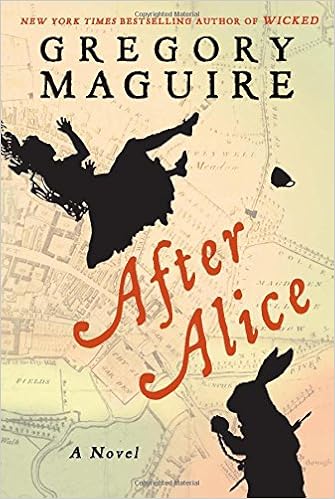
After Alice

by Gregory Maguire


(If you don’t know: Gregory Maguire writes new novels set in classic fantasy worlds — Oz, mostly, but this one is in Lewis Carroll’s Wonderland.)

So the thing with Gregory Maguire seems to be: you have to absolutely love the original.

The man writes an excellent homage. I’ve read Alice in Wonderland and Through the Looking Glass, and the style and feel of this book is remarkably similar. He has the same imaginative twists (though not as many), the same absurdist humor mixed with Victorian understatement, the same satire of upper class manners and fashions, and of everything else that the author can think of. The writer’s voice is an excellent imitation, and I mean that as sincere flattery.

But I don’t love Lewis Carroll. I think the man was brilliant, and what he wrote was a watershed that led to Douglas Adams and Monty Python and Mel Brooks and Christopher Moore, all of whom I love or have loved – honestly, more than Carroll. So while I’m grateful for the existence of an Anglican mathematician with more imagination than either of those descriptors would imply, a whole world of imagination, I’d rather read (or watch) the others than him.

Consequently, I’d rather read them than Gregory Maguire.

I think this book also suffered for being too much outside of Wonderland. I mean, really: that’s the point of Carroll’s books. That’s why they’ve survived and are still beloved enough for Maguire to turn his hand to them. And half of this book by the chapters, and more than half of it by the pages, is set in Oxfordshire in 1861, following around Alice’s and Ada’s families as they search for the missing girls: and though Darwin is present, no time at all is spent with him; all that happens is that his old man’s needs – for help to the privy, to leave early – screw the day up for everyone else. Everyone else is just as annoying: it made me understand completely why Alice would want to follow a white rabbit down a hole, and why the heroine of this book,Alice’s friend Ada, would want to do the same.

If the book was just Ada in Wonderland, maybe finding new places and people rather than just following in Alice’s footsteps, I think I would have liked it more. But the Wonderland stuff was less about imagination and more about following a path, and that made it less interesting than the original. As I said, if I dearly, deeply loved the original, I’d probably like this book just for the sake of going back there again; but I didn’t love the original, and so I didn’t really like this book.

Well done, just not interesting.

On the Second Day of Christmas, Just Dusty Blogged for Me:

Top Ten Ways to Enjoy the Holidays


Before I begin the actual countdown, here are a few rules about my Top Ten lists. First, they are not in order. #10 is not the least, and #1 is not the most. #1 is not first, and #10 is not last. Second, they will not always be ten items long: I always try for ten, because it feels nice to hit the mark; but I am also obstinate and mischievous, far more than I am traditional and organized, so nine is certainly possible and eleven is likely.

Third, and most important: people determined to take these lists to heart do not have to accept the whole thing. The reason for itemized lists is that the items are not all required to accomplish the goal. If every item were required, this wouldn’t be a list, it would be a full essay, everything linked together and with an end result that is greater (hopefully) than the sum of its parts. But a list is only its parts.

So if you like what I say here, take one thing away with you. Or two, or three. Not all ten.

Especially not if there are only nine.

#1: Jolabokaflod.

This is also #8.

Here’s a lovely article on a lovely idea.

This year, Toni and I tried to do this Jolabokaflod thing (The above article has a link to the pronunciation, but it is pronounced pretty much like it looks. All of the o’s are long, so the word rhymes with the phrase, “Joel, a bloke, a toad.”), the Icelandic tradition where they give gifts of books on Christmas Eve. We went out and bought them on Christmas Eve, which was actually pretty fun; Barnes and Noble wasn’t absurdly crowded, and I enjoyed seeing that many people in a bookstore buying books. I liked buying a book for her, and I loved seeing the book she bought for me. I should have bought her a better book: I bought the one that was a gimme, a Stephen King novel – we both love Stephen King – but she had already bought me the same book for Christmas. She actually took her time and looked around for a book I would like but had never heard of; she found a collection of essays called How to Ruin Everything. I’m going to go back and exchange the one I got for something else. And in future – because this thing will happen again; it was too good not to keep doing – I will buy these books the way the Icelanders (Icelandish? Icelandiks? Icees?) do: I will look around in the months leading up to Christmas and find something she’ll like. And I’m going to enjoy giving her that one, too. I may try to wrap it.

Speaking of wrapping:

#2: Wrap presents however you want.

I wrap presents like the proverbial mutant T-Rex. I usually struggle with it, and try to make my presents as, well, presentable as possible; my father is a perfect wrapper, and Toni, of course, is a deft and capable wrapper, and so I feel the need to live up to their standards. I can’t. It usually frustrates the crap out of me when I realize that I cut the paper at a bad angle, or just a little too small, or that my corners aren’t crisp. And why is it that every time I fold up the ends, I get a bubble along the center seam? Why can’t the paper just lay flat?

So this year, I said screw it, and I embraced my crappy wrapping.

This slideshow requires JavaScript.

It was both relaxing and fun. I mean, the point is to hide the present until the person is ready to enjoy each one, right? I understand the beauty of a finely-wrapped and beribboned present; but when that isn’t an option, why worry about it? Focus on what matters: the actual present. Oh no – I mean the thought. It’s the thought that counts.

Speaking of thoughts:

#3: Do something nice

Do something nice for someone you love. Then do something nice for someone you do not know. They can be things you do all the time. The person you love and do something nice for can be yourself. They can be holiday-themed, like putting money into the Salvation Army bell-ringers’ cans, or not, like donating blood to the Red Cross, which I will be doing this week or next.

Don’t overthink it. If you feel like the nice thing you’ve done isn’t quite nice enough, then do two things. Don’t do something so nice you regret the sacrifice you have to make. But do something nice.

#4: Listen to whatever the hell you want.

The Christmas music station here in Tucson really sucks. It’s terrible: they play two songs and then a pile of commercials; in the evening, when I’m in the mood for music, they have the most obnoxious sap-tastic hostess, who is constantly pulling that “Let’s hear everyone’s warmest wishes for the season,” and then taking calls from people who are grateful they got to have Christmas with their Aunt Buffina before she passed from the rheumatic cancer of the diverticulitis but at least they got to pray together one last time, and I just want to hear Blue Christmas, dammit.

But you know what I found this year? Hamilton. That is a badass musical. And the soundtrack is on Amazon Prime. (Want to know an excellent gift? A year of Amazon Prime. Don’t give me any shit about feeding the corporate monster: I buy local books, too. And Amazon Prime comes with free streaming, free shipping, a free E-book every month, and a streaming music player that lets you listen to albums without buying them. It is an outstanding service.) So this year, it’s been a very Hamilton Christmas for me. And I’ve been singing along, and enjoying it. I like that it has an uplifting element, and also a melancholy element, and that it is oustandingly, outlandishly cheesy.

And yes, I’m aware that I both celebrate the cheese in a musical about the Founding Fathers, and deride the cheese in the evening heart-warming radio call-in show. Everyone has their preferred cheese. Mine comes with speed-rapping about the Marquis de Lafayette.

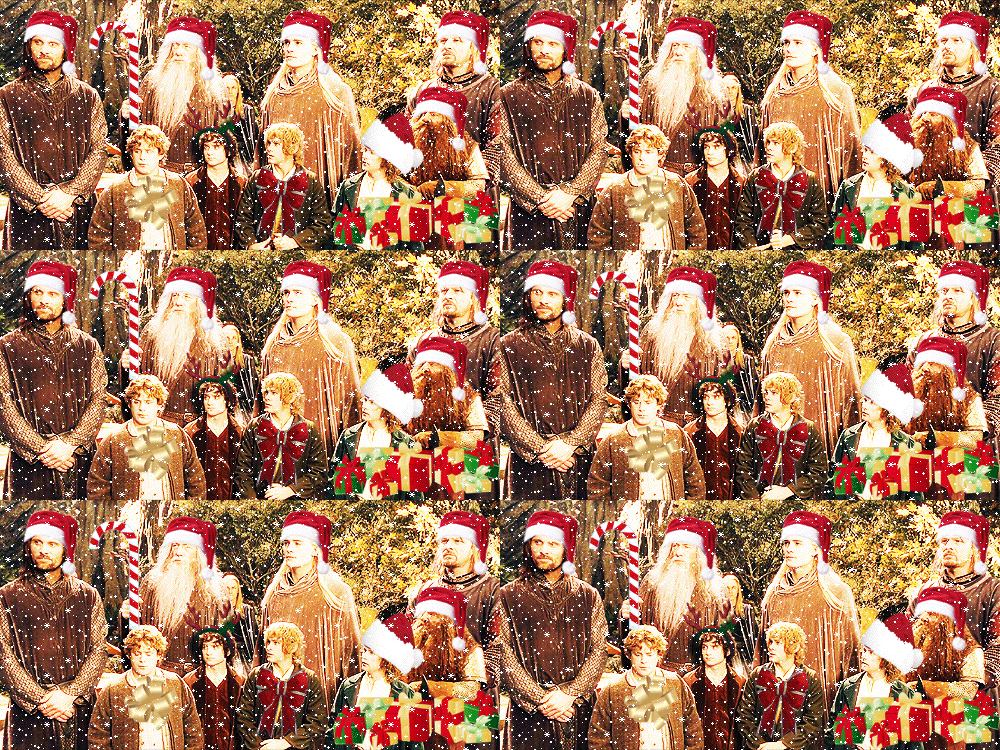
Along with that: if you are a fan of Christmas movies, then go right ahead and watch It’s a Wonderful Life, or A Christmas Story. But if you are not, watch something else that you love but haven’t seen for a while. This year Toni and I will be watching both the Lord of the Rings extended editions and the Pirates of the Caribbean series. Because nothing says Christmas like pirates and Nazgul.

Hold on: imagine a Christmas-themed installment in either of those franchises. Hoo boy, there’s an image. Who plays Santa, Gimli, or Gandalf? Or maybe Elrond – Santa is called a jolly old Elf.

Speaking of weird Christmas mixtures:

#5: Eggnog Latte

The holidays should be a time for doing what makes us happy. The things I like about Christmas are enjoyable mainly because they aren’t things I do all the time. Like eggnog. I love eggnog. I would crawl a mile, over gravel and rusty nails, for a glass of good eggnog. But after a few quarts – okay, gallons – of eggnog, I get tired of it. Luckily: it goes away. And then when it comes back, I’m excited for it. And the best eggnog moment in the holiday season is when Starbucks brings back their Eggnog Latte. I can’t tell you how gorgeous it is to have a latte made with eggnog. If you are a fan of eggnog and of coffee, go get one, right now.

If you are not a fan of eggnog, that’s fine; turn this one into whatever treat you do love around the holidays. Sugar cookies, candy canes, fudge, roast turkey with all the trimmings, whatever. Eat it. Enjoy it. If you want to combine this with #3, do what my perfect wife did: bring someone an eggnog latte (or a roast turkey) while they are at work. A visit from a friend bearing goodies? Who wouldn’t love that?

#6: Whatever you do, no New Year’s Resolutions.

This may be a pet peeve of mine, but it’s also the truth. New Year’s Day is an invented holiday. It is not meaningful. (Well, this year it may be a little meaningful, because it will finally be the death of 2016. Hasta la vista, baby. Yippee-ki-yay, motherfucker.) There is no particular reason to think of the first day of January as the beginning of the year: it has utterly no significance in the solar calendar, it is not the anniversary of a momentous occasion in history; it is the day we arbitrarily decided was first. It’s like someone having eight kids and deciding the third from the last is Kid #1. It makes no sense. And because it makes no sense, any feeling of renewal or a fresh start is entirely fabricated. Now, that isn’t a bad thing: I think it is good to decide that this day, this hour, is where it begins, whatever it is; but the only power in that is the act of deciding. And part of that is deciding that it is exactly, precisely, now. So I think when we base that decision on someone else’s arbitrary choice of starting point, it has only as much power as we think other people have over us – which, when it comes to breaking old habits or starting new ones, is not very freaking much. I did manage to quit smoking, almost exactly nine years ago – and I started on December 28th. Because I knew I was going to quit; why wait three more days and do it when the calendar says I should?

So: resolutions are fine and good. I have several myself, including blogging more regularly and getting back to the gym. But I’ll start them whenever I decide to. I recommend the same for everyone else.

#7: Decorate. But do it your way.

We all want to feather our nests, want to make the place where we spend the most time as comfortable and attractive as possible. So do it. The holidays offer a unique opportunity, because I think Christmas lights are beautiful. One of my favorite things is trying out new ways to hang the lights. Try new designs, new colors, hang them in different patterns or in different places, inside and outside. Along with that, the tree indoors is a splendid thing. Try for a living tree, maybe; the smell of pine is available through a wreath or cut branches, and living trees are often cheaper and reusable. While you’re at it, buy some knick-knacks that make you laugh; we have a Chris-Moose that always makes me smile. And a pair of holiday toads that hang on a doorknob that makes me laugh.

Now: if you have too many knick-knacks already, maybe the way you should decorate is by getting rid of them. At least some of them. Empty out one box, or one room – and I mean give them away or throw them out – and then thin the others to fill it back up again. But first, try sitting in a room with no knick-knacks at all; see how it feels. Whatever you do, if you have or want knick-knacks, don’t tell other people about it. If you tell people that you enjoy ceramic narwhals, you will never get anything else for birthdays or Christmas, and your house will look like a narwhal knick-knack museum within three years. Come look at my mother-in-law’s frog collection and you’ll see what I mean.

Along the same lines: a lovely way to decorate is to clean. Or to organize. Or both. Don’t try to do the whole house; pick one task that matters but is rarely or never done, and do it. Make it an accomplishment.

#8: Wear good socks.

New socks. Comfortable socks: ones that are the right size, that aren’t too stretched out to hold to your ankles and calves, but aren’t so tight they leave red lines on your skin. If you don’t have good socks: buy some. Don’t hold onto old socks. Don’t skimp on cheap socks. Nothing feels better than good socks. You want both thin and thick varieties to go with the weather, and if you can find ones that you think are funny or pretty, all the better. But wear them. And throw out the old ones.

I don’t know if these are comfy, but they’re awesome.

#9: Change razor blades

Similar to the socks, but this one is even more important. Don’t cut yourself on Christmas. Use new blades. If they feel too expensive, then get a safety-razor; the blades are cheap and the handle isn’t disposable, so you’re adding little to the landfills – and no plastic. But if you like a nine-bladed cartridge, great, use that. Use a fresh one. Have a good shave.

Mine’s about a 1950.

#10: Go out and take a walk.

One of the loveliest things about the holidays is that, on the actual day itself, Thanksgiving Day, Christmas Day, New Year’s Day, most people stay inside, stay home, don’t work. That means the world is quiet. Go out and take a walk in it. Go someplace that is normally busy and crowded and chaotic, and enjoy the peace and quiet. Move your feet, breathe the air, listen to the silence. Take someone with you if they can be quiet while they walk. Don’t listen to music: listen to the world. It’s a nice place.

I got sunshine, here in Tucson; but even on a cloudy day, a quiet walk is lovely.

#11: Ask yourself why you don’t do these things every day.

On The First Day of Christmas, Dusty Blogged For Me . . .

Merry Christmas!

(I really like this one, too: )

No, really: Merry Christmas. And Happy Hanukkah. And Heri za Kwanzaa. And a joyous Milad un Nabi. And a blessed Solstice. Happy Holidays to everyone, for whatever reason you have to celebrate. (A special happy birthday to people born around the holiday season, since you normally get left in the cold. You rule the Yule.)

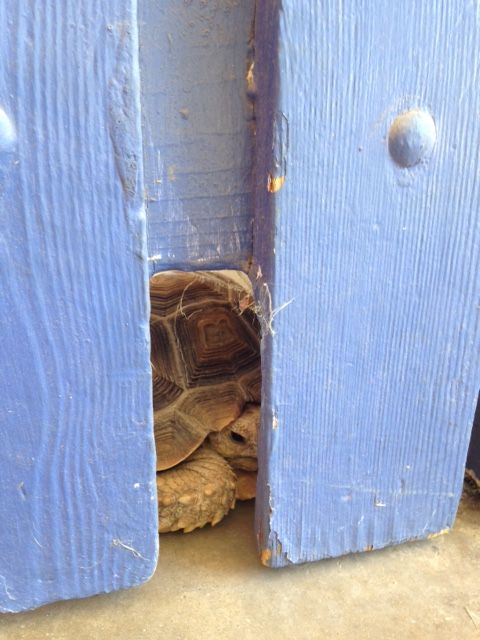
I’m saying this because I had trouble finding a reason to celebrate this year. No, that’s not true: I have a dozen reasons to celebrate; but none of them are related to Christmas. (My reasons: my wife, my dog, my bird, my tortoise; my family and friends; my house, my books, my favorite things; my health and the continued existence of this reality and this planet and this country; art and words and truth and beauty. Oh – and coffee. Always coffee.) So I had trouble getting into the holiday spirit this year. I didn’t want to sing along with the Christmas carols; I didn’t help decorate the tree; I didn’t wrap presents until Christmas Eve. I wore my holiday stuff and I put up lights on the outside of the house, but it didn’t really excite me. I wasn’t feeling it.

A little bit of that is that Christmas is not a particularly beloved holiday for my wife Toni, and so walking around belting out “Walking in a Winter Wonderland” is not the joyeaux occasion around here that it might be in other homes. But even if she was Santa’s favorite elf (Back off, Kringle – she’s mine), I wouldn’t have felt much like doing that.

Because it’s 2016. And John Glenn just died. And Trump will be president in less than a month. And civilians are being killed in Aleppo.

And for me personally, it’s been hard because I had school up until the 22nd, and was still fiercely grading and doing schoolwork on the 23rd, when grades were due. It’s hard to feel Christmas-y when you’re reading bad essays. It’s not much easier when you’re reading good essays, when you have to grade those essays.

Here’s my Christmas wish: I wish that I was permitted to write, on the papers of students who clearly didn’t read Fahrenheit 451 with the class but still write on the test that Bradbury’s dystopia won’t come to pass because people in our society still read, “You stink of lies.” Or maybe, “It’ll be your fault when it happens.”

See? Feelings like that have no place in Christmas.

But you know what I realized? They kinda do.

I’m not a religious man. I don’t actually care about the birth of Christ. Oh, I have no problem with it: Jesus was a good dude, as I understand it; he’s in a couple of my favorite books (Lamb and Kevin Hearne’s Iron Druid series – though his big one is not one of my favorites. Never read that. I hate it when they number paragraphs. Feels like a reading comprehension test.), and I like what I know about what he had to say. But it doesn’t put rum in my eggnog, if you follow me. Nor does the birth of the Prophet Mohammed matter to me, nor the miracle of the lamp, nor the longest night and the shortest day of the year. Though that last one is pretty cool. And I do like the idea behind Kwanzaa, namely community and cultural celebrations. But it’s pretty generic for me, not being African-American: my culture has never been threatened, other than by our own cynicism and sarcasm. And our exceptionalism and arrogance. And by – but we’re not talking about America here, we’re talking about the holidays. The holidays – including New Year’s, by the by, which annoys me much more than it pleases me – are not terribly meaningful occasions for me.

So the only thing the holidays really mean to me is: there is stuff in there that I like. More than anything, I like my vacation. So very, very much. I actually finished a book yesterday, for the first time in more than a month. Me. I haven’t been reading books. What does that say about my job? My time management? My choices in life?

No: we’re not talking about that crap, either. We’re talking about things I like about the holidays. I like singing along with the songs. I like knowing all the words. I like decorating my house, especially with lights. My neighborhood is very dark – no streetlights – and the Christmas lights really shine. I actually really like having a tree inside. I love giving presents, and I like sending greeting cards, though I’d rather be more selective and intentional with it (And I’m annoyed that all of my relatives sent my Christmas cards to the wrong address.), because sending a card with a canned comment about the holidays doesn’t make me happy; I’d rather send cards that I know people will like, with thoughts inside about that person, just because that person will like the card and I might have been thinking about them; whether it’s actually a holiday card or not is pretty irrelevant. I would like it more if it wasn’t, actually; if the person and the card were the only occasion necessary for the sending. I like wearing goofy holiday-themed clothes, though I kind of always wear goofy themed clothes, because I don’t really own any t-shirts that aren’t printed with either a pop culture reference, a bad pun, or something about books and reading and imagination.

Do you see what I see?

Here it is.

It doesn’t matter that it’s Christmas. I mean, Merry Christmas, especially if that is a day of great meaning and symbolism for you; but you know what? Happy December 26th, too. And March 9th: my very best wishes for that day. Oh – and the eleventh of June. That’s a good date. The 21st, too; of every month. It doesn’t matter that today is Christmas because it doesn’t matter what day it is. What matters is that this is a time of year when we stop our usual grind and do things that make us happy. People who love seeing their families make time to do it around now. We give presents, and cards, and wish people well. We actually use the mail, and get excited about things arriving in the box. We decorate, especially with bright colors and lights. We take vacations: we take time off from work and do things that we like to do, like bake, and sing, and watch favorite movies.

My God, we need those things more in our lives. Especially because it’s still 2016, and Carrie Fisher had a heart attack, and there’s a typhoon hitting the Philippines. And Trump’s going to be president in less than a month.

There’s an important thing that I have to say. Are you listening? Okay, here it is: I wish people happiness because happiness is good. But sadness is good, too. (I know this because I paid attention when I read Fahrenheit 451. You bunch of tools. My students are the tools, not people who are reading this. If you’re reading this, then you rock. You really are the reason we will hopefully avoid Bradbury’s dystopia, where the books are banned and the people don’t care.) Sadness is important. And not just because you need to feel sadness in order to understand happiness; I suppose that’s true, but I can’t say that I have any experience with being happy without being sad, so who knows? No: sadness is important because sadness is a genuine human emotion. When you are feeling sad, then that’s you, and that’s you feeling. Those are important. You have to be yourself. You have to feel. You have to experience all of your feelings, even the dark ones.

Christmas is a time of sadness. First just because it’s winter, and it’s cold, and it’s dark. Sometimes because we can’t do the things we want to do, because of job or money or circumstance. Sometimes because it reminds us of people who are gone. That last is a genuine feeling, and an important one. Don’t belittle grief just because everyone around you is wearing a light-up tie. It may be difficult to live with sorrow in the face of so much ostentatious cheer, but it’s better to do it than try to ignore what you feel or block it out. And your sorrow is not wrong, nor is it less important than someone else’s joy.

Here’s another reason why Christmas makes people sad: because of Christmas traditions. Because traditions become obligations, and then when we don’t keep them, we feel like we have failed. That’s why people risk their lives to drive through blizzards to be in a specific place on a specific day; because that’s their tradition. People put themselves deep into debt, and then spend the rest of the year fretting about it; because that’s their tradition. People whose traditions include things that are gone, and people that are gone, get to both grieve and feel like failures.

Bullshit. Traditions should only be maintained if it pleases you to do so. If it doesn’t, make up new traditions. Or screw tradition: do whatever the hell you want. That’s what the holiday spirit should be about: do whatever the hell you want, just because it makes you genuinely happy. Start with being nice to people. Every year, we all see the news stories about someone getting robbed, or mugged, or assaulted, and we all say, “You shouldn’t do that to someone during Christmas.” And then we all think, and maybe say, “Well, really, you shouldn’t do that to someone any time.” That’s right. The holiday season should be a time when we think about, and act with, kindness and generosity, more than any particular religious observance; and every day should be the same.

Because it doesn’t matter that it’s Christmas. A day for giving and for cherishing those that you love can be – should be – any day. Every day. And if today is a day when you feel sad, do that. Feel it. Go through it. And then make some cookies, and read a book, or call someone you haven’t talked to in a while. Feel better for having felt bad.

Have a happy today, everyone. I wish you all the very best.

And the same again, tomorrow.

Yeeeaaaahhhh, sorry about that.

I would like to apologize for my disappearing act. Main cause was NaNoWriMo, which I did manage to complete, but which took all of my writing time and much of my other time in the process. And even though it ended four weeks ago, I still haven’t had much time for words, because I’ve had to grade everything my students have written. Which is, it turns out, quite a lot. I haven’t even been reading — only finished two books in the last month or more.

But this will all end. This isn’t even a post, just a notification to anyone who follows the blog and actually reads what I write. I plan to complete Twelve Days of Blogging for Christmas, starting on the 25th and going through the 6th of January (Which is actually 13 days, but this isn’t the time to get into that.), and then after that, I hope to continue blogging several times a week, if not every single day. I have ideas for themed posts and categories and things, and though I’m sure some of them won’t work out, I think many of them will, and there should be more content on this blog worth looking at.

I also plan to finish my NaNoWriMo novel, which is a sequel to an already-finished novel, and then I will be publishing both. And advertising, on this blog and anywhere else I can.

So if you do like my writing, hang on: in six days, you’ll get plenty. And maybe next year, you’d like to buy a book full of my writing. I hope you will.


Thanks for sticking with me this far.


–Dusty

Never Stop! Never Stop Fighting Until the Fight Is Done!

Hey. HEY!

Stop being sad. Stop it.

I know: I feel the same way. This was not the result I was expecting. I was growing more and more stunned all last night as I watched  the results come in, and in, and in. I watched the commentators on CNN and then on BBC being just as stunned.

We didn’t think this was possible. We didn’t think this was our country.

It was possible. It happened.

And this is still our country.

It is not The Donald’s country. He did not win us. I know he thinks he did, and at some point today I’m going to have to watch a victory speech from that smug  asshole that is likely to make me vomit. He is going to have to start lying —

Wait. I honestly can’t believe I actually wrote that.

His lies, ongoing and ever more egregious, will now focus on trying to convince people he hates that he doesn’t hate them, right before he begins working to enact policy to prove that he hates them. The hypocrisy, and the assurance of our gullibility, will be infuriating. I’m already annoyed that my Republican friends are crowing over the victory. And I know I’m going to be mad a lot over the next four years, at least.

But this is still my country. And like it or not, that rotten son of a bastard is going to be my president.

My wife says he’ll never be her President. She said she may not be able to stand for the Pledge of Allegiance for the next four years.

Good.

We all know exactly what happened: millions of people looked at their options, and chose what was, to them, the lesser of two evils. Millions more of us think they chose wrong. And millions of us are racists, and sexists, and xenophobic bigots who want walls built, refugees interned, and immigrants deported.

Not everyone who voted for him. Not everyone. Millions, yes. But not everyone.

The thing that makes this worse is that we didn’t expect it. We didn’t realize this was coming. Neither did the media. This should tell us something: the discussions I have  seen of late that say that our world is turning into an echo chamber, where we only hear what we want to hear, where we only communicate with people who agree with us  and share our views, are correct. If you settled the election based on my  own Facebook feed, then Bernie Sanders would be president. If not Cthulhu.

This,  then, is our task. Tasks. There are several.

First, we have to start listening to each other. Even to people we disagree with. We have to be better than the hypocrite that just got elected, who will ignore the needs of millions of people who were not in the demographics who supported him, whom he campaigned against. We have to understand that there are millions of people who thought Donald Trump was the lesser of two (or four) evils. Millions. Those people must be heard, because the biggest reason that they voted for Trump was, I think, that they believe they have not been heard.

So listen. Take them seriously. They are people, and they are important. Not the racists and sexists and xenophobes: fuck them. But listen to the millions of rational, genuine people who believed Trump was the best choice, or at least the least-bad.

Second, we have to fix this government. Millions who voted for Trump, and millions who voted for third party candidates, and many, many millions who did not vote, believe our government is broken. It is. We have to fix it, because Trump won’t. He will take advantage of the breaks to break it more — for one thing, he’s going to nominate a hard-right pro-life conservative to the Supreme Court, and then perhaps another, since the liberal justices are aged and unwell. That means all three branches of government will be Republican, behind Donald Trump. So we must work. We must be vigilant. We must read the news — unbiased sources, if we can find them, because if the surprise on the newsmen’s faces last night says anything, it says that the liberal media bias has some validity, that the news channels, too, are become something of an echo chamber — and we must speak out, and we must organize, and we must march, and we. Must. Vote. 59,000,000 some odd votes  for Clinton, 58,000,000 some odd votes for Trump. 330 million people in the country. 219 million eligible voters.

This is broken. We must fix it. We can fix it.

Last,we have to deal with the worst part of this. Millions of Americans are sexist and racist and bigoted xenophobes. We have, it seems, spent too long considering them anachronisms and harmless cranks, and sweeping them under the rug. We pushed them out of the echo chamber. And then they found a  candidate who was just racist enough, but not too racist — “He was talking about illegal immigrants, not Latinos! He meant Syrian refugees that might be terrorists, not all Muslims!” — and sexist enough, but not too sexist — “He was just talking. He wouldn’t actually sexually assault anyone! He’s got a beautiful wife! He hires women!” — that millions of other people could stand to vote for him.

Remember that. Not everyone who voted for Trump is racist or sexist.

But there are millions who are. And we must deal with them. Not simply demonize and push them away: deal with them. Educate them. Argue with them. Fight them, if necessary: but we cannot continue to ignore them.


We can do this. We can. I mean it. We were hoping that Hillary Clinton and the Democratic party could save us, and they failed. They failed. Not us. Not those of us who voted for her, and not those of us who were too disillusioned to vote for her. We did not fail.

The only way to fail is to give up trying.

So don’t give up. Fight. Fight for the country you want, and you believe we can have. Be active: learn, and speak, and act, donate, protest, canvass, join a third party and run for political office. Always oppose Trump’s plans, if he ever actually makes any real ones. Listen to the people who voted for him, who aren’t terrible people. Fix our government. Fight the evil that has reared its head all the way into the White House: the evil of racism and sexism and bigotry.

Do something. Don’t be sad: be determined.

We  can do this.

Weird Al-lection

I think we’ve probably all (And by “all” I mean the very small percentage of people who actually listen to Weird Al, filtered through the even smaller percentage of people who are still willing to think about the election) seen Weird Al Yankovic’s song about the debates. If not, here it is:


This is, of course, excellent. But I am prejudiced: not only can I talk about politics forever, but I have been a dedicated Weird Al fan for his entire career: my dad played me “Yoda” when I was about 9, and I bought “Weird Al In 3-D” soon thereafter. I have been a fan of his longer than any other band, any other musician, any other genre. I know pretty much all of his songs, most of them by heart.

So perhaps it should come as no surprise that as I listened to this, I realized that it wasn’t the only Weird Al song that was appropriate for this election.

In fact, Weird Al has created the theme song for the whole thing. I mean, all of it. Every candidate — and for some of them, two or three.

So, in honor of a man I do honestly consider a musical genius, who can do anything at all, from reggae to heavy metal to rap to country, and in hopes of adding a wee bit of levity to our long national nightmare (Which will end soon! Only a week! Don’t forget to vote!), I hereby present The Weird Al-lection.


Starting with the Republicans:

Governor Jeb Bush: For the third Bush to run for President, who based all of his policies on “Well my brother did this, so I think it’s a good idea,” and his appeal on, “Hey, aren’t a lot of you folks white men? So am I!” This is the only song:


Dr. Ben Carson: Sometimes it’s too obvious. Though I like how absurd the lyrics are, and if you imagine this parody of a surgeon actually doing this job on you, that’s pretty much how I feel about Carson being president.


Governor Chris Christie: Now, this seems like a cheap shot; but actually, the connection to the New Jersey governor is more about the attitude in these lyrics: “Just watch your mouth, or I’ll sit on you.//If you see me comin’ your way, better give me plenty space; If I tell you that I’m hungry, then won’t you feed my face!”


Senator Ted Cruz: This one bothers me because this is one of my favorite songs, and Cruz is one of my least favorite organisms. But it’s perfect.


Carly Fiorina: 1. It’s about computers, like Ms. Fiorina; 2. it’s a parody of a song about money, also like Ms. Fiorina; 3. While the song is a good parody, it is vastly annoying. Like Ms. Fiorina.


Governor Mike Huckabee: I know he wasn’t in the race long, but Governor Huckabee’s mixture of devout Christianity and political incompetence makes me think this would be the result of his election. Rick Santorum can share this song.


Governor John Kasich: Since his pitch seemed to be, “Well, you can’t vote for Jeb Bush any more, so how’s about me? I can swing Ohio!” he gets this:


Senator Rand Paul: My impressions of Senator Paul: he is a strange derivative version of his father. He is frequently angry for very little reason. He is extremely white. There are actually some things about him that I like, but overall, I can’t stand the guy. Which is how I feel about polka. I’m sorry, Mr. Yankovic; I find them amusing when you do them, but — it’s just such a terrible musical form!

For Senator Paul: The Angry White Boy Polka.


Governor Rick Perry: For the man who can’t count to three:


Senator Marco Rubio: Again, this seems like a cheap shot — and a racist one, at that — but I thought this fit because Senator Rubio tried to take advantage of his heritage while also trying to appeal to all the honkies in the GOP; that reminds me of someone who speaks only food Spanish. Hence this song. Plus the original is all about trying to be smooth, which Rubio tries but can’t pull off; and the singer, Gerardo, is only appealing on the surface. Like Rubio.


Governor Scott Walker: The man is nothing but a front for corporations. He is an empty suit stuffed with dark money. So, he gets to have another of my favorite Al songs — one that says a lot about our culture, while saying nothing at all. Like Governor Walker.

(I’m adding a second song because Gov. Walker’s treatment of teachers in Wisconsin makes him pretty much The Most Hated Man On My List. Other than the Big T, that is.)

(By the way: if you’ve never seen this first video, it is brilliant, as is the song, if you’ve ever worked in a corporate environment.)


Finally, in honor of the forgotten candidates, Lindsey Graham, Bobby Jindal, Jim Gilmore, and George Pataki, none of whom anyone can remember, because nobody cared about their incredibly short runs for the Big Chair, I present my favorite completely absurd Weird Al songs. Because these people, like these songs, make no sense whatsoever.

(The video for this one also makes no sense.)


Now we finally get to the Dems.


Governor Lincoln Chafee: The guy’s so cool. And so utterly not.


Governor Martin O’Malley: You know, I don’t have much to say about Governor O’Malley. He seems like a pretty reasonable centrist Democratic candidate. I think this just wasn’t his year. Maybe that means it won’t ever be his year. So, he gets this one:


Senator Bernie Sanders: Such a mensch. Just listen to the first ten seconds, and you’ll see why this song. But the rest of it fits, too.


Senator Jim Webb: Senator Webb strikes me as being pretty much the guy who yells at kids to get off his lawn, if his lawn was a national debate stage.


Now for the big ones: those actual nominees who will be getting our votes in a few days. Please understand this post is not intended to endorse any particular candidate; please vote your conscience, wherever that leads you. Just please vote.

Don’t vote for Trump.


Dr. Jill Stein: I particularly like this one, because Dr.  Stein seems reasonable and logical and appealing at first — but the longer you listen to her, the less rational she seems. Let’s just cancel college debt? Anti-vaxxers have a point? Here you go, Doctor:


Governor Gary Johnson:  Mr. “What’s Aleppo?” gets two, one just because he was the governor of New Mexico.


Hillary Clinton: First, for all the promises she’s made, particularly the ones she’s made in exchange for a check:

And then, just because one song about mail is not enough for Hillary Clinton (Best thing about this is that the gist of this song is that people keep sending the same crap around the internet, and that people believe complete bullshit without any evidence. Perfect.):


Donald Trump: This is the way Mr. Trump actually lives. No exaggeration. It’s beautiful. Bigly beautiful.

And this is how we all feel about him.


The Not-So-Great Pyramid

I need to be delicate with this one.

I have a thing I want to talk about, and I intend to be critical of that thing. But there are people involved, people I know (at least tangentially) and I don’t want to criticize them. Well, I do, but not terribly harshly; they are a product of our society. It’s our society I want to talk about. But there may be some people caught in the crossfire.

But then, I doubt they read my blog. So let’s just have at it.

I have recently had several encounters with pyramid schemes. Mostly through Facebook and Twitter posts, comments from the sorts of friends I feel I need to qualify as Facebook friends — my wife’s cousin, people associated with people I know but who have never met myself, or those I have met but am not necessarily friendly with. And at least one former student whom I would count as a friend even in a non-electronic sense.

I have no doubt there are others that I do not see, either because I do not see their posts, or because they do not post about this when they fall victim to it. I’m sure there are several. Because while pyramid schemes and get-rich-quick scams are as old as money, as old as sloth, as old as impatience — and that’s pretty goddamn old — I think there are more of them, now. I think we are seeing something of a perfect storm of influences and trends in our society that has thrown a great feast before this particular monster’s maw, and it is chuckling while it digs fatly into the mounds of fresh meat, chewing and swallowing and then crapping out greater quantities even than it takes in: because this beast expands, you see, and covers everything it touches with filth.

All right, that’s probably overstating it. But I like the image. I’m picturing a grossly fat Sphinx, its jowls dripping with blood, and it brings its head down and opens wide, and people — like my Facebook friends — just walk right in. And behind it? A Great Pyramid of shit.

Anyway, enough of the metaphors. A pyramid scheme is when a company sells a terrible product of some kind, generally water filters or kitchen knives or vacation condo timeshares, but it employs a particular trick: this company’s major profits do not come from customers; rather the profits come from new employees. Either the new employees need to pay for “training,” or “licensing,” or both; or the new employees need to purchase the goods they then have to resell. Or all of the above. It’s called a pyramid scheme for two reasons (at least it should be two reasons): because the flowchart has to expand with each level — the shmuck who starts the company has to find at least two suckers to pay him, and then they have to turn around and find two new suckers to recoup their losses, because the best way to make a profit at this company is to bring in new hires, and then those four suckers have to find eight, and so on down as far as it can go, and generally speaking, each level profits from all of the levels below it, so even if the guys in Level 3 do manage to get rich quick, they aren’t as rich as the people above them. That’s the first reason, the real reason. The other reason, the should-be-true reason, is because the pyramids were built by slave labor for the narcissistic pleasure of exactly one guy: the Pharaoh. For everyone else involved — and we’re talking tens of thousands of people — the Pyramids were nothing but shit, formed into blocks and stuck together with blood and sweat.

Yeah, there’s an image. Maybe I can use that on the poster for my Self-Actualization seminar.

Pyramid schemes are not illegal because their claims are true: if you can get two new people to come work for the company, you will get a bonus, and you will earn a piece of their income if they make any, just as part of your income gets kicked up to the people who brought you in; and if you spend $500 on crappy products that, in theory, you can sell for $5000, then you will make a tremendous profit. Never mind that the people above you already made their profit, because you spent $500 buying crap that isn’t worth $50. They don’t say that the crap almost certainly won’t sell — who the hell needs a water filter other than the one you have in the fridge already? Who buys a $500 knife set from a traveling salesman when you can buy everything at Costco, or online? — but then, they don’t need to; as long as they aren’t actively lying, they aren’t committing fraud, and if you’re foolish enough to think that paying out $500 to buy water filters that you have to sell door-to-door is a better way to earn money than working for minimum wage, then caveat emptor. Or rather, caveat venditor: let the salesman beware.

No, wait — I was right the first time. These people are buyers. They are consumers. They are at the bottom level of this pyramid of crap, with the weight of all that came before pressing them down into the mud.

But these companies are absurd. They’re absurd: I remember a student back twelve, thirteen years ago got into one of the water filter ones, and tried to sell me; I had bought cookies from students before, and boxes of fruit for the holidays, so I said I’d look at his catalog — but the freaking things started at $300. And needed to be installed. Okay, first, I rent my house, so there’s no way I’m donating a high-quality (I assume from the price. Right? Makes sense, right? Who’d charge that much for a piece of crap?) permanent water filter to my landlord; and secondly, have you not heard of Brita? I never bought anything. But he got a real job at a restaurant, and I tipped him when I ate there; honestly, he probably made more off of that than he would have from the water filter — though I’m sure the level above him was disappointed in both of us.

So why are there so many? Why am I seeing more and more of these?

Partly it’s because we live in a capitalist society. There have always been snake-oil salesmen. There have always been people who take advantage of others. Read Huck Finn and think about the Duke and the King, how they exploit both Huck and Jim, and each other, shamelessly from their first arrival on the raft until they finally get tarred and feathered — and when he sees that final justice, Huck feels sorry for them, and wishes he could help them. So this is nothing new.

But there are new elements. I think part of it is the Great Recession, especially when it was brought about largely by the last string of get-rich-quickers, the home loan industry. Ten, fifteen years ago, these people who now sell products for these companies probably worked for Joe Don Bob’s Big Home Howdy Howdy Mortgage Ranch Yee-Haw! Ltd. Same principle: pay the company for your “training,” and then work on commission, which in theory allows you to get rich, but actually makes those above you rich, and you only make money if you find people even more foolish than you were for taking the job in the first place; in 2004, that was people who believed they could get a home loan for a house they could not in any way afford, because they’d just flip it before the balloon payment came due. And it worked, at first — because there was the next group of suckers looking to get in on the action, and who were willing to buy the flipped houses, because they were going to flip those puppies, too.

Except for one thing: at some point, you run out of suckers. And since each new level is the new base of the pyramid, when the new level isn’t large enough or strong enough, the whole structure collapses. Though I’m not sure how the metaphor works that way: I guess if you imagine the whole pile of shi- I mean stone — being lifted up on thin struts, propped up by sticks and old rebar, so they can slide new stones in underneath before they jack those up along with everything atop them, until finally the jacks fail and it all comes down like the world’s worst game of Jenga — yeah, that works.

So we have an economically depressed society, one in which college is now too expensive for people to want to go at all, even if they know what they want to study and don’t need to get rich quick; one in which traditional sources of employment have almost entirely vanished, and everyone who lost their jobs in the collapse has had to jerry-rig a half-dozen different incomes — they teach an extension class, and sell beaded pillows on Etsy, and do aromatherapy consults, and throw Tupperware lingerie parties, and also, sell some water filters and timeshares (20% off if you buy both!). And since all of those people are college graduates, it makes education seem even less useful, even less worth the cost. Which just makes the problem worse: because that means that there are more and more people without education, so they aren’t perceptive enough to understand why this sweet new deal being offered them is too good to be true, and they can’t find a good job anyway, without a degree — so why not?

Enter the people I know who have bought into these schemes. They are all high school graduates, but none of them are college graduates. (To show that I know college is not a panacea nor always vital for success, one of the people who got hit up to join a pyramid scheme laughed at the whole thing, and he doesn’t have a college degree, either. What he has is a decent paying job he likes, and a clear and perceptive intelligence, so the get-rich-quick spiel bounced right off and slunk away into the gutter to find someone more desperate.) And here is the part that actually makes me angry, and was the impetus for this particular blog: those people, the ones who take these jobs, they work hard at those jobs. Harder than I do at mine, without a doubt — longer hours, certainly. They are proud of this, and their loved ones are proud of them for it. Hell, it’s even turned into memes:


Again, this is nothing new; the country was founded on that Puritan work ethic, which teaches that our role in life is to work, until we die and go to Hell. (Thanks, Puritans! Jesus, why couldn’t we have been founded by Taoists? Or Transcendentalists? Or free love hippies, or something? Why did it have to be freaking Puritans?)

And here’s my problem. If you’re that willing to work hard, if you understand that real effort is the only thing that brings success: THEN WHY THE HELL DIDN’T YOU WORK HARD IN SCHOOL?

Why wouldn’t you put your effort into something that is genuinely valuable, and not just because you make money from it, but in every way that something can be valuable? Education makes you a better person, living a better life, in a better world. Why did you pass that up in favor of cold-calling every phone number on a list to ask strangers if they want to buy your product — a product you don’t even really understand, if it’s, say, a timeshare, and which, I don’t doubt, your involvement with stops at, “You’re interested? Great, let me transfer you to my supervisor, who is actually a trained and licensed real estate broker, because he’s higher up the pyramid; but at least by transferring you, I made five bucks. Just fifty more buyers, and I’ll pay for my training certificate!”

If you’re willing to spend five, ten, twenty years building your business empire, why the hell wouldn’t you start with four years of college — studying, oh, I don’t know, maybe BUSINESS? Or even two years of trade school, so that you can have a good-paying job of some kind while you plan your entrepreneurial masterpiece? Maybe you can even base said magnum opus on something valuable, some genuine skill you acquired, instead of some bullshit like scammy real estate?

Maybe if these people had paid attention when the class read Huck Finn, they’d know that the We-Buy-Homes-Cheap company is the Duke and those water filter people are the King. So why didn’t they read the book?

Because they couldn’t see the value in something that genuinely has it: but they think they see value in a pyramid made of shit. I guess because the pyramid is tall.

There’s also this: our society has always believed that physical labor is harder, and therefore more Puritannically admirable, than mental labor. It isn’t necessarily enviable, because people who don’t have to spend eighteen hours a day digging fence post holes don’t want to switch to doing that, but we have always admired the people who can do it. We admire people who have three full-time jobs, even if their combined income is a fraction of our own. Those people work hard. And God bless ’em for it. Salt of the Earth. At least they’re not taking charity, right, Puritans?

You know, I’ve never had a serious physical labor job, like digging ditches or picking fruit. But I have done physical labor — I was a janitor and maintenance flunky for five years in college — and I have done home improvement type stuff, for hours at a stretch, out in the hot sun. So I understand how brutal physical labor can be.

I’ve also taught high school English for sixteen years, and in the process, I’ve written four novels and several hundred blogs and book reviews. So I understand mental labor, too. And while a full day of hard work in the hot sun leaves me completely drained and empty and torn, like the plastic wrapper after you take it off the Twinkie, that exhaustion is nothing compared to what it feels like to spend eight hours grading essays on June 15th when grades are due at 4pm. That kind of tired is the kind of tired where you don’t get brain-dead, and you don’t want to just sleep for days; you’re so tired you get angry. You don’t want to sleep, you want to punch things, starting with your own brain for getting you into this mess. It’s a whole different kind of tired, because it’s a whole different kind of hard.

So my point is: if we admire laborious hard work so much, why the hell don’t we admire those who put in the genuine effort to study, and really study hard, and learn? Why do we think it’s better to put in eight hours at an office — or in a ditch — than it is to put in eight hours at a library? Imagine how much better off we all would be, if the people who work so hard to sell shit, and pile up shit for their bosses to sit on top of while they, the hard workers, squelch around underneath, suffering and dying while they just keep adding more shit, like Giles Corey in The Crucible calling for “More weight!” if he then put the stones on his own chest until he died — imagine if all of those people who work for these ridiculous goddamn companies (And the biggest pyramid scheme of all, by the way, is the United States military — but that’s a topic for another day) could actually produce their own original ideas. Imagine where we would be then.

If you actually put in the effort to read all of this, that is.

Those of you who have half a dozen water filters in boxes behind your couch? I know you didn’t.

Book Review: Too Many Curses

Too Many Curses
by A. Lee Martinez


This book was a surprise for me. I’ve read three or four by Martinez before, and he writes a pretty good wacky/funny fantasy. I expected this one to be the same.

And there are some elements of wacky/funny fantasy in here: it is the story of an evil wizard, one who spends his long life seeking more power for himself, which he then uses mainly to unleash his cruel vengeance on anyone who irritates him. His victims then live in his castle, transformed into mice, into decapitated animated skeletons, into nothing but an echo.Some of the curses are loony and silly and fun, and so are some of the characters living with those curses — a hero turned into a fruit bat, the wizard’s mother transformed into a clinging ivy plant while his brother occupies a small jar, reduced to nothing but a few body parts floating in goo, a banshee that can only materialize to give dire warnings, so she stretches the meaning of the word “dire” in order to materialize as often as possible, whereupon she moans hideously, “Yooooouuu’ll stub your TOOOOOOEEEEEE!” And so on.

But the main character is the very opposite of wacky. She is serious, and she is a genuinely good protagonist — both for the story, and as a person. Nessy the Kobold takes care of the evil wizard’s castle; that is her task, and she does it well. When things go wrong with the wizard, it is up to her to take care of things, simply because there is nobody else who can. Fortunately, Nessy is good at taking care of things, and she does the best she can with her limited abilities.

It’s a good story. There are some nice twists. I was a little disappointed with the revelation of what’s behind The Door That Must Not Be Opened, but the secret of the castle itself, and of Tiama the Scarred, and the final fate of the wizards in the story, was most satisfying. I loved Sir Thedeus (He’s the fruit bat), and the monster under Nessy’s bed who just wants her to read him stories every night. And I really did love Nessy, both as a character and as a protagonist; I agree with the message she presents to the reader, which is basically the same message from Tolkien’s Lord of the Rings: heroes may be small, but it is the small, good things that we do which make all the difference in the world.

Good book. Recommended.

Book Review: The Martian

The Martian

The Martian by Andy Weir

This was a fun book. A hell of a lot of fun. This is fairly unique because it’s quite definitely hard science fiction: set in the near future where we have made more advanced spacecraft, but nothing outside of our abilities, and used them to start a manned exploration program to Mars, this is the story of an astronaut who gets left behind accidentally. There is a storm on the surface of Mars, and he is hit by falling debris when the storm blows over parts of the mission’s base camp; his heart monitor is destroyed and he is thrown far out into the dust storm, so the rest of his crew think he is dead; they look for him, but have to leave in a hurry before the storm destroys their liftoff craft and strands them all on the surface to die.

So this guy, who happens to be the mission’s botanist and mechanical engineer, is not in fact killed, and he wakes up to realize they have left him behind. The book is then his attempts first to survive, and then to contact Earth so they can help him survive, until the next Mars mission lands in three years or so.

I know, I know, most people have seen the movie with Matt Damon; I haven’t, so the book was brand new for me, and therefore very exciting. I am normally not excited by hard science fiction, by talk about machines and rockets and physics and acceleration and mass and interstellar travel and such; but I have also found that most authors of hard science fiction tend to lean on science more than on storytelling or character development. (There are hundreds of sci-fi authors I have not read, so I’m sure there are plenty that do it well. No offense meant.)

Andy Weir doesn’t do that, however. He does have some very hard science: he is himself an astrophysicist who has worked for the space program; there are several characters who focus quite a bit on the math and the physics and the probabilities. But the main character is a joker, who doesn’t take anything too seriously; clearly it is something that is necessary to help him survive the ordeal — just the thought that he has been left behind on an alien planet, where he will have to be alone for years, without enough food or water or the means to save himself, would be enough to break anyone but an eternal optimist, so it makes sense that he is exactly that — and it makes his narration so much more fun to read than most sci-fi characters that I’ve hit upon. And though there are more serious scientist-characters at NASA, and some of them do take themselves too seriously, the book does not; it shows disagreements that lead up to insults sometimes, and several of the characters are described — often by themselves — as being bad with people. It makes them more human, and the science more palatable.

The last factor that made this interesting is the theme: it isn’t about the need for space exploration, or the value of science, or the future of mankind in the universe; all those things come up, but really, the book is about this: what is the value of one human life? If you could save a life, what would you do, what would you spend, what would you give up to do it? That is an interesting question, and this book provides an interesting answer. I hope it’s the same one that all of us would give.

Highly recommended. Dunno if it’s better than the movie, but it’s a damn good book.

The Soul of an Octopus: Book Review

The Soul of an Octopus
by Sy Montgomery
I got this one for my wife, for two reasons: first because we both read and loved Montgomery’s book The Good Good Pig, and second because she loves octopuses. (By the way: Montgomery makes this clear in the first pages, that the correct plural is not “octopi;” the word “octopus” is from the Greek, which doesn’t pluralize -us ending words with -i. That’s a Latin plural. The correct English plural is octopuses. The correct Greek plural, used only by painfully awkward British nerds, is “octopodes.” But we’re not talking about that. Watch this if you want more word-nerdery.) How much does she love octopuses? You tell me.

(Oh yeah — she also likes doll heads. This book isn’t about that, though.)
So I got her the book, she read it, loved it. And I put it on my To Be Read shelf so I could read it, too. And now I have. And here’s what I found out:

I don’t love octopuses.

I don’t know why. I have something of a fear of the ocean, as I am afraid of drowning; I didn’t much like reading about the octopus’s strength, how one could easily pull a human into its tank, how one two-inch sucker could lift and hold 20 pounds or so, and the average octopus has about 1600 suckers. I admit I don’t really like slime, and there is quite a bit of slime involved with octopuses. I don’t much like the idea of being tasted, and the octopus’s entire skin is a sensitive tasting/smelling organ. So there was quite a bit of creepiness in the book for me, which tended to reduce the enchantment of it, an enchantment that is obviously shared by my wife, and by the author, and by the other people who go through this octopus journey with Montgomery, mostly biologists and volunteers at the New England Aquarium, where Montgomery met and made friends with several octopuses over several years.

Now: I do find cephalopods fascinating. I am amazed by their intelligence and by their multifarious abilities — octopuses can camouflage, can change shape and color and texture in less than a second; they have these remarkable arms with remarkable suckers; they can squirt ink; they can squirt water as either a weapon or as a means of locomotion; their bite is venomous. They can squeeze through any space that can fit their beak, the only hard thing in their bodies. Octopuses are badass and incredibly interesting because of it. So in terms of the science aspect of this popular science memoir, it was great; Montgomery writes well, and obviously knows her stuff, and the information was interesting. The parts about the idea of consciousness, and how an octopus may have an intelligence no less than our own, but totally different from our own, were fascinating to me. (I want to write a story now about an ancient octopus civilization at the bottom of the ocean. Except Lovecraft beat me to it. Hey — maybe he’s why I don’t like octopuses.)

But when Montgomery waxes rhapsodic about the softness of an octopus’s head, or the peace and beauty of time spent communing with an octopus while its tentacles wrap around your arms — nope. Gave me the shivers.

If you, like my wife, love the octopuses, then get this book and read and enjoy it. If you find octopuses interesting and they don’t make you feel all squirmy, then go ahead and read it; you’ll learn a lot. (There is also a lot of information about fish, about aquariums, about raising sea cratures, about keeping them in captivity, and about scuba diving. Oh — and about octopus sex.) If eight-legged sucker-wielding boneless deep-sea creatures make your eyes wide and your mouth small, then go read The Good Good Pig.