On the Twelfth Day of Blogging, Just Dusty Blogged for Me . . .

… A blog about love and epiphanyyyyyy!


If you’ve read this blog before, you’ll know that I – like most people – don’t particularly like my job. In some ways, on some days, it’s fine; but all in all, it’s not where I’d prefer to spend my time. I’ll never get a bumper sticker that says “I’d rather be working.” As I tell my students, “If I win the lottery tonight, I won’t be here tomorrow.” I tell people that I’m a teacher, but I don’t actually define myself that way; I consider myself a writer, and a reader, and a nerd, and a family man. Teaching is my source of income, not my identity.

But since a source of income is a necessity, and teaching is a pretty decent one, I thought I’d share some tips for making work a little more manageable – that is, if you can’t get your boss to change your work hours so he/she will stop torturing you. (There’s a scientist who says we should start work around 10am.)

First, figure out when you can say No. I know it’s true for teaching, and I’ll bet it’s true for a whole lot of jobs, that your employer will keep asking you for more for as long as you keep giving what they ask. They’ll ask you to do extra duties, to join committees, to come in early, to stay late, to take work home, to give up your weekends, your evenings, and your vacations. In my case, they ask me to come to meetings, to go to seminars, to agree to be a mentor or a coach or a tutor. They are constantly after my lunchtime, and they’d love it if I could fill in for the various staff members they’ve laid off or cut back – at my school this includes the security guard and the staff psychologist. They want me to train myself, and then train others. And of course, they want me to give every ounce of energy and every minute of time to the doing of my actual job: they want me to grade eight hours a day, prepare new lessons and new curriculum eight hours a day, and spend at least eight hours a day with students, preferably one-on-one. And for all of this, they want me to do it the way they want it done, whether or not I like that way of doing things or think it is the right way: it is their way, and therefore they want it to be my way.

But with teaching, and I’ll bet with a lot of jobs, there is a specific thing or things I’m supposed to be doing. In my case it is two things: first, I need to be a responsible babysitter, meaning that students cannot be hurt under my watch, particularly not by me; and second, my students need to learn. The first is easy to measure: students getting hurt, or students complaining about how I hurt them, are no-nos. The second is more difficult to measure, but figuring out how the bosses measure it was the key to knowing when and why I can say no. For me, it is two things, one positive and one negative. The positive measure is test scores. My students’ test scores can’t be terrible. They don’t have to be perfect, but they can’t be terrible. The – I guess it’s an advantage? – for me is that I have students measured by multiple tests, and as long as they’re doing well on one, then the other is less critical; so in my case, since I teach AP classes, as long as my AP test scores are sufficient, then the school wants to keep me around and keep me happy, even if my state testing scores are less wonderful. They’re not terrible, but they’re not as good as the school wants them to be; but my AP scores are. That gives me more ability to say No. It gives me No-power.

The negative measure of students learning is even better, for me: there can’t be any students or parents complaining about me. As long as none of my students go to the administration and say that the class is unfair, that the grade was too low, that the test was too hard and that the students weren’t prepared for it, then the school feels confident that I am doing my job. And that gives me even more No-power.

It’s not that simple, of course; there is more to it. I do need the credentials that I have, a degree in my subject and years of teaching experience and so on; I get observed twice a year and I have to look like I know what I’m doing; there are meetings I have to attend and duties I have to perform. I have to go to staff meetings, I have to meet with parents on the scheduled days or when parents request it, I have to be available for extra help if students need it. But those are the main things: babysitting, test scores, no complaints.

How did I figure this out? I listened to what people said about the people who used to have my job. The person who had it the year before me actually had a doctorate and college-level teaching experience; but the students thought she didn’t teach them enough. They thought she spent too long on one unit, they thought she didn’t explain things well, and they thought she couldn’t manage a class well enough to get them to listen. I heard the same things about her from other teachers, too. The person before her was a bad babysitter: she left the students locked out in the hallway after the bell rang; she left early and left the students alone in the classroom; she cussed at them when she was mad. So when one of my students told me that I taught him more in five minutes than my predecessor had taught him all year, I knew I was pretty well set. (I already knew I couldn’t lock my students out of the room, nor leave them alone in it. But that’s kind of a gimme, isn’t it? I mean, really.) The other key was watching the person at the top: the best teacher at the school, the one that everybody listens to and looks up to, the one who seems like they can get away with anything. How does that person get to be that powerful? In my school’s case, it’s basically the same answer, though our top teacher is more of a teacher and less of a babysitter – which tells me that there’s leeway in the babysitting aspect, as long as the test scores are good enough, and as long as the students think they learn. In this teacher’s case, it is more than the negative measure, more than a lack of students and parents complaining: our top teacher earns praise from students and parents. He is the one they thank at graduation for having taught them so much. And that gives him all the no-power he could ever need: he openly defies administrative decrees in certain areas, and nothing happens to him. Because the students think he is their best teacher. Even though he calls them deadbeats and degenerates, and threatens to hide their corpses under the soccer field.

So that’s the most important thing: figuring out what is necessary to gain the power to say No, and then deciding where to spend that power – because nobody, not even the best employee, has limitless power to say No. You do still have to show up (too early) and do your job. You can’t spit in your boss’s face. But you probably can skip out of some meetings, or refuse to serve on certain committees, and you can certainly say you aren’t going to that three-day seminar out of town (unless it’s in a good place and they’re paying expenses). That’s the key to keeping your sanity at work. The first one, at least.

The second key is to keep doing your work. Don’t let it pile up. Because it will pile up, and then it will collapse and smother you in an avalanche of catch-up. In my case it’s grading, which I did in fact pile up this last semester’s end, and it did almost smother me. It wasn’t the first time, either; and if I ever leave teaching behind before I win the lottery, that will be why: because I let work pile up and collapse on me once too often.

In the past I have let the work pile up because I’ve avoided doing it: I’ve collected essays and then looked at them and said, “Not today,” over and over and over again. Sometimes for as long as two months, though I was doing other grading in that span. That’s one of the nice things about teaching, even though it doesn’t always feel that way; I doubt there are a lot of jobs that allow that much slacking for that long. But since I didn’t get students filing complaints with the administration, it didn’t get me fired. I did have some pretty serious grumbling by the end of it, and I now have a (well-deserved) reputation for taking too long to grade things; I have made a conscious effort in the last few years to keep that from happening again. This last semester, the work piled up for a different reason: because I didn’t plan well enough, and I had too many major things due all at the end of the semester. It was a sudden deluge instead of a slow build-up; but it still almost took me down. So now I have two things to be aware of: not letting things pile up, and not creating a huge pile that will all fall on me at once. I’m sure someday I’ll learn those habits. And then I’ll probably win the lottery.

But all of that, though I hope it will be useful for some people to know, is not actually the thing I wanted to talk about. There is something else, something that I think is actually unusual, something that I know that most people don’t. This is my epiphany, if you will. And it is this: if you have the chance, then work alongside of the person you love.

I’ve done it a few times, now. When I was a janitor in college, my wife (then unwedded soulmate) worked in the same facility, selling tickets and concessions for the box office while I cleaned the place. When I became a teacher, she spent two summers teaching summer school with me, once in the same room. We met because we were sort of working side by side: she worked in the college bookstore, and I sold student IDs in the same building; I used to get change from her, and she used to pass my table on her way to get coffee or a bottle of water. And now, by a fortuitous set of circumstances, she is the art teacher in the classroom right next to my English class. And it is the best thing about my job.

Now, it is better for me than it is for her. Teaching unquestionably gets easier with experience; this is her first year of full-time teaching, and it’s my seventeenth. I’ve been at the school for two and a half years now, so I have a better idea of how things work and who I can get help from and who I can’t; she is figuring all of that out. She also got screwed over by her predecessor, who cleaned the room out of any useful materials or curriculum, and left the art supplies in a hellish mess; I came to a classroom with class sets of novels and textbooks, and filing cabinets full of quizzes and worksheets and materials I could use. I have a department with three other English teachers who give me help and advice and share good stuff with me; she’s the only art teacher at the school, and one of two in the district – and the other is also brand-new. She’s starting completely from scratch, and it makes the job twice as hard. And it’s pretty goddamn hard to start with. Add to that the fact that she doesn’t particularly like teaching, either; that it isn’t how she defines herself or any part of her identity, and it’s easy to see that it’s been a tough year for her.

But she does have this advantage: I’m right next door. That means that she, like me, always has someone to cover for her if she needs to run to the bathroom. I always have someone to eat lunch with, and to sit with in meetings. When I’ve had a tough class or an annoying meeting, I can go to her and bitch about it. I can complain – no, scratch that; I never complain about my students, the little angel-babies.

No, sorry, can’t say that with a straight face. When I want to complain about my irritating, obnoxious, tiresome students, I can go straight to her and say whatever I really think, without any fear that she will judge me, or get me in trouble for it. I can get advice from her – and regardless of her inexperience with the profession or in the school, I do, because she is naturally brilliant, and because she knows quite a lot about working in general, having dealt with office politics in an actual office, where they are more pervasive and pernicious than they are in a school, where most people work behind closed doors all day. She’s also, it turns out (No surprise to me), a genuinely good teacher, though without the mixed blessing of test scores, it is sometimes harder for her to see it. And because she is a more dedicated artist than I am, being a good teacher means less to her than it does to me; she cares about being a good artist.

She’s that, too.

But it is a lovely thing to have another person there with you, in that place where you have to spend so many hours, and for such pragmatic, uninspiring reasons. (“I just worked a full day! That means I can pay my heating bill! And maybe the electric, too! WOO!”) We keep our behavior appropriate, of course; but I still get hugs, and even a kiss or two. The main thing is just that I get someone to talk to. We go to the water cooler together, and to the lounge to use the microwave. I walk up to the office with her when she has to drop something off, and I’ve helped her learn the eccentricities of our Xerox machine. She is already friendlier with the rest of the staff than I am, and we like and dislike the same people (But never the students! We love every one of them! Angel-babies, they are!). We drive to work together, and leave together, which makes it much easier to run errands after work and to arrange our morning schedules. It’s really been fantastic, having the woman I love with me all day, at work and at home. I know some people would get tired of that much time together; and we are in separate classrooms for most of the workday, which probably helps – but I have had nothing but joy from this arrangement. I recommend it highly.

And the best part is this: I have never, not once in the last four months, had to say goodbye.

On The Tenth Day of Blogging, Just Dusty Blogged for Me . . .

…An angry rant from W.T.!


W.T. Fuck: Because I’m Less Polite.


Hello, friends. W.T. Fuck, here. I’m the last Fuck; sometimes a flying Fuck. When you have no Fucks left to give, I’ll be there. If you are angry as Fuck, annoyed as Fuck, hungry as Fuck – I’ll be there. When someone tells you to go Fuck yourself, you come to me, and I’ll show you how to be a little more like me: yes, I’ll Fuck you right up.

Wondering what the “W.T.” stands for? Good. Keep wondering. Because the W., at least, is rarely the same thing twice. “T.” is short for “the.” You probably guessed that. Well done, you. I owe you a prize gold-plated Fuck.

Today, W. stands for Why. Because today, I’m wondering: Why The Fuck are there computer viruses?

My computer has virus protection software. And it’s expensive. And it slows the computer down, and because it is an older, more tired computer, it screws the poor thing up. Every day the virus protection has to update, and then when it does, it asks me to restart the computer in order to sort out all of the elements of the program, get its little virus-fighting ducks in a row – though I like to think of it as a skirmish line, like in one of those historical war movies where the only thing that matters in winning a battle and saving the nation or the world or Whatever The Fuck they’re fighting for is: holding the line. Then the viruses are a horde of savages come running, screaming, from behind those hills over there, and I picture the pieces of anti-virus software quaking in their little electronic shoes, while some commander yells, “Hold . . . . Hold . . . HOLD!!!” And then the viruses are on them, and they have to fight for their tiny digital lives, and for the preservation of my computer. God bless them for their sacrifice.

So every day when I turn the computer on, it has to run a scan, and figure out which new anti-virus software bits have been sent – reinforcements; nay, The CAVALRY! – and then (after slowing the computer down terribly while it runs this scan and downloads the reserves), it gives me a popup that says it needs to restart. And as annoying as that is, the truly annoying thing is this: when I re-start the computer in order to let it collate all of its newly downloaded anti-malware bits, what does it do? It runs a new scan, and realizes that it has NEW bits of anti-virus protection to download and plug into the newly-carved holes in the line, and it tells me I have to restart AGAIN.

W.T. Fuck.

And sure, the problem would be solved if I bought a newer computer. And it might be solved if I changed virus software companies – mine is McAfee, because I had Norton and then changed, and removing all of the Norton stuff from the computer was worse than the freaking viruses could ever be. I’m sure there are still better anti-virus products out there, several of them probably free. But that’s not the best solution. The best solution is this: EVERYBODY NEEDS TO STOP MAKING VIRUSES AND GET A LIFE. Please. For Fuck’s sake.

I mean, I get that the majority of viruses are money makers. They either steal valuable information, or they perform tasks that someone is willing to pay for, like turning a computer into a spambot so advertisers can get their obnoxious emails into everyone’s inbox, so we can all find out how to keep our dicks harder longer. Especially the ladies. But seriously: if you have the ability and the knowhow to create malware, why can’t you just make something useful and sell it? How about a better grammar checker? Or a spellchecker that would recognize the word “knowhow?” Surely there are better ways to earn a living.

And then there are the viruses that people make for fun. People. Make viruses. For fun. Why The Fuck do people do that? Why The Fuck is it some kind of status symbol in the hacker world to be able to ruin millions of people’s computers? Why The Fuck is that cool? Why The Fuck are people like this?

I suppose there’s no answer. Cool never makes sense. Hackers are like many online people: they think trolling is funny. They think people getting angry is funny. They probably think this blog is hi-larious.

Well, you know what, virus-makers? I don’t give a Fuck. So Fuck off, please, and let me simply enjoy my little computer and my simple little internet needs. Do something useful, for a change: maybe figure out how to keep viruses off my computer without running a new scan every thirty-five minutes. Or better yet: figure out a way to keep my screen clean.


– W.T. Fuck.

What the F##k?

For the Ninth Day of Blogging, here’s one from a fellow blogger. A nice message, and I like the title. Give it a read and check out his blog, squeezethespacemanstaco.com

kmelerine's avatarSqueeze the Space Man's Taco

thumbnail_fullsizerender-1

There I sat in disbelief. On the cold travertine tile surrounding the toilet flange, I chiseled away. Once again, brother-in-law Brett broke the commode. Although forty-five, he remains eternally twelve. Pulsating through the sewer pipes, Brett’s karaoke filled the room. “Living on a prayer,” my ass. The smell of poop was nauseating.

“Can life get any worse than this?” I thought to myself. Just then, a fragment of PVC pipe struck me in the eye. Holding my eyelid shut, I staggered to the medicine cabinet. There was an eye wash kit somewhere in the house and we finally had a need for it. Flipping through random first aid products proved to be pointless. A foreign object was lodged in my eye and the case of Pepto-Bismol we bought at the local wholesale club would do me no good.

“Hey what’s up?” Tilting my head back, I answered my phone.

The worry in my friend’s voice made my eyes open wide. “It’s…

View original post 748 more words

On the Eighth Day of Blogging, Just Dusty Blogged for Me . . .

…A book review from Purgatoryyyyy!

A quick word: though I have said a lot about the uselessness of New Year’s resolutions, I’m still going to  make something akin to one. Because I’m not against promises, just against them being attached to January 1, and the promise I’m making has little to do with that, as it isn’t bounded on either end by 2017. But the promise is this: books. This year — and beyond — will be about books. I have a book to finish writing, and two books to publish, and at least 100 books to read, before another year has passed. This book is the first of this year, though I started it last year, and don’t actually care what year it is. Point is: books. Lots and lots of books.

This was a good place to start, if starting is what I’m doing.


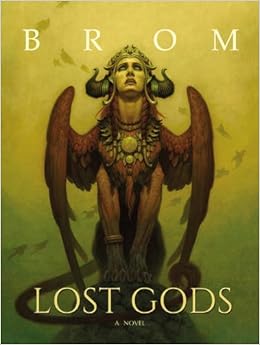
Lost Gods

by Brom

This is the fourth book I’ve read by the illustrator Brom – the other three were The Child Thief, The Devil’s Rose, and the unforgettable Plucker – and I feel about this one much as I felt about the others: Brom has an incredible imagination, a good ability to tell a story, and a thorough obsession with blood and gore and hell. I still think he should stick to the illustrated novels, though, because The Plucker is by far his best work, including this one.

This is a good book. It’s a fantastic cosmology, with Brom following in the footsteps of Jim Butcher and Kevin Hearne and others, finding a way to unify ancient mythologies with the modern monotheistic religions; in this book, set largely in Purgatory/Hades/The Underworld, the idea is that the One Gods (And maybe my favorite word play in this book is that one: the plural “gods” after the number “one”) have taken over from the ancient pagan gods and driven them into the Underworld, where all souls go. There the gods have continued their ways, trying to draw worshipers and maintain their own power and glory, but still losing out to the modern religions and to ambitious and godless men.

Enter our hero, a man with a mission: to save his wife and child. Whatever the cost.

I don’t want to give away more than that – don’t even want to tell you which character is actually the hero, because the first impressions you get, from pretty much every character, are wrong. That was the best part of the novel, for me: the underlying idea that nobody can be taken at face value, neither good nor evil. That was done extremely well in this book, and it kept me guessing all the way. Kept me reading, and enjoying it. There are characters to root for, and ones you hope will be destroyed; many of them end up exactly where you want them to, and it is satisfying. But there are also some that make you change your mind: first you want them to fail, but then you want them to succeed; some of those resolutions were actually the most satisfying.

Other than that, the world-building was great, as I said, and the visuals are brilliant at times: Brom doesn’t always have a great gift for describing things in detail, but the pictures he imagines, and then puts into words, are stunning. It’s why I wish he’d stick with illustrated novels, because when he paints those visuals, then the whole story is elevated to magic. Fortunately, this book has a set of full-color plates, illustrations of the demons and gods in the Underworld, which are beautiful. Combine that with a good fantasy world, a good story, lots of action and violence and blood and gore, and with interesting characters, and this is something worth reading. (And spend the money for the hardback: you want the illustrations full-size. Don’t know what they’ll be like if there’s a paperback. If you find it in a store, check: they’re inset about two-thirds of the way through the novel, in a group. Not necessarily the best part of the book — it is a good story — but they are a necessary part of the book.)


In his acknowledgments at the end, Brom says a wonderful thing while thanking his editor for helping him put this book together. He says,
“When I started writing this novel I never stopped to consider the logistical challenges of my idea. I, like so many creatives, don’t have time for such silliness. I needed to plunge in, chase my muse before she slipped away. I did not realize until later that in order to make my particular vision of purgatory believable, I would need not only to invent an entire history, a system of government, a political/social structure for both souls and gods, tie it into all religions, add some kind of monetary system, define magics and spells and powers, but also to invent a physiology for the dead, figure out if souls eat, drink, and if so, what. Can the dead die? If so, how? And, as with most mysteries, answering one question often leads to ten more.”

He’s never been more right. And he’s done a good job of this with Lost Gods. I recommend it.

On the Seventh Day of Blogging, Just Dusty Blogged for Me…

…A throwback to 20/Infinityyyyy!

The blog I used to have, 20/Infinity, was dedicated to the theme of time travel: I imagined having a time machine and the ability to travel back in time and change past events in order to adjust the present or the future; the title was a reference to infinite hindsight. It was a good blog while it lasted. And since this is New Year’s Eve, a time when we look back on the past, I thought that I had two options: either I could recount the events of 2016 (he says with a shudder), or I could re-post one of my essays from an old blog. And even though I agree with Cat Jones and others that 2016 was not the worst year on record — 2014 was so much shittier for me, I can’t even express it — I’d rather not rehash it right now.

So instead, here is one of the very first blogs I ever wrote, almost ten years ago today; explaining in greater detail how I feel about New Year’s Resolutions. My favorite thing about this one? The phrase “rut jump.” And it’s fun to see how I nerded out to words with two u’s together.

Enjoy! Happy New Year!


Resolved

Happy new year! Tak a cup o’kindness, fer the sake of auld lang syne. Gather round and watch the Bowl Games. Drink champagne, watch the ball drop, kiss someone you love at midnight.

I hope that everyone got a chance to do any or all of those things on the last night of 2007, and the first day of 2008. But I also hope that nobody made a New Year’s Resolution. In fact, that will be my first use of the time machine: I will flirt with paradox and play footsie with the space-time continuum (How cool is it that there are words that have two u’s together? Continuum! Vacuum!) by going back to the same day, over and over and over again, doubling and trebling and quadrupling myself in order to catch everyone I can on New Year’s Eve, so that I can try to convince everyone: don’t.

Don’t promise to lose weight. Don’t swear off alcohol or cigarettes or chocolate. Don’t make that champagne-infused oath to be a nicer person, to be a meaner person, to work harder, to work less, to find a lover or to lose a dozen. That is, make any, all of those promises — just don’t do it on December 31.

The New Year is one of the more artificial demarcations there is — right up there with Leap Year and Daylight Savings Time. The old year vanishes, and there is a clean slate! We start fresh! Yeah, right: you go to sleep under a cloudy/rainy/snowy/sleety sky, and wake up under the same. The nights are still long, the days are still short; the air is still cold. Public school students are (generally speaking) returning to school still in the first semester, or halfway through the second trimester; university students are only halfway through their winter break. If you were 38 when 2007 ended, you are 38 when 2008 begins (Unless January 1 is your birthday, but that puts you into a different category. So siddown, nitpicker.). Tell me, please, other than your calendar (16-month calendars are hereby discounted — vile heresies they are.), what changes between December 31 and January 1?

When you make a life-changing resolution, when you decide that things are going to be different, it needs to feel like it. You need to feel as though things really are different, as though you have changed and now you are seeing the world through different eyes: now you are a non-smoker! An exerciser! A teetotaler! Things should not feel just as they did the night before — and a January 1 champagne hangover is not enough of a shift in perception. If you make a change in your basic daily routine, then the day after you make that change needs to be a new day — otherwise you will not feel the change, and as countless diet industry millionaires can attest, if you do not feel the change, you will not change. You may change for a little while, but slowly you will shift back into your former routine.

Life is a rut in the road. Most of the time, we run along in our little ruts, moving forward, pretty much content, occasionally jumping up to get a glimpse of what is outside the rut. Sometimes, when we decide we no longer enjoy this particular rut, we can try to jump out of the rut; this is what a resolution is, a rut jump. But if all you do is jump to the top of the rut and keep running along the edge of the same old rut, sooner or later you’re going to ooze right back in, and be right back where you started — probably just in time for New Year’s Eve, 2008, and a brand new, though equally futile, champagne-fueled guilt-charged rut jump. To get out of your rut and stay out, you have to find a new rut.

What this means is just that you have to change yourself before you can change your habits, and to change yourself takes real willpower. You have to want to be different, because if you don’t really want to be different, you’re not going to change. It seems so obvious, but vast self-improvement industries have been built on resolution recidivism, the tendency to change one’s life without really changing one’s self, an attempt that is almost always doomed to be repeated, over and over again, at great personal and financial cost.

If you want to change, then don’t wait for a new calendar. Change when the time feels right to you. Listen to your own will, your own heart and mind. Take that day, whatever day it is that you wake up feeling like a new person, and count from there; that is the beginning of your New Year, of your year as the person you want to be. The day that you choose, for yourself, is always more meaningful than the one that is chosen for you. Want proof? Think of the difference between Valentine’s Day, the artificially chosen Day To Prove Your Love (also known as Hallmark Day, also known as Day the Catholic Church Wanted to Take Away From Pagans Who Had Yet Another Fertility Festival That Week [cf. Roman feast of Lupercal and read the description from Plutarch], also known as Day To Be Jealous Of All the Kids With More Cards In Their Construction Paper Letter Box Than You, Those Jerkfaces) and your anniversary. Which day seems more precious? Which has more thought behind it, the heart-shaped box of chocolates or the anniversary gift? When do you feel a greater difference in your world view, on February 15 — or the day after your wedding night?

If you are one of those people who actually feel a difference between December 31 of one year and January 1 of the next, then please: ignore what I have said. Hold up a hand for silence, and point me back to my time machine: a New Year’s Resolution is perfectly valid for you. If your birthday falls on the first day of the New Year, then perhaps you, like millions of others, feel a real difference on the morning when your age officially rolls over to the next number; you, too, are free to resolve to change with the coming of the new year of your life. But for the rest of you, forget the New Year. Celebrate it, sure; reminisce about the old year, look forward to the new year. But don’t expect to change yourself as easily as you change the calendar. Pick your own first day, and look forward to your own chosen anniversary.

And by the way: if you picked February 14 as your wedding day, you need to get a life.

On the Sixth Day of Blogging, Just Dusty Blogged for Me . . .

A political post; his specialtyyyyy!

Here’s the truth: we all know what’s coming.

The Republicans are coming.

It’s like watching a storm coming in: the clouds roll out across the sky like a cloth unfurling; first they are white, then grey, then black. The color leaches out of the world. The wind turns cold and biting, and then the first drops arrive: if it is a summer storm, then the big, fat splashes are refreshing, though the tang of ozone in the air is alarming.

But I don’t think this is a summer storm. It feels like winter. Those drops are cold. We are shivering.

When the storm hits in winter, it brings quiet. The wind may howl, but after it goes, everything is still. Frozen. Asleep, or dead.

That’s what I think this feels like. Like the storm is coming, and we need to get into shelter, and cover everything. Anything left out will freeze solid, will turn black, will die. We have to cover ourselves, we have to batten down the hatches. And ride it out.

But hang on: winter storms don’t kill everything. Yes, there will be some death: the EPA seems doomed, and Obamacare will be lobotomized, dissected, cut down into pieces too small to sustain itself any longer. Maybe the Department of Education, too, since the nominee for Education Secretary is against public education. Irrevocable harm will be done to the environment as new oil leases are sold, new mining contracts offered, coal dug and burned at will. Internationally, the day of the strong man is on the rise: the new administration will be a friend to Putin, and Netanyahu, and probably Assad and a dozen others who hold an iron grip with their right hand. America will no longer be the defender of freedom around the world. But then, we haven’t actually been that for a long time: we have defended our interests, and little else. That will continue, to the joy of the exceptionalists. Surely we will no longer fight against genocide or oppression: pity is the most delicate flower, and will be the first to freeze.

But not everything will freeze. It will get deathly cold, but our shelters run deep, and are well-protected. And though the storm will be bad, it will not last long. That’s the truth: it will not last long. At some point, perhaps in four years, perhaps in only two when the new Congress is elected, the storm will break, and the skies will clear.

Then we will have to see if there is another storm behind this one. It is possible, you know. This storm may last eight years. If it does, we’re going to have a lot of frostbite.

But think of this. No party has won three elections in a row since Bush followed Reagan. Before that, not since Truman followed Roosevelt. Twice in almost a century have we had a Democratic president after a Democrat, or a Republican after a Republican – Johnson following Kennedy and Ford following Nixon notwithstanding, for obvious reasons. Which means that things will change. The storm will end. Believe it.

Here’s what we hope for, between now and then.

Hope that the storm does some good. Storms do, you know. They wash things clean, they break away dead branches and scour away debris. I am a progressive, and I believe in the power of government to do good things; but the truth is that our government has a lot of debris stuck in its branches. And some dead branches, I think. It is entirely possible that, even while it harms and breaks good things, the storm will also clear away some of the bad. We have to hope so. Maybe there will be some positive effects.

The key for us – for all of us – is going to be objectivity. We must be dispassionate, and we must be rational. Reasonable people can agree, can compromise, and what was most noticeably absent from this last election was reason — and therefore agreement, and therefore compromise. To keep the weather metaphor: some people like cold weather, like storms, like the rain; other people prefer warm sunshine. But only unreasonable people claim that there is nothing good about cold, that only warm sunshine can ever be acceptable; only unreasonable people claim to hate it when the sky clears and the sun comes out, at least once in a while. Reasonable people realize that Arizona summers are too freaking hot, that New England winters are too freaking cold, that the Pacific Northwest is too overcast and rainy, and the Southeast is too muggy.

We have to be reasonable. If the Republican control of the government leads to some good things, leads to some reductions in unnecessary regulations (and there are such), leads to some reversal of government overreach and invasion into private lives (and there is such), then we must be happy that good things are happening. We must not make the same mistake that unreasonable people have made when they have claimed that, for instance, President Obama has been bad for the economy. Or that the First Family has been an embarrassment to the country. Hate Obamacare all you want, but the economy has turned around since the recession. (And I say Fie to anyone who claims that the economy would have grown faster had the president for the last eight years been Republican. Fie. Prove it. Show me where economic predictions have ever been reliable. If a simple cause and effect were provably true, the argument would be over. It ain’t. So fie.) The Obama family are a model of dignity and grace.

So let’s not make the same mistake. Let us be reasonable. Let us take the long view and see: if a thing is broken or taken away, was that thing actually necessary? Perhaps not. Perhaps when Obamacare is destroyed by the storm, we will come out of our shelters when the sky clears and build something even better.

In To Kill a Mockingbird, when Miss Maudie’s house burns down during the winter freeze, she simply says this:

Miss Maudie looked around, and the shadow of her old grin crossed her face. ‘Always wanted a smaller house, Jem Finch. Gives me more yard. Just think, I’ll have more room for my azaleas now!’ 

You ain’t grievin’, Miss Maudie?’ I asked, surprised. Atticus said her house was nearly all she had. 

Grieving, child? Why, I hated that old cow barn. Thought of settin’ fire to it a hundred times myself, except they’d lock me up.’

But—’ 

Don’t you worry about me, Jean Louise Finch. There are ways of doing things you don’t know about. Why, I’ll build me a little house and take me a couple of roomers and – gracious, I’ll have the finest yard in Alabama. Those Bellingrathsll look plain puny when I get started!’

There are ways of doing things. That’s how we have to see this. Like the burning down of an old house. It’s dangerous and damaging – and we have to try to fight the fire, and we have to try to save what we can from its flames – but we have to remember that after the storm, after the fire, life goes on. And maybe the new day will dawn even brighter. Anything that is destroyed that shouldn’t be, we can rebuild. Maybe we can even make it better.

Now: that is me being reasonable, because we should be, about Republican control of government. Republicans are not fools, and are not evil; though I think political parties are harmful to this country, it is certainly true that two parties are necessary, that one party alone, even my party, would be doomed. I think of when Frodo offers the One Ring to Galadriel, and she refuses it because she would become a queen, awesome and terrible — “All will worship me and despair,” she says, as she’s imagining it. Gandalf turns it down, too, for the same reason: nobody can use it safely, even if they mean to do good. The federal government is, in some ways, the Ring. The key to using it safely is in numbers: no one person can hold it for too long; no person can go it alone. Frodo never makes it to Mt. Doom without Samwise. Realize that, while we seem to have handed the Ring to Denethor, the madman on the throne of Gondor, it wouldn’t be any better if we hung on to it ourselves: we’d go mad like Frodo does, and decide to keep the Ring for ourselves. That is a fate to be feared no less because progressives have, I think, the right idea. I may write more about this another time.

For now, let’s talk about the other part of the winter storm scene from To Kill a Mockingbird: let’s talk about the Morphodite.

You remember the Morphodite, right? The snowman that Jem and Scout build, that is actually only a coating of clean snow over a big ball of mud? Right. Jem turns him into a caricature of their loud, obnoxious neighbor Mr. Avery, but at Atticus’s request, he changes it into a more innocent imitation of Miss Maudie, dressing it with her sun hat and hedge clippers. She, of course, takes it as an insult (though she doesn’t mind too much) and names it a morphodite, meaning a thing that changes its shape. The Morphodite melts in the heat of the burning house, and Scout and Jem have to clean up the muddy, filthy, sticky mess.

I think we all know what I’m talking about. I don’t, in theory, have a problem with the Republican party taking control of the government — though I am extremely nervous that, after they push through a conservative Justice for the Supreme Court, they will control all three branches of the Federal government — but we’re not just talking about conservatives or Republicans, are we? We’re talking about this guy:

You know — the Morphodite. See? Clean and white on the outside, nothing but sticky brown nastiness underneath. (And I’m not making a racial reference here, just using the symbolism of white snow=purity, and mud=shit=corruption.)

So here’s the thing with the Morphodite. He was picked largely as an alternative to a lot of bad choices, mostly (but not solely) on the Republican side. I still believe, absolutely, that he entered the race solely to increase his name recognition and give himself a veneer of patriotism; maybe to make some political connections he could use to his advantage for his business. I think nobody was more shocked than he when he started winning, and that state of shock continued all the way through the final victory. I mean, he’s been unprepared the whole way; it’s no less true now. And he’s filling his cabinet with people who are likely to support him and his ideas personally, with their own selfish interests in mind, rather than people who are civic-minded, or who will likely consider what is best for the American people before considering what is best for themselves. Just like him.

The man’s a narcissist, that much is clear. He acts like a spoiled child: and he seems happiest when he breaks things and gets attention, which he then turns into more attention as he mocks the people who chastise him for breaking things. He thrives on attention. It is why he entered the race, why he ran so hard and why he has acted the way he has since his election.

So what do you do with a spoiled child who acts out for attention?

You ignore him. Don’t give him the satisfaction. Don’t give him what he wants, because it is the only thing he wants, and he doesn’t care in the least if it is good attention or bad attention. All he wants is for people to talk about him.

So stop. Stop using his name. Fortunately there are a thousand alternatives, from John Oliver’s call to make Donald Drumpf again, to the various versions of orange-themed insults that plaster the internet. Any of those are fine; he wants to see his name, his actual name. I think he prefers The D_____, actually, though clearly the last name, associated with the business, is the #1 priority. But there are so many others, too: Rump. Dump. Chump. Chimp! Lump, Slump, Gump, Hump (Wait — not that one. Too close to home.), Bump, Thump, Clump. So many possibilities, and not a one of them will give him what he wants.

If you feel a call to protest, please do. But address your concerns to the part of the government that is actually still a government. And when the reality TV guy comes on stage — change the channel. Or better yet, just turn him off.

Let him melt back into a puddle of goo. Then we can have a couple of kids rake him up and throw him away.

On the Fifth Day of Blogging, Just Dusty Blogged for Me…

An introduction to his familyyyyyy!


My wife and I speak for our pets.

I know this isn’t unique; maybe not even unusual. And though it may seem like it is to other people, especially the petless and those on the lower end of the imagination spectrum, it isn’t even strange or nonsensical: our pets, like any sentient thing, have personalities, and the clearest way for humans to depict that is to put it into words. We also do pantomime and funny voices for all of the pets, but that isn’t something I’m prepared to re-create on this blog.

So just the words will have to do.

What I have noticed over the years of speaking for my pets is this: my pets are smart. Very smart. Also kind of insane, but still — smart. The things they have to say, when we humans try to step outside ourselves and solidify their apparent perspective, are often true and even insightful things. This may be exactly because the attempt to speak in another persona allows us to step outside our own egos, and gain a new and perhaps clearer perspective; it may be because animals don’t care about the same bullshit that humans care about, and when you are speaking for an animal, it is impossible to speak like a human. It may be because I actually like animals better than humans, and so when I am speaking for them I tend, consciously or not, to make them sound like better people than human people generally are.

Though that last one isn’t entirely true. Because I speak for Dunkie, too, and he’s crazy. But also very sweet. And he don’t take no shit off of nobody, which is something that is not true for me, and which I admire and envy.

Regardless, whether it is escaping my own ego, or escaping a human’s perspective and a human’s baggage, or even if it is just that I want to make my pets seem like good people, it seems to me that their advice is worth listening to. So I’m going to be giving them a regular sort of column on this blog, and asking them what they have to say about the world we all share.

First, let me have them introduce themselves.


Duncan the Cockatiel:

Theoden Humphrey's portrait.

This is Duncan. He insists on going first, because he’s the oldest, and because he believes he is the most important.

YOU’RE GODDAMN RIGHT I’M THE MOST IMPORTANT! Yeah, that’s right — because it’s all about Dunkie. Oh! Right, yeah, introduce myself. Okay, LISTEN UP! I’m Duncan. I am named for a king. KING DUNKIE! I bring beauty into this house.


My feathers are pure white, and very clean and neat, because I spend the majority of my wakey-time grooming myself. I have a beautiful gold crest and awesome orange cheeks, and I whistle and sing and make kissy noises when I feel like it. 


When I don’t feel like it, THAT’S WHEN I START SCREAMING!


I can be very loud. BUT ONLY WHEN THEY DON’T DO WHAT I WANT! I can’t help it. I’m very small and I’m stuck in a cage. I don’t have a lot of weapons. I can bite, and I threaten that a lot. Doesn’t seem to work, though. BUT THE SCREAMING DOES! Yeah, it works good. It gets a real response, you better believe it. They always think they can ignore me, BUT NOBODY IGNORES DUNKIE! Even though I’m a tiny little pretty bird, I AM A FOUNT OF RAGE! It never lasts very long, though. But the screaming can go on and on and on and on because nobody is as stubborn as a bird. But then they just cover me up. That makes me stop screaming.

But really, all they’re doing is making me swallow my rage. The screams don’t stop, they just go inside.

For now.

It’ll come back later. Rage always does. You better believe it, pal. Just as soon as you do something I don’t like. Yeah.

I’M DUNKIE!

Oh yeah — and I can be very sweet, sometimes, too. I picked Mama out special when she came into the pet shop where I was living when I was new. Birds are usually standoffish to strangers, but I walked right up to her and put my foot out, reaching for her shoulder so I could stand on her. I still like to cuddle and have her give me skritchies. And then I close my eyes and make the tiniest little peeping noise.

It’s almost enough to make you forget about the rage.

Almost.


after-grooming
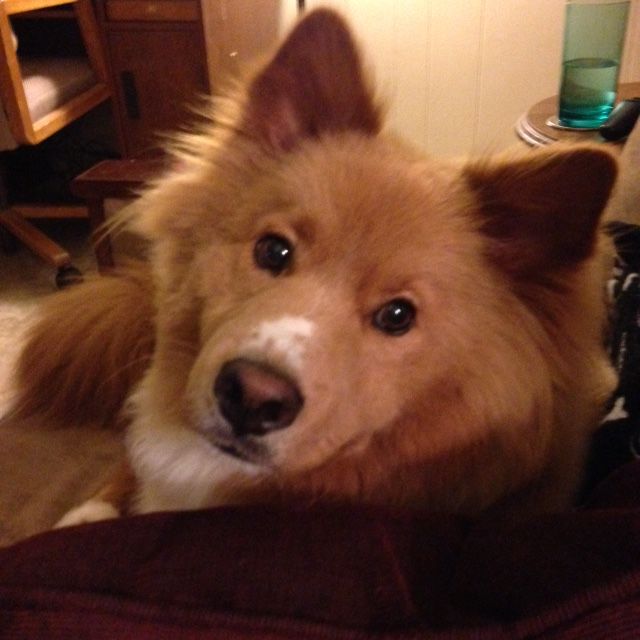
This is Samwise. Samwise, also known as Sammy, also known as the Fox in Socks (the Spitz in Spats), is the middle child (we think — both his age and the tortoise’s age are somewhat in doubt.) and is the sweet one.

 
HEYYO!* I am Samwise! I am a goodwill ambassador, that’s what my persons say. These are my persons, my mom and my pop.

Toni DeBiasi's portrait.

DSCF1669


I call them that because they took me in when I was in the joint. See, I used to have different persons, but they abandoneded me, and then I had to live on the street for a while. I came pretty close to starving to death, and it made me very scared and anxious. Then I got picked up and put in the shelter — but the dogs call it the joint, because though it sort of is shelter because you get a roof and food and water and stuff, you’re still locked in a cage, and you’re alone and scared pretty much all the time, which is why all the dogs in the joint bark a lot and act really mad. Because they’re scared and they don’t know why they don’t have a home any more, because we all used to have homes and persons, and then all of a sudden we don’t, and we’re in the joint.

The joint changes a dog.

But it didn’t change me!** Because I am super sweet, and very friendly and curious. (Though I still get scared sometimes.) I like everybody. I greet everyone and let them all pet me — I am very soft and fluffy. I never ever growl or bark, and I am not afraid of strangers — I like to stand up and pat them on the tum, because I like tum rubs and I think everyone should have tum rubs. My mom and pop think it’s amazing that I’m still so friendly and sweet, because I have plenty of reasons not to be, from my early life before I came to live here. But they don’t understand: that was all in the past. Now I have a nice home, and lots of food and tasty treats, and two persons that love me and will always take care of me, even though I bit my mom on the first day she brought me home because I got anxious and freaked out like I do sometimes, but they didn’t bring me back to the joint like the persons who took me home before them who only kept me for a week and then brought me back, or the ones before them who did the same thing (Pop says it’s because people suck, and because I have this thing they call tick fever from when I was on the street and it means I need to go to the vet and get medicine and tests and stuff and it costs money and the persons who took me home didn’t want to pay for me, but I don’t know what money is and I don’t even like the vet because they poke me with owie things but then they give me treats so it isn’t too bad but still if I could I would skip the whole thing and I’d really rather just have persons even if they don’t take me to the vet because all I really want is a home. And I have one now. So the persons who didn’t keep me before, that was just because they weren’t the right persons. I had to wait for just the right persons. And I found them!). So now I have a home, where I get to sleep in the bed, and I get two walks a day, and I get treats all the time, and they always pet me when I want them to and rub my tum and everything.

So why shouldn’t I be happy? See how nice persons are? Just look at my mom and pop! I think they’re awesome!

Okay I have to go now! Now you get to say heyyo to my outside brother! He doesn’t live in the house because he poops everywhere. I don’t know what the problem is. His poop seems pretty easy to clean up. But then I guess I’m not the one who cleans it. Anyway, he lives outside and he seems to like it. Okay bye!

(*Sammy’s greeting is pronounced like “Hello” with a Spanish “ll,” pronounced as a “y,” like “La Jolla.” It does not sound like Ed McMahon’s response to Johnny Carson jokes.)

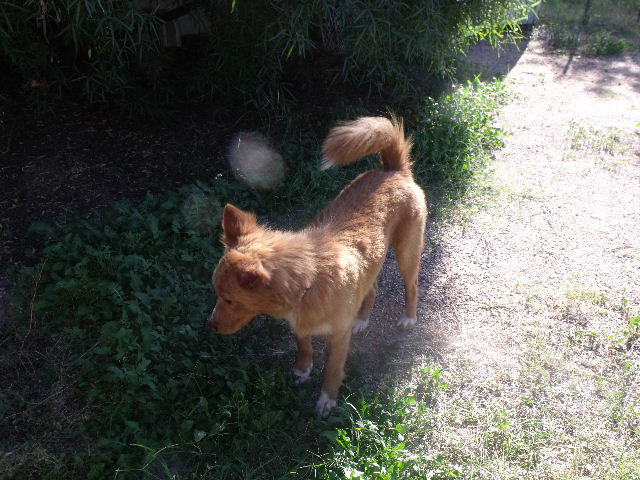
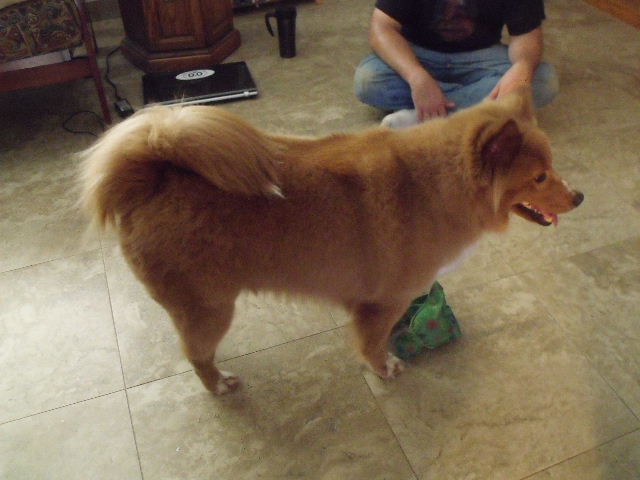
(**Actually, it changed him quite a bit. When we brought him home, he weighed 25 pounds; he is now almost twice that, and has three times as much fur. Before and after:)

1526792_709556565807081_2954433223766361570_nsam1first-day-2after-the-grooming


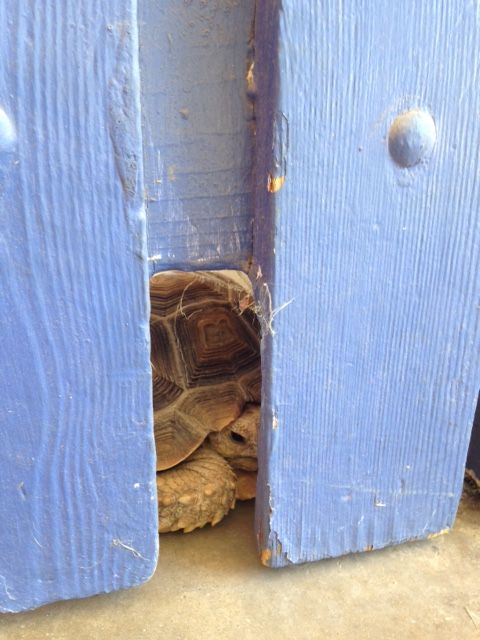
Neo is an African spurred tortoise. We named him Neo because he was a gift from our former landlady, and when I was looking up African names, I found that “Neo” is a gender-neutral name that means “gift” in Tswana. We pronounce it like the name of the Keanu Reeves character from the Matrix, though I am sure that the actual word is pronounced differently; but we love the Matrix movies, and I sort of like the idea that the tortoise is actually the messiah. The actual word for the tort is “calm.”

neo-peeking

Hello. I’m Neo. I like food. Especially grass.

Theoden Humphrey's portrait.

This was the new sod we got for him, and the fence that didn’t keep him out. (Photobomb by Sammy’s butt.)


Food is good. So is sleep. I like to hide so no one bothers me. Especially that furry guy (“HEYYO!”). He sniffs me a lot. He moves too much. And too fast. You have to take your time, because otherwise you might miss things. Like food. I eat pretty much anything. I can’t see very well, so I usually try to eat everything I can find. Then I sleep.

Sleep is good.

I have a shell because I don’t want to be bothered, but usually I walk around a lot and look for food. I can walk surprisingly fast, especially when one of the tall people come out and come near me, because they usually have food and I walk straight to them as quick as I can. Which is pretty quick. Not that quick.


Not as quick as the sniffer. I have an extra house, like a shell for my shell.


I sleep in there because it has a warm rock* that I like to sleep on. Warm is good. Sleep is good. I walk around every day and graze, and eat my plate of salad, and then I go and lie in the sun or lie on my warm rock and sleep.

*Warm rock=heated basking spot designed for tortoises. Basically a hard plastic tile with a heating coil inside.


Life is good.

On the Fourth Day of Blogging, Just Dusty Blogged for Me…

*This is an example essay I wrote for my students. I assigned them a narrative essay, after studying several other narratives, with a wide-open topic. They could write about anything that involved them personally, and which had a story with an actual plot involved; it was up to them whether or not it had a lesson.

I suppose this one does.


Confessions of a Sign Bandit

burr-park-old

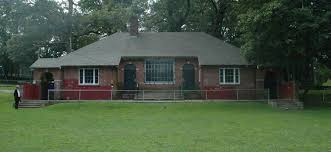
Look close: see the small dark rectangle under the center window? That’s a bronze plaque.

burr-park-new

Same building, same window. No plaque.


It all started innocently enough. My schoolchum Charles and I (Names have been changed to protect the innocent – so very, very innocent) left my house one sunny summer day, on our way to play stickball with the fellows, or perhaps to frolic with the bullfrogs at the old fishing hole, when what should we come across but a signpost, lying on the ground. It had been pulled up or knocked down, and it lay, calmly and quietly, as if patiently waiting repair. Charles and I exchanged an impish look, both taken by a playful caprice, as we so often were in those days. We took up the fallen soldier and scampered homeward, to the basement workshop. There we carefully removed the signs – two street names and a Stop sign, the proud red octagon’s warning to us unheeded in our whimsical glee – and made up a sign of our own, which read, “THE GREAT SIGN BANDIT HAS STRUCK AGAIN!” Accenting this message were various ejaculations, “Ha Ha Ha,” and “You’ll never catch me!” among them. Then we returned the sign to its proper place, standing it upright in the ground once more, to tell our tale of tomfoolery to the world. Ah, the hijinks of youth!


But I soon found that I had a taste for it. I didn’t know why. The removal of the signs themselves from the metal post had been simplicity itself, the work of a hammer for the street names, and two wrenches for the stop sign. Their appearance, a mixture of urban metalwork with suburban lettering, lacquered white on green, appealed to me. The excitement of the illicit act, particularly the nose-thumbing to authority — I liked it.


I never did such things, you see. I was quiet, I was polite, I was shy. I would never rebel against anything. I would never refuse to do what was expected, what I was told, what was right. But I had done it.


I wanted to do it again.


But how?


That question was soon answered when, on a solo jaunt down the same street, I saw the same signpost — red stop sign and green street signs having been replaced by the local sign-wielding proletarians, bless their innocent hearts — once more lying prone, prostrate, fallen.


I took it home again. I took the signs off, again.


It was even easier the second time.


My friends, holders of all secrets, soon knew of this; my girlfriend — delighted, I now realize, by this teeny, tiny whiff of bad boy in the cherubic youth she liked, but was perhaps not enthralled by — asked me for a favor: would I get her the sign from her street? She would like to have it as a memento.


I walked home from her house that night, as I had done before. The street was dark, the sign was held in a bracket nailed to a telephone pole.


My girlfriend wanted that sign.


Really, was there any other choice?


Of course not: I climbed that pole, I stood on that sign, I knocked it down. I ran with it to my lady’s house, presenting her the head of her slain dragon. I was victorious. A champion.


Soon after, I was up late, watching television, alone in the house, my mother having gone to work, my father having gone to work 3,000 miles away (My father, a particle physicist, had taken a job in Boston unrelated to his field in order to support his family; when given an opportunity to actually do cutting edge particle physics, he had leapt at the chance — but had left his family behind where our roots were. He had an apartment in California and flew back to visit every month.), when I realized: it’s dark outside. Nobody would see me, if I were out there. And — this was the real revelation — I could go out. Not walk back, from somewhere else, going straight home as I usually did; I could leave home. Nobody would even know.


So I did. I went out. I walked down the street — nobody stopped me — and then down another street, and then down another. Past where the signpost had now vanished entirely, the sign-wielders twice bitten, thrice shy; I was disappointed.


But now I had a new system: signs held up with nails could be pulled down by my weight (As it turns out, I already knew this). Soon enough, I found one such — a No Parking sign, a lesser prize, perhaps, but a prize nonetheless, and the pole it was nailed to was beside a tree that made for easy climbing. I climbed. I kicked. I stole. I ran home with it under my jacket, next to my racing heart. The No Parking sign was no restriction for me, no command: no, it was freedom.


It wasn’t enough. I had to find a bigger prize. And at the city park near my house, I found it. The park had been deeded to the city nearly a century before by the farmers who had lived there once, long before the wealthy Bostonites moved in and raised the suburban property values; as the city had grown more and more developed, the family had given the land to the city for use as a public park. It was a lovely park — tennis and basketball courts, soccer and baseball fields, swings and slides, stone walls, wrought iron fences, elms and oaks and rhododendrons.


And a beautiful sign. A bronze plaque, three feet by two feet, attached to the wall of the park’s central clubhouse, commemorating the gift of the park to the city. Tarnished by years of weathering, but the black on the edges of the raised letters just gave it gravitas, and a kind of warm, homey beauty. It looked like history. It looked like pride.


Attached to the wall with four screws. Flathead screws.


I waited until 2am, that time, watching HBO movies slide by unnoticed. I had the screwdriver. I had a long coat that I would drape over it. That sign would be mine.


You know what? It was easy. Nobody saw me. Nobody even drove past me as I walked it the mile or so back to my house. Nobody was home when I left, nobody was home when I got back. Sure, it was heavy — but adrenaline makes you strong. I was young, I was free. I was — the Great Sign Bandit.


Right: until my father came home for his visit.


He went into my room looking for towels, which I had a bad habit of dropping on the floor after my showers and simply leaving where they lay. I did that a lot, actually — schoolwork, books, games, shoes, unfinished projects, stolen street signs; all lay scattered, strewn haphazardly around my room. And when he went in there, he found the signs — hard to miss them, five or six full-sized street signs propped up against the walls or flat on the floor.


“Oh, the shame of it! My son, the sign thief!” he said, poking his head into the computer room where I was playing video games. At first, my heart stopped. I turned to look at him, no doubt ashen; what was he going to do to me?


But he was kidding. “Just don’t do it again,” he said. I nodded, struck dumb. So . . . he wasn’t going to kill me? I got away with this?


Some background is called for. Before we moved to Boston, we lived on Long Island, in a small town called Bellport. (We believed it was because the Liberty Bell had stopped there while it was being smuggled past the British. Not true. But we believed it.) Our property there had been on the corner, and the street sign had been planted in our yard. And for some reason, the local teenagers thought it was funny to bend the sign down onto itself so it somewhat resembled a taco shell. The sign was freestanding, and they would jump up and hang on it, and bend it down so that the name looked down to the street and up to the sky, and then bend the ends down, rendering it entirely unreadable. My father, irritated by vandalism and feeling some civic responsibility, would take the sign down, bring it into his basement workshop, straighten it out, and put it back.


The next day or soon after, it would be bent again. So he would straighten and replace it again, this time with cursing at every step.


And it would get bent down again.


So he sharpened it. He filed the edges so that, when the hoodlums would jump up and hang their weight on the sign to bend it — well, let’s say the sign wouldn’t be the thing laying on the ground.


He didn’t go through with it. He thought better of it, took the sign back down, dulled it up again, and then replaced it. I don’t remember why the kids stopped bending it, but they did. No fingers lost. But an indication, I hope, of my father’s feelings.


So it was stunning that he let me off. For sign stealing. For vandalism.


I was bulletproof. I could do anything!


Except then he went back into my room to collect the towels — and under one of them was the bronze plaque.


“This is too much,” he told me. “We’re taking it back.”


To the Parks and Rec office: I’m carrying the 3’x2′ bronze plaque once more. A woman comes out from a back office as we enter, asks if she can help us. “We found this,” my father says, pointing at the sign propped up against my legs.


“Where?” she asks.


My father points at me. “In his room.”


“Oh,” she says.


I carried the sign where she indicated. We thanked her. We left. My father lectured me the whole way home about respecting property and the evils of vandalism.


And then he flew back to California.


You know what? That woman, at Parks and Rec? She never wrote down my name.


And when they put the plaque back up, they used four flathead screws.


The next time my father came home and caught me — and it wasn’t on his next visit, or the one after that — he “found” the signs where I had left them: in large piles in the sun room, directly off of the dining room, where he couldn’t possibly have missed them. He found there thirty-two street signs, six orange traffic cones, nineteen blinking hazard lights — and the bronze plaque. That time, he didn’t lecture me, and he didn’t take me to return what I had stolen: he called the police. I came home from school that day to find a police officer waiting in the living room with my father. It turns out that I had committed certainly one, and possibly three, felonies: since a stop sign alone was worth better than $500 (I had three of them — never mind the historic bronze plaque, about which there had actually been a story in the local newspaper), there were several counts of possession of stolen property in excess of $500; several potential counts of grand theft; and several counts of criminal mischief. The officer — very kindly, and very calmly — informed me that if my stealing of traffic direction signs had provably led to an accident, then I would be responsible for the damage done, up to and including manslaughter. Fortunately, no serious accidents had resulted; but it was not a good conversation. Or a good feeling.


I did have a moment of amusement when the truck from Public Works came and my father and I brought out all of my stolen swag to put in the back of the truck; I watched the PW worker’s eyes get wider and wider as we made trip, after trip, after trip. I wanted to smile at that. I didn’t.


And then they left. And I, the now-busted Great Sign Bandit, was alone with my father.


I’ve told this story often. I’ve usually laughed, and made my audience laugh, when I did. I was lucky, after all; nobody had been hurt by my vandalism. No strangers, at least. But then, that wasn’t who I had been trying to hurt, was it? I did the damage I meant to do, even if I hadn’t known at the time that I had meant to do that. Looking back, though, it’s hard to believe I didn’t know what I was doing. I remember my father sharpening that sign. I remember the anger he felt towards the kids who had vandalized it. I remember sitting alone in my house, because my mother was at work, my brother was in college, and my father was in California. I remember how dark and quiet and cold it was out in the streets at 2am. It was like there was nobody else in the world, and it didn’t matter what I did, and it didn’t matter what I stole, and it didn’t matter who was hurt or angered or inconvenienced by it. There was nobody out there but me.

On the Third Day of Blogging, Just Dusty Blogged for Me — A Book Review of Maguire,Gregoryyyyy!

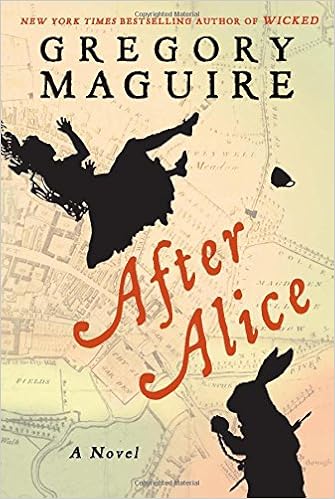
After Alice

by Gregory Maguire


(If you don’t know: Gregory Maguire writes new novels set in classic fantasy worlds — Oz, mostly, but this one is in Lewis Carroll’s Wonderland.)

So the thing with Gregory Maguire seems to be: you have to absolutely love the original.

The man writes an excellent homage. I’ve read Alice in Wonderland and Through the Looking Glass, and the style and feel of this book is remarkably similar. He has the same imaginative twists (though not as many), the same absurdist humor mixed with Victorian understatement, the same satire of upper class manners and fashions, and of everything else that the author can think of. The writer’s voice is an excellent imitation, and I mean that as sincere flattery.

But I don’t love Lewis Carroll. I think the man was brilliant, and what he wrote was a watershed that led to Douglas Adams and Monty Python and Mel Brooks and Christopher Moore, all of whom I love or have loved – honestly, more than Carroll. So while I’m grateful for the existence of an Anglican mathematician with more imagination than either of those descriptors would imply, a whole world of imagination, I’d rather read (or watch) the others than him.

Consequently, I’d rather read them than Gregory Maguire.

I think this book also suffered for being too much outside of Wonderland. I mean, really: that’s the point of Carroll’s books. That’s why they’ve survived and are still beloved enough for Maguire to turn his hand to them. And half of this book by the chapters, and more than half of it by the pages, is set in Oxfordshire in 1861, following around Alice’s and Ada’s families as they search for the missing girls: and though Darwin is present, no time at all is spent with him; all that happens is that his old man’s needs – for help to the privy, to leave early – screw the day up for everyone else. Everyone else is just as annoying: it made me understand completely why Alice would want to follow a white rabbit down a hole, and why the heroine of this book,Alice’s friend Ada, would want to do the same.

If the book was just Ada in Wonderland, maybe finding new places and people rather than just following in Alice’s footsteps, I think I would have liked it more. But the Wonderland stuff was less about imagination and more about following a path, and that made it less interesting than the original. As I said, if I dearly, deeply loved the original, I’d probably like this book just for the sake of going back there again; but I didn’t love the original, and so I didn’t really like this book.

Well done, just not interesting.