Money Talks

Image result for red for ed

[Read Part Two: But You Get Summers Off]

[Read Part Three: Walking Out]

I don’t know how much what I’m about to say needs to be said. This blog is full of book reviews and liberal political ranting; the majority of my readers are people I know personally, which means they’re mostly teachers and liberals and readers (Oh my!), like me. I feel pretty confident that most people reading this already think that teachers should be paid more. But I want to take it one step further, because while most people seem to think that teachers should be paid more, somehow we’re not; so there does seem to be a need, here. My hope, therefore, is that people who don’t realize how vital this issue is will learn something that helps push them towards what I think is the right answer; maybe you all will even share this or some of the ideas with your own people, and then others might learn something or be pushed towards the right answer.

For myself, I need to do this. Because, you see, I teach in Arizona, and in two days, thousands of Arizona teachers are going to walk off the job and out of their schools in order to try to win the same argument I’m going to talk about here; and I won’t be walking out with them. That makes me feel terrible. So I need to do what I can to support them, and one of the things I can do is argue, and write, and then share this. So here goes.

Let’s talk first about what teachers make. I started teaching in 2000, in San Diego County in southern California; that year I made about $36,000 before taxes. I also got good health coverage, though I didn’t need it at the time, and about $4000 was contributed to a pension account in my name. However, as some of you know and the rest can imagine, San Diego County is quite an expensive place to live, and so that first year, I needed to take a second job over the summer to make ends meet: I went with the obvious one, and taught summer school. Six weeks of extra work, and I made $25 an hour, 7 hours a day. Not bad. That year I was able to purchase my very first car, a 2-year-old Chevy pick-up with 74,000 miles, and we found a decent 3-bedroom house to rent. (I should note: I am removing my wife from this almost entirely, because her income has been extremely inconsistent: some years she made a lot, some years not so much. She’s an artist. The point I’m trying to make is this: it shouldn’t matter. I’m a highly trained and capable professional. I should be able to pay for a lower-middle-class lifestyle for two people with no kids and no expensive habits. Don’t you think?) We were able to pay for most purchases, but when surprise bills came up, they went on credit cards. Luckily, not that many bills came up, and we didn’t purchase very many things. No large entertainment systems. No extra vehicles. We took one vacation, an overnight trip to Disneyland. We did buy pets, I’ll admit. The bunny cost us $20. The dog was the big ticket item: $150 for him.

We moved to Oregon in 2004, partly because we hadn’t been able to save anything substantial, despite the fact that I kept teaching summer school, and got a $1500 raise every year (Teachers generally have a salary schedule where we step up every year for some number of years, and then every couple of years, and then we top out after 15-20 steps. You can also get raises if you get more post-degree education, which shifts you up a column.), and we knew that we’d never be able to afford to buy a home in San Diego’s real estate market. When we moved, I was up to $42,000 a year pre-tax; my new position in St. Helens, Oregon paid about $35,000. Back to square one. I had to take out the retirement money because four years isn’t long enough to get vested into the California retirement system, so we rolled it over into an IRA. But there was a problem: the cost of living in Oregon wasn’t actually much less than it had been in California, and my monthly paychecks weren’t enough to cover our bills. I had to change from 12 monthly checks to 10, which meant I didn’t get paid over the summer. No problem: I would teach summer school.

They didn’t have summer school.

So we cashed out my retirement money, and that got us through the summer; about half of my total retirement savings from California was left. The next year I got a raise, but still not enough to go to 12 monthly checks (Please note: this is now my 6th year teaching, and I didn’t make enough to pay for two people with a very modest lifestyle, no kids, no expensive hobbies. When my lawnmower died, I bought a push mower.); fortunately, that year they ran a summer school, and I taught it. Allow me to point out: this was a second job. I know people make a lot of teachers getting the summers off, and we do – that’s one of the main reasons why I started teaching, because I wanted to use the summers to write my novels – but we work 50-60 hours a week during the school year. Especially the first few years, because everything is new and takes ten times as much planning (Especially when, like me, you get handed new never-before-taught classes and you have to make everything up from scratch.). You also don’t get to sleep, because everything makes you nervous or angry or both. Everything. I threw a book at a kid my first year because he was rolling around the classroom in my desk chair. (Don’t worry, I missed him.) The summer isn’t really vacation, it’s all the hours you lost over the school year, the only time you get to relax and do fun things, or spend time with family, or sleep. The average school year is 36-38 weeks long (My current school has a 40-week academic year with two extra weeks of professional development for teachers); even if we don’t count the work we usually do over summer on lesson plans and such, the hours are comparable: a regular office job is 50 weeks, 40 hours a week, which is 2000 hours a year; a teacher works around 53 hours a week, on average, for, let’s say, 38 weeks, which is 2014 hours per year. So having to teach summer school is exactly the same as having a second job right after your 40-hour-a-week job: you don’t get to take advantage of your hours off, you never really get to rest. It is not easy.

So I taught summer school that second year in Oregon, and it helped; but not enough, because we had bought our very first house, which saved money on rent and allowed us to start building equity, but it also meant we had new bills. So that we’re clear: we did not go crazy with this purchase; we bought the ugliest house in the best neighborhood, and in April of 2005, it cost us about $140,000; we didn’t have a down payment, but there was a special deal offered to teachers that covered 100% of new home mortgages. So that year we had to cash out the rest of my retirement money to make it through the summer. And I had no idea what we were going to do the third year.

The third year in Oregon, I found out that my district had been shortchanging me: they had calculated my column on the salary schedule as though my credits were quarter credits, when most of them were semester credits, which should have moved me up to the third column (Bachelor’s degree +45 graduate credits instead of +30, because I did two and a half years of graduate school after my BA. Teacher training, not a Master’s program, but it counts.). They gave me the difference in one large check: that and the new step I got that year meant we were able to cover the summer gap, with the summer school work. The following year, my fourth year teaching in Oregon, the step was just barely enough that we could shift to 12 paychecks: and for the first time, I could pay my way with just my teacher’s salary. Mostly. We still couldn’t handle a large money emergency, and we still didn’t have any appreciable savings. Two people. No kids. No expensive habits. Hadn’t taken a vacation since Disneyland. We had a second car at this point: my wife’s parents gave her their GMC Jimmy when they bought a new car for themselves.

Right about then (2007-2008), the economy collapsed. Even though we had bought the cheapest house we could, and done a lot of improvements ourselves, we went underwater on our mortgage. Teachers started getting RIFfed (Reduction In Force, the eduspeak version of layoffs), and our health insurance costs started going up, and our salaries got frozen, step raises delayed or canceled. Somewhere around there, right around when we finished paying it off, my Chevy got broken and we couldn’t afford to repair it, so it sat in our driveway for a year while I walked to work. (That was by choice. I could have taken my wife’s car, or had her drive me, but I liked the walk. The point is that I couldn’t afford to pay for a house and two cars. Eight, nine, ten years as a professional teacher. And Oregon teacher salaries are pretty good, taken as a whole.) So in 2010, I again took a second job, as a union negotiator for the contract talks we had with our district. That might have been the toughest job for the least compensation I’ve ever had; I got a one-time stipend of, I think, about $1400; in exchange, I stopped sleeping for the year and a half that I was the lead negotiator. Instead of sleep, I just hated everyone and everything. Especially myself.

Here’s the gist: by the time we moved away from Oregon, in 2014, I was earning $59,000 a year before taxes, though like everyone, our health care costs were going up every year. We sold our house in 2013 for a small profit, but only if you don’t count in the money we invested in it, or the time. We used much of that money to buy a new car – a two-year-old Kia Sportage with 25,000 miles – and a new mattress, and our first flat screen TV (Which we still have). And we moved to Arizona, where I took a job at a charter school in Tucson. That first year? My 14th as a teacher, who now had over 90 post-graduate credits, because I had to take more classes to renew my Oregon credential?

I made $36,000. Before taxes.

So now here I am, in my 18th year as a teacher. I am Highly Effective according to my last performance review, the top score you can earn. I have been one of the favorite teachers, if that matters (and since charter schools compete with public schools for students, and one of our selling points is to have students tell other students that they really like their __________ teacher, it does matter; I’ve had parents tell me the reason they came to or stayed with the school is because of the English department) every year; I was named Teacher of the Year in Oregon. This year I made about $45,000 before taxes. I only got it up that high because I teach AP (Extra work because there are more and longer essays), because I teach five different preps (Extra planning work to figure out what five different classes are going to do each day, and also tough to shift gears that many times during the day when I get four minutes in between classes), and because I teach more than a full schedule (I teach 29 periods per week instead of the usual 25) – basically, I’m teaching summer school during the year, now. And I can almost pay all of our bills. Almost. Still couldn’t handle a money emergency, nor save a lot. Won’t be buying another house any time soon. We are doing better because of my wife’s income. But shouldn’t I be able to pay for two people, no kids, no expensive habits? Isn’t that a reasonable expectation for a teacher’s salary? Especially a good teacher with almost twenty years of experience and two Master’s degrees worth of extra credits?

So here’s my question for the room. How much should a teacher make? I don’t mean a dollar figure, since that can reasonably be tied to cost of living depending on location; I mean, where should teachers fall on the scale? Are we middle class? Working class? Are we servants? Public sector workers? I’m sure you’ve seen the memes about teachers as babysitters (I have about 20 students at a time [Charter schools do have smaller class sizes, which is lovely] for seven hours a day; if parents pay babysitters $10 an hour or more, how much should I make? Sure, I’ll take $1400 a day.) or calculating all of the different tasks a teacher does during the day, or comparing teacher pay in the US to teacher pay in, say, Finland; but I’ve also seen people describing teachers as lazy and incompetent, as people who get summers off, as people who just hang out with kids all day, and therefore we are overpaid. Allow me to point out that part of the reason for low teacher pay is that teachers have always been willing to give up dollars in exchange for benefits: for good health coverage, for good retirement, for tenure, the system that makes it harder to get fired. (Not impossible: it is never impossible to get fired. Don’t believe anyone who says it is.) Allow me also to point out that, though it varies state by state, I currently have decent health coverage that is pretty expensive for me; no contribution to any retirement beyond social security; and no tenure. Those benefits are vanishing. And in exchange, we get – more work. And less pay.

You could argue that teachers know what they’re signing up for. You’d be sort of right, although – like most people, I would think – there were expectations I had that didn’t prove true, like the summers off and the tenure and such. But by now, I know what I’m signing up for. I could quit teaching, try to find something else; but I’d have to start at entry level. And also, I’m good at teaching: it seems like something I should stick with. And it seems like something I should be able to make a living doing, at least enough to pay for two people with no kids and no expensive habits. I could have turned down the job in Arizona, stayed in Oregon and made more. I could move away now and make more, especially if I moved to Massachusetts or New York, or back to California. But while that solves my problem, it doesn’t solve the whole problem: because there will still be more than a million students in Arizona, who need teachers. And if Arizona won’t pay those teachers enough, and the teachers all move away, then – what? What’s the plan? All the students follow the teachers to different states? They all get homeschooled, learn their math from Khan Academy?

I read an article this morning in the New York Times about how all public sector government jobs have been disappearing and losing pay; a couple of statements struck me. Both came from the same woman, Teresa Moore, a social worker in Oklahoma who investigates reports of abuse of both children and seniors. The first was this:

Ms. Moore’s friends and neighbors hold conflicting views of her taxpayer-funded job. “The minute they have someone in the nursing home they perceive to be mistreated, we’re the first people they come to,” she said. “They want us when they need us. And when they no longer need us again, they don’t want us.” Source, Emphasis added

The second was this:

Some are resentful that they are being asked to pay for benefits that they themselves struggle to afford.

I asked my brother, ‘How do you feel about this pay raise?’” Ms. Moore recalled. “He said: ‘I want you to have it. You deserve it. But we don’t feel like we should pay for it.’” Source

I think this is how this country sees teachers. People want teachers to care for children, and they want us to do a good job of educating them; for some people, that means a specific information set, and for others, it means a different set – but everyone wants us to do a good job. Unless, y’know, they don’t actually have kids and don’t need to think about education, in which case, they’d really like us to just go away. Or else they don’t want to pay for us personally, and they think only parents should pay for us. (This attitude, held by the many retirees who come to Arizona for the winter months – the so-called “Snowbirds” – is a large part of the reason why Arizona teachers are the worst paid in the nation.) Or, of course, they don’t know who should pay for us: so long as it isn’t them, personally. (This also may be where the Snowbirds land.) I’m sure there are some who are resentful of teachers making more money or having better benefits than they themselves have, but that’s an insupportable argument if it comes only from envy: you can argue that teachers should make less money if you have an argument why teachers are worth less money. For many people, that argument starts and stops with good benefits and summers off and “spending all day with children.”

None of which, I hope I’ve shown, are actually true. The benefits are gone; the summers off never existed; I haven’t talked about the lil angels we get to spend all day with, but I doubt most people believe that. Because of course they aren’t angels. You weren’t, were you? Neither was I.

People want us to do a good job, but they don’t want to pay us to do a good job. They want to pay us the bare minimum, and ask us to do the maximum – because it’s for the children. And while we should do the very best we can, for the sake of the children and for society, that doesn’t mean we should be paid the very least we can survive on at the same time. Because that isn’t for the children: that’s for the people who just don’t want to pay us. Who maybe think we deserve more money, but they don’t want to be the ones footing the bill.

The last month or so has shown us the new truth: teachers are done with this trade-off, our best for taxpayers’ least. There has been a long slow slide down, which has taken advantage of career teachers who don’t want to look for new jobs; and which has taken advantage of old benefit packages which have been traded for pay cuts (The time has run out on this one, since there isn’t any more pay to cut, and so those benefits have been cut, too); and which has taken advantage of teachers’ general sense of goodwill and public service to the community. A lot of us want to teach in the places we grew up, and places that pay less, like Arizona and Oklahoma and Kentucky and West Virginia, have surely taken advantage of that. One of the best teachers at my school, my department chair, is still there despite being overworked and underpaid and being treated generally shabbily, for all three of these reasons: she grew up here, she’s been a teacher here for 25 years, she’s willing to make a little less if her benefits would be a little better.

What does it say about us as a nation that we treat people like that so poorly? We liberals rant and rave about how President Trump makes us look bad: but we all let teaching get to where it is. All of us.

And then, of course, there is the biggest reason why teachers don’t make enough: we care. We usually want to do a good job. We usually care about children, and about education, and we are sympathetic to the needs of families. When I was running the union negotiations, the biggest hurdle we had to overcome wasn’t the district, or the parents: it was the other teachers. Many of them wanted to cut their own pay because that would have saved other teachers’ jobs. Many of them wanted to accept whatever was offered, just so long as they got to keep teaching; and whether or not they could afford to live on their salary didn’t matter: their students needed them. It’s the same reason why, when classroom supply budgets get cut, most teachers go right out and buy the supplies themselves, even though in many communities, the parents make more than the teachers. But we do it because the kids really need those supplies. If the kids don’t have those supplies, we can’t do that project, and that project is really effective – plus the kids love it. We’re nice people, and that makes us saps. It also makes us good at our jobs. But we only get paid like saps. And then they ask us to do a little more, to give a little more, to work a little harder. For the children.

It’s gone too far. Teachers are going on strike, even without a union to protect their jobs and pay them partial wages, as would have happened had my own negotiation broken down that far. (It didn’t. We took the deal the district offered us. We saved jobs, lost money, and kept teaching. Of course. But Oregon has farther to fall before it reaches where Arizona is now.) Despite all the reasons why we don’t want to, we’re walking out of our classrooms, walking out of our schools, walking out on our students and our careers. We’re no longer willing to do this for what America seems willing to pay us. Either we get paid more, or we stop doing this. I say, we need to get paid enough to pay for two people, with no kids and no expensive habits, to build up some savings and maybe buy a house. Not just because that would suit me, but because I think it’s reasonable based on the value of services rendered. I will endeavor to prove that in another blog, hopefully tomorrow.

We’re good at our jobs. Unless America doesn’t want us to do our jobs any more, then we say we need to be paid more. Starting right now.

And you know what? We’re right.

After all, we’re teachers.
Not Another War

You know what? I just don’t want a war.

It saddens me – no; it horrifies me that my students who are 14 and 15 and 16 years old have never lived in a United States that wasn’t at war. It’s a good swath of my adult life that this country has been at war; but almost all the years before that – I was born right around the end of the Vietnam War – I have known a country that has been relatively peaceful. We had the Cold War throughout my youth, of course – the Russians were the bad guys in pretty much every movie I saw until I was in college – and we sent troops to Panama and Grenada, Africa and Serbia; and there have been troops stationed all around the globe throughout my life; but we hadn’t invaded a country and torn down its government until I was a teacher. Until after 9/11.

I remember it well. One of my strongest memories is of hearing that we had invaded Iraq, two years later, on a pretense that I didn’t begin to understand, let alone believe; when we did, I remember writing angrily in my journal that I was afraid we would colonize the country, that Bush the Younger had brought us back because Bush the Elder hadn’t finished the job, and now we would never leave. I was almost right: we left, eventually, but because we did so, now we will never do that again. Because as soon as we left Iraq, ISIS rose, and became the new villain in every movie from now until – well, probably forever.

That’s why I don’t want a war. Because mark my words: any country we invade, from now until the end of this country’s reign as the world’s most violent nation, will become a permanent victim of this nation’s military colonialism. Because we need to “stay until the job is done.” Because we need to “ensure stability.” Because we need to “prevent the rise of terrorism.” You know: all the reasons why we still have troops in Afghanistan after seventeen goddamn years of occupation. Because something has to justify the continued expenditure of trillions of dollars to feed the military-industrial complex.

The same reason why the military wants to keep our forces in Syria. To ensure stability in the areas not controlled by Bashar al-Assad. To prevent the resurgence of ISIS.

And may I just say: god damn that group for giving our military the only justification it will ever need, forever. But I also have to say that I understand their motives. After all, we are invaders. We are colonizers. We attack governments that are not our enemies, under the thinnest of pretexts, devastating every inch of infrastructure in the country, and then we occupy and act exactly like the tyrants we are supposedly removing from power: we paint the nation black with corruption and graft, we put our cronies into positions of power regardless of their suitability for the role, we act with complete impunity while arresting hundreds if not thousands of “insurgents” and “terrorists,” many of whom are surely innocent, and plenty of whom are thrown into dark holes from which they never escape, where they are brutalized and often tortured. You know where ISIS started, right? Right: in American-run prisons.

Some country did that to my homeland, I’d fucking be a terrorist, too. Well: I wouldn’t. I’m a pacifist. But I’d probably get arrested by the CIA for the things I’d write, and the things I’d teach my students. I might even end up in Guantanamo Bay.

They’re still there, you know. 45 prisoners, some of them detained since 2002. Sixteen years in prison thousands of miles from home, many if not all of them victims of torture; none of them given due process according to our own nation’s laws, let alone the laws of their various home countries. Because we call them terrorists, and prisoners of war. A war older than my students.

I do not want another war.

It’s hard for me to say that, because the two impending wars (assuming John Bolton and Mike Pompeo don’t get their way and lead us into a war in Iran), in Syria and North Korea, would both, in some ways, be “good” wars. Both those regimes are guilty of unspeakable crimes. The North Korean dictatorship has killed millions of people, mostly through starvation, over the last seven decades; 500,000 Syrians have been killed and 100,000 more are missing under the Syrian regime and the civil war that has ravaged the country since 2011, when a dozen young men were arrested, imprisoned, tortured, and executed for painting anti-government graffiti on a wall in Damascus. Syria especially frightens me, because the steps leading to the current atrocities have all been ones that I could see our government taking in this country: it began with people talking about overthrowing the government, which led to arrests; the arrests led to protests, which led to a police and military crackdown; and then the revolution started. After that, the arrests turned to a machine: tens of thousands were detained, imprisoned in terrible conditions, beaten regularly, hung from manacles, starved and mistreated, and then executed. I have trouble thinking that American soldiers would emulate Nazis, with cattle cars and death camps and gas chambers and ovens; but I can certainly see them beating people, holding them without trial, even executing them; all of those things have happened in CIA and military prisons over the last seventeen years of this current war. Could they happen in this country, to our people, if those people were deemed enemies of the state?

I’d say yes.

That scares the hell out of me. Particularly when I listen to stories about Bashar al-Assad responding to accusations of war crimes with, essentially, “Fake news!” When he dons a suit and carries his briefcase to work the day after the U.S. targets his chemical weapons facilities, because bluster and bluff are how he has managed to hold onto power – along with his backing from Russia.

It just keeps getting scarier, doesn’t it? You know Assad’s been reelected twice? Sure. He wins around 98% of the vote, every time. Biggest electoral victory in history. And the biggest crowds at his inauguration. Huge crowds. Beautiful inauguration. The best. Believe me.

I don’t want us to go to war in Syria because if we do, we’ll never leave. We’ll keep troops there forever, the same way we’re keeping them in Afghanistan, because we somehow think that our troops are maintaining stability: even though, as a foreign invasive force, I have no doubt we are creating the same instability, the same violent resentment of our presence, that we have to stay in the country in order to suppress. See how perfect that is? As long as our troops stay there, there will always be a need for our troops to stay; and as long as our troops stay there, there will always be attacks that stoke up the dogs of war back home, so they keep supporting those troops, supporting those troops. Look at how the Republican party, the party of fiscal responsibility and small government, was happy to sign away the biggest budget and one of the biggest deficits in history, a budget which expands government in every possible way – because that same budget increased military spending. That’s it, that’s all they got: more money for the military. And did you listen to them talk about it? “We have to make sure we handle our readiness issues,” I kept hearing. Because apparently the largest and best-equipped army in the world is not quite ready enough to do violence, should they be called upon to do so. We have to be ready just in case. To protect our freedom.

I don’t want to go to war in Syria because doing so will cause some further instability somewhere else in the region: the Syrian civil war was at least partly caused by the rise of ISIS, which wanted to conquer Syria for its caliphate; and ISIS was partly created by our invasion of Iraq and Afghanistan, which broke al Qaeda and then created a power vacuum to give the remnants of al Qaeda room to grow into ISIS. Of course, al Qaeda was partly created by our support of the Mujaheddin in Afghanistan, because they resisted the Russian invasion; and also by our support of Iraq in the 80’s because Iraq opposed Iran – which was our enemy because the Ayatollah Khomeini blamed us for installing the Shah, after we overthrew the Iranian government in the 50’s. Because that government opposed our support for Israel. It never stops: it’s an unbroken chain of broken countries, broken governments, broken people turned into refugees, and then into terrorists and extremists, by us and our allies, simply because we won’t. Fucking. Leave.

I don’t want a war in Syria because if we are in another ground war when 2020 rolls around, then President Trump will get reelected just like Bush did in 2004, because Trump’s not any less popular than Bush was in 2004 (And I heard today that Joe Biden is thinking of running for the Democratic nomination, and all I could think of was John Kerry in 2004, and Al Gore in 2000, and to a lesser extent Hillary Clinton in 2016: because when we run these same kinds of Democrats, we get – Bush and Trump. And even if he won, well, Biden certainly supports the military, doesn’t he? Sure.), and because Trump will pull the same bullshit that Bush did: you can’t change commanders in the middle of a fight, and those Democrats don’t support our troops and aren’t willing to bankrupt the entire nation in order to ensure our troops are entirely, eternally, apocalyptically ready for any battle at any time in any place, including every battle at once. Just in case North Korea gets uppity while we’re suppressing Syria and Iran. Even though clearly the Democrats are just fine with bankrupting the nation in order to feed money to the military-industrial complex, because they signed that budget, too.

I can’t stand it any more. My former idealism, believing in the essential goodness of the government, especially the American government, is gone now, shattered by the eagerness with which all of our elected officials beat the war drums and spend, spend, spend, to send Americans into danger and to kill thousands upon thousands of innocent civilians in other nations, in drone strikes, in air strikes, in strikes designed to degrade the enemies’ capability to cause damage. My love for my country is gone, because what kind of country is this to love? The only nation to use nuclear weapons – also on a civilian populace. The only nation to prefer carpet bombing to putting “boots on the ground,” because we’d rather cause collateral damage (read: dead innocents) than put our precious soldiers at risk. Don’t get me wrong, our soldiers are precious – but so are the innocent people we bomb. So are the soldiers we kill, even if they aren’t innocent; they aren’t our enemies. When was the last time we fought a nation that was actually, actively, the enemy of this country? 1945, wasn’t it? Al Qaeda was an enemy and a threat, and I suppose ISIS is, as well; but the nations where they live are not. Nor was Vietnam. Nor was Korea. And look how well those worked out. And while we’re talking about Southeast Asia and incessant airstrikes: you realize our years of carpet bombing Cambodia in the 1970’s helped give rise to the Khmer Rouge? Killed 1.5 millions Cambodians, that group did.

That’s my nation. It has always been my nation, because right now I live in a city that used to be a thriving metropolis for the indigenous people of the Southwest, the Hopi and the Navajo and the Pueblo peoples. We killed them, too. And then used their desperate attempts to resist our invasion and slaughter of innocents to justify increasing the size and aggression of our military, so that we could keep our people safe while our people were stealing the lives and the land of other people.

And then people say that the military protects our freedom. Holy crap. Tell me: what threat to our freedom existed in Afghanistan in 2001? Sure, there was an existential threat to some number of our people, no doubt; but we have lost more soldiers in the war than people who died on 9/11. Afghanistan has lost – well, everything, really. And maybe that’s al Qaeda’s fault. But we were the ones who invaded. In order to protect our freedom. It amazes me that people can even say that with a straight face. I suppose now our freedom is somewhere in Aleppo, and sometime (before the election in 2020), we’ll have to put boots on the ground in order to protect it. We really should stop letting that freedom roam around like that. Especially in the Middle East.

I don’t want a war in Syria even though Bashar al-Assad is guilty of war crimes, even though he has used chemical weapons – because I can’t for the life of me understand why the chemicals sarin and chlorine are absolutely forbidden, but when the chemicals are gunpowder and lead, and TNT or phosphorus or napalm or any of the thousand other incendiaries and explosives that burn down entire nations, are no problem whatsoever. Assad has killed thousands with chemicals, and hundreds of thousands with guns and bombs and starvation; and we attack him for using the chemical weapons? It makes no sense. But even though his atrocities demand justice, I do not want a war. Because there is no possibility, none at all, that a war can create justice. It has never happened and will never happen. The “best” war I know of, World War II, which stopped the Nazi death machine, still did not create justice, because there can be no justice for 6 million victims of the Holocaust, and because the war against the Nazis gave them the cover to hide their actions for years, and because we were the ones who firebombed Dresden and used atomic weapons in Hiroshima and Nagasaki, and because our alliance with Stalin allowed him to retain power and kill 10 million of his own people, which also helped give rise to Mao and the Cultural Revolution that killed millions more. That’s not justice. That’s not a better outcome. I can’t say we shouldn’t have fought the war, because I can’t say anything other than the Nazis had to be stopped: but I can’t say that and not also say that the genocides in Rwanda and Darfur, and Cambodia, and North Korea, and China, should not also have been stopped. We didn’t fight those wars. So have we really saved people with our wars?

I don’t think we can. I don’t think that anything good can come of war. I think that we don’t really grasp the quintessential truth of the phrase “War is hell.” Especially not because we never think what that makes us, every time – every time – we start a war. We make hell. Every time.

And we call ourselves saviors. But we’re not: we’re the devils.

I don’t want another war. Not ever again. Not for any reason. Not even a good one.

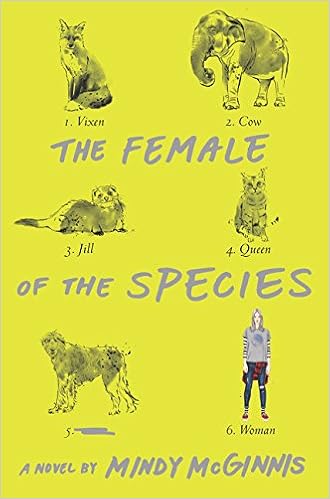
Book Review: The Female of the Species

Image result for the female of the species

The Female of the Species

by Mindy McGinnis


It is probably best, in reviewing books, to stay away from comparisons; no two authors are the same, no two books are the same, no two readers are the same, and so any attempt to compare experiences will inevitably come up short.

On the other hand, if you can’t compare two reading experiences, there’s not much point in book reviews and recommendations in the first place. So let me give this a shot.

I have two comparisons I want to make with this book. The first is to another book, probably more famous, called Thirteen Reasons Why by Jay Asher. That book is about teenagers, as this one is; it is about grief and heartbreak and mental illness, among other things, as this one is; it is an indictment of rape culture, as this one is. So there are enough points of comparison for me to say something valid, I think. Now here’s the difference: that book, compared to this one, is crap. Absolute shlock. The characters are unrealistic, the events are underwhelming and overdramatized, the ending and the book’s overall message were just obnoxious, in my opinion.

This book is none of those things. These characters are some of the most fully-realized and relatable that I have ever read. My favorite thing about this book is that none of the characters – not even the static characters, the foils for the protagonists, the minor characters who only pop into a chapter or two – none of them are permitted to be one-dimensional. The bitchy cheerleader has depths, and real kindness. The golden boy is not all golden: he has flaws, and shortcomings, and he fails, more than once. The villains are recognized as not being that different from the heroes.

And the hero is a psychopath. An entirely sympathetic and fascinating psychopath. I know there are other books that have taken that approach – Dexter, American Psycho, I Am Not a Serial Killer – but this one is by far the best, in my opinion. (Since I’ve been talking about comparisons, let’s be clear: Dexter and American Psycho are entirely different books, different stories, different characters. I Am Not a Serial Killer has some similarities in that it is also a YA book with a teenaged hero; but that book is about self-doubt, and this book is not. At least not from the psychopath’s point of view.) This psychopath, you cheer for. She’s a badass, which was a lot of fun to read. And she volunteers at an animal shelter, and is good to the dogs. I got more than a little upset with the other characters for not being able to relate to her at times, when she’s so clearly right.

But at the same time, because she’s not one-dimensional, the psychopath is not only right. Some of the things she does are terribly wrong, and we know it. This is part of the advantage of McGinnis’s use of multiple point-of-view characters: we get to see all of the major characters from multiple perspectives, both inside and outside themselves, which is part of what makes the characters, and the book (which is entirely character-driven) so good.

And that brings me to the second comparison: the writing. I am a writer. I’ve written for young adults, and I’ve written about violent, mentally ill protagonists. So though I know I shouldn’t, when I encounter a book that is in some small way similar to something that I’ve written, I tend to compare the writing to my own; particularly when it is the first time I’ve read something by a particular author. I don’t do it all the time; when I’m reading something by Steinbeck or Khaled Hosseini or something similar, I don’t even try. But I do think, “I would have done that differently,” or, “I could have written that better.”

I couldn’t have written this book better. I wouldn’t have done it differently, but: there’s no way I could write this well. I actually got a little sad for a while when I was reading it, because this book was so good, so well-written, the characters so genuine and interesting, the action so arresting, that I thought, “Well, what could I add to the literary world when it already has something like this?” I got over myself, of course, but the point is this: this is one of the best pieces of young adult fiction I’ve read. This is one of the better novels I’ve read, period.

So here’s one last comparison: me, to you. I’ve read this book. You haven’t. Which means I’m happier than you. You should fix that. Go get it.

I’m going to go try to learn to write better. And read another book by Mindy McGinnis.

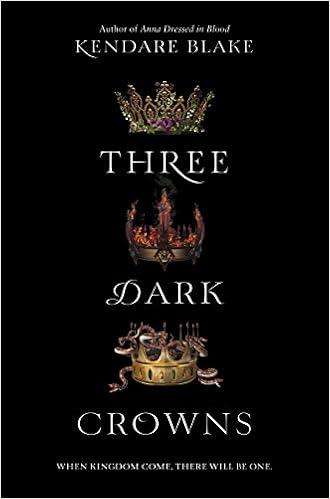
Book Review: Three Dark Crowns

Image result for three dark crowns

Three Dark Crowns

by Kendare Blake

This book got me. Got me good. If we had been fighting a duel, I would have bowed my head, said, “Touche,” and apologized for however I had given offense. And then probably applauded my honorable opponent for the impressive victory.

And then the next thing I knew, I’d be flat on my back, completely stunned, looking up at the book smirking over me, hearing the onlookers making shocked noises at how badly I had been slammed. Because just when I thought the book was done – it wasn’t done. It was just setting me up for the knockout.

All right, enough metaphor: let’s just get into it, shall we?

This is a young adult fantasy novel, one with young female protagonists and a fair amount of romance and social drama – friendships being made and broken, trusted advisors turning traitor, and so on – and so it would most likely appeal to young female fantasy fans. But I am only one of those things, and I enjoyed reading the book, so don’t let me pigeonhole it: it’s a good fantasy novel. It’s the first in a series, so it’s setting up the world and the long-haul plot; both are interesting. The world is based around a magical island, hidden by mists and guarded, so the people believe, by a goddess. This goddess creates a new group of potential rulers for the island once a generation, and that group is always the same: a set of triplets, all girls, born to the previous queen.

The difficulty is that only one of the girls can become queen.

The other two have to die.

The other key factor here – and honestly, the part of this book I had the most trouble with (Other than the portrayal of a couple of the teenaged boys, who were idiots or cads, but I’m not going to complain about that because Lord knows there have been more than enough fantasy novels where the female characters are the crappy ones, and it’s certainly not all the guys in this book who are twits; just two, one idiot and one cad. I’ll just shut up and take my lumps.), because it doesn’t work terribly well – is that each of these triplets has a magical power. There are three main magical powers on the island, grouped into houses; whichever house has the triplet who wins the crown becomes the ruling council for the length of her reign. The three powers are: elemental control, animal telepathy, and – poison.

Look, I don’t mean to be one of those comic book guy, gaming fantasy nerds who complain about a fantasy world being not as good as, say, Tolkien; but this honestly felt off to me. The animal telepathy I’ve got no problem with; there’s not an epic fantasy story in the world that hasn’t made me want to pull a Doctor Doolittle. I want to speak to the Eagles like Gandalf, and run with the wolves like Perrin Aybara, and communicate with dragons like Daenerys Targaryen. So that power was great. The elemental power seemed overbroad, because that queen can do everything: she can bring storms, she can bring earthquakes, she can dance wreathed in fire. And on the other hand, the poison-powered queen can, umm, eat poison. And not die. That’s it. Seems lame in comparison. Also not terribly useful in a magical duel to the death. So I admit, that bugged me a little, particularly because the story is about these three girls approaching the age when they are supposed to start fighting over the throne, meaning they have to kill each other; and really, what are the odds here? The animal telepath can control animals and send them to kill her sisters, and the elemental sister can bring fiery wrath from the skies; the poison sister can – not die while she eats poison. I really couldn’t make that work well in my head, and so it was a bit of a stumbling block.

But here’s the thing: apart from that, the story is great. The girls have different power levels, which means some of them expect to die and others expect to kill their own sisters; and neither is a good place to be. That tension is very well done. The desperation of the weaker sisters to find some way to make their powers sufficient to survive and even kill, that’s also well done. And all of the intrigue, the social interactions, the boys hovering around them trying to become the consort of the next queen (which also means they have to bet on who’s going to win this fight), that was very well done. I liked all of that. I liked all three of the sisters’ characters, even though they’re all entirely different. I was trying to think of a way out of the conundrum they were in, and regretting that I couldn’t; that’s a sign of a good piece of writing, when it leaves the reader looking for a solution to the conflict.

But then: then it got me. At the very end (and no spoilers), an event happened that I pretty much expected, though the means of it was a surprise. But it turned out to have a twist, which I really didn’t expect; Blake set this plot up so well that I was genuinely thrown when the twist happened.

BUT THEN THERE WAS ANOTHER TWIST! Completely unexpected, totally out of left field. And that one, hooooooo BOY – that was the one that knocked me on my ass. But it was great, because it also changed the way I saw the book I had just read: I went from thinking it was okay, to finding it much more interesting once I had this new piece of information. And the best part about it was that it set up a whole different expectation for what would happen in the second book, which means that, of course I have to read that one, now.

So this was a good one. I will want to read the sequels before I recommend it entirely, because I’m not going to recommend a fantasy series that doesn’t end as well as it starts; but this was definitely a promising beginning.

Book Review: Noir by Christopher Moore

(Been a while, I know. Even with my avowed intentions to use this blog to talk about my experiences trying to become a published writer. I didn’t want to sound like I was kvetching —  so instead, I haven’t been posting.

But I got this ARC of Christopher Moore’s newest novel, and I could not think of a better way to come back into my book reviews, at the very least. So here it is.)

Image may contain: 1 person, smiling

The product model is my birb Duncan.


Noir

by Christopher Moore

Trouble walked in, shaped like a dame.

Also shaped like a black mamba. (Though he didn’t walk in.)

Also shaped like an alien straight from the crash in Roswell, New Mexico in 1947. (He didn’t walk in, either. Also might not be a he. I mean, probably not, really.)

Also shaped like the usual suspects from a Christopher Moore novel: smartasses and dumbasses, goons and gadflies, men in drag and women in drag and a venerated Chinese uncle who runs an opium den and has a most unfortunate nickname. (It sort of translates to “cat lover.” In a non-traditional sense.)

The trouble? Noir. In San Francisco, in 1947, and it all comes down on Sammy Two-Toes and his friends and allies, and enemies and victims, and especially on that rotten little foul-mouthed kid that keeps waking Sammy up.

Hate that kid.

But I love him, too. And I loved this book.

It is hilarious: I don’t know of anyone else since Douglas Adams who writes books that can make me laugh out loud, hard enough that I have to put the book down, but Christopher Moore can do it, and he has done it again; from the description of the manly scream on the first page, to the black mamba giving a raspberry to the guy he bit on one of the last pages (Not THE last page; the book ends with one of those wrap-ups describing how everything falls out for all of the characters, and no spoilers here –well, not big ones.), I laughed all the way through this book. There are some fantastic zingers, some absolutely glorious descriptions – my favorite is the one of the whorehouse madame in her tight green dress and flaming red hair described as looking “like a tube of red paint that someone squeezed hard in the middle,” because my God, that is just incredible – and some utterly delicious dialogue, particularly when the characters get into their snappy 1940’s noir patter, which I doubt that anyone writing today could do as well as Moore can. In the afterword, he describes his own book as a cross between Damon Runyan and Bugs Bunny, and I think that’s perfect, too. There is also some slapstick, some goofy sex jokes, a bit of gross humor, as there usually is; because that’s Christopher Moore, too.

And then there is the love story (Remember that dame who walked in and brought trouble? That’s the one). It is wonderfully sweet and romantic, and also a little sad; and for me it elevated this hilarious book into something that I would recommend to anyone who doesn’t mind a little filth in their fun; it’s not the whole plot, as of course there is the wacky story line that I will leave to be discovered, but there is also a Cannery Row sort of story about the boys, the ones who live right on the edge of the skids, but who hang on, mostly because they hang together; on some level this is their story, and it’s a good one. I was rooting for them the whole way. And once again, I don’t want to spoil anything – but at least one of these plot lines turns out all right, which made me walk away with a smile, even after the laughs stopped.

This is a great book. You should read it.

Letter To My Congresswoman

I’m an American high school teacher, so as you can imagine, this last week has been a time of turmoil. And for the first time — a fact which I find shameful– this latest school shooting has actually driven me to do something. I wrote my representative in Congress, Martha McSally, who is currently running for the Arizona Senate seat that will be vacated by the retiring Jeff Flake, about gun control.

I should have done this many times in the past, and I can’t justify my own inaction. I’ve argued about this topic for years, but to say that I’ve never voiced my opinion to the people who can actually do something — well. I’ve done it now. Sent the email ten minutes ago. I will also be sending a version of this to every candidate who runs for McSally’s seat — one which will probably be hotly contested, considering the political climate in this country and the fact that this is a Democratic area with a Republican representative — and I welcome anyone who wants to use this as a framework for their own letter. Steal it, steal a paragraph, steal everything you want. Do more than I have done. Let’s see what we can make happen.

February 23, 2018

To Representative McSally:

I am an independent voter living in Tucson, in the 2nd Congressional District for Arizona. I am an educator: I have taught high school English for eighteen years, for the last four at Sonoran Science Academy, one of the premier STEM charter schools in the state – the only high school in Tucson which Governor Ducey visited this past year. I am writing to you despite knowing that you are currently very busy, seeking a new job in addition to performing the duties of your current position, because you should know that I will also be seeking a new position, and quite possibly a new profession, unless you and your fellow Congresspeople can do the right thing. Unless you bring some sense to the debate over gun control, and specifically firearms in schools, then Tucson, and Arizona, and this country will lose thousands of outstanding teachers and educators. Like me.

The sense I seek – the sense I demand – in this debate has three elements, one positive change, one negative stance, and a general direction. The positive change is simple: Congress must repeal the Dickey Amendment of 1996, which prohibits the Centers for Disease Control from performing any research into gun violence in this country if said research “may be used to advocate or promote gun control.” I find this law appalling, entirely apart from my stance on gun control, because it is nothing more than enforced ignorance: it is a law passed by our government intended solely to limit and suppress knowledge. It flies in the face of science because it presumes an outcome and refuses the research for fear of that outcome – but it is entirely possible that the outcome of that research would be evidence against gun control! There is absolutely no reason to prevent the CDC from investigating the causes of gun deaths, and 30,000 reasons to allow that research to go forward, every year. I say that as an educator, not as an advocate for gun control; the truth is always better than ignorance, and I for one would gladly change my stance on gun control if the evidence supported such a change. Congress must allow the CDC to dispel our ignorance, to teach us why this problem is unique to the United States. That knowledge, suppressed for twenty years, is why this debate is still so acrimonious: because we do not know the facts behind it. We do not know if the right to bear arms is a cause of those 30,000 annual deaths, or if it prevents even more deaths while contributing to none. We are left searching for reasons, for answers, while the body that could provide us with several of those answers sits with its hands tied. Please: make this the first action you take regarding this debate. Jay Dickey himself regrets his namesake law and argued for its repeal in 2012, after the shooting in Aurora, Colorado. Strip away the veil of ignorance, and let us know the truth. Repeal the Dickey Amendment.

The negative stance I would ask you to support has to do with a common reaction to the atrocity of school shootings. I have been a teacher since 2000, and I was in school to become a teacher when the massacre happened at Columbine; I have watched, again and again, as maniacs with firearms have devastated communities by targeting our children. Every time this happens, whether the debate remains local or expands to include the entire nation, at some point, someone will suggest arming the teachers. This time the suggestion came most clearly from our president, Mr. Trump. He Tweeted that “Highly trained, gun adept, teachers/coaches would solve the problem instantly, before police arrive. GREAT DETERRENT!” Allow me to state, unequivocally, that this is false. Highly trained teachers is what this nation already has, but we are, as we should be, highly trained in education, not in combat. I would never presume to lecture you, who have been in combat, on what that experience means and what training and preparation went into making it possible for you to fight for our country, but I am entirely and absolutely sure that I do not have what you had. I do not have the training, I do not have the preparation, I do not have the will to fight. My classroom is not a battleground, and I am not a warrior. What’s more, I will not become such. Turning me from an educator into a fighter would destroy too much of what I need to be successful in my profession: it would change my relationship to my students, it would change my view of myself and my role, it would change the priorities for my continuing professional development and the allocation of resources. It would make my position untenable for me, and if it ever becomes policy, I will quit. I will quit immediately and without reservation, and I will not be alone: please recognize that thousands and thousands of teachers feel as I do. The country already has a teacher shortage, and a longstanding problem with hiring and retaining quality educators; do not make it worse by misunderstanding who we are and what we do. I will never carry a weapon in school, and I will never fire on a student. Don’t ask me to.

Lastly, I would ask you to join me in moving the gun control debate in a general direction that I hope you will be able to support. I recognize the right to self-defense and the concomitant right to keep and bear arms. I oppose authoritarian government, and applaud the democratization of physical force through the private ownership of firearms. But the reality is that the ready availability of firearms, particularly of weapons that have uniquely destructive properties, allow for the unequal and devastating use of force in a way that reduces individual rights: one 19-year-old man’s ability to purchase an AR-15 and “countless” magazines has taken the right to life, the right to liberty, the right to pursue happiness, away from thousands of students. While of course such simple measures as a waiting period for semi-automatic rifles, or an age limit of 21 on the purchase of long guns, or a limit on magazine capacity, or a universal background check system, would not stop all massacres and would not affect the majority of gun deaths, the simple fact that such measures would stop some massacres, and would reduce gun deaths, without materially affecting the right to bear arms or the ability of Americans to defend themselves, makes these measures requisite. It makes them necessary. It makes their continued absence a failure and a dereliction of duty. I myself was inspired to write you, an action I have not taken in the past, by the political will and activity of the victims of the Parkland shooting; I consider myself to be derelict in my duty in not having taken up this cause in the past with the same vigor and determination that these teenagers are showing us now. I am a teacher; I am an adult; I should have been fighting this fight, not waiting for children to fight it for me. Had I fought for these measures in the past, had everyone who agrees with me done so, had all the congresspeople and elected leaders in this nation done what we all (I hope) know to be the right thing, then this particular massacre would not have occurred. That weighs on me, and though I don’t hope it weighs on you, I hope you can empathize with me about it. I hope you can understand the determination that I now have, that this situation not continue as it has in the past, that we not let this moment sink back into oblivion and change nothing and do nothing. I will not take up arms and fire on a student: but neither will I be silent while madmen do exactly that.

I hope you can agree with me on these three actions: to repeal the Dickey Amendment and allow the CDC to investigate the causes of gun violence; to oppose the absurd idea that our schools should encourage or require teachers to carry arms as a means of defending students from attack; and to press for some common-sense gun safety measures that would help to regulate arms without removing any citizen’s inalienable right to self-defense. Please believe that my vote, and my support, depend on that agreement.

Sincerely,

Theoden Humphrey

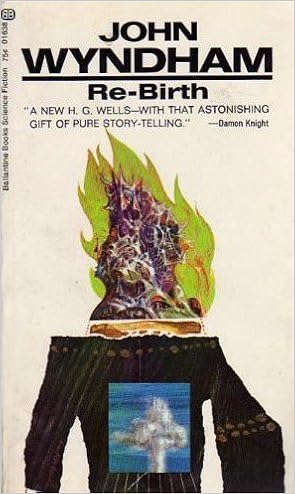
Two Books by John Wyndham

Image result for rebirth john wyndhamImage result for the secret people john wyndham

Two by John Wyndham: Re-Birth and The Secret People

I’ve gone up and down with John Wyndham. A couple of his books – The Midwich Cuckoos and Day of the Triffids – are outstanding; Chocky was just okay. Generally I like his storytelling, and his ideas are wonderful; but they can’t all be gems, no matter who the author is. No problem. Really, this fits in nicely to the Golden Age of Science Fiction, where Wyndham deserves a place, since even Heinlein and Asimov wrote some stinkers. I like Wyndham, though, and I like that I keep finding his books in cheap paperback editions from the 60’s and 70’s with interesting cover art. That cover art was what made me pick both of these.

So I had two of his novels to read, and once I read them, well – to be honest, my opinion of Wyndham went down. This has been mitigated now by the fact that one of these two, The Secret People, was one of his earliest works, written in 1935; my first book isn’t very good, either. But that’s not enough: because this book wasn’t just “not very good.” It’s a stack of crap in a cover.

We’ll start with the good one, though. (Warning: Spoilers ahead.) Re-Birth, from 1955, (Published in Wyndham’s native UK as The Chrysalids, which is a way better title but I assumed they changed it because the American public’s response was overwhelmingly, “Wut’s in tarnation’s a chrysalid?”) is a great book in two ways: it has a post-apocalyptic setting fully as interesting and disturbing as A Handmaid’s Tale, with the same kind of theocratic hypocrisy in full bloom. Told from the point of view of a young boy whose father is a pillar of the community, it has that excellent innocent perspective that makes social commentary novels genuinely effective, from The Giver to To Kill a Mockingbird. We learn how screwed up the society is as the protagonist does, and it works extremely well. There’s a nice twist, too: because we find out that the main character, David, is actually one of the forbidden people, one of the untouchables, as it were, but in a way that enables him to hide it. So we get the view of the society from both a child’s perspective and an outsider’s perspective, and it’s very well done.

The society is an agrarian theocracy after the world-shattering nuclear war; it is probably somewhere in Greenland, though that isn’t entirely clear. (That may be my poor grasp on world geography – or, honestly, it’s been a couple of months since I read it; I may just not remember.) The society has an absolute rule against genetic mutations, which are more common because of the radiation; anyone who is born with any kind of imperfection is essentially exposed to the elements. (Turns out they don’t always die, but that’s not for the society’s lack of trying.) David is a genetic mutation, but not with any physical alteration, and so he slips through the net, and eventually finds several others who are like him.

I don’t want to spoil it any more than that, because it is essentially worth reading. I didn’t really like the ending, though. We get two glimpses into other societies, one of the outcast genetic mutations who have survived on the fringes of the theocratic society, and one highly advanced society from another part of the world; and frankly, both suck. The book as a whole just made me dislike people. Which, I mean, that’s fair, but it’s not always the kind of book I want to read; I also felt that this one didn’t hold out any real hope for a better world or better people. I guess there’s a small chance that David and his friends are the hope, but they continue to be a part of the crappy societies, so I don’t really see it.

But I did like the characters a lot, and I thought the society and the central conflict over genetic “perfection,” with the underlying theme of questioning that very concept – what exactly is the “correct” genotype? Or more importantly, the correct phenotype? At what point does variation become too far from the “norm?” – all that was great. If you’re a Wyndham fan, go ahead and read this one.

Don’t read The Secret People. Not anyone, not for any reason – not even for that epically bizarre cover. Because the cover is a lie! There aren’t any weird dirt-people with mushroom horns! They’re just short! I wanted freaky gnomes and dwarves and stuff, but what I got was – crap. Racist crap.

So The Secret People, originally published in 1935, is a lot like an H. Rider Haggard novel, except Wyndham wasn’t as good a writer. And they both had crap ideas. This book starts with a couple of poorly explained technological advances to get us in the sci-fi mood; the main character is an international playboy with his own jet plane – and I mean, it’s a rocket ship with a cabin and everything, that flies in atmosphere – and at one point, he picks up his newest Bond Girl and flies over the inland sea that is being made where the Sahara used to be. Sadly, they crash into the water, and through a series of mishaps, they find themselves in an underground world peopled by strange beings! Living under the Sahara! SO WEIRD!

Except they’re not. They’re Pygmies, from Africa, who apparently wandered into underground caves centuries ago, and just kept wandering. And just like Haggard, who had a serious case of TheWhiteManIsTheRightMan-itis, Wyndham describes these “secret people” as essentially savages who have been unable to advance their civilization in any way past their original stone-tool-and-superstition society. The modern Eurotrash heroes get chucked into a prison cavern with all the other surface dwellers who have found their way underground now that the inland-sea-over-the-Sahara project has compromised the Secret People’s secrecy, and then they have to find their way out and back to the jet plane, which is their only hope of surviving. Because, you see, the inland sea has started leaking into this vast underground cavern world, and the whole place is going to drown.

But that doesn’t matter! What matters is who gets to the plane first: the heroes, our playboy and his Bond Girl, or the sinister criminal element, who were already in the cavern when our heroes arrive, and who are both rapey and swarthy – an unforgivable combination. But that’s okay, because they’re also stupid and cowardly and everything else you would expect from a swarthy criminal type, and so yes, our heroes are the ones who make it out alive before all of the Secret People drown. Which, y’know, is a happy ending.

Terrible book. Don’t read it. Go for Re-Birth/The Chrysalids – or even better, read The Midwich Cuckoos.

Book Review: Mortal Engines, Hungry City Chronicles #1

Image result for mortal engines

(Also, see that hot air balloon on the cover, with the tiny gondola the two characters are in? Not at all how the airships are described.)


Mortal Engines (Book One of the Hungry City Chronicles)

by Philip Reeve


I kind of hated this book.

Not everything about it. Some things in here are wonderful. The concept is fantastic: a future world where cities are mobile, enormous steampunk structures on wheels, rolling around in the wasteland that is all that remains of our world, destroyed (of course) by World War III and hyper-advanced war machines. These cities follow a philosophy of “municipal Darwinism” (great name), which teaches that the largest, strongest city will devour the smaller cities. It’s a “town eat town” world, and the mobile towns do exactly that: they capture the smaller, slower towns, swallow them, tear them apart and use their raw materials as fuel and building materials to maintain and expand the larger town.

That’s a cool idea.

The main town in the story is London, and London is now governed by four Guilds: the Historians, the Navigators, the Merchants, and the Engineers. The Historians, who comprise both doddering old museum relics and Indiana Jones-style explorers who search through the wreckage of ancient civilizations to find useful artifacts from the time before the wars that ended everything (This is our time, of course, and the Frankenstein We-let-our-technology-advance-too-far-and-it-destroyed-us theme is vigorous in this book), are sort of the main protagonists, and the Engineers, who care about nothing but power and control, as those engineers would, are the antagonists. There is also the Anti-Traction League (the moving cities are called “traction cities”), which have settled in parts of the world not dominated by moving towns nor devastated by ancient wars, and they oppose the traction cities as a whole.

This is fine and good. I was a bit annoyed by the stereotypes of the heartless engineer and the hapless-but-wise-and-kind historian, but I like the plotline that involves the Lord Mayor of London and his megalomaniacal schemes, and the discovery of a new doomsday weapon that allows his city to destroy any other; the weapon is actually a rediscovery from the ancient times, and I thought the book handled that well, particularly at the end. (Though there are some pretty severe plot holes, especially regarding the time lapse between the ancients and the traction city era:  it’s been like two thousand years. So really, the ancient technology? It just wouldn’t work. At all.) I like the Anti-Traction League, and I particularly like the subset of non-city-dwellers who live in the air: this being a proper steampunk novel, there are airships galore, and even a flying city, and those parts were great.

No: I hated the characters. The specific characters who play the roles of hero in this book are half crappy, and by the end, half dead. I won’t say which group is which so as not to spoil, especially since this book is now being made into a movie by Peter Jackson, who probably won’t be able to save this thing, in my opinion. However, since the book won oodles of awards, I suppose most people liked the characters a whole lot more than I did. But really, they aren’t good characters: there’s one who should hate everything London is doing and all that it stands for, but at a crucial moment, this character freaks out on those who want to stop London from destroying everything good with its doomsday device; and then later the character realizes, “Hey, wait – London sucks! I should do something about that!” But this epiphany comes at an entirely random time, and is annoying because of that; I would think that the betrayal by a Londoner whom the character worships would have changed the character’s mind, or maybe when the two main characters are tricked and enslaved by a traction city; or maybe when they are captured and abused and threatened and nearly killed by a bunch of half-insane traction city pirates. No: it’s while the character is – climbing stairs. It’s ridiculous.

The other big problem for me was the writing. Half of the characters, good and bad, are entirely unbelievable; their emotions and motivations don’t make a lot of sense. There are a ton of cliches and platitudes, and some of the descriptions and action sequences are just not well done.

And then, at the end – he killed the fucking dog. That’s right: Philip Reeve kills the dog. No reason, either; we already hate the people who do it, and the character who I suppose is intended to be inspired to murderous vengeful rage by the death of the dog WAS ALREADY AT THE POINT OF VENGEFUL RAGE. It’s an entirely gratuitous dog-killing. And I don’t mean to overstate how much this bothered me, because I was already annoyed by the plot holes and the poor characterization and the mediocre writing – but really, that moment just took the cake. And then for the next thirty pages until the very end (when almost every other sympathetic character dies, too), Reeve kept mentioning the dead dog: the dog’s owner kept looking around for the dog, kept expecting to hear the dog’s footsteps, but no, because the dog was dead.

Screw you, Reeve. Dog killing crap writer.

No, that’s too strong. But really, I didn’t think much of the book. I wish someone else had thought of this idea and done a better job writing it. I hope the movie is better, but I won’t be watching it: because they’ll probably kill the dog.

Looking Up

I woke up this morning about 5am. I usually do. The alarm is set for 5:20, and I often get up before the alarm so that I can take my shower and then have a few minutes to relax, browse the internet, eat breakfast, make even more coffee; though my morning timing is more dependent on my wife, who gets up after I do, and then has to finish her morning so we can go to work together around 7:45. First thing I do when I wake up every morning is take the dog outside, since he hasn’t had a whiz since the night before. Usually I take my phone, look at Twitter; he’s only out there for thirty seconds, maybe a minute. No big deal.

This morning when I opened my eyes, I saw light coming through the windowshade, and I thought, “Oh, right – blue moon, supermoon, blood moon, right? Cool.” So when I went outside with the dog, I looked up at the moon.

It was eclipsing.

It threw me off, at first; I had a student tell me that the eclipse would happen between 5 and 7 pm, the evening before (Though at this point, I realized he had probably seen the times and not realized that they were am, and this is why I don’t trust student recommendations of things.), so when I saw the moon looking less than full, I was confused. But I quickly realized that it was shadow that I was seeing, not a different phase of the moon.

I tried to take a picture: didn’t work. I only had my phone, and it isn’t set up to take precision images of celestial events. So I just looked at it for a minute while the dog trotted around the yard, and then I went inside to take my shower. I glanced out the bathroom window, and I could still see the moon, so I checked on its progress, which was much faster than I would have thought; so I hurried. I went back out to look at the moon before I brushed my teeth, because I wanted to catch a glimpse of the almost-but-not-complete eclipse.

Here’s the thing: I have a telescope. A pretty nice one, not an observatory telescope, but a step up from the Junior Astronomer telescope that grandparents buy their science-y grandkids. I never really use it, sadly, but I do have it sitting in the corner of the living room. But clearly now is the time to bust it out, right? So I take it outside, fumble off the lens caps in the pitch black cold, and then I swivel it around in the general direction (After trying to use the spotter sight on the side of the telescope, but I’m pretty sure I didn’t set that thing up right, as it never shows what the main eyepiece sees.). And it takes a minute, because my dumb luck is actually pretty dumb, but eventually, there it is! The lunar eclipse.

I mean, it’s a gray-white blob, part of it darker than another part of it. I focused the telescope better, and now it is – a gray-white blob with some dark patches. Those are craters. I think: they might be mountain ranges. The most interesting thing is actually a tiny point of light that zips around the edge of the moon’s disk, and is either an interesting effect of the sun’s light, or some imperfection between my eye and the telescope. I am not riveted, is what I am saying. And I’m cold.

20180131_051518

My best camera photo of the eclipse. SEE HOW IT’S NOT ROUND?!? COOL, HUH?!?

So I went inside to brush my teeth, and then wake up my wife. This is when I would be sitting down on the couch, petting the dog while I look at the internet, starting with social media and then moving to the New York Times. (Hey – there was a State of the Union speech last night. Another craggy, reddish-white object that I didn’t watch as it turned slowly darker and more shady. Fancy that.) But instead, I went back out to look at the moon, which was now fully eclipsed, and starting to turn reddish: the Blood Moon.
Now, I love the idea of a blood moon. I’m a fantasy/horror fan, and a writer of same; the blood moon is vampires and werewolves and things that go bump in the night. It’s awesome. I’m also a longtime collector and player of Magic: The Gathering, and I have a card called Blood Moon, which I’ve used to good effect in the past. (If you don’t know the card but do know the game, it’s a red enchantment that turns non-standard lands into mountains. I had it in a goblin/mountainwalking deck with two Goblin Kings – who give all goblins mountainwalking. Mwahaha. If you don’t know anything about Magic, sorry for the delay: back to the actual moon now.) So I am psyched for this blood moon. I’m happy that I have a little free time in my mornings, so that I can do some gazing. I’m happy that I have a telescope so I can see it close up.

Except now I can’t see the moon in the telescope. It moved in the intervening ten minutes while I was brushing my teeth and getting coffee, and now I can’t find it. I also can’t work the controls that make the telescope move, because though I learned how to do this, it’s been too long since I have done it, and it’s too dark outside to see what the various dials and gadgets do. I keep trying, fidgeting with the fine adjustment wheels, unsure if they’re actually doing anything because all I can see in the field is blurry darkness and occasional stars. And sometimes the very edge of what appears to be a very large circle of light, which is either light pollution zipping across the lens, or the end of the world, I don’t know which. Finally I tip the whole telescope, lifting one of the tripod legs, and the moon shoots across the field. Success! I hold it there and try to find a way to move the controls to make it point at that exact spot without me holding it up.

I can’t do it. I don’t know which levers to loosen, which wheels to turn; when I find something that can turn, I can’t tell if it’s working, or whether or not it’s going in the right direction, so do I keep turning it, or do I turn it back the other way? I picture my students laughing at my telescopic incompetence. I get more and more pissed as I spend more time trying, and still failing, to center the telescope. Goddammit – my morning is ticking away; the blood moon won’t last forever; I’m getting cold – WHY CAN’T I TURN THIS FUCKING TELESCOPE?! WHY?? WH – Oh. There it is. I finally get the moon in the field, and I see –

A gray-white blob. Somewhat reddish. Mostly blobby. I focus, and I see – a gray-white blob with dark spots. Still somewhat reddish. Those are craters. I think.

I lift my head and look up into the sky, and I see: a blood moon. Big, fairly bright, definitely red, quite clear. It’s excellent. I look back through the telescope, having to adjust it again to center the moon in the field; it looks – I mean, it’s a little larger, a little clearer. But without the whole sky to frame it, to make it into the moon I have looked to all of my life, it’s . . . boring.

So I spent a few minutes looking at the moon, this morning, while I drank my coffee. I put the telescope back inside, and when Toni was done with her morning shower and all, I called her out to look at the blood moon, and I just pointed at the sky. “Wow,” she said. “Beautiful!”

So it was. When you just looked up at the sky.


You know what I thought about today? I thought about how often I try to look very, very closely at things – particularly literature, since that’s my job; but also my life and what I’ve accomplished and what I’m worth; my reflection in the mirror and how my hairline is changing, and my jawline, and the shape of my eyes; my career, what I can do, what I have done, what I should do – and how, when I try to look really closely, I take away the bigger picture. Often I am looking through a lens that I am not using correctly: when I decide to write a blog about politics, for instance (as this one was going to be when I first thought of it), I’m setting myself up to have a hard time, because I just don’t know enough about politics to really see clearly. I know there are people who can use telescopes and could have used mine to see far finer detail of the eclipse and the blood moon than I could see with my naked eyes; I know there are people who can see far more nuance and historical significance in political events than I can see. For me, I just sort of fidget around for a while, turning things and twisting things, getting more and more frustrated, and nothing gets any clearer.

When that happens, I should step away, and just – look at the sky. It’s worth seeing, all by itself, even without a telescope.

This morning, I saw a blood moon. It was wonderful.

This is hard.

I wanted to explain why I haven’t been blogging very often, and why I haven’t been talking about the effort to publish my book. Why I don’t  write about writing. As a writer, I should — shouldn’t I? If I’m a writer? And even now, while I am trying to find the words for this, I immediately want to start apologizing for it. I want to say that I know this is a cliché, that everyone who writes, and everyone who makes art, we all have this same problem: that things have been said before, and why would I think that my way of saying them would be any better? I want to say that I know this isn’t interesting to anyone, but I felt a need to write it, so I’m just going to go ahead and do it: unapologetically apologizing. I feel like I’m lost in a fog, and I keep bumping into things, into people; I’m clumsy, and blind, and — sorry. Sorry! Oh, that was your foot. Sorry about that.

I want to apologize a lot. I’ve done a lot of things wrong, as a writer: I’ve made a lot of clumsy mistakes, often fallen on my face. I want to apologize for my first book being too long, which kept it from being published; I want to apologize for giving up on seeking an agent to represent me, and I want to apologize for taking so long to get into self-publishing. I want to apologize for being a teacher, and for being good enough at it, and believing in it enough, to take time away from my writing; clearly I should have taken a shit job so I could focus entirely on accomplishing my dreams. I want to apologize for wasting my years being happily married and not having kids; because even though I never wanted kids, the best reason that I can give anyone who asks me why not is that I wanted to focus on my career; and after all this time, I haven’t done enough to earn justification for that decision. I’m sorry. (Still not sorry I didn’t have kids. Absolutely not sorry about my marriage.) I want to apologize every time I write on this blog, because my book reviews aren’t good enough, because I don’t socialize with other bloggers enough, don’t follow enough, don’t comment and Like enough. I want to apologize for my essay/rant/blogs because I’m sure I’m offending someone, either because what I say is offensive or because it isn’t offensive enough. I want to apologize for not having enough expertise to really teach a general audience something they didn’t know before, and therefore wasting their time with my mediocre insights and tired, angry humor. I want to apologize for not writing short stories and poems, for not getting published in literary journals, for constantly shifting my blogging style and my intent with this blog.

Basically, I want to apologize for being me, at least the me that I think I am, though I’m probably wrong, probably indulging in some ridiculous fantasy so as not to face the truth of my mediocrity. I’m sorry. All I can say is, this is hard.

I’m pretty well lost in the dark out here; I don’t know where I am, or the right way to go, or what’s at the end of the path — or even what’s the path. I think I know what it takes to be a writer, but it’s hard to remember what I think I know, and it’s hard to believe, still, in what I think is true, no matter how many times people, including people I respect and admire, say the same things: never give up. Write every day. Write what you know, and write what you want; don’t try to chase the latest trend or the hottest thing: just don’t give up. I want to hold onto those touchstones, follow that map laid out for me by those I would be honored to follow, whose footsteps I dream of walking in.

But see, those are great writers who say that. People who have found success, who have published books, who have sold books. Not me. They have an audience: people want to read what they have to say. They have interesting and useful thoughts, crafted from the perfect words. They know what they’re doing, they can see the way to go; they can see it all so well that they notice the tiny details, they see little moments of beauty, or oddness, or even horror. I can’t even see the ground under my feet, can’t even see my feet, when I start writing: what makes me think that my thoughts, my words, are the right words? And if they’re not the right words, what the hell am I doing? I could be getting ahead on my school paperwork, and I could be playing video games and binge watching all the shows I haven’t seen. I’d be more comfortable at my day job, and I could participate in the conversations about pop culture. I’d know where I was, and I’d know what I was doing. I’d know what was right.

But when I decide to write, I step away from that comfortable, familiar assurance, that life like an easy walk through a mall. Air conditioning, clear lighting, You Are Here maps. And I step into confusion. Every time I write, I have to wonder: What is the right thing to write?

Who is the right me to be?

Figuring that out is hard. Not that actual figuring: I think that’s pretty simple. I mean, I think I am a writer. But I don’t really know why I think it. Every reason I can think of to support the assertion that I’m a writer, I can instantly, with no trouble at all, think of a counterclaim to disprove it. I’m good with words: but I don’t do enough drafts, don’t spend enough time on the work. And . . .

Oops. Turns out I can’t even think of a second reason to call myself a writer. I can keep going with reasons why I’m not a writer: I haven’t had any success, never sold a story, never got accepted for anything, been blogging for ten years and never broke 100 followers. I have never written a way out of the darkness where I go when I try to find the words. Never reached the light.

It is very hard to keep thinking that I should in fact keep writing at all, let alone finish this blog, let alone keep writing books that I don’t believe anyone will want to read. I mean, really, what’s special about these words? I didn’t create anything new with them. I didn’t describe anything that’s never been described before; in fact, I don’t think I described anything. They’re just words, and they’re just from me. Who cares?

I’m sorry for wasting all of our time.

I’m trying to come up with a final epiphany, an affirmation that can sustain me, keep me writing, make people understand why I do this, and why every other creative should continue to do it, too. (But then the voice in my head says, I’m not that creative. My book concepts are entirely derivative: a vampire story? Really? You wrote a book about a pirate? TWO books? Oh, good Lord. Let me guess: your blogs are about you being an angry progressive who doesn’t understand why our country is so stupid, right?

Have you ever considered that maybe it isn’t the country that’s stupid?)

Sorry. It’s hard to keep that voice silent. Hard to think that all of that isn’t the simple truth.

It’s hard to think.

I also get afraid, sometimes. I don’t deal with depression, myself, but so many artists and writers do. Today is Virginia Woolf’s birthday, and she’d think everything I’ve ever written is absolute shit. She was one of the best writers who ever lived. She killed herself. So that means either that I can’t be a good writer because I don’t have the same problems that the good writers have and had; or if I ever get to be a successful writer, I’ll hate every second of it, and want to get back to where life was simple. I’ll want to walk away from writing, from the place I worked so hard to get into. I’ll get there, and I’ll want to run away.

Why the hell do I do this, again?

I’m sorry. I shouldn’t keep repeating myself. It’s a bad habit. I think I’m looking for something familiar. Safe. Known. Which writing is not. Really, I shouldn’t be writing at all: I have way too many bad habits, and I don’t spend enough time taking extra classes, and studying exactly what my favorite writers do,  and carefully scrutinizing every line of prose I’ve ever written to determine how it could be improved. That’s why I’m not a good writer, which is why I’m not a successful writer. Because writing is hard, and I’m too lazy, and too cowardly, to actually do it right. I’m also too old: all the great writers publish their first great books much younger than me. I’m 43: clearly time to get to work on finding some other hobby that would be better for me, that wouldn’t cause me as much consternation, that wouldn’t be so hard. I can’t keep doing this one. I can’t.

But I’m still writing. Doesn’t that show that I am, in fact, a writer? Maybe even a good one, because I don’t give up? Because I try to be honest? Share what I feel and what I see in the world?

Sure, if what I shared and felt wasn’t shit. But if it is, then people are just rolling their eyes and laughing at me. I mean, I guess I don’t care if people are laughing at me, but I also don’t see any reason to keep going if people aren’t appreciating and enjoying my work.

And yet I’m still writing. Still trying to find a way to finish this, to make a point. I think I may have written myself into a corner with this whole “I should stop doing this” thing. I think I already contradicted myself pretty badly, and I’ve probably confused the shit out of anyone who is reading this. I’m pretty lost, myself.

This is hard.

I don’t want to give up. I don’t want to need readers: I want to write for the sheer joy of writing. I feel that sometimes. I get excited about stories. There have been some moments when I’ve looked back over what I’ve written, and I’ve impressed myself. I want to feel that the thousands upon thousands of words that I have put together are an accomplishment, that they mean — I don’t know, something.

And in my best moments, I do think that. I do think that anyone who has written four books — Jesus, four books! And hundreds of blogs, book reviews, essays, along with two-thirds of two other books — I mean, that person has to be a writer. Right? I don’t know where the line is between writer and non-writer, but I’m pretty damned sure that nothing else I’ve done in my life compares to what I’ve accomplished as a writer. (Not counting the things that matter, but aren’t really accomplishments, like being happily married and taking good care of my pets and such. If those are accomplishments, I’m proud of myself for them. If those define me, I’m proud to be those things.)

Actually, that’s not an if. I am proud of the husband I am, of the marriage I have helped to build and keep. Toni and I have been together for 23 years, and she is still the one thing in the world that makes me happiest. She is my world. I have given a home to an iguana, a dog, and a bunny who have all passed on after long healthy happy years; I am currently taking care of a dog, a cockatiel, and a Sulcata tortoise who are also living happy, healthy lives. I am absolutely and unequivocally proud of that. I am happy to be defined as that man, that husband, that father of many pets. I have no doubt of that: knowing that is not hard. This is where I am comfortable, where I am — mostly — sure of myself, and of the ground on which I stand.

I wish writing was the same way. That art was the same way. Comfortable. Sure. Easy.

But the truth is, it isn’t. Art isn’t easy. Art is never sure. Art is never comfortable. We live on mostly solid ground, and we can see all around us; but art is off the edge of the map. It has to be, because it is created. It could be created out of familiar pieces, it may be shaped to resemble something that we’ve known, but — it’s not something we’ve known. It’s something new. To make something new, you have to go away from solid ground. Where everything floats, and nothing is clear. You can’t see where you are, can’t see where you’re going. That’s the only place you can make art: can make a new place to stand.

Art is too big, too impossible to define, too hard to understand. It’s larger than we are, you know; I mean, of course. Of course the English language, and every concept that can come from all the creative minds that have ever existed, of course that’s all larger than me. And when I compare myself to that, of course I am insignificant, a bug, a nothing. Nothing at all. Trying to find my way in that unending expanse, that eternally shifting and growing universe, that limitless world being created and re-created every day, by every artist? Of course that’s hard. It should be.

And I’m still writing. Goddamn it, I’m still writing. Not as well as some others do, maybe not even as well as I could, given the perfect circumstances: if I didn’t have to work, say, or if I had some perfect storm of idea, and passion, and time, and could burn through my own Fahrenheit 451, my own Bell Jar, my own God of Small Things. But given everything I carry with me when I go marching into this unknown, into this mysterious world where art exists, where I make art, where I am past the familiar, through the looking glass, where even the landmarks do not exist until I create them — I think I do as well as I can. I don’t know if it’s good enough. I don’t know what “good enough” means.

But I’m still writing. Maybe it’s even more impressive if it isn’t good enough, because if I can’t have enough talent to really be good, at least I can have enough courage to keep trying, to keep writing, to keep going out into that chaos of formless possibility, and deciding: choosing: determining: building; and then going back to where I was, to the real, solid, familiar world, and carrying with me the thing I made — which is never like the real world, and every time I compare it, I know that what I made is not as clear, not as solid, not as real as the real world. But still, I bring it back here with me, and I give what I write to other people, and I say, “Here, read this. Look at what I made. Tell me what you think.” That does take courage, to dive into the unknown, and try to build yourself a place to stand before you fall: and then to invite other people to stand there, too. That takes courage.

And I’m still doing it.

I’m still writing.