What a Weekend!

WOW! That was… amazing.

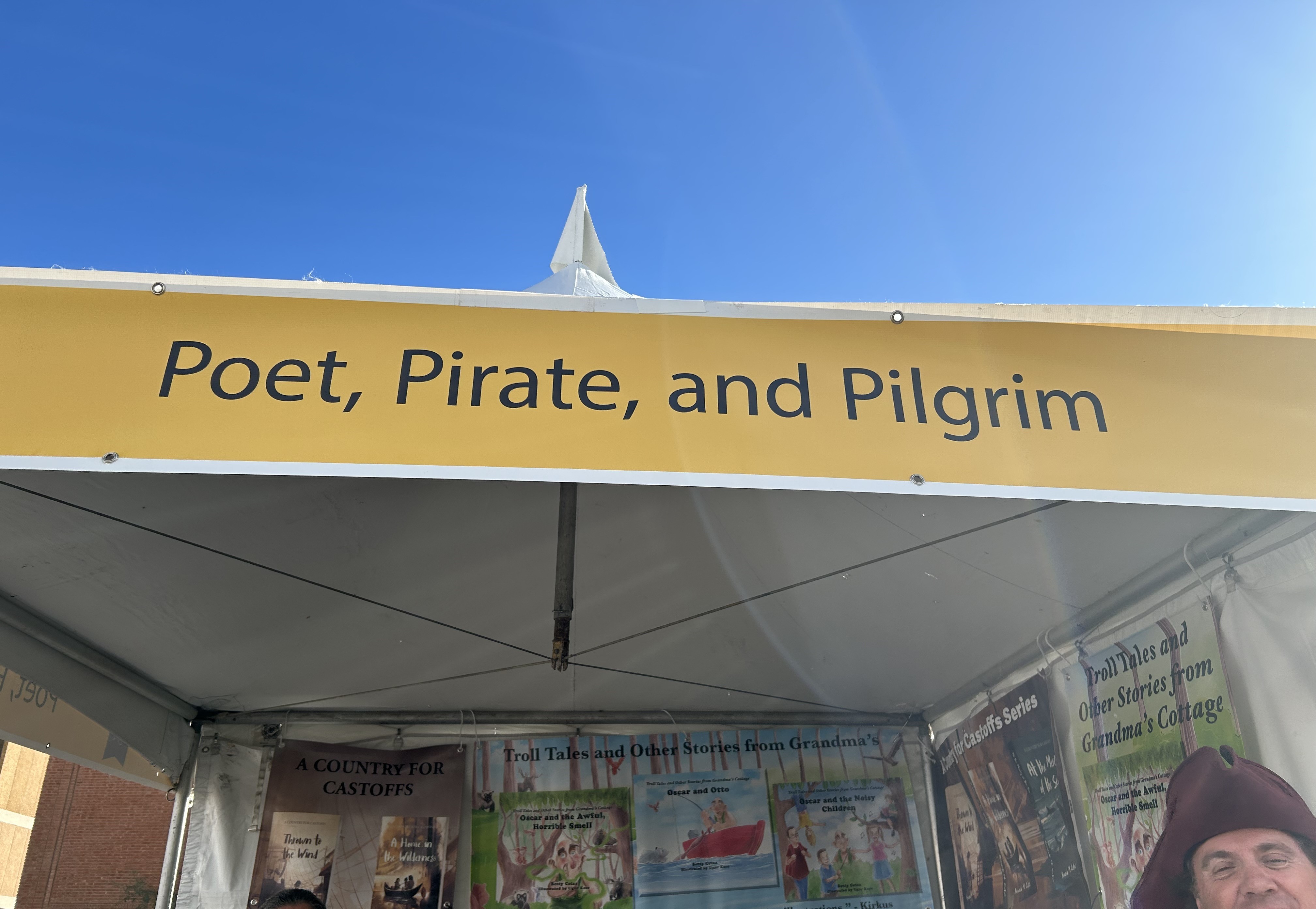
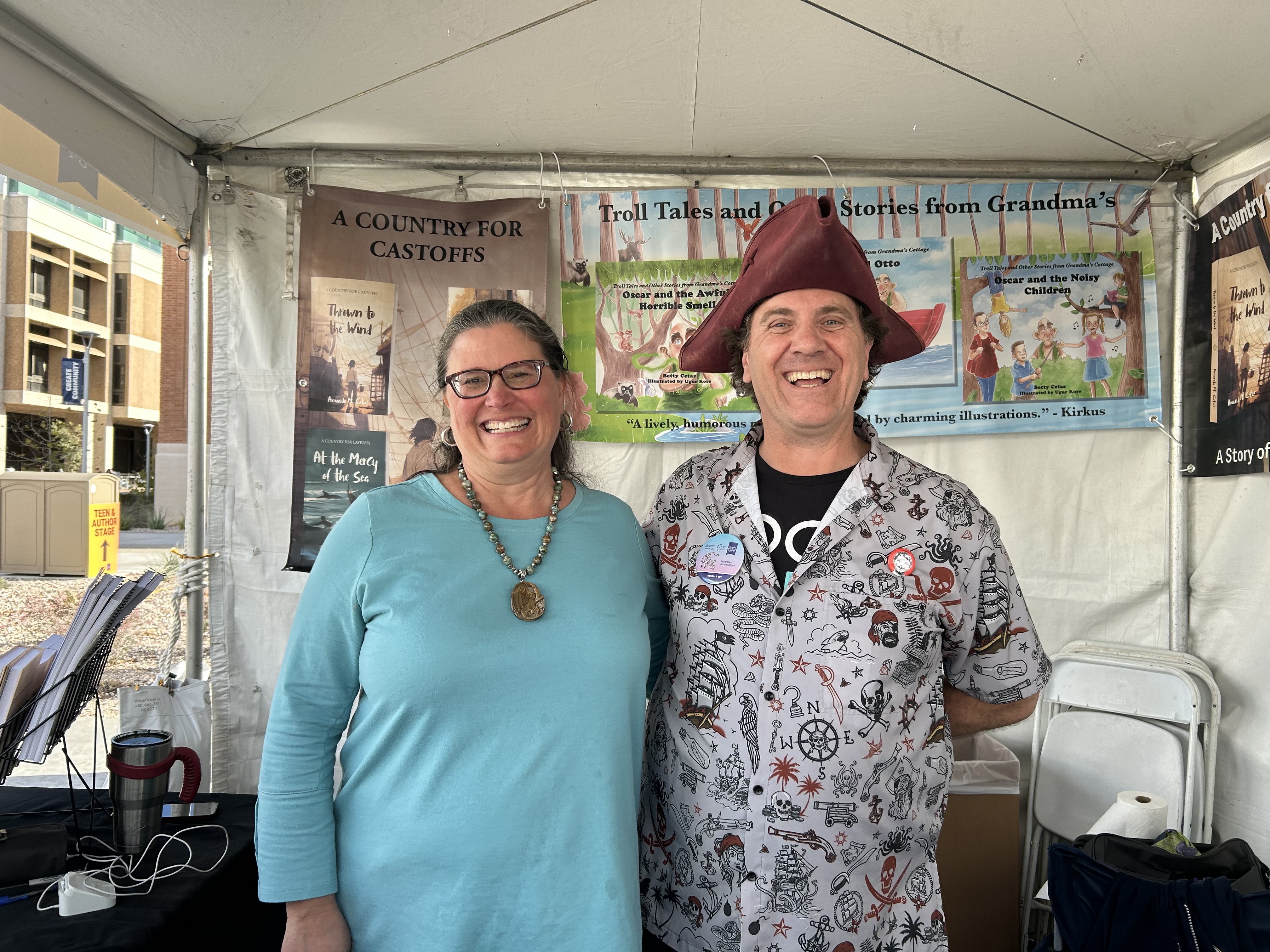
This last weekend was the Tucson Festival of Books. And for the fourth year, I had a booth, and I offered my pirate books, the three volumes of The Adventures of Damnation Kane, for sale to anyone who: 1) Saw my tri-corner hat and pirate-themed shirt; 2) Noticed the name of the booth, or 3) Paused to look at the INCREDIBLE art that my wife Toni DeBiasi created for all three Volumes of the series.

And that was a LOT of people.

I went there with, I think, about 65 books.

The first day, Saturday, I sold 42 of them. (The Answer to Life, the Universe, and Everything!) I sold every copy of Volume I I had with me. I went home, got the four other copies of Volume I at my house, also grabbed my VERY FIRST copy, the first printed copy of any book I have ever written, and brought that on Sunday. I used the very first copy (which was NOT for sale) as a display copy.

I sold the other four. And six more copies of Volume II and Volume III. And I unfortunately had to turn away a few other people because I didn’t have a copy of Volume I to sell them, at the end of the day, or else I would have had at least two or three more sales.

I now have 13 copies left of the 69 copies I brought with me to the Festival.

I have never done that well. The Festival has always been pretty good to me: I have a good book (Three of them, I think), I have a good hook — “Can I tell you about my time-traveling Irish pirate?” — and the aforementioned three attention-grabbers (sign, cover art, and stylish chapeau) brings people close enough to get drawn in by my elevator pitch. But my previous record was, if I remember right, 29 books sold. So I almost doubled that.

Thank you, thank you, thank you, to everyone who came and bought my books. I am honored beyond belief. And now I am anxious as hell that you all won’t like the books, or that you won’t like the third book, or — I dunno, something. So if you could see your way clear to tell me if you do like the books: go to the Contact link at the top of the page (Under the three lines, on mobile), or click on the Feedback link that should be floating in the bottom left corner of the page, and send me a message. Send me a Facebook message or Instagram message — @TheodenHumphrey, in both cases. (Also the same handle on X, if you are a glutton for punishment — or Threads, if you’re a glutton for social media.) Or if you’re really feeling good about my work, post a review somewhere — Amazon, or Goodreads, or Lulu.com where the books are produced — and then let me know that you did so. Thank you.

Thank you, as well, to my fantastic booth partner Amanda Cetas, who stood with me on a patch of sole-stabbing gravel for eighteen hours over two days, who covered me when I wanted to take a break (And made sales for me, too), who directed people to my side of the booth when they seemed more interested in fantasy than in historical fiction, and who stayed positive and energetic all the way through. Thank you, also, to all the people who bought Amanda’s books — she said she did better this year than she has before, too, so it wasn’t just the Pirate who made out like a bandit.

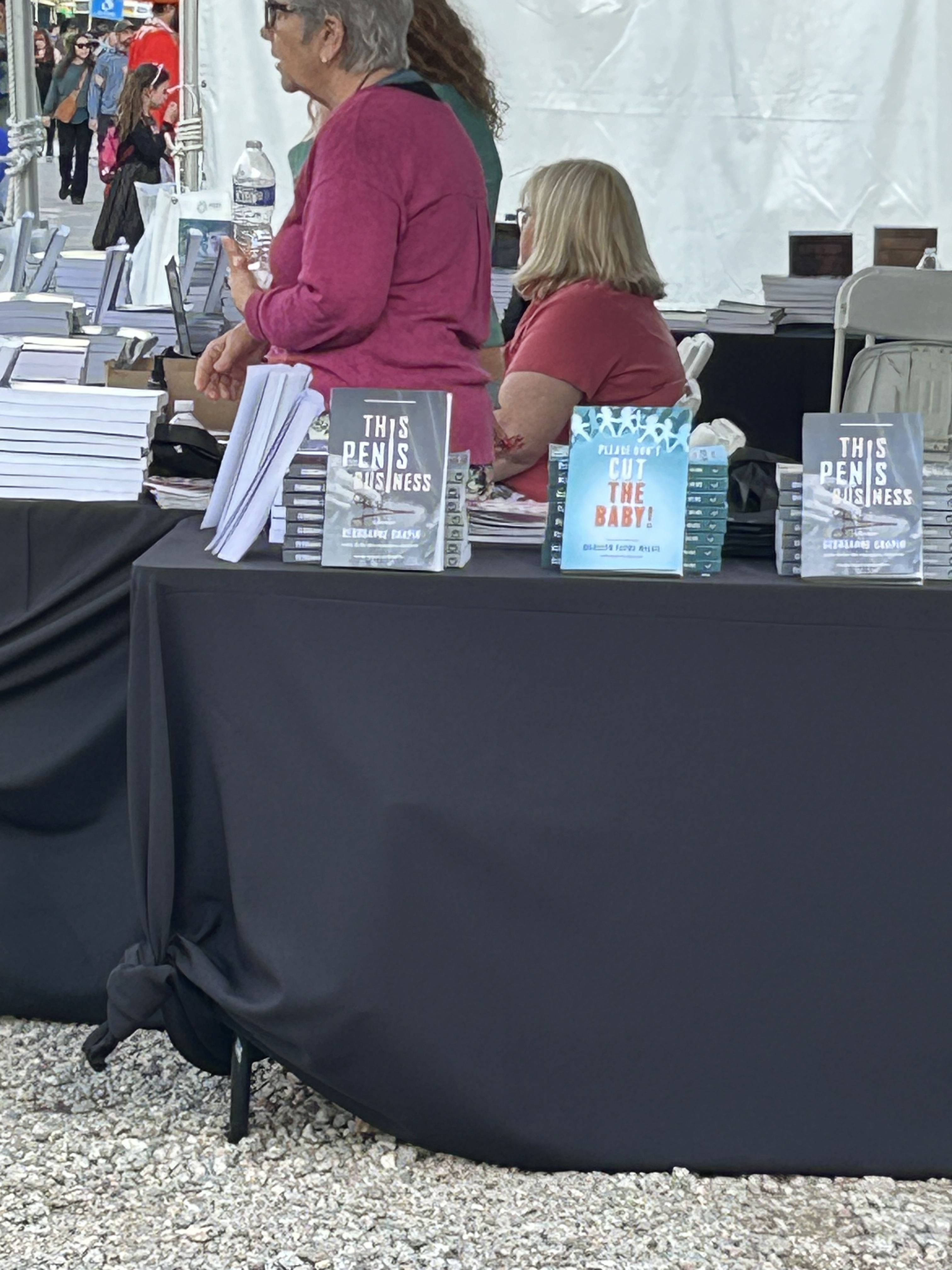
Amanda also shared my confusion over our nearest neighbors, who were… intactivists. Anti-circumcision activists. With whole books. About… circumcision. Now, I actually know the arguments against circumcision, and — how do you fill an entire book with them? Let alone TWO?!?

Needless to say, they did not send many customers over our way, and we didn’t send any their way, either. I didn’t have any people come to my booth and say, “Pirates, huh? You wouldn’t have anything about foreskins, by any chance?”

(I would have sent them over if they did. But they didn’t. The people over there still had people at their booth all weekend, so I think they did fine, too.)

If you didn’t get the book or books you wanted, or you now want more books, then please use the links on this page to Contact me or to order yourself a copy from Lulu.com. (If you Contact me, I will sign the book for you before I ship it.) If you didn’t make it to the Festival this year, then come to next year’s — Amanda and I will be there (Hopefully with our partner, the Poet, Lisa Watson, who wasn’t well enough to attend this year), and I will have all of the Adventures and at least one new book, as well. Amanda will probably have nine new projects, all of them as wonderful as the ones she has right now.

And if you bought books, two things: thank you for reading. You, along with the rest of the literate people, are the bulwark holding back the tide of Fahrenheit 451. You are giving my world meaning. You are joining me in this weird sort of slow-motion conversation that is a novel.

And also: get off the internet and go read. Like I’m about to do.

(If you’re wondering, I only bought two books this year. But that’s because this is my TBR pile.

No, I’m not kidding.)

Here are the two books, anyway.

Happy Reading, all.

Please Allow Me To Introduce Myself

So I recently got asked to do a second interview by the same website that interviewed me before, though now it was for a new — page? A new site? A new theme? I dunno, it was an interview, and it was all done through email, so that’s the kind of interview I like. They did a lovely job with both interviews, I thought. So go check it out, give them some views, maybe find out something about me and my writing.

Here it is.

And then a couple of months ago, a student of mine had to make a website about a teacher, and he chose me. I am a little displeased that he included every time I said “like” in the interview, but he was certainly accurate in his transcription. And otherwise, it’s a lovely site and a flattering compliment.

Go look at it.

All right: and then, for some new content in this post, I looked up Bad Interview Questions, and got this list of 100. I am not going to answer them all: they are British, some are about sports, some are Gotcha questions about physics that I do not know. But maybe this will be fun. Let’s see.

Credit where credit is due.

Cue ridiculous interview questions…

1.‘ If you could be Batman or Robin, which one would you be?

Come on. Batman. Let’s not be stupid. Who the hell would say Robin? “Would you rather be a billionaire playboy who is secretly the coolest gadget-centric superhero in history — or a ward named after a bird?”

2.‘ What football team do you Support? ‘ Why them?

No, we’re not going to answer that.

3.‘ Do you prefer cats or dogs?

I do not. All pets are wonderful.

4.‘ Why on earth are you here today?

On Earth? As a human? I think our purpose as conscious beings is to experience the universe in whatever way we can. I think our purpose as human beings is to create art and discover truth. I want to do all of those things. I’m here today because it’s today, and I should be here: on this blog, posting.

5.’ What was the most traumatic experience to happen in your personal life?

Definitely not going to answer that one.

6.’ Sing a song that best describes you.

I mean…

7.‘ When you go on holiday, when do you pack your case?

Morning of or night before.

8.‘ What would I find in your fridge right now?

Food? Cheese, milk, soda, beer, leftovers, some vegetables, buncha condiments… food. Nothing shocking.

9.’ How would you explain a database in three sentences to your eight year old nephew?

My question would be: how the hell did I get an eight-year-old nephew?

10. ‘If aliens landed in front of you and, in exchange for anything you desire, offered you any position on their planet what would you want?

I don’t see the downside here. Why is this a trade?

11.’ If Hollywood made a movie about your life, whom would you like to see play the lead role as you?

Imma go with Jameela Jamil. I’d like to be that beautiful once.

12.‘ If someone wrote a biography about you, what do you think the title should be?

Cap’n English Sings The Blues

13.‘ If I assembled three of your format supervisors in a room and asked them about you, what would they say about you that you would say is not true?

First YOU tell me what a format supervisor is.

If you asked my former principals, they would probably say that I was stubborn as hell. I’m not: except when the policy is stupid, and then no, I won’t obey it.

14.’ How would you design a spice rack for a blind person?

Specific single-jar dividers and either braille or raised letters to identify each spice.

15.‘ If you were a character from Star Wars, which one would you be?

Darth Vader because he’s the best. The most like me is probably Obi Wan Kenobi: I think I’m a good enough teacher, but I’ve probably helped create the end of all good things, and my winning move is sacrificing myself.

16.‘ Sell me this glass of water.

*Grabs collar*

*Smashes water glass across face*

*Threatens with shattered glass shards*

“GIVE ME ALL YOUR MONEY!”

17.‘ What has been your most bizarre life experience?

Teaching for 24 years.

18.’ Why are manhole covers round?

So they don’t fall down the hole.

19.‘ What do you think would be a fitting epitaph on your gravestone?

“I’m Crowded…. Roll Over”

20.‘ What’s the most interesting holiday you’ve ever had?

My first Christmas with my wife, when she went back to visit my mom with me in Massachusetts and I almost killed her with a train.

21.‘ What would you choose as your last meal?

My own heart.

22. ‘How would you define your personal work-life balance in terms of ratio (50/50 70/30 etc)?

I think 50/50 is probably accurate, but I’d like to shift that to less work and more life, more like 30/70.

23.’ Given the numbers 1 to 1,000, what is the minimum number of guesses needed to find a specific number, if you are given the hint ‘higher’ or ‘lower’ for each guess you make?

One if you guess it right.

24.‘ Using a scale of 1 to 10, rate yourself on how weird you are.

Banana.

25.‘ Explain quantum electrodynamics in two minutes, starting now.

26.‘ How many balloons would fit in this room?

Inflated? Several hundred. Empty? Probably hundreds of thousands.

27.‘ If you were shrunk to the size of a pencil and put in a blender, how would you get out?

I’d be poured out with the rest of the goo. Now you tell me why the fuck you picked a pencil as the size comparison for a question about blenders.

28.’ You have a bouquet of flowers. All but two are roses, all but two are daisies, and all but two are tulips. How many flowers do you have?

Three: one rose, one daisy, one tulip.

29.‘ What is the philosophy of martial arts?

30.‘ Explain to me what has happened in this country during the last 10 years

The culmination of the 50-year project by the corporatocracy to create their utopia, in which the rest of us rank somewhere between slaves and livestock.

31.‘ If you could be any superhero, which one would you be?

I’m tempted to say someone with infinite power, but I’d really just like to be Spider-man.

32.’ How do you weigh an elephant without using a scale?

Guess ten tons: if the elephant is flattered, double it; if the elephant is offended, halve it.

33.’ If you had 5,623 participants in a tournament, how many games would need to be played to determine the winner?

IT’S ME. I’M THE WINNER.

34.’ How many bricks are there in Shanghai? Consider only residential buildings.

No.

35.‘ You have five bottles of pills. One bottle has 9 gram pills; the others have 10 gram pills. You have a scale that can be used only once. How can you find out which bottle contains the 9 gram pills?

What the fuck kind of scale can only be used once?!?

36.‘ How would you market table tennis balls if table tennis itself became obsolete? List many ways, then pick one and go into detail.

I’d have my wife paint eyeballs on them.

37.’ How many Smartphones are there in London?

Nah.

38.’ You are in charge of 20 people. Organise them to figure out how many bicycles were sold in your area last year.

19 to ask around, one to ask you why you care.

39.‘ Why do you think only a small percentage of the population makes over ‘125,000 a year?

See Answer #30 about the corporatocracy. Income inequality is their mission.

40.‘ You have three boxes. One contains only apples, one contains only oranges, and one contains both apples and oranges. The boxes have been incorrectly labeled so that no label accurately identifies the contents of any of the boxes. Opening just one box, and without looking inside, you take out one piece of fruit. By looking at the fruit, how can you immediately label all of the boxes correctly?

Open the one that is labeled apples and oranges and pull out one fruit: if it’s an apple, then label that box as such, label the Orange box “Apples and Oranges” and the Apples box “Oranges.” If it’s an orange, reverse this.

41. ‘How many ball bearings, each one inch in diameter, can fit inside a 747 aircraft?

More than a couple.

42.‘ You need to check that your friend, James, has your correct phone number but you cannot ask him directly. You must write the question on a card which and give it to Heidi who will take the card to James and return the answer to you. What must you write on the card, besides the question, to ensure James can encode the message so that Heidi cannot read your phone number?

JAMES WHY THE FUCK CAN’T I ASK YOU DIRECTLY IF YOU HAVE MY PHONE NUMBER AND WHY DON’T I WANT HEIDI TO KNOW IT?

43.’ If you were given a free full-page ad in the newspaper and had to sell yourself in six words or less, how would the ad read?

“Buy me. I’m dope af. 100.” Gotta appeal to that Gen Z demo.

44.’ How do you feel about affirmative action?

It’s a poor solution to a much larger problem — but it’s better than nothing, which is what we have without it. And if you’re asking would I be willing to give up a job in favor of a minority candidate? Yes, I would, because I can go find another job, and I don’t think something, like a job I’m applying for, or a slot in a college, belongs to me when it… doesn’t belong to me.

45.’ You are given 2 eggs, you have access to a 100-story building.’ Eggs can be very hard or very fragile which means they may break if dropped from the first floor or may not even break if dropped from the’100th floor. Both eggs are identical. You need to figure out the highest floor of a 100-story building an egg can be dropped without breaking. The question is how many drops you need to make. You are allowed to break 2 eggs in the process.

Chuck them both at the interviewers while singing this:

46.‘ Are you a cat person?

No, just a regular human.

47.‘ If you were a salad, what kind of dressing would you have?

I think I am salty and bitter at heart, so that’s probably how I taste (Also describes much of my diet, so) — which means I’d say I’d taste best with something a little sweet. I’ll go honey mustard.

48.‘ How do I rate as an interviewer?

Banana.

Okay: I think that will do. Do I get the job?

Bold Journey

So my wife was interviewed by this website, because she is a wonderful artist and an interesting person; and then she recommended they interview me. Personally I think that was a mistake, but they did it anyway — and here it is. Please give it a read.

Imperfect Persistence


One of my flaws as a teacher is my insistence on persistence. I like finishing things: I don’t like leaving them incomplete. It’s a problem for my classroom because it means that I don’t always adapt quickly to how my students are taking in the material, how much they are learning from it; I have, more times than I can count, stubbornly kept on reading the same piece, the same essay, the same story, the same book, even though my students have completely lost interest, simply because WE’RE NOT DONE YET. Maybe even worse, I have gotten irritated about reading excerpts, and have gone ahead and given my students the entire piece to read, just so we can do the whole thing; then, when they get tired of it — or, honestly, if the author gets out of their golden zone and drops down into less stellar writing — and nobody is paying any attention to what I am reading, I keep reading it anyway. Why? BECAUSE WE’RE NOT DONE YET. Again, this is because I was unsatisfied with an excerpt, and insisted on reading the whole thing. (This example, by the way, comes from my experience with Ralph Waldo Emerson’s “On Self-Reliance,” which is a lyrically beautiful piece of writing, with amazing ideas in it — aaaaaand it’s also over 10,000 words long, which is about 19 pages of 19th century transcendentalist sermon. Most textbooks that cover the era or the genre have excerpts from it. I gave a class the whole thing and tried to read it to them. The excerpts were better.)

To be somewhat more fair to me, I love literature and words and writing and reading more than I can clearly explain; so for me, all of Emerson’s essay is beautiful, and essentially all of it can be inspiring. I also feel a sense of — duty, I suppose, in that I find it disrespectful to take only excerpts from a longer piece. If all Emerson had to say was the thing about trusting yourself, that’s all he would have said; obviously, he thought there was more that was worth saying, and since Emerson was an incredible genius with words and ideas, and one of my heroes and inspirations, I want to honor the man and his work by taking it in, and giving it to my students, in the form Emerson intended: all 19 pages of it. So I gave my students the whole thing to read because I thought, and I think, that it’s worth reading the whole thing, that reading the whole piece is the right thing to do.

It turned out they disagreed with me, and as always, the students win those arguments by the simple expedient of shutting down, no matter how passionately I read, or how carefully I point out the valuable material in the rest of the essay after you get past the “Trust thyself: every heart vibrates to that iron string.” Maybe there’s a way I could have maintained their interest as Emerson goes on and on and on — no, there’s definitely a way; I just don’t know that it’s worth it when there are other good things to read in the world, and limited time to do that reading. At some point even my desire to finish things caves in the face of continued passive resistance, and I do (I did with Emerson) give up and discard the piece in favor of something newer and more interesting for the class to work on.

Though if I think their resistance to the learning was because they were being lame, rather than me being lame in my choice of material or pedagogy, I will often re-inflict the same sort of thing on them. I mean, what if we move on from Emerson — and go straight to Thoreau? CheckMATE, teenagers! Transcendentalism IN YO FACE!

On the other hand, one of my flaws as a political activist is a distinct lack of persistence. Or maybe it’s a lack of focus: I don’t have a single cause that I fight for; inasmuch as I have a political side and a set of causes to fight for, I don’t push myself very far into that fight. I give up very easily. I will argue until the cows come home — and then I will argue with the cows — but I won’t go out and do things, won’t collect signatures or donations, won’t canvass or march, won’t join political action committees or grass roots organizations. It goes straight back to the same point I made with what I teach in my class: because as much as I love literature, I do not love being around people. I guess I won’t say I hate it, because there are certain people I like being around as much as possible; but I hate going out among strangers. It’s one of the things that makes teaching an acceptable career for me, as an introvert; because I get to know my students, in some cases quite well, and that makes me more comfortable being around them. I hate the beginning of the year, and I hate getting new students and losing old students I like; because new students in new classes are strangers, and I don’t want to be around them until I get to know them better. (I don’t have to like them, actually, but I still feel more comfortable and get along better with students I know and dislike, than with students I can’t even recognize or attach a name to.) But that same discomfort with new, strange people keeps me out of political activity: because a march is thousands of people I don’t know, and all other grass roots political activity is focused entirely on meeting new people and getting them into the fight on my side. And I don’t want to do that.

But the result is, I don’t do much to make the world a better place, even though I want to, even though, knowing my abilities, and ignoring my personality and preferences and comfort level and anxieties and everything else apart from my abilities, I always tell myself that I would be good at politics. And I would: I think well, I listen well, I speak well; I’m very good with people. But also, there’s simply no way that I could be happy and comfortable being surrounded by strangers all the time, which is essentially the life of most political activists. Certainly the life of politicians, which I have also thought (And continue to think, in my less self-aware moments) that I could be successfully. I could give a speech. I could draft a law, and argue for it. Of course, I wouldn’t be able to make and maintain the friendships and alliances that would be absolutely necessary to get anything at all done in politics; I’d always want to just go back to my office, sit by myself, maybe read something; but that doesn’t matter, right?

Thinking this way has always had me considering whether or not I should start running for political office. (Also my students frequently tell me that I would be a good candidate and they would vote for me. It would mean a whole lot more if they voted. Or knew anything about political candidates beyond the most superficial information. Hey, they’re kids; what do you expect? It’s nice to hear, which is actually their point anyway.) I could start small, maybe a local school board; then something like a state representative, and then who knows? Congressman Humphrey? Why not? I wouldn’t want to go much farther than that, since greater power requires greater compromise, and I wouldn’t want to sell out; but I hear about congresspeople like Earl Blumenauer of Oregon, who do the work of the Congress, who do the research and write the bills and all the behind-the-scenes grinding that is required to get stuff done. I could do that, I think. It would be useful if I did that. And I would give a good speech, and I would be awesome in a debate. Which makes me think I could get some useful things done, if I could go that far.

It struck me hard in this strange, idle ambition of mine when I heard that Mitch McConnell, whom I loathe more than most politically opposed people in this country, but who is unquestionably one of the most effective politicians of the last half-century if not more, absolutely hated working with Barack Obama: because Obama wanted to explain the ideas behind his political goals and actions, wanted to get into the philosophy and convince McConnell to work with him on the merits of the thoughts and his ability to communicate them; and McConnell just wanted to do a fucking deal. Because that would 1000% be me, trying to get into the underlying morality and the cause and effect of any legislation or policy I wanted to pursue; and the other politicians, the deal makers and negotiators, all those goddamn extroverts, would just roll their eyes and say they had another appointment.

So no. I should not go into politics. I should not run for office. If I could just jump straight into the role for which I am suited, I would be a real asset to the country or the state or whoever I worked for — I would make a hell of a speechwriter, I think — but that’s sort of like the ambition I had when I was a kid, to work my way into the NBA by becoming a 100% never-fail flawless free-throw shooter, who they could substitute in whenever a foul was called, and then I could calmly hit all the free throws and help win the game, despite being 5’10” and essentially unathletic. The problem being, of course, that the game doesn’t work that way. To become a speechwriter for a political campaign or organization, I would have to work in the field, and especially network in the field, for years; and I would have to do all the things I don’t want to do in order to do the one thing I want to do.

This same persistence makes me a good author, because I can keep working on one story until it is a whole book. And the same lack of persistence makes me an unpublished author with five — almost seven — genuinely good novels sitting on my computer, and not on bookstore shelves. The contrast, and what seems to me to be fairly extreme opposite traits, is difficult to wrap my head around sometimes: because how can I give up so easily on some things, and fight so goddamn hard and so goddamn long on others? If I’m willing to put in so very much time and effort to write a novel, to the extent that it takes over my life at times, and becomes one of my defining attributes, that I am a writer, that I am a novelist: why on Earth won’t I fight to get my books published? Do I just want to write, but not have other people read what I write? Why would I want that? And yet, that seems to be exactly the life choice that I have made: I’ve been writing novels for almost 20 years now, and have not published a single one, other than through self-publishing. (I know, I know — hang on, I’ll come back to it.) But you see, I know, with a bone-deep conviction of total understanding, that writing is communication, and therefore requires an audience for the writing to be anything real. I want people to read what I write. I am happy that people came and read my blog two weeks ago, when I posted the chapter from my novel Brute, and I am disappointed that fewer people read the one from last week, about Martin Luther King’s Letter from Birmingham Jail. (That combination has contributed significantly to this topic, by the way. I’ll come back to that, too.) I do want readers. I want my work to be published.

So why do I give up?

And the larger problem is, how do I get myself to change? If I can’t understand my motivations, the causes of my actions, I can’t address them, can’t change them; self-awareness is the most important factor in self-change. How do I tell myself to keep fighting for the things I give up on, when there’s no simple explanation for why I give up on those things and not on others? I’m neither 100% stubborn, nor 100% (Hey, what’s the opposite of stubborn? Wishy-washy? Flimsy? Weak-willed? Maybe adaptable.) adaptable, so I can’t just point at my nature and say “That’s just who I am, I never/always give up.” At the same time, if I’m willing to give up on things because of inherent or essential aspects of my personality — I am not going to stop being an introvert, which means I’m never going to be a good political operative — why do I keep persisting in the areas that are just going to keep hitting this wall? If I’m never going to be a good political operative, why do I keep trying to get involved in politics? If I’m never going to push myself to publish a novel, why the fuck do I keep writing them?

This is where I come back to self-publishing, then. Because honestly? It’s the perfect compromise. I have printed and sold somewhere in the hundreds of copies of my three published novels. (One has never been printed because it’s only available as an ebook. But there are a fair number of people who have read it electronically.) That means I have an audience: I have readers. The feedback I have gotten from my readers about my novels has been almost entirely positive. (Some people think I’m too wordy. No, sorry: EVERYBODY, including me, thinks I’m too wordy; some people think that’s a problem with my books. Mostly agents and publishers.) It also means I don’t have to do all the shitty things I would have to do if I were to become a professionally, traditionally published author, namely: I don’t have to compromise. I don’t have to edit my books to someone else’s standard, which standard would be almost entirely derived from what the market research said would be most profitable. Why didn’t my first novel sell? Because it was too long: it’s a young adult fantasy novel, based almost to the point of plagiarism, on Harry Potter, and it’s 600 pages long. And sure, the last HP books topped 600 pages — but the first two did not. After those first two became the most popular YA fantasy novels of all time, Rowling was able to write whatever the fuck she wanted and sell it to anyone, which is how we got The Cursed Child. (By the way, I liked parts of that. But not enough of it. And there’s no reason on Earth why it is a very short play, rather than what would likely have been a very good novel, other than Rowling decided she wanted to write a play, and was arrogant enough to think she had to be right because she’s JK Rowling. Which is also how we got this neverending TERF bullshit that has tainted the entire franchise. Sometimes persistence is not a virtue.) So once again, I want to skip all the difficult stuff and just go right to doing whatever the fuck I want to do, namely writing the very long books I enjoy writing.

However: let me also point out that the book is so long because it’s actually two and almost three books combined into one: the character has a life in the “real world,” a second life in the world of dreams which is the main fantasy aspect — and a third life in a role-playing game he runs, which I narrated as a real story, lending the book an element of swords-and-sorcery fantasy which I think is a real strength. Telling three stories means a lot of pages. Also a lot of work. But even writing this paragraph out here is making me excited about the concept all over again; maybe it’s time to go back and write the sequels I never wrote. Because I gave up on that series when it didn’t sell, even though I loved it and loved where I planned to have it go.

So maybe I do give up on writing sometimes. Well, like I said, I did eventually stop reading “On Self-Reliance” at my students. I don’t like doing things that don’t work. I don’t like wasting time. I have too much other stuff to do. More productive stuff.

More productive stuff like publishing my own books. Another accomplishment I am very proud of. And even though I don’t like being around strangers, I have, twice now, been very successful at selling my novels to strangers at a booth at the Tucson Festival of Books. Which I’m going to do again this year. And that’s an area where I actually like interacting with people: because they are book people, and I get to talk to them about pirates and stuff. And then they give me money, and they take my book away with them, and hopefully read it and enjoy it. A couple of them have told me they did read it and enjoy it, so I think I can assume that other people did, too. (I know for sure that several of my friends have read and enjoyed my books, and I’m grateful for that, and for them. I’m just saying that of the strangers who bought my books, most of them probably read the books, and some number of them enjoyed the books. A couple of those strangers have told me so.)

So then, why, if I’m happy self-publishing, if I get an audience and also a sense of accomplishment, and freedom as a writer — why do I still want to publish with a traditional legacy publishing house?

Because my other dreams and aspirations persist, too. I don’t just want to write: I want to get rich from writing. I want to be famous because of my writing. I want to be invited to speak on a panel at a convention, where I can see people dressed as my characters. I want people to write essays about my books like I have written essays about the authors whose works I admire.

It’s the same thing with politics: I don’t want to be around strangers and I don’t want to compromise; but I do want to make a difference. I do want to make the world a better place, to make people’s lives happier and more fulfilling. And sure, I’d like to be famous as a politician, too. As someone who made a difference. (Also, if I was a politician then I could get my damn books published.)

I meant for this topic to be just a brief introduction, a lil hook, to my intended goal with this post: to finish talking about Dr. King’s Letter from Birmingham Jail. There’s a whole second half, more than half, of that essay which I left off, last week. I talked to my brother, who told me the interesting truth that Martin Luther King Jr. Day is his favorite holiday: that the ideas and values represented by the holiday, associated with Dr. King, are closest to him, most important to him, compared to those associated with other holidays. And I told him that I had just written about Dr. King that weekend, about the Letter, and he asked which piece by Dr. King that was: was it the one about the long, slow arc of justice that bends towards freedom? No, I said, it was the one where he said “Injustice anywhere is a threat to justice everywhere.”

“Oh,” my brother said, “the one about white moderates, about how he was disappointed by the white moderates.”

“That’s the one,” I confirmed: and immediately felt guilty. Because I left that part out. I stopped before that section of the Letter, which goes on for many more pages, covering many more ideas — and continuing to be brilliant.

I should have kept going, I thought. I didn’t finish the piece, and I left out important parts of it.

But then again, my wife, after reading the post last week, said it was good — but also that it was long. And my WordPress stats counter told me that not very many people read it. (Actually, my most popular posts continue to be my old book reviews, a couple of them in particular, and some of my essays about novels — especially the one about The Lord of the Rings and Gollum, and The Metamorphosis and Gregor Samsa.)

Regardless, though, I thought this week, I would finish analyzing the rest of the Letter. For Dr. King, another of my ideological and wordsmithing heroes; and for my brother, and for the sake of getting to the powerful statements the Letter makes in the last two-thirds, particularly about just laws and unjust laws, and about white moderates. Because, first, I want to finish the piece; and second, I worry that I am one of those white moderates who would have disappointed Dr. King. Because I don’t keep fighting for justice, don’t maintain my persistent participation in the political struggles that affect people in this country and in this world.

And thinking about that got me to here. On a subject about which, apparently, I have a lot to say. (I think I will probably finish analyzing the Letter next week. But we’ll see.)

I don’t want to be one of the white moderates who disappointed Dr. King. I don’t want to be wishy-washy, and tell myself that I’m being adaptable, when the thing I am adapting to and accepting is failure to do what is right, what should be done. If I should get my books published, I don’t want to be a coward who gave up and failed simply because I didn’t have the strength of will, the persistence, to keep fighting. If I have a role to play in achieving a more just world, I do not want to be the person who backed away from the fight simply because I don’t feel comfortable around strangers.

But the answer to this is not what I am implying there — what I frequently catch myself saying to myself, as a criticism, until I remember that it should not be a criticism, not even of myself. The answer is not to never give up, ever, for any reason under any circumstances ever ever ever. The answer is not to become a zealot who never compromises, to become an extremist. (Though Dr. King makes a wonderful point about extremists in the Letter, calling himself an extremist for love, and for freedom, and for justice. I could be that kind of extremist, I think.) Dr. King himself was a moderate: he wanted change to come without violence, without tearing down the systems and institutions that were tainted with intolerance and injustice. He wanted this country to be better: but he still wanted it to be this country.

I’m reading a book, currently — Shock Doctrine, by Naomi Klein — that is about extremists who were willing to do anything to achieve their ideological goals: they recognized that the only way to really achieve the change they wanted was to create a crisis, a shock, that would set a people back on their heels, and while the people were all reeling, the changes could be implemented because people wouldn’t be able to resist. And those people? They’re evil. Not only because their ideas were wrong and bad for humanity (The specific group Klein is focusing on is the neoliberal economists of the University of Chicago, under their prophet Milton Friedman — and fuck that guy), but because they refused to accept anything less than everything. They were not moderates. Their economic theory requires absolute purity, not a single element of compromise; and so they are zealots. And because Friedman was himself a zealot, who spent his long life fighting for this one cause, for this one idea, for the supremacy of his theories and the absolute elimination of all else, he did incalculable harm to this world. And it stuns me, and I’ve commented to myself in my annotations in the book (Of course I annotate books I read. Don’t you?), that Friedman and his colleagues and disciples could have such complete courage in their convictions, such unwavering confidence in themselves and their rightness, and their righteousness. Such complete, perfect, persistence. The ideology and Friedman’s example both lend strength to that tendency; but I think that’s a sign of zealotry in all cases, that absolute unquestioning confidence. And zealotry, in all cases, is bad.

I don’t want to be a zealot. Not even for a good cause. But I also don’t want to be weak, don’t want to give up when a fight is worth fighting.

So the answer?

Compromise.

Self-publishing my novels is the right thing for me to do. It’s where my focus and my energy should go. I may send away queries to agents, sure, and I may even hit the lottery and get published; but otherwise, I should compromise between what I want, and what the reality of my strengths and weaknesses dictate. There’s no point in wishing I could network with the publishing industry and get published that way; it’s not who I am. Sure, self-publishing means I am unlikely to ever get rich and famous from my writing; but that’s the idea of compromise: you don’t get all of what you want. But you focus on the main goals, and you work hard to get those, even if you have to give up something else.

My main goal has always been to be a writer. To create worlds. Part of that means I need to have people read and participate in my writing. That’s the main goal. That’s what’s important. And if I have to give up fame and money in order to achieve that? Fine. Probably better for me, even if it doesn’t feel like that.

Another of my main goals has always been to help people. This one, like the goal of becoming a writer, is essential to who I am, and who I want to be. If I want to make a difference, it doesn’t have to be a difference that affects the whole world, or even the whole country or the whole state: making a difference for one person is making a difference in the world. And I do that: for my family and friends, for my readers, and for my students. And since I’ve had thousands of students, I can actually say that I’ve had a pretty strong impact on the world around me, because I have had an effect on a pretty big number of people.

And I did it by staying true to who I am, and knowing what I can do and do well, and then doing that, exactly that. Not by wishing I could do something else, or be someone I am not. I do wish, sometimes, that I could do or be more than I am — I wish I was more tech-savvy as a teacher, and more organized, and better about using different styles of teaching and learning; and I wish I could be more of an extrovert when it would be useful to interact more with other people — but I have my strongest effect, and make my greatest progress, by doing what I do well, and persisting in that. Knowing what is actually important and what is actually good — and knowing, on the other hand, what would be nice, but isn’t necessary. And also, in contrast to Milton Friedman and his Chicago Boys (And if you want to know why I will continue to say #FUCKMILTONFRIEDMAN, read Shock Doctrine, or listen to Unfucking the Republic.), being open to the idea that what you think is the most important thing, and what you think is true, may not be — and being willing to learn what is true. That is also part of knowing what is really important, what is really good. I believe that reading is vital for everyone, that to be able to have a full and valuable life you must be literate: but I am coming to accept the idea that people don’t need to read. It’s still good and always will be, and for me personally it is vital; but not everyone needs to read. I can accept that. Because I’m not a zealot. And I’m not an asshole.

I’m not saying you shouldn’t have some confidence, some persistence in believing that what you think is actually true: you need some. I have to believe my writing is good enough to publish, or I would never put it in front of any audience, and then I would not be a writer. It’s important to believe in yourself and your decisions, to trust your decisions about what is important, which means you need to trust yourself; but the best way to do that, in my experience, is to trust your process whereby you came to the decision, and to base it on good processes: gather information, verify the information, draw conclusions from what you know; be open to newer or better information, even if it contradicts what you used to believe. As long as you are willing to abide by new information (also, good information), then what you decide based on what you currently know is the best you can do: and that should be good enough. Trust yourself — but verify your information. Friedman never questioned himself, not even when other facts interfered with his conclusions; he had an explanation for everything that showed how his theories weren’t flawed, it was the world that was wrong. That’s too much self-confidence. That’s arrogance and zealotry. But also, when I ask why I never got published, part of me wants to think it is because I’m not a good writer: and I know that isn’t true. I am a good writer.

What I am, is someone who has read Emerson’s “On Self-Reliance,” the whole thing. I understand what he meant when he said “Trust thyself.” And I know that his point rests on an older commandment, which is even more important: Know thyself. Know what you can do. Know what you should do. And when those two streams converge, when the two strings vibrate in harmony: keep going, keep fighting, and never give up.

The Skinny Poem

My apologies; I have had a hell of a few days, and though I wrote this on Saturday (Partly: part of it I wrote a week ago), I completely forgot to post it both Sunday and Monday.

So here it is, my Tuesday post: this is an analysis of the poem “I Was a Skinny Tomboy Kid” by Alma Luz Villanueva. I wrote this because my wife told me that I needed to do a better job of using my essays as models for my class; that when I wrote an essay for them, rather than my usual self-conscious method of reading it fast and then moving on, I needed to actually go through it, explain what I did, and get feedback from the students about what worked and what didn’t, and why. So I did that. My AP class had to write an analysis of this poem, and most of them didn’t do it, so I gave them this to show what it should look like. I think it helped.

I hope it gives you something worth reading. If nothing else, the poem is amazing; read that, and then go about your day, and you won’t have lost anything.

I Was a Skinny Tomboy Kid

[My apologies for the link; the poem is written a specific way on the page, and I can’t capture it in this post format. YOU MUST GO AND LOOK AT THE POEM THE WAY IT IS MEANT TO BE READ.]

Literary Analysis of Alma Luz Villanueva’s “I Was a Skinny Tomboy Kid”


When do we grow up? What makes it happen? When we say someone grew up too young, or too fast – what does that mean? Is it possible to grow up before you grow up? If that happens, is it bad? And then, once someone has grown up – is that it? Is childhood gone? Is innocence gone? Can we never be childlike, if not actually be a child, ever again?

In Alma Luz Villanueva’s narrative poem, “I Was a Skinny Tomboy Kid,” the speaker seems to grow up over the course of the piece; and it seems to be positive that she does so, not least because she realizes the truth about some important things in her life. But then at the end, she seems simultaneously to regress and progress, and so the overall message is unclear. But perhaps that is intentional: after all, how many of us know the actual clear, definitive answers to any of these questions about life?

The poem starts with the title line: since the word “tomboy” clearly associates with a female child – because who would call a boy a tomboy? Boys are just boys – and since the author is female, it’s tempting to assume that the piece is autobiographical and accurate. But whether the speaker is the author or not, she is fierce in that opening: her “fists [are] clenched into tight balls.” So she is angry, and defensive – maybe even offensive, maybe even looking for a fight. But at the same time, while she is a tomboy, which connotes overtly stereotypical masculine traits like aggression and risk-taking, she is also, in the title and the first lines, a skinny kid. Which connotes weakness, and fragility, and youth and innocence, because “skinny” seems to say a child who hasn’t grown a lot yet, who hasn’t yet reached her potential. This makes her fists seem much less intimidating: as does the use of the phrase “tight balls,” which don’t make her fists sound terribly frightening. And since she is a skinny kid, they’re probably not very frightening at all.

From that first image, we go into a different view of being a tomboy kid: because she isn’t fighting, she is avoiding people. “I knew all the roofs/And backyard fences,” we are told: places where other people would not be, would not see her. She goes on:

I liked traveling that way

            sometimes

      not touching

the sidewalks

            for blocks and blocks

it made

      me feel

victorious

somehow

over the streets.

So she is avoiding. She is hiding, trying not to be seen, trying not to touch the places where other people are. Only sometimes. And only, we are told, because she liked traveling that way: but the desire to feel victorious over the streets is telling. It implies that the streets are not something she could normally be victorious over, so she has to seek this way of doing it. And as another author pointed out, that pause between “feel” and “victorious somehow” pretty clearly shows some doubt or some question in that wording, doubt created both by the pause and by the uncertainty in “somehow.” So “victorious” maybe isn’t the right word, here. Maybe the streets aren’t her enemy? Maybe the streets can’t be conquered? What does it even mean to conquer the streets? Based on her description of achieving victory here, it seems to mean escaping them, rising above them – becoming more, grander. Learning to fly. Gaining freedom.

I liked to fly

         from roof

  to roof

      the gravel

falling

away

beneath my feet,

      I liked

          the edge

        of almost

not making it.

And the freedom

of riding

                  my bike

  to the ocean

and smelling it

    long before

I could see it,

We can see here one of Villanueva’s stylistic choices, in the line breaks and the formatting of the poem, with some lines jutting out beyond the others – particularly appropriate when describing the edges the speaker jumps off of, the edge of almost not making it. The gravel falling away, the words almost sliding across the page under our eyes as the gravel slid away under her feet. So here we see the risk-taking, which may be what the speaker does to be considered a tomboy – also climbing up on buildings and jumping across alleys is not a traditional “female” activity (Though it should be, because women usually have better balance than men): but now, separate from the issue of tomboyhood and so on, we have to ask the question: why does she do this? Why is she jumping from rooftop to rooftop? On some level she enjoys the freedom of flying, as she calls it; but then she clearly wants the risk, she liked the edge of almost not making it. Gravel falling away beneath her feet, which scares me just thinking about it. 

Why would someone want that? 

But the thought cuts off there, almost as if she shies away from it, changing the subject to something less shocking, less disturbing: she likes riding her bike to the ocean! How lovely! She likes smelling the ocean before she could see it – which may have some small meaning about the usual smells around her, the smells of city streets, which are generally awful and that’s why she revels first in smelling the ocean; this is emphasized by the fact that she can jump from roof to roof, and along or over backyard fences, for “blocks and blocks:” which shows the size of the urban area and how densely crowded the houses and buildings are there. But enough of the streets this speaker wants to defeat: now we’re going to the ocean.

Disguised as a boy, she thought. In an old army jacket. 

Why does she want to be disguised as a boy? Why did she think wearing an old army jacket would disguise her as a boy? Because women aren’t in the army? Don’t wear army jackets? She does continue the thought in the same stanza:

and I traveled disguised

as a boy

      (I thought)

          in an old army jacket

  carrying my

fishing tackle

    to the piers, and

        bumming bait

        and a couple of cokes

Fishing, bumming bait and a couple of cokes: these are all boy things, right? Sure, I don’t really understand why myself; I grew up as a boy and never carried fishing tackle down to the piers, never bummed bait or a couple of cokes – or caught crabs, as she goes on to say in the next stanza. But because the speaker says “I thought,” this is no longer about actual gender roles or expectations: this is about her perception of them. She thought wearing an old army jacket, carrying fishing tackle and so on, disguised her as a boy. So the more interesting question is not whether that disguise would work, what society would think of what she is wearing; it’s why she wanted to wear it. Why she thought it would work. 

The next stanza – though it isn’t clear that it is a new stanza; there is a large line break between “and a couple of cokes” and the next line, “and catching crabs,” but that is clearly continuing the same action, the same thought, and the new stanza doesn’t start with a capital as the last one doesn’t end with a period – goes on with this fishing expedition, with no particularly interesting images or ideas – until all of a sudden, after a dash, but without changing sentence or stanza, the speaker shifts from apparently fond memories of the seashore to this:

I didn’t like fish

       I just liked to fish—

and I vowed

                     to never

    grow up

    to be a woman

      and be helpless

  like my mother,

but then I didn’t realize

         the kind of guts

it often took

              for her to just keep

       standing 

where she was.

I’m sorry, what? How did we get from talking about fishing to talking about the speaker’s mother, and the speaker’s apparent contempt for her?

The answer is that we have been talking about this all along: it was just disguised in an old army jacket, with fishing tackle, jumping from roof to roof and almost falling. 

The speaker wants to not be female. “To never grow up to be a woman and be helpless like my mother.” That’s a sharp intrusion, a sudden juxtaposition, and a hard one to take in. The associations: growing up, being a woman, being helpless, like my mother; three of them are all neutral if not positive – but all changed entirely by the idea of helplessness. To this girl, her mother is helpless. Women are helpless. Perhaps adults are helpless, though it seems likely that her mother’s womanhood is the real culprit, not her maturity (On the other hand, the speaker is apparently not helpless yet, and the thing she wants to avoid is growing up, along with being a woman like her mother. So maybe it is age.). What kind of terrible situation makes this girl connect these ideas this way? To think that her mother’s helplessness – a word that describes both total vulnerability, and also complete isolation, because she is in need of help and has none – is inherent in womanhood? Is inevitable for her mother? 

My first thought is that her mother is abused. The victim of domestic violence. If this is what the poem implies, then I also suspect that this is a common situation in this girl’s world, because while she uses her mother as the example, she does associate this helplessness with womanhood, so perhaps she’s seen other women, perhaps all other women she has ever seen, in the same situation. But it is also possible that the trouble here is that her mother is trapped: perhaps by responsibility – perhaps by the girl herself, as the trap for the mother might be the fact of her motherhood – and can’t escape. Maybe that’s why the speaker escapes into freedom, and feels victorious by doing so. The rest of the stanza, while it changes the girl’s perception of her mother, doesn’t resolve this for us: it simply tells us that the girl later recognizes the kind of guts, the kind of strength and courage, that it took for her mother to “just keep standing where she was.” The courage to remain, standing and static, “where she was” might imply the mother is trapped; but the “just keep standing,” and the “kind of guts it took,” might imply the violence.  Either way, it makes us pity this poor woman, and understand, if not necessarily empathize, with the girl’s desire to escape – empathy being potentially held back because: why doesn’t she help her mother? Although the fact that she doesn’t, that she sees this situation as inherent in womanhood, and the fact that the poem opens (and closes) with the speaker’s fists, all maybe implies that the mother is the victim of violence, and there is simply nothing the daughter can do about it, being just a skinny kid. Other than to escape it, and spend quite a long time outside of her home, pretending to be a boy.

The last quarter of the poem brings in some new ideas. Partly because this depiction of the speaker’s mother shows her transition from childhood to adulthood:

I grew like a thin, stubborn weed

watering myself whatever way I could

believing in my own myth

transforming my reality

and creating a

legendary/self

She grew: she became an adult. She stayed skinny, though – though now it turns into “thin,” with a connection to “stubborn” and “weed,” which for me implies a certain strength, though it feels like a somewhat desperate strength; but I think that fits. It takes strength to be one’s own support, to water one’s self and produce one’s own growth; it takes resourcefulness for the kid to find “whatever way I could” to provide for herself. It also shows trauma: because it shows neglect, and the “whatever way I could” implies that the ways she did find were insufficient, or problematic. I have to wonder if something happened to this growing kid’s mother, that prevented her from watering the weed-kid, forcing the child to take care of herself: to grow up too fast. The last part of this section of lines (Not the end of the stanza, which goes on without a line break) shows the more positive view of that experience: the child grows up too fast, abandoned or neglected in some way – but that makes her powerful, in some ways. “Believing in my own myth” is a beautiful way to depict this: the idea of a child finding her own strength and her own way to support herself has a real pull-yourself-up-by-your-own-bootstraps  paradoxical impossibility to it; and believing in one’s own myth has the same. Myths are false, of course, but they do provide something useful to people, in that they create a story, an explanation that makes sense of the universe and of the human condition, which is then useful to help us to move forward and not get stuck in existential despair. Faith creates strength and confidence, even if the faith is in nothing tangible or even real. It’s a house built on sand: but sometimes it can be enough for someone to grow strong and move on to a more solid foundation. As this kid did: she transformed her reality, and created a legendary/self. 

I’m not sure what to make of that slash; my first thought is that it creates two equal alternatives, like using “he/she” as a pronoun, meaning either option is equally likely and valid. Which means that this kid’s adult self is legendary, and I can’t see that as anything but positive. But that’s not right, because I can see it as something other than positive: legends also, like myths, are not real – though in my understanding, they are based on real life. There was a King Arthur, after all; he just didn’t pull the sword from the stone or preside over chivalrous knights seated at a round table. He united Angles and Saxons in the vacuum created by the departure of the Romans; and then his kingdom crumbled after his death, and was turned into something much more idyllic by romantic authors writing five or more centuries after him. So a legendary self might be a false self, an illusion: still just that myth, even if she believes it herself.

Reading on, I think that may be the answer: that the self she creates is legendary, both in that the facade she creates for herself is amazing and strong and capable, and also in that it is false. Because the next section of the poem says this:

every once in a while

late at night

      in the deep

       darkness of my sleep

  I wake

        with a tenseness

in my arms

       and I follow

it from my elbow to

      my wrist

and realize

       my fists are tightly clenched

and the streets come grinning

and I forget who I’m protecting

This is a clear and effective description, for me, of childhood trauma coming back to haunt the former skinny kid. The return to the clenched fists and the streets from the beginning of the poem show me the echo from her childhood; the fact that it comes at night, when she relaxes her control, and that it is associated with darkness, with tenseness, all makes me think she has never entirely recovered from what she went through as a child. But then: none of us really do, ever, “recover.” We assimilate the pain and the sadness, we perhaps find a way to accept it; but it never heals. It never goes away. This shows the hollowness, in a way, of the myth, the legend, of the adult who was once the skinny kid: I think she created a new self, which for me sounds like a victory; but I think inside that newly created skin, there is still that same little kid, trying to escape and unable to, trying to win and really just running away. There is a detachment in the description of her waking, feeling tension in her arms, and following it to the clenched fists: she doesn’t immediately realize that her fists are clenched, she has to discover them after following the feeling; that numbness and alienation from the actual fists seems like they are still her child’s fists, still representing the same anger and fear that she tried to fight in the past – and still, even now, small and ineffective, unintimidating: because look, the streets come grinning. They don’t fear her. They laugh at her attempt to fight back. Perhaps at her attempt to escape, because they come back, even now, even when she is presumably far away from where she grew up; they still come back, and when they do, she forgets where and who she is now (Now because these last lines are in the present tense for the first time in the poem).

I don’t know what to make of the last line in this section. “I forget who I’m protecting.” Who is she protecting, and why does she forget? If she is protecting herself, which seems likely – how could anyone forget that? And if not herself, who? Her child self? How does a present adult self protect a former child self? Is she protecting someone else entirely? Who, then, is she protecting them from? 

The last hints come in the final four lines of the poem; though to interpret those hints, we have to look back at the rest of the poem. The last lines are:

and I coil up

          in a self-mothering fashion

and tell myself

it’s o.k.

These have several possible meanings. This is intentional, of course, because there’s no doubt that part of the author’s purpose here is to create doubt, or rather to show the speaker’s doubt. One thing that is lost in the absence of strong, present parental figures is surety and confidence: it takes someone telling you that you are right before you can start believing you are right, and the first one whose word we take as gospel is always our parent. It’s a trope, sometimes even a joke – Milhouse, the nerdy best friend of Bart Simpson, confidently tells us that “My mom says I’m the handsomest guy at the school.” What a dork: but also, what a good mom. The doubt throughout this poem, and particularly at the end, is certainly representing the absence of that early guiding light, which leaves our speaker without any real way to know what is right and what is wrong, except to figure it out for herself: which in the case of something as abstract as morality, means she has to believe her own myth, find her own truth and believe it just because.

One way to read these final lines is positive: the kid has grown up, and in the absence of a mother figure, she has become her own mother figure, and now she can offer herself comfort. It’s another possible depiction of real strength and a successful adaptation; the same as in the legendary/self that transformed her own reality. And this isn’t wrong: the last words of the poem are “it’s o.k.” She is self-mothering as she is a legendary/self: she has become what she herself didn’t have, and that is both impressive and comforting, that in the absence of something we truly need, we can be enough for ourselves. 

But also, the idea that “it’s o.k.” is enough to dispel night terrors – and maybe it’s just me, but that line “the streets come grinning” is genuinely terrifying; the streets are, we all know, a place and source of danger, and grinning danger is the worst kind, both supremely confident that we can’t protect ourselves from it, and happy about what harm it is about to do to us – that’s not right. If the streets are coming for me in the deep darkness, I don’t want someone to tell me it’s o.k., I want someone to tell me they will protect me, and they have a shotgun. “It’s o.k.” is a weak sort of comfort. And the fact that the speaker has to be self-mothering, while it could be a sign of great strength, is also paradoxical: one cannot be one’s own mother, and so self-mothering seems as impossible as a weed watering itself, as a myth becoming real by believing in itself. That impossibility creates doubt as to the truth of this description. Is she mothering herself? Or is she just pretending? I think the phrase “I coil up” also shows this, because it sounds tense: not relaxed, not sweet and comforting, but desperate; and that makes that final statement sound like a lie. I also note she doesn’t simply state a truth that it is o.k.; she tells herself that, and then it is up to her to believe it. And it’s minor, but – “o.k.” is lower case. Unimportant. A whisper, not a confident shout. Put it all together, and it seems like this woman is not any better off than she was when she was a kid, and she was trying to escape but could not. She’s still the same kid: maybe a little taller – but still skinny.

However: all of this leaves out one unresolved question. Who is she protecting? Who did she forget she was protecting, when her past terrors resurface during her deep darknesses?

I don’t believe it is herself. The reaction when threatened, especially when threatened by a terrifying figure from one’s childhood, is to draw inward, to become more selfish, to protect one’s self instead of someone else. It’s a shameful response, maybe, but a wholly human one. I can’t see how she could forget to protect herself – in order to protect herself. I’ve tried to wrap my head around the idea that she was protecting her child self, but that doesn’t make sense either: what does it mean to protect one’s child self, once one has grown up? To preserve an illusory memory, to refuse to accept the ugly truth? It doesn’t fit. The only other person talked about in this is her mother: and if she was protecting her mother, and the streets came grinning and then she forgot and tried to defend herself – that doesn’t fit with the first part of the poem, when she leaves her mother behind while she runs off to be free. Now, maybe, there is some memory here of a time she did protect her mother, and stood up to a threat (maybe one from the streets) and the memory of that dangerous situation comes out in her dreams, and she forgets that she fought to defend her mother, and in her night terror, only thinks of herself. That’s not terrible.

Except “I forget who I’m protecting” is in the present tense. She’s protecting someone now, not in the past. 

And now this talking about her mother, and protecting, and the past to the present brings up another question: how did she finally learn that her mother was actually strong? The implication is that she has learned it in the years since her childhood, because the lines say 

but then I didn’t realize

         the kind of guts

it often took

              for her to just keep

       standing 

where she was.

Then she didn’t realize means now she does. So what is different about now? Is it just that she is an adult? A woman?

Or is it that she is a mother?

What if she realized her mother’s strength when she had to use the same strength herself? What if that’s when she realized that her mother needed to be strong for her, her mother’s child – and maybe her mother couldn’t do it, couldn’t provide the structure and the safety and the support that her child needed, leaving our speaker to grow as she could, on her own: but maybe the mother had to use all her strength just to shield the skinny kid from the danger the mother dealt with every day. Maybe the reason the skinny kid could be a tomboy was because her mother had the guts to keep standing where she was: between the skinny kid and the danger – maybe, again, the danger from the streets. And maybe the kid thought she was helpless, but really she was standing, strong, as a shield, sacrificing herself to defend her child. 

And maybe now the skinny kid, no longer a tomboy or a kid, is herself standing and trying to be strong for her own child: protecting her own child. And now, when she has to find her strength to be a mother, to be strong for her child, in nothing more than believing her own myth, because she never got the support from her mother that would have let her grow up with the strength to be strong when she became a mother, maybe now she understands that her mother had to do the same, find strength somewhere within herself, because her mother also didn’t strength from the generation before. Maybe the tomboy’s mother also swore not to grow up to be a woman and be helpless – until she became a mother to a skinny tomboy kid. And then somehow found the strength to protect her kid, who grew up, if not confident, at least safer; and then maybe that kid, grown up into a legendary/self, could find the strength to give her child both safety and confidence.

Even if sometimes, in the deep darkness of sleep, she wakes up scared – a relic left from her difficult childhood, which wasn’t all bad, really, since she got to ride her bike to the ocean and go fishing, got to fly from roof to roof for blocks, thanks to the freedom her mother won for her, even if she had enough pain and fear to not understand what a gift that freedom was – and she has to stand in for mother, now gone, and for a moment, mother herself.

Until she can get up and mother her child. 

Getting Deeper into Atlas Shrugged

This is the first of what may be a new category of post on this blog. As you’ve probably noticed if you’re a follower, I’ve been moving away from the usual ranting essay type of post and more into book reviews; this is intentional. But sometimes, I have more to say about a book, and when I do, I will write one of these. I’m going to call them DustNotes. (Maybe HumpNotes? No. Definitely DustNotes.)

I will also say that this one comes from requests that I got from friends, several of whom said they were glad that I had read this book because now they didn’t have to. This gave me an idea: I have plenty of TBR books of my own, of course — too many, really — but I would be willing to take requests, if there are any books that someone wants to get my opinion on. That includes new and unpublished authors, by the way; I’m willing to read and review pretty much anything you want my take on. You can email me at writeth@tonidebiasi.com if you’re interested.

For now, here are my DustNotes.


Book: Ayn Rand’s Atlas Shrugged

Concept: While the book was being written, the working title was The Strike; that is the concept. (Gotta say: Atlas Shrugged is actually an excellent title, and a clever way to describe the theme. Godlike being holding up the world, and the weight grows too much for him, so he – shrugs it off.) The Prime Movers (as Rand referred to them in her notes, though not in the novel), the most valuable members of society, withdraw from society – they go on strike – and society collapses without them. In general, these people are the Men (and the book is bloody sexist, though maybe a reflection of the times, as it was written between about 1946 and 1957) of the Mind; most of them are industrialists – an oil man, a steel man, a copper man, a man who makes cars and another who builds airplanes. Though there is also a physicist and a philosopher, a banker, and a token few artists. They are the Men of the Mind because they are extremely intelligent, extremely capable, extremely strong-willed; they are perfect rational beings, which Rand saw as the human ideal.

The reason the Men of the Mind go on strike is because they recognize that society only exists because of their contributions, but that society gives them nothing in return for what they provide to their fellow men. We need them, but they don’t need us. Not that people couldn’t live without them at all, but rather, without the Men of the Mind to prop up the society we have built which relies on them so heavily, will inevitably and rapidly destroy itself. According to this book, the Men of the Mind are good in all ways, and the rest of society are weak and lazy, incapable and, as Rand frequently states unequivocally, evil. Intentionally, utterly evil. Why? Because we don’t produce, we simply take what the Men of the Mind produce. We are looters.

Rather than get into a specific synopsis – which, considering how excessively long this book is, would be too dull to read – I’m going to break down the ideas in the book into the ones that are Interesting, those that are Silly, and those that are worth More Thought. I will probably not explain these too well; partly that’s because I’m trying to be brief about some complicated things, some of which I still need to think more about in order to understand and agree with or critique; partly it’s because the explication of these ideas came in the form of a novel that was too long by a factor of ten. I got tired of trying to understand, and Rand’s writing doesn’t make it easier. I will try to present them anyway. Here we go.

Interesting idea: man is a rational animal; a creature of “volitional consciousness.” The means of our survival is our reason, which is our ability to perceive reality and then act upon it and shape it through the application of our intellect. The “volitional” part is where Rand states that we must choose to use our rational faculty; if we do not choose to do so, then we are not human, or not good. It is interesting to state that our purpose is to think, and that thinking defines us; so many of our definitions have to do with chosen associations like nationality or religion or politics, or accidental ones like race or bloodline or family name. I like this idea.

Idea that needs more thought: the realization of man’s rational faculty is – production. Rand is very clear about this: because production is the means of our physical survival, it is the natural and correct result of our reason – which is the means of our survival, remember, so by using our reason, we produce, generally concrete value, preferably in the form of steel or coal or oil or a railroad. The pinnacle of our society, she says, our greatest accomplishment as a race—is New York City. This is also why the industrialists are the pinnacle of human achievement, because they are the most productive. I am not sure that everything that humans do qualifies as productive – if a scientific theory doesn’t lead to better steel or a faster car, is it productive? If not, does that make it evil or a waste of time? What about art? – and I am not sure that our purpose is to continue surviving through concrete productivity. More thought on this one, for me.

Silly idea: The United States of America is the greatest country in the history of the world because it was the only country founded on the idea that men should be free to use their reason and be independent individuals; all other countries are founded on random chance and evil institutions. Okay, sure, the Constitution is a genuinely special document, and the Founding Fathers were, in my opinion, some of the greatest political geniuses who ever lived, and we are the recipients of their genius; but that really doesn’t mean that every other country is a pile of shit, which is essentially what Rand says. Particularly not now, when a large number of modern nations have exactly the social and political structure that Rand claims is the only moral one – that is, capitalism (though of course, she wants it laissez-faire – but hell, America ain’t that, either.) and a foundation of individual rights. It’s American exceptionalism taken to an extreme, and it ignores both the flaws in this idealized nation and the successes of other nations. It’s silly. Though I guarantee that this is one of the reasons this book is so very popular among Americans. I should note that the book was written during the height of the Cold War, and Rand herself lived through the rise of the Soviet Union and suffered because of it; she was virulently anti-Socialist, and in the book, every other nation on Earth is socialist, and all of them are propped up by goods provided by the United States. So she might have been picking a very specific bone in a specific context; given the world of 2017, she might pick out a couple of other nations that are acceptable, the UK or Australia or Germany or South Korea or Japan.

Interesting idea: industrialists are the greatest contributors to our modern productivity. Through innovation and economic leadership, they add more to our productive capacity than anyone else, and therefore create more wealth and save more time, through freeing up people from menial labor, than anyone else in history. For this we should be grateful; instead we tend to castigate them as greedy, soulless robber barons. I hadn’t thought of industrialists this way, and I think there is validity to it (Note that you have to agree that the purpose of humanity is production to accept the full conclusion that Rand gets to, which is that the industrialist is the ideal human being, just as NYC is the ultimate achievement. I’m not there, but I can appreciate the things that industry has done for us. I’m glad I don’t have to spend my life behind a plow.). I know I have been hard on capitalists and industrialists and corporate men in the past, and this has made me realize I shouldn’t have been. Sure, of course some of them have been and are vile people; but just the fact of being a successful industrialist isn’t a crime, and shouldn’t be seen as morally reprehensible.

Needs more thought: the individual is better, in all ways, than the collective; altruism, which for Rand means sacrificing something of value for the sake of another person, is evil. This is the fundamental piece of the book’s philosophy that I have the most trouble with. The leader of the Men of the Mind has them all take an oath: “I swear that I will never live for the sake of another man, nor ask another man to live for mine.” The book argues that any gift is a sin, that the only moral interaction between people is voluntary trade, with value given for value and the consent of both parties. It is very clear that charity is evil: not only for those who ask for help, but also for those who grant help, unless it is part of a trade. Rand has to do some fancy stepping to make things like love and family fit into this ideal; she claims towards the end that giving aid to someone you deem worthy is a trade, because you as the giver gain the value of supporting someone you think worth supporting; this strikes me as a real stretch. She grants marriage the status of a trade largely because of sex; she says nothing about raising children. I don’t see how raising children can be anything but a gift from parent to child; I know I certainly can’t repay my parents for what they gave me. I suppose the possibility that I will care for them in their old age as they cared for me in my youth, but what if that doesn’t happen? Certainly it isn’t a debt that can be called in except under specific circumstances, and if it isn’t called in – isn’t that a gift?

Rand is also clear that only the person who owns a thing, a thought, an invention, a piece of property, should be permitted to judge what to do with it. Having any form of government or social control over an individual’s property is always theft. Only an individual can decide what to do with his mind, or the product of his mind; any attempt to coerce that individual is a denial of that individual’s rights, and also, interestingly, a denial of the coercer’s basic humanity: because when I claim that I need someone else to do something for me, to make a decision for me, then I am saying that I can’t make the decision for myself. I am denying my own rational capacity, which is, Rand says, what makes me human. (One of the unfortunate corollaries of this in the book is the idea that anyone who supports charity is actually a murderous, larcenous, amoral villain; everyone who isn’t a Man of the Mind in the book is essentially a caricature of a cackling mustache-twisting criminal. It gets a little tired.) The Men of the Mind in this book are always absolutely sure of their own individual decisions; everyone else can’t make a decision even when their lives depend on it. This theme is repeated so often that it turns first into a parody, and then into just repetitious drudgery. After 1070 pages of the non-awesome-people saying, “I don’t know what to do! I can’t decide! You decide for me!” and the awesome people lifting their mighty chins and saying, “No,” I wanted to freaking decide for them just to shut them up.

Point is: the idea that I have to choose what I do, that only I can choose for myself, that I must trust my own judgment over all others’; interesting idea. The argument that taxes, therefore, for any purpose other than police or courts or national defense are only theft of an individual’s property at the barrel of a gun – the libertarian ideal – still needs more thought for me, though this book did make me move a bit more libertarian and a bit less liberal, at least at the moment. The idea that this also means that I can’t ever give anything to anyone, that altruism is suicide, that EVERYTHING must be traded value for value – pretty freaking questionable.

Silly idea: All of the Men of the Mind are tall. All of them are slender, and all are white except for one Argentinian. Who’s pretty danged white, since he only speaks English, never spends time with anyone who isn’t a white American (Not when he’s in the actual narration. He does go back to Argentina, where he talks, presumably, to other Argentinians, but we never follow him there.), and has blue eyes. All of the Men of the Mind have light-colored eyes, blue or gray or green. A lot of ’em are blonde, though they are mostly tan, so not all white. But that doesn’t matter; we’re concerned with their abilities and their actions, not their appearance. Still, the book talks a whole lot about the good people being slender and the evil ones all being either pudgy or scrawny; the pattern is too consistent to be accidental, or anything other than specific intentional symbolism. And as a member of the House of Pudge, I found it annoying and distracting. Though I will note that Rand would have thought me evil. So maybe she was onto something.

Interesting idea: Happiness is the moral purpose of life. Our purpose in existing is to experience joy, the complete, fulfilling, guilt-free joy that comes with actually doing what we are meant to do. Now, this gets a little tangled around the idea of “purpose.” Our purpose as living things is to keep living, but that’s not enough for happiness; our means of living as humans is reason, but just thinking isn’t enough for happiness; our purpose in living is happiness. I’m not really sure how to parse those all out, but I like the idea that we exist to be joyful. Rand claims that our joy comes from the realization of our individual values, which I find more questionable – because in Rand’s eyes, we all have the same values, namely that we are all happiest when we are being productive, and I question that because Jeffrey Dahmer was happiest when he was murdering and eating people – but still: joy good. Rather than “sacrifice to a greater good” being our source of true fulfillment, or a specific thing like raising a family, living a good Christian life, whatever – we should live to be happy. There are interesting implications of the idea, but mainly, I just like it.

Needs more thought: Existence exists, reality is real, A is A. This comes apparently from Aristotle, so isn’t properly Rand’s thought; but it is a major theme of this book, because the book claims repeatedly (exhaustingly, just like everything else in this book) that contradictions cannot exist, that when we think we see a contradiction, we are mistaken in one of our premises – and I am very glad that I don’t have to read, again, about the Men of the Mind emitting some manly condescending chuckle and saying, “Check your premises.” Buncha know-it-all smug-butts. Apart from that, though, this is the foundation of Rand’s epistemology, and apparently has a lot to do with her criticism of modern society. It seems we make shit up a lot, and act as though it is real; in so doing, we create contradictions, and then either ignore them even as they break down our ability to progress, or use the contradiction we have created as evidence that there is nothing absolute in life, that everything is relative, which leads eventually to nihilism.

It isn’t so much that I question this tenet. It’s more that I question the converse which Rand is criticizing. It turns out a lot of this book is, for me, a straw man argument: a whole lot of the immoral collectivist thought that damages and imprisons the Men of the Mind is actually Christian thought – the idea of Original Sin, the doctrine that knowledge of good and evil led to man’s fall from paradise, the idea that suffering in life leads to bliss in the afterlife, and the basic sundering of spirit from body – and I don’t agree with any of that. So for a thousand pages, I was told that I’m an evil man who’s destroying what humanity could and should be – because of my Christian dogma. And, well: nope. I’m not a nihilist, either, so all the declarations that reality is knowable and that we can act based on our knowledge weren’t challenging for me. So I don’t know how much this philosophy changes my paradigm, and therefore how much it matters to me.

I also question the idea that there can’t be contradictions. I think maybe there can be. I get the idea that it is probably because of a mistaken assumption; when I teach paradox, I generally point out that most paradoxes rely on a specific perspective, and if you change the perspective you eliminate the paradox, which is that “Check your premises” shtick. But there are contradictions that, even if we know it is a mistake in perspective, we can’t resolve. Modern physics, for instance: Schrodinger’s cat leaps to mind. Telling me to check my premises isn’t going to fix that problem. So this one needs more thought.

Silly idea: all smart people think alike. Okay: Rand was trying to make a philosophical point about the ideal Man. Her ideal Man is an industrialist, an extremely productive person. Okay, sure. The thing is: none of the Men of the Mind are drunks. None of them are teetotalers. All of them smoke. (There is a TON of smoking in this book. Pretty funny, really.) None of them are bipolar, or manic-depressive, or have traumatic pasts. None of them are cantankerous, or impolite, or smelly; none of them habitually refuse to wear pants or eat nothing but cornbread. None of them are even gay, which would seem like the simplest way to have some variety in the characters, if you don’t go for the equally obvious choice of having a couple of them not be honkies. They all love classical music – not a jazz fan, or a blues fan, or a country and western fan in the bunch. They all believe in the value of money, and in the essential goodness of capitalism, and of productivity. They are all rationalists. When the leader tells them his secret, none of them disagree, or refuse to join the strike. (I should say: one of the real main characters, probably the most important character in the book, does refuse to join the strike. But she does it while agreeing with everything the strikers believe. Even she doesn’t think differently; she’s just more optimistic, or less beaten up by the world, than the rest of them. She’s also pretty much the only woman. Coincidence?!?) None of them are vegetarians. None of them have pets. All of them are open-minded about the same things. All of them feel the same way about everything. Now, that level of conformity follows logically from an ideal based only on a couple of very simple tenets – A is A, man is rational, only trading can be moral – but it really undercuts the message of individualism. I think it’s pretty well exemplified by the fact that at least four of the Men of the Mind are all in love with the same woman, the one female main character, the railroad tycoon Dagny Taggart. (By the way: Rand has some spectacular character names, particularly among the bad guys; but a lot of her heroes have really dumb names. Midas Mulligan is one of the dumbest. Ragnar Danneskjold and Francisco d’Anconia are fine, but a bit of a mouthful. Ellis Wyatt and John Galt are good. But Dagny Taggart? Yick.) And even though she chooses only one of them in the end, they are all perfectly happy for her, and perfectly at peace with all of their rivals for her affection. Come on: not one of them is petty? I mean, we’re all rational beings, sure, but we’re still human.

Idea that I want to label as silly but Rand seems really damn sure of it so maybe it needs more thought: compromise is evil. When John Galt speaks at the end of the book and reveals an encapsulated version of Rand’s philosophy which this book is supposed to represent, he talks about morality and right and wrong. And he says that the people in the middle of a moral argument are the worst people, the greatest evil. Someone who takes the wrong side is at least taking a side, even if they are wrong about it; people who want to compromise are the real villains. So for me, this is complete bullshit; compromise is how humans build society and survive with each other. But this book is one large slippery-slope argument; the looters – like me, with my support for taxes and public welfare – have survived as long as we have while leeching off of the Men of the Mind because the M.o.t.M. are willing to compromise with us. They give us a little; then we ask for a little more. They give us more; we ask for the rest. They give us the rest; we ask for their lives. The book depicts this as inevitable, and the only solution is what the M.o.t.M. do in this book: they stop it dead, they walk away, they say “No more!” and go on strike. Leaving all of us looters to die in chaos and bloodshed, whining pathetically that it’s all their fault.

Now, as a public school teacher, I understand the danger of a slippery slope. My school is always asking me for a little bit more, and a little bit more, and a little bit more. It does seem as though taxes just keep going up and up; the American Revolution was fought over a tax burden of about 1-3% of total income. But the fact that compromise shifts you off of your extreme position doesn’t mean that you can no longer make a stand: it means you have to select a new position somewhere more towards the middle, and stand there. Whether you stand on the far side or three steps in from the edge makes no difference; in either case, the strength of your stance is the same, whatever determination you can muster to maintaining that position. The difference is that a position somewhere in the middle acknowledges that other people have minds, as well, and probably have a point in their argument; believing Rand’s argument that I must trust my judgment above anyone else’s doesn’t mean I never listen to anything anyone else says, ever. And it doesn’t mean that I shouldn’t try to get along with other humans, which requires compromise. Rand seems to believe that life should be a constant competition, and if you aren’t the winner, then you should get the hell out of the way. Personally I think that damns the vast majority of humanity to essential worthlessness, which seems bad. But then, I don’t really like the majority of humans very much, so maybe there’s something to it.

Since I have to take an extreme position, though, I’m going to call this idea silly.


In the end I think there are better ways to get the same set of ideas, rather than reading this book. Then again, the book is still selling, still being read; maybe this really is the best form of the argument. Maybe there’s something good here that I missed, or didn’t appreciate. I will note that if you happen to be a tall, thin, money-loving independent American businessman, then accepting the ideas in this book would make you the pinnacle of humanity and the source of all good things in the world: that is a very attractive reason to think Rand has a point. If you are one of those.

But as a liberal, moderate, government employee, and member of the unproductive bourgeois, I guess I’m not one of the Men of the Mind. That’s okay: I don’t want to die, as every other character in the book does when society collapses and returns to the Dark Ages; but I also wouldn’t want to hang out with those people. They don’t read enough. And clearly, I read too much.


COROLLARY  DISCUSSION:

After I posted a link to this on Facebook, a friend and former teaching colleague of mine, who has spent far more time reading and thinking about Rand’s work than I have, commented on that link about this review/explanation of Atlas Shrugged. Her comments came in two parts because of the permissible size of Facebook comments (I had to do the same thing in my reply to her); I responded to the first half but not the second, and then she replied to me. All of that discussion is below; I’m appending it because her explanations of Rand’s thoughts and the corrections she made to my above explanations are both important and useful. There are still some things I disagree with, and still things that require more thought; the second half of her initial response requires more reading of Rand’s non-fiction, which I plan to get to eventually, and until I do there’s no point in continuing our discussion of compromise — but it’s going to end up being a sticking point, I think. At any rate, if you read this post, please do go on and read this discussion: it is very helpful. Any further discussion is entirely welcome in the comments.

The only formatting change I’m going to make is to mark quotations we both used. All her quotations are from me; I quoted myself and her response, and marked it as such. The name-links lead to our respective Facebook pages.


Jessica Porter Dusty, I enjoyed reading your take on Atlas Shrugged. Your review is more thoughtful than many I have read. I first read Atlas Shrugged about three years ago and have spent a considerable amount of time since then mulling things over and sorting through the different pieces of Rand’s philosophy to see if they stand. Your review is fair in some areas but off in others. There are several places in particular where the book’s big ideas are not quite accurately represented—and since many people are never actually going to read Atlas Shrugged but will look to reviews like this for a summary instead, I think it’s only fair to push back on a few things.
__________________


“The reason the Men of the Mind go on strike is because they recognize that society only exists because of their contributions, but that society gives them nothing in return for what they provide to their fellow men…. According to this book, the Men of the Mind are good in all ways, and the rest of society are weak and lazy, incapable and, as Rand frequently states unequivocally, evil. Intentionally, utterly evil. Why? Because we don’t produce, we simply take what the Men of the Mind produce. We are looters.”

-This summation is incorrect. It’s not that the producers are upset that society merely provides nothing in return for their contributions; it’s that what society does provide in return is contempt, derision, and threats. “Society” also steals from the producers, taking values through violence that were not offered freely, value-for-value. For the producers, this is a matter of justice. The framing of their motives is important, and your framing obscures the injustice that underlies the trade imbalance between the producers and the consumers. Your summary frames everyone who is not a producer as being a looter worthy of total contempt. For Rand, though, the label of evil is for the James Taggarts of the world: those whose entire mode of operation is looting and non-thought. Not all lesser-producers are this way in Atlas Shrugged, and Rand does not condemn all of the non-industrialists as she condemns James Taggart. What distinguishes good people from bad people, in Rand’s view, is essentially: are you trying to focus and think, or are you purposefully trying to do the opposite? Taggart seeks non-thought and non-production and is entirely happy to mooch off of others. A person could be weak, lazy, and incapable but yet still be seeking rationality, pursuing the full achievement of their values, and trying to be better. I think Rand would, in that case, not categorize that person as evil at all but as a person who is at least making a noble attempt.

“Note that you have to agree that the purpose of humanity is production to accept the full conclusion that Rand gets to, which is that the industrialist is the ideal human being.”

-This is not the case. First of all, I don’t think that Rand would even agree that there is a “purpose of humanity” at all. Individuals have purposes. Humanity as a collective does not. For each individual, though, Rand’s take is that each person’s purpose is not production, but rather the achievement of their personal happiness (which you discuss later in your post). Production of some sort is necessary for the achievement of values, but Rand is in no way stating or suggesting that industrial production is the purpose that every individual should pursue. She is also not suggesting that those who do not pursue industry are any less noble or valuable as human beings than those that do. Also, for Rand, the ideal human being is John Galt (and all of the characteristics that define him), not the “industrialist” in a disembodied, abstract sense. Galt’s skill set includes innovator, inventor, and philosopher. He is a man of thought and action, moral and practical. He is not a stand-in for Bill Gates or Elon Musk. Among other things, I think Atlas Shrugged was a thank you note from Rand to the industrialists who made the Western world great, and this is why many of the heroes in this book happen to be industrialists. In The Fountainhead, by contrast, Rand’s hero is a starving artist.

“The book argues that any gift is a sin.”

-No, the book does not argue that any gift is a sin. Rather, any sacrifice is a sin. A sacrifice, according to Rand, is “the surrender of a greater value for the sake of a lesser one or of a non-value.” For example, in the book, when Hank Reardon tolerates his wife’s denigration of his life and his values, he makes a sacrifice. Hank is giving up the full expression of his own pride and accomplishments for the sake of getting along with a wife who is an awful person. He does this merely because he assumes without giving it much thought that this is expected of him. Hank gives up (until he meets Dagny) the opportunity to be with people who actually value him for who he really is and respect him for what he values for the sake of keeping up appearances and doing what society expects a person to do. Rand would agree that sacrificial charity is evil, but she would not agree that all charity or gifts are evil.

“Rand has to do some fancy stepping to make things like love and family fit into this ideal [of love as being selfish rather than altruistic]; she claims towards the end that giving aid to someone you deem worthy is a trade, because you as the giver gain the value of supporting someone you think worth supporting; this strikes me as a real stretch.”

-It sounds like your trouble with this is that you don’t see how a love-based relationship like marriage or parenting could be fundamentally selfish and not altruistic. Ask a parent: Is your life richer for having had children? If their answer is no, then their experience of parenting would fit your framing and would be considered altruism. If their answer is yes, however, then the act of parenting, even though it takes a huge amount of work, also brings huge rewards. For many people, choosing to parent is a choice that is made in order to bring joy and fulfillment to life. By Rand’s definition, this is selfishness, not altruism. Your analysis neglects the fact that relationships do bring enormous values to many people. Watching a child you love grow up and experience the world, for example, is worth more than what it costs to be a parent for many people (which is not to say that being a parent doesn’t cost something). Same with marriage. Does marriage have a cost? Absolutely. But many people choose marriage because the rewards it brings outweigh the costs. This is not altruistic. For Rand, love is 100% a selfish act, according to her definition of selfishness, which may be worth looking into further.

“Anyone who supports charity is actually a murderous, larcenous, amoral villain; everyone who isn’t a Man of the Mind in the book is essentially a caricature of a cackling mustache-twisting criminal.”

-Be careful not to equivocate on the concept of charity as it is used in the book. If a person supports forced, sacrificial charity, then according to Rand, yes, that is bad. But if a person supports the trading of value for value, which includes non-sacrificial charity, then that is great. Also, Eddie Willers is not one of the leading industrialists but is also not characterized as a mustache-twisting criminal. What is different about Eddie that causes Rand to frame him in noble terms even though he is not in the ranks of Galt, etc? This matters. If you perceive one of Rand’s points as being that if a person is not a super star Superman industrialist, they are an evil, pathetic loser, you may be reading your own concerns into the book.

Jessica Porter

“Because in Rand’s eyes, we all have the same values, namely that we are all happiest when we are being productive, and I question that because Jeffrey Dahmer was happiest when he was murdering and eating people “

-A valid question, yet this overlooks the fact that rationality and reason are absolute requirements for true happiness. Galt sums it up well when he says, “Happiness is not to be achieved at the command of emotional whims. Happiness is not the satisfaction of whatever irrational wishes you might blindly attempt to indulge. Happiness is a state of non-contradictory joy—a joy without penalty or guilt, a joy that does not clash with any of your values and does not work for your own destruction, not the joy of escaping from your mind, but of using your mind’s fullest power, not the joy of faking reality, but of achieving values that are real, not the joy of a drunkard, but of a producer.” I am no expert on Jeffrey Dahmer, but I doubt very much that Dahmer’s actions fall into the category of non-contradictory, non-destructive joy. I suspect one would find a great number of contradictions in Dahmer’s personal philosophy.

“It turns out a lot of this book is, for me, a straw man argument: a whole lot of the immoral collectivist thought that damages and imprisons the Men of the Mind is actually Christian thought …. So for a thousand pages, I was told that I’m an evil man who’s destroying what humanity could and should be – because of my Christian dogma. And, well: nope. I’m not a nihilist, either, so all the declarations that reality is knowable and that we can act based on our knowledge weren’t challenging for me. So I don’t know how much this philosophy changes my paradigm, and therefore how much it matters to me.”

-If you don’t think that Rand’s label of evil applies to you, then why are you sure that throughout the entire book, she is saying you are a horrible person? I don’t think Rand’s criticism is so much against Christianity as it is against the altruist morality, which is 100% not exclusive to Christianity. Rand’s background was an atheist dictatorship rather than a Christian one, and as far as I know, she reviled and wanted to destroy socialism much more so than she did Christianity (although she hated Christianity as well). What makes you think that her philosophical criticisms are targeted primarily at Christian dogma?

“Compromise is how humans build society and survive with each other.”

-I recommend that you read the essay, “The Anatomy of Compromise” by Rand.

“Rand seems to believe that life should be a constant competition, and if you aren’t the winner, then you should get the hell out of the way. Personally I think that damns the vast majority of humanity to essential worthlessness, which seems bad. But then, I don’t really like the majority of humans very much, so maybe there’s something to it.”

-Where does Rand say that life should be a constant competition and that if you aren’t a winner, you should get the hell out of the way? That is not an idea I have encountered in my readings of Rand. Where are you getting this? She definitely does not shy away from judging people, but nowhere does she advise against thinking through other people’s ideas, having friends, acknowledging that other people have minds, and pursuing the values that are unique to you personally (not everyone is a steel magnate). You frame this as if Rand is some sort of non-human Nazi with a riding crop incapable of living any sort of thoughtful life with other human beings. That, I think, is a bit of a caricature. You have to take the whole of Rand’s philosophy into account, where there is plenty of room for love, connection, and thought. Compromise, not so much, but again, you should read “The Anatomy of Compromise” for more details.


Theoden Humphrey

Me in blog:'”The reason the Men of the Mind go on strike is because they recognize that society only exists because of their contributions, but that society gives them nothing in return for what they provide to their fellow men…. According to this book, the Men of the Mind are good in all ways, and the rest of society are weak and lazy, incapable and, as Rand frequently states unequivocally, evil. Intentionally, utterly evil. Why? Because we don’t produce, we simply take what the Men of the Mind produce. We are looters.”‘

You: -This summation is incorrect. It’s not that the producers are upset that society merely provides nothing in return for their contributions; it’s that what society does provide in return is contempt, derision, and threats. “Society” also steals from the producers, taking values through violence that were not offered freely, value-for-value. For the producers, this is a matter of justice. The framing of their motives is important, and your framing obscures the injustice that underlies the trade imbalance between the producers and the consumers. Your summary frames everyone who is not a producer as being a looter worthy of total contempt. For Rand, though, the label of evil is for the James Taggarts of the world: those whose entire mode of operation is looting and non-thought. Not all lesser-producers are this way in Atlas Shrugged, and Rand does not condemn all of the non-industrialists as she condemns James Taggart. What distinguishes good people from bad people, in Rand’s view, is essentially: are you trying to focus and think, or are you purposefully trying to do the opposite? Taggart seeks non-thought and non-production and is entirely happy to mooch off of others. A person could be weak, lazy, and incapable but yet still be seeking rationality, pursuing the full achievement of their values, and trying to be better. I think Rand would, in that case, not categorize that person as evil at all but as a person who is at least making a noble attempt.

Me now: You’re right, I should have included the concept of justice and injustice; it is critical to Rand’s explanation of this situation. I don’t know that I agree with her description of society’s treatment of producers, that the injustice of a trade imbalance, as you describe it, leads to contempt, derision, and threats; I suppose that is the distinction, that it is evildoers like Taggart who take us from – can I say “mere injustice?” I don’t mean to belittle the problem, but I do see a distinction between the injustice involved in taking the production of people, and doubling down on that injustice by offering them contempt, derision and threats. Taggart and his ilk take it to that point. Society – “only” – steals from the producers. I should have talked about the theft.

I don’t know that I saw that critical distinction about thought and focus being enough to earn Rand’s approbation. Yes, Taggart seeks non-thought, I saw that; but I’m not sure I agree that this book depicts a world where a lazy, weak, incapable person, who is seeking to get better, is valuable. There is a set of evildoers who are the real villains – but the workers at the 20th Century Plant, and the citizens of Starnesville who return to savagery as a result of what Jed Starnes’s heirs do, are not good. They are not as villainous as those heirs, and the guy at the end, the drifter with the clean collar – is it Jeff Allen? – whom Dagny gives a job to, is clearly one of those people who has done wrong by participating in the corruption of the 20th Century plant, but is trying to do better now, and he receives positive treatment from Dagny and from Rand. So I see what you’re saying. But he seemed the exception. I felt like the book was tremendously critical of everyone who was not on board with Galt’s ideas, in general. It seemed like ignorance was not much of an excuse. Maybe I was misreading suffering for villainy, since the villains suffer as well.

Me in blog: “Note that you have to agree that the purpose of humanity is production to accept the full conclusion that Rand gets to, which is that the industrialist is the ideal human being.”

You: -This is not the case. First of all, I don’t think that Rand would even agree that there is a “purpose of humanity” at all. Individuals have purposes. Humanity as a collective does not. For each individual, though, Rand’s take is that each person’s purpose is not production, but rather the achievement of their personal happiness (which you discuss later in your post). Production of some sort is necessary for the achievement of values, but Rand is in no way stating or suggesting that industrial production is the purpose that every individual should pursue. She is also not suggesting that those who do not pursue industry are any less noble or valuable as human beings than those that do. Also, for Rand, the ideal human being is John Galt (and all of the characteristics that define him), not the “industrialist” in a disembodied, abstract sense. Galt’s skill set includes innovator, inventor, and philosopher. He is a man of thought and action, moral and practical. He is not a stand-in for Bill Gates or Elon Musk. Among other things, I think Atlas Shrugged was a thank you note from Rand to the industrialists who made the Western world great, and this is why many of the heroes in this book happen to be industrialists. In The Fountainhead, by contrast, Rand’s hero is a starving artist.

Me now: I was confused by the idea of purpose in this book. The achievement of personal happiness comes from achievement of values, which requires some form of production; doesn’t that mean that productivity is, if not THE purpose of a human life, a critical element of it? I got lost in the idea of what is good and what is purposeful and what is valuable. I’m not explaining my confusion well, I know. I do understand that industrial production is not the key, but it is telling to me that the focus of much of Rand’s praise is related to industrial production. She talks about how innovators and inventors and industrialists have saved us time, and therefore life, along with providing the means of sustaining life, through increasing our productivity; she doesn’t say as much about the value of, say, medicine as a means of saving lives, or the value of producing art. She has a doctor character in Galt’s Gulch, so it isn’t that industrialists are the only good men – but it seemed like they were the best men. I see your point about Galt’s various qualities, but there is also the point that he specifically avoids academia to go work for a commercial, industrial concern; isn’t there a higher value, then, placed on that sphere of activity? You say it, too: “the industrialists who made the Western world great.” Did they? Is that who did it? Then doesn’t that mean that there is indeed a bias towards industrialists?

Theoden Humphrey Me in blog: “The book argues that any gift is a sin.”

You: -No, the book does not argue that any gift is a sin. Rather, any sacrifice is a sin. A sacrifice, according to Rand, is “the surrender of a greater value for the sake of a lesser one or of a non-value.” For example, in the book, when Hank Reardon tolerates his wife’s denigration of his life and his values, he makes a sacrifice. Hank is giving up the full expression of his own pride and accomplishments for the sake of getting along with a wife who is an awful person. He does this merely because he assumes without giving it much thought that this is expected of him. Hank gives up (until he meets Dagny) the opportunity to be with people who actually value him for who he really is and respect him for what he values for the sake of keeping up appearances and doing what society expects a person to do. Rand would agree that sacrificial charity is evil, but she would not agree that all charity or gifts are evil.

Me now: Okay, yes, but if a gift comes with a reward in return, then it isn’t a gift. If it is better for me to use the word “sacrifice,” so as not to taint the idea of gift-giving, then sure; I’m not trying to critique Rand by saying “She’s against BIRTHDAY PRESENTS!” I have an issue with the idea that all sacrifice is a sin, and I used the word “gift” to signify a sacrifice of value that doesn’t come with an equal return of value.

Me in blog: “Rand has to do some fancy stepping to make things like love and family fit into this ideal [of love as being selfish rather than altruistic]; she claims towards the end that giving aid to someone you deem worthy is a trade, because you as the giver gain the value of supporting someone you think worth supporting; this strikes me as a real stretch.”

You: -It sounds like your trouble with this is that you don’t see how a love-based relationship like marriage or parenting could be fundamentally selfish and not altruistic. Ask a parent: Is your life richer for having had children? If their answer is no, then their experience of parenting would fit your framing and would be considered altruism. If their answer is yes, however, then the act of parenting, even though it takes a huge amount of work, also brings huge rewards. For many people, choosing to parent is a choice that is made in order to bring joy and fulfillment to life. By Rand’s definition, this is selfishness, not altruism. Your analysis neglects the fact that relationships do bring enormous values to many people. Watching a child you love grow up and experience the world, for example, is worth more than what it costs to be a parent for many people (which is not to say that being a parent doesn’t cost something). Same with marriage. Does marriage have a cost? Absolutely. But many people choose marriage because the rewards it brings outweigh the costs. This is not altruistic. For Rand, love is 100% a selfish act, according to her definition of selfishness, which may be worth looking into further.

Me now: Correct, I don’t see how a love-based relationship can be fundamentally selfish and not altruistic. I suppose again I’m considering altruism as something other than sacrifice; I think of it as meaning “kindness.” Totally selfless kindness, if that is the definition (and according to Google it is, so I suppose I’m wrong on this), is not what I think of in regards to love-based relationships; I agree that we enter into those relationships because we gain rewards from them. I don’t think anyone thinks differently: I didn’t see Lillian Rearden as a realistic character. Is she? Is that really how people are in a marriage, demanding that the other person destroy themselves? So is there a marriage that isn’t the pure trading of value between Galt and Dagny, but isn’t the abusive marriage of the Reardens?

I think I’m having trouble understanding the distinction between trading value for value, and acting in a kind way in order to receive emotional rewards – or rather, I think there’s a distinction there that Rand maybe wouldn’t make. Maybe it is the harsh criticism of acting on feelings that runs throughout the book; I know that’s because the non-rational characters use “feelings” as an excuse for their irrational behavior, but it was hard – it is hard – not to feel incorrect whenever I talk about feelings. Like that last sentence: I see it as wrong because I said “to feel incorrect.” I know, happiness is the goal, and so if parenting brings true happiness, then that is value returned for the sacrifice (But it isn’t a sacrifice if it makes me happy. Still confused about which word to use.). But it doesn’t come from the kid, it comes from the existence of the kid; the kid doesn’t return value specifically. It’s not a trade. I think I see your point, but it is confusing.

Me in blog: “Anyone who supports charity is actually a murderous, larcenous, amoral villain; everyone who isn’t a Man of the Mind in the book is essentially a caricature of a cackling mustache-twisting criminal.”

You: -Be careful not to equivocate on the concept of charity as it is used in the book. If a person supports forced, sacrificial charity, then according to Rand, yes, that is bad. But if a person supports the trading of value for value, which includes non-sacrificial charity, then that is great. Also, Eddie Willers is not one of the leading industrialists but is also not characterized as a mustache-twisting criminal. What is different about Eddie that causes Rand to frame him in noble terms even though he is not in the ranks of Galt, etc? This matters. If you perceive one of Rand’s points as being that if a person is not a super star Superman industrialist, they are an evil, pathetic loser, you may be reading your own concerns into the book.

Me now: What exactly is non-sacrificial charity?

You’re right about Eddie Willers, and Cherryl Taggart is another one. I do not think that it is simply a dichotomy of John Galt and James Taggart. But Eddie and Cherryl both die when everything falls apart, so I dunno – didn’t seem like they were all that positive as role models for the reader. I had trouble discerning where the criticism of the looters ended and the – what, the pity? – for the regular folks who weren’t either the villains or the victims began. I wasn’t sure how much the regular folks should have been working to avoid the villainy of the looters. Are they villains to some extent because they allow the looters to control the government? Because they vote for the government officials, because they believe the propaganda, and they are not always properly grateful to the men of the mind? Because they don’t understand what the men of the mind understand?

And of course I’m reading my own concerns into the book; am I not supposed to? Am I not supposed to see how this relates to me, how I fit into this worldview? Was I supposed to read this book just as an escape, a pastime? Maybe I’m misunderstanding your comment. Are you saying that I am feeling my own guilt for my own actions and seeing Rand’s criticism of regular folk too harshly, is that it? I have no idea how to answer that, in any case. Don’t know how to step out of my own perceptions and critique them. I will say I have no idea how Rand would have seen me (I’m pretty sure I’m not a villain, but I am not a hero. I do not know if Rand would have seen me as rational. Please don’t answer that for me; I am going to continue reading Rand and figure it out for myself.), and that probably contributes to my overall confusion here. I did say a lot of this needs more thought.

Jessica Porter

1. “I’m not sure I agree that this book depicts a world where a lazy, weak, incapable person, who is seeking to get better, is valuable…. I felt like the book was tremendously critical of everyone who was not on board with Galt’s ideas, in general….Maybe I was misreading suffering for villainy, since the villains suffer as well.”

I agree with you that the book is not centered around lazy, weak, incapable people seeking to be better who are painted as noble. You are right about that. But Rand’s book is primarily a novel with a plot, and just because she doesn’t place many characters like that within this particular plot, that doesn’t mean anything in any moral sense about those characters. Atlas Shrugged is first and foremost a novel; it doesn’t seek to answer every question of Objectivism, cross every T, and refute every objection that could ever exist. There is much that goes unaddressed. Weak people trying to be better would be one of those things that Rand does not focus on in this book, although she addresses moral questions related to that in her other writings. But mostly, my point here is that just because Rand’s world in this particular novel does not include a specific thing that you are interested in or an idea that you want to see doesn’t mean that her philosophy rejects that thing. You probably wouldn’t write a pirate novel, for example, with large chapters focused on the pirate captain’s many children growing up alone without a father on an exotic island somewhere if their story didn’t contribute to the book you were trying to write. As a side note, Rand expressed in her theory of aesthetics that in any work of art, absolutely every element is and must be essential. And this, I think, is why weak yet noble characters are de-emphasized in A.S. They are just not relevant to the story Rand wanted to write, and I don’t think it’s useful to draw moral conclusions from their absence.

Also, you are right that characters like Eddie, the train hobo, and Cherryl are exceptions and that Rand expresses general criticism toward most of the Joe Schmos in the book. I think this is because Rand’s view of the average person is that most people just kind of go with the flow while the leaders set the tone for a society. Rand thought that most folks take their philosophical and political cues from the leaders and repeat whatever the leaders emit. But if the moral leaders of the day are James Taggart and his ilk and are setting the tone for the millions under them, people will likely behave badly. But that is more a tragedy of circumstance than it is a moral failing, I think. To what extent it is a moral failing, though—that is not addressed in A.S. as far as I can remember. I think the resentment you are reading in Rand’s tone has more to do with the worldview the common people have accepted from their leaders than with the fact that they are not industrialists or producers like Galt. There are two classes of people that I think you might be conflating: actual looters (people who actively contribute to and participate in stealing from the producers and create moral justification for doing so) and low-level producers (who don’t participate in politics and just do their low level jobs every day). It’s the first group, the people who forward along the looting meme, that Rand really has a hard time with.

And finally: “Maybe I was misreading suffering for villainy.” In Rand’s universe, unlike in the Christian moral universe, for example, people don’t necessarily get what’s coming to them in the moral sense. There is no karma (although her heroes always win—but that’s a different topic, I think). Rand’s point is not that what happens to people is what is just. I think her point is more that what happens to people is a combination of their personal effort, luck, their environmental circumstances, and the kind of society that they live in. So, when good people like Eddie suffer and die, Eddie doesn’t suffer because he is ignoble, he suffers because the society of Atlas Shrugged is impossible to live in.

2. “Doesn’t that mean that productivity is, if not THE purpose of a human life, a critical element of it?”

Well, yes. It is. I thought that you were trying to say that industrial production in a sterile, pre-selected, universal sense, is the collective purpose of humanity, and that industrialists are morally superior to every other kind of person in Rand’s view. I guess it really just depends on what you mean by production, and I was not sure what you meant. For Rand, production really just means, “the application of reason to the problem of survival.” Or, to quote her further (this is one of my favorite quotes on this subject), “Whether it’s a symphony or a coal mine, all work is an act of creating and comes from the same source: from an inviolate capacity to see through one’s own eyes—which means: the capacity to perform a rational identification—which means: the capacity to see, to connect and to make what had not been seen, connected and made before.“ So, yes. Production in this sense would be a necessary component of any full, human life.

3. “It is telling to me that the focus of much of Rand’s praise is related to industrial production. She talks about how innovators and inventors and industrialists have saved us time, and therefore life, along with providing the means of sustaining life, through increasing our productivity; she doesn’t say as much about the value of, say, medicine as a means of saving lives, or the value of producing art…..You say it, too: “the industrialists who made the Western world great.” Did they? Is that who did it? Then doesn’t that mean that there is indeed a bias towards industrialists?””

Rand’s point in A.S. is not that industrialists as human beings are morally superior to doctors and artists; rather, her point is that society does not recognize the enormous value that innovators have added to the world. In Rand’s view, all rational people are equally moral, but in a purely quantitative sense (entirely removed from the realm of morality) industrialists and innovators have been humanity’s greatest benefactors (after philosophers and perhaps artists). But people already know that philosophers and artists provide us with great ideas and inspiring works. Philosophers and artists are much less controversial than industrialists, who are painted as greedy, exploitative, unfeeling robber barons who love to watch children go hungry if it pads their wallets. Because of the efforts of a few great innovators (great in the sense that what they did was extraordinarily helpful to the lives of others, not great in the sense that they are more moral than any other rational person), the world is exponentially easier and more pleasant to live in. This is just a matter of economic fact, and it is a fact that was particularly important to Rand, as she saw society as completely overlooking this. Take for example, the person who invented modern agronomy: Norman Borlaug. Borlaug’s contributions, and others made billions of lives possible at the most basic level: he made it possible for them to eat. In Atlas Shrugged, Rand is trying to dramatize the millions of people starving that we in our non-Atlas Shrugged world didn’t have to see because of contributions like Norman Borlaug’s. So, yes, she does elevate industrialists, but she does so in order to reveal them as benefactors, not to christen them as the moral gods of humanity. And she does this because people do not commonly see it.

Jessica Porter

4. “But if a gift comes with a reward in return, then it isn’t a gift…. I have an issue with the idea that all sacrifice is a sin, and I used the word “gift” to signify a sacrifice of value that doesn’t come with an equal return of value.”

Really? Then is it not a gift if I treat my mom to a tour of the Japanese Gardens on Mother’s Day and then give her a gift card to the gardening store? I get a huge return of value from that—I love to see my mom feel loved and happy. Creating a situation where I get to make my mom’s life a little happier brings a lot of value to me because a world where my mom is happy is a world I want to be in. If I hated my mom, though, and if I bought her flowers for Mother’s Day even though I resent her for every moment of my childhood, would that be a proper gift according to your definition? If I were to take my mom to the Japanese Gardens and then say, “But you have to pay for lunch so that we are even,” then I would agree with you that that is not a gift. But in Rand’s world, it’s not that there is some God of Value-for-Value Payments hanging out in the sky calculating who owes what to whom. It’s more that each individual should act for her own benefit. She should do things that make the world more like a place she wants to live. If giving a gift to someone makes the world better for you, then giving that gift is not a sacrifice. It doesn’t matter where the “payback” comes from or what sort of currency it’s in. All that matters is that you receive some value from giving the thing and that you aren’t trading a higher value away to the universe for a lesser one. It does not matter where the value comes from (whether it comes from the exact person you gave the gift to or not).

5. “Correct, I don’t see how a love-based relationship can be fundamentally selfish and not altruistic. I suppose again I’m considering altruism as something other than sacrifice; I think of it as meaning “kindness.” Totally selfless kindness, if that is the definition (and according to Google it is, so I suppose I’m wrong on this), is not what I think of in regards to love-based relationships; I agree that we enter into those relationships because we gain rewards from them. I don’t think anyone thinks differently: I didn’t see Lillian Rearden as a realistic character. Is she? Is that really how people are in a marriage, demanding that the other person destroy themselves? So is there a marriage that isn’t the pure trading of value between Galt and Dagny, but isn’t the abusive marriage of the Reardens?”

I am a bit confused by your confusion. First you say that you don’t see how love-based relationships can be fundamentally selfish rather than altruistic. But then you say that you disagree with the definition of altruism in the dictionary, and you think of altruism as meaning something other than what Rand is saying that it means. (“Kindness” is not at all what Rand is talking about when she talks about altruism, just like a stingy lack of regard for others is not what she means when she talks about selfishness.) And then you say that people do enter into relationships because people gain rewards from relationships. And then you ask whether Lillian Rearden is a realistic character. I am not quite following. Rand is pretty clear about what she means by altruism and what she means by selfishness. And if people enter into love relationships because they gain rewards and they want to be kind to their loved one….then isn’t that an internally consistent way of framing selfishness? Why would the existence of a non-abusive, non-value-for-value marriage be relevant here?

6. “Maybe it is the harsh criticism of acting on feelings that runs throughout the book; I know that’s because the non-rational characters use “feelings” as an excuse for their irrational behavior, but it was hard – it is hard – not to feel incorrect whenever I talk about feelings.”

It’s not acting on feelings that Rand condemns, but acting on feelings as a primary. Emotions are supposed to be the shortcut to knowing how to respond to the world; there’s supposed to be reasoned-out values bolstering them from below. Rand condemns those who respond to the world from feelings that they themselves do not understand and do not want to understand. Feelings themselves are not being criticized. What’s being criticized is irrational action based on unexamined emotion.

7. “What exactly is non-sacrificial charity?”

Non-sacrificial charity would be the same thing as taking your mom to the Japanese Gardens and paying for lunch because her happiness makes you happy. Or giving money to a cause you believe in because doing so contributes to the world becoming more of the place you want it to be. It is giving away a value in order to receive an equal or greater value without expecting something in trade from the person who receives the gift.

8. “And of course I’m reading my own concerns into the book; am I not supposed to? Am I not supposed to see how this relates to me, how I fit into this worldview? Was I supposed to read this book just as an escape, a pastime? Maybe I’m misunderstanding your comment. Are you saying that I am feeling my own guilt for my own actions and seeing Rand’s criticism of regular folk too harshly, is that it?”

I don’t mean that you should not read the book with your concerns and worldview in mind, and I especially don’t mean to say that you must be expressing your own feelings of guilt. Not at all. I do mean that the concerns you (or anyone) brings to a book this challenging can obscure what Rand is actually getting at. If we take for granted, for example, that altruism is just kindness based on a sort of vague, culturally absorbed definition, then Rand’s treatment of altruism will probably seem contradictory or bizarre, but it isn’t either of those things. But it can be difficult to see what Rand is talking about at times if a person is not able to set aside the culturally-absorbed definition of altruism, for example. I say this after having personally struggled a lot with my own concerns clouding my ability to really follow some of Rand’s ideas all the way to the end at first. So, I did not mean any insult. If I offended, it was not intended.