Serving the Battle-God

There’s a poem that I have taught for years, a piece by the American author, journalist, and poet Stephen Crane. I’m reminded of it every time Memorial Day or Veterans’ Day rolls around; every time my Facebook feed is filled with “God Bless the Military” statements and sentiments. Here it is.

“Do not weep, maiden, for war is kind”

Do not weep, maiden, for war is kind.
Because your lover threw wild hands toward the sky
And the affrighted steed ran on alone,
Do not weep.
War is kind.

Hoarse, booming drums of the regiment,
Little souls who thirst for fight,
These men were born to drill and die.
The unexplained glory flies above them,
Great is the battle-god, great, and his kingdom—
A field where a thousand corpses lie.

Do not weep, babe, for war is kind.
Because your father tumbled in the yellow trenches,
Raged at his breast, gulped and died,
Do not weep.
War is kind.

Swift, blazing flag of the regiment,
Eagle with crest of red and gold,
These men were born to drill and die.
Point for them the virtue of slaughter,
Make plain to them the excellence of killing
And a field where a thousand corpses lie.

Mother whose heart hung humble as a button
On the bright splendid shroud of your son,
Do not weep.
War is kind.

I love this poem. Not only has it helped to clarify my own feelings about the military, but it has served as an incredibly useful teaching tool over the years. It’s become one of my favorite lessons, the one I look forward to and plan around. Even though it is probably the saddest thing I teach, both for subject matter, and because, no matter how well I teach it, whether my students understand it as I do or not — it doesn’t change the U.S. military. I can’t kill the Battle-God.

I lead my students through this first as though it were sincere: we skip the second and fourth stanzas, and I gloss over the specifics of the imagery; we focus on the apparent speaker, and who that person might be. It seems, based on the speaker’s attempts to comfort the surviving relatives — first sweetheart, then child, then mother — of soldiers killed in battle, that the speaker would be a military spokesman, the guy who writes the letter home or delivers the telegram that says “We regret to inform you . . .” I get my students to make a list of the kinds of things this familiar figure would say: Your loved one was very brave. He was a patriot, he was a hero. He died for a greater good, fighting for his country. He didn’t suffer. On the surface, it all seems to fit, and they get it quickly.

Then we go back and look more carefully at the images. In the first stanza, the lover throws wild hands toward the sky, and the affrighted steed runs on alone. So the man was shot while riding a horse into battle. But for me, the steed running on is a telling detail: I would think the horse, terrified by the sights and sounds and smells of the battle, and by the sudden violent loss of his rider, would run away from the fighting. But if the steed runs on — that implies it was already going that way. So perhaps this man was shot in the back while fleeing, perhaps even by his own side, killed as a deserter. I ask the students: doesn’t it seem strange that a military man would describe this scene so specifically to that dead man’s sweetheart — and then afterwards tell her not to cry, because war, which killed her terrified (and cowardly) lover, is kind?

Maybe I’m reading too much into that one. But look at the third stanza. Look at the details in the description of the father dying — see how painful and pathetic it is? And realize that this is, apparently, being described to that dead man’s child. His young child, because it is a “babe.” (I often think of the scene with Christopher Walken and the gold watch in Pulp Fiction, one of the most horrifyingly amusing scenes I know of in any movie.) I mime this for my students: I crouch down with my hands on my knees, and bounce as I say, in that cheerful sing-song we use to ask little kids if they want to see Santa Claus or ride the pony: “Okay, little boy, let me tell you about your daddy: he was shot in the chest, fell on his face in the mud, and died choking on his own blood!” Then I stand up and say, in an aggressively sarcastic tone, “Oh — and don’t cry. Because war is kind.” It’s effective.

After I take them through the fifth stanza, which I think of as ironically juxtaposing the humble, unimportant mother (whose heart is but a button) with the bright, splendid shroud of the son (I like connecting this to the American flag we drape over soldiers’ coffins, though Crane probably just meant the actual white winding sheet. There’s another one, too: the yellow trenches the dying man chokes in in the third stanza really should be a reference to the use of mustard gas in World War I — but Stephen Crane died in 1900, so, nope. Possibly a reference to yellow fever, since he did cover the Spanish-American War, where more soldiers died of disease than from bullets and bombs.) — a pair of images that lionizes the dead man and devalues the living, sorrowing mother — I have them look at the second and fourth stanzas, where the speaker changes and the tone changes. These stanzas, with their references to drums and glory and swift, blazing regimental flags, seem much more like the words of a pro-military warmonger, at first. I point out for them the irony in the comparison between the little souls, pointless (“The unexplained glory flies above them,” either the American flag, or the idea of gloriously dying in war, or both), valueless (“These men were born to drill and die,” and nothing else), and the line “Great is the Battle-God.” I ask them who the Battle-God is; though I have to get them past the idea that it is Ares — there is always at least one who is very proud to know this fact — since that is more symbolic than I need it to be. I ask them who is made great by battle — and who, in truth, is made greater when the losses in that battle are greater. Who rules over a kingdom of a thousand corpses? The answer I want is: the generals. The presidents. The ones who send the little souls to die, and are made famous by their ability to order men killed. I ask them how on Earth it can be said that slaughter is virtuous and killing excellent — and I help them recognize that there is really only one place in our world where it is possible to be an excellent killer, and it is a virtue to wipe out swaths of people as if they were lambs being slaughtered; that one place is, of course, war.

Yup. War is kind.

This poem, all in all, strikes me as a criticism of the military: not the soldiers, though they are certainly seen as fools or children who die for no good reason; and not the officers who would bring the sad news home to the survivors, if they are sincere in their desire to comfort — that’s the point of the list of common statements these people would use: there is no way that anyone would actually talk to a family member the way the speaker in this poem does, as he says quite the opposite of what we would expect: your lover is a coward; your father died in incredible pain; your son only matters because he died, and you don’t matter at all. But if those people, those officers, are knowingly lying about the experiences of those who died in war, there can only be one reason: they want that child, that babe, to grow up and — follow in his father’s footsteps. They want the family members to believe that those who die in war were heroes, every one of them, even though the officer telling them of this heroism knows the truth: these soldiers died for nothing, in great pain and fear, because the only thing that matters is that they die: their corpses make the Battle-God great. Those liars serve the Battle-Gods, and they make a new generation of little souls thirst for fight; they ensure that their destiny, which could otherwise be grand and great, as any human’s could be, is — to drill and die. This poem criticizes two groups: those who profit from the deaths of soldiers — the Battle-Gods — and those who lie to people in order to get men to agree to be soldiers, and to die for the aggrandizement of the Battle-Gods. The recruiters.

And that’s why I think of it every Memorial Day. Because that’s exactly how I feel about the military.

Those men and women who volunteer to fight because they want to protect innocent lives, because they believe in the cause, or in their country, I have great respect for, in some ways. There is no question to me that the willingness to die for the safety and well-being of another person is one of the most honorable qualities a person can have. I think it less honorable, but still virtuous, to be willing to fight and kill for the same cause — for the sake of other people. This is why I have great respect, too, for police and firefighters and other people who put themselves into harm’s way in order to protect the rest of us. They are brave, they are strong, they are noble and good.

That’s the good stuff. Now here’s the bad.

Our military is not always used to serve the greater good. It is sometimes, because the Army Corps of Engineers builds things, and because the military has been used for rescue missions, for relief missions, and, sometimes, for peacekeeping; I think the National Guard has been used more frequently and reasonably in this way, simply because it is the National Guard, and the U.S. hasn’t been invaded in two hundred years. The National Guard, and the Coast Guard, then become large bodies of well-equipped, well-trained people serving to keep people safe and happy. This is what the military should do, and the only branches that should still exist, in my opinion. Yes, some wars — World War II and the American Civil War, from the Union’s perspective — are actually fought for the greater good; but even those wars do not require a standing military like the Army, Navy, Air Force, and Marines. We could send our National Guard to fight, if necessity required it; even better, maybe we could offer some genuine support, troops and materiel, to the United Nations. Imagine what they could do with the military might of the U.S. Then ask yourself why the U.N. doesn’t have that already.

Because our military is, and has always been, used to do harm. They are sent to foreign lands to kill and destroy, not to help people, but to serve the “national interest.” Not to keep us safe, but to achieve policy goals. Not to die so that others may live — but to make the Battle-God great with their corpses. And this is a crime, and a tragedy, without exception. I refuse to accept, for instance, that the millions who died in Vietnam served any greater purpose, for the United States. For the Vietnamese, one could argue that they died protecting their country from a terrible foe, a foreign aggressor who dropped millions of tons of high explosives, incendiaries, and poison on their country; perhaps that was worth all the murder, all the destruction, all the death. But for us? For the U.S.? What was that war but evil? The same for the war in Iraq, and the extended war in Afghanistan. Perhaps you could argue that Osama bin Laden needed to die for 9/11, but the argument is troubled by the fact that we made bin Laden, training him to fight the Soviets in the ’80’s, and by the fact that we invaded and destroyed Afghanistan but retain strong ties with Saudi Arabia, and with Israel, and with Turkey, and with dozens of other countries with histories of terrible human rights abuses.

Not to mention our own record in that area. How any nation that manned Abu Ghraib, that STILL maintains Guantanamo Bay, can claim to be protecting people or freedom or human rights, is beyond me.

Now it becomes a question of, not the greater good, but the greater evil. It is bad enough to attack a sovereign nation for your own political purposes, bad enough to kill for your ideals; but to use good people as your weapons to do that? Because those people who join the military for noble reasons, the ones who are willing to die for others, are the best of people, those who are willing to send those good people to their deaths, must be the worst of people. They are even more vile when they do it for selfish reasons, which is why Dick Cheney (Who knowingly lied us into war) is a worse man than George W. Bush (Who, for the most part, stupidly believed what he was told, and was otherwise knowingly selfish and arrogant), who is a worse man than Barack Obama. But all of them sent good people to die unnecessarily, and thus are they all villains.

But are even those people the worst?

I think it — let’s say naive — to join the U.S. military for honorable and noble reasons, in the modern era. Perhaps it made sense in the nation’s first century, though I personally consider the American Revolution a political war, not a war for the greater good (Yeah, we won our freedom from the British. So did Canada. How many people died for that one?), and the Mexican-American War and the Indian Wars were nothing but bad. But today, a thinking person cannot believe that joining the military will be all noble or all good. Because in this country, which does still have free speech and a free press, I think it impossible to believe the military only does good things, unless one possesses great skill in the most Orwellian of doublethink, or the deepest ethnocentric prejudices (“Everything we do is good, because ‘Merica!”).

Unless, of course, one is actively, aggressively, and successfully lied to, exactly when one is most vulnerable.

That’s why the worst people in the world, in relation to the U.S. military — if it is not the Battle-Gods themselves, that is — are recruiters.

That’s who Stephen Crane was criticizing in his poem: those who would lie to the family members, who would try to make war seem glorious and good when it is nothing but evil and suffering; those who knowingly manipulate and deceive, in order to bring fresh meat to the grinder, in order to aggrandize the Battle-Gods, to make their kingdoms — not a thousand corpses, but tens of thousands, a million. More.

The people who show up at high schools, particularly high schools with low graduation rates, with terrible college attendance rates, where the local community is economically depressed (Because I never once saw a recruiter in my own upper-class public high school, and I have not seen a single recruiter in the school where I teach now, which has a near-100% college attendance rate — but they were there every damn week in St. Helens, Oregon, which is everything I just described.), and stand there in clean, well-pressed uniforms, challenging children to perform feats of strength — as though it matters in the military how many goddamn pull-ups you can do, over how many people you can kill or how slowly you can die — and handing out prizes to those who “win,” and telling children who don’t know any better that: the U.S. Military is honorable, and glorious, and good; that it protects our freedoms and it makes the world safe for democracy; that joining up will make them better people, give them a better future, and offer them adventure and a wonderful life.

I would excuse those people if I believed that they actually thought what they said was true. And inasmuch as the military uses new recruits to bring in other recruits — which they do, in one of the more callous and appalling pyramid schemes I know of, as they actually offer promotions to those who can lure in larger numbers of fellow victims — I don’t blame the actual people who try to tell their friend that they should join up, too. They are naive children, who have been manipulated and lied to themselves. But that isn’t who mans the recruiting offices, or the tables at high school lunchtimes. Those are the older soldiers. The ones who know better, and who do it anyway. They are the ones who make the military seem good, so that good people will join, so that they can then be used, by evil men, to do evil.

Perhaps the most insidious and harmful part of this process now is the tendency of the military, since World War II and the G.I. Bill, to glorify the military as something other than a military: they make the military sound like a job, rather than an institution that creates death. With this, you have people signing up to serve in the military who don’t have noble reasons, nor evil ones; they just don’t know what else to do with themselves. This is perhaps the worst, because it is the easiest: for these people, you don’t even have to lie that much. The GI Bill is a real thing; the military does offer benefits to veterans; you can indeed learn skills that will serve you later in life. All those things are true. To talk about this, as a recruiter, you just have to ignore two things: one, the vast majority of soldiers do not do skilled work, and so will gain nothing of practical use — particularly not those who may after service have access to money for college, but have not one of the academic skills necessary to succeed in college, possibly because they blew off high school knowing they would just be going into the military at 18 — and two, you have to ignore that the reason the military exists is to kill, and the first job of any soldier is to die. If you can ignore those things as a recruiter, you can make the military sound just fabulous; if you can ignore those things as a recruit, you can look forward to your service. You can also see the military as a way to cure your ills, your laziness, your juvenile delinquency, your chemical addictions, your weight problem; all of these are put forward as valid reasons to sign up, and all of them have brought in new corpses for the kingdom. Hell: we even see military service as a way to get laid, because you get in shape and get a cool uniform and you get to be a badass — and women loooooove a badass in uniform with six-pack abs. Just watch Top Gun. That’ll prove it.

So that’s what I think about, when I see memes honoring soldiers. I think: Did you really sign up to protect freedoms? Or was it just that you couldn’t get a job? If you did sign up to protect freedom, did you think of fighting the Taliban in the hills of Afghanistan, quite literally on the other side of the world, and so removed from anything even remotely good for America that nobody even tries to justify the war any more beyond “You broke it, you bought it?” If you believed fighting in Afghanistan would be noble, who lied to you? And how hard did they have to work to convince you?

It all makes it very hard to look at a serviceman and say “Thank you.” I know it’s not their fault, and I know that many of them do have genuinely noble intentions in joining the military; some of them have noble intentions despite going into it with eyes wide open; and to those people, for their intent, I am indeed grateful, and I will salute them, and I will thank them. The same for those veterans who fought in the past, and those who died, for actual noble causes.

But most of the time, I just feel sorry for them, these little souls who thirst for fight, these men who were born to drill and die — or at least that is what they are told, by the Battle-Gods and their vile minions. All they are is more corpses for the kingdom.
Let me close with another poem, this one by a soldier who died, for his country, soon after writing this.

Dulce Et Decorum Est
by Wilfred Owen

Bent double, like old beggars under sacks,
Knock-kneed, coughing like hags, we cursed through sludge,
Till on the haunting flares we turned our backs
And towards our distant rest began to trudge.
Men marched asleep. Many had lost their boots
But limped on, blood-shod. All went lame; all blind;
Drunk with fatigue; deaf even to the hoots
Of disappointed shells that dropped behind.

GAS! Gas! Quick, boys!– An ecstasy of fumbling,
Fitting the clumsy helmets just in time;
But someone still was yelling out and stumbling
And floundering like a man in fire or lime.–
Dim, through the misty panes and thick green light
As under a green sea, I saw him drowning.

In all my dreams, before my helpless sight,
He plunges at me, guttering, choking, drowning.

If in some smothering dreams you too could pace
Behind the wagon that we flung him in,
And watch the white eyes writhing in his face,
His hanging face, like a devil’s sick of sin;
If you could hear, at every jolt, the blood
Come gargling from the froth-corrupted lungs,
Obscene as cancer, bitter as the cud
Of vile, incurable sores on innocent tongues,–
My friend, you would not tell with such high zest
To children ardent for some desperate glory,
The old Lie: Dulce et decorum est
Pro patria mori.

This Is The Voice

Another season has come and gone; another winner has been named (Once again, it was the wrong one; but this time, like the last, there wasn’t a right one: hence this blog.). This time the final result was spoiled for me, because the internet is a pain in the ass: a world of instant information, and hardly ever the right information at the right time, which makes it the next thing to useless. And not to tangent too much, but this is why books are better: because they are passive. They allow themselves to be collected and categorized and clearly controlled, and thus, with access to a library with a good card catalog, or a volume with a good index, you can quickly find exactly what you need, exactly when you need it, without wasting a ton of time looking at the wrong things: this is what the internet cannot do. Mostly, I assume, because it’s too young to know better. Just like the winner who was just named this week (BOOM! Back on subject, baby! That was no tangent — it was a parabola!), whose victory, once I knew about it, made me want to watch the show a little bit less: the same effect the last season’s final result had; and at the same time that my interest ebbs, a tide of irritation and contempt, caused by the parts of the show that bug me, rises and swells and threatens to wash me away.

Damn The Voice, anyway.

I was excited when it began. Toni and I are fans of contest shows, especially those involving art and talent; cooking shows like MasterChef and Hell’s Kitchen and Chopped; the tattoo contest Inkmasters and the movie makeup show Face Off; Design Star and Project Runway. And, of course, American Idol. We watched the first season of that, and despite Ryan Seacrest and Paula Abdul, despite the show’s need to create mock-celebrities like William Hung or that “Pants on the Ground” guy, we still watched it, most seasons. But we were getting tired of it. They spent too much time bashing on Simon Cowell, who, regardless of what he may be as a person, is and always has been a hell of a talent scout and a top-notch critic, and the main reason the show ever worked. It seemed like every word out of the guy’s mouth required an irritated (and irritating) rebuttal from Paula Abdul or What’s-her-name, Kara DioGuardi, and this was becoming the primary focus of the show. Meanwhile, on stage the talent was getting less impressive, substance swallowed up in style; the bickering between judges, with snark from Seacrest, was the order of the day, and we were getting sick of it.

But here came The Voice. It wasn’t about appearances: you wouldn’t have to look like Carrie Underwood to win. The audition process wasn’t a nationwide weeks-long freak show. The host was Carson Daly, who is to Ryan Seacrest what Jerry Seinfeld is to Andrew “Dice” Clay. The judges – coaches, whatever – were much more interesting, it would seem, than Paula Abdul and Randy Jackson; I love Maroon 5, and Cee Lo Green. They would more than make up for that country guy who I’d never heard of and Christina Aguilera, who I could take or leave.

So we watched the first season. And honestly? That was a good show. The singers were very impressive, varied in their ability and style and the type of music they sang, which made for a good competition. This guy, Javier Colon, had one of the finest singing voices I’ve ever heard. And he won. Perfect! We watched the second season: Jermaine Paul, who won that one, wasn’t my favorite, but he also had a hell of a set of pipes. Carson Daly was solid; Adam Levine was hilarious; it was fun to watch Cee Lo’s eloquence, originality, and creativity; and I had grown to like Blake as much as I had grown to dislike Christina Aguilera.

Jesus – Christina Aguilera. You know, I’ll give her this: she’s really an incredible singer, one of a kind, one of the best singers and performers of our generation. She’s pretty, too, though I loathe her fashion sense. But she’s crap as a coach, and the reason is simple: she’s a diva. Ever since she was – what, four months old when she started singing? – the attention has always been on her, and that’s where she wants it. If you watch the show, there’s only one coach who ever sings along with her team members during rehearsal, and every time, she acts like it’s a gift she’s giving them; and they, who know where their bread is buttered, respond in kind, “Omigawd I’m singing with Christina Aguileraaaaaaaa!!!” Of course, all of the singers she chooses resemble her in terms of singing style and song choice, so it’s not surprising that they would share her love for – well, for herself.

But then the show started to go downhill. The third season was won by the cute girl who sang country, who beat out far better singers to do it. Fourth season was won by the cuter girl who sang even more country, who beat out other country singers, because together they had eliminated the far better singers. The fifth season winner, TessAnne Chin, was indeed the best singer that year – but she was also the most attractive woman on the show. There was a problem, here. It wasn’t all bad in Voice-Town: Christina Aguilera left, replaced by the wonderful and effervescent Shakira, and then by the sweet and amusing Gwen Stefani. Shakira I had always derided as a shaking ass that sang stupid songs out of its other end, but she quickly won my respect for her intelligence and generosity as a coach, and for her humility — despite being markedly more successful as a pop singer than Christina Aguilera. That was a definite improvement. They also, thankfully, got rid of the mind-wrenchingly obnoxious Mouseketeer Christina Milian and her goddamn social media updates. Cee Lo left, which was bad, but Usher was a fine replacement, and Pharrell an even better one. A mixture of good and bad changes to a generally good show—it should have been able to hold it together and keep making good television, while also introducing talented singers to the country. And as American Idol showed us, with Jennifer Hudson and Chris Daughtry and Adam Lambert and others, you don’t need to win the show to become successful afterwards, so even the dominance of pretty wasn’t the kiss of death.

Unfortunately, something happened. It was, as I recall, during the fourth season, when Blake’s All-Country team wiped out all competition, like WalMart smashing through mom-and-pop stores in rural Alabama. Adam’s team had a pair of amazing singers – two of the best the show had seen, one of whom, Judith Hill, I was so sure was a lock to win the whole thing that I was a little annoyed that there was no suspense – and America eliminated them both at one fell swoop, preferring extra tall stacks of country music. (I mean, come on—the Swonn Brothers? Over this? Seriously?) And in the last seconds of that results show, as Carson Daly revealed the final vote, Adam Levine said into a live mike, “I hate this country!”

I think that’s when the shit hit the fan, and sprayed all over the show. It shouldn’t have: Adam was voicing a moment of frustration, both as a competitor and as a lover of good music, because he – and we – lost on both counts, in that one vote. He was right: just then, America sucked. But of course, just as we learned from the Dixie Chicks, celebrities cannot criticize our country. Adam had to apologize for what he said. But that wasn’t enough: the producers had to make sure that that wouldn’t happen again. I think that’s why it’s gone downhill ever since, culminating in this last season, which was not at all good. Sawyer Fredericks is not a great singer. He has talent, certainly, but he isn’t great. Neither were the other contestants, though Meghan Linsey was better, and I liked Koryn Hawthorne when she wasn’t singing the wrong songs – which, sadly, she frequently was. But out of a field of good-but-not-great, Sawyer Fredericks was probably third and maybe farther back. Yet he won. Same thing last season, with Craig Wayne Boyd, the redneck-from-the-seventies, (By the way: here are some other men with the middle name Wayne.) taking it over two better singers (Damien and Matt McAndrew).

But all is not lost. The show still has a good foundation to build on: three good coaches, a good host, a great concept – a contest that focuses on the actual singing, that rewards musical talent, that highlights the best part of pop music: the voice. It really is a good idea, one that has a place in America’s notoriously superficial pop culture. I don’t want to give up on my show. But I haven’t wanted to watch the last season and a half of it – maybe not even since Josh Kaufman won season six, the last guy who was the right one to go all the way, and who did it solely on his voice and not on his looks nor the kind of music he sang.

So, in order to ensure that The Voice can regain its fading glory before it jumps the shark and hires Ellen Degeneres as the fifth coach – or, God forbid, Nicki Minaj – I have some suggestions. Some of them are just my personal preferences, but mostly, they are intended to keep this contest alive, and to honor the hard work and talent of actual musicians, both those who compete and those who have won fame the hard way, because I think it a deep insult to make celebrities out of people  who just aren’t that good – it’s bad enough to skip people ahead to the front of the line by putting them on TV in the first place. Here we go: eleven things that will save The Voice.

#1: America should not vote. No, that’s too harsh: America should not be the only vote. Especially not through social media. You want to know why Sawyer Fredericks won this season? Because he’s sixteen, and he’s a boy, and he’s cute. The same thing happened with American Idol, over and over again. Because the show allows people to vote using text messages, and it allows one person to vote more than once. And nobody on this planet texts more often, or with greater speed and agility, than 14-year-old girls. They also have higher turnout in these sorts of votes, like retired conservatives in off-year political elections, because young girls watch a lot of TV, and they fall in love easily, and they – come on, do I need to explain, or can I just say Justin Bieber? When the show allows America to vote, they ensure that the cute young contestants win over older, talented ones. They also push it more towards men than women, generally speaking, simply because teenaged boys are too busy playing video games. Or watching porn.

America can be the fifth vote, the tie breaker; but the coaches should generally decide who stays and who goes. When you watch the battle rounds, when the coaches make the decisions, they almost always choose the right ones; when they don’t, I generally think it is because Blake figured out that America’s votes would go to the cute young ones, and so the coaches lean towards those contestants who can win over those who sing better, simply because they (the coaches) all want to win. The answer, if the show is to be a real musical competition, is to stop letting America decide.

#2: For mostly the same reason, there should be a minimum age to compete, and it probably should be 18. I know there are prodigies out there, but there are a whole lot more mediocrities, and mostly the people who go far despite being very young do it on their looks rather than their ability, which is, unsurprisingly, immature and thus limited, even if they do have real talent. Letting in teenagers is a way to get ratings, not a way to get great singers.

I will also confess that I’m sick to death of hearing children sing about lost love and broken hearts, shattered dreams, and frustrated lives. If I hear one more of those little girls say, “Well, I’ve never had a boyfriend, but I lost a friend in fifth grade (when she told me she hated Justin Bieber), so I’m going to use that emotion while I sing ‘Total Eclipse of the Heart.’” Listen up, kids: you need to experience some life before you can sing the blues, okay? It’s just how it is. So, minimum age. Maybe they could require a high school diploma, so we can encourage public education. I’d like that.

#3: Tone down the production. This is The Voice. It should be a singer, on a stage, with a band and lights; that’s it. No dancers. No wacky background projections. No falling spark-fountains or pyrotechnics. Please stop making these untrained, inexperienced singers work a stage the size of a football field. Give them a mike stand to hide behind, and let. Them. Sing. I suppose you can dress them up in cool outfits, and then compliment them on their style, but that really shouldn’t be a thing that matters. Just – the Voice. Right? Along with that, take out the most contrived and artificial elements: no more pretending to drive up in a car before the battle rounds, no more of the mini-runways leading down into the audience so the singers can high-five some of their “fans” (You know, the people who got tickets to the show having no idea who was going to be singing that night, because I don’t believe for a second that they fill the audience the same day they record), no more gimmicky shit like gospel choirs or kids choirs or having the singer do that back-to-back-crouch-down-and-stand-up-again-ROCK’N’ROLL! WOO! thing with the guitarist like they’ve been playing shows together for fifteen years. It’s a house band. You don’t know the guy’s name. Stop rubbing against him while he’s playing. And stop letting the “singer/songwriters” play an acoustic guitar that isn’t even miked while they are singing. It’s silly. Especially when they give up the pretense after the first chorus and just let the guitar hang there like Tom Robinson’s left arm, and then have to walk down to the front of the stage for high-fives with this giant wooden prop strapped to their chests for no reason.

#4: Stop with the social media. I am extremely grateful, if that wasn’t already clear, that they dumped Christina Milian and the Sprint Skybox, but I must also say: I don’t want to listen to Carson Daly read tweets from the Heartland or from the contestants’ moms, I don’t want to read what the coaches tweet right after a decision is made about their team, and I really can’t stand the Instant Twitter Save thing they’re doing now, where the bottom two or three perform and then one person is saved by tweet-votes. I know what this is: this is market research saying that the more you can get the audience involved, the more loyal they are to the show and the more they watch. But you know what actually makes people watch a show? Make a good show. Ask The Simpsons, who never had twitter-feeds. (Maybe they do now. I stopped watching the show, even though that breaks my heart. Know why I stopped watching? It wasn’t that I lacked buy-in. They just stopped making good shows. Just do a good show, guys, all right? Screw market research.)

#5: Also with the same rationale, you should let the coaches actually coach, which means: let them criticize. Ever since Adam’s blowup – and that may not have been the precipitating factor, though I’m sure it didn’t help – the coaches have stopped telling the singers when they do a bad job. Or when they miss a note. Or when it is the wrong song choice. Or when the production was overdone, or just plain weird. No, all they say now is, “That was great, you’re the best, I’m a fan, I love everything you do, that was the best performance you’ve done (Choose one:) so far/of the night/of the season/I’ve ever seen on this show.” Nothing but praise. Now I’m sure what happened was market research and focus groups: the producers brought in a test audience, gave them those happiness-dials, and had them watch the show; and every time a coach said, “You were off pitch, and that dance routine was just offputting,” the test audience dropped into the red. Because here in ‘Merica, it is rude to criticize. Telling people they did something wrong is judgmental, it is arrogant, it is often racist, sexist, ageist, elitist, and it is a direct insult to that person’s hometown, home state, alma mater, mama, and to God Himself. I saw the same thing with Simon Cowell on American Idol: every time he said the singer did a poor job (and he was pretty much always right), the audience booed, he’d roll his eyes, Seacrest would say something genuinely nasty disguised as funny, and in order to allow the show to move on, Cowell would give Seacrest a level look and just accept his punishment for having the temerity to, y’know, tell the truth.

What’s funny, though? The contestants never really seemed to mind very much. Because honest criticism makes you better, and if you actually care about your craft, then you seek it out and are grateful when you get it. These coaches on The Voice are, I think, generally smart and perceptive and experienced in music and performance; we should let them say what they really think, and be grateful when their advice makes the artists better. And makes the show more interesting – it would be nice if Toni and I didn’t have to fast forward through the commentary after every performance when we watch on Hulu.

#6: No more guests. Unless the guest is going to perform with the contestants, all they’re doing is slowing down the show so they can promote their new single. I can see how that is a good deal for Sia or Gym Class Heroes, but I really couldn’t care less. And also, no more painful pretense of friendship and the casual visit, when Carson goes out into the audience to see his “pals,” the cast of whatever-piece-of-crap-NBC-put-on-after-The-Voice, so they can say they just dropped by to enjoy the incredible talent, and by the way, they’re on at 7 Eastern, 2:15 Central, on alternate Thursdays and Easters. It makes the whole show ring false, and that’s bad for both the singers and the audience. And never, NEVER, does that kind of advertising work. If I want to watch a show, it’s not because “Hey! I saw them in the audience on The Voice, doing nothing even remotely like what they do on the show that I decided I want to watch based on seeing them in an absurd non-sequitur!” Unless they make a show called Audience Crashers. Then, okay.

#7: Along with that No Guests rule, the results shows should be faster. There’s absolutely no reason why it should be an hour. I get that you want to milk it for advertising, but handle it some other way. Maybe a half-hour reaction show with guests afterwards, like Talking Dead, because then I just won’t watch it (like Talking Dead) and everyone’s happy. I’m sick to death of how long it takes to find out what actually happened, and what’s worse, the results shows are so boring, Toni and I tend not to watch them right away, because we have to galvanize our spirits in order to sit through tonight’s special guest Nick Jonas (AGAIN!), and so we get the results spoiled for us by the damn Internet. And tell Carson to just read the damn results, without the minute-long pause between “America . . . saved . . . . . . . .“ and the name. Oh – and if it’s not too much to ask, can you stop asking the contestants to say how much the experience has meant to them? We already know. The answer is always the same. Ditto for asking the coaches why America should vote for this person. But then, this last-second-interview is a standard trope of every reality contest show, and it always annoys me (Maybe the worst for this is Gordon Ramsey, who asks every single contestant up for elimination – two a show, every show, and sometimes more – why they should stay on Hell’s Kitchen. Gets on my nerves. But this is way off topic now.)

#8: More variety of songs. There is a whole world of music out there, going back literally a hundred years. So many fantastic singers, so many wonderful, beautiful songs. And they just keep singing Beyonce. And Simon and Garfunkel. And Sam Smith. And Coldplay. Creedence Clearwater Revival, too. When I was looking up clips to link to for this blog, I kept seeing the same songs, over and over again. Make It Rain. Amazing Grace (oy.). Fix You. Jealous by Nick Jonas (vey). But every time they do this, I think, “Why doesn’t anyone sing blues? Ella Fitzgerald? Jonny Lang? Or what about Ray Charles?” Or Elton John. The Beatles, who rarely show up, or Elvis, who never does. Or what about some hard rock? Aerosmith (Not “Dream On,” of course, but anything else in their forty years of music.)? The Who? If you want ballads, you can’t beat the Scorpions. Seriously. And that guy has a hell of a voice: good fodder for singers.

I wonder quite a lot about the song choices. Sometimes the singers pick their favorite songs, which is sweet and all, but we don’t always like the best songs. We don’t even like good songs. I can’t help but enjoy the Backstreet Boys. The larger problem for a show like The Voice is that we don’t like songs that are good for us to sing. I’m a singer. My favorite bands include Tool, Soundgarden, and, in my cheesier moments, Journey. There’s not a song by those three bands that I could sing well. My voice just doesn’t do that. A song that I love and could sing well is XTC’s “Dear God.” But that’s a song about how Christianity has screwed up the world for humanity, and not, therefore, something I should be singing were I ever on national television, especially not in Jesus-lovin’ ‘Merica. Then there are the contestants who sing songs by people who can’t sing well, like Bruce Springsteen or Tom Petty. Here’s the problem: those guys may write good music (not my style, but to each their own), but that actually makes it worse. Because Tom Petty, for instance, understands that his voice sounds like a live chicken being grated into a pot of Velveeta fondue, and so he uses his songwriting abilities to – ready for this? – hide his own voice. This means that “Free Falling” is a song with a wonderfully catchy hook, interesting lyrics, and a terrible melody to sing. The coaches should know this, and yet they force their contestants to sing unmelodic songs, or anything by Sting, or Whitney Houston, or someone else with a set of pipes that simply cannot be matched.

Here’s my last gripe about song choice. There are some songs that match the original singer, and nobody else. They are legendary classics, often, and this is because they were done so very well that no one can touch them. “I Feel Good” by James Brown. “Dream On” by Aerosmith. “Bohemian Rhapsody” by Queen. “Creep” by Radiohead. These songs, and several others like them, are uncoverable. I know people try, but their versions are crap. Don’t take crap as inspiration to do your own crap. Find a good song that is more anonymous than that. Pick one that speaks to you even more than it spoke to the original artist. Jimi Hendrix did it with “All Along the Watchtower,” which is a Bob Dylan song. Elvis did it with “Hound Dog.” Hell, “Respect” was an Otis Redding tune before Aretha Franklin owned it for all eternity, and Whitney Houston’s “I Will Always Love You” was Dolly Parton’s. There is a whole world of music out there. If you’re serious about trying to create a moment, take more than a moment in picking your song. Okay?

#9: No more fucking arm waving.  This one is personal, I admit, but hey, don’t I deserve something for all this helpful advice I’m offering? I’m saving your show! Now you can do something for me. Take all of those people in the sections right in front of the stage and tell them: stop waving your arms from side to side over your head whenever any singer starts anything even remotely slow in tempo. It’s entirely artificial, and entirely obnoxious. The only time anyone should wave their arms in the air is when they are waving to someone far away, or when the spirit of God compels them, or when the person on stage has just said “Hip hop hooray!” That’s it. It is otherwise never appropriate, and it enrages me every time I see it. Just stop.

#10: No more Christina Aguilera. Please? And for the assistant coaches, get people who actually know what they’re talking about. Get a producer I’ve never heard of who knows how to help people sing better, instead of Meghan Trainor, who is very sweet, but entirely unhelpful. Please note that American Idol‘s first “permanent mentor” was Jimmy Iovine. But seriously: no more Christina Aguilera. Everyone else who has ever been on the show was a better coach. And I’m including Christina Milian, mainly because she never referred to herself as X-Tina. That is, if you’re not aware, Miss Aguilera (and I’m sure you’re aware), a reference to Jesus Christ; Christmas becoming Xmas using the first letter in the word “Christ” when written in Greek. And no matter how well you sing: you are not the Messiah. Just because you personally could win the contest doesn’t mean you should run the contest. Just think of beauty pageants run by contestants. Or prisons run by inmates. It’s a bad idea.

Last but not least, #11: If this is supposed to be a show that makes people stars, that gives them a chance to succeed in the music industry, then please, please, actually do that. There is not a single winner from this show who has become successful, or who was even heard on the radio afterwards, except for, God help us all, the country singers. And the Swonn Brothers. The show finishes with its contestants, and then chucks them away until they want to bring them back for a guest appearance on future episodes. Some of the singers have managed to make it themselves, which of course I respect; but the show is letting down its own people, which is not a good way to bring the best talent on future seasons. I know you can’t actually make people into stars, because pop is fickle; but they should try harder. The coaches always say they love their contestants, and plan to keep in touch with them, and it always feels like a lie.

I don’t want my show to be a lie.

So do it right, and do it for real. That’s the whole point, isn’t it? Do it. Thanks very much.

What is this?

(Please note: throughout this piece, every use of “I” and “me” should be taken to mean both myself and my wife; we are equal partners in this endeavor. She has read and approved this before publication, and she has kindly let me speak for us both. It was just too awkward to keep saying “Toni and I.”)

DSCF1627

This is the dog who lives at my house. The question is, what does that make me?

I call myself his father; I call him my son. But of course, he’s not that; we are of different species. He doesn’t look like me at all. I don’t treat him as I would a human son. He doesn’t eat at the table. He doesn’t wear clothing. He doesn’t have Legos.

My human son would have Legos. I would teach him to read, and to talk like a pirate. We would watch The Iron Giant and Monty Python together, and play Sorry and Parcheesi and War. I would learn to play chess so I could teach him.

None of these things are true with the dog. So he must not be my son.

The law calls me his owner; him, my property. But how can that be? The measure of an individual life, the distinction between an object and a person, between animate and inanimate, is sentience. Sentience is the ability to feel or perceive: the dog can clearly do both. His perceptions are markedly more sensitive than mine, in some cases.

Not in all cases, though. His sense of taste, for instance. Not only does he regularly chew up live, squirming insects of any kind that he can catch, he also picks up anything — anything — that might resemble food, no matter how remotely, while on his walk. Sure, he grabbed that discarded Goldfish cracker, and he tried to eat the doughnut that someone dropped and then ran over; but he also picks up bird feathers, cigarette butts, flower petals, balls of lint and hair, pieces of tar and plastic, shiny things, and the excrement of other animals. He also regularly licks the tile floor in the kitchen, for minutes at a time. I have doubts about the functionality and acuity of those taste buds.

But there is no doubt that he can feel. He misses me when I am gone. He is happy when I return. He loves to cuddle, and to play tug-fetch. He has trouble with anxiety: when I change my routine, it can upset him, and he — well, he freaks out. He starts moving and breathing quickly, and he tries to get as close to me as possible, nipping at me and whimpering softly, desperately; if he doesn’t calm down at that point, the next stage is a good five minutes of sprinting, at top speed, in and out of the room where I am, throwing himself as violently as possible onto the bed or couch where I lay, barking at every turn and biting anything or anyone who intervenes. Clearly he has feelings — prodigiously strong feelings. He suffers because of it.

The mechanistic paradigm would hold that these are nothing more than reaction to stimuli and conditioned response, and perhaps so. As such, they are no different from any of my feelings, about which one could make the same argument — I smile when he comes to me and rolls onto his back because doing so ensures me a pleasurable experience, namely rubbing his belly, which feels good to my fingers, lowers my blood pressure, and so on. Such affection is pleasurable because it signifies pack bonding, which helps to ensure my individual survival: for I have allies in the hunt and against my enemies.

Whatever. The point is, he is as sentient as I. I do not think he can be considered an object. Property. No more than I.

When I come home, he meets me at the door, wagging his tail, but he is not a jumper; he likes it when I come down to his level. I crouch down, usually with one knee on the floor and the other out to the side, and he curls into me, pressing his body against my leg and across my torso, and I put my arms around him and bend low to kiss his head, and he is surrounded and encapsulated by me. Each morning when I get up, I lay on the couch to drink my first coffee, and he leaps up to lay beside me, sitting in the space made by my sideways lap. He leans against me while I pet him, and if I use only one hand, he puts his front paw on the other one and tugs, as if to say, “Why aren’t you using this hand, too?” So I do. And he smiles. Within minutes he melts, oozing down to lie beside me in the narrow space I do not occupy, his long legs lolling over the side of the futon. Often he rolls onto his back, hoping that I will gently scratch his belly. That’s his favorite.

He wants to be in the room where I am, no matter what. As I move back and forth between kitchen, living room, bathroom, bedroom, he follows me, his chew toy in his teeth, laying down on the bed even for the half a minute while I put on my belt and pick up my shoes. Whenever I go to any door, he wants to lead me through it, the grand marshal of my daily parade.

So what does that make him, all of that? My pet? Too condescending. My shadow? Too stalker-y. My companion? Perhaps.

I call him my friend. My buddy. (I sing the song, which I learned by heart during my adolescence when the television burned at both ends.) And it’s true. But there’s more.

I named him. We call him Samwise — Sammy for short — after my favorite character in the same books that gave my name to my parents (Well, my second-favorite character, but really, The Witch-King of Angmar, Lord of the Nazgul is no name for a dog. That’s a cat name. Or a bunny.). I named myself for him, because I speak for him as I speak to him. I recognize that the names, like the words, like the personality and the voice that I have created for him (He sounds like Sniffles the Mouse from the old cartoons) are all and only of and from me, not from him; but he takes them on, for me. He lets me color him in. He lets me play with him when I want to laugh, and hug him when I want to cry, and always, he makes me feel better.

So what is he, to me?
Here’s why it matters, what he is to me; here’s why I’m writing about this. Here. This is the second time I’ve had a dog-friend-son. The first was Charlie.

2011_1220pictures0020

Charlie died last year. He died because of a brain tumor. But really, he died because I killed him. I told the doctor to poison him, and I held him while he died.

If Charlie was my son — and just as I do with Sammy, I called him such, called myself his father; my parents called him their grand-dog — then I would not have done this. I would have fought that tumor, would have put Charlie on the medication, gotten him the CAT scan, talked to doctors about surgery, about chemo and radiation, about prognoses and time and quality of life.

If Charlie was my property, I wouldn’t feel badly about his death. When a possession is broken — and that tumor broke him, at the end, sent him into grand mal seizures, caused apparent blindness and confusion and loss of equilibrium and loss of bladder control, and I can’t imagine how much pain he’d have been in had we not had him on analgesics — you throw it away. Maybe you miss it, but you don’t regret throwing it away. I didn’t even throw Charlie away: I kept his ashes in a white box, high on a shelf, with his collar beside it, and the Christmas ornament we got for him, embroidered with his name.

But I feel badly about Charlie’s death. I regret the decision I made, even if it was the only one I could have. I know it was the only one I could have made, and the actual decision took almost no time; there was no question that it was the right thing to do, none at all. But I wish I hadn’t had to make it. I still wish he was here. I miss him. I loved him. I still do.

If he was my friend, then his death at my hands makes some sense. He was suffering. He was losing himself, and every day that he lived would have taken him further away from who he was. When you face that, it may be your friend — your buddy — that you ask to pull the trigger, to pull the plug, to end it.

But I’ve had friends. I have friends. None of the other ones live with me, and even when they did, I never, ever scratched their tummies like they liked. There’s a connection here, a trust and an intimacy, that friendship does not include. And, more, there’s this: the truth is, I don’t know if Charlie wanted me to have him put to sleep. He didn’t ask me for that. He didn’t decide.

I decided for him.

If I had a human child with a terminal illness, at some point, I would make the same decision — though I might decide differently. But still, I would decide to keep fighting or to let go. I would. Not the child. And I would never make that decision for a friend. Only for someone whose life was actually in my hands, someone who trusted me so completely, that I knew so well, that I could make that call for him. I’ve never had a friendship that close, and don’t expect I ever will.

That kind of relationship is family.

So, I guess that’s what Sammy is, what Charlie was. My family. My pack. My son.

My dog.

DSCF1669

Stay in School. Learn Everywhere.

I just saw this on Facebook.

So my first reaction is, “So you are a poet, a musician, with the fire to have something to say and the deftness to say it with music — but you don’t think there was any value in studying Shakespeare? Well you must be a goddamn idiot, then.” But that’s not fair.

Before I get into this any further, let me share this, as well.


All right. Not an idiot. Someone who understands that the speaker in a poem does not represent the author (And yes, I’m a little ashamed that I made the obvious assumption, too. But hey! He insulted English! Them’s fightin’ words!). Intelligent young man with, if I may say, some wrong ideas mixed in with the good ones. So only one part of his brain is a goddamn idiot. No, I’m kidding. And I kid because I love.

I love this goddamn idiot.

(Re: the rhetorical question you ask in the response video about why everyone cares so much about your hair. Bro, have you seen your hair? First of all, it’s beautiful; I kept my hair long for twenty years and never got that much length. Secondly, it is by far your most noticeable feature. People look at your hair the way they look at puppies in a pet store window: with the strength of inevitability. It’s like gravity, and your hair is a black hole. It draws the eye and holds it, and thus becomes your identifying quality, and so of course people comment on it.  If you didn’t have the hair, people would call you the thin guy with the lovely hands and the zombie-pallor. If you’re upset that people notice and comment on physical features, get in line behind every woman ever.)

Right: first, let’s address the concern expressed in the song. He claims that the syllabus of required material in public schools is inefficient, that it spends far too much time on material that is not of any practical use, and that it lacks any standardized instruction in areas that would be of tremendous practical use, such as the laws of the country, good voting practices, taxes. And first aid. And human rights. In the commentary video, as in the captions at the very end of the song, he explains that he thinks the more esoteric subjects like higher math (He says “maths” because British, and I wish I could because I like the term better, but I’m not British so it would be pretentious) should be voluntary, and that the current subject matter choices were made arbitrarily hundreds of years ago, and have no applicability to the modern world.

My instinct when I hear this is to circle my arms around my pretties and frown aggressively, like a four-year-old who scored all the good toys at playtime. I don’t mind him ripping on math, but nobody can touch my English classes! How dare you mock Shakespeare? Do you not realize the influence that man had on our culture? Don’t you see that studying Shakespeare is studying life?!?

Then I remember. I remember first that I myself have argued many times against the specific run of required classes. That I have wished for more electives and greater freedom for students, and even for me as a teacher (Why can’t I teach The Watchmen and V for Vendetta? Oh right: sex and blood. And I quote: “Loosing her virgin belt, he lapped her round in sleep and when the god had consummated his work of love he took her by the hand and hailed her warmly: ‘Rejoice in our love, my lady! And when this year has run its course you will give birth to glorious children— bedding down with the gods is never barren, futile— and you must tend them, breed and rear them well.” Yup; a divine Roofie and rape, followed by, “Hey, be happy now! You’re going to have kids, too!” That would be from The Odyssey, by Homer. Want me to quote the part where Odysseus plunges a burning stake into the cyclops’s eye?). I remember my own public school experience: I hated math, too. If I could have dropped it, I would have pursued more art, probably — I loved my calligraphy class, and I could have gotten behind some ceramics. Or another go at woodshop. That would have been excellent. Of course in my case, I was already taking choir and Italian, and I had gone through every English elective the school offered by Junior year. My school was not the school he is talking about.

I also remember that I kind of hated Shakespeare. I enjoyed Macbeth, but Romeo and Juliet killed me. Seriously? Your plan is to fake your own suicide? That’s what you came up with? Then again, you are seventeen and thirteen, and you’ve known each other for all of three days (By the way: a plot hole that I can never really talk about when I teach this is the fact that the pressure on Romes and Ju-Ju comes from her father’s intention to marry her off to the Prince. The solution to which is to marry the Montague first. They already have a man of God to perform the ceremony, and consummation is not an issue — after which the Prince wouldn’t even want her, and would go away. Because there is no divorce at this time. The Prince or the Capulets would have to kill Romeo, and that little weasel’s harder to kill than cockroaches. Scandal? Ostracism? Sure, but they already have that with Juliet’s plan. And this way, no dying, not even fake dying.). And the best scene in the play is when Mercutio gets stabbed, and cries out, “Oh, I am slain!” and then AFTER that, Romeo asks, “What, art thou hurt?” My friends and I had a field day with that one.

I get it. Especially the hatred for math and the quadratic equation. But higher math is a low-hanging fruit: it seems readily apparent that the more esoteric math is nothing the average person would use on a daily basis. After you come for math, though, the next thing you reach for is the study of great literature, particularly poetry and quality literary non-fiction, George Orwell and James Baldwin and Virginia Woolf. Because why would anyone need to know Shakespeare? Or haiku? And there, I see problems.

Here’s the thing: high school is not about teaching valuable facts. There are not that many valuable facts in the world.  Yes, the things he mentions should be taught, universally and intentionally; his point about people dying for a lack of first aid/critical care knowledge is well-taken. I got first aid, but not everyone does, and everyone should. And we should teach how to balance a checkbook and fill out taxes just so people will stop throwing that in the face of public education every damn day. But you’re talking about maybe a week’s worth of material, in only one class. How long does it take to learn how to fill out a tax form? Maybe the British ones are brutal, but the 1040EZ? Seriously? Even without TurboTax, it’s like fifteen minutes, and the instructions tell you where to find everything. Same with balancing a checkbook: “Save receipts. This column is for Bye-Bye Money, and this one is for Hello Money. Finally, learn how to do math. Now for our next lesson, boys and girls . . .”

I’m exaggerating, and I shouldn’t. Yes, there should be a life skills class. Yes, it should cover the actual method of finding a job, registering for college, and the basics of finance, and laws and rights. I don’t know about parenting, which seems to me a larger subject than could be taught in any school, anywhere — but sex ed? Hell yes. How to recognize mental illness? Probably good, but might be better in a psychology class; I would think that would do better for those interested, rather than everyone. Things that could be taught in a simple manner, and that would be directly applicable to life: I can agree they should be in school. And it really wouldn’t take much to make that happen.

Voting, on the other hand. And human rights. That’s a more complicated thing. That, we should teach more seriously.

That, we do teach. Seriously.

I don’t know much about the list of human rights; I’ve  never looked at them. (I probably should.) But I teach good voting. I always have. How do I do this, being an English teacher? I teach critical thinking. That means, to me, that I teach my students not to accept what they see at first read. When we study a poem, we read it through first, and then we try to understand it — which generally means taking each piece of the poem both as an individual statement of meaning, and also contributing to a whole. I teach my students to look for added meaning, like emotional shading and bias, in the words the author chose, in the characters that novelists build, in the specific details that writers include and those they leave out. And I teach my students to connect their lives to the lives of the characters, and the authors; to feel empathy, as much as that can be taught, and to see parallels that aren’t always immediately obvious. These are the very things that should make people good voters: reading motive and sincerity, knowing the difference between facade and reality, understanding the tension between allegiance and independence, and questioning everything. I teach a lot of questioning.

Does every student get it? No. Would more get it if I taught these things explicitly, rather than asking my students to make the mental leap from my class to their actual lives? Probably, but then they wouldn’t be able to make the leap from my explicit lesson to any other aspect of life — as in, if I taught how to vote in a presidential election, could they then use the same skills in determining guilt or innocence when they serve on a jury? If they can’t make the connection themselves between The Crucible and modern politics, why would they make the connection between voting for President and voting guilty or not guilty? At some point, students have to use what they are taught themselves, which means they need to adapt it themselves to their own lives; I cannot teach everything, nor can I walk through each of my students’ lives like some freaky stalker-Yoda, dispensing just the right advice at just the right moment to all of them, forever.

The point is, high school is not where you learn what you need to know. High school teaches you how to think. (College gives you something to think about.) You will never use directly 90% of what you learn in public education, not poetic devices, not the terms of each President or king, not the quadratic formula. You will always use the habits of mind you learn — and not the ones you don’t. And I’ll tell you something else: that quadratic formula that is burned into your mind? If  you don’t use it, you will forget it. I did.  You were rattling it off in your rap, and I was gaping slack-jawed at all the strange letters and symbols. Then I thought, “Okay, I kind of remember that. Not how to use it, though.” But even in the few seconds I was looking at it and thinking about it, and the few minutes afterwards when a shred or two of the formula stayed in my mind, I started to break it down. I thought about simplifying the equation. I thought about the order of operations, and how to isolate a variable.

I thought like a mathematician. Because I learned how to do that in high school. (Thank you, Jo Ellen Hillyer, and all the other teachers whose classes I hated, but learned in anyway.) I took enough math, and learned enough in those classes, to gain a habit of mind. I haven’t used it often, not consciously; but I have learned something about logic, and I have no doubt that when I put on my logic hat, the tag inside says “Math.”

So I think, sir, that you and everyone who agrees with you (including teachers) are thinking of public school curriculum in the wrong way. Don’t think about isolated facts and their utility. Think about the ways you think, and how easy it might be for you to change from a math situation to a science situation to a history to a language. If you took all those classes in college, or if you work in, let’s say, CERN in Switzerland, and you might have to go from an engineering meeting to a physics meeting to a PR meeting to lunch with the French speakers on staff, then consider whether or not the required classes in public school were of use to you.


Now. Is all that to say that the schools work well? No. Common Core, standards, and the hegemony of Data are killing American education, and probably having some influence worldwide. Are the required classes the right ones? No; I think you’re probably right about the upper level math making better electives than requirements. But the issue should not be whether a kid is interested in the subject; and it should not be whether a kid is going to use that material in his future career: one of the things killing education, and making your problem worse, is the urge to prepare students for making money; because the business folk will tell you they want students highly trained in math and science. So starting from a career orientation is just going to bring the math hammer down. Allowing pure free choice, while a good and important ideal, will lead to students who take only the easy classes, and others who take classes only in order to get a certain job, and not necessarily one they care about: one they think will get them the right money for the right effort. Free choice is not what you want to base the decision on, not for teenagers. What you want to do is consider this: has the student mastered the habit of mind that comes with that subject? Once you learn to think in math — and I would say that probably comes with algebra, maybe trigonometry or geometry, because proofs and the like, and the manipulation of formulae, and the conversion of functions to graphs and back, are all good mathy ways of thinking — then that’s probably enough. Same with history and language and science. But we need to remember what school can do and what it should do — and it really, really isn’t for allowing kids to explore freely. That’s what the world is for. School is for teaching you how to find what you need, and recognize it when you find it, and that can be taught in any subject, and isn’t taught in enough.

Now: where were those human rights, again? Ah. Here they are.

The Last Unicorn

The Last Unicorn
by Peter S. Beagle

I’ve been a lifelong fantasy fan and English guy; yet I’ve never read The Last Unicorn. Clearly there is something missing, a gap in the castle keep built in my mind on a foundation of Tolkien and Piers Anthony and Dr.Seuss, with towers called Robert Jordan and Stephen King (That one’s a dark tower) and Dungeons and Dragons and Harry Potter. I assume it’s the gap where the Red Bull lives — and I wonder if the drink took its name from this book, and if so, why nobody’s creeped out by that.

So I read the book. I’ve owned this copy for years; I don’t even remember when or where I got it. I never felt strongly enough to get into it. Maybe because I don’t really care for unicorns: the idea of preternatural, untouchable beauty just kind of irks me; I much prefer the unicorn in Roger Zelazny’s Amber series, who is captured by Oberon and who bears his many children; or the unicorn in Mary Brown’s excellent book The Unlikely Ones, who lost its horn to an evil witch. Beauty should be real, should be tangible, should be breakable: not because it should be broken, but because it should not be, and that should be a conscious, active choice. How do you love something you can’t protect, because it can’t be hurt?

I also never read it because I saw the movie, and it put some dark images into my psyche at a young age.

But hey: I like dark images. And Peter Beagle clearly feels the same way I do about unicorns, because the whole concept of this book is this question: should perfect immortal beauty exist? Is it better if it is in the world but unseeable, or is it better if you can point to it every day? Or is it better if the beauty is that of a woman who loves you, who you love; a woman you can marry, a woman you can kiss? The villain in the piece is a king who refuses to rule, and the monster is entirely intangible: the Red Bull sleeps and wakes, snorts, rumbles, charges, terrifies — but he quite literally touches nothing at all.

I have to say, now that I’m thinking about it more, I’m liking the thought of this book more than I did while I was reading it.

Okay, so let me say this: the writing is absolutely gorgeous. Lush and captivating without being overcomplicated, this is some of the best wordsmithing I’ve seen in a fantasy novel. I can understand how it managed to become a classic. And the ideas are rather unexpectedly intriguing, and probably bear more thought than I have given it.

But this book pissed me off. Because it’s post-modern. Because it breaks the fourth wall, because it questions its own meaning and message. Because the hero is named Schmendrick. Because the Robin Hood mock-up is waiting for the field researchers to come record his folk songs. Because it’s way too self-referential and smarmy. Maybe Beagle thought that was funny, and maybe he was trying to deconstruct the fantasy tropes — whatever. Fantasy is not for avant garde anti-establishment attacks by people who read too much Sartre. It’s for goddamn fantasy. If this book had none of the overly clever parts, I would think it was a beautiful piece of work. But as it is, I find it annoying.

Smells Like Dog

Smells Like Dog
by Suzanne Selfors
Here’s what I love: I love books. I love dogs. I love pirates. How could there be anything more perfect for me than a book about a boy and his dog who go seeking pirate treasure? Well, it could also have secret rooms in a museum (I love both secret rooms and museums), and a secret society! And a goat farm! That would be even better than perfect.

Unfortunately, it wasn’t perfect.

The elements were all there, and parts of it were excellent.There are some twists that were particularly surprising in a young book like this, which are often extremely predictable, though still enjoyable. The main character, Homer, and his relationship with his sister were both nicely done; in the beginning, I wished Homer would stand up for himself a bit more, be a little less passive, and over the course of the book, he becomes able to do that, and that was nice to see — he would have made a good hero for a kid like me, like Homer, who reads a lot, doesn’t have many friends, and has dreams quite apart from what his family expects of him. I liked Homer’s whole family, in fact.

The other characters, though (Apart from Lorelei — Lorelei was fantastic), were a lot less real, and therefore a lot less interesting to me. They seemed too much like they were lifted straight out of A Series of Unfortunate Events, including the freakish grotesqueness of them and the strident imperiousness of the principal villain. Maybe this suits a young book, but I would think that if some characters could be complex and interesting — the secret of Homer’s father, for instance, revealed a whole other side to him, and in one moment, changed my perception of him entirely; that is good writing, and a good character — then they all could. They weren’t. It was too bad.

My biggest complaint about this book, though? It didn’t smell enough like dog. Dog is a lovely fella — though really, that’s a terrible name, even if it does come from children — with a nice uniqueness about him. But there isn’t enough of him: he and Homer bond, and there’s no real reason for it. Maybe that’s the way it works with kids and dogs, they grow to love each other for no reason at all, but I want there to be some affection, some connection, before they are willing to fight and die for each other. There wasn’t. Dog did not have nearly enough of a personality for such a vital character to the story, and one so important to drawing me into the book. He’s just there for Homer to love and protect, and to serve as a plot device at a particular moment.

Overall, good stuff and bad. I liked Lemony Snickett better.

Unpopular Essays

Unpopular Essays
by Bertrand Russell

I need a new copy of this book; mine is old, and the glue in the spine has failed, allowing the first thirty or so pages to fall out.

I need a new copy because even though I have read this, I want to keep it. I want to read it again.

Partly that is because I want to learn a bit more philosophy; I didn’t understand the essays “Philosophy and Politics,” “Philosophy for Laymen,” or “Philosophy’s Ulterior Motives” as well as I would have liked. I followed the logic and the writing, of course, as I think that Lord Russell was possibly the clearest thinker and the clearest writer in the history of English and the history of philosophy; but the references to the large ideas of Kant and Nietzsche and particularly the Greeks, were new to me, and thus no chord was struck.

Mainly it is because I did understand everything Russell was saying in the less-referential pieces. Particularly “The Superior Virtue of the Oppressed” and “What It Means to Be a Teacher.” The last resonated with me especially because I am a teacher, and I strive to be one that Lord Russell would have approved. I want my students to think: to weigh evidence, to question assumptions, to come to their own conclusions, and then justify their decisions logically. It’s difficult. They don’t want to. I myself am much less than perfect as a model of the ideals. If I could, I would have them read Bertrand Russell. (Come to think of it, I’ll have them do just that. I am a high school literature teacher, after all. But which essay?) Whether they ever do or not, I plan to read all of his works that I can get my hands on; and I will read this one again. If for no other reason, then because of this, from the introduction: “A word as to the title. In the Preface to my Human Knowledge I said that I was writing not only for professional philosophers, and that ‘philosophy proper deals with matters of interest to the general educated public.’ Reviewers took me to task, saying they found parts of my book difficult, and implying that my words were such as to mislead purchasers. I do not wish to expose myself again to this charge; I will therefore confess that there are several sentences in the present volume which some unusually stupid children of ten might find a little puzzling. On this ground I do not claim that the essays are popular; and if not popular, then ‘unpopular.'”

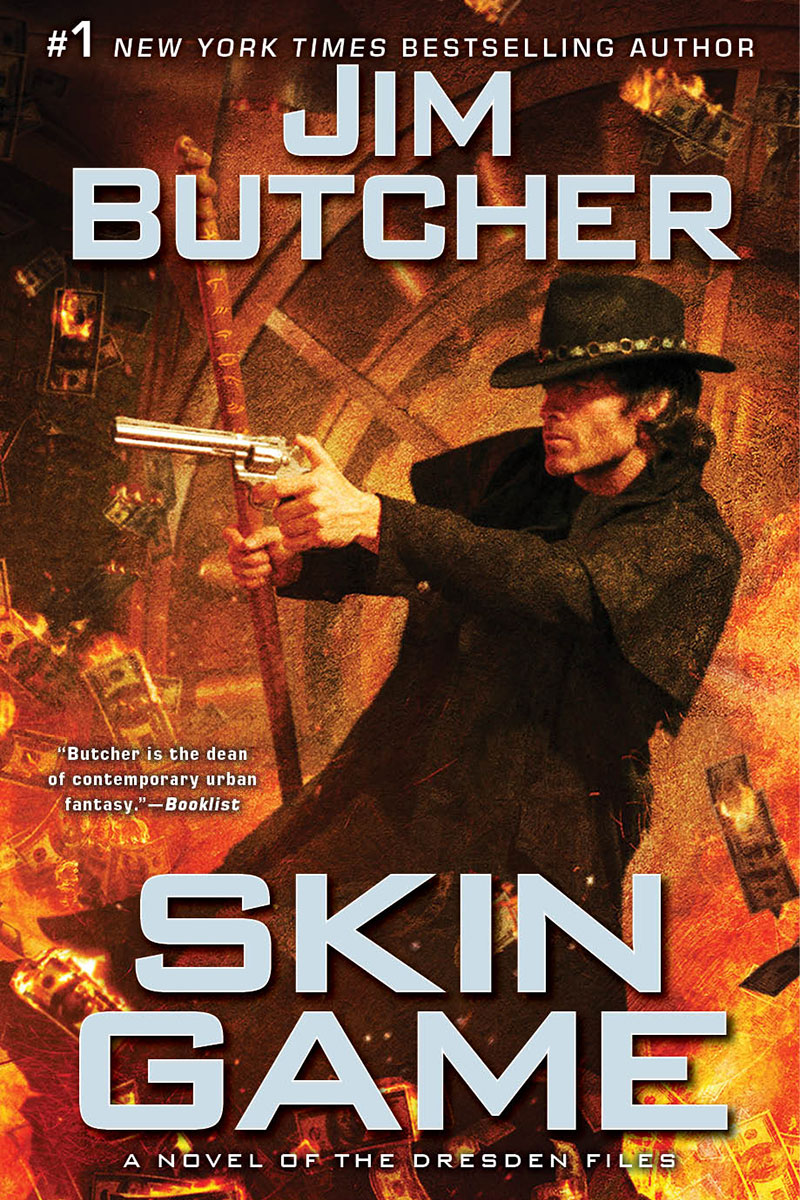
Skin Game (Harry Dresden #15)

Skin Game (Dresden Files #15)
by Jim Butcher

I’ve read lots of book series. I went through a lengthy mystery phase, when I read pretty much every Nero Wolfe book that Rex Stout wrote; I read all the Travis McGee novels of John D. MacDonald — and in both cases I read a few of the knockoffs by imitators, and was unimpressed. I’ve read all of the Wheel of Time, and Stephen King’s Dark Tower series. I read twenty or so of Laurell Hamilton’s Anita Blake books, and every one of the Sookie Stackhouse novels. I read all of the Series of Unfortunate Events, and the Bloody Jack Faber series.

I stopped reading the Song of Ice and Fire after Book 4. Because I won’t put up with that kind of nonsense, Mr. Martin. You publish your books before you make the TV series. At the least, work on both concurrently, sir. I’m using up all of my patience with Diana Gabaldon’s Outlander books; but at least she has to do extensive historical research before she writes each book. You make ’em up, George. I learned from Robert Jordan the risks of waiting too long for a series to end; didn’t you learn, too?

The point is, I enjoy the series. I’ve seen them get better as they go (LOTR) and I’ve seen them get worse (ABVH), I’ve seen them end too soon and too late.

Never — not once — have I enjoyed a series as much and as long as I have enjoyed Jim Butcher’s Harry Dresden books.

It is extraordinary to me that Butcher is able to keep these books as alive as they are. They are nothing but action: generally 400-500 pages, they cover only a day or two, and the entire time is spent in some form of combat, chase, or intrigue. Harry Dresden must be the tiredest man in the imagined universe. And yet, despite fifteen books with the same general outline, they have never gotten boring, nor repetitive; I have never left the edge of my metaphorical seat. The key is that the book is much, much more than action (despite my prior statement): even though Harry never stops fighting, there are many pauses and lulls in between the knock-down drag-out brouhahas, and in these pauses, Butcher has built not only a world and concept of magic that I find as compelling as any I’ve ever read, but also some of the most completely realized characters that I can imagine finding in an action novel. Dresden is not Man-Compelled-To-Fight-By-Need-For-Justice, though there’s some of that, and he’s not Man-Torn-Between-Good-And-Evil, though there’s some of that. Harry is a man, a complicated, flawed, man, both strong and weak, admirable and despicable. (Part of this is the fact that Butcher has had a canvas fifteen books wide to paint this character on. Some of the less prominent but still important characters — Michael, Thomas — are a bit more one-dimensional. But even those sorts of characters have their hidden sides — think of Bob. Mac. Charity.) On top of all that, Butcher has an ability to weave in philosophical sorts of musings, on what it means to be human, to be mortal, to be powerful; to love, to hate, to fight; along with the best sense of humor since Douglas Adams. And his nerd references are a solid 10.0. Funniest thing in this book is when a character starts quoting Monty Python without even realizing it.

The point is, I love these books, completely, unabashedly. I’ll keep reading them as long as Butcher writes them, and cry when he stops. Then I’ll re-read them all.

This book is a heist story. The tension comes from the fact that Harry has to work with his enemies, yet they remain enemies, regardless of any cooperation (Like the Winter Court, though the Fae are not as prominent in this novel.). Some allies come back, out of semi-retirement from the main plotline, which was wonderful; new villains are introduced, who were excellent; there is a fantastic cameo by a god; there is a hell of a plot twist; there is one of the coolest Ascension scenes (When a character becomes something more than he or she was before — like Molly at the end of Cold Days) ever, with one of the best nerdgasm moments of all time.

Best of all? I can’t wait to read the next book. I have to see what happens with Dresden’s daughter.

No: the other one.

Teaching Hard

I’m tired.

I hate the end of the school year.

But let me tell you why.

Teaching requires an inordinate amount of energy. It’s why there is such a prejudice towards younger, newer teachers, and against older, wiser teachers: we all know that both age and inevitable cynicism detract from available verve (By the way, if I ever need a stage name, I’m going to use Available Verve.), and we know (Some of us know) just how much pep is required in this profession.

It’s a lot. Because we have to fight children all day.

I’m just going to leave that image to simmer for a minute.

Aaaaaand now I’ll explain.

Elementary school teachers have to fight to first contain, and then direct, a classroom full of sugar-hyped attention-deficient kidnadoes. Think about what it takes to force a child to eat when it doesn’t want to, to sleep when it doesn’t want to, to take a bath when it doesn’t want to; now think about making them do math. Elementary teachers have to be an unbreachable wall standing against a stampede, an immovable object against 25 — or 30 — or 35 — irresistible forces.

High school teachers have the opposite problem: our classrooms are carpeted with anthropomorphic phlegm-globs, like the spittoon of a frost giant with a head cold, that would rather sleep than breathe (And who would be ecstatic if they could sleep without breathing. Or circulating blood. Except you wouldn’t recognize the ecstasy, as expressing it would, like breathing, be too tiring.), and somehow we need to motivate them to read poetry and study history and solve mathematical equations. We must be an irresistible force for a room full of immovable objects.

In either case, it’s bloody exhausting.

Add in the requirements of pleasing supervisors (who want pre- and post-observation conferences, and PLC meeting minutes, and professional development buy-in) and calming frazzled parents (The most-common phrase a teacher hears from adults is probably “I just don’t know what to do with him/her.” It has always amazed me that I, who am and will ever remain childless, can somehow give out parenting advice without getting a face full of “Excuse me? Who the hell do you think you are?” It’s not because my advice is good, though — it’s because I care enough to give it, because I take the time to try. But this, too, is exhausting, because I am handing over just a little bit more of my time and my energy.) and the endless paperwork and the endless guilt, and you might be able to imagine how tiring this profession is.

But that’s not the hard part.

The hard part is that teachers, more than any profession other than the medical fields, emergency services, and ground-level social work, get emotionally invested in the work. My clientele, if we can call them that, are people. They are children (Though in my case they have beards, breasts, and body odor [Not all three at the same time (Well, not often [See, I can’t even make this joke without feeling bad for mocking them in such a personal way. But as an English nerd, I am very pleased by this:].).].), children that are unhappy most of the time. They are confused: confused by difficult school subjects, confused by awkward romance and even more awkward bodies, confused by changing social alliances and the tidal forces of unstable families. They are bereft of childhood, and lament that lost innocence; they are terrified by a future both uncertain and looming, and avoid everything that reminds them of it. And they are angry, and sad, about all of those things.

In “Dover Beach,” Matthew Arnold described our modern world this way:

…For the world, which seems
To lie before us like a land of dreams,
So various, so beautiful, so new,
Hath really neither joy, nor love, nor light,
Nor certitude, nor peace, nor help for pain;
And we are here as on a darkling plain
Swept with confused alarms of struggle and flight,
Where ignorant armies clash by night.


Arnold was describing a world without faith. That’s adolescence. That’s my students.

I sympathize with them. I remember it. I remember how my world got so very much harder when I became drenched in hormones around 8th grade (though not, sadly, drenched in sex appeal and confidence to match), and then exponentially harder again when I got to high school and, for the first time, had to work hard to succeed academically. I remember my hopes and dreams feeling shattered by reality. How everything seemed so dark, and so hopeless, and so insane. All of my writing at the time was about madness, loss, betrayal, destruction, murder. About fear and anger. That’s all I was for several years, a ball of fear and anger. With pimples. And an erection.

So when I talk to my students, I feel for them, and I want to help. Helping generally means listening to their problems, really listening and then trying to give some sort of useful response. A lot of the time — too much, really — I can’t help, and I know it; but that’s not any easier, especially when it’s because I know they wouldn’t listen to what I have to say, or that I shouldn’t say it because they should figure it out for themselves. Holding the words in is as hard as speaking them. Sometimes it’s harder. When one of my nerdy students — and as a lifelong nerd and a former awkward loner (Perhaps I flatter myself with that “former,” but my wife tells me I’m handsome and cool and funny, so shut up.), I feel the nerds’ pain more intensely — when one of them tells an awkward joke, or says the wrong thing at the wrong time, or laughs like a dork or fails to control their body odor, I want to say, “This is why girls don’t talk to you. This — and your hair.” But I can’t say it. It wouldn’t help. And it wouldn’t be right for me to do.

It’s hard to remember that. It takes effort to remind myself that I don’t have all the answers, that what worked for me won’t work for all of my students, that often they cannot hear me or believe me because of who I am. The key is to remember that they are in the same situation: no one can hear or believe them, either, because of who they are. But even when I remember that nothing I say will help, I still want to help. So I do what I can: I help them with schoolwork.

I try not to give my students busywork, because I want to show that I value their time. So my assignments tend to be lengthier, and more thoughtful. To help them both be successful and feel confident, I try to read everything they write, and give the best feedback I can; I am known for writing more on some essays than the students themselves. I respond to their thoughts more than the form of them, the grammar and syntax and vocabulary, because the ideas are the important part and also, much of the time, their strength.

But all of that takes time and energy. If I just gave them worksheets all day, I could grade everything in five minutes — or even give them to a T.A. to grade. Or my wife, who loves grading. She likes the power of the red pen. But because I give them extended questions and thought-provoking assignments, and because I want to respond to their thoughts, it means I have to grade everything myself, and I have to read everything, and I have to pay attention while I’m doing it.

And then I have to try to fix their problems. But it’s just like fixing their life problems: sometimes I can’t, and sometimes I shouldn’t; and even when I can and should, it takes time and effort. At least when they come to me with their life problems, they want an answer; but when the issue is that they don’t know when to use a semi-colon or what the point of The Odyssey is, they don’t generally want to deal with fixing that problem; they just want it to go away so they can sleep.

This is probably the worst thing: that when I try to help them, by making their assignments more meaningful and effective, they want me to give them work that is easier. They want worksheets. Because they are tired and stressed, and they don’t want to think, and if I’m trying to be helpful, why can’t I just give them easy stuff to do, or even better, no work at all? Why do I have to make them think all the time?

That’s why they turn into a sticky layer of marshmallow fluff melting over a desk. And then it’s up to me to motivate them, to scrape them up, mold them back into a vaguely humanoid shape, and crack open their brains so I can pour in the knowledge.

Except that’s not actually the way it works. I have to get them to think. Which means I have to get them to want to think.

Which is hard. And it makes me tired.

So then the end of the school year comes slouching towards us. They’re tired and sick of school, and thus that much harder to motivate. I am exhausted myself, and so now I need to do two motivatings: I have to perk myself up to perk them up. God forbid I have seniors, because then the inertia of the Senior Slump becomes quite simply insurmountable. And, though I don’t want to set myself up as being different from other teachers, I do have a couple of added difficulties that I don’t know if they share: first, I didn’t and don’t like school (though I love education), and so the glamor of the end of the school year, the proms and the yearbook signings and the graduation ceremonies, all fail to cheer me; and second, I don’t want to use grades as a means of motivating my students.

I don’t believe in it. Too much emphasis is placed on grades already for this very reason, so that they might be a more effective stick and carrot for tempting and prodding the phlegmatics. (That’s the name of my new band, by the way. The Phlegmatics. Available Verve and the Phlegmatics.) But grades are deceptive: they are an inaccurate measure. If a kid gets an A in my class, was it because of hard work? Natural ability which made effort unnecessary? Is the kid a successful cheat? Was it because my class was too easy? Because this kid had the advantage of a stable home life, with enough money for food and clothing so that this kid didn’t have to work 20-30 hours a week after school? Was it because this kid has learning disabilities and consequent accommodations?

Grades do not help students learn. Grades teach students to game the system. My students focus on large assignments rather than small ones, because small ones don’t change grades as much. But without the practice that comes from doing small assignments, and the steady incremental improvement gained thereby, they don’t do very well on the large assignments. So they ask for extra help. They ask if they can do work over again for a higher grade (Meaning I have to grade it a second time, after reading it a second time), or ask if I can look over work before they turn it in (so I can look it over again) and tell them what grade it would get (Before I grade it again, officially). They hunt, like pigs after truffles, for extra credit. And, of course, they cheat. Not because they’re lazy or stupid, most of the time, but because they don’t think they can do the assignment well enough to get the grade they want. And much of the time, they’re right — again because of the lack of steady incremental progress. That’s what grades do: they focus only on the ends, and thus destroy the means. They harm education. They replace education.

And then because we use grades as carrot and as stick, they cause stress, for students, for parents, for teachers, for schools. And that makes everything worse: my students are more miserable, and more exhausted, and so am I, both from their stress and from my own. Which is always worst at the end of the year, when the grade becomes THE GRADE.

I don’t want to add to their stress and misery. I don’t want to scare them. So I don’t hold their grades over their heads. They’re up there anyway, that sword of Damocles called THE TRANSCRIPT and THE PERMANENT RECORD, but I don’t point to it and put on my angry face. (Full disclosure: my own transcript, which was pretty ugly, hurt me exactly — none. Affected me not at all. Which is part of the reason I don’t try to use grades as a stick, because they meant zip to me personally back when I was a rage-horn-ball. But again: does that apply to all other people? Probably not.)

Unfortunately, that means I have to find some other way to motivate them. And the best one — the only one — requires of me a higher output of energy. I have to make the class, and the work, interesting. To teenagers. I have to make it useful, and also fun. I have to treat my students like the unique feeling individuals they are, and I need to show them that what matters is the thinking and the learning — not the grades.

I have to do that five times a day, every day, for ten months. And the farther we get into the year, and the closer we get to summer, the harder it gets.

I hate the end of the school year.

I’m tired.

We Are Pirates Review

We Are Pirates by Daniel Handler

That’s it. I’m never reading a sad book again.

I don’t know how people do it. How do you all read literary classics and modern mainstream novels, and enjoy them? How do you read them one after another? I mean, John Steinbeck is one of my favorite authors, but how do you go from Of Mice and Men to The Grapes of Wrath without reading, say, The Hobbit in between? I can’t do that. I’ve tried for years, I have a degree in literature, I’m an English teacher, I’m a book reader and reviewer, and an author: I know that there is a certain prestige that attaches to the great novels, and almost every one of them is sad, is tragic. But I just can’t do it any more.

I got this book because I loved the Lemony Snickett books, and because I love pirates. Stupid, I know; but why not? The Series of Unfortunate Events (Also sad — I’m aware that I should have paid more attention to the very obvious clues) was genuinely well written, and pirates are not only fun (But also sad: because the average lifespan for a Caribbean pirate was about two years, before they died of disease, alcoholism, or a “short drop followed by a sudden stop.” Like I said: many clues.) but also fascinating, because they represent savagery, and also egalitarianism, among other things. Escape, and rebellion, and a final middle finger to a cruel world.

This book was exactly that. Daniel Handler captured not only the world of the pirate, the anger, the pain, the fight against all conformity and thus against all society and even against humanity itself; he also captured the modern world — and thus made me long to be the pirate, even while I sorrowed for those following that path, pitied them their rage and their pain. And I raged against those who tried to contain the pirates; and then I felt their pain, as well. Because as Handler points out, with the title and with the entire book: we ARE pirates. We all are. We are.

The book is good, damn good, maybe even brilliant; I just finished it minutes ago and maybe don’t have the perspective to really grasp all of its insights and nuances. But I laughed at passages, I recognized people, I loved and hated and felt contempt and pity for the characters and their lives. It’s written the way a book should be written, and it’s about a great subject — not only pirates, but also family and children and growing up and careers and ambitions and dreams and, of course, disappointments. It’s got a wonderful twist at the end, which changes your understanding of things; more than one, actually. It is multi-layered and complicated, but nonetheless still easy to read, and it has some beautiful flourishes and original creations. This is a very impressive piece of work.

And it’s sad. And I’m done.