Book Review: Three Dark Crowns

Image result for three dark crowns

Three Dark Crowns

by Kendare Blake

This book got me. Got me good. If we had been fighting a duel, I would have bowed my head, said, “Touche,” and apologized for however I had given offense. And then probably applauded my honorable opponent for the impressive victory.

And then the next thing I knew, I’d be flat on my back, completely stunned, looking up at the book smirking over me, hearing the onlookers making shocked noises at how badly I had been slammed. Because just when I thought the book was done – it wasn’t done. It was just setting me up for the knockout.

All right, enough metaphor: let’s just get into it, shall we?

This is a young adult fantasy novel, one with young female protagonists and a fair amount of romance and social drama – friendships being made and broken, trusted advisors turning traitor, and so on – and so it would most likely appeal to young female fantasy fans. But I am only one of those things, and I enjoyed reading the book, so don’t let me pigeonhole it: it’s a good fantasy novel. It’s the first in a series, so it’s setting up the world and the long-haul plot; both are interesting. The world is based around a magical island, hidden by mists and guarded, so the people believe, by a goddess. This goddess creates a new group of potential rulers for the island once a generation, and that group is always the same: a set of triplets, all girls, born to the previous queen.

The difficulty is that only one of the girls can become queen.

The other two have to die.

The other key factor here – and honestly, the part of this book I had the most trouble with (Other than the portrayal of a couple of the teenaged boys, who were idiots or cads, but I’m not going to complain about that because Lord knows there have been more than enough fantasy novels where the female characters are the crappy ones, and it’s certainly not all the guys in this book who are twits; just two, one idiot and one cad. I’ll just shut up and take my lumps.), because it doesn’t work terribly well – is that each of these triplets has a magical power. There are three main magical powers on the island, grouped into houses; whichever house has the triplet who wins the crown becomes the ruling council for the length of her reign. The three powers are: elemental control, animal telepathy, and – poison.

Look, I don’t mean to be one of those comic book guy, gaming fantasy nerds who complain about a fantasy world being not as good as, say, Tolkien; but this honestly felt off to me. The animal telepathy I’ve got no problem with; there’s not an epic fantasy story in the world that hasn’t made me want to pull a Doctor Doolittle. I want to speak to the Eagles like Gandalf, and run with the wolves like Perrin Aybara, and communicate with dragons like Daenerys Targaryen. So that power was great. The elemental power seemed overbroad, because that queen can do everything: she can bring storms, she can bring earthquakes, she can dance wreathed in fire. And on the other hand, the poison-powered queen can, umm, eat poison. And not die. That’s it. Seems lame in comparison. Also not terribly useful in a magical duel to the death. So I admit, that bugged me a little, particularly because the story is about these three girls approaching the age when they are supposed to start fighting over the throne, meaning they have to kill each other; and really, what are the odds here? The animal telepath can control animals and send them to kill her sisters, and the elemental sister can bring fiery wrath from the skies; the poison sister can – not die while she eats poison. I really couldn’t make that work well in my head, and so it was a bit of a stumbling block.

But here’s the thing: apart from that, the story is great. The girls have different power levels, which means some of them expect to die and others expect to kill their own sisters; and neither is a good place to be. That tension is very well done. The desperation of the weaker sisters to find some way to make their powers sufficient to survive and even kill, that’s also well done. And all of the intrigue, the social interactions, the boys hovering around them trying to become the consort of the next queen (which also means they have to bet on who’s going to win this fight), that was very well done. I liked all of that. I liked all three of the sisters’ characters, even though they’re all entirely different. I was trying to think of a way out of the conundrum they were in, and regretting that I couldn’t; that’s a sign of a good piece of writing, when it leaves the reader looking for a solution to the conflict.

But then: then it got me. At the very end (and no spoilers), an event happened that I pretty much expected, though the means of it was a surprise. But it turned out to have a twist, which I really didn’t expect; Blake set this plot up so well that I was genuinely thrown when the twist happened.

BUT THEN THERE WAS ANOTHER TWIST! Completely unexpected, totally out of left field. And that one, hooooooo BOY – that was the one that knocked me on my ass. But it was great, because it also changed the way I saw the book I had just read: I went from thinking it was okay, to finding it much more interesting once I had this new piece of information. And the best part about it was that it set up a whole different expectation for what would happen in the second book, which means that, of course I have to read that one, now.

So this was a good one. I will want to read the sequels before I recommend it entirely, because I’m not going to recommend a fantasy series that doesn’t end as well as it starts; but this was definitely a promising beginning.

Book Review: Mortal Engines, Hungry City Chronicles #1

Image result for mortal engines

(Also, see that hot air balloon on the cover, with the tiny gondola the two characters are in? Not at all how the airships are described.)


Mortal Engines (Book One of the Hungry City Chronicles)

by Philip Reeve


I kind of hated this book.

Not everything about it. Some things in here are wonderful. The concept is fantastic: a future world where cities are mobile, enormous steampunk structures on wheels, rolling around in the wasteland that is all that remains of our world, destroyed (of course) by World War III and hyper-advanced war machines. These cities follow a philosophy of “municipal Darwinism” (great name), which teaches that the largest, strongest city will devour the smaller cities. It’s a “town eat town” world, and the mobile towns do exactly that: they capture the smaller, slower towns, swallow them, tear them apart and use their raw materials as fuel and building materials to maintain and expand the larger town.

That’s a cool idea.

The main town in the story is London, and London is now governed by four Guilds: the Historians, the Navigators, the Merchants, and the Engineers. The Historians, who comprise both doddering old museum relics and Indiana Jones-style explorers who search through the wreckage of ancient civilizations to find useful artifacts from the time before the wars that ended everything (This is our time, of course, and the Frankenstein We-let-our-technology-advance-too-far-and-it-destroyed-us theme is vigorous in this book), are sort of the main protagonists, and the Engineers, who care about nothing but power and control, as those engineers would, are the antagonists. There is also the Anti-Traction League (the moving cities are called “traction cities”), which have settled in parts of the world not dominated by moving towns nor devastated by ancient wars, and they oppose the traction cities as a whole.

This is fine and good. I was a bit annoyed by the stereotypes of the heartless engineer and the hapless-but-wise-and-kind historian, but I like the plotline that involves the Lord Mayor of London and his megalomaniacal schemes, and the discovery of a new doomsday weapon that allows his city to destroy any other; the weapon is actually a rediscovery from the ancient times, and I thought the book handled that well, particularly at the end. (Though there are some pretty severe plot holes, especially regarding the time lapse between the ancients and the traction city era:  it’s been like two thousand years. So really, the ancient technology? It just wouldn’t work. At all.) I like the Anti-Traction League, and I particularly like the subset of non-city-dwellers who live in the air: this being a proper steampunk novel, there are airships galore, and even a flying city, and those parts were great.

No: I hated the characters. The specific characters who play the roles of hero in this book are half crappy, and by the end, half dead. I won’t say which group is which so as not to spoil, especially since this book is now being made into a movie by Peter Jackson, who probably won’t be able to save this thing, in my opinion. However, since the book won oodles of awards, I suppose most people liked the characters a whole lot more than I did. But really, they aren’t good characters: there’s one who should hate everything London is doing and all that it stands for, but at a crucial moment, this character freaks out on those who want to stop London from destroying everything good with its doomsday device; and then later the character realizes, “Hey, wait – London sucks! I should do something about that!” But this epiphany comes at an entirely random time, and is annoying because of that; I would think that the betrayal by a Londoner whom the character worships would have changed the character’s mind, or maybe when the two main characters are tricked and enslaved by a traction city; or maybe when they are captured and abused and threatened and nearly killed by a bunch of half-insane traction city pirates. No: it’s while the character is – climbing stairs. It’s ridiculous.

The other big problem for me was the writing. Half of the characters, good and bad, are entirely unbelievable; their emotions and motivations don’t make a lot of sense. There are a ton of cliches and platitudes, and some of the descriptions and action sequences are just not well done.

And then, at the end – he killed the fucking dog. That’s right: Philip Reeve kills the dog. No reason, either; we already hate the people who do it, and the character who I suppose is intended to be inspired to murderous vengeful rage by the death of the dog WAS ALREADY AT THE POINT OF VENGEFUL RAGE. It’s an entirely gratuitous dog-killing. And I don’t mean to overstate how much this bothered me, because I was already annoyed by the plot holes and the poor characterization and the mediocre writing – but really, that moment just took the cake. And then for the next thirty pages until the very end (when almost every other sympathetic character dies, too), Reeve kept mentioning the dead dog: the dog’s owner kept looking around for the dog, kept expecting to hear the dog’s footsteps, but no, because the dog was dead.

Screw you, Reeve. Dog killing crap writer.

No, that’s too strong. But really, I didn’t think much of the book. I wish someone else had thought of this idea and done a better job writing it. I hope the movie is better, but I won’t be watching it: because they’ll probably kill the dog.

Book Review: Ship Breaker by Paolo Bacigalupi

Image result for ship breaker

Ship Breaker

by Paolo Bacigalupi


I wish I’d written this book. And not just because I wish my last name were Bacigalupi – though I do wish that, too. This is the kind of book I wish I could write: it’s an outstanding idea, it’s a fast-paced thriller, and it has a wonderfully relatable hero that made it possible for me to feel like I was in the story, along with characters that hint of far greater depth to the world, which makes me want to read the “companion” book, The Drowned Cities. And I probably will.

On the other hand: because there are hints of depth to the world-building, and especially to the most interesting character, the half-man Tool, which are left entirely out of the story, I feel like this book was just gutted by editors who wanted to pick up the pace and cut down the word count so it would sell better. I know that if I had written this book, it would be at least twice as long, and so I’m kind of glad that I didn’t write this book because I would hate to have my book cut in half – and then have it be successful? Have it be a finalist for the National Book Award? That would drive me crazy. I realize, of course, that the success and the accolades that accrue to a book this short with this rapid pace tells me something about my own writing – it’s too wordy and slow to ever enjoy this kind of sales in the modern market – but I still hate the idea of taking out all the good stuff to pander to a readership that gets bored inside of fifteen seconds.

(There’s a lot of background to this, by the way. I’ve written four novels, all of which have been repeatedly rejected by agents and publishers; the two times I’ve gotten interest in short samples and sent in longer portions of the work, I’ve been rejected both times after a second reading because my writing is too wordy and too slow. Rather than cut out half of my stories to make a book like this one, I’m self-publishing my long works, because fuck ’em if they like their books short. Yes, I’m an idiot. But I also wish that prizes like the National Book Award didn’t go to the short fast books. Though this one is probably good enough to deserve to be a finalist even in its presumably truncated form. And maybe I’m wrong all the way, and Bacigalupi wrote it exactly like this. But I wouldn’t have, so there it is. I’m bitter, and he’s successful. Moving on.)

The story is set in this wonderfully real and timely dystopia: climate change has raised sea levels and created Category 6 “city killer” hurricanes, and corporate capitalism has so run amok that it seems to be the only basis of social organization; all else is might-makes-right anarchy. The story mainly takes place in a beach – uh, I guess it’s a “community” – in the Gulf of Mexico; the beach is strewn with the rusted remains of the old steel ships, cargo ships and oil tankers and the like. Oil has now become rare enough that it is no longer how cargo is moved: the modern cargo ships are sleek hydrofoils called “clipper ships,” and they sail with wind power – jet stream winds, that is, since they have huge sails that they launch, with cannons, several miles up into the stratosphere. And the people in the book make a living by ripping the old steel ships apart for salvage. Hence the title.

The main character, Nailer, is a teenaged boy who lives a hard and brutal life among the ship breakers. This is where the writing really shines, because Bacigalupi has created a society where environmental and economic devastation has made life a thousand times worse than it is in our world today – and yet, the problems on the human level are exactly the same. (I have no doubt, as well, that there are places in the world that are pretty much exactly like this place, and it’s only science fiction to me because I live in the sheltered part of the world. Like Lucky Girl in the book.) Nailer’s mother is dead and his father is a violent drug addict; Nailer has to work to earn his own food and possessions, and he is constantly having to prove himself or else someone else will take his job and he will starve – he can’t take time off when he gets hurt at work, for instance, or he will get replaced. Nailer lives in a dog-eat-dog world, where everyone fights everyone else for everything they have, all the time. Almost no one is willing to help anyone else, because it puts themselves at risk; we see this early in the book, when Nailer, whose job in ship breaking is to crawl through the duct work and collect copper cable, gets trapped in the depths of a derelict ship, and when he turns to another person for help, he is refused and left to die. His death would be more profitable to the other person than his life, and so that means – Nailer is left to die. (Spoiler: he doesn’t.) Because that is his world, the most important thing to him is loyalty, and the greatest virtue is – kindness. Generosity. It is the rarest quality, and so it is prized.

That leads Nailer into the main conflict, when a modern clipper ship is wrecked on their beach, and Nailer discovers it – and the survivor aboard, one of the people from the other side of the world, where wealth protects and shelters you from all of the terrible conditions that Nailer lives with on a daily basis. And again, despite everything else that is going on in the world and around them, the things that matter at that point are loyalty, and kindness. That’s the story of the book.

There’s more: but not enough more. The story ends with the resolution of the main conflict, but it ends right there; you don’t get to know what comes next, even though a number of things change, in very important ways, for the main characters. The half-man, Tool, is a great creation; the half-men are genetically altered mixtures of human and canine DNA, and they are fanatically loyal to their owners, even dying, samurai-like, when their master dies – except for Tool, who has no master but himself. He’s a remarkable character, and I desperately want to know his backstory, but I never get it; he also vanishes at a certain point in the book, and we never find out what happens to him, which also drove me batty, and is the reason I think the book got the crap cut out of it before publication. And I understand the need for a book to be fast-paced and exciting, especially when it’s YA fiction like this one; but dammit, I want to know Tool’s story. I want to know what comes next in Nailer’s story. I want more of this book!

Ah, well. This is a good book, a fast read that I enjoyed quite a lot. I definitely recommend it. Though I hope that people also look for and buy the books that go more in depth, that give a reader something to think about beyond the bare essentials, that give you a world and characters you can sink your teeth into. (Maybe buy my books, for instance. They will be available soon. Don’t worry: I won’t turn every review into a sales pitch. Just this one.)

Book Review: Lloyd Alexander’s Westmark

Westmark

by Lloyd Alexander


I grew up reading the Chronicles of Prydain by Alexander, and I only discovered as an adult that, in fact, the man wrote several other books. It’s been a lot of fun discovering and reading those other novels, even though it makes me feel kind of dumb that I didn’t already know about them; after all, Alexander won two National Book Awards and was nominated for four more, so . . . I guess everybody but me knew about his broader legacy. I would like to blame my parents for not telling me about Alexander’s other books. And also Piers Anthony, who so captivated my youthful love of fantasy that I read every single one of his books. Including his genuinely crappy autobiography, Bio of an Ogre.

Blame and castigations aside though, this is a genuinely good book. It is more adult than the Chronicles of Prydain: it really only belongs in fantasy because it’s Lloyd Alexander. He never writes with too much magic, but this book has none; rather, it has – politics. It’s about a printer’s assistant, Theo, who goes on the run after his master Anton is killed by the military as part of an attempt to control the press. The printer’s assistant hooks up with a con man and snake oil salesman who is a mixture of Shakespeare’s Falstaff, and the King and Duke from Huck Finn; he’s a big, bombastic, lovable rogue who makes no bones about the fact that he’s in it for the money and will tell whatever lies he can in order to get it. He’s a lot of fun and he makes the book a lot of fun.

It isn’t all fun and games, though: the fear and anger over the printer’s death and the subsequent flight are quite serious. Theo eventually parts ways with the con man and joins up with a group of intellectuals leading a rebellion, who are a great set of characters; the last third of the book is a quite realistic portrayal of the beginnings of a revolution, including Theo’s efforts to print anti-royalist pamphlets as his own efforts to free the people. Yeah: definitely not a simple children’s book.

The book leans more fantasy in the royal aspect of the politics: although there is a definitely historical feel in the elements about revolution, the causes of the nation’s oppression come straight from a fairy tale. The king is bereft and despondent to the point of uselessness over the death, several years ago, of his beloved only daughter. An evil counselor – I definitely think of Jafar from Disney’s Aladdin, or Flagg from Stephen King’s The Eyes of the Dragon – has taken over running the kingdom, and is trying to consolidate power for himself, becoming a tyrant in the process. He is overcome not by the revolution, but by the direct actions of our hero, who essentially saves the day – though there is a twist I won’t give away.

It’s a good book. The characters are well-drawn, as is the setting; the plot is a little haphazard, which I think is because of the mix of fairy tale and historical novel, but it isn’t hard to follow. And the other reason for the somewhat complicated course of the story is: this is the first book of a series of three. So there are seeds planted here, paths started but not taken to their ends, because there is more story to tell.

I’m going to try to find the other two books. I recommend this one.

One last note: the biggest downside of this book, for me, was honestly the cover. I hated this image, and the way it depicted the characters, so much that I tried not looking at it while I was reading the book, and even now I can’t stop thinking bitter thoughts. Yech. But of course, don’t judge this good book by its crappy cover.

Book Review: The King of Messy Potatoes by John Dashney

Messy Taters

The King of Messy Potatoes
John Dashney

You know what? I’m just happy I found this book.

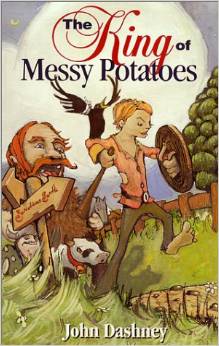
I picked it up at a library book sale. I bought it because the cover image is both sweet and, for me, evocative: a boy marching with stick in hand and shield on arm, with a line of friends and companions by his side: a cow, a giant, a viking, a crow. This is what I imagined as a child. I read Tolkien and Alexander, Lewis and Anthony, and in every case, the story really revolved around the journey: the journey, and the companions. As a fairly solitary child, that was what I wanted. So I had to get this book. Plus: how could you ignore that title? I love potatoes more than I love epic fantasy. If given the option, I would certainly pour gravy on this book and eat it. Who wouldn’t?

For even more fun, the author has written several young adult adventure books, is self-published and small-press published, and this book is signed. It’s perfect.

Now as for what was inside: that was good. I won’t say it was perfect, but it was good — far better than most small-press, self-published authors I have encountered. This book hits a beautiful balance between fantasy and reality, using a frame story about a boy and his grandfather, an aged Episcopal priest and scholar who is writing a history based on Biblical times, a book about the kings of Mesopotamia. Which the boy hears as — Messy Potatoes. (I am proud to say I actually made that connection before I started reading, when I picked up the book and considered reading it next. I am impressed that Mr. Dashney actually had this idea and saw the beauty of it.). The boy asks about it, and though the grandfather laughs, he agrees to make up a story about the King of Messy Potatoes for his grandson.

Then we get the story of Spud. Spud lives on a very special farm, though he doesn’t know it. He doesn’t know much of anything, other than how to grow good potatoes, and that his older brothers are dimwits and the local nobleman is a jerk. But then Spud meets a new friend: a crow, who, if he bites someone and tastes their blood, can speak that person’s language for a full day. This crow tells Spud the truth, and helps Spud to begin his adventures, and pursue his destiny — as the King of Messy Potatoes.

Both of these stories are successful. The frame story of the boy and his grandfather is sweet and heartfelt, and rings very true — especially to me, with my staggeringly erudite and somewhat distant (because eminently dignified) grandmother, who nevertheless loved me dearly. The story of Spud is exciting and amusing and fun to read, and you want to hear both sides of this as you go through it.

It isn’t perfect. There are parts of Spud’s story that are a bit too short, and feel like they’re there just to fill space without really adding anything; the Viking part, for one. The villain is a great idea, but isn’t really pursued completely — understandable, as this is a young book, but still: kids understand evil, and hearing about evil that is vanquished is a good story for any age. Spud is given a dialect that just doesn’t fit and doesn’t make sense, neither for the character nor for the “author,” the Episcopal scholar grandfather. And at the end, I want to hear more of the story of the King of Messy Potatoes, but I never will. Which is too bad.
But overall? I was very lucky to find this book. It made me happy.