This Morning

This morning, I think I have an answer to my question from yesterday morning.

Yesterday, I was wondering what I could say to my wife, to my students, to myself, that would help comfort us in the face of inevitable suffering, and I wished that I could rely on God as that answer, because then I could at least stop thinking about it — and I should have said worrying about it and fretting about it, because that’s the point; it’s not the idea of not thinking, it’s the idea of “let go and let God.” Which I can’t do, but I appreciate that people can.

But I have another cliche that I have gleaned from outside of the fields of the Lord (And that enormously obscure reference is brought to you by the podcast I’ve been listening to, Sunday School Dropouts. Probably also why God has shown up in this atheist’s morning ramblings.), that as I understand it, many churches focus on as the heart of their message (and others may sprinkle in, in between railing against homosexuals and abortion and Democrats in Washington), which is this: God is love.

Once again, that doesn’t work for me. But it comes with another way of looking at it, that I think does fit in nicely with what I’ve been looking for:

Love is God.

That is to say, love is everything. Everything that matters. It is the alpha and the omega, it is the answer to all questions, all doubts and fears. Love. And love, I think, can offer an answer precisely as satisfying  — and not any more satisfying — as can the answer “God.”

What should I tell my students when the future looms ominously over them? Love. Look for love in your life, look for love in what you do; if you don’t find any love in your life, then change it, and if you don’t find any love in what you do, then stop doing it. Don’t work for money, work for love: and I don’t mean to be flippant there, because I am a person who works for money precisely because he cannot live on what he loves; but for me, the money I earn is spent on those I love, and used to give me an opportunity to do what I love, which I am doing right now. So I never mind my job very much, because it is done for love, if not always in love. And yes, sometimes I love my job: I do love books and poetry, and I love writing, and I guess I don’t entirely loathe my students. (No, I love some of them. More, I love the people they become, and the potential I see in them when they are young.)

What do I tell myself when I am in my darkest, foulest, most hopeless moods? Love. I have lost some of my liberal idealism in these last few years, and I have begun to lean a wee bit more conservative; it has made me worry, because I know that this is a common pattern, especially among aging white men, as we start to get a taste of power and become greedy and start worrying about people taking away what we have. And I do not want to be that guy. But I think that so long as I focus on love, so long as my actions and intentions are begun with love in mind, then I won’t turn into someone I would hate. At least some of my shifting to the right is based on the consideration that people on the right can’t be bad people, can’t be evil people, not all of them. (Trump is.) Not any more than there are evil people on the left. It’s not reasonable to take a person’s political leanings as the sole evidence of their morality or their value, or anything else apart from their political leanings; evil people are conservatives, conservatives aren’t evil people. Thinking that makes me give some conservative ideas (like the free market and lower regulation, the independence of states and, perhaps most shocking to me and those who know me, the value of the Second Amendment) the benefit of the doubt, and that makes me move away from my liberal roots.

But that doesn’t matter. It doesn’t matter if I’m a liberal or a libertarian or a moderate or an anarchist: so long as I consider what is best for my fellow men, and treat them always with respect and with love, then my ideas will never be bad, even if they are wrong.

I also need to remember this for myself when I am disappointed in my writing career. When I think about how old I am compared to other writers, and when I realize how good I am compared to some other writers — and then when I think about how entirely devoid of success I am compared to most other writers; I need to remember: love. I do this because I love it, because I love the me who does this. And so long as I write for love, with love, and out of love, then I can’t be a failure. I am a writer.

What do I tell my wife when she worries about our future, about what we’ll do for money, about where we’ll live, about how we’ll see the world and how we’ll live in it? I will tell her, as I do as often as I possibly can, that I love her, without limits and without end, and that I always will, and that love will see us through, no matter what else happens. Always. Love.

It doesn’t solve the problems we all face. But then, neither does God. I hope that it brings you some comfort, as it brings me some. I hope that it gives us all the strength to keep fighting towards our goals, and I hope it keeps us from hating those who fight against us, or at least in the opposite direction. I hope that the love in your life is enough to make you smile, as it is for me, even on a Monday morning.

Thank you for reading what I write. I won’t say I love you, because I don’t know you, but I love the fact of you and the existence of you, and what you give to me. Thank you.

Now go love!

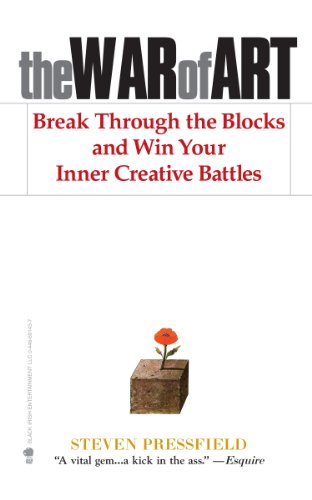
Book Review: The War of Art

Image result for the war of art

The War of Art

by Steven Pressfield

In retrospect, I should have known from the foreword that this was the wrong book for me: Robert McKee talks about art like it’s a war that Pressfield will help me to win; and while I think art is a struggle, I really don’t think it’s a war; indeed, as I am a pacifist, couching things in warrior’s terms is just going to push me away. He also references golf as evidence that Pressfield is a consummate professional (Pressfield wrote The Legend of Bagger Vance, which I have neither read nor seen; I guess it’s about golf? I guess Pressfield likes the game? But he writes anyway instead of playing, which – I guess is impressive?), and there’s the second best way to alienate me. He talks about tearing up over the Spartans’ death at Thermopylae, which was the subject of Pressfield’s other big book, Gates of Fire, which I did read, and did like quite a lot – but it didn’t make me weepy, and I don’t know what it has to do with inspiration to make art. So I’m really having trouble relating to this foreword author – and then he ends his intro with this:

“When inspiration touches talent, she gives birth to truth and beauty. And when Steven Pressfield was writing The War of Art, she had her hands all over him.”

Creepy sexual metaphors, especially about things that are not remotely sexual – like the act of putting words on a page – that is the number one way to make me say “Nope.” So I should have known.

Let me say this, though: this is a book intended to inspire artists, to help people break through creative blocks and create art they can be proud of. I can’t think of many more noble things to try to do, and I appreciate Pressfield’s earnest and genuine attempt to give people tools to do what they should be doing. So: if you do appreciate sports metaphors, and war metaphors, and you like a good, strong pep talk – or as the cover blurb calls it “A vital gem… a kick in the ass,” (which also should have been a warning sign for me) – then please ignore this review, and go get this book. I hope it helps.

It didn’t help me.

There are moments when I agree with Pressfield. He talks about questioning his writing, and feeling hopeless, and the strength and stamina it requires to push through all that and just keep working. He calls it work, and talks about how important it is to just keep putting in the hours, to keep trying, to keep seeking to hone your craft and do the best you can – but first and foremost, to just put the goddamn letters on the goddamn page, and to never give up. And I agree with that entirely. He talks about how he was in his 40’s before he found success, and how it came from an entirely unlikely source, which was, logical or not, simply the book he had to write at the time; and as a 44-year-old writer who is working on his second novel about a time-traveling Irish pirate, I appreciate everything about that.

But then there are the places where he talks about being a Marine, and how other servicemen in other branches are weaker than Marines because Marines love being miserable (This is a metaphor for how artists should be: willing to suffer and be miserable. I kind of see that. This whole Marines-have-bigger-dicks-than-other-soldiers? Nah.) and the other services are soft. Where he talks about writing and art like it is a war to be fought and won; or an animal to be hunted and then eaten; or a football game where you have to “leave everything on the field.” And I hate all of that. He talks about the urges and habits that get in the way of art as Resistance, and that’s pretty good, but he also talks about how like not cleaning your room is a way to lose to Resistance, and – what? And how golf is an art, and Tiger Woods is the greatest artist of all because he can be interrupted mid-swing, stop his swing, and then refocus and hit a golf ball really hard and – I fail to see the art in that. And he says that mental illness, depression and anxiety, are not real, but only a failure to combat resistance, which can be overcome by determination and the earnest pursuit of one’s true calling, and hey, fuck you, Pressfield.

He’s got a strange (And contradictory) section where he tries to talk about thinking territorially instead of hierarchically, and basically he means you should do what you think is right rather than worry about what other people think is right, and okay, sure – but first, he says elsewhere in the book that he knows he’s written well when his family is pleased and proud of him, which is hierarchical thinking by his own definition and explanation, so either he’s a REALLY bad editor who missed that continuity break, or he’s full of crap in one of these places; and second, his example of someone thinking territorially is Arnold Schwarzenegger going to the gym. Which is both weird and not at all artistically inspiring. It gets really weird in the third section, where the devout Christian Pressfield (Though he also admires the ancient Greeks so damn much that he seems to kinda want to worship Zeus and Apollo. I can’t really disagree with that, though I wouldn’t pick the same gods.) talks about angels who help inspire artists to work, because God wants us to create beautiful things for Him to admire, and how everything an artist is comes from God and we should understand that we contribute nothing, that we are only the vessel through which the divine will is worked. I mean, when we’re not being hardcore fucking Marines. Or hitting 310 yards off the tee. Otherwise, though, we should be all humble before God. It is not quite this Christian – he really does admire and know a lot about the Greeks – but it does read that way, as a repudiation of human accomplishment and a glorification of the eternal Whatever. And as an atheist and a part-time humanist, I am not at all down with that.

This thing reads exactly like what it is: a privileged Baby Boomer looking down on everyone else who doesn’t have all of his privileges; and by the way, he says some interesting and intelligent things that show me he really is an artist like me. Just way more of a shmuck. Hoo rah.

This Morning

This morning, I am thinking about books.

I have too many books. I have too many books and I don’t read enough. I have a hard and demanding and time-consuming job, one that is important to me to do well, and so that takes up a ton of time and energy; maybe the worst thing about it is that my most-free time is late at night before I go to bed — but I can’t read then because it puts me to sleep. Which sucks because I want to read! And it also makes me feel like a lame-o who doesn’t care enough about reading, I mean, if I loved reading enough, I wouldn’t fall asleep doing it. But that’s dumb, because reading relaxes me, and I’m tired, et voila. Nodding off mid-page and dropping the book, which I do all the time. Scares my dogs. Though fortunately I rarely hit myself in the face. Not never; but rarely.

I also have this second job where I’m trying to write books. That also is draining and difficult and time- and energy-consuming, and so the two things together leave very little time for reading. This one gives me a strange feedback loop, too, because while I want to read as much as possible, as it gives me inspiration and fodder for writing, that means that when I read, it makes me want to write, so if the reading is going well that’s generally when I stop reading to write. Conversely, if the writing is not going well, it makes me want to read more, but then I also feel bad for not getting my writing done, because as much as I want to read, that is still my avocation, my hobby, my peaceful relaxing thing; it’s not my job. I don’t have goals and ambitions as a reader, but I do as a writer, so when I’m reading with the intention of getting back to writing, I am more focused on the getting back to writing, which makes me not enjoy the reading as much.

But I love reading. I love getting lost in a book. I love finding a new hidden thing, or a lovely turn of phrase. I love arguing with the author, or questioning why they did a thing — and I adore when I realize later in the book exactly why they did that thing. I love getting to know and understand characters, and I love seeing how things unfold in their lives. I love seeing how authors begin a story, and how they end one. I love reading detailed descriptions, and perfect metaphors, and ideas that I’ve never thought of before but that resonate with me down to the iron strings inside that Emerson talked about in “On Self-Reliance.” I love doing that, too, thinking of things I’ve read while I’m out in the world, and realizing that the book has had an influence on me, that it matters outside of the time I spend between the covers, wandering across the pages.

I love long books and short books, fiction books and fact books, children’s books and adult books, fantasy and science fiction and horror and romance and everything in between. There is no genre I won’t read, and no subject I won’t at least read about, though of course I have my preferences. Bookstores are dangerous for me, because every time I stop and notice something, I want to buy it. Even knowing that I have too many books at home and I don’t know if or when I’ll ever get to read that new book, I still want to buy it. I want it to be mine. I want to have the opportunity to pick that one right off my shelf, and then dive in and start reading it. When I travel, I pack extra books, because I don’t know when I’m packing which book I will want to read next, and I want that first moment of opening a book to be exciting and welcome, not feel onerous or like it’s just the best I can do. I don’t mind too much having too many books, because I just read that Umberto Eco had a personal library of 30,000 volumes, which he never could have read, but that it’s good to have more books than you can read because then you have to choose, which makes you more invested in the book and gives you the chance to learn new things throughout your life. I like that. I want to die with books unread: but not as many as  books read. That’s my goal.

I don’t ever want to be without books.

This Morning

This morning I am thinking about the work of art.

I have often questioned whether or not I’m an artist, a writer. And whether or not I should be an artist. I think that I don’t take it seriously enough, because art doesn’t always come first for me; I do all sorts of things other than art. The most obvious is work: as a teacher, I put in fifty or so hours a week on my job, and since I’m an English teacher, a lot of that time is spent reading and writing and talking about reading and writing. I took the job because I thought it would be both fun and beneficial for me to be surrounded by language and literature,  and to some extent it has been both; but I don’t understand why I didn’t think about how much effort it would take to do the job well. I question all the time whether I should have stayed a janitor, some kind of nice, essentially mindless work that would allow me to go home at the end of the day and write, for hours on end. I ask myself: are you really an artist if you spend all of this time and energy on your job? Shouldn’t all of that effort go into writing? Shouldn’t you quit your job and find a mindless one? Or at the least do your job poorly, with the minimum expenditure of effort?

Maybe so.

I also took this job because of summers off, and the several week(s)-long vacations; I figured I could use that time to write more seriously. And I have; summer has always been my primary writing time, along with spring break and winter break, and fall break, now that I have that. But even in those times, I only spend a couple of hours a day, at most, on actual writing. I’ve read about authors who work for eight hours a day, or who lock themselves away for a month, two months, six months at a time, and do nothing but write, all day every day. And here I am with two or three months off, and I write for — an hour a day? Clearly I can’t be much of a writer if that’s all I can stand to do.

But that’s not fair. Because the truth is that writing is fucking hard. It takes an enormous effort to focus on every single word, every single punctuation mark, every sentence, every paragraph, and make exactly the right choices in exactly the right places; and to do that at the same time that I am trying to keep a larger story in mind? Especially when the story is a novel, and so I have both the complete scene I am writing and the overall story to keep in mind while I am selecting each and every word? Jesus Christ, it’s amazing I can do this at all, if you don’t mind my bragging a little. Of course I don’t make all of the right choices, I probably make wrong choices most of the time; but I’m good enough at this that even my wrong choices are generally not terrible, not unforgivable. And just as a doctor’s first rule is “Do no harm,” meaning make sure you don’t do the wrong thing even before you try to do the right thing, I think my first rule as a writer is, “Don’t write shit. Or at least if you write shit, don’t let anybody else see it.”

But even that is hard, because shit is enormously easy to write. Just ask James Patterson. BOOM! No, I’m kidding, he’s not a bad writer. He’s a whore who made a name for himself and then let his publisher pimp that name out in “collaborations” that Patterson likely has almost no hand in, but his name is prominent on the front cover in order to boost sales — but he’s not a bad writer. I don’t want to actually name any bad writers; I’m not going to throw any writers under the bus quite that hard, because all of us struggle with this. All of us have to put in this colossal effort, and then take this terrible soul-searing step of letting other people read what we write.

It’s brutal. It is laborious and effortful and wearing and taxing and just hard.

And I keep doing it. And I keep doing it well enough that I am pleased with what I produce. And I do it sincerely enough that I feel better emotionally after I’ve done it, after I’ve written honestly and as well as I can; even though I’m generally mentally exhausted after I do it. I will also say that I don’t write much more than an hour most days, but I can always put in that hour: these morning blogs have been quite good for that, it turns out; I’ve also worked on my book every day for the last few days, and I’ll do it today, too. I am also capable of some serious marathon sessions of writing: I wrote the final chapter of my most recent book over one weekend, two days of solid writing for more than eight hours each day; I produced something like fifty pages.

Huh. Maybe that’s why I haven’t written that much in the months since.

But even when I hit these dry patches, I still come back to it. Even though it’s hard — and it is hard, though I sometimes fool even myself into thinking that it’s easy because sometimes the words just come and are perfect; but that is the end result of a whoooooooooole lot of hours spent slogging, and writing and rewriting and discarding the whole thing and then starting over again. Still I put in the time. I put in the work. Because I love it, and I believe in it, and I like myself better when I do it than when I don’t.

I guess I am an artist, after all.

This Morning

This morning I am thinking about work.

It’s an interesting word, one that we use in many different ways: it is simple effort (“That looks like a lot of work!”), it is our profession (“I have to go to work. Please kill me.”), it means to stretch (“You have to work the joint”) or to exercise (“I have to go work out. Please kill me.”). It means to move or to move into place (“Her mouth worked furiously as she worked the Q-tip into her ear”), it means to control or manipulate or stress the emotions (“He worked himself into a tizzy, and then he went out on stage and worked the crowd like a pro.”). It means to maximize reward or response through confidence and panache (“Work it, girl!”) and it is the final product and achievement (“This is a work of art.”).

It is, for an artist, the goal. The purpose. We do this for the sake of the work. And not just the final product, because you can’t know going into it that what you will end up with will be a masterwork, will be your magnum opus (Magnum means great. Want to guess what opus means? Other than the most adorable cartoon penguin in history, that is?); we do what we do for the sake of doing it, for what doing it makes us feel, and what it makes us not feel; for who we are when we are doing the work and who we become after we do it and after we decide to keep doing it.

Sorry if that was too abstract. Let me be more clear. (Let me also give a modicum of credit to Steven Pressfield, because while he’s a toxic-masculine doofus who wrote a bad motivational book, he does talk about the value of artists simply doing the work, putting in the time and the effort, and so he has inspired me despite his doofery.) I write because writing brings me joy, and it gives me solace. When I am upset about something, particularly when the thing upsetting me is confusing or complex, my first urge is always to get out a journal of some form and write about it. When I have an idea, I always want to write it down; and then once I start writing about it, I want to keep writing about it until I have explored all of the possibilities. I am always happiest communicating through writing (Though I’m still, always, a little nervous when someone is reading what I have written.). This relationship with the page, the pen, the written word, along with my lifelong passion for reading, has led me to become a writer. That is how I define myself, how I view myself. It’s where the monogram that makes up my banner on this site came from (Also note: my brilliant wife, who is an artist and illustrator because everything I say about writing, she would say the same about drawing, made that banner for me.) My most important work, the thing that I was born to do, is write. Thus, when I write, both while I am in the act of writing and when I have done enough writing to have produced something worth reading, I feel most myself. I like myself best at those times. I like my life best at those times. That’s why I write: not for reward, not for applause or respect; but because of who I am when I write.

One of my favorite poems, We Are Many by Pablo Neruda, includes these lines:

While I am writing, I am far away;
and when I come back, I have already left.

I’ve taught this poem several times, and students always struggle to understand it (Not just because of these lines: the whole thing is about multiple selves, particularly perceived self vs. actual self, and it’s fantastically bizarre to read — “and so I never know just WHO I AM,/ nor how many I am, nor WHO WE WILL BE BEING.”). but I understand this part perfectly, and I think other artists would, as well, if they change the verb “am writing” to something appropriate to them, am dancing, am painting, am carving, am composing, am playing. Am working. While I am writing, I do not feel connected to the world; I am in my mind, sifting through words and phrases, images and metaphors, like the child I once was at the beach, when I would grab up handfuls of sand and pour them onto the ground, onto my legs, from one hand onto another, just to see how the sand piled up and how it fell, how it felt running through my fingers and sliding across my skin. I would thrust my hand, palm down, into the dry whispers of sand, and then I would lift my hand straight up to watch myself emerge from the Earth, and to see the way the sand would remain in skeletal ridges on the backs of my fingers; then I would drop my wrist and watch the sand blow away in a swirl of motes.

Just now, I forgot that I am sitting on my couch next to my dog, with a blanket around my shoulders and my laptop perched atop my crossed legs. I was remembering being on the beach and playing, and I was trying to dig for the right words to capture that moment. I was far away.  And now that I’ve come back, I’ve already left — which line I think has two meanings, both that the self that Neruda most clearly takes as his own, his writing self, the part of his mind that rises to find the words and put them in place, is only present while he is actually writing; and also that once he has written down what he was thinking, and he returns to awareness of the world and sees the words as a completed thought on the page, his writing mind is already off on another voyage through the clouds, soaring far above or below where he sits, suddenly aware that his ankles ache. It makes me want to just keep writing, to recapture that feeling of weightlessness, of timelessness, of pure and simple being; the fact that I can do it, and the fact that when I do it, I have this evidence, this product, this work that is my words, pleases me enormously. So much so that the potential rewards of that work, while I want them for the sake of my non-writing self, don’t matter so much as this: I did the work, and the work now exists because of me. It is both humbling in that I don’t matter nearly so much as the words do, and also flattering in that I am capable of making those words do what they do.

I am proud of my work.  I hope my work is proud of me.


I do have to note that this was not where I intended this entry to go; I was going to talk about the effort required to make art, and how it has to be done regularly, constantly, no matter how onerous it feels — and it does feel onerous sometimes; but I think I’ll save that for tomorrow. I am happy with this work.

This Morning

This morning I am thinking about words.

I’ve written about 700,000 words worth of books, over five (longish) novels. I’ve no doubt I’ve written twice that in blogs and essays and book reviews, and probably its equal again in journals and diaries, notes and letters and the various ephemeral thoughts that find their way onto paper. That means I’ve written somewhere above 3,000,000 words in my lifetime.

How many of them were the right word? The best word? Twain said that the difference between the right word and the almost-right word is the difference between lightning and a lightning-bug, and nobody has said it better. Not all of mine are the best words, not by any stretch; but I think some of them have been. Sometimes. and even where they weren’t the perfect word, the best word, quite a few of them have been good words. And when the total is 3,000,000 words, “quite a few” — well, that’s something. It’s something.

I wonder how many people have read my words. I’ve read my essays to students for as long as I’ve been teaching, and sometimes my short stories or even an excerpt from one of my books; that’s around 3,000 students over the last twenty years. Three thousand people. And of course, I’ve written notes and comments and such on their work, and answered their questions and concerns in emails now to the tune of thousands of words, tens of thousands of words. I’ve never sold a lot of books, but I have sold some, and I’ve had blogs, with some number of readers, for more than a decade.

How many times have my words made people smile? Made them widen their eyes? Made them feel angry, or sad, or touched? How many times have my thoughts made someone else think something truly powerful, a sky-shattering inspiration, a ground-shaking memory, a tidal wave of thoughts?

I think those things have already happened. I think I’ve done them several times. I have. With my words.

This morning, I’m proud of that.

This morning, I hope I get to do it more, and more, and more.

This Morning

This morning I realized that giving up doesn’t hurt any less than fighting.

This morning I realized that I’ve been giving up.

This morning I realized that the world is a mouth, and we are all being chewed into a thin paste so we can be swallowed: some of us are soft and plump, full of juice and flavor, and we burst easily and quickly; and some of us are hard as nuts, would crack the tooth of the world if it bit down too hard and so it grinds at us and grinds at us and grinds at us and grrrrrrrrrrriiinnnnnnnnnnnnnnnnddsssssss at us until we, too, are reduced to little more than dry powder: and then down the hatch we go.

This morning I realized that the world-mouth metaphor is a lot of fun, but it doesn’t go anywhere useful; like I could get into meat, and have some of us be tender and chewy and some of us be tough as gristle — but if in the end we all get chewed and all get swallowed, what’s the point? Do I say that we have to enjoy our time in the mouth, getting chewed up, getting destroyed? It would be fun to try to talk about flavors mixing, and maybe those tough nuts can bathe in the juice of the soft plump fruits — but that’s either too gross, or too intimate. Bathing in someone else’s juices is either sex or murder, and neither is empowering. Or actually maybe both are empowering.

This morning I realized that not every thought, not every idea, needs to be pursued — but the ones that go somewhere need to be nurtured and loved, and even the ones that don’t work out should be sat with for a little while, because they may then get added to one of the better ones.

This morning I realized that I haven’t been writing, and I’ve missed it. I’ve missed me.

This morning I realized that fucking Candy Crush repeats fucking levels, and that my dream of living out the meme I saw and conquering every level and thus beating the game is a stupid one; that I should spend that time writing instead. That even if I can’t find it in me to continue working on my enormous book project, and I can’t craft a single clear idea into one crystalline pillar of perfection before I even start writing a blog, I SHOULD WRITE ANYWAY. And I should post my thoughts.

This morning I realized that I probably haven’t lost my audience, at least not completely, but I’ve let them down– I’ve let you down. And I shouldn’t have done that. I shouldn’t have given up. I shouldn’t have laid down.

This morning I realized that I can write short things that are worth writing, and therefore worth reading.

This morning, I came back to myself.

This morning, I stood up. I fought. I wrote.

This morning I decided to do it again tomorrow morning.

Winning and Losing and Fighting

I wrote this last night.

I just want to say that I have nothing to say.

My fiction has not had the appeal that I always hoped it would; I’m not sure if it’s more because my writing is boring and overly wordy, or because people have largely given up reading, or some combination of the two. But the point is that the ideas I come up with, which I think will get people to buy and read and talk about my books, don’t make any of those things happen.

I’ve also come to realize that, in almost all areas of life that I wish to write about, I don’t really know what I’m talking about. I understand teaching well, and to some extent I understand writing and literature, but even there, I realize that I have only one of many perspectives on what I do, and I don’t think I have any real proof that my opinions are correct. I have suspicions that the same urge we all have to confirm and conform and support one another is the real reason why people tell me I teach well and write well.

This means  that I think there  is little reason for me to share my ideas. Those ideas are probably wrong, after all, and not well-written enough to be worth contributing just for the sake of  the eloquent prose and powerful rhetoric. I mostly just babble online, and the books show it. My essays show it. My audience shows it. My continued — shall we be generous and call it a “lack of success” rather than an abject failure? — lack of success shows it. I don’t know that I’ve ever convinced anyone of anything. I suppose I’ve been entertaining, though not on any scale that makes it worth doing.

So since I don’t know facts, and I don’t write lyrical prose, why would I say anything at all? Any time I think about picking a position and going for it, I think that doing so for the sake of fulfilling my urge to write creates an atmosphere of contentious disagreement, and if it’s not a strongly held conviction, then it feels like disagreement for an audience. Back to entertainment, and doing nothing good for my country — which I do love, by the way. But that’s not interesting. I don’t do that because nothing’s going to change my audience’s mind, so nothing I say is going to have any impact on the world. Et voila.

I have felt the urge to write. I don’t do well with not writing. I wanted to write tonight, about an argument that would be worth having. I thought about writing about Trump, but what I’ve seen for the past two years has shown  me that people, whether they agree or disagree  with Trump, will bend over backwards to show how they will never, ever, EVER, change their loyalty, no matter how many reasons they find to do exactly that. On both sides, too: if I were to write an essay praising Trump for what he has done well — engaging with North Korea and Kim Jong Un, maintaining the strong economy, even things like renegotiating NAFTA and getting NATO members to pay their fair share of the defense spending for the alliance — I’d get lectured on what he’s done that’s terrible (Too long a list to include). If I focused on the Naughty list, I’d get these things put forward as reasons why he’s done all the right things, and a dozen other angry disagreements about why I’m wrong and an unAmerican libtard. I don’t know that anyone would consider the points I’d raise, not least because I don’t even know what the hell I’m talking about.

If I stay away from politics, which would be fine with me, then what do I write about? Teaching? Ugh; talk about beating a dead horse. I don’t think I’ll ever again have an interesting or informative story about teaching that I haven’t already told. So what, then? My dogs? They’re lovely, but I don’t know anything about them other than what I observe, all of which has already been observed by anyone with dogs.  Talking about my family is taboo, especially if I were to try to air the dirty laundry that would make those stories interesting. I could try to write fiction — I am trying, still — but then we come right back to that whole “Your writing sucks and is boring” theory I’m operating with.

Again: I’m not trying to garner sympathy or affirmations. I’m trying to explain why I haven’t been writing, so that other people who are feeling like they don’t have anything to say that’s worth hearing can understand how I got to feel this way. I don’t know if it started with the failures of my fiction career (which are not shocking, as fiction writing is a damn hard business to break into) or if it came with my recent understanding that I am often wrong in my political views, that many of them come from my party loyalty rather than my own rational thought, and that plenty of my ideas are based on prejudice rather than reason. (That also is not a knock against myself: that is a description of how 99.9999% of us act about our own political views, which are generally wrong if not simply irrational. Though this is my own opinion, and as such is highly suspect, as it is based on little or no evidence, like all of my political opinions.)

I’m not sure what my point is. I was trying to write something more in line with my absurd argumentative holiday, but I couldn’t settle on a topic, and then I couldn’t get it going; I suspected that it was because this idea, that I am not fit to write and that my opinions are not worth being written, has permeated my thoughts more and more lately. It is possible I’m being too hard on myself. If so, I’m not sure how to fix it. Maybe if I can share my honest feelings and thoughts — and that, too, is difficult, as my honest opinions and thoughts are exactly what got me into trouble some years ago — then it will help me move past them.

Though I don’t know if there’s anything worth saying on the other side of these doubts, either.

I really don’t know much of anything.

I posted it, and then twenty minutes later, I took it down. I decided people didn’t really need to see my despondency, and while I said in there that I was trying to be honest so people could understand how I felt and how I got to be that way, that wasn’t really my intent; I was sad, and I was frustrated, and I was trying to write something. Anything.

It had already had some effect, though, because I know there are people who get email alerts from this blog which contain the posts, so it went out to those people, at least, and some of them might have read it. And it had some effect on me: by the end of writing this, I was thoroughly depressed, and by the time I went to bed, I was worse. I woke up at 2am thinking about this post, and about my life and my writing; it took me two hours to get back to sleep, and now here I am, first thing in the morning, writing this, rather than doing my usual check of Twitter and Facebook while I eat breakfast.

Here’s the thing: this is not true. I am not a bad writer. I am not a failure. I am not a fool. It’s true that I’m not an expert in the things that I write about, but I am damn good at research, at critical thinking, at deciding what facts to include and what to discard, and how to show a logical path of reasoning to a conclusion. That means I can write a good essay, which is pretty much all I write on this blog, apart from the book reviews (which are also good, I think). There’s nothing wrong and a lot right with my attempts to speak to truth in writing. I don’t have to already know the incontrovertible truth before I do that. In fact, there’s a reason for me not to know everything when I start writing: part of my intent is, as I claimed to be doing here, to show my thought process; I can’t do that as well if the thoughts are already done and set. Besides, even when I really am struggling to find an answer, that still doesn’t mean I can’t write an essay, and a good essay: because the word “essay” comes from the French for “attempt.” That’s what it is, and that’s what I do, and I do it well. Most of the time, I know that. As much as I know anything.

So what happened last night, that left me oozing melancholy onto this blog (My poor blog: you’ve taken so much from me, with never a word of complaint. Thank you for that.), is simply that I set myself an impossible goal. I picked a battle that I could not win, because I didn’t think it through before I started fighting. (There’s a reason I’m using war metaphors, instead of, say, “I set out on a journey I couldn’t complete because I didn’t know the destination, or the path.” That would work too, and if that makes more sense for you to describe a creative endeavor, then think of that, instead.) I decided that I had to write something last night. Had to be done on November 5th. No other option. I decided it in the late evening, around 7:00 or so, and by 8:00, I had — no ideas at all. I did an eminently stupid thing, which was to look on Twitter for possible inspiration; I honestly can’t think of a less inspiring place for genuine thoughts — unless  it’s  Facebook, where I also looked for ideas.

Needless to say, it didn’t work. I started writing something political, but I’ve had a lot of trouble determining my political stance lately — or maybe it’s my perspective — and so I question every potentially political statement I try to make. Happened last night, and I swiftly gave up on writing about politics. (Though that’s why it has a prominent place in the deluge above. That and I do think writing has the potential to make change, and politics is the thing in our society that needs the most changing, I think. Actually, maybe I’m wrong. You know, I’ve never really written about prejudice or hate. Hmm.)

That’s when I gave up. Surrendered. Decided I had nothing to write last night, and therefore, I had failed. And thus, in a stubborn attempt to write something, I wrote about my failure. But I didn’t do it well, which is why I took it down, and why I’m writing this now.

I did fail last night. But only because I was impatient. I created an artificial deadline for myself, and then collapsed when I couldn’t meet it. I think now (this is what I thought about between 2am and 4am) that this tendency to make up imaginary deadlines is a common practice, and not only for creatives; I think a lot of us do it a lot of the time. I have to be married with kids by 30 or 35. I have to have my dream job by 25. I have to be a millionaire by 40, or retired by 55. We pick essentially random points in the future, and we center our sights on it — and charge.

And miss.

On some level there’s nothing wrong with artificial deadlines like this, because it does keep us moving. It keeps us from putting today off for tomorrow, especially when today is the deadline. That’s a good thing, because despite what my students say, there is actually nothing at all good about procrastination. It’s understandable, but it’s never good. My students say they work better under pressure, but honestly, the pressure always comes from within: either you make the thing a priority, or you don’t, and if you do, there’s pressure to do it, and if you don’t, there’s not. Invented deadlines can be a way to convince your underbrain, that lazy lizardy bastard, that this thing is a priority NOW. There are plenty of times when I’ve sat down to write, telling myself I needed to find something to write about — and I have found something, and I’ve written, and it’s been fine, and I’ve won. Most of Damnation Kane was written that way, to be frank, especially the first book. I decided it was going to be a serial, I decided it was going to have a chapter published every Saturday by noon, and so every Saturday morning, I sat down and wrote a chapter.

The problem is what I did wrong last night: sometimes you pick a bad deadline, or a bad goal, and then when you miss it, you feel like a failure. Last night I shouldn’t have been writing. It was Monday: Monday’s a bad day to write. I should have been listening to music and grading vocabulary sentences. It was my own fault that I felt like a failure, because I didn’t create a way for me to succeed. I lost the battle with myself, with my writing, because I didn’t think enough about my strategy, about my plan of attack or my objectives, and so I didn’t win.

Why am I talking about writing like it’s a war? Because today is Election Day. And just as we set imaginary deadlines for ourselves in creative endeavors, so we do in politics, as well.

We’re going to be hearing a lot today about how this is the moment, this is the chance, this is the make or break, do or die, last hope for everything we believe in. I heard on the radio yesterday that today’s election will determine if this is Trump’s America, or not. I had the same reaction to that that I’m currently having to my own bullshit (That was what I was trying to write about last night before I gave up on politics), which is: that’s fucking nonsense.

So let me be clear. Today is a battle. Last night was a battle for me. Neither last night for me, nor today for this country, is the end of the war. I didn’t write something useful last night; here I am, less than twelve hours later, writing something I am much more pleased with (Though it still may not be a victory. It probably never is, which is where the military metaphor fails. I used it to make the analogy to politics, is all.). If this election goes badly — and I mean that, in all sincerity, for people of any and all political positions, because this election, like all of our politics right now, is so supercharged and combative that any result is going to be heartbreaking for one side or the other, if not both — the most important thing in the world to realize and remember is: there is another election in two years. (We should also remember that politics is not all of life, but that’s a different subject.)

The truth is this: the struggle never ends. Never. We win small battles, we lose small battles — usually only when we surrender, especially when the battle’s with ourselves — but we always keep fighting. The victories that progressives have had in the last fifty years have built up the fighting spirit on the conservative side, and that gave us the current situation; that situation is now building up the fighting spirit on the progressive side. That’s maybe even the way it has to be. It’s almost physics: for every action there is an equal and opposite reaction, and so the pendulum swings, and then swings back, and the farther it goes in one direction, the harder and faster the return swing is going to be. There’s nothing — nothing — that can happen that will end the swinging of the pendulum, other than the death of all humanity. (Which is a fair possibility, of course, and the one that should probably have the most urgency to it, because those deadlines aren’t so artificial.) If Trump was actually Hitler (He’s not) and he took over the country in a fascist dictatorship, then there would be a rebellion, there would be a war, there would be an overthrow. The struggle would continue, and eventually, it would move the other way. There would be untold suffering in the meantime, and I don’t mean to say the struggle doesn’t matter, therefore: what doesn’t matter is the deadlines.

In a creative endeavor like my writing, there is no end. I’ll never be such a great writer that I don’t feel the need to get better. I’ll never write a work so fantastic that I’ll never want to write something even more fantastic. I will at some point write something that I can’t beat, but I’ll always want to. I will want to keep writing until I die, whether I am successful or not, whether I achieve what I want to achieve when I want to achieve it, or not. The struggle — the journey — will always go on.

Last night I decided there was an end to the fight, at least in the immediate sense. And I picked the wrong end, and I failed. I am going to try not to make that mistake again; when it’s a bad night for writing, I just won’t write, even if I told myself that I would. My ambitions have to bend to reality, not the other way around.

Let’s all try to remember that today, okay? Today may be a chance to achieve what we want to achieve. And it may not be the right time yet. Maybe things have to get a little worse before they get better — whatever you think “worse” or “better” means for this country. But today is not the end. Tomorrow we will still have to fight, even if we win today.

Tomorrow I’ll still want to write. Today, I won.

Now I’m going to go vote, and hope. And stay ready.

This is hard.

I wanted to explain why I haven’t been blogging very often, and why I haven’t been talking about the effort to publish my book. Why I don’t  write about writing. As a writer, I should — shouldn’t I? If I’m a writer? And even now, while I am trying to find the words for this, I immediately want to start apologizing for it. I want to say that I know this is a cliché, that everyone who writes, and everyone who makes art, we all have this same problem: that things have been said before, and why would I think that my way of saying them would be any better? I want to say that I know this isn’t interesting to anyone, but I felt a need to write it, so I’m just going to go ahead and do it: unapologetically apologizing. I feel like I’m lost in a fog, and I keep bumping into things, into people; I’m clumsy, and blind, and — sorry. Sorry! Oh, that was your foot. Sorry about that.

I want to apologize a lot. I’ve done a lot of things wrong, as a writer: I’ve made a lot of clumsy mistakes, often fallen on my face. I want to apologize for my first book being too long, which kept it from being published; I want to apologize for giving up on seeking an agent to represent me, and I want to apologize for taking so long to get into self-publishing. I want to apologize for being a teacher, and for being good enough at it, and believing in it enough, to take time away from my writing; clearly I should have taken a shit job so I could focus entirely on accomplishing my dreams. I want to apologize for wasting my years being happily married and not having kids; because even though I never wanted kids, the best reason that I can give anyone who asks me why not is that I wanted to focus on my career; and after all this time, I haven’t done enough to earn justification for that decision. I’m sorry. (Still not sorry I didn’t have kids. Absolutely not sorry about my marriage.) I want to apologize every time I write on this blog, because my book reviews aren’t good enough, because I don’t socialize with other bloggers enough, don’t follow enough, don’t comment and Like enough. I want to apologize for my essay/rant/blogs because I’m sure I’m offending someone, either because what I say is offensive or because it isn’t offensive enough. I want to apologize for not having enough expertise to really teach a general audience something they didn’t know before, and therefore wasting their time with my mediocre insights and tired, angry humor. I want to apologize for not writing short stories and poems, for not getting published in literary journals, for constantly shifting my blogging style and my intent with this blog.

Basically, I want to apologize for being me, at least the me that I think I am, though I’m probably wrong, probably indulging in some ridiculous fantasy so as not to face the truth of my mediocrity. I’m sorry. All I can say is, this is hard.

I’m pretty well lost in the dark out here; I don’t know where I am, or the right way to go, or what’s at the end of the path — or even what’s the path. I think I know what it takes to be a writer, but it’s hard to remember what I think I know, and it’s hard to believe, still, in what I think is true, no matter how many times people, including people I respect and admire, say the same things: never give up. Write every day. Write what you know, and write what you want; don’t try to chase the latest trend or the hottest thing: just don’t give up. I want to hold onto those touchstones, follow that map laid out for me by those I would be honored to follow, whose footsteps I dream of walking in.

But see, those are great writers who say that. People who have found success, who have published books, who have sold books. Not me. They have an audience: people want to read what they have to say. They have interesting and useful thoughts, crafted from the perfect words. They know what they’re doing, they can see the way to go; they can see it all so well that they notice the tiny details, they see little moments of beauty, or oddness, or even horror. I can’t even see the ground under my feet, can’t even see my feet, when I start writing: what makes me think that my thoughts, my words, are the right words? And if they’re not the right words, what the hell am I doing? I could be getting ahead on my school paperwork, and I could be playing video games and binge watching all the shows I haven’t seen. I’d be more comfortable at my day job, and I could participate in the conversations about pop culture. I’d know where I was, and I’d know what I was doing. I’d know what was right.

But when I decide to write, I step away from that comfortable, familiar assurance, that life like an easy walk through a mall. Air conditioning, clear lighting, You Are Here maps. And I step into confusion. Every time I write, I have to wonder: What is the right thing to write?

Who is the right me to be?

Figuring that out is hard. Not that actual figuring: I think that’s pretty simple. I mean, I think I am a writer. But I don’t really know why I think it. Every reason I can think of to support the assertion that I’m a writer, I can instantly, with no trouble at all, think of a counterclaim to disprove it. I’m good with words: but I don’t do enough drafts, don’t spend enough time on the work. And . . .

Oops. Turns out I can’t even think of a second reason to call myself a writer. I can keep going with reasons why I’m not a writer: I haven’t had any success, never sold a story, never got accepted for anything, been blogging for ten years and never broke 100 followers. I have never written a way out of the darkness where I go when I try to find the words. Never reached the light.

It is very hard to keep thinking that I should in fact keep writing at all, let alone finish this blog, let alone keep writing books that I don’t believe anyone will want to read. I mean, really, what’s special about these words? I didn’t create anything new with them. I didn’t describe anything that’s never been described before; in fact, I don’t think I described anything. They’re just words, and they’re just from me. Who cares?

I’m sorry for wasting all of our time.

I’m trying to come up with a final epiphany, an affirmation that can sustain me, keep me writing, make people understand why I do this, and why every other creative should continue to do it, too. (But then the voice in my head says, I’m not that creative. My book concepts are entirely derivative: a vampire story? Really? You wrote a book about a pirate? TWO books? Oh, good Lord. Let me guess: your blogs are about you being an angry progressive who doesn’t understand why our country is so stupid, right?

Have you ever considered that maybe it isn’t the country that’s stupid?)

Sorry. It’s hard to keep that voice silent. Hard to think that all of that isn’t the simple truth.

It’s hard to think.

I also get afraid, sometimes. I don’t deal with depression, myself, but so many artists and writers do. Today is Virginia Woolf’s birthday, and she’d think everything I’ve ever written is absolute shit. She was one of the best writers who ever lived. She killed herself. So that means either that I can’t be a good writer because I don’t have the same problems that the good writers have and had; or if I ever get to be a successful writer, I’ll hate every second of it, and want to get back to where life was simple. I’ll want to walk away from writing, from the place I worked so hard to get into. I’ll get there, and I’ll want to run away.

Why the hell do I do this, again?

I’m sorry. I shouldn’t keep repeating myself. It’s a bad habit. I think I’m looking for something familiar. Safe. Known. Which writing is not. Really, I shouldn’t be writing at all: I have way too many bad habits, and I don’t spend enough time taking extra classes, and studying exactly what my favorite writers do,  and carefully scrutinizing every line of prose I’ve ever written to determine how it could be improved. That’s why I’m not a good writer, which is why I’m not a successful writer. Because writing is hard, and I’m too lazy, and too cowardly, to actually do it right. I’m also too old: all the great writers publish their first great books much younger than me. I’m 43: clearly time to get to work on finding some other hobby that would be better for me, that wouldn’t cause me as much consternation, that wouldn’t be so hard. I can’t keep doing this one. I can’t.

But I’m still writing. Doesn’t that show that I am, in fact, a writer? Maybe even a good one, because I don’t give up? Because I try to be honest? Share what I feel and what I see in the world?

Sure, if what I shared and felt wasn’t shit. But if it is, then people are just rolling their eyes and laughing at me. I mean, I guess I don’t care if people are laughing at me, but I also don’t see any reason to keep going if people aren’t appreciating and enjoying my work.

And yet I’m still writing. Still trying to find a way to finish this, to make a point. I think I may have written myself into a corner with this whole “I should stop doing this” thing. I think I already contradicted myself pretty badly, and I’ve probably confused the shit out of anyone who is reading this. I’m pretty lost, myself.

This is hard.

I don’t want to give up. I don’t want to need readers: I want to write for the sheer joy of writing. I feel that sometimes. I get excited about stories. There have been some moments when I’ve looked back over what I’ve written, and I’ve impressed myself. I want to feel that the thousands upon thousands of words that I have put together are an accomplishment, that they mean — I don’t know, something.

And in my best moments, I do think that. I do think that anyone who has written four books — Jesus, four books! And hundreds of blogs, book reviews, essays, along with two-thirds of two other books — I mean, that person has to be a writer. Right? I don’t know where the line is between writer and non-writer, but I’m pretty damned sure that nothing else I’ve done in my life compares to what I’ve accomplished as a writer. (Not counting the things that matter, but aren’t really accomplishments, like being happily married and taking good care of my pets and such. If those are accomplishments, I’m proud of myself for them. If those define me, I’m proud to be those things.)

Actually, that’s not an if. I am proud of the husband I am, of the marriage I have helped to build and keep. Toni and I have been together for 23 years, and she is still the one thing in the world that makes me happiest. She is my world. I have given a home to an iguana, a dog, and a bunny who have all passed on after long healthy happy years; I am currently taking care of a dog, a cockatiel, and a Sulcata tortoise who are also living happy, healthy lives. I am absolutely and unequivocally proud of that. I am happy to be defined as that man, that husband, that father of many pets. I have no doubt of that: knowing that is not hard. This is where I am comfortable, where I am — mostly — sure of myself, and of the ground on which I stand.

I wish writing was the same way. That art was the same way. Comfortable. Sure. Easy.

But the truth is, it isn’t. Art isn’t easy. Art is never sure. Art is never comfortable. We live on mostly solid ground, and we can see all around us; but art is off the edge of the map. It has to be, because it is created. It could be created out of familiar pieces, it may be shaped to resemble something that we’ve known, but — it’s not something we’ve known. It’s something new. To make something new, you have to go away from solid ground. Where everything floats, and nothing is clear. You can’t see where you are, can’t see where you’re going. That’s the only place you can make art: can make a new place to stand.

Art is too big, too impossible to define, too hard to understand. It’s larger than we are, you know; I mean, of course. Of course the English language, and every concept that can come from all the creative minds that have ever existed, of course that’s all larger than me. And when I compare myself to that, of course I am insignificant, a bug, a nothing. Nothing at all. Trying to find my way in that unending expanse, that eternally shifting and growing universe, that limitless world being created and re-created every day, by every artist? Of course that’s hard. It should be.

And I’m still writing. Goddamn it, I’m still writing. Not as well as some others do, maybe not even as well as I could, given the perfect circumstances: if I didn’t have to work, say, or if I had some perfect storm of idea, and passion, and time, and could burn through my own Fahrenheit 451, my own Bell Jar, my own God of Small Things. But given everything I carry with me when I go marching into this unknown, into this mysterious world where art exists, where I make art, where I am past the familiar, through the looking glass, where even the landmarks do not exist until I create them — I think I do as well as I can. I don’t know if it’s good enough. I don’t know what “good enough” means.

But I’m still writing. Maybe it’s even more impressive if it isn’t good enough, because if I can’t have enough talent to really be good, at least I can have enough courage to keep trying, to keep writing, to keep going out into that chaos of formless possibility, and deciding: choosing: determining: building; and then going back to where I was, to the real, solid, familiar world, and carrying with me the thing I made — which is never like the real world, and every time I compare it, I know that what I made is not as clear, not as solid, not as real as the real world. But still, I bring it back here with me, and I give what I write to other people, and I say, “Here, read this. Look at what I made. Tell me what you think.” That does take courage, to dive into the unknown, and try to build yourself a place to stand before you fall: and then to invite other people to stand there, too. That takes courage.

And I’m still doing it.

I’m still writing.

A Letter to My Readers

Okay so here’s the thing.

I’ve been having something of a crisis of confidence. Maybe not a crisis, actually, because it’s been going on for quite a while; I’m still not out of it, in fact. But I’m realizing that it is probably more important than I’ve been giving it credit for being, and it almost certainly has to do with this blog, and what has happened to the kinds of things I post on here. I think this is the reason why I’ve reduced myself to posting only book reviews (Not that there’s anything wrong with that), and why all of my intentions to post frequently have fallen by the wayside, so that now I’m lucky if I get one post a week on here.

What happened is that I found out that I’m not actually very good at arguing. I think quickly, but I think shallowly; I tend not to do much research, I don’t argue about things that I have spent years learning; I jump in with both feet and start slinging opinions around everywhere. Then I get angry, and I start insulting my opponents – sometimes subtly, sometimes not so much – and when they insult me back, then I get huffy and leave the argument on my high horse. Though frequently, I say I’m leaving the argument but then I don’t; I just take a little longer to think up my next response, or I let other people talk for a while and then I wade back in. Basically, I’m really, really annoying, and the main reason why I always thought I was good at arguing was because I surrounded myself with people who agreed with me, and who therefore complimented me on my ability to take down my opponents. I don’t think I actually took them down very often; I just needled them into shutting up, or else I made wittier fun of them than they made of me, and so my audience applauded.

I don’t like this, but it’s true. It may be a little too harsh; I have had many arguments, and some have gone well, and sometimes I do know what I’m talking about. But ever since I found this out, I’ve noticed how often I talk without thinking, how often I ignore the need for facts to support my arguments, relying on words and, y’know, “logic.” Meaning explaining my thoughts and expecting other people to agree with my thoughts, which is mostly what we mean by logic. I have noticed how often I get angry and then say something shitty. And so I’ve started deleting those nasty comments, and more importantly, I’ve started avoiding arguments. Which I think is a good thing.
Along with that, however, I’ve stopped thinking that I should be ranting about the state of the world, and then sharing those rants with the world. I no longer see myself as a natural authority on truth, justice, and the American way, because my reason for thinking that was mostly that I could win arguments, which I thought made me right. It doesn’t. And if I’m not right, what exactly am I bringing to the table when I post about politics or the state of the world?

Not much, as it turns out. I don’t have a whole lot to offer society as a whole. So I’ve stopped wanting to offer it.

But there’s good news. I still think I write well. I think I have good stories that I’ve written, that I am writing. I think I do a decent book review, though there are certainly others who do more thorough assessments of their books, and who give more useful information; but I think mine are okay, so I’ve kept writing them. But that isn’t the exciting part. The exciting part is that I have kept writing fiction, and other than the fact that I have to spend much too much of my time working and also living my life, I have been writing fiction the whole time I have been pulling away from blogging and ranting and arguing. Which, yeah, that’s good news. Because I write well.

And then this last week sometime – the days all blend together, it seems – I had another realization. While I’m going through this fiction-writing adventure: why the hell am I not blogging about it? I mean, sure, it’s a change from what I’ve done in the past, but if that stuff was not very good, maybe this is a good change. Maybe I should stop ranting for a while, and instead keep this blog as, y’know, a blog, a weblog, an online journal detailing what I’m living through right now.

So to that end, I plan to start keeping a record, as often as I can manage, about this new thing I’m doing. I may still rant sometimes (I certainly will have some ranting to do about school and the world of education, I have no doubt) and I’ll keep up with the book reviews as much as I can; but otherwise, this will be the subject of this blog. Rather than trying to be Just Dusty, I’m going to make this – just Dusty.

Oh right. So what am I going through, you ask? Those of you who are still reading this, that is? Both of you?

I’m publishing my book.

I did this before, but I did it in such a terrible way that I don’t even count it. I wrote a book, completed it in 2006, and then when it wasn’t picked up by an agency or a publishing house after fifteen or twenty query letters (I think; I don’t even remember at this point how often I sent it out, though I do remember buying at least three Writer’s Markets to look for leads), I decided to self-publish it as an ebook. I joined Amazon.com’s Kindle publishing program, followed their instructions, and uploaded my book to the Kindle Store. I made an author profile, and – that’s about it. I didn’t really edit the book — still had more than a dozen simple typos, and I don’t know how many clunky passages, because I didn’t go through and smooth them out. It didn’t have a cover; I found a pattern image on my cheap-ass graphics program, slapped the title and my name on the front, and called it good. Here, this is it:


The Dreamer Wakes (The Dreamer's Tale Book 1) by [Humphrey, Theoden]

Yeesh.

My plan was actually to include a plug for my book in all of my Amazon reviews, because at the time, I had something like 100 book reviews on the site which had garnered some thousands of positive votes; seemed like a good opportunity to say, at the end of my long and detailed reviews, “Hey, maybe you should go check out my book, too.” But when I added a line at the end of my reviews, Amazon pulled them from the site. Because you can’t advertise for a book in the reviews of a different book. And of course I get that – but also, why the hell not? The whole page is designed to get customers to look at other books, other books by the author, other books that people bought after looking at this book, other books that Amazon thinks are related to the one you’re checking out. My review plug clearly wasn’t Amazon’s choice for readers, only mine, so I didn’t see why they got pissy about it. Anyway, I pulled the plugs out of the reviews, and then I did nothing at all to promote the book. It’s still there, still for sale, but in the two years – three years? – that I’ve had this particular blog, I don’t believe I’ve ever mentioned it before.

Turns out I’m not only bad at arguing, I’m also bad at advertising.

But it’s okay! I’m really not trying to denigrate myself. It’s still a good book. (Though the larger problem now is that it is actually the first book in an intended trilogy or tetralogy, and I’ve never written the other books. Which is vile and wrong of me, and considering how much crap I’ve talked about George R. R. Martin for never finishing the Song of Ice and Fire series of books before he turned into a TV mogul, it’s really pretty appalling that my only work available for sale is an unfinished series.) It’s just not the story I’ve been writing.

The story I’ve been writing, which I have brought back for its second go-round as a serial blog, is The Adventures of Damnation Kane. It’s the story of an Irish pirate from the 17th century who finds himself, with his ship and his crew, in 2011. I started this story in 2013, kept it as a serial blog for about a year, and then stopped. But I love this story, and I want to finish it all the way to the end; and this time, while I’m writing it, I also want to publish it. This time, I have a real plan. This time, I’m going to do it right.

And that includes trying to talk up the book wherever and whenever I can. I want people to be as excited about the book as I am.

Which means that I should be talking about it – here. Among other places, of course, but certainly, at the least, in this space, which is supposed to be a collection of my thoughts, of the things I believe are important. If I don’t put my own book into this space, what the heck am I doing? If my own work isn’t important to me, then what is?

So here’s the deal, you two people who stuck it out through all this navel-gazing: The Adventures of Damnation Kane are currently available, from the beginning, on my other blog. But only until I get the book published, and then the chapters will come down; I will keep up a couple of the first chapters so a new reader could get an idea of what it’s all about; and I will keep posting new chapters every Saturday as I’ve been doing for ten months, now. The first volume of the Adventures will be available in trade paperback form, and also as a series of four short ebooks; my readers on this blog who review books, I will be asking you all to write me a review, if you would be so kind. And in the meantime, while I am working on getting these books out into the world, I will be writing about the process and the experience of writing and publishing books.

I hope and believe that this time, I’m on the right path. Thanks for coming along with me this far.

Yours,

Dusty Humphrey