Pride Goeth Before… Something Something

I got stopped by a fellow teacher this past week and asked a question I had never thought about before: between the two most common science fiction future predictions, that is, that humanity will evolve and transcend in some way, or that humanity will destroy itself, which did I think was the most likely? And although I had never thought about that before, I have read enough sci-fi to have encountered both of these predictions — actually, in my new elective class on fantasy and science-fiction literature, we have read both a dystopian novel (Feed by M.T. Anderson — HIGHLY recommend) that predicts that humanity will destroy itself and the Earth’s ecosystem along with us; and a short story by Isaac Asimov called “The Last Question” (Asimov said this was his best story. It’s probably not — but it’s a cool idea, and it’s very well realized. Also recommend. But not as highly as Feed.) which depicts humanity evolving and transcending. Along with our computer intelligences, I might add; which is a nice element to include in this unusually hopeful story. So I was able to formulate an answer, quickly; one that responded to the question but also considered some of the complexities in the topic: I said, immediately, that the doom option is far more likely — but I also pointed out that said doom is certainly not going to be the actual end of the human race, because we are enormously adaptable and incredibly good at surviving, so some people would live through the end of the rest of us, and those people would end up being very different from the people who came before the doom; and therefore those people may be said to transcend. But also, I asked what was meant by “evolve” and by “transcend?” Humanity has largely stopped evolving physically, because we now evolve societally; our greater height and longevity, our now-selective fecundity but also our incredibly improved survival rate — all these are changes that have been wrought by society, and not by physical evolution through natural selection. So is evolution to be defined as something that happens naturally through the same process of environmental pressure which differentiated us from the other great apes? Then hell no, humans will not evolve. But is evolution simply about the changes wrought on the species by their — our — continued survival and our steady adaptation to differing circumstances? Then yes, we will continue to evolve. Also, does “transcend” mean changing who we are as a species? Being born different, as the kids say? Or is it about changing individuals after birth? That is, if I am born as a normal weak-ass human, but then I add machine elements to my body, and end by uploading my consciousness into a robot body: have I transcended? Have I evolved?

Is this an evolved human? I mean, other than because it is Patrick Stewart…

Anyway, the point is I talk too damn much. But also (And this is more the point): I’m very smart. I was able to start answering the question, and then think about both the question and my answer, while making my initial point. I thought of these two works I have named, and thought about how they fit into the spectrum of future possibilities. I could have kept going. I could have turned this into a lesson, or even a unit, without thinking too hard. (We should also include “Harrison Bergeron” by Kurt Vonnegut. Great story about evolution, and also dystopian doom. And “By the Waters of Babylon” by Stephen Vincent Benet is a nice example of people surviving past the cataclysm, and maybe becoming better? Maybe stronger?) I could have put this to students, and maybe helped them to recognize the importance of trying to become better, rather than worse, even though worse is MUCH easier. I have used it as an example here, but I could have turned this into a whole essay; it might have been a good one.

I am proud that I can do that. I am proud of my abilities. I read well and remember what I read; I think well and speak well and write well. Over the last 20+ years of teaching, I have actually learned to think like a teacher: surprising, considering that I didn’t even think like a student when I was growing up. Part of why I do that, why I think like a teacher? I’m proud of being a teacher. I’m proud of what I have done as a teacher. Not as proud as what I have done as a writer; I still think art is more important than education, because education has been co-opted and commodified, and also to some extent Balkanized (Meaning it has been broken up into small pieces, as the Balkan states were broken off of the Soviet Union; now there are lots of them, but they are individually much less than they used to be, partly because they are hostile to each other. Huh. I actually didn’t know that last part was in the definition. Now I have to think about whether that applies to teaching. Yeah, probably; I have often had conflict — beef, as the kids say [By the way: I do that “As the kids say” thing precisely because it is “cringe,” which is hilarious. I can actually make my students shiver with loathing when I say something like “No cap, for real for real.” I love it.] — with other teachers, and that probably is a result of the system, at least in part.); while that has definitely happened to art on the internet (which was where and how I discovered the term Balkanization, in a description of how the internet has affected art), art is able to — well, to transcend that process, and remain valuable, which education has struggled to do. So when asked what I have accomplished that I am proud of, the immediate answer is always: my books. I have written books. They are good books. I am proud of them. Only after I have said all of that — and probably much more — do I maybe add — “Oh, and I’m proud of teaching, I guess.”

And that’s why I’m writing this: because two weeks ago I wrote about value and worth and price, and I recommended that people stop buying stuff, which theme I wanted to expand on lest I be too holier-than-thou; and both that piece and this one are in response to the number of my friends who question their value and their worth: particularly in terms of their art and their accomplishments as artists. I do it too, and for some of the same reasons; but I do it less. Because I’m a proud man.

And Pride goeth before a fall.

Okay: so what is pride? What does it mean to be proud of something, or of someone? What does it mean to be proud of yourself — and is that the same as being proud as a person? Of having pride? Is pride good, or bad?

According to Christian values, pride is bad. We should instead be humble. But okay, what does that mean? My immediate thought is that humble means “Not proud;” so I should define “pride” first, and then “humility” in relation to it. I suspect we are more familiar with and have a better understanding of pride, especially we Americans. So we’ll start there.

I think of pride in two contexts: pride in one’s accomplishments, and the pride a parent feels about their child. That’s not to limit it to those: I am proud of my wife, I am proud of my brother, I am proud of my father (Maybe even more so than he is proud of me…), I am proud of my friends. I am proud (in a way) of things about me that I wouldn’t label as accomplishments, like my intelligence and my empathy. But the first things that come to mind are the first two I stated. When I talk about being proud of my accomplishments, I think that feeling is a sense that what I have done is good, is important, and is something I think is defining for me. I’ve done stuff that I’m not proud of (Which should be a simple statement describing things like “I drove to the post office today” but has a strong negative connotation, implying things that I have done which I am not only not proud of, but that I am ashamed of; those things also exist), and some of it is good and important — like food. I make dinner sometimes. I made dinner last night. Sandwiches. Pesto, tomatoes, mozzarella cheese. Potato chips on the side. (I didn’t make those.) Delicious. Food is good and important, the fact that I make the food sometimes so my wife doesn’t have to is good and important — but I’m not proud of that. Because I don’t see it as defining.

That’s another aspect of this we struggle with, I would guess. It’s hard for us to define ourselves. It’s particularly hard for artists to define ourselves, because most of us — almost all of us — have other jobs. Almost no one makes their living exclusively from their art. And here in our capitalist society, we define ourselves first and foremost by our jobs; that is, by our income-earning vocations. Even that word is misused: it means a career or occupation (One regarded as particularly worthy and requiring great dedication, the Google tells me, so the definition is closer to what I want it to be, and I’ve just been misusing it. But I wonder how many people who use the word use it to that full definition.), but it comes from the Latin word for “to call,” vocare, so it is a calling. Something we are summoned to, something we are compelled to do — no, even that doesn’t have the right feel, because honestly, I am summoned and compelled to earn a paycheck because I have a mortgage and because I need to buy tomatoes and pesto and mozzarella for my sandwiches. A vocation should be something that thrums the iron string of our soul that Emerson wrote about in On Self-Reliance. Something that makes sense of us, and by which we make sense of ourselves and our world. My father spent five years or so working as human resources director for a tech company in Boston; but his vocation was always particle physics, and when he went back to that, he made sense to himself. So he is proud of his work at SLAC [Stanford Linear Accelerator Center], and not as proud of his work at the tech company. Similarly, I am proud of my writing, and proud of my teaching — and I mean, I guess it’s cool that I have put a lot of work into home renovation projects over the years.
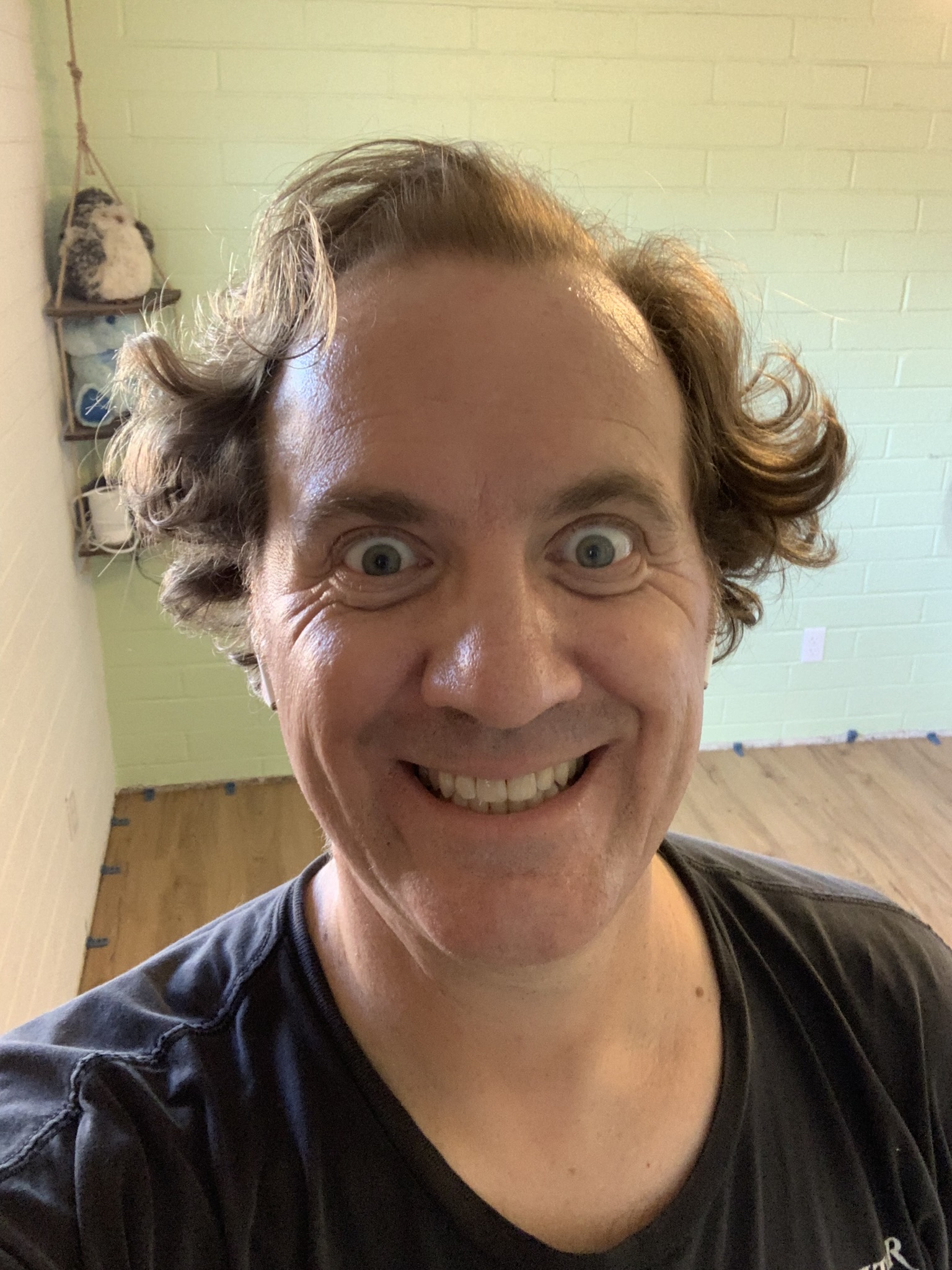
I’m quite proud of this image of me, which I captured after I spent several hours installing that floor. I guess I’m proud of the floor.

So that’s the first part of pride. When you do something that is good and important and defining, then you are (or should be) proud of that. “Important” is a word in there that probably needs defining too, though it is definitely subjective for me: there’s no real reason to think that my writing is important, as I have not been groundbreaking or influential or even particularly successful with my writing; but I think it is important. And I see a distinction between my important writing, like this blog I keep trying to keep up, and my books; and my unimportant writing, like my journal or the emails I send, stuff like that.

So if that is pride, I’m not sure why it’s a thing that Christianity would be against. Other than, of course, the cynical assumption that the faith wants to put all goodness into God so that people need to rely on the church; if God is the source of all good things, then there isn’t anything for any human to be proud of, because we didn’t do that stuff, God did; he just let us borrow it. Personally I don’t like that. But then I’m not a Christian. That may be exactly the mindset they’re going for.

But I don’t think that’s the source of the idea that “Pride goeth before a fall.” (Hang on, let me check on that, because I used “Spare the rod and spoil the child” in an essay I wrote once for school and claimed it was from the Bible, and later on I looked it up and it does not in fact come from the Bible at all. I am actually proud of that essay in a particularly perverse way: I think it’s one of the worst things I’ve ever written, which it was meant to be, and it has been an effective example for my classes because it is so bad. Okay, so this one is from the Bible but I’m misquoting: it is “Pride goeth before destruction, and an haughty spirit before a fall.” Proverbs 16:18, King James Version) I think — though I agree that my understanding of Christian ideology is a pretty laughable foundation for a discussion — that the pride spoken of there is a different kind of pride: and now that I have actually found the correct quote, I feel pretty well confirmed in that.

It’s the haughty spirit. That’s the point. That’s the bad pride, the one that leads to karmic justice in some way.

See, there are plenty of people who take enormous pride in things that they didn’t even do. So it’s one thing to take pride in something that isn’t good; I’m pretty damn proud of my longstanding hobby (One might even call it a vocation?) of stapling papers in the wrong corners in order to mess with my students:

Trigger warning: if you like things being done just so and being done right, you will not like what I did to these papers.

But there’s nothing good about that.

And then there are plenty of things I am proud of which are not important — like the video games I have beaten, that sort of thing. And I already spoke of things that aren’t defining, like cooking dinner for my family. Those things may not really deserve pride — and because of that it does make me question whether I feel proud about them — but regardless, there is no harm in being proud of things that don’t really matter much.

But then there are people who are proud of things they didn’t even do: like being American. Or male. Or tall. Or white. Don’t get me wrong, you can like those things, you can appreciate being those things (I’m not really sure why you would, but to each their own): but what on Earth would make someone proud of being born in this country? What did you do to make that happen? What time and effort did you put into it? Now, if you emigrated here, went through the enormous upheaval of moving to a whole new country; if you made a life and a home here, and created a place for yourself: that would be something to be proud of. But if you are proud of the fact that were born here, well. Bill Hicks has something to say about that: (**Please note: this clip is not safe for work.)

In To Kill a Mockingbird, Miss Maudie talks about Atticus’s shooting ability, once it is revealed that he was called One-Shot Finch, after he shoots the rabid dog. The kids can’t understand why Atticus never talked about how he was a dead shot, and why he never goes shooting if he is so good at it. Miss Maudie theorizes (Falsely, in a way, because he later says what he wanted his kids to think — that courage is not a man with a gun — but this point of Maudie’s also makes sense and might be part of his reasoning) that it is because Atticus recognizes that there’s no sense in taking pride in what she calls a God-given talent. She says that being born with a good eye and a steady hand is nothing that comes from hard work and dedication; it’s just a thing that is true about Atticus, like being tall.

I don’t entirely agree with Miss Maudie — I think that shooting a gun accurately would take a hell of a lot of practice, and therefore would be something to be proud of; but also, you would need to shoot in a good way, and also in an important way, for it to earn pride in my definition — but I see her point and I agree with the idea that taking pride in something you didn’t do, something you aren’t responsible for, is silly. That’s the idea of the Bible verse, too, I think.

See, if you put in the effort on something, if you really do the work, then it’s damn difficult to be proud of it. Because first of all, you’ve seen alllllll the mistakes you made in the process of learning; and if it is something hard to do, then you made a lot of mistakes. You also know, better than anyone, how much effort you have spent, and also you should know the difference that effort made: and that should pretty clearly show you that anyone else who put in the same effort would probably make the same progress — unless you were born with a gift of some kind that contributed to your ability, like having a sharp eye and a steady hand. But if it is something really difficult, then you also recognize that your sharp eye and your steady hand are not the things that make you good, or that make you great: they make it easier for you to be good or great — but only effort and dedication makes you good, or makes you great. The physical gifts are not something you did, so not something you should be proud of: the pride comes from what you put into making yourself into someone you can be proud of. Michael Jordan certainly has physical gifts that make him a great basketball player: but he’s Michael Jordan because he had the will and the drive, and he put in the effort. Therefore, I think he should be proud of what he accomplished. Shaquille O’Neal, on the other hand — well, he should be proud that he is apparently a very nice person. And then, of course, if you do what most of us do with our passions, and you look around at other people who do the same thing, what you are bound to find is people who do it better than you. Because nobody, not even Michael Jordan, is actually the greatest: there’s always somebody better. Knowing that keeps us humble, even if we have accomplished something to be proud of.

But even though it is difficult to take pride in what do, if that thing we do is a calling, if that thing is very difficult, if that thing takes years of dedication and effort to accomplish: then we have to take pride in it. We have to. Because there’s another aspect of pride.

The pride a parent takes in a child, that I take in my wife, my friends, my family, is not the pride of accomplishment. I mean, I’m proud that I support my wife in her art (and I’m proud I make her delicious sandwiches for dinner, without which she could not continue to make art), but otherwise? Her art isn’t my accomplishment. I did nothing to make her into the artist she is, not really. My support and sandwiches were helpful, but she could have done it without them, of course. But I am so incredibly proud of what she can do. So is that like the pride that dumb people take in being born between Canada and Mexico?

No: it’s something else.

The quality of an accomplishment that makes it pride-worthy, the aspects of it that make it (to one’s subjective viewpoint) good, and important, and defining, can be boiled down to one simple emotion: the most powerful emotion. Love. I write because I love what writing can do, and I love what writing is; and therefore I love writers — and therefore, when I write, I love myself. I love when I am able to create the effects that make me love writing. I am so very proud of those moments, of those effects, of what I did, and of myself for achieving them. And yes, it is entirely subjective: but then, often, so is pride. That doesn’t make it bad.

Pride is bad when it is not based on love. That’s the second half of the proverb, the “haughty spirit.” When one bases their pride on their contempt for others, then pride is bad. When one sets oneself above others, and is proud as a corollary to that, that is bad. That leads, in a righteous universe, to destruction: to a fall. (I know it doesn’t always. This is not a righteous universe.)

So really, it’s not that it’s dumb to be proud of being an American; it’s dumb to think that other people are lesser for not being Americans. (I knew that, actually. I am proud of my country. But also, I am humbled by it, because I can never do enough to make it the country that it should be, which means I am not fully worthy of it: so my pride does not create in me an haughty spirit. What a phrase that is. Don’t you just love the KJV?) It’s not that bad to be proud of being tall, or of being white; it’s bad to think that short people are worse off, or that people who aren’t white are somehow worse or less than white people. That’s where pride goeth before destruction: at least it is to be hoped that it does goeth before destruction. Because that kind of pride should be destroyed.

That’s not the pride that people have in their children, unless those people are really damn awful. Parents who put in a lot of work helping their kids to achieve something can take pride in their accomplishment, too, but mainly, parents are proud of their kids because they love their kids. And that love is pride; that pride is really just love.

I think that pride is love turned outwards. Love is generally directed into the person, or the pursuit, or the object, for whom/for which you feel the love; or it is turned into ourselves, as we enjoy the loved thing or the loved one being around us and bringing us joy. When we are proud of someone, as when we are proud of our accomplishments, we want to share that love with others: we want to express it, we want others to see it, we want everyone to know about it. That’s pride. I am proud of my books because I love my books. I am proud of my wife because I love my wife. I want to show off my books, I want to show off my wife, because I want other people to know of my love, and I want other people to understand how much I love, and why I love, and how lucky I am to have these loves in my life: both my accomplishments, and my incredible, incomparable wife.

Also: I am sometimes not proud of being an American. Because I do not always love my country. I am always proud of my wife.

But please remember this, whoever is reading this: if you work on something hard; if you think that thing is good; if you think it is important; if you think it defines a part of you: then be proud of it. Be proud of it like a parent is proud of their child. Notice that I have not spoken of the value or the worth or the price of the thing you do of which you are proud: love has no price, and so neither, therefore, should pride. You just feel it, and want to share it: and you should. Always. And if you are a parent: be proud of your child, especially when that child is proud of themselves. Love them for who they are and for what they do: and love yourself the same way. Don’t talk yourself out of it because you could have done better, or someone else could have done better, or it wasn’t exactly what you thought it would be: just love what you did, and love yourself for doing it. Be proud.

You deserve it.

This Morning

This morning, I am done with grades. This morning is the last of my school year.

This morning I received notification that California has approved my application for a teaching license. This doesn’t change my immediate plans, I will still be staying in Tucson for the next academic year; but it gives us more options for the year after that. It also shows, I think, that my sordid past is now behind me, because if even the champion nanny state approved me, I don’t think anyone will say nay because I was mean on a blog almost ten years ago.

More importantly, this morning is the last of my wife’s career as a teacher. She returns now to doing what she always should have been doing: making art full time. She has been a wonderful teacher, who has helped many students to improve their skills, gain confidence and interest in art, and especially to see the world in a different way; she will be sorely missed at school. But this is the best thing for her, and this is what is right: because look. Just look.


So congratulations, Toni. You have more than earned this. I am so proud of you for what you have done as a teacher, and I’m even more proud that you are walking away from it to dedicate yourself to art. You amaze me every day.

Especially this morning.

This Last Morning

This morning I’m thinking about endings, about finales.

Oh right, I hear some TV show ended last night, didn’t it? Sure hope that lived up to everyone’s expectations.

But that’s not what I’m thinking about this morning.

This morning I turned off my alarm clock for what may be the last time for the next two and a half months. That is a lovely thought.

But that’s not what I’m thinking about this morning.

This morning I am thinking about my friends who are leaving my school. Because today is their last day of teaching.

My friend Veronica, who came to Tucson and to this school from out of state, and was thrown right into the deep end, teaching high school students who have, many of them, gone to the same charter school for five, ten, or even twelve or more years (We had a graduate last year who went to pre-school with this charter, so, fourteen years in one school. It’s like Little House on the Prairie or something.), and who were used to their friends and their teachers, and who DON’T LIKE CHANGE. Then a year later, and for no valid reason, she was switched entirely to middle school students — who are, of course, demons. Turns out, Veronica is a splendid demon wrangler, and she spent the next two years lashing them into submission, mostly with her height, which is remarkable; her voice, which can be both piercing and booming as she wishes; and her humor, which is far more biting than her students knew.

But I knew, and that’s what I’ll miss: her humor. The evil little chuckle, the manic smile, the way she says “YEAH!” when I make some joke about making students suffer. I’ll miss the dedication and effort she put into helping children, too.

My friend Kellie had a similar experience with coming from out of state to teach high school and then ending up with middle school, except Kellie’s was even faster: she never even got to teach high school. And it’s an absolute crime, because she is exactly what a high school teacher should be: she has deep knowledge of and love for her subject; she’s cool and relaxed; she can relate to teenagers and speak to them like human beings. The school found a great science teacher — and then they threw her into the demon pit of middle school, where she suffered all year, without support, without any consideration for her needs or wishes. Since she had taught before, she knew exactly what she was missing, and she is leaving this school to go where she belongs: to a high school.

I’m going to miss her humor, her style, her passion for science, and her companionship. It’s been great to have her on my end of the hall, and it’s going to be far less interesting next year without her.

Adriana, my fellow English teacher, came in specifically to teach middle school, because clearly she’s insane. But what’s really insane is this: she taught them. She taught the hell out of them. She took students who were absolute hellions, and she not only controlled them, not only taught them to follow her rules and expectations — she taught them English. Whoever ends up teaching those kids when they get to high school is going to have a far easier time, with far more capable students; and it will be because of Adriana. I am personally grateful to her because her willingness to teach those tiny hyperactive, hypersonic imps meant that I didn’t have to do it: she spent three years jumping on grenades for me, and I can’t thank her enough.

I’m going to miss having her in the department, having her in meetings, hearing her infectious laugh, and knowing that the students were being mashed into some kind of shape by her incredible efforts. She’s been an inspiration to me, and I’m grateful for it.

The last one is both the hardest and the easiest to deal with: because it’s my wife, Toni DeBiasi. She’s been in the classroom next to me for the last three years, which has made them the best and most enjoyable three years of my two decades in teaching. She’s been utterly incredible: she came in with not much experience teaching, certainly nothing like multiple classes for an entire year, and she mastered it, entirely and completely. She’s so smart, and so capable, that she has been able to build a successful fine art program, in a STEM school, while also becoming a vital emotional and mental support for her students, who love her almost as much as I do. She came in to an empty room, almost — except it wasn’t, it was chock full of crap — because the previous teacher took out all of her teaching materials and lesson plans, and left Toni with a small, cramped room filled with shelves, filled with old paint and old paper, old clay and ceramics, old tools and materials that she had no idea what to do with. It took months to clean it all out, even while she was trying desperately to come up with material to teach her five classes, covering every ability level from elementary to college. May I also note, since I saw it first hand (Though I’m sure that the other three did the same in their own lives), that she managed to help me keep our household together and running, if not smoothly, at least consistently.

I’ll miss her at school, but at least I have the consolation of coming home to her every day.


I want this post to be more about recognition than making a point, but there is a very clear point here: all four of these women are excellent teachers, and all four of them are leaving the school within three years of being hired. That’s an issue. All four of them taught middle school, and for three of them, that’s the main reason they’re leaving (Veronica can’t stand the Tucson climate, which is also fully understandable.); that and the near-complete abandonment of them all by the institution. This is a problem that needs to be dealt with, or it will only get worse. Though all of them have gotten support from fellow teachers, friends, and loved ones, still, the school has not been able to give them what they need, and so the school has lost them — but the loss will be felt most keenly by the students. And by me and the rest of the faculty, of course, because these four women are lively and fun and intelligent and splendid to be around, and we’ll miss their spirit.

I will also note that three of the four are leaving teaching, two — Adriana and my wife, Toni — leaving forever. This is, again, a problem that needs to be dealt with, and it is a problem for this entire country. Twenty years ago, nearly, I wrote an essay about being a teacher, and in it I pointed out that the lack of structure and support, and the lack of respect and interest from students, was the main reason (along with money, of course) that 40% of teachers left the profession in the first two to five years. That has not gotten better: if the trend at my school is any indication, it’s gotten worse.  We need to fix it before we lose everything.

But any fix will be too late to save this loss.

Thank you all for your friendship, and for your wonderful gift of teaching. I appreciate you all, and I will miss you all in the hallway.  May the best of your past be the worst of your future, and may the road ever rise up to meet your feet.

This Morning, This Week

This morning I am thinking about down time.

Image result for candy crush

Specifically


This morning I played a video game for the first time in a week. I gave them up last week as part of my ongoing project to try to change one of my habits for a week and see how the change affects me. I wanted to change my video game habit because it’s been a constant for essentially all of my life; because it can get pretty invasive; and because the games I’ve been playing lately are brainless and dumb, and that makes me feel lame. I mean, if I was a serious gamer, who participated in some MMORPG  or online tournaments, then it would be a waste of time but at least I’d be involved in something; I’d be part of a cultural moment, of some kind. I’m rarely involved in those types of things, and I often feel bad about it — for instance, I’ve seen neither Game of Thrones nor the Marvel Cinematic Universe movies, so everything on Twitter right now goes over my head, instead of just most of it going over my head.

So if my video gaming was at least marginally cool, I wouldn’t feel so bad about it. If I felt like the video games I played had some positive place in my daily routine, I wouldn’t feel bad about that, either — so if I had a following for my video game reviews, or if I wrote for games, or even if I played the Sims and used the opportunity to work on my storytelling, all of that would fit in with my more-complimentary views of myself. Solitaire, though? Mah-Jong? Freaking Candy Crush? How do I feel good about those? Surely I would be better off without them: more focused, more productive, more — interesting.

Turns out: nope.

The big lesson from this past week is this: I don’t veg out because I am addicted to video games; I play video games because I need to veg out. This entire week, the times when I would have been  playing video games, but I wasn’t, were all spent doing something else that wasn’t terribly productive. Mostly scrolling through Facebook and Twitter, which I did more of this week than normal; I watched far more videos, which I usually just scroll past. Losing the video games had a minimal effect on my habits and productivity.

I did try: I tried to read more, and I tried to do some research on the Democratic candidates for President for 2020 (Okay, only on Elizabeth Warren. She’s been my pick since 2016, honestly, and I wanted to look into her policy proposals more. I think I looked at  her website for ten minutes? Maybe fifteen?). But the issue was, I’ve been exhausted all week: I’ve been having pretty serious insomnia; and this is the hardest time for teachers because we have to drag both ourselves and our students through the last few weeks; and there have been stressful things going on for my friends, which has affected me for their sakes; and I’ve been trying to find a new place to live. So it was not a good week for productivity: it was, if I may paraphrase Monty Python, a week for lying down and avoiding. Even my reading, which is one of my other preferred relaxations and escapes, was no good for this week: I’m reading a history of philosophy, written by the mathematician/logician/philosopher Bertrand Russell, whom I admire enormously, but who is always more interested in math than anything else, and whose writing requires quite a lot of focus and effort to get through with full comprehension. So even reading was exhausting.

But when I did find the time and energy to be productive, I did it well: I pursued housing diligently all week; I kept up with my classes and got a lot of grading done; last night I finished a lengthy short story I’ve been working on as a present. I’ve been blogging faithfully all week, and with some pretty substantial posts. It’s been a productive week, considering my circumstances. Just — not because I stopped playing Solitaire.

Leaving behind the video games didn’t make me happier, and didn’t make me more productive. So back they come.

I did learn that if I’m going to pursue anything serious on social media — try to expand my book sales or the following for this blog — I need to improve my use of the platforms. There is no reason whatsoever why I didn’t find new accounts on Twitter and new blogs on WordPress for me to follow; I just didn’t. So I think there will come a week soon when I set aside time every day to do that, and see if I can make a new, useful habit.

Not this week, though. This week is still everything stressful: my friends are still struggling; my rental search is still ongoing; schoolwork and students are still dragging me down. I’ve slept better this weekend, but we’ll see how that goes when I go back to work.

So this week, I asked my wife what I should give up.

She said, “Gum.”

“I don’t chew gum,” I said.

She nodded. “Exactly. Think how easy it will be.” I laughed, and she added, “You think I’m going to make it hard on you? Really?”

I love my wife. And so I’m going to take her suggestion.

I am going to make it slightly harder on myself: I’m going to give up snacks for the week. I come home pretty much every day and eat some kind of salty finger food, pretzels or peanuts or Cheez-its or potato chips; and we frequently have a little ice cream or a couple of cookies for dessert. I rarely eat those things because I’m actually hungry; just because I want some comfort, something to keep me awake. I don’t think I need to use food for that. So I’m going to give all that up, and only eat the major meals, and maybe an apple in the afternoon — I am a teacher, after all; apples sort of come with the job, right?

But if it comes down to it? I’ll let myself slide on everything that isn’t gum.

That’s what my wife told me to do.

This Morning

This morning I’m thinking about being sick.

I have a cold. Came down with it Friday, and spent my weekend not feeling very well. Fortunately it’s not severe enough to really limit me: I still walked my dogs, ran errands, looked for new rental houses, read books, and even graded a half-dozen rough drafts. But the whole time, doing all of those things, I felt pretty crappy. Friday at work was the worst: I could barely get myself to teach anything at all, some periods, and others I was more cranky than teacher-y. (I can’t even think of a better word than teacher-y. More pissy than pedagogical, how’s that?) Now it’s time to go back to work, and I still feel under the weather.

It’s an interesting phrase, isn’t it? Under the weather? Aren’t we always under the weather? I assume it’s supposed to mean directly under the weather, meaning out in the storm without a roof to keep off the rain or walls to block the wind; that would be pretty miserable, all right, which seems apropos.

Regardless, though, I do not feel like working. The fact that I was sick this weekend already put me behind, both in my grading — I got a half-dozen rough drafts done, but I should have finished all of them, and maybe done the other class’s essays, too — and in my relaxing, because while I did nap several times a day, I never felt a whole lot better. At least, I don’t feel a whole lot recovered now.

This is one of the problems with teaching, too. We get more sick days than most professionals, I think — that is, other than the ones who are simply trusted to make up their own minds about when they can and cannot come in to work, and they are considered responsible adults who can get their work done even if they don’t actually show up every day, you know, like professionals — but we can’t just call in sick: we need to arrange for a substitute. This school the administration actually gets the sub, which is an improvement over my last school, where the teachers did it themselves: yet another example of something teachers are all too willing to take on themselves because we want to help, and because we want every petty shred of control, including, apparently, the ability to select who we give control to when we can’t have it ourselves. But in any case, I have to plan lessons for my classes. It’s both easy and hard for me: because I can always give them something to read  — but nobody can run my class the way that I can. Other people could surely run a discussion, but you have to really know the literature to run it the way I do, and subs would not, of course. So every day I’m out is basically wasted, because it can only be something extra, never the thing the class would be doing if I were there. My students realize this, of course, and so they are not as dedicated or as involved as they would be with me there. That’s not to say they’re all that dedicated or involved regardless; they are teenagers and it is almost May.

That’s the worst thing. It’s almost May. My school starts its year ungodly early — August 1, usually — which is a hideous ordeal in August; but it means we finish school in May, before Memorial Day. I only have three weeks left before finals. My students, as you may expect, are done already; the only thing keeping them going is my will to keep dragging them behind me. That and a certain amount of fear of bad grades. (But the smarter ones realize that as the semester nears the end, grade inertia sets in: because new assignments are just added to the pile, and so no specific assignment will change the overall grade very much. When the total points in the class is, say, 100, then a 50 point assignment means everything; but three months later, when the total points are 5000, 50 points is kinda nothing. Shhh — don’t tell the rest of them.) So the point is, the temptation for me, not feeling well, cranky, and behind on my grading anyway, to just throw up my hands and say, “That’s it, we’re done: somebody put on YouTube and get out the Uno deck,” grows daily. And my students would like nothing more.

But I can’t complain too much. Because my wife — God, my poor wife — has all of these same problems: only worse. She got sick too: with the flu. Knocked her down for three full days two weeks ago. And then, because the flu made her cough nonstop the whole time, it gave her laryngitis: she basically coughed her voice out. She went back to work last week barely able to whisper. Spent the whole week coughing and wheezing and suffering. And now it’s pollen season, and her allergies are kicking in: so she feels almost as miserable now as when she had the flu.

On top of that, when this school year ends, she’s done. She’s quitting, to go back to doing art full time (and not a minute too soon). So think of how eager she is for these three weeks to pass. And when it comes to subs, she not only can’t get a sub who can do what she does, because no sub understands drawing and painting like she does, but also her students don’t really care about her class, because they see it as some elective they have to get through to graduate and nothing more, a problem only exacerbated by our school’s focus on STEM. There are exceptions, of course, but most of her students are pretty indifferent to art. So they’re even less likely to work for a sub, or for my wife; and they are that much harder to drag behind her towards the finish line.

And by the way: where do you think we both caught these diseases? That’s right, from the little germ factories that surround us every day. It’s like being in the trenches while they’re chucking biological weapons in at us. For three more weeks. Three long, tiring, sickly weeks. I expect they’ll be three of the longest weeks in my wife’s life.

That’s what really makes me sick. That I can’t make these last three weeks go faster for her.

If any of you could do something about that, I’d really appreciate it. Thanks.

This Morning

This morning I am thinking about my wife.

Today is her birthday.

I have presents for her, and I have a card, and I have my excited “Happy Birthday!” all ready to go. I’m going to take her out to dinner tonight, and I’m going to buy her something delicious for dessert, and I’m not going to tell the waitstaff that it’s her birthday because she hates when the waiters sing the song to her. Even if she gets a free dessert.

But I can’t possibly say all the things I want to say about her. I don’t have the time, and I don’t have the words: even me, even with all the words that I’ve written over the years, I still don’t have enough words to say how perfect she is. I want to use all the cliches, because (as good cliches do) they all fit: she is my everything. She is my queen, my angel, and my goddess. She is my better half, and my partner in crime. She completes me. She carries my heart.

None of that is enough.

But that doesn’t matter.

It doesn’t matter what I call her, what goes in the blank of “She is my ____________.”

That matters is the three words before the blank.

She is mine. And I am hers, but today I am thinking about the fact that she is mine.

There is nothing and nobody that I am happier to say that about, on this entire Earth, in this whole universe, in all of time forwards and backwards from this moment, this day that is her day. She is mine.

Happy birthday, my love.

Image may contain: 1 person, phone and eyeglasses

Tied Down at the Edge of a Cliff

We say we have to get me out of teaching. We say it often, laying in bed at night before we turn the lights off, when we usually turn to face each other, heads on pillows, and sort of put a punctuation mark on the day – sometimes an exclamation point, sometimes a question mark; but usually just a comma or a semi-colon, because the end of the day is almost never an ending, almost always a brief pause for breath before we go on with the next clause, the next day, separate from the last but still connected – always connected.

My life is a run-on sentence. And I don’t know how to stop it.

No: I know how to stop it. (And I’m going to leave this metaphor behind now, this navel-gazing grammatical pun. Jesus, Dusty. Get a life.) I could change my life quickly if I leave everything behind, including my wife and my pets, a sentence that took me several tries to actually write. I could change everything if I left everything. I do what I do so I can earn what I earn so we can live how we live: as we. But our bed, where we lay at night together, is actually the ground at the top of a cliff. Everywhere I go, I am at the top of this cliff. At night we lay together, our heads heavy on the pillows, and we look into each other’s eyes and I tell her how much I love her and she smiles at me and I love her more, and then we kiss goodnight, and roll over – and I stare off the edge of the cliff.

The cliff is the edge of my world. I don’t mean the end of life; I’m not talking about dying. I’m talking about where the place I am, the place I live, where it ends, abruptly, startlingly, dangerously. Honestly I have pretty much always stayed near that cliff’s edge, in various ways. But never too near: because I am a coward, I think. And though every night I look out into the open air beyond that cliff, to actually jump off that cliff and land somewhere entirely different – or perhaps instead of landing, take flight and sail across the sky, which is how I imagine it would feel to be a writer – I would have to leave behind everything I am now, everything that is this place where I live, this life where I live, where I sleep with my head heavy on my pillow and my eyes straining to look out farther but tired, so very tired, with the looking; but behind me (or no: before me, between me and the cliff, not to protect me but because she is even closer to the edge of that empty space that might hold a new life) is the best woman in the world, and at our feet lies the sweetest dog I’ve ever known, and nearby are a bird and a tortoise who need me, who are tied to me, who are weighing me down. And none of them – not even the bird, sadly – can fly.

Let me be clear: it is not my wife’s fault. She never asked me to get this job, never demanded a larger home, a larger paycheck, health insurance, stability, all the tethers of the modern world that tie me down at the top of the cliff, safe and immobile, able to turn my head and look out to eternity, growing and throbbing out there beyond the fall to the bottom. She doesn’t demand them of me now, never tells me when I talk of leaving teaching that I can’t do that because the family relies on my stable income and health insurance. She has never said that once. She never would. She lies with her head on her pillow, holds my hand, her fingers exploring mine as she imagines drawing my hands (as she imagines drawing everything), and says, with her eyes sad, “We have to get you out of teaching.” Now that she has tethered herself down right next to me – but closer to the edge of the cliff than I am – she says “We have to get ourselves out of this.”

Then we talk about how we can be free, mobile, able to pick and choose what we do with our lives, if we just buckle down and teach for three years and pay off all of our debts. Maybe four years. Maybe five. Tethered down right at the edge of this cliff, looking out into space, lying with our heads heavy on the pillow, holding hands.

I’ve never jumped off a cliff. I jumped off a swing into a river, once, but I landed flat on my back when I tried an ill-advised backflip; it hurt. I don’t remember if I went back on the swing again after that, but probably not; I’m a coward, and I always have been, and that’s why I’m still at the top of this cliff, near the edge but not on the edge. I’m looking out on this vista, this panorama, of wide open space, and I’m – I don’t know, shouting over the edge? Maybe whispering, blowing words like soap bubbles, glittering and evanescent as they drift pointlessly free? But I’m still here, on solid ground, holding on for dear life even though I am nowhere close to falling.

I should be falling. If I was a writer, I’d be falling; if I was falling, I’d be a writer.

Instead I am – yes, I know it. A spider. Remember the tiny ones at the end of Charlotte’s Web, how they spin out a single thread of silk and throw it up into the wind, letting the air lift and carry them away? That’s how I want to go out over the edge of the cliff; not free fall, not dropping down and just hoping that something will catch me, though I’m not sure now if that’s because I’m a coward or just because I don’t care for the thrill, never have, never liked adrenaline, never wanted to feel alive because I almost died. I hate stories that rest on that idea: that life is either risk or boredom, that everything that is lovely or pleasant or simple becomes blasé, because I feel like if I could live forever, I would just read all of the books that I won’t have time to read, and play all the video games, and walk over every inch of the Earth, and why would that get boring? I don’t believe that it would. And so I want to drift over the edge of the cliff, not plummet. So here I lay, throwing out single threads of silk, gossamer words, hoping that one of them will catch the wind and lift me free and sail me away through the sky – and my wife and our family with me.

I’m growing roots. I have been for years, though I frequently pull them out of the ground and let them wither and die. I don’t need the roots, though I don’t hate them; that’s probably why I let them grow, and maybe that’s why I haven’t gone over the cliff, because I don’t mind the slow growth, don’t mind drifting down into the earth instead of up into the sky. Maybe if there was a way to sink below the surface, grow a taproot large enough and deep enough and then pour myself down instead of drawing nutrients up, follow my own growth into the deeps, and then tunnel down through the cliff from behind its face, back behind the bones, down and down and down until I came to the bottom and then slid out from between the teeth, out with the breath of the earth back into the open air. Then I’d be in a new place, and not at the edge of a cliff looking out; then I would have changed, would have moved.

But I would have never flown. Never left the ground. Is that, could that be, what it would mean for me to be a writer? To move through the earth to new ground? Does that metaphor make sense?

Is this the thread that will lift me? Or the one that I can crawl down, like Dante down the leg of Lucifer, crawling down until suddenly he was crawling up, out of the depths of Hell to the mountain of Purgatory? But see, he was carried on that final voyage out. He was on a mission from God. All he had to do was hold on and wait.

I don’t think I can just hold on and wait. I think I need to move. I don’t know if I can fly and take my family with me – and I won’t leave them behind. There is nothing that would be better without them. I don’t even know why I say it, other than I know that most people who jump off the cliff, who make themselves suddenly into writers (or into flattened, shattered remains), go it alone. I don’t want that. I don’t think I ever have, but I know I don’t now. So the question is: do I keep throwing strands of silk into the air? Do I stitch them together into a single sail, and just wait for a wind great enough to lift me, and my wife, and our heavy heads from off of our pillows, and we can grab the bird and the dog and the tortoise in passing and carry them with us? Could there be a wind great enough to lift a sail large enough to carry us all aloft?

Or do I try to find a new way, this magic that will turn the earth beneath me malleable, let me alter the flow and the path of all things so that I grow in the wrong direction, turning the wrong into right? Honestly, I don’t even know what this metaphor means: would I write for the local scene, find local websites, write for the Tucson newspaper? Is that what it means to go down your own taproot, to go deeper into the earth, to become a writer by digging down? I don’t know. I want it to be magical, somehow, to be an alteration of the paradigm, a new path, a new alchemy that turns stone into water, just for me, so that I could swim through something that can’t be swum through – but though I can imagine that, I don’t understand it, I don’t know how I could do that, if it could be done. I don’t know if I’m creative enough to do it, if I have the wizardry to break the laws of nature. But since it took me four tries to actually type the word “wizardry,” I’m going to say the omens are bad.

Maybe I should try to climb down the cliff. Grind it out, slow and steady, keep working, keep writing, keep moving; no magic, just constant effort, every moment testing my strength to the limits, every moment hyperalert, looking for that next ledge, that next handhold.

I don’t know. I’m 42, and I haven’t started climbing yet. I might already be too tired just from lying at the top of the cliff. Lifting my head off that pillow every goddamn morning. Looking out at the expanse of sky and thinking about how wonderful it would be to sail away. Spinning my silken threads, my tenuous sails – watching them break and fall, or vanish off into the ether without me. And here I lie.

I don’t know how to fly.

Update.

Toni read this. We talked about it. And having talked to her about it, the answer is clear: we will be alchemists. We will swim through the Earth, and see where we end up.

I consider the metaphor of flight to represent getting published by a traditional brick-and-mortar company, selling books out of Barnes and Noble, the whole Best-Selling Author bit. I’d still like to fly. I’m going to keep sending up streamers of spidersilk, hoping that one will catch just the right breeze and lift me up into the sky. I would like that. For Toni, the same metaphor probably applies to suddenly hitting it big in the art world: becoming a name, being sold in galleries, getting commissions for public art, all of that. And that would be swell, too.

But that’s not the goal. Neither is the goal a safe and sure and trying descent.

No: the goal is to try something new. We plan to write and illustrate and sell graphic novels, and illustrated novels. I plan to go back to publishing a serial novel, which will be available as enriched and expanded e-books, featuring extra stories, back stories, side characters, and so on. Maybe we’ll run a book store. I will publish my novels, and she will sell her art – and we will see what we are capable of and where we can go. What new places can we discover, and explore? What exactly is down there, underneath us? Could it be even more intriguing, even more wondrous, than the sky above?

We will never jump off the cliff. And we will never leave each other behind. (Nor the pets.)

We choose – magic.

My Life

#1: “I feel bad when I have a cold when I go to the doctor. I don’t want to get germs all over them.”

#2: The other night she shuffled slowly from the living room into the kitchen, set herself, drew back one slippered foot, and then gently kicked me – really more of a boof – in the shin. Then she said “You called me a poop. Don’t call me a poop.” (Actually what I had called her was Poopzilla.) I hung my head, laughing, and said, “Consider me properly chastised.” She nodded, said, “Okay,” and shuffled away.

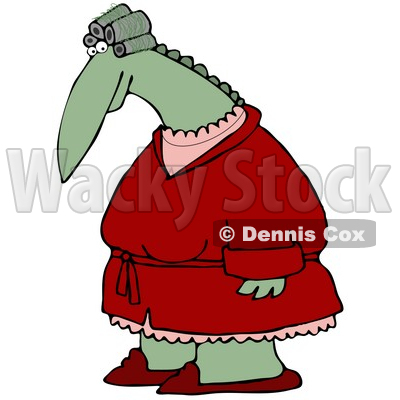
She doesn’t wear curlers, actually. I just like the image.

Source


#3: Speaking of her students: “If I don’t keep spewing a steady stream of hatred towards them, they just want to talk to me.”

#4: Speaking to a student:

Student: “My brother moved to Utah.”

Jokingly: “Utah? Why, to become a Mormon?”

Student (baffled): “We’re Mexican. We can’t be Mormons.”

On the Twelfth Day of Blogging, Just Dusty Blogged for Me . . .

… A blog about love and epiphanyyyyyy!


If you’ve read this blog before, you’ll know that I – like most people – don’t particularly like my job. In some ways, on some days, it’s fine; but all in all, it’s not where I’d prefer to spend my time. I’ll never get a bumper sticker that says “I’d rather be working.” As I tell my students, “If I win the lottery tonight, I won’t be here tomorrow.” I tell people that I’m a teacher, but I don’t actually define myself that way; I consider myself a writer, and a reader, and a nerd, and a family man. Teaching is my source of income, not my identity.

But since a source of income is a necessity, and teaching is a pretty decent one, I thought I’d share some tips for making work a little more manageable – that is, if you can’t get your boss to change your work hours so he/she will stop torturing you. (There’s a scientist who says we should start work around 10am.)

First, figure out when you can say No. I know it’s true for teaching, and I’ll bet it’s true for a whole lot of jobs, that your employer will keep asking you for more for as long as you keep giving what they ask. They’ll ask you to do extra duties, to join committees, to come in early, to stay late, to take work home, to give up your weekends, your evenings, and your vacations. In my case, they ask me to come to meetings, to go to seminars, to agree to be a mentor or a coach or a tutor. They are constantly after my lunchtime, and they’d love it if I could fill in for the various staff members they’ve laid off or cut back – at my school this includes the security guard and the staff psychologist. They want me to train myself, and then train others. And of course, they want me to give every ounce of energy and every minute of time to the doing of my actual job: they want me to grade eight hours a day, prepare new lessons and new curriculum eight hours a day, and spend at least eight hours a day with students, preferably one-on-one. And for all of this, they want me to do it the way they want it done, whether or not I like that way of doing things or think it is the right way: it is their way, and therefore they want it to be my way.

But with teaching, and I’ll bet with a lot of jobs, there is a specific thing or things I’m supposed to be doing. In my case it is two things: first, I need to be a responsible babysitter, meaning that students cannot be hurt under my watch, particularly not by me; and second, my students need to learn. The first is easy to measure: students getting hurt, or students complaining about how I hurt them, are no-nos. The second is more difficult to measure, but figuring out how the bosses measure it was the key to knowing when and why I can say no. For me, it is two things, one positive and one negative. The positive measure is test scores. My students’ test scores can’t be terrible. They don’t have to be perfect, but they can’t be terrible. The – I guess it’s an advantage? – for me is that I have students measured by multiple tests, and as long as they’re doing well on one, then the other is less critical; so in my case, since I teach AP classes, as long as my AP test scores are sufficient, then the school wants to keep me around and keep me happy, even if my state testing scores are less wonderful. They’re not terrible, but they’re not as good as the school wants them to be; but my AP scores are. That gives me more ability to say No. It gives me No-power.

The negative measure of students learning is even better, for me: there can’t be any students or parents complaining about me. As long as none of my students go to the administration and say that the class is unfair, that the grade was too low, that the test was too hard and that the students weren’t prepared for it, then the school feels confident that I am doing my job. And that gives me even more No-power.

It’s not that simple, of course; there is more to it. I do need the credentials that I have, a degree in my subject and years of teaching experience and so on; I get observed twice a year and I have to look like I know what I’m doing; there are meetings I have to attend and duties I have to perform. I have to go to staff meetings, I have to meet with parents on the scheduled days or when parents request it, I have to be available for extra help if students need it. But those are the main things: babysitting, test scores, no complaints.

How did I figure this out? I listened to what people said about the people who used to have my job. The person who had it the year before me actually had a doctorate and college-level teaching experience; but the students thought she didn’t teach them enough. They thought she spent too long on one unit, they thought she didn’t explain things well, and they thought she couldn’t manage a class well enough to get them to listen. I heard the same things about her from other teachers, too. The person before her was a bad babysitter: she left the students locked out in the hallway after the bell rang; she left early and left the students alone in the classroom; she cussed at them when she was mad. So when one of my students told me that I taught him more in five minutes than my predecessor had taught him all year, I knew I was pretty well set. (I already knew I couldn’t lock my students out of the room, nor leave them alone in it. But that’s kind of a gimme, isn’t it? I mean, really.) The other key was watching the person at the top: the best teacher at the school, the one that everybody listens to and looks up to, the one who seems like they can get away with anything. How does that person get to be that powerful? In my school’s case, it’s basically the same answer, though our top teacher is more of a teacher and less of a babysitter – which tells me that there’s leeway in the babysitting aspect, as long as the test scores are good enough, and as long as the students think they learn. In this teacher’s case, it is more than the negative measure, more than a lack of students and parents complaining: our top teacher earns praise from students and parents. He is the one they thank at graduation for having taught them so much. And that gives him all the no-power he could ever need: he openly defies administrative decrees in certain areas, and nothing happens to him. Because the students think he is their best teacher. Even though he calls them deadbeats and degenerates, and threatens to hide their corpses under the soccer field.

So that’s the most important thing: figuring out what is necessary to gain the power to say No, and then deciding where to spend that power – because nobody, not even the best employee, has limitless power to say No. You do still have to show up (too early) and do your job. You can’t spit in your boss’s face. But you probably can skip out of some meetings, or refuse to serve on certain committees, and you can certainly say you aren’t going to that three-day seminar out of town (unless it’s in a good place and they’re paying expenses). That’s the key to keeping your sanity at work. The first one, at least.

The second key is to keep doing your work. Don’t let it pile up. Because it will pile up, and then it will collapse and smother you in an avalanche of catch-up. In my case it’s grading, which I did in fact pile up this last semester’s end, and it did almost smother me. It wasn’t the first time, either; and if I ever leave teaching behind before I win the lottery, that will be why: because I let work pile up and collapse on me once too often.

In the past I have let the work pile up because I’ve avoided doing it: I’ve collected essays and then looked at them and said, “Not today,” over and over and over again. Sometimes for as long as two months, though I was doing other grading in that span. That’s one of the nice things about teaching, even though it doesn’t always feel that way; I doubt there are a lot of jobs that allow that much slacking for that long. But since I didn’t get students filing complaints with the administration, it didn’t get me fired. I did have some pretty serious grumbling by the end of it, and I now have a (well-deserved) reputation for taking too long to grade things; I have made a conscious effort in the last few years to keep that from happening again. This last semester, the work piled up for a different reason: because I didn’t plan well enough, and I had too many major things due all at the end of the semester. It was a sudden deluge instead of a slow build-up; but it still almost took me down. So now I have two things to be aware of: not letting things pile up, and not creating a huge pile that will all fall on me at once. I’m sure someday I’ll learn those habits. And then I’ll probably win the lottery.

But all of that, though I hope it will be useful for some people to know, is not actually the thing I wanted to talk about. There is something else, something that I think is actually unusual, something that I know that most people don’t. This is my epiphany, if you will. And it is this: if you have the chance, then work alongside of the person you love.

I’ve done it a few times, now. When I was a janitor in college, my wife (then unwedded soulmate) worked in the same facility, selling tickets and concessions for the box office while I cleaned the place. When I became a teacher, she spent two summers teaching summer school with me, once in the same room. We met because we were sort of working side by side: she worked in the college bookstore, and I sold student IDs in the same building; I used to get change from her, and she used to pass my table on her way to get coffee or a bottle of water. And now, by a fortuitous set of circumstances, she is the art teacher in the classroom right next to my English class. And it is the best thing about my job.

Now, it is better for me than it is for her. Teaching unquestionably gets easier with experience; this is her first year of full-time teaching, and it’s my seventeenth. I’ve been at the school for two and a half years now, so I have a better idea of how things work and who I can get help from and who I can’t; she is figuring all of that out. She also got screwed over by her predecessor, who cleaned the room out of any useful materials or curriculum, and left the art supplies in a hellish mess; I came to a classroom with class sets of novels and textbooks, and filing cabinets full of quizzes and worksheets and materials I could use. I have a department with three other English teachers who give me help and advice and share good stuff with me; she’s the only art teacher at the school, and one of two in the district – and the other is also brand-new. She’s starting completely from scratch, and it makes the job twice as hard. And it’s pretty goddamn hard to start with. Add to that the fact that she doesn’t particularly like teaching, either; that it isn’t how she defines herself or any part of her identity, and it’s easy to see that it’s been a tough year for her.

But she does have this advantage: I’m right next door. That means that she, like me, always has someone to cover for her if she needs to run to the bathroom. I always have someone to eat lunch with, and to sit with in meetings. When I’ve had a tough class or an annoying meeting, I can go to her and bitch about it. I can complain – no, scratch that; I never complain about my students, the little angel-babies.

No, sorry, can’t say that with a straight face. When I want to complain about my irritating, obnoxious, tiresome students, I can go straight to her and say whatever I really think, without any fear that she will judge me, or get me in trouble for it. I can get advice from her – and regardless of her inexperience with the profession or in the school, I do, because she is naturally brilliant, and because she knows quite a lot about working in general, having dealt with office politics in an actual office, where they are more pervasive and pernicious than they are in a school, where most people work behind closed doors all day. She’s also, it turns out (No surprise to me), a genuinely good teacher, though without the mixed blessing of test scores, it is sometimes harder for her to see it. And because she is a more dedicated artist than I am, being a good teacher means less to her than it does to me; she cares about being a good artist.

She’s that, too.

But it is a lovely thing to have another person there with you, in that place where you have to spend so many hours, and for such pragmatic, uninspiring reasons. (“I just worked a full day! That means I can pay my heating bill! And maybe the electric, too! WOO!”) We keep our behavior appropriate, of course; but I still get hugs, and even a kiss or two. The main thing is just that I get someone to talk to. We go to the water cooler together, and to the lounge to use the microwave. I walk up to the office with her when she has to drop something off, and I’ve helped her learn the eccentricities of our Xerox machine. She is already friendlier with the rest of the staff than I am, and we like and dislike the same people (But never the students! We love every one of them! Angel-babies, they are!). We drive to work together, and leave together, which makes it much easier to run errands after work and to arrange our morning schedules. It’s really been fantastic, having the woman I love with me all day, at work and at home. I know some people would get tired of that much time together; and we are in separate classrooms for most of the workday, which probably helps – but I have had nothing but joy from this arrangement. I recommend it highly.

And the best part is this: I have never, not once in the last four months, had to say goodbye.

Me Mates are all Jemmy Coves! Wot wot!

So I’m wondering: how far should I be willing to go for my friends?

Now, it so happens that the meme world has quite a bit to say about friendship — but unfortunately, as always with the meme world, the information is not very helpful.


So my  friends are people I like and do stuff with. Okay, I knew that; those are the people I call my friends anyway. But what does “do stuff with” mean? Do I have to do stuff with them in person? Because then a number of my friends probably don’t count any more, since I literally haven’t seen them, face to face, in more than twenty years. And what does “like” mean? I mean, I like cupcakes, and I like my students. But those are two different feelings. Do I have to like my friends all the time? Do I have to like everything about them? 51/49, like/dislike?


I like the sentiment, but I don’t know quite what it means. One of my friends had a lot of trouble finding an au pair that would actually remain reliable for more than a few months. He lives 2,500 miles away from me. How do I make that my problem? I suppose I could look through online listings of au pairs, but is that really helpful? I don’t have children, don’t know anything about au pairs, let alone good ones. Do I fly to Massachusetts to help him interview? Do I become his new au pair? And what if while he is looking for an au pair, another friend is dealing with a sick parent, out in California? And another friend, living in Louisiana, needs to find a cheap apartment?

Maybe I just tell them that I’m sympathetic and will help in any way that I can. But when I know there’s no way I can help, it feels terribly hollow to say that. I don’t feel like a friend when I can’t help. But I can’t always help. Does that make me not a friend?

Maybe it matters that this says “BEST friend?” Do we really still make that distinction? I mean, the Sims do, and 4th graders; but do we all think that way?


So I have to know things about someone that nobody else knows. Well, that simplifies things pretty well, because there is exactly one person in the world that I am that close to. I suppose my wife is my only friend.

So what do I tell all those losers who think I’m their friend?

(N.B.: You can’t get mad if I just called you a loser. Because:)

Now, if I don’t think it is particularly offensive to shout “F*CKNUGGETS!” when I stub my toe, should I be willing to say it in front of friends who prefer not to hear cussing? Or wait — they’re not my friends. My friends are only the ones who yell back “YEAH, HOT BUTTERED DI*K-BISCUITS!”  (Side note: I love those asterisks. I hate that they’re necessary, but I love them. So much. “Profanity? No, I meant ‘Focknuggets.’ It’s a German bar food. And ‘disk-biscuits’ is Cockney for pancakes. Why? What did you think it was?”) But what if I’m around their kids, or their aged grandparents who have taken holy orders to become Catholic nuns? (Yes, including their grandfathers. Don’t try to determine another person’s gender identity, you social fascist.) And maybe it’s that I should be the good friend, and not cuss around friends that I know don’t like cussing? Should I be considerate of my friends’ delicate sensibilities, or should they accept me for the foul-mouthed hooligan I am? In a friendship, who bends to whose standards? If others have to bend to mine, can I mess with that? I mean, can I get someone to agree to be my friend, and then punch them in the face and steal their sandwich, and then just say “Hey, that’s how real friends act. You can punch me and take my sandwich, sometime, too.”

Maybe I should just forget all of this, and when I stub my toe, yell, “Oh, dash it all, what deuced rotten luck, eh wot wot?!” Wouldn’t the world be a better place if we lived like moderns but talked like Victorians?


This one kind of cracks me up, because really, it makes no sense. It combines this idea of insincerity with an idea of priorities. Because it recognizes that people have busy schedules, but, it says, YOU should be THE MOST IMPORTANT THING IN THAT PERSON’S WORLD. Nothing else will do. Anyone who claims to be your friend, but for whom you are not THE MOST IMPORTANT THING IN THE WORLD is a faker, a liar, a superficial person who doesn’t care about you, really care about you, deep down, where the real feelings are, underneath all the bulls*it. They just want something from you. Which apparently you, who want them to literally drop anything else in their lives in order to pay attention to you — what, you don’t want anything from them? Okay, sure.

And you represent that with Minions. The definitive image of depth and genuine human sympathy.

But again, that makes it pretty simple for me. I have one friend. My wife. All of the rest of you shouldn’t waste your time on me. Because I just want something from you.


But here is the meme I agree with.


You damn right, CM. Damn right.


The answer to all this, of course, is that it depends on the friend. With some friends, I am willing to drop most stuff, give up most stuff, if they needed me. With others, I’m willing to give up little stuff — like maybe some of my free time. Sure, I’ll do that. Other friends, I’d give up sleep, I’d give up food, money, comfort. One friend, I’d give up anything I have in this world, other than her. And I call them all my friends. On some level, that’s a problem, because a language as large and varied as English should be able to make distinctions between those types of friends; and we sort of do, because of course I don’t call her my friend, I call her my wife. That shows the differences in commitment quite handily: I would not die for most of my friends; I would die for my wife. Sure. Makes sense.

The issue is that we have grown overfond of the specific word “friend.” So fond we now use it as a bloody verb, like “text” and “impact.” Bah. According to the internet, I have over 350 friends, but if you asked me to name my actual friends, I’m pretty sure I wouldn’t run out of toes. If you named some criterion like “Friends are only those people you see regularly, say, every three years,” then I wouldn’t even run out of fingers.

But we want to call lots of people our friends; that’s why Facebook uses the term. (Not that Twitter or Instagram or the various blogging/content-sharing sites are any better: the term “follower” is almost weirder and more fraught than “friend.” But one strangely warped internet term at a time, eh wot wot? Else it’ll be a fifteen puzzle! Don’t want to get the morbs. [Victorian slang here. It’s some pumpkins.]) It’s not enough for me to call her my wife — that could imply all sorts of different relationships. I have to include the description, “And she’s my friend.” In fact, I generally call her my “best friend.” Not that it isn’t appropriate, but the point is, we’re trying to bring in the term “friend” to relationships where it wouldn’t normally belong. It is now a more inclusive term, rather than exclusive — applying, in some way, to everything from acquaintances to co-workers to the love of my life.

Which means, when it comes to determining my relationship with my friends, deciding just how far I am willing to go for them, it isn’t enough to just say to myself, “He/she is a friend. Therefore I will _________ but I will not _____________.” (Sample answers: share the last cookie/die.) Where, then, do I draw those lines? If I call someone a friend, how much — let’s call it “tolerance,” since that’s generally the measure of my relationship to other humans — does that entitle them to?

I feel as though there is a simple answer to all of this, and it is, “You have to decide, on an individual basis, how much tolerance each friend gets. Put up with a friend for as long as you want that person as a friend, and then stop.” And I feel that my audience is probably thinking this, and getting bored with my philosophicality here. (Hence the Victorian slang, dash my wig! I’ll be poked up if I shoot into the brown here!) And that’s fine in theory, and I’ve probably been putting that into practice, really, for the last few years.

But I’m tired. Having to decide whether or not to stick with friends who are on the margin; trying to decide if I should encourage and support them, or joke around with them, or neither, is becoming exhausting. Even worse is pretending to be friends with people I don’t really like very much, but have some reason to pretend to be friends with, reasons like working together, or for. I used to be in the staff band with one of my administrators, and I really didn’t like the guy, though I wasn’t going to tell him that. And of course, some of the time, he was great — like when we were actually playing together. If I have a friend that is great some of the time, and crappy some of the time, how much of the time does he have to be great to make up for the crappy? Should I just get rid of any friends who are at all crappy? But what if my good friends, who get a whole lot of tolerance, have an opinion I happen to disagree with? An opinion I disagree strongly with? How crappy does that have to feel for me before they cross the line and get dumped?

I try to be forgiving with my friends. I don’t actually mind disagreements. I ended two “friendships” this past weekend, both times because the person shared a meme joking — joking — about the atomic holocausts at Hiroshima and Nagasaki. That was an easy call. But I have other friends who consistently mock Bernie Sanders followers, which generally includes me and several of my other friends. So now the question becomes, do I speak up when they say or post something that annoys me? Or do I ignore it, for the sake of the friendship? What about those who mock everyone who ISN’T a Bernie Sanders fan? Do I really have to decide on an individual basis, every time they say something? In an election year?

This is further complicated for me because I generally have to be careful about what I say on the internet; my past statements and profanity very nearly lost me my license to teach. And I’m friends online with many — hundreds, probably — of my ex-students. I’m pretty open to becoming friends with them, but to be honest, I don’t have a whole lot in common with a lot of them. I remember them fondly from class because they’re bright, or they worked hard, or they had interesting things to say in discussion; but now that I interact with them casually and socially, I find out things like, they only care about cars. Or they’re devoutly religious. Or they’re prickly and combative. Or they believe astrology. Or they want to vote for Trump.

So now what? Do I dump them? Or do I ignore the annoying foibles? For how long?

Do I have to keep a balance sheet for each of my friends? And if I do — where are the cut scores?

I also worry about myself. How much can — should — I interact with them? I am, after all, a lot older than them; if I joke along with their jokes, like a friend, does that make me seem like a creepy old guy desperate for friendly interaction? Do they think that of me? Are they just putting up with me despite my annoying habits out of some sense of obligation because I was their teacher? Of course some of them are — but which ones? If I call them on their bull*hit, does that make me their straight-up honest friend, or some hypercritical *sshole? Of course the difference is in our relationship: but what if they’re of that group of people that prefer straight-up brutal honesty? Do I assume that? Do I use my own standards, and expect them to cleave to what I think is right? Am I more friendly or less friendly if I pick fights with people? What if I say something harsh, but I add “lololololololol” at the end of the comment? Is that something a friend would do? How about an acquaintance? How about a former teacher who gave you an A? How about a former teacher who gave you an F?

I really don’t know. But I’m thinking I may stay off Facebook more, or thin out my friends list a bit, to save myself some effort. And maybe that makes me a bad friend. Maybe I should be willing to put the effort into the friendship, whatever kind of friendship it is. I really don’t know.


I don’t think I have a final insight for this other than: I think we should start using terms other than “friend.” I would like to suggest, as one alternative, “chuckaboo.” Wot wot? Dash my wig, I’m off to bitch the pot. I’m going to get half-rats.