The Most Important Lesson

So this is how I started my English 10 classes this year. I first had my students write an essay about what they want, and what they need. Then I showed them this, and asked them first to discuss what I had to say here about wants and needs, and I asked them to write a second draft of their essay. Then we read a short story — “The Bet” by Anton Chekhov — and talked about how that story said something about wants and needs, because the goal of the class, in part, is to get them to think about what literature has to say about life and about the human condition, and how it relates to them personally and directly. Then I asked them to add another piece to their essay about that short story, which I also did with mine.

So here is my essay, on the most important lesson anyone can learn.

***

When I was learning how to be a teacher, we had a presentation from a guy who had been a teacher for a long time. He came in talking fast and loud, brimming with confidence: his opener was something like “What I’m about to show you is the most important lesson you’re ever going to see!” He was saying that on two levels: he was talking both to us, a group of university students on the way to becoming teachers, and to the students we would eventually have, because this was how he started the lesson he was presenting to us, which was the way he started his own classes as a teacher, and he was telling us what he thought we should say to our future students. He was saying this was the most important lesson we were going to learn, that would make all the difference for us as future teachers, and telling us that we needed to take advantage of it: and he was telling us how to pitch his lesson to our students, the way he pitched it to his, as the most important thing they would ever learn. And then his lesson was on the difference between wants and needs.

Here’s how it went. He would start his class by asking his students what they needed. Right then, in school or out, whatever: he wanted them to say what they needed. He would call on some, get some volunteers, and make a list of things on the board that they said they needed. “A job” was one. “A car” was another. “A girlfriend” was the one he put down as a joke, but I don’t doubt that he got that response many times over his years of teaching this lesson this way. “Sleep” might be another example, or “McDonald’s.” 

Once he got this list, he would then ask: Okay, what happens if you don’t get this? He would pick out the students who gave the different answers, and ask them: what will happen if you don’t get a job? If you don’t get a car? If you don’t get a girlfriend? The students would joke about it, maybe – “It would suck!” “I’d have to rob banks for money!” – and then get down to the answer, the truth: nothing would happen, really. If that student didn’t get the car, they would just continue getting rides from other people, or riding the bus or walking, or however they got around. They would be able to continue on just as they had been up until that point, because of course they did not have a car (Imagine if someone who had something said that they needed it? How ridiculous! You don’t need things you already have!), and they had been able to get to that point in their lives just fine.

“Okay,” the teacher would say. “Then you don’t need that. Right? You don’t need that job, that car, that girlfriend. You just want those things.”

Then he would go to one of the other examples given: like sleep. Or McDonald’s. And he would focus on those: what happens if you don’t get sleep? Is that the same as not getting a car, or a girlfriend? Or McDonald’s: okay, maybe you don’t actually need a Big Mac and fries – but if you don’t have any food at all… you would not be able to keep living.

That was different from not getting a car, or a girlfriend. Without food, without sleep, we cannot live.

“So those,” he would tell his students, “are needs. Things you can’t live without. Everything else is just a want.”

That lesson, that conversation, has stuck with me – obviously – for a long time: more than a quarter century. I’ve never actually used his lesson, because the want/need discussion went on to a different topic, which was his actual point: he would then talk about control. We all want control, he would say to his students, but we don’t need it. His point was that those students did not get to have a lot of control over their own lives – as you do not – and that they wanted it, as you probably do; and it was his belief that much of the misbehavior that students carried out in his class was an attempt to take control: teenager gets bored of doing what the teacher wants, which is really being tired of being controlled, so they yell out something disruptive or do something distracting, because they want to take control of the class. They don’t necessarily want to focus on the distracting thing they say or do: they just want to remove the teacher’s ability to control the class, and to control the time and attention of that particular student who was being disruptive. Who was trying to take control of themselves, and coincidentally, of the class. And he said that he would ask his students to allow him to have control over the class, so that the class could get through the work they needed to do: and that was why he talked about wants and needs, because while the student may want control, what they needed was to learn; and so while he as the teacher may not want control, he needed it if they were going to learn anything. He needed them to let him have control over them, to choose to let him take control. On days when they might be struggling with being controlled, he would take the disruptive students out into the hall and ask them if they could let him take control over them temporarily, and they generally would let him – or, if they just couldn’t stand to let him be in charge of them right then, he would accept that and just ask them to go to the principal’s office, where they would not be under his control, but they also wouldn’t be taking control of the class away from him. And when he gave them that choice, they usually were able to choose one or the other: accept his control over the class, or accept leaving the class for that day.

He said it was the best method he had ever heard of or seen for maintaining discipline in a class. He actually told us that we were not allowed to use his lesson if we ended up teaching in the same school where he taught, because he wanted to be the one to use it and he didn’t think it would work if two teachers used it with the same students. I remember being impressed by that. Because most of the people we learned from were not actually teachers, not in high schools or middle schools; they taught teachers, they didn’t teach teenagers. But this guy did teach teenagers, and this was a lesson that was actually important to him: not just an idea he had that he thought might work, maybe, which was my impression of most of the rest of the examples I was being given.

But I never taught that lesson to my classes. Because I hate the idea of taking control. I like the idea of being allowed to have control, of asking people to consent to my temporary control, because I recognize that I need to have some control to teach the class; but I hate the idea of taking it. I hate telling people what to do. Which is maybe something I shouldn’t be saying to you. Because what if you now think that you can take control away from me, and I won’t do anything to take it back?

See, the thing of it is, I may not want to take control. But if I need to, I can. And I will.

What I would rather do, though, is get you all to understand what you want, and what you need – and what I can do to help you get what you want, and what you need. So let’s get back to that.

The reason that teacher started his lesson about control with a discussion of wants and needs was that he wanted his students to recognize that they did not need to take control of the class, because they already had control over the only part of the class that really mattered: themselves. The teacher was telling his students – and us, his potential future co-workers – that we had control over ourselves, all of us, because we have choice. His students could choose to let him take control over them, or they could choose to leave. If they chose to leave, and go to the principal’s office, there would be consequences, of course – just like if you all choose not to come to school at all, or if I chose to quit my job – but the truth is, there are consequences of every choice: choosing to come to school and sit in class and let the teacher be in charge means you are choosing to be bored, at least some of the time. Choosing to sit through things that you already know, or do not need to know, or do not want to know. Choosing to be uncomfortable, to not have the things you want, right now, like sleep, or McDonald’s.

I never taught the lesson that teacher showed me (Which was titled “EVERYONE IS TRYING TO CONTROL ME AND I CAN’T MAKE THEM STOP!”) because I do not want to take control. I don’t like the idea of telling my students that I need to take control over them. (His explanation of how he proved to the students how they chose to come to school was “Nobody is holding a gun to your head!” And I do not like that, do not like the idea of a want being anything that is not literally a risk to the continuation of your life, do not like the idea that the need I am providing for is, therefore, someone holding a gun to the heads of my students.) I do, however, like the idea of helping my students to see that they already have control, because they have choice: you have choice. You can choose to be here, or you can choose to not be here. Both choices have consequences, of course, but both are possible. There are, in fact, several ways you could achieve your goal, if your goal is to not be here; and all of those ways have consequences, and all of those ways have steps you would need to take to get to where you wanted to be (Not here). For instance, you would not be here if you went to a different school; and there are ways you could try to achieve that. You would not be here if you graduated early; and there are ways you could achieve that – even at your young age, though you would have to have already started on that path to have achieved it by this current moment. Still: you could have achieved that. You could achieve not being here by ditching class, and maybe you could even avoid those consequences; but probably not for long. But hey, maybe your consequences for ditching would be a suspension – and then you wouldn’t be here!

Or, you can choose to be here. Which then leads to several more choices: you can choose to pay attention, or not; you can choose to participate actively, or not; you can choose to disrupt the class, or not. All of those choices have consequences, some good and some bad – though all I mean by that is that some are consequences that you may want and some are consequences that you would not want. (Choices also have moral consequences that make them good or bad, but that’s WAY too big a topic to get into in this conversation.) – but all of them are choices you can make. Because you have control over yourself. Unless you give me control, unless you choose to give me control, I don’t have control over you. Which is good, because I don’t want it. 

Why don’t I want control? Especially when so many other teachers do? Let me put it this way. There’s a part in a story I teach in one of my classes (“The Story of an Hour” by Kate Chopin) where the main character realizes that she is now free, that no one will be able to control her any longer; and she thinks “There would be no powerful will bending hers in that blind persistence with which men and women believe they have a right to impose a private will upon a fellow-creature. A kind intention or a cruel intention made the act seem no less a crime as she looked upon it in that brief moment of illumination.” That last part, when I read it and thought about it, hit me hard: controlling someone else – imposing my private will on them – is a crime, whether it is done with a kind intention or a cruel intention. That’s why I don’t want to take control of you: because I don’t want to commit a crime.

Please notice, though, that when I do take control as a teacher, it is not me imposing my private will on you: it is done because it is my job to be in control of this class, and it is justified by the fact that you personally are not the only person here. There is a public need which overrides private will. But this is beside the point. The point is that I do not want to impose my private will on you. Ever. I want you to choose to work with me.

So that’s why I wanted to write about this, and to share it with you. That’s why I wanted you to write about what you want and what you need, and why I want you now to think about it more – and talk about it more, if you want to do that. Because while that other teacher focused his lesson on control, I want to focus on wants and needs; I think those are much more interesting, and important, to talk about, and think about, and then write about. (If you want to talk about why wants and needs are more interesting than control, we can talk about that.)

I think his distinction, the difference that he described, between wants and needs – that needs are things you can’t live without, and wants are everything else, which you can choose to have or not – is much too simple. I mean, you could get everything you need, and you would survive, but if you never got anything you wanted – would you want to keep living that way? And even in terms of getting what you need to live: how much of it do you need? Are there things we need more than other things we need? We need food and water and shelter, because without them we cannot live; but we also need sleep. But we can live without sleep: just not in any way we would want to live. The same with social interaction, with relationships with other people: we CAN live without any of that at all; but not any kind of full, healthy, satisfying life. And then, for me personally, I don’t just eat because I need to live, I eat because I want to. I love food. (Not McDonald’s, though.) So much, in fact, that I eat more food than I should, and that will at some point lead to me having medical problems that might make it harder for me to live; so, too much of what I need, as much as I want, becomes something I can’t have. 

His claim that, if you didn’t get what you wanted, then nothing would happen, nothing would change, is not true. There are consequences to both getting and not getting anything, wants or needs. And the idea that someone who had a car would not say they needed a car, because you don’t need something you already have, is clearly not true: we say that we need food even when we have food: because the need is ongoing. When we eat the food we have, we will need more food. Having it doesn’t mean we don’t need it any more. In some cases, having something might even mean we need it more, because we get used to having something – like a car, or a girlfriend – and we would suffer without it. Once we have it, and get used to it, we need it more than we did before we ever had it: so even a want can become a need, maybe. 

It’s complicated. But I also think it’s incredibly important. And also pretty interesting.

There’s a story about this, which I think comes at it in an interesting manner: Anton Chekhov’s “The Bet.” The story is about two men, in 1870, who make a bet about – well, actually, it’s not clear what it’s really about, or what their motivations are; it seems fairly clear that the bet is really just an example of how foolish these two men are, in different ways and for different reasons. The bet arises during a dinner party conversation about the death penalty: the participants discuss whether capital punishment is more or less moral than life imprisonment. Uninterested in actually considering what the meaning of “justice” might be, or the purpose of the criminal justice system in our society, a banker gets irritated at a lawyer who claims that life imprisonment is not so bad, and he bets the lawyer two million (he never mentions the units, but maybe “pounds” makes sense – which translates to something like $400 million in modern money) that the lawyer can’t stay voluntarily imprisoned for five years. The lawyer, apparently so incredibly arrogant in his opinions that he cares about nothing more than proving he’s better, ups that time to fifteen years, and the two agree. The lawyer then goes into confinement in a wing of the banker’s house for fifteen years. He actually goes through with it: he spends the next fifteen years trapped in a single room, without talking to a single person, without seeing the sun once. In that time he is given as many books as he wants, and he reads extensively – of course, having not much else to do – and then by the end of his confinement, he has changed. The banker has changed as well: since he is careless with his wealth (As is pretty obvious when a man is willing to bet 2 million pounds for – what? For winning an argument? He says later that this bet doesn’t prove either side, not that capital punishment is better nor that life imprisonment is better. Is it for the thrill of winning? Why didn’t he insist that the lawyer put up stakes? The banker stands to profit exactly nothing from this bet even if he wins it. That’s not a good money manager. So actually, I guess he has not changed.) he has lost much of it, and if he now has to pay out the 2 million pounds, he will be ruined. So, as one does, he decides to sneak into the locked room the night before he loses the bet, and kill the lawyer. However, he finds a letter beside the sleeping lawyer; he reads it and finds out that the lawyer has decided that nothing in this life matters, that he doesn’t want anything, not freedom, not money, not life; and so he will intentionally lose the bet to show that he doesn’t need the money. Saved from destitution, the banker leaves; then the lawyer leaves, losing the bet – and then the banker conceals the lawyer’s letter.

The interesting element of the story, for me, is the choices these two characters make, and the motivations behind them. Why does this bet happen? What are the characters after? In other words: what do they want? It’s definitely not a need – no one needs to bet anything, really. The original bet happens because both men are bluffing: they each want the other to give up. They both go through with the bet because they want to prove that they are men of their word: even when their word is foolish. It makes me realize that I want to be a man of my word, as well; though I think I need to not make foolish promises like “I will stay in one room for fifteen years just to prove that I can.” By the end of the story, the lawyer, after years spent alone reading and studying everything from natural science to philosophy to religion, comes to the personal revelation that Heaven’s value far outweighs everything on Earth, and therefore he does not want the money for the bet – but he also does not care if he has his freedom, or even his life. He stays in the prison voluntarily (as he has all along) to show that he doesn’t need freedom or health or anything on this Earth; he leaves just minutes before he would win the bet to show that he doesn’t need the money, either. I’ll agree with him that money is not something we need, not something of great value: but I could not disagree more that life on this Earth is without any value whatsoever. I need my life, on this Earth, and I need it to have value and purpose, while I am alive. Whether there is a heaven or not at the end of this life is irrelevant to this life, because we do not know anything other than this life exists: therefore this life is, for now, everything.

But in the story, both men’s choices are interesting to me. Among other impressions I get from this, I think it shows that more of our needs are really only wants than we actually think; when the lawyer deprives himself of things we see as critical to our lives, primarily human company, he realizes that he does not actually need those things at all. But I think the story also shows that we do need an audience for the important things we have to say – more often than we probably realize – and that sometimes we need to keep other people from having an audience, which is why the banker hides the lawyer’s letter at the end of the story. The narration claims it was to “avoid unnecessary rumors,” but it does not identify what rumors the letter will start; I have to wonder if it is the “rumor” that maybe two millions – or even $400 million – is not anything of great importance, if you choose to think of it that way. The banker’s decision to murder for that same amount shows that, for some people, that money is certainly important.

I would say that the actually important thing here is choice. 

So now you have a choice, which I am giving you because I don’t want to take control and tell you what to do. (Though I am limiting your choices within the boundaries of what I can control, and I am requiring you to make this choice; so in some ways I remain in control. Though you still, of course, have the choice to pay attention or not, to participate or not. As you always do. With consequences no matter what you choose.) We can talk, as a whole class or in small groups you will choose, about the difference between wants and needs, what it means to want something and what it means to need something; or you can each think about it on your own. In either case you will write about it, expanding on what you wrote before, because I want you to learn that writing about something is an excellent way to help you understand it, as long as you actually think about what you are writing about, especially after you already thought about it and wrote about it a little, and then read something about it and think about it some more.

No matter what you choose, you will eventually need to figure some of this out. You need to know what you need, and what you want, in your life. You need to figure out how you want to get what you need and what you want in your life. Not right now, not all at once – but eventually, you need to know.

Or else you won’t get it.  

And that’s the most important lesson you will ever learn.

***

Unfortunately, my students did not seem to learn this lesson. Their first essays about what they want and need were (mostly) incoherent, because they (mostly) do not think about what they write: they write to complete a task, to get finished and turn something in so they can get a grade. Their second essays were the same: because they (mostly) don’t re-think what they have already done; the task was accomplished without thought, what good would it do to think about it afterwards? Their third attempts, after we read “The Bet,” were confused in two ways: first because they didn’t really understand the story, they just thought it was weird and really dumb that the lawyer would choose fifteen years when he could have gotten the money for five, and they were pretty sure they would have done five years for millions of dollars, because money is (clearly) the most important thing in life; and then they were confused about how to include those weird ideas in their essays, which were about different things, things they want and need, not what some old guy in 1870 wanted and needed.

I’m exaggerating a bit (and leaving out the examples that were from students who really did think about this stuff, and really did have some insights and some interesting thoughts), but basically, my students did not see the need to think very much about any of this. They just wanted to get the task done. And when they found out that they would get a 100% for completing the essay, no matter what they wrote or how, they decided not to think, because it was easier to just do nothing. And while they accept that they need to do schoolwork and get good grades, so they can graduate and get good jobs, so they can make money (because money is the most important thing in the world), they don’t want to do anything other than fun stuff like talk to their friends and play video games. Which, okay, valid.

And I don’t want to control them.

I think I need to find a new career.

Pride Goeth Before… Something Something

I got stopped by a fellow teacher this past week and asked a question I had never thought about before: between the two most common science fiction future predictions, that is, that humanity will evolve and transcend in some way, or that humanity will destroy itself, which did I think was the most likely? And although I had never thought about that before, I have read enough sci-fi to have encountered both of these predictions — actually, in my new elective class on fantasy and science-fiction literature, we have read both a dystopian novel (Feed by M.T. Anderson — HIGHLY recommend) that predicts that humanity will destroy itself and the Earth’s ecosystem along with us; and a short story by Isaac Asimov called “The Last Question” (Asimov said this was his best story. It’s probably not — but it’s a cool idea, and it’s very well realized. Also recommend. But not as highly as Feed.) which depicts humanity evolving and transcending. Along with our computer intelligences, I might add; which is a nice element to include in this unusually hopeful story. So I was able to formulate an answer, quickly; one that responded to the question but also considered some of the complexities in the topic: I said, immediately, that the doom option is far more likely — but I also pointed out that said doom is certainly not going to be the actual end of the human race, because we are enormously adaptable and incredibly good at surviving, so some people would live through the end of the rest of us, and those people would end up being very different from the people who came before the doom; and therefore those people may be said to transcend. But also, I asked what was meant by “evolve” and by “transcend?” Humanity has largely stopped evolving physically, because we now evolve societally; our greater height and longevity, our now-selective fecundity but also our incredibly improved survival rate — all these are changes that have been wrought by society, and not by physical evolution through natural selection. So is evolution to be defined as something that happens naturally through the same process of environmental pressure which differentiated us from the other great apes? Then hell no, humans will not evolve. But is evolution simply about the changes wrought on the species by their — our — continued survival and our steady adaptation to differing circumstances? Then yes, we will continue to evolve. Also, does “transcend” mean changing who we are as a species? Being born different, as the kids say? Or is it about changing individuals after birth? That is, if I am born as a normal weak-ass human, but then I add machine elements to my body, and end by uploading my consciousness into a robot body: have I transcended? Have I evolved?

Is this an evolved human? I mean, other than because it is Patrick Stewart…

Anyway, the point is I talk too damn much. But also (And this is more the point): I’m very smart. I was able to start answering the question, and then think about both the question and my answer, while making my initial point. I thought of these two works I have named, and thought about how they fit into the spectrum of future possibilities. I could have kept going. I could have turned this into a lesson, or even a unit, without thinking too hard. (We should also include “Harrison Bergeron” by Kurt Vonnegut. Great story about evolution, and also dystopian doom. And “By the Waters of Babylon” by Stephen Vincent Benet is a nice example of people surviving past the cataclysm, and maybe becoming better? Maybe stronger?) I could have put this to students, and maybe helped them to recognize the importance of trying to become better, rather than worse, even though worse is MUCH easier. I have used it as an example here, but I could have turned this into a whole essay; it might have been a good one.

I am proud that I can do that. I am proud of my abilities. I read well and remember what I read; I think well and speak well and write well. Over the last 20+ years of teaching, I have actually learned to think like a teacher: surprising, considering that I didn’t even think like a student when I was growing up. Part of why I do that, why I think like a teacher? I’m proud of being a teacher. I’m proud of what I have done as a teacher. Not as proud as what I have done as a writer; I still think art is more important than education, because education has been co-opted and commodified, and also to some extent Balkanized (Meaning it has been broken up into small pieces, as the Balkan states were broken off of the Soviet Union; now there are lots of them, but they are individually much less than they used to be, partly because they are hostile to each other. Huh. I actually didn’t know that last part was in the definition. Now I have to think about whether that applies to teaching. Yeah, probably; I have often had conflict — beef, as the kids say [By the way: I do that “As the kids say” thing precisely because it is “cringe,” which is hilarious. I can actually make my students shiver with loathing when I say something like “No cap, for real for real.” I love it.] — with other teachers, and that probably is a result of the system, at least in part.); while that has definitely happened to art on the internet (which was where and how I discovered the term Balkanization, in a description of how the internet has affected art), art is able to — well, to transcend that process, and remain valuable, which education has struggled to do. So when asked what I have accomplished that I am proud of, the immediate answer is always: my books. I have written books. They are good books. I am proud of them. Only after I have said all of that — and probably much more — do I maybe add — “Oh, and I’m proud of teaching, I guess.”

And that’s why I’m writing this: because two weeks ago I wrote about value and worth and price, and I recommended that people stop buying stuff, which theme I wanted to expand on lest I be too holier-than-thou; and both that piece and this one are in response to the number of my friends who question their value and their worth: particularly in terms of their art and their accomplishments as artists. I do it too, and for some of the same reasons; but I do it less. Because I’m a proud man.

And Pride goeth before a fall.

Okay: so what is pride? What does it mean to be proud of something, or of someone? What does it mean to be proud of yourself — and is that the same as being proud as a person? Of having pride? Is pride good, or bad?

According to Christian values, pride is bad. We should instead be humble. But okay, what does that mean? My immediate thought is that humble means “Not proud;” so I should define “pride” first, and then “humility” in relation to it. I suspect we are more familiar with and have a better understanding of pride, especially we Americans. So we’ll start there.

I think of pride in two contexts: pride in one’s accomplishments, and the pride a parent feels about their child. That’s not to limit it to those: I am proud of my wife, I am proud of my brother, I am proud of my father (Maybe even more so than he is proud of me…), I am proud of my friends. I am proud (in a way) of things about me that I wouldn’t label as accomplishments, like my intelligence and my empathy. But the first things that come to mind are the first two I stated. When I talk about being proud of my accomplishments, I think that feeling is a sense that what I have done is good, is important, and is something I think is defining for me. I’ve done stuff that I’m not proud of (Which should be a simple statement describing things like “I drove to the post office today” but has a strong negative connotation, implying things that I have done which I am not only not proud of, but that I am ashamed of; those things also exist), and some of it is good and important — like food. I make dinner sometimes. I made dinner last night. Sandwiches. Pesto, tomatoes, mozzarella cheese. Potato chips on the side. (I didn’t make those.) Delicious. Food is good and important, the fact that I make the food sometimes so my wife doesn’t have to is good and important — but I’m not proud of that. Because I don’t see it as defining.

That’s another aspect of this we struggle with, I would guess. It’s hard for us to define ourselves. It’s particularly hard for artists to define ourselves, because most of us — almost all of us — have other jobs. Almost no one makes their living exclusively from their art. And here in our capitalist society, we define ourselves first and foremost by our jobs; that is, by our income-earning vocations. Even that word is misused: it means a career or occupation (One regarded as particularly worthy and requiring great dedication, the Google tells me, so the definition is closer to what I want it to be, and I’ve just been misusing it. But I wonder how many people who use the word use it to that full definition.), but it comes from the Latin word for “to call,” vocare, so it is a calling. Something we are summoned to, something we are compelled to do — no, even that doesn’t have the right feel, because honestly, I am summoned and compelled to earn a paycheck because I have a mortgage and because I need to buy tomatoes and pesto and mozzarella for my sandwiches. A vocation should be something that thrums the iron string of our soul that Emerson wrote about in On Self-Reliance. Something that makes sense of us, and by which we make sense of ourselves and our world. My father spent five years or so working as human resources director for a tech company in Boston; but his vocation was always particle physics, and when he went back to that, he made sense to himself. So he is proud of his work at SLAC [Stanford Linear Accelerator Center], and not as proud of his work at the tech company. Similarly, I am proud of my writing, and proud of my teaching — and I mean, I guess it’s cool that I have put a lot of work into home renovation projects over the years.

I’m quite proud of this image of me, which I captured after I spent several hours installing that floor. I guess I’m proud of the floor.

So that’s the first part of pride. When you do something that is good and important and defining, then you are (or should be) proud of that. “Important” is a word in there that probably needs defining too, though it is definitely subjective for me: there’s no real reason to think that my writing is important, as I have not been groundbreaking or influential or even particularly successful with my writing; but I think it is important. And I see a distinction between my important writing, like this blog I keep trying to keep up, and my books; and my unimportant writing, like my journal or the emails I send, stuff like that.

So if that is pride, I’m not sure why it’s a thing that Christianity would be against. Other than, of course, the cynical assumption that the faith wants to put all goodness into God so that people need to rely on the church; if God is the source of all good things, then there isn’t anything for any human to be proud of, because we didn’t do that stuff, God did; he just let us borrow it. Personally I don’t like that. But then I’m not a Christian. That may be exactly the mindset they’re going for.

But I don’t think that’s the source of the idea that “Pride goeth before a fall.” (Hang on, let me check on that, because I used “Spare the rod and spoil the child” in an essay I wrote once for school and claimed it was from the Bible, and later on I looked it up and it does not in fact come from the Bible at all. I am actually proud of that essay in a particularly perverse way: I think it’s one of the worst things I’ve ever written, which it was meant to be, and it has been an effective example for my classes because it is so bad. Okay, so this one is from the Bible but I’m misquoting: it is “Pride goeth before destruction, and an haughty spirit before a fall.” Proverbs 16:18, King James Version) I think — though I agree that my understanding of Christian ideology is a pretty laughable foundation for a discussion — that the pride spoken of there is a different kind of pride: and now that I have actually found the correct quote, I feel pretty well confirmed in that.

It’s the haughty spirit. That’s the point. That’s the bad pride, the one that leads to karmic justice in some way.

See, there are plenty of people who take enormous pride in things that they didn’t even do. So it’s one thing to take pride in something that isn’t good; I’m pretty damn proud of my longstanding hobby (One might even call it a vocation?) of stapling papers in the wrong corners in order to mess with my students:

Trigger warning: if you like things being done just so and being done right, you will not like what I did to these papers.

But there’s nothing good about that.

And then there are plenty of things I am proud of which are not important — like the video games I have beaten, that sort of thing. And I already spoke of things that aren’t defining, like cooking dinner for my family. Those things may not really deserve pride — and because of that it does make me question whether I feel proud about them — but regardless, there is no harm in being proud of things that don’t really matter much.

But then there are people who are proud of things they didn’t even do: like being American. Or male. Or tall. Or white. Don’t get me wrong, you can like those things, you can appreciate being those things (I’m not really sure why you would, but to each their own): but what on Earth would make someone proud of being born in this country? What did you do to make that happen? What time and effort did you put into it? Now, if you emigrated here, went through the enormous upheaval of moving to a whole new country; if you made a life and a home here, and created a place for yourself: that would be something to be proud of. But if you are proud of the fact that were born here, well. Bill Hicks has something to say about that: (**Please note: this clip is not safe for work.)

In To Kill a Mockingbird, Miss Maudie talks about Atticus’s shooting ability, once it is revealed that he was called One-Shot Finch, after he shoots the rabid dog. The kids can’t understand why Atticus never talked about how he was a dead shot, and why he never goes shooting if he is so good at it. Miss Maudie theorizes (Falsely, in a way, because he later says what he wanted his kids to think — that courage is not a man with a gun — but this point of Maudie’s also makes sense and might be part of his reasoning) that it is because Atticus recognizes that there’s no sense in taking pride in what she calls a God-given talent. She says that being born with a good eye and a steady hand is nothing that comes from hard work and dedication; it’s just a thing that is true about Atticus, like being tall.

I don’t entirely agree with Miss Maudie — I think that shooting a gun accurately would take a hell of a lot of practice, and therefore would be something to be proud of; but also, you would need to shoot in a good way, and also in an important way, for it to earn pride in my definition — but I see her point and I agree with the idea that taking pride in something you didn’t do, something you aren’t responsible for, is silly. That’s the idea of the Bible verse, too, I think.

See, if you put in the effort on something, if you really do the work, then it’s damn difficult to be proud of it. Because first of all, you’ve seen alllllll the mistakes you made in the process of learning; and if it is something hard to do, then you made a lot of mistakes. You also know, better than anyone, how much effort you have spent, and also you should know the difference that effort made: and that should pretty clearly show you that anyone else who put in the same effort would probably make the same progress — unless you were born with a gift of some kind that contributed to your ability, like having a sharp eye and a steady hand. But if it is something really difficult, then you also recognize that your sharp eye and your steady hand are not the things that make you good, or that make you great: they make it easier for you to be good or great — but only effort and dedication makes you good, or makes you great. The physical gifts are not something you did, so not something you should be proud of: the pride comes from what you put into making yourself into someone you can be proud of. Michael Jordan certainly has physical gifts that make him a great basketball player: but he’s Michael Jordan because he had the will and the drive, and he put in the effort. Therefore, I think he should be proud of what he accomplished. Shaquille O’Neal, on the other hand — well, he should be proud that he is apparently a very nice person. And then, of course, if you do what most of us do with our passions, and you look around at other people who do the same thing, what you are bound to find is people who do it better than you. Because nobody, not even Michael Jordan, is actually the greatest: there’s always somebody better. Knowing that keeps us humble, even if we have accomplished something to be proud of.

But even though it is difficult to take pride in what do, if that thing we do is a calling, if that thing is very difficult, if that thing takes years of dedication and effort to accomplish: then we have to take pride in it. We have to. Because there’s another aspect of pride.

The pride a parent takes in a child, that I take in my wife, my friends, my family, is not the pride of accomplishment. I mean, I’m proud that I support my wife in her art (and I’m proud I make her delicious sandwiches for dinner, without which she could not continue to make art), but otherwise? Her art isn’t my accomplishment. I did nothing to make her into the artist she is, not really. My support and sandwiches were helpful, but she could have done it without them, of course. But I am so incredibly proud of what she can do. So is that like the pride that dumb people take in being born between Canada and Mexico?

No: it’s something else.

The quality of an accomplishment that makes it pride-worthy, the aspects of it that make it (to one’s subjective viewpoint) good, and important, and defining, can be boiled down to one simple emotion: the most powerful emotion. Love. I write because I love what writing can do, and I love what writing is; and therefore I love writers — and therefore, when I write, I love myself. I love when I am able to create the effects that make me love writing. I am so very proud of those moments, of those effects, of what I did, and of myself for achieving them. And yes, it is entirely subjective: but then, often, so is pride. That doesn’t make it bad.

Pride is bad when it is not based on love. That’s the second half of the proverb, the “haughty spirit.” When one bases their pride on their contempt for others, then pride is bad. When one sets oneself above others, and is proud as a corollary to that, that is bad. That leads, in a righteous universe, to destruction: to a fall. (I know it doesn’t always. This is not a righteous universe.)

So really, it’s not that it’s dumb to be proud of being an American; it’s dumb to think that other people are lesser for not being Americans. (I knew that, actually. I am proud of my country. But also, I am humbled by it, because I can never do enough to make it the country that it should be, which means I am not fully worthy of it: so my pride does not create in me an haughty spirit. What a phrase that is. Don’t you just love the KJV?) It’s not that bad to be proud of being tall, or of being white; it’s bad to think that short people are worse off, or that people who aren’t white are somehow worse or less than white people. That’s where pride goeth before destruction: at least it is to be hoped that it does goeth before destruction. Because that kind of pride should be destroyed.

That’s not the pride that people have in their children, unless those people are really damn awful. Parents who put in a lot of work helping their kids to achieve something can take pride in their accomplishment, too, but mainly, parents are proud of their kids because they love their kids. And that love is pride; that pride is really just love.

I think that pride is love turned outwards. Love is generally directed into the person, or the pursuit, or the object, for whom/for which you feel the love; or it is turned into ourselves, as we enjoy the loved thing or the loved one being around us and bringing us joy. When we are proud of someone, as when we are proud of our accomplishments, we want to share that love with others: we want to express it, we want others to see it, we want everyone to know about it. That’s pride. I am proud of my books because I love my books. I am proud of my wife because I love my wife. I want to show off my books, I want to show off my wife, because I want other people to know of my love, and I want other people to understand how much I love, and why I love, and how lucky I am to have these loves in my life: both my accomplishments, and my incredible, incomparable wife.

Also: I am sometimes not proud of being an American. Because I do not always love my country. I am always proud of my wife.

But please remember this, whoever is reading this: if you work on something hard; if you think that thing is good; if you think it is important; if you think it defines a part of you: then be proud of it. Be proud of it like a parent is proud of their child. Notice that I have not spoken of the value or the worth or the price of the thing you do of which you are proud: love has no price, and so neither, therefore, should pride. You just feel it, and want to share it: and you should. Always. And if you are a parent: be proud of your child, especially when that child is proud of themselves. Love them for who they are and for what they do: and love yourself the same way. Don’t talk yourself out of it because you could have done better, or someone else could have done better, or it wasn’t exactly what you thought it would be: just love what you did, and love yourself for doing it. Be proud.

You deserve it.

That Costs HOW MUCH??

A Twitterer (Tweeter? Just Twit?) I follow posted an observation about English:

“Price” and “Worth” mean the same thing, yet “Priceless” and “Worthless” are opposites.

They followed this with the usual metatags, you know, #DeepThought, #Philosophizin, #MindBlown, the identifiers that are much more “tag” than “meta,” in the sense that they are markers used to track things, clunky lumps sutured to one’s ear out in the wild; or perhaps they are a children’s game that seems designed to frustrate all the players but one. But just as those tags are really more prosaic, more obvious, and more concrete and direct than they are meta, so this conundrum of English is not that difficult to untangle: it’s a paradox like any other in English, meaning it is only contradictory, only interesting, if seen from one particular angle. Change the angle and it becomes clear. The answer, I posted in a reply to this Twitterer, is that “price” and “worth” are not actually the same thing at all: “worth” is something’s inherent value, its qualities that make it precious and/or coveted; and “price” is a measurement of what someone is willing to pay to acquire that value. So “worth” is set by the thing itself, and by the perceptions of the owner or coveter; “price” is set by the market, and determined much more by one’s available assets and one’s eagerness to possess: the depth of one’s coveting, that is. “Worth” is internal (though externally perceived), and “Price” is external (Though to some extent internally determined). In recognition of this, we use the antonyms, priceless and worthless, to name two different qualities: one describes an object you would never sell, and the other describes an object you would never buy.

This is why I don’t have more followers on Twitter. Because my posts, while free for all, are not valued by many, and are not coveted by any. So I don’t earn much of the modern currency of social media: attention. I could, of course; I could post nothing but #HotTakes, and maybe some #FunnyJokes, and throw some #Shade at some #Influencer; that would earn me more currency, more attention, and that could eventually translate into value for me: especially insofar as I would be able to sell copies of my books, and raise my #Profile by #EngagementFarming — and I don’t mean to mock or belittle the people who do that, because they do, as I said, find value in it: usually through price, because they market their products successfully to their circle of engaged followers, but sometimes through genuine connections made with people who reach out to them personally and build relationships, which I would consider worthwhile. Either way, more power to them, whether they draw in attention currency through the worth of what they create, or through using the market to raise the price (The key to engagement farming is not only to capture attention, it is too demand attention and receive it; since attention is the currency of the social media market, when an engagement farmer [If you’re unfamiliar with the term, this means one of those accounts that posts things intentionally for likes and follows and responses of any kind: either platitudes or intentional irritation are the most common paths] demands more of your attention and receives it, they are raising the price of their product, and you, the consumer, are paying it.) of what they offer. Either way, it is creating value, and it’s a fine thing.

But it’s not my thing. I’m bad at price. You can tell because I am a fantasy author, married to an artist, and both of us are public school teachers: nowhere in there did we find a way to get rich. And we’re not, subsequently. The things I do with my time have a low price: at least partly because I love doing them. But that doesn’t mean, at all, that they have a low worth: my writing, my wife’s art, and both of our teaching, are extremely worthy pursuits, and ones that are generally valued in our society: just not by the market. This is because markets value scarcity, not worth. Which is why, again, the comparison of “price” and “worth” is not good: not only are they not equal, but they are almost unrelated in the modern world.

Not entirely: I make a living, a decent living, through teaching, and I have for more than 20 years; this last week, I went to speak to my principal about something, and as I was leaving after saying my piece, he stopped me because he wanted to ask why I hadn’t signed my contract for next year: he wanted to know if there was a problem, or if, in the worst case scenario for him, I hadn’t signed it because I was leaving. I am not leaving, I assured him: I had actually just signed the contract the day before, he just hadn’t seen the notice yet. (I hadn’t signed it earlier not because I refused to sign it, but because when I looked at the online document awaiting my signature, it said that the contract start date was — my salary. I don’t know when “63,810” is, but I’m pretty sure it’s not this coming August, which is when I have to start teaching, so I thought I should double check that the contract was correct before I signed it. But when I went back to check again, it had resolved, and the correct start date was there, so I signed it. Or at least I typed my name into the text box and clicked on the blue button, a process that will never not be weird to me. At any rate, on hearing that I had signed and would be returning, my principal literally did this:

Phew GIFs - Get the best gif on GIFER

So that tells me my work has worth. Last week I Twitterered that I was struggling, on evening; I felt like my students didn’t value my teaching, and I didn’t want to stand in front of them and be ignored; it feels not only like a waste of my time and a waste of their opportunity, but also, it’s just damn insulting: first because my teaching is valuable, whether students recognize it or not; and second because their idea of value is so skewed that they would rather watch a video of someone falling down than listen to me teach them about reading and writing and literature. But one of my former students replied that I was her favorite teacher, the one who had the greatest impact on her; that I was damn good at teaching and she would always be grateful that she had been in my class. That, even more than my principal, tells me that my work has worth.

But it is not valued in our society as much as it is worth: and that is why my price is low, compared to, say, an engineer or a doctor or a professional athlete. When people talk about the teacher shortage, and how to fix it, this is how: we have to value teachers according to their worth; not according to their price. Teachers should not be paid at what the market will bear: partly because the market has intentionally been jiggered to keep all wages artificially low; and partly because teachers are generally passionate about our work, and therefore we are willing to do more work than we are paid to do. So we get exploited as workers, and we get exploited as people who care about children.

And then they call us indoctrinators. And fucking groomers.

And you wonder why there’s a teacher shortage.

There’s another issue going on today in our society regarding a disparity between value and worth; it’s inflation. Actually, it’s consumerism in general, but we’re seeing the making of the sausage right now, in a way we haven’t really seen for a long time: there’s been inflation, but not this much and not this quickly.

Inflation occurs when the worth of something is greater than its price: sometimes because of supply and demand, sometimes because of changes and innovation, but for whatever reason, if something is worth more than we are paying for it, as sure as sunshine in summer, that price is going to go up, until the price is equal to the value: which is generally above the worth. (By the way: I’m definitely not using the economics terms for these things correctly; but then, I’m not a trained economist. You can tell because I’m not evil.[#FMF]) It’s above the worth because we have always equated price with value: whenever something is expensive, we think it is a good thing, surely a better thing that that cheap knockoff, or that discount brand, or — God forbid — that used version. And so because expensive things automatically have more value, in order to increase both sales and profits, we mark up the high price even more: that draws more people in, and more people want to pay more for something they have to pay more for, even though it has no more value than it would if it were priced more reasonably. This is why there is premium gasoline. Or gasoline at all, for that matter.

The problem with inflation right now is that it is no longer being driven by the worth of the products being more than their price. It was initially: because during the pandemic, people needed something that could cheer us up. We also needed to adapt to our new circumstances. And we needed to stop putting things off for later, because we didn’t know if we would have a later. All of these things increased demand, which also increases the worth of something: if I need it more now than I would have last year, because I’m having an ongoing existential crisis right now, then the thing that will cheer my up out of my crisis is more valuable now than it would have been before, because it will have a better and more powerful impact on me. The same with equipment that will allow me to work from home, in a time when people are losing their jobs and their businesses left and right: I am more desperate to keep my job, and so I am more desperate for what I need to do my job in these trying times. In addition, as people lost jobs and businesses closed, the supply chain for our goods and services simply disintegrated. Which increased the scarcity of things we wanted just as we started really desperately wanting them. And although scarcity doesn’t actually increase worth, it does increase price, because people grow more desperate to get something they want when that thing is hard to get. (I suppose in some way it increases worth because if we want something very rare and we get it, then our satisfaction is greater than what we feel getting something common: but also, a root beer and a good tuna sandwich would make me happier than a limited edition copy of a novel by my favorite author.)

So when inflation started, it was because of that: people really, really wanted to buy stuff, and there was less stuff to buy: so prices went up. No, it was not the government giveaway of money: because prices went up around the world, and the US government only gave money to American households. U.S. inflation increased fourfold between 2020 and 2021, which put us — 19th out of the 44 most industrialized economies.

The problem since then has been that inflation has continued to rise: and there are two reasons for that. One is that the people who sell things to us very quickly realized that our desperation to buy things meant that they could charge us more, while the supply chain issues and the fanatical belief propelled by neoliberal economists that increases in the monetary supply are the only and inevitable cause of inflation (I mean, other than the many, many times this government has increased the money supply without affecting inflation; but those other times don’t count. This time was the one that proved their thesis. Certainly not the first stimulus checks that came to us in the middle of the quarantine shutdown, which affected inflation not at all. It was the other ones. You know: the Democrat ones. Damn those tax and spend Democrats. Totally their fault that a change in the monetary supply had a greater effect than any other similar change in the last four decades. Totally not other causes.) gave those companies cover. Because normally, if a company just raises prices because they can, there is a backlash: people get pissed that the stuff they want is more expensive now, and so they don’t buy it. This is why I don’t go to Starbucks any more, because their coffee is too damned expensive, without giving me any greater happiness from buying it.

But if companies are raising prices because they’re struggling, too, then it’s not their fault: and we grumble — but then we pay the higher prices. And somehow, we ignore the unbelievable increases in corporate profits for the last two years: and we just get madder and madder at — Joe Biden. (Please follow that link: not only is it a very reasonable explanation of what has actually driven inflation, but also it includes this AMAZING statement: “It is unlikely that either the extent of corporate greed or even the power of corporations generally has increased during the past two years. Instead, the already-excessive power of corporations has been channeled into raising prices rather than the more traditional form it has taken in recent decades: suppressing wages.” #DAMN.) So now, the price of goods and services is higher than the value we gain from them, and MUCH higher than the actual worth of those goods and services: which I’m going to say is lower than the value because the things we buy make us happy, which we need, but they aren’t actually making our lives better, which should be part of calculating something’s worth. Because the corporations and megacorporations that make the world economy move find value and worth in only one thing: money.

Money Gif - IceGif

So okay: here we are, watching prices go up and up, and still paying them, partly because we are still in need of comfort (And it’s getting even worse as our financial positions get harder thanks to how expensive everything is now! DAMN JOE BIDEN!), and partly because we don’t want to deal with the difficulties that would arise if we went looking for alternatives. I’m not sure I want to encourage everyone to look for alternatives: because that seems to me like accepting the prices and the inflation and the reasons for the prices and inflation. That is what the Fed is doing: having accepted without comment that corporations had started gouging Americans, the Fed did the only thing they can do: raise interest rates, fuck up the economy, and throw people out of work. If enough people are poor enough, they stop buying things, and that should make prices stop going up. But since the prices are going up out of alignment with the actual situation, simply because corporations decided to take all the money they could, it’s nearly impossible to say when enough will be enough, and people will stop buying things. Take cars, for instance. At what price point do people stop buying cars? New car prices will easily drive people to buy used cars, of course; but when used car prices are nearly at new car prices? Will people stop driving?

Of course not: not only are cars necessary for productive work across this bigass car-centric nation, but we see our car as part of our identity: it’s not even about buying a car to make ourselves happy, it’s about being utterly miserable without one. Nobody could abide that. My students still see getting a license and a car as more important than getting an education, which is why they let their work and grades slip so they can get an afterschool job: so they can buy a car. And they, and their families, will go into deeper and deeper debt in order to get a car. And then, if the Fed keeps raising interest rates, those car loans will become unsustainable: and they will lose their cars, and have to buy older used cars, which they will still be barely able to afford, but won’t be able to live without. So they’ll have to cut back on other things, or they’ll have to get a second job in order to afford their car in order to get to their first job — and probably their second job.

Hey, isn’t it a blessing that we’ve moved into a gig economy? It’s so much easier to get a second job!

So Easy GIFs | Tenor

Now let’s talk about rent, shall we? It’s the same thing, but worse: at what point can people stop paying rent? They can’t. They have to get second jobs. They have to cut back on everything else. Or else they have to live on the street. Which, of course, people are doing. In record numbers. (That is to say: people are struggling with rent more, not necessarily becoming homeless more often. This report gives the current state of affairs, which isn’t all bad — veteran homelessness, teen homelessness, and family homelessness are all down. But the most chilling bullet point here? This one:

This stability belies more serious issues among those most at risk of falling into homelessness, at
the time of the 2022 PIT Count roughly 50% of renters making less than $25,000 a year reported
being behind on rent.

So what do we do?

Honestly, I came into this intending to say that we should stop trying to find comfort in the act of purchasing material things. And I do believe that: I want to encourage more people to read, because reading is comparatively free and can take up literally every free hour of your life. The same with taking walks, or playing games with friends and family. I think there are wonderful things we can all do that will make us happier, and which don’t cost money; and I think that our society would be better off if we did more of those things. Not only because we’d be happier — and for a longer time because the joy we get from shopping is ephemeral and superficial — but also because it would be better for our planet to stop consuming everything available, and better for our economy to simply stop paying the prices that corporations are demanding of us: because if we stop buying, they won’t stop selling: they’ll start selling for less. It will happen, it will work; the Fed is doing the same thing, just by coercion and with a whole lot less choice and a whole lot more pain in the bargain.

But. I don’t mean to sound like a Boomer telling millennials to stop buying lattes and avocado toast, because the real problem is the system, specifically the way it is intended and designed to reward greed. The whole point is to push the exploitation of the masses as far as they possibly can, because that is how they extract wealth from us. That’s how it is supposed to work: and it does. Here we are, being pushed farther than ever before, while the wealthy capitalists get richer faster than ever before. I think we should try to escape consumerist culture for our own well-being and the well-being of the planet: but for the plutocrats who are destroying not only our world, but also us, in their pursuit of ever greater wealth? The ones who would drive people to live on the streets? Who would exploit people’s joy, and expand and then exploit people’s suffering, for the sake of profits?

I have a different answer. And I think it will certainly improve our moods — and probably help to bring prices down, pretty damn quickly. Because it will increase the cost to those who would increase the prices without increasing the value: and who would discard our worth as human beings in the process. Because whatever worth we can find in consumer goods, and whatever worth we can find in non-consumer goods, and whatever value our exploiters find in the wealth they hoard, it is nothing to the worth of people, nothing compared to the cost of people suffering so that other people can have money.

Here it is. Ready?

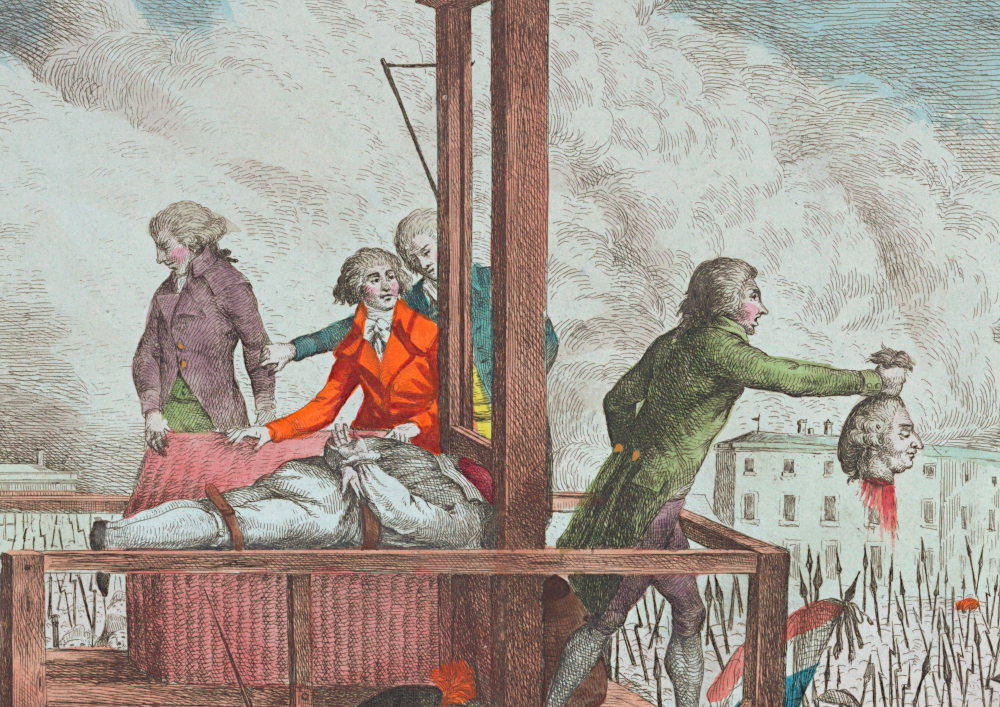
A Slight Freshness on the Neck”: Prints Depicting the Execution of Louis  XVI (ca. 1793) – The Public Domain Review
Please be aware: this video is good because it shows the lyrics of the (honestly terrible) audio of this unfinished recording, but it also shows EXTREMELY graphic footage of protests, specifically suicidal self-immolations, in Vietnam and in Czechoslovakia.

This Morning

This morning I am thinking about pride. Where pride comes from, what makes it valuable and what makes it problematic. My central thought is this:

The price of pride is pain.

Christianity says that pride is a sin; I don’t agree, though I certainly recognize that pride can lead to sin —  arrogant dismissal of others’ value, nationalism, racial divides and conflicts, a hundred other ways that pride “goeth before a fall,” as they say. I also see where pride is strength: pride in my accomplishments, as a writer, as a teacher, as a human being, is often what keeps me going in the face of continued struggle and defeat. Pride lifts up the downtrodden and helps  them to fight back against oppression, often in the face of overwhelming odds. There is value in pride. It also may be that pride is essentially inevitable, that in a culture that constantly appraises the value of everything as good or bad, better or worse than everything else, there is no way a rational person could not see which of their traits are on the approved list, and feel a bump, or a jump, in their worth.

But like everything else that has value, pride has a cost. I think that pride has to be earned. I say it is pain, but I include painstaking effort in that; anyone who has fought hard for a skill or an ability or to overcome a prodigious obstacle knows that pain is not only limited to sharp injuries. There’s a great scene in To Kill a Mockingbird when Scout and Jem are trying to find anything in their father Atticus Finch to be proud of, and then they find that he is a crack shot with a rifle; when they ask their neighbor Miss Maudie why Atticus never bragged or showed off his ability, she says that Atticus knows better than to take pride in something that is a gift from God. His ability, the steady eye and steady hand that lets him hit everything he aims at, was not earned: it was inborn. (There’s an argument to be made that practice and training made him better, but this is both a simplification and a speculation on Maudie’s part. The point remains.) I am an American, but I did not work for that: it was an accident of my birth. I take no pride in accidents. I do take pride in the actions I have taken, the burdens I have carried, for the sake of my society, and which have made that society better; I vote, I pay taxes, I participate in the cultural and political conversations, and probably most importantly, I teach. I think that those who serve, both in civil society and in the military and public safety, have earned and deserve their pride in themselves and the country they helped to build and maintain. They (we, if I may be bold) have paid for it in effort and sacrifice, and often (they, not me) in suffering and loss.

I want to say that those who do not earn their pride before they hold it, flaunt it, and press eagerly forward to show it, chins out and hands balled into fists, will pay for their pride in suffering afterwards: that the fall will come, that they will be humbled and humiliated. But of course that doesn’t always happen. The universe is not just. There is an easy way that people with unearned pride can avoid the pain themselves, and that is simply to move the suffering off of themselves and onto others, and thus you have the Ku Klux Klan, and domestic abuse, and bullies. And Donald Trump.

But for those who are not that, who are not victimizers and warmongers, the point I want to make is that pride must be earned.

And the price of pride is pain.

Money Talks

Image result for red for ed

[Read Part Two: But You Get Summers Off]

[Read Part Three: Walking Out]

I don’t know how much what I’m about to say needs to be said. This blog is full of book reviews and liberal political ranting; the majority of my readers are people I know personally, which means they’re mostly teachers and liberals and readers (Oh my!), like me. I feel pretty confident that most people reading this already think that teachers should be paid more. But I want to take it one step further, because while most people seem to think that teachers should be paid more, somehow we’re not; so there does seem to be a need, here. My hope, therefore, is that people who don’t realize how vital this issue is will learn something that helps push them towards what I think is the right answer; maybe you all will even share this or some of the ideas with your own people, and then others might learn something or be pushed towards the right answer.

For myself, I need to do this. Because, you see, I teach in Arizona, and in two days, thousands of Arizona teachers are going to walk off the job and out of their schools in order to try to win the same argument I’m going to talk about here; and I won’t be walking out with them. That makes me feel terrible. So I need to do what I can to support them, and one of the things I can do is argue, and write, and then share this. So here goes.

Let’s talk first about what teachers make. I started teaching in 2000, in San Diego County in southern California; that year I made about $36,000 before taxes. I also got good health coverage, though I didn’t need it at the time, and about $4000 was contributed to a pension account in my name. However, as some of you know and the rest can imagine, San Diego County is quite an expensive place to live, and so that first year, I needed to take a second job over the summer to make ends meet: I went with the obvious one, and taught summer school. Six weeks of extra work, and I made $25 an hour, 7 hours a day. Not bad. That year I was able to purchase my very first car, a 2-year-old Chevy pick-up with 74,000 miles, and we found a decent 3-bedroom house to rent. (I should note: I am removing my wife from this almost entirely, because her income has been extremely inconsistent: some years she made a lot, some years not so much. She’s an artist. The point I’m trying to make is this: it shouldn’t matter. I’m a highly trained and capable professional. I should be able to pay for a lower-middle-class lifestyle for two people with no kids and no expensive habits. Don’t you think?) We were able to pay for most purchases, but when surprise bills came up, they went on credit cards. Luckily, not that many bills came up, and we didn’t purchase very many things. No large entertainment systems. No extra vehicles. We took one vacation, an overnight trip to Disneyland. We did buy pets, I’ll admit. The bunny cost us $20. The dog was the big ticket item: $150 for him.

We moved to Oregon in 2004, partly because we hadn’t been able to save anything substantial, despite the fact that I kept teaching summer school, and got a $1500 raise every year (Teachers generally have a salary schedule where we step up every year for some number of years, and then every couple of years, and then we top out after 15-20 steps. You can also get raises if you get more post-degree education, which shifts you up a column.), and we knew that we’d never be able to afford to buy a home in San Diego’s real estate market. When we moved, I was up to $42,000 a year pre-tax; my new position in St. Helens, Oregon paid about $35,000. Back to square one. I had to take out the retirement money because four years isn’t long enough to get vested into the California retirement system, so we rolled it over into an IRA. But there was a problem: the cost of living in Oregon wasn’t actually much less than it had been in California, and my monthly paychecks weren’t enough to cover our bills. I had to change from 12 monthly checks to 10, which meant I didn’t get paid over the summer. No problem: I would teach summer school.

They didn’t have summer school.

So we cashed out my retirement money, and that got us through the summer; about half of my total retirement savings from California was left. The next year I got a raise, but still not enough to go to 12 monthly checks (Please note: this is now my 6th year teaching, and I didn’t make enough to pay for two people with a very modest lifestyle, no kids, no expensive hobbies. When my lawnmower died, I bought a push mower.); fortunately, that year they ran a summer school, and I taught it. Allow me to point out: this was a second job. I know people make a lot of teachers getting the summers off, and we do – that’s one of the main reasons why I started teaching, because I wanted to use the summers to write my novels – but we work 50-60 hours a week during the school year. Especially the first few years, because everything is new and takes ten times as much planning (Especially when, like me, you get handed new never-before-taught classes and you have to make everything up from scratch.). You also don’t get to sleep, because everything makes you nervous or angry or both. Everything. I threw a book at a kid my first year because he was rolling around the classroom in my desk chair. (Don’t worry, I missed him.) The summer isn’t really vacation, it’s all the hours you lost over the school year, the only time you get to relax and do fun things, or spend time with family, or sleep. The average school year is 36-38 weeks long (My current school has a 40-week academic year with two extra weeks of professional development for teachers); even if we don’t count the work we usually do over summer on lesson plans and such, the hours are comparable: a regular office job is 50 weeks, 40 hours a week, which is 2000 hours a year; a teacher works around 53 hours a week, on average, for, let’s say, 38 weeks, which is 2014 hours per year. So having to teach summer school is exactly the same as having a second job right after your 40-hour-a-week job: you don’t get to take advantage of your hours off, you never really get to rest. It is not easy.

So I taught summer school that second year in Oregon, and it helped; but not enough, because we had bought our very first house, which saved money on rent and allowed us to start building equity, but it also meant we had new bills. So that we’re clear: we did not go crazy with this purchase; we bought the ugliest house in the best neighborhood, and in April of 2005, it cost us about $140,000; we didn’t have a down payment, but there was a special deal offered to teachers that covered 100% of new home mortgages. So that year we had to cash out the rest of my retirement money to make it through the summer. And I had no idea what we were going to do the third year.

The third year in Oregon, I found out that my district had been shortchanging me: they had calculated my column on the salary schedule as though my credits were quarter credits, when most of them were semester credits, which should have moved me up to the third column (Bachelor’s degree +45 graduate credits instead of +30, because I did two and a half years of graduate school after my BA. Teacher training, not a Master’s program, but it counts.). They gave me the difference in one large check: that and the new step I got that year meant we were able to cover the summer gap, with the summer school work. The following year, my fourth year teaching in Oregon, the step was just barely enough that we could shift to 12 paychecks: and for the first time, I could pay my way with just my teacher’s salary. Mostly. We still couldn’t handle a large money emergency, and we still didn’t have any appreciable savings. Two people. No kids. No expensive habits. Hadn’t taken a vacation since Disneyland. We had a second car at this point: my wife’s parents gave her their GMC Jimmy when they bought a new car for themselves.

Right about then (2007-2008), the economy collapsed. Even though we had bought the cheapest house we could, and done a lot of improvements ourselves, we went underwater on our mortgage. Teachers started getting RIFfed (Reduction In Force, the eduspeak version of layoffs), and our health insurance costs started going up, and our salaries got frozen, step raises delayed or canceled. Somewhere around there, right around when we finished paying it off, my Chevy got broken and we couldn’t afford to repair it, so it sat in our driveway for a year while I walked to work. (That was by choice. I could have taken my wife’s car, or had her drive me, but I liked the walk. The point is that I couldn’t afford to pay for a house and two cars. Eight, nine, ten years as a professional teacher. And Oregon teacher salaries are pretty good, taken as a whole.) So in 2010, I again took a second job, as a union negotiator for the contract talks we had with our district. That might have been the toughest job for the least compensation I’ve ever had; I got a one-time stipend of, I think, about $1400; in exchange, I stopped sleeping for the year and a half that I was the lead negotiator. Instead of sleep, I just hated everyone and everything. Especially myself.

Here’s the gist: by the time we moved away from Oregon, in 2014, I was earning $59,000 a year before taxes, though like everyone, our health care costs were going up every year. We sold our house in 2013 for a small profit, but only if you don’t count in the money we invested in it, or the time. We used much of that money to buy a new car – a two-year-old Kia Sportage with 25,000 miles – and a new mattress, and our first flat screen TV (Which we still have). And we moved to Arizona, where I took a job at a charter school in Tucson. That first year? My 14th as a teacher, who now had over 90 post-graduate credits, because I had to take more classes to renew my Oregon credential?

I made $36,000. Before taxes.

So now here I am, in my 18th year as a teacher. I am Highly Effective according to my last performance review, the top score you can earn. I have been one of the favorite teachers, if that matters (and since charter schools compete with public schools for students, and one of our selling points is to have students tell other students that they really like their __________ teacher, it does matter; I’ve had parents tell me the reason they came to or stayed with the school is because of the English department) every year; I was named Teacher of the Year in Oregon. This year I made about $45,000 before taxes. I only got it up that high because I teach AP (Extra work because there are more and longer essays), because I teach five different preps (Extra planning work to figure out what five different classes are going to do each day, and also tough to shift gears that many times during the day when I get four minutes in between classes), and because I teach more than a full schedule (I teach 29 periods per week instead of the usual 25) – basically, I’m teaching summer school during the year, now. And I can almost pay all of our bills. Almost. Still couldn’t handle a money emergency, nor save a lot. Won’t be buying another house any time soon. We are doing better because of my wife’s income. But shouldn’t I be able to pay for two people, no kids, no expensive habits? Isn’t that a reasonable expectation for a teacher’s salary? Especially a good teacher with almost twenty years of experience and two Master’s degrees worth of extra credits?

So here’s my question for the room. How much should a teacher make? I don’t mean a dollar figure, since that can reasonably be tied to cost of living depending on location; I mean, where should teachers fall on the scale? Are we middle class? Working class? Are we servants? Public sector workers? I’m sure you’ve seen the memes about teachers as babysitters (I have about 20 students at a time [Charter schools do have smaller class sizes, which is lovely] for seven hours a day; if parents pay babysitters $10 an hour or more, how much should I make? Sure, I’ll take $1400 a day.) or calculating all of the different tasks a teacher does during the day, or comparing teacher pay in the US to teacher pay in, say, Finland; but I’ve also seen people describing teachers as lazy and incompetent, as people who get summers off, as people who just hang out with kids all day, and therefore we are overpaid. Allow me to point out that part of the reason for low teacher pay is that teachers have always been willing to give up dollars in exchange for benefits: for good health coverage, for good retirement, for tenure, the system that makes it harder to get fired. (Not impossible: it is never impossible to get fired. Don’t believe anyone who says it is.) Allow me also to point out that, though it varies state by state, I currently have decent health coverage that is pretty expensive for me; no contribution to any retirement beyond social security; and no tenure. Those benefits are vanishing. And in exchange, we get – more work. And less pay.

You could argue that teachers know what they’re signing up for. You’d be sort of right, although – like most people, I would think – there were expectations I had that didn’t prove true, like the summers off and the tenure and such. But by now, I know what I’m signing up for. I could quit teaching, try to find something else; but I’d have to start at entry level. And also, I’m good at teaching: it seems like something I should stick with. And it seems like something I should be able to make a living doing, at least enough to pay for two people with no kids and no expensive habits. I could have turned down the job in Arizona, stayed in Oregon and made more. I could move away now and make more, especially if I moved to Massachusetts or New York, or back to California. But while that solves my problem, it doesn’t solve the whole problem: because there will still be more than a million students in Arizona, who need teachers. And if Arizona won’t pay those teachers enough, and the teachers all move away, then – what? What’s the plan? All the students follow the teachers to different states? They all get homeschooled, learn their math from Khan Academy?

I read an article this morning in the New York Times about how all public sector government jobs have been disappearing and losing pay; a couple of statements struck me. Both came from the same woman, Teresa Moore, a social worker in Oklahoma who investigates reports of abuse of both children and seniors. The first was this:

Ms. Moore’s friends and neighbors hold conflicting views of her taxpayer-funded job. “The minute they have someone in the nursing home they perceive to be mistreated, we’re the first people they come to,” she said. “They want us when they need us. And when they no longer need us again, they don’t want us.” Source, Emphasis added

The second was this:

Some are resentful that they are being asked to pay for benefits that they themselves struggle to afford.

I asked my brother, ‘How do you feel about this pay raise?’” Ms. Moore recalled. “He said: ‘I want you to have it. You deserve it. But we don’t feel like we should pay for it.’” Source

I think this is how this country sees teachers. People want teachers to care for children, and they want us to do a good job of educating them; for some people, that means a specific information set, and for others, it means a different set – but everyone wants us to do a good job. Unless, y’know, they don’t actually have kids and don’t need to think about education, in which case, they’d really like us to just go away. Or else they don’t want to pay for us personally, and they think only parents should pay for us. (This attitude, held by the many retirees who come to Arizona for the winter months – the so-called “Snowbirds” – is a large part of the reason why Arizona teachers are the worst paid in the nation.) Or, of course, they don’t know who should pay for us: so long as it isn’t them, personally. (This also may be where the Snowbirds land.) I’m sure there are some who are resentful of teachers making more money or having better benefits than they themselves have, but that’s an insupportable argument if it comes only from envy: you can argue that teachers should make less money if you have an argument why teachers are worth less money. For many people, that argument starts and stops with good benefits and summers off and “spending all day with children.”

None of which, I hope I’ve shown, are actually true. The benefits are gone; the summers off never existed; I haven’t talked about the lil angels we get to spend all day with, but I doubt most people believe that. Because of course they aren’t angels. You weren’t, were you? Neither was I.

People want us to do a good job, but they don’t want to pay us to do a good job. They want to pay us the bare minimum, and ask us to do the maximum – because it’s for the children. And while we should do the very best we can, for the sake of the children and for society, that doesn’t mean we should be paid the very least we can survive on at the same time. Because that isn’t for the children: that’s for the people who just don’t want to pay us. Who maybe think we deserve more money, but they don’t want to be the ones footing the bill.

The last month or so has shown us the new truth: teachers are done with this trade-off, our best for taxpayers’ least. There has been a long slow slide down, which has taken advantage of career teachers who don’t want to look for new jobs; and which has taken advantage of old benefit packages which have been traded for pay cuts (The time has run out on this one, since there isn’t any more pay to cut, and so those benefits have been cut, too); and which has taken advantage of teachers’ general sense of goodwill and public service to the community. A lot of us want to teach in the places we grew up, and places that pay less, like Arizona and Oklahoma and Kentucky and West Virginia, have surely taken advantage of that. One of the best teachers at my school, my department chair, is still there despite being overworked and underpaid and being treated generally shabbily, for all three of these reasons: she grew up here, she’s been a teacher here for 25 years, she’s willing to make a little less if her benefits would be a little better.

What does it say about us as a nation that we treat people like that so poorly? We liberals rant and rave about how President Trump makes us look bad: but we all let teaching get to where it is. All of us.

And then, of course, there is the biggest reason why teachers don’t make enough: we care. We usually want to do a good job. We usually care about children, and about education, and we are sympathetic to the needs of families. When I was running the union negotiations, the biggest hurdle we had to overcome wasn’t the district, or the parents: it was the other teachers. Many of them wanted to cut their own pay because that would have saved other teachers’ jobs. Many of them wanted to accept whatever was offered, just so long as they got to keep teaching; and whether or not they could afford to live on their salary didn’t matter: their students needed them. It’s the same reason why, when classroom supply budgets get cut, most teachers go right out and buy the supplies themselves, even though in many communities, the parents make more than the teachers. But we do it because the kids really need those supplies. If the kids don’t have those supplies, we can’t do that project, and that project is really effective – plus the kids love it. We’re nice people, and that makes us saps. It also makes us good at our jobs. But we only get paid like saps. And then they ask us to do a little more, to give a little more, to work a little harder. For the children.

It’s gone too far. Teachers are going on strike, even without a union to protect their jobs and pay them partial wages, as would have happened had my own negotiation broken down that far. (It didn’t. We took the deal the district offered us. We saved jobs, lost money, and kept teaching. Of course. But Oregon has farther to fall before it reaches where Arizona is now.) Despite all the reasons why we don’t want to, we’re walking out of our classrooms, walking out of our schools, walking out on our students and our careers. We’re no longer willing to do this for what America seems willing to pay us. Either we get paid more, or we stop doing this. I say, we need to get paid enough to pay for two people, with no kids and no expensive habits, to build up some savings and maybe buy a house. Not just because that would suit me, but because I think it’s reasonable based on the value of services rendered. I will endeavor to prove that in another blog, hopefully tomorrow.

We’re good at our jobs. Unless America doesn’t want us to do our jobs any more, then we say we need to be paid more. Starting right now.

And you know what? We’re right.

After all, we’re teachers.