I Wish for Each

“Congress shall make no law respecting an establishment of religion, or prohibiting the free exercise thereof; or abridging the freedom of speech, or of the press; or the right of the people peaceably to assemble, and to petition the Government for a redress of grievances.”

So all right. We’ve been hearing a lot about this lately, right? Those are the words of the First Amendment to the Constitution. But what does it mean?

What is free speech?

Does it mean anybody can say anything they want? Anything? Or are there limitations? Should there be?

Does it only apply in American? Only to citizens? Does it apply differently to public figures, to famous people?

And why the hell are we still talking about this? Do we not know what it means? Shouldn’t we know what it means by now? I mean, really?

Okay: well first, let me just address that. I do not think there is anything wrong with having a conversation again. I don’t believe that something can be talked through once, and then that’s it, and we all know everything there is to know, and there’s no need to bring it up again. I understand that people get tired of having the same conversation over and over again, but you see, I’m a high school teacher: my whole job is essentially to have the same conversation over and over and over again. From one year to the next, from one class to the next, from one student to the next, I have to continuously repeat myself, and that often means I have to continuously find new ways to say the same things I have said before. The fact that I am willing to do that, even eager to do that, is what makes me a good teacher: because if I got impatient with students who didn’t hear or didn’t understand what I said to another student, then nobody would learn after the first student. I confess that I do get tired of saying the same things to the same people over and over again, but that’s not the same thing as having the same conversation: that is stating the rules, the limits and boundaries which are necessary for us to live and work together and abide one another, and then stating them again because some childish, selfish person decided they didn’t have to follow the rules. And then I repeat myself: and then I get angry about it.

But if you didn’t understand what I said before? I will say it again. If you don’t understand it after the second time, I will say it a third time, in different words or with different examples. And I will keep repeating it until it is clear and fully understood. And then, when you have a new thought or a new experience, and that changes how you view what we talked about before, I will happily talk about it again: perhaps after I have thought about it some more, to integrate whatever new concept or perspective you brought into it today, apart from what we discussed yesterday. No problem.

We seem to still be having trouble with freedom of speech. We are still talking about it, still debating it, still disagreeing over it; and now we are doing this in the wake of Charlie Kirk’s death. In that wake, and, I suspect, pretty directly related to that terrible crime, my wife was censored by Facebook, because someone reported a post she shared about Trump, calling it spreading misinformation. It was not, it was simply a joking criticism of the administration; specifically, it was this:

Exploring Shutdown Day 1: Discovering New Perspectives

My working assumption is that the person who reported her post was a Trump supporter, angered (as always) by libs and the left and so on, and recently energized by Kirk’s murder and the gaslighting from the right, convincing people to take action now to defend free speech (And please stop talking about the Epstein files and the still ongoing wars in Gaza and the Ukraine and the swiftly tanking U.S. economy), who probably reports every left-leaning or Trump-criticizing meme they see. Probably laughing while they do it. Facebook, as a private company that doesn’t want to suffer the wrath of the Trump administration, not only took down my wife’s post, but has also been monitoring and restricting her posts ever since: they are limiting her free speech. These new situations — unique neither to Charlie Kirk nor to my wife — has given people a new perspective on the issue, so: let’s talk about it again.

Here. This is where we start.

“Congress shall make no law respecting an establishment of religion, or prohibiting the free exercise thereof; or abridging the freedom of speech, or of the press; or the right of the people peaceably to assemble, and to petition the Government for a redress of grievances.”

Okay, so the First Amendment actually says a lot of things. It restricts Congress’s ability to control religion, and the press, and peaceable assembly, and the right to petition, all in addition to the freedom of speech. Let’s put those other aside for now: though it may be worth considering why all of those different, and all of those important, ideas were all packed together into a single amendment, and then the next one is only on one issue: guns. And the one after that is only about not letting soldiers sleep in your house against your will. Both important, maybe (though neither as important as freedom of speech) but both very narrow topics. Why are all these other things together in one place? Honestly, I haven’t read enough on the Founding Fathers and their choices regarding the Bill of Rights, so I could only speculate; but either way, we can ignore this topic for now, because we’re only here talking about the freedom of speech (and the others will become more clear as we focus just on speech, I think). Freedom of the press might come into it directly if we want to talk about Jimmy Kimmel, but it’s not clear to me that that discussion needs to involve anything other than free speech; that one right seems enough to cover what happened there. So let’s focus.

What is freedom of speech? Why do we have a right to it?

So hot take: freedom of speech is not actually critical. It is a roundabout way to protect the actually critical thing — or rather, two critical things: freedom of thought, and freedom to express those thoughts. Freedom of thought is absolutely critical to humanity, because in the most essential sense, we are our thoughts. I am what happens inside my skull. My body is also a critical part of me, but if I have a broken body, I am still me, because it doesn’t change what is inside my skull. It changes how well I can act out and reflect the decisions I make inside my skull — my freedom to express my thoughts — but it doesn’t change who I am. But if my brain dies, then who I am is gone, even if my body remains. My body can’t express my thoughts if I have no more thoughts: and without those thoughts, there is nothing for my body to express, no purpose for it to achieve; it can continue for a period of time, and then it will, mercifully, stop.

I wonder if my body would be sad if my brain died. Would my body grieve the loss of my mind?

Well: I would grieve the loss of my mind, so the question of my body’s reaction is academic. It is a part of me.

Now, in the ordinary way of things, there is nothing that could limit my freedom of thought. It’s one of the great things about being a sentient, thinking being; on that most essential level, we are always free. (Well, almost.) It’s because we are always essentially alone, and because there is no substance to thoughts: they can dance and flit anywhere we can imagine, always within the skull that holds the brain; and nothing will change other than the thoughts themselves — and potentially the mind having those thoughts. Nothing else is affected, and so nothing else can affect those thoughts: they can dance and flit to anywhere else, faster than anything that actually exists. Nobody else will even ever know where our thoughts are going, inside our minds. This was what Henry David Thoreau was talking about in On Civil Disobedience, when he described the inability of the state to actually punish him with a night in prison after he refused to pay his taxes:

I could not but smile to see how industriously they locked the door on my meditations, which followed them out again without let or hindrance, and they were really all that was dangerous. As they could not reach me, they had resolved to punish my body; just as boys, if they cannot come at some person against whom they have a spite, will abuse his dog. I saw that the State was half-witted, that it was timid as a lone woman with her silver spoons, and that it did not know its friends from its foes, and I lost all my remaining respect for it, and pitied it. Source

As he says, his thoughts cannot be trapped inside the cell, but can go anywhere that Thoreau wishes to send them: and the attempt to punish his body because they cannot punish his mind is just pitiable. What the State wants here is to control his thoughts, because they want to control Thoreau’s actions through his decision-making ability. Because their initial attempt to control his actions, through a threat to his body’s freedom if he made a certain decision the way the State didn’t want him to decide, didn’t work: knowing the threat, Thoreau still decided not to pay his taxes. His thoughts were uncontrolled, and his person/body/being followed along that thought decision, and didn’t pay his taxes. So then the State put him in jail: and he just kept right on deciding not to pay his taxes, regardless of what they did to his body. His thoughts were entirely unaffected, and uncontrolled, and they did the thing that the State didn’t want them to do — without any influence from the State at all. And so we all do, every thought we have that is in defiance of what our society demands of us. We are free to think whatever the fuck we want to, even the thoughts we’re not supposed to have, or not allowed to have.

Please take a moment and think a thought or two, which people outside of your head would not allow you to have, if they could tell you what to think. Any thought you like. Any thought at all.

Nice.

So because nobody can control a person’s thoughts, the laws focus on the second critical part of the process of having a free mind: the expression of our thoughts. Free speech, and in a broader context, free expression. Let me focus on that second aspect for a moment, because it shows more clearly what the point is here.

I can have my thoughts, and you can’t stop me. So far so good. But obviously, if I can’t act on those thoughts, then my thoughts cannot be complete. If, for instance, I think about spitting on the sidewalk, decide to spit on the sidewalk, but I cannot spit on the sidewalk — at the moment that is just because there is no sidewalk near me; I could spit on the floor of my office and call it a sidewalk, and to some extent I would have acted out my thought, and brought that thought to its completion, but then I would have to deal with my spittle, and also my wife would kick my ass — so I don’t spit: and thus the thought is not free, it is limited. I think, “I’m going to spit on the sidewalk!” and then I can’t do it: the thought is constrained. When the thought is constrained by reality — “I want to grow nine arms and use them to juggle chainsaws!” — then again, my thought is not free, but there’s no point in talking about our freedom to do things that we can’t do, or the need to pass laws to prevent things that are not possible. At that point, all we can do is shrug, and say, “It sucks to suck, Dusty. But you go ahead and dream of nine chainsaw-juggling arms, that’s fine, you can think about it all you want.” Freedom of thought is still protected, because I can carry the juggling arms thought as far as it can go; and as thought is still the most essential aspect of being human, that’s fine then. Thoreau can think that his taxes should not be collected by a government that supports both human chattel slavery and a war of conquest against Mexico (the reasons Thoreau didn’t pay his taxes), and if the action is not possible — if taxes didn’t exist and so he couldn’t choose to pay them or not to pay them — then he has all the freedom he could ever have.

But see, what happened is, Thoreau’s aunt paid his taxes for him, against his will. I don’t know why: I suspect she either thought he was suffering in jail and wanted to help him, or she was ashamed that her nephew was in jail, and wanted him to stop embarrassing her. (I would guess the second one, because she did not consult with him before she did it, and if she wanted to help, seems like she would at least visit and ask if he was okay.) Which then limited his free expression of his thoughts: he could think his money shouldn’t go to the government, and he could decide not to give his money to the government; but the government got his money anyway. Not because it was impossible for the government to have his money, but because someone else took his choice away. I guess it wasn’t really his money, it was his aunt’s money; but Thoreau’s idea was not to save his own pocket change, it was to refuse to participate in the government’s immoral acts, and when money went to the government in his name, it defied and negated his decision. Imagine if he talked to someone about not paying his taxes, if he argued with the government tax collector about the issue, and expressed his disagreement with the government, and said, “I will never contribute to this immorality, sir!” Can’t you just see the agent smirking and saying, “Sure, buddy. I mean, we already have your money, so you can say what you want.” Thoreau’s thought, while still free, has been constrained in its expression: and that pretty much ruins the thought; a thought which was not constrained by impossibility, it was possible, and he could have acted upon it — but then the option was taken away.

This is why, of course, jail is actually a very effective punishment for most people: because while we are all free to think our way out of jail, I would guess most people in jail want to walk out of jail: and they can’t. Which means their thoughts, while potentially free, are nonetheless really trapped along with their bodies. It is worth noting that, if you can find a way to free your thoughts, then prison wouldn’t matter so much; it would become a struggle to try to force you, through continued discomfort, to think about being in prison and how much you don’t want to be; then your thoughts are controlled, and trapped, and you are suffering for your punishment. But when Malcolm X was in prison, he found freedom in learning: and he talked in his autobiography about how prison really didn’t bother him at all, once he taught himself how to read and found things worth reading — and also once he found his faith in Islam, which also gave him something to think about that wasn’t constrained by being in a cell.

I have often reflected upon the new vistas that reading opened to me. I knew right there in
prison that reading had changed forever the course of my life. As I see it today, the ability to read
awoke inside me some long dormant craving to be mentally alive. I certainly wasn’t seeking any
degree, the way a college confers a status symbol upon its students. My homemade education gave
me, with every additional book that I read, a little bit more sensitivity to the deafness, dumbness,
and blindness that was afflicting the black race in America. Not long ago, an English writer
telephoned me from London, asking questions. One was, “What’s your alma mater?” I told him,
“Books.” You will never catch me with a free fifteen minutes in which I’m not studying something I
feel might be able to help the black man.

But I’m digressing. I told the Englishman that my alma mater was books, a good library. Every
time I catch a plane, I have with me a book that I want to read-and that’s a lot of books these days.
If! weren’t out here every day battling the white man, I could spend the rest of my life reading, just
satisfying my curiosity – because you can hardly mention anything I’m not curious about. I don’t
think anybody ever got more out of going to prison than I did. In fact, prison enabled me to study
far more intensively than I would have if my life had gone differently and I had attended some
college. I imagine that one of the biggest troubles with colleges is there are too many distractions,
too much panty-raiding, fraternities, and boola-boola and all of that. Where else but in a prison
could I have attacked my ignorance by being able to study intensely sometimes as much as fifteen
hours a day? Source

So again: the real goal of punishment, the only kind that is possible being constraint of the body, is to control the mind; and if the mind is able to continue thinking, then the constraint of the body is essentially meaningless. But in the vast majority of cases — and also, I will point out, in these two cases I have mentioned, because I don’t doubt that at some point Thoreau would have wanted to get out of jail and therefore would have felt trapped, and therefore actually would have been trapped, and Malcolm X would have been severely constrained if he had not been released to become the leader he became — trapping the body, because it limits the expression of thoughts, is an effective way to control a person’s thoughts. And even more importantly, for the purposes of society in general, constraining someone’s actions, the expression of their thoughts, is enough, because the purpose of prison is to stop a person from affecting others, and thoughts have no effect without expression. So just like I accept that I can’t ever have those juggling arms I dreamed of, society accepts that it can’t ever control our thoughts: and it just makes do with having potentially total control over our bodies.

And that’s where the amendment comes in.

I hope it is clear that thought without expression through the body, whether through action, through communication, or through a public display of some kind, is incomplete, and more importantly, useless. A useless thought is not a bad thought: all impossible thoughts are useless in and of themselves, which includes every dream, every fantasy, and every imagined existence; but they can still have enormous impact; and even if they don’t, they can encapsulate important things about the person who thought them, and that’s good, even if that encapsulated thought never reaches outside the mind that dreamed it. But when society wants to control us, controlling the impact we can have on other people is the primary goal and thus also the primary means of controlling people and the thoughts that define us. And that’s why the Founding Fathers included an Amendment that protects free expression in several different forms, most importantly speech and press and peaceable assembly.

Let me be clear now: the Founding Fathers were not always right. You don’t have to look any further than chattel slavery to know that they and their ideas, and the documents and the nation that they built, were fundamentally flawed, right from the beginning. There were some bad thoughts in there, and we’re still dealing with the legacy of those bad thoughts. But they were right in this: government wants to control people, and that means they need to control our thoughts — but they can only control our bodies, which is what they try to do. The First Amendment is there to set a baseline protecting our thoughts, through protecting the only things the government can attack and control, which is our actions.

So that is the essence of the Amendment, and the right: we have the right to express our thoughts, freely. The government cannot control our expression of those thoughts, so long as the thoughts do not have a direct impact on others in a way the government can control, and should control. In other words, if I decide to pick up a rifle and shoot someone I disagree with, that is no longer simply the expression of my thought, now it is an attack on another person, and it can be controlled, and should be because it is harmful. Though I will point out that, to some extent, the expression of that thought can’t always be controlled; sometimes it can only be reacted to after I have already done the thing I decided to do. But insofar as it can be predicted, and thus prevented, it should be.

Do I need to talk about why I shouldn’t have the unfettered ability to inflict harm on my fellow humans? Or can I assume we’re all on board with that? Just for the sake of saying it, the issue is that I have no right to control other people’s thoughts, nor their expression of their thoughts, except in the service of preventing harm. If I do harm to another person, I am affecting their ability to express and complete their thoughts, or possibly even their ability to think thoughts in the first place. If I am the one looking to do harm, not just prevent harm, then someone should have the ability and the right to stop me before I do harm.

Should that be the government? My first thought was to say that of course it should be; that this is the reason why we create governments and cede to them the power to control us: so they can prevent us from doing harm to one another. But government is frequently bad at this, and in that case, maybe other people and other authorities should have that power, that right, that responsibility, to prevent my harmful actions. But this is where we get into a conversation about how society should work, and that’s too complicated for right now. Suffice to say that the government, as imagined by the Founding Fathers — that is, existing with the consent of the governed — is a reasonable place to invest the power to control people’s obviously harmful actions. I would like to expand on the FF’s ideas about the governed who were consenting to the government, to include all of those who are governed, which would include people they didn’t consider worthy of consideration, or even consider to be people; it would also include all those who reside within the jurisdiction of the government in question, and who would be subject to the government’s control: those people should be considered “governed,” and therefore should be asked for consent to the government over them. Yes, that means undocumented migrants as well as those who don’t have full legal status. And also suspects, convicts, prisoners and parolees, all those governed by the justice system: they, too, must consent to the government over them, or else it becomes illegitimate and tyrannical.

And to be clear, when I say “consent,” I mean continuous, affirmative, and enthusiastic consent. The only kind of consent that matters.

Also at this point, I would like to express my burning volcanic rage that the First Amendment does not include the right to vote. What the actual FUCK, Madison? Why did you leave that one out?

It was the slaves, wasn’t it.

So all right: we should give the government the power to control our actions which can be harmful (and which can be controlled): but we retain the power to consent to be governed, and also the power to abolish the government if it becomes destructive of the ends we created it for, ideally through voting in free and fair elections. Since the government exists with our consent, what one thing do we most clearly need in order to legitimize that government?

A voice. The power to say “Yes,” and the power to say “No,” and to have those words heard. The power to consent, in the simplest terms. Continuous, affirmative, enthusiastic consent. If we don’t have that power, the government has taken too much control and has lost its legitimate authority, and should then be abolished: and that is the intent of the First Amendment, to protect and enshrine, first and foremost, our power to keep or abolish our government, which would otherwise have unchecked power over us.

You know: the power to vote. But in the absence of that, the power at least to speak, and to be heard. Not just to think freely, but to actually express those thoughts. The power to spit on the sidewalk. And on fascists.

So. Now. Did Charlie Kirk have freedom of speech? He did, and he should have: he spoke, and was heard. He lost that freedom when another person caused harm to him, murdered him, in an act that our government should have done all it could to prevent. Was Charlie Kirk a promoter, and therefore a martyr, for the cause of free speech? He was not: it was not his job to protect people’s right to free thought nor to free speech as an expression of their thoughts; inasmuch as he encouraged free thought and the free exchange of ideas through debate, then he was a proponent of free speech; but watching his debates makes it very quickly clear that he was not interested in the expression and free exchange of ideas, he was interested in scoring points and (as my students would say) farming aura: trying to get famous and powerful because he was seen as a staunch defender of his political and religious views. This is no criticism of the man: I would also like to get famous and powerful using my words, though I’d probably rather write than speak; but I want the same thing. But it does mean he was not a martyr for the cause of free speech, because free speech was not his cause: it was the means by which he tried to achieve his purpose, to fight for his cause. He shouldn’t have had to defend his free speech, he should have simply been able to exercise it. And just like Charlie Kirk, as a private citizen, it is not my job to protect free speech directly: that is what the government is for. To secure these rights, to Life, Liberty, and the Pursuit of Happiness.

Let me emphasize that again, because we talk about free speech as though it is just something that needs to be protected from the infringement of the government on our rights, that the point of the First Amendment is to constrain the government from taking away our free speech; the First Amendment is that thing, that is its point — but also, the real point of the amendment is to tell the government that it should be working to protect and secure that right for all people within its jurisdiction and influence. Actively. Affirmatively. Enthusiastically. Continuously.

Which means, in practical terms, that the government should not only have done more to protect Charlie Kirk from being murdered (if we believe the government could have done more to prevent that, which I think is self-evident, but that’s not the argument I’m making here), but also, it should be doing more to ensure that all people under the jurisdiction of the U.S. government, all persons resident in this country and under its control around the world, have the opportunity to be heard, to express their thoughts freely. By publishing their opposition to the war and genocide in Gaza, without losing their legal status. To have their case heard before an immigration judge, through the due process of law. Through posting whatever the fuck you want on social media, even if other people don’t like it, so long as it is not actively, directly causing harm. Through speech, through the press, through petition, through peaceable assembly.

Which means the government should have kept the Fairness Doctrine. And in this modern era, the government should ensure that social media does not censor people’s free speech, so long as that speech does no harm. In fact, I would argue that the government should have a platform for people to be heard, to be seen, to which all people who must consent to the government over them have access. I would include NPR, PBS, and VOA among those platforms, but I would argue the government should also provide some simple form of social media, to at least offer an alternative to the private companies, which are all controlled by billionaires with agendas. I don’t think the government should seek to control the social media companies per se, but they have a responsibility to ensure our rights: including the right to speak our thoughts, online as well as through print and speech. The government should also protect protestors and ensure that they have the right to assemble and petition for redress of grievances, so long as they are peaceable in that assembly.

Yes, that last clause, as well as the earlier condition that speech should be protected as long as it does no harm, does create an opportunity for the government to limit free speech, depending on what we mean by speech that does harm, or by peaceable assembly. I think the current laws distinguishing between protest and riot, and the laws preventing libel and slander, make sense and should remain (I don’t know enough about the specific laws and so can’t speak to their current efficacy, but conceptually, I’m in favor), and where these two rights cross over, with the law preventing speech that incites to violence, is also a useful law that protects people from harm. I also think there should be a gray area around and beyond those laws (Does “Fight like hell or you won’t have a country” count as incitement to violence? I honestly can’t say, not without further evidence of intent and context. If only there had been a trial…), and that the burden of proof within that gray area should definitely be on the government, as the ones who enact the control of people’s speech, to show that someone lost their right because they were causing harm with their speech. We have a system in place to carry out that process: but we need to have people in the government who are dedicated to maintaining and using that system.

We do not currently have that. We have an authoritarian who wants to eliminate free speech because he doesn’t want anyone to have rights except himself. We have a legislature that agrees with him, completely and slavishly — they are not expressing their thoughts, they are expressing only his. (The opposition, presumably, is not expressing the authoritarian’s thoughts. We just need to find where that opposition is hiding…) We have a Supreme Court that also thinks no one should have rights other than the President, and themselves, because they think their trump card over Trump (pun obviously intended, as all puns should be — also, we should have a right to pun…No, we do have a right to pun, and it should be protected by the government.) enables them to live as exceptions to the dictatorial power they want to give him, and they like the idea that a dictator could enhance the lives of the people whom they (the “justices”) deem worthy of enhancement, and destroy the lives of those whom they deem worthy of destruction, without they themselves dirtying their lil fingies. They’re wrong, of course, because if Trump ever did become a dictator, he would end up killing or jailing the justices because they have defied him in the past, and no dictator can abide that kind of challenge to their power; but then, all of these people are wrong. They all think that the dictator would only use power the way they want him to use power, and that’s not how dictatorship works.

Please take note, all you MAGA voters who want Trump to hurt the people you hate, but not you yourself. That’s not how dictatorship works. He doesn’t dance to your tune. If the Supreme Leader is the only one with rights, then we will no longer have rights ourselves: not the right to life, not the right to liberty, not the right to the pursuit of happiness. We will then not have the right to express our thoughts through speech or writing, through assembly and protest and petition; more importantly, we will no longer have the right to consent, and though that immediately means the government will no longer be legitimate, it also means that we won’t have the ability to remove it without violence.

That is where the Second Amendment comes in. It is not, as the fools who care only about that one and not the First would have us all believe, the right which ensures all the others; that is the First Amendment. It is free speech. It is the power to consent, and to withdraw consent. The practical power that enforces the moral and intellectual power is the right to communicate, to agree, to assemble and stand together: that is what changes governments. (Also, if we don’t lose it, the right to vote. Tell me why the right to free exercise of religion usurped the place that should have gone to the ballot, I beg you.) The right to defend ourselves physically is the last resort when the first one has been lost: and every one of those gun rights advocates, from the rational ones to the chuckleheads, have been ignoring the infringement of the First Amendment while trying to protect the Second. Protecting it, I might add, through their right to free speech.

So. Free speech is not only important, it is critical, it is definitive, both to us as humans, and to our country as a free country, with government of the people, by the people, for the people. It is the most important right we have, and it is the best way to delegitimize, remove, and replace the current government, which I think we can say safely does not have our consent any longer to govern us, taking “our” and “us” in the largest collective sense, meaning the majority of people governed by this administration. The government should not only not be infringing on it, the government should be actively protecting and promoting it: that is the government’s job, the reason it exists, and the best way to ensure that the other rights are also maintained. Because free speech leads to the free exchange of ideas and information, to the shining of a light into the darkness where tyranny grows. It’s what lets us all communicate and understand each other, and then agree: and take action.

Before it’s too late.

Opening The Window

…Maybe Shouting Out of It

I have been thinking about writing. I do that a lot: mostly because I haven’t been writing a lot. But I just don’t know what to write.

Then I saw this:

@therapyjeff

You’ve got, like, 1 to 3 business days before hypernormalization drags you back under. #mentalhealth #therapy

♬ original sound – TherapyJeff

It hit me.

It’s hard to predict what will hit you, what will have an impact; that’s part of why I haven’t been writing as much — I don’t know what to say to have an impact on my audience (if I even have any audience left), and I can’t predict what will have an impact on me. And the hypernormalization that he talks about is definitely real, and strongly controlling of my day-to-day interactions with the world and the world of current events. I will also say that my role as a teacher is partly to encourage some of that hypernormalization, because my students freak out, often because they enjoy freaking out and more often because they are young people in a terrifying and confusing world; and whether they are freaking out for the sake of their shattered nerves, or for the sake of the meme (or freaking out for the meme as a way to disassociate from their shattered nerves) , the answer is always to remain calm and to try to pour water on the flames they are fanning. So I spend part of pretty much every working day trying to calm the tempestuous waters of teenaged souls. Then I come home, and sometimes my wife is freaking out — in that case it is never for the meme, it is only because of her shattered nerves or because the world really is a dumpster fire and sometimes we are caught in the flames (which is NOT FINE) — and then sometimes, again, my job is to make awful things seem normal and manageable and not a big deal. Sometimes my job is to freak out with her, which, sadly, I am bad at, because my freaking out usually looks like me getting really mad, and that doesn’t always make people around me feel peachy; but I do my level best anyway, Partly because my nerves are shattered, too.

But this is counterproductive for my writing, because I don’t want to write about how things are normal, how they are just fine. I want to write about how they are fucked up. I don’t want to freak out, because nobody wants to read pages and pages of AAAAAAAAAAAAAAAAAAAAAAAAAAAAAAAAAAAAAAAAAAAAAAAAAAAAAAAAAAAAAAAAAAAAAAAAAAAAAAAAAAAAAAAAAAAAAAAAAAAAAAAAAAAAAAAAAAAAAAAAAAAAAAAAAAAAAAAAAAAAAAAAAAAAAAAAAAAAAAAAAAAAAAAAAAAAAAAAAAAAAAAAAAAAAAAAAAAAAAAAAAAAAAAAAAAAAAAAAAAAAAfuckfuckfuckfuckfuckfuckfuckfuckfuckfuckfuckfuckfuckfuckfuyckfukfuyckfuckfuckfukfuckfuckfuck Hey that’s pretty fun when you get the rhythm going!

But it’s hard to write, calmly and rationally, about how things are fucked up when you are yourself freaking out. Which is, of course, what the powers that be want: they want us to draw into our individual isolated shells and hide from the horrors they have put into the world, because that makes us easier to control, and easier to eliminate; and that’s why this very nice therapist made this TikTok, in which he tells us to take a step, even a small step, towards interacting and connecting with others during this particular moment of jarring insanity; because, as he says at the close of that video, even that small step of having a conversation or connecting with a group of potentially like-minded people, is much bigger than sinking back into the hypernormalization without having done anything other than twitch bonelessly for the 1-3 business days of this moment when we can break loose.

So let’s break loose. Rationally. Without freaking out, but also without rationalizing everything into normality. Because this is not normal: a man shot Charlie Kirk in the throat. Charlie Kirk is dead — apparently assassinated, though one thing I will say is that we absolutely must stop speculating about shit we know nothing about, until we actually know what is going on. We don’t know that the murderer was an assassin in the sense that we know for sure that the killing was politically motivated, and that Kirk was murdered because he was a prominent political voice; he was a prominent political voice, so in the case that we see any such death as an assassination, then it was, but I think it is important to distinguish between John Hinckley’s attempted killing of Ronald Reagan and Lee Harvey Oswald’s successful killing of John F. Kennedy: Oswald intended to kill the US President because he disagreed with Kennedy’s political stances and actions, and maybe what Kennedy represented; Hinckley thought Jodie Foster would notice him if he shot the President. That second one is not, to me, an (attempted) assassination. If we assume that this one was an assassination, which is a reasonable assumption but not a certainty because the killer carved fucking memes into his bullet casings — “If you read this you are gay LMAO” is not a political statement — it is also not clear if it was done because Kirk was too right wing, or if he was not right wing enough, which means we may be able to label it as an assassination, but not then go on to say anything meaningful about that fact other than it was a terrible, horrible thing, like every murder, especially unnecessary ones. (Yes, there are necessary murders. Not many, and they are still terrible, but there are. Not this one, so that is not our topic.) We do not know, and I will disagree with the people saying all over the internet and TV, that Kirk was killed for his political views, or his ideological beliefs, or his past statements which the killer may have found too offensive or not offensive enough; when all of that becomes clear, then we can discuss it — though we are unlikely to come to any useful consensus about it. And that’s partly because of Charlie Kirk.

I don’t want it to be because of me, too. I like to think it never could be, because I, of course, am rational and reasonable — and also correct, which, as I like to tell my students (quoting the late great Bill Hicks), gives my argument that extra oomph — but of course we all think that about ourselves. I do certainly write divisive things, both because my arguments are aggressive and confident, sometimes even spoken in words as hard as cannonballs (to quote Ralph Waldo Emerson), and because my language and my personal statements about my opponents and enemies are frequently deeply offensive. If people who disagree with me read these posts, they probably get pretty mad at me, and at them. Though they may deny it, because of course online debaters must never admit that they are upset, that they are emotional and out of control.

I am quite emotional. I am often somewhat out of control, usually, as I said, because I have a temper, and because my nerves are shattered. Anybody who doesn’t feel the same, at least that last part, is either lying or a sociopath.

Because stuff is fucked up. Deeply, multifariously, evilly fucked up. A man was murdered, and we all flipped our shit about it: and on the same day, two children were wounded by a third, who shot them at their school and then killed himself. I don’t even know how many other people have died in the days since Kirk was killed, but if we keep up this year with last year’s average it would have been about 47 per day. The right accused the left of causing Kirk’s murder with our political rhetoric; the left accused the right of causing Kirk’s murder with their violent fascism; people posted about how saddened they were by the death, especially because his wife and children were there and saw it happen; other people posted about how they were glad Kirk had been killed because of the awful things he had said and the positions he had espoused in the past, including racism and sexism and homophobia and transphobia.

It’s all fucked up. And even the virtuoso guitar playing of Stevie Ray Vaughan (Who was only five years older than Kirk — 36 to Kirk’s 31 — when SRV died in a helicopter crash) can’t make it better, can’t make me feel calmer and more in control at this moment.

So I had a thought. A step to take, in this window (which may have closed already, because it’s been four days since he died; but I’m going to try to do this anyway because I don’t think I’ve sunk back into the hypernormalization yet) of opportunity. Not to argue for gun control, though I am doing that on social media; not to argue against hyperpartisanship because arguing against people arguing badly is a losing endeavor, no matter how you slice it; not to lament the loss of free speech in this country, because Malcolm X was assassinated sixty years ago — also in front of his wife and children — and the Alien Enemies Act signed into law by President John Adams in 1798 was used by President Donald Trump in 2025 as a legal justification for deporting both citizens and non-citizens without due process, so I would argue that we have never had fully free speech in this country.

I want to try to reverse the polarity of this moment. I want to try to speak positively. Not about Kirk’s murder, which is nothing but horrendous; I just want to use this moment to try to imagine a world in which Kirk would not have been murdered. A world that certainly could have existed, if we had made different choices as a nation and a people, and one that we can certainly bring into existence if we try. Maybe if I try to normalize hope, then we can have some when we sink back into our absurd routines.

Let’s start with a beautiful image. This one came from here, and is advertised as using no AI.

I don’t see why not. Hope is not any harder than despair: hope takes work, but we have to work to keep our despair gurgling inside of us, just as much. We have to spend time looking for more reasons to feel despair, have to keep thinking negatively about what is in our world or in ourselves — or what is not there — have to keep all of that front of mind, or else we might spot a video of a cute puppy and not be sad any more. If you’ve ever felt sorrow or despair, then you know the struggle to keep it that I am talking about. (Depression, now: depression does not require any work to maintain; that’s why it is depression. But I’m not talking about mental health, other than to say that hope and positivity in a non-toxic way might help with depression, as well. Not going to oversimplify the facts of depression, but still. Here’s that puppy.)

Your Puppy: What to Expect at 13 to 16 weeks - Vetstreet | Vetstreet
This is my favorite ear configuration: one up, one down. And nobody does it better than Corgis. This image is from here.

I’m not trying to slap some pretty pictures up over the horrors: that kind of forced, hollow veneer just makes things feel worse because we know how thin it is. I’m just using the images to counteract the — let’s call it the acidity of the first part of this post, the corrosiveness of horror and violence and conflict. But for the hope, I want to speak genuinely. Because I think the hope is real.

First, what am I hoping for? I’m hoping for a society that recognizes the value of all of its members, and takes all stakeholders seriously when considering what to do collectively. I’m hoping for a world where people are able to find and create joy, consistently, throughout their lives. A country where we try to find our common ground, and respect our common humanity, before we disagree about what our country should look like. A life where people recognize the liars and conmen, the gaslighters and manipulators, and see the corruption for what it is, and don’t tolerate it because it smells just like our own. A world of integrity and trust.

No. It isn’t impossible. I’m certainly speaking in broad generalities, because no, I don’t expect any world to reach a point where problems are eliminated, where there is no conflict, where liars are vanished and corruption is prevented before it taints everything. But I do know that our world, our society, our ethos, used to be different, in at least some ways and to some degree; and that means that change is possible. We talk about the pendulum swinging, and it does, and it will — though I suspect that the pendulum, like most other political machinery in this ever-so-exploitable country, has been manipulated in some way to ensure that the people in power don’t lose that power when the pendulum swings; but the power of the pendulum metaphor is that the swings are inevitable, and reactive: you can hold back the pendulum, you can even push it farther away from plumb; it’s just going to swing harder and faster when it finally goes, and swing farther in the other direction when it does. It can’t be stopped. And it can’t be stopped because people are essentially good, despite what our cynical profiteers would have us all believe — because they want us all hiding in our individual isolated shells, hiding from the horrors, easily controlled and easily exploited. No: people are essentially good. We are just — we’re really, really scared. That’s what we have to overcome.

Here’s a nice picture of individual shells:

🔥 Cuban snails ( Also said to be the most beautiful land snails ) :  r/NatureIsFuckingLit
These are Cuban snails. Image from the subReddit NatureIsFuckingLit. Hell yeah.

And it begins with trust.

That’s the message I want to share today. Hope is possible, and achieving what we hope for is possible, especially if we all hope for (essentially) the same things. It begins with trust: we need to trust each other, to believe that we all will cooperate, so far as we can, to achieve those things we hope for.

I know this because I am a high school English teacher. And I have watched my classes struggle more, in some ways, every year, as their attentions spans wane, as their interest in reading disintegrates, as they become less and less literate. I have certainly lost hope at times; I have certainly lost trust in my students, have believed that they do not want to learn what I have to teach, that they do not want to read, that they do not want to do anything other than play video games, watch TikToks, and be annoying. I have believed all of those things because there are days when they act like that. Some of my students act that way all the time, and some of those even say that they have no interest in learning to read better, no interest in ever reading as long as they live. It’s hard to keep trusting kids who say that to me, especially the ones who know the impact on me of what they are saying.

But those are only some days. And those kids? They are only kids. They don’t want to read because they don’t have any hope. They are not incapable of reading, and they are not incapable of hope. On my worst days, I don’t believe that; but on my best days, I inspire hope in them. I know it: I’ve seen it, and I’ve been told about it, both in the moment and years afterwards. I was having a rough day this last Friday: and then one of my students — now former student, because they have departed my school for online schooling — came back to thank me for being their teacher. They gave me a lovely hardback copy of To Kill a Mockingbird, the book I taught them. Because they saw it and they thought of me, and they wanted me to have it. They saw a book: and they recognized the value of that book, because I taught them that book had value. And, I mean, I’m a good teacher: but I’m no miracle worker. This was just an ordinary interaction, a regular unmotivated and difficult student, who I happened to connect with enough that they trusted me when I said that TKAM was worth reading: and then I proved it. And for the rest of their life, they will know at least one book that has value, that is something worth giving to another person as a thank-you gift.

That’s hope.

And it starts with trust.

I’m going to keep going with this idea, because I like it, and I think there is value in it. Hopefully I can get some of you (if there are any of you — but I trust that there are) to trust me enough to start hoping, as well. And if we can agree on what we should be hoping for, then we can make it happen. We’ll turn that goddamn pendulum into a wrecking ball — one made of candy.

That’s how we’ll change it.

Day of Hope

Yesterday was my birthday. I had a great day: my wife and I went out for an incredible brunch at a restaurant in Tucson called Blue Willow – HIGHLY recommend the breakfast burrito, if you go – and then went home and had presents – I got two awesome t-shirts and a video game, Skyrim for my Nintendo Switch, which is a lovely thing mainly because Skyrim was one of those games I avoided when it was new, since I knew it was exactly the kind of video game I love most (sandbox swords and sorcery) and would therefore consume all of my waking hours once I opened Pandora’s Box and started playing it, and as I told all of my students at the time when they asked if I was going to play Skyrim, I have a job; which means that now I have been given permission to go ahead and let my free time be consumed, partly because I deserve and need nice things, and partly because the truth is that I will not actually allow ALL of my free time to be consumed, that I can be trusted to do what is necessary even if I would rather just dive back into the video game (Hold on, the t-shirts reminded me: I need to cull my collection. Be right back. [Got rid of seven shirts. Good progress.]) – and then we went to an arcade with friends, where I got to play pinball and a car racing game and a pirate shooting game and the BIGGEST SPACE INVADERS IN NORTH AMERICA, and then we came home and ordered Chinese food in and then had huge slices of an AMAZING cake. It was a great day.

Yesterday in Washington D.C., the Republican party passed Donald Trump’s “Death to the Poors” bill (I will neither call it the B.B.B. as that shitmouth named it – though honestly I appreciate the bald hypocrisy of that, coming from the party that has been loudly and repeatedly criticizing large omnibus bills for years if not decades, until said omnibus comes from President Turdtongue – nor talk about it as a tax cut bill as the news outlets insist on calling it, while they also name it as a Asslips’s “most significant accomplishment,” which is a wild phrase: just imagine talking that way about, say, Auschwitz, or the Night of the Long Knives, or the invasion of Poland, as Hitler’s “biggest achievements” to date. I will come back to hypocrisy.), which Pres. Butt-Teeth will be signing today, in a continuation of his efforts to taint and corrupt every single piece of American culture so that nobody can ever enjoy anything ever again in this country.

Not that this is my favorite holiday: I’m a vegetarian, and I live in Tucson, Arizona, so barbecues at the park are out on both meat-related and heat-related grounds; plus my dog is terrified of fireworks, and I personally dislike the strong possibility of wildfires being started by an idiot with a bottle rocket and a match. But there are, nonetheless, reasons why I want to celebrate this holiday, and hold onto it in the face of ol’ Colon-Throat’s attempted appropriation. And I want to write about it today because I realized that the reasons for me, for us, to hold tight to the Fourth of July are the very same ideas that I want and need to write about.

I wasn’t sure what I wanted to write about. Part of me doesn’t want to write at all: I just want to curl up on my couch, pet my dog, and play video games. (And not only because I just got Skyrim, though that is definitely part of the draw… I can hear it calling to me right now… No, wait, that’s my cockatiel Duncan screaming because he’s upset about something.) And while I want to rant about Donald Trump, and the Supreme Court, and the Congress, because all three branches of government have been captured by the proto-fascists who want to turn America into a white Christian ethnostate with a patriarchal dictatorship that is decidedly unChristian, I don’t know what the value would be in ranting: the people who would read it already agree with me, and it would just make them sadder than they already are because the horror is relentless and it’s hard to remain so ourselves; and the people who might read it who don’t agree would find it tiresome to just hear more ranting; and the people who are on the opposite side of these issues (who don’t read, but just hypothetically) would be giddy with Schadenfreudish glee, cackling about how angry I am and signing up for WordPress accounts just so they can comment “Cry more!” and throw down some of the memes I’ve been getting hit with because I have (foolishly) been commenting on news stories on Facebook. And I don’t want to create any of those responses.

I recognize that the most important thing we can do is spread good information, and so that makes me want to become a journalist, and share correct information, and – I mean, maybe I should do that. But I already have a job. And it’s a hard job, and I work hard at it. And I have a family which I love, but which, like all families, requires a lot of time and energy – and not that I begrudge that, I do not, I would spend all of my time and energy on my family if I didn’t have to work, and I look forward to the day when that happens; I’m just saying that I will not take time and energy away from my family in order to become a journalist. There are already better journalists, trained and professional journalists, out there doing that work, so I shouldn’t have to. Clearly my fight against misinformation is in my teaching, and I will continue to do my very best there, in every way I can.

But that leaves me with nothing to write about.

It is summer, and so that makes me want to write, because over the school year I am often too tired and burnt out and frustrated to write; but I have been facing this conundrum about what to write about, and I haven’t been writing much. (Also my summer has not been all that restful, but it’s mostly been family stuff, so I don’t resent it.) As I haven’t been writing, however, I have been trying to get back into my other great passion that I haven’t been able to spend enough time on: I’ve been reading. And one of the things I’ve been reading has been these:

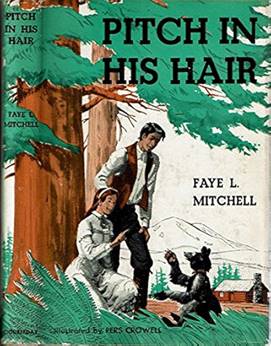
These are my great-grandmother’s novels, published in the late 50s, when she had retired from teaching. (Have I mentioned that I come from a line of teachers and writers on  my mother’s side? This is part of that line.) I’ve never read them before, partly because I never knew my great-grandmother; for most of my life I didn’t even know that she had written books or published them or that we had copies. So I’m reading them now, and they have shown me a couple of things. First, because these are young adult books, and historical/regional fiction (They are all set in western Washington, where the Mitchells lived and where both my grandmother and then my mother were born and raised, during the frontier times between about 1970 and 1890, when the Mitchells did not live there – Faye and her husband Burt emigrated from Kansas), they are not great literature in a canonical sense: but they are good stories. And this helps to settle in me something I have always struggled with, because I am not a writer of great literature, and though I don’t want to be, I always think I should be; but I think that in truth I am, like my great-grandmother, a storyteller, not a literary giant. And I would rather be that. Second, these books, because they are set where they are and because the main character, Abby Conner, is a young woman who wants to become a teacher and a writer and who talks about what it means to be a teacher and a writer, are helping me to be prouder of the teacher and the writer that I am, because I think that my great-grandmother would probably be proud of me, and I like that – and my Nonna, whom I loved and respected but who passed before I had even decided to become a teacher, would definitely be proud of me, and I love that. And third, because my great-grandmother clearly wrote about what he knew, I have been thinking about how I need to do that. Not with my novels, which are almost certainly going to stay fantastic and more about vampires and time-traveling pirates and magical dreams that change reality; but with these blogs, and with the things that I write every day: I need to write about what I know.

So this is what I’m going to do: I’m going to write about what I know.

So. What the hell do I know?

I used to be optimistic.

My wife talks about it, about how I used to be much more cheerful, and much more calm, and much more positive. She doesn’t make it sound as bad as I just did: she doesn’t say all those things at once, and she doesn’t say it with any kind of accusation or disappointment or anything – never “You used to be a lot more fun!” or anything like that. She has taken note of it out of concern for me: because my general demeanor has become darker and angrier over the last decade or so. And it’s coming out in ways and in places that I don’t like: I have had a hard time keeping myself from losing my temper with my students, and I have failed at that, and lost my temper, several times in the last few years, sometimes to my real regret. I am also having a hard time keeping my spirits up in order to push back against my wife’s occasional depressing outlook, which is sometimes something she needs me to do (Don’t we all?), and which I have not been doing as well as I used to.

I suspect this happens to a lot of people, if not to all of us. We lose our idealism, and our hopefulness – those of us who ever had it, that is, which is not everyone. But I think as time goes on, and life gets harder, and as people just keep on disappointing us, over and over again – say, by re-electing an orange-tinted fascist would-be dictator even after he tried to overthrow our government the first time: it’s hard to look down the road and think that it actually goes to a better place. And while Trump certainly wasn’t inevitable, the difficult and sad things that happen as we get older are inevitable: we lose people we love, and eventually we lose ourselves, and there is often a great deal of suffering on the way to that. As that happens to us more, and as we are shielded from it less, our lives become sadder in many ways, and it makes sense that we would do the same.

I do also think the last few years have been rough on people in this country. Trump’s two electoral wins and two administrations, the pandemic, the various economic and global crises: it’s been tough to keep looking on the bright side of this pile of shit. I certainly haven’t been immune to that. In fact, it has been directly detrimental to my optimism: because I keep thinking, and saying, and arguing, and preaching, that things are going to work out the right way: and I keep being wrong. I said that Trump was going to lose in 2016, both in the primary and then in the election, and I thought that he would go to trial for his crimes and that he would get convicted, and I thought he would lose in 2024. Wrong, every time. (Okay, he was convicted, but only of the least important one, and it didn’t affect his political ambitions in any way at all, which I also thought it would. Still: he is a fucking convicted felon, and anyone who claims it was only a politically motivated prosecution, you’re goddamn right, and it was a successful one, and it should have kept people from voting for him, and it was therefore the right thing to do – but I think we can see that, even though it was a politically motivated prosecution, that didn’t affect the general populace very much: the election is evidence that the jury was honest and sincere.) That record makes me not want to keep my hopes up: not mainly because I hate being wrong and looking dumb (though I do, both), but mainly because I don’t want to give people false hope and then have them fall farther and harder when my false hope is proven wrong. Again.

But okay: now let’s talk about the Fourth of July. (See, this is why I’m so goddamn wordy and circuitous in my writing, even though the only way to write great literature is to keep it short and simple, as much as possible, to edit even more than you write: because I’m not a great literary mastermind, I’m a storyteller, and this is how stories get told. Thanks, Great-grandmother. Actually, since I called her daughter Nonna, I’m just gonna call Mrs. Mitchell Grandnonna. I hope she would like that. And let me note that, as wordy and circuitous as I am, I get back to where I want to go. Eventually.)

The Fourth of July is a convergence of three of my heroes. Three of the greatest writers in American history, because all three were three of the greatest thinkers and idealists in American history. Not all the best people, but I generally think the art, and the truth, can transcend the people who discover it or create it. If you look at science, for instance, there is not and never has been a scientist who was worthy of the power of what they discovered: not Newton, not Darwin, not Einstein… maybe Carl Sagan. I don’t know if Galileo was a good man, honestly, but how could he possibly be good enough to live up to what he did for our understanding of the universe, for what he made possible? He couldn’t. The same with great artists: the people who affect the lives of millions and even billions of other humans in positive ways couldn’t possibly be good enough in and of themselves to really be seen as deserving of the praise that their impact deserves. Martin Luther King, Jr., could not possibly be good enough as a person to actually deserve the honor that he rightfully gets as the civil rights leader and genius communicator that he was, even if he hadn’t been an egotist who cheated on his wife. But his impact, his positive impact on the world, is beyond measuring: is beyond what one person could contain. So I am willing to praise the work, and the words, and the ideas, even if the person who created those things was worse than their impact.

This does not excuse J.K. Rowling, by the way, though I do also think the criticism of Harry Potter is lazy and vicious and incorrect; but Rowling is, it turns out, a terrible person who should absolutely be canceled entirely. While we all keep reading Harry Potter. Don’t worry, it will get easier when she is dead.

So: the three people who are connected by the Fourth of July and whom I find inspiring are Thomas Jefferson, Frederick Douglass, and Abraham Lincoln. (See what I mean about not the best people? Douglass was a saint, but I only say that because I don’t know enough about him to know the bad stuff; Lincoln was a racist egotist, and Jefferson owned his own children. But the point here is that we need to look at the work, and the ideas, and the words.) Thomas Jefferson, of course, wrote this:

When in the Course of human events, it becomes necessary for one people to dissolve the political bands which have connected them with another, and to assume among the powers of the earth, the separate and equal station to which the Laws of Nature and of Nature’s God entitle them, a decent respect to the opinions of mankind requires that they should declare the causes which impel them to the separation.

We hold these truths to be self-evident, that all men are created equal, that they are endowed by their Creator with certain unalienable Rights, that among these are Life, Liberty and the pursuit of Happiness.–That to secure these rights, Governments are instituted among Men, deriving their just powers from the consent of the governed, –That whenever any Form of Government becomes destructive of these ends, it is the Right of the People to alter or to abolish it, and to institute new Government, laying its foundation on such principles and organizing its powers in such form, as to them shall seem most likely to effect their Safety and Happiness. Prudence, indeed, will dictate that Governments long established should not be changed for light and transient causes; and accordingly all experience hath shewn, that mankind are more disposed to suffer, while evils are sufferable, than to right themselves by abolishing the forms to which they are accustomed. But when a long train of abuses and usurpations, pursuing invariably the same Object evinces a design to reduce them under absolute Despotism, it is their right, it is their duty, to throw off such Government, and to provide new Guards for their future security.–Such has been the patient sufferance of these Colonies; and such is now the necessity which constrains them to alter their former Systems of Government. The history of the present King of Great Britain is a history of repeated injuries and usurpations, all having in direct object the establishment of an absolute Tyranny over these States. To prove this, let Facts be submitted to a candid world.

Those two paragraphs might be the best argument ever written: because the words are perfect, the logic is perfect, and the idea was so much better than the people who formulated it that it has led to better outcomes and a better world for hundreds of millions of people, for two and a half centuries. We hold these truths to be self-evident.

All men are created equal.

(Which also means that we all suck. Just sayin’.)

And I think we know why this idea, these words, and this man are connected to this day, for me. For all of us.

Lincoln, on the Fourth of July in 1863, said this:

Four score and seven years ago our fathers brought forth on this continent, a new nation, conceived in Liberty, and dedicated to the proposition that all men are created equal.

Now we are engaged in a great civil war, testing whether that nation, or any nation so conceived and so dedicated, can long endure. We are met on a great battle-field of that war. We have come to dedicate a portion of that field, as a final resting place for those who here gave their lives that that nation might live. It is altogether fitting and proper that we should do this.

But, in a larger sense, we can not dedicate — we can not consecrate — we can not hallow — this ground. The brave men, living and dead, who struggled here, have consecrated it, far above our poor power to add or detract. The world will little note, nor long remember what we say here, but it can never forget what they did here. It is for us the living, rather, to be dedicated here to the unfinished work which they who fought here have thus far so nobly advanced. It is rather for us to be here dedicated to the great task remaining before us — that from these honored dead we take increased devotion to that cause for which they gave the last full measure of devotion — that we here highly resolve that these dead shall not have died in vain — that this nation, under God, shall have a new birth of freedom — and that government of the people, by the people, for the people, shall not perish from the earth.

This is sometimes described as the perfect speech – partly because it is so short, and therefore nothing that I ever could have produced – and there’s an argument to be made for that. I find it inspiring because I think it translates some of Jefferson’s ideals, which were intentionally more universal, into something more personal, more grounded: this is how the idea that all men are created equal comes to be an American ideal instead of a human one – though it is still, and always should be, a human ideal. Still, Lincoln and this address are why we as Americans should consider this to be something personal, something we own, not simply a truth that exists in the world. Jefferson and the Founding Fathers are part of that as well, because the Declaration of Independence was not just a statement of ideals, but also a political and pragmatic document (which is why I include the first paragraph in the quotation from it, and in what I describe as the perfect argument: that sets the purpose for the second paragraph, where all the intellectual brilliance is. But as a rhetoric teacher, purpose matters, so the first paragraph is part of that, and part of what Jefferson and the rest of them were committed to, like Lincoln.); but because the Founding Fathers were patriarchal slaveowners who didn’t want to pay taxes, their purpose doesn’t rise to the level of their ideals. Which makes them fascinating, really, because slaveowners who didn’t want to pay taxes somehow managed to formulate and then enact one of the greatest ideals in human history, that all men are created equal and that government should be based on that fact and all of the logical consequences of that fact, such as the necessity of consent; but Lincoln’s purpose in saying his words was, first, to honor the sacrifice of people who died for those ideals, which is one of the most important and perhaps most abused elements of recognizing the worth of all humans (and not something expressly focused on in the Declaration, not even in its lists of abuses and usurpations), and second, to maintain the existence of the nation based on that fact, and to help bring it closer to being a nation that lives up to its own purpose, a nation governed by a system based on the fact that all men are created equal. Those purposes are worthy of those words, of the ideas they express, as the words and the ideas are worthy of the purpose. Probably not so with Jefferson.

And then Douglass. I wish I could have heard Douglass speak, because unlike the other two, Douglass was a great speaker as well as a great writer; but at least we have the words he wrote down, and the story he told with them, the story of his own life. And if you don’t know why Frederick Douglass is connected to the Fourth of July, it’s because of this:

(1852) Frederick Douglass, “What, To The Slave, Is The Fourth Of July”

Frederick Douglass

Daguerreotype photo by Samuel J. Miller

That whole speech is worth reading. But let me focus on this:

Fellow-citizens, pardon me, allow me to ask, why am I called upon to speak here to-day? What have I, or those I represent, to do with your national independence? Are the great principles of political freedom and of natural justice, embodied in that Declaration of Independence, extended to us? and am I, therefore, called upon to bring our humble offering to the national altar, and to confess the benefits and express devout gratitude for the blessings resulting from your independence to us?

Would to God, both for your sakes and ours, that an affirmative answer could be truthfully returned to these questions! Then would my task be light, and my burden easy and delightful. For who is there so cold, that a nation’s sympathy could not warm him? Who so obdurate and dead to the claims of gratitude, that would not thankfully acknowledge such priceless benefits? Who so stolid and selfish, that would not give his voice to swell the hallelujahs of a nation’s jubilee, when the chains of servitude had been tom from his limbs? I am not that man. In a case like that, the dumb might eloquently speak, and the “lame man leap as an hart.”

But, such is not the state of the case. I say it with a sad sense of the disparity between us. I am not included within the pale of this glorious anniversary! Your high independence only reveals the immeasurable distance between us. The blessings in which you, this day, rejoice, are not enjoyed in common. The rich inheritance of justice, liberty, prosperity and independence, bequeathed by your fathers, is shared by you, not by me. The sunlight that brought life and healing to you, has brought stripes and death to me. This Fourth of July is yours, not mine. You may rejoice, I must mourn. To drag a man in fetters into the grand illuminated temple of liberty, and call upon him to join you in joyous anthems, were inhuman mockery and sacrilegious irony.

Here we see Douglass’s purpose, and the reason he also needs to be included in this list of great writers connected to the Fourth of July: because Douglass held this country to account for its hypocrisy. (Told you I’d come back to it.) Douglass showed, more clearly than anyone else, that the United States has never lived up to its ideals.

He said this:

I remember also that as a people Americans are remarkably familiar with all facts which make in their own favor. This is esteemed by some as a national trait—perhaps a national weakness. It is a fact, that whatever makes for the wealth or for the reputation of Americans, and can be had cheap will be found by Americans. I shall not be charged with slandering Americans if I say I think the American side of any question may be safely left in American hands.

I leave, therefore, the great deeds of your fathers to other gentlemen whose claim to have been regularly descended will be less likely to be disputed than mine!

My business, if I have any here to-day, is with the present. The accepted time with God and his cause is the ever-living now.

Trust no future, however pleasant, Let the dead past bury its dead; Act, act in the living present, Heart within, and God overhead.

We have to do with the past only as we can make it useful to the present and to the future. To all inspiring motives, to noble deeds which can be gained from the past, we are welcome. But now is the time, the important time. Your fathers have lived, died, and have done their work, and have done much of it well. You live and must die, and you must do your work. You have no right to enjoy a child’s share in the labor of your fathers, unless your children are to be blest by your labors. You have no right to wear out and waste the hard-earned fame of your fathers to cover your indolence. Sydney Smith tells us that men seldom eulogize the wisdom and virtues of their fathers, but to excuse some folly or wickedness of their own. This truth is not a doubtful one. There are illustrations of it near and remote, ancient and modern. It was fashionable, hundreds of years ago, for the children of Jacob to boast, we have “Abraham to our father,” when they had long lost Abraham’s faith and spirit. That people contented themselves under the shadow of Abraham’s great name, while they repudiated the deeds which made his name great. Need I remind you that a similar thing is being done all over this country to-day? Need I tell you that the Jews are not the only people who built the tombs of the prophets, and garnished the sepulchres of the righteous? Washington could not die till he had broken the chains of his slaves. Yet his monument is built up by the price of human blood, and the traders in the bodies and souls of men, shout —”We have Washington to our father.”—Alas! that it should be so; yet so it is.

The evil that men do, lives after them, The good is oft’ interred with their bones.

And this:

At a time like this, scorching irony, not convincing argument, is needed. O! had I the ability, and could I reach the nation’s ear, I would, to-day, pour out a fiery stream of biting ridicule, blasting reproach, withering sarcasm, and stern rebuke. For it is not light that is needed, but fire; it is not the gentle shower, but thunder. We need the storm, the whirlwind, and the earthquake. The feeling of the nation must be quickened; the conscience of the nation must be roused; the propriety of the nation must be startled; the hypocrisy of the nation must be exposed; and its crimes against God and man must be proclaimed and denounced.

What, to the American slave, is your Fourth of July? I answer: a day that reveals to him, more than all other days in the year, the gross injustice and cruelly to which he is the constant victim. To him, your celebration is a sham; your boasted liberty, an unholy license; your national greatness, swelling vanity; your sounds of rejoicing are empty and heartless; your denunciations of tyrants, brass fronted impudence; your shouts of liberty and equality, hollow mockery; your prayers and hymns, your sermons and thanksgivings, with all your religious parade, and solemnity, are, to him, mere bombast, fraud, deception, impiety, and hypocrisy—a thin veil to cover up crimes which would disgrace a nation of savages. There is not a nation on the earth guilty of practices, more shocking and bloody, than are the people of these United States, at this very hour.

Douglass said a lot that could apply to us today, which is why it is worth reading the whole speech. (And I’m thinking now I may teach it next year. We’ll see.)

But, since I have now gone on for far too long (Not gonna feel bad. Storyteller. Also, I was quoting.), let me get to my purpose: the reason why I wanted to talk about these three men and their writings on this day, the Fourth of July.

Because all three of these men represent hope.

If they did not believe that this nation could exist in its ideal state, or at least that it could come closer and that approaching that ideal would be better than moving away from it, they would never have said what they did. None of them lived in this nation in its ideal state, and probably none of them thought they ever would live in that nation: but they all believed it (or something close to it) could exist, and that that wonderful reality was worth fighting for. I know because all three fought to achieve it, for essentially all of their adult lives, with all of the considerable powers at their disposal. They fought, for years, for decades, in the face of insurmountable odds, of endless trudging through swamps of opposition, the stinking mud sticking to them and tainting everything they did and everything they saw, making absolutely no progress, for longer than some people have to live their whole lives.

But they kept fighting. Because they believed they could succeed. They did not give up. No matter what.

That’s what optimism is. It’s determination, and belief. It is hope. It doesn’t have to be based on reality and an understanding of the truth and the terrible odds stacked against us: but when it is based on that, it is that much stronger, that much more potent. That much more indomitable.

I don’t know if I’m indomitable. But I do know I’m stubborn as fuck. And maybe that’s the same thing.

I don’t know if I have that kind of optimism. But I hope I do: and so I’m going to keep fighting, and keep trying, and keep writing. Because I think that my purpose, and my ideals, are worth all of that effort, and all of that fight, and all of that struggle. And because I believe that the world I dream of is possible. Even if I never see it.

But I hope I do. And I hope you will, too.

Happy Independence Day.

The Trump Doctrine: Bullshit, and Fling Shit

Okay. Let’s talk. Honestly. Let’s get down to brass tacks.

The truth.

I’m trying to get my Freshman English students to do that. To talk honestly. They don’t – ever – but I think it’s mostly because they don’t know how.

See, what we have done in education over the last ten or twenty years is reward lying. Reward cheating. To a certain extent that is not new: I lied constantly when I was a teenager, especially to my teachers and my parents, and I would guess that most teenagers had similar experiences. And for the same reason: schools reward lying and cheating. For as long as schools have been product-focused, rather than process-focused, we have given students an opportunity to achieve all the rewards of school (All the apparent ones, at least) without doing the difficult parts. My grade in my classes was based on the work I turned in: which means that if I can find a way to cheat on those assignments, then I get the exact same grade I would if I did the work myself, the hard way. And sure, we also try to stop students from choosing to cheat, through threats of dire consequences if they get caught; but that “if” in what I just wrote is a humming, glowing, throbbing beacon of glorious light. Because teenagers are dumb: we think that we can get away with anything, even while we are actively not getting away with it. The very first time I caught students cheating – and they were cheating on a small, simple, easy assignment, a set of study questions that came after a reading, which they did with the reading in hand, in class – I realized while I was reading their responses that three young women, all friends, had given identical, word-for-word answers. They had copied. And the giveaway was they had used the word “oasis” completely out of context – something like “and the oasis of the story was the courage the characters had.” One of them – the one who had done the work and given it to the other two, the source student – had written “basis,” in cursive, and the other two had misread it. So I gave them all zeroes for copying, two for doing it and one for letting them, and when I handed the work back, I told them they had gotten zeroes. But instead of confessing, they argued with me. Vociferously. Angrily. Denying that they had ever done such a thing. I hadn’t handed back their papers, choosing to keep them as evidence, and just informed them of their grades; when they demanded I show them the evidence, I realized I had left the papers in my other classroom (Like many first-year teachers, I got the crappiest job assignment, so I floated between three different classrooms and taught two different remedial classes), and they insisted on coming with me to see the evidence; they yelled at me the whole way across campus, about how dare I accuse them, and they would never do that, and it was not fair, and so on. We got to my other classroom, I showed them their papers, pointed at where they wrote “oasis” and said, “Explain that.”

And they actually tried. They tried to come up with some bullshit on the spot about how “oasis” was meant to represent the safe space that had been created in the story by the characters… the girl who was talking trailed off in the middle of the sentence. I just shook my head and said, “No.” And they left. Grumbling. Still denying that they had done what they couldn’t actually prove that they hadn’t done – because they had done it.

But what happened? The student who had done the work had her mother complain to the administration, and I had a meeting with one of the vice principals and this mother. Who told us that her daughter was under a lot of stress, and after all, she had done the work, and then had made the poor choice to let her friends copy because they all just wanted so badly to do well. That’s not really bad, is it?? So, as per the decision my administrator made, that girl got the grade. The other two had a chance to make up the work and get a grade. They got a warning.

A few days later, one of the boys in the class told me that he had actually let the first girl, the source girl – the one who got the grade – copy his work.

So. This is the structure we have built for students. Cheating is overlooked; copying is standard; getting “help” with the answers is encouraged. Because the product is what matters, not the process by which you create that product. (It’s the perfect conceptual framework for a life cut short by working yourself to death in order to get the company more profit. But surely that’s just a coincidence…) And onto that structure we have added the internet, with all of its access to perfect information and perfect writing; and now AI, the same perfect information and perfect writing, but now both customizable – and untraceable. And we still grade students on product, not process. We still assign homework, so they can complete the assignments in privacy, without supervision, with full access to resources like AI and Google. We use the same assignments year after year, so students can pass on work they did to the next year’s class. And we tell them that what really matters in school is getting good grades, so you can get into good college, so you can have a good job and make money. Oh, we tell them they need to learn, they need to master the skills; but that’s just talking. Every single reward in school is derived directly from product. (With the exceptions of PE, the arts [which sometimes reward product, but not always – my wife’s Life Drawing class is graded only on process, her AP Art class graded largely on process… though in that last case that’s because if she graded their art work as she would grade a college student’s work, they’d all fail. She has high standards. And we don’t work at an art school.] and a few classes like foreign language, where students are graded on their conversation and pronunciation and so on: performance metrics.) And almost every product can be completed with some kind of corrupting assistance, whether it is copying from a friend, getting help from a family member, or using the online resources they have available. Even just using the excuse of “Oh no, my paper didn’t upload!” to get extra time to complete it and turn it in, with permission, a second time. Because after all, I can’t blame a student if the WiFi went down, right?

Right.

So I’m trying to get my freshmen to think about lying, and whether it is good or bad. They all, without exception, think it is good in the right circumstances, which are always two: to spare someone’s feelings – the classic “Do I look good in this outfit?” conundrum – and to save yourself from getting in trouble. They do usually offer a third circumstance: when someone threatens to kill you if you don’t tell them something, like where you hid the money, then it is acceptable to lie to save your life. Thank you for including that hypothetical, children; surely an important one. But it’s that middle one, the lying-to-get-out-of-trouble, that I want them to think about. Actually, the first one, too, because I gave them the counterargument: if you tell someone they look great when they look terrible, then you’re telling that person to walk around proudly, while they look terrible, and don’t know it. They didn’t have an answer to that. They’re not ready to admit what I think is the answer, that honesty really is the best policy, and the key to getting along is knowing how to speak truth without being harsh and insulting – you don’t have to say “Damn, you look terrible!” when someone looks terrible in an outfit, but you should not lie and say they look perfect when they look terrible – and the key to not getting in trouble is… not doing things you shouldn’t do. I don’t think they’ll all come over to my side, but I want them to think about it, because they lie to me constantly, and I’m sick of it.

But then, last night, I watched our President stand up in front of Congress, his words broadcast to the whole world, and tell lie after lie after lie. After lie. After lie. For ninety minutes. And the whole time, without exception, the Republican majority clapped and cheered for his lies. The two grinning dolts behind him, Mike Johnson and J.D. Vance, grinned and laughed – because Donald Trump didn’t just lie, he was also needlessly, gleefully cruel, and appallingly stupid, again and again and again, and clearly that stupid cruelty was even more popular than his lies. Because the cruelty won’t even get the apathetic next day fact-checking that his bullshit has gotten today; the cruelty we just let go, maybe frowning a little at how our President doesn’t show the same decorum we enjoyed so much from President Obama (When he wasn’t bombing people in the Middle East or deporting families from the US), who was always polite and well-spoken and never overtly cruel and bullying like this guy, with his goddamn shit-eating grin when he tells some joke about innocent people he’s going to harm, because it will save money, or because it will win him points with his equally cruel, stupid, bullying base. But he won’t have to suffer any consequences for his lies or his stupidity or his cruelty; he did all the same things last time, and we elected him again. Because eggs were too expensive.

(Please understand – and know that I am in the middle of writing a piece about that, about grocery prices and inflation and Trump’s broken promises regarding the issue, but I had to address this absolute horror show of a “speech” – that I recognize the genuine damage and stress that inflation and high prices inflict on those of us who are on the edge of not having enough. I am a high school teacher: I can’t afford eggs. I am also a partial vegetarian: eggs are one of my primary sources of protein. So I get it. I only mock the idea of egg prices as a reason to vote for Trump because even if we do see that as a valid reason to elect a president – and I will argue all day that presidents just don’t have that much control over prices in our system – it ignores SO MANY other things about Donald Trump. I get the need for relief from the cost of living: but that’s not the only thing that matters. That’s why I say it. If you disagree with me about the right priorities to focus on for a vote, then so be it. We’ll discuss this more another time.)

For now, let’s start with talking about what Donald Trump lied about last night in his address. This is easy to find, of course – here’s a good source FactChecking Trump’s Address to Congress – FactCheck.org, that gives a clear list followed by more careful analysis – but while they do include some of the things that sometimes slip past fact checkers, like that Trump ignored the influence of the Covid-19 pandemic on creating the economic situation that the Biden administration dealt with, they focused on the specific lies Trump told in the speech: and that means they don’t talk about the lies he has used as the justifications for his actions thus far, which he then discussed in the speech. And that’s where I want to focus.

But let me also list out, if you are not interested in following the link – if you believe, as many people do, that fact checkers are unreliable, that only independent media sources are believable, which means you have not thought a whole heck of a lot about why “independent” is more important than “part of an organization whose business model relies on truthful reporting rather than garnering attention” – some of the more egregious falsehoods that Trump spouted.

First, the savings he and Elon Musk have found through the “work” of “DOGE.” They have not found hundreds of billions in waste: they have “saved” about $20 billion, claimed $105 billion, and proved that exactly none of it was savings from eliminating fraud. It’s all “savings” from firing employees. Which, sure, that saves money – but it also eliminates work and productivity. If you have three people working for you and you fire one, you save one-third of your payroll costs – AND YOU LOSE ONE-THIRD OF YOUR PRODUCTION. Seems like this would be already known by two guys who run such huge and successful companies, but maybe not. They do both seem to believe that they personally do the work which is actually done by their employees, so, maybe they’re unclear on the concept.

Or maybe the only fraud here is the one being perpetrated by Trump and Musk and DOGE.

Kabosu, Dog Behind Famous 'Doge' Meme, Dead at 18

Next: Social Security. Trump went on and on and on about the MILLIONS of people who Social Security “believes” are over a hundred years old, including some that he said were older than the United States. So let’s be clear on this: when we say that “Social Security” “believes” these people are impossibly old… who are we talking about? Is Social Security the name of the person in charge of the organization? Is it the hive mind of all the bureaucrats who work there? Is it the AI who runs the database? Is Social Security here in the room with us now?

No: social security is the much-beloved system whereby we ensure that senior citizens don’t have to starve to death in shantytowns after they stop working. And it is also the biggest “entitlement” in the Federal budget: and therefore it is the one the Republicans most want to cut. But since so many of their voters are senior citizens, they can’t cut it without facing the wrath of their voters: so they try to turn their voters against social security. By talking about it like it’s the Avatar of bureaucrats, and that it’s stupid enough to “believe” that there are impossibly ancient people still getting social security checks.

Here’s the truth: the social security database is enormous. Tens of millions of people receive checks every month; hundreds of millions of people make payments into the fund for those checks every month. When people pass away, there is a form that one’s survivors are supposed to fill out and file with SS to let them know that someone on the roll has passed and no longer need checks. But: people don’t consider that to be an important job, especially while grieving, so they don’t always do it. Also lots of people don’t have loved ones to file the form. I would guess millions of people, over the years. The ancient people in the database are not people that Social Security “believes” are alive, they are people who were on the rolls as alive, and who have never been confirmed to be dead. See the difference?

Trump doesn’t. Well: he does, he just lied about it, and pretended these two different things are the same. They’re not. If you want to see this as a moment when Trump is monumentally stupid instead of a liar, I’m fine with that. And yes, it’s monumentally stupid: if someone told me there were people on the SS database who were over 120 years old, I would assume there was a mistake in the data, not that Social Security “believed” there were Americans living over 120 years old. Especially not the millions whom Trump gobbled about.

And while thousands of those people – thousands out of the millions, which is fractions of a percentage point – may still get checks, and some of them get checks because living people are using the name of a dead person to collect social security (Frank Gallagher does this with his dead mother in Shameless.), which is fraud, the rest of the millions of unconfirmed-dead people on the roll are just – on the roll. In the database. They don’t get checks. Money is not wasted on them, and it would not be saved by cleaning up the database. Of course cleaning up the database would be a good idea, but how many man-hours would it take to confirm that millions of people are actually dead? And if you decide to remove everyone who is over, say, 100 years old, there will be at least 80,000 people who will want to have a word with you.

Centenarian, older adult population change by state | Northwell Health

Several of Trump’s other lies were of a less serious nature: claiming that 38,000 Americans were killed during the construction of the Panama Canal (5,600 workers died during construction, mostly from diseases like malaria and yellow fever. Not all of them were American. Special Wonders of the Canal – PMC), that Biden inherited a great economy and Trump inherited a terrible one twice, that Europe has given less than the US to the Ukraine and that the US has given $350 billion – these are just bad facts; they’re definitely lies, but they are small, because none of them change people’s minds, and none of them serve as the primary justification for Trump’s bad policies: he wants to take us to war over the Canal because China has an influence there, not because some number of Americans died during construction; he constantly lies about his accomplishments and, especially last night, about Biden’s failures, but that doesn’t change anyone’s opinion about either man; Trump is going to give as much of the Ukraine to Russia as he can, because he wants to be allies with Putin, not because of how much Ukraine costs to defend. And he doesn’t want to be allies with Putin to save money, it is to make himself into a strongman, in appearance if not in fact. (Though I have to note here that when I said last night that Trump wanted to be Putin, my wife’s immediate response was “Trump will never look that good with his shirt off.” Savage, she is. But: she ain’t lyin’.)

But the lies I really want to get to with Trump’s speech are the ones about people who are disenfranchised in this country. Such as people who are described, by that shit-flinging gibbon and his handlers, as representatives of DEI: like General C.Q. Brown, whom Trump fired from his position as head of the Joint Chiefs of Staff, and whose fucking resume looks like this:

EDUCATION
1984 Bachelor of Science, Civil Engineering, Texas Tech University, Lubbock
1991 U.S. Air Force Fighter Weapons School, Nellis Air Force Base, Nev.
1992 Squadron Officer School, Maxwell AFB, Ala.
1994 Master of Aeronautical Science, Embry-Riddle Aeronautical University, Daytona Beach, Fla.
1997 Distinguished graduate, Air Command and Staff College, Maxwell AFB, Ala.
2000 Air War College, Maxwell AFB, Ala.
2004 National Defense Fellow, Institute for Defense Analyses, Alexandria, Va.
2008 Air Force Senior Leadership Course, Center for Creative Leadership, Greensboro, N.C.
2012 Joint Force Air Component Commander Course, Maxwell AFB, Ala.
2014 Joint Flag Officer Warfighting Course, Maxwell AFB, Ala.
2015 Pinnacle Course, National Defense University, Fort Lesley J. McNair, Washington, D.C.
2017 Leadership at the Peak, Center for Creative Leadership, Colorado Springs, Colo.

ASSIGNMENTS
1. May 1985 – April 1986, Student, undergraduate Pilot training, 82nd Student Squadron, Williams Air Force Base, Ariz.
2. May 1986 – July 1986, Student, lead-in fighter training, 434th Tactical Fighter Training Squadron, Holloman AFB, N.M.
3. August 1986 – March 1987, Student, F-16 training, 62nd Tactical Fighter Training Squadron, MacDill AFB, Fla.
4. April 1987 – October 1988, F-16 Pilot, 35th Tactical Fighter Squadron, Kunsan Air Base, South Korea
5. November 1988 – April 1991, F-16 Instructor Pilot, wing electronic combat officer, and wing standardization and evaluation flight examiner, 307th and 308th Tactical Fighter Squadrons, Homestead AFB, Fla.
6. April 1991 – August 1991, Student, U.S. Air Force Fighter Weapons Instructor Course, Nellis AFB, Nev.
7. August 1991 – August 1992, F-16 Squadron Weapons Officer and Flight Commander, 307th Fighter Squadron, Homestead AFB, Fla.
8. September 1992 – October 1994, Weapons School Instructor, and standardization and evaluation flight examiner, F-16 Division, U.S. Air Force Weapons School, Nellis AFB, Nev.
9. October 1994 – July 1996, Aide-de-Camp to the Chief of Staff, Headquarters U.S. Air Force, Arlington, Va.
10. August 1996 – June 1997, Student, Air Command and Staff College, Maxwell AFB, Ala.
11. June 1997 – September 1997, Student, Armed Forces Staff College, National Defense University, Norfolk, Va.
12. September 1997 – November 1999, Air Operations Officer, Current Operations Division, Operations Directorate, U.S. Central Command, MacDill AFB, Fla.
13. November 1999 – June 2003, F-16CJ Instructor Pilot and assistant operations officer, 79th Fighter Squadron; Weapons and Training Flight Commander, 20th Operations Support Squadron; Operations Officer, 55th Fighter Squadron; and Commander, 78th Fighter Squadron, Shaw AFB, S.C.
14. July 2003 – June 2004, National Defense Fellow, Institute for Defense Analyses, Alexandria, Va.
15. June 2004 – June 2005, Deputy Chief, Program Integration Division, Directorate of Programs, Headquarters U.S. Air Force, Arlington, Va.
16. July 2005 – May 2007, Commandant, U.S. Air Force Weapons School, 57th Wing, Nellis AFB, Nev.
17. May 2007 – May 2008, Commander, 8th Fighter Wing, Kunsan AB, South Korea
18. June 2008 – May 2009, Director, Secretary of the Air Force and Chief of Staff Executive Action Group, Headquarters U.S. Air Force, Arlington, Va.
19. June 2009 – April 2011, Commander, 31st Fighter Wing, Aviano AB, Italy
20. May 2011 – March 2013, Deputy Director, Operations Directorate, U.S. Central Command, MacDill AFB, Fla.
21. April 2013 – February 2014, Deputy Commander, U.S. Air Forces Central Command; Deputy, Combined Force Air Component Commander, U.S. Central Command, Southwest Asia
22. March 2014 – June 2015, Director, Operations, Strategic Deterrence, and Nuclear Integration, Headquarters U.S. Air Forces in Europe – Air Forces Africa, Ramstein AB, Germany
23. June 2015 – July 2016, Commander, U.S. Air Forces Central Command, Air Combat Command, Southwest Asia
24. July 2016 – July 2018, Deputy Commander, U.S. Central Command, MacDill AFB, Fla.
25. July 2018 – July 2020, Commander, Pacific Air Forces; Air Component Commander for U.S. Indo-Pacific Command; and Executive Director, Pacific Air Combat Operations Staff, Joint Base Pearl Harbor-Hickam, Hawaii
26. August 2020 – September 2023, Chief of Staff of the U.S. Air Force, the Pentagon, Arlington, Va.
27. October 2023 – present, Chairman of the Joint Chiefs of Staff

SUMMARY OF JOINT ASSIGNMENTS
1. September 1997 – November 1999, Air Operations Officer, Current Operations Division, Operations Directorate, U.S. Central Command, MacDill AFB, Fla., as a major
2. May 2011 – March 2013, Deputy Director, Operations Directorate, U.S. Central Command, MacDill AFB, Fla., as a brigadier general
3. July 2016 – July 2018, Deputy Commander, U.S. Central Command, MacDill AFB, Fla., as a lieutenant general
4. October 2023 – present, Chairman of the Joint Chiefs of Staff

FLIGHT INFORMATION
Rating: command pilot
Flight hours: more than 3,100 including 130 combat hours
Aircraft flown: F-16A/B/C/D and 20 additional fixed and rotary-wing aircraft

MAJOR AWARDS AND DECORATIONS
Defense Distinguished Service Medal with two oak leaf clusters
Distinguished Service Medal
Defense Superior Service Medal
Legion of Merit with three oak leaf clusters
Bronze Star Medal
Defense Meritorious Service Medal
Meritorious Service Medal with two oak leaf clusters
Aerial Achievement Medal
Joint Service Commendation Medal
Air and Space Commendation Medal with two oak leaf clusters
Combat Readiness Medal
National Defense Service Medal with bronze star
Armed Forces Expeditionary Medal
Global War on Terrorism Expeditionary Medal
Global War on Terrorism Service Medal
Korea Defense Service Medal
Nuclear Deterrence Operations Service Medal
NATO Medal
Republic of Korea Order of National Security Merit (Tongil Medal)
Republic of Singapore Pingat Jasa Gemilang (Tentera) Meritorious Service Medal
Republic of Korea Order of National Security Merit (Samil Medal)
Brazilian Order of Aeronautical Merit (Degree of Grand Officer)

PUBLICATIONS
“Developing Doctrine for the Future Joint Force: Creating Synergy and Minimizing Seams,” Air University Press, September 2005 “No Longer the Outlier: Updating the Air Component Structure” Air University Press, Spring 2016

Yeah. That guy was a DEI hire.

People who are endangered by the anti-vaccine movement that Trump supports and promoted last night – which is all of us, but is especially those who can’t work in close proximity to others, for any of a thousand reasons (permanent disability, mental illness, inability to travel, along with being immunocompromised, again for a thousand potential reasons), but who do work, and who who now have to return to work because Trump is a cruel idiot and a liar who claims that “not coming IN to work” is evidence of laziness or fraud. It is not clear to me whether the real goal here is just to fire valuable workers for a reason that Trump’s base can stand behind, so that Trump and Musk can channel the money “saved” from payroll into tax breaks for billionaires, or if it is to undermine the very idea that a person who cannot come into an office can nonetheless, in this day of complete interconnectedness online, still be a productive worker because that idea is, I dunno, woke or some shit. Either way, it is a stupid lie that is cruel to those who need the accommodation of remote work – and also cruel to those who just like it better, because what the hell is wrong with working from home if you can do the work?

Trump is going after people with neurodivergence, in addition to attacking those who need to live in a vaccinated world, by lying about the history of autism diagnoses, in conjunction with his comments about naming the anti-vaxxer Robert F. Kennedy Jr. to a post for which he is not only unqualified, but entirely unfit. It is not true that “not long ago” 1 in 10,000 children had autism; it is true that 50 YEARS AGO we did not understand autism nor how to diagnose the entire spectrum of conditions associated with the term. It is also emphatically not true that autism is a disability that would justify removing or changing the vaccine schedule, as Trump was implying. The entire argument that parents would rather risk their children dying of measles than “becoming” autistic because of the MMR vaccine is disgusting, along with being a thoroughly debunked and incredible lie. Even where autism does present as disabling, ask a parent of an autistic child whether they would rather have their child living or dead – and then duck, before they quite rightly punch you in the face. Though I’d be really happy if all of those theoretical punches landed on Elon Musk, and also on whoever suggested that Elon’s Nazi salute was a sign of Musk’s own autism. Remember: “Always Punch Nazis” includes punching those who argue that being autistic explains away Nazism.

But I will admit that, despite all of the terrible and cruel and stupid things that Trump said in that speech, the lies that actually bothered me personally the most were the transphobic ones. Maybe because they got the loudest cheers. Maybe because he seemed proudest of his anti-trans policies like the declaration that there are only two genders in the U.S. – which is both a lie, and a cruel and stupid statement. Or his executive order keeping men from playing women’s sports, which, HOLY GOD THAT I DON’T EVEN BELIEVE IN CAN WE STOP? Can we just stop? Can we just agree to never again allow anyone to repeat the absolute and utter nonsense and poppycock that there are “men” playing “women’s” sports? There are women playing women’s sports. Nothing more. And 99.99% of those women are those who were assigned female at birth. And also, this is fucking sports we are talking about. Not something important. Sports are entertainment. They are inconsequential. They don’t matter. They matter plenty to the people who play them, both professionally and passionately, and therefore they are worth consideration for the sake of those people; but the idea that a national policy, as a focus of what is essentially a state of the union address, would make such a deal of opposing the existence of trans people, particularly in relation to sport? What the hell are we doing here?

The answer is simple: we, and by “we” I mean that orange-tinted shit-flinging gibbon and his flying monkeys and most definitely not me, are attacking and belittling and trying to destroy and torment and kill anyone whose destruction would make the stupid, cruel base of the Republican party feel stronger and meaner, which is how they want to feel. Trans people are not the danger, regardless of what nonsense some goddamn volleyball player claims (Want to know how many volleyball players get hurt every year? About 35,000. Volleyball Related Injuries in Adolescents: A Decade of Data | Published in Orthopedic Reviews How many of those injuries were caused by trans athletes? Conversely, how many trans athletes suffer injury and abuse and death because of the way they are objectified and demonized and ostracized and assaulted in every way by the entire Republican establishment of this country? I bet it’s more than the one injury Trump claimed was caused by a trans athlete.)

I don’t know why this one upsets me more than the other loathsome false accusations and attacks that Trump launched at everyone who is morally and ethically and humanistically better than he is himself. But it does. I suppose it doesn’t matter why it bothers me, any more than it matters why the base and the Republicans and the shit-flinging gibbon himself chose trans people to try to destroy: it’s just that they found someone they can harm, and I have found someone – millions of someones – whom I want to help protect from that harm, in whatever way I can assist. I don’t really need to justify which fight I choose to take on: I just need to be aware of who my real target is.

It’s not just Trump. Just like Adolf Hitler, who was a uniquely effective figurehead for the Nazi party and the apparatus that rose during the Third Reich, but neither the brains behind that apparatus nor the one in control of it, Trump himself is not the cause of the problem, he is simply the most visible pimple on the very wide flabby ass of the MAGA movement. It is possible that, after Trump is gone (Hopefully before the end of his term, though personally I’m hoping for impeachment and jail rather than the death that many others think he deserves), JD Vance or one of the other flying monkeys will take over as the chief shit-flinger; and that might even be worse. It’s not even the billionaires who back Trump and who are taking advantage of the distraction he is because of the shit he flings – shit that is flung like no one has ever seen before – because the wealthy have always been there, trying to control things, trying to take advantage of every opportunity to have wealth and power, without being in the spotlight themselves. I know it’s not Elon Musk: there’s a reason why the real power brokers don’t ever do what he is doing, and put themselves out front. It’s because when people get mad enough to pick up the torches and pitchforks – and the more effective Musk is, the sooner that will happen, as it always does when inequality gets too extreme – they look for an obvious target for their anger. We all know who Elon Musk is. Who the hell is Rebekah Mercer?

(Is it wrong of me to point out that, were she to become known to those with torches and pitchforks — or, let’s say, were she to get targeted by the next Luigi Mangione — nobody would miss the ENORMOUS target that is her head?)

Natural History Museum Curators Revolt Against Trustee Rebekah Mercer for  Funding Climate Change Deniers | Artnet News
Now we know what Megamind’s mom looked like

What I oppose is what Trump represents and distills. It is stupidity, chosen because it is easier than learning, and more comfortable than truth – because stupidity lies to us, even as we lie to the stupid. It is cruelty, because cruelty, also for the sake of ease and comfort, brings the displaced self-hatred of the stupid crashing down on the innocent; and not only do we then have that many more victims, some of whom will lash out at other disempowered people, but we also have those among the stupid who now cannot face enlightenment because then they would have to admit what they did to people who never deserved anything but the kindness and empathy due every one of our fellow human beings, and so those angry, cruel, stupid people will be even more incapable of changing what they are doing, no matter what truth is put before them and no matter what pleas for mercy they hear and ignore.

The worse we act, the less likely we are to stop acting badly. That’s why Donald Trump is the way he is: because he’s always been this way, he’s just been getting worse, for his entire life. And he’s an old, evil, man, now.

And everything he says is bullshit.

Either/Or, Neither/Nor

Oof. That was a rough night.

I watched the Presidential debate on CNN last Thursday, and I wish I hadn’t. Or rather, I wish I hadn’t seen what I saw, because I wish it hadn’t happened the way that it did. I wish there hadn’t been a debate for me to watch, because it did not go well for my side. Or, even better, I wish the sides were different: I wish the debate had featured entirely different candidates, giving entirely different answers to the questions — which probably should have been moderated by entirely different journalists on an entirely different channel.

Overall, I’m going to give that debate a vigorous No. None of the Above, please. We saw that Biden is too old and depleted to make up for his shitty moderate stances, and we already knew, and had confirmed for us, that Trump is a lying sack of crap who uses rage and cynicism to make up for his catastrophic reactionary stances. The whole thing just made me feel desperate and hopeless.

And that’s exactly the way it is supposed to be. At least according to the preferences of the people and forces which shape the politics of this country. Which, in our current state of affairs, is not the will of the people nor the votes of the majority: because this country is, practically speaking, not a democracy. The simplest understanding of a democracy is that the majority will of the people rules, and no president has ever been elected by a majority of the citizens of this country, let alone the residents. Certainly not these two specimens.

But that’s fine because this is actually a constitutionally limited republic, not a democracy. So there.

Actually dog Meme Generator - Imgflip
ACtually…

No, I’m fucking around, because there are internet bros who always get snotty when people in political arguments say this country is a democracy. It’s not. By the strictest definition, at least — and it’s a distinction that doesn’t even matter at all, and the fact that shitty people use their nitpickery about it to shame and silence people pisses me off: so I’m mocking those people. Sorry if it is confusing. At least the dog in that Actually meme is cute.

But here’s the real actually: whatever the intended shape of the government for this country, we are in truth currently controlled by an oligarchy: a plutocracy (or maybe a kakistocracy and certainly a kleptocracy) made up of people with too much money, who are willing (unsurprising, but still disgusting) and able (appalling and even more disgusting) to influence the political machinery of the country in order to benefit themselves, at the expense of all the rest of us. They have captured both major parties, thanks in large part to the influential power of money in our elections, particularly as unleashed by the Citizens United decision, and sanctioned de facto by politicians’ continued inability to pass election financing reform, solely because they put their own interests before those of the nation or their constituents.

Unsurprising. But still disgusting.

Because the people who run the politicians who run the country are in the business of doing business — namely using their money to make even more money, which is their sole purpose and motivation, their raison d’etre — the corruptions they create in our politics are mostly those which benefit business. They just got their personal Supreme Court to knock down Chevron deference, for instance, which will make it much easier for them — rich people who can afford the attorneys and legal costs, that is — to challenge government regulations in court, because now judges, who are definitely not experts in such matters as workplace safety or environmental impact, but who, like most people — especially these fucking people

Or at least six of them

— like to think they are experts in every way that actually matters, can knock down regulations that they personally don’t think are valid or necessary. Even if the actual experts disagree with them. And do we think that our One-Percenter overlords will be taking advantage of this process?

You bet your sweet bippy we do.

But the point is, the people in charge are best served by the continued dominance of the two major parties. Because both parties rely on enormous infusions of cash in order to defeat — each other. Elections like this one, choices like this one — like the contest between these two terrible old men, the Mummy and the Blob — serve the preferences of the ruling class, because they make us desperate, not hopeful. If we had a good candidate, one who gave us hope — and the last one such was Barack Obama (who still was not a great president, because he, like Joe, was too moderate and didn’t do enough to change the life of the average citizen of this country; though in fairness to Obama, he was trying to make change pretty much on his own, and fighting against the entire political machine, and of course he lost. Donald Trump gave some segment of the populace hope, but he’s a lying sack of shit, so that hope doesn’t count, in my opinion.) — then it would inspire people to get involved, to take action; the rulers do better, have more control, when we despair, and give up, and lie down and take it. Take whatever they give us, and hate everything — and do nothing. Most of us don’t even vote. Which makes it that much easier for the plutocrats to control the votes of those who do turn out. And they like that it is only two parties, and in every specific electoral contest, for every seat and every office, it is winner take all — the person who gets one more vote beats the person who gets one fewer vote — because that also makes it easier to control the politicians. This system means the two opponents are best served by focusing only on each other, cooperatively blocking any third candidate (who already has a named role in most three-way races: “spoiler”) and fighting to the death against their one nemesis, fighting for every single vote: and that means the holders of the moneybags, the distributors of the thirty pieces of silver — the rich fuckers who try to control everything — have a death grip on the entire system, because they have a death grip on both of the two major parties: because they offer either party a way to destroy the other party if the other party dares to try to give up that sweet, sweet dark campaign money. Their money is the best way for both parties to get one more vote than the other party.

See? If the Democrats stop taking corporate One-Percenter cash, they will lose all elections to the Republicans, and vice versa. Shit, even members of the parties who don’t continue to meet with the approval of our corporate masters can’t win elections, because they can’t win primaries in the face of huge amounts of money. And third parties can’t possibly compete with the amount of money that continues to flow to the two major parties — and there’s no need for the One-Percenters to shift their money to the third parties, because the two major parties do everything their masters ask of them, whether it is Trump cutting taxes on corporations (with a bone thrown to the rest of us in the form of a middle class tax cut which had a sunset clause, the tax cuts ending in 2025 [After the end of a hypothetical second Trump term, and no it’s not a coincidence: there ain’t no cynic like a government cynic], while the corporate tax cut did not.) or Biden failing to rein in the corporate profiteering which helped drive the inflation that may cost him re-election.

But if Biden, like Trump, fails to win re-election, that doesn’t matter, of course, at least not to the people who matter; because if Biden loses, our corporate hegemony will be perfectly satisfied with Trump in the White House. The one they couldn’t abide would be Bernie: and that’s why Bernie lost two primaries to deeply unpopular candidates. Because money. And political machinery controlled by money.

Welcome to politics where votes don't count and only money matters - drew  carey oiler meme - quickmeme

Wow. I’m sorry: I didn’t even mean to go that far down this road. Now I’m wrecked in the eternal darkness of the abyss at the end, mired in hopelessness.

No. Fuck that. You know why? Because there is hope. Really. There is hope because, whatever those racist elitist pricks who founded this country meant to do, what they actually did was create a lasting democracy. A democracy — shut the FUCK up about a constitutionally limited republic, please, Internet Bros — because the power to change the entire government rests, in the end, in the hands of the people. No matter how cynical we are, I am, about who is in charge, and no matter how we keep feeling like there’s no way anything can change: there IS a way for things to change, and it is through Americans casting votes for their choice of candidate (and in some cases for their choice of laws). Because we can choose to remove and replace our elected officials, who — money or not — are chosen ONLY by votes, according to our laws, according to our system of government. There is no tiebreaker that counts how much money the candidate has. All that matters, for determining who runs this country, is the votes.

Yes: of course those votes are generally easy to influence through money; that’s how we got to where we are. But influence is not control. No matter how many times I call them overlords and masters and rulers, they are not: the rich influence everything, and so end up getting what they want most of the time. But not all the time. Because it is still votes that change the government. All of it: obviously we could vote in a new President, and new Senators and Representatives; but also, if we stack up enough votes for congresspeople who will actually do what we want them to do, then even the Supreme Court, the one unelected branch, can be controlled: they can be impeached and removed from office, they can be outnumbered by an expansion of the Court, their decisions can be overridden by laws passed by Congress, and even, if necessary, by Constitutional amendments: which are passed by popular vote.

Make no mistake: getting people to vote for anything is nearly impossible, unless you have, at this point, billions of dollars to pour into the campaign. But if something is nearly impossible, it is still possible.

YARN | Now, mostly dead is slightly alive. | The Princess Bride | Video gifs  by quotes | cb1a7c60 | 紗
Just like my hopes. Not all dead. Not yet.

(And also, let me note in passing that we have as much money as the One-Percenters: we just spend it on food and stuff. But we could buy ourselves an election, even in the face of all the dark money in the world, if we really needed to. Just think about that.)

It’s possible for us to throw off the yoke and chains of our oppressors. It is. We’ve done it before, in opposition to slavery and the secession of the Confederacy; after the Great Depression; during the fight for civil rights. We can do it again. The way to compensate for a lack of ready money to throw around is: organization. And patience. If I may paraphrase the Doors: they got the bucks, but — we got the numbers.

But that is the long term goal. So. What do we do about this current debacle?

Clearly we don’t want either of these fucking guys — sorry, I’ve gone far afield, let me bring it back:

These fucking guys (Source)

We don’t want either of these fucking guys to be in control of our lives. Not even a little bit. I’ve been arguing for a while now, going back to 2020, that Biden is the better choice; but I still don’t want him to be President, and I never have. He was my third-to-last choice in the crowded Democratic field in 2020 (The two below him on my list were Marianne Williamson, because combining lunacy with complete inexperience is just about the worst thing you can do, and Michael Bloomberg, because actually putting one of the One-Percenters in charge is the worst thing you can do. [Note that, Trumpers. I don’t know how you got tricked into forgetting that, but that’s who Trump really is. Actually.]), and he was my second choice even in this election where my first choices (Elizabeth Warren and Bernie Sanders — and Andrew Yang, and Jay Inslee, and Cory Booker and Julian Castro and John Hickenlooper and Tim Ryan and JESUS CHRIST FUCKING ANYBODY ELSE) didn’t run, because Dr. Cornel West would be a far better President than either the Geezer or the Groper. The Sleeper or the Shitbag. The Fumbler or the Fascist.

So do we vote for the third party candidates?

Do we boycott and refuse to vote?

We do not: because this election will put one of these two into the White House. The system cannot change between now and November; not unless we actually rise up and revolt. I don’t plan to grab a pitchfork and light a torch; if you do, we’re going to have to have some serious talks about what you plan to do and why, because violent revolution is something I can’t support as a pacifist; and as someone who both read AND understood George Orwell’s 1984 (That’s not a dig against you: that’s another one for the internet bros who say things like, “Facebook took down my anti-trans meme! It’s LITERALLY 1984!”), I recognize that revolutions generally don’t change the system, they only change the people who hold the whip: they don’t change who the whip falls on, nor remove the whip entirely. So we can discuss it, but I don’t think violent revolution is the right thing to do.

I think the right thing to do is to work on improving the system. We don’t even need to change it, to tear it down and build a new one, because as I said, this actually is a democracy in the most important sense: no, we do not vote directly on all political matters (which is actually what a “democracy” means, control by the people without representatives), but our votes have the greatest authority. We can vote to change literally anything in our system, even the system itself through Constitutional amendment.

I do think we’ll need to change a whole lot of things to make the system functional in the long term. But there are a couple of specific things that we can work to change in the fairly short term — meaning in the next, say, five to twenty years, but not before November — that will make an enormous difference, and make it much easier — even simply possible — to change everything else we need to change. Those things are the factors which give the plutocrats their ability to influence politics so powerfully: unlimited money in campaigns, unlimited advertising in campaigns, monied lobbying and the revolving-door interactions between the government and industry, the winner-take-all two-party system (and other minority-rule structures like the electoral college). I think there are politicians who would be willing to change those things for the better. Or maybe there are people who would be willing to become politicians in order to change those things for the better. Starting with money in politics: that is the simplest and most direct way we have to challenge the plutocrats, the One-Percenters. And people like John McCain existed. People like Alexandria Ocasio-Cortez, who unseated a corporate Democrat using only small-dollar donations, exist and are currently in Washington. It is possible. It can be done. It may take years or even decades to get a majority of such people in Congress: but we can do it. And that’s what we need to do.

But what do we do about November?

About these two fucking guys?

I know some of you aren’t going to like hearing this, and I don’t like saying it: but the answer is, we have to vote for Joe Biden. The arguments haven’t changed, not even with that incredible faceplant of a debate performance. Trump is still a wannabe fascist, who will do untold damage to the actual lives of real people during the four years he would be in office; not to mention the damage he would do to our democracy. Biden is a failure as a leader of our nation: both because he hasn’t done nearly as much as he should have done, and because he is a miserable excuse for a figurehead — not the most important role of a president, but not a negligible one. But he is not a threat to our nation’s continued existence. Trump really is.

Don’t stay home: the MAGAts won’t. Don’t vote for RFK Jr. (If you would otherwise vote for a Democrat, that is: if you’re a Trump voter, go right ahead and vote for ol’ Brain Worms): he’s a seriously terrible candidate in his own right (and currently only on the ballot in eight states, so literally cannot win 270 electoral votes and take the presidency) and votes cast for him would only result in the victory of Trump or Biden, with no positive effect at all; because he’s not running as representative of a legitimate third party. If you want to vote Green Party or Libertarian Party or another established third party, that has more merit, because a larger number of votes cast for a third party makes it easier for the third party to gain entry into future races, which is part of the way we break the duopoly of Democrats and Republicans; but be aware that, in this election, taking a vote away from a Democrat, even a shambling mound like Joe Biden, makes it more likely that Trump will take over, and that will be very bad for us all. Including Republicans, whatever they think about how much they’ll laugh in all those stupid lib faces once Trump is in charge. The truth is that Donald Trump is not our friend, and will not do anything to help anyone but himself, if he is returned to the White House. I promise you. For the same reason, I will not be voting for Cornel West, even though I like and admire him and would choose him over every other candidate. My vote for Dr. West will not make him win: and I cannot abide the thought of a second Trump term.

So I will do the right thing to protect and serve my country and my fellow Americans: I will not choose None of the Above, and I will not cast a protest vote. I will vote for Joe Biden.

This fucking guy.

And then I will work to make sure this kind of bullshit stops. Once and for all.

No more malarkey.

Abidin’ Biden

Joe Biden: The President | The White House

There’s my guy. My buddy Joe. Pretty regular fella — other than the fact that his 81-year-old face has fewer wrinkles than my 49-year-old one, which, sure, fine, lots of people use Botox and plastic surgery and all — but Joe is unquestionably at the stage where his face has been so thoroughly Zambonied that it looks more “plastic” than “young.” But other than a flat plastic face, overly-squinchy eyes, and those too-white-pearly-whites? Very normal man. Reminds me of my dad. Especially when he talks, since most of the time he sounds like he’s kind of running out of breath, unless he is particularly excited.

I have to admit, though, that for a normal man — a regular dude — he’s sure fond of supporting some pretty fucked up things. Like Israel’s genocide in Gaza. Hopefully we can all agree that the ones really responsible for the atrocities and the genocide are Hamas, and Benjamin Netanyahu’s war-loving government, both of whom benefit from increased conflict and greater frequency and intensity of atrocity, as it increases their support by radicalizing more of the population; and also creates enough confusion among the smoke and rubble for them to siphon off wealth. I do not for a second believe that my old buddy Joe could put his arm around Bibi’s shoulders, lean in real close, and whisper, “Hey, man, cut the shit, okay?” and get any kind of real result. Netanyahu is never going to stop the war, because when the war stops, so does his political career, as he is epically unpopular now — but when he leaves office, he’ll no longer be able to avoid prosecution for his corruption, which is pervasive and pretty concretely proven everywhere but in that court of law he is avoiding. (Sounds like a certain would-be Fascist dictator in this country, doesn’t it? No wonder they get along.) But on the other hand, even though Ol’ Joe can’t stop the genocide in Gaza, I would very much appreciate not having my country supply the weapons to Israel for their genocide.

And then there’s Joe’s past support for crime bills targeting African-Americans, and a lack of support for abortion access for women, and for clearing Clarence fucking Thomas for the Supreme Court, and his willingness to destroy people’s lives at the southern US border, which he backs partly because he wants to be able to blame the Grand Ol’ (Fascist) Party, the GO(F)P, for their failure to secure the border, undercutting their own main talking point; but also because he’s clearly pretty comfortable with adopting said Fascist party’s framing of the issue as a crisis at the southern border, and the problem being one of too many people trying to live out the American dream and the ideals we claim to stand for, and with the argument that punishing those people as brutally as we can is definitely the best way to handle it.

All of that is garbage. And all of it is Joe Biden.

Plus there’s the simple fact of the man’s titanic goddamn ego, which makes him look in the mirror every morning and say, in all sincerity, “The only man who can be President is you. The only man who can stop Trump is you. You have to run again, Joe. You gotta save the world! All by yourself! LET’S DO THIS!” That’s Joe Biden, too.

But you know what else is Joe Biden?

He’s the most progressive president we’ve had in 75 years — even though he failed to provide Medicare for All or a livable minimum wage or a permanent child tax credit or a Voting Rights Act or a balanced and reasonable Supreme Court.

But the focus on climate change spending, particularly in the Inflation Reduction Act, is brilliant. The Infrastructure bill was good though not enough — but it was good, no question. The change in tone and the reintegration of the US into the world’s leadership, particularly NATO, was necessary. And his administration has done a good job of making sure the US did not fall into the economic malaise that the rest of the world has fallen into. I don’t like everything about the way they did it, because like always, inflation was brought under control mainly by punishing working and middle class families by raising interest rates to levels high enough to make us stop buying houses, even though the rent is too god-fucking-damn high; and like always, the majority of the GDP gains went to the top 1% so the corporations and Wall Street mavens could keep making campaign contributions to Joe and the Democratic party; but still, unemployment is ridiculously low — and there have been some actual gains to wages set against inflation and the cost of living.

So. Considering all of that, I have a request for all of you.

Vote for him. Vote for my man Joe in November.

I mean, to be clear, the only other realistic option for someone who could actually win is the fucking Fascist. And you — yes you, person who is reading this right now, who has felt enough connection to me that you came here to read this piece that I wrote — you better not vote for the fucking Fascist.

But that’s not the issue here. Right? Millions of cultish fans, and millions of people freaking out over the scourge of Socialism, are going to vote for Trump; but he lost the popular vote in both of his elections, so I expect he will lose again. The issue is whether or not enough of the voters on the margins, the ones who maybe don’t want to vote, who don’t care enough to vote, or who are wavering between the two choices, will swing the battleground states to the right side to win the Electoral College. That’s what the issue is, and what I want to talk about: will the undecided voters decide to go the right way?

It should honestly be pretty simple for every Democrat and progressive: Joe Biden is no progressive — but the progressive movement has made major gains with this administration, and importantly, Smilin’ Joe’s worries about his legacy, and also his genuine and historic support for unions and the working class, mean that he would likely continue to move slightly to the left of center, and might be able to enact and solidify some of the gains made in this first term. Any other president, from the left or the right, would be likely to ignore Biden’s accomplishments and try to create their own: but Biden will try to make sure that Biden’s wins stay in place. And Barack Obama doing exactly that is why we still have the Affordable Care Act despite all the best attempts by the fascists and corporate interests to root it out and remove people’s health insurance. Compared to Medicare for All, the ACA is hot garbage; but it was and is progress. It was and is a good thing. The same goes for Biden’s wins. Even though we’d like to have more of them, it would be useful to make sure what we’ve got, we won’t lose; like any other leftist/progressive idea, once it is in place, people realize it’s probably a good thing — and then they don’t want to get rid of it. Just ask Trump and his Republican congress about the ACA.

So re-electing Biden would make sure that we don’t move backwards. And let me point out how important that is: both Trump and Biden did a whole lot of stuff through executive order; and because those come from one man’s pen, they can be (and were) undone by another man’s (or a woman’s) pen. That fact, and the stark contrast between Trump’s foreign policy (Which is basically this) and every sane President’s desire to remain involved with the world on some kind of good terms, are why so much of the rest of the world is now wary of relying on the US for anything. And while I definitely think it would be better for the US and the world not to have the US in any kind of leadership role, since we have fucked up almost every other country on the planet at one time or another for our own desires or aggrandizement or simple profit, I do think that inconsistency from our policies or our economy has severe negative long-term knock-on effects on the rest of the world. So keeping ourselves in check is the best possible thing for everyone: and for that, a second Biden term, with his focus on maintaining American value around the world and renewing and continuing old policies about connection and cooperation, are the best possible choice.

I understand and agree that just maintaining what we have is not enough. We need to have an actual progressive administration, and more importantly, a progressive congress to go with a progressive executive, so they can name progressive judges, and then we can do some of the things we really need to do. And the more often we are given this kind of bullshit either-or, Lesser-of-Two-Evils choice, the longer we have to delay an actual progressive movement and the accomplishment of simple but necessary things that will save lives, like a livable minimum wage and Medicare for All. But to accomplish that, we need to start at the grass roots: and that’s where progressives suck. Don’t we? Because we won’t fear monger the same way the establishment and especially the Fascists will, we can’t drive the same kind of brand loyalty that only comes with paralyzing fear of the other side. We have to educate. And the political education of the populace relies on one thing: actual policy wins. Actual things being done, by government, to help people. And you know what we need in order to achieve that? More progressives in office, which basically starts with more progressives in the world.

And you know what drives more progressives in office? Anger and frustration with Fascists and with the establishment Democrats who appease them. In the large historical sense, the longer we have to deal with these people in charge, the better our side will do in recruitment and inspiration and drive. You cannot stop the pendulum from swinging: the GO(F)P has done a fantastic job of slowing down the swings for a long time now; but there have been lots and lots of little swings — LGBTQ rights, for instance, even though we’re seeing the violent Fascist reaction to that swing — and the big swing? It’s coming. And it’s going to swing a long way.

And then it will swing back again.

Let me also point out that the reason the GO(F)P has done so well for the last twenty-five years is because they started at the grass roots FIFTY years ago, and built up slowly; and the best news I can say for the future of the progressive movement is that Trump and MAGA have completely torn down the Republican infrastructure that helped put Trump into office. So if we can stay focused, and pay attention and do the work, we can take the country back. For real. I’ll write more about that another time.

And if none of that convinces you? Let me just remind you: the guy on the other team is a fucking Fascist. And no, I won’t tone down that language or that accusation: it is appropriate, and accurate. I will express that in greater detail another time, but I hope everyone reading this is already close to accepting that, if you’re not already there.

So let me sum up.

Biden has done a genuinely good job. He should have done more, but he has done more good than harm — and that’s an important metric for any politician. The first line of the Hippocratic Oath is “Primum non nocere” — first, do no harm. Politicians should all swear the same thing. Actually, we all should. And Biden has done good, for the economy, for the country’s manufacturing and infrastructure, for climate change adaptation, and for the international rules-based world order.

The best criticisms against him are: he has failed to end support for the genocide in Gaza, which is an entirely fair criticism, and the reason why I voted against Biden in my state’s primary, as I want him to recognize that this is an issue; he has tried to meet the GO(F)P in the middle of the aisle, particularly on the border, which shows far too much acceptance of Fascism and, essentially, racism and sexism, which were already issues for Biden as they are for so very many white male Americans; and he has accepted the current framing of issues like the economy, where he has failed to support the real change that would actually achieve his “from the bottom up and the middle out” economic growth.

Oh right — and he’s old.

And he sounds kinda dumb when he talks sometimes.

Those criticisms are bullshit.

He’s old. Granted. So why does he need to be young? Because only young people understand the needs of young people? Are we really that wedded to identity politics, that we believe that nobody can understand the needs of a group to which he doesn’t belong? That nobody can be sympathetic to those needs, and supportive of them? How different are those needs, really? Do we actually think there’s that much of a gap between the basic human needs of someone who is 8 and someone who is 80, when both people are human beings? Both love their family, both want to be safe and healthy, both love cheese and naps; must we have an 8-year-old president in order for 8-year-olds to live good lives? And if not: why do we need a 40-year-old President? Or a 50, 60, 70-year-old President?

He doesn’t speak well. And? Why does he need to speak well when he can get other people to deliver complicated policy platform announcements, or to handle press conferences with the piranhas of the press corps? Do we really need Joe Biden to inspire us with his soaring rhetoric? Or could we maybe read a book, listen to a poem, watch a Rage Against the Machine concert video, and get our inspiration from those? If we have a President who needs the help of other people to run his administration, then maybe we get something more like, I dunno, a representative Republic serving democratically. Instead of a strongman who handles everything himself, and who can and might want to build a cult of personality.

Whatever else you say about Old Joe, he is not going to build a cult of personality. None of us can stand his personality. No: he will build a team of smart and capable and driven people, who will help to fill in the gaps where he doesn’t have the best strengths. One of the best things about Biden is that he realizes who he is and what he can do (Other than his enormous ego, but clearly that is a prerequisite for an American politician), and he looks to others for help. He stood behind Barack Obama completely. That says a lot. I am also, despite my criticisms of his past shitty positions, genuinely impressed with his ability to recognize when he might be wrong, and to listen to others with better ideas. The fact that he is not the same man with the same ideas he had fifty years ago? That’s a good thing.

Look. Seriously. The President doesn’t need to be young. The President doesn’t need to be strong. The President doesn’t need to be a good speaker. We like all those things in our politicians, as we like them in all of our celebrities: but the reality is that the President is a politician and a leader. And that doesn’t require strength in a physical, youthful sense. It requires determination and drive: and Biden has those. Even if he needs to take a nap every day (And don’t pretend we wouldn’t all support a President who mandated a daily nap), he gets up and still has the same absolute convictions about the right things: the goodness of America, the desire to help people, the opposition to cruelty and violence. Right? You can’t miss those things when you talk about Biden. That same ego I was mocking earlier actually shows his strength in this area: he believes he is right, and a lot of the time, in a lot of ways, he is.

Let me also note: if our President is strong-willed, so strong that nobody could stop him or oppose him or stand in his way — how do we not end up with a dictator? Hell, we almost got a dictator with the last guy, and he only thinks he is strong and commanding. Someone who actually is? There’s a real risk there. And there’s only a benefit in that if we think that this country is actually carried by one guy.

It is not. The strength of this country is not in the leadership. It is not in the White House. It is not in our politicians, at all: they are all — or almost all — weak people. Weak morals, weak wills, and a lot of weak minds, especially in the GO(F)P.

We are the strength of this country. We are smarter, stronger, braver, wiser, kinder, and better in every way than our political leaders. As we should be: because we are the ones who run this country. We are.

When we abdicate those roles and those responsibilities, when we elect politicians intending for them to carry the load for us, to do our thinking for us, to do everything for us so that we need to do nothing for ourselves — we get exactly what we want. We get controlled. We get exploited. We get screwed: because we put people in power over us, people who want to screw us, and we hand them the tools to do it.

Joe Biden, whatever else he is — old, weak, stumbling, mumbling, moderate, somewhat racist, somewhat sexist — he is not looking to screw us. He just wants to help.

So let him.

Vote for him.

My man.

Joe Biden 'not sure' he would seek re-election if Trump were not running

Vote No

Okay. Let’s talk about it.

I understand if you don’t want to discuss the election that will take place later this year. I sympathize, I absolutely do.

But I’m going to talk about it. And I’m going to ask you to listen, even if you don’t want to — or really, to read, even if you don’t want to. I’m going to ask that you take a deep breath, let it out, say out loud — as loudly as you can — “I don’t want to think about this” (and if you are so inclined, add “shit” at the end of that sentence).

And then read what I have to say. Because it’s important. Not because I’m saying it: I’m just a regular guy, smarter than some and not as smart as others; good with words but far from the best; aware and knowledgeable in some ways and deeply ignorant in others. Just a regular guy. But the topic is important, which is why I’m writing about it — even though I don’t really want to. I want to take a break from writing: I just finished editing my book. I want to take a break from politics: I’ve been much too closely involved in the subject for way too long now.

But this election, this November? It’s a big one. That’s not to say it is the only important election; all elections are important, to some people, for some reason. But this one is important to all of us. And I mean ALL of us: this one has literal global implications, pretty serious ones. It’s our responsibility as people to be decent to each other, to try not to harm each other, to try to help each other; and in this case, that means we need to talk about the election in November, and we need to think about it, and then we need to do the right thing. Or else we are not living up to our responsibilities as human beings. I don’t want to be that person, and I presume you don’t, either — or else you’ve already clicked away from this, and you’re not reading these words right now.

(By the way: if you clicked away, it doesn’t mean you’re not a decent person; but if you’re not a decent person, you’ve definitely clicked away. Because I’m gonna get all woke and try to shame you, and you don’t put up with that kind of shit. But getting all bunched up about being woke-shamed? That means you’re an asshole. Not to say that woke-shaming is good; I have people who try to woke-shame me, and it’s obnoxious; but I put up with it because I’m not an asshole. If you’re still here, you’re at least tolerant, and therefore not an asshole.)

I’m not actually going to woke-shame you, by the way. Because I don’t need to. You don’t need to be a woke liberal snowflake to recognize the right thing to do in this election. That’s the point of this post: I’m not even talking about my opinions about what is best for this country, or the best choice to make in November; I may talk about that some — I plan to get into the best choice in the next post. But for this one, it is simple, it is stark, it is clear: it is black and white.

Vote No on Donald J. Trump for President of the United States.

Now, I get it: I’m tired, too. I’m tired of the political game the two parties play, where you have to vote for OUR candidate because THEIR candidate is SO MUCH WORSE. We have to vote for the lesser of two evils, and it’s exhausting and depressing to never vote for anyone with some actual hope in our hearts. Honestly, that’s why the last two presidents — not the current one — got elected: because people felt hopeful about their candidacies. Obama was inspiring; Trump was energizing — for different sections of the society, of course. People who were inspired by Obama did not find Trump energizing. But in both cases, Obama and Trump offered something different from the usual kind of political candidate, and that newness had a lot to do with how they won. And I hate, I loathe, that the Democratic party, rather than taking an opportunity to back a candidate who had some new ideas, who had some integrity and consistency, and who inspired some of the same energy in their electorate — Bernie Sanders — went sprinting straight back to a 50-year Washington insider, an old white male politician who has literally never inspired anyone to do anything.

But we’ll talk about ol’ Sleepy Joe next time. This time we have to talk about the other old white male politician running for this election. The dangerous one.

This guy.

Trump will only be a dictator on Day One

No, no, I know he was kidding. Of course he was; he says that he has two intentions on day one, for which he claims he would use power dictatorially: to close the border, and to drill, drill, drill (for oil). “After that,” he says, “I’m not a dictator.” Totally harmless. I shouldn’t take things so seriously, especially not when Trump says them, right? He’s just kidding around. Just a lil funnin’.

But let’s be clear. First of all, in terms of the joke, Sean Hannity set that up as a serious question, saying “Under no circumstances, you are promising America tonight, you would never abuse power as retribution against anybody.” When Trump drops his joke, there is a clear moment of horror, because he didn’t say “Absolutely.” He didn’t say “Of course I would never do that.” He didn’t say “In America we believe in the rule of law and in democracy, so I would never act like a dictator in any way.” He said “Except on day one.” In a moment when he was asked for sincerity, for honesty, for a promise to the American people: he made a joke. A joke about being a dictator.

And considering it realistically, it seems perfectly reasonable to assume that he is sincere in his two intentions to use power dictatorially: to close the border, which would mean violating dozens of laws and international treaties and disrupting the lives of millions (because I assume by “close the border” he means stop allowing people to cross the border, including innocent legal travelers; or else he means send overwhelming military force to stop all illegal crossings at the southern border, while also defying due process in order to build some ridiculous wall covered in electrified barbed wire and anti-personnel mines filled with Sarin gas and anthrax: either way he would be breaking the law and disrupting the lives of millions.), and defying all science in order to destroy the environment while feeding money into the bottomless maw of the fossil fuel industry: also in violation of who knows how many laws and policies of our own government. Of course he is serious about that: those are two of the “policies” (To be clear, he has no policy positions or plans at all; he’s running purely on hate and lies) he is running on, which are both very popular: fuck everyone who isn’t already American (by which we all know he means “white”), and fuck the environment and everyone who cares about it.

I refuse to then believe, subsequent to misusing presidential power for these two issues, that he would not immediately misuse presidential power to do what he does not tell Sean Hannity, what he does not promise the American people, that he would never do: seek retribution against his perceived enemies. Because of course he would do that: it’s all he ever does. He did it while he was in office, he has tried to do it since; he ran on the promise that he would lock up Hillary Clinton, and he is running now on the promise that he will weaponize the DOJ and FBI and go after all of his enemies, while filling the government with people loyal to him.

You know all this, right? I mean, I know we’re all tired of listening to him speak, and we’re exhausted by the constant news cycle of the whatever is the most recent travesty he said aloud — a news cycle that has gone on uninterrupted for the last nine years, since Trump declared himself a candidate for the Presidency — but still, the information is everywhere, the facts are unavoidable.

So why is he leading in the polls?

I’ve been avoiding writing this post because I can’t think of anything new to say. Every time I think, “I need to write that post about why people should vote against Trump, why people should fight Trump’s reelection,” I then think, “But what will I say?”

What can I tell you that you don’t already know?

What insight can I offer into the threat that Trump poses that you’re not already aware of?

What point can I make that hasn’t already been made? Here, this piece from The New Republic literally says everything I want to say about why Trump is dangerous and why we need to stop him from getting reelected: read this, if by some chance you don’t already know everything it is going to say.

But if you know everything that I know about Trump, why the fuck is he leading in the polls???

Seriously, I cannot fathom this. It has been driving me nuts. I keep telling people my opinion: Trump hasn’t done anything to make himself more popular, so he can’t possibly be more successful in this election than he was in the last — which he lost, as I hope everyone reading this is painfully, exhaustively aware. But every time I say that, smart people around me say, “I dunno, man. He’s leading in the polls.” Every time I open a newsletter or listen to an episode of my favorite political podcast, Unfucking the Republic, the host is saying he expects Trump to win this next election. Trump. To win. Not cheat his way into the White House like he already did in 2016, not lead an insurrection to take control of the country like he tried to do in 2021, but win. The election. With votes. From Americans.

I know you have to sign in to watch this, but do it. For me. And for America.
This is about something else, but the lyrics are apropos. Plus it slaps.

I honestly don’t know how to deal with this. I know I’m not alone: listen to Jonathan Capeheart coming a hair’s breadth away from just losing his shit in this interview with Presidential historian Michael Beschloss, about 2:45:

(The Black, gay, liberal MSNBC host clearly has reason to lose his shit, as he expresses later in the clip.)

Okay, I understand some of the issue here. I get that if 44,000 votes, out of 150,000,000, had gone the other way, then Trump would have won reelection. And actually, I get that if he had, a number of people think things would have gone better, or at least not much worse, over the last three years; they’re wrong, but I can’t disprove a hypothetical any more than they can prove it, so I can accept that people believe it. It pisses me off that people mock the opposition to Trump by saying the only reason we don’t like him is because he was too mean on Twitter, like there aren’t a thousand reasons to despise Donald Trump and what happened during his administration (Top ten: insurrection; impeachment; second impeachment; The Big Lie; 6-3 Conservative SCOTUS; COVID non-response; tax cut for the rich and $8 TRILLION added to the deficit; “Very fine people on both sides” and also the trans ban for the military; pulling out of the JCPOA and Paris Treaty and shit-talking NATO and all other treaties; and it wasn’t part of his presidency, but I’m not going to ignore all of his sexual assaults) — but I understand that people believe lies about all of those things, or those things at least align with things they do believe. And I mock the other side for their stupidity, so I can accept that they mock me for what they perceive as mine.

I know that, in conjunction with what I’ve just been saying, the country is so divided along partisan lines that people would generally vote for a disease-carrying mosquito rather than cross party lines; and that means any GOP nominee can count on 200 or so electoral votes, just as any Democratic nominee can count on 200 or so different electoral votes, and while Trump has only gotten worse over the last four years, so has inflation, which people blame Biden for. They shouldn’t, but again, I don’t know how to prove that, either. If you don’t know that corporate profits and supply chain issues were responsible for the inflation of the last three years, then you’re not paying attention — or you’re paying attention to the wrong things. (Best line from the article at that last link: “It is unlikely that either the extent of corporate greed or even the power of corporations generally has increased during the past two years. Instead, the already-excessive power of corporations has been channeled into raising prices rather than the more traditional form it has taken in recent decades: suppressing wages.”) I know that our country is awash in lies about socialism and government takeovers. I know, also, that there are people who vehemently believe in Great Replacement theory, the conspiracy theory which claims Democrats (Or even better, the “global elite” led by Jewish people) are bringing dark-skinned people into this country to replace white people, because one of them yelled at me on Facebook not too long ago.

I know that people are not excited about voting for Biden. I hoped he wouldn’t run, too — but come on. Let’s not pretend that anyone who decides to be President doesn’t already have an ego that needs its own West Wing. You can’t be an ordinary person and believe that you would be the right individual, the only right individual, to lead this entire country. You have to think you are the greatest ever. That’s why we have term limits in the first place: because after FDR, who clearly believed himself to be the only person who could ever run this country, believed it strongly enough to run FOUR TIMES, we recognized that it was genuinely unlikely that a modern President would give up power. And look at how they all run for that second term. All of them. (Quick tip of the hat to LBJ for backing out of a second run because he thought the country was too divided over his war in Vietnam) So we all knew he would try for the nomination again — and if the DNC backed him over Bernie in 2020, why would they stop backing him now?

I want to talk more about voting for Biden, because he’s actually done an outstanding job as president; but that’s not the topic for today.

The topic for today is voting No on the question of whether Donald J. Trump should once again be President of the United States.

This is our duty. It is our responsibility, both for the sake of our country and our democracy, but also for the sake of the world. Everybody, literally, is counting on us to stop this asshole from fucking up everything in this country that he hasn’t already fucked up.

I know we don’t like voting for the lesser of two evils, so let me put it this way: I’m not asking you to vote for the lesser of two evils. I’m asking you to vote against evil.

I don’t actually care how you do that. I think the safest course is to vote for Biden, because in our winner-take-all electoral college system, voting third party is potentially dangerous; but if you want to vote for Jill Stein or Cornell West, please do so. I’d love to see the Green Party gain more national attention, and I think Dr. West is far and away the best candidate running right now. (Oh — don’t vote for Robert F. Kennedy, Jr. Libertarians are dangerous, particularly when they are also anti-vax. And he is the worst kind of anti-vax. Don’t give him a platform, please.) But what matters is taking away votes from Donald Trump, so if you were going to vote for the Democrat and you don’t want to vote for Biden, be aware that taking your vote away from Biden is not voting No on Trump. It is voting No on Biden. You are welcome to do that, as I said, especially if you live in a safely blue state like New York or California; but you first need to vote No on Trump.

Vote No on Trump by giving a political donation to the Democratic party. Vote No on Trump by volunteering to help the Democrats get voters out and registered and to the polls — which is still what I plan to do, now that MY BOOK IS FINISHED and now I have time to do that. Vote No on Trump by convincing a would-be Trump voter to change and vote for someone else (They can even vote for RFK, because if he pulls votes from the GOP he’ll never get conservative backing again, and that would be swell.). Vote No on Trumpism, as well, by supporting those who oppose him: vote Democratic or Green or Progressive or left-leaning Independent on all of the downticket races; pay for and consume media that does not support the Trumpiverse view of things.

Or vote No on Trump by voting for Biden, even if you don’t like or agree with him, because in our system, Joe Biden has far and away the best chance to stop Trump from becoming President again.

This isn’t a matter of picking between two identical puppets run by the same political machine. It’s certainly true that the moderates of both parties are frequently indistinguishable in their actual governance, even if their rhetoric has contrasts; but the Republican party has had to fall in line behind Trump — and they have done it. They are obedient acolytes, they are foot soldiers, drones, servants of their Beloved Leader. Trump knows it, and he pushes them around at will; he will, of course, continue doing it as President — because while he may be a lame duck president, he will continue to apply pressure to the members of his party; he will anoint the chosen and castigate the insufficiently loyal: and all of them, it seems, will dance to his tune. Biden may be a puppet of the powers-that-be, and that is dangerous; but he’s not the puppet master, and Trump is. (Even though Trump himself may be controlled by others, either autocrats like Putin and Netanyahu and Kim, whom he somehow needs to impress, or anyone with power enough to gain access, and brains enough to manipulate that goddamn idiot.) If we retain Biden and those who have influence over him, it won’t lead to the collapse of this country’s democracy. Trump’s election might. I won’t say he definitely will turn himself into a dictator and end American democracy entirely — but I also won’t definitely say he won’t do that. He is a danger to this country, and because we are the richest, most powerful, and also the most toxic country in the world, Trump is therefore a danger to everyone — look no further than Avdiivka for that.

We all know that all that is necessary for evil to triumph is for good men to do nothing. Donald Trump is evil. Whatever else you think of him or about him, his intentions, his corruption, and his ability to do harm through the office of the Presidency are far too great for any of us to ignore. So please: do something. \

Vote No on Donald J. Trump for President of the United States.

Never Stop! Never Stop Fighting Until the Fight Is Done!

Hey. HEY!

Stop being sad. Stop it.

I know: I feel the same way. This was not the result I was expecting. I was growing more and more stunned all last night as I watched  the results come in, and in, and in. I watched the commentators on CNN and then on BBC being just as stunned.

We didn’t think this was possible. We didn’t think this was our country.

It was possible. It happened.

And this is still our country.

It is not The Donald’s country. He did not win us. I know he thinks he did, and at some point today I’m going to have to watch a victory speech from that smug  asshole that is likely to make me vomit. He is going to have to start lying —

Wait. I honestly can’t believe I actually wrote that.

His lies, ongoing and ever more egregious, will now focus on trying to convince people he hates that he doesn’t hate them, right before he begins working to enact policy to prove that he hates them. The hypocrisy, and the assurance of our gullibility, will be infuriating. I’m already annoyed that my Republican friends are crowing over the victory. And I know I’m going to be mad a lot over the next four years, at least.

But this is still my country. And like it or not, that rotten son of a bastard is going to be my president.

My wife says he’ll never be her President. She said she may not be able to stand for the Pledge of Allegiance for the next four years.

Good.

We all know exactly what happened: millions of people looked at their options, and chose what was, to them, the lesser of two evils. Millions more of us think they chose wrong. And millions of us are racists, and sexists, and xenophobic bigots who want walls built, refugees interned, and immigrants deported.

Not everyone who voted for him. Not everyone. Millions, yes. But not everyone.

The thing that makes this worse is that we didn’t expect it. We didn’t realize this was coming. Neither did the media. This should tell us something: the discussions I have  seen of late that say that our world is turning into an echo chamber, where we only hear what we want to hear, where we only communicate with people who agree with us  and share our views, are correct. If you settled the election based on my  own Facebook feed, then Bernie Sanders would be president. If not Cthulhu.

This,  then, is our task. Tasks. There are several.

First, we have to start listening to each other. Even to people we disagree with. We have to be better than the hypocrite that just got elected, who will ignore the needs of millions of people who were not in the demographics who supported him, whom he campaigned against. We have to understand that there are millions of people who thought Donald Trump was the lesser of two (or four) evils. Millions. Those people must be heard, because the biggest reason that they voted for Trump was, I think, that they believe they have not been heard.

So listen. Take them seriously. They are people, and they are important. Not the racists and sexists and xenophobes: fuck them. But listen to the millions of rational, genuine people who believed Trump was the best choice, or at least the least-bad.

Second, we have to fix this government. Millions who voted for Trump, and millions who voted for third party candidates, and many, many millions who did not vote, believe our government is broken. It is. We have to fix it, because Trump won’t. He will take advantage of the breaks to break it more — for one thing, he’s going to nominate a hard-right pro-life conservative to the Supreme Court, and then perhaps another, since the liberal justices are aged and unwell. That means all three branches of government will be Republican, behind Donald Trump. So we must work. We must be vigilant. We must read the news — unbiased sources, if we can find them, because if the surprise on the newsmen’s faces last night says anything, it says that the liberal media bias has some validity, that the news channels, too, are become something of an echo chamber — and we must speak out, and we must organize, and we must march, and we. Must. Vote. 59,000,000 some odd votes  for Clinton, 58,000,000 some odd votes for Trump. 330 million people in the country. 219 million eligible voters.

This is broken. We must fix it. We can fix it.

Last,we have to deal with the worst part of this. Millions of Americans are sexist and racist and bigoted xenophobes. We have, it seems, spent too long considering them anachronisms and harmless cranks, and sweeping them under the rug. We pushed them out of the echo chamber. And then they found a  candidate who was just racist enough, but not too racist — “He was talking about illegal immigrants, not Latinos! He meant Syrian refugees that might be terrorists, not all Muslims!” — and sexist enough, but not too sexist — “He was just talking. He wouldn’t actually sexually assault anyone! He’s got a beautiful wife! He hires women!” — that millions of other people could stand to vote for him.

Remember that. Not everyone who voted for Trump is racist or sexist.

But there are millions who are. And we must deal with them. Not simply demonize and push them away: deal with them. Educate them. Argue with them. Fight them, if necessary: but we cannot continue to ignore them.


We can do this. We can. I mean it. We were hoping that Hillary Clinton and the Democratic party could save us, and they failed. They failed. Not us. Not those of us who voted for her, and not those of us who were too disillusioned to vote for her. We did not fail.

The only way to fail is to give up trying.

So don’t give up. Fight. Fight for the country you want, and you believe we can have. Be active: learn, and speak, and act, donate, protest, canvass, join a third party and run for political office. Always oppose Trump’s plans, if he ever actually makes any real ones. Listen to the people who voted for him, who aren’t terrible people. Fix our government. Fight the evil that has reared its head all the way into the White House: the evil of racism and sexism and bigotry.

Do something. Don’t be sad: be determined.

We  can do this.

It’s Time for The Talk.

All right: so let’s be clear. Donald Trump is not the problem.

I didn’t want to write about this, you know. I’m trying to keep this blog focused on lighter subjects, funny things, and on books and reading and teaching. And  the Trump campaign is not funny. It hasn’t been since Iowa. Since we found out that people actually wanted to vote for him. People actually want Donald Trump to be the President of the United States.

That’s the problem.

Look — he denies that he’s a divisive incendiary racist demogogue. Who wouldn’t? I deny that I’m an subversive lazy egotist, but that doesn’t make it any less true. And one of the more disturbing things about Donald Trump (May I call him Drumpf? If you haven’t watched John Oliver’s splendid takedown of Mr. Drumpf, do so now. Though for the sake of clarity, I’ll use his actual name.) is that it seems impossible to tell if he is aware of the part he is playing, or if he is being as genuine as he can be. Because it could be that he’s playing a part, having learned how to act in this role of reality-TV-star-and-capitalist-mogul that has brought him fame and fortune; but it also could be that he is one of those lucky souls who has fit perfectly into his specific niche, and this is just who he is. The famed book of Hitler speeches by his bedside could go either way on this.

But it doesn’t actually matter if he really believes everything he says, and if he’s aware of the effect he is having on his followers and on this country, and if that effect is really his intent or if he is, as I have been arguing since the start of his campaign, just trying to increase his name recognition because that is the foundation of his wealth, himself as brand. It doesn’t matter because Donald Trump is not the problem.

The problem is that millions of Americans want to vote for Donald Trump.

And the larger problem is that the rest of us didn’t know this, and we are not doing what we should be doing to fix this.

I’ve argued with a number of Trump fans. And there are three things going on here. The first is the economy. This is the biggest reason why people want to vote for Trump: they believe that the problem with the economy is the government spending too much money, which piles up too much debt, which will bring our country crashing to its knees, just like an individual who owes too much money to credit card companies. They believe that Trump knows how to handle that, that he will stop the government from spending so much money, and he will reduce the debt, because he’s a businessman, and businessmen understand money and how to make a profit. The second thing is that Trump is a bully, and bullies are funny. People like things that make them laugh, and Trump makes people laugh. He also has a reputation for honesty, and honesty is something that Americans can’t make up their minds about.

Seriously. Let me just pause to talk about this for a moment. I ask my students every year, in one context or another, how they feel about honesty and lying. And every year, they say they prefer honesty, but think that lying is just fine in two circumstances: when the truth would hurt someone’s feelings, and when telling the truth would get you in trouble. What does that mean? That means they prefer lies, but don’t want to admit it (So they’re lying when they say they like honesty.). Because what other reasons, apart from those two, does anyone ever have for lying? People lie to spare someone else’s feelings, and they lie to cover their own butts. That’s the vast majority of lies, and if those are okay with you, then lying is okay with you. Sure, there are people who lie for profit, and people who lie for malice; I can accept those as categories of lies that even Americans don’t like. But for the most part: we prefer to be lied to. We like it. We like having our feelings spared.

And then Trump comes along and says things that most of us would never say, and would prefer never be said about us — and somehow he is admirable for doing it. He is “honest,” and we love him for it. My best understanding of this is that people believe that politicians are so dishonest and so corrupt that they lie with every word they say; and we are tired of it. So even though Americans personally would prefer some little white lies, we want a President who would never, ever lie to us. And I get that: I would prefer an honest politician, too.

There is also an impression of courage in the willingness to stand up and say ugly things. Makes the man seem tough. Comes back to the bully thing: we admire bullies. Always have. We like Sheriff Joe Arpaio, and we like mafia dons like Al Capone and John Gotti, and we love fictional characters that follow the same pattern. We like, as another Scarface would put it, a man with balls. And the willingness to offend, particularly in an arena — politics — where offending anyone in any way is shunned, and where people work very hard to twist themselves into knots  trying to please everyone all at once, saying offensive things seems like courage.

These two issues — Trump’s business acumen as a cure for the economy, and his crass rudeness as A) a source of humor, B) a sign of honesty, and C) a sign of courage — are reasonable enough, are understandable enough. Trump isn’t the first guy to earn our admiration for his crass rudeness: pretty much every famous radio DJ and half of the talk show hosts and stand-up comedians we love are exactly the same way. Why do we like Roseanne Barr? Howard Stern? Rush Limbaugh? Simon Cowell? All the same reasons we like Trump. As for the business thing, that has roots that go back probably as far as the United States: we have always believed that there is something special, some secret knowledge, that comes with wealth; we always think that someone who knows how to make money one way knows how to make money all ways. As if that first million — or billion — dollars is a key that unlocks the Midas touch. Carly Fiorina ran on exactly the same platform, as did Herman Cain in 2012, and Mitt Romney in every campaign he ran.

But then there’s the third reason why Trump is winning. And it’s the most disturbing. The third reason is that Trump is a bigot. He denigrates and objectifies women, an attitude that you can see reflected in the malice and bile that Americans direct at Clinton. He treats Muslims and Latinos, and women, like Untouchables: fine as long as they stay in their place and know who’s boss, but needing a lesson as soon as they get uppity and start breaking the rules that are meant to keep them in their place, separate from the nice white Christian American folks (Or, in the case of women, barefoot and pregnant in the kitchen.). And that message resonates. It resonates strongly. There are millions of Americans who feel exactly the same way, particularly about those two racial/ethnic groups. Never mind that illegal immigrants (the epithet Trump uses for Latinos, because that wording divides the “bad Latinos” from the “not so bad ones” — you know, the ones that stay in other countries instead of coming to this one) and legal immigrants, which comprise all racial groups and nationalities — but when Trump is talking about building a wall on the southern border, he isn’t talking about Asians coming to California on cargo ships or Europeans overstaying their visas — are actually good for the country, bringing a necessary labor force and a positive addition to the cultural mix. Never mind that Islam is no more violent or dangerous a religion than every other: that is to say, when fanatics use it to convince others to commit violence, it is a staggeringly effective tool; but if guns don’t kill people, neither does Islam. Never mind that women are better than men (That’s right. I said “better.” My wife is smarter and more talented than me. More organized, harder working, more reasonable and level-headed. Better.), and even though I personally support Sanders, I would dearly love to see Hillary Clinton debate Donald Trump. Because she’ll grind his bones to make her bread, and all he’ll be able to do is make a comment about menstruation.

The truth is, millions of Americans believe women should submit to men. The truth is, millions of Americans hate and fear Muslims and Latinos. They fear that Latinos will take over this country and make it different; and they fear that Muslims are terrorists. And they want a leader who thinks like they do.

The problem isn’t Donald Trump. It’s that despite all of the progress we have made since the Civil Rights era, despite all the political correctness and the affirmative action and everything else we have tried to do to achieve racial equality and a just society, we haven’t really done anything. We haven’t really changed anything. But we’ve convinced ourselves that we have: we elected a black President, after all. And the Ku Klux Klan is no longer hanging people by the side of the road in broad daylight. So surely we have improved; surely the problem is less now.

But it’s not. And the problem is still here because even those of us who want to try to fix the problem are not going about it the right way.

I said it above: I’ve been arguing with people who support Donald Trump. I’ve been doing it frequently, on Facebook; my students would never try to challenge a teacher on a political issue: they know how angry people get about politics, and while they don’t mind arguing with their teachers, they don’t want to make us mad for fear of grade-related consequences. And though I argue as reasonably and courteously as I can, people get angry about politics. I get angry about politics. No, that’s not true: I don’t get angry about the topics. But when someone I’m disagreeing with says, “Lol, your a retard. You need to grow the fuck up.” then I tend to get angry.

My wife can always tell. The volume and speed of my typing always goes up when I’m mad, as I start hitting the keys harder and faster. “Are you arguing again?” she asks. “Yup!” I say, pounding away. Telling someone that I don’t need to grow up, they need to learn how to think.

And that’s what we’ve been doing. Those of us who don’t support Donald Trump, who can’t believe that other people support Donald Trump, have begun every discussion with his supporters with “What the hell is wrong with you? Trump? Really? What are you thinking?!?” But they’re thinking what I listed above. They are thinking reasonable things.

You cannot convince people who are thinking reasonable things to change their minds by telling them they are unreasonable. Just like I get mad when someone says “Lol, your a retard.” That is no different from saying, “How can you support Trump? What is wrong with you!” You cannot win an argument by insulting your opponent.

To deal with Trump as a candidate, people need to treat him as a candidate: the people who support him for rational reasons need to be talked to like rational people. They need to be questioned fairly, and their answers listened to, and then, perhaps, argued with if we can do that without losing our tempers. I hope that the two people running against him (whichever wins the nomination) will behave like the long-time politicians they are, and focus on his ideas and qualifications, and refuse to go down to his level and have a bully-fight. If they can stay rational and courteous, I don’t doubt that Trump will lose the general election. The fact that gets lost in the uproar and hoopla is that he really doesn’t know what he’s talking about when it comes to running a country. Because he is not a politician, he is not a government worker, he is not an elected official: he has no experience. He does not know what he is doing. Businessmen can run businesses, but the country is not a business. But that is not our argument: that is either Bernie Sanders’s or Hillary Clinton’s argument.

What the rest of us need to focus on is going back to square one. There are bigots in this country. Millions of them. Our current system of affirmative action and token representatives (“The Oscars/Hollywood aren’t racist! Halle Berry won Best Actress in 2002!”), paying lip service to real understanding through nonsense like politically correct speech, have done nothing. If anything, we have pushed the problem underground, where it can fester and swell. And now it’s bursting out. Which means, as hard and uncomfortable and ugly as it is, now is our chance to clean out the infection.

We have to deal with racism. We have to fix this problem at the root: and the root is not Donald Trump. Donald Trump is not the problem.

We are.