What’s In a Name?

I want to write about the AP exam I scored. But those scores haven’t been released yet, and neither have the examples and so on, which show how the scores were earned; and I don’t want to get in trouble for posting confidential material.

So, without going into too much detail about the exam or the prompt or how a student earned a specific score, I’m going to talk about one general aspect of the exam which I noticed this year more than most: terminology.

In keeping with the theme I seem to have established of talking about my dad, and also of using quotations to center and introduce my thoughts, here is one of my dad’s all-time favorite quotes:

“The map is not the territory, the word is not the thing itself.”

This is from the science fiction novel, The World of Null-A, by A.E. van Vogt. It hasn’t been turned into a meme on the internet — so I’m going to put the cover of the novel here, because it’s awesome.

A.E. van Vogt – The World of Null-A (1948) Review | A Sky of Books and  Movies
Wouldn’t you love to live in Purple World? Arches and spires everywhere? STAIRCASES TO NOWHERE?!?

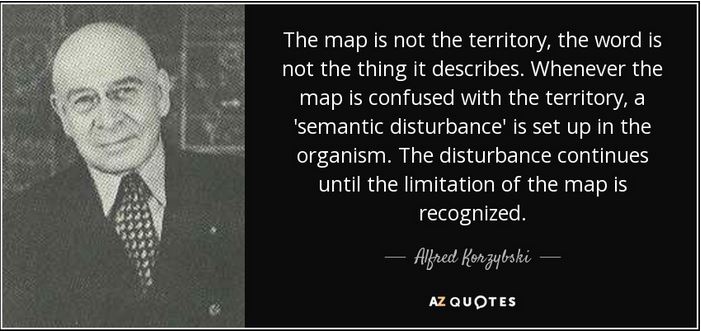
The quote is slightly adapted from a statement originally from Alfred Korzybski, a Polish-American philosopher and engineer, and while van Vogt’s words have not been memed, Korzybski’s have been.

Map And Territory - We Confuse The Map With The Territory

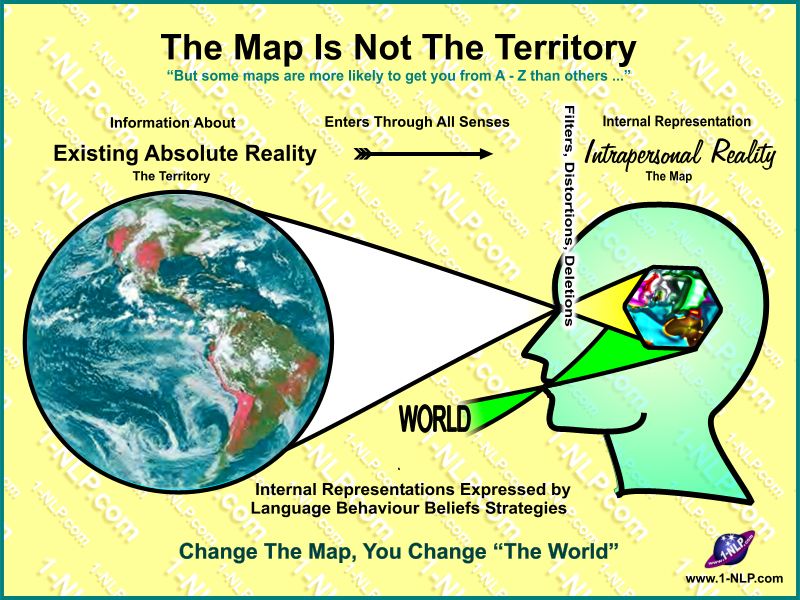
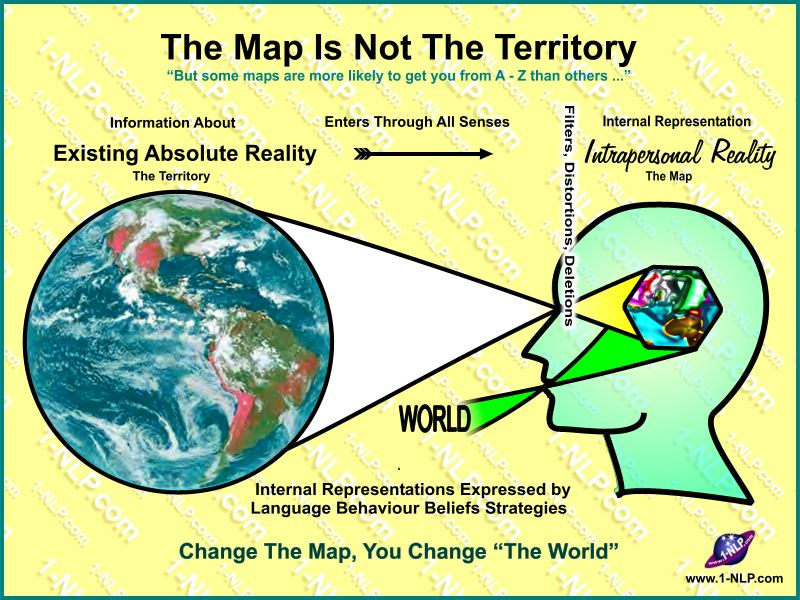
That’s the full quote, and you can see how quickly it makes one’s eyes cross. Here it is made even more confusing by the visuals:

The Map is Not The Territory – Explained in Simple Terms – Welcome to Club  Street Post
This was made by someone who does not understand how to explain things.

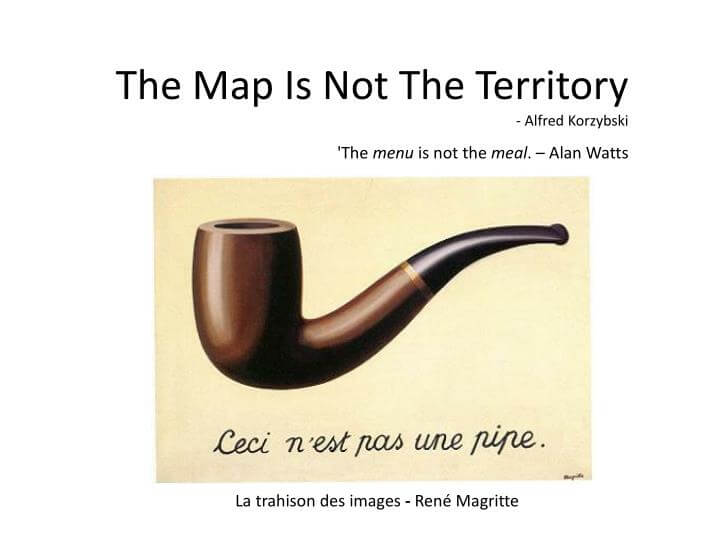
But that’s okay, here’s the simpler version, complete with standardized background image:

The more observant among you will notice the resemblance to a meme I used in yesterday’s post here.

But really, I prefer this last version, because I also like Watts’s iteration of this — and I love Rene Magritte.

The map is not the territory - Tom McCallum

So the point of this, then, is to recognize the limitations of representation and image — and of language itself. The map is probably the best example, because a map always sacrifices detail for coverage, showing a greater area while not showing everything about that area. If a map showed every detail of the area it depicted, it would be a photograph, not a map — and its value would be limited.

(Though it might be funny sometimes.)

On some level, this shows the difference between “book knowledge” and “world knowledge” — which my students still, still, call “street smarts,” a perfect example of a name that has lasted despite its limitations, which makes it a perfect example of the second half of this statement. If you know the name of a thing, that is analogous to “book knowledge;” and if you understand the thing (which is where I think the quote is going here, to a point about understanding, because certainly with a concrete object there is no doubt that the word could be the thing itself: I’m not sitting in the word “chair” right now.), that is equivalent to the experiential and deeper understanding implied by “street smarts.” Knowing the name for something does not mean you understand that thing, because the word is not the thing itself; again like the map, words reduce specific details in order to gain another value — generally universality, and economy, meaning I can communicate a fair amount of information, to a lot of people, without too many words. If I say I own a black SUV, then you don’t have much detail about my car — but (if you speak English) you have a general understanding of the category of vehicle to which my car belongs, and a general idea of its size and shape and appearance and so on, because we understand what aspects are included in the category “SUV,” and we know the color “black.” Also, as my wife has pointed out many times, with steadily growing annoyance as each year passes, all SUVs look the same — and a large proportion of them are black. But that means, while you can get a general idea of many, many cars with just two words, you can’t really identify those specific cars very well. And you definitely don’t know the things that make my car special, that make my car into my car. Not terribly important to understand the special things about my car, of course; but if you want to understand a person, you need to know much more than their name.

This comes into focus with the AP exam because I teach my students that they don’t really need to know the name of what they are talking about: but they need to understand the thing. This is, clearly, not how all AP teachers instruct their students, because I had MANY essays that used vocabulary the student did not really understand: and it showed. They named things they didn’t really have, because they didn’t understand the thing named. So that I don’t do that, to explain the details lacking in the term “AP exam,” so that you have more understanding of this thing instead of just knowing the name, the essay I scored last month was for the AP Language and Composition exam, which focuses on non-fiction writing, and examines primarily rhetoric. “Rhetoric” is another good example of a word which people know and use without really understanding it, because the connotations of the word have changed; now it mostly comes in a phrase like “empty rhetoric,” and is used to describe someone — usually a politician — who is speaking insincerely, just paying lip service to some idea or audience, without saying anything of substance; or in more extreme cases, using words to lie and manipulate their audience for a nefarious purpose. My preferred definition of rhetoric, the one I teach my students, is: “Using language to achieve a purpose.” What I am doing now in this blog is rhetorical: I am choosing words and using examples that I think will achieve my purpose — in this case to explain my idea, and to a lesser extent, to convince my audience that I am correct in my argument: that knowing the name of a thing is less important than understanding the actual thing.

So in the AP exam on Language and Composition, which focuses on rhetoric — or understanding and explaining how a speaker or writer uses language to achieve their purpose, as when a politician tries to convince an audience to vote for him or her — there are 50 or so multiple choice questions, and three essay questions. This year I scored the second essay question, which is the Rhetorical Analysis question; for this year’s exam (This is not privileged information, by the way; the questions were released right after the exam in May. It’s the answers that are still secret.) they used a commencement speech given at the University of Virginia at Charlottesville by former U.S. poet laureate Rita Dove. The goal of the essay was to “Write an essay that analyzes the rhetorical choices Dove makes to deliver her message about what she wishes for her audience of graduating students.”

Interestingly enough, the AP exam writers have given hints to the students in this instruction, which I’ve taken from the exam. They generally give important context in their instructions, quite intentionally; it’s easier to analyze rhetoric if you understand the context in which the speech or writing was delivered, so knowing that this speech was given at a commencement, at a university, in 2016, gives you a better idea of what is going to be said in the speech — you get the general shape of what is included in the thing named “commencement address.” One of the key aspects of this speech by Dove is both the expectation of what is included in a commencement address, and how she subverts that expectation: and that centers around the term “wish.” That’s the hint in the instruction there, along with the buzzwords “message” and “audience,” which are commonly part of a study of rhetoric and of rhetorical analysis.

Okay, that wasn’t interesting. I’ve lost you here, I realize. Let me use fewer words and just give you the general gist of my point: when students were analyzing Dove’s rhetoric, they did much better if they explained what she was doing and why, but didn’t know the proper name for her strategy; some of them knew the name of the strategy — or of a strategy — but couldn’t really explain it. They had the name, but not the thing itself.

Partly that’s because the study of rhetoric is very old, and thus has an enormous amount of terminology attached to it: much of it based on Latin and Greek roots, which makes the words sound really smart to modern speakers and readers of American English. It’s cool to use the words “antithesis” and “juxtaposition” and “zeugma,” so students remember the words and use them for that reason. I think it is also partly because a number of AP classes focus on remembering the word for something, rather than knowing the thing itself, because lists of words are easier to teach and easier to memorize and easier to test. Partly it’s because students under pressure try to impress teachers with the things they can do, to dazzle us and make us not notice the things they can’t do — like actually explain the thing they named.

Again, I don’t want to get into too many specifics on this particular essay because it hasn’t been released yet and I don’t want to get in trouble, so let me just give general examples.

There’s a rhetorical device called “polysyndeton.” (Cool name, isn’t it? Little annoying that the two y‘s are pronounced differently…) It means the use of more conjunctions than would be strictly necessary for grammar. If I listed all of my favorite activities and I said, “I love reading and writing and music and games and spending time with my pets and eating delicious food and taking walks with my wife,” that would be an example of polysyndeton. And if you were writing an essay about my rhetoric (Please don’t), you could certainly say that I used polysyndeton, and quote that sentence as an example. And if you used that sentence, it would be a correct example, and the person scoring your essay would recognize that you know what polysyndeton is, and you correctly defined and identified it, which is surely worth some points. Right?

But what does polysyndeton do? What did I do when I wrote the sentence that way, instead of, for instance, “I love reading, writing, music, games, spending time with my pets, eating delicious food, and taking walks with my wife.”? The ability to understand that, and to explain that — and, most importantly for the AP exam and for rhetorical analysis, the ability to explain how the effect I achieved through the use of polysyndeton helps to deliver my message, to achieve my purpose — that’s what matters. Not knowing the name.

(It’s a bad example here, by the way, because I made up the sentence just to show what the word meant, so it isn’t really part of my larger purpose; the purpose of using polysyndeton there was just to show what the hell polysyndeton is. And sure, I guess it was effective for that.)

The worst offenders here, on this year’s exam as in most, are the terms logos, pathos, and ethos, which are words used to describe certain kinds of argument, and also certain aspects of rhetoric. The words are Greek, and were chosen and defined by Aristotle; most rhetoric teachers at least mention them, usually, I imagine, as a way to show that there are many different ways to win an argument and to persuade an audience. That’s why I mention them in my class. But while a lot of students know the words, they don’t understand the thing itself, and so they find items in a passage they’re analyzing that looks like it belongs in one of those categories. Like statistics, which they identify as logos arguments, meaning arguments that appeal to reason and logic, which is indeed one way that statistics can be used. Dove uses a statistic in her speech, and a raft of student writers identified that as an instance of logos. The problem is that it isn’t logos, partly because it’s not a real statistic — she uses the phrase “150% effort,” and at one point lowers that to “75% effort” and “50% effort;” but at no time is she trying to present a reasoned and logical argument through the use of those numbers, which of course don’t come from any study or anything like that — and even more, because she’s not really trying to persuade her audience.

She was telling her audience an anecdote. And that’s where I ran into a stumbling block, over and over again in reading and scoring these essays: just because students know the name for something doesn’t mean they understand the thing: and just because students remember the name for something doesn’t mean they remember how to spell it.

Let me note, here and now, that these students are brilliant and courageous for even trying to do this damn test, for even trying to write three college-level essays in two hours AFTER answering 45 difficult multiple-choice questions in one hour. Also, because this was written under pressure in a short time frame, and with almost certainly only one draft, mistakes are inevitable and should be entirely ignored when they don’t get in the way of understanding. I knew what every one of these students were trying to say, so I ignored their spelling, in terms of scoring the essay. I also ignored their generally atrocious handwriting, not least because mine is as bad as any of theirs and usually worse.

I just thought this was a fine example of knowing a term but not really knowing it. Ya know?

(Also I apologize for the image quality. Just trying to make a point. And the picture is not the point.)

The first one gets it right. Another one gets it right — but spells “English” as “Enligh.” Also please note the spelling of “repetition” which students repeatedly struggled with.

Fun, huh? I scored 695 essays this year. Last year it was over a thousand. And that exam passage also used anecdotes.

I’m really not trying to mock the students; just using this fact to show that knowing a term doesn’t mean you understand the term, because the word is not the thing itself. By the same token, knowing the spelling doesn’t mean you know the term, or that you understand the thing itself; which is why we ignore misspellings in scoring these essays. I think understanding the thing is much more important than knowing the word — and I’m a word guy. I love words. (Flibbertigibbet! Stooge! Cyclops! Wheeeee!) But I’m a word guy because I think this world is magnificent and incredible, and I want to understand as much of it as possible; words help me to do that, and to share my understanding of the world we live in. That complicated image I used above to show how some people can’t explain things well? Here, I’ll bring it down here so you don’t have to be confused which one I’m talking about.

This one.

This makes a few important points, even if it makes them badly. I do like how it goes from an image of the Earth, to a jumbled collage of colors inside the head, to the one word “world.” I think that, once you can follow it, makes this point well, how much translation and simplification happens between observed reality and the words we use to represent them. Though it should also lead to another head, of a listener, and show how that one word activates their own jumbled collage of colors in their head represented by the word “world.” (Far be it from me to suggest making this more complicated, though.) Because communication happens between two minds, and both minds contribute to the communication: which is why language works despite this simplifying process.

I do also like the statement at the bottom of the image: “Change the map, you change the world.” (Even though I hate how they capitalized and punctuated it.) Because that’s the last point here: while words are not the things they represent, they are incredibly important to our understanding of the world and our reality. Because we think and communicate in words. Not exclusively: my wife, for one, is deeply eloquent in communicating with images; my dogs can communicate with a look; musicians communicate with sounds that are not words. And so on. But language is our best and most effective form of interpersonal communication: and also one of the main ways we catalogue and recall our knowledge inside our heads. So getting the names of things right is incredibly important to our ability to use the information we know, and to communicate it to others. And what is the most important factor in getting the names of things right? Understanding the things we are talking about.

Because a rose by any other name would smell as sweet — but if you want people to know you are talking about one of these, you better call it a rose.

How to Say Rose in Different Languages | 1800Flowers Petal Talk

And for my sake, please spell it right.

Just Imagine

I want you to do something for me.

Imagine you were born with only one arm.

Doesn’t matter which one, left or right; for simplicity’s sake, imagine you have your dominant arm, whichever hand you write with. That one is still there, exactly as it is right now, and has always been there. But the other one — in my case, my left arm — was never there. You didn’t lose it in an accident, or to cancer or anything like that; you were just born without it. No stump, just a perfectly smooth shoulder.

Imagine that for a second.

Now, if you were born that way, with only one arm, it wouldn’t be that big a deal. Really: there are some things that would be difficult to do, because they require two hands working simultaneously; it would be a bit harder to drive, for instance (though you certainly could do it), and there are a lot of musical instruments you just couldn’t play, like guitar and piano (But if Rick Allen of Def Leppard is any example, you can play drums with one arm all the way to the Rock and Roll Hall of Fame); and sports would be challenging, especially baseball and basketball and hockey. You could play football, if that were your preference, though not all the positions; and soccer, of course, it wouldn’t even be a disadvantage, really. Other than that? You couldn’t play pattycake, and jumprope would be tough (unless you jumped double-dutch), but you could play tag, or hide-and-seek; and you could play with dolls and Legos. Some video games would be impossible or close to it: but you could play Wii, and handle most driving games; and of course with any strategy or puzzle based games, your one-armedness would mean nothing at all. Most parts of life, in fact, having one arm would mean nothing at all: you could still read and write and do math and science, you could use a computer or a smartphone, you could ride a bike, you could dance in the rain. You could date and fall in love (There might be some people who would reject you for only having one arm, but come on, how ridiculous and messed up is that?), you could marry and have children. You could be a lawyer, a doctor, a car salesperson, a carpenter, a sculptor, a farmer, an engineer, a rocket scientist, a dogwalker. You could live a full and healthy and rich life.

It would be difficult to find clothes that fit you well. People would probably stare. Little kids would make jokes, and tease you. For a lot of people, it would be the first thing they would ask you: it would be a thing that defined your identity, even though to you, it would mean next to nothing. You never had the arm. You don’t miss it. You may sometimes wish you had two arms so you could throw a flowerpot on a pottery wheel, or shoot a longbow; but it would be more comfortable for you to sleep on that side, because you’d never have to figure out where the hell to put your arm so your hand didn’t fall asleep. Mostly, it just wouldn’t matter.

Can you picture that? Try going through your day, in your mind, with only one arm. Some things might be a little tougher — mostly it would just take more time — but really, not that big a deal.

Okay: now imagine, having lived your life with only one arm, you came home today, took a lil nap because it’s Monday and we all deserve a lil nap on Monday; and when you woke up — you had two arms.

Picture that. Not how wonderful it would be to suddenly be able to juggle three chainsaws: but how incredibly brain-meltingly shocking and horrifying it would be to suddenly have a whole other limb where one hadn’t been before. Step out of this whole thought experiment for a second and imagine how it would feel to wake up from your lil nap to find you have three arms, one new one growing out of the middle of your chest. Would you think “Hell yeah, now I can juggle FOUR chainsaws!” or would you think “AAAAAAAAHHHH WHAT THE FUCK IS THAT THING GROWING OUT OF MY CHEST JESUS CHRIST GET IT OFF GET IT OFF!!!!”

I know what I would think. And so I know, for the person who had one arm their whole life, suddenly getting that second arm would be absolutely appalling. Your body would suddenly be different. Your balance would be off. All of your clothes, bought and maybe adjusted or even tailored to fit your one-armed self, would suddenly be different. Everyone who ever knew you would talk about nothing else, pretty much forever, especially if you didn’t have an easy explanation for what happened. If you have any fundamentalist Christian friends, they might decide it was a miracle, a gift of God, and they might try to make an example out of you; conversely, they might think it was the work of the Devil, and shun you, or try to exorcise the demon in your new arm.

Your whole idea of yourself would change. You wouldn’t recognize your body in the mirror. Imagine how weird it would be to keep seeing a hand, fingers moving and gesturing, in the wrong place, attached to the wrong side of your body. Everything you had ever thought, ever said, ever come to a difficult recognition of, about what it is like to be a one-armed person in a generally two-armed world — all of that would go out the window. You’d have to be — normal. But at the same time, not at all yourself. Everybody would think you were normal now, and they would probably congratulate you, and be super happy for you: but the whole time, you would, most likely, feel wrong. Just wrong. Not yourself. Not at home and not comfortable in your own body. You wouldn’t know how to sleep, because you’d have spent your whole life sleeping on the side where there was no arm, and being perfectly, totally comfortable that way: now there’s a fucking arm there, and the whole thing is different. Is wrong.

So here’s the question. If you felt that way, if you felt uncomfortable and strange and weird, all the time, would you grow to hate your new arm? You might. I might. I might not: I might adapt, might adjust; but I might not adapt, either. I might resent my new arm. I might miss being one-armed. And if there were people around me, if I had joined a group of one-armed people, say, and I had to see them sleeping comfortably with their single arms, I might really hate what had happened to me: and I might even grow to hate myself.

If that happened — and I know we’re getting pretty out there, but hold on, we’re close to the end — what if I came to a decision, and went to a doctor, and told that doctor to remove my left arm? To give me back my self-image the way I thought it should be, to make me into the person I knew I really was, no matter how I might look to others who thought I should be happy to have two arms like they do?

Would that be wrong of me to do? Would it be insane, to remove a healthy limb? Would it be butchery, for the doctor to agree?

What if I had really descended into depression and self-loathing? What if I were suicidal, because I had too many limbs, and I couldn’t stand it any more? Then would it be wrong of me to ask, and would it be wrong of the doctor to remove my unwanted body part?

I think it would not. I think it would be my choice, and I think there is nothing at all wrong with being one-armed. I think if someone chooses to be one-armed, then they have every right to make that decision, and to be that person if that’s what they want — particularly if being that person would help them to live a happy life, to have a good self-image and self-esteem, and to keep from harming themselves.

And that’s why I support trans rights.

Now: this may seem offensive. And if this were the actual analogy I were making, it would be; because there actually is a disadvantage in only having one arm, and there is literally no disadvantage, at all, in being transgender, other than how people treat transgender people. There is nothing “wrong” or “missing” in a transgender person, at all. But this is not the analogy I’m making: this is just the warm-up, just the practice round. (Okay, I’m kind of making this analogy: because there are a number of parallels. But it is an imperfect analogy. And it is not the main one I want to make.) Now it’s time to move to the actual topic of conversation here.

You see, there’s a trend I’ve seen in arguing with conservatives (And with assholes, let me point out, because I do my arguing these days on Twitter, which is now like the black hole of assholes [WON’T… MAKE… THAT… JOKE… WORSE… THAN… IT… ALREADY… IS!], pulling them all in until they have more mass than anything else in the solar system), and it has to do with the issue of transgender people getting gender-affirming health care, in two specific areas: one, young trans people getting puberty blockers and then hormone therapy during their adolescence, before they complete puberty; and two, trans people of any age getting surgery.

The trend is this: these folks, both the “compassionate” conservatives (And some of them probably are genuinely compassionate, but not a one of them tries to understand or empathize with what trans people experience, so their compassion is more performative than genuine) and the transphobic assholes, say that they don’t mind people being trans or living how they want: but they don’t agree with people changing their bodies to match their gender identity. They do what conservatives, and compassionate people, and assholes the world over have always done, which is claim to have the right to decide what other people should do, in this case because they are arguing only for young trans people: for children, they will tell you, children who are not mature enough to make decisions about themselves or their lives or their identities.

“What about a young person making decisions in collaboration with their parents, and with loving and competent medical care providers?” I ask these people, over and over again. I get either a simple refusal to accept anyone making a decision these people disagree with — or silence. It speaks volumes, either way. It shows that they are lying when they claim only to be watching out for children, only protecting those too young to protect themselves.

And at some point, I realized why.

They object to surgery, most specifically and frequently, because, they say, nobody should “cut off healthy body parts.” That’s crazy, they say. And for them, maybe it would be — though I would disagree with calling it “crazy,” because our bodies do not define us, we define our bodies: starting with tattoos and piercings and circumcision (Not that I’m getting into THAT conversation, because while I will fight all day with transphobes, intactivists scare the bejeebers out of me) and all kinds of voluntary surgery like cosmetic surgery and permanent birth control like vasectomies and tubal ligations; so honestly, if somebody decided their life would be better with only one foot, then I say mazel tov: go for it. Save all that money on shoes; now every sale is BOGO (though you’d need a friend who only had the other foot, in the same size. [Business idea: ShoeMates, for people who only need one shoe, to share with another person who only needs the other shoe. Call the Tinder people. Whole new meaning for swiping “left” or “right.”]). Make all kinds of jokes about “The shoe’s on the other foot now!” or waiting forever for the other shoe to drop. Joke — or lament — about how you will never again have to do the Hokey Pokey. But okay, let’s say that to someone who likes having two feet, removing a healthy foot would be crazy. Or to stop stigmatizing mental health, let’s just say it would be something they would never, ever do. To them, it would make no sense, and they’d never, ever do it. Just like most of us would never voluntarily choose to remove an arm, particularly not one that we’ve had our whole lives, particularly not a healthy one.

But what they are not considering is how one’s body feels if one is trans.

DISCLAIMER: I am not trans. I have never been trans, and I do not for one second think that I can speak for trans people or try to explain how they feel or how they experience the world or their bodies. I, unlike the conservatives and assholes I’ve been arguing with, would much rather leave ALL people, trans, cis, and everyone else, to make up their own damn minds about who they are and how they feel, and what their bodies should look like, with absolutely no unsolicited input from me at all, ever. But what I want to do, what I think I can do, is try to get some of the people who actually can be compassionate to understand what is wrong with this argument that I’ve been facing. This argument that it is wrong for someone to remove a “healthy” body part just because of how it makes them feel, particularly when they are young (though again, conservatives are not actually protecting young people, as can clearly be shown BECAUSE TRANS PEOPLE ARE AT PARTICULAR RISK OF SUICIDE AND SELF-HARM AND GENDER-AFFIRMING CARE IS PROVEN TO HELP WITH BOTH ISSUES AND IS THEREFORE THE BEST WAY TO PROTECT CHILDREN BUT I GUESS I FUCKING DIGRESS), and therefore, gender-affirming health care should be banned for those under 18 (or under 21, when the mask starts to slip and they reveal that it isn’t about children, it’s about control), particularly hormone therapy, puberty blockers, and surgery.

“Butchery.” They keep fucking calling it “butchery.” They insist on it. As if we weren’t talking about medical procedures carried out by fully trained and licensed physicians in a modern hospital with all the proper precautions and care and science around it.

It’s because they’re not trying to understand how the trans person feels, what made them decide to pursue hormone therapy or puberty blockers or surgery.

The people arguing against GAHC (Gender Affirming Health Care, and yes I hate the acronym, but it’s a pain to type out over and over and I don’t want to change the name from what it actually is because words matter and my opponents intentionally use the wrong terms) are thinking about what it would be like if they went to the doctor and removed their body parts. Their healthy body parts. Their wanted body parts.

That’s not it.

Here’s the real thought experiment. Ready?

So instead of picturing yourself with one arm, and then suddenly waking up with two, picture yourself as you are now: and then you take your lil Monday nap — and you wake up with the wrong genitalia.

If you are a woman, imagine waking up with no breasts. Not that they have been removed, which would be traumatic enough: they’re just not there. Flat chest, completely. And imagine in between your legs, you suddenly have a penis and testicles. If you are a man, imagine waking up without your penis and testicles. And you have breasts. And — forgive me for this, but it helps make the point — they’re big. That penis and testicles, those breasts, they’re HUGE. Just slapping around, there. Every time you move — and when you move, it’s awkward, because you never had them before so you do it wrong, and it hurts more than a little — they shift, they flop, they smack into something else, into your legs or arms, into your belly, into everything. They are there, and they are unavoidable.

And they are WRONG.

Joking aside: can you picture that? Can you imagine how awful it would be to wake up with the wrong body parts in the wrong places?

Now imagine you go running out and go to your loved ones, and say “WHAT THE HELL IS HAPPENING TO ME!?!?”

And imagine if they acted like it was normal. And like you were strange for thinking those body parts were wrong. Maybe they would even be offended.

If I woke up with different body parts, with large lumps where before there had been no large lumps, I would immediately think it was cancer. Or like some kind of horrible infestation or infection, like the aliens had laid eggs in me. It would terrify me. It would be awful.

But to everybody else who wasn’t me, those lumps would be — healthy. Normal. Not only normal, but positive, important, defining.

Think back to when you went through puberty. When your body started changing. Did you have someone — a loved one, or maybe, like me, one of those terrible cheesy sex ed movies from the 70s — tell you that you were perfectly normal? That your body was supposed to change, that it was supposed to look like that? That you were becoming a man, or a woman?

What if you were becoming the wrong one?

Can you imagine how that would feel?

If I had woken up as a young woman, with breasts, with feminine hips (And imagine if I burst into tears, and immediately thought that I was crying like a little girl), my mother would have been ecstatic. I said before, she always wanted a daughter: it would be affirming for her if I had been her little girl. She could have taught me everything she knows about being a woman, as she understands it — and my mom knows a lot. She cooks. She knits. She sews. She is a nurse. She worked for decades with post-partum mothers and children with complications, so she can handle ANYTHING to do with babies. And my mom is a very feminine woman, in the classic stereotypical sense: she sings, she dances, she wears bright colors and pretty dresses. She would have LOVED to take me under her wing and show me how to dress and how to act with my feminine body. How to sing with my high feminine voice. How to live with my menstruation, and what it all meant for my future as a mother.

But if I was me — and in my mind I have always been male — all of that would be horrifying. Particularly because I would know that refusing to be the girl my mom wanted me to be would break her heart. But I’ll tell you right now: even apart from the horror of finding my body was not the body I wanted or expected it to be, the very thought of pregnancy and childbirth is the most horrifying thing I can imagine. It has always given me the heebie-jeebies in a way and to an extent that I can’t explain. I’m terrified of all of it.

And if I were, in my mother’s eyes, a girl, and she started talking about how lucky I was that I would get to look pretty in dresses, and eventually get married to a man (Ew) and have babies?

Aw, HELL no.

This is not how it feels to be trans. Puberty does not happen overnight, and doesn’t change a familiar, known, comfortable body into an entirely different body. But puberty does feel sudden, because you don’t notice the changes until you do: and then suddenly it feels like everything has changed. And for someone who is trans, that change might feel — wrong. And every day it continues unchecked, it gets worse: it gets wronger. But if you go to someone for comfort, for understanding, they will most likely not sympathize with your feeling: they will most likely tell you that your feelings are wrong, that your understanding of yourself is wrong, that your body is right, and you should just try to accept it. They might even get offended: and insist that the body, and the identity that they associate with it, is a good thing, a thing you should be happy about and proud of.

Picture that: you, as a man, wake up with breasts, and your loved ones say “But you’re such a pretty girl!” You, as a woman, wake up with a penis and testicles, and your loved ones say, “Come on, stop crying, BE A MAN! Show some BALLS!” But you are not a man. You do not want balls.

That’s the point. Don’t imagine GAHC as removing your body parts, healthy, wanted body parts: imagine if you had body parts you DID NOT want. Body parts that DID NOT belong on your body. They might look healthy to everyone else, but to you, they are more like tumors. More like infections, or infestations. They are wrong. They do not belong there. And worst of all, those body parts redefine you, in everyone else’s eyes, as something you are not. As something you do not want to be.

Wouldn’t you want them removed?

Wouldn’t you want to have the right body, the body you know, the body that you belong in?

What wouldn’t you do to get that body back?

That’s how we should think of GAHC. It’s not changing someone from what they should be into what they should not be: it is AFFIRMING a person’s body, making it look like what that person knows it should look like, what it should feel like. Making it into the right body. And, not least important, changing the way everyone else responds to that person and their body, so that they can live the way they know they should live.

I know that I have done this badly. I apologize for that. I know I’ve said this in a terrible cringey way, and I’ve probably been insulting. I do not mean to be. I just want people who think that GAHC, particularly gender affirming surgery, is removing “healthy” body parts, to understand that it is not what conservatives and assholes say it is. It isn’t about taking your body, that you belong in, and making it different; it is about taking a body that is already wrong — and making it right.

That’s the point. I hope, if I have said everything here crudely and stupidly, that I have at least helped make it more clear that most cis people think of GAHC in entirely the wrong way: we think about it like ourselves. But we never think about it as it is for trans people.

We should stop that.

Hey, you know what we should do?

Listen to the people in question tell us, themselves, what they need, what they want, what is right for them. And then we should support them so they can have that, the same way of life that most of us enjoy without ever recognizing how easy it is for us to live as ourselves.

Imagine that.

Take My Penis, Please

Warning: I’m not sure how offensive this is going to get. Can it get more offensive than my title? you may ask. Of course it can. I don’t know how far I will go. I am not intending to offend everyone who is capable of being offended; there is a specific group of people that I intend to be maximally offensive to, but they will never care at all what I say, and the rest of you fine people are not targeted for intentional offense. I suppose the issue is more that this post might make you feel — kinda squidgy. Uncomfortable, like. For that, I’m sorry, but I can’t write anything other than this right now. I won’t. This is the one for now, until I finish this. Then I’ll go back to less squidgy things. Promise.

I mean — if I can.

I am a white male. I am, more specifically, a cis/het white male American. If any of those terms confuse you, allow me to explain: American should mean I was born in any of 35 countries or 13 territories in the North and South American continents or in the Caribbean; but because I was born on the pushiest, grabbiest, most narcissistic nation in the Americas if not on the planet, it only means that I was born in the United States. And I was: in the Northeast, in the state of New York, to be precise. “White” means nothing: we should probably switch to blanco, the Spanish version of the color name, because the “blank” cognate is much more appropriate than “Caucasian,” the usual, err, technical term for my race and ethnicity. Because “Caucasian” makes no sense. To find any of my ancestors who were anywhere near the Caucasus region (The hunk of land between the Black and Caspian Seas, which is mostly Armenia, Azerbaijan, Georgia, and Russia.), you’d have to go back so far in my family tree that it wouldn’t be recognizable as my family tree. My race is, basically, “Nothing specific,” and my ethnicity is “More of the same.” I suppose I am European; what I know of my national heritages includes Welsh, English, Scottish, German, and French; my family name is most probably derived from a Saxon word that means “Defender of the Home,” though my grandfather theorized it came from “Dall’Umpre,” from Umpre, which he thought was an area of Spain where the Basque people lived. That’s way more interesting than my family heritage actually is, though. I’m just white. Moving on.

The “cis/het” is the most recent addition to my descriptors; I will add that I use the pronouns “He/him,” because I, unlike a whole bunch of goddamn idiots on the internet, am not upset nor offended by the use of pronouns. I speak English, I read and write English; I understand the necessity of pronouns in my language. If you don’t, allow me to present English without pronouns: here is the same paragraph I am finishing up now, without any pronouns. Ready?

The “cis/het” is the most recent addition to Dusty’s descriptors; Dusty will add that Dusty uses the pronouns “singular male signifier subjective case/singular male signifier objective case,” because Dusty, unlike a whole bunch of goddamn idiots on the internet, is not upset nor offended by the use of pronouns. Dusty speaks English, Dusty reads and writes English; Dusty understands the necessity of pronouns in Dusty’s language. If the audience reading this paragraph doesn’t, allow Dusty to present English without pronouns: here is the same paragraph Dusty is finishing up now, without any pronouns.

Isn’t that fun? Sorry: Isn’t the activity Dusty just completed fun?

Of course not. It’s garbage. Everything is better with good pronoun use. Everybody should, therefore, embrace the appropriate use of pronouns. Which means respecting what other people want you to use in reference to them. And which also means including your preferred pronouns in your self-description/introduction when you can, so we all can get used to asking about and respecting people’s preferred pronouns. I know that it may feel strange, especially to those of us who had the habit beaten out of us, to use singular “they,” or to use a pronoun that doesn’t obviously match a person’s appearance, or to use one of the new pronouns like xe/xem/xer [Those are pronounced “zee/zem/zurr”, and are, in order, subjective, objective, and possessive: Xe wanted a ride on xer pony, so we gave xem a turn.]; but suck it up. Practice a little bit, don’t feel bad when you unintentionally make a mistake; just do your best, and you’ll get used to it. My first trans student — pardon me; I had trans students whom I did not know were trans students at the time they were in my classes — my first out trans student used pronouns I wouldn’t have associated with him, based on my assumptions about his appearance, and I struggled with it more than once; but over the four years I knew him, I stopped making the mistake, and he never got mad at me about it. Partly because I never said anything like “This is hard and I’m tired of it, why can’t I just call you ______?” The only expectation, the only burden being asked of us is, “Don’t be an asshole.” Which is too much for some, I know, but don’t let them influence you: you don’t have to be an asshole. So don’t.

“Cis/het” means that I am cisgender, which is the opposite of transgender, meaning I identify as the gender to which I was assigned at birth, and which matches the stereotypical assumptions based on my appearance, at least most of the time — I had very long, very pretty hair for a long time, and I was frequently mistaken for a woman, which I did and do find flattering. Because the “het” part means I am heterosexual, so I am attracted to members of the opposite gender from myself, in this case women; calling me a woman means I would be, in my eyes, far more attractive than most men. (I say “most” because there are some very pretty men out there.)

Why am I saying all of this when most of you certainly already know this? Two reasons: one, it’s difficult to ask about all this stuff, and I know some people are still confused; it took me quite a while to remember what “cis” meant. And it’s difficult to ask for clarification because the issue seems very sensitive, and it often is: but remember, the only expectation is, Don’t be an asshole. I constantly ask my students to explain what their slang and lingo means, and they think it’s cute that I don’t understand. They love teaching me, even though they cringe, visibly, when I use the slang myself. You know why? Because I’m not an asshole. (I’m based, fam. frfr.) And also because I’m not an asshole, I very much want to normalize this entire topic: I want everyone to be comfortable talking about preferred pronouns, and transgender and cisgender people, and heterosexuality and homosexuality and bisexuality and pansexuality and asexuality, and everything in the queer world, in general. Because this is the queer world. Right here. Right now. We all live in it. There is no “normal.” There’s just — people. All of us. And all of us need to not be assholes: and that is the only expectation that matters.

The second reason I am talking about all of this is because there are, apparently, too many people in this country who don’t understand, or who misunderstand, and I assume that some of my friends and loved ones and my beloved readers are included in that group. That is not an insult: none of you are assholes. (Because assholes wouldn’t read what I write every week. I don’t hang out with assholes.) But some of you are uncertain, or confused, or misinformed, I assume. So I want to clarify. I want to help, and I believe that understanding reduces tension, and there is too much goddamn tension in this country right now. (Please also note: I am not an expert in this, and there is stuff I don’t know and stuff I get wrong. This is just what I do know, presented in the hopes that it will be helpful to some.)

So here I go: not talking about my penis.

The last word I used to describe myself is “male.” I identify as male. I think of myself as a man, which is not the same thing as being male: when I was young, I was male, but I was only a boy; when I was an adolescent, I was male, but I was an asshole. And in this whole list, the only one that has anything to do with my genitalia is the last one: because the main reason why I was an asshole when I was a teenager was because I had a penis, and the usual teenage sex drive, and the common total lack of morals or empathy where that sex drive was concerned. Too much focus on the penis makes one less of a man, I have found.

That’s why I picked the title. Because honestly? I don’t need it. I don’t care enough about it, and it drives me fucking nuts that there are so many goddamn people who believe that the existence of a penis attached to my body is somehow the most important defining characteristic when it comes to my gender and sex; so I’m sick of it. Take it. Give it to someone who wants it. I wish them well of it.

I wrote last week about being proud, and what it means to be proud. I am proud of being a man. I believe that is something I have accomplished over the years — though I will immediately and repeatedly say I didn’t do it all by myself. But I am not proud of my penis. My penis did not make me a man. My penis did even make me male: because the category of “male,” biologically speaking, means “of or denoting the sex that produces small, typically motile gametes, especially spermatozoa, with which a female may be fertilized or inseminated to produce offspring.” [Also, writing this I realize that I may not be a male, because I have not to my knowledge ever produced offspring. So do my testicles actually produce spermatozoa? Maybe not.] Which means that my testicles made me male, and more generally, my XY chromosome structure (So far as I know. As I have never had my genes examined, I may not be chromosomally male, any more than spermatozoically male. That’s not a word.). Know how I know that my penis didn’t make me male? Because if I lost my penis in an accident, nobody would identify me as anything other than a cis male: because most people (Obviously no longer including Republican lawmakers, who are trying to pass bills requiring genital examinations as a prerequisite for sports. For fucking sports.) do not check my penis before deciding that I am a male. So its lack would go unnoticed in the face of secondary characteristics: I would still have facial hair and body hair in a “masculine” pattern, and I would still have a relatively deep voice, and I would have the same shoulders and hips, hands and feet and facial structure, and I would still be 5’10”. Those things, amusingly, are much more to do with my heritage, with my race and ethnicity, than with my gender or sex, because I am squarely in the average for most adult white people. Those things are also, at this point, not dependent on my testicles; I could lose those in an accident (And seriously, take ’em. Useless lumps. Itch and sweat and get in the way. And give me cancer scares. [Also, PSA to testicle-havers: do self-exams in the shower. Get used to how your testes are shaped, because you are looking for changes as a sign of potential problem.] Totally pointless, and very annoying.), or have them removed if they became cancerous, and still keep most of the same traits that would make people identify me as male; the ones that might fade would be easily recovered with some simple hormone treatments. Which many of my fellow men will get voluntarily as they get older, even without losing their testicles. And that won’t make them men, either, just as the natural decrease of testosterone doesn’t make one not a man. Regardless of what all those ads on the radio and the spam emails want me to believe.

You know what else didn’t make me a man? Having sex. I know because I had sex when I was still — I don’t want to say “a boy,” because that takes this into weird[er] places; I was between about 15 and 17 when I first had sex, so not a boy: but I was sure as hell not a man. I was an adolescent. I was immature. I was selfish. I was, as I said above, an asshole. And, again, not having sex would not make me not a man: if I lived the rest of my life as a celibate, I would still be a celibate man, and everyone would see me as a man, with no idea of what my sex life was or was not like. The vast majority of you, thankfully, not caring, and wanting to know nothing about it, as I don’t want to discuss it. Further, having children does not make you a man, because I don’t, but I am. (Again, and this still makes me chuckle, the ability to produce sperm that can father children apparently does make you male, which means I might not be male. Well, Mom always wanted a daughter.)

Being aggressive does not make you a man: I am an introvert, and I hate and fear and dread confrontation of all kinds. I can do it, and I have when it is necessary; but I hate it. Being violent does not make you a man: I have never committed an act of violence, never been in a fight, never fired a gun, never killed anything larger than a mouse. (Killing a mouse does not make you a man. Elsewise cats would be men. Though of course they don’t want to be men: cats don’t want to be anything other than cats. Why would you? Once you’ve reached the peak, you don’t come down if you don’t have to.) Loving sports, especially blood sports, does not make you a man; I don’t care for most sports, but the ones I do like are generally skill and grace sports, like gymnastics and skateboarding.

We’ll come back to sports. Because there are a whoooooole bunch of assholes focusing almost exclusively on sports these days, in relation to this issue.

I think to be a man means, in part, not being an asshole. And I hate that, not only do millions of people disagree with that, but millions of people think the opposite: that being an asshole makes you more of a man. It does not. It just makes you an asshole.

And here’s the point: believing and affirming that trans men are not men, or that trans women are still men (or confused men, or “biological men”) makes you an asshole. Not a man. Not a rational person. Not a defender of women, or of people in general. It does not mean you adhere to science and accept objective reality. It means you are an asshole. Because you are helping to oppress and potentially destroy the lives of thousands upon thousands — millions, more likely — of trans people. Men don’t oppress and destroy innocent people. Monsters do that.

So okay, out of all of these things that do not make one a man — including a penis and testicles — what does make one a man?

Well that’s the thing: it changes, doesn’t it? It depends on context. I know that’s an annoying answer (This is why my students hate English sometimes, and prefer math, where there are definite answers. It’s easier that way. But please remember that life is poetry, not geometry.), but it’s the only one, and we know it. I’ve been giving some examples of the classic standards by which we define men, along with counterexamples that show those standards are not actually definitive: appearance does not make one a man, genitalia does not make one a man, fatherhood does not make one a man (Though it sure would be nice if more men were fathers and more fathers were men — though also, more fathers should be women and more women should be fathers. By which I only mean that shitty people shouldn’t be parents, and people who are parents shouldn’t be shitty people.). The only answer that actually fits all circumstances is this: I make myself a man. By deciding that I should act like one, according to my definition of a man’s behavior, and then doing it.

This is a dangerous answer, though. Because if I happen to think that being a Nazi and slaughtering millions of innocent people is what would make me a man, and I did that, then by my definition I would be a man; and I think it’s clear that would make me a monster, not a man. So there have to be some real standards of manhood, for the idea of manhood to have any meaning or value; and since, as I said, I am proud of being a man, I think we should retain the idea of manhood and manliness. I just really, really need us not to focus that idea on the genitalia. And preferably without any gender distinctions, because I think anyone can be a man who wants to identify themselves that way. Anyone who shows the qualities I define as manly qualities will absolutely be welcome to be called a man by me, if you want me to.

So what does manhood mean? First, it means being responsible, because being a man is about being an adult. Children are not men. Nor are they women: they are children. For me, the major difference between childhood and adulthood is responsibility. Responsibility means knowing what is needed, and then being strong and using that strength to do what is needed. Please note that this is not exclusive to men, because women also must be responsible and adult in order to be women — and also, children can be responsible and even adult in some ways, while still being children. The difference there is that children who must be adult are being harmed by that: asking adulthood of children is asking too much, and is harmful even if the kid can handle it; it’s still bad to make kids grow up too fast. Adults are those for whom responsibility doesn’t harm, it actually helps. I feel better when I am responsible, when I do my work, when I do what is necessary. I don’t like it, a lot of the time; but I feel better for it. Another aspect of adulthood which is necessary for manhood (and also for womanhood) is control: self-control, that is. Children do not have good self-control, but that is forgivable in children; it is less so in adults, in men and women. (Though I will note that everyone can be irresponsible from time to time, and also can give up self-control and let loose, sometimes. Just not all the time. Not when it matters. And to be an adult, you have to know when it matters.)

I will also say that one of the toughest kinds of self-control to have is the ability to keep yourself from controlling others. It is also, however, one of the most important. I have been struggling lately, because one of my classes needs to learn that it is important for them to pay attention to the class when I am teaching it; the way I am teaching them that is by not teaching them for a time, and letting them teach themselves. And they are doing a terrible job. And it is so damn hard for me not to stand up and take the class over and make them all learn the way they should be learning: but I need to not control them, I need them to learn. So I’m controlling myself, and letting them learn this vital lesson. It’s hard. But I’m doing it. Because I am a man. Men control themselves. (Also: please note, therefore, that rapists are not men. They are monsters. And any definition that allows rapists to be fully included in the ranks of men is a shit definition. Remember that when we talk about penises as man-defining.)

So that’s what distinguishes men from boys, from children. What distinguishes men from women?

As I said, it’s unclear: it changes. It depends on context. There is not a single trait of manhood that I could name that should not also be part of womanhood. Which is why transphobic bigots have to rely on the one clearly distinct difference in their eyes: genitalia. Ask them about intersex people (Intersex people are those who have more than one of the traits for male and female biological sex — so both ovaries and testicles, for instance. There is a wide range of people with a wide range of traits, and the term is non-exclusionary. Read more here. Note, for instance, androgen insensitivity syndrome, which can affect people with XY chromosomes and can, in some cases, mean that their cells reject male-trait inducing hormones entirely: and they will be phenologically [Is that a word? Should it be “phenotypically?”] indistinguishable from someone with a stereotypically female phenotype), or about men who lose their genitalia, and they will dodge the question. Every time. “Intersex people are so rare,” they will say. “I’m talking about MOST people.” Sure: most of the time “shit” means excrement; but sometimes (say, on 4/20) one might want to go out and buy some “good shit,” and would be VERY upset if someone sold them a baggie of excrement for $50. If you insist that “shit” only be used, ever, for the most common cases, you are losing some very important uses of the word — and your definition, therefore, is shit. A shit definition of shit. So too with simple definitions of “man” and “woman.”

I think in our society most people see the major distinction as being one between strength and kindness. Most people in our society see strong qualities as men’s qualities, and kind qualities as women’s qualities. People who are not assholes, of course, understand that everyone should be kind and everyone must be strong; but if there is a meaning to gender at all (And by the way, I’m totally cool with dispensing with gender entirely: I’m a human and a person much more than I am a man. I said I was proud of being a man, but I am really proud of being strong and responsible and kind.), I think it lands there. I think that I am a strong person, and my accomplishments that have required strength are the ones I am proud of, as a man. I have developed greater strength over time, and I am proud of that; though I think there is an upper limit (like, it’s not true that the stronger I get, the manlier I get, ad infinitum: if I am twice as strong as I used to be, I’m not two men [though I might like just repeating the syllable in one word, like I could go from being a man to being a manman, and then a manmanman].), I do think there is a general area where having enough strength to get through something — and often, to help someone else get through something — distinguishes one as a man from a child, because a child would need to take strength from someone else, where a man would provide strength to someone else who needed it. And a child who got through something requiring strength just on their own is seen as — grown up.

But here’s the thing: I may be a man because I am strong — but I am a good man because I am kind. So let’s not pretend that either virtue is exclusive, or disallowed to anyone in any category. Let’s not be assholes. Which category certainly includes a subset of both men and women. But recognize, again, that there are no traits that are exclusively men’s traits, and no traits that are exclusively women’s traits.

Which is why the debate over trans rights is so goddamn stupid. They have to focus on the only thing that they can point to as exclusively male: my penis. And ignore all the exceptions to that oversimplified definition. Most particularly, they have to ignore that the logical result of that argument is this: if someone who wasn’t born with a penis acquired a penis, then they would, by the anti-trans bigot’s own definition, become a man. This is why the more intelligent anti-trans bigots focus instead on chromosomes: which is just as reasonable and intelligent as distinguishing between people based on their skin color. You can describe someone with their chromosomes, if you can know their genes; but you can’t define them that way. Also, if you look at the intersex links I put above, you will find that there are people with chromosomes that just don’t fit into either category. “But those cases are so rare,” they say. “I’m talking about most people.”

You know what’s amazing about these people, and these arguments? That they then make the exact opposite point by claiming that trans athletes are a threat to sports. To women’s sports, of course — they never talk about trans men in men’s sports. (Someday a trans man is going to join a men’s gymnastics team, and he’s going to wipe the fucking floor with those dudes. But anyway.) Do you know how many trans athletes there are competing at the collegiate level in this country? In this nation of 330,000,000 people or more?

36. 36 trans athletes. (Source)

Out of 520,000 NCAA athletes, nationwide. (Source)

It is impossible to get a complete count of the number of trans athletes, of course, because not all of them are out; but whatever count you come up with, it is vanishingly small. So if you’re going to ignore intersex people and insist there are only two biological sexes, then you should bloody well ignore the tiny percentage of trans athletes and just let people compete. Actually, you should just let people compete even if there are millions of trans athletes: because people who want to compete should be allowed to compete. I wrote once before about how biological differences are sometimes accepted and sometimes not in sports, and it’s earth-shatteringly stupid to say that Usain Bolt has a fair advantage and Caster Semenya has an unfair advantage because Bolt has a penis and Semenya does not. Protecting women’s sports from trans athletes only makes sense if you pretend that trans women are not women: and they are. More importantly, why are we so goddamn concerned with some people winning sports and other people losing? Aren’t they still sports if you lose?

Or did all of my PE teachers lie to me?

Sports are supposed to be fun. I keep hearing they’re not about winning, they’re about sportsmanship and competing and building team spirit and so on; but apparently not so to Republican legislatures around this country, and all the assholes on Twitter, who are fucking up sports, and fucking up the lives of young people, because they hate and fear trans people. The assholes who constantly use videos and photos of trans adults to mock the idea that someone can be trans: and yet nobody speaks of all the men in the world who look damn “feminine,” and all the women in the world who look damn “masculine.” They only attack trans people, which shows how absurd their bigotry is: exactly like racism, exactly like thinking someone is less because of the color of their skin, but ignoring when some “White” people have darker skin than some “Black” people. Or more orange skin than any human anywhere. Because it’s not actually about appearance: it’s about hating the idea of trans people. They see trans people as toxic, as dangerous; as able to spread their “condition” (variously called an illness, a delusion, and every other shitty word that assholes use to insult other people unfairly) to others like a contagion.

That’s why all the arguments about people “turning” children trans, of trans kids being “peer pressured” into seeking gender-confirming medical care like puberty blockers or hormone treatments or even surgery. Look: I am a high school teacher. I have trans students, and I have had several trans students in the past. I did not know all the trans students I had in the past, because not all of them were out; until the last decade, none of them were out, so far as I know — but of course, I don’t know if any of my earlier students were trans and I never knew it, because they might have been visibly indistinguishable from other people of their identified gender; and some of them may have been transitioning without me knowing about it.

Know how much that affected me, or my relationship to them as students?

Neither do I, because I don’t know who or how many there may have been. So I’m going to have to say the impact of their being trans was — none. No impact. Didn’t matter in the least. As with the former students who have come out as trans, or queer, or genderfluid, or anything else under the sun: none of my relationships have been affected by their gender identity. Which is as it should be.

But those people themselves have been sometimes greatly affected by their gender identity. In every single case that I know of, these young people have been happier when they have been accepted as who they are, as people who have been able to find their way to live their truth, to define themselves according to their own standards. As I have been doing for myself in this blog, because I have a right to: and not because I have a penis. Those young people have struggled mainly because they have had people who denied their self-identification, people who told them they were wrong for being who they are, for knowing who they are, and for defining themselves, as we all not only have the right to do, but the responsibility to do, the obligation to do. And then, as reasonable human beings should, the rest of us are responsible for accepting what other people determine their own identity to be. As I have accepted with my trans students, which is why I have never had any trouble with them being trans. Nor will I ever: beyond sometimes slipping up with names and pronouns. But I’m not an asshole, so I do my best, and I always accept people for who they tell me they are. I don’t question or argue with it. Because it’s not up to me, and I don’t try to control other people’s choices, because I am a man, and I am not an asshole.

And in no case, not one case of any student I have ever had, or ever will have, has genitalia been anywhere in the consideration.

Right! See how horrible that is? The very idea of an English teacher judging a student by genitalia? SO WHY THE FUCK DOES ANYONE DO IT, EVER??? How can anyone rationally decide to pass a law requiring genital examinations as a prerequisite for participation on a specific sports team? How can that happen? What kind of insanity is that? It’s as ridiculous as me asking all of you to read this essay I titled with a consideration of my genitalia. Don’t nobody want that. (Actually, the anti-trans bills are unquestionably worse than my title for this piece. But I still feel guilty for talking about my piece in this piece. Kinda.)

By the same token, taken one small step further: we don’t actually judge anyone’s identity by secondary sexual characteristics, not in terms of identity. Nobody thinks a boy with a high voice is not a boy. Nobody thinks a girl with a flat chest is not a girl. Nobody (sorry, guys) thinks that a teenager with a sad peachfuzz mustache is actually a man. But also, I have students with more facial hair than I will ever grow: but I still don’t think of them as more manly than me. Because I am an adult, and they are not, however thick and luxurious their face-locks. Appearances don’t matter. Not for who people are.

So.

If someone wants to be called by a different name, call them that. (Definitely don’t ever be the person who uses only the name on the attendance sheet: my wife’s birth name was Anthony. Because her dad was a prick who wanted a son, not because she is not a woman. On a much less controversial note, my official name is Theoden, but I prefer to be called just Dusty. Partly because most people can’t pronounce Theoden correctly.) And because pronouns are not at all more meaningful than names, if they want you to use different pronouns, then use the different goddamn pronouns. Mistakes are fine, but do your best, and don’t be an asshole. (Unless you identify as an asshole, in which case, fuck you. And don’t ever make an “I identify as…” joke. They’re not funny.) Don’t judge someone by their appearance. Yes, someone is perfectly able and permitted to be a trans man or boy and wear dresses and long hair, as someone is perfectly allowed to be a cis male and wear dresses and long hair. Yes, someone can be a trans woman or girl and have facial hair. If you think it doesn’t look right, nobody cares what you think. It’s not up to you. If someone changes their name or identity or preferred pronouns several times, just try to keep up: and expect to make mistakes, and expect those mistakes not to matter, so long as you are being kind. Don’t question why they changed; it’s not up to you. Don’t say they’d be happier if they didn’t change, or you liked them better before; it’s not up to you. Your only job is to try not to be an asshole.

And one last thing. I wanted to write this blog because I heard about recent polls that show that the public view of trans people in this country is, in my opinion, going in the wrong direction. This research from Pew shows that the majority of Americans believe people’s sex is only what is assigned at birth (and that majority has grown over the last six years), and that the majority of Americans think that trans athletes should not be allowed to compete on teams that match their gender identity, and that almost half of Americans think that medical treatments should be limited for trans youth under 18.

So let me be clear. Gender is not determined by sex. Sex is not determined by chromosomes. And neither is set in stone and immutable. That being the case, who is the one person most likely to know best what their gender identity is? Themselves. (Notice the singular “they” there. And if you wanted me to write “Him/herself,” then get over it.) We know ourselves better than anyone else knows us. And sure, not all of us know ourselves very well; I have been confused about how much of myself I have discovered just in the last few years, and I’m 48 years old. So it’s reasonable to think that young people who think they may be trans may be unclear, or uncertain — just as some cis people are unclear or uncertain about who they are, for countless reasons, including the possibility that they may actually be trans, and not know it, or not be able to accept it.

In that case, you know who are the best people to help the young person figure out what their real self, their true identity is? It’s not reactionary, transphobic, attention-seeking Republican lawmakers, that’s for goddamn sure. No: it is the young person’s family, and their caring medical professionals. And of course some people have fucked up families, who shouldn’t be allowed to influence their children’s choices: but don’t you think that’s true in whatever way the family is fucked up? Macaulay Culkin’s family should not have been allowed to steal all his money. Brittney Spears’s father should never have been granted conservatorship over her. Abusive parents should not be allowed to abuse their children. But if you think that trans youth are only trans because their parents, or their friends, or their teachers, or their social media, tell them they should be trans, then you’re either an asshole, or an idiot. The world tells trans people they should not exist: nobody tells cis people they should be trans. Nobody chooses to be trans, just as nobody chooses to be white: some of us just are. The world should allow us to be who and what we are, so long as we don’t cause any harm. And trans kids don’t harm anyone by being trans. Or by playing on sports teams. Or by receiving gender affirming care, which is often critically important to prevent harm being done to the one person most likely to be hurt by a trans kid: themselves.

And if it helps, if the young trans person who told me that he wants a penis wants mine, he can have it. Take it. Please.

But it’s still not going to make you a man.

You’ve already done that, sir: because you are strong, and you are kind.

Now if only everybody else could be the same.

What are we fighting for?

HONK FER FREEDUM

Coronavirus: the US resistance to a continued lockdown

I want to understand the argument.

I don’t. And it’s vital that we understand the argument, even if we don’t agree with it; agreement is not necessary, compromise can be reached, solutions can be found even if we don’t agree.

But if we don’t understand? Then what do we do?

“We believe that the state governor has gone beyond his constitutional authority in shutting down businesses and ordering people to stay at home,” organiser Tyler Miller tells me from the grounds of the state capitol.

In mid-March Washington Governor Jay Inslee announced an emergency proclamation mirroring many issued around the world; closing restaurants and bars and banning large gatherings.

But protestors say that was unconstitutional.

“The state constitution says that the right of the people to peaceably assemble shall never be abridged. We believe that the (emergency coronavirus) proclamations that the governor here ordered violate that,” Mr Miller says.

Mr Miller said he was not protesting against the recommendations from the public health bodies and respected the need to ‘flatten the curve’.

“I even self-quarantined for 14 days back at the very beginning of this myself, when I had an illness that mirrored some of the symptoms,” he says.

“The fact I am protesting does not mean I think it is a good idea to have gatherings, I just believe that the government has no authority to prohibit them.”

Throughout the crisis, Mr Miller has also been able to continue his work as an engineering technician with the navy.

He says the thing that has angered him is what he feels it is an un-American overreach of power by the Democratic governor of Washington.

I don’t understand that argument.

There is a simpler argument, which is just that people are getting desperate: the country has been shut down in places for more than a month now, and people are facing another rent payment, another car payment, on May 1st, this coming Friday. I understand that desperation, that anxiety; I understand and (mainly) support the desire to let government officials know that you need and demand action. I think it’s a mistake to violate social distancing guidelines, and there are people in the article above and others I have seen who say things like “I have a strong immune system, I take care of myself,” who I think are somewhere between ignorant and idiotic: ignorant if they don’t know that Covid-19 has killed young and healthy people as well as older, sicker people; idiotic if they believe unfounded statements (Mostly from conservative “news” sources) that the novel coronavirus is no worse than the flu.

(This may be too harsh: this is an interesting article about how we are wired to be intuitive, and so underestimate the evidence that comes from outside our experience. I know I was telling my students in March that any shutdown of schools would only last a couple of weeks and would certainly not affect their graduation. On the other hand, I am not saying the same thing now, because I have learned better; I’m not sure why these people haven’t, but my two options above are certainly possibilities.

(Also, this ad popped up in that same article about people being too optimistic. Lol.

Screenshot (6)

(If you believe not only that a miracle stretch relieves years of back pain, but also that chiropractors are stunned by it, AND that chiropractors are the authority whose stunning represents a medical breakthrough, then you are unquestionably in this overly-optimistic bunch.)

But while I understand and sympathize with people who are desperate to get back to work and pay their bills, and I believe (and am infuriated) that the federal government has once again bailed out large corporations with deep political donation pockets and left average citizens to twist in the wind, I don’t understand the other argument. The freedom argument.

I don’t think it’s a reasonable argument.

Listen. I worry about government overreach. I won’t say I’m learned in history, but I know about the Japanese internment camps during World War II, and I know some things about the rise of the various authoritarian dictatorships that plagued the 20th century. I have hated the USA PATRIOT Act since it was imposed on us, during the paranoid jingoist nationalist fervor that swept the country after 9/11 and swept us into a neverending war. I know that it gets renewed every time it comes up because the government doesn’t like to give away power that it has seized. Because of that experience, I have been pointing out to my friends who argue against the lockdowns that the thing we need to worry about is the powers the government arrogates to itself after the crisis: the new regulations and limitations, and invasions of citizens’ rights, that follow a partial return to normalcy, and that are intended to prevent this kind of thing from ever happening again. We have to watch out for the permanent changes, or for the attempts, often subtle and underhanded, to make temporary changes permanent.

I don’t doubt those will happen. I think the first attempt will be by President Trump, when he decides to make his temporary limit on immigration permanent.

But see, I think that because Mr. Trump has a long history of a clearly established position to end immigration. I think that because I have read reports that Trump’s anti-immigration advisors have talked about this pause into something more long lasting. Because this article quotes DHS acting secretary, Chad Wolf, as saying to Fox News that

his agency will soon recommend a move to limit temporary work visas as well.

“That is something that the department has been looking at for the past several months, so we are well underway and look forward to presenting to the President those recommendations for additional steps,” said Wolf.

So there’s your government overreach, as part of an established pattern of behavior, aiming at known long-term targets. After the fact. Once the danger has passed. The current actions are not government overreach: they are government responding as government should to a crisis. The stay-at-home orders were issued during a crisis, and in line with scientific facts and the advice of experts. This is exactly when, and exactly why, people’s rights can and should be limited. We have the right to protest, but if you decided to walk into a burning building in order to protest the fire, people would stop you: and they would be right to. We have the right to freedom of speech, and of assembly, but you cannot gather with an army and plan the destruction of the United States: the right is to peaceably assemble, and free speech does not include sedition or criminal conspiracy. Individual rights are not limitless, not under any circumstances; even the most libertarian of us would state clearly that one person’s rights cannot be permitted to infringe on another’s, that your right to swing your fist stops where my nose begins. And of course individual rights are limited in an emergency, because the free exercise of one’s rights puts others into danger.

This is what government is for: to protect people from danger. Now, if you want to argue that the coronavirus is not that dangerous, then you’re in the wrong place. Start with this.

Then read this.

Then read this.

Then read this. 

(Especially that last one; it’s about the infectiousness of the coronavirus. And lest you think that the infectiousness of Covid-19 is lower than SARS or MERS, both of which caused fewer problems and killed fewer people, go back and read those other articles again, and then also pay attention to this quote from that last article:

“An R0 value of 1 means the average person who gets that disease will transmit it to one other person; in that case, the disease is spreading at a stable rate. An R0 of more than 1 means the disease spreads exponentially.”

And then read this essay about exponential growth.

Okay? Okay.

As I said, the government has the right and the responsibility to limit individual freedoms in response to a crisis, in order to protect the people from that crisis. (I’m aware that some people don’t agree with this: some because they don’t think the coronavirus is a crisis, and if you still think that, go back and read the above articles, but this time with your eyes open; and some because they think that nothing should ever limit individual rights under any circumstances: my above examples of protesting inside a burning building, or convening an army to overthrow the US government, are just fine, for them. I will be writing another blog about that. I’ll let you know when it’s done. The important thing is that, while I don’t agree with that argument, I understand it.) I think, though, that the basic argument behind the protests, the reason that President Trump tweeted support for people trying to “liberate” the states that have both lockdown orders and Democratic governors, is that the government is not trying to protect people from the crisis: the government is trying to control people. To take away their freedom. that’s the argument I don’t understand.

(I am also not going to write here about the elephant in the room, namely the upcoming election and the similarities — remarked on in the BBC article I linked first — between the anti-lockdown protests and Trump rallies. People who are going to the rallies just to support President Trump are certainly not reading this, and are not worth the time to put forward an argument. President Trump is probably trying to use the rallies as a way to hype his base up for the election, but he also said that he thinks Georgia Governor Brian Kemp is opening his state too soon, so I’m not going to jump on Trump today. We’ll see what happens tomorrow. Also: I understand this argument.)

But here’s the thing with tyranny: it makes sense. There is reason behind it.

That’s what’s missing from the freedom argument of the protests.

Break it down. Think it through. Okay, the government — pardon me, the govment (Read this article that I wish I wrote) — limits people’s rights to assemble and move freely, to run a business and participate in the free market economy. Because they want to establish tyrannical control over the free people of these United States.

Why?

I understand that the government has taken on, for most of the people who support these protests, the aura of Darth Sidious and the Sith: evil just for the sake of evil; power hungry just for the sake of power. But, see, that’s a character from a movie franchise, and it’s not a realistic one. I admit, if the Democratic governors were trying to raise a clone army from a mysterious source; or they were trying to corrupt a Jedi knight with incredible power but terrible self-control, then I would see the danger.

Why would the Democrats, or the government in general, want to lock people inside? I saw someone argue that the Democrats exaggerated the danger of Covid-19 in order to justify the lockdown expressly so they could destroy Trump’s economy, because that’s the only way they could beat him in the next election.

Come on.

(An argument I have seen but will not be rebutting is that Andrew Cuomo of New York exaggerated the need for ventilators so he could get…a huge excess of ventilators. Sure. As you do. He’s going to put them in one huge room and then go swimming in them like Scrooge McDuck. Swimming through the ventilators.)

First of all, there’s no way that an economy ruined by Democrats would be pinned on Trump. Trump is already positioning himself to argue that it was the Democrats who did the harm in this crisis. (Elephant in the room…) If this is provably true, if Covid-19 is really not that bad and the Democrats have exaggerated the danger, we’ll know it before November, and this Dem gambit will fail. Secondly, and more important, if they ruin the economy, they not only have no hope of winning the next election, but they lose access to the money. If  the Democrats, or the government in general, are corrupt,  they want money. Money does not come from enforcing a stay-at-home order. We are all losing money, including the government. I know they are flinging money around like it’s meaningless paper (…), but there is a limit to that because at some point the economy will actually collapse, and the more they spend now the closer that outcome gets: and why would anyone in power want that? To destroy the economy that underpins the entire system they are ostensibly seeking to control? Nonsense. There are people who want the government and the entire society to collapse, but they are not the ones in power: they are the ones without power. That’s why they want the system to collapse, because they don’t currently gain from it. The ones in the system, the Democrats in Washington and the state capitals, very much want this current system to survive, even if they are corrupt, because this system is how those corrupt people get what they want. The corrupt actions the Democrats take (And yes, many Democrats are corrupt; not all of them or only them, but yes they are.) are clearly intended to increase their wealth and their ability to stay in their current positions so they can continue increasing their wealth. That’s why we still don’t have term limits or meaningful campaign finance reform. Nobody wants to make the money go away, least of all corrupt Washington politicians.

So what’s the reasoning? Because the Democrats are secretly anti-American communists? Okay, let me try to address the idea of Dems seeking power for power’s sake; I still think that sounds like the Sith, but sure, let’s imagine that they are simply evil and that’s their reasoning. Communists, or anyone trying to overthrow the government, would be trying to seize the reins of power. They would be going after the sources of power, trying to control those so they could then get the next source of power, and so on; it’s like Risk. You conquer territory that lets you conquer more territory. You don’t just act arbitrarily, you seek the means of control. In this country, the means of control are (in no particular order): violence and force; the ballot; information; and money.

Which of those things are the Sith-Democrats gaining through the lockdown? Not money; I already talked about that. (Sure, the government is giving money to corporations, who paid the politicians. But those corporations make more money in an open economy. The same goes for people arguing that the government is trying to make people dependent on government handouts rather than their own paychecks: the money will run out if the economy doesn’t open. then the system collapses and the people in power lose.) Greater control over information? If there are secret things going on that we can’t see because we’re all staying home, then I take all of this back and apologize; let me know if the clone army executes order 66, or the Final Order fleet rises from Exegol. Otherwise the press has not seemed limited by the lockdown, and I don’t really see how it would be; limiting reporters’ physical movements seems a loser’s gamble in a world of the Internet and drones with cameras. The ballot? I mean, we’ll see when the election comes, but at the moment, the lockdown seems to play more into Republican hands because it limits voters’ access to the ballot box, which tends to favor conservative politicians.

Does the lockdown give the government more ability to commit violence, more ability to use force against the people? I honestly can’t see how. I mean, I guess they could be trying to force us to obey so we get more used to obeying, so that the next time they give us an irrational and arbitrary order, we’ll obey just because that’s what we do now. But if that were the case, they wouldn’t be using Covid-19 as their cover. Because that gives us a reason, and that means they’ll need to have another reason, as good as this one, to support their next attempt to tell us to stay home: that progression only works with weaker and weaker justifications. Using a global pandemic is not a weak justification; quite the opposite. (And notice that even this one isn’t working…)  Read 1984: O’Brien wants Winston to not only tell him he sees five fingers, he wants him to actually see five fingers; and that’s the only reason Winston gets for the months of torture he undergoes. He is very intentionally not given a reason to obey Big Brother: he just has to do it, or else he suffers. In this case, if we don’t obey, it’s not that we suffer the wrath of the government — it’s that we get sick. (And this is true.) If you want to create a totalitarian state, you need to create loyalty to the state without reason: loyalty to the state based on an emergency doesn’t cut it. Because the loyalty ends when the emergency does.

Now: if this lockdown turns out to continue past when the virus disappears. Or if the virus doesn’t disappear, either because the press is controlled and doesn’t report the true numbers of the disease (And I know people think that is happening, but I’m talking about the press saying there are thousands of cases when there are none, not the medical authorities miscounting the thousands of cases that are in existence; if anything we are undercounting the actual cases, and we all know it.), or because the government takes actions that continue the spread of the coronavirus (I mean, maybe tweeting support for protests that seem to be increasing the chances of the disease spreading would qualify as that?). Then I will agree that this is an attempt to establish tyranny. But you see what the actually despotic actions are there? Enforcing control over freedom of movement when there is no crisis. Controlling the press. Actually using biological warfare, directly or indirectly, against the people. Those are tyrannical actions.

Asking people to stay home is not tyranny. It’s concern. Even if you think it is unfounded concern, I don’t see any reasonable way to argue that it is anything other than concern.

But you know what really concerns me?

People are acting based on this argument. This argument that doesn’t seem to have any real rational basis. It honestly seems to be just “You can’t tell us what to do. Not even if it’s in my best interest.” Rebellion for rebellion’s sake. Cowboy shit. Cowboy shit that has no particular goal, no particular target; it’s just people wanting to act like cowboys. Rebels. March and wave flags. That doesn’t make any sense: but people are still doing it.

The fact that I can’t figure out the argument doesn’t concern me as much as the fact that people seem willing to act even though they don’t understand why they are acting. That’s irrational.

I don’t know how to argue with irrational people.

Even worse, I don’t know how to live in the same country with them.

People say this country is founded on the rule of law, or on the Constitution, or even on the will of God; none of that is true. It was founded on reason. The argument for the Constitution and the rule of law is reasonable, it is rational; it makes sense. The way the Constitution sets up our government is rational, every aspect of it. Hundreds of reasonable people argued — argued! Gave reasons and explanations! Appealing to the intellect of their opponents! — for years to write it. Some of the arguments were wrong, and some of the beliefs were wrong; the people making the Constitution were imperfect, and had some bad reasons, which should give way to better reasons over time — but that’s the system they set up, one in which better arguments, better reasons, will win out over worse ones. It’s all founded on reason.

The country can live through any danger, even the coronavirus. But it can’t live through the death of reason.

That’s what scares me. That’s why I want to understand, because if I can understand, I know that my opponents, even if they are wrong, are still listening to reason, and that means there’s hope.

I hope I can understand.

Invisible People

I don’t think about trans people.

That’s a confession, and it’s not a comfortable one. Because I should think about trans people; I should consider them, and try to understand them; and because I want to be an ally, I should do better at remembering them and their needs when I write about topics that touch on gender.

I’m hoping that writing this now, and posting it, will help me to keep trans people in my thoughts, will remind me to look over what I write about gender and sexism and men and women with a thoughtful eye; because shame is a powerful motivator. Considering what trans people have to go through in our society, I think the least I can do is feel shame about my past behavior and mindset.

I don’t have too much shame: I’ve never mocked a cis male for being feminine or a cis female for being masculine (For those of you who do not know — and I’m adding this because I was confused when I first encountered the term — “cis” is short for “cissexual” or “cisgender,” and it means someone whose gender identity matches the sex they were assigned at birth. It’s the opposite of transsexual or transgender. Read this.), never used “sissy” or “tomboy” as any kind of insult, never confused transvestites for transsexuals — never really thought that men in drag were funny, and so I didn’t laugh at bros in high school when they put on wigs and skirts and fake breasts for Halloween or pep rallies. I have never intentionally misused pronouns, nor thought that trans people were perverts, nor argued that anyone should use any specific bathroom (My ideal bathroom situation is and always has been single-occupancy bathrooms. I do not understand why it has to be one room with many people sharing a private function, when it could be a row of cubicles, each with their own toilet and sink and mirror and locking door.). I feel shame because I want two things: I want to give people who are transgender the respect they deserve as my fellow human beings, and because they are also an oppressed minority, I want to be an ally and fight for their equal rights and just treatment. I am always willing to do the second one, though I will also confess I am sometimes awkward or uncomfortable in the actual process of it; but because I don’t do the first well enough, I’m not good enough at the second.

Let me explain.

I know transgender people. Of course I do: so do you. Estimates of trans prevalence vary wildly, mostly because of the stigma attached to being trans, which keeps people from being open about who they are, and complicates the process of data collection as well; but this study shows that somewhere around 1 in 11,000 people seek either surgical or hormonal therapy; in surveys of self-assessed gender identity, the prevalence of transgender was around 1 in 300. That’s a huge difference, and just looking at the Wikipedia page shows that the prevalence of trans people has varied wildly over time and in different places — and Wikipedia only reports a half-dozen surveys in four countries. My point is both that being transgender is not uncommon, and also that our society has made it so complicated that everything about being trans is incredibly opaque: who is trans, what it means to be trans, how we should talk about (or if we should talk about) gender identity — everything.

The solution to this, of course, is to talk about it. And while there’s obviously a certain irony and disingenuousness in me, as a straight white cis male, opening up the conversation (Because what the fuck do I know about being trans?), it’s equally obvious that I risk nothing in so doing: I’m not going to be judged, not going to suffer bigotry, not going to lose my job or friends or family, or my life, by talking about this; and that means it is incumbent on me to do it, on whatever scale and with whatever platform I have available to use for that conversation. So here we are.

Why is it incumbent on me? Why is this any of my business? Because this is my world, this is my society, as much as it is anyone else’s; and the purpose of society is to enable the members of that society to live in the world. That’s why people are social animals: because grouping together and cooperating improves our survival. We need other people, not only to survive, but also for our well-being as individuals. Society enables us to do that, to cooperate with and socialize with other people, and for it to work, all of us need to contribute to that, to help accomplish that purpose. Think of it like this: when someone doesn’t fit into society, there is friction; that friction affects not just the person who doesn’t fit, but everyone they come into contact with — and that means it is in all of our best interests to try to smooth the way for everyone in our society, to reduce the friction. For everyone. Since the friction goes both ways, the solution, the conversation, can start from either side, and it’s easier for it to start with me; thus, for society’s sake, as well as for my own, I should be the one to do it.

And, of course, because I have empathy, and because trans people have to struggle and suffer; and I would like to make that struggle easier and that suffering less, just because they are people. That’s enough reason to try. Even if it is awkward.

I don’t want to come off as a savior: I do not think I have very much to contribute to this discussion. I don’t know very much. But as a teacher, my job is (ideally) just to start conversations; I see my job as a blogger the same way. When I can get a group of students to read a story and start talking about it, I don’t need to know very much about the story: the students, in talking about it, will find their way to the best answer they could possibly have — one they create themselves. My job then is only to make sure that their answer comes from the story, from the source, and not from something someone made up or brought from outside; and to ensure that everyone has a chance to offer their input and hear everyone else’s ideas.  I see this the same way, and so I’m going to treat this conversation the same way I treat a subject in my class: I will talk about what I know, what little that is, and try to express the value and importance of the topic; and then I will open it up to discussion. (I recognize that this blog is not a terribly great place to discuss anything, as the comment function is awkward; I’m fine with the conversation continuing between people away from this website, or even just inside someone’s head. But if you have anything you want to say here, you are invited to do so.)

So here’s what I know. I know that being transgender (And also being genderqueer and genderfluid, which are terms that attempt to encapsulate the middle ground in between cis and trans) in today’s society is hard. It’s hard to get people to treat you the way you wish to be treated. It’s hard to get people to understand who you are and the way you wish to be treated, not least because you have to be the one to explain, over and over and over again, to literally every person you interact with, how you want to be treated. Imagine that: imagine if every single time you introduced yourself, the other person disagreed with you. Thought you were wrong. Was confused and wanted an explanation, or even an argument. “Why do you have a boy’s name? You’re a girl.” “No, I’m trans.” Imagine having that or a similar exchange every single time you met someone. Imagine having to justify something as simple as your name. To justify it: imagine someone who just met you telling you your name is wrong. It may be hard to imagine this — though people who use nicknames or names other than their legal names have some inkling of it — because most of us don’t have to argue for the way we want to be treated in terms of common courtesy; I don’t have to fight to get people to call me what I want to be called.

Imagine if, every time you met someone or talked to them, they started thinking about your genitalia. You know? You tell them that your name is X, when they think your name should be Y because of your voice or your size or your body shape, and they frown and look down at your pelvis, or your chest. And they look hard. And they think about it. Maybe they ask you about it. Even if they’re trying to be understanding, and they ask you about what you have, or what your plans are for what you have. You know how many people have asked me directly about my genitalia? As if they have a right to know the answer? As if this is a conversation that anyone can have in casual polite company? You know how many: almost certainly the same number of people who have asked you about yours. Zero.

And when there’s stigma attached, all of this is infinitely worse. Like the bullshit about gender identity and perverts in bathrooms. Look: being transgender is hard. It’s dangerous. People judge and hate and mistreat and attack you for it. The idea that someone would claim to be transgender for the express purpose of finding victims to rape or molest is so far beyond absurd that it should not even have a place in this conversation. Why does anyone even think this? Do you imagine it’s hard for rapists to find victims? Do you think that child molesters can’t find children to molest? Do you think that grown adult men need to go into women’s restrooms in order to rape or molest someone? Are you insane? Women get raped and children get molested every day, and not by trans people in bathrooms.

But because people still talk about being transgender like it’s a pathway to easier sexual assault, it makes it that much harder to be trans, because now not only do you have to argue for your name and your basic courtesy, you have to convince people that you’re not a rapist or a child molester. Imagine having to basically announce, out loud, that you are not a rapist every time you walk into a public bathroom. White cis men like me get all pissy when someone accuses us of being rapists, claiming that the mere accusation smears all men (#NotAllMen); but first, not only do we not have to prove to people around us that we aren’t rapists on a regular basis — we are also the freaking rapists. Straight cis men are far more likely to be sexual predators than are trans people. Orders of magnitude more likely. Yet we can walk into public restrooms without people raising an eyebrow.

I’m not even going to talk about the jokes and memes, generally from conservatives, about people “choosing” to “identify” as absurd things in order to get preferential treatment. All I’m going to say is: try it. You think people would identify as trans, or as anything other than what people see them as, just to receive special treatment? Try it. Try something easy: walk into your church and identify as Muslim, or atheist. Walk into your sports bar and claim to like a different team, or even just a different sport. Tell your family you’re going to change your name. See how much special treatment you get. See how freaking easy it is to disagree with what society thinks you should be. See what it’s like to have to argue just to be yourself.

That’s my experience. I know someone who is both transgender, and gay; his love life is therefore complicated. And I thought, when I learned this about him, “Man, it would be so much easier for him if he could just give up being trans, because then he (as a cis woman, which he is not) would have a much easier time finding guys to date.” And of course it would be easier. He wouldn’t have to convince everyone to use the name and pronouns he prefers; they’d just do it, just act as if his name is a given, an assumed truth, rather than a source of argument. He wouldn’t get strange looks, and awkward questions, and accusations and arguments, whenever he wants to use a restroom. He wouldn’t have to dread introducing himself  — or hearing his name called on the roll at school, remember that? Remember the kid with the unpronounceable name, who had to either deal with the substitute/first day teacher struggling with their name, or had to predict where in the roll their name would appear and just shout out “Present!” when the teacher frowned and squinted at the list? Imagine the shit you would get if your name was easy to pronounce, but was associated with a different gender? Or if your name on the roll, on your driver’s license, on your legal documentation, was not the name you wanted to use, and the name you wanted to use would start an argument? He has conservative family members, too, who give him unending shit about his gender identity, and he would be able to dispose of all of that, if he were cis. And sure, if it matters, he would be able to date more guys, because there are more straight men than homosexual men, and so the pool would be larger if he were a straight cis woman.

And that is what showed me that I’m an idiot, and so is everyone else who thinks that being trans is a choice. There is no situation where it would be easier to be transgender. None. There is nothing about being transgender that is easy.

That’s how you know it isn’t a choice.

And that’s why we, as a society, need to recognize and ease the struggle that transgender people deal with every day. Because they, as people, have every single struggle that all people already have (Money/bills/job/housing/health/family/age/fulfillment/trauma), and they have another one, a constant, trying, sometimes brutal fight with themselves, with the world, with everything. And they have no easy choice in the matter: they can deny who they are, or they can fight to have everyone else stop denying who they are. Neither one is easy, and neither one is harmless.

Think about that.

Now discuss.

This Morning

This morning I am thinking of a strange question. It is: how right do I have to be?

My thinking of it now comes from an ill-advised dip back into a particular cesspit of an argument from my past. I didn’t win the argument, because I threw up my hands and walked away. I think I did the right thing for my sanity, but I’ve never been happy with failing to win the argument. I want to be entirely right. I am still somewhat haunted by the idea that I may not be right at all, because if I’m not right in an argument that I feel strongly about, but can’t muster the intellectual chops to actually win on the battleground, as it were — what does that mean for my other ideas that seem right, that feel right? Does it mean that nothing I think is right, at least not right enough to win an argument over it?

Does that matter?

Hence my question. How right do I have to be?

Let me give an example, and see if I can illustrate the conundrum here. I have found myself, as a high school teacher of English and therefore of persuasive essays, rhetoric, and argumentation, discussing the legalization of drugs in the U.S. time and time again over the last twenty years. It  is always a topic that comes  up, and now that I’m doing argument with three of my classes, it has come up again.

My opinion on the issue is complex, and not worth hashing out again now; I’ve written about it too many times. (Here’s one. And here’s another. Second one has a better soundtrack.) For this example, all I want to say is this: I waver on whether or not it would be a good idea to legalize all of the drugs. I see arguments for both sides. I don’t know which side has the better points, the truer final argument; I’m not sure which to choose. That’s why my opinion is complex, and why I keep coming back to it, never fully comfortable with my decisions about what policy to support, not sure how to come to a final conclusion.

The question is, should I keep doing this? Should I keep coming back and thinking about it again and again? On some level that is valuable, as it keeps making me revisit my own past opinions and decisions, and I think the changed perspective through time gives good insight. I also think it’s valuable not to get too dogmatic about things — though I confess I enjoy appearing dogmatic, and I often act as if I have not a scintilla of doubt in my mind about various opinions; but mostly that’s for show. There are few things that I’m 100% sure about — mostly it’s that my wife is the best wife in the whole world, education is entirely good  as a concept, if not as an institution, and reading is the greatest thing in the world, except maybe for the satisfaction of basic needs like food and sleep and hugs.

So it may not be bad that I can’t come to a final determination. On the other hand, if there is a 100% right answer and I can know it, then that is the thing I should be working towards and supporting and arguing for, right? Shouldn’t I do the right thing? If I can know the right thing, then I can do the right thing; and that means I should figure out how to know the right thing and go from there. Because  if I’m not doing the right thing, then I’m doing or on some level participating in the wrong thing, and I don’t want that.

How much do I have to know to know the right thing? Beyond a reasonable doubt? 110% entirely completely sure, with evidence and logic to back me up? If it’s the second one, then I have to be very careful about what arguments I take up, as settling them with absolute clarity and certainty would take a crap-ton of time and effort, and I can’t do that with every argument; so I need to be selective.

How do I know which arguments are worth taking up and finding out the definite answer to? Is there a 100% true answer as to which arguments I should be arguing? Is that what I should spend my time on  first, deciding what to know?

If it doesn’t have to be 100% certainty before I can know the right thing, then what else do I use as the basis of my decisions? They feel right? They seem right, based on my upbringing and my culture and my morality? Why would I assume those things are right, especially in the face of obvious arguments to the contrary, things about this culture that strongly imply that this culture is wrong? I am and have been wrong countless times; why would I ever trust my gut on anything of import?

But if I don’t trust my gut, who or what do I trust?

This comes up in my writing, too. I have to decide what the right story is to tell. Writers’ advice tells me to tell the story I feel I have to tell, and satisfy my own inner critic first; but what if I have several stories I feel I have to tell? Which one comes first? And what if my inner critic is an idiot? How can I know?

Do I actually need to trace out the entire epistemology and philosophical basis for all knowledge, so I can be sure of my knowledge,  so I can be sure of my decisions? How long will that take? How many aspects of life will it apply to — and how many will I lose because I’m focusing on this one endeavor, seeking purity of knowledge and purpose? And if  I go out and read all the books that underpin Western reason, how sure can I be that those authors followed the same rigorous standard for confidence in their ideas? What if they went with their guts, rather than establishing a sound logical basis for everything they say?

Does that mean they were wrong?

Does that mean I can’t actually trace perfect knowledge and understanding and thus make a 100% perfect decision?

Yeah, I don’t think I can do that last one, either. So if there can’t be a 100% perfect decision, is there at least a sound basis, a bedrock to build knowledge on? Or is it just turtles all the way down?

Image result for turtles all the way down

Image taken from here. And it’s for sale, and you can vote for it.

So that’s the question, then: how right do I have to be before I make a decision about what side to choose, who to support, how to argue? How right is right enough? How aware is aware enough? And is it even so bad to be wrong, or to change my mind?

I don’t know this answer. I’m genuinely not sure I should know — but regardless, I want to.

I suppose I can only start  by asking the question.

If anyone has an answer, I’d surely like to hear it. And if I have confused you entirely, I apologize; I feel the same way, believe me.

And I don’t know what to do about it.