*This is an example essay I wrote for my students. I assigned them a narrative essay, after studying several other narratives, with a wide-open topic. They could write about anything that involved them personally, and which had a story with an actual plot involved; it was up to them whether or not it had a lesson.
I suppose this one does.
Confessions of a Sign Bandit
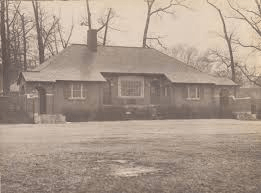
Look close: see the small dark rectangle under the center window? That’s a bronze plaque.

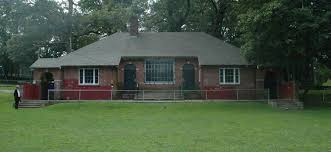
Same building, same window. No plaque.
It all started innocently enough. My schoolchum Charles and I (Names have been changed to protect the innocent – so very, very innocent) left my house one sunny summer day, on our way to play stickball with the fellows, or perhaps to frolic with the bullfrogs at the old fishing hole, when what should we come across but a signpost, lying on the ground. It had been pulled up or knocked down, and it lay, calmly and quietly, as if patiently waiting repair. Charles and I exchanged an impish look, both taken by a playful caprice, as we so often were in those days. We took up the fallen soldier and scampered homeward, to the basement workshop. There we carefully removed the signs – two street names and a Stop sign, the proud red octagon’s warning to us unheeded in our whimsical glee – and made up a sign of our own, which read, “THE GREAT SIGN BANDIT HAS STRUCK AGAIN!” Accenting this message were various ejaculations, “Ha Ha Ha,” and “You’ll never catch me!” among them. Then we returned the sign to its proper place, standing it upright in the ground once more, to tell our tale of tomfoolery to the world. Ah, the hijinks of youth!
But I soon found that I had a taste for it. I didn’t know why. The removal of the signs themselves from the metal post had been simplicity itself, the work of a hammer for the street names, and two wrenches for the stop sign. Their appearance, a mixture of urban metalwork with suburban lettering, lacquered white on green, appealed to me. The excitement of the illicit act, particularly the nose-thumbing to authority — I liked it.
I never did such things, you see. I was quiet, I was polite, I was shy. I would never rebel against anything. I would never refuse to do what was expected, what I was told, what was right. But I had done it.
I wanted to do it again.
But how?
That question was soon answered when, on a solo jaunt down the same street, I saw the same signpost — red stop sign and green street signs having been replaced by the local sign-wielding proletarians, bless their innocent hearts — once more lying prone, prostrate, fallen.
I took it home again. I took the signs off, again.
It was even easier the second time.
My friends, holders of all secrets, soon knew of this; my girlfriend — delighted, I now realize, by this teeny, tiny whiff of bad boy in the cherubic youth she liked, but was perhaps not enthralled by — asked me for a favor: would I get her the sign from her street? She would like to have it as a memento.
I walked home from her house that night, as I had done before. The street was dark, the sign was held in a bracket nailed to a telephone pole.
My girlfriend wanted that sign.
Really, was there any other choice?
Of course not: I climbed that pole, I stood on that sign, I knocked it down. I ran with it to my lady’s house, presenting her the head of her slain dragon. I was victorious. A champion.
Soon after, I was up late, watching television, alone in the house, my mother having gone to work, my father having gone to work 3,000 miles away (My father, a particle physicist, had taken a job in Boston unrelated to his field in order to support his family; when given an opportunity to actually do cutting edge particle physics, he had leapt at the chance — but had left his family behind where our roots were. He had an apartment in California and flew back to visit every month.), when I realized: it’s dark outside. Nobody would see me, if I were out there. And — this was the real revelation — I could go out. Not walk back, from somewhere else, going straight home as I usually did; I could leave home. Nobody would even know.
So I did. I went out. I walked down the street — nobody stopped me — and then down another street, and then down another. Past where the signpost had now vanished entirely, the sign-wielders twice bitten, thrice shy; I was disappointed.
But now I had a new system: signs held up with nails could be pulled down by my weight (As it turns out, I already knew this). Soon enough, I found one such — a No Parking sign, a lesser prize, perhaps, but a prize nonetheless, and the pole it was nailed to was beside a tree that made for easy climbing. I climbed. I kicked. I stole. I ran home with it under my jacket, next to my racing heart. The No Parking sign was no restriction for me, no command: no, it was freedom.
It wasn’t enough. I had to find a bigger prize. And at the city park near my house, I found it. The park had been deeded to the city nearly a century before by the farmers who had lived there once, long before the wealthy Bostonites moved in and raised the suburban property values; as the city had grown more and more developed, the family had given the land to the city for use as a public park. It was a lovely park — tennis and basketball courts, soccer and baseball fields, swings and slides, stone walls, wrought iron fences, elms and oaks and rhododendrons.
And a beautiful sign. A bronze plaque, three feet by two feet, attached to the wall of the park’s central clubhouse, commemorating the gift of the park to the city. Tarnished by years of weathering, but the black on the edges of the raised letters just gave it gravitas, and a kind of warm, homey beauty. It looked like history. It looked like pride.
Attached to the wall with four screws. Flathead screws.
I waited until 2am, that time, watching HBO movies slide by unnoticed. I had the screwdriver. I had a long coat that I would drape over it. That sign would be mine.
You know what? It was easy. Nobody saw me. Nobody even drove past me as I walked it the mile or so back to my house. Nobody was home when I left, nobody was home when I got back. Sure, it was heavy — but adrenaline makes you strong. I was young, I was free. I was — the Great Sign Bandit.
Right: until my father came home for his visit.
He went into my room looking for towels, which I had a bad habit of dropping on the floor after my showers and simply leaving where they lay. I did that a lot, actually — schoolwork, books, games, shoes, unfinished projects, stolen street signs; all lay scattered, strewn haphazardly around my room. And when he went in there, he found the signs — hard to miss them, five or six full-sized street signs propped up against the walls or flat on the floor.
“Oh, the shame of it! My son, the sign thief!” he said, poking his head into the computer room where I was playing video games. At first, my heart stopped. I turned to look at him, no doubt ashen; what was he going to do to me?
But he was kidding. “Just don’t do it again,” he said. I nodded, struck dumb. So . . . he wasn’t going to kill me? I got away with this?
Some background is called for. Before we moved to Boston, we lived on Long Island, in a small town called Bellport. (We believed it was because the Liberty Bell had stopped there while it was being smuggled past the British. Not true. But we believed it.) Our property there had been on the corner, and the street sign had been planted in our yard. And for some reason, the local teenagers thought it was funny to bend the sign down onto itself so it somewhat resembled a taco shell. The sign was freestanding, and they would jump up and hang on it, and bend it down so that the name looked down to the street and up to the sky, and then bend the ends down, rendering it entirely unreadable. My father, irritated by vandalism and feeling some civic responsibility, would take the sign down, bring it into his basement workshop, straighten it out, and put it back.
The next day or soon after, it would be bent again. So he would straighten and replace it again, this time with cursing at every step.
And it would get bent down again.
So he sharpened it. He filed the edges so that, when the hoodlums would jump up and hang their weight on the sign to bend it — well, let’s say the sign wouldn’t be the thing laying on the ground.
He didn’t go through with it. He thought better of it, took the sign back down, dulled it up again, and then replaced it. I don’t remember why the kids stopped bending it, but they did. No fingers lost. But an indication, I hope, of my father’s feelings.
So it was stunning that he let me off. For sign stealing. For vandalism.
I was bulletproof. I could do anything!
Except then he went back into my room to collect the towels — and under one of them was the bronze plaque.
“This is too much,” he told me. “We’re taking it back.”
To the Parks and Rec office: I’m carrying the 3’x2′ bronze plaque once more. A woman comes out from a back office as we enter, asks if she can help us. “We found this,” my father says, pointing at the sign propped up against my legs.
“Where?” she asks.
My father points at me. “In his room.”
“Oh,” she says.
I carried the sign where she indicated. We thanked her. We left. My father lectured me the whole way home about respecting property and the evils of vandalism.
And then he flew back to California.
You know what? That woman, at Parks and Rec? She never wrote down my name.
And when they put the plaque back up, they used four flathead screws.
The next time my father came home and caught me — and it wasn’t on his next visit, or the one after that — he “found” the signs where I had left them: in large piles in the sun room, directly off of the dining room, where he couldn’t possibly have missed them. He found there thirty-two street signs, six orange traffic cones, nineteen blinking hazard lights — and the bronze plaque. That time, he didn’t lecture me, and he didn’t take me to return what I had stolen: he called the police. I came home from school that day to find a police officer waiting in the living room with my father. It turns out that I had committed certainly one, and possibly three, felonies: since a stop sign alone was worth better than $500 (I had three of them — never mind the historic bronze plaque, about which there had actually been a story in the local newspaper), there were several counts of possession of stolen property in excess of $500; several potential counts of grand theft; and several counts of criminal mischief. The officer — very kindly, and very calmly — informed me that if my stealing of traffic direction signs had provably led to an accident, then I would be responsible for the damage done, up to and including manslaughter. Fortunately, no serious accidents had resulted; but it was not a good conversation. Or a good feeling.
I did have a moment of amusement when the truck from Public Works came and my father and I brought out all of my stolen swag to put in the back of the truck; I watched the PW worker’s eyes get wider and wider as we made trip, after trip, after trip. I wanted to smile at that. I didn’t.
And then they left. And I, the now-busted Great Sign Bandit, was alone with my father.
I’ve told this story often. I’ve usually laughed, and made my audience laugh, when I did. I was lucky, after all; nobody had been hurt by my vandalism. No strangers, at least. But then, that wasn’t who I had been trying to hurt, was it? I did the damage I meant to do, even if I hadn’t known at the time that I had meant to do that. Looking back, though, it’s hard to believe I didn’t know what I was doing. I remember my father sharpening that sign. I remember the anger he felt towards the kids who had vandalized it. I remember sitting alone in my house, because my mother was at work, my brother was in college, and my father was in California. I remember how dark and quiet and cold it was out in the streets at 2am. It was like there was nobody else in the world, and it didn’t matter what I did, and it didn’t matter what I stole, and it didn’t matter who was hurt or angered or inconvenienced by it. There was nobody out there but me.



 Just Dusty