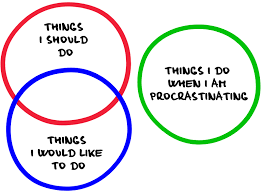
Late to Work, Work Too Late

I have a confession to make: I procrastinate my work.

Specifically, I procrastinate my grading. I procrastinate my paperwork, too; if I’m not the last one every year to get my self-evaluation done, I’m the runner-up. It’s almost a point of pride for me to refuse to turn in my Intent to Return paperwork until it is appallingly late; I dress it up as a sort of protest, because I hate the system — my school requires teachers in February to sign a letter of intent that says we do mean to return for the next school year, and listing the classes we would like to teach (There is also an option on there for “I would like to work for the school district, but I am willing to transfer schools” which I have never and will never check, because if anyone puts me into a middle school, I’m quitting on the spot and becoming a meter maid. Or maybe one of those guys who spin signs for tax preparers.), but then they don’t actually offer us a job, or tell us what we will be teaching, until JULY. I hate that we are supposed to commit to the school MONTHS before they have to commit to us — and in some cases, they don’t tell us the classes we are teaching until the school year starts: in 2021 I was teaching a full set of online classes, but I did not know until an administrator emailed me and asked “Hey, how do these students I have registered for your class sign into the Zoom?” ON THE FIRST DAY OF CLASSES. So yeah, the system pisses me off: but also, I do intend to return, and the people who need my signed letter — specifically my principal — are not the people who set up this obnoxious unbalanced system. So there’s no particular reason why I procrastinate signing the letter; I just do. Like with all of my paperwork. And all of my grading.

I don’t like admitting it, because I’m a teacher, and I’m supposed to set a good example for my students; I’m supposed to not only teach them that, in the real world, deadlines matter, and organization and a work ethic are important; but I’m supposed to enforce that learning by requiring them to hold to deadlines, to be organized, to develop a work ethic, so that they will be prepared for the real world. If I don’t prepare them for the real world, I’ve been told, then not only will I be setting them up for a rude awakening when they get fired from their jobs, but also I am tearing apart the foundations of our society by eliminating personal responsibility, which means that everything in this country will fall apart when this current generation gets out of school and goes into the real world.

Where have I been told this? On Twitter, of course. Where I was this morning when I should have been working.

Step 1: head on Twitter Step 2: regret your life decisions | Twitter | Know  Your Meme

Please don’t get me wrong: I have a strong work ethic. I take personal responsibility for the tasks that are required of me. If anything, I take too much responsibility, and work too hard; where I could just shrug cynically and say “Hey, if those rotten little punks don’t want to read the book, then they’ll fail and they’ll deserve it,” instead I say, “Maybe I should read it to them in class, so I can explain it and make it more interesting, and they can at least understand what’s in the book and what it means, even if they aren’t reading it on their own.” Does that require more of me? It does. Not only do I have to work harder in class, then, but also it means I can’t assign quiet independent work in class, and get my grading done while my students are working; that means I have to do my grading outside of class, which inevitably means I have to do it on the weekends.

Which causes a secondary problem: because I put so much effort into my daily classes, trying to run every lesson, keep every kid involved, cover every topic with them and make the information interesting, so I can be (at least somewhat) sure that they understand and are learning, I have little energy or motivation at the end of the week to do grading. And frankly, at the end of the week of work, I think I deserve a break: and I’m right. I do deserve a break. Teaching is a hard job, and I work very hard at it. It’s important to me: I recognize the value of education, and the value of an educated populace; I think of it as my most valuable contribution to a world that has been very generous to me in my life — and also, I’m good at it. And my students need to learn, and they need to have good teachers and good adults in their lives, and I am all of those things. So while I am at school, and after school, and during my lunch breaks, and so on, I work as hard as I can to do as much as I can for my students.

The result, then, is that on many weekends, I don’t do any grading. Even though I haven’t done it over the week at school, either. Because I’m tired, and because I deserve a break, and weekends are what I get.

The result is that it takes me too long to grade.

It’s a problem. It’s a problem for a lot of reasons: first because it’s bad teaching practice. Feedback should come quickly: students (like anyone) forget in short order what they did on an assignment or how they did it; if they get the assignment back with feedback within a few days, then they can take the feedback as constructive suggestions on how to improve. But if they get the work back two weeks later, or three weeks later, or four, five, six, seven, even eight weeks later — and yes, I have done that — then it’s useless. They don’t even remember doing the assignment. I have frequently handed back a paper to a class, and had them say “What is this? Oh man — I forgot all about this.” I cringe every time. And tell myself I’ll do better: I’ll spend more time grading, less time doing nothing at school or doing other things at home. The job is important, after all.

But then when the weekend comes, I can’t bring myself to do it. And there are all of the other things that I also need to do: I need to spend time with my wife, who is my whole world; and as important as my students are, and as important as teaching is, she is more important. Much more important. Orders of magnitude more important. Plus, spending time with her makes me happy: which does have the added benefit of helping me recover from the work week, which then gives me more energy to teach as well as I can in the next week. Which is also important: and maybe more important than getting those grades done. The same goes for spending time with my pets, and also working on my house, or going to the gym. All of them are important — the gym helps reduce my stress, and will keep me healthy, which will help me live longer (certainly something that teaching will not do for me…); working on my house makes me more comfortable, and also helps increase the value of the house, which means I will be more financially secure in the future — which not only reduces my stress, it also helps to ensure that I will be able to keep this important job in this underfunded, underpaying state of Arizona.

And so on. There are always reasons to do things other than grade: and I don’t mean bullshit reasons like “I just don’t really feel like it right now,” but valid reasons, genuine excuses: other important priorities that should come first. So I put them first. And so I don’t grade.

Grading Memes 20+ Funny Images Only Teachers Will Understand

And then there are the feedback loops.

You see, because I know that I take too long to grade, and I give myself all the excuses I could ever want to keep allowing myself to do that, I can’t bear to make my students stick to hard grading deadlines. Even though it would be easier, because that way there would be less for me to grade. Even though it would be “teaching them about the real world and taking personal responsibility.” Even though it would make the work more meaningful when they did it, because when they come back weeks or months after an assignment was to be turned in and they complete it then, the chance that they are still able to learn from the lesson is almost nil. But I can’t do it. If I don’t stick to hard deadlines, how can I make them?

I mean, of course I could. We have unequal power in the class. I get to set their deadlines, and the consequences for missing those deadlines; and I get to decide when I complete my own work. I have the power to make these determinations.

But I can’t justify it. I can’t justify the time I take to do the grading, so I can’t justify holding my students to a short, hard deadline, and then taking weeks and weeks to give them back the grade on the assignment they turned in on time.

So I don’t hold them to deadlines. Which is how I contribute to the imminent collapse of our society, according to those Twitter pundits who told me that holding students to deadlines is critical for preparing them for the real world.

It’s also, I know, how I leave an opening for students to put themselves into a real bind. Because I don’t hold them to deadlines, and I don’t get mad and yell and get them in trouble and ruin their GPAs if they don’t get the work done for my class, I make it that much easier for them to procrastinate the work for my class. And, see, they have so many classes, and so much homework for all of them, and their math and science and history teachers all keep hard deadlines, and chew them out and shame them when they miss deadlines, and refuse to let them turn work in late, and therefore ruin their grades if they don’t get the work done — that they always choose to do the work on time for their math and science and history classes. They know they can take a little more time for Humphrey’s work. So they take it: because after a long day of sitting in classes and trying desperately to learn — and they are trying — even when it is boring, even when the teacher doesn’t communicate well, even when other things in their lives or in the classroom are distracting them, they are tired. And understandably so: it’s hard work trying to learn. Especially trying to learn complicated advanced concepts like how to write an essay. But that’s okay, they can put off Humphrey’s work; he doesn’t care.

Let me just set the record straight on that one, because it makes me mad every single time they say it.

Are you listening, kids? (Of course not.) Here it is anyway.

I care.

I care about how you act in my class. I care about whether or not you are paying attention to me. I care about whether you are looking at your phone or if you are reading. I care about whether or not you turn in the work on time. I care about your grades. I care about your test scores. I care about everything. All of it. Always. I care.

I just don’t have the energy to apply pressure on all of you, all the time. I can’t do it. I can’t make the lesson interesting and useful to all of you, while also fighting to make you listen to the lesson I have already put effort into to make it interesting and useful. I can’t stand to have to fight to make you listen to my interesting and useful lesson: you should just fucking listen. Okay? You want to talk about not caring? How about all of you little punks not caring about how much you annoy me when you don’t listen to me no matter what I do or say? Even after you say you like me and like my class? You still don’t listen, and you don’t care how much that hurts, and how frustrating that is. You make me fight you, make me make you follow the rules you know you have to follow already, and then when I ask you to follow the rules, you argue, and you fuss. So I have to fight harder.

Think of this: for every action there is an equal and opposite reaction, right? So if it takes a certain amount of time and effort to overcome your resistance to doing work in class any given day, and I have to be the one to overcome that resistance for you, then that means the effort put into my action to create the reaction in you that allows you to learn is just as hard for me as it is for you. So if you struggle to make yourself pay attention and try, I struggle just as hard to make you pay attention and try. The difference is, I have to struggle with 20 of you, every single period, every single day. And then once I have managed the struggle, and gotten you all to pay attention and try — then I have to teach you. And make it interesting and useful for you, so you can keep paying attention. And that takes effort, too.

So much of the time, even most of the time, I just can’t do it. I can’t put out that much effort in every class, every day, with every student. So I blow it off. I procrastinate. I just start teaching the lesson, knowing that not everyone is paying attention; hoping that somehow they will listen to me as I try to make it interesting and useful, and they will do the work themselves, and then I will be able to help them learn.

It never happens. Not with the whole class. Not with a whole unit.

So I have to let it go. And since I let it go, I can’t demand that they put out more effort than I’m willing to put out. To be clear, again: I could do that. Lots of teachers do that. The fact that I don’t do that is one of the reasons they like me. But because they like me, they feel more casual about my class, and it’s easier to blow off work for a class that is more casual, especially when the teacher is cool and doesn’t care about deadlines. (I. CARE.)
Matrix Morpheus Meme - Imgflip

So the students blow off deadlines, and that creates more work for me. Because I need to try to track them down to get the work completed so I can grade it; or by the time they get around to it, they don’t remember how to do it, and I have to take some time to remind them of what the assignment was. Or they blow off some assignments, which lowers their grade, and then they need to make sure other assignments are perfect so they can bring their grades back up — and that means they need to check with me about what the expectations are, and what they need to do, and if the work they have so far is good enough or how they can change it to make it better and get a better grade. Which is freaking awesome: because it means they’re learning, and they want to learn, and they want me to help them get better, and that is the whole point of all of this —

And it takes more time and energy. Which I am happy to expend on students who ask for help, especially the ones who have been struggling and have low grades because they haven’t turned anything in, which always makes me worry that they don’t understand the assignment or the content at all; when they ask for help, and I help them, and they get it, then I feel like I won. And they turn the work in, very very late, and I grade it immediately because I’m so pleased they got it done, and then I am complimentary in their feedback because I want to encourage them to keep turning in work and showing improvement.

Which, of course, just encourages them to keep turning work in late, and getting extra individual attention, and getting nice feedback and so on.

But then I’m even more tired, and so I get even less done for the class as a whole. Which makes me feel bad, like a slacker, like a bad teacher. Sometimes I get so depressed I can’t stand to work at all. But of course, I keep doing it. Because I have to. Because the students need me. Even if they never act like it.
Meme Creator - Funny You can come back to work now We miss you (& need you)  Meme Generator at MemeCreator.org!

That’s what procrastination is.

I don’t know how or when or why we all forgot that, all got confused about it. Who told us that procrastination was being lazy? Nonsense: blowing off work entirely, never getting it done at all; sometimes that is due to laziness. (Rarely, I would argue. But sometimes.) Procrastinators do the work, we just do it late, or at the last minute, while also applying enormous pressure to ourselves mostly in the form of anxiety. So if you do the work a little at a time from Monday through Thursday, and I cram it all in on Thursday night, and we both turn the work in on Friday — or if I do all the work on Sunday and then turn the work in late on Monday — which of us has done more work? Nobody, of course, unless, as I said, you want to count the extra effort I expended on anxiety and guilt. (And maybe the extra effort you spent on organizing and managing your time and the project — but you loved doing that, and we all know it.) We all do the work. It is certainly true that waiting until the last minute frequently limits the amount of time we have to put into the work: but in my experience it does not at all limit the effort put into it. That is a separate decision, which lots of people make — and sometimes it is due to laziness, I agree. But procrastination is not lazy.

It’s prioritizing.

As I said, when I decide on Friday night that I would rather spend an evening with my wife than grade papers, that is a choice I am making based on what I think is most important: not what requires less effort. Okay, spending time with my wife does require less effort: but considering how much time I spend away from her doing work, it should be clear that I don’t always pick the easier path because it’s the easier path. I usually don’t. When I do choose to spend time with her, it is partly because I have spent all of the effort I can possibly spend, and now I need to do something that puts something good back into me: and an evening with the woman I love will do that. (Also I choose to spend time with her because she is the best and most important person in my world, and she deserves to have my time more than any of my students do.) The time I spend writing is time I could spend grading, and believe me, this is not any easier in terms of intellectual effort. I think it is more important, at least once a week, for my self-understanding and my identity. So I prioritize: I make a choice. And that choice means I have less effort and time to spend on the other tasks. I will still spend as much time and effort on them as I can: but sometimes — frequently — constantly — that effort is not my full effort. It just can’t be.

Because I have too much shit to do.

Want me to get all my work done? Reduce my student and class load, without reducing my pay (Because if I get paid less, I’ll need to go find a second job to cover my expenses, and I will not have more time.). Or even better, make all of my students do their part by having them pay attention to my lesson, to my whole lesson, every day, so I don’t have to fight to make them stay on task and learn the content. Though, to do that, you’ll need to lighten their load as well: because believe me, after being told all their lives that they need to learn everything and get good grades OR ELSE THEY WILL BE DOOMED TO A LIFE OF MISERY AND WASTE BECAUSE THEY DON’T HAVE ANY WORK ETHIC OR RESPONSIBILITY AND THEY WILL HAVE DISAPPOINTED EVERYONE AROUND THEM, they are also trying just as hard as they can: and it isn’t their fault they can’t do everything we demand of them any more than it is my fault.

We are simply demanding too much. And then calling it procrastination when everything doesn’t get done.

This is the point I want to make, and I want to make it twice. Because people on Twitter (Assuming they are people, and not malicious semi-sentient globs of slime) have repeatedly and vociferously claimed that teachers are lazy. We are not. We work as hard as any and harder than most. Of course there are lazy teachers, as there are lazy people in every group; but teaching as a profession takes all that we have, and demands even more. Students, like all children, are a bottomless hole of need: they always need something, and then they always need more. It’s fine; they are children, they’re not supposed to be self-sufficient. But there is never an end to their need. So we who provide care to children, of any kind, we have the full range of tasks required of us professionally — and then we have all those children. And all of their needs. It’s too much: and so I, like all of my colleagues, prioritize. Some of us choose to prioritize work over family, or over ourselves; some of us choose one aspect of work over others — I have colleagues who spend enormous amounts of time and energy making sure that their students are happy, even if the curriculum maybe doesn’t all get covered; I have others who make sure that the students are understanding all the work, even if that means they maybe don’t have the most fun and exciting classes; I try to make sure that my students find some interest in and affection for my subject, because I want, more than anything else, to get them to be readers: and thus lifelong learners, who will grow far beyond what I could ever impart to them. But the issue is, we all try to do all of those things, all at the same time, along with doing all the rest of our work; and it is too much to get done. So we do what we can, and procrastinate the rest, and when we finally run out of time — we say to ourselves that we’ll work on that next year.

And now let me make the same point twice: students need help. They need support. Not all of them need the same help in the same way, but all of them need something. All of them. Partly because they are children: and partly because everybody needs help; everybody, young or old, needs something. What students need more than anything else is grace. They need kindness. They need us to try to understand what each of them individually needs, and to try to provide that to them, as much as we can. We need to know where our boundaries are, when we run out of energy and the ability to give; because they can’t be expected to know how much is too much, and they will always need more than we can give. It’s fine: they are children. Children need support. And there are fortunate children who get most of what they need provided for them by their families and friends; those children don’t need much from their teachers and other caretakers. But they still need something: even if it’s only praise for a job well done, and a suggestion about where they could go next.

The other reason why students all need help and grace is because we demand too much from them. We give them limited time, limited resources, and the limited energy and support of their teachers, and expect them to accomplish — everything. Not only to learn all of the subjects which their teachers have spent our professional lives mastering, but also to learn everything else they need for adult life. And apparently — according to Twitter, at least — they need to learn it all NOW, before they get into the “real world” and discover that they are unprepared for the harsh realities of life. They need to learn to do their work, and do their best, all the time, no matter what they may have going on in their lives outside of school; because in the REAL WORLD, you don’t get to give excuses: you just get fired if you show up late or miss a day of work or miss a deadline or break the rules in any way.

Never mind that I have frequently been late turning in my work. Never mind that I have had colleagues and coworkers who show up late, or miss work, all the time. (I tend not to miss work, and I’m obsessive about being on time. But also, I let my classes get off topic at the drop of a hat, and waste all kinds of time arguing with students over silly subjects instead of pursuing curriculum. We all do the things our bosses don’t want us to do.) Never mind that I and several of my colleagues constantly disobey the dress code, or don’t clock in or out properly, or cuss in front of students, or spend time on our phones looking at social media when we’re supposed to be working. Or show up hungover to work. (I’ve never done that one, either. But I did get suspended because of things I posted online about my students. So I guess I never learned that “If you don’t have anything nice to say then don’t say anything at all” lesson in high school, huh? Must have missed that day. Probably hungover.)

No: we tell these children, who don’t know any different, don’t know any better, because they have only been in school, because we won’t let them leave, that they have no chance in life if they don’t learn everything we have to teach them RIGHT NOW NOW NOW NOW NOW NOW NOW. And then we give them far too much to learn, all at once. And tell them they not only have to learn all of it, but they have to get high grades, or else they are doomed, and we will be disappointed.

And then we are surprised when they procrastinate? When they blow work off sometimes? When they try to take a little bit of time and space for themselves, to do something they enjoy, after hours and days and weeks of doing work, for no tangible reward? We’re shocked when they sleep until noon on the weekends — and then we call them lazy?

How dare we?

No. Students are not lazy. They are doing their utmost to live up to our impossible standards, to our impossible expectations, even with their limited resources and their nonexistent experience, which means they have not mastered the same coping strategies that we have. They don’t know what to do other than — maybe not do some work. And then we get mad at them for not doing their work, and they feel bad, and they fear the consequences we give them right now so they can learn to avoid consequences later; and all of that adds pressure, which wears them down — and they need to take more time off, to escape from even more work. Just so they can survive.

Just like us.

The answer is: they need to work less. We all need to work less. And if we can’t, then the very least we can do for each other is, when we have the power and the opportunity — be nice. Be kind. Give someone a little grace. And take a little for yourself. Even if it looks to others like you’re procrastinating. It’s better to turn in the work too late, than to work until it is too late.

We’re all doing our best.

What We Need In Education: Time and Hope and Change. But mostly time.

Okay, I had two preliminary thoughts this morning, which I want to get to before I dive into the main subject, because both thoughts are pertinent. (And then I came here to write this, and had a third thought, which is — holy crap, there are people reading this blog? Hundreds of people?! When did that happen?!? Welcome, and I’m sorry I haven’t been posting regularly, and I will do my very best to change that. Feel free to check out my years of archives, linked on the sidebar. Also you can go to my website and see my other projects. And a picture of me with a sloth.)

The first thought is in regards to what is happening in the world right now. Russia has invaded the Ukraine, and there are people fighting and dying; I thought it would be awful of me, entirely selfish and exhibiting “blinkered, Philistine pig-ignorance” to quote the great Monty Python, to write about really anything other than that crisis. I keep seeing fluff items in my news feed, things like what Meghan Markle wore to the NAACP Spirit Awards, and I keep thinking, “Man, they’re still going ahead with that kind of thing? Now? When Russia has invaded the Ukraine?” So surely I wouldn’t be so tone deaf to the suffering of others to write something about teaching in the US today? Especially if I wrote something hopeful and positive in tone?

But that’s not fair. First of all, there is literally nothing I can do about Russia and the Ukraine. I don’t think I need to do anything to raise awareness; I’m confident that anyone reading this blog already knows, and most of you certainly know more than I do about this. I may have something to say about it, being a dedicated pacifist, because this is exactly the point where pacifism becomes questionable, when there is violence instigated by a clear aggressor, acting without provocation; does that make it acceptable to fight back against that violence? Recognizing that allowing violence to continue — well, it allows violence to continue; being pacifistic while people are fighting and killing doesn’t reduce the amount of violence in the world, and arguably, if fighting against those who are violent would end their violent aggression, it might reduce overall violence in the world. At the same time, I have to honor the choice of dedicated pacifists like devotees of Buddhism who refuse to fight back when attacked: maybe they have the right idea.

Most importantly, though? There is always suffering in the world. There is always violence, and atrocity. And while we certainly shouldn’t turn a blind eye, neither can we let the suffering of others, no matter how terrible and heartbreaking, stop us from living our own lives, and doing what we can to alleviate suffering about which we can do something. If I can help make life a little easier for myself, for my friends and family, for my fellow teachers and my fellow countrymen, then that is a good thing to do, even if it doesn’t help people currently being bombed by Vladimir Putin’s stormtroopers. It’s good to spread hope, and to promote progress on the problems that face the world today, both the existential crises and the slower, less obviously catastrophic concerns: like the state of education. The fact that people are dying doesn’t change the need to make the American education system better, or to maybe help teachers feel a little better about our world right now.

So I’m going to go ahead. For real, and I’m sorry this took so many words for me to get to the subject. And no, I haven’t forgotten that there were two preliminary thoughts: the other was, simply, that things take too much damn time to do. You know? I got up this morning, fed my dogs, drank some coffee while puttering around on the internet, then I walked the dogs, went to get bagels for breakfast, made a run through Target for some supplies and then came home — and cursed out loud when my wife was already up and met me at the door, because I was carrying presents for her birthday tomorrow, unwrapped presents which I was just about to wrap with the shiny new paper I got from Target, and she wasn’t supposed to be awake yet, but the run to Target had taken longer than I expected and it was already the time when she usually gets up on the weekend, but fortunately she’s wonderful and so when I yelled “GO AWAY!” she ran away and went back in the bedroom so that I could wrap her presents, which I did — and then I ate breakfast and now here I am writing this: and it’s almost 11am and I need to stop so I can give my dog a bath which he sorely needs, after which I will need to take my own shower, and then it will be time for lunch and a nap: and I haven’t even gotten to my subject for this post, and I haven’t done the grading I need to get done this weekend. And my weekend, which was a very welcome four-day break (for the Tucson Rodeo! A four-day weekend! After we didn’t have a day off for Presidents’ Day! And this isn’t even a cowboy sort of area any more! It makes no sense! Wheeee!) is almost over, and I need to get back to work. And I’m not really sure what I’m teaching tomorrow.

So that’s the second thought, and I am using this to enter directly into what I want to talk about, which is: what we need to do about teaching in this country. Because the truth is, what we need to do will take time. A lot of time. And while we are doing those things, while we are making the necessary changes, we also need to keep doing the things we are doing now, because if we put everything on hold today so that we can make tomorrow better, then the people in need today suffer. And while it sucks to realize that working on the immediate needs of present students in the present system will delay the necessary changes that will improve the system, especially when we recognize that much of our work now is necessitated by the problems and flaws in the current system, it’s also important to realize just how much work we’re getting done, and how important that work is.

Let me emphasize this. The biggest problem in education right now, for teachers and for students, is burnout. We are overworked and overstressed, and we’ve reached our limits. Students are showing that by acting out and by rebelling, because they can’t change the system, so instead they refuse to participate (which just makes things worse for teachers, but then, it’s not the students’ fault that they have no other recourse [which does not make it any easier to handle them on a daily basis]); teachers are showing it by quitting, retiring, and also by losing our minds. For me to say that we need to keep doing this work, all of it, and that we also need to put in extra effort to reform the system — well, I sort of want to punch myself in the throat for it. But: first of all, not everyone has to participate actively in the reform of the system. We do what we can, and that’s all we can do; most of us will be simply maintaining the status quo, at least for right now. But that is important, because maintaining the status quo? Means educating students. In a flawed and inefficient way, which promotes even greater burnout; that’s why we need to do something to change the system. But anyone who does anything to help a student to learn is doing a good thing. Teachers, who put all of our time and energy into helping hundreds and thousands of students to learn, are doing wonderful and awesome things.

Don’t forget it. Don’t minimize it. Teaching is of vital, critical, importance, both in the immediate and in the long term. If all you can do right now is teach, or do what you can to support teaching and learning, then that is enough. That is amazing and wonderful. I thank you and honor you for it. And I thank and honor myself, because I’m still doing it, too. I don’t want to go to school tomorrow, but I’m going to. And I’m going to teach as well as I possibly can.

Not totally sure what I’m going to teach. But it’s gonna be something.

Look at my morning. I took up hours doing a bunch of things, and it’s tempting to focus on what I didn’t do — writing, or grading — and see the morning as wasted; but instead of that, look at all I got done: my dogs are well cared for, my wife and I had a delicious breakfast, her presents are now wrapped; I even got little things done, like I stopped and did the recycling, and I listened to an episode of my new favorite podcast. (It’s called Unf*cking the Republic. It is political, progressive, and utterly brilliant. Highly recommend.) Time was spent: but it wasn’t wasted.

Time spent working in education is — no, wait; I can’t say it is never wasted. It is constantly and consistently wasted. But, time that is spent actually helping students or teachers is never wasted. It is always good work.

Sadly — and this is why there is so much burnout right now — it’s a lot of work. And a lot of effort is wasted in the process of doing that work. Take ESS (Exceptional Student Services, the new term that has replaced Special Education — and if there’s anything that is more wasted effort than dreaming up new euphemisms to conceal that there are efforts being made to help students learn, I don’t know what it is): I have a couple of pretty extensive forms I need to fill out for a couple of students who are having meetings to consider their individual learning needs and how those needs are being addressed; I have two after school meetings this coming week to discuss the students’ progress in my class. Figure three hours, outside of the time I normally spend preparing and teaching my classes. Multiply that by the six other teachers each student has, along with the time spent by the ESS coordinator to arrange the meeting and make sure that everyone fills out the paperwork, and the time contributed just to this specific part of the process by the student, the parents (Both of whom, students and parents, spend uncountable hours trying to help the student learn), and the administration, and you’ll see something of why teaching is so hard and why we’re burnt out. And the real issue is? What these students mostly need, in addition to their resource classroom, is — consideration. Extra time on assignments, preferential seating in the classroom, and the ability to check in with teachers about progress and understanding are by far the most common accommodations, along with the option to take breaks when needed and to take tests in a more relaxed setting like a smaller classroom or after school. Tell me which of those things would be refused by any reasonable teacher. Of course, the very fact that we have the official process and all the paperwork shows that there are definitely teachers who have refused to allow those and other reasonable accommodations; and that is certainly one of the problems we need to address in education. And I also recognize that having a system in place to provide plans and communicate needs to individual teachers alleviates the students and their parents of the obligation to discuss with every single teacher what the student needs to succeed; I know full well that without that process, most of my students who need accommodations would never talk to me about them, because it is still stigmatized to need help in any way for any reason.

I can’t quite fathom why it is bad to do what it takes to learn. To want to learn enough to look for and find the particular ways that one can learn successfully despite one’s inherent difficulties. I mean, that’s all the ESS students want, is to learn. Why exactly is that bad? Why is it shameful enough that we need to stop calling them Special Education students? Why has our society stigmatized those who want to learn?

So that’s what I mean. There’s too much work, and too much of it should not be necessary — but to make it unnecessary would require different work in different ways. We would need to make it easier for students and parents to talk to their teachers. We would need to get rid of teachers who stand in the way of learning, thereby necessitating a process that forces them to provide what students need to learn — because any teacher who isn’t willing to take reasonable steps to help students to learn doesn’t need to be in public education. And all of that, either the current work that puts bandaids on the problems, or the additional work that would be needed to heal the problems permanently — it all takes time.

It all cascades, you see. The reason why teachers and students are so burnt out right now is because we didn’t allow ourselves time off when the world came crashing to a halt. Instead, we all doubled or tripled our work load overnight. When I left school on March 13, 2020, I was a classroom teacher; when I went back to school two weeks later, I was an online teacher. All of my students suddenly had to become online learners. We had to find ways to do the same work we had been doing, but in an entirely new way: most immediately for me, I had to figure out how Zoom and Google Classroom worked, how to record the sessions (which my school required), how to help my students get into the sessions, and how to present the content through online media. I scanned two entire books, page by page; I recorded audio of me reading those books chapter by chapter. And I spent the same hours I had always spent teaching classes, grading work, responding to emails, and so on. My students did essentially the same things in reverse.

All, of course, while watching our world collapse, and for many of us, worrying acutely over the health and wellbeing of ourselves or our loved ones.

That continued into the fall, when classes were going to be in person, then went online, then went hybrid, then bounced around all three for the remainder of the school year. All of it required me to do my usual work and also the extra work of making my class available over the internet. All while still watching my world collapse and worrying acutely over myself and my loved ones.

All, by the way, without any extra pay for the extra hours and extra effort.

So because I had to spend extra hours doing the same work, what did I sacrifice? Myself, of course. I slept less. I read less. I played fewer games. My wife and I didn’t do the things we used to do to have fun — go out shopping, go to restaurants, play boardgames with friends, and so on. I didn’t take time for myself, at a time when I desperately needed time for myself, to deal with the constant stresses. I had even less time to decompress, as well as less time to help my family and friends, to do the things I normally do when I am not working, even while the need for all of those things was greater, because I had to spend extra time working just to do the same job in the new circumstances. And all of it was harder, because I knew that it wasn’t working. I read dozens of articles saying everything about why and how it wasn’t working: how we needed to go back to in-person school, how we were incurring “learning loss,” how we were doing a terrible job; and also how it was vitally necessary to protect the health and wellbeing of the students and the staff and everyone’s family by having school online, and it was terribly critical for teachers to figure out how to keep students engaged even over the webcam. All that weight was on us.

I can’t even imagine the pressure that was put on health care workers.

So because I was working harder, and taking less time to recover, and also being told (and seeing direct evidence) that my efforts were leading to less positive results, it wore me out. Worse than any year I’ve had as a teacher — and that’s saying something, believe me.

And then this school year started: and on the first day of classes, with no advance warning of any kind (That is the fault of my specific school, though I don’t doubt that other teachers at other schools had similar problems), I suddenly found out I was teaching four online classes at the same time I was to be teaching six in-person classes.

So it kept on going. All through the first semester. Then, thankfully, the online school hired its own specific teachers, and I and my colleagues no longer had to teach two simultaneous groups of students; so I guess this current semester is easier.

But it sure doesn’t feel like it.

So the wear and tear on my mind and my soul make it feel like I have to do more to take care of myself, to destress and unwind; also, the last two years that I have not had the time and energy to pursue my personal projects as much as I would like — which for me is a particularly big deal, as I still consider myself a writer as much as if not more than I consider myself a teacher — have made me feel guilty and sad, and desperate to get back to who I used to be: and all of that makes it harder for me to take the time to do my work as a teacher. Which then makes me feel guilty because I know how much my students need to get back to normal, and how much they need to learn; and that falls to me, because they aren’t really holding up their end right now, since they are also tired and burnt out and stressed and in need of comfort and a break from work.

All of which — and I know it’s too much, and forgive me for ranting, but this is some of what I need right now — leads me to the one thing I am going to say we need to do to change education, the single most important thing.

[Warning: there is cussing ahead.]

We need to take away the goddamn fucking deadlines.

Who gives a shit, WHO GIVES A SINGLE SOLITARY SHIT, if a student takes two years to master a subject or skill while it takes another student only one year? Why on God’s green and verdant Earth do we need to make sure that every student learns the same stuff IN THE SAME AMOUNT OF TIME?? Why do they have to graduate by eighteen? (For that matter, why the hell do we sort them according to their birthdays? Rather than making groups of students according to their interests and aptitudes, we group them according to age? Whose stupid goddamn idea was that? But hold onto that one, I’ll come back to it.)

Do you realize how much better this whole situation would be if we had just LET STUDENTS TAKE A YEAR OFF??? If we had let teachers just take a year off??? I realize that means teachers wouldn’t be doing our jobs and therefore we wouldn’t get paid — but let me just point out that we should have simply paid everyone who was forcibly unemployed because of the pandemic and quarantine, the whole time. But anyway. If we have to have teachers working, then it would have made perfect sense to offer educational opportunities to those who wanted them, and to offer childcare to families who needed it, without actually calling it a school year; that’s how we could have kept teachers employed. If we didn’t have to think of it as a school year, I guarantee teachers could have found a way to keep kids occupied so their families could go to work; though based on the number of students who actually went in to school even when we were fully online in the fall of 2020, there weren’t actually that many families who needed the help. There were some, and our system is what provides most families with childcare, so I see the need to continue providing that, within the limitations of the pandemic and the quarantine: but why, in the name of all that’s holy, did we have to try to make them learn? Everything they would have learned if nothing had changed? Why did we need to pretend that we could still teach, and they could learn, with the same rate of success as a normal year?

Deadlines, that’s why. Because letting this specific group of students graduate when they were 19 instead of 18 (Again, those who desperately wanted to learn to graduate “on time” could have made use of the opportunities without driving everyone involved to the brink of insanity) was apparently unthinkable.

And that’s why everything in education sucks right now. Because we couldn’t fucking take a fucking year off DURING A FUCKING PANDEMIC.

Okay, sorry. I’m better now.

I have more thoughts for where education should go in the future, but I’m going to save them. I’ll try to write about them next week.

This week, I just want to reiterate, again and again: things take time. Work takes time to get done. If the work is made harder by circumstances, it takes even longer, because it puts more stress on the people doing the work, who then need even more time to wind down from their work, in order to maintain their productivity.

If you are and have been working to help students learn, you have done good work. Thank you. If you are and have been working to help teachers teach — or you have been helping teachers survive — thank you. You have done good work.

And before we talk about anything else with education, start with this: the only reason, the only reason, we have concepts like schedules and deadlines and on-time progress and “learning loss” in education is because we choose to force people to complete things in a specific time period. No exceptions.

That needs to change.

This Morning

This morning I am thinking about appreciation.

Yesterday I tried to recognize the teachers and educators I have worked with (And I still forgot a few — so thank you, Mary Wells, for all that you do, and thank you, Nora Caragan, for being the best paraprofessional in the history of paraprofessionals), and I got a grateful and heartwarming response. Teachers loved hearing what I had to say.

But there’s a problem there: I had to say it.

One of the things I object to, even though I participate in, is the support network that teachers provide for each other. It is a staggeringly wonderful thing: these people, who are already working so hard, and who are already giving so much, turn and without hesitation give even more to each other. I can’t tell you how many times I’ve seen it: teachers go into each others’ rooms all the time, and frequently the visitor comes in mad or frustrated or down — until they see the face of the person they are visiting, and see that that person is feeling even worse. Suddenly, whatever the teacher came in to complain about or vent or even ask for help with is gone: frustration vanishes in concern, and the visitor says, “What’s wrong?” Prepared, in an instant, to take more burdens onto shoulders already weighed down with overwork and the emotional strain of seeing up close and personal the struggles and sufferings of children (And also with the strain of struggling through the suffering caused by children — and the worst is that it is often the same children, that those who are neediest and most desperate are the most obnoxious people we see. Which is saying something.), not because we don’t need help any more, but simply because a friend, a fellow teacher, needs help more, or even just needs help too: and so we help.

It’s amazing and inspiring. I will say, without any humility, that I participate in this, that I support my fellow teachers at all times and in whatever way they may need, and that I rarely ask for help myself because  I don’t want to trouble them.  I’ve even seen this go too far, when I was part of my union’s negotiating team and we were  fighting for better compensation and working conditions; trying to get teachers to actually stop working, to stop sacrificing, to start asking for something for themselves — and not luxuries, but a living wage and necessary health care and the like —  was nearly impossible. They wanted to give up whatever they had to give up in order to make everyone else happy. The magnificent bastards.

But here’s the thing: we shouldn’t have to do that. Of all the people who should be sacrificing in order to keep teachers sane and healthy, IT SHOULD NOT BE TEACHERS WHO DO IT. That makes no sense. It defeats the purpose. We not only put on someone else’s oxygen mask first, we take ours off and strap it on top of that person’s own oxygen mask just so they can be twice as safe while they watch us suffocate.

If it’s not clear already, this drives me nuts, that teachers do this. I don’t like that I do it, either, but it is without doubt who we are as people, and what the culture of teachers encourages in us. This is why we spend our own goddamn money on school supplies for our students, despite how little we are paid. And perhaps the worst part, though this is not the place to get into this, is that we are therefore propping up a system that is in many ways a terrible system: not terrible for us, though it is that, but terrible for the students, and terrible for the country. Yesterday I bought donuts for all of my students taking the AP Literature test. I encouraged and helped students to “succeed” on a high-stakes test run by a private corporation with disproportionate influence on college admissions. I structure the whole class around that damn test: a test I should be opposing with every fiber of my being. But I bought them donuts.

So here’y my request, for those who want to appreciate teachers — REALLY appreciate us, not simply nod in our direction while we lie bruised and bleeding in a ditch. (I know, it’s hyperbolic, but it’s also the end of the year, and it feels like that. I feel bruised. I feel sick because I haven’t been sleeping, and I feel sore because my body has been too tense for too long: my shoulders honestly ache right now.) Ready?

Make it so we don’t have to hold each other up.

Give us enough support, and take away enough of our burden of responsibility, that a single person can do a teacher’s job alone, or at least can handle the pressure alone.

Specifically, that means essentially three things: money, time, and trust. In the first years of a teacher’s career, there is a fourth, which is: help.

I don’t want as much money as I want, if I can be permitted that sentence. I want as much money as is needed so that I don’t have to worry about it. That’s all. I’ve been a teacher for twenty years, and I still don’t earn enough to own a home, and I don’t have any retirement savings, and I still have debt that I haven’t been able to get rid of.  I want to make enough money to take care of those problems. I don’t need enough to pay for vacations or jet skis or that diamond-encrusted pirate hat I’ve had my eye on; just enough so that I don’t have to suffer from money stress. I want to be middle class. I aspire to the bourgeoisie.

I want enough time in my school day to get my work done in my school day. I don’t mind planning lessons from home; it’s kind of fun sometimes. But I don’t want to have to spend one more weekend grading, not one more evening filling out paperwork. I already work 40 hours a week at school; why is it that I am expected and required to add another 10-20 hours on top of that, every week? It’s because I have too many students, and too many requirements for teaching those students. Too many things I have to cover, too many things I have to compensate for, and too many people I need to report to and satisfy in order to show that I did my job. You know what should be the only evidence needed that I did my job? That my student can read a book, write an essay, discuss a poem. That’s it. Don’t ask me to prove that I did my job: ask the kid. See what he can do. And ask him, honestly, if I helped him do that. Make it his responsibility to prove that I did my job. He is the product, after all. (Please note: this is not a serious suggestion for assessment of teachers. Students shouldn’t have to have that burden either, and too many of them are not reliable witnesses nor reliable learners. All I’m saying is that I don’t want to do it, to prove to all and sundry that I did my own job.)

And anyone who thought “But you get summers off!” just know: I am currently mentally punching you in the brain. Hard. Kicking, too.

The last thing I need is trust. I have proven that I am a good teacher. I’ve won awards, I’ve won accolades, I don’t have anyone who disagrees with that basic premise: not students, not students’ families, not other educators. Of course not everyone likes me or likes my class: but I don’t believe there’s a single person who could genuinely say that I teach badly. So please, I beg you. BACK OFF AND LET ME TEACH. Don’t try to improve my curriculum for me, or my methods. If you’ve got suggestions, I’ll listen, of course; but don’t tell me what to do, especially if you’re not versed in my subject or my profession. Stop assessing me: my driver’s license is valid for 25 MORE YEARS: and that’s based on a single test I took more than 20 years ago. Yet my teaching license expires every three to six years, and requires hundreds of hours spent on learning to be a better teacher. I get observed every year, often twice a year, and have multi-page evaluations, every year. How much proof do you need that I can do this job? The answer is that there will never be enough proof that I can do it, because I will never be trusted to do it. That has nothing to do with me and everything to do with our culture and our system, but I don’t care why it is that way: I just want it to stop.

I already care about my profession, and about my students, and about my subject. I care about my fellow teachers and educators. Please, stop making me also care about and for myself: let someone else do it. Give me some real appreciation.

And don’t let it come from other teachers.

This Morning

This morning I am thinking about waiting.

Time heals all wounds, we’re told, and it doesn’t. That’s a lie. Not all wounds heal. The implication that we don’t need to do anything actively to heal the wound is often a lie, as well. But it is true that wounds that can heal, will heal with time. I’ve always liked when I see this metaphor taken to completion and the healing described as full medical wound care, because wounds need treatment: once you have cleaned a wound, and applied first aid, and assuming there aren’t deeper complications in the wound and the damage done by the original wound isn’t critical — THEN time heals all wounds.

That doesn’t have the same pithy brevity, though. Too bad: because what could be a valuable piece of advice about patience and waiting and allowing things to happen, rather than going out and forcing them to happen, is somewhat ruined by — well, by impatience, by the need to keep the truism short and to the point. Four words sound good; forty tell the truth; we generally pick the four. It’s faster. Easier.

And, often, false.

Waiting is one of the best things to be good at. One of the hardest things for a new teacher to master is wait time: when you ask a question, you have to stop and give your students time to come up with the answer. It’s hard, because of course you as the teacher already know the answer, so in your brain, the necessary wait time is zero, and there you are, staring out across this room full of blank faces, thinking, “Come on, how do you not know this? It’s hyperbole, for god’s sake! Everyone knows what hyperbole is!” And if no one comes up with it immediately, you turn into that annoying kid who blurts out all the answers. It’s unfair, and it’s not good teaching — but it feels good, because first of all, you know all the answers (Maybe the hardest thing about teaching well is learning to not need to be the smartest person in the room.) and secondly, it’s so awkward, sitting there in a silent room while nobody is saying anything! If you just give the answers right after the questions, then everything moves forward, quick and smooth and easy.

And without learning.

Learning to resist that urge, learning to wait, is extremely difficult. Took me years. It took me enough instances of saying the answer just to have a student say, “I was just going to say that!” and feeling guilty for cutting the student off, and enough instances of recognizing how great it is when they come up with the answer themselves instead of me saying it, to learn to wait for someone to answer. It has made quite a difference in my teaching.

Now, of course, I have also learned to enjoy their (slight) discomfort. I like making them wait in silence. I like making them feel the need to fill that void with something, anything, at least a guess. I like asking hard questions, and watching them have to stop and think. I especially like staggering a smart student, one who is rolling along, doing great, smashing every question out of their way like a marathoner going through those ribbons at the end of the race — and then I ask something that needs more thought, and they have to come to a halt to consider. I like to be the wall the marathoner bounces off of. I love that. (I love it even more when, after a five- or ten- or even twenty-second pause, that same kid comes up with the answer. That’s the best thing.) I might love it too much: I am well known among my students for refusing to give them answers, ever. I’ll ask a difficult question —  why does the author make this choice instead of this other choice — and then they try a few thoughts, and we discuss it and those thoughts don’t work; then a pause, then they try another, and it doesn’t work either. Then somebody says, “Well, will you tell us why?” And my response is generally, “Oh, I’ll never tell you. You’ll figure it out, or you won’t know.” They groan. I grin.

But the point is, the waiting is the key. Time may not heal all wounds, but time is a necessary component of any change: from unprepared to prepared, from sad to happy, from good to great. It is rarely, in my experience, the only component; I think effort is probably equal in almost anything, and also thought — but time is necessary. Patience is necessary.

I’m still learning that. I’m 44, soon to be 45, and I’m still unpublished. (I am traditional enough to think that self-publishing doesn’t count. It does. But it isn’t what I really want, what I really really want, therefore…*) I think my writing has improved, but I haven’t reached my goal. It is not easy to deal with. Ten years ago I blamed everything on callow agents and a heartless publishing industry that just wouldn’t recognize my talent; now I tend to blame myself for not being good enough, for not having the right ideas. But in either case, I still don’t have what I want, and it hurts. It hurts all the time. It bothers me every time I see someone younger than me publishing books. It feels a little better when I see those posts and memes that list the ages of successful artists and authors who were older when they had their first breakthrough; but I’m starting to move into the middle of that pack, too. I saw on Twitter yesterday where someone was trying to give this kind of affirmation, and said, “I didn’t publish my first book until I was 38. Now I’m contracted for my tenth.” And I thought, Shit.

I also don’t always wait and think things through, especially about the effects of my words. I like to just type and go, hit Post, Reply, Send; I like doing that fast. It was a problem when I argued online regularly; now I do that less, but I still have the same problem. And it is a problem, not just  because I often misspeak when I do that; it also means I don’t realize the effect of everything I am about to say before I say it, and so I do things to people that I don’t mean or want to do. I make them angry or I make them sad, or I make them laugh and scoff at me, or I make them feel embarrassed or ashamed. And if I would just stop, and think, before I hit Send, and re-read what I wrote, then I would probably realize, “Oh, no, I shouldn’t say that, I shouldn’t say it that way.” And I’d fix it, and then I would prevent a problem that is caused by my own desire to hurry, my own inability to wait. But I hurry, and so I do harm, to someone else or to myself.

In other words, time may not heal all wounds: but impatience causes them.

Waiting is the key.


*Yes, that is a Spice Girls reference. Here, watch this: this will make it better.

What It Means to Be a Writer

Scrolling through my Twitter feed when I found a link to this piece.

I walk by accident into one of London’s über-bookstores to be taken over by a very familiar type of sadness—as a child I used to feel this way when thinking about the cosmos and my own insignificant place in it. This is London’s biggest bookshop: 6.5 km of shelves, the website proudly tells us, as if this particular length and not another were a reason to rejoice. Book after book after book thrown into this worded jungle—a hoard that could be a waking counterpart to a Borgesian wet dream. Fiction books and books on writing fiction. Photography and art books and books on photography and art. And so on: most forms of expression and myriad words of meta-dialogue, some of them even justified or at least nicely edited and with colourful covers. Nothing escapes this total library: no corner of the universe or the mind is left unaccounted for. It is a hideous totality for it is an ordered totality, filtered through the minds of who knows how many marketing specialists; it is effective as a selling platform but it is a desert of anonymity for the diminished names on the shelves. Were I ever to be asked for a writing tip, something born out of this experience would be my choice: walk into any gigantic bookshop and think whether you can face being one more name lost in this desert of words. If that ideal situation proves too much to bear do something else with your time (it is of course highly likely that if you go around asking for writing tips you will never make it on print).

Okay, first of all, that parenthetical comment at the end gets you a punch in your snooty little snoot with a fist labeled Fuck You. I presume you mean that true poetry, great writing, emerges from the soul as a fait accompli, like Athena cracking her way out of Zeus’s head fully-grown; if a would-be writer is too naive to recognize this immortal truth, and to think that one could simply ASK for a way to be a better writer, then that person is doomed to less than mediocrity. Or else it is the bourgeois feeling of the “writing tips,” the oversimplified, sanitized, pre-packaged saccharine packets that show up in ten-item numbered lists on the various clickbait websites advertised on Facebook. I am more understanding of contempt for those, as I am contemptuous of people who make a living on the internet by telling people how to make a living on the internet – by running a website telling people how to make a living on the internet, which is done (Spoiler alert!) by getting people who want to make a living on the internet to buy your secret to making a living on the internet; and the people who do this always seem to call themselves “writers.” But my contempt is for the people at the top of the pyramid: not for the people down on the ground, choking on dust and sand, dreaming of a way to climb. Those people who want writing tips because they want to be better writers deserve respect for their courage in trying to find a way to get what they want; and their desire to improve, whether or not they know a good path to improvement, is admirable and not at all an indication of their potential as writers. Fuck you in the snoot, sir.

Now let’s talk about the central issue here. You’ve got two problems with this bookstore and the despair it engenders in you. One is that your words will never be truly unique, because somebody out there will say pretty much the same thing you say – or in Borges’s universe that you reference later, with his infinite Library of Babel that holds all combinations of letters and thus every possible book, one of the other volumes on the shelves will say exactly what you say. And maybe Borges was right and it does repeat in a chaotic pattern for eternity, if such a thing can be said to exist. Right? All the kilometers of fiction books, the books about art and photography and writing; all been done before, nothing is new, nothing is original. Somebody get me a cigarette and a bottle of cheap red wine, and build a Parisian basement cafe around me for a tomb.

The second problem is that you will never be the one person whose words everyone reads, everyone knows, everyone talks about; because there will always be so many others putting words on the page, that it is impossible that your words would be the ones that capture every reader at once. Particularly not if you want to capture every non-reader as well. This problem seems to be the larger one, as you speak more of being lost in the noise than you do about repeating what has already been said.

The futility of writing is something I face up to every time I set pen on paper or hand to keyboard. Why am I doing this? My compulsion to write does not occlude the uselessness of filling pages with words. I know that what I do is pointless, one more message in a bottle in a moment when everyone else around me is also casting messages adrift.

This is a poor proof. Your message in a bottle being surrounded by other messages in a bottle does not make your message pointless. Not even in the metaphor: so long as one person finds your message and reads it, and – I suppose – comes to rescue you from your desert island of despair (Perhaps your bottle message is something entirely different, something like “If you let your eyes go unfocused, a Moen kitchen faucet starts to look like a snobbish sheep with a very long snout. But it’s hard to recapture the magic once your eyes go back to normal and the sheep turns back into a faucet, so don’t waste it.” In that case, you won’t be rescued, but somebody may spend a lot of time squinting at their kitchen sink because of you, which is pretty funny, really. I’d call that success.), then your bottle was a success. You won. You did what you set out to do. You made your point. Wherefore, then, does it become pointless? Is the idea that the thousand bottles around your bottle make it less likely that your bottle will be read? This is not true for the same reason your enormous bookstore should not lead to despair. Ready for the reason? Here it is.

There is more than one person reading. (Shocking, I know. Hold onto your snoot, Buttercup.)

Let’s start with the metaphor. There are a thousand bottles with messages in them, bobbing in the water by the seashore. If there was only one person walking by, and for some reason that person had sworn a sacred vow to read only one bottled message, then your chances of being read are a thousand to one. Agreed, and that would suck. But in the – ahem – “real world” of this fantasy, that one guy wouldn’t stop at one bottle: he’d keep opening bottles. Because if he was doing it out of curiosity, out of a need to see what was written on those messages; or if he was looking for the perfect message, the one that would speak directly to his soul, then reading one message would never be enough. He’d read another, and another, and another. He’d probably try to read them all. I would. Wouldn’t you? If you saw a thousand bottles bobbing in the water with message inside them?

And if it was more than one guy on the shoreline? If it was actually a crowded beach, with tourists, and beachcombers, and dogwalkers, and a tai chi group, and a bunch of hungover teenagers wrapped in sandy blankets and the stench of wet cigarette butts? The bottles would catch all of their interests. They would all want to open their own bottle, be the first to read a message. Then they would share the messages they found with each other. They’d be diving into the water, throwing bottles back onto the shore, shouting and laughing and waving their messages over their heads. The more bottles there were in the water, the bigger the spectacle would be, and the more those people would be drawn to where the bottles were. They might even come back the next day to look for more bottles.

Are you following me, sir? Those bookstores with the kilometers of shelves? They are not only filled with books, they are filled with people. People who read books. And those people never stop at just one book. I know: I used to frequent a very similar establishment, Powell’s City of Books in Portland, Oregon. Five floors of twelve-foot-high bookshelves, covering an entire city block. I never expect to see so many books on display in a single place in my life again. I could spend the rest of my life reading (Ah, bliss!) and not finish a single floor’s worth of books. I went there every month for the ten years I lived in Oregon, to buy books, and you know what? That place was always packed with people. With readers. Never mind the kilometers worth of shelves: how many kilometers of people do you think go through those stores on any given day? 3,000 people, on the average. [source] Average front-to-back measurement of a person is approximately ten inches; I’m an American and we’re thicc, so let’s bump that up to a round foot. (Screw the metric system, though I’ll convert for your convenience, sir.) 3,000 feet of human every day, which is very nearly one kilometer of human flesh – around 915 meters, to be precise. And that’s not even lying down head-to-foot. That means that in a week, if the London store has a similar number of visitors, the people looking at those books outdistance the books they are looking at. And I can tell you that the turnover rate for the people looking is far higher than the turnover for the books on the shelves.

There are an enormous number of books in the world, and it grows every day. It is impossible for one person to read them all, and realistically impossible that one of them will be read by all people.

But that doesn’t mean that my book won’t be read. It doesn’t mean that your words will never be seen.

I think about selling my books, which I have not yet succeeded in doing. But let’s imagine that I do so: imagine if my sales, by every measure of the publishing industry, are absymal. Let’s pretend that I only sell one thousand copies of my novel about a time-traveling Irish pirate. So lame, right? I am – what was your phrase? – “lost in this desert of words.”

A thousand people bought my book. Presumably that means a thousand people read it. (Some surely would cast it aside in disgust or disappointment, sure, but I think some of them would like it enough to share with someone else, or else resell it. Let’s just imagine that one sale equals one reading.) Think about that. I have never been in a room with a thousand people who all know me: not in the way that a reader knows at least an aspect of a writer. I have spoken to thousands of people in my life, but I doubt that a full one thousand of them cared about what I had to say: cared enough to sit down, in a quiet room, and spend hours just listening to my words, thinking about my thoughts. Hearing me. If I could sell just one thousand copies of my book, then I could achieve that. So what if at that same time a million people were listening to Stephen King, and ten million were listening to Kim Kardashian? So what if the world is larger than I can speak to at once? So what if all I can have is one small corner –with one thousand people listening to me?

Isn’t that enough?

Think about it in terms of time. I don’t know how many hours it takes me to write a book, but the pirate book was finished in about a year, so let’s use that. It’s a pretty fast read, I think; someone could finish it in maybe ten hours of reading at a leisurely pace, maybe even less. If a thousand people spend ten hours reading my book, then the year of my life spent writing it (And of course the vast majority of that year was spent sleeping, working, eating, singing in the shower, watching TV, playing The Sims, et cetera) has turned into ten thousand hours of other people’s lives spent – on me. There are 8,760 hours in a year (And 525,600 minutes), so even if I had spent every single one of them working on my book, that time spent is balanced by time spent reading my book if only a thousand people were to read it. More than balanced.

So the question is, what more could you possibly want?

If the only thing that would make writing worthwhile, that would give this endeavor a point, is if every single person on Earth read your work, and only your work, then I agree that writing would be pointless. But I can’t fathom a writer, a real writer, being that childish, that selfish, to think that the world must revolve around your work and your work alone. I mean, the only cultural phenomenon with that impact is Wyld Stallyns. Granted, you’re not them, and neither am I. And that stings a bit, I’ll bet. Yeah, it does me too.

I’ll comfort myself just thinking about how easy it would be to get a thousand people in the world to read a decent book. Shit, if all I want is readers, I could offer it for free and get that many readers without even trying. You wrote this obnoxious angsty piece of snobbery, and I read it, and then spent – mmm – more than an hour responding to it. See? The time you spent on this crud then earned for you this time spent out of my life. Time I could have been reading, ya selfish bastard.

And honestly, I think this is enough time spent on you. I am sorry that your life is so empty and meaningless, and sorry that I threw a couple of hours of my life into your black hole of an ego. Do us both a favor: gain some perspective, will you? Thanks.

(I have to say: the rest of the piece has some valid points about marketing on social media, and about the democratization and banalisation [His word] of writing that has occurred through the internet. There is some good thought here. If there hadn’t been, I wouldn’t have read all the way to the end, and then taken the time to write a response. I don’t disagree with everything he says. Just the central premise. I dream of having a thousand readers, and I am absolutely sure that, even in a world inundated with voluminous writers of every imaginable quality and a limited number of readers with a limited number of books they will read, still: I will hit that mark. And it will be worth it.

(Thank you for inspiring me to write this, sir. Now pull up your fucking pants.)