This Morning

This morning I’m thinking about mental health.

We talk so much about mental illness. And I find myself wondering — Is there even such a thing as mental wellness? Are any of us right in the head? Just asking that question, even beyond the fact that it implies that people with mental illness are “wrong” in the head, it seems impossible. It seems impossible to me that anyone’s mind could — just… work. 

I mean, don’t we all have invasive thoughts? Self-destructive urges? Moods that overtake everything else? Don’t we all, every one of us, sometimes think just stupid, ridiculous things?

I talk to people fighting depression and anxiety, and obsessive and compulsive traits and habits and thoughts, and I always think and I sometimes say, “You shouldn’t think that way.” (I would probably use different words.) Like if someone says that a possible failure, say if they didn’t get a job they wanted, would be a signal of doom, of complete worthlesssness; I would say, “Don’t think like that, it’s not true, don’t listen to the part of your mind that says so: that’s the depression/anxiety speaking, and it’s lying to you.” And I’d mean it, and I’d be right.

And then I’ll get a rejection letter from a literary agent, and I’ll say to myself, “Welp, that’s it, my writing career is doomed now, I am competely worthless. RIP me.”

I don’t suffer from depression or anxiety, or any other form of mental illness, so far as I know; that’s a difficult statement to be sure of, because there are so many forms of mental illness or disorder (Just that word, disorder. Hell yes my mind is disordered. Does anyone actually have mental order? For real?) and they are so hard to define and diagnose; I know there are specific criteria that move such issues into a specific category such as something that requires therapy or treatment of some kind, and I’m not trying to argue against that; but if someone comes in below that threshold, it doesn’t mean they’re not suffering. If someone’s depression is not persistent  enough or severe enough to warrant medication, that doesn’t mean it’s not depression, and that doesn’t mean it doesn’t hurt or doesn’t handicap that person’s life in some way. I certainly do go through bouts of anxiety, and depression; I have pretty severe insomnia, and some pretty unhealthy behaviors and obsessions. My brain doesn’t “work right” quite a lot of the time.

Does anyone’s?

An even simpler example: somehow my mind decides to accept things that I know are patently untrue. Like I look in the mirror, and think, “Wow, too bad I’m balding; my hair was my only good feature, and now I’m going to be ugly  forever.” And then I will tell myself — and it’s not really like there’s part of my brain that doesn’t know this and part of my brain that does, IT’S THE SAME BRAIN — “That’s absurd, you look fine. You look good. Your wife, the only opinion that matters, tells you all the time that you are handsome, that she loves your eyes, your smile, the shape of your face — your eyebrows, for Christ’s  sake, she loves your eyebrows!” And then I’ll think, “Yup, too bad about being ugly forever without more hair.” Or weight: I can think I look fat, see someone who is TWO TO THREE TIMES MY SIZE and recognize them as far bigger and more obese than me; see someone who is thin and think they are too skinny, and then still think: I’m fat.

The thoughts don’t make sense. And if I recognize they don’t make sense, why do I still have them? How can I argue with myself, win, and yet still have lost because the problem doesn’t go away? Why doesn’t my own brain listen to logic? Or even simple commands?

My brain at 4am: So those essays. Have to grade those.

Smart brain part: Don’t think about it now, you’ll do them later. Now you should sleep, so you’ll have more energy to do the essays quickly and easily and well.

4am brain: Right, gotta grade those essays. There are twenty of them. Essays.

SBP: Stop thinking about it. Go to sleep.

4am: See, there are these essays, and they need grades. I have to do that.


What kind of properly functioning mechanism does that?

I’m very healthy, in general. I don’t have allergies, I don’t have any chronic disorders, I am basically fit (FAT I’M FAT) and things work the way they’re supposed to. I’m 44 and I’ve always been like that; I’m very lucky, but also, this is the way it’s supposed to be, right? Like my parents aren’t eugenic miracles, they don’t have perfect health themselves, it’s not like we’re superhuman; I just — work. Correctly. I know there are lots of people like me whose bodies  work.

So why the hell can’t my brain do that, too?

I guess my point with all of this is that there is a different standard we should be using for our minds, for our mental state. I suspect that no one’s, no one’s, is perfect, is “right,” is “healthy.” I suspect we all have good days and bad, and the proportions change as our circumstances change.

And also, that’s a stupid goddamn thing. Our brains are stupid. I wish they worked the way they’re supposed to.

I hate thinking that this is the way they’re supposed to.

But it probably is.

Dammit.

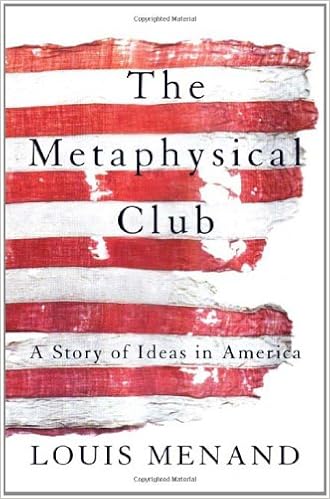
Book Review: The Metaphysical Club

Image result for the metaphysical club

The Metaphysical Club

by Louis Menand

I’m not smart enough for this book.

But I want to be, and I think that means I have to keep trying to read books like this, and think about what they say while I’m reading them.

So this book traces the influence of four American intellectuals on the general mindset of the United States. The four are Oliver Wendell Holmes, Jr., the Supreme Court Justice; William James, philosopher and psychologist (And older brother of the writer Henry James); Charles S. Peirce, whom nobody has heard of but was an influential thinker and writer; and John Dewey, the philosopher who had more influence on American education than anyone else. The wonderful thing about the book is that the sheer volume of information is staggering, and yet it is told in a generally simple and straightforward narrative style, well-written, and with a deft human touch; Menand delves into the men’s youth, their childhoods and upbringings, their parents, particularly their fathers, and the influence those men had on these four men, and builds a fuller picture than I have seen in most histories – and he does it for all four of them, while also pursuing a history of a set of ideas. So for instance, we read about Charles S. Peirce, whose father, Benjamin Peirce, was a mathematician, author, and Harvard professor; we see how the elder Peirce’s ideas reflected and interwove with the dominant ideas of the time – since the book focuses on men who came of age in America in the second half of the 19th century, the most important event was the Civil War and the most important idea Darwin’s theory of evolution through natural selection – and how his father’s ideas influenced Charles’s thinking, and how Charles’s thinking was affected by Darwin and by the Civil War; and then lastly, how Charles’s thought influenced and was influenced by the thought of the other three men. Along with the philosophy of Emerson and Kant and Hegel and umpteen other pieces that go into an exploration of a whole set of ideas.

It’s a complicated web. That’s why I’m not smart enough: because I knew none of this, knew nothing about these men – had never heard of two of them, and could never remember whether Holmes Jr. or Sr. was the jurist – I could not keep all of the facts and names and such straight. By the end of the book I was having to look back to the beginning of the book to remember who people were; this was made easier by the extensive index in the back, but still, that’s not my favorite way to read. And while I enjoyed the book, it was hard enough to get through that I don’t want to read it again, which is obviously the best way to handle this much information.

But: while the book is a history of four important men (The details of whose lives, while interesting, are not things I really need to retain), it is more an exploration of a set of ideas. And those, I found fascinating, and do want to spend more time thinking about. The basic ideas that stuck with me, after this first reading and without doing more research and thought (I just finished the book fifteen minutes ago), are: truth is socially constructed. We don’t know if what we know corresponds in any way to an external reality, but we can know if it corresponds with what other people know – which, unless we are born with certain ideas already implanted in our brains and our DNA, is the only way we can learn anything. Identity also may be socially constructed, meaning that we only learn who we are in relation to who other people are, and thus who we are not. Conflict is always and only the result of a misunderstanding, which, depending on how optimistic one is, may naturally get worked out on the way to a common understanding. There are no rules that can be formulated that can trump the specific context of an individual case (though I’m probably misstating or overstating that one), meaning that the historicity and specific application of an idea are necessary parts of understanding it.

That’s where this book really shines. Because Menand gives context. To everything. Everything he talks about is grounded in the specific events of the day and of these men’s lives. He has a wonderful habit, too, of giving brief synopses of the end of the story; Charles Peirce divorced his first wife as part of a large scandal in the late 1800’s that cost him his academic career, and before this book is over, we know not only what happened to Charles afterwards, but also what happened to both his first wife and the woman he left her for. It’s great. Even somewhat minor characters, people that move quickly in and out of the lives of the four main subjects, get parenthetical descriptions, like, “Joe Smith (who would go on to international fame as the Ambassador-at-large for chickens), had an encounter that struck our hero in an interesting way.” That was my favorite part of the book as history.

My favorite part of the book as philosophy and thought-provocation? I’ll let you know when I’m done thinking about it.

Tell me about the rabbits again, George.

I’ve decided I want to be stupid.

If I were stupid, I couldn’t be a teacher. No, that’s not true: I couldn’t be a good teacher, but we all know there are plenty of bad teachers out there. So I wouldn’t be a good teacher any more, which is sad; but I wouldn’t know it, so there wouldn’t be any problem. What’s more, I wouldn’t ever worry about being a good teacher. I’d never have to worry about whether my students were really understanding the point I was trying to make, because I’d never have a point. I wouldn’t have to read their essays any more, and write comments on them trying to make them better, and feel the frustration when they don’t pay any attention to those comments but go right on making the same mistakes; I could start grading essays according to how many words they are and whether they follow MLA format perfectly and how many words over three syllables they use. I wouldn’t realize the damage that standardized testing does to students, and to education, because I wouldn’t understand the purpose or the power of education, and I wouldn’t know what an opportunity is lost when students are beaten down with tests; I’d just do what I was told, and teach to the test, and threaten my students with bad grades if they don’t pass. So I’d never have to worry about lesson plans ever again. I would swallow all of the snake oil that gets sold to teachers, and I’d believe everything the salesmen said about it, so I could change entirely my policies and lesson plans and teaching methods every three or four years; so I wouldn’t even get bored. Every day would be a PowerPoint presentation and a jigsaw lesson, followed by a standardized test. And you know what? I bet my students would love me. Because they’d never have to think, either.

If I were stupid, I couldn’t be a writer. But wait: that isn’t true, either. It just means I couldn’t write well. But – assuming I still wanted to be a writer, which I probably wouldn’t because I wouldn’t be able to see the world the way I do now and I wouldn’t care about what I couldn’t see; I wouldn’t believe that art could help make the world a better place, as well as making me a better person; I wouldn’t even believe that writing was an art, because I’d think that art was only painting pictures. So if I were a stupid writer, that would work out great: because my books wouldn’t take so long to complete, and I wouldn’t have to work so hard to write them well. I could just vomit out whatever drivel I wished about super-powered vampire werewolves who drive around at night in Lamborghinis (which I’d always call a “Lambo” because I couldn’t spell the full name) –

Dear God, I wouldn’t have to worry about spelling any more.

– fighting demons with their super-powered vampire werewolf kung fu and having sex with hot chicks at the same time. Then I could self-publish my e-books on the internet.

I bet they would sell a million goddamn copies.

I could stop reading challenging books: right now I am reading Arundhati Roy’s The God of Small Things because I will be teaching it to my AP class, and I am also reading Bertrand Russell’s Wisdom of the West (a condensed version of his three-volume A History of Western Thought) because I admire the hell out of Bertrand Russell and I am thirsty for more understanding of philosophy. But fuck that – sorry, screw that (if I were stupid, I’d believe that cursing is bad, especially the F-word): if I were stupid, I wouldn’t be teaching that strange and wonderful and ethereal and challenging novel; it’s got weird sexy stuff in it, and I’d know that was wrong to show to little kids like the high school juniors in my AP class. Plus I wouldn’t understand it because the story jumps around a lot and the plot is hard to follow. Plus I wouldn’t like it because it isn’t set in America and there aren’t any super vampire werewolves in it. Plus my class wouldn’t teach any full novels, because that takes too long and isn’t necessary to pass a standardized test that only asks you to read short passages and excerpts. And there’s no way I’d read philosophy, especially not a survey of philosophy starting in ancient Greece; I’d think the Greeks were homos and philosophy is gay. I’d get rid of every book like that and just read James Patterson. And books about sports. Though I’d prefer the audio books, because it’s easier and faster and not as boring.

Speaking of sports, I could watch football instead of spending my Sundays doing school work or reading or writing, and go to bars at night with my buddies and drink beer (and I’d just drink cheap American beer, instead of having to take the time to peruse the menu looking for good beer) and watch more sports and yell real loud when my favorite sports-squadron scored a goal-unit-basket. And I could wish that I had been good enough at sports to go pro, but known deep inside that it would never have happened, because I’m white and black people are better at sports. Which is why I would like baseball and hockey and NASCAR so much, because lots of white people are good at those sports. Though not hockey as much because they’re all Canucks and Russkies. Though watching the fights would be fun. And I could watch MMA and laugh when Kimbo Slice (That’d be a great name for one of my super vampire werewolves! Maybe I could change it to Jimbo, and then he wouldn’t sue me. Then I could make him white, too.) challenges his opponent to actually compare testicle size during a pre-fight interview.

Though I would have to worry about the size of my genitalia. And whether the size of my hands and feet gave an accurate representation of that size.

Speaking of hand and genital size, if I were stupid, I wouldn’t have to argue and debate and worry about politics: I could just vote for Donald Trump to make America great again, and go back to watching football. And then I could watch Fox News and never have to worry about reading or thinking about what is going on in the world: I could just be sure that America is the best country, that we have to have a strong enough military to keep everyone from invading us, but that if they did invade us, I’d be ready with all of my guns to fight them back, just like in Red Dawn, which would be one of my favorite movies. And maybe I’d have to worry about that socialist Bernie Sanders getting voted in, but I’d be pretty sure, in my heart of hearts, that America would never let that happen: I’d probably secretly believe that the Statue of Liberty and the statue of Rocky Balboa would come to life and drag Sanders down into New York harbor. And I’d never worry about that broad Hillary getting elected over The Donald: no way would America pick a woman over a man. We all know you can’t trust a woman with power – what happens when she has her period? She’d fire the nukes if she didn’t get enough chocolate ice cream! (I would have written Haagen-Dazs, but I can’t spell that, either. And Ben and Jerry are socialist hippies.)

I would believe that a wall on the border could keep out Mexican illegal immigrants. I’d believe that immigrants are bad. I could ignore uncomfortable irony like the history of my own family’s immigration to this country. Because I’m white.

I could chant “USA! USA!” without irony. And tear up when a small child or a crippled person sings the Star-Spangled Banner at my ballgames. And secretly hate that Beyonce sings better than anyone in country and western.

I could listen to country and western music. I wouldn’t have to change radio stations any more, because there’s only one country station here and I’d love every song because they all sound the same. I wouldn’t have to listen to challenging or depressing lyrics, or admire musical talent or songwriting ability; I’d just like the ones who say America is great and talk about drinking American beer and driving around in trucks. Which is all of them.

I could stop taking criticism to heart. I would think I was great because I am American, and a white male, and therefore I am the best people in the world, and everyone else is just jealous of what I have. Except for that genital thing. But I’m sure I could convince myself that there was no problem there. My hands are pretty big, after all. And it wouldn’t matter to me if people thought my writing was bad, or my teaching, or that I was behaving in any way wrongly: because I’d think they were haters, and Taylor Swift (who I would totally listen to, and try not to think about how hot I’d think she is because she’d be too young for me, but I’d know in my heart of hearts that she would totally have sex with me if I ever met her in a bar, because I am an American white male with not-too-small hands.) would have told me that haters gonna hate, hate, hate, and I just needed to shake it off. Man, that song is just so catchy! And that Kanye West guy is a racist. Though his wife is hot. And of course she married a black guy, because she’s got a huge butt and black guys like big butts. Sir Mix-A-Lot told us that.

If I were stupid, I would think that “were” sounds weird: because I wouldn’t know about the subjunctive mood and statements that are contrary to reality requiring a different verb; so I’d just say “was.”

If I was stupid, I wouldn’t worry about my diet. I wouldn’t care if animals suffered in factory farms, because they’re just animals and they don’t feel pain, plus the Bible says they’re here to serve us. I’d love bacon more than anything except steak, and best of all would be steak wrapped in bacon and topped with lobster. Wrapped in bacon. Maybe with a bacon milkshake on the side. I wouldn’t care about my cholesterol, because I’d know that America has the greatest health care system in the world and I could have all the triple and quadruple bypasses I needed when my ticker started giving out. And I wouldn’t care about my weight, because I’d lift weights – that is to say, I’d do it differently than I do now, because I would do bench presses and curls and maybe five sit-ups a week and call it good – because as long as my pecs and arms were big, I’d think I was hot, because check out these guns! Plus women don’t think the same way about appearance. Men are visual, they need chicks to be hot; but women just need them to be manly, so they feel protected and safe. And I’ve got all the guns I need. Get it? Get it? Because I meant my biceps AND the Glock on my nightstand!


Yes. I want this. Last night I went to see Of Mice and Men on stage, and it was lovely and heart-wrenching; but if I was stupid, I never would have gone to see it, and it wouldn’t have made me sad. And then afterwards, I spent a fair while writing an irritated response to a comment on Facebook from a woman who didn’t understand everything I was saying in my argument, but she was pretty sure I was a socialist and wanted to take tax money away from hard-working Americans to give to the junkies on welfare. But then I had to delete my reply. Because reasoned discourse is no longer acceptable in this country: all we care about is if people agree with us, and if they don’t agree with us, there must be something wrong with them; and if they tell us we are wrong, then we get offended. I had to delete the comment because I am a teacher, and teachers are not allowed – ever – to be offensive, even if the only reason we are offensive is because other people don’t like our arguments.

I had to delete my comment because six years ago, an offended woman on Facebook nearly got me fired and banned from teaching in Oregon by complaining about a comment I made, which led my employer to my blog, where I had written things that were true, but not polite, and not acceptable coming from someone who was supposed to love and protect and coddle all of the children while preparing them for the tests and cheering for them at football games, which is, I think, how most political entities view ideal teachers. I was called “morally reprehensible” for what I said. And the worst thing is this: that I have had to think about that, and whether it is true, and decide that to some extent it is, and then I have had to feel both shame and doubt because of it.

And last night, I realized: as long as I am a teacher in America, I will never be able to say exactly what I think, and I will never be able to argue, especially not about controversial issues like politics and guns and war and racism and religion and education, because telling someone that they are wrong, especially when they are, is offensive, and particularly for me because of my history, offending anyone, anyplace, anytime, could very easily get me fired. This means not only that I will always have to worry about what I write and post online, but also that I cannot use my abilities, my greatest assets – my intellect and my words – to do what I think is right, to try to make the world a better place through critical thought and reasoned argument, because I will never be able to argue, not as long as I teach. And probably not after that, because I’d like to be either a professional writer or own a small business, but if I make people mad at me by taking their bad arguments apart online, they will give me bad publicity, which will hurt my career, whatever career it is. I will always have to worry about what someone else will do to me if I tell them they are wrong. Because reasoned discourse is dead. We prefer circuses.

And I decided that I don’t want to worry about anything any more. I just want to do what I’m told and work hard and do the things that make me feel good.

I’d rather be Lennie than George. All the way to the end.

The Right Opinion

There’s something I’m tired of hearing.

I get it all the time. Mostly because my interactions with other human beings take place almost exclusively in the classroom, where I talk to teenagers, or on the internet, where I talk to people on the internet. And as we all know, these are, far and away, the two most annoying groups of people on the planet. (Yes, I’m aware the second group includes me. Seeing as I’ve spent my entire life after the age of two in schools, in one way or another, I think I’m an honorary member of the first group, too. Of course I know I’m annoying. That’s beside the point.) And this is one of the most annoying things that people say. It’s annoying because it is an attempt to end discussion and debate, to validate the worst garbage that comes out of people’s brains: the thoughtlessness, the prejudice, the spite, the hate, the idiocy, the vapidity and superficiality — all of it. And I’m tired of it. So, by the power vested in me by my love of both thought and communication, and the energy and time vested by me in both of these aspects of human existence; by the authority I have gained through fifteen years of teaching, by the resentment and impatience that has built in me all that time and which has granted me the sheer gall to presume to say something like this, I hereby declare and assert:

Nobody has the right to an opinion.

That’s what people say that I’m tired of hearing. They say it in several different ways: Everyone has the right to their own opinion. That’s just what I think. We just have a difference of opinions, and we’ll have to agree to disagree. I’m entitled to my opinion.

That last one is the worst. That last one is the one that got me thinking about this subject for this blog. Because it says it all, doesn’t it? Entitled. I’m entitled to my opinion. Apart from the political baggage that has been strapped onto that word through the labeling of certain parts of the social safety net as “entitlements,” which apparently require “entitlement reform,” the word “entitled” contradicts itself. It means that you inherently deserve something, that it is yours by natural right; but when we call someone entitled, what we mean is that they don’t at all deserve the thing they claim, that they have it through underhanded means, or without justification — often because it was given to them without effort. That they didn’t earn what they feel “entitled” to.

And I’m thinking now that people aren’t entitled to have the opinions they claim to have.

I think you have to earn the right to have an opinion.

Not to voice it; once you have it, you have the freedom of speech and of the press, and you can shout your opinions from the rooftops — even if those opinions are offensive or unpatriotic or even inflammatory. You can post it on Facebook and you can whisper it to yourself in a movie theater and you can march around the streets wearing it on a sandwich board and you can even hold a parade declaring that you hold this opinion. Have at it, feel free; I would never stop you. In fact, I will applaud you.

But first you have to earn that opinion.

People need to earn their opinions because, first, people hold a lot of really stupid opinions. They think climate change is not real; they think the universe was created in six days about 6,000 years ago; they think that white people are better than all other people. They think that Will Ferrell is funny, they think that Jon Stewart is not, they think that Taylor Swift shouldn’t be forcibly removed from popular culture and never allowed to return. They think that 9/11 was an inside job and that Barack Obama is coming for their guns and that the worst thing the government has done in the last ten years is Benghazi. All of these opinions (Okay, forget about the middle three, there; those are examples of what we really mean when we say “That’s just my opinion,” which is personal preferences. But seriously: removed entirely from popular culture. I don’t mind her existing, but I don’t ever want to hear from her or see her again.) are not only held contrary to fact, but are held contrary to facts or despite facts that are patently obvious and really beyond contestation. And the excuse we allow people is the belief that everyone has the right to their own opinion. This is the justification for absurdities like insisting that schools teach Creationism alongside Darwinian evolution: because, we say, some people believe one thing and some people believe another thing, and both people have the right to their opinions, and we have to respect both opinions.

I can’t believe that people are too dumb to understand the evidence. I can’t believe that the truth is so hard to understand, or so hard to accept, that people are incapable of understanding and accepting it. Because some people do, and there’s nothing that makes those people inherently better than the people who do not. They are capable of accepting the truth: they just don’t. And the reason, I think, is that people don’t think about their opinions. They don’t look for evidence, and they don’t consider all sides of the issue. Why? Because they don’t have to. Because they already have their opinion, and they have the right to their opinion. And that’s why they believe stupid things. I don’t think that people are actually incapable of thought, even though they — oh, who am I kidding? Not “they.” We. — even though we act like it a lot of the time; but we don’t think when we believe we don’t have to, just as we don’t work when we don’t have to, and we don’t wear pants when we don’t have to. The idea that we have the right to our opinion simply because it is our opinion, the belief that everyone has this inherent, unalienable, natural right, and that it is sacrosanct — this is why these opinions still exist and why they are allowed to plague and annoy, and even to harm us.

No more. From now on, everyone, everywhere, has to earn their opinions.

And here’s how you do that: you have to think about your opinions. You have to consider all of the available evidence you have access to (On a sliding scale: the stronger the opinion, and the more important, the more evidence you must consider. We can hold tentative opinions when we don’t have all the facts yet, or when the subject isn’t all that important. Like whether cheesecake is a pie or a cake. Or if Star Trek was socially progressive for having the first interracial kiss on TV, or regressive for — every other kiss involving Captain Kirk. But those opinions must be tentative: held lightly, offered only with reservations.), and you have to listen to the opinions of those who think differently, and you have to think about whether those people might, in fact, be right. And when they are right, you have to adjust your opinion accordingly. You don’t have to change your opinion entirely; it is your opinion — but you have to include an exception, or a caveat, or an alternative. In other words, your opinion must be rational, and it must be open to change. You have to work on your opinions, and make them the very best opinions you could possibly have. Then — and only then –can you take pride in holding those opinions.

The other reason why people should earn their opinions is because the idea that we don’t, the idea that my opinion is as good as your opinion simply because it is my opinion, is used ever and always to end debate and discussion. I believe that discussion is necessary: discussion, communication, is how we gain — everything good, really. Collaboration and cooperation are necessary for society, and society is necessary to maintain both the species and the culture we have created. Communication creates empathy and understanding, which allows for acceptance and peace and harmony. Speaking your mind allows you to shape and solidify what you think; I often start these essays with little more than a single idea, and the rest only appears as I write it (I know: you can tell. Sorry about that.). Communication makes us better people, and happier people, and safer people — and therefore, I would argue, we should have some right to communicate, both the right to speak and the right to hear others speak to us.

Yes, I would argue. I argue a lot; that’s the way that I am annoying, both in the classroom and on the internet. People often don’t want to argue with me, and I can accept that; not everyone likes to struggle and fight. No problem. But even if we aren’t going to argue, we should at least discuss: we should share our ideas, our evidence, our thought process. This is how we learn and grow, this is how we gain respect for each other, and for our opinions: through communication, through conversation. I don’t have to argue, I don’t need to be right, to win or lose — but I do want to understand, and I do want to be understood. I need that. Yet too many of my discussions end the same way: the other person says, “Well, that’s just my opinion, and I’m entitled to that opinion. You’re entitled to yours.”

This sounds like a validation, but it isn’t. It’s the opposite: it’s a put-down. This is telling me that you don’t want to talk to me, you don’t want to share your thought with me: that I’m not worth the effort. This is blocking communication, and therefore also blocking understanding. This is imposing silence on me, not only depriving me of understanding your position, but also stopping me from making my position understood. You don’t have the right to do that, and if the way you do that is the statement, “That’s just my opinion, and I’m entitled to my opinion,” then you don’t have the right to that opinion. In fact, you’re not entitled to any opinion.

You have to earn your opinions.

That’s my opinion. Anyone care to discuss?