What Should Be Saved

I’ve seen this piece making the rounds today. It is worth reading.

Prepare for the Ultimate Gaslighting

Prepare for the Ultimate Gaslighting

After reading this, I started thinking about what I’ve experienced over the last month or so. I tried to decide if there was anything that I would want to keep in my life, and changes that I would want to make permanent, after things — “go back to normal.” It’s not so much about keeping, because everything right now is honestly pretty hideous; I don’t want to keep anything to do with this pandemic once the coronavirus goes back to lurking in the shadows. But the author makes the point that we have a unique opportunity now to step outside of our daily lives and regular routines, and observe,and make decisions about what we really want, what we need, what we want our new normal to look like. Everything will change, we all agree: so the question is, what do we want to keep in the new world after Covid-19, and what do we want to discard?

The first thing that came to mind is something I do not want to keep after the quarantine ends: teaching remotely. When it started, I joked that this was the dream: teaching without actually having to see and interact with students — and also, largely, teaching without grading. I’ve joked for years that teaching would be 1000% better if I just didn’t have any students. Well, now I sort of don’t have any; and since we can’t guarantee access to online material for all students, the school’s policy is that no grades can be applied that would lower the students’  grades from what they were before the quarantine started; so there’s not much grading to be done.

And I hate it. I miss my students. I miss talking to them personally, about their lives and their joys and sadnesses; I miss answering their random-ass questions; I miss being able to interact them while I teach them, because, it turns out, teaching people who aren’t there in front of you is not good. It’s hard enough to get teenagers to participate voluntarily; take them out of the room and put them at home behind a video camera, and participation essentially stops dead. I run a discussion class because that is both the most effective and the most interesting way to teach literature, and now I’m forced to do little more than lecture to a silent room. And it sucks. I miss being good at my job.

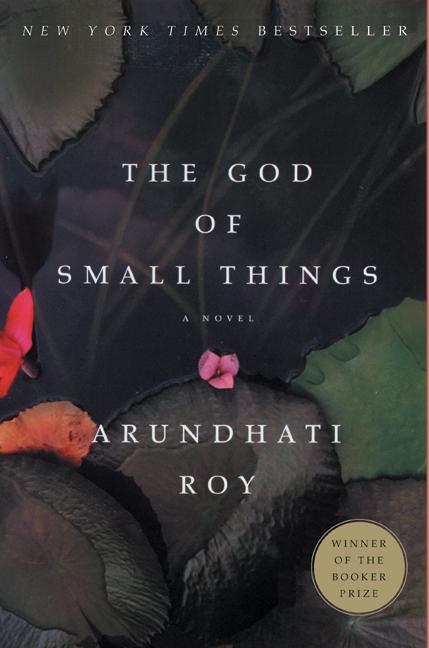
However: while I’ve been doing the distance learning online, I’ve been reading The God of Small Things to my AP Literature class; it’s an incredible novel  that I’ve written about before, and reading it to them has so far been worth the time. It works fairly well online, because they can relax and listen to me read; I like that it is helping them reduce stress while also helping them experience the story. It may be somewhat different in the classroom, but also, students need to reduce stress pretty much all the time; that’s not going to change by next spring. So I think I will do it again next year, when I have them in front of me. I think it will be worth it to shift other parts of the class to homework and independent study, and really use the time in class to understand and appreciate this work. So I guess I’ll — keep — that. Also, I am pretty happy to not be grading anything. Sadly, I won’t be allowed to keep that aspect. Ah, well. C’est la guerre.

I miss my coworkers, too. I talk to them pretty regularly through social media and texts, and we’ve been having weekly video chats; but it’s made me realize that I like having them around more than I thought I did. I’d like to spend a bit more time being a bit more social. I think I’ve probably focused too much on my introversion, using that as an excuse to not spend more time talking to people I like talking to; I should stop that. I am an introvert, and there are definitely days, especially as a teacher surrounded by teenagers who demand far more attention than I could give, let alone am willing to give, when I just want to go home and not talk to another human (My wife of course does not count: she is a goddess.); but most days, I think I should stop in to my friends’ classrooms and say Hi.

The dogs and I have been taking extra long morning walks, which I’d love to keep; but that’s more to do with the amount of time I have in the morning before work, rather than because of my preferences. I would like to keep longer, slower mornings; but, c’est la guerre. I’ve always done longer slower mornings on weekends, including extra long walks, so that will stay. I have also been taking short evening walks with my wife: that I would definitely like to keep, at least until the Tucson summer clamps down. It’s less fun to walk around the block in 100-degree heat. I’ve been seeing more of my neighbors out and about on the walks, both in the morning and the evening; I’d love to keep that even after we can all go back to driving everywhere all the time.

My wife and I have been good about doing our long-term meal planning, so we can minimize trips to the store (Don’t give me that look: Tucson has not been a hot spot, and once  I stopped going to school every day, back on March 13, we were entirely within the social distancing guidelines. So no, I have not been locking down and sheltering in place, I’ve been still buying groceries. If it helps, I need to buy fresh produce to feed my tortoise. So it’s not just for me.); we’ve gone up and down on this in the past, because in Oregon the grocery store was a pain to get to, so we shopped large once a week and then bought small items as needed, but here in Tucson shopping is much easier and so we have tended to decide what we want for dinner on the day of, and then do our shopping on the spot. But this is better. We’ve always known it, we just haven’t pushed it; I think we will keep that one.

I’m definitely keeping the podcast. I’m pleased with how it’s going, and how it’s been received; I like doing it and I think I do it well. I’m certainly at a stage in my life where I want to stop wasting time on idle pursuits and I want to be more productive; I don’t know that I can always find it in me to write serious fiction, so I think it will be good to keep different projects going, to use different skills and make different kinds of content. I’ve avoided doing things like this in the past because I think of it as taking time away from my main pursuits: the days I spend making podcasts are days I am not writing. But you know what? I don’t spend all of those days writing, anyway. I spend more of them just taking it easy. Which is good, but not the thing I think I need to do. I’d rather work a bit harder and be more proud of myself; that will be easier if I have more ways I can work, and more things to be proud of.

I think I may keep the daily blogging. I did it for a while last year, and it was great, though it was hard sometimes. It’s been the same this last week: sometimes I have no idea what to say, and sometimes it feels like I don’t have the time to dedicate to writing something serious, and sometimes when I have something to write it takes more time and energy than I thought it would, and so other things don’t get done; but it’s good for me to write. I don’t know how it is for you all to read my ramblings, but it seems like some of you like it, and the rest of you don’t do it, so. I will try. I will also not be too obsessive about doing it EVERY day.

That’s probably the big one. I’ve been working on forgiving myself for not being productive, for not always having the energy to do something “useful” or “valuable.” Because right now, the most important thing we can do with each day we have is — get through it. Stay alive, stay sane, stay ourselves: just keep going, every day, on to the next day. Because each day is a new chance to do something more than that — but if you don’t do that, then you won’t do anything. We have to keep our minds on the main goal, on the most important thing we do: keep going. I’ve learned that, and I’m being better to myself on the days when I don’t have the strength to do more than make it through: because I’m aware that that’s the only strength I really need to make sure of. Just enough to keep going. So long as I have that strength, the other strength will come back. I will be able to do more on another day, and I will still want to. I’ve never believed the conservative  argument that people on welfare want to stay on welfare because they’d rather be lazy; I don’t know why I thought it about myself, but I always have. It’s not true, though: I’ve been lazy, and I’ve been productive; I would rather be productive. So after I rest, I work.I want to work. I look forward to it.

But sometimes I need to rest. It’s okay to not be productive sometimes, even a lot of the time. When I can be, I will; and when I can’t, I don’t have to be mad at myself about it. I can relax about relaxing. I have been letting myself do that, and that one, I’m definitely going to keep.
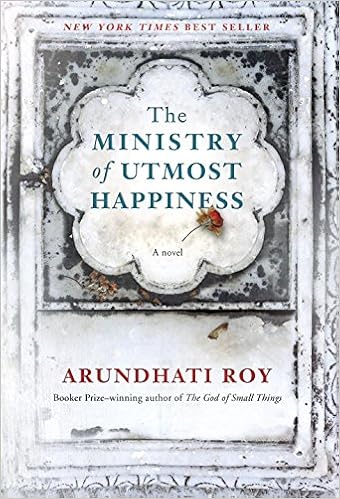
Book Review: The Ministry of Utmost Happiness by Arundhati Roy

Image result for the ministry of utmost happiness

The Ministry of Utmost Happiness

by Arundhati Roy


God damn Arundhati Roy.

God damn her and her beautiful books, which are so impossibly sad and so incredibly beautiful.

I have always thought, because I teach it to my AP students, that The God of Small Things ends with the most beautiful romantic scene I think I’ve ever read because Roy wanted to end the book on a happy note, that she wrote it intentionally out of chronological order specifically so that she could end it with hope, with the two lovers planning to meet again the next day, even though we know they won’t, or if they meet the next day, then they don’t meet the day after that, or ever again.

Now that I am reading The Ministry of Utmost Happiness (I am not finished with it, so I’ll need to stop writing this in a moment and go back to my sorrows), in which she has done nearly the same bloody thing, putting an exquisite lovely romantic scene near the end of a brutally heart-wrenching book, I think I may have to stop believing in the optimistic explanation of the incongruous, unchronological way Roy writes these books. I’m not sure yet, because this isn’t the very last chapter, so maybe other things will happen – and there actually is some hope in the novel that there will be some happiness, a fair number of good characters who could create a safe space to live and laugh in; but in God of Small Things two of the four good characters died and one ended up insane, leaving the fourth utterly alone, so… – but I am familiar enough with this feeling to know that Roy might have made the same play. This book is also out of chronological order, and since it is my first time reading it, that makes it difficult to follow, so there are parts I don’t remember well and maybe I should, to understand; which means maybe I don’t understand. I have to go read more.

But now I’m wondering: what if she put the happiest, most love-full part at the end of The God of Small Things because that makes it impossible to enjoy, since we’ve just been through 25 chapters of sorrows? What if she does it that way because she wants us to read the joyful part and think, “Well, this would be lovely, if my heart wasn’t already shattered into a million pieces by everything else I just read.”? And what if that is the point, because it makes the joyful part into a sad part, knowing that we can’t enjoy the joy because of the sorrows we’ve been through – which makes the sorrows even sadder?

Pardon me. Have to go finish the book. I just had to write down this theory when it hit me.

One hour and twenty minutes later –

All right. Okay. I was wrong: this book does actually have a happy ending. Of course it isn’t that simple, it isn’t all happy; there is death everywhere in the book, and it isn’t good death, not valuable, honorable, restful death. But the book is as much about those who live as it is about those who die, and the deaths make the life more precious, not the other way around.

So: to be clear. This book is about India and the war in Kashmir. At the end of the book, a character reads these words in a notebook: “How do you tell a shattered story? By slowly becoming everybody. No: by slowly becoming everything.”

That’s the book.

It has much of the same beauty that Roy put into The God of Small Things. The writing is, as always, brilliant: essentially beyond my capacity to even grasp, let alone describe. The book has a dense history of India, a complex exploration of the relationship between the present and the past, once again worked out through complicated family relationships and through appalling violence. The caste system is, as I suspect it always is, an indispensable element of the conflicts, though they are largely religious in nature: Muslim versus Hindu versus Sikh versus Christian. There is a terribly intricate narrative structure, with multiple interwoven plots and point of view characters, with no particular adherence to a timeline. There is another character that bears much resemblance to Roy herself, the child of a Syrian Christian woman from the state of Kerala, who studies architecture but does not become an architect, who is beautiful and strange and difficult. There is a beautiful romance, a number of broken romances, and an enormous, unbearable weight of violence and suffering and sorrow and alienation.

But there’s a lot in this book that wasn’t in the first book. The scope is wider: there are more characters, there are more conflicts, there are more settings. There is much more violence, and more villains who carry it out. And there is a lot more happiness at the end, a lot more peace, a lot more closure.

I don’t know if I recommend this book. I will need to read it again, and probably write a lot in the margins. But I feel much the same about this book as I felt about The God of Small Things after I had read it only once without writing anything in it, which was, I thought I should read it again; once I had, it became one of my all-time favorite works of literature. I suspect this one may follow the same path. So in the meantime, in-between time, this is a beautiful and difficult book, and if that’s your thing, I highly recommend it.

Small Things, Big Anger

It begins so beautifully.

“Dissolute bluebottles hum vacuously in the fruity air. Then they stun themselves against the clear windowpanes and die, fatly baffled in the sun.
“The nights are clear, but suffused with sloth and sullen expectation.
“But by early June the southwest monsoon breaks and there are three months of wind and water with short spells of sharp, glittering sunshine that thrilled children snatch to play with. The countryside turns an immodest green. Boundaries blur as tapioca fences take root and bloom. Brick walls turn mossgreen.”

It’s so lovely: fatly baffled — what a phrase! Suffused with sloth and sullen expectation — what alliteration, what a way to draw out those sounds, slower and slower, exactly like a slow, sultry night time when you wait forever for coolness that never comes. Thrilled children — what a rhyme! And the sharp, glittering sunshine they snatch to play with — what an image! Immodest green and mossgreen — my God!

And though the tone is far darker, it ends with the same beauty:

“He held her against him, resting his back against the mangosteen tree, while she cried and laughed at once. Then, for what seemed like an eternity, but was really no more than five minutes, she slept leaning against him, her back against his chest. Seven years of oblivion lifted off her and flew into the shadows on weighty, quaking wings. :Like a dull, steel peahen. And on Ammu’s Road (to Age and Death) a small, sunny meadow appeared. Copper grass spangled with blue butterflies. Beyond it, an abyss.”

It’s magnificent. The clarity of the images, the remarkable insight into the symbolism of color and movement and the connections between life forms — he against the tree and she against him; oblivion flying away like a peahen, both of them dull and steel-colored; a sunny meadow appearing on the road of life in this small, lovely interlude, this moment of peace in the midst of turmoil and destruction and sorrow, leading to that waiting abyss. It’s amazing. I can’t read this book enough. I can’t teach it enough. I don’t know that I’ve ever enjoyed a novel by a writer as poetic as Arundhati Roy, in her book The God of Small Things.

So then what the hell is this:

“He was a naked stranger met in a chance encounter. He was the one that she had known before Life began. The one who had once led her (swimming) through their lovely mother’s cunt.”

Wait, what? That’s the image, twin infants swimming through the birth canal? And that’s the word you want to use? Their lovely mother’s cunt? Why on God’s green and verdant Earth would you use that word, and that image, in that moment? Admittedly, the very next line connects this passage to the idea of jarring discord, to paradox and conflicting feelings — “Both things unbearable in their polarity. In their irreconcilable far-apartness.” So I assume that the use of jarring words and clashing images, the image of the pain and the tearing and ripping of birth sweetened into a casual synchronized swim, and the juxtaposition of “lovely mother” with “cunt,” are meant to show this unbearable polarity, this irreconcilable far-apartness. Okay. It makes sense. I still don’t like it, but it makes sense.

But that’s not the only one. There’s also this:

“As Khubchand lay dying on his cushion, Estha could see the bedroom window reflected in his smooth, purple balls. And the sky beyond. And once a bird that flew across. To Estha—steeped in the smell of old roses, blooded on memories of a broken man—the fact that something so fragile, so unbearably tender had survived, had been allowed to exist, was a miracle. A bird in flight reflected in an old dog’s balls. It made him smile out loud.”

And I love the phrase “smile out loud.” So what’s with the dog’s purple scrotum? Who spends that much time staring at dog balls? How the hell could the sky be reflected in dog scrotum-skin? Is that possible? You know what, I’m never going to know. Because I’m never going to check. And the idea that this is a smiling occasion, that old dog nuts are the perfect image of tender fragility, is just not a thought I’m prepared to entertain. Nope. Once again, I get it — testicles are indeed fragile, as I’m fully aware; and an old dog is a deeply tender and sweet beast: I already had my heart broken just before this passage, when Roy describes the dog’s failing health, his murky eyes and his uncontrolled bladder, because both of those are crystal clear reminders of my beloved dog’s last days — but I don’t need to know what mystical secrets you see when you stare at a dog’s junk. This only makes me think Estha and Arundhati Roy herself are too irretrievably weird for me to handle.

But I can’t just leave it at that. Because I get the book. I understand the idea of the Small Things, and how deeply important they are, and how the whole world can pivot on a single point, can go from up-facing heaven-ascending glory, swiveled down to a face full of mud and hell, on one brief tick of the clock, sometimes no more than a minute. There is a moment when Ammu, the lovely mother of the swimming twins, looks up and sees Velutha, the man who will become her lover, the man who makes her oblivion fly away, and she sees him for the first time as a man: she has known him since childhood, and their respective stations in life — he an Untouchable Hindu laborer, she the upper-caste daughter of a factory owner and a Syrian Christian — have kept them from seeing each other as equals and therefore potential partners; but in this one moment, she spots him not only with his shirt off and his lovely body showing, but also, she sees him playing affectionately with her daughter, and Ammu thinks: father — husband — man. Had she not looked up in that moment, she might never have seen Velutha in that way, and she might never have leaned against him under a mangosteen tree and laughed and cried at once. And the doom of everyone in the novel may not have been sealed. She had to see him right then, and she had to be feeling the way she did right then. That one moment changed everything.

Life is a collection of such tiny moments. But most of them, we ignore completely: because we only look at the big things. We are inundated with the suffering of the world around us, and so we cannot bear to speak of our own, not even when that speech would save us from guilt and choking silence like that which eventually swallows Estha, before he follows in the footsteps of his surrogate father and becomes for his twin sister Rahel the God of Small Things, as Velutha was for Ammu, their mother — and, we hope (though we do not know) is saved and redeemed by that one small moment of solace, his own oblivion leaving him as Ammu’s did before. We do as Estha did: we think of ourselves as small, as unimportant; we think of those tiny moments, those pivotal points when everything changes, as tiny as well, even though they are, in reality, everything. Even the large things, the suffering of war, and famine, and pestilence, and death, are made up of tiny, pivotal moments in the lives of tiny individual people — individual people who make up all of teeming humanity.

So how does Roy show us this contrast, between the big things and the small things? With a madman’s penis, that’s how.

“Murlidharan, the level-crossing lunatic, perched cross-legged and perfectly balanced
on the milestone. His balls and penis dangled down, pointing towards the sign which
said

COCHIN
23 KM

“Murlidharan was naked except for the tall plastic bag that somebody had fitted onto
his head like a transparent chef’s cap, through which the view of the landscape continued –dimmed, chef – shaped, but uninterrupted. He couldn’t remove his cap even if he had wanted to, because he had no arms. They had been blown off in Singapore in ‘42, within the first week of his running away from home to join the fighting ranks of the Indian National Army.”

That’s right: an army veteran with no arms, because he lost them in a pointless war, only a week into his military service. And because of his missing arms — surely the thing we notice the most, as we are forced to consider the experience of living without through the surreal and terrible image of some buttmunch putting a plastic bag on this poor guy’s head, which he can’t then remove — we only notice the large things, and not the small things. But it’s the small things that matter: the character’s madness, described as cabinets in his mind, which predicts Estha’s future similar mindset; and the place they are going, where Estha’s madness will begin when he is molested by the Orangedrink-Lemondrink Man. Where is that place? Cochin. And what points the way there?

Murlidharan’s dick.

Why, Ms. Roy? Why do you have to make a dick joke? Why couldn’t this guy just be sitting under the sign, with the words right over his head, or maybe reflected in his eyes? Why does he have to point to them with his genitalia?

AND WHY DO I HAVE TO KEEP THINKING “WELL, THOSE MUST BE THE SMALL THINGS?”

Here’s why I hate this. Because the book is both brilliant and complex. Because it’s taken me three readings to understand maybe half of it well. And I know there is far more that I am missing than I am getting. So when I read these little obscene, absurd moments, when I am so bothered and discombobulated by them, I can’t help but think that I am missing something. That there is no possible better word to describe birth than “swimming,” and no better way to talk about Ammu than to refer to her cunt. That the perfect image for fragility is a flying bird reflected in dog’s balls. That the best foreshadowing in the world is to have a penis pointing to the name of the place where another penis will begin the ruination of Estha.

I assume, when I am bothered by what I think of as really terrible choices by a really brilliant author, that the problem is not her, but me. That I am too lame to appreciate the book fully. And that turns my whole-hearted admiration for this wonderful work into something much more sour and cracked and sulfurous.

See? It’s the little things that make all the difference.

Book Review: The God of Small Things

The God of Small Things
by Arundhati Roy

I don’t know what I can say about this book that hasn’t already been said. It’s a prize winner, an internationally acclaimed best seller, and has been for twenty years. But I read it for the first time in 2014, when I moved to Arizona and started a new teaching position with new materials, including this book; I liked it then, liked the style of it, liked the way Roy wrote and the things she had to say, but it was one of several books that I read in an awful hurry, and with a whole lot on my mind at the time.

I read it again, this past two weeks, just finishing it this morning. And this time, because I am encouraging my AP Literature students to read books actively, that is, with a pen in hand and the margins of the book’s own pages as their paper, to comment and question and interact with the text, I did just that: I used my new purple ball point (Which may be the best thing about the gym that my wife and I joined last October: it has good equipment, but not great, and it had been fairly uncrowded until our last work out when a visiting college baseball team came in en masse and inundated us in jockery: but at least they give away ballpoint pens with purple ink!) so that the ink would stand out against the black typeface, and I underlined and I arrowed and I added everything I thought that I thought was worth thinking and adding to the text.

I read it more, this time. More carefully, more attentively, more thoughtfully. I was invested in the text, this time.

And this time, I didn’t just like the book. I loved it.

I was actually enlightened by it. Roy made me think about my own society, and particularly my own family, in a way that I never had before. She crystallized some thoughts for me that might never otherwise have come clear. She also showed me an elegance and a musical grace in words that I never would have seen: words written backwards, and words broken up in new ways — there is a Bar Nowl that lives in the warehouse and hunts mice on silent wings — and a poetry that I don’t ever see in prose. She showed a depth of perception, both in descriptions of environment and of character and of humanity as a whole that I don’t know that I’ve ever seen done better. And she wrote this book on the other side of the world. In her second language. I don’t know if that shows the grandiosity of her genius or if it reveals the power of an outsider’s perception, both hers of my mother tongue and mine of her world and how it parallels my own; I think perhaps she was writing about what she knows, and I see the same things in what I know because people are people all around the globe — but regardless, this book is magic. It is going up on my Very Top Shelf, with Fahrenheit 451 and To Kill a Mockingbird and Of Mice and Men and Shakespeare and ee cummings.

And that’s what I have to say about this book.