
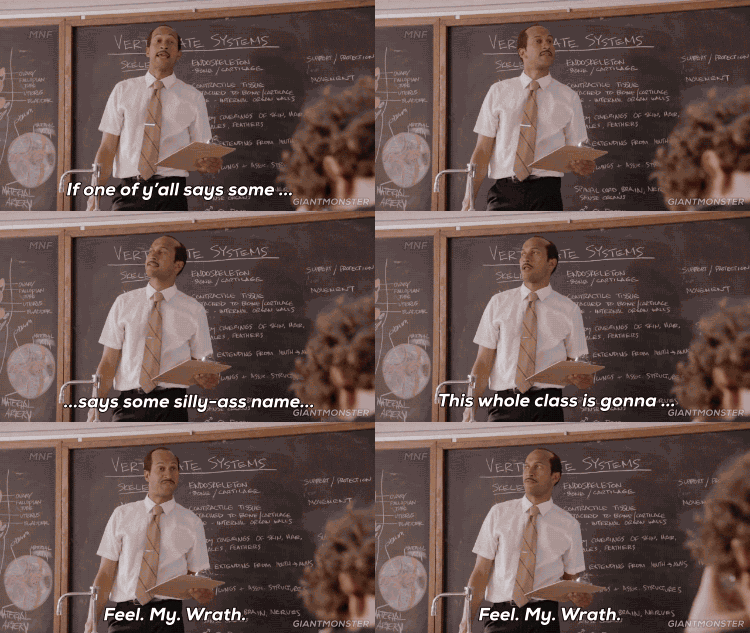
Sure.

Tired Teacher GIFs | Tenor
Australian Teachers Share The Frustrating Reality Of Their Jobs

It’s been quite a week.

A few of the highlights:

*Two of my classes are reading To Kill a Mockingbird, and this week we read one of my favorite sections, the two chapters when Scout goes to first grade for the very first time, and meets her new teacher, Miss Caroline. These chapters are the first which show the novel’s dominant theme, the idea of empathy, that you don’t understand someone until you see events from their perspective; Miss Caroline, seen from Scout’s perspective, is a terrible person who treats Scout badly, shames a poor farm boy named Walter Cunningham, and has no idea how to teach or manage a class. But when you see these chapters from Miss Caroline’s point of view — she is a 21-year-old woman, this is her very first day teaching, and in addition to several other problems, one of her sweet lil angels calls her a snot-nosed slut. First graders, man. Freaking savages. — you recognize that this teacher has had the very worst day ever. I explain the chapters from Miss Caroline’s point of view, which I understand as a teacher, and I show students how she is not bad, she’s just having a bad day. A lot of times in the past, when I’ve taught this, they get it; my students understand how frustrating and soul-searing Miss Caroline’s day is, and they realize she shouldn’t be blamed or hated for her choices, even when she screws up, as she does a few times. 

Part of Miss Caroline’s bad day is that she reads her favorite children’s story to the class — and they don’t react at all, because they are, as Scout puts it, “immune to imaginative literature.” And I look out at my class, half of whom are looking at phones or computers, another third of whom are chatting or spacing out while I talk about this novel, which I have told them is one of my very favorite works of literature, and I say, “Can you imagine what that’s like, to share one of your favorite stories with a class full of students who just don’t care? Who aren’t paying attention? To whom the story makes no difference at all? Can you imagine what that would feel like?”

They couldn’t.

Falling Asleep In Class GIFs | Tenor

*Yesterday a student climbed up onto a metal stool in my room in order to unplug another student’s Chromebook, which was plugged into an outlet that for no good reason is about seven feet off the floor, near my whiteboard. The student then called out “CANNONBALL!”, jumped off the stool, kicking it out sideways, landing awkwardly as the stool shot out and crashed into a bookcase.

Falling Chair GIF - Falling Chair Man - Discover & Share GIFs

*One of my other classes, in reading through a passage from the novel Maud Martha, by Gwendolyn Brooks, commented “I didn’t think these characters were African-American. They don’t have African-American names.” The names in question were Maud Martha, and Helen. One student pointed out that Helen is a Greek name, as a way of proving to me that these were clearly not African-American names. (I refrained from pointing out that the student’s name is Roman in origin, though the student in question is Southeast Asian.) Another student told me that the activities the family pursue in the passage are rural, country kinds of activities — specifically gathering wood for a fire — and that made them think the characters were White. To which I responded “Because rural areas are only White? And African-Americans don’t gather firewood?”

Did I mention that my principal was observing me that class? He was. His comment later was that I had had “several teachable moments” in the period. (He also said I handled it well, so that was okay.)

*Today one of my students came back from the restroom, started talking to the other students about something (This was, by the way, while I was talking about Miss Caroline and how it feels when students don’t listen to your favorite story), and at some point I realized that what they were saying was that this student, on the way across the hall to the restroom, had seen someone they didn’t recognize outside the school door (Which is mostly glass and is at the end of the hall near my classroom — who needs that “security” stuff?), that my student had let them in, and that the person in question, referred to both as “kid” and “guy,” was wearing a mask, carrying a backpack, and was currently in the bathroom. Refraining from asking the student why IN THE NAME OF ALL THAT IS GOOD AND HOLY they had let some literal masked stranger into the school, I went to the bathroom to see who was in there. There was someone in the stall, but I could only see shoes. So I quickly went to get an administrator to check on the bathroom, and then I went back to my class — where I received the clarification that the student had not let the person in, a teacher had, which almost certainly moved this from “Possible crisis precipitated by a student who lacks critical thinking skills” to “A student went out to a car, with permission from a teacher, came back in, and my student didn’t recognize them.” And the second option is what it was, and a few seconds later the administrator gave me a thumb’s-up on the way back from identifying the person in the restroom as one of our students. 

But it was a fun five minutes.

Loosing-my-mind GIFs - Get the best GIF on GIPHY

None of this is what I wanted to write about tonight, however. (Actually I wanted to write about it last night, but another thing that happened this week is my phone stopped working, so I spent last night ordering a new phone.) What I wanted to write about tonight was the worst thing I’ve dealt with in the last week. One of the worst things I’ve had to deal with all year.

Data Day.

Last Friday was our first Data Day. And the big problem with this particular occasion was that it was our very first Data Day at this school. At least the first one involving my department. To be sure, we have looked at data before: data is inescapable in public schools today. We start every school year with a brief overview of the school’s test data from the year before. Which is all about students who have already left the classes in which the data was collected, which might seem to some people as though it reduces the value of the data.

Some people.

Anyway, we look at data all the time. But I work for a small charter school, which has a hell of a lot of turnover in the staff and the administration, and every year things get a bit discombobulated and confusticated and lost in the shuffle; and so we have never done a Data Day like this Data Day. Unfortunately, those in charge of Data Day thought we had all surely done Data Days before, and so didn’t think we would need specific instructions about how one carries out a Data Day. But since we have never had a Data Day before, we did need those instructions, and we didn’t get them, and so the day was — awkward.

But hold on. Before we even get to the awkwardness of the actual day, I can hear you asking “Wait — what even is a Data Day?” 

A Data Day is when teachers get together in groups and look at the data for our students — in other words, their test scores. This Data Day was scheduled after we gave our first major standardized test this year, a practice ACT. The ACT, a sort of West-Coast cousin of the SAT, has four parts: Reading, English (grammar, that is), Math, and Science. Now, as I assume that all my readers are among the most astute people in the population, so I assume you have noticed that this selection of tests leaves out a few of the usual departments in a high school: Art, PE, foreign language, computer science, ESS (or SPED) — and, of course, history and social studies.

But that’s fine! Even if not all teachers have data and so can participate in Data
Day, the thing to focus on is the subjects which do have data. And lucky for me, English has double the data! And EXTRA lucky for me, this is my first year as head of the English department. So not only do I have double the data — but I get to run the meeting!

Did I mention that my principal was observing my meeting? He was. He did not tell me that I handled this one well. I think I did okay. We had several teachable moments.

But we didn’t have everything. We should have had our individual class data, from the shorter single-subject quizzes we’ve been giving over the course of the semester; we should have all been looking at our individual laptops and comparing our individual data to the school wide data, so we could find where our specific classes were different from the school population as a whole — that is, what are my 10th grade students failing to learn in my class, which the school as a whole is mastering? Those are the areas where I can make changes in my class in order to improve the instruction and the learning in specific skills and knowledges, to help my students catch up. And that was where we were supposed to develop our Action Plan, building SMART goals (Specific, Measurable, Achievable, Relevant, and Time-bound) so that, when we have our next round of ACT practice tests in December, we can move straight into our second Data Day, and we can see what areas have improved and where we need to keep working, maybe finding new strategies that can make a difference in the scores. That is the goal of a Data Day.

I ran the meeting. Completely making it up as I went along, because I have never done a full Data Day. I didn’t tell everyone they needed to bring their laptops and individual classroom data. I didn’t have my individual classroom data. I had not examined the school wide data previously, and so while I pointed out a couple of obvious things — our students did better on reading and English than they did on math and science (I work at a STEM school, if you didn’t know.), better on English than on reading (which mystified me because they mostly can’t answer a single grammar question correctly — but I guess they can correct grammar on a multiple choice test?), and in some cases better, in others worse, when compared grade to grade. But everything I said was obvious. I didn’t know that we were supposed to create a SMART goal, or how to do that, and I didn’t take notes or guide the discussion or watch the time — or delegate any of those tasks. I did a bad job with the meeting. It was uncomfortable. That was my first Data Day.

So.

You all know that whole thing is a pile of horsepucky, right?

I knew you were all astute.

Okay, let me be clear: the basic idea of examining what my students know and what they don’t know, identifying areas where they have mastered the class content and where they still need work, and then strategizing methods to improve their learning? All of that is fine. None of that is horsepucky. We can get general ideas about how things are going, and we can find some ways to maybe make them better; that’s fine. It is a lot of work, for a questionable reward, and since I am already obscenely overworked, and still behind where I should be, I question whether or not this is the best way for me to spend my time; since I have 300 ungraded assignments turned in on my online education platform, I have a better idea of how I could spend a good couple of hours on a Friday afternoon.

Yup. Drinking.

I grade on Sundays. I shouldn’t. But I don’t have any other option. I’m not kidding about the 300 ungraded assignments, and that’s after I spend at least a few hours working every Sunday, and have done since the school year started August 1. A couple of hours on Friday afternoon, even if I hadn’t used that time as I deserve and gone drinking, would have helped make a dent in that pile — though of course it wouldn’t have eliminated the pile. But Data Day didn’t help at all. In fact it stressed me out so much that I didn’t even get my other tasks finished on Friday: I went home and collapsed uselessly on my couch. I did play some Minecraft, so that’s a win, I guess.

But let’s imagine that I did have some extra time, a couple of spare hours that I didn’t have to spend teaching class or working with students or grading essays. I could have done Data Day. I could have compared the results of a test which the students didn’t care about and didn’t try their hardest on, because they knew perfectly well they weren’t going to get graded on it, and that it wasn’t the official ACT, and therefore this test didn’t give them a chance to get a high score they could use to get into college or win scholarships; to the results of a series of short, five-question multiple choice assessments I give in my class, one for each standard they are supposed to master this school year. Those, also, the students didn’t care about and so didn’t try on. But hey, that makes the comparison more valid, right? The students taking it didn’t care, in both cases! Matching apathy! Also, neither set of tests was designed by me, or related directly to the content I used to teach the standards — none of them are on To Kill a Mockingbird, for instance. Oh, and also, the ACT is not broken down by standard, so I’m comparing a five-question multiple choice quiz on a single standard to a 40-question reading test and a 75-question English language test, on all of the standards taught in all four years of high school, and also quite a few that come up in middle school and a couple that are only used in college or adult life. Because one aspect of the ACT is that it is designed to be too hard, in parts, for any student to get a 100% on. Because the goal is to find the extent of a student’s knowledge and ability, right? If I give you a quiz on what you know, and you get 100%, I have not found the extent of your knowledge: those questions might cover every single thing you know on the subject — or they might only scratch the surface of your galactic levels of knowledge. To find out for sure, I have to make the questions get progressively harder until you cannot answer them correctly. That’s where I can assume your knowledge ends, when you can’t answer the questions any more. Which means the ACT tests, like all similar tests, is intended to get progressively harder until it becomes impossible for any high school student to answer the questions. 

Which means, of course, that there will always be gaps and areas for improvement, no matter how spectacularly I teach and the students learn, because of the way the test is designed. So if I take this concept seriously, that I need to teach my students enough for them to be able to score 100% on the test, I can never be complacent. Ever. I will always have more to teach. But of course, my students will move on out of my class before I finish teaching them; but that’s fine, they can learn the rest of everything in their next class.Right?

Sure.

More to the point, did you catch where I described how different the two tests are? Five questions on a single standard, compared to 115 on the general areas of reading and writing. Also, the standardized tests are given in very short timeframes, because the ACT’s base assumption is that the more you know about a subject, the faster you can answer the questions. An assumption that is so deeply flawed that it casts doubt on all of the ACT results — because of course speed has little if anything to do with knowledge or skill. A genius with bad eyesight or dyslexia or a headache the day of the test will not be able to answer all the questions within the time limit, which is 35 minutes for the 40 reading questions (which are about four different reading passages, with 10 questions each), and 45 minutes for the 75 grammar questions, which is just cruel. Oh wait, sorry: that’s only for the 11th graders. The 10th graders took shorter tests in shorter time limits — 24 reading questions in 30 minutes, and so on. But that’s fine, I’m sure we can compare the two classes and get some kind of useful idea of how much students know. Right?

Right?

Sure.

Here’s the part that killed me. Right at the start, when I’m trying to fumble my way through the schoolwide data we have about the ACT and Pre-ACT tests, and the middle school results from an entirely different assessment which the 6th-8th graders took, we were told to ignore the gaps in the test results that were caused by students who were having a bad day, or who had a headache the day of the test, or who didn’t care and so didn’t try. Because we can’t control those things. We need to focus on the places where we can have an impact, where we can raise those scores. 

Uhh — excuse me? How can we know which areas are lacking because of a flaw in the program, and which are lacking because students didn’t feel like trying their hardest? That’s right: we can’t. Just like we can’t see the specific standards for the questions on the ACT (I don’t think; there might be a way to break it down like that, but I didn’t know it, so.), and we can’t know if the five-question multiple choice quizzes give us good information, either, because in addition to being skewed by student apathy and also student humanity, five questions won’t do a good job of determining what the student knows and what they don’t. You can randomly guess on five multiple choice questions and have a not-insignificant chance of getting them all correct even if you couldn’t read at all. And also, let’s not forget that if a student learns all the material, but then fails the assessment because of a non-academic reason like a disability or an illness or a lack of motivation or a grudge against the school or the teacher or a bad testing environment or a bad breakup or a bad bit of potato they ate the night before which gave them vivid dreams in which they were visited by three different spirits of Christmas — that student did not succeed. They do not pass Go, they do not collect $200, because our system is based largely on high-stakes tests and the ability to pass them. And it doesn’t matter what I teach or how well I teach if a student who fails the assessment, despite knowing everything about my subject, is considered a failure. All of the things that I was told to ignore, because they are out of my control, are the entire reason why that hypothetical student could fail my class. 

But guess who would still get at least some of the blame for that student’s failure. And who would have to make SMART goals to try to improve that student’s test results. And who would have to examine that student’s data, again and again, to find the reason why the student was unsuccessful. But please, keep ignoring the aspects we can’t control, like a lack of motivation.

Right.

Sure.

And while we’re at it: who the hell told educators that we could control anything? Listen, you don’t know how hard I tried today, to make my students learn the lesson of Miss Caroline. And instead they were distracted by the possibility that someone had let in a school shooter — which was exactly where all their thoughts went when they heard that there was a possible stranger in the school, in a mask and carrying a backpack. Because of course that’s what they thought. And I’m supposed to teach those kids? To control their learning? To specifically assess the lessons that worked and the ones that didn’t, and to make adjustments which will ensure all the learning happens exactly as we want it to, which will then be shown clearly on the test?

Let me also say: if I go back tomorrow and try again to teach the same lesson, my students will say “We already went over this yesterday.” And if I say “Right, but you didn’t learn it as well as you should have, because you were distracted,” they will then reply, “That’s okay, we learned enough. We should move on.” And it wont matter how much I try to teach the lesson, how hard I want to reteach it, or whether I know exactly how to make that lesson more effective: it was ineffective because of events outside of my control. The opportunity was lost. We did not have a teachable moment today.

Here’s the truth. That neat, data-driven ideal, where teachers do the math and find the perfect way to help students reach mastery? School doesn’t work that way. Students don’t work that way, learning doesn’t work that way, even tests don’t work that way. None of it is scientific. None of it is precise. There are real benefits to teachers getting together and talking about what works and what doesn’t, and trading ideas and strategies; to that extent, Data Day was a real success. But otherwise? There is no data. Not anything real, not anything reliable. It’s all guesstimates, all gray area. Teachers do things that seem like they work, that seemed like they’ve worked in the past; students seem to learn things, and seem to get grades that reflect their learning. Somewhere in there, real learning happens, and part of it is probably because of what teachers do. But not all of it. And none of it for certain. Data Day is an attempt to pretend otherwise, to pretend that we can capture a mathematic truth about human beings, who are not by our nature quantifiable. And it just doesn’t work.

But hey, maybe that was just this time. All those things about human nature and whatnot? All out of our control. Let’s try to focus on what we can control, and we’ll circle back around in a few months and see what the data tells us.

Can’t wait.

Tread All The F$%^ Over This

(To Secretary DeVos, Part II. Part I Here.)

It starts with the tests. It always starts with the tests. But really, it isn’t just the tests: it is the very concept of “accountability.” Accountability says that we need to have paperwork — data — that shows that our schools are accomplishing what they are supposed to accomplish, and that the teachers are doing what they are supposed to be doing, and not something else. Accountability is founded on the idea that we don’t trust teachers. We think — because sometimes it’s true — that teachers are in it only for the paycheck, that they don’t care at all about the students who pass anonymously through their room.

We all have that story, right? Of the teacher that taught exclusively through movies and worksheets? I’ve known several (Though honestly, I never had one when I was in public school.) at the various schools where I’ve taught: there was the health teacher whose entire curriculum was canned, who showed his students videos four days a week and then tested them on the videos on the fifth. There was the math teacher who, every single week, Xeroxed the next chapter out of his textbook and handed it to his students while he sat at his desk and read the newspaper. Yeah, I’ve known those teachers. And I think those teachers should be gently pushed out of the profession. Or maybe not that gently: because the harm they have caused to my profession is entirely out of proportion to their actual sins.

They brought the idea of accountability to the fore. From lazy bastards like that, we got the idea that there are many teachers who don’t work very hard. And in order to satisfy those who insisted that this was a serious threat to our children’s futures, lots and lots of people agreed to ensure — ACCOUNTABILITY.

And so we get testing. And it’s funny, because everybody hates testing — students hate it, parents hate it, teachers fucking loathe it: but everyone likes, or at least accepts, the idea of accountability which drives that need for testing.

I had a meeting last week. An all day meeting, with all of the English teachers in my — my company, I guess it is; it’s a group of charter schools here in Arizona, some in Tucson and some in Phoenix. It’s a private corporation that runs these schools, though they are public schools, so yeah: my company. (Which means, of course, that I and my fellows are precisely what DeVos wants teachers and schools to look like; except that we collect our money from the state, instead of from tuition or tax vouchers. Down, Voucher, down! Gooood Charter.) And in this meeting, the biggest complaint was about our current testing system. We bitched about it for hours. Literally. Killed the whole meeting agenda. Hey — English teachers, we got a lot to say. Especially about standardized testing. And don’t get me wrong, it’s a stupid testing system, no question. And the consensus was that we should get rid of the clunky thing.

But.

All of them wanted to replace it. With a different system, that would work better. One that would allow more essay tests, for instance, and that would follow our curriculum more closely. (Even though the curriculum is shitty. Know what the selling point for this curriculum was? It was made by other teachers. So it must be good. But it’s not. It’s shitty. But it’s ours, and we plan to follow it. And find a testing system that will align more closely to it. More on why the curriculum is shitty below.)

I don’t know if I was the only one who thought this, or if everybody else was just saying what they were supposed to say, but: I kept thinking — why do we even have a testing system at all? Why do we need to assess student learning? I mean, in theory we’re supposed to do it so as to make teaching more efficient: we learn what students know, and then we know what students need to learn, and then we teach that. That and, of course, accountability: because while the teachers are figuring out what the students know, the administrators and the politicians are using what the students know to determine how well the teachers are teaching.

Except that never works. Tests don’t show everything a student knows. The various members of any given class never know the same things, never need to learn the same things. In theory I’m supposed to differentiate instruction so that each student learns only and precisely what he or she needs, but of course that’s a joke: that flies in the face of public schooling, which is built around the idea of efficiency through mass instruction: I teach 100 students so that we don’t need 100 teachers. But that only works if I can teach 100 students basically the same thing. And I can’t even do that, because not all of the students care, or are interested, or see the value in it; not all of them like me and want to work with me; not all of them are present regularly, and not all of them are sober when they are present, or when they take the tests. And it’s even more skewed because they are sick, to death, of testing. I give them a test to find out what they know, and what I find out is: they know they hate tests. They stop trying about halfway through, and start guessing — if they didn’t start guessing from the outset. And there is nothing I can say that will change that. Somewhere, many years ago, a student guessed on a test and got an A, and every student who doesn’t care has been trying to replicate that feat. And not caring when it doesn’t work, because at least they didn’t put in much time or effort. And if they get a failing grade because of the test (Which is actually a bad idea, the administrator in my meeting told us: because the tests are designed to assess growth, and growth can’t be given a letter grade because letter grades show achievement, not growth [Example: I know everything my 10th graders need to know. If I take the test at the beginning of the year, I will score 100% achievement. When I take another test at the end of the year, I will show 0% growth — because I’ll score another 100%, because I already knew everything. So what’s my grade, the 0% the test says? Or an A+ based on my knowledge of the concepts?]. Which is funny, kinda, because my school administrators told me to make the test score a grade in the class, in an effort to get students to take the test more seriously. Didn’t work. Because:), they don’t really care because they’ll make up for the grade somewhere else, or else they’ll just live with a C as their final grade in English this year. Who cares? Not them.

So then you want accountability, right (Well, not you, but somebody sure does)? So how well am I teaching? Let’s say — because this actually happens a whole hell of a lot — students like my class, and they learn a lot from me; but they’re not too concerned with grades, and they hate standardized tests. So they intentionally blow it off as something of a protest, and shrug when I give them a bad grade — and then go right back to really learning, really thinking, really getting everything I’m trying to help them achieve. What’s my accountability score? Am I a rocking teacher for getting kids who don’t really care about school to pay attention and learn? Or am I a shit teacher for not getting good test scores out of them?

My answer is different from my school’s answer.

So there’s the thing, the main thing, that I am willing to see destroyed by Secretary DeVos if she manages to pull down the public education edifices in this country. If she wipes out standardized testing and the need for multiple layers of accountability, I will be ecstatic. I would like my school to know what I teach, how well I teach it, because they come and watch me teach. Frequently. Because they read my students’ papers, and see the comments I put on them. Because they talk to my students about what they learn, and their parents about what their kids have talked about this school year. On all of those measures, I’m a goddamn rock star. I would love it if DeVos pulls down the enormous wall of tests and lets people see what I can actually do. I would much, much rather be transparent, than accountable.

There’s more, too. The desire to make sure every school teaches the same thing, to ensure that every kid has the same access to the same learning, that everything bloody “aligns,” is a liberal obsession. It leads us to the Common Core, and standards-based education. Which is a goddamn joke, almost on the same scale as testing. Because here’s the thing (And it’s also a large part of the issue with standardized tests): who decides what the students need to learn? That’s the critical question about standards, and it never, never gets asked. But it has to be asked, because the ends determine the means: if I have to teach critical thinking, it’s going to mean a different class than if I have to teach grammar, which will be a different class from the one I teach to create cultural literacy.

So who decides? If it’s teachers, then you can expect to never actually get a working document: because every single person who teaches — who really teaches — a subject is going to have different ideas about the best way to do it, and the precise goals one should be aiming at when teaching that subject. Me, for instance: every English student needs to read Fahrenheit 451, and understand tone and symbolism in poetry. They have to do independent reading, and they need to write personal essays. They don’t ever need to study grammar or read any Victorian literature. There, see? I just caused every English teacher reading this to roll their eyes, and/or drop their jaws in shock. And when they come back and say every student simply MUST read Dostoevsky and the Brontes and diagram sentences, I’m going to puke black bile and India ink, just for them. No, that’s too gross. I’m just going to say No. Not in my class. Not ever.

So who decides? Easy: businesspeople decide. The ones with the money. They hire think tanks, who hire ex-teachers, who say whatever the businesspeople want to hear about what schools can do and what they should do. Because they are ex-teachers. What they hell do they care about what bullshit teachers have to put up with? They got out of the game already! Then those businesspeople bring their information to politicians and say, “This is what the business community thinks their next generation of workers should know. Don’t worry — we asked teachers, and they said all this was solid gold!” And the politicians, hungry for campaign contributions (“Did someone say gold?!?”) and eager to say they helped kids be ready for gainful employment, mandate that all schools in the district/state/country have to teach this vital information. And then maybe — maybe — some teachers sit down and talk about how they could teach that stuff. And they promptly disagree about everything, at which point the school district/state/federal government hires consultants: the ex-teachers who work for the think tanks. And they come and tell us, “It should be done this way.” And the teachers either think, because they’re like me, “All right, bro, but I’m still going to teach Fahrenheit 451 and tone and symbolism in poetry.” Or if they’re like most teachers, who were A+ students and still want to get gold stars, they think, “Okay, well I’ll try that and see if it works. I want to do what’s best for my students.” And there are the consultants, patting them on the shoulder and saying, “Trust me: this is what’s best for students.”

The first part of this process, up through the politicians, creates the Common Core. The second part, with the teachers, creates Engage NY. And the politicians love Engage NY and the Common Core because they make the businesspeople happy, and they mandate that all schools have to teach using that curriculum (or something just like it with a different name), and teach those standards (Or the same standards with a different name — like, say, the Arizona College and Career Readiness Standards, or AZCCRS.). Then they buy a testing system that aligns with those standards and that curriculum (And any liberals involved say, “Well, good, at least every student is getting exactly the same education and the same set of standards! That’s fair!”), and mandate that schools must achieve high scores or the state will impose sanctions. And then the Galileo company comes along and says “Use our test for practice, because then your students will get higher test scores on that state test!” And the administrators, who also have no idea of nor interest in what gets taught and how, buy the Galileo testing system because it’s cheap, and then they tell teachers that they have to do whatever it takes to raise student test scores on Galileo, because, they imagine, that will get students to do better on state tests (Because it aligns! IT ALL ALIGNS!), which will please the politicians, because it pleases the businesspeople. And so teachers — give up. And teach to the test. Because we can’t change the damn system, and we can’t escape it, and we might as well earn a decent paycheck, for once.

But we don’t, because the businesspeople also got the politicians to cut their taxes and cut spending, which means there’s less money for schools; and then they break teachers’ unions, and there’s nobody asking for more money for teachers, or trying to shift the focus off of testing and the Common Core.

All of that, Secretary DeVos. Kill the Common Core and all standards-based curricula, and let me decide, based on what I know and what my students want to know and need to know, what I should teach. Wipe out standardized testing, because if I want to know what my students know, I will assess their knowledge and ability in some way that makes sense: I will assign an essay, and I will read it. And you all can read them, too, if you want; (But only if Mrs. DeVos kills FERPA, the law that prevents teachers from allowing students names and grades to be public information, and which therefore keeps us from publishing student samples — even though one of the very best ways to learn is to read what other people just like you have written.. Please kill FERPA, Mrs. DeVos.) or you can ask me how they’re doing, and I’ll tell you. Because I will know. That’s actually my job, you know. And while you’re at it, lay off 2/3 of the administrators, from assistant principals to superintendents: at least 2/3 of all of the administrators that I have ever known have been even more incompetent and unqualified to run a school than — well, than you, Secretary DeVos. And that’s saying something. The other 1/3 have been outstanding: I would be happy with just those outstanding people running the school. And if you got rid of common curriculum, standards-based learning, standardized testing, and FERPA, then 2/3 of the school’s paperwork would disappear, and we wouldn’t need nearly as much middle management to handle it. Oh — and wipe out 504 plans and IEPs, would you? I have never yet had one of those things actually change the way I teach. Because if a student of mine has a learning disability or a challenge of some kind and they need extra time or extra help or a different standard of achievement, you know what I say? I don’t say, “Where’s your documentation, buster?”

I say “How can I help?”

Because I’m a teacher. Because I’m a good teacher.

So keep me, Mrs. DeVos. And if my colleagues are not good teachers, you can find out by talking to their students and parents, and watching them teach and talking to them about what they’re teaching; and then, by all means, fire them. Go out and find better teachers. Shit, if I’m wrong and I’m actually a terrible teacher, who’s been able to hide in the chaos and paper-smothered madness of modern education, then fire me, too. Find new people with new ideas and interesting subject matter. Let them make up classes — why does it always have to be math and science, history and English? Why can’t there be a class on video games? If it teaches critical thinking, analysis, problem solving, and good communication, who cares if it’s never been done before? Who cares if there isn’t a test for it? Let’s see if it works!

It certainly can’t be worse than the system we have now. Which, as long as you do it carefully and thoughtfully, feel free to break into smithereens. I’ll help.

This is a test. It is only a test.

(How perfectly ironic is it that the above clip was preceded by an advertisement by HP that runs on the tagline “Every student learns differently.” Now let me talk about standardized testing of those different-learning individuals, shall I?)


It’s testing season again.

If only that meant we could shoot them.

I have been reluctant to write about testing from a teacher’s perspective, because it feels so obvious: of course we hate tests. Of course we do. Everybody knows it, right?

But in the last week I’ve been asked by two different people – one a current high school student, not one of mine but one who presumably knew I’d be good for a rant; the other an auditor for the state of Oregon, who sent me (and presumably thousands of others – but wouldn’t it be funny if it was just me? If some random number generator landed on my Roulette-wheel slot, and my answers were the only ones that mattered?) a link to a survey looking for feedback – about standardized testing. And I’ve had to give standardized tests to my students, and I am working to prepare my AP students for standardized tests that are coming up soon and that are freaking them out; and in my discussions of those tests with those students, I have been sending mixed messages. And presumably thousands of other teachers have done exactly the same.

So there is a reason to write about this. Because maybe it’s not so obvious that teachers hate standardized tests.

But it should be.

I know I’ve written about standardized tests before in terms of grades and evaluation, and that criticism holds true: we put too much weight on test scores only because they are easy to understand. We feel like knowing that someone scored a 1500 on their SATs, and a 142 on their IQ test, tells us something about that person’s capacity and ability and potential. But think of it this way: if I tell you that I scored a 92 on my driver’s test, does that tell you how well I drive? Of course not: it tells you how well I drive when there’s a DMV employee with a clipboard in the car watching my every move. The situation is artificial, and therefore the results are not representative of my genuine abilities or normal performance. And the testing people would say yes: we create a situation of artificial intensity in order to put someone to the test; that’s what a test is, a crucible that melts away the impurities and discovers someone’s purest essence, so to speak. My driving abilities under pressure should represent my best driving abilities, right?

But they’re not, are they? As I drive around town, I will not be driving the same way I did when I drove for the clipboard-man. I will not be as alert, and I will not be as cautious, and I will not be as scrupulous in following the rules. And because of that, I will not drive as well. I will not be using my full driving capacity because I won’t feel the pressure. And so which is my purest essence: the things I can do in an artificial high-pressure situation, or the things I do on a daily basis? Which is my verbal language ability: the 720 I scored on my SATs, or the successes and failures in my day-to-day reading and writing, my failure to comprehend reading material that I didn’t pay much attention to, my failure to make someone else understand my point in an email or a letter or a memo? Wouldn’t it be the latter? Will Durant wrote, “We are what we repeatedly do.” (Often attributed to Aristotle, because Durant was writing about and paraphrasing Aristotle when he wrote it. But Durant was the one who actually said that.) So I would argue that it is our daily practice that shows our actual skill level, not the level we can force ourselves to when put on the spot: that reveals much more about our ability to handle pressure. Even that is flawed: because test pressure is different from actual crisis pressure, because tests are expected and planned, and we can prepare for them, study hard, psych ourselves up, have a good breakfast, bring extra #2 pencils; whereas crises happen without foreknowledge and with infinitely more chaos. What does my ability to handle clipboard-man pressure reveal about my ability to drive in a haboob?

(Note to non-Arizonans: a haboob is a sudden and intense sandstorm or duststorm. It is one of the hazards that Arizona drivers face. But I only included that because I wanted to write “haboob.”)

Nothing at all. And that’s what tests give us in terms of useful information: nothing at all. The nice thing, I suppose, is that now the test companies aren’t even pretending to give useful information; because teachers don’t get to see the test questions.

That’s right. Standardized tests are, like all tests, supposed to tell us how well a student is doing, right? To show us where the student is struggling, so we can focus our instruction on that area and help the student improve? Right: except standardized tests don’t do that any more, because they don’t reveal their questions, nor do they show a student’s right and wrong answers. The scores on standardized tests are also becoming more obtuse: test companies wish to preserve their market, and so they make their score reports esoteric, in order to ensure that people require the company’s services to interpret the test scores. Students don’t get a 70%, a 95%, or an A; they get a number without any context at all. Either a percentile rank, which tells you how well you did in comparison with other students, or you get a raw score that means essentially nothing. When I taught in Oregon and pushed my students through the proprietary Oregon reading test, the OAKS (Oregon Assessment of Knowledge and Skills, isn’t that clever; if test companies and others who sell education materials excel at anything, it is generating semi-clever acronyms.), they got their score automatically at the end of the 54-question multiple choice test. The highest score I ever saw was a 274. The lowest score I ever saw was a 206. So you tell me what that means. Sure, 274 is higher than 206. But does the 206 mean that the student got nothing right? Did the 274 student get everything right? Does that mean the 274 needs no further instruction in reading? Does the 206 kid go back to elementary school? Who knows: the range of scores is wider than the number of questions on the test. It’s not even a matter of multiple points, or partial credit; it’s a multiple choice test. And even if I could know how many questions a student got right or wrong, I don’t get to see the questions, because of fears about test security, because the testing company doesn’t want to have to create entirely new tests every year because that’s expensive. So all I as the teacher know is: the student got a low score on the reading test. Tell me how I plan instruction to help that student improve.

Which brings us, I suppose, to the real problem with standardized tests: students don’t care. It was extremely rare for the students who got the lowest scores to be the ones who actually have the most trouble with reading. Those students, aware of their troubles with the subject, tried harder than anyone else, because they wanted to do well, they wanted to improve, they wanted to succeed. In almost every case, the lowest scores came from those who simply didn’t try on the test, who clicked through the screens guessing randomly rather than paying attention to the (hideously boring) reading passages, because they didn’t think the tests mattered. And they were right: even when I attached a grade in my class to the test scores, it was only one grade, and it didn’t ever change much in the grand scheme of things. Besides, how many of my students really cared about their grades? Cared so much, that is, that they would take two hours to complete a test they could zip through in about twelve minutes? The students who did well were those who wanted to do well on the test; the students who scored the highest generally weren’t my very best students in terms of language ability, but rather my very best students in terms of diligence. What a shock: standardized tests reveal the best standardized students, the ones who respond best to the usual motivators, the ones who can put forth the most consistent effort on the most tedious tasks. The ones who can work without passion and never feel the lack. Essentially, the ones who are the best at not caring: because they can not care, and still complete the task.

Tests do not find the smartest people; they find the best cubicle monkeys, the best worker drones. And perhaps that’s what schools are for: we have surrendered the idea that education builds a meritocracy, that the cream rises to the top, that the very best students at the very best schools are the ones who should be in charge or our companies or our country; no, we’d rather have the guy who swills beer and watches football, the guy who goes to church, the regular Joe as our president, and we’d rather have the guy who shows results in charge of the company – tangible results. Increased profits. Higher test scores.

This is the real value of standardized tests. They allow people who profit thereby to manipulate the system. The new politician, the new superintendent, the new principal, they come in, they point to the low test scores; because no matter how successful a school is, there will be low test scores. Especially when test scores are reported as percentile ranks; because that means there has to be a bottom rank as well as a top rank – even if everyone who took the test scored 95% and above, percentile ranks simply compare those students to each other, so the ones who scored the 95% now get placed in the bottom rank of students, because other students scored 96% and above. So the new hired gun points at the low test score and says, “This is unacceptable. I will change this.” Then they do a few obvious things: maybe they dedicate more computer labs to the tests, or longer testing periods. Maybe they offer prizes, like pizza parties, to the students if they do well. Maybe they force the teachers to provide free after-school tutoring to students who are struggling. Maybe they buy a test-prep program – conveniently provided by the same company who runs the testing, because why wouldn’t you use them? They make the tests, of course they can tell you how to pass the tests! And then the scores go up. The new principal or superintendent or politician points to that raised score, they claim success, they collect huzzahs; then they parlay that result into a better position, moving higher up the ladder, lifted skyward by their new reputation as an Education Reformer.

Tests are very good at that. They are also very good at making profits for the companies that make the tests – mostly the College Board, which runs the SATs and the AP and ACT tests, and Pearson Testing, which makes pretty much every state assessment for public schools – who make billions off of their purported ability to reveal important information about a student’s learning, and about a school’s success in teaching, when they actually reveal nothing of the kind. At least the College Board releases their test questions after the fact. But they take a three-hour test, following a year’s intensive study, and boil it down to a number between 1 and 5. Then they return their test scores attached to advertisements for products, books and seminars and training and websites, that will absolutely no question guaranteed raise those 1’s to 3’s, and those 3’s to 5’s.

Teach those students more? Help them to learn? Pssh. Why would we do that? We can raise their scores. What else matters?

This matters: every minute, every consultant, every dollar dedicated to test prep is time and money and effort and people taken away from actual education. When students are learning how to succeed on tests, they are not learning how to read and write and think and calculate and plan and analyze and evaluate and hypothesize and create. They’re not even learning how to play dodgeball.

I’d rather they spent the same amount of time playing dodgeball. At least they’d have some fun and get some exercise. And when it’s a question of my tax dollars going to buy tests, or going to buy those big red rubber balls, I’d rather subsidize Wham-o than Pearson any day.

It’s just like health care, and the military. We spend more money on education than most other countries, and yet we don’t get good results.

In 2011, the United States spent $11,841 per full-time-equivalent (FTE) student on elementary and secondary education, an amount 35 percent higher than the OECD average of $8,789. At the postsecondary level, U.S. expenditures per FTE student were $26,021, almost twice as high as the OECD average of $13,619. Source

Why? Because this is capitalism. Our money funds profit. It funds profit for the companies that make the tests, and for the administrators and politicians who come in, raise scores, and then move on, without having actually improved anything, without having had any effect on education itself. I have no doubt there are teachers who do the same thing: who swoop in to low-performing schools, teach their students a good trick or two, bribe them with donuts on test day, and then reap benefits in the form of a reputation as a reformer, and maybe even merit pay bonuses. I myself have profited from my predecessor’s low test scores, because the fact that mine (and when I say “mine,” I mean “The scores earned by students I’ve taught”) are higher helps to ensure my job security. But the difference is, I actually teach. And I’ve never earned merit pay.

But I have helped to create this problem. I have told my students, in all sincerity, taking advantage of my reputation as a trustworthy authority figure with their best interests in mind, that tests are important and they should try their hardest. I have attached grades in my class to test scores that I can’t predict, that I can’t really improve, and that I can’t even see, in some cases; I have given students grades in my class based on their effort on the state tests, based largely on how long they took to complete it while I watched. I have shook my head and gotten annoyed, and I have even lectured my students, when they blow off the tests as unimportant. Right now I have students who are paying almost $100 apiece and who knows how much in stress and anxiety to take the AP test simply because I have decided that those who take the AP test get an automatic 100% on the final exam in my class – and some of them have told me straight out that they’re doing it to buy the grade from me. I have taken money to fix grades, and I haven’t even gotten the profit myself. I should ask College Board for a bonus.

I have told parents that test scores matter. I have offered ways for students to improve their test scores. I have even given out those atrocious, terrible test prep books from Princeton Review and Kaplan and the like, and told people they can use them for practice in order to master the tests. Not the material: the tests. I have sat through meetings about test scores and discussed the reasons why they’re low, and ways to raise them. So has every other teacher I know, and presumably every teacher across this country.

When put to the test, the real test of understanding and caring about education, I and my fellow teachers have failed.

In his Letter From Birmingham Jail, Martin Luther King, Jr., said this:

“[T]here are two types of laws: just and unjust. I would be the first to advocate obeying just laws. One has not only a legal but a moral responsibility to obey just laws. Conversely, one has a moral responsibility to disobey unjust laws.”

“Now, what is the difference between the two? […] Any law that uplifts human personality is just. Any law that degrades human personality is unjust. All segregation statutes are unjust because segregation distorts the soul and damages the personality. It gives the segregator a false sense of superiority and the segregated a false sense of inferiority.”

Is there any better description of how test scores make us feel? A false sense of superiority and inferiority? A segregation between the haves and the have-nots?

“Let us consider a more concrete example of just and unjust laws. An unjust law is a code that a numerical or power majority group compels a minority group to obey but does not make binding on itself. This is difference made legal. By the same token, a just law is a code that a majority compels a minority to follow and that it is willing to follow itself. This is sameness made legal. Let me give another explanation. A law is unjust if it is inflicted on a minority that, as a result of being denied the right to vote, had no part in enacting or devising the law.”

So: students. Who, when it comes to having any real say in their own education, have been left behind.


I agree with Dr. King’s argument. I think he’s right, that we have a moral obligation to disobey unjust laws – and unjust policies – when we know them for what they are. And so I would like to call on my fellow educators to join me in finding ways to resist, non-violently, of course, the invasion of standardized testing in American schools. Let me quote Dr. King again:

“I hope you are able to see the distinction I am trying to point out. In no sense do I advocate evading or defying the law, as would the rabid segregationist. That would lead to anarchy. One who breaks an unjust law must do so openly, lovingly, and with a willingness to accept the penalty. I submit that an individual who breaks a law that conscience tells him is unjust, and who willingly accepts the penalty of imprisonment in order to arouse the conscience of the community over its injustice, is in reality expressing the highest respect for law.”

Or, in this case, the highest respect for actual education. I believe that we must defend education against the tests: we should begin simply, by telling the truth, by calling the tests what they are: a sham and a fraud. Useless. A waste of time and money and resources. A drain on students and teachers and schools and the entire country, perpetuated only for the profit of a select few. Say it. Say it in public, say it to your students, say it to their parents, say it to administrators, say it to your fellow teachers, and help them to start saying it, too.

We are teachers: we must be the leaders in this fight. We won’t have to risk jail, not for refusing to pretend the tests have value. We may risk our jobs, but there are ways to counter that, particularly if we are good enough teachers to help students learn and therefore improve, with or without test scores.

If I may end by quoting a less august source, but one no less poetic and no less accurate than Dr. King:

It has to start somewhere.

It has to start sometime.

What better place than here?

What better time than now?

All Hell can’t stop us now.


Marketing lol

“You’re not marketers,” she said. You’re right. I’m not.

So why have I been in a training about marketing all afternoon? (Especially on Monday?? After a four-day weekend???)

“It is not your responsibility to recruit.” Right again.

So why are we discussing the best ways to recruit new students?

“What sells this school, what brings new students here, is two things: the rigorous academics, and the familial atmosphere.” Makes sense to me; that’s what brought me back to this school for my second year.

So why, rather than spending these same 90 minutes working on my rigorous academic curriculum, am I being told how to bring strangers into the school family? Why am I being treated in this rather condescending way, which somehow assumes that I don’t represent the school well? Why do you feel you have to tell me that I should speak well of the place where I work, and that I should do my job well in order to turn people into positive voices for the school rather than negative ones? Do you think I don’t know that? More importantly: do you think I do my job well so that the school can have good PR?

Hi! In case we haven’t met, let me introduce myself. I’m Dusty. I’m a high school English teacher. I work at a public charter school. If you’re not familiar with charter schools, they are just like other schools, except rather than an elected school board making decisions, there is a private entity – in this case, it is a board of directors for the corporation that runs about ten different schools in this state – and the students are drawn from all over, rather than a specific geographic area. We are non-profit, tuition-free, state-funded, and we teach the same basic curriculum, with the same accountability, as do other schools. I teach five English classes, two of them Advanced Placement, and I run a creative writing club. My students like and respect me, and so do their parents, as far as I can tell. I work very hard at what I consider the most important aspects of my job: I create a comfortable atmosphere, where students feel like they can say whatever they need to say; I drive my students to think critically and dig deeper, both into the content I teach and into their own thinking and assumptions; and I try to make language arts a vital and useful part of my students’ lives, by showing the beauty and power of great writing, and the importance of reading and thinking. And I am good at what I do.

Now let me tell you what I’m not.

I am not a salesman. Despite what the marketing consultant hired by my school said to us in that afternoon workshop, that’s what the school wants us to be. She even said why: because the charter school market in this state is flooded, is one of the most competitive in the country, because Arizona turned to “school choice” as a priority earlier than most other states that have since followed suit; the school where I work has a 15-year history, which is lengthy for a charter school. But you see, despite the belief that competition brings out the best in everyone and everything, that the free market inevitably produces the best possible results, competition between charter schools to recruit students has quite the opposite effect: rather than encourage schools to be the best schools and get more students that way, it asks teachers to become marketers – because advertising is cheaper, easier, and let’s be honest, more effective than simple excellence. Just ask Donald Trump. As part of my regular job – which is apparently at least part marketing executive – I am required to staff open houses, where I give tours to prospective student families; I am frequently asked to volunteer at community events, to hand out fliers, to put those doorknob-hangers on the houses in my neighborhood. I am asked to encourage parents to post positive reviews of the school on Yelp and GooglePlus and the like.

But I am not a salesman. I do not consider my students to be either clients or customers: that’s why I call them students. Their parents are also not clients or customers: they are the parents of my students.

I am not a parent. I do not consider my students my family, nor my fellow teachers and staff members. I like them, both students and staff, and I do what I can to help and support them as I would any group of students or staff. But I do not staff sleepovers (Seriously: my school has sleepovers. Where students stay the night at the school, with teachers supervising them. I suppose I should mention that the school is K-12, and the sleepovers tend towards the younger end of the range than the elder.), and I don’t do home visits and have dinner with students’ families, and I would not describe the school to others as having a familial atmosphere. Even though the marketing consultant wishes me to say that, and what’s more, wishes me to draw other people – she calls them “prospective clients” – into that familial atmosphere, to show them how wonderful the school is so that they will want to be a part of it, will want to join my family.

But I can’t help but wonder: at what point does it cease to be a familial atmosphere? Do people recruit strangers for their families? I suppose if I were a medieval baronet looking to arrange marriages for my offspring, then sure; but I’m not. I think the answer probably is: it ceases to be a familial atmosphere when my bosses ask me to go out and bring strangers into our family so that my family can secure more funding. I think that’s the point that I no longer feel valued for my own contributions to the family.

Now all I can think of is The Godfather. Forgive me, my Don, for speaking against the family.

I am not competitive. I do not care if the school is the besterest in the whole wide world. I do not care if the school’s reputation is shinier than anyone else’s. I don’t care at all how the school is perceived, other than I want that perception to be accurate. I do want the school to be an effective place of learning, and a safe place for our students and staff; and if other people want to know about that, then well and good. But school pride makes no sense to me, any more than does patriotism: my country didn’t make me, didn’t raise me, didn’t teach me; people did that. Those people shared a national identity with me, but they also shared a generally symmetrical and bipedal form, two ears, two eyes, and a chin, and I don’t feel any special loyalty to that, either. (Yay for chins! Chinned people unite! See how ridiculous that sounds? Now replace “chin” with “America.”) So talking up the school? Trying to enter competitions so that the school can add awards? Creating special events so that we can brag about the awesome stuff we’re doing there? Nah, and double nah. If I do awesome stuff, if I encourage my students to enter competitions or help them win the ones they enter, it is for the sake of the awesome stuff, or for the sake of the students; I couldn’t care less about whether the school’s reputation benefits.

My essential point is that I am not a capitalist. I do not believe the profit motive is actually a good way to bring out the best in people; I do not think the free market produces the best possible goods and services. I teach as well as I can, and work as hard as I can, because I believe in what I do. I believe that art is the soul of humanity, and language is our church. I believe that young people should have help to become better adults (Though I also believe that help should be offered but not imposed, and the young people have to want it and take it from me.). I believe that I can help them, and that I do a good thing when I do it. That’s why I work hard. I require a wage for my work, because I require subsistence, and my work deserves reward; but I do not work harder and improve my craft in the hope of more money; I do it in the hope of better results. I teach as well as I can because I teach: and that is important to me.

I am not a data collector. More, I am not a data masseuse. I will not put my time and effort into squeezing a few more points out of my students. The school would like me to, as they would like me to actively market the school (And please note, in terms of capitalism: they are not paying me more for my marketing, not even if I bring in new students. And that’s why the free market doesn’t produce the best possible product: because sometimes you can get results without improving your product, especially if you can get your employees to work harder for nothing.). The number-one way that the school earns its reputation, and therefore increases its recruitment numbers, is academics. And rightfully so: I’d rather be at a school known for its education than one known for its football program; there’s a reason I don’t live in Texas. But there is a right way and a wrong way to show academic success: the right way is to hire good teachers and provide them the time and support they need to teach well; to provide many opportunities for your students to succeed in various academic endeavors; and to help your students achieve academic success in their chosen endeavor. If you then want to brag about that stuff, go nuts: I’ll even join in. And in those things, my school has done a good job: the graduating class earned an average of $25,000 in scholarships last year, we had two National Merit semi-finalists this year; we have an award-winning robotics program along with award-winning essayists, artists, and a poetry recital contestant going to the state finals.

The wrong way to go about it is to have high test scores and high grades. Because the more you focus on those aspects as the means to a better reputation, the more you force teachers and students to focus on superficial data, rather than actual education. The reputation based on test scores becomes advertising, intended largely to increase our funding; and like any other advertising, it takes on the shade of propaganda: in other words, it becomes a lie. We have all of those award winning students because they were not forced to focus solely on raising their test scores. I will not participate in that superficial, specious, insidious nonsense called “teaching to the test.” I will not recommend certain of my students for the AP exams and discourage others; when asked which of my students are ready to try the AP exam, my answer is, “All of them. And all of the other students, too. And how about some people walking down the street? And their dog? And that lizard basking in the sun over there?” Because why not? Other than the hefty test fee, why shouldn’t everyone give it a shot, if they want to? What does it matter if they fail? It’s only a test, after all.

I like the school where I work. I am proud to be associated with the staff there, and happy to work with the students there. It’s the best school I’ve worked at in sixteen years as a teacher, in three states. But I wish they had a better idea of who I am, and what I do. I wish they understood me.

Isn’t that what family is for?