This Morning

This morning I am still thinking about being positive, but I actually mean to do it.

As soon as I posted yesterday and then  went back to read it a little later, I realized that despite saying at the outset that I was going to be positive, most of yesterday’s post was negative. Either it was things we need to stop; or it was, once again, simple criticism. But as Ned Flanders said to Homer, “It’s easy to criticize, Homer,” (to which Homer replied, “Fun, too!”), and I should stop taking the easy way. Well, not stop, necessarily, but make an effort to do the right thing instead of the easy, fun thing. At least some of the time.

So what positive things can we do to make boys less suckish?  We can expand their options, starting when they are very young, and try to steer them in directions according to their interests and abilities, rather than their gender or with an eye to their future. For instance, when buying boys presents, get them an Easy Bake Oven along with the football. Buy them Legos, and also buy them stuffed animals. (I’m aware that these present examples are archaic, and I couldn’t care less. Substitute in whatever you want from the world of Pokemon or whatever.) Enroll them in dance class, and in music lessons with non-manly instruments: flute and violin and the French horn (Somewhere there’s a buff, tattooed flautist slowly twisting her flute into a knot and dreaming of doing the same to my neck. [Just out of curiosity: did you read that pronoun as I wrote it, or did you substitute a male one in there?] But I am speaking of traditional gender stereotypes in order to encourage defiance of them; I think that “manly” instruments according to the prejudice are the rock band instruments, drums and guitar and bass, maybe saxophone and trumpet. Orchestrals are welcome to tell me I’m wrong.) Get them into knitting and quilting and gardening, grow their hair long, let them help Mom on the weekends instead of Dad.

That’s a big one, I think. Encourage boys to spend more time with girls. One of the things that has made me a better man is that my best friend and strongest influence is my wife, whom I’ve known since I was 20; also, my profession is populated  predominantly by women, and so most of my work friends are female. I think it helped also that I was a Mama’s boy, my mother’s favorite son, and that my very best friend as a lad was a girl, with whom I used to play imagination games with our stuffed animals and her little woodland creature figurines. Man, those things were cute.

I think that most of the traditional competitive activities are fine if the competition is dialed down about thirty-four notches. Football is a fun game when it’s pickup tag/flag football, the kind of game where every side scores a touchdown every play. Same with most team sports. The problem comes when there is a focus on winning and losing: when the point is fun, or even when the point is to compete with one’s self and try to do better than one did the day before, then I think sports can be a fun physical activity, even a valuable one. This generally means that team sports are less positive than individual sports, because in team sports, while there is the cooperation and camaraderie of the team, those teams always turn on the weakest link, the one kid who dropped the ball and cost them the game, just like Jack’s hunters turned on Simon, and then on Piggy. More importantly, the team sports focus on wins and losses: and that means that anything  that gets a win is good. When one focuses on improving, then the sport tends to promote good habits, rather than an anything-goes mentality.

Let’s see, what else? I think reading is a key. A large part of toxic masculinity is a focus on self and a lack of empathy for others, and reading builds empathy and tends to downplay the value of selfishness, especially if one reads tragedies or stories with a tragic hero, because at least half of the time, the protagonist’s tragic flaw is arrogance or egotism or both. Watching hero after hero go down in flames that he set himself has a sobering effect on the male ego, I think. Reading is also quiet and intellectual, and therefore antithetical to the activities approved under the Toxic Masculinity seal. And if we can also remove the gendering stereotypes of books, that would be great, too; some of my favorite books are romances, and books by female authors or about female characters or traditionally female roles and situations — or all of the above.

Okay, one controversial one, and then I’ll call it a day. I think that dating and romance should wait until after the first towering inferno of adolescence has passed. One of the things that makes teenaged boys awful, in my opinion, is the terrible tyranny of the penis. It may be an exaggeration to say that everything that teenaged boys do is intended to get them laid — but it may not. The old trope about boys thinking about sex every seven second is, if anything, an underestimate. This monomania leads to all kinds of terrible treatment of girls by boys — and also of boys by boys, especially in our world of suppressed homoeroticism. It also leads to competition between boys for the affections of those they desire; and boys quickly learn, if they don’t already know from sports or the kind of friendly bullying that boys do to each other, that the easiest way to get ahead of your rivals is not to be better than them, but rather to make them look worse. That’s one of the reasons why boys are so quick to embarrass and shame each other, and do things that make other boys look bad, especially in front of girls. I don’t know if it is possible to stop boys and girls from dating until they’re around 18 or so, but it would surely be helpful, especially if we could encourage them to be friends instead. Maybe if we put a focus on friendly activities instead of dating activities in high school: like maybe the prom? Shouldn’t be about bringing a date? Just a thought.

That does lead me to an interesting thought about changing porn, both how we view it and what the standards should be for pornographic content; maybe if it was more acceptable and had better intentions behind it, it wouldn’t be so very encouraging of violence and objectification.

But I think that topic is not one I want to get into.

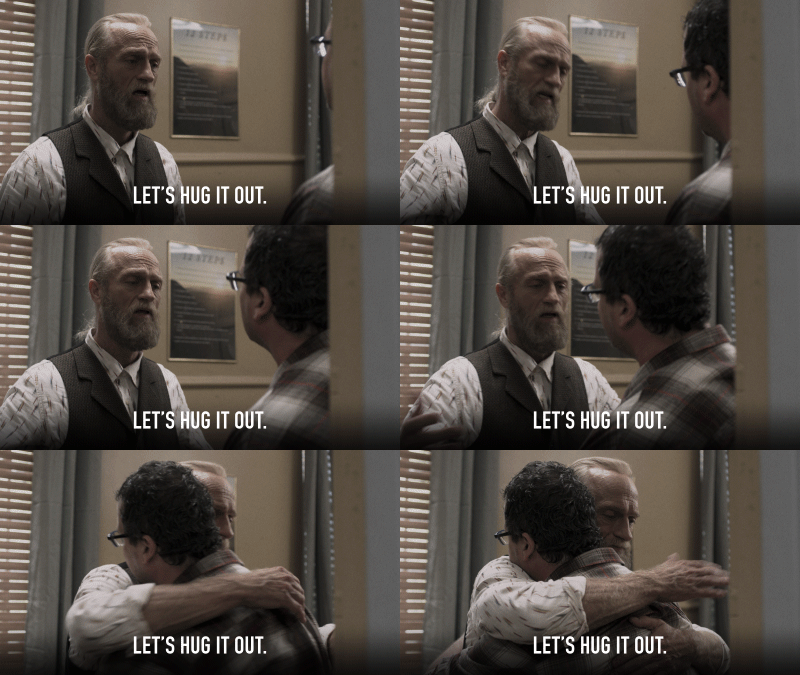
I guess I’ll just leave it with this: we should encourage boys to hug. Handshakes are lame. High fives, especially intricate ones, are cool; but you know what’s a far, far better way to greet your friends and to show your affection for one another? A good, genuine hug.

Here’s one from me to you.
 

This Morning

This morning I am thinking about being positive.

I’ve been as critical as I can  be, the last few posts; I think I should try to come up with some positive solutions to the problems I’ve been describing. After all, if you’re not part of the solution, you’re part of the problem.

Okay, actually, that’s the first thing. No more either/or thinking. No more win or lose, no more all or nothing. (Okay, maybe a little bit of all or nothing. I don’t want to be definitively black and white about this.) It is entirely possible to be both part of the solution AND part of the problem; I  think most of us are like that at least some of the time. It says something positive about you if you have enough self-awareness to recognize that you are part of the problem, and if it is a serious enough, complex enough, intransigent enough problem, then the effort, the incremental steps towards being part of the solution, are good enough. Working is enough. Trying is enough. There are also those who are only part of the solution, not part of the problem, and they will be the ones moving things forward; if those of us who are still stuck with one foot in the muck can just ooze out of their way, that will be enough.

Example? Sure. I do a lot of things right as a teacher. I focus on the actual material and the skills that students can gain from it. I am open and willing to take student input on what we will do in class, how long we will work on it, and so on, so I give them agency in their own education and also some ability to make their education more useful and appropriate. I care about them, but I do not mother them. I know and love my subject, and I model that love and that knowledge for them, as often as I can. So with the problem of, say, adults who don’t treat teenagers with respect but expect both respect and unending effort (and humility) from teenagers, I’m not part of the problem, only the solution. With the problem of education being detached from utility and from interest — the sort of education that stops at “The mitochondria is the powerhouse of the cell” — I am part of the solution and not part of the problem.

But when it comes to argument, I still tend to want to win, and to show myself as smarter and more right than my opponent, and I am all too willing to see my students as my opponents. I overwhelm them and cow them, and make them feel like they’ve been defeated, rather than like they’ve been taught. I do this in all of my arguments. I am aware of it; I am trying to fix it. I am trying to stop myself from taking up arguments in class; two years ago I inserted myself into a class assignment on writing argumentative essays, and I wrote essays in response to my students’ arguments; I don’t do that any more. So I’m learning. But it’s difficult, because I run a discussion-based class, and I want my students to offer attempts and theories, but I also want to challenge them to go further and explain better what their point is. Too often that challenging discussion can slip right into an argument.

So I’m working on it. Still not there yet. If someone else could come in and fix that for me, it would be great, thanks.

But that’s not the positive solution I wanted to offer today. (It’s part of it.) The issue I wanted to talk about today is the one from yesterday, the way that teenaged boys suck. I feel like I’ve got some connection to this problem, though not as much as someone who is actually raising a boy, so I can at least offer some suggestions.

The first one is the most obvious: toxic masculinity has to end. Not the competitive indoctrination, which is a separate issue; but the idea that men must be manly, must be strong and especially silent, must enjoy and appreciate only manly things: all that has to stop. The training in violence that comes with this also has to stop, for more reasons than just for the sake of the boys who our society makes into brutes. So if we can continue to work on the problems of bullying and emotional isolation and gender specific activities and traits and strengths, that would help enormously; I think those things would help all of us be less douchey, not just teenaged boys.

But yes: the thing that I believe will make the most difference with teenaged boys is the constant shouting in their faces that they must be competitive, and they must always strive to win. Sports is the first and most obvious issue here. Sports, especially little league sports, have to be changed entirely and immediately. We need to stop keeping score. We need to stop talking about winning and losing, and about doing whatever it takes to be the one on top.

That probably has to start with how adults consume sports. I was listening to NPR yesterday, and the news host was  talking about the Tampa Bay Lightning, a hockey team who just got eliminated from the playoffs in the first round by a team they were supposed to beat. And though part of me questions whether that is even news outside of Tampa Bay (or Columbus, the team that beat them), the larger issue was the tone of the story: the host actually asked a Tampa sports reporter if the people of Tampa felt angry and betrayed by the loss, in addition to being shocked and disappointed. And the Tampa reporter said: Yes.

Look: if your year, or even your day, is ruined by a game lost by a team that happens to share a zip code with you, you have bad priorities. I will die on this hill.

I am fully aware of the arguments for team spirit, how it brings people together and gives them something to cheer for and to bond over; but there is too much evidence that losing hurts more than winning, and that our time and money would be better spent on almost any other activity rather than watching professional sports (Just look at how “winning” a professional franchise affects a city) to sustain that argument. We’d be better off treating sports as something fun to watch sometimes, and more fun to play, if we’re not too hardcore about winning. That’s how sports should be treated with young boys.

That’s how everything should be treated with young boys. And with grown men. There are serious things that need to be taken seriously: the problems with the world, and the causes of suffering. That’s where we should be aggressive, and take no prisoners and never retreat and never surrender: getting clean water into Flint, Michigan. Ending the spread of AIDS. Peace in the Middle East. You want to teach your kids to fight? Teach them to fight those things. Fight to make this world a better place.

Otherwise, maybe we should teach our kids to just have fun. And we should mean it.

(To be continued.)