The Most Important Lesson

So this is how I started my English 10 classes this year. I first had my students write an essay about what they want, and what they need. Then I showed them this, and asked them first to discuss what I had to say here about wants and needs, and I asked them to write a second draft of their essay. Then we read a short story — “The Bet” by Anton Chekhov — and talked about how that story said something about wants and needs, because the goal of the class, in part, is to get them to think about what literature has to say about life and about the human condition, and how it relates to them personally and directly. Then I asked them to add another piece to their essay about that short story, which I also did with mine.

So here is my essay, on the most important lesson anyone can learn.

***

When I was learning how to be a teacher, we had a presentation from a guy who had been a teacher for a long time. He came in talking fast and loud, brimming with confidence: his opener was something like “What I’m about to show you is the most important lesson you’re ever going to see!” He was saying that on two levels: he was talking both to us, a group of university students on the way to becoming teachers, and to the students we would eventually have, because this was how he started the lesson he was presenting to us, which was the way he started his own classes as a teacher, and he was telling us what he thought we should say to our future students. He was saying this was the most important lesson we were going to learn, that would make all the difference for us as future teachers, and telling us that we needed to take advantage of it: and he was telling us how to pitch his lesson to our students, the way he pitched it to his, as the most important thing they would ever learn. And then his lesson was on the difference between wants and needs.

Here’s how it went. He would start his class by asking his students what they needed. Right then, in school or out, whatever: he wanted them to say what they needed. He would call on some, get some volunteers, and make a list of things on the board that they said they needed. “A job” was one. “A car” was another. “A girlfriend” was the one he put down as a joke, but I don’t doubt that he got that response many times over his years of teaching this lesson this way. “Sleep” might be another example, or “McDonald’s.” 

Once he got this list, he would then ask: Okay, what happens if you don’t get this? He would pick out the students who gave the different answers, and ask them: what will happen if you don’t get a job? If you don’t get a car? If you don’t get a girlfriend? The students would joke about it, maybe – “It would suck!” “I’d have to rob banks for money!” – and then get down to the answer, the truth: nothing would happen, really. If that student didn’t get the car, they would just continue getting rides from other people, or riding the bus or walking, or however they got around. They would be able to continue on just as they had been up until that point, because of course they did not have a car (Imagine if someone who had something said that they needed it? How ridiculous! You don’t need things you already have!), and they had been able to get to that point in their lives just fine.

“Okay,” the teacher would say. “Then you don’t need that. Right? You don’t need that job, that car, that girlfriend. You just want those things.”

Then he would go to one of the other examples given: like sleep. Or McDonald’s. And he would focus on those: what happens if you don’t get sleep? Is that the same as not getting a car, or a girlfriend? Or McDonald’s: okay, maybe you don’t actually need a Big Mac and fries – but if you don’t have any food at all… you would not be able to keep living.

That was different from not getting a car, or a girlfriend. Without food, without sleep, we cannot live.

“So those,” he would tell his students, “are needs. Things you can’t live without. Everything else is just a want.”

That lesson, that conversation, has stuck with me – obviously – for a long time: more than a quarter century. I’ve never actually used his lesson, because the want/need discussion went on to a different topic, which was his actual point: he would then talk about control. We all want control, he would say to his students, but we don’t need it. His point was that those students did not get to have a lot of control over their own lives – as you do not – and that they wanted it, as you probably do; and it was his belief that much of the misbehavior that students carried out in his class was an attempt to take control: teenager gets bored of doing what the teacher wants, which is really being tired of being controlled, so they yell out something disruptive or do something distracting, because they want to take control of the class. They don’t necessarily want to focus on the distracting thing they say or do: they just want to remove the teacher’s ability to control the class, and to control the time and attention of that particular student who was being disruptive. Who was trying to take control of themselves, and coincidentally, of the class. And he said that he would ask his students to allow him to have control over the class, so that the class could get through the work they needed to do: and that was why he talked about wants and needs, because while the student may want control, what they needed was to learn; and so while he as the teacher may not want control, he needed it if they were going to learn anything. He needed them to let him have control over them, to choose to let him take control. On days when they might be struggling with being controlled, he would take the disruptive students out into the hall and ask them if they could let him take control over them temporarily, and they generally would let him – or, if they just couldn’t stand to let him be in charge of them right then, he would accept that and just ask them to go to the principal’s office, where they would not be under his control, but they also wouldn’t be taking control of the class away from him. And when he gave them that choice, they usually were able to choose one or the other: accept his control over the class, or accept leaving the class for that day.

He said it was the best method he had ever heard of or seen for maintaining discipline in a class. He actually told us that we were not allowed to use his lesson if we ended up teaching in the same school where he taught, because he wanted to be the one to use it and he didn’t think it would work if two teachers used it with the same students. I remember being impressed by that. Because most of the people we learned from were not actually teachers, not in high schools or middle schools; they taught teachers, they didn’t teach teenagers. But this guy did teach teenagers, and this was a lesson that was actually important to him: not just an idea he had that he thought might work, maybe, which was my impression of most of the rest of the examples I was being given.

But I never taught that lesson to my classes. Because I hate the idea of taking control. I like the idea of being allowed to have control, of asking people to consent to my temporary control, because I recognize that I need to have some control to teach the class; but I hate the idea of taking it. I hate telling people what to do. Which is maybe something I shouldn’t be saying to you. Because what if you now think that you can take control away from me, and I won’t do anything to take it back?

See, the thing of it is, I may not want to take control. But if I need to, I can. And I will.

What I would rather do, though, is get you all to understand what you want, and what you need – and what I can do to help you get what you want, and what you need. So let’s get back to that.

The reason that teacher started his lesson about control with a discussion of wants and needs was that he wanted his students to recognize that they did not need to take control of the class, because they already had control over the only part of the class that really mattered: themselves. The teacher was telling his students – and us, his potential future co-workers – that we had control over ourselves, all of us, because we have choice. His students could choose to let him take control over them, or they could choose to leave. If they chose to leave, and go to the principal’s office, there would be consequences, of course – just like if you all choose not to come to school at all, or if I chose to quit my job – but the truth is, there are consequences of every choice: choosing to come to school and sit in class and let the teacher be in charge means you are choosing to be bored, at least some of the time. Choosing to sit through things that you already know, or do not need to know, or do not want to know. Choosing to be uncomfortable, to not have the things you want, right now, like sleep, or McDonald’s.

I never taught the lesson that teacher showed me (Which was titled “EVERYONE IS TRYING TO CONTROL ME AND I CAN’T MAKE THEM STOP!”) because I do not want to take control. I don’t like the idea of telling my students that I need to take control over them. (His explanation of how he proved to the students how they chose to come to school was “Nobody is holding a gun to your head!” And I do not like that, do not like the idea of a want being anything that is not literally a risk to the continuation of your life, do not like the idea that the need I am providing for is, therefore, someone holding a gun to the heads of my students.) I do, however, like the idea of helping my students to see that they already have control, because they have choice: you have choice. You can choose to be here, or you can choose to not be here. Both choices have consequences, of course, but both are possible. There are, in fact, several ways you could achieve your goal, if your goal is to not be here; and all of those ways have consequences, and all of those ways have steps you would need to take to get to where you wanted to be (Not here). For instance, you would not be here if you went to a different school; and there are ways you could try to achieve that. You would not be here if you graduated early; and there are ways you could achieve that – even at your young age, though you would have to have already started on that path to have achieved it by this current moment. Still: you could have achieved that. You could achieve not being here by ditching class, and maybe you could even avoid those consequences; but probably not for long. But hey, maybe your consequences for ditching would be a suspension – and then you wouldn’t be here!

Or, you can choose to be here. Which then leads to several more choices: you can choose to pay attention, or not; you can choose to participate actively, or not; you can choose to disrupt the class, or not. All of those choices have consequences, some good and some bad – though all I mean by that is that some are consequences that you may want and some are consequences that you would not want. (Choices also have moral consequences that make them good or bad, but that’s WAY too big a topic to get into in this conversation.) – but all of them are choices you can make. Because you have control over yourself. Unless you give me control, unless you choose to give me control, I don’t have control over you. Which is good, because I don’t want it. 

Why don’t I want control? Especially when so many other teachers do? Let me put it this way. There’s a part in a story I teach in one of my classes (“The Story of an Hour” by Kate Chopin) where the main character realizes that she is now free, that no one will be able to control her any longer; and she thinks “There would be no powerful will bending hers in that blind persistence with which men and women believe they have a right to impose a private will upon a fellow-creature. A kind intention or a cruel intention made the act seem no less a crime as she looked upon it in that brief moment of illumination.” That last part, when I read it and thought about it, hit me hard: controlling someone else – imposing my private will on them – is a crime, whether it is done with a kind intention or a cruel intention. That’s why I don’t want to take control of you: because I don’t want to commit a crime.

Please notice, though, that when I do take control as a teacher, it is not me imposing my private will on you: it is done because it is my job to be in control of this class, and it is justified by the fact that you personally are not the only person here. There is a public need which overrides private will. But this is beside the point. The point is that I do not want to impose my private will on you. Ever. I want you to choose to work with me.

So that’s why I wanted to write about this, and to share it with you. That’s why I wanted you to write about what you want and what you need, and why I want you now to think about it more – and talk about it more, if you want to do that. Because while that other teacher focused his lesson on control, I want to focus on wants and needs; I think those are much more interesting, and important, to talk about, and think about, and then write about. (If you want to talk about why wants and needs are more interesting than control, we can talk about that.)

I think his distinction, the difference that he described, between wants and needs – that needs are things you can’t live without, and wants are everything else, which you can choose to have or not – is much too simple. I mean, you could get everything you need, and you would survive, but if you never got anything you wanted – would you want to keep living that way? And even in terms of getting what you need to live: how much of it do you need? Are there things we need more than other things we need? We need food and water and shelter, because without them we cannot live; but we also need sleep. But we can live without sleep: just not in any way we would want to live. The same with social interaction, with relationships with other people: we CAN live without any of that at all; but not any kind of full, healthy, satisfying life. And then, for me personally, I don’t just eat because I need to live, I eat because I want to. I love food. (Not McDonald’s, though.) So much, in fact, that I eat more food than I should, and that will at some point lead to me having medical problems that might make it harder for me to live; so, too much of what I need, as much as I want, becomes something I can’t have. 

His claim that, if you didn’t get what you wanted, then nothing would happen, nothing would change, is not true. There are consequences to both getting and not getting anything, wants or needs. And the idea that someone who had a car would not say they needed a car, because you don’t need something you already have, is clearly not true: we say that we need food even when we have food: because the need is ongoing. When we eat the food we have, we will need more food. Having it doesn’t mean we don’t need it any more. In some cases, having something might even mean we need it more, because we get used to having something – like a car, or a girlfriend – and we would suffer without it. Once we have it, and get used to it, we need it more than we did before we ever had it: so even a want can become a need, maybe. 

It’s complicated. But I also think it’s incredibly important. And also pretty interesting.

There’s a story about this, which I think comes at it in an interesting manner: Anton Chekhov’s “The Bet.” The story is about two men, in 1870, who make a bet about – well, actually, it’s not clear what it’s really about, or what their motivations are; it seems fairly clear that the bet is really just an example of how foolish these two men are, in different ways and for different reasons. The bet arises during a dinner party conversation about the death penalty: the participants discuss whether capital punishment is more or less moral than life imprisonment. Uninterested in actually considering what the meaning of “justice” might be, or the purpose of the criminal justice system in our society, a banker gets irritated at a lawyer who claims that life imprisonment is not so bad, and he bets the lawyer two million (he never mentions the units, but maybe “pounds” makes sense – which translates to something like $400 million in modern money) that the lawyer can’t stay voluntarily imprisoned for five years. The lawyer, apparently so incredibly arrogant in his opinions that he cares about nothing more than proving he’s better, ups that time to fifteen years, and the two agree. The lawyer then goes into confinement in a wing of the banker’s house for fifteen years. He actually goes through with it: he spends the next fifteen years trapped in a single room, without talking to a single person, without seeing the sun once. In that time he is given as many books as he wants, and he reads extensively – of course, having not much else to do – and then by the end of his confinement, he has changed. The banker has changed as well: since he is careless with his wealth (As is pretty obvious when a man is willing to bet 2 million pounds for – what? For winning an argument? He says later that this bet doesn’t prove either side, not that capital punishment is better nor that life imprisonment is better. Is it for the thrill of winning? Why didn’t he insist that the lawyer put up stakes? The banker stands to profit exactly nothing from this bet even if he wins it. That’s not a good money manager. So actually, I guess he has not changed.) he has lost much of it, and if he now has to pay out the 2 million pounds, he will be ruined. So, as one does, he decides to sneak into the locked room the night before he loses the bet, and kill the lawyer. However, he finds a letter beside the sleeping lawyer; he reads it and finds out that the lawyer has decided that nothing in this life matters, that he doesn’t want anything, not freedom, not money, not life; and so he will intentionally lose the bet to show that he doesn’t need the money. Saved from destitution, the banker leaves; then the lawyer leaves, losing the bet – and then the banker conceals the lawyer’s letter.

The interesting element of the story, for me, is the choices these two characters make, and the motivations behind them. Why does this bet happen? What are the characters after? In other words: what do they want? It’s definitely not a need – no one needs to bet anything, really. The original bet happens because both men are bluffing: they each want the other to give up. They both go through with the bet because they want to prove that they are men of their word: even when their word is foolish. It makes me realize that I want to be a man of my word, as well; though I think I need to not make foolish promises like “I will stay in one room for fifteen years just to prove that I can.” By the end of the story, the lawyer, after years spent alone reading and studying everything from natural science to philosophy to religion, comes to the personal revelation that Heaven’s value far outweighs everything on Earth, and therefore he does not want the money for the bet – but he also does not care if he has his freedom, or even his life. He stays in the prison voluntarily (as he has all along) to show that he doesn’t need freedom or health or anything on this Earth; he leaves just minutes before he would win the bet to show that he doesn’t need the money, either. I’ll agree with him that money is not something we need, not something of great value: but I could not disagree more that life on this Earth is without any value whatsoever. I need my life, on this Earth, and I need it to have value and purpose, while I am alive. Whether there is a heaven or not at the end of this life is irrelevant to this life, because we do not know anything other than this life exists: therefore this life is, for now, everything.

But in the story, both men’s choices are interesting to me. Among other impressions I get from this, I think it shows that more of our needs are really only wants than we actually think; when the lawyer deprives himself of things we see as critical to our lives, primarily human company, he realizes that he does not actually need those things at all. But I think the story also shows that we do need an audience for the important things we have to say – more often than we probably realize – and that sometimes we need to keep other people from having an audience, which is why the banker hides the lawyer’s letter at the end of the story. The narration claims it was to “avoid unnecessary rumors,” but it does not identify what rumors the letter will start; I have to wonder if it is the “rumor” that maybe two millions – or even $400 million – is not anything of great importance, if you choose to think of it that way. The banker’s decision to murder for that same amount shows that, for some people, that money is certainly important.

I would say that the actually important thing here is choice. 

So now you have a choice, which I am giving you because I don’t want to take control and tell you what to do. (Though I am limiting your choices within the boundaries of what I can control, and I am requiring you to make this choice; so in some ways I remain in control. Though you still, of course, have the choice to pay attention or not, to participate or not. As you always do. With consequences no matter what you choose.) We can talk, as a whole class or in small groups you will choose, about the difference between wants and needs, what it means to want something and what it means to need something; or you can each think about it on your own. In either case you will write about it, expanding on what you wrote before, because I want you to learn that writing about something is an excellent way to help you understand it, as long as you actually think about what you are writing about, especially after you already thought about it and wrote about it a little, and then read something about it and think about it some more.

No matter what you choose, you will eventually need to figure some of this out. You need to know what you need, and what you want, in your life. You need to figure out how you want to get what you need and what you want in your life. Not right now, not all at once – but eventually, you need to know.

Or else you won’t get it.  

And that’s the most important lesson you will ever learn.

***

Unfortunately, my students did not seem to learn this lesson. Their first essays about what they want and need were (mostly) incoherent, because they (mostly) do not think about what they write: they write to complete a task, to get finished and turn something in so they can get a grade. Their second essays were the same: because they (mostly) don’t re-think what they have already done; the task was accomplished without thought, what good would it do to think about it afterwards? Their third attempts, after we read “The Bet,” were confused in two ways: first because they didn’t really understand the story, they just thought it was weird and really dumb that the lawyer would choose fifteen years when he could have gotten the money for five, and they were pretty sure they would have done five years for millions of dollars, because money is (clearly) the most important thing in life; and then they were confused about how to include those weird ideas in their essays, which were about different things, things they want and need, not what some old guy in 1870 wanted and needed.

I’m exaggerating a bit (and leaving out the examples that were from students who really did think about this stuff, and really did have some insights and some interesting thoughts), but basically, my students did not see the need to think very much about any of this. They just wanted to get the task done. And when they found out that they would get a 100% for completing the essay, no matter what they wrote or how, they decided not to think, because it was easier to just do nothing. And while they accept that they need to do schoolwork and get good grades, so they can graduate and get good jobs, so they can make money (because money is the most important thing in the world), they don’t want to do anything other than fun stuff like talk to their friends and play video games. Which, okay, valid.

And I don’t want to control them.

I think I need to find a new career.
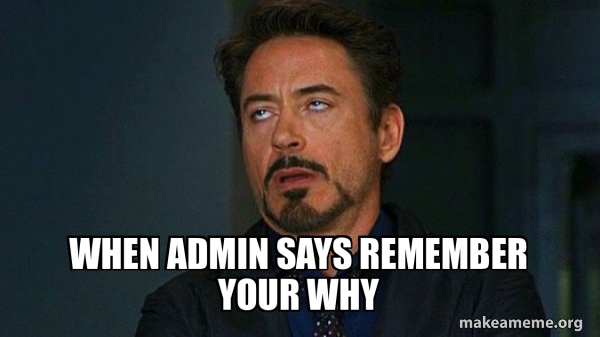
I Did It My Why

when admin says remember your why - Tony Stark Eye Roll Meme Generator

It’s inservice season!

Of course that should be the time of year, as the old joke goes, when we all get to hunt inservices, but it just means that this is the time of year when teachers go back to work in order to pre-game before the students arrive. (Yes, if you’re wondering, we’ll be drinking – but not enough. Never enough.)

If you are wondering – or, if you are one of my fellow teachers, which means your mouth is hanging open and you are cussing foully at the very thought of this – yes, this is absurdly early. In fact I am writing this at the end of the first half-week of inservice: this year I went back to school on July 16th. I kept seeing memes from teacher meme accounts that joked about our general outrage over Back to School sales happening now, with some kind of How-dare-you caption or comment that included the phrase, “It is JULY!” And though I share that outrage, every time I saw it I had to just sigh. Because not only am I back to work in the middle of July, but I will actually have students in July: classes this year start on Tuesday, July 29th. Thereby spelling the doom of that last vestige of the past advantages of being a teacher: it used to be a steady job, that was respected and appreciated, and which offered good benefits and a lovely, long summer vacation; now none of that is true, at least outside of the wealthier blue states.

But at least we’re still badly paid. So that tradition goes on.

Whenever I think about inservice – which I try not to do whenever I am not in the middle of it, but when I am in the middle of it, I always find myself stuck in uncomfortable chairs in rooms full of people who will look askance at me if they do not actually accuse me of disrespectful misbehavior should I have the audacity to distract myself from the pointless and condescending lecture being presented as helpful instruction, and so I end up spending quite a bit of inservice time pondering in silence the meaning of various available abstractions like this one – I wonder: What is inservice? (Also Why am I here? And Is there value in suffering?) It’s a strange word, after all: is it intended to differentiate this process from some other system called outservice? Which, frankly, if the only difference between inservice and outservice is that outservice is carried out in some place other than the school building, I’ll still take that one every time. And whether the service is in or it is out: who is being serviced? Am I and my fellow teachers the recipients of said service, like cars out of tune? Or are we the ones servicing something or someone else? If it is the teachers performing the service, what (who?) are we servicing, and why?

The ostensible answer is that inservice is meant to provide teachers with time and training to help us prepare for the upcoming school year; so essentially, it is the first one: we teachers are rolling into the garage like smoke-belching, backfiring, broken-down jalopies (Not entirely inaccurate), and the mechanics tune us up to get us ready for the race about to begin. I’m not sure what that makes the students, who are not the drivers and not quite passengers – maybe the cargo? Maybe the road we are driving on? – but I think that’s taking the metaphor too far. This lens does bring into clarity a number of obnoxious things that happen during inservice, not the least of which is: remembering my why.

There are themes that run throughout inservice everywhere, always, and which return every year, like a repeating motif in a Beethoven symphony, or like a recurring nightmare; one of these is the certainty that someone, almost certainly someone who does not teach, will ask the teachers to remember their why.

Why do we teach? Why do we take on this difficult and underappreciated job? Why do we come back to it year after year? Is it like returning to an abusive relationship? Is it like trauma that hides behind a memory block, as is supposed to happen with women who go through natural childbirth and then have to forget how incredibly painful the experience is or they would never have any more children?

As I have never given birth, nor been in an abusive relationship other than working in education, I cannot say. I will say that I remember, every year, how awful the previous year was – and also how wonderful it was, at times.

Which brings me to this year, and the current inservice season, and the direction – which was indeed delivered last week, by a presenter who is not a teacher – to remember my why.

Last year was bad. It wasn’t my worst year – that will always be 2011-2012, when I was working through a recession and a state investigation and a union contract negotiation in which I was the lead negotiator (And it says something that 2012 was the year I won Teacher of the Year for my school district in St. Helens, Oregon) – but it was bad. I spent a fair amount of time last year thinking about, and looking for, jobs that were not teaching jobs. That’s how bad it was: it changed my why into a What the hell am I doing here?, a question that is much less conducive to being a good teacher, and so not one that will be recognized at most inservice training sessions, even though surely many teachers at those sessions are asking that question, repeatedly, sometimes out loud, though under our breaths, so we don’t get dirty looks.

But here I am, one more time – my 26th – starting a new school year, about to teach high school English to a new (Well, partly new; partly familiar, which is at least part of the problem) cohort of students. And I found myself this past week thinking, genuinely wondering, Why?

Why am I teaching? Still? Why am I doing this to myself?

I don’t have an answer, not an immediate one. On some level, I don’t want to be here any more, don’t want to be teaching, don’t want to be teaching at the school where I have been teaching for the last 11 years. But that, too, is not the whole answer, and the whole answer is not immediately obvious in that context, either.

So let’s talk about it.

Why am I here? Why am I teaching?

First of all, most clearly and fundamentally, I’m here because I need a job. If I lived in a different kind of society – one that I think would be better in countless ways – that did not define a person’s value by their economic activity, then I would not be a teacher, at least not a classroom teacher. I have often thought I would like to teach the way Socrates did: at dinner parties, in conversations with interested parties, or out on the streets with random passersby; obviously I couldn’t do that for money, but I think I’d be pretty good at it. But I don’t live in that society, I live in this individualistic capitalist one, and so I must work for money so I can have a house and food and air conditioning, all the vital necessities of life. It’s possible I could survive without a job, but my level of misery would go up exponentially, even over what I went through, what I go through, as a teacher. So I work, rather than become homeless and starve on the street.

But does it need to be this job? At the moment, that answer is close to a definite yes, because my wife, who was also a teacher last year, and who had a far worse year than I did, lost her job to budget cuts at the end of last year; as she is working to build her entrepreneurial endeavors, it falls to me to provide a steady income and health insurance; because teachers are generally more valuable as we gain experience, our pay goes up every year and then drops precipitously if we change schools or school districts – I have done this twice, the first time losing about 20% of my annual pay and the second time 40% — so that means I need to stay in this job, rather than get another teaching position. That wasn’t an easy or a simple decision: I applied for, and could have gotten, a job teaching in a different school that would have earned me about 30% less than I make now; but I just couldn’t afford the drop in pay. So here I am. (It does help that I have many dear friends at this school, and that some of my students are lovely people. But it only helps, it doesn’t make the decision easy. It’s not the why.)

It is possible I could change jobs entirely, even change industries; but because most jobs pay more with experience, like teaching does, I would have to start at the bottom of the scale, and that is generally also less than I make as a teacher, even if the upper end of pay would be more. I am also painfully aware that the current political power structure puts continuing health insurance across changes in employers at serious risk of ending, which makes me doubly unwilling to leave my current job for a new one. Any job that would pay as much as or more than I make teaching would require additional training and/or certification, which makes them possibilities for the future, but not for now. (Also, I am 51, so starting a whole new career at the bottom and working my way up is both less attractive and also less likely than it would have been 20 years ago. Plus ça changeplus c’est la même chose.)

But of course, I could do those things. I could get a job in marketing, or in public relations, or in corporate training. (I could become one of the people who provide inservice to teachers, but I would really have to hate myself to do that.) Especially if I and my family moved states, to one that had a generally higher payscale for professional jobs, I could find something that provided the same approximate income. Yet here I am, back teaching again. So there’s more reason for my returning to teaching than just necessity, more than just money. I will also point out that, if I just wanted to receive my paycheck and cared about nothing else, it would be fairly easy for me to keep my job despite becoming a terrible teacher, because it is in fact quite hard to fire bad teachers. So long as I didn’t hit or harass one of my students, I could treat my job very differently from how I treat it now, how I have always treated it, so that even though it was the same job, it would be a very different experience.

Let me be a little specific. I teach English to high school students, and I do it well. I make literature both understandable and interesting to my students – or at least I create an opportunity for them to find literature both understandable and interesting. I make the class as valuable and entertaining an experience as I can, as much of the time as I can – and that’s a good amount of the time (though of course the experience of my class is subjective and I don’t doubt that some students think I do a terrible job of teaching, and/or that my class is boring as hell. But mostly, they don’t think that, not if they pay attention and try.). I work very hard to achieve that: I spend hours and hours thinking about what I am going to teach and how, hours and hours preparing materials and assignments and activities, and then when it is time to go and teach those things, I show up, every day, as ready as I can be to teach the material to the students I have. I ignore the inconveniences and frustrations of my daily work, of my classes and my situation, and do my best to treat every class period as an opportunity for both progress and also fun. I try to learn as much as I can about my individual students, both so that I can teach them better and so I can show them the respect they are due as human beings who are as wonderful and valuable as every other human being, despite being adolescents (That’s not a dig, not really; adolescence is miserable, and all of us react to that misery by inflicting misery on others. I did it too. I don’t blame them for it: but it can be very hard to deal with them while they work their way through it.). I try to be as honest and vulnerable and trusting with them with my own genuine self as I can be, again so that I can teach them better and so I can show them the respect of being real with them, so they can trust me, so they can work with me.

The fact that I do that, that I have done that every year, is part of the reason why I had a bad year last year, and part of why I don’t want to do this any more: because my students last year did not generally return my respect and my openness. They did not listen or value my honesty and vulnerability, and they did not show me the respect I deserve as a fellow human being, let alone as a teacher who has some ability to affect their lives, possibly for the better. They mostly didn’t disrespect me maliciously, just being teenagers in this modern world; but it was hard to remember that and to keep caring about them and keep trying to be the kind of teacher I want to be with them while they treated me with callous indifference. There were many times, for instance, when I would ask my students about something, and they would ask me what I thought or what my experience was in regards to that idea or situation, and while I was answering the question they asked me, they would not listen: they would turn away and have side conversations, or look at their phones or Chromebooks, or leave the room, because they were bored. Not because they hated me and wanted to insult me, but just because they didn’t care, and they didn’t feel like they needed to show me the respect of their attention, even as I answered the question or gave the explanation they asked for. So as I said, not malicious, but nonetheless hurtful, and hard to deal with. And this year, I will have many of those same students back again. Will they treat me more respectfully? Will they listen to me when I talk, either as their teacher or as a fellow human being?

Probably not. But I am willing to try.

I don’t have to: I could assign them readings, and questions, and maybe videos or audio files of literature – particularly non-fiction, which is what my administrators want me to focus on anyway, as it is the heart of the testing that produces the data that is the obsession of all administrators everywhere –  and I could sit at my desk and monitor their online activity to ensure they were on task. To my school, that would be considered teaching, to a degree sufficient for me to keep my job and my current pay, which is not really related to my success or failure in actually teaching my students. If I produced data that was better than what I currently engender with my involved, honest, human, active, interactive teaching, then I would be even more secure in my job. I might even get a little bonus money if their test scores went up. And it would be so easy. Especially if I just had AI design my “lessons” for me. And grade their assignments.

I choose not to do that. I choose to take the much more difficult path, which does not necessarily make my job more secure, and which definitely does not produce the best test scores. And why do I choose that, you might ask?

That’s the Why worth thinking about.

I teach the way I do because I don’t just teach for money, and I don’t ever teach for test scores. I think that my teaching methods help students to get better at understanding literature and at explaining their understanding in writing, and so higher test scores should be the result of my methods; but those test scores are not my why. If anything I sometimes, perversely and against my own best interests, want those scores to go down while my students’ knowledge and abilities improve, for the data to become less reflective of my students’ actual learning and abilities. Because I want my students – and also my school and my community and my society – to care less about test scores and measurable progress data. Ideally they would not care about it at all, ever; and my hope is that when students grow and learn in my class, and know that they grow and learn in my class, and everyone around them knows that they grow and learn in my class, and then those test scores don’t improve, or even go down, then it shows the truth: that test scores do not measure what matters in education. Test scores and measurable progress data are the wrong focus for educators, because they put the focus on the wrong thing, especially in my subject: English as a subject of study is not about measurable progress in discrete skills. There is no “mastery” in English. It is about growing: growing as a person, as a thoughtful person, as a person who thinks about the world and our place in it, who is curious about the world, who is appreciative of the world, and who cares about the humans who live in it with them.

I want my students to be that. It will make them better people, with better lives, in a better world. I want to make that happen. So I am willing to work for it. Even though it’s hard. I’ve worked for it, worked hard, every day and every week and every month and every year, for coming up on three decades.

Last year, and to a lesser extent the few years before that, it didn’t work as well as I thought it should. My students did not grow as much as I wanted them to. Partly because they did not pay attention enough and did not try enough to actually improve in the subject, to actually work and learn in the class; because they did not pay me the respect I deserve as their teacher and as a fellow human being with some ability to improve their lives and the world they live in, who is working hard to do that, who shows up every day and who is as honest and vulnerable and genuine and compassionate as I can be with them, as often as I can be, and regardless of how they treat me and the work I do and the subject I love. Part of what made last year bad, I think, was that I was not able to keep being patient with my students when they disrespected me and my class: it made me lash out in frustration, or it made me shut down, which then confirmed for them that this was not a class and I was not a person they needed to listen to or be respectful of. We spiraled, because of that, both my students and myself, more than once; it took extra effort to drag us out of those spirals – and very little of that effort came from my students. If anything the majority of them encouraged that spiral, because they know that if I give up, and they give up, then they can stop trying, and they can just do nothing for as long as I have given up, as long as I stop trying and do nothing. For many of my students, for much of the time, their goal is to do absolutely nothing, to put forth no effort, to achieve no ambitions – to have no ambitions – and to not care about anything at all. Because of that they put all of the requirement for effort and motivation on me: often consciously and intentionally, again so that they can give up by making me give up.

But I did not give up, not in the long run (though I did, too often, in specific moments with specific classes), no matter how annoying some of my students were to work with, to be honest and vulnerable with, no matter how disrespectful they were in not listening, in not trying to think or empathize with me or to connect to the material. And the reasons why I didn’t give up are another part of my why, and more of what brought me back to teaching again this year.

The first one, the simpler one, is that I love English. I love literature, I love poetry and plays and novels and stories and essays and screeds and letters and songs and – all of it. I love reading and writing, and I love talking about those things, and learning about them, and teaching about them. All of it is fascinating and beautiful and magical to me, as well as incredibly important, both practically and esoterically, concretely and abstractly. It would wound me, deeply, if I were to treat my subject as something not worthy of real attention and focus and thought and energy, if I were to reduce it to excerpts and handouts and multiple choice questions and AI-generated content. It would dishonor this area of knowledge, this way of living in and interacting with the world, that has meant so much to me, that has consumed so much of my time and effort, that has brought me so much joy and also so much power. And I won’t do that, not even though my students do it every minute of every day, in every class, to one extent or another. Part of my why, part of my reason for teaching, is to fight back against that apathy and indifference and cynicism, that belief, endemic among my students and my society and growing worse every year, that reading is boring and pointless unless it is reading the captions on a TikTok or the comments on a YouTube video or a SubReddit, that writing is something best done with a prompt to ChatGPT. Preferably one entered with talk-to-text. I don’t think I can change that attitude in all of my students; certainly not in the ones who never even try to get better in my class, the ones who prefer to do nothing, at least in this context, and to be nothing as a consequence, at least in this context; but I can help change it for some of them, at least. And because I have read and taught and thought about Ray Bradbury’s novel Fahrenheit 451 for so many years, I know that winning some people over to the side of the angels, to the side of the readers and the writers and the thinkers, the poets and the storytellers and the wordsmiths, is enough to save the soul of humanity and society – at least until we blow it up.

But then we will rebuild. If there are people who have not given up. The character Granger says it at the end of the book, after their world has, at least a little, blown up:

“There was a silly damn bird called a Phoenix back before Christ: every few hundred years he built a pyre and burned himself up. He must have been first cousin to Man. But every time he burnt himself up he sprang out of the ashes, he got himself born all over again. And it looks like we’re doing the same thing, over and over, but we’ve got one damn thing the Phoenix never had. We know the damn silly thing we just did. We know all the damn silly things we’ve done for a thousand years, and as long as we know that and always have it around where we can see it, some day we’ll stop making the goddam funeral pyres and jumping into the middle of them. We pick up a few more people that remember, every generation.”

That’s the other reason why I keep teaching, and again it is fairly abstract and idealistic, and again it is generally ineffective with the majority of my students: I want to make my society a better place. I want my students to understand the damn silly things we do, and that burn us up, so that they can help get us closer to that day when we stop jumping in the middle of our own goddamn funeral pyres. I want some of them to remember. To never give up.

I can’t fix all of it, of course, and so that makes it harder to keep coming back and trying again; just this year, I have had to sit through a conversation among teachers, who should all know better, about how AI is both inevitable and a valuable tool, and so we should not only accept it, but take part in it, contribute to its growth, tumor-like, on the collective mind of humanity; hearing that from my fellow teachers felt like being stabbed in the gut, and it makes me want to throw up my hands and cry out “A plague on both your houses!” I have for years chosen not to fight my students on their use of electronics, preferring to ask them to come along with me into the world of literature I make available and interesting and useful in my class; but I have watched as more and more and more of them have refused my kind invitation, my well-meaning passivity, and have failed to gain anything from me as a consequence. So now I will have to fight to make my classes available to my own students, and I don’t know how well that will work – and I don’t want to do it. I have no choice, so I will; but I don’t want to. That’s a why on both sides: I want to teach so I can fight for the souls of my students, and I want to let them do what they want, even if it destroys them.

But as I have learned from literature and from being a part of humanity and thinking about humanity, when some people are allowed to destroy themselves, they bring the rest of us down with them. I don’t want to allow that, not for a reason as stupid and worthless as laziness or fear of failure which creates failure, which are the main reasons why students don’t pay attention in class. Again, I don’t think I can save all of them – I don’t think I can save any of them, really, but I think I can help make a change in the paths for some of them, which will allow them to save themselves – but if I can save some, that will be enough. Not enough to make me happy, or to make my job easy; but enough to keep society moving mostly forward, and to allow humanity to continue to get better. If I can help them to empathize with others, as they might learn from To Kill a Mockingbird, or to think about the consequences of lies and self-serving fingerpointing, as they might start doing after reading The Crucible, or if I can just make them curious about the real value and power of reading, as they might learn from Fahrenheit 451, then I will accomplish that goal. I’ve done it before: and I hope to do it again. And again. Until I can’t do it any more.

That’s why.

Art Schooled

This was a bad school year.

It was a bad year for a number of reasons: I taught Freshman English for the first time in seven years, and it was a struggle. My students – nearly all of them – are addicted to their phones and generally unwilling to read, which made every class a struggle. My administration, which has changed – hang on – eight times in the last five years, changed again, and it was both unexpected and unwelcome, as the principal, who was a friend, had to leave the position for health reasons. But before he left, he asked me to take down a Facebook post for political reasons, which was gross, and he wrote me up for cussing at my class (which write-up was justified, because I did – well, I cussed about them in front of them, I didn’t cuss AT them, strictly speaking. But it deserved some kind of sanction.) and for leaving them unsupervised, which was NOT justified as I had just stepped out into the hall and was right outside the door, as teachers are instructed to do when we want to talk to a student individually. He left before the end of the semester, and a district admin filled in until the new principal started with the new semester: and that guy wrote me an email warning that he would write me up if I didn’t keep my classroom door closed and locked at all times. And on top of all that, Toni’s and my personal lives, specifically in relation to our families, was difficult all year, which made every stressor at school just that much harder to deal with.

And then, this spring, the school cut staff because our enrollment is projected to go down: and one of the first ones laid off was my wife, who had been the advanced art teacher at my school for the last three years, teaching an Honors/AP class and the only life drawing class offered in a public high school in Arizona. (We checked.)

That last one. That’s why I’m here writing.

Not because my wife lost her job: that sucks, it came as a shock and it ruined a very manageable system for our family, because it was very convenient for us to work at the same place, and it worked well for her to teach only part-time, and the income she earned on top of mine was enough to cover our expenses. No, I wanted to write about this because my school cut back their art program. Toni wasn’t the only art teacher, but the full-time art teacher (Who, to be entirely fair, had less seniority than Toni, and so Toni should have been offered her position rather than being cut first – but also Toni would have turned it down, because the full-time art teacher position includes teaching two levels of middle school art, which Toni did for three years the first time she worked at my school, and she will not do it again. But also, they should have offered her the position, if we are using the seniority rules that most schools abide by. But I digress.) will only be teaching Art 1, which is the usual survey art class most people get in high school, where you try a little of this and a little of that, and focus on nothing in particular – it’s a bit ADHD, really. Toni’s classes were the ones that really got into some depth, into the specifics of a form of art – drawing and painting, which are Toni’s specialties. And she knows them better than any high school art teacher: because Toni is a specialist, she doesn’t really want to do clay sculpture or weaving or whatever other art forms most high school art teachers include. But Toni’s students learn more about drawing and painting than they will anywhere outside of college – and in some cases, more than they would in college. Toni changes their way of thinking, their way of perceiving the world: it is her intent, and her students have attested to it. It works. She does it. She teaches them not only how to make art, but how to think like an artist.

My point is, our family’s personal situation aside, and my basic dander being ruffled over those buttheads RIFing my wife, my school had a unique art program. And they cut it. First thing. No, second thing; first they cut the Turkish language classes, which in some ways was even more shocking, as the school was founded by Turkish immigrants who were working in tech jobs here in Tucson, and started a STEM charter school with an international focus so that their kids could have a decent place to learn the STEM skills their engineer parents wanted them to have. The original charter for the schools includes a requirement that Turkish always be a language offered to the students. And they cut that too. But with Turkish, there may have been other reasons: the teacher struggled with the job in ways Toni did not, and the Turkish classes were not terribly popular, which Toni’s classes are; and there are two other languages (Spanish and American Sign Language) offered at the school still. So other than simply recognizing that the administration cut back on both languages and art, and they removed two different unique aspects of the school’s programs, I’m going to focus more on the art that they cut.

Because it was stupid to cut it. And damaging, both to the school and the students. I will note, along those lines, that they did also cut our paraprofessionals, who offer one-on-one assistance to our SPED students, and they cut our wonderful counselor/504 coordinator, who offered emotional and educational support to all of our students as well as to our staff. So they made the school worse in several ways, not just through cutting the arts and languages programs.

Now, of course, cuts had to be made: the enrollment is down for next year, and we get paid per student by the state. We’re losing something over 10% of our total student body next year, according to projections. We have always lost some number of students because we are a small charter school (Just so that everyone is clear on this, charter schools are public schools but we don’t have elected school boards and we don’t have a geographically fixed district to draw students from), and students who want to go to schools with larger sports programs or more elective options usually leave: every one of our high school classes (with some exceptions) is smaller than the one below it – we have fewer seniors than juniors, fewer juniors than sophomores, and fewer sophomores than freshmen. That’s expected. The problem is that we are losing students from every grade: and the puzzling thing is, so is every other public school in Tucson. One of the middling public school districts has had to cut millions of dollars from their budgets because so many students are leaving.

So the obvious question is: where are they going? If public schools were shrinking and charter schools were growing, that would make sense; it would show that parents wanted smaller class sizes for their children, and maybe a specific focus like my schools’ STEM identity. If charter schools were shrinking and public schools were growing, that would mean even more students than before wanted more elective options or maybe more varied social life and so on; also, there is definitely a number of students who are not successful at our school and who transfer to other schools hoping for a different outcome. But that goes both ways, as well; we usually get the ones who “get in trouble” and need to be removed from their friend group. And in Arizona, at least in Tucson, ALL public schools, charter and comprehensive, are shrinking.

So where are those students going?

Some are going to private schools. Some – more, I would guess, though I don’t have data – are going to online schools, or homeschooling. Some are probably just dropping out, though they may be lying about that, telling their prior school or the state that they will be homeschooled or attending online school, and then just going out and getting jobs instead.

And that’s where this all starts getting frightening.

Because this shows that public education is dying.

Probably not everywhere, though I highly doubt Arizona is alone in this; we’re just first, because we have pioneered the Republican party’s long, slow erosion of public education in this state, and we have pushed it a little farther and a little faster. Arizona has been in the bottom three for both test scores and teacher compensation for several years; now we are seeing the payoff. Especially when you include the fact that our business-friendly – sorry, make that business-sycophantic – state has cut taxes to the bare minimum and below (A trend exacerbated by the number of “snowbirds,” retired people from cold states who winter in Arizona and sometimes declare residency here and vote here, where they obsessively and virulently oppose all taxes, because they don’t need much from the state in the way of services and damned if they’re going to pay for those friggin locals), while also allowing families to create “Empowerment Scholarship Accounts,” which allow them to pull funding from public schools and spend their tax dollars on their children’s private schooling. So now we can see why private school enrollments are going up: because it is a well-established principle that our capitalist society believes that something you pay for is higher quality than something you get for free, so paying tuition at a private school clearly means their kids are getting a better education.

I mean, maybe not one with advanced art programs.

But now we don’t have that at our charter school, either, so. Might as well send my kids to that big Catholic school. You know they can maintain discipline. And they have a pretty good football team, too.

Those same ESAs help explain online schooling, as well, and I suspect there are at least some parents who take the money and make some idle gesture towards homeschooling – probably while telling their lazy kid to go get a job. Though honestly, I would guess most people who go the homeschooling route, or the drop-out-and-go-to-work route, either don’t know about the ESAs and how to access them or don’t care, and the money probably just stays in the system. What money there is in the system. Which really ain’t enough, even without families pulling it along with their kids, as though the only reason we pay taxes for schools is to educate only our own children.

Funny how those ESAs aren’t offering rebates to childless couples like myself and my wife. It’s almost like it’s intended to harm public schools, not to be “fair” to taxpayers in some way. Oh wait, that’s right: it is.

This is part of the long-term Republican project. You can see it happening faster, and a thousand times clumsier and stupider, in Trump’s attempted destruction of universities, with Harvard currently acting as the breakwater. Public education is bad for Republicans, you see, in a number of ways: first because educated citizens are harder to fool, and when your entire mission statement as a political party is to use cultural wedge issues to get elected, and then bait-and-switch so you can cut regulations and taxes for corporations and the wealthy, you need citizens who are easy to fool, or else you’ll never get re-elected. Secondly, public education tends to teach people how to question, how to reason, and how to research for themselves; all of which makes it harder to gin up a successful level of fear and anger with wedge issues. Someone who can Google competently, for instance, is far less likely to vote for politicians who promise to keep trans athletes out of sports: maybe because the competent Googler could find out just how miniscule is the population of trans athletes in sports, or one could discover that trans athletes do not have a persistent advantage in sports once they start hormone therapy, or that the divisions we have used in sports for the last century or so are not as black and white as the GOP would have us believe, as human biology and sex categories are neither simple nor clear-cut. And lastly, modern education, especially taken to the university level, tends to reduce people’s adherence to dogma, and to increase people’s empathy, not least because universities are where people meet other people who don’t look or talk or act or believe just like them. It’s easy to keep a childhood faith when you live in the same town you grew up in, where everyone goes to the same church every Sunday; it’s much harder when you go to college in a different state, and not only don’t have the exact same denomination of Christianity there, but also start meeting people from other nations, people who are Muslim, or Hindu, or Buddhist, or Jewish, or atheist. Especially when you learn real science, or history.

Oh: and then there’s the fact that uneducated people make more easily exploitable workers. Right? Because uneducated people in the Appalachians are always going to be coal miners, and uneducated people in the South are always going to be sharecroppers and farmworkers, and uneducated people everywhere are going to cling to the “good” jobs they can get – by which I mean being sexually harassed at Wal-Mart or having to piss in a bottle in an Amazon warehouse – because they know they won’t be able to find anything better. So they’ll absorb wage freezes and benefit cuts, they’ll live with reduced hours and a lack of promotions. They’ll (generally) oppose unions, because they don’t want to see their paycheck go down even as little as unions dues would take; and they’ll immediately and violently turn on darker-skinned immigrants who are “taking our jobs.” All of which serves the desires of corporations and the wealthy, and therefore the primary mission of the Republican party.

So for all of those reasons, the Republican party wants to destroy public education. I am now grown cynical enough to think that the Democratic party is on board with at least some of this project – because this has been going on for decades, and the Democrats haven’t made any of the structural changes that would be necessary to solve the problems, primarily a national school funding scheme and a national curriculum and free college tuition – but at least Democrats want to appear to support education, and so they don’t pull shit like trying to close Harvard or removing evolution from school curriculum.

But they’ll sure as shit agree to cut art. Which is why my wife got cut.

To be clear, the decision to cut the advanced art teacher specifically came from the district administration. As I said above, they have cut everything they could that makes the school a better place for students; because they district administration, unsurprisingly, are Republicans. That’s an assumption, but it’s not exactly a leap, based on every interaction I have ever had with said administrators. But just like when Republicans in Washington cut something – SNAP benefits, for instance – that Democrats support pro forma but not with any sincerity, there is some noise made about opposing the GOP, and then about reversing the cuts; but all they actually do is use those cuts as their own wedge issue, to get Democratic voters to vote for whichever corporate stooge the party wants to install in power, who will then make life easier for their wealthy donors, while making it harder for their poor voters; because even though Joe Biden didn’t create a national minimum wage, or create a national system of health care coverage, or tax the wealthy in any kind of rational way, or cut the military and end all wars and the American network of international political oppression – hey, at least he’s not Donald Trump, amirite?

My friends and I have joked – bitterly, and often humorlessly – that our administration is DOGEing our school: making stupid, short-sighted cuts that are going to do far more damage to the entire endeavor than they are worth in terms of money saved, and with reckless and almost gleeful disregard for the lives they are affecting with those cuts. But while I guess the Democrats in Washington are trying to oppose Elon Musk and the DOGE cuts, I didn’t see any real opposition from any of our administration to the cuts made at our school. Regret, sure; I saw that. Wishes that a way could be found to avoid the cuts, and plenty of blame for those mean ol’ district administrators who actually determined who would be RIFed. But no action. And not that I expect anyone to throw themselves on their sword and quit so that my wife could keep her job – after all, I didn’t do that (though I recognize that such a self-sacrifice would actually be self-defeating in our particular case) – but a friend of mine pointed out that all of the teachers were given a raise this year; not a substantial one, but several hundred dollars – and if you took $500 of that raise from all of the staff members at the school, that would basically cover my wife’s salary. So if my friend the teacher could find that money, I don’t really believe the administration couldn’t. No: they didn’t try.

Because the school administrators didn’t really disagree with cutting the advanced art teacher.

They did not cut the core teachers, of course. They DEFINITELY did not cut the STEM teachers – sorry, the STM teachers, as we do not currently have an Engineering program. They did cut the administration a few years back, when they combined the principal positions at the elementary school and the middle-high into one principal of both schools (another DOGEing, because it was a stupid cut that has caused nothing but inefficiency and problems at both schools), but they didn’t cut it more to meet this most recent budget shortfall. Even though administrators get paid two to four times as much as teachers (and an even greater multiple for my wife, who was part-time, or the paraprofessionals, who were paid less per hour).

They may have regretted RIfing my wife, because she is a wonderful person and a wonderful teacher: but on the inside, they agreed that cutting advanced art was the right thing to do. And cutting the third (and least-popular) foreign language. And cutting the staff who only serve some, but not all, of the students.

Because those cuts make sense, right? I mean, the people who serve the largest number of students are clearly the most valuable. And come on: it’s not like art is that important. We all know what really matters, what schools have to focus on: jobs. And STEM is where the jobs are, the good jobs, the career jobs like computer programmers and software engineers. Aerospace engineers. Mechanical engineers.

You know: the guys who work for Elon Musk.

I could go off on this topic for a very long time. I already have, frequently. Schools should not be focused on jobs: the task of education is to make life better for our students, and thereby to make the world better for all of us; and nobody is actually served by having students go into engineering. Sure, it’s a career; but is it actually a satisfying one? One that would serve to define the identity of our students, over and above any other element, all of which other elements we almost completely ignore? Job preparation, inasmuch as it is an appropriate topic for schools, should not be focused on STEM white collar jobs like engineers or accountants or science teachers or researchers: the real need in this country, and the real area of potential employment, is in the trades. And I would argue our students would be FAR better served by becoming trained mechanics, who would make as much or more as many engineers and scientific researchers – who would go home and read philosophy and compose classical music and act in community theater and, most importantly, PAY ATTENTION TO FUCKING POLITICS IN THIS WILD SHITSTORM OF PRIVATELY FUNDED GASLIGHTING WE PRETEND IS A NATION.

But school shouldn’t be focused on job preparation, not at the K-12 level. We need to do three things: give students the basic tools they need to succeed in ANY serious endeavor in their life, primarily the ability to think critically and to learn on their own anything they have not already learned; teach them to be decent fucking human beings; and expose them to as many different kinds of human activity, as many different modes of thought, as possible. We particularly need to focus on the exactly the ones they will not use at work every day of their lives: because if we teach them nothing but how to work, what will they do during their off hours?

You know what they will do: the same thing most of them do now, the same thing that too many of us do.

Nothing.

We should teach them how to make art (And music, and poetry, and everything else that we include in the “arts”), precisely because it is not the thing they will do 9-5 Monday through Friday throughout their lives. (And also, even at a small charter STEM school, let’s not pretend there are not at least a few students there who WILL make art into the thing they do 9-5, Monday through Friday, throughout their lives; and let’s be clear that the more people we can help move into that kind of life, the better off we will all be.) It is the thing they should do to express themselves in ways they cannot, during their 9-5 jobs, Monday through Friday, throughout their lives. It is the thing they should do to claim time and mental energy for themselves, even when they willingly sacrifice all of their free time, money, and energy to their future children. Because art is one of the most personal things we can do, and everybody needs personal time, and everybody needs personal expression.

Because art is fundamental. It is fundamentally something that makes us human: it defines us as humans, because no other animals make it in quite the way we do. Art allows us to express what is inside us that cannot be expressed, which forces us to find ways to express it: and if no ways exist, it forces us to create ways to express it, because that voice inside cannot be silenced once it is ever allowed to speak. Art makes us more human, because it forces us to think in ways we normally do not, and that adaptable, imaginative projection outside of our habitual thought patterns is our primary survival strategy, our defining trait, whether we are hunting mammoths or trying to survive in the rat race of society. If we intend art to be shared with others, then it forces us to think about how others think, and how we can communicate and affect other humans; and that improves our empathy and our cooperation, and it opposes our desire to exploit and oppress each other, because you can’t exploit and oppress people you see as your equals, as your fellows: as other people who can appreciate art as you do.

That’s why billionaires are never artists.

The job of schools should not be to channel students into specific pathways; that is limiting them, it is oppressing them – it is lessening them. Art expands us: it frees us, and ennobles us. It makes us greater. That’s why students love it, because they are dying to be more than they have been allowed to be: because they want, more than anything, to discover themselves and express themselves.

Are they supposed to do that in chemistry class? In computer programming class? In math?

My school does not understand what the task of a school is. Which means they will fail at their actual task, while they are pursuing, single-mindedly, the wrong task. And they will fail at that, too. And they will never understand why.

Because they, too, are not artists.

(I’ve been listening to this next one for more than thirty years, and always loved it, and never knew what it was about — because I never bent my mind in this particular direction. Now I love it even more. The audio here isn’t the best version, but it goes SO well with the image.)

And this one’s ridiculous, but — necessary. Entirely necessary.

Deep Breath — Now Hold It… Hold It… Keep Holding…

I bet this would work.

***

Wow. It’s been so long since I’ve written a post that I got logged out of my own website.

I would apologize, but first, you all are sick of hearing me apologize; as I say to my students when they offer an apology for their behavior, “I don’t need you to apologize, I need you to do better.” And I can’t promise that I will do better: because the reason I haven’t been posting is that I’m too busy drowning in work and responsibilities. I haven’t caught up on the work, and the responsibilities aren’t going away; so I won’t be writing much any time soon. Though I do have a break a week from now, so I may be able to find some time there to post some more; I do have several ideas for things I want to write.

But this one has to come first. Because, you see, a large part of my problem with keeping up this school year is that I am extra exhausted: and a large part of that problem is that my students are extra exhausting. I’m back teaching 9th grade English, for the first time in 8 years; and the last time, it was an Honors class. I don’t have my lovely fantasy/sci-fi elective this year; not enough students signed up for it — though I can’t imagine who wouldn’t want to take a class in which you get to read “The Fortress Unvanquishable Save for Sacnoth.” (And I BEG you, if you like swords and sorcery and epicness beyond the known realms of epic, click on that link and go read the story. It’s lengthy, but it’s SO good.) The class was fun, and therefore easier to teach; the classes I have now are mostly not fun, and mostly not easy. And though I don’t want to sound like an old man shaking his fist at a cloud, I have to say that part of the problem really is my students, their attitude about school, and the way they treat me and my class.

But another factor — a more difficult one — is how my administration directs me to deal with those students.

For the sake of this post, which I want to keep shorter and more to the point than my usual logorrhea, I’m just going to share the text of a … friendly lil email I got from my administration. Let me preface this by saying that I actually like my administrators very much, first on a personal level and then second (and somewhat less than the personal) on a professional level. They work very hard, even harder than I do; and they, like me, like everyone in education, have enormous and ridiculous demands on their time and energy. One of the demands on my administration is for them to implement the systems that the higher-up administrators want them to implement; and at my school, as at many schools, one of those systems is PBIS.

I have written before about PBIS. But there is nothing I could say about it that would communicate the full level of insipid uselessness that it imposes on teachers. The basic idea of it is that we need to praise students for the things they do right, more often than we need to criticize them for the things they do wrong; and that’s fine — but the idea of it being a system that we need to impose on teachers? Processes that require training? The idea that it will produce data which we will then analyze and use to form data-driven decisions that will surely improve school for everyone? My god, the pile of steaming bullshit in that is larger than Mount Olympus. I already praise my students when they do things right. I do it because I am a kind person, and I care about both my students and the work we are involved in, this pursuit of their best selves. So it already happens. Any system, any process, any practice that teachers are trained in, is inevitably going to be artificial, and therefore undermine the actual relationships that teachers form with students, and which are far and away the best chance we have of changing the way they act, changing their attitudes and reducing their misbehaviors. Relationships, guys. Not PBIS.

When my students are being resistant, or obstructive — or just little freaking jerks — they don’t really need me to be nice to them and find something in their behavior to praise. They need me to tell them to shut the hell up, and make it stick: they need me to have a relationship with them that means they will listen to me when I tell them they need to shut the hell up. That is 99% of the problem with student behavior. For the sake of contradicting the image of me as old man shaking my fist at a cloud, let me say this: students today aren’t worse than they were ten years ago, or twenty, or thirty, when I was a student (Okay, thirty-five…): but they aren’t any better. They are sometimes, some of them, intentionally cruel; that is a separate and more serious issue that has to be dealt with individually and more emphatically. They are frequently distracted and detached, and that sometimes has to be dealt with, though I still generally believe the best way to handle that is to let them not learn anything for a time, and point out to them that they have not been learning anything, and maybe they should do something about that. But really, the problem that comes up in every class, every single day, and which requires a reaction from me, a reaction I am VERY tired of giving, is: they make too much goddamned noise. They just need to shut the hell up. That’s it. Otherwise they are basically fine, and usually good.

Or, as my administration put it in an email I recently received:

As we continue working together to create a positive and productive learning environment for all of our students,

Off to a great start. Also, I thought I was teaching them English?

But please, go on.

I want to emphasize the importance of using Positive Behavior Interventions and Supports (PBIS) when addressing behaviors around our SSA campus. One key aspect that often impacts the success of these interventions is the tone we use when interacting with students. At times, incidents can escalate unnecessarily due to an improper or harsh tone. I encourage each of us to be mindful of how we address behaviors, focusing on de-escalation rather than confrontation. A calm, respectful approach can go a long way in turning potentially challenging moments into opportunities for growth and learning. It’s also crucial to remember that our students deserve the same level of respect we expect from them. When we address students with kindness and respect, we not only model the behavior we want to see, but we also build stronger relationships that can lead to more positive outcomes inside and outside the classroom. I’ve included some behavior interventions that can be helpful when dealing with defiant or disrespectful students.

Oof. Okay. First, I hope we all know that the least effective sentence in the English language is “Calm down.” It never, EVER, makes anyone calm. It is much more likely to piss the person off and add that to whatever agitation they are currently going through.

Second, I have to point out that I strongly suspect a particular interaction between one of my fellow teachers and one of our high school students, which happened the day before this email was sent out, was a large part of the impetus that led to this particular email: because that interaction was not positive, and was not de-escalated by the two people involved. So there was cause for some means of addressing that issue.

But — and this is third, but it should be first, last, and every number in between, when discussing how my administration works with their teachers in ways they should not — any particular issue with any particular teacher SHOULD BE HANDLED SPECIFICALLY WITH THAT TEACHER. Don’t talk to me about being calm; I am too calm. I need to lose my temper more often. Know how I know that? My students tell me that. Talk to me about not confronting my students when they misbehave: that is something I have trouble with. Don’t say that to my colleagues, several of whom are extremely good at addressing issues when they rise, and most of whom do it calmly.

Last, and best, don’t do what the email went on to do, and which it does in this first part as well: don’t tell us to be positive and respectful and several other handy pieces of trite advice, while doing none of those things in the email telling us to do them. Pedagogy experts are legendarily bad about this: almost every teacher training I have had in 25 years in this business has been largely about how to keep students connected to n involved with the learning, presented by people who fail to connect us to or involve us with the learning in any way. The most famous example is the trainers who teach teachers by showing us PowerPoint presentations with blocks of text on every slide, which the trainers then read to us verbatim while we are looking at the slides. Every teacher I know who assigns PowerPoint presentations would fail every one of those presenters. I myself just think about how much better it would sound if I read it for them.

So. Here are the specific pieces of advice this email then offered us. Ready? Here is How To Deal With Students Misbehaving 101. With notes by me, illustrating how I would put these nuggets of wisdom into practice. (If I ever put these into practice. [Not bloody likely. Not as they are worded here.])

Here is your hypothetical situation requiring my intervention: one of my students is talking too much, too loudly. That student needs to shut the hell up. Here is how I would say it, adopting my administration’s guidance. [Said guidance will be quoted preceding each example.]

– Stay Calm and Maintain Neutrality
Responding with a calm demeanor can prevent the situation from escalating. Take a deep breath before addressing the behavior to ensure you remain composed.

*Takes a deep breath, then, composedly,* “Shut the hell up.”

– Give Clear and Specific Directions
Sometimes students react negatively due to confusion or misunderstanding. Make sure your instructions are clear, direct, and specific.

“[Student name]: shut the hell up. Shut your mouth, with the words inside. Lock your throat into silent mode. Do not make the speaky-speaky noises. Am I being clear? Shut the hell up if you understand me.”

– Use Positive Reinforcement
Acknowledge and praise positive behavior when you see it. Often, recognizing what students are doing right can prevent future defiance.

“Good job shutting the hell up. Keep it up.”

– Provide Choices
Offering choices allows students to feel they have some control over the situation. For example, “You can either take a break for five minutes or finish your task quietly.”

“You can choose to shut the hell up, or you can accept that you have no control over this situation, and shut the hell up because I told you to. Your call.”

– Restate Expectations Respectfully
Respectfully but firmly restate your expectations, reminding students of classroom rules while remaining respectful and kind.

“I expect you to shut the hell up. Respectfully.”

– Active Listening
Take time to listen to the student’s perspective. Sometimes defiance comes from frustration or a lack of feeling heard. A few moments of active listening can de-escalate the situation.

“I am now prepared to listen to you shutting the hell up. I am actively listening for absolute silence.”

– Have a Private Conversation
Address the behavior in private whenever possible to avoid embarrassment or defensiveness. This can help maintain the student’s dignity and prevent power struggles in front of peers.

*Takes student out into the hall.* “Stay out here. Shut the hell up. Learn to have some dignity, and some respect for your fellow students, and for me.” *Returns to class where silence prevails. Teaches respectfully. Student’s embarrassment, standing alone in the hall while other students walk by and snicker, helps to enforce that their behavior was unacceptable. Student learns.*

– Teach Problem-Solving Skills
Help students reflect on their behavior and guide them in developing solutions for similar situations in the future.

“The problem with your behavior is that you are not shutting the hell up. Can you offer any potential solutions to this problem? Here’s a hint: it rhymes with ‘Butt the shell pup.'”

– Offer a Reset
Give the student an opportunity to reset their behavior without consequence by offering a short break or a moment to collect themselves.

“Let’s reset your volume to zero by shutting the hell up. Feel free to take a short break from talking. Collect your lips together into a single, unbroken unit.”

Look. At least some of this is valuable advice. For teachers who don’t know how to handle student misbehavior. Which is not all of us. More to the point, if all you had to do to teach somebody something they don’t know, and get them to adopt it as part of their pattern of behavior going forward, was show them a bulleted list, then *Takes a deep breath as advised* I WOULD HAVE GIVEN MY STUDENTS A LIST OF STATEMENTS THAT READ “SHUT THE HELL UP” AND WE WOULDN’T HAVE ANY MORE PROBLEMS. Also, I would give them a list of ways to write essays and read books, and how not to waste their lives and potentials and their very minds and souls on screens and social media, and a whole lot of things would be a lot better. (I have another list for Donald Trump. I’d really like for him to read my list, and absorb everything it says.)

And if you think I’m exaggerating about the prominence of the doesn’t-shut-the-hell-up problem, let me just say that the confrontation that might have led to this email was started by the student making loud noises in the hallway during class time. So.

I will end this by including the last paragraph of the email in question, which is almost everything I would want our administrators, or any colleague, to do when talking to their peers and coworkers. The only other thing I’d like to see with this is a statement that the administration will be working on these problems with both individual teachers, and all the students, who also clearly need to learn these steps in how to de-escalate a situation and treat people with the respect they expect to receive from those people. And for this whole email to never have happened at all.

Let’s continue to create an environment where respect and kindness are the foundation of all our interactions, and where every student feels valued and understood. Thank you for all you do for our school and our students. I appreciate all of you! 

“I appreciate you shutting the hell up.”

Suffer The Little Children

Fostering a Better Community for Children and Youth | City of Boulder

On Children

Kahlil Gibran

And a woman who held a babe against her bosom said, Speak to us of Children.
     And he said:
     Your children are not your children.
     They are the sons and daughters of Life’s longing for itself.
     They come through you but not from you,
     And though they are with you yet they belong not to you.

     You may give them your love but not your thoughts,
     For they have their own thoughts.
     You may house their bodies but not their souls,
     For their souls dwell in the house of tomorrow, which you cannot visit, not even in your dreams.
     You may strive to be like them, but seek not to make them like you.
     For life goes not backward nor tarries with yesterday.
     You are the bows from which your children as living arrows are sent forth.
     The archer sees the mark upon the path of the infinite, and He bends you with His might that His arrows may go swift and far.
     Let your bending in the archer’s hand be for gladness;
     For even as He loves the arrow that flies, so He loves also the bow that is stable.

https://poets.org/poem/children-1


[Content warning: because people accuse liberals/teachers/LGBTQ+ people of committing sexual assault against children, I talk about that issue and those accusations.]

They keep saying it’s for the children. That’s why.

That’s why they’re censoring books, and harassing librarians, and persecuting teachers, and trying to outlaw the teaching of specific ideas and topics.

Because they want to protect the children.

I can’t tell you how many times I’ve seen it on the dumpster fire that used to be called Twitter and is now (sort of) called X: some conservative putz of a commentator says something like “You know, I didn’t really care about [CRT or racial equity/LGBTQ people/sex education] UNTIL THEY STARTED COMING AFTER OUR CHILDREN. BUT THEN I HAD TO SAY ‘HELL NAW!’” See, that’s where we liberals crossed the line, they say: we went after their children.

And they want to protect the children. So they say. Over and over and over again, generally growing louder every time.

Now, I understand this. I want to protect children too: I want children to be free to exist as themselves without being hated or abused or ostracized. I want children to be happy. I want to help them create opportunities to achieve their goals in life, to be who they want to be; that’s most of the reason why I became a teacher and why I still do it, even after 23 years, even despite the ways that others (mostly conservatives) have tried to stop me from teaching. I want children to live: I won’t say that I would put my life on the line to save a child’s life, because I also want to live; but I would fight to save a child’s life. And I am a pacifist: I wouldn’t otherwise fight for anything. But I’d fight to protect a kid.

(Also I would fight to protect my wife or our pets. I’d lose, but I’d fight. Just sayin’.)

The truth is that liberals, along with schools, and Democrats, and LGBTQ+ people, are not “after” their children. Inasmuch as most of those groups of people want to help educate children, we are actually seeking to make children happier and stronger: not to take them, and not to harm them. Personally, I REALLY don’t want to take anyone’s children: I don’t want children. Not at my house.

But I’m being disingenuous here. They don’t think I’m after their children because I intend to kidnap them and take them home with me; that would be absurd. No: they think — at least they say, and yell, and scream — that I and everyone on the left, in schools, involved in LGBTQ+ issues, or even just someone in drag reading stories to their kids, are sexual predators. Pedophiles, who are grooming their children by exposing them to inappropriate material.

Let me be very, very clear here. Democrats and liberals and schools and LGBTQ+ people and those who fight for racial equity and all the rest are not in any way groomers or pedophiles. Of course there are pedophiles and abusers among every group, but there’s no particular reason to claim that they are more common on the left, and to say that any teacher who talks about gender or sex is grooming children in order to rape them means that I will punch you in the fucking face. Even though I’m a pacifist. Because fuck you if you think that, or you make that accusation. How fucking dare you? The one time I got a conservative to agree with me immediately was when, during a Twitter argument about something in education, some asshat called me a groomer and I blocked him; another conservative commenter asked, as conservatives are wont to do, why I had blocked him, saying something about how I was hiding from the argument; I said “No, I’ll argue with anyone all day about these issues — but if you break out that disgusting fucking pedophile/groomer slander about me, you can fuck right off forever.” He liked the comment and let the subject drop. Because fuck you if you actually think that. And I expect that rational people would see my point on this.

I recognize, of course, that all of you reading this are rational people who see my point on this. None of you reading this think that I or teachers in general are groomers; none of you reading this believe that, because I teach novels and short stories that relate to sexual activity or gender identity or anything along those lines, I am intending to make the students in my class easier to rape; but the whole disgusting fucking slander makes me just foam at the mouth with rage. I hope that’s understandable. That is, naturally, the goal; it’s hard to debate the issues when someone is accusing you of raping children, and it’s harder when their evidence is a gross and appalling and absurd misinterpretation — an intentional misinterpretation — of what you actually do. Because then I feel like I have to start justifying the things I do, like teaching a book that might have a sex scene in it or might talk about gender roles, to show unequivocally how wrong they are: as if there’s any justice in claiming, for instance, that To Kill a Mockingbird (which does have a “romantic” [actually it’s sexual assault] scene involving sexual touching, and also accusations of rape and hints of incestuous sexual abuse, and does question gender roles pretty extensively through the character of the ‘tomboy’ Scout) is actually intended as a way to make it easier to rape children; and it’s even harder to walk away and refuse to dignify their slander with a response, which is the right thing to do, but then that fucking asshole is back there still calling me a groomer and I have to ignore him rather than punching him in the fucking face.

But their goal is to make me lose the argument, or even better, walk away, leaving them alone on the soapbox, because I’m so pissed off about what they said to me that I can no longer address the argument they are making. And it’s effective: because here I am dignifying this bullshit with a response, and speaking to people who know better. But I can’t help it. It upsets me.

It’s upsetting to be someone who spends so much of my time and energy, so much of my life, trying to help and also protect children, and then to have people, generally for crass political gain, use my own dedication against me by claiming that my very desire to help children implies that I want to rape them. And for them to justify these attacks, these various attempts to take apart our democracy and our education system, along with that disgusting slander, by saying they are — protecting the children.

It’s been happening a lot. It’s very upsetting to me.

So I wanted to talk about it some. Because I don’t want to leave conservatives alone talking on the issues here because I’m too mad to speak.

(Another caveat: I do know that not all conservatives support these arguments, and certainly not all conservatives make those disgusting accusations. All I can say is: it sucks to be stereotyped, doesn’t it?)

But let’s focus for now on the actual arguments. 

So first, the argument that CRT and similar (intentionally misinterpreted) ideas are taught in schools and that this is damaging to children hearing about these ideas. We all know, I hope, that CRT, Critical Race Theory, which is a framework used to describe TO LAW STUDENTS IN GRAD SCHOOL how the historical institutions of racism in this country have made it harder for equitable outcomes to exist in the modern era, is not taught in any K-12 public school in this country. But that’s not the main point, just like arguing over whether the AR in AR-15 stands for “Assault Rifle” is not the main point in a gun control debate, is only in fact a red herring. (By the way, if you ever are arguing about gun control with someone who cares about this particular nonsense, it stands for Armalite Rifle. ArmaLite was the company that originally designed the weapon.)

The real objection is not to CRT, it is to teaching the idea that the US is a racist nation, and that historical racism has impacts on the world today. Conservatives don’t like hearing people say that this nation is a bad place, or that it has done bad things to people, or especially that it continues to do bad things to people. They think that we are united in our love for our country, and that’s how it should be. 

But the problem is, we’re not united in our love for our country, we are united in our love for the ideals our country represents for us. And we should all be appalled by the corruption of those ideals in our country’s actual actions and impact on the world. We are supposed to be a country that stands for liberty: and instead we promote the oppression of billions of people around the world, in various ways — from subsidizing economic slavery in every poor nation that makes our shoes and electronics, to allowing climate change to devastate people’s homes and livelihoods because we won’t fucking stop driving Ram 35000s, to directly overthrowing democratic governments because they stand in the way of our economic exploitation, or because they are, in our sordid little fanatic-minds, associated with the greatest enemy of the corruption of our actual ideals: Communism/Marxism/socialism.

Speaking of red herrings. This one is the reddest: and it has thrown us completely off the rails for coming up on a century now. We have, literally, assassinated political leaders, and overthrown governments, and blocked democratic elections, because we thought they would create a stable Communist/Marxist/socialist state, and for some goddamn reason, we can’t let that happen. We’re supposed to be about liberty? Us? We’re supposed to believe in free expression, and live and let live, and the free marketplace of ideas — and yet we have to stamp out Communism/Marxism/socialism wherever it exists, both in our “free” nation and in other nations? Somehow that became our most important ideal, around the world: the nation that supposedly stands for liberty actually stands for taking it away from anyone who uses that liberty to freely choose Communism/Marxism/socialism. And why? Because we don’t defend liberty: we defend capitalism. 

Sorry: I got off the topic of racial equality, and historical racism and institutional racism. So feel free to go back over everything I just said, and wherever I talked about Communism/Marxism/socialism, go ahead and replace those words with “racial equity,” and the word “capitalism” at the end with “institutional racism.” All still true. We have contributed to the oppression of free people, and overthrown governments, and blocked democratic elections, and assassinated leaders, because those situations and people promoted racial equity in some form; and this country defends institutional racism, and always has. Almost every evil and disgusting thing we have ever done as a nation also has a racist element to it. 

One of the more amazing examples I know of how appalling and unrepentant we are about our racist culture is the running argument in modern partisan bullshit about which political party is more racist: is it the Republicans, who support racist policies? Or the Democrats, who used to support even more overt racist policies? Or both parties, who participate in institutional racism even while either decrying it or claiming it doesn’t exist? 

You know what? FUCK WHO IS MORE RACIST, LET’S JUST STOP BEING RACIST! What do you say? How would that be? And you know who that would help?

The children. Who really shouldn’t have to grow up in a racist world, and who shouldn’t be taught to believe racist ideas. Like the idea that the United States, which is unequivocally guilty of countless racist acts including multiple genocides, is not actually a racist nation. Do we not see how pretending that this country is innocent of harm is one of the most harmful racist things we could do? That that pretense not only allows the harm to continue, but also states clearly that the past harms don’t matter? Which could only be true if the people who were harmed did not matter?

The problem with trying not to teach these ideas in school — that the US is a nation with racist institutions that came from a historically racist past and foundation — means we can’t teach the truth. And as Fox Mulder (not the Fox News Channel; Mulder is the reliable one) told us, the truth is out there: which means kids are going to learn it eventually. And that’s when they’ll realize that not only has this country been racist in the past, it still is now: because the people now tried to cover up that racist past.

Trust me. I had that experience. I grew up in Newton, a wealthy suburb of Boston; and not until college did I learn that Boston was where the last and worst riots — actual fucking riots, that is — [https://en.wikipedia.org/wiki/Boston_desegregation_busing_crisis] over desegregation of schools occurred in the 1970s. 40 riots. Carried out by white people, in the place where I grew up.

Gee, I wonder if they were as bad as the BLM riots of 2020. They certainly were not precipitated by the police murder of an innocent man like the BLM riots were. They were caused by a bunch of racist people who didn’t want people of other races in their kids’ schools.

Nobody in my schools told me that. Which is — let’s use the word “interesting,” because a lot of my teachers had been teaching, in Newton, for 20 or 30 or 40 years. I graduated in 1992, which means my teachers? They were there. Not all of them, of course, but some of them were. And nobody told me about it. So when I learned about the Boston bussing riots, how do you think I felt about my teachers?

I lost faith in them, a little. I realized that some of them were racists. 

Shall I mention here that nobody in my high school was LGBTQ+? 1600 students, and not a one of them was gay or bisexual. 

To be clear, literally hundreds of them were gay or bisexual or in some way queer; but none of them were out, none of them were open about it: because they would have had the shit beaten out of them, if they were not actually murdered. My hometown was not welcoming to LGBTQ+ people. I wasn’t, either: one of my most distasteful moments is when, in the middle of the hilarious and silly home movies my friends and I made in high school, we burst casually into multiple homophobic slurs and jokes. Just a stream of them, many coming directly from my mouth. I hate it. 

But that’s how I was raised: not thinking that any of these issues were real, that the people who lived them were real people; or at least that they didn’t involve ME or MY town or the people I knew. All of that was, y’know, somewhere else, and in the past, racism in the South before the 60s and homosexuality and so on in San Francisco. 

Never heard of Stonewall, either. Not until after college, even. And before I lived in Newton, I lived on Long Island. A suburb of New York City. Though of course, I wouldn’t have heard about the Stonewall riots then; I moved when I was in 3rd grade, and you can’t tell a 3rd grader about race riots.

You sure can tell him about war, though. The Shot Heard Round the World, and the Minutemen plugging away at the Redcoats. Cowboys shooting Indians. Allies fighting the Nazis. Cops fighting robbers. Pretty sure I heard about some of that before I was 8.

So the point is, when you conceal the truth, you open yourself up to the righteous and deserved accusation of — being someone who lies to hide the truth. And what reason could you have for hiding the truth other than — something nefarious that probably includes a continuation of the problem that led to the truth you concealed? Only racists would want to hide the truth about racism, because they want to minimize the reality in order to maintain it, or because they think the victims are not deserving of consideration — which is a racist idea. I never heard about the Japanese internment during World War II, either. 

I mean, maybe my high school education just kinda sucked. I admit I didn’t pay all that much attention.

But the point is that I did learn the truth later, and it made me lose faith. And rightfully so.

But on the other hand: my dad told me, when I was a kid, that his mother, my grandmother, had been an alcoholic, and it had caused my father a lot of pain and a lot of problems in his life. He told me that he was attending AlAnon meetings — actually they were mainly meetings of a group called Adult Children of Alcoholics, which was the heart of the issue; but he had also, at one point, gotten concerned about his own drinking, so he went to some AlAnon meetings, too. And he told me about it. Which gave me great and abiding faith in my father: in his honesty, in his courage, in his respect and concern for me, for our family, for himself. I was inspired by his willingness to tell me the truth of the problems that he faced, and by his willingness to try to address them. I still am. 

The same goes for issues not of race, but of sexuality: and here, as with race, let me point out that many children have an experience I did not have, which is recognizing that they themselves are the secret that is being concealed, that is being ignored. I learned that my nation’s history was concealed from me — or whitewashed; I graduated in the same year as the 500th anniversary of Columbus’s voyage, in a city that has strong Italian roots, and so as you may imagine, my understanding of Columbus was… incomplete — but I never had to recognize that the person telling me that racism wasn’t really an issue was ignoring my own lived experience of racism, or that the person telling me that men should only love women was denying my own right to exist and be myself. But the larger point is the same: if we pretend that LGBTQ+ people don’t exist, or that they are somehow less real than cis-het people (because queerness is contagious, is taught, is socially constructed and influenced; not like the “natural” and “normal” sexuality of the dominant paradigm [NB: I am writing bullshit to represent what other people think; that statement I just wrote is not true.]), then the LGBTQ+ people who are listening — anywhere between 3% and 10%, or up to 20% if you recognize the more different aspects of sexuality we have been recognizing and learning about for the last few decades, which means in my high school of 1600 people there were anywhere between 50 and 300+ people who were LGBTQ+, only in one year of the four I was there — will recognize that we are lying. And the only reason why we would lie is because we want to do LGBTQ+ people harm, or we deny their right to know the truth about themselves and their world. And both of those are, to be clear, very, very, bad. Telling people they don’t exist or don’t matter is not how you protect the children. Lying to children in order to convince them that LGBTQ+ people don’t exist: that’s where I’m not sure how we can even conceive that we are protecting them. What exactly is the danger to children in the existence of LGBTQ+ people?

And here, exactly right here, is where we get to that disgusting fucking slander: because they have to invent a danger in order to conceal the truth: that there is no danger to protect children from, it’s just that the people who don’t want children to learn about gender or sexuality are bigots and homophobes, and they want to continue and promote their hate. That’s all.

By the way: my school, 1600 students? I think about 20 of them were Black. They all rode a bus to Newton North from Boston. I never heard about why. I just remember thinking that they were being given an opportunity for a better education in the rich white school in the rich white suburb. A thought I never confronted or analyzed. Because my racist environment tried to put racist ideas into me. I am thankful that my parents were not racist, and so did not encourage the growth of those ideas in me, and that I was later educated in a more open-minded and free environment, where I did learn the truth. 

You know what’s another thought that bothers me, now? My parents unquestionably chose a town to live in because it had a good school district, and good property values, and a low crime rate, and all of the other proxies by which people in this country choose predominantly white-skinned, white-collar neighborhoods. And though I don’t for a moment think they thought about sticking with a white community, I don’t think they confronted or analyzed those thoughts, or the reasons why that town was the safest and richest and best educated. They just picked Newton, even though my dad’s job which brought us to Massachusetts from Long Island (Also an extremely white enclave on the edge of a more racially diverse city) was based in Cambridge. 

To be fair, Cambridge is pretty close to Newton. I’m just saying: they fitted us comfortably into a privileged environment, and that’s how I grew up. Oblivious to the truth. Sheltered. Safe. And, if I had not learned the truth, I suspect I would have ended up racist. I surely had enough bigoted ideas and behaviors when I lived in Newton. 

So. Keeping these issues, these truths, out of schools is not about protecting the children: it is about protecting racism. I’m not saying that people who try to protect children are aware of what they are doing to protect and promote racism, any more than my parents were aware of the consequences of putting me in such a sheltered white enclave; but the proof is in the pudding, so to speak: the result of these policies is bigotry, not safer children. As proven, I hope, by the fact that people have to invent slanderous attacks on teachers in order to justify their crusade. 

The same is true of all the other crusades that are ostensibly taken on to protect children: the attempt to eliminate gender-affirming health care, which helps save the lives of trans children, and the concurrent attempt to deny the existence of trans children by keeping them from playing games with other children (Because calling those games “sports” doesn’t make them not games. They are children’s games. And people in this country are trying as hard as they can to stop some children from playing the game. Because that’s how much we suck. And then we crow about being the land of the free? And the home of the brave? Where we’re afraid of a trans kid?), are not intended to protect children, and they do not protect children: they help to destroy children, their happiness and their complete understanding of themselves and their world, if not their actual lives. The attempt to keep children from getting free lunch, which isn’t even supposed to help children other than the vague “protect them from drowning in debt” while we continue to pay nearly a trillion dollars a year for the military that is not currently fighting any wars, and we cut taxes for billionaires and subsidize toxic industries, while we ignore climate change and don’t talk about how that will lead to the world’s children literally drowning in rising ocean waters, is not even deserving of refutation. The attempt to keep parents in absolute control of their children’s education is not actually protecting children either: it is protecting those parents from having children who might disagree with them, or who might ask questions the parents don’t want to answer. And it is creating the danger for those children of living in a country that is less safe and less open, because it would be less educated — since “school choice” is just the choice to choose worse schools. If you want to make schools better, then make schools better: don’t make it easier to leave them and go somewhere else. I work for a charter school. It isn’t better than a traditional public school. Trust me.

And then there’s the big one: the most important and dominant wedge issue, the one that has made people pick sides, and plot and plan and center their entire lives, political and otherwise, around this one single topic: abortion. Because conservatives want to ban abortion, in all cases, whatever compromise they may temporarily accept about the life of the mother or cases of rape or incest; whatever lies they tell about states’ rights and judicial activism while they try to impose federal , national, judicial injunctions on birth control and chemical abortifacients — and they say they are doing it to protect the children. The children who their mothers murder, they say. Innocent children. It’s all for the children.

Except it’s not.

Never mind the points that have been raised for fifty years, about how the same conservatives who argue for saving children’s lives by banning abortion, also argue against those children having free lunch at school, or even a school to have a free lunch at. Never mind the very clear truth that the best way — the only way — to lower abortion rates is to improve both sex education and access to birth control, both of which conservatives oppose because they think, somehow, by keeping children from a knowledge of sex, they will stop those kids from having sex. Which doesn’t work any better than protecting children by keeping them shielded from knowing the truth about history, or about sexuality and gender, and which does just as much harm as all such lies do. Personally I am grateful that my mother, saying clearly, “Well, I don’t want to tell you about that stuff, so I’m glad they will” while signing my permission form to get sex ed in my elementary school, understood that I needed to learn about sex, even though she didn’t want to talk to me about it; if she hadn’t done that, I might have been left with the knowledge of how sex worked which I gained from my friend Benjy when we were 9 — and suffice it to say, Benjy did not have the straight dope about how sex worked. I will also say, that several years later when I understood how sex worked physically but not the harm it could do emotionally, it was a story my mother shared about her past experiences that showed me why I shouldn’t have been doing what I was doing — so even though she was uncomfortable with it, my mother had the honesty and the honor to tell me the truth, and the courage, as well; and that gave me even greater respect for my mother. 

But never mind all of that. Here is how we know it is not about the children. Because when Judge James Ho wrote his opinion in the recent Fifth Circuit Court of Appeals decision regarding the limitation of mifepristone, he showed us that the abortion arguments of the right are not about the children. We always knew they were not about the women, not about the mothers, that the entire argument showed a callous and wanton disregard for the rights, the sovereignty, the simple human value of the women whom conservatives want to force to bear those precious children to term: but Judge Ho showed us that it’s really all about — the men.

Judge James Ho, who was sworn into office by Supreme Court Justice Clarence Thomas in his billionaire benefactor Harlan Crow’s library in 2018 (Texas Republican senator Ted Cruz was also there), wrote his own opinion in the case in order to expand on what he sees as “the historical pedigree of Plaintiffs’ conscience injury, and to explore how Plaintiffs suffer aesthetic injury as well.” 

Antiabortion doctors suffer a moral injury when they are forced to help patients who have complications from the use of mifepristone, Ho wrote, because they are forced to participate in an abortion against their principles. 

Those doctors also experience an aesthetic injury when patients choose abortion because, as one said, “When my patients have chemical abortions, I lose the opportunity…to care for the woman and child through pregnancy and bring about a successful delivery of new life.” Indeed, Ho wrote, “It’s well established that, if a plaintiff has ‘concrete plans’ to visit an animal’s habitat and view that animal, that plaintiff suffers aesthetic injury when an agency has approved a project that threatens the animal.”

In cases where the government “approved some action—such as developing land or using pesticides—that threatens to destroy…animal or plant life that plaintiffs wish to enjoy,” that injury “is redressable by a court order holding unlawful and setting aside the agency approval. And so too here. The FDA has approved the use of a drug that threatens to destroy the unborn children in whom Plaintiffs [that is, the antiabortion doctors] have an interest.” 

“Unborn babies are a source of profound joy for those who view them,” Ho wrote. “Expectant parents eagerly share ultrasound photos with loved ones. Friends and family cheer at the sight of an unborn child. Doctors delight in working with their unborn patients—and experience an aesthetic injury when they are aborted.” 

https://heathercoxrichardson.substack.com/p/august-16-2023

So. Now we know. Conservatives don’t want to protect the children. They want to protect their right to possess those children. To treat them as spectacles, as attractions; as something that exists for the adults to admire, to appreciate, to enjoy. To use. To own. 

That’s what all of this is about. Control: treating children as the property of their parents, of the conservative leaders. I’ve seen the point made, in regards to the abortion debate, that the unborn are the perfect special interest to fight for: because they have literally no demands, no requirements, no arguments of their own: they don’t even exist as separate human beings. Conservatives never have to confront them, never have to talk to them, never have to treat them as their own people who might disagree with the politicians who work so hard to “protect” them. Using children, conservatives can promote their own agenda, and always, always, claim the moral high ground — because they are protecting children. Closing down and militarizing the border isn’t because we are racist and want to deny entry to people who aren’t white; we’re protecting children from fentanyl. Shutting down schools isn’t because we recognize that educated people tend to lean liberal politically (almost as if the truth pushes people in that direction); it’s because we’re protecting the children. Destroying the lives of women isn’t because we are essentially misogynist and supremacist: it’s because we want to protect — okay, actually, that one really is all about us; it’s because we like seeing the little pink babies. We think they’re cute. And so we feel that women should be enslaved in order to produce more of them for us to make goo-goo noises at.

So say the conservatives. And again, I realize and admit that not all conservatives feel this way — but those who don’t agree with the policies and arguments I have described here, also don’t separate themselves from those policies and arguments. Do they?

And me?

I make my job much, much harder than it has to be because I honestly do not like telling children what to do. It might be different if I taught the younger children: but the children I teach are nearly adults. I know that they have minds of their own, and wills of their own, and desires and dreams of their own: because they tell me about those things, they show them to me, on a daily basis. And I cannot stand the thought that I would take away any of that, their dreams or their abilities or their thoughts or their wills, simply to replicate my own thoughts or my own desires through them. I hate that thought. Even when it would be a good idea, I hate it. 

Because they are not my children. They are themselves.

That is the message I want to give to conservatives, in the end. You do not own children. You can try to protect them — preferably from actual threats — but you cannot control them. They are not yours to do with as you will, not even when you want to guide and shape and mold them into people you think they should be. It is not up to you who they should be. It is up to them. If they cannot decide for themselves now, then you still do not have a right to decide for them: all you can and should do is help them get to the stage where they can decide for themselves. You cannot, and should not, keep the future decision hidden from them, even if you hold back all the details until they are ready for them.

And you know who decides when they are ready to hear all the details? They do. 

Your children are not your children. They are their own. 

Treat them with respect.

Changes

Yesterday was sad.

Not because it was the first day of school inservice season, starting earlier this year than ever before. Actually, that was part of it, because this is WAY too early. I hate being back in the work mindset already: I was having a fantastic summer (though with ups and downs as always), and I very much want to it continue; but now I have to spend my time and energy teaching instead of all the other things I want to do, which I do over the summer. It’s never enough time, because there are a lot of things I want to do; but this year was especially not enough time, which sucks because I was doing really well on my other projects and purposes.

But that wasn’t the real reason why yesterday was sad. (Although the fact that I had to go to school yesterday was the reason why this post is now late. Sorry.)

And it wasn’t because I had to do what I always have to do in the early days of inservice season, which is move a bunch of furniture and run around a lot looking for things. I did that, and it really was crappy because it was about 110° yesterday here in Tucson (Climate change? What climate change?), so I spent much of the day sweating, which is less than enjoyable. It’s also one of those things that makes me feel like I’m wasting my time, you know? Maybe it’s just my job (though I REAAAAALLLLLLYYYY doubt it) but there are activities and tasks I have to complete that don’t feel like the important activities and tasks, and so whenever I spend time doing those, it feels like I’m not doing the things I really should be doing, and so I regret the time spent. Every summer, the school gets a deep cleaning, which is good and necessary: but it then requires me to rearrange my classroom, every year, because the lovely and hardworking cleaning people take everything out of my room, clean it, wax the floors, and then put everything back — but they just sort of put everything inside, not paying much attention to where it belongs. Which is entirely fine (Though the custodian in me remembers VERY carefully keeping track of where things were so I could move them, clean, and then put them back precisely where they were — but also, teachers always change their room configurations, so there’s not much point in being that precise with classrooms), but it means that every year, I have to put my desks back where they belong, and get all my stuff out of the places where I stored it for the summer. And then there are teachers who move rooms, and new teachers, and that means desks have to move, and bookcases have to move; and my wife is an art teacher at my school, and that means I have to help her move her furniture and equipment — and art has a fair amount of equipment involved.

So yesterday was sweaty, is my point. And difficult. And yet I didn’t do the dozen other tasks I have to get to before classes actually start, which makes me feel like I didn’t do much, even though I did.

It wasn’t even sad because on the way home, Toni and I got caught in a raging monsoon: more rain coming down at one time than I have ever seen from inside a car. We literally could not see the road or anything ahead of us, because the windshield was simply a gray screen of water: and at the same time, hail was pelting the car, and the wind was shaking it. It was nuts. But actually, though it was scary, it was also really cool.

And our home didn’t suffer any damage, and our pets were fine. So that’s not why yesterday was sad.

Yesterday was sad because of this.

This is the classroom next to mine. It is the room where my excellent friend and colleague and collaborator and ELA sister, Lisa Watson, has worked with me for the last nine years.

And now she is gone. Because Lisa quit.

It isn’t only sad: Lisa moved from being a teacher and ELA department head to being a principal at another charter school.

It’s a definite step up, and a wonderful role for her: she is an amazing person, kind and caring, determined and perceptive, empathetic and wise; and thus an outstanding leader. She’s going to have a tremendous, and tremendously positive, impact on that school, and on the teachers and students who work there. The school that got her is lucky to have her — and my school is stupid as hell for letting her go, and for not putting her into a similar role for us. The fact that my school has been stupid as hell in not recognizing how excellent Lisa is, is the main reason why she’s leaving, and she’s right to, and I’m glad she is going. So the move is good for Lisa, and great for the school she is going to lead.

But for me? It’s sad.

Lisa hired me. Nine years ago, she and two administrators (one of whom was competent) interviewed me over Skype (That is the MySpace of Zoom, for all you Gen Z’ers out there. Who are definitely not reading this blog. And don’t know what the hell MySpace was. Look it up, punks.) from Oregon, and hired me based on that interview, which is what brought me to Tucson. I don’t doubt that Lisa’s voice was the main one in choosing me, because while I was clearly competent as an English teacher, and she knew right away that she and I would get along well and I would fit into the department, I was also, while I was being interviewed, suspended from teaching because of my blog-blowback. I don’t think I would be any administrator’s first choice — but I was Lisa’s. And while there are certainly things about Tucson which I don’t love, this city has become home, and has been very good for my wife and I: and Lisa made that possible. When people ask me what I think of Tucson, my usual answer is that there is poetry on the rocks here: and Lisa is a poet, as well as a teacher, so she is part of that Tucson poetry, for me. But she didn’t just hire me: she also made sure that I got the Advanced Placement classes, which usually go to the current staff when a teacher leaves, because those are usually the most coveted classes and we distribute classes through seniority; it’s very unusual for a new hire to get AP classes. (I will admit that I was an unusual new hire, because 14-year veteran teachers don’t usually look for new jobs.) I got them. I love them. And Lisa gave them to me.

No photo description available.
Lisa and another wonderful teacher she hired, our friend and colleague Aleksandra — who fortunately is still at the school.

Once I got here, Lisa was immediately and enthusiastically supportive. She gave me ideas and materials, but she let me create my own curriculum for all of my classes. She observed me, complimented me, and put her trust in me. She listened to my thoughts, gave me feedback, and encouraged me to keep doing what I was doing, no matter how often I worried about how my teaching was ineffective or misguided; my anxiety and self-doubt and imposter syndrome were no match for Lisa’s loving and generous guidance. Over the last nine years she has defended me from administrative interference, helped me focus on the real goal — helping students improve their language skills — and taught me an enormous amount about teaching. I am ten times the teacher I was before I met her, and it’s because of her, more than anything else. All of my students who appreciate me and my class have Lisa to thank, because I wouldn’t be here in Tucson and I wouldn’t be the teacher I am if it weren’t for her.

Do I need to say that she’s incredible?

As if that weren’t enough, Lisa is also an author: a poet, first and foremost, she also writes essays and short stories and novels. I’ve known a fair number of people over the years with aspirations of writing, but Lisa is one of the only ones to accomplish writing, real writing, good writing, I’ve ever known. Her poetry, especially, is incredible to me: of the several volumes of poetry she has published — and I think I have every one — my favorite is the first one I read, Hear Me Now, which starts with these two poems:

Ashes

The embers of the fire

Glowed in the night sky

Smoke filled cloud

Reigned overhead

Sweltering head from

A

Careless human

Drops a match

Flames dance

Before our eyes. Demolish the wrong

As the mirror sees nothing

You see the dark places

Of humanity

Burn

And burn

Until we all fall down

Dancing with Raindrops

The gray clouds overhead

Have everything to dread

That little spot of sunshine

Is dancing

And she won’t stop

Dancing with the raindrops

She smiles up at the skies

As drops fall carefully

On her eyes

The drops against her skin

Makes her start dancing again.

What beauty does she exude?

What moves does she make?

Her dancing breaks the clouds apart

And her smile heals my broken heart.

I love those. I love the contrast between sky and Earth, between fire and water, sunshine and clouds. That one pun in “Ashes,” “Smoke filled cloud/ Reigned overhead” just gives me chills. I admire the way Lisa can go from despairingly despising humanity for setting fire to everything, to filled with joy because of a child’s dance (which is also the dance of a spot of sunlight under clouds). I love the way one image, one thought, blends into the next, giving more meaning to both — in “Ashes,” is it the dark places of humanity that are themselves burning? Or is it that you see the dark places in humanity commit the acts of arson which burn everything down? And either way, the mirror sees nothing.

It’s amazing work. She is an incredible poet. And what I love most about her poetry is that it is almost entirely instinctive and unconscious: she will not write a word for months, and then suddenly have an outpouring of dozens of poems in one night, when inspiration strikes, and those tiny bits and pieces, the stems and seeds of poems, that have all been germinating inside her, all blossom at once. But then, she is so capable and knowledgeable about language and poetry and the craft of writing, that even her instinctive, unconscious poetry carries incredible meaning, incredible perceptiveness.

And this wonderful writer has taken me as her writing partner. She encourages me, she pushes me to write and keep writing. She has helped me to realize my own dream, of publishing and selling the books I have written, which were just languishing in my files until Lisa (And my wife, who has always encouraged me as well) got me to make a booth at the Tucson Festival of Books, where I have learned that my fears were not true: I am not a bad writer, or even worse, not a writer at all; and I learned that my hopes were true: people like reading my books. Once I started getting my books into people’s hands, the positive feedback has only grown, and that has been a magical gift for me. I might have reached that one without her, because my wife has given me the same gifts of encouragement and confidence; but I needed Lisa to help create that booth, to create that success, and to push me to keep writing. (I will say that I have given her the same gift of support and encouragement with her writing, and she has written more and published more and sold more because of me. I’m proud that I have been able to give that back to her even as she has given it to me.)

No photo description available.
Lisa and I at our booth at the TFOB — along with our other friend, Amanda, another one of the actually talented writers I have known. (WHO ALSO LEFT MY SCHOOL, but who’s keeping track?)

That’s what I have had in the room next to me for the last nine years. An amazing writer, a gifted teacher, a caring and supportive colleague and supervisor (She even lets me yell at my class, which I do when I get too excited about the literature or the argument I’m going through with my class, and rather than coming to my room to complain about the noise, she just tells her students that I’m preaching.). And, of course, my friend. One of my best friends. She has carpooled with me every day for the last three years; we have walked our dogs together; we’ve had dinner, had lunch, gone drinking; she gave me her old couch, and my wife’s favorite chair; she called me when she had a bird get trapped in her house and was freaking out. (She literally ran away screaming when the bird took off while I was trying to herd it out the door. It was hilarious.) She calls me her brother, and because I know how important her family is to her, I am mindful of the compliment in that, even though I don’t really think I deserve it. But it is true that we’ve talked about everything, and helped each other through everything, and worked together on everything, and together we have been successful far more than we have failed. But even when we have failed, we’ve done it together.

And now she’s gone. And so I am sad.

But of course, Lisa is not gone. She is working in a different place: but she is still doing the same things. She has given me so much that I have needed for the last nine years, I certainly can’t begrudge her decision to give those same gifts to other people instead of me; I probably don’t need them any more — though I certainly still want her gifts, as they are wonderful, like her. And, of course, even if she isn’t teaching with me, she is still available to help teach me and support me in my teaching; and she is still my friend, and my writing partner, and my sister. I’m going to make her go out for a drink with me and with our other friends at least once a week over this coming school year; because I know that Lisa will need our support as much as we need hers. And now that she has stepped up to take charge of an entire school, I will do my part: and I will try to step into her role at my school, to be the department head and to encourage and support my colleagues and help them to grow as much as Lisa helped me. I won’t succeed as well as she did, but I’ll do my best; and I know I’ll have her support.

Another poem of hers, from the volume Beautiful but Ugly, is called Privacy:

In the bedroom

I found a rock

Another rock

There are too many rocks

I have fallen to pieces

That’s Lisa: so many pieces, and she leaves them everywhere, without even realizing it until she turns around and sees them everywhere. Poems, students, friends, family; people she has touched, people she has inspired, people she has taught and made better, in every case by giving them — us — a piece of herself. She thinks she just does it all without thought, just reacting, just feeling, and sometimes she thinks she’s making a mess, and she apologizes; but exactly as she writes her poetry, her teaching and her friendship are so very intelligent and wise that even her seemingly unconscious and instinctive gestures are wonderful, thoughtful gifts, which I will always treasure. My greatest gift to her has been to show her that she is not falling to pieces, and she does not need to apologize: she is giving her gifts to everyone around her, and we have to thank her for it all. The one area where Lisa notably lacks is that she is not nearly kind enough to herself, for all her generosity with others — and that, too, is a lesson I need to learn.

I’m going to miss her being in the room next to me. It has been so very lovely to have this wonderful friend so close for these last nine years, to have the jokes and the laughter and the passion and the wisdom she brings to every place she is. My school has been lessened by her departure. But my friendship has not been lessened, and though she has given me and everyone else around her so much of herself, Lisa has not been lessened by her generosity — and that’s the most important thing I have learned from her. The more you give, the more you are.

But still, you do have to make sure you give to yourself. So Lisa, I hope you do keep giving to yourself at least a little of the wonderful bounty you have given to all the rest of us.

You deserve it, my friend.

Late to Work, Work Too Late

I have a confession to make: I procrastinate my work.

Specifically, I procrastinate my grading. I procrastinate my paperwork, too; if I’m not the last one every year to get my self-evaluation done, I’m the runner-up. It’s almost a point of pride for me to refuse to turn in my Intent to Return paperwork until it is appallingly late; I dress it up as a sort of protest, because I hate the system — my school requires teachers in February to sign a letter of intent that says we do mean to return for the next school year, and listing the classes we would like to teach (There is also an option on there for “I would like to work for the school district, but I am willing to transfer schools” which I have never and will never check, because if anyone puts me into a middle school, I’m quitting on the spot and becoming a meter maid. Or maybe one of those guys who spin signs for tax preparers.), but then they don’t actually offer us a job, or tell us what we will be teaching, until JULY. I hate that we are supposed to commit to the school MONTHS before they have to commit to us — and in some cases, they don’t tell us the classes we are teaching until the school year starts: in 2021 I was teaching a full set of online classes, but I did not know until an administrator emailed me and asked “Hey, how do these students I have registered for your class sign into the Zoom?” ON THE FIRST DAY OF CLASSES. So yeah, the system pisses me off: but also, I do intend to return, and the people who need my signed letter — specifically my principal — are not the people who set up this obnoxious unbalanced system. So there’s no particular reason why I procrastinate signing the letter; I just do. Like with all of my paperwork. And all of my grading.

I don’t like admitting it, because I’m a teacher, and I’m supposed to set a good example for my students; I’m supposed to not only teach them that, in the real world, deadlines matter, and organization and a work ethic are important; but I’m supposed to enforce that learning by requiring them to hold to deadlines, to be organized, to develop a work ethic, so that they will be prepared for the real world. If I don’t prepare them for the real world, I’ve been told, then not only will I be setting them up for a rude awakening when they get fired from their jobs, but also I am tearing apart the foundations of our society by eliminating personal responsibility, which means that everything in this country will fall apart when this current generation gets out of school and goes into the real world.

Where have I been told this? On Twitter, of course. Where I was this morning when I should have been working.

Step 1: head on Twitter Step 2: regret your life decisions | Twitter | Know  Your Meme

Please don’t get me wrong: I have a strong work ethic. I take personal responsibility for the tasks that are required of me. If anything, I take too much responsibility, and work too hard; where I could just shrug cynically and say “Hey, if those rotten little punks don’t want to read the book, then they’ll fail and they’ll deserve it,” instead I say, “Maybe I should read it to them in class, so I can explain it and make it more interesting, and they can at least understand what’s in the book and what it means, even if they aren’t reading it on their own.” Does that require more of me? It does. Not only do I have to work harder in class, then, but also it means I can’t assign quiet independent work in class, and get my grading done while my students are working; that means I have to do my grading outside of class, which inevitably means I have to do it on the weekends.

Which causes a secondary problem: because I put so much effort into my daily classes, trying to run every lesson, keep every kid involved, cover every topic with them and make the information interesting, so I can be (at least somewhat) sure that they understand and are learning, I have little energy or motivation at the end of the week to do grading. And frankly, at the end of the week of work, I think I deserve a break: and I’m right. I do deserve a break. Teaching is a hard job, and I work very hard at it. It’s important to me: I recognize the value of education, and the value of an educated populace; I think of it as my most valuable contribution to a world that has been very generous to me in my life — and also, I’m good at it. And my students need to learn, and they need to have good teachers and good adults in their lives, and I am all of those things. So while I am at school, and after school, and during my lunch breaks, and so on, I work as hard as I can to do as much as I can for my students.

The result, then, is that on many weekends, I don’t do any grading. Even though I haven’t done it over the week at school, either. Because I’m tired, and because I deserve a break, and weekends are what I get.

The result is that it takes me too long to grade.

It’s a problem. It’s a problem for a lot of reasons: first because it’s bad teaching practice. Feedback should come quickly: students (like anyone) forget in short order what they did on an assignment or how they did it; if they get the assignment back with feedback within a few days, then they can take the feedback as constructive suggestions on how to improve. But if they get the work back two weeks later, or three weeks later, or four, five, six, seven, even eight weeks later — and yes, I have done that — then it’s useless. They don’t even remember doing the assignment. I have frequently handed back a paper to a class, and had them say “What is this? Oh man — I forgot all about this.” I cringe every time. And tell myself I’ll do better: I’ll spend more time grading, less time doing nothing at school or doing other things at home. The job is important, after all.

But then when the weekend comes, I can’t bring myself to do it. And there are all of the other things that I also need to do: I need to spend time with my wife, who is my whole world; and as important as my students are, and as important as teaching is, she is more important. Much more important. Orders of magnitude more important. Plus, spending time with her makes me happy: which does have the added benefit of helping me recover from the work week, which then gives me more energy to teach as well as I can in the next week. Which is also important: and maybe more important than getting those grades done. The same goes for spending time with my pets, and also working on my house, or going to the gym. All of them are important — the gym helps reduce my stress, and will keep me healthy, which will help me live longer (certainly something that teaching will not do for me…); working on my house makes me more comfortable, and also helps increase the value of the house, which means I will be more financially secure in the future — which not only reduces my stress, it also helps to ensure that I will be able to keep this important job in this underfunded, underpaying state of Arizona.

And so on. There are always reasons to do things other than grade: and I don’t mean bullshit reasons like “I just don’t really feel like it right now,” but valid reasons, genuine excuses: other important priorities that should come first. So I put them first. And so I don’t grade.

Grading Memes 20+ Funny Images Only Teachers Will Understand

And then there are the feedback loops.

You see, because I know that I take too long to grade, and I give myself all the excuses I could ever want to keep allowing myself to do that, I can’t bear to make my students stick to hard grading deadlines. Even though it would be easier, because that way there would be less for me to grade. Even though it would be “teaching them about the real world and taking personal responsibility.” Even though it would make the work more meaningful when they did it, because when they come back weeks or months after an assignment was to be turned in and they complete it then, the chance that they are still able to learn from the lesson is almost nil. But I can’t do it. If I don’t stick to hard deadlines, how can I make them?

I mean, of course I could. We have unequal power in the class. I get to set their deadlines, and the consequences for missing those deadlines; and I get to decide when I complete my own work. I have the power to make these determinations.

But I can’t justify it. I can’t justify the time I take to do the grading, so I can’t justify holding my students to a short, hard deadline, and then taking weeks and weeks to give them back the grade on the assignment they turned in on time.

So I don’t hold them to deadlines. Which is how I contribute to the imminent collapse of our society, according to those Twitter pundits who told me that holding students to deadlines is critical for preparing them for the real world.

It’s also, I know, how I leave an opening for students to put themselves into a real bind. Because I don’t hold them to deadlines, and I don’t get mad and yell and get them in trouble and ruin their GPAs if they don’t get the work done for my class, I make it that much easier for them to procrastinate the work for my class. And, see, they have so many classes, and so much homework for all of them, and their math and science and history teachers all keep hard deadlines, and chew them out and shame them when they miss deadlines, and refuse to let them turn work in late, and therefore ruin their grades if they don’t get the work done — that they always choose to do the work on time for their math and science and history classes. They know they can take a little more time for Humphrey’s work. So they take it: because after a long day of sitting in classes and trying desperately to learn — and they are trying — even when it is boring, even when the teacher doesn’t communicate well, even when other things in their lives or in the classroom are distracting them, they are tired. And understandably so: it’s hard work trying to learn. Especially trying to learn complicated advanced concepts like how to write an essay. But that’s okay, they can put off Humphrey’s work; he doesn’t care.

Let me just set the record straight on that one, because it makes me mad every single time they say it.

Are you listening, kids? (Of course not.) Here it is anyway.

I care.

I care about how you act in my class. I care about whether or not you are paying attention to me. I care about whether you are looking at your phone or if you are reading. I care about whether or not you turn in the work on time. I care about your grades. I care about your test scores. I care about everything. All of it. Always. I care.

I just don’t have the energy to apply pressure on all of you, all the time. I can’t do it. I can’t make the lesson interesting and useful to all of you, while also fighting to make you listen to the lesson I have already put effort into to make it interesting and useful. I can’t stand to have to fight to make you listen to my interesting and useful lesson: you should just fucking listen. Okay? You want to talk about not caring? How about all of you little punks not caring about how much you annoy me when you don’t listen to me no matter what I do or say? Even after you say you like me and like my class? You still don’t listen, and you don’t care how much that hurts, and how frustrating that is. You make me fight you, make me make you follow the rules you know you have to follow already, and then when I ask you to follow the rules, you argue, and you fuss. So I have to fight harder.

Think of this: for every action there is an equal and opposite reaction, right? So if it takes a certain amount of time and effort to overcome your resistance to doing work in class any given day, and I have to be the one to overcome that resistance for you, then that means the effort put into my action to create the reaction in you that allows you to learn is just as hard for me as it is for you. So if you struggle to make yourself pay attention and try, I struggle just as hard to make you pay attention and try. The difference is, I have to struggle with 20 of you, every single period, every single day. And then once I have managed the struggle, and gotten you all to pay attention and try — then I have to teach you. And make it interesting and useful for you, so you can keep paying attention. And that takes effort, too.

So much of the time, even most of the time, I just can’t do it. I can’t put out that much effort in every class, every day, with every student. So I blow it off. I procrastinate. I just start teaching the lesson, knowing that not everyone is paying attention; hoping that somehow they will listen to me as I try to make it interesting and useful, and they will do the work themselves, and then I will be able to help them learn.

It never happens. Not with the whole class. Not with a whole unit.

So I have to let it go. And since I let it go, I can’t demand that they put out more effort than I’m willing to put out. To be clear, again: I could do that. Lots of teachers do that. The fact that I don’t do that is one of the reasons they like me. But because they like me, they feel more casual about my class, and it’s easier to blow off work for a class that is more casual, especially when the teacher is cool and doesn’t care about deadlines. (I. CARE.)

Matrix Morpheus Meme - Imgflip

So the students blow off deadlines, and that creates more work for me. Because I need to try to track them down to get the work completed so I can grade it; or by the time they get around to it, they don’t remember how to do it, and I have to take some time to remind them of what the assignment was. Or they blow off some assignments, which lowers their grade, and then they need to make sure other assignments are perfect so they can bring their grades back up — and that means they need to check with me about what the expectations are, and what they need to do, and if the work they have so far is good enough or how they can change it to make it better and get a better grade. Which is freaking awesome: because it means they’re learning, and they want to learn, and they want me to help them get better, and that is the whole point of all of this —

And it takes more time and energy. Which I am happy to expend on students who ask for help, especially the ones who have been struggling and have low grades because they haven’t turned anything in, which always makes me worry that they don’t understand the assignment or the content at all; when they ask for help, and I help them, and they get it, then I feel like I won. And they turn the work in, very very late, and I grade it immediately because I’m so pleased they got it done, and then I am complimentary in their feedback because I want to encourage them to keep turning in work and showing improvement.

Which, of course, just encourages them to keep turning work in late, and getting extra individual attention, and getting nice feedback and so on.

But then I’m even more tired, and so I get even less done for the class as a whole. Which makes me feel bad, like a slacker, like a bad teacher. Sometimes I get so depressed I can’t stand to work at all. But of course, I keep doing it. Because I have to. Because the students need me. Even if they never act like it.

Meme Creator - Funny You can come back to work now We miss you (& need you)  Meme Generator at MemeCreator.org!

That’s what procrastination is.

I don’t know how or when or why we all forgot that, all got confused about it. Who told us that procrastination was being lazy? Nonsense: blowing off work entirely, never getting it done at all; sometimes that is due to laziness. (Rarely, I would argue. But sometimes.) Procrastinators do the work, we just do it late, or at the last minute, while also applying enormous pressure to ourselves mostly in the form of anxiety. So if you do the work a little at a time from Monday through Thursday, and I cram it all in on Thursday night, and we both turn the work in on Friday — or if I do all the work on Sunday and then turn the work in late on Monday — which of us has done more work? Nobody, of course, unless, as I said, you want to count the extra effort I expended on anxiety and guilt. (And maybe the extra effort you spent on organizing and managing your time and the project — but you loved doing that, and we all know it.) We all do the work. It is certainly true that waiting until the last minute frequently limits the amount of time we have to put into the work: but in my experience it does not at all limit the effort put into it. That is a separate decision, which lots of people make — and sometimes it is due to laziness, I agree. But procrastination is not lazy.

It’s prioritizing.

As I said, when I decide on Friday night that I would rather spend an evening with my wife than grade papers, that is a choice I am making based on what I think is most important: not what requires less effort. Okay, spending time with my wife does require less effort: but considering how much time I spend away from her doing work, it should be clear that I don’t always pick the easier path because it’s the easier path. I usually don’t. When I do choose to spend time with her, it is partly because I have spent all of the effort I can possibly spend, and now I need to do something that puts something good back into me: and an evening with the woman I love will do that. (Also I choose to spend time with her because she is the best and most important person in my world, and she deserves to have my time more than any of my students do.) The time I spend writing is time I could spend grading, and believe me, this is not any easier in terms of intellectual effort. I think it is more important, at least once a week, for my self-understanding and my identity. So I prioritize: I make a choice. And that choice means I have less effort and time to spend on the other tasks. I will still spend as much time and effort on them as I can: but sometimes — frequently — constantly — that effort is not my full effort. It just can’t be.

Because I have too much shit to do.

Want me to get all my work done? Reduce my student and class load, without reducing my pay (Because if I get paid less, I’ll need to go find a second job to cover my expenses, and I will not have more time.). Or even better, make all of my students do their part by having them pay attention to my lesson, to my whole lesson, every day, so I don’t have to fight to make them stay on task and learn the content. Though, to do that, you’ll need to lighten their load as well: because believe me, after being told all their lives that they need to learn everything and get good grades OR ELSE THEY WILL BE DOOMED TO A LIFE OF MISERY AND WASTE BECAUSE THEY DON’T HAVE ANY WORK ETHIC OR RESPONSIBILITY AND THEY WILL HAVE DISAPPOINTED EVERYONE AROUND THEM, they are also trying just as hard as they can: and it isn’t their fault they can’t do everything we demand of them any more than it is my fault.

We are simply demanding too much. And then calling it procrastination when everything doesn’t get done.

This is the point I want to make, and I want to make it twice. Because people on Twitter (Assuming they are people, and not malicious semi-sentient globs of slime) have repeatedly and vociferously claimed that teachers are lazy. We are not. We work as hard as any and harder than most. Of course there are lazy teachers, as there are lazy people in every group; but teaching as a profession takes all that we have, and demands even more. Students, like all children, are a bottomless hole of need: they always need something, and then they always need more. It’s fine; they are children, they’re not supposed to be self-sufficient. But there is never an end to their need. So we who provide care to children, of any kind, we have the full range of tasks required of us professionally — and then we have all those children. And all of their needs. It’s too much: and so I, like all of my colleagues, prioritize. Some of us choose to prioritize work over family, or over ourselves; some of us choose one aspect of work over others — I have colleagues who spend enormous amounts of time and energy making sure that their students are happy, even if the curriculum maybe doesn’t all get covered; I have others who make sure that the students are understanding all the work, even if that means they maybe don’t have the most fun and exciting classes; I try to make sure that my students find some interest in and affection for my subject, because I want, more than anything else, to get them to be readers: and thus lifelong learners, who will grow far beyond what I could ever impart to them. But the issue is, we all try to do all of those things, all at the same time, along with doing all the rest of our work; and it is too much to get done. So we do what we can, and procrastinate the rest, and when we finally run out of time — we say to ourselves that we’ll work on that next year.

And now let me make the same point twice: students need help. They need support. Not all of them need the same help in the same way, but all of them need something. All of them. Partly because they are children: and partly because everybody needs help; everybody, young or old, needs something. What students need more than anything else is grace. They need kindness. They need us to try to understand what each of them individually needs, and to try to provide that to them, as much as we can. We need to know where our boundaries are, when we run out of energy and the ability to give; because they can’t be expected to know how much is too much, and they will always need more than we can give. It’s fine: they are children. Children need support. And there are fortunate children who get most of what they need provided for them by their families and friends; those children don’t need much from their teachers and other caretakers. But they still need something: even if it’s only praise for a job well done, and a suggestion about where they could go next.

The other reason why students all need help and grace is because we demand too much from them. We give them limited time, limited resources, and the limited energy and support of their teachers, and expect them to accomplish — everything. Not only to learn all of the subjects which their teachers have spent our professional lives mastering, but also to learn everything else they need for adult life. And apparently — according to Twitter, at least — they need to learn it all NOW, before they get into the “real world” and discover that they are unprepared for the harsh realities of life. They need to learn to do their work, and do their best, all the time, no matter what they may have going on in their lives outside of school; because in the REAL WORLD, you don’t get to give excuses: you just get fired if you show up late or miss a day of work or miss a deadline or break the rules in any way.

Never mind that I have frequently been late turning in my work. Never mind that I have had colleagues and coworkers who show up late, or miss work, all the time. (I tend not to miss work, and I’m obsessive about being on time. But also, I let my classes get off topic at the drop of a hat, and waste all kinds of time arguing with students over silly subjects instead of pursuing curriculum. We all do the things our bosses don’t want us to do.) Never mind that I and several of my colleagues constantly disobey the dress code, or don’t clock in or out properly, or cuss in front of students, or spend time on our phones looking at social media when we’re supposed to be working. Or show up hungover to work. (I’ve never done that one, either. But I did get suspended because of things I posted online about my students. So I guess I never learned that “If you don’t have anything nice to say then don’t say anything at all” lesson in high school, huh? Must have missed that day. Probably hungover.)

No: we tell these children, who don’t know any different, don’t know any better, because they have only been in school, because we won’t let them leave, that they have no chance in life if they don’t learn everything we have to teach them RIGHT NOW NOW NOW NOW NOW NOW NOW. And then we give them far too much to learn, all at once. And tell them they not only have to learn all of it, but they have to get high grades, or else they are doomed, and we will be disappointed.

And then we are surprised when they procrastinate? When they blow work off sometimes? When they try to take a little bit of time and space for themselves, to do something they enjoy, after hours and days and weeks of doing work, for no tangible reward? We’re shocked when they sleep until noon on the weekends — and then we call them lazy?

How dare we?

No. Students are not lazy. They are doing their utmost to live up to our impossible standards, to our impossible expectations, even with their limited resources and their nonexistent experience, which means they have not mastered the same coping strategies that we have. They don’t know what to do other than — maybe not do some work. And then we get mad at them for not doing their work, and they feel bad, and they fear the consequences we give them right now so they can learn to avoid consequences later; and all of that adds pressure, which wears them down — and they need to take more time off, to escape from even more work. Just so they can survive.

Just like us.

The answer is: they need to work less. We all need to work less. And if we can’t, then the very least we can do for each other is, when we have the power and the opportunity — be nice. Be kind. Give someone a little grace. And take a little for yourself. Even if it looks to others like you’re procrastinating. It’s better to turn in the work too late, than to work until it is too late.

We’re all doing our best.

Salute

It’s hard being a teacher.

I had a committee meeting today. (That’s right, even a deadly global pandemic can’t stop committee meetings.) And it came up, more than once, how hard the teachers at my school are working; because, you see, we’re doing distance learning. My school is — lucky? prescient? — enough to have 1:1 Chromebooks, so in theory, we should be able to reach all of our students with new curriculum.

Heh. I thought it would be easy. And in some ways it is: I don’t have to dress fancy (Though I will say, albeit without judgment of others who make different choices, that I do wear pants every day), I don’t have to drive to school and home, I don’t have to be away from my wife and my dogs and all of my creature comforts. As a lifelong struggler with bashful kidneys and public restrooms, it is a great relief to be able to use MY bathroom in between classes.

But teaching online, it turns out, is goddamn hard. It’s a mental shift, and not an easy one, and so it makes me doubt all of my choices, choices that in class I would be confident in. I’ve been doing this long enough and I have enough ability and knowledge to think that I do it well; but the signals that I’m doing it well, which I’m used to getting from my students, are completely missing. And so, for that matter, are about half of my students; because they may have access to the curriculum, but that doesn’t mean they want it, or can actually show up and take advantage of it. So I just don’t know. Is it working? Is it not? Should I change? Today, for instance: one of my usual central methods is to get input from my students. I give them options about what they want to do next when we finish a unit; I ask them if they have any questions or topics they’d like to ask about or discuss before we get to the work I want to give them. I don’t assign them due dates, I ask them how long they think they’ll need to do something, and I let them decide when they want to turn it in. Today my AP Language class finished early, and so I asked them what they wanted to do: get some new material, or end class.

They couldn’t tell me. Two students said they were fine either way; two others said if we ended early they’d be bored, but that they didn’t really want to do new work, either. And the rest of them said — nothing. Nothing at all. For fifteen minutes. I’m used to students not wanting to make decisions; they prefer when I tell them what to do. It’s a lot easier and they don’t have to take responsibility for the decisions. That’s why I make them do it, of course. But usually they come around to the fact that they have to make some kind of decision,  take some responsibility, and then they do it. But today? Nope. They just sat there. I have no idea what to do with that. It makes it very hard to keep trying to figure it out and do it.

So that’s what came up in the meeting: that the teachers are all working as hard as we can. My principal said that hopefully, after all of this, more people will have an appreciation for what teachers do, and maybe so. Though my immediate knee-jerk reaction was to scoff at the idea; teachers have always worked this hard, and people that haven’t gotten that yet aren’t going to. But hey, since there are many, many parents who are trying to fill teachers’ shoes, maybe I’m wrong; maybe they will have a better idea. I’ll tell you, though, our problem as teachers has not usually been that parents don’t appreciate our abilities and efforts: it’s the people above us that are the bigger problem, and I don’t think that’s going to change. But maybe. Hopefully.

The reason I’m not sure that things will change is because this isn’t a simple shift of teaching responsibilities onto homeschooling parents. If everything else was normal, and parents just had to step into teachers’ shoes (Or again, it’s not really parents; though it’s nice to think that there are many, many administrators and school board members and state education department bureaucrats and elected representatives who suddenly have to teach their kids, and I appreciate that thought very, very much), then maybe the sudden increase in the difficulty of dealing with their kids would help to make the point. But that’s not what’s happening here. The world is on fire: all of us are trying to do our best while also running around trying to beat out the flames with our bare, scorched hands  and feet. Parents aren’t just homeschooling their kids, they’re also dealing with working from home, or not working, and all the financial worries that come with that; along with the health worries; and they are also dealing with their kids as kids, not just as students. It’s too much. Now, teachers are doing the same, as all of us are — I’m trying to teach while also worrying about everything from my every cough, to the health and wellbeing of my loved ones, to the long term financial impact of this; because my world’s on fire, too — but the point is, the hell that we’re all going through is not likely, I believe, to translate into, “Man, that teaching thing is hard!” I think the lesson we will all learn is “EVERYTHING ABOUT THAT WAS ABSOLUTE HELL.”

I also have to say that the toughest thing about teaching is not something that homeschooling  parents have to deal with, at least not in the same way. The toughest thing about this very difficult job of mine is going through some tough situation, an ugly class, a troubled or troubling student, and you deal with that, and it takes a lot out of you: and then the bell rings, and they leave — and a new group of students comes in. And in three to five minutes, you need to put away everything you were just feeling and dealing with, and be mentally and emotionally ready to teach the new group, because of course they had nothing to do with whatever just happened; they can’t lose out on their education just because that last class was awful. That’s the hardest thing. That, and starting over again with the terrible class/student/whatever the next day — and the next, and the next, and the next, for the entire school year. I know how trying children can be, and of course they’re even worse with their parents; but you love your kids. I like my students just fine, but I don’t love them. I just have to put up with them. Day after day after day. And keep trying to teach them, regardless.

And you know what? Sometimes I get those same kids back the next year. And the next.

So no, I don’t think that people will have much of a new appreciation for teachers after this — though I genuinely hope we will have a greater appreciation for a functioning government and leaders who understand their role and who carry out their responsibilities — but that doesn’t matter. Teachers will be fine. We’ll be so happy to be back in our classrooms that for at least a year after this, we probably won’t even complain very much — and believe me, that will be a big change, because the only thing teachers love more than our job and our students is bitching about our job and our students. We’ll be okay.

But there’s someone else who is being forgotten in all of this. Someone who is struggling just as much as the rest of us, though for the most part, we aren’t noticing. Some people notice, of course, and some even acknowledge the difficulty; but mostly, we’re treating them more like game pieces that we move around the board. Or maybe livestock, which we feed and water, groom and shelter; but never ask how they’re feeling about all of this.

The students.

As I said, teachers are struggling, but so is everyone else, and with the same things; parents are struggling, workers are struggling, everyone is struggling: and so are our kids. They have all the same worries, all the same fears, all the same guilts and frustrations. They also have no idea how to handle any of this. They don’t know if anything they’re doing is the right thing, and they have no idea who to ask, or what to do with the answers even if they got them. They may not understand all of the financial implications, depending on their age and awareness; but they certainly understand that their parents are worried about things, and that there’s danger, and while they may have the shelter of ignorance and innocence, they have absolutely no power to affect anything, no control, no opportunity to even try and make things better for themselves and the people they love.

As much as I may be struggling with online learning, my students are having an even harder time of it: and just like me, they are afraid for their health, and for their loved ones, and for the world around them that is on fire, and they can’t escape and they can’t put it out.

And yet they’re trying. Just as hard as me, and probably harder, in most cases. Sure, half of my students are not coming to my online discussions or doing the readings I’m sending them; but half of them are. Despite all of their worries and troubles. They’re still showing up, and still trying to pay attention, and learn. Think about that. Think about trying to follow along with a literary novel right now. I don’t know about you, but I can’t pay attention to anything for longer than about 45 minutes, let alone six weeks. And math? Freaking math?! People are supposed to be learning calculus right now? Now?! It’s insane. It’s impossible. I could barely get past my own problems to learn anything when I was in high school, and I had a comfortable, sheltered, privileged life, with a complete lack of the world being on fire.

And yet they’re trying. I have students writing essays. Good ones. Listening to me reading a novel, and asking questions, and raising points of interest, making observations. Good ones. They’re showing up every day — and when they can’t, they email me and apologize because their internet was down, or because their parents needed their help at the family business that day, or because they slept until noon because they were up worrying until 5am.

Sure, they had trouble today making a decision about whether they wanted to end class or keep going, but that’s because making a decision when your entire soul is one giant Rube Goldberg anxiety machine is almost impossible: I shouldn’t even have asked them to do it. I should have known how hard it would be for them to take responsibility for even a small choice like that, when they have so much to worry about already. They couldn’t do it. Not their fault. Just showing up today was enough. I want them to know that I am pleased with them for that, and proud of them for what they have done over the last four weeks.

My students are amazing. They are hard working  and dedicated, and they are talented and brilliant. All of in spite of what they have lost, and what they are losing, and what they are risking, and what burdens they are having to shoulder, right alongside the rest of us: helping with childcare, and with paying bills, and with taking care of their loved ones and keeping people’s spirits up, and trying to figure out what the hell they can do, what they should do, to make things better, now or in the future. They are doing all of that: and they are doing their assignments. They are inspiring. I am so very grateful to them, and so very proud to know them.

That’s what I want people to learn from this, and to remember after this is all over. That as hard  as it is and has been on us, it is as hard if not harder on these kids, who have fewer defenses and adaptations to difficulties, but who are still, still, doing their best. Let’s try to do our best for them, too.

Brave New World Aftermath: Does Everybody Really Want to Rule the World?

It struck me as I was reading Brave New World, both in the beginning when Huxley takes us on a tour of his nightmare baby factory, and at the end when the World Controller, Mustapha Mond, explains that the people of the Brave New World have chosen stability and happiness over independence and change and growth: why would anyone want to create this?

Why would anyone want to rule this?

I admit freely that I don’t really understand the thirst for power. Myself, I’d really rather just be left alone. Sure, I can see the draw of commanding everyone to obey me, both for selfish pleasures (Like ordering people I don’t like to go get me a donut. No! TWO donuts. And then I won’t share the donuts with them. Ha! How you like that, Doug from third grade?!) and because I think that my vision of the world is the correct one and I would like to solve every problem that exists through my genius becoming law according to my whim.

Because surely that could never go wrong.

I have a certain amount of power, because I’m a public school teacher. And while I have no control over the larger context of my profession or the specifics of my particular job — I don’t get to pick my clients or my work hours or my work space — I do have quite a bit of control over my classroom and the other humans in it. I can boss them around. I can generally make them obey me, at least in small things. I have, no joke, gotten them to get me a donut. And you know what I think every single time I am required to take control over them? I think, “Jesus, do I have to do this shit again? Why me? Why can’t they just, I dunno, control themselves?”

Nothing makes you a libertarian anarchist like trying to control a room full of teenagers.

I genuinely don’t understand why people want power. The obvious reason is personal enrichment and glory, and I understand both of  those things; they’re not worth it to me, but I understand them. I want to be rich enough to have all the donuts I want, and I would love to have a donut named after me so I could be remembered after my death. But if it means I have to be in control of the donut shop, and get up at 2am to make the donuts, then the attractions of power become a whole lot less, for me.

(By the way: remember this guy? I do. Fred the Baker. Icon.)

I still don’t fully understand why Donald Trump became president. He was already rich and famous. I suppose a narcissist like our First Stooge can never have enough money and glory, and I guarantee his little troll-ego gets a big happy jolt out of bossing people around — since that was his whole shtick on his TV show — but unless one gets to be a third-world dictator, then being in charge is, believe me, a whole hell of a lot of work. Even being a third-world dictator is a lot of work: because dictators don’t just get power, they have to keep power. And the way you do that is by keeping the other wielders of power happy with you in charge. If your power base is the bankers and corporations, then they have to be given a free hand with the business world to make all the money they want; if the people get upset about the bankers and you want to squeeze those bankers to please the people, you can’t, because then you lose power. If your power base is the military, then you pretty much have to treat the generals as even more important than you, and make sure they get all the wealth and prestige they want. The person in charge has to work, continuously, to remain in charge. Even in my tiny world of one classroom with a couple of dozen students, being in charge is a constant pain in the ass. I can’t imagine what a pain it is to be President.

He must have known that, having been a dictator in the past, with his company. So why did he do it? I maintain that he enjoyed the race: he liked the debates (Which people still talk about him winning through his oratorical skills. No: you act like a shitpitcher, you’re going to score more points than someone trying to be polite. But in any real debate you’d be stopped by the moderators; that didn’t happen because the TV moderators were not really in charge, because they work for TV stations who love shitpitchers, so Trump was allowed to continue being an ass, and then pundits pretend it was a clever strategy.), he loved giving his rallies, he loved being on the nightly news; he’s been powerful and wealthy all his life, but he’s never had crowds cheering for him, and that must have been a hoot. I think he didn’t ever expect to win, and as surprised as we all were that Wednesday morning, he was the most surprised at all. I think he’s only running now because he can’t back down and maintain his ego.

But that doesn’t explain why he does all the stuff he does. I mean, if I’m right and he never wanted the job, then he’d spend all of his time on social media or the golf course — oh wait. My theory gains ground. But still: he also does stuff. He gives speeches that are not about himself. He holds a couple of press conferences. He works to pass laws and whatnot. He’s doing a terrible job, but he’s still doing the job; and now he’s fighting very hard to keep that job. So maybe it’s not as simple as I am arguing; maybe there is another reason for him to want power.

This is where  his supporters get the idea that he is beneficent and patriotic. We all know being president is a shit job, and only someone who really wanted to help Americans would take on that pile of shit. (Though here’s another theory: shitpitchers would be attracted to piles of shit, right? Maybe the biggest pile of shit job drew in the biggest shitpitcher in the country. It’s the law of fecal gravitation.) I don’t believe that because he’s not really helping anyone very much. Other rich assholes, sure, but I don’t think his loyalty to them is strong.

In the Brave New World, the people in charge have an even shittier job, honestly. Because they get prestige, but they don’t really get to be in charge: their job is simply to maintain the machinery of the society, which is exactly what I think makes being President so shitty: there’s an unending mound of duties just to keep things going. In Huxley’s book, the people they control are under perfect and total control, which, I would argue, would take all the fun out of being in control: there aren’t any rebellions to be crushed (And if you want to know how much fun crushing rebellions is, watch Star Wars and think about the fact that Darth Vader controls a GALACTIC EMPIRE and yet spends all his time chasing down a ragtag band of rebel scum.) and even the sucking up you get from your underlings is only because you programmed them to obey. I can see the ego boost from bending another will to your own; but when the will is already broken, what’s the point? In the book the controllers don’t get to put their ideas in place, don”t get to be glorified; the society has erased (and continues to erase) the past, and their social structure was set centuries before the book.

So why would they want the job?

Are they selfless lovers of humanity? Like Trump?

But then why would they crush the humanity out of the people they “serve?”

Like Trump?

I don’t have an answer here. I realized, when I went to get that video clip at the beginning of this, that the song might be satirical; that Tears for Fears meant the song to make the same point I’m making, that ruling the world would be hellish.

But I guess Satan chose to rule in Hell, didn’t he? Maybe that’s enough.

All I know is, it’s time to go make some donuts. Play us out, Fred.

This Last Morning

This morning I’m thinking about endings, about finales.

Oh right, I hear some TV show ended last night, didn’t it? Sure hope that lived up to everyone’s expectations.

But that’s not what I’m thinking about this morning.

This morning I turned off my alarm clock for what may be the last time for the next two and a half months. That is a lovely thought.

But that’s not what I’m thinking about this morning.

This morning I am thinking about my friends who are leaving my school. Because today is their last day of teaching.

My friend Veronica, who came to Tucson and to this school from out of state, and was thrown right into the deep end, teaching high school students who have, many of them, gone to the same charter school for five, ten, or even twelve or more years (We had a graduate last year who went to pre-school with this charter, so, fourteen years in one school. It’s like Little House on the Prairie or something.), and who were used to their friends and their teachers, and who DON’T LIKE CHANGE. Then a year later, and for no valid reason, she was switched entirely to middle school students — who are, of course, demons. Turns out, Veronica is a splendid demon wrangler, and she spent the next two years lashing them into submission, mostly with her height, which is remarkable; her voice, which can be both piercing and booming as she wishes; and her humor, which is far more biting than her students knew.

But I knew, and that’s what I’ll miss: her humor. The evil little chuckle, the manic smile, the way she says “YEAH!” when I make some joke about making students suffer. I’ll miss the dedication and effort she put into helping children, too.

My friend Kellie had a similar experience with coming from out of state to teach high school and then ending up with middle school, except Kellie’s was even faster: she never even got to teach high school. And it’s an absolute crime, because she is exactly what a high school teacher should be: she has deep knowledge of and love for her subject; she’s cool and relaxed; she can relate to teenagers and speak to them like human beings. The school found a great science teacher — and then they threw her into the demon pit of middle school, where she suffered all year, without support, without any consideration for her needs or wishes. Since she had taught before, she knew exactly what she was missing, and she is leaving this school to go where she belongs: to a high school.

I’m going to miss her humor, her style, her passion for science, and her companionship. It’s been great to have her on my end of the hall, and it’s going to be far less interesting next year without her.

Adriana, my fellow English teacher, came in specifically to teach middle school, because clearly she’s insane. But what’s really insane is this: she taught them. She taught the hell out of them. She took students who were absolute hellions, and she not only controlled them, not only taught them to follow her rules and expectations — she taught them English. Whoever ends up teaching those kids when they get to high school is going to have a far easier time, with far more capable students; and it will be because of Adriana. I am personally grateful to her because her willingness to teach those tiny hyperactive, hypersonic imps meant that I didn’t have to do it: she spent three years jumping on grenades for me, and I can’t thank her enough.

I’m going to miss having her in the department, having her in meetings, hearing her infectious laugh, and knowing that the students were being mashed into some kind of shape by her incredible efforts. She’s been an inspiration to me, and I’m grateful for it.

The last one is both the hardest and the easiest to deal with: because it’s my wife, Toni DeBiasi. She’s been in the classroom next to me for the last three years, which has made them the best and most enjoyable three years of my two decades in teaching. She’s been utterly incredible: she came in with not much experience teaching, certainly nothing like multiple classes for an entire year, and she mastered it, entirely and completely. She’s so smart, and so capable, that she has been able to build a successful fine art program, in a STEM school, while also becoming a vital emotional and mental support for her students, who love her almost as much as I do. She came in to an empty room, almost — except it wasn’t, it was chock full of crap — because the previous teacher took out all of her teaching materials and lesson plans, and left Toni with a small, cramped room filled with shelves, filled with old paint and old paper, old clay and ceramics, old tools and materials that she had no idea what to do with. It took months to clean it all out, even while she was trying desperately to come up with material to teach her five classes, covering every ability level from elementary to college. May I also note, since I saw it first hand (Though I’m sure that the other three did the same in their own lives), that she managed to help me keep our household together and running, if not smoothly, at least consistently.

I’ll miss her at school, but at least I have the consolation of coming home to her every day.


I want this post to be more about recognition than making a point, but there is a very clear point here: all four of these women are excellent teachers, and all four of them are leaving the school within three years of being hired. That’s an issue. All four of them taught middle school, and for three of them, that’s the main reason they’re leaving (Veronica can’t stand the Tucson climate, which is also fully understandable.); that and the near-complete abandonment of them all by the institution. This is a problem that needs to be dealt with, or it will only get worse. Though all of them have gotten support from fellow teachers, friends, and loved ones, still, the school has not been able to give them what they need, and so the school has lost them — but the loss will be felt most keenly by the students. And by me and the rest of the faculty, of course, because these four women are lively and fun and intelligent and splendid to be around, and we’ll miss their spirit.

I will also note that three of the four are leaving teaching, two — Adriana and my wife, Toni — leaving forever. This is, again, a problem that needs to be dealt with, and it is a problem for this entire country. Twenty years ago, nearly, I wrote an essay about being a teacher, and in it I pointed out that the lack of structure and support, and the lack of respect and interest from students, was the main reason (along with money, of course) that 40% of teachers left the profession in the first two to five years. That has not gotten better: if the trend at my school is any indication, it’s gotten worse.  We need to fix it before we lose everything.

But any fix will be too late to save this loss.

Thank you all for your friendship, and for your wonderful gift of teaching. I appreciate you all, and I will miss you all in the hallway.  May the best of your past be the worst of your future, and may the road ever rise up to meet your feet.