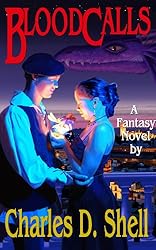
E-Book Review: Blood Calls by Charles D. Shell

Image result for blood calls charles shell

Blood Calls

by Charles D. Shell

(Please note: I was given a free copy of this e-book in return for my honest review. This is it.)


Now that was a fun book.

I haven’t read a ton of independently published e-books; but of the ones I have read, this was without a doubt the best.

It’s the story of two outcasts, a man and a dragon, both the victims of deep-seated and vicious prejudice, who find friendship and solace with each other; until they are finally forced to leave the land of their birth. The man, Corbin, who is a nobleman of his home country of Denza despite being an unwanted bastard with a mother from a despised minority, is given a minor diplomatic post in neighboring Sunal, thanks to the influence of his influential uncle. Corbin and his only friend, the dragon Blood, travel to Sunal, where, if everything goes according to plan, Corbin should be able to sink into relative obscurity, pursuing his twin passions of drinking and womanizing, and perhaps occasionally dipping his toes into diplomacy.

But world events, and Corbin’s heart, have other plans. Corbin finds that the prejudice that he has suffered under for all of his life is nonexistent in Sunal, where the Skuranese, his mother’s people, are accepted. Corbin is able to find friendships (with other men, for once) and even to pursue a woman for more than a roll in the hay. This would be enough changes in Corbin’s life: but there’s more. War is coming to Sunal. War that could threaten everything that Corbin has found there, as well as his homeland, his life and the life of his dragon, and perhaps everyone on the continent. Unless Corbin and Blood can do something about it.

The world-building in this book is top notch. The relationships between the various nations and their people are interesting, and enough historical backstory is given to make it all seem quite realistic. The magic system is done well, with different spellcasters making use of summoned spirits and creatures, or simple control of the four elements, or Frankenstein/steampunk creations made of living creatures mixed with machines. There are some unusual elements in the magic system that were very intriguing – like sonomancy, the use of sound for magic and also as a weapon; Shell was also able to reflect that form of magic in the society that makes use of it, which was a thoughtful and effective choice. The military aspects of the war – which is told not only through Corbin’s experiences, but also from the point of view of an officer of the aggressor nation of Gurein, which is trying to conquer and consolidate an empire, no matter what the cost – are as good as any military fiction I’ve read. I did wish there was a map, a visual aid that I have always found both interesting and useful in books like this; hopefully the author, with his arts background, will be able to provide one in future books.

The book isn’t perfect. I thought the romance was a bit haphazard: Corbin has never been anything but a womanizer, and though it makes sense that he’s never had an opportunity to be anything more, he jumps from that habit to a pursuit of true love a little too easily; he also settles on the object of his affection without much more inspiration than Romeo and Juliet, and though I love the Shakespeare play, I don’t really believe in love at first sight, especially not when it is turned into a chivalrous courtship, as this one basically is (though not entirely, I hasten to add). The dialogue and banter between the characters is often amusing, but much too close to our own society, using slang and colloquialisms that don’t make a lot of sense in world that isn’t ours; hearing a man from Denza call his telepathic dragon a “smart-ass” sort of took me out of the fantasy. (Also, maybe it’s me, but I want fantasy books to have fantasy names; though most of the main characters do, there are side characters with names like Jerry or Terri, which again kind of burst the bubble.) I didn’t like the character of Dante Firetongue, who is a newspaperman straight out of modern comics – he even refers to a good story as a “scoop” – and who never really settles on a personality, leaving us guessing whether he’s a shallow, selfish bastard or a good guy with a high defensive wall around his heart. I also thought Blood, the dragon, who is a good guy with a high defensive wall around his heart, was just too much of a jerk sometimes, when I wanted him to be lovable even when he was being sharp-tongued.

However, none of these things are the heart of the book. The heart of the book is the characters learning how to live together, accept each other, and protect what is truly worth protecting. That, the book does extremely well. There is good action, good suspense, and good humor throughout; and I enjoyed the ending as much as I enjoyed the beginning, which is the sign of a good novel. I’d recommend this book for fantasy fans, and I plan to see what else Mr. Shell has to offer.

Book Review: The Mighty Swordsmen

Isn’t that beautiful? Interesting how the men are in greater detail than the women, who are graphic and one-dimensional. Maybe there’s a reason for that . . .


The Mighty Swordsmen

Edited by Hans Stefan Santesson


A collection of Mighty Warrior swords-and-sorcery stories, this was like most of its kind: a couple of good ones, some that were okay, and a couple of stinkers.

The stinkers were “Break the Door of Hell” by John Brunner and especially “The Keeper of the Emerald Flame” by Lin Carter. The Carter story was too painfully derivative of Conan stories to be worth reading – though I admit I like the name Thongor – as well as too long and plodding, and the bad guy at the end was completely lame. The John Brunner story had some good bits: the concept is Ahura Mazda, the evil deity of Zoroastrianism, wandering Earth and granting people their wishes – which immediately makes those people regret their wishes. Some of those evil wish-grantings were great. The main city that Mazda goes to torment – and he sees himself as merely acceding to people’s wishes, not in any way working evil, and he’s probably right – has a great number of noblemen who would be sorcerers; they start casting their mojo, and even though they don’t really know what they’re doing, Mazda makes it so that their spells actually work: to their unspeakable regret and torment. That part was pretty fun, but also a bit repetitive; and at the end, the twist just irritated me. Bad story, overall.

The mediocre ones were the Elric of Melnibone story, “The Flame-Bringers,” and one of the two Conan stories, “The People of the Summit” by Bjorn Nyberg. The Elric story was actually fine, but exactly like every other Elric story I’ve ever read: he goes questing with Moonglum, brings out Stormbringer even though he doesn’t want to, chops up some enemies and eats some souls, and then calls out the damn dragons to save his bacon at the end. The one Conan story was also fine – better than Thongor – but it was overshadowed by the one that finished up the collection.

That last one, “Beyond the Black River,” along with the Roger Zelazny story “The Bells of Shoredan,” was by far the best. The Zelazny story was about his Dilvish the Damned character, who’s cool to begin with, and this was, for once, a self-contained story, with a good twist, and Zelazny’s usual beautiful prose and wonderful atmosphere. The last story was Conan as written by Robert E. Howard, and seeing that story along with a Conan by a different author, and the cruddy Thongor knock-off, really drove one point home: Robert E. Howard was a hell of a writer. That last story is the longest in the collection, but also the most exciting; Conan is the ultimate badass, and yet he is the most human and believable hero in the bunch. If you can find this collection – unlikely, as I picked up a faded copy with the cover falling off at a Goodwill in town – then it’s worth getting just for the Howard story. And the sweet 1970 pulp fantasy cover art. Good stuff.

The Warrior of World’s End

The Warrior of World’s End (The first book of the Gondwane Epic)
by Lin Carter

I’ve been reading some of the older pulp fantasy/sci-fi books, and this was one of those — a Daw paperback, the pages yellowed on the edges, the cover price only 95 cents. Lin Carter is one of those names I always see on rows of thin, dog-eared paperbacks in used bookstores, but not one I ever needed to read.

But that was only because I didn’t know what I was missing. And if you’re a fantasy fan, especially a fan of cheesy Robert-E.-Howard’s-Conan style fantasy, you must read Lin Carter.

This book was brilliant. I can’t wait to get back to the used store and buy the second book in the Gondwane Epic, and then keep going until I get to the end — and I hope that’s a long way off. The basic idea is this: 700 million years have passed since our current era, and the Earth’s continents have drifted into each other to form a single mega-continent — the title of the epic and name of the continent coming from the primordial Gondwanaland, the mega-continent that was the southern half of Pangaea, when all of the Earth’s land surface was in one land mass that became two and then became many — and things are, of course, very different. It’s a fantasy world-building technique that I’ve always enjoyed; my other favorite use of it was in the Wheel of Time. In this case, you have a traditional swords-and-sorcery society, with the opening narrative from the point of view of a trader riding a donkey from one great city to another, passing through the Crystal Mountains by a great desert, with his wife, who is actually a sentient plant-being. On the way through the mountains, an earthquake shakes the land, and soon they discover a Great Epic Hero wandering through the aftermath, lacking even the ability to speak intelligibly — but his thews are mighty, and his hair is glittering silver. This is Ganelon Silvermane, the hero who will save the world from doom: the star of the epic. The trader and his wife take Ganelon in and raise him like a seven-foot-tall bodybuilder/baby; they teach him to be honorable and courageous and everything a hero should be, and then off he goes a-heroin’.

It’s great. Carter uses all kinds of unnecessarily fancy words and complex sentences, but without making the book as hard to read as, say, H.P. Lovecraft’s work. There is a simplicity and childish glee in it that made me smile the whole time. It reminded me very much of Conan, or of Edgar Rice Burroughs’s John Carter of Mars series, but with a heavier tilt towards fantasy and away from SF — since there is a Red Enchantress, and an Illusionist, and Death Dwarves, and a magic flying bird-vehicle made of brass and granted intelligence and a personality, and the ability to speak. Ganelon meets a lithe Amazonian-type warrior woman, whom he saves from evil priests, and who I’m sure will be a love interest at some point, but our hero is too innocent of the ways of love as of yet; so far all he does is fight great battles and break large things with mighty swings of his flashing sword, all that kind of stuff.

It was a hoot. Highly recommended for those who like this sort of thing.

If you liked this book, you might also like:

Conan stories by Robert E. Howard or Robert Jordan

John Carter, Warlord of Mars series by Edgar Rice Burroughs

Dark Elf Fantasy

(Probably not what you were thinking.)

Homeland (Book One of the Dark Elf Trilogy in the Forgotten Realms world of AD&D)
by R.A. Salvatore

I’ve never read these books before, though every gaming nerd I’ve taught English to in the last fifteen years has read and loved and recommended them. Drizzt Do’Urden is one of the most prominent and well-known characters to rise out of the D&D universe, which has run the gamut from role-playing games to countless novels to bad TV shows and worse movies. Drizzt is a Drow, a dark elf, one of the evil races of the D&D universe, like orcs and goblins and the like, and this book takes on the interesting task of making the Drow seem vile and cruel and merciless, while also making Drizzt himself sympathetic.

It’s a tough challenge, but Salvatore did it fairly well. I have read better books with a similar concept — the Elric of Melnibone series by Michael Moorcock are probably the best at this, along with Fritz Leiber’s Lankhmar books — but this one was well done. Drizzt is born into a noble House of the underground kingdom of dark elves called Menzobarranzan; as the third son (the kingdom is both matriarchal and theocratic, with the dark elf women serving as priestesses of an evil goddess named Lloth) he would have been sacrificed at birth, except that one of his elder brothers assassinates the other the same night when Drizzt is born, opening a slot for Drizzt to remain alive. He does, and grows into a hero, the greatest swordsman of the realm, and, most unusual for a Drow, a man with a sense of honor and a conscience.

The world is very well built, internally logical and consistent and in keeping with the larger D&D world; the Drow read like what they are, a universally evil race who worship a spider-demon and loathe kindness and mercy and love and anything else virtuous or good. It was interesting to see the ways Salvatore used elements of fascism in the Drow world: the children are very clearly indoctrinated, taught to hate an external enemy and blame that enemy for all of their own suffering, though that suffering is clearly inherent in their way of life; at the same time, they must obey the dictates of their own unquestioned supreme leader, constantly trying to curry her favor and savagely turning on those who displease her, even though they do not know why she is angry or why she is happy with any particular Drow. I imagine this is much what it was like to live in Hitler’s Germany, which I’m sure was Salvatore’s intent, or at least his inspiration.

I was a bit less pleased with Drizzt himself. Partly that is because I hadn’t read his previous adventures; these books are an origin story for a beloved character from another series, and so there were moments that were supposed to be meaningful for me that weren’t — for instance, the Drizzt character is well known for his companion, a magical black panther named Guenhwyvar; when she was introduced, I should have thought, “Hooray!” but it didn’t register at all other than :”Hey look, a magical black panther.” More problematic was the author’s attempt to make Drizzt a better man than his family: because there was no particular reason why he should have been more decent or honorable or merciful than every other Drow — he just was. Some of it came from his (not-quite-as) honorable mentor, who trained him; but why was the mentor more honorable then? Well, he just was, too. And sure, that’s how it works in D&D, but I think characters in a novel should make more sense.

The action was good, the world was great, the characters were fine. I’ll be reading the sequel.

If you liked this book, I would recommend:
Elric of Melnibone by Michael Moorcock (And the rest of the series)
The Fahfrd and Grey Mouser series by Fritz Leiber (Swords and Deviltry, Swords Against Death, Swords in the Mist, etc.)
The Conan books — I’d recommend the two Roberts, E. Howard who created the character and Jordan who wrote it better than anyone else since.