Spring Break Book Review #6

(Had a slowdown there when I had to get some work done for school, and had a family visit. But it’s still Spring Break! And I’m still reading!)
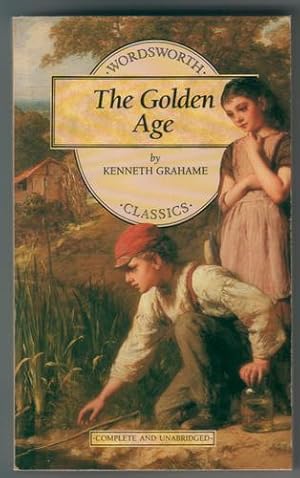
Image result for the golden age kenneth grahame

The Golden Age

by Kenneth Grahame

I think I have just read the most British book ever written.

It’s Victorian, of course. Written by the man who wrote The Wind in the Willows. It is about a family of children, three boys and two girls, who are orphaned; but that fact is, in proper British fashion, never really talked about: it is hinted at by saying that they know a long succession of aunts and uncles, none of whom they get along with too terribly well, and never talking about their mother and father. It describes their childhood in the most idyllic fashion imaginable: they scamper and run and play in the green meadows and fertile farms and darkened woods of the English countryside, never seen as anything other than glorious and, yes, golden; and the narrative is almost entirely tongue in cheek, but not in a terrible way: it’s more like a grownup playing along with children, taking their games seriously, believing what they believe, but always knowing and appreciating the innocence of those kids.

It’s nicely done, actually. Made me laugh several times. The kids have great imaginations, and they play games that sound like enormous fun, and made me want to go out and steal a rowboat and row it up a creek, pretending to be Jason and the Argonauts in search of the Golden Fleece. I like how they constantly try to dodge their lessons – provided, in very upper-class-British fashion, by a tutor and a governess; I like how they play King Arthur and fight over who gets to be Lancelot. There is a very sweet moment when they plan to throw a snarky celebration when their much-feared governess departs, but as the day grows closer, they realize they don’t really hate her, but will miss her when she is gone, and their snarky celebration turns into a genuine sadness over the leavetaking. There is a hilarious moment when they play a game at midnight, creeping through their house, and in the process scare off their new replacement tutor, who thinks they are ghosts and goblins. There are many realistic moments when they talk about their relationship with each other, which sibling is the tattle-tale, which one is the most manipulative, which one is the easiest to trick; and also when they talk about their relationships with adults, who often condescend or ignore, or – worst of all – think that everything they say is funny. So annoying, those would-be comedians.

It is a golden age: so golden it’s almost fantasy. Which is interesting, because this book is almost more fantastic, in the sense of being make-believe, than The Wind in the Willows, which has fantastic elements in a much more serious and realistic setting and plotline. This book is very much a depiction of childhood innocence, and it was a lot of fun to visit those halcyon days of yore.
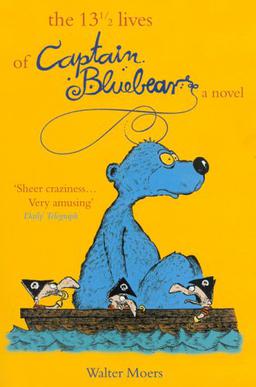
I’d read it 13 1/2 times.

The 13 ½ Lives of Captain Bluebear

by Walter Moers

What I really want to do is spin a yarn worthy of this book. Something about how I found it rattling around inside a mandolin that was given to me by a Chupacabra who had disguised himself as a mariachi in order to hide from his family, who didn’t understand his determination to give up sucking the blood of goats and stick entirely to turnip juice, which he found much less phlegmy.

But that’s not my task. My task here is simply to tell people about this book, and how it was to read it; I have to tell you about Walter Moers’s imagination.

So here it is: this is an amazing book. Simply amazing. The cover says that it is “equal parts Douglas Adams, J.K. Rowling, and Shel Silverstein.” That’s essentially right, though it is honestly not quite as funny and improbably absurd as Douglas Adams’s books (But then, what is?). But it does have the same sort of basically shy, unobtrusive main character swept up in events larger than he, though Bluebear does come into his own more than Arthur Dent ever did, and it does have the same no-holds-barred universe, where literally anything is possible: where a character can transform into a fish in midair to save themselves from a fatal plummet off a cliff; where one can walk into the brain of a giant and have adventures accompanied by a thought; where an entire city can exist inside a tornado, and another can launch itself as a giant spaceship. Most importantly for the Adams connection, this book has an explanatory device that functions like the Hitchhiker’s Guide: Professor Nightingale’s Dictionary, which Bluebear has inside his head, after studying with the Professor himself for a time, and to which he refers whenever he is mystified by his surroundings – which is frequently. Those are some mystifying surroundings.

They are magical, too, which is how like this book is like Rowling’s work; the depth and breadth of the world is much like the magical realm of Harry Potter; and this one, too, exists within – or perhaps parallel to – our own world; I wish I could walk into Zamonia just like I wish I could visit Diagon Alley and Hogwarts.

And what’s more, this book is illustrated by the author, whose style is much like Silverstein’s. As if the wonderful story wasn’t enough, he adds these adorable cartoony drawings, just to bring it that much more to life.

There are a few other books and authors that this novel reminds me of: Alice in Wonderland springs to mind, of course, as does Winnie the Pooh, whose sweet innocence and serenity are echoed in Bluebear (Who is also, of course, a bear: one with blue fur, as the name implies). China Mieville’s UnLunDun is the most recent book I’ve read that has the same magical realm close to our world in it, which also brings me to Neil Gaiman’s Neverwhere, though that book is darker than this one. My own childhood mythology included the Moomintrolls of Tove Jansson (Also European, also translated, also illustrated by the author, as is Bluebear), and in the epic and episodic nature of this adventure, I can see just a little of Don Quixote and my favorite fantasy series, The Lord of the Rings and The Wheel of Time.

It’s got a bit of everything, and so I would recommend it to – well, everyone. Quite highly.

Book Review: The Patron Saint of Lost Dogs

By the way: that cute dog isn’t even in the book. So disappointing.


The Patron Saint of Lost Dogs

by Nick Trout

So it turns out the author of this book is a real vet. And it reads like it.

I don’t mean to be too critical: this was a sweet book, with a genuinely happy ending; I was rooting for several of the characters – hoping for rewards for some, and comeuppance for the others – and pretty much everybody got just what they deserved. And, not to spoil anything, but there is no terribly sad animal death, as there is in nearly every other book about pets, from Where the Red Fern Grows to Marley and Me. It was lovely to read about animals who come into a vet’s office not feeling well, and then leave feeling better. It made me smile, and if that would make you smile, the book is worth reading.

But the hero, Dr. Cyrus Mills, is just such a weenie. There are reasons for it, and he deals with them and improves; but it takes him so long to dig his way out of his weenie-ness that first the book feels annoying, and then a little unrealistic, because how could a guy who’s that deep in the ween-pit finally turn it around that quickly? And while not all of the small-town Vermont characters were obnoxious, there were several who were, and when the hero-weenie can’t deal with them beyond getting tongue-tied and scratching at the back of his head, which is quite literally how every conversation ends for the first half of the book, it makes you want to crawl into the book and start punching. Which is less sweet than the feeling you get from cured animals.

Mills is not a people-person: I get that. I’m an introvert myself, and I don’t handle confrontation well, either; but the trouble is, he’s not even good at not being a people-person. Mills is a veterinary pathologist by trade who finds himself in a small-town vet practice, trying for the first time to deal with actual living pets and their owners, rather than slides of tissue and the remains of deceased pets in a quiet, sterile lab. He is cold and clinical and tends to hide in scientific jargon. All of that makes sense. But he is also tender-hearted: being around the animals is almost instantly emotional for him, breaking through his shell; this is what makes him tongue-tied, because he is aware that he is cold and harsh-seeming, and he tries to change that for the sake of communicating successfully with the pets’ owners. I don’t buy that. If he has spent fifteen years in a basement lab with dead things, and liked it enough to do anything he can to get back to it (which is the basic conflict in the plot), then he would be indifferent to the feelings of the humans who come to see him, and probably of the animals, too. Sure, the sweet puppy faces might break through that hard exterior, but it wouldn’t happen with the first one. If, on the other hand, he’s a big softie who loves the animals – a position I fully support – how could he have been happy sitting in his basement lab for fifteen years, never even owning a pet?

All the reader is left with is the determination that this guy is a weenie who either doesn’t know what he really wants, or doesn’t have even a little of the gumption needed to go out and get it. By the end of the book, he sorts this out – but I disliked him enough in the beginning to not really care that he wins by the end. I was happy that his victory works out well for a lot of other people in the book, who I actually liked better than Cyrus himself.

Especially Frieda Fuzzypaws.

Overall, it’s not a bad book. There are probably better.