Good Art, Bad Artists

Judith Beheading Holofernes, by Caravaggio: a scoundrel and murderer. The artist, that is: Judith was a warrior fighting an oppressor. And a badass.

I had a difficult conversation with a student this week.

Actually, I had several: and yes, I still need to write about how teachers have too many expectations put on us, because I acted this week as a counselor and a confidante, a corrector and a — a conspirator is too strong; but “co-worker” is not strong enough. Ah, well. Even without the perfect alliteration, I still talked to a student about cheating, and to another student about old relationships, and another student about aging family, and another student about old relationships that won’t go away; and I discussed abortion with two different classes, and the dress code with three, and racism with my co-workers…

And then there was this difficult conversation that came up with one of my favorite students.

I start every day with “Has anyone got any questions or concerns or issues you’d like to raise to the class?” And in some of my classes, there are specific students who respond to that invitation every single day: two of them ask about me and how I’m doing, which is very sweet but also invites dishonesty, because I don’t usually want to start the class with “I’m terrible and right at this second talking to all of you people is the last thing on Earth I want to be doing;” so instead I say something more neutral, even though I don’t like lying. But that’s an acceptable lie, because the class isn’t about me, even though students are happy to delay work by discussing me and my life; my job is to move them into the learning, so I do that, and it’s not a big deal.

But I have this one student who always brings something up. It’s usually something philosophical: this young person is extremely bright, extraordinarily curious, and has a deep love of learning, and so all of his free time is spent learning things or discussing things that he has learned; and all of his time in class is spent — well, the same way, really. I have shown him that I’m also interested in philosophy and enjoy talking about topics both random and profound, and so he has grown more comfortable over the school year with talking about whatever happens to be on his mind.

For perspective, he responded to my invitation Friday morning by talking about the deep anxiety he feels when he thinks about death: because, as he said, swaying in his seat and throwing his arms and head about like a wild-eyed symphony conductor, leading the orchestra of his body in playing the song of his opinion (which is the way he always talks when he gets excited about something), he loves life so much, and wants to experience everything, and the human lifespan is just not long enough! And while I was trying to disagree with him, because I am of the opinion that years are actually very, very long, and while there is never enough time to do and see everything we want to do and see, there is so very much time to do and see most things, he explained that in a few months’ time he will have a birthday and at that point he will be older than his older brother: and that comment made some things very clear to me. This is why he knows, in his bones, that life can end, suddenly, without warning, and far too early; and so of course he is anxious about it, and of course it seems to him like it is far too short. Because sometimes it is: and he knows it much better than I.

And that wasn’t the difficult conversation we had.

No, the difficult conversation came on Thursday: when he asked if it is possible to separate the art from the artist, and enjoy content created by a person you could not personally enjoy, or agree with, or even abide. And if it is possible, how could it be done?

That’s a tough conversation.

It was made worse by the fact that we disagreed on at least one prominent example of this issue, the author J.K. Rowling; and then, as we were getting into the weeds with this, I realized that I was speaking only to this one student, while the rest of the class was off on their own; so I had to cut it off. I hate cutting conversations off: particularly when they are important, as this one is, and when they are meaningful to those involved, as this topic was both to me and to this young man. And to be clear, if this had been one of my English 10 classes, which are currently studying argument, or my AP Lang class, which is just about ready to move into argument, then I would have opened the discussion up to the whole class, formalized it into a specific topic with a specific claim, and then solicited points pro and con, and counterarguments to those points, and then spent the whole class period on this if necessary; but it was College Readiness, which never studies argument, and I needed to move on. I tried to write more of my opinions on this for the young man to read, while they were working on their application essays, because part of what I had said had hit him in the feelings; but I didn’t have the time or the mental acuity to make my point clear enough.

I knew I had to write about this for this week’s blog.

(Yes, I know I am again procrastinating the analysis of the rest of the Letter from Birmingham Jail. I’ll get there. But I asked my class if I should write about what I said I was going to, or if I should procrastinate that topic and write about the one that had captured my thoughts; and they all said I should procrastinate. Who am I to dispute with a class full of honors students? At least, when they say something I want to agree with anyway. So. Here goes.)

“Tehemana Has Many Parents” by Paul Gauguin, who abandoned his wife and children to move to Tahiti and make art. Amusingly, I got this image from a New York Times article titled “Is It Time Gauguin Got Canceled?”

So the question is, if something is created by somebody who has something terrible about them personally, can we enjoy the thing that terrible person created? Or is it tainted by the terribleness of the creator? Is it possible to separate entirely the art from the artist, and enjoy content from problematic people? This question is made more difficult, of course — particularly for my students’ generation, though also for all of us older more jaded people, too — by the recent rise of the social standard which says anything associated with, for lack of a better word, evil, is also evil, and taints everyone and everything who touches it. This is the standard by which people have been cancelled online — again, like J.K. Rowling.

And that’s where this gets complicated. Because I am a liberal, and I want to promote liberal ideas like equal rights and privileges for all, and a safe, supportive community for those who are marginalized and discriminated against. And because I am a white man, and I recognize that I am not a good judge of what is hateful and hurtful, as essentially none of the hate in the world is directed at me, and even that which is doesn’t have much impact on me, as white men like me have built a society that privileges and protects us, I know that I should listen to others who say the work is offensive more than I should dismiss those claims based on the useless fact that I was not offended by the work. But I am also an artist, and a teacher, and therefore a passionate believer in the value of art, and in the defiant opposition to what I see as the unforgivable act of censorship. So my liberal side wants to support those who tell me that artists with evil ideas or acts or intentions are harmful; and my artist/teacher/free speech side refuses to even consider the idea of cancelling anyone.

That is, at least in part, what we are talking about: cancel culture. But see, the second I type that, and start to think about opposing the idea of cancelling someone like J.K. Rowling, I start to sound like what I look like: a privileged middle aged white man who has never had to deal with oppression, and is therefore too quick to protect other such privileged white people, and maintain the status quo that continues the oppression and marginalization of people who don’t look or live like me. I start to sound like a Republican, and particularly like the worst of them. I sound like Trump.

Okay. Not really. I’ll never sound like Trump, not least because I can put together a goddamn sentence; much more because I’m not a heartless, shameless narcissist. But still: it’s uncomfortable to side with the bad guys. I want to stay on the side of the angels, as I see them.

But on this? The angels are kinda wrong.

Okay, so let’s lay out the basic premise. If an artist has a bias, it is likely, but not inevitable, for it to show up in their work. This is particularly true of artists from the past, because as time goes on, and society progresses away from the oppressive past, we recognize more about what we do and have done that is wrong — not least because we are finally paying attention to what marginalized and oppressed people have been saying all along. This means that the biases of past artists were not as obvious to them as they are to us, and were also frequently more socially acceptable. Shakespeare, for instance, was atrociously anti-semitic; but that’s partly because Edward I expelled all Jews from England in 1290, and the persecution of Jews continued through Shakespeare’s time: so for Shakespeare, he was likely unaware of how the stereotypes of Jews that he knew were false and offensive. For him, simply having the character of Shylock was very progressive; he wrote a caricature of Jews (And a nasty one — a bloodthirsty moneylender), because that’s all he knew; but then he gave that Jewish caricature an important role in the play — albeit as the antagonist — and a genuinely wonderful speech that argued eloquently for the essential humanity of Jews. And then, of course, he has Shylock saved at the end of The Merchant of Venice by converting to Christianity: so yeah, pretty gross. But my point is that Shakespeare wouldn’t have recognized that as offensive in the same way that we do: he likely would have seen it as open-minded. It’s the same, though on a different scale, with Harper Lee’s novel To Kill a Mockingbird: the work is consciously and intentionally anti-racist, with the portrayal of an African-American man, Tom Robinson, as an innocent victim of the corrupt Alabama courts and jails, who are clearly in the wrong; and with Atticus Finch’s insistence that people be judged by their actions and not their appearance or reputation. But at the same time, there aren’t many better examples of the “White savior complex,” the idea that African-Americans are incapable of fighting for their rights, defending their own against racism and racists, just generally incapable of solving their own problems — and thus in need of rescue by high-minded White heroes. Atticus rides in on his white horse to save the day, and the Black population of Maycomb are immensely grateful and also extremely deferential, standing for him as he passes from the courtroom, and even doing the same for his children when Scout and Jem go to Calpurnia’s church. The book centers the White experience of racism, with the Black characters serving as background. But again, considering the 1960 publication date, and the author’s upbringing in Alabama in the 1930’s, it’s a damn progressive novel — which we can now see is problematic. I hate reading the scene where the people at Calpurnia’s church line up and take off their hats for the kids, and though Atticus’s closing argument is one of my favorite speeches in all American literature, there’s a part there where Atticus offers something of an apologetic for Bob Ewell, the appalling villain of the book:

“…We do know in part what Mr. Ewell did; he did what any God-fearing, persevering, respectable white man would do under the circumstances—he swore out a warrant, no doubt signing it with his left hand, and Tom Robinson now sits before you, having taken the oath with the only good hand he possesses—his right hand.
“And so a quiet, respectable, humble Negro who had the unmitigated temerity to ‘feel sorry’ for a white woman has had to put his word against two white people’s.”

Because yes, that line about “God-fearing, persevering, respectable white man” is sarcastic; but it’s sarcastic because Bob Ewell is none of those things other than a White man, and therefore it’s ironic and even absurd that he is playing the role of such a White man: but that argument relies on the idea that swearing out a warrant to arrest the innocent Black man, who was definitely not raping his daughter, is precisely what an actual God-fearing, persevering, respectable White man (Henceforth a GFPRWM) would in fact do. And that’s gross. As is Atticus’s complimentary description of Tom which focuses on him being “quiet” and “respectful,” rather than, say, dignified and respectable.

So in both of these cases, as in countless others, the bias of the artist is clearly and indelibly represented in the work. And that, I have no disagreement, degrades the work and takes away from any positive impact the work may have. The fact that neither author would necessarily have seen their art as racist or even insulting is beside the fact: we now recognize these works as such — and we’re right, because the authors were blinded by bias and cultural ignorance.

But does that bias, and that degradation it causes, mean that the work should be eliminated from our culture? Forgotten, put aside, replaced with something more current and aware?

Maybe. In some cases. In these two cases, no.

I think that, while the work shows bias and is offensive, these two examples (and others, like Mark Twain’s The Adventures of Huckleberry Finn) are also of such high quality and such important influence on our society, that the negative aspects do not entirely negate and disqualify the positive aspects. There are cases (like Mark Twain’s The Adventures of Tom Sawyer, which is both deeply racist and also pretty dang stupid as a book, even though Twain’s writing craft is always brilliant) where the negative aspects do override the positive aspects, because the positive aspects are smaller, or the negative aspects are worse; another fine example would probably be Adolf Hitler’s Mein Kampf, interesting for historical study but otherwise definitely worth being consigned to the ash heap of history. (Clarification: I’ve never read Mein Kampf. It may be better than how I am describing it. But I doubt it. And there the author is SO bad that even work of Shakespeare’s quality should probably be discarded. I mean, it’s Hitler.)

But the important point is this: the negative aspects of the author and the work do detract, yes. But the positive aspects of the author and the work should be seen as pushing the needle back the other way, weighing in on the good side and thus counterbalancing some or even all of the negative aspects. Which means that we can’t simply discard every work by every artist we disagree with, even if that would be easy and feel nice. These decisions need to be made, even though they are hard; there isn’t a simple, fast, obvious rule. Each case should be decided individually, on its own merits — and as individual pieces, not merely one decision about the artist’s entire body of work. I would argue that the work, and our society, gains something positive by the simple process of having those conversations, even if they are difficult.

This is where I part ways with many of my fellow liberals who participate in or support what is often called “cancel culture.” The label “cancel culture” is itself biased and offensive; it is a sarcastic label, applied by the right to people on the left, which has come to be taken seriously by those on the right without any sense of humor or proportion; saying that people were cancelled because of their misdeeds and misstatements and bad personal ideologies or habits was originally a joke, though a biting one that was sometimes serious; and it gained initial popularity on “Black Twitter” — though I’m sure that’s a coincidence, and the opposition to cancelling and cancel culture from the right is in no way related. (More detail here.)

Cancelling someone often means a total separation, a total refusal to have anything to do with the person or their work; and I don’t agree with that. As I said, I think artistic work has to be taken on its merits as well as its demerits: and it has to be done on a case-by-case basis. Because if a piece of work does not reflect the creator’s biases or negative ideologies, then the only reason to cancel or refuse to engage with that piece is a moralistic judgment of the person and a sort of self-righteous attempt to remain pure and untainted by association with the offender.

And that’s bullshit.

That is not to say that I support people who have nasty opinions or who are nasty people; and that is where this argument gets even more complicated — with the idea of support. If I subscribe to Andrew Tate’s How To Be A Manly Man videos (Again, I have never actually watched Tate’s content; and I ain’t gonna), then I’m giving him money and adding to his follower count. If I share or promote them, then I am extending his reach and influence. Though, if I subscribe because I want to make fun of him and have specific evidence of what makes him a cripplingly ridiculous shitnozzle, I tend to think that counterbalances the money and the notoriety I add in his favor. Mentioning his name in this here blog is in some ways promoting him, because now people may look him up out of curiosity (Word to the wise: don’t. That is, don’t watch his videos or subscribe to his content. Feel free to read about how Greta Thunberg broke his little man-heart.), but I don’t believe that I am going to gain him followers. I recognize there is some risk of this, because somebody who reads this may look him up out of curiosity, and end up being influenced by his worldview; but I don’t really think that people who read this blog are liable to fall in line with a toxically masculine fucksack like Andrew Tate. I think the same thing about the movement in recent years to never mention the name of a mass-murderer, because some of them have said that they carry out their massacres in order to achieve notoriety; first, I call bullshit on that, because murderous psychopaths are murderous psychopaths, and if you take away one motivation, they’ll find another one; and second, which murderous psychopaths are going to read this blog, or someone’s social media post, and then get a frisson of pleasure at seeing their name? Does that really happen? I don’t buy it.

On the other hand: there is not much lost which is positive if I use general epithets instead of a specific name, like if I mention the school shooter at Sandy Hook without naming him. I don’t lose anything; I guess the phrase “school shooter at Sandy Hook” is longer and a little more unwieldy than his actual name, and one could argue that a murderer who was an attention hound would get just as much pleasure from the notoriety of his actions even if his name weren’t actually included, so naming Sandy Hook takes away the point of leaving out his name (It was Adam Lanza, by the way, and he certainly can’t benefit from me writing his name since he is dead; and the argument that giving him notoriety might inspire other shooters is too unlikely for me to accept); but generally speaking, there isn’t much harm in not writing out a killer’s name. So even if I don’t think it matters, I’m willing to follow the trend there, because it doesn’t cost me anything other than a few extra keystrokes — and considering how many extra words I put in any particular post, well.
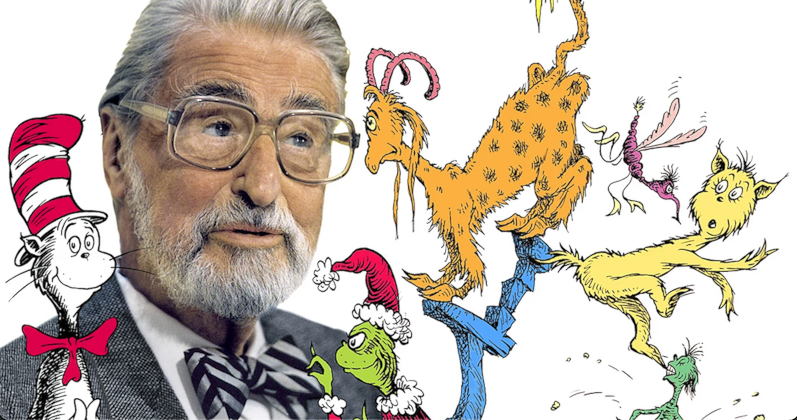
You’re a vile one, Dr. Seuss! You have termites in your smile! You have all the tender sweetness of a seasick crocodile, Dr. Seuss…

There is, however, a cost in discarding great art, and particularly in cancelling an artist and all of their work entirely. Dr. Seuss did indeed create a number of deeply racist cartoons when he was illustrating for magazines before becoming the world’s most famous (and in my opinion, best) children’s author and illustrator; and those things are genuinely bad, and do taint his legacy because they change our view of him. But Dr. Seuss’s books are an absolute wonder, and a gift to children as well as to the world. It is not worth losing all of Seuss in order to send a message about people being racist in the 1940s. Similarly, while Mahatma Gandhi was a terrible husband and father, the incredible influence he had on the world should not be thrown aside in order to avoid “promoting” bad behavior by talking about a man who committed such bad behavior. I don’t think simply speaking about a person promotes everything they ever said or did or thought: I think promoting those particular bad works, those bad actions, those bad words, specifically, maybe promotes those negative words and deeds and thoughts — though even then, the context matters, and how you speak of the artist’s work or the politician’s words or the historical figure’s personal life, matters.

As a teacher, I also think that presenting the issues of bias and offensive material in art honestly and fully, with an understanding of the context of the artist and the art, and a clear recognition of both positive and negative impacts of the work, helps to detract from the potential negative influence of art produced by nasty people. H.P. Lovecraft, who created the Cthulhu mythos and the genre of cosmic horror, was a disgusting racist, and you can see that bias in the fact that every one of his protagonists is a white-collar white man, like Lovecraft himself; and frequently in his books, the monstrous demon or god is summoned by a group of non-white people who are frequently described as “sub-human” and shit like that. Again, the author’s bias is clear, and present in his work, and it definitely detracts. But I think if I go in as a teacher of fantasy and science fiction, and choose a story that doesn’t have the same problems (Say, “The Shadow Over Innsmouth,” in which the evil human minions of the evil god are, in fact, not really human — and not because they are not white [they are white New Englanders, just like Lovecraft and the story’s protagonist], but because they are part fish [And another thing that might help to prevent Lovecraft from negatively influencing my students might be pointing out that while he hated non-white people, he actually hated fish even more, which is why so many of his monsters are subaquatic and have fishy characteristics like scales and tentacles and cold blood and slimy skin. He also hated and feared air conditioners. Just sayin’.]), and in teaching it I bring up and show the negative sides of Lovecraft in a negative light for my students — I think that makes the experience overall positive, and creates a positive influence for my students, even though I’d be talking about and teaching something from a racist.
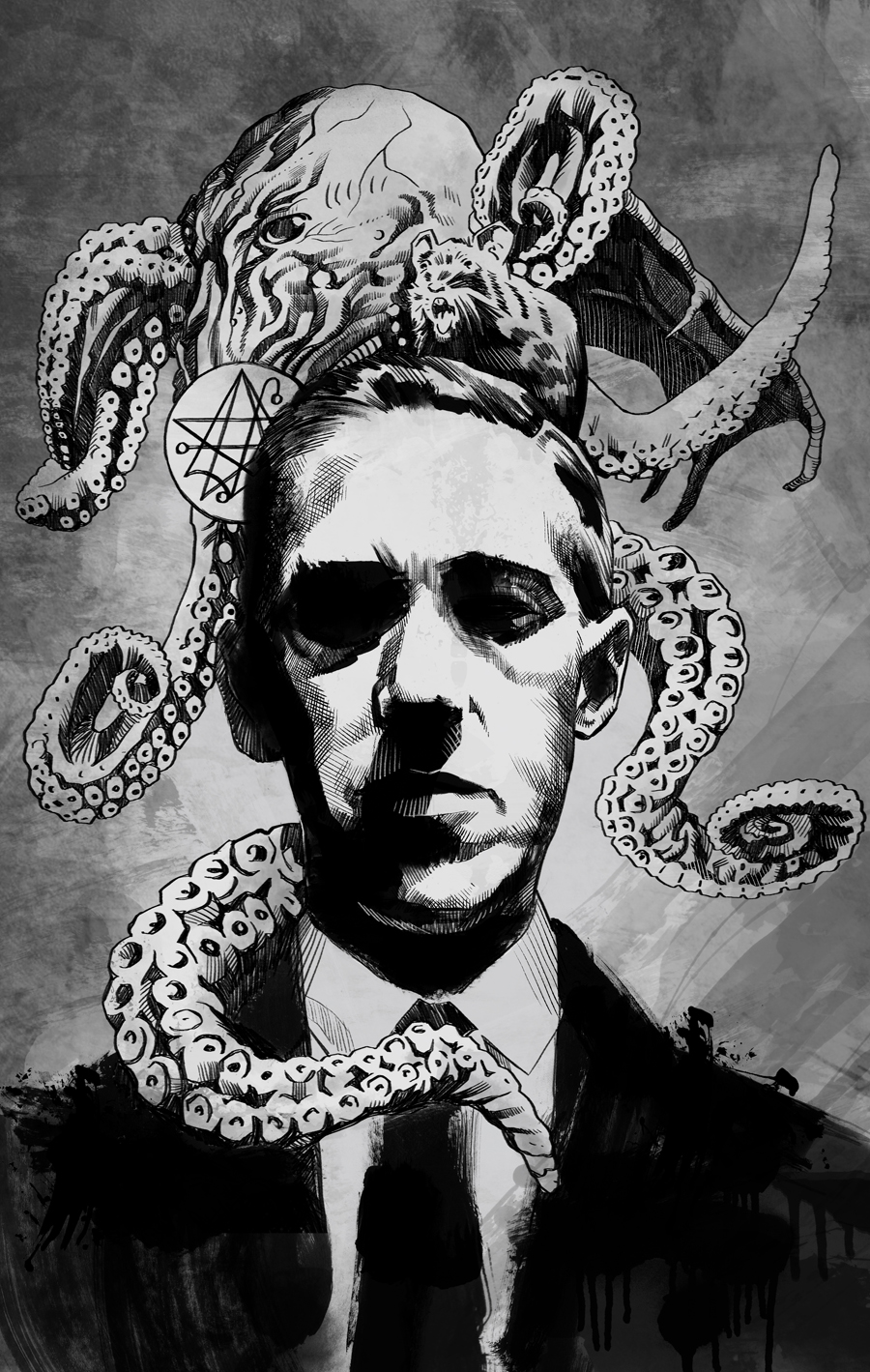
Image by Matthew Childers: who may or may not be a bad person. Or an eldritch monster. Prints available here.

Which is why I teach To Kill a Mockingbird even though it shows the biases of its author; because despite those biases, there is not another work I know of which attacks the same issues with the same brilliant prose and the same ability to captivate teenagers, even 60 years after it was written. When I find a work which does that but without the problems that come with Harper Lee’s book, I will stop teaching To Kill a Mockingbird. But I still won’t tell people not to read it or say its author’s name.

The conversation with my student got difficult because he brought up J.K. Rowling, and also Lewis Carroll. (I’m not going to talk about Lewis Carroll here: because although he is another prime example of my argument, that the vile nature of the artist does not necessarily disqualify the full value of the art, the specifics with Carroll are too toxic and taboo to discuss fairly — because Carroll was a pedophile, which we understandably see as literally the worst kind of person. I understand my student’s point that the fact of Carroll’s attraction to the actual Alice, because it is so closely connected to the work, taints the reading experience for him; I respect that, though I don’t agree. Rowling’s example is better for my overall argument, even though her opinion is also vile.) J.K. Rowling is a TERF: a Trans-Exclusionary Radical Feminist. She believes that people who have lived their entire lives with the full biological apparatus of a female person, meaning a womb and ovaries and menstruation — and who have, therefore, suffered from living under an oppressive male patriarchy which commits violence against women without hesitation — are more deserving of the name “woman” than someone who is trans. (Read this for the whole story in detail.) There’s no question for me that this bias is terrible and wrong — because trans women are women, and while the experience of cis women and trans women is different and you can certainly discuss those differences, there’s no good reason at all to argue that one or the other is a “better” or “worse” experience, or more “deserving” of anything — and also that it is a strongly-held part of Rowling’s specific worldview; but I don’t believe that it is a bias which is reflected in the Harry Potter books. Gender, and especially transgenderism, are simply not anything that matters particularly in Harry Potter. The work reflects the author’s biases in that there are more male heroes and villains than female heroes and villains; the Headmaster of Hogwarts is apparently always a man, or an evil woman (Dolores Umbridge) who is fanatically loyal to a man despite the man’s incompetence. But there’s just nothing in there about transgenderism, neither positive nor negative. It’s not a factor. The closest I’ve seen to the issue being present in the works is the idea that Rowling’s prejudices make the books, which are about an outsider who faces constant rejection, but eventually finds a place where he belongs, less wonderful for those, such as people who are trans, who found inspiration in them; and I can see that, and sympathize with those who may feel that way about the books — but that is a subjective response, which may certainly make a person discard the books: but it doesn’t mean that everyone should discard the books.

I do not think we should discard the books. I am a fan and lover and teacher and author of fantasy literature: and in the history of fantasy literature, the most influential and significant author is Tolkien — and the second most influential and significant is Rowling. Her opinions are, to me, nasty and unreasonable; but the books are wonderful, and largely untainted by those disgusting opinions. I recognize the desire to refuse to support Rowling by buying her books, or paying to see movies or other content based on her characters, all of which makes her more money — but I have to call bullshit on the value of a boycott of Rowling: she is the richest goddamn woman in Britain, and one of the richest women in the world. No boycott is ever going to touch her. No boycott, therefore, is ever going to change her opinion. Part of the issue here is her pride, her arrogance, in refusing to back down over this argument; she’s decided this is the hill she will die on, and that’s it. So let her die on it: don’t think that you can starve her out. Now, the article I linked above says that her last two books, written under the pen name Robert Galbraith, are much more connected to the issues of transgenderism and social media; though I haven’t read them, I’ll bet those are much more tainted by Rowling’s biases: and so I’m fine with cancelling those.

But not Harry Potter. Not over this.

There have been a number of commentators on the internet, it seems, who have gone back and looked at Rowling’s masterwork in order to find problems with it; but I am going to call bullshit on those, too. My student, in trying to argue that Rowling was too toxic to accept Harry Potter in our culture, said that the books are anti-Semitic, because Rowling created a race of beings who are short, ugly, deformed, big-nosed, cruel, and deceptive, and who run the banks. No: she gave goblins, who have ALWAYS been all of the descriptors I listed, a place in her magical world. Not a good place, granted, but then goblins have always been evil, as well. Reading that as an intentional negative portrayal of Jewish stereotypes is nonsense. I’ll accept it as a biased depiction of goblins, but I don’t see that as much of a concern. (Also, Griphook, while not really good, shows that the goblins have many positive qualities, and are also deserving of dignity and respect and equal treatment by wizards even if we don’t like them. So for a bigoted screed, it sorta doesn’t hold up.) The next shot was at the House Elves, and how Hermione is seen as ridiculous and stupid for standing up for this enslaved race, while all of the other wizards are entirely fine with slavery; this was described (by my student, again, who probably saw a video explaining this issue, but I have not done the research into it and did not ask for more details during the conversation, so it may have a source I am unaware of.) as supportive of or promoting slavery of a specific race. Probably supposedly an apologetic for slavery, though again, I don’t have the primary source for this. This is also nonsense, because Hermione — who is not alone in her objection to the enslavement of house elves; Harry agrees with her and eventually frees and befriends Dobby — is clearly the one in the right here; the plotline about the house elves is a criticism of the wizard world, and all of the wizards who scoff at Hermione are the ones falling in line with their society’s biases rather than engaging with them and questioning them, even when prompted to by Hermione. And those biases are wrong: even if the house-elves enjoy their situation, as many of them do, they are not seen as in the right, they are not benefiting from their slavery, as actual slavery apologists have argued for centuries. Nobody in Harry Potter says that the elves are better off for being enslaved by the wizards. They, the wizards who support slavery (And let’s note that, other than the elves who work for Hogwarts, the only two family house elves we see directly are both owned by evil families, the Malfoys and the Blacks), are the ones being critiqued, just as Voldemort, who is expressly linked to Nazi ideas and paradigms including racial purity and fascist dictatorships, is certainly not putting forward ideas Rowling agrees with, at least not in the books’ depiction of them. Rowling is certainly not promoting the idea that enslaving the house elves is right: Dobby is one of the best characters in the series, and his death one of the saddest moments in the books.

Frankly, he makes all the other characters look bad.

This, for me, shows the problem with the argument for cancelling someone: people have to go looking for reasons to do it. If the argument for discarding someone entirely stands on its own merits — as I would argue that Hitler’s work as an artist can be discarded summarily and entirely — then you don’t have to go making up shit to make them look bad, or to make the books look bad. But in trying to find something new to say, in a world where a million voices are all shouting at once, people find bad reasons to criticize people who are perfectly deserving of honest criticisms, because the honest criticisms don’t make the people look bad enough for the desired conclusion, that nobody should ever again interact with anything those bad people create. (Or because the people who make up criticisms and pile onto someone who has been singled out for attack online want to say something unique and different to promote their own brand. I’m not in favor of that shit, either. Don’t make your name throwing shit at someone else’s.) And they do the same to the art: Harry Potter is certainly male-dominated, and certainly largely monocultural, owing to the cultural experiences and biases of the author; that’s a fair criticism.

But it ain’t anti-semitic. And it’s not transphobic, either.

What Harry Potter is, is one of the most important and wonderful pieces of art created in the last half century, which has spawned other wonderful pieces of art, like the movies. (Not as good as the books, but then, they never are; the Potter movies are still excellent.) And the value of that art, the fact that in my 23 years of teaching English I have never seen books that inspired readers like Harry Potter did and still does, the fact that these books transformed our culture and gave us a dozen touchstones we can all connect to (Muggles! Dumbledore! Hagrid! He Who Must Not Be Named! Expelliarmus! Avada Kedavra! And on and on and on,), shows that the value of the art far outweighs the failures of the artist.

At least in this case.

The last thing I have to say is to speak up for the value of the right to free speech. It’s become such a political football, tossed around to try to score points in the unending nonsense debates that we use as a way to keep from having to actually understand one another and work together, that it’s maybe hard to consider it honestly for what it is: but this is perhaps the most fundamental right that humans have. Because those are our most fundamental abilities. We are social animals; we are rational animals. We therefore have ideas: and we give life to those ideas by expressing them to others who can understand them. By giving life to our own individual ideas, we give life to ourselves: we give ourselves reason to live. While I don’t think that people whose ideas tend towards removing life, or reason, or freedom, from other people, should be allowed to put their ideas into practice, or to express their ideas without rebuttal, I do believe that they must have their right to try to express their awful thoughts protected; or else we will lose our ability to respond to those terrible ideas. And when only one person is speaking, their words become truth: and that’s when you get genocide. Not as a simple “If A, then B” cause and effect; but limiting freedom of thought and freedom of communication does lead pretty directly to oppressive regimes, which are the ones who actually destroy people and their lives. And there is no communication, no speech and expression, more at risk than art: because so much of our society believes we can always do without it. We can always buy a nice poster instead, of a kitten, maybe. We can always read the poem in a Hallmark card, if we can’t read the poem about oppression. People don’t like those troubling art works: and artists are not and have never been good advocates for themselves (ourselves) or for their work. But when we lose the art, the rest of our speech is not far behind: and with the loss of free speech goes everything else we should care about.

Art is precious. Art is what defines us as a species, along with truth. Art that speaks the truth, even if that truth is mixed with lies and false beliefs, is something we desperately need, always, and often. It can’t be separated from the artist, and it shouldn’t be; we should grapple with it, and with the flawed human who created it, even more closely when it can serve as a way to learn how to be better than we are.

That’s the best we can do.
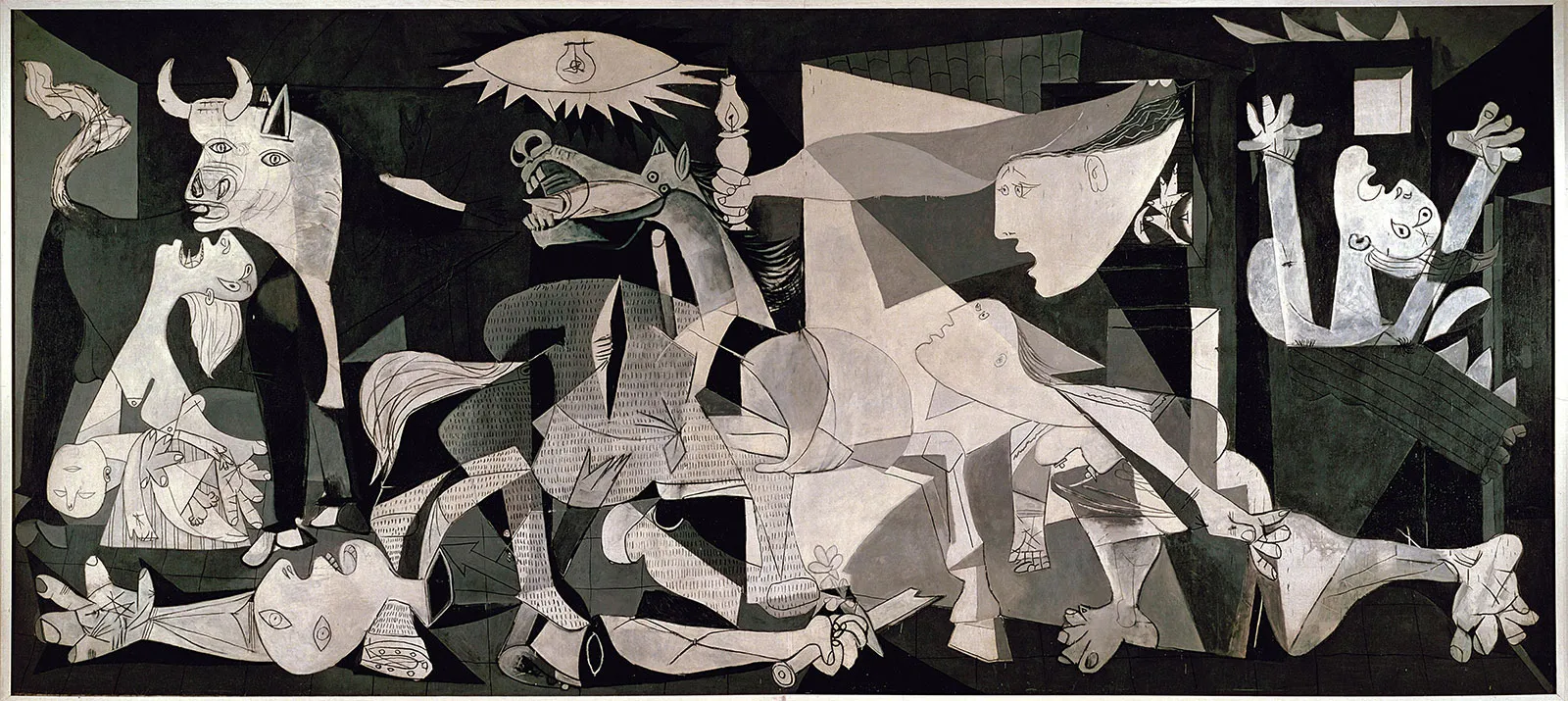
Pablo Picasso was an arrogant, womanizing son of a bitch. Who created Guernica.

Step by Step

Tomorrow’s a big day. And if you have work to do today and tomorrow, then thank you, and know that I support you. Go get ‘em.

Remember, though, that change doesn’t happen overnight. The events and influences that got us here didn’t arrive yesterday, and they won’t disappear tomorrow.

Things change incrementally. And there are two things we all have to keep in mind because of that.

First thing: don’t expect everything to be different all at once. No matter how momentous tomorrow may seem, remember that tomorrow is not change: tomorrow is an opportunity to move one step closer to change, or to move one step further away — which probably just means standing where you are, unmoving. Tomorrow may turn out that way: standing in place. No change. But whether that happens or not, it won’t make a big difference; not tomorrow. Tomorrow plus the next day plus the next day plus the next hundred days, the next thousand — those will make a big difference. That’s when we’ll see change. If we look back a thousand days ago, things appear very different from now: but only because we’ve made a thousand choices, taken a thousand steps. No one step is going to move us very far. Not even tomorrow.

So stay patient. Don’t give up hope, and don’t fool yourself into expecting more than a single step.

And the second thing is, if you want to make change, great change, momentous change — or if you want to ensure that there is no change in the things you want to conserve, if you want to fight off all those who want to push you off of the ground where you stand — then you must be persistent. Patient, as real change takes time; and persistent, because though it takes time, still you need to take that step, tomorrow, and the day after that, and the day after that. If you want to take a thousand steps, then you need to fight every single day for a thousand days. You need to fight against the people who don’t want to take any steps, and the people who want to stop after a hundred steps, and the people who want to take a thousand or a hundred steps in a different direction.

You need to fight all of them. Every day. For every step. And the more often you win, the harder they will fight.

Persistence is the key. Never give up until you get where you want. And if you can’t keep fighting, find allies, and help them take one more step than you, and then another step after that. No step is all-important. But every step is important.

Let’s take the next step in the right direction. Please.

I don’t know what this means.

When I was six, I was walking through the woods on my grandparents’ property in Washington, and I stepped on a yellowjacket nest. I remember the sensation as my foot came down: pushing through the humus of dried leaves, a moment of resistance, and then I crunched through what I thought was solid ground, and fell lower than I thought I should have, on that foot. That’s when I heard the buzzing: z z z ZZZZZZZZZzzzzzzzzz It hit a fast crescendo and then lowered to a purposeful, ominous hum, as if I had prodded a sleeper who did not want to wake and who growled resistance at me.

Then the stings started. One, two, three, each more painful than the last, the infuriated insects stitched their revenge up my leg as I stood, frozen, suddenly unsure of the ground beneath me — was it more hollow still? Would I fall through again? — obeying my training that told me to stand still when bees landed on me because they didn’t want to sting me, after all.

But these weren’t bees: they were yellowjackets. And they wanted to sting me. Understandable, really, since I had just destroyed their house and maybe crushed some of their family members; but that didn’t make me feel good about the fiery needles jabbing into me.

Fortunately my mother was there, and having grown up on that place named for her family, she was familiar with the sound of angry bees and yellowjackets: and she realized this was not a good time to just stand still. She scooped me up and ran. Of course I realize now that she was running to get us both away from the yelllowjackets, but at the time, I was suddenly sure that she was running me back to the house because I was going to die: my father is allergic to bee stings, and even at that age, I knew the potential danger of those tiny packets of venom which I could feel throbbing in my shin — and maybe moving up through my bloodstream? Was this the end?

It was not. It was about to be my first encounter with witch hazel (a name that still feels mysterious and alchemical to me), the rapid soothing of the burning stings, a cookie or two to soothe my burning tears, and the disappointing reckoning of a mere six stings, none higher than my knee. Not enough damage for a good I-stepped-on-a-beehive story, though it’s a damn good indication of my mother’s reflexes and quick thinking.


That moment of stepping down onto, and then falling through the ground and into a sudden attack: that’s what 2020 feels like to me. The hollowness of the hive beneath me, incapable of holding me up, echoed in the middle of me as I realized what was going to happen, a hollowness that seemed to swell and expand even as it grew more empty and dark and cold, as if my fear were a black hole inside, swallowing more and more and growing larger with each terrified thought that fell into it: that’s what I feel like inside, right now, and for the last six months. It’s a much slower process, this time, lasting months instead of seconds; but I feel very much as though my reaction is identical: I am frozen, panicked, trying to figure out what to do and coming up with no good ideas, just standing and watching as the danger swirls up around me.

At the same time: I am not just the kid walking through the woods, this time. I’m the yelllowjackets. The hollowness inside me is the hive, and the shell around that emptiness is too weak, and can’t hold up the weight of the world that is stepping on me. And as everything going on around me crushes through me and into me, I lash out, angrily — maybe understandable, but really, useless  — and I sting, and I bite, and I attack. I have never been so short-tempered, so cranky, so bitter, so apt to strike, so apt to sting with my words and my tongue, as this year. I hate it. I can’t stop it. I can’t: I don’t have the strength. That’s what was hollowed out of me. And I can’t just set myself and bear up under the weight: because the hollowness is under my feet, too, and I am being stung even as I am stinging.

I don’t know what to do. I’m just standing here. I have been for what feels like forever.

And I’m so tired.

And this time, my mother can’t scoop me up and run me back to the house for the twin magics of herbal remedies and baked goods.

This time, I might just get stung to death.


Probably not. I’m aware that as high as the number of Covid-19 cases is, it’s still only a fraction of the population, and that while my state is not handling the pandemic well, I am taking reasonable precautions that should keep me safe; I will most likely come out of this with an unremarkable tally of suffering. I do not mind, this time. I would very much prefer a half-dozen stings, no permanent scars, no need for a doctor. Just some soothing liquid and a cookie or two.

But I’m not just standing still with my foot in the danger zone; I’m still walking forward through the woods. In fact, since school starts tomorrow and goes to in-person classes in four weeks, I may be stepping onto the hive, and then continuing on into it, like walking down into a hive the size of a subway tunnel, with yellowjackets the size of Shelob. (At the same time: those goddamn hobbits are coming into my home, fumbling and ripping through my webs, and they are goddamn well going to pay for it. Nasssty little hobbitses.)

What precautions do I take then, as I move deeper and deeper into this hive pit? My school is trying to stay on top of things, having offered fully online learning as an option, instituting new protocols — social distancing, mandatory* masks, sanitizing spray to be applied every two hours**, fever checks on arrival — intended to prevent the spread of the disease. I don’t know how well it’s all going to work, though; and I have no idea what to do about that. I can’t quit. If I raise too great a stink, they’ll fire me. I guess I just have to stand there. Maybe the small things hovering around me don’t want to sting me, this time.

*Mandatory here means just what it does everywhere: masks are required until someone raises a loud enough political objection, and/or presents a doctor’s note. Then, not. Hope the virus takes doctor’s notes, too. 

**Said sanitation to be applied by me, every two hours, in between classes. On a side note, the spray requires four minutes to take full effect. Time between classes is four minutes. Hope the virus will wait out in the hall.

The danger, though, is not what is haunting me. Perhaps it should be, but the thing that is building a growing ball of hollow darkness inside me, the thing that makes me feel as if my next step will land on an equally hollow surface that will drop me through and out of the world, while at the same time the weight on top of me punches through my thin outer layer and into the hollow within, is this:

I am tired.

The hollowness inside me is not just fear. It is exhaustion. I am so very, very tired. Tired from fighting, tired from standing watch, tired from holding up others as well as myself. I’m tired of watching the pandemic grow, and watching my country wallowing in ignorance and selfishness like a pig in shit — just as filthy and twice as proud of ourselves — as we deny science, and raise alarms for problems that aren’t real, pointing to imaginary dangers that somehow block out of our sight the very real danger of this virus. I am so tired of being angry about it. I am so tired of fighting with people who smugly ignore every fact and every reasonable thought because it doesn’t make them feel safe, or worse, it doesn’t make them feel strong and fearless. Saying they’re not afraid of Covid, that makes them feel strong and fearless.

It’s as if when my mother rushed to scoop me up out of the yellowjacket hive, I had pushed her down, spit on her (Because the people who think this way are some of the rudest, most inconsiderate, most contemptuous hooligans I’ve ever interacted with. And I teach high school.), and then stood with fists on hips, chin jutted, nostrils flaring, and said, “Don’t you tell me where I can stand, I’m an American. You run if you want to, you and all the other sheep!”

While the yellowjackets swarmed around me.

And of course it’s not only the virus. I am so very tired of racism. I am tired of being ashamed of what people who look like me have done to people who feel like me for centuries. I am tired of confronting the same angry, willful ignorance about the protests or about opposition to police violence. At the same time, I am tired of being treated like the people I look like by the people I feel like — and I am tired of knowing that I have no right to complain about any treatment I may suffer, because my world has been built to prop me up, and whatever I may have to go through pales in comparison to the ordeals of those who are less pale than I. I hate that people tell me I have no right to speak my opinion, to take a stand; that all I can do is get out of the way and let better people take what they have been denied for centuries, because people who look like me oppressed them, which has enabled me to become everything that I am — all of it tainted by centuries of crimes against humanity. Not my own gifts and efforts, but my privilege, I am told, is why I am who I am and can do what I can do: and that means I don’t deserve what I have, and using that privilege to try to help solve the problem earns me a sort of sly sneer from those who know that my actions on behalf of the cause are just white guilt, and really, I am still the enemy,still perpetuating the problem if I do anything other than get out of the way.

That’s how it feels. It’s maybe not true that people working for social justice think that way of me, but — that’s how it feels. Of course, maybe that’s just my white guilt talking. And my white privilege thinking that I should be the one to speak up and fight for the cause: because that means I am centering whiteness in a movement that is not intended for the benefit or the recognition of white people or white suffering. It’s so easy to fall into the same patterns that have existed unrecognized throughout my life; how can I tell what is genuine and what is instilled in me by institutions of oppression and privilege? Is everything about me broken and wrong because of the world I grew up in? Is there nothing that is me? No, I want to say; I am good, I am worthwhile, I want to help and I am capable of helping. It is not right that I get pushed aside and marginalized, stereotyped, included in sweeping generalizations, based only on my skin color, my nationality, my gender —

And how pathetic do I sound saying those words.

I’m so bloody tired of irony.

I want to help, is the problem. I don’t want to be like those ignorant yahoos I fight with. I don’t want to be selfish.

But so many people need so much help.

I can do a lot of it. I am happy to do a lot of it: happy to support my family, my friends, those who rely on me. They are struggling, too, because this year has not only been hard for the pandemic and the riots: it’s hard financially, and crippling politically, and my family has had a series of tribulations fall on us like Biblical plagues, one after another and each worse than the last, mostly medical and due to my parents’ generation reaching the stage of life where things go badly. And of course, I can’t do anything. I can’t go help them because I might infect them, and that would kill them — and that would kill me. I worry about them double, because I realize that, on top of everything else, the pizza delivery man might give them Covid-19, and then I wouldn’t be able to visit them in the hospital while they coughed their life away.

And I can’t talk about this, can’t complain about this: because everyone else has it harder than me. Everyone. It’s not just white privilege, not just male privilege; I am healthy, and have remained fully employed, at a job where I am respected and well-liked, and I am generally well-balanced emotionally. I’m not well-balanced this year, of course, but since I started off having an easier time than most, and we’ve all gone down together, I still have more of my head above water than others do who were half-drowning before 2020. So I have no right at all to complain, and if I open my mouth to do it, the response I get back (the response I should get back) is something along the lines of, “Yes, I know, I’m going through that too — and a dozen things that are worse.”

Part of me can’t stand myself, right now, for complaining that I have it too easy in life to complain. And normally, the fact that I do have it easier than most would keep me from complaining because it would keep me from suffering. And even when I do suffer, I don’t have such troubles that I need to vent, need to talk them out. Normally I don’t need much support.

But this year is not normal.

I need to vent. It helps, you see, even if you don’t see how it could possibly help, even if you don’t know why it helps, talking about your feelings helps. I need that help. I need to say how I feel, even if how I feel is gauche or insufficiently woke. (“See that? That’s white sensitivity right there. He needs to grow a thicker skin, learn to deal with being told what he’s doing wrong. It’s just that he’s never been criticized much before, not in this society built for people like him.” Yes. I know it. But this is still how I feel.) Because people need my support, and so long as I am this tired, and feel these hollows under my ribs and under my feet, I can’t give them what they need.

This is what I need: I need to talk. I need to write. I haven’t wanted to do it, not for months now, for all the reasons I’ve been talking about here. There is too much, and I need to figure out what the hell I’m really feeling; I hate to ramble and blunder and sound like I don’t know what the hell I’m getting at. But one of the difficult Catch-22s of being a writer is that writing is exactly how I figure out what I’m feeling; I usually don’t know what I’m getting at when I start writing, I just get there when I get there, and I have a pretty good idea of when to stop. I have no doubt that this blog is irritating and confusing for people who read it. I expect you, too, are short-tempered, unable and unwilling to put out a whole lot of effort helping someone else deal with their shit when you’re sitting there with both hands full of your own.

I’m sure you’re tired too.

It feels strange to write this, because it makes me feel better, and so maybe I want to share that; but I don’t want to be a bother, don’t want to be a burden.

Which is also how everyone else feels, too.

So I’m just going to say it. If what I’m saying is wrong, please feel free to correct me; but first, I need to say it. Actually, I take that back: if you have something you want to say about something I’m doing wrong, put a pin in it. We’ll circle back around to it later. For now, I just need to talk about how I feel. And I won’t ask people to listen to me, because I know you’re all struggling, too — but it would mean a lot if you did.

We all need help. We all need support. We need to ask for it for ourselves. Just asking makes us feel better: because it validates how we feel. Being willing to ask for help, from those whom you are willing to give help to, shows that you consider yourself as important as they are, as worth helping as they are. It shows them that they are not a burden on you, that they can help even as they ask for help for themselves. And everyone feels better when they can help.

I need help. I’m standing on unsteady ground, in a country that is tearing itself apart, and I’m about to go back to work where I will be surrounded (Virtually, for the most part, but still) by students — who all desperately need all the help they can get.

That’s what made me actually open this post and start writing. That’s really what I’m afraid of. I’m afraid of the virus, afraid of what’s going to happen in thousands of schools across the country to hundreds of thousands of teachers and millions of students; but what scares me right now is the knowledge that those students will come to me, and they will need me. They will need me to listen to them, to understand them, to take them seriously, to help them. They are bottomless abysses of need, just like I was at their age, as we all are in that terrible time of adolescence. They will need me even more now, because their world is on fire, too.

I don’t know how much I will have to give them.

I’m so very tired.

I’m just standing here: hoping I don’t get stung.

Can someone please pick me up and run me away from the swarm?

Or if not that — can I have some witch hazel and maybe a cookie or two?

Thanks.

This Morning

This morning I am thinking about appreciation.

Yesterday I tried to recognize the teachers and educators I have worked with (And I still forgot a few — so thank you, Mary Wells, for all that you do, and thank you, Nora Caragan, for being the best paraprofessional in the history of paraprofessionals), and I got a grateful and heartwarming response. Teachers loved hearing what I had to say.

But there’s a problem there: I had to say it.

One of the things I object to, even though I participate in, is the support network that teachers provide for each other. It is a staggeringly wonderful thing: these people, who are already working so hard, and who are already giving so much, turn and without hesitation give even more to each other. I can’t tell you how many times I’ve seen it: teachers go into each others’ rooms all the time, and frequently the visitor comes in mad or frustrated or down — until they see the face of the person they are visiting, and see that that person is feeling even worse. Suddenly, whatever the teacher came in to complain about or vent or even ask for help with is gone: frustration vanishes in concern, and the visitor says, “What’s wrong?” Prepared, in an instant, to take more burdens onto shoulders already weighed down with overwork and the emotional strain of seeing up close and personal the struggles and sufferings of children (And also with the strain of struggling through the suffering caused by children — and the worst is that it is often the same children, that those who are neediest and most desperate are the most obnoxious people we see. Which is saying something.), not because we don’t need help any more, but simply because a friend, a fellow teacher, needs help more, or even just needs help too: and so we help.

It’s amazing and inspiring. I will say, without any humility, that I participate in this, that I support my fellow teachers at all times and in whatever way they may need, and that I rarely ask for help myself because  I don’t want to trouble them.  I’ve even seen this go too far, when I was part of my union’s negotiating team and we were  fighting for better compensation and working conditions; trying to get teachers to actually stop working, to stop sacrificing, to start asking for something for themselves — and not luxuries, but a living wage and necessary health care and the like —  was nearly impossible. They wanted to give up whatever they had to give up in order to make everyone else happy. The magnificent bastards.

But here’s the thing: we shouldn’t have to do that. Of all the people who should be sacrificing in order to keep teachers sane and healthy, IT SHOULD NOT BE TEACHERS WHO DO IT. That makes no sense. It defeats the purpose. We not only put on someone else’s oxygen mask first, we take ours off and strap it on top of that person’s own oxygen mask just so they can be twice as safe while they watch us suffocate.

If it’s not clear already, this drives me nuts, that teachers do this. I don’t like that I do it, either, but it is without doubt who we are as people, and what the culture of teachers encourages in us. This is why we spend our own goddamn money on school supplies for our students, despite how little we are paid. And perhaps the worst part, though this is not the place to get into this, is that we are therefore propping up a system that is in many ways a terrible system: not terrible for us, though it is that, but terrible for the students, and terrible for the country. Yesterday I bought donuts for all of my students taking the AP Literature test. I encouraged and helped students to “succeed” on a high-stakes test run by a private corporation with disproportionate influence on college admissions. I structure the whole class around that damn test: a test I should be opposing with every fiber of my being. But I bought them donuts.

So here’y my request, for those who want to appreciate teachers — REALLY appreciate us, not simply nod in our direction while we lie bruised and bleeding in a ditch. (I know, it’s hyperbolic, but it’s also the end of the year, and it feels like that. I feel bruised. I feel sick because I haven’t been sleeping, and I feel sore because my body has been too tense for too long: my shoulders honestly ache right now.) Ready?

Make it so we don’t have to hold each other up.

Give us enough support, and take away enough of our burden of responsibility, that a single person can do a teacher’s job alone, or at least can handle the pressure alone.

Specifically, that means essentially three things: money, time, and trust. In the first years of a teacher’s career, there is a fourth, which is: help.

I don’t want as much money as I want, if I can be permitted that sentence. I want as much money as is needed so that I don’t have to worry about it. That’s all. I’ve been a teacher for twenty years, and I still don’t earn enough to own a home, and I don’t have any retirement savings, and I still have debt that I haven’t been able to get rid of.  I want to make enough money to take care of those problems. I don’t need enough to pay for vacations or jet skis or that diamond-encrusted pirate hat I’ve had my eye on; just enough so that I don’t have to suffer from money stress. I want to be middle class. I aspire to the bourgeoisie.

I want enough time in my school day to get my work done in my school day. I don’t mind planning lessons from home; it’s kind of fun sometimes. But I don’t want to have to spend one more weekend grading, not one more evening filling out paperwork. I already work 40 hours a week at school; why is it that I am expected and required to add another 10-20 hours on top of that, every week? It’s because I have too many students, and too many requirements for teaching those students. Too many things I have to cover, too many things I have to compensate for, and too many people I need to report to and satisfy in order to show that I did my job. You know what should be the only evidence needed that I did my job? That my student can read a book, write an essay, discuss a poem. That’s it. Don’t ask me to prove that I did my job: ask the kid. See what he can do. And ask him, honestly, if I helped him do that. Make it his responsibility to prove that I did my job. He is the product, after all. (Please note: this is not a serious suggestion for assessment of teachers. Students shouldn’t have to have that burden either, and too many of them are not reliable witnesses nor reliable learners. All I’m saying is that I don’t want to do it, to prove to all and sundry that I did my own job.)

And anyone who thought “But you get summers off!” just know: I am currently mentally punching you in the brain. Hard. Kicking, too.

The last thing I need is trust. I have proven that I am a good teacher. I’ve won awards, I’ve won accolades, I don’t have anyone who disagrees with that basic premise: not students, not students’ families, not other educators. Of course not everyone likes me or likes my class: but I don’t believe there’s a single person who could genuinely say that I teach badly. So please, I beg you. BACK OFF AND LET ME TEACH. Don’t try to improve my curriculum for me, or my methods. If you’ve got suggestions, I’ll listen, of course; but don’t tell me what to do, especially if you’re not versed in my subject or my profession. Stop assessing me: my driver’s license is valid for 25 MORE YEARS: and that’s based on a single test I took more than 20 years ago. Yet my teaching license expires every three to six years, and requires hundreds of hours spent on learning to be a better teacher. I get observed every year, often twice a year, and have multi-page evaluations, every year. How much proof do you need that I can do this job? The answer is that there will never be enough proof that I can do it, because I will never be trusted to do it. That has nothing to do with me and everything to do with our culture and our system, but I don’t care why it is that way: I just want it to stop.

I already care about my profession, and about my students, and about my subject. I care about my fellow teachers and educators. Please, stop making me also care about and for myself: let someone else do it. Give me some real appreciation.

And don’t let it come from other teachers.

This Morning

This morning I am thinking again about friends.

I wrote about friends five mornings ago, and said that I don’t really know that I have many friends. I ended with saying, “Maybe I should just stick to dogs.” And since at this moment, my beloved beautiful fuzzball Samwise is curled up right next to me, I think that sticking to dogs is just about right.

But I also think that I do have friends. Good friends. Lots of them.

Because yesterday I sent out a call for help, and my friends responded. Immediately. And though I am sure that several of them rolled their eyes at El Sonorridor!, they didn’t give me grief for it, didn’t mock me, didn’t tell me it was stupid. No: they went to the ADOT website and commented that the new interchange should be named the Sonorridor. They encouraged me. They complimented me. They made me happy.

That’s a friend. My friends. Thank you all.

Walking Out

[Read Part One: Money Talks]

[Read Part Two: But You Get Summers Off]


It is fascinating how America views teachers.

In the last week I’ve been told, repeatedly and stridently, that parents support teachers. I’ve also been told that we should be grateful for that support, and we shouldn’t do anything to risk its continuance. That as long as parents support us, everything will be fine.

But I don’t think that’s true. I don’t think it’s really true that teachers have parents’ support, and I certainly don’t think that the support of parents is the most important thing teachers could ever, ever have.

I don’t think everything’s going to be fine. Not unless we are willing to do what is necessary to make things right, right now.

I don’t mean to complain. I want that to be clear. I’m writing this series because I want people to understand, not because I want you to pity me. There are things about my job that I love, and that’s why I still do it; that’s why I defend it as vigorously as I can, because I want to be able to continue doing the things I love, hopefully without also having to do the things I hate, like enforce sexist dress codes and assign meaningless and misleading grades, or give hours and hours of pointless, mind-breaking tests. Or survive on insufficient money, with insufficient funds available for my classroom and my school to allow me to do an adequate job.

If I cannot get the things I need to be happy here in this job, I will quit and move on; I will find another state that pays teachers better, and I will get a job there. But while that solves my problem, there will still be a million students in Arizona who need teachers: and if not me, then who? Shall I give them the same advice that I keep getting thrown in my face, namely, “If you don’t like it, go somewhere else?” Shall all one million Arizona students move with me to California and find school districts there with adequate resources, who pay their teachers a reasonable wage and so don’t have 40-50% turnover and hundreds of unfilled positions? That sounds like a solution, right?

It’s not. Of course not. Just like the other things that get spat at me and my colleagues on Twitter that are not solutions. But they do show how America views teachers: and it is fascinating.

So what should we do? What should teachers do about this funding crisis in Arizona, this decades-long slide into poverty and a broken, underfunded school system? To be specific, for those who haven’t been a part of this conversation up until now, Arizona cut more funding from schools than any other state during the Great Recession: funding went down 36.6% from 2008 to 2015. Some progress was made in the last three years, but the state is still spending almost 20% less now than ten years ago. About half of the new money since 2015 was mandated by a lawsuit brought against the state government by teachers, [NB: If you go to that link, Prop. 123 is the referendum I mention below. Please note where the lawsuit requires $300 million spent on capital improvements annually, and Governor Ducey promised $17 million.] because the legislature failed to follow through with an earlier state supreme court decision in another lawsuit; the first decision was that the state actually needed to fund schools, which apparently they did not want to. They were required to fund capital improvements to sites and facilities, and to provide funding for textbooks and supplies. They were also instructed to increase the funding yearly for inflation. That last part, they stopped doing; and so the teachers sued the second time, and the courts again decided that, according to the state constitution, Arizona does need to actually fund education. Rather than simply increase revenue to cover that expense, the state passed a referendum settling the lawsuit for 70% of what was owed; that money came from sales of state-owned land (Land which is already supposed to be used to fund education, a fact which made a judge rule the Proposition was illegal.). This is the source of the increased funding that our governor, Doug Ducey, has been crowing about for four years; and it still falls short of where we were a decade ago.

So essentially, the state of Arizona is a deadbeat dad: they do anything they can to get out of paying what they owe for their own children; up to and including just not handing over the money, refusing to pay the bill until the courts force the issue – and then grudgingly paying part of it, and demanding credit for what they did pay.

As I said: what should we teachers do about this problem? We are on the front lines, but though we do suffer because of this, in the form of absurdly low pay (Arizona ranks 48th in pay for high school teachers, 50th for elementary school) and insufficient resources to do the job properly, we are not the main victims: that would be the students themselves, who have to make do with not enough, not as much as other states, not as much as they deserve, in everything from school buildings to programs to textbooks to computer resources to good, stable teachers who stick around for more than a few years. We teachers see this, every day; we live this, every day; we try to make up for it, every day.

What should we do to fix it?

According to one fellow I talked with on Twitter, we should talk about walking out, but not actually do it.

“I support the need for more money in education,”

he said.

“I do not support the manner in which teachers are trying to get it. This hurts, kids and families. There is a much better way to accomplish this goal.”

So I asked, “How?” And because I’m a teacher, I added, “Please be specific.”

He replied,

“Here is how. Use this momentum from #RedforEd to force the Governor and legislators to the negotiating table with the threat of a walkout to start the 2018 – 19 school year. Parents will support you, Ducey will be motivated due to election. Kids and families not affected.”

We went back and forth a little more, but this was the gist. I did not say, though it is true, that the #RedforEd movement has been active since February, and so far the governor has refused to negotiate directly with the main group, Arizona Educators United. (By the way: that is not a union. It’s just a group of teachers who decided to do something more than try to make do with what we’re handed by the state.) I did say that I don’t understand why Ducey would feel more pressure to negotiate after the teachers decided to do nothing for four months; my Twitter friend didn’t have an answer other than he wanted us to wait. He wanted teachers to make sure that kids and families were not affected, because that way we would keep parents’ support. (Because his son is a high school junior, and apparently it would be catastrophic if he didn’t have school now.)

I’ve heard this from more than one person: they support the teachers, but not the walkout that the Arizona teachers have planned. They think we should continue threatening the walkout, but not actually do it, because that will hurt students and parents.

That’s right. It will. And that’s the idea.

I don’t want to do that. I want to believe that Americans like their teachers enough to understand what we’re asking for, and why. I’ve tried to make it clear with these blogs, but in case I haven’t, let me say it outright: we want to be able to do our jobs. That’s it. We don’t want to get rich: as everyone under the sun knows, teachers don’t become teachers to get rich. No one expects that. We don’t want someone else to do our job for us, and we don’t want to find a way out of work: that’s not the reason for the walkout. I think, actually, that parents sometimes forget that teachers are not their teenaged children; after all, we spend all of our time together, and the kids often tell their parents how much they like some of us, and how much they hate some of us; I’m sure in their anecdotes, teachers sound like – other teenagers. “My English teacher is so cool, all laid back and stuff. But my science teacher is a total loser. He thinks he’s funny, but he’s so lame!” And teenagers want a day off. Several days off, if possible. Because they’re teenagers: I had one of my students, very sweet girl, when someone mentioned a school district that was canceling classes because of the teacher walkout, say, “I’m so jealous!”

I’m not. I’d rather not be one of those people who have to take the risk, who have to dig in their heels and fight the entire community, simply because the community has ignored and neglected our needs for years and years, and a few years more. I’d really rather be one of the self-righteous people arguing against me, than me.

We don’t want days off, don’t want to get out of work; we want to be able to be successful in the work we are already doing. Teachers aren’t striking for fewer students (though we should) or lighter requirements in terms of preparation or training or testing or evaluations, or anything else related to working conditions: all we want is more money. And not just for ourselves: because Governor Ducey offered teachers a 19% raise over the next three years, and the teachers’ overwhelming response was to vote for the walkout.

Why did the teachers turn down the pay increase? Three reasons: one, we don’t trust the governor and the legislature, who have failed for years to provide legally mandated funding; two, the pay increases extended past the gubernatorial election this fall, and so who knows if the next governor will feel any need to keep Ducey’s promises (And I include the possibility that Ducey will get re-elected and then feel no need to keep his own promises afterwards); and three – and most important – the pay increase was only for teachers, according to the governor’s definition of “teacher.” It did not include teacher’s aides, or secretaries, or counselors, or janitors, or anyone else who is just as vital to education as the teachers are. It didn’t even include those who teach enrichment classes, like elementary school music and PE, because it was only for teachers who had their own roster. It did not include necessary increases to capital spending, where Arizona has cut 84% of funds compared to 2008, money that is needed for facilities and resources. The governor tried to throw money at the teachers – some of us – but he refused to fund education. And the teachers refused to accept the deal.

And yet we get called greedy. We are accused of taking extreme actions that will hurt children, because teachers are walking out across the state today, and classes are being canceled and schools are being closed, and parents have to find something to do with their kids. Wouldn’t it have been more greedy if we ignored what was best for students and schools and just took the payoff?

So let’s talk about the walkout, because I’ve been hearing a lot about it from people on Twitter. Comments like this:

I never said I don’t support the teachers, I do…but this is the wrong way to go about it. The community and parents have been very supportive of our teachers but this walk out only hurts the students and the community. For many students, they’ll have no where to go.

This particular person is insistent that she supports the teachers, in all things, in all ways, except in this one way: she says the walkout will hurt students and families. Because parents will have to take off work in order to watch their kids. That, apparently, is insupportably, unspeakably evil of the teachers to do. She also wants us to do nothing but wait, and know that we have the support of the parents. So long as we don’t walk out, that is.

I’ve also gotten comments like this:

Great example for your students, teachers. Akin to taking ball and going home.

#redforedaz is an evil movement founded by clowns WHO SIGNED CONTRACTS!! And your children are being left without an education! #MondayMotivaton

(Honestly, I’m curious about the hashtag at the end of that one. I’m supposed to be motivated by this? Also, the sheer number of typos in the anti-teacher tweets is both 100% amusing, and 1000% unsurprising. This is my favorite:

#redforedaz is another entitlement programme. Teachers are WELL PAID considering they work only 9 months. Average teachers salary is 35, 000 a year. Teachers are on a 45, 000 a year course! Wow!!! To think, these teachers are teaching you’re kids! #appalling

At least he spelled “appalling” correctly. He made it a thread, too:

Stop making teachers look like the victims. They are still paid whiner!

I believe this man has made his point.)

All right. First, the contract. Teachers do sign contracts, and those contracts determine our pay. It generally doesn’t change over the year, so we know what we’re signing up for – though there are performance bonuses and incentives, also known as merit pay; if my students’ test scores are high enough, my pay goes up, if they are lower, it goes down. If I’m a coach or I spend extra time helping students enter competitions, then I get paid more the better my students do and the more time I spend helping them. And sure, I suppose a teacher working hard and teaching well would be able to earn more thereby; but when my students intentionally tank the test because the schools have tested them to death and they just can’t care any more, or when the students this year aren’t interested in entering competitions, or this year’s volleyball team sucks, then all the good teaching or coaching in the world won’t earn me that money.

More importantly, the contract doesn’t really set working conditions: there’s nothing in there about a budget, or resources. There’s no guarantee that we will have textbooks, or enough paper to make copies for the whole year, and if we don’t, then I have to work harder: find new resources, create new resources, raise funds myself. There’s nothing in the contract about class sizes. So if I agree to take X dollars to teach for the year, and then my school doubles my student load, I have to work twice as much for the same salary. Which, of course, happens all the time. And if enrollment drops and a class loses too many students – especially if it’s an elective – then the class is canceled, and suddenly, my contract signed in the spring is worth less in the fall.

Tell me again about how contracts are binding agreements that I have a responsibility to follow through on.

No: it takes two parties living up to their agreement to make a contract binding. And if nothing else, the state of Arizona has not held up its end of the bargain, for years. I think there is no argument, legal or moral, that says that Arizona teachers can’t walk out on these contracts. I will also note that, unless the walkout lasts so long that the school year gets canceled, most school districts will extend their year for as many days as the walkout cost them; which means the same teachers who walk out will walk back into their classrooms and put in as many days of work as were agreed to, and without any increase in money, as any deal struck will not take effect until next school year at the earliest. And all of the teachers’ plans will be disrupted and delayed too, and our summer will be shorter, too.

So those who are arguing that we signed a contract and we have to live up to it, please understand: we will. We will do more to abide by the agreement than will the other side. If you want to uphold the rule of legal agreements and insist that people keep their word, then look to the state capitol.

I don’t know how much I need to address the direct ad hominem attacks; I’m sorry if the Monday Motivaton guy doesn’t like the leaders of the RedforEd movement, but it really is a grass-roots movement; thousands of teachers have joined voluntarily without any sort of pressure at all. I did, even though I was told I was being suckered by a 23-year-old Socialist, or that I had

“opted to follow a quasi-union led by DNC delivery boys. You sold freedom”

I don’t remember selling freedom. Didn’t get anything from the DNC, either. I’ve seen a couple of digs from teachers at the Republican party, but honestly, they have controlled the state government that shorted education for the last two decades, so they really do own this. But I have not seen the same calls for registering-and-then-voting-the-bums out that have characterized, say, the gun control movement led by the Marjory Stoneman Douglas students; these teachers just want our current government to fix this problem, right now, and if the government does so, I think they can wrap up the election in November, since this is a comfortably red state as it is. If they don’t help fix this problem, then they shouldn’t be re-elected, though I haven’t seen any of the RedforEd movement people agitating for replacement candidates: the election is too far away. We want this fixed now.

I also don’t feel the need to argue that we aren’t childish: childish would be throwing eggs at the governor and then trying to steal office supplies to make up for our insufficient pay. Or just quitting: for the guy who said we were taking our ball and going home, wouldn’t that be if all the teachers quit and walked off with our educations? If we’re fighting to get better working conditions so we can continue doing our job, isn’t that very much not “taking our ball and going home?” How about the bad example, is it that? Again, I don’t know how much students are going to absorb the desire to strike; I know that teachers hate the idea completely, and so I doubt many of us are talking it up to kids; I also know that it would be a worse example to set if we let ourselves get abused and devalued, and yet kept busting our asses for insufficient compensation. I have heard students say for years that they don’t ever want to be teachers, based on what they watch us deal with: so I don’t think it is the teachers who are setting a bad example.

But are we hurting them? Are we hurting our students and their families by walking out?

On some level, yes. We are. Some families will struggle to find child care during the strike (Though I know a whole state full of high school students/babysitters who are going to have a lot of free time…). There are students who are taking AP tests who will miss out on some last minute preparation before the tests, which start next week. I presume there are athletes who will lose their coaches, and performers who will miss opportunities, and some experiences that won’t happen because the teachers are not working.

But this is what has done the most harm at the school where I work: the first year I worked there, 2014-2015, there were two teachers who quit at the end of the year, our Spanish teacher and one of our best science teachers. Both because of pay. We also lost a PE teacher and a science/math teacher to budget cuts. The second year, there were six teachers who quit: science, math, art, two social studies, and English. Seven if you count the long-term sub who replaced one of the social studies teachers for half of the year; he got a job in California. They had different reasons for leaving, but pay was a factor for several of them. The school didn’t replace the science teacher. Third year, it was two math teachers and another science teacher – and one of those math teachers was the heart of our school, the best math teacher I’ve ever known, the reason why our STEM school has had such success. They didn’t replace one of the math teachers that year, either. Oh, we also lost our school psychologist. In three years, we’ve had thirteen teaching positions emptied: and I work at a small charter school with a total teaching faculty of 23. We’ve had more than 50% turnover in three years.

How many teachers are we going to lose this year? What are the chances that their replacements will be better? Who is more likely to leave to seek employment elsewhere, the good worker, the smart teacher, the capable employee — or the one who is already entrenched and doesn’t want to leave for fear they won’t be hired anywhere else? That’s not to say the teachers who have stayed at my school are like that – but our turnover rate is not unusual, so I think it’s a fair argument for the state as a whole. A lot of the best teachers are leaving. Even if good teachers replace them, then experience is lost, continuity is lost, relationships are lost. And as budgets continue to be cut, despite the funding increases touted by our governor, class sizes go up and good outcomes become less and less likely. And I don’t mean good outcomes for the teachers: I mean for the students. The students whom we are hurting by walking out.

Hurts pulling off a bandaid, too. But it’s better to do it, and better to do it quick and sudden.

I do know that the walkout will hurt people. Teachers will get fired, faculty members will get into bitter arguments and conflicts; students will lose out on education and some opportunities; parents are going to miss work and have enormous headaches dealing with child care. But when the only alternative is to go on as we’ve been doing, then it isn’t a choice. Parents who argue that their support for the teachers will be lost because of the strike have not been enough to fix the problem, despite their goodwill and support, because the problem is still here. The goal of the strike is to push other people: those who have done nothing but take advantage of the teachers willing to work and keep working without enough pay, those parents who are willing to keep sending their kids to less-than-ideal schools so long as they themselves don’t have to worry about it, and all those people who ignore the serious consequences of an inadequate education system just so long as they don’t have to pay more in taxes. Those are the ones we want to hurt. Those are the ones we want to push to take action, to inflict their ire, perhaps goaded by us, on those who actually merit it: the government, the deadbeats, the people in the state capitol who have let us sink to this level.

I am sorry it will hurt, and I have tried not to be too aggressive or insulting with this series, or with my Tweets. It helped that I am currently reading To Kill a Mockingbird with my 9th grade English class, because I got to read this scene, when Atticus Finch tells his daughter why she can’t haul off and punch anyone who insults her father because he is defending a black man accused of rape.

“Come here, Scout,” said Atticus. I crawled into his lap and tucked my head under his chin. He put his arms around me and rocked me gently. “It’s different this time,” he said. “This time we aren’t fighting the Yankees, we’re fighting our friends. But remember this, no matter how bitter things get, they’re still our friends and this is still our home.”

There are a million students in Arizona. There are tens of thousands of teachers. We all live together, and work together. After this fight is over, we will go back to teaching, and they will go back to learning. We will all go back to doing what we can, working together, supporting each other, for the sake of the children, of our students, of our future. Let’s try to remember that, and try not to let this get too vicious. We all need this resolved, in the right way, in the best way: quickly, and well. Please help make that happen. Please help us get what we need to do what we want to do: to teach. To teach as well as we can, for as long as we can.

You say you support the teachers? Are you just going to talk the talk?

Or will you walk the walk?