I’m Doing My Best

Yesterday was a bad day.

That’s why I didn’t get a post up; I had one, about half done, which I started last Thursday; but yesterday I couldn’t handle finishing it and posting it.

Because yesterday, I lost faith in myself.

It’s pretty easy to do, really; I’m human, I make mistakes. All the time. Sometimes those mistakes are easy to brush off — I’m terrible at estimating time and distance; I know this about myself, so usually I don’t trust my first instinct when I think, “Oh, that’ll only take ten minutes to drive there. What is it, five miles away?” Because I know both of those numbers are wildly inaccurate. So if I need to know the distance, I will look it up; if the time to get there is important, I will double my original estimate. Or triple it, maybe. So that means I generally leave early and arrive early: but that’s no problem, because I get up every day at the crack of dawn anyway, and if I arrive early, it just means I don’t have to search for parking or an empty seat, which I hate doing anyway.

What I don’t do, however, is get mad at myself for mistaking the time or distance, and decide that I’m an idiot who can’t do anything right, and I’m therefore doomed to a life of mediocrity and failure, and it’s my fault for not working hard enough, or learning enough, or making the right decisions in the past. No, I save that kind of existential crisis for when I’ve done the worst thing I do: screw things up for somebody else.

It doesn’t have to be a big thing. If I give bad advice, or advice that doesn’t help; if I teach badly, or fail to control my class, and get called out on it; if I try to do a thing and fail at it: any of those are enough to send me into a certain kind of shame-spiral, when I start thinking, Well, if I can’t do that right, then I probably can’t do those other things right; and that means everything I do is wrong, and I’m useless and stupid and I’ve wasted my life and harmed people by inflicting my stupidity on them when what they really need is someone who can help them. Basically, I think of myself as an intelligent person, and if I experience something that makes me feel unintelligent, then I doubt everything connected to my intelligence, and everything that I’ve ever done comes crashing down like a house of cards.

Of course, this is not a new phenomenon. And it is not unique to me. There’s a whole thing.
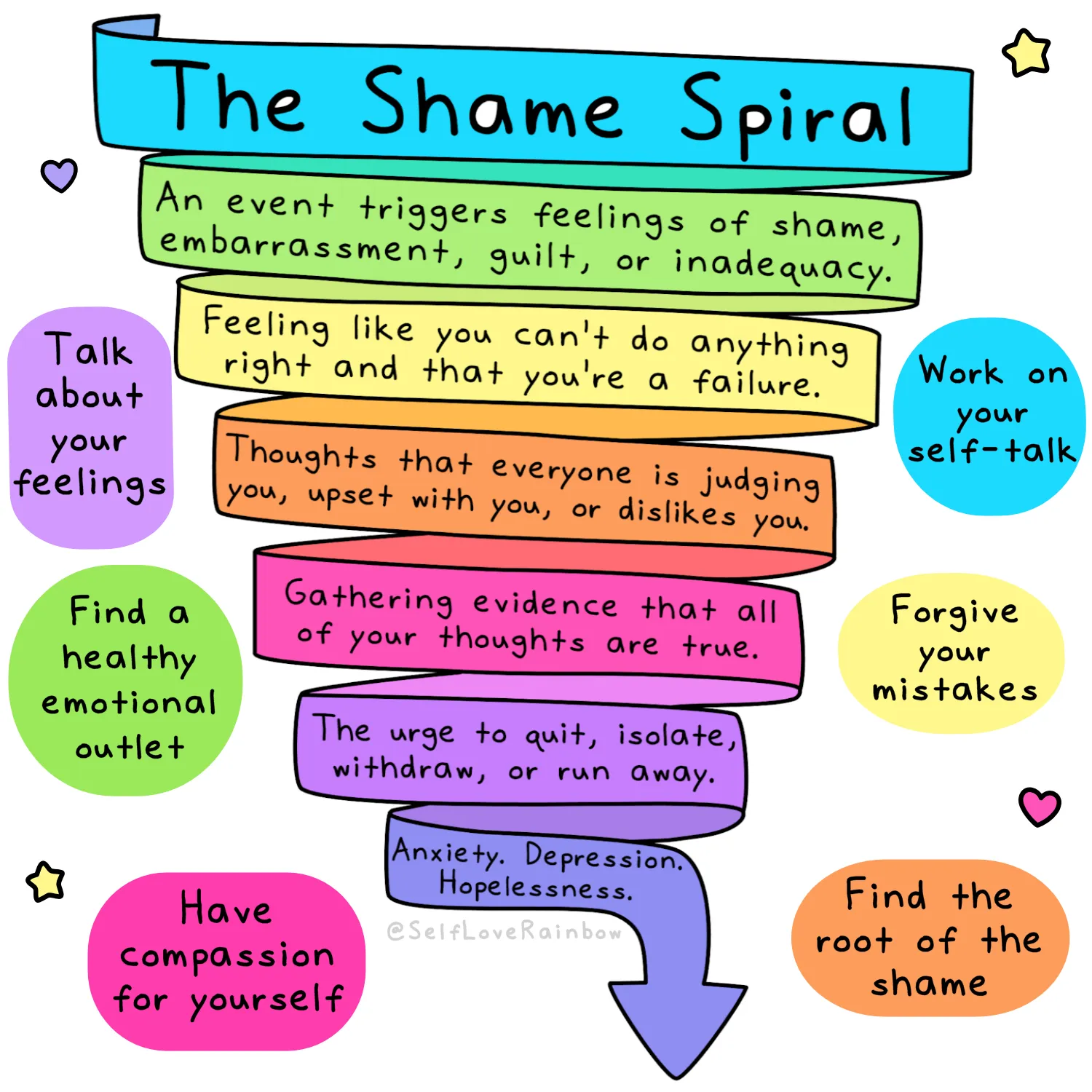
This came from this site, which looks quite delightful and helpful, so please go look if this speaks to you:

The bubbles around the edges are the ways to fight the downward spiral. I didn’t do those yesterday; I went straight to avoidance, and spent most of the day playing Minecraft. (I’m going to have to do a post on Minecraft, by the way, which I have only discovered this last year — that is, I knew about it, but I didn’t know that I would love it as much as I have grown to in the last year.) And so last night, I couldn’t sleep: because I was ashamed of having done nothing useful yesterday, including this blog, which I really do want to keep up with; and I failed. I blew it. I must be a terrible person…

Fortunately, my shame spiral this morning was interrupted by two things: first, I started writing this blog while I was eating my breakfast bagel, with the intent of finishing it tonight, because I can certainly accept posting one day late (Have I mentioned that I’m not real big on deadlines?), and so that reminded me that I can give myself one day of grace on my tasks without assuming that I am worthless; and second, I had to stop writing this blog so I could go to school. And while I was completely exhausted at school today — I was falling asleep while I was grading AP essays this morning (That is not a comment on how boring those essays were [Yes it is.] and also I surely did not lose focus on the essays while I was determining their final score […]) — and that made me cranky as hell, I also taught today. And I taught well. We went over the climactic end of the first act of The Crucible, and while my other class is not grasping the play, this class is. My AP Lit class is really getting into the details of Donald Barthelme’s amazing story GAME (Though they still haven’t figured out why Shotwell has the jacks). The Fantasy/Sci-fi class finished another chapter of The Hobbit, and I got to do a Mirkwood-spider voice, which was fun.

And now here I am, back trying once more to finish this blog.

So I am not stupid. I am not lazy. I am not incompetent, or incapable.

It is true that I’m not sure I have the level of expertise that makes this blog worth reading. Depending on the subject: when it is literature or teaching or writing, I’m fine; I understand those things better than most people, and anyone who understands them more than I do is always welcome to take issue with what I say. (Anyone is, really. Please feel free to comment on the post, or use the Feedback link on the bottom left of the screen, or go to the Contact link at the top. I’d love to hear from you, for whatever reason.) But the post I started last week is not about any of those things, so I’m more uncomfortable about it; hence, yesterday, when I was doubting myself and my abilities and my worth, I couldn’t gather the confidence to say what I want to say on the topic.

But, see, I don’t really write this blog as an expert. As I said, in literature and teaching and writing, I think I can at least hold my own, at my level — you will not find any doctoral theses on this page — but otherwise, when I write about politics or society or life, I’m not writing as an expert. I’m writing as a person. I have my perspective. I think the value I offer in this blog is not necessarily the brilliance of my insights: it is the clarity and the precision, and to some extent the humor, that I add in the writing of my insights. Basically, I’m just a guy with some ability to observe the world around me, and crystallize what I observe into a thought: and a genuine ability to put all that into words. And if that’s enough to make you read what I write, great: I hope my words on my perspective help you to have some thoughts of your own. I don’t think of it as advice.

If it hasn’t become clear, the specific problem yesterday was that I gave a student advice, and it wasn’t good advice. I mean, so it goes, right? I gave it my best shot, I didn’t make the best call. Nobody died, nothing was permanently broken. But I got into this thought pattern like: If I don’t give good advice, what am I doing teaching? If I don’t understand teenagers well enough to know what they should do in a certain situation, why do I work with them? Why should they listen to me? And if I’ve wasted 23 years of my life teaching when I shouldn’t be doing it in the first place, am I doing that only because I need to avoid being a writer for real? And I’m just fooling myself into thinking I’m a good teacher when actually I’m just kinda charming and easygoing, and so the students like me because I don’t make them work too hard, and that’s why I’ve kept my job even though I’m basically incompetent and, let’s face it, just pretty fucking stupid, right???

And what the hell am I doing offering my wisdom on this blog if I can’t even give good advice? Why would anyone listen to me?

I dunno. Why would anyone listen to anyone? Because sometimes, we get things right. Even if sometimes we don’t.

So here’s what I want to do. I don’t want to give advice: because I don’t know more than other people do, except in my small areas of expertise. But I do want to share some of the things I have figured out. I want to share my understanding, my perspective. And if it is helpful, or if it is interesting, then great: and if not, come back next week and see if I have anything better to say.

Okay?

Here we go.

#1: Love really does make the world go round.

Also The Beatles are even more wonderful than you think they are.

My greatest joy is my wife. Living with her, seeing her, talking to her; supporting her, cheering her on, protecting her, watching her be amazing. She is my everything: because I love her. That keeps me wanting to do more with her and for her, and keeps me from being tired of her or resenting her or any of that other shit that comes between people. I am incredibly lucky that I can still feel this strongly for her after almost 30 years: but if I didn’t, if she didn’t still love me, then I would hope we could amicably separate, and go find other people to love. Because love is the most important thing in our relationship, as it is the most important thing in any of our lives. That love is more important than the relationship: the relationship remains because the love remains (And if we fell out of love, we might have a companionable love that would remain, and we could stay in that kind of relationship, and that would be fine: as long as there is love. It doesn’t always have to be the same kind of love. [Though I hope it does stay. It’s awfully nice.]), and the love is what matters, more than the relationship.

I write because I love it. I read because I love it. I teach because, basically, I love humanity. I am a pacifist for the same reason (Even though sometimes I want to hit my — well, maybe not my students. But I want to hit things around them, you know?). Every important thing about me is based on what I love, or what I don’t.

Love is everything.

#2: Life is long — but never long enough to do everything you want.

I hear people talk about how fast time goes: and I don’t understand it. I mean, sure, my childhood is loooooong gone, and I don’t remember everything that happened between then and now; so that might seem like it was a shorter time than it should have seemed like; and I have definitely felt some dilation of time in the last few years: I cannot fathom that the pandemic and the quarantine were three years ago. So I definitely do that thing where I go “What?!? Three years??? Seriously? Where did the time go?”

But then I actually think about it: and the last three years have been — three years long. I’ve done a whooooole lot of stuff in that time. A lot of it is the same stuff over and over again, but it’s been different every time. And it’s always like that. Life is very long. I hear the cliches about how we only have a very short time on this Earth and in this life, and that’s true: but only from the perspective of mountains. From a human perspective, we have a very long time to live. My students are so goddamn young; and I am 30 years older than they are. And 30 years? That’s a long fucking time. If I have 30 years left to live, that’s a long fucking time left. A very long time.

At the same time: in those 30 or 40 or 20 or however many years I have remaining, there are more things that I will not do, than there are things I will do. Partly because I will have to spend a huge amount of those remaining years doing shit like — grading AP essays while I try not to fall asleep. And that time lost will be sad, because it won’t be spent doing things I love. And it should be. Because see #1.

So we have to pick and choose what we spend our time doing. It’s important to choose, and to do it intentionally, and thoughtfully, as much as we can. Don’t let time slip by without paying attention to it at all; because we have a lot of time — but we can still waste it, and we shouldn’t. We should love our lives, as much as we can. Because #1.

#3: There are three things you can have with any job, any task, anything you buy or hire for: you can have good, you can have fast, and you can have cheap. You can only have two of them at a time. So if it’s good and fast, it ain’t cheap; if it’s good and cheap, it ain’t fast; and if it’s fast and cheap, it ain’t good.

This is the best single piece of wisdom I ever got from my dad (Though there are a lot of other things he’s taught me, more than I could count. It’s just that this is the best.). I think about this all the time. I’ve written about it a lot of times, too. Hiring a plumber: not cheap. But usually they do good work, if they’re professionals; and it’s always MUCH faster than doing the repair yourself. Or you can think about it in terms of buying a car: you can get a POS rusted-out Mustang, that still might be fast, and it will be comparatively cheap: but that won’t be a good car. Or you can get a good, cheap car like a used Toyota — and it will not be fast. Or you can buy a good fast car: but it’ll cost you. Or getting music on the Internet: you can get free music without ads (That’s what I’m calling “fast” in this case: no download delays and minimal interruptions), if you don’t mind listening to shit on Soundcloud; or you can get good music fast (without ads) if you don’t mind paying for premium services; or you can get free good music on YouTube (I’m currently listening to this, which I find both beautiful and amazing, but I also genuinely feel bad for this guy’s forearms. It’s like you can smell the tendonitis in the air, like smoke.) if you don’t mind sitting through ads.

Also: you don’t always get two. You can get only one. Or you can get none: because you can buy expensive shit that takes a long time to get finished, and when it’s done, it still sucks.

#4: The most important thing in any relationship, from friendship to love to family to business to neighborhood association to — anything — is communication.

I’m teaching argument right now, and if my students are understanding it, they should be figuring out that the first key to any argument, to understanding what someone else is saying, is always to define your terms. And clarify your meaning. And show where you get your information from, and why it leads you to the conclusions it does. And the same is true in any interaction: I am a good teacher because I want to understand my students, and I’m good at making them understand me. My wife and I still have a strong relationship, apart from our love, which is irrational and magical and incomprehensible and the most powerful force in the universe, because we communicate: because we tell each other what we think and feel, and we listen when the other is talking. I get along with my coworkers because I talk to them and listen to them. My students don’t complain about my grades because I am clear about why I give students what I give them — and if they have opinions about those grades, I listen to them, fairly. And if their communication makes sense to me, I am willing to change the grade. Their parents don’t complain about me because whenever they have a question for me, I answer it, fully, completely, and honestly.

Corollary to #4: communication requires honesty, which is why honesty — not patience, not courage, not intelligence nor openmindedness nor anything else — is the most important virtue.

No, you don’t have to be honest all the time. Yes, you can lie and say someone looks good in that outfit, or the food was tasty when it was not. But understand the consequences of those lies. And be as honest as you can.

#5: Everybody should have pets.

I have no opinion for or against children: if you want them, I wish you the very best; if you don’t, I wish you the same. But everyone should get pets. They are pure love and they teach pure love.

I always use the dogs for this, so here’s a video of Dunkie the cockatiel whistling. He’s adorable, too.

#6: Everybody should exercise, even if it’s only walking. Or dancing.

When I was a kid, I rode my bike everywhere. So much better than driving. Now I walk my dogs every chance I get, and also go to the gym. Movement helps with everything physical, mental, and emotional. We were made to move: so do it. Make sure it is something you enjoy, or you won’t do it — but when you enjoy it, do it as much as you can. It’s always good for you.

#7: Doing it yourself is better than buying it: but see #2. And #3, because doing something yourself instead of buying it is cheap, which means you can’t have it be both good and fast.

I was thinking of this in context of making food. Cooking yourself is healthier, in this country; generally cheaper than food from a restaurant (If it’s not cheaper, it’s DEFINITELY healthier), and if you can do it right, it tastes better, too. My advice for cooking is to learn a couple of specific dishes, and really master those: I can’t make eggs, but I can make three different kinds of mac and cheese, and they are all AMAZING. Also I am good with sandwiches. And my wife says I make good salads, too.

But it goes beyond that: my wife and I (with my dad’s help when he came for a visit) painted our first house, the entire exterior, two coats; and we did a hell of a job, and it was an accomplishment I was proud of. It was worth doing. But it did take a damn long time, I will say. It was a lot of work. Because of that, it is certainly worth it to hire an expert to do things for you sometimes, rather than take the time to do it yourself, always, because #2 means you have to pick and choose where and how you spend your time.

But if it’s important to you, and if you love it, do it yourself, as much as possible. Learn how and then do it.

#8: Everybody should read.

More than we do, unless you already read as much as you possibly can. I’m not against watching TV and movies and playing video games, and all outside/physical activities are good too, as is just relaxing and doing nothing. But we all need to read. It does more for the mind than any other intellectual activity. It brings us closer to the world every time we do it, because good writing is about the world. And writing is communication, which allows us to build and strengthen relationships, every time we read. It’s just the best thing. We should do it more.

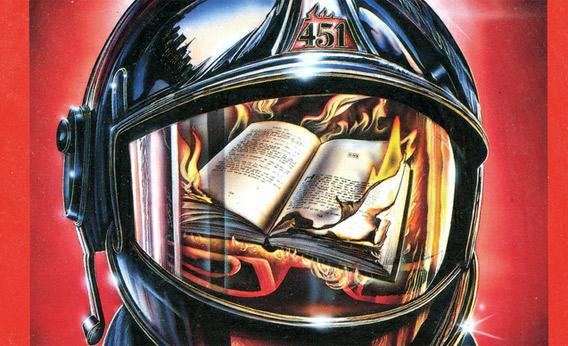
Also, it will prevent the arrival of the world of Fahrenheit 451, which is closer now than ever before, and getting closer all the time — and that is not a good thing.
Also: everything is better with music. So listen to lots of music.

Now I’m listening to this. And to be honest, I have something of a pseudo-crush on the singer/songwriter/rhythm guitarist for this band. Which I’m only saying because honesty is important. And nobody is 100% straight. And damn, he’s got a good voice.

Also, this is maybe my favorite love song. Though I don’t have a crush on this singer. But he does have an amazing voice. Damn fine piano player, too. And I have no idea how he made this gruesome concept into a romantic song — but he did.

And this is one of my favorite songs about life. Which I should listen to more. It makes me feel better about myself.

#9: Put your own mask on first.

When the oxygen masks fall from the ceiling in an airplane emergency, what do they tell us to do? Put your own mask on before helping anyone else. Because if you pass out from lack of oxygen, you can’t help anyone.

I suck at this. I sacrifice myself for others all the time. Not in the grand sense: there’s almost no one I would be willing to die for; and the ones I would be willing to die for, I don’t want to die for, because I want to stay alive so I can love them and be loved by them. But I give up way, way, WAY too much of my time and energy for other people. I fight for my political beliefs because I want to do good in the world. I spend too much time working on my teaching because I want to help my students. And I do these things even when I can’t find the strength to do it: because it’s important to me. And then, when I do take a day off to play some Minecraft, I feel guilty about it for days afterwards. I get mad at my wife when she does things that I was going to do — say, vacuum or wash the dishes — because I was going to do them, and she shouldn’t have to do my tasks. But one of my favorite things to do for her is to take a chore that she was planning on doing, and do it for her, so she can relax.

But the more I spend of myself on others, the less there is of me. We get used up. And we don’t realize it, because we think we’re happy helping others — and we are (At least I am [and maybe I should have included the statement Don’t Be a Selfish Asshole, but I feel like we all know that already. Right?]), but helping others takes energy. It takes time. It takes: when we give, we lose something, even if we get a little bit back from sharing joy and human kindness. Whereas if we would take the time to take care of ourselves, we would have more to spend helping the people we want to help, the more capable we would be to do the things we want to do, which would then give us more time and energy and satisfaction/happiness to be able to share more with others. Think of it in terms of #2: a low-stress life will let me live longer; and the happier and more content I am, the more energy and will I would have to do things that I want to do — like paint my own house. Or help my students learn how to write better arguments. Or learn how to cook eggs. But if I am stressed, then I don’t want to learn to cook eggs: I just want to order a pizza and watch TV.

So: take care of yourself first. And then take care of other people. Definitely do the second one: putting time and energy into other people helps with #1, and makes all of our lives better; but do it second. Put yourself first. When you don’t need any more attention, you’ll turn to others; and it won’t be a struggle. Happy people are helpful people. Helpful people are happy people.

And that explains the current state of the GOP.

Frank Thorp V on Twitter: "Randy Rigdon of Cincinnati wears a "TRUMP 2016 - FUCK  YOUR FEELINGS" shirt at Trump's rally at the US Bank Arena ==>  https://t.co/HFDnuJYdHJ" / Twitter
Look at ’em. Are those happy people? They are not.

#10: Be kind. Everybody deserves it — though not everyone deserves it twice.

Make sure you are kind to yourself, too, and that certainly means removing unkind people from your life: and don’t feel bad about it when you do it. But otherwise: start every interaction with kindness, and try to end every interaction the same way. Why? Because

Wanted:


(Couldn’t resist)

I want to say that I want everything back that I’ve wasted. All the money, all the time, all the opportunities.

The money I spent on things that would have been cheaper if I had waited, or if I had gone to another store. The money I wasted on things that I thought would be better than they were. The money I threw away  on things that broke as soon as I bought them: things that I threw away almost before the money for them left my hand. I want back the money I spent on the ten bikes I lost between the ages of 8 and 18. One a year. I want back the money for all the food I have bought and dropped, all the expensive coffee I have spilled, everything I’ve bought that went bad before I got a chance to eat it.  My God, I want back all the money I spent on cigarettes.

I want back the time I’ve lost being bored. Being depressed. Thinking that I just didn’t feel like doing anything useful or important, or even anything fun. Just doing something I enjoyed would have made me feel better; why couldn’t I just do that? Just start? All the time I have spent changing channels instead of turning off the TV, and turning pages of bad books rather than putting them down and picking up better ones, and all the mindless video game levels I have played, and replayed, and played again. I can’t even remember the video games I’ve finished: but I remember  how anticlimactic it has always been to reach that final screen. I have never had a less satisfying “win.”

I want back the time I gave to people who didn’t deserve it, and I want to spend that time with people who deserved more than I gave them. I want to tell Rocco that I made it. I want to talk to my uncle Rob and my cousin Chelsea more. I want my Nonna to read my book.

I want another chance at all the opportunities I’ve missed: because I was too slow, because I was too lazy, because I was too afraid. I should have written twice as many books, and I should have sent ten times as many query letters; maybe if I had, I wouldn’t be writing this: because I wouldn’t be teaching any more. I want the opportunity not to do this any more, and if I’ve had it and missed it, I want it back again.

I want it all back again. That’s what I want to say.

But as I was thinking about this, I realized: those things I wasted were only wasted for me — and not always that. Every opportunity that I missed, gave someone else their chance, or gave me something that I wanted even more. Every dollar that I wasted taught me something, or gave me a laugh, or a story to tell: and those laughs and lessons and stories were worth more than the dollars they cost.

Well. Maybe not the cigarettes. That really was a lot of money. A pack a day for almost 17 years, and the average price of those packs was at least $4.00. It’s about $25,000. I don’t have any stories worth that.

But maybe I do: and maybe I have missed opportunities to write them, or to publish them; but every time an agent said no to me, that agent looked at the next query, and liked it more: and someone else got their dreams to come true. If the agent picked my book, then they would have had one less space to take on someone else; the opportunity only missed me. And my turn will come. In the meantime, I’ve become someone I am proud of. I don’t know if that would have happened if I had gone straight into professional writing; a lot of literary people are not people I want to be. Or if I had stayed a janitor, a job I could do in my sleep; maybe that would have been easier, but I was never proud of how well I scraped gum off the bottom of the seats.

Okay. I was a little proud of that.

Time is never wasted, because no matter what, you keep moving forward: and sometimes the path, even when it’s rocky and difficult, leads places you don’t expect. When I was a teenager, I hated high school. Partly because my father moved to California when I was in 8th grade, and without him around, I lacked structure and discipline,  and my native laziness and idiocy took over. But mainly, I felt like high school wasn’t for me, wasn’t good for me; it didn’t teach me anything I wanted or needed to know. So I never put any effort into it, and I got back pretty much the same nothing. A few teachers mattered, a few classes; a few friends. Not a whole lot. For the most part I was a failure at high school.

But because my father moved to California, that’s where I went to go to college. And because I was a failure, I went to a community college, because I couldn’t get into the university I wanted to attend, with my nothing grades.

And that’s where I met my wife.

If I had been a success in high school, I never would have met her. And that would be the biggest loss of them all. She also helped me become and stay a teacher, where I got the second advantage of my failure: being a teenaged idiot made me a better teacher, because I understand my teenaged idiots better than most of their teachers do, because their other teachers were not idiots.

If I hadn’t wasted time reading bad books, watching bad TV, and playing bad video games, I wouldn’t have the sense of humor I have now, nor the ability to draw something useful from almost any pile of crud you put in front of me. I can do things that matter to me more efficiently now because I’ve wasted so much time in the past. (I wrote this in about 45 minutes.)

The money I’ve wasted, which has gone to make good stories and funny experiences, for the most part, has paid for other people to do things that might have been great. Not many, because I’ve never had much money to waste; but every little bit helps, and it hasn’t hurt me very much. Except for the cigarettes. That one still hurts.

So you know what I want? I don’t want that money back: I spent it, and even if I didn’t get my money’s worth, somebody else did. I don’t want that time back: regretting the choices I’ve made would mean regretting all the wonderful things that I have now because I’ve taken the particular path that led me here. I don’t want those opportunities back: I want to make new ones, better ones, and while I still want to be better about seizing those opportunities, I know that every one I let slip by makes me stronger and faster and better at grabbing the next one: and there’s always another opportunity.

No, what I want is this: I want to take back all the terrible things I have thought and said about myself, all the times I called myself lazy, or a coward, or a failure. I want to see myself as positively and as optimistically and as admiringly as I see almost everyone else: because humans amaze me, yet somehow, I’ve always thought that I came up short of the mark. I don’t. I surpass all expectations. At least some of the time.

I want to be proud of myself for who I am, and never regret the things that made me, me.

Even the cigarettes.

This Morning

This morning I am thinking about how much fun I am having. About how good I am at this.

I was in a booth at the Tucson Festival of Books yesterday. Selling my book.

I was worried on Friday that nobody would stop by the booth. But dozens of people did. Though we had some lulls, we were busy pretty much all day. We had a good spot, for one thing, which might have been because I was early to reserve the space, so we ended up near the food court on one of the main walkways, which was great. The name of the booth helped (We called it A Pirate and A Poet, and only a few people mistook that to say “A Pirate Poet” or “Pirate Poetry.” Though I don’t know why you wouldn’t stop to talk to a pirate poet; that sounds awesome.), as did the fact that I had two of my fellow teachers sharing the booth with me, my friend Lisa Watson — the Poet — and our friend and co-worker Adriana King, who was looking for clients for her editing and book-doctoring business. (I highly recommend them both, by the way. Lisa’s poetry has a lovely sweet tenderness to it, except when she’s writing ferociously, as she often does, and Adriana is one of the most organized, capable, hard-working and knowledgeable people I know.) Lots of people paused when they saw my display, and came over to talk to me, specifically.

I was worried that no one would show any interest in my book. I’ve been worried about that, that my premise is lame, that my fascination with pirates and my choice to write an entire book (an entire trilogy!) about one was too precious, or affected, or just focused on too narrow an audience. But I had people all day coming up with the words, “I love pirates!” To which I got to respond, “Me too!” And more than one person said that they read everything they can find about pirates. Most of those people took one of my bookmarks, which have my website address on them, so it’s entirely possible that some or several of those people will go on to buy the book from home.

I was worried that no one would buy the book. But I sold twelve copies. My wife overheard some other authors talking in the Indie Authors tent, where you could rent a single table space for cheaper than the whole booth cost (And I have to say, that booth was pricey. We all three did well, but I don’t know that we’ll actually make back the cost, not in direct sales at least.), and they were saying that they sold three or four books, and that the big seller had sold seven. I sold twelve. Several of those —  half, I think? — were to students of mine, past and present, which is cool all by itself, because it shows that my students were willing to shell out $25 for a book largely because I wrote it; but even cooler for me was the half a dozen people or so who bought the book because I sold it to them. Because I told them the story, the character, the origin of the idea, how I wrote it, anything else I could; and people bought it. People bought my book.

I did this well. I spoke casually and pleasantly, I addressed people as they came up to the booth but didn’t give a hard sell — I generally asked, “Can I tell you all about my pirate book?”  — my promotional materials were eye-catching and useful. And, most importantly, I wrote a good book. Two people took the time to actually open the book and read some of my writing, and both of them bought it.

Today’s the second day. And I don’t want to jinx it, but I hope it goes as well or even better. I’m pretty sure (Though I am tired; it was a long day yesterday, and I woke up early this morning)  that I will do well again. And then I’m going to have to start looking for other opportunities to do this, because — I did this well.

This Morning

This morning I am thinking about words.

I’ve written about 700,000 words worth of books, over five (longish) novels. I’ve no doubt I’ve written twice that in blogs and essays and book reviews, and probably its equal again in journals and diaries, notes and letters and the various ephemeral thoughts that find their way onto paper. That means I’ve written somewhere above 3,000,000 words in my lifetime.

How many of them were the right word? The best word? Twain said that the difference between the right word and the almost-right word is the difference between lightning and a lightning-bug, and nobody has said it better. Not all of mine are the best words, not by any stretch; but I think some of them have been. Sometimes. and even where they weren’t the perfect word, the best word, quite a few of them have been good words. And when the total is 3,000,000 words, “quite a few” — well, that’s something. It’s something.

I wonder how many people have read my words. I’ve read my essays to students for as long as I’ve been teaching, and sometimes my short stories or even an excerpt from one of my books; that’s around 3,000 students over the last twenty years. Three thousand people. And of course, I’ve written notes and comments and such on their work, and answered their questions and concerns in emails now to the tune of thousands of words, tens of thousands of words. I’ve never sold a lot of books, but I have sold some, and I’ve had blogs, with some number of readers, for more than a decade.

How many times have my words made people smile? Made them widen their eyes? Made them feel angry, or sad, or touched? How many times have my thoughts made someone else think something truly powerful, a sky-shattering inspiration, a ground-shaking memory, a tidal wave of thoughts?

I think those things have already happened. I think I’ve done them several times. I have. With my words.

This morning, I’m proud of that.

This morning, I hope I get to do it more, and more, and more.

I said I would still rant a little.

Let’s talk.

I know I just said last night that I was going to reduce the rants and move towards a simple journal about my experience trying to be a published writer. I also said I was terrible at arguing. Both of those things are true.

But also, I think that continuing the conversation is vital to our democracy. People frequently blame our president for his continuous denigration of the media, and you can see the results in how frequently that charge is echoed by his supporters; but the free press alone is not enough to protect our country and our liberties. We all need to think about it, and talk about it. The women’s marches, last year and this, are a wonderful example of citizens participating in the conversation, and the interview I heard this morning on NPR in which a woman criticized the marches for not having a clear message was, I think, missing the point. If you are determined that the answer must be clearly known and entirely solidified before you speak up, before you take action, then you’re assuming that the answer is simple, and therefore so is the problem.

We’re talking about our country. Our democracy. It is not simple. Especially not when you also include women’s rights in our society, women’s issues within our culture, gender politics, and the culture of sexual assault and harassment in the conversation. I recognize that the woman making the comment on the radio was trying to say that we should limit the conversation to a single talking point, but then it becomes easy to discard because that single talking point doesn’t affect everyone. Sometimes a single issue should be the exclusive focus, but sometimes it should be broader. Both types of conversation are necessary: a marriage can’t be considered healthy just because the two people have figured out who does the dishes, but no marriage can go on without figuring out who does the dishes.

So here’s a conversation I came across and that I would like to participate in. Not as an argument, just a conversation. It’s a couple of days old, now, but if Fox News will let me, I will link to this blog in the comments, and see if anyone gives me a response. I welcome responses of any kind.

It’s an op-ed called The Truth About Trump’s First Year, by Allen C. Guelzo, a professor of history at Gettysburg University. The first victory for the president, according to Professor Guelzo, is simply that he is still president:


But despite the Russia investigation by Special Counsel Robert Mueller, despite the unrelenting fury of the princes of the op-ed pages, despite President Trump’s hiring of staff he was forced to fire, and despite his much-criticized tweets, the president is still in charge at the White House. And he appears to be wearing down all but his severest critics.


The last sentence is the thesis of the essay (though Guelzo goes a bit further than that by the end of the piece), that the President is convincing all and sundry that, actually, he’s doing a better job than we have given him credit for. The slant of the piece is apparent in the list of “despites:” the Mueller investigation is not over, of course, and Professor Guelzo does not list the various elements of the investigation that have already called the president’s actions and associations into question; the “unrelenting fury of the princes of the op-ed pages” is a wonderfully loaded phrase, calling into question both the rationality and impartiality of the pundits, and also implying they are undemocratic, unlike the Man of the People in the White House (I will not point out that Mr. Guelzo is himself declaiming on the opinion page, as I’m doing the same; but I will include this picture of the Man of the People.);

Image result for trump private residence the tweets are “much-criticized” not because we’re all biased against the President, but because the man should not Tweet as he does – and nearly every interview I hear with a supporter of the President says the same. You think there’s broad bipartisan support for DACA? Run a poll on whether or not Twitter should close the President’s account. So I think that Professor Guelzo is already discounting things that should not be discounted, in any assessment of the President’s first year in office.

But let’s see how the President is wearing down his critics. The first issue raised is ISIS: Guelzo refers to a New York Times op-ed that discussed the collapse of the Islamic State this past year; the author, Ross Douthat, who describes himself in the piece as focusing primarily on finding fault with the President’s actions, grudgingly gives the President some of the credit for ISIS’s collapse:

So very provisionally, credit belongs where it’s due — to our soldiers and diplomats, yes, but to our president as well.

But Douthat’s argument isn’t terribly good, either:

I mean the war against the Islamic State, whose expansion was the defining foreign policy calamity of Barack Obama’s second term, whose executions of Americans made the U.S.A. look impotent and whose utopian experiment drew volunteers drunk on world-historical ambitions and metaphysical dreams. Its defeat was begun under Obama, and the hardest fighting has been done by Iraqis — but this was an American war too, and we succeeded without massive infusions of ground troops, without accidentally getting into a war with Russia, and without inspiring a huge wave of terrorism in the West.

Right, so as Douthat himself states, the war effort began under Mr. Obama, and was fought primarily by troops from the countries involved – Iraqis in the struggle to overthrow ISIS in their country, and Kurds and Arab soldiers in Syria; at least 160,000 fighting troops, and about 2,000 U.S. advisers, plus the American personnel carrying out airstrikes and artillery support – and so I immediately have to question how much of an American war this was. Yes, we were involved; but the President changed very little about that, he didn’t send more troops, didn’t appreciably change the strategy or the resources, didn’t bring new allies into the coalition. He gave the U.S. generals more freedom in deciding strategy, but how much influence did that really have? Were our generals behind the actual strategy as carried out by the fighting men? And then the success markers Douthat lists – we DIDN’T send in thousands of American troops, we DIDN’T get into a war with Russia, we DIDN’T inspire new terrorists (Well. Not yet. Right?) – I mean, that’s a low bar. I didn’t do any of those things, either. Can I have credit for the victory? (Snark aside, this article from the Guardian makes a compelling argument that the collapse of the actual Caliphate was inevitable, and that we have not yet seen what will come of ISIS as a stateless terrorist organization, which is what we have made of al Qaeda and the Taliban – both of which we are still fighting. I think this is not much of a victory at all, let alone a victory for the President. I will also say that the collapse of the Islamic State is a good thing, and that U.S. forces do deserve some credit.)

Next in Professor Guelzo’s argument is this:

Douthat’s observation was followed by never-Trumper and fellow columnist Bret Stephens’ insistence that, despite the collapse of ISIS and other achievements, President Trump must remain beyond the pale because he lacks “character.”

What Stephens didn’t say was that the Constitution does not list “character” as a prerequisite for the presidency, nor do voters necessarily reward it – or punish a perceived lack of character.

The issue of “character” certainly did nothing to affect Bill Clinton, or, for that matter, Lyndon Johnson and John F. Kennedy. Stephens’ attack was a pout, and when pundits turn to pouting, it means they have lost faith in their own argument.

This is, unsurprisingly, a poor rendition of Stephens’s argument. Stephens, who calls himself a conservative, discusses how the conservative viewpoint was once the one that touted character as the most important criterion for political office; he describes how the President’s particular personality has had harmful effects on his own administration. He makes a dozen points to support his contention, and to dismiss them all with “Well, character’s not in the Constitution!” is a pretty ridiculous red herring. Guelzo’s other point about character not affecting Clinton or Kennedy or Johnson is obviously false: Clinton was destroyed by the Lewinsky scandal, and Gore was sunk by the same torpedo; whether or not Kennedy would have been affected by character assassination was made moot by the other assassination. Professor’s Guelzo’s argument regarding this President seems to be that if one gets elected, and does not specifically violate the requirements in the Constitution, then that shows that one is satisfactorily performing the office.

I suppose we’re not going to talk about the emoluments clause. Did you know that Trump never even set up the blind trust (which wasn’t going to be that blind since his children are not exactly disconnected from him) for his company? I didn’t know that either.

Guelzo then refers to a third New York Times columnist, David Brooks, who wrote about how people meeting the President are surprised to find that he’s not actually a lunatic in person. I suppose that’s a victory. This is followed with these critiques of the left’s response to the President’s inauguration:

[A]s we turn the page on President Trump’s first year in office, the dirigible of anti-Trumpism is assuming an amusingly deflated look. It actually began deflating in the first few weeks of the Trump presidency, after Antifa thugs gave the “resistance” a self-inflicted black eye and a “Women’s March” made the wearing of funny hats its biggest accomplishment.

All right: so “Antifa thugs” that gave the resistance a black eye is only valid from a specific point of view, one that was looking for a black eye to give the left after the largest single protest movement in the history of humankind – which, apparently, only accomplished the wearing of funny hats. I think the only response to this is to reverse it: the white supremacists in Charlottesville gave the President’s party a black eye, which they tried to cover up with their MAGA hats. No, that’s not all the Republican party and the conservative movement accomplished in the last year, and the very worst elements affiliated with the right should not taint that entire half of the political spectrum. So too with the Women’s March or Antifa, which all by itself should not be tainted by its worst members – none of whom, I will say, drove their car into protestors.

What’s next, Professor Guelzo?

President Trump succeeded in getting Neil Gorsuch confirmed to fill the seat on the Supreme Court vacated by the death of Justice Antonin Scalia. In addition to Gorsuch, the Senate has confirmed 22 Trump nominees for federal appeals and district courts, with another 43 awaiting action.

What’s more, as Jonathan Adler of the Case Western Reserve University Law School has said: “The overall intellectual caliber of Trump’s nominees has been as high, if not higher, than any recent predecessor. That’s almost the opposite of what you might have expected.”

Okay, this is certainly an accomplishment; the appointment of Justice Gorsuch was one of the most pivotal issues that swung traditional conservatives to support the rather unconventional candidate picked by the GOP’s base. Turns out that this is actually an impressive number of judicial appointments:

Trump ranks sixth of 19 presidents filling the highest number of judgeships at the Supreme, appellate and District Court levels in their first year in office, while Obama ranked tenth, according to a Los Angeles Times analysis Friday.

The president has appointed 23 judges, including Supreme Court Justice Neil Gorsuch, a dozen appellate court judges and 10 District Court judges. Obama appointed 13 judges—Supreme Court Justice Sonia Sotomayor, three appellate court judges and nine District Court judges.

Source

Of course, context is everything. You know that, Professor: you’re a teacher. You teach history, for Pete’s sake. Why would you drain all the context out of this, if not to achieve a slanted partisan talking point?

Context:

Trump’s success comes in part from the fact that the GOP holds a slim majority in the Senate, which confirms Trump’s picks. In addition, Republican senators in Obama’s first five years blocked three dozen judicial nominations, Politifact found. Democrats used a simple majority to pass most judicial confirmation votes, not a super-majority of 60.

“Nominations pretty much came to a halt until the start of the Trump administration when the Senate started quickly confirming his nominees,” University of Georgia law professor Susan Brodie Haire told the LA Times.

Source


And as to Professor Guelzo’s comments about the intellectual prowess of Trump’s nominees, this is why he went with the opinion of a single pundit using a single subjective metric:

However, the American Bar Association’s Standing Committee on the Federal Judiciary has rated four of Trump’s nominees as “not qualified,” which is close to 14 percent of his picks and a higher percentage than recent presidents.

Of the 23 confirmed judges, only nine have previous judicial experience and most have backgrounds in litigation in either private practice or government. The association bases its ratings not on candidates’ politics, but their “integrity, professional competence and judicial temperament,” its guidelines state.

And while 23 confirmed appointments and 43 awaiting processing is impressive,

There are still more than 140 vacancies in the federal judiciary.

Source


Context, Professor.

At this point in the piece, however, Professor Guelzo does take on a more fair and balanced view of the President’s first year in office.

And despite an undeniable string of misfires with Congress (especially on the “repeal and replace” of ObamaCare), there are now more grins than grimaces among Trump loyalists from the increasing number of successes the president has scored over trade deals (withdrawal from the Trans-Pacific Partnership), the repair of the crucial diplomatic relationship with Israel, the decline in illegal border crossings, and the economy.

I mean, the withdrawal from TPP may have been a victory, but I have heard nothing but negatives about the renegotiation of NAFTA, the withdrawal from the Paris Accord, the attempted scuttling of the Iran nuclear deal. I suppose we have improved our relationship with Israel, though of course there are two sides in Israel and we have pleased the hardline conservative faction while upsetting the more liberal faction, so it’s more that the President shifted our relationship with Israel than that he repaired it; the President’s decision to move the U.S. embassy has also made our relationships with Arab nations much more difficult, especially Jordan, a nation whose population is 30% naturalized Palestinians, with another 2 million Palestinian refugees living in the country.

So what’s the clear victory here? Must be this:

“It’s the economy, stupid,” was once a Democratic battle cry; it may now become President Trump’s.

The Dow Jones industrial average has soared from 18,259 on the day President Trump was elected to over 26,000, in what one analyst called “the most doubted bull market of all time.” New jobs created topped 200,000 in December, driving the unemployment rate down to 4.1 percent – the lowest in 17 years.


I mean, how can I argue with this?

Luckily for me, I don’t have to. Professor Guelzo argued it for me.


Anti-Trump diehards will argue that these are not really Trump accomplishments at all, but the last successes of the Obama years. There is probably some truth in that. The reality is, though, that it’s irrelevant.

Every president takes the credit (or assumes the blame) for what occurs on his watch, and harvests the votes afterward.


Simply put, I don’t think the truth is irrelevant. I don’t think the ability to “harvest votes” (A strange phrase, when one thinks that every vote is a person) justifies all. He’s right, of course, that every president takes credit for things that aren’t his doing; but that sucks, and we shouldn’t accept it, let alone encourage it.

So let’s tell the truth. President Obama was not the greatest president in history. Nor was President Clinton. The Democratic Party has done some really bad work in the last two decades, including the catastrophe of the 2016 primaries that led to Hillary Clinton’s nomination. (Some specifics: President Obama never dealt with Guantanamo; the continued and in some ways intensified involvement in Middle East nation building – the longest war in our history, presided over by Obama longer than any other president including Bush – has had terrible consequences; Obamacare is a travesty of a gutted compromise when what we should have had was single-payer healthcare, or nothing. President Clinton ravaged the welfare system, took down the Glass-Steagall Act and thereby was the single most important precursor of the 2007 Wall Street collapse, and yeah, really did lack character in important ways, which have continued to resonate to this day. And the 2016 primaries? Superdelegates and collusion among the DNC leadership, anyone?) I also have argued and will continue to argue that the President should not be impeached until and unless he is proven to have committed high crimes and misdemeanors against this nation, just as I argued that President Clinton should not have been impeached just because he cheated on his wife; the idea that he lied about it and therefore perjured himself was too much of the snake eating its own tail. I think the Russia investigation is important to restore some faith and credibility to a democracy that got invaded by Russian hackers; but I doubt that it will bring down the President, and unless Mueller finds evidence of high crimes and misdemeanors committed by the President, evidence that has so far been nonexistent, it should not bring him down.

And on the other hand: it’s the economy, stupid. Our current President deserves little if any credit for the unemployment rate, which has been going down steadily since its height in 2008-2009. The arguments that conservatives have been using to knock that progress, that the official unemployment rate doesn’t include those who gave up looking for work, and that the current rate doesn’t reflect the number of people who are underemployed, are still true. The bull stock market only increases wealth disparity, as it concentrates more wealth in the hands of those who had the money to invest big in the market before it went up, an issue which the tax overhaul only intensified, and no amount of short-term tax cuts for the 99% can counteract. Income inequality is the number one place where our entire government, of millionaires for millionaires, fails to act to protect our country and our citizens; I hope I don’t need to actually argue that the election of a billionaire real estate developer has not brought progress on this issue. The deficit and national debt have been increased, as it always is by the majority party when they are in control, and despite past Republican claims that they would rein in spending, despite the President’s claims that he would drain the swamp and oppose the entrenched Washington interests. Did you see, by the way, that the President has now said that he will campaign for incumbents? Or at least that he’ll avoid primaries?

At the same time, the President has launched an all-out war against immigrants, which has had the effect of scaring millions of people, and therefore both reducing border crossings and increasing tension with other countries; I can’t see it as a good thing in the final summation – though it has not yet run its course, so we’ll have to wait and see before we can judge that. He has agitated our enemies (Iran, North Korea) and insulted our allies (Germany and the EU, the Arab nations, and all of those shitholes). He has, whether Professor Guelzo wants to admit it or not, so soiled the office of the Presidency that even his staunchest allies are forced to turn hypocrite or offer weak criticisms of his Tweeting while ignoring the bullying, the accusations of sexual assault and misconduct, and the clear racism. It’s true that poor character is not the exclusive province of the President; but it’s also true that he does exhibit it to an extent that Americans should decry, regardless of their positions on policy. It’s a tired trope, but I would get fired if I did half the shit that the President does, and I’m only responsible for a hundred or so students. That’s the truth.

Conservatives may be pleased by the reduction of regulations, by the dismantling of the EPA and the Department of Education; they should be pleased by the appointment of conservative judges, particularly Justice Gorsuch. I’m sure corporations are still whooping it up over the tax cuts, and those who are seeing direct benefits, such as the increased wages and the bonuses, should be happy too. The current administration has had victories, both symbolic and practical.

But that’s not the whole story. And the conversation should continue, and continue to be as honest as we can possibly make it.

What It Means to Be a Writer

Scrolling through my Twitter feed when I found a link to this piece.

I walk by accident into one of London’s über-bookstores to be taken over by a very familiar type of sadness—as a child I used to feel this way when thinking about the cosmos and my own insignificant place in it. This is London’s biggest bookshop: 6.5 km of shelves, the website proudly tells us, as if this particular length and not another were a reason to rejoice. Book after book after book thrown into this worded jungle—a hoard that could be a waking counterpart to a Borgesian wet dream. Fiction books and books on writing fiction. Photography and art books and books on photography and art. And so on: most forms of expression and myriad words of meta-dialogue, some of them even justified or at least nicely edited and with colourful covers. Nothing escapes this total library: no corner of the universe or the mind is left unaccounted for. It is a hideous totality for it is an ordered totality, filtered through the minds of who knows how many marketing specialists; it is effective as a selling platform but it is a desert of anonymity for the diminished names on the shelves. Were I ever to be asked for a writing tip, something born out of this experience would be my choice: walk into any gigantic bookshop and think whether you can face being one more name lost in this desert of words. If that ideal situation proves too much to bear do something else with your time (it is of course highly likely that if you go around asking for writing tips you will never make it on print).

Okay, first of all, that parenthetical comment at the end gets you a punch in your snooty little snoot with a fist labeled Fuck You. I presume you mean that true poetry, great writing, emerges from the soul as a fait accompli, like Athena cracking her way out of Zeus’s head fully-grown; if a would-be writer is too naive to recognize this immortal truth, and to think that one could simply ASK for a way to be a better writer, then that person is doomed to less than mediocrity. Or else it is the bourgeois feeling of the “writing tips,” the oversimplified, sanitized, pre-packaged saccharine packets that show up in ten-item numbered lists on the various clickbait websites advertised on Facebook. I am more understanding of contempt for those, as I am contemptuous of people who make a living on the internet by telling people how to make a living on the internet – by running a website telling people how to make a living on the internet, which is done (Spoiler alert!) by getting people who want to make a living on the internet to buy your secret to making a living on the internet; and the people who do this always seem to call themselves “writers.” But my contempt is for the people at the top of the pyramid: not for the people down on the ground, choking on dust and sand, dreaming of a way to climb. Those people who want writing tips because they want to be better writers deserve respect for their courage in trying to find a way to get what they want; and their desire to improve, whether or not they know a good path to improvement, is admirable and not at all an indication of their potential as writers. Fuck you in the snoot, sir.

Now let’s talk about the central issue here. You’ve got two problems with this bookstore and the despair it engenders in you. One is that your words will never be truly unique, because somebody out there will say pretty much the same thing you say – or in Borges’s universe that you reference later, with his infinite Library of Babel that holds all combinations of letters and thus every possible book, one of the other volumes on the shelves will say exactly what you say. And maybe Borges was right and it does repeat in a chaotic pattern for eternity, if such a thing can be said to exist. Right? All the kilometers of fiction books, the books about art and photography and writing; all been done before, nothing is new, nothing is original. Somebody get me a cigarette and a bottle of cheap red wine, and build a Parisian basement cafe around me for a tomb.

The second problem is that you will never be the one person whose words everyone reads, everyone knows, everyone talks about; because there will always be so many others putting words on the page, that it is impossible that your words would be the ones that capture every reader at once. Particularly not if you want to capture every non-reader as well. This problem seems to be the larger one, as you speak more of being lost in the noise than you do about repeating what has already been said.

The futility of writing is something I face up to every time I set pen on paper or hand to keyboard. Why am I doing this? My compulsion to write does not occlude the uselessness of filling pages with words. I know that what I do is pointless, one more message in a bottle in a moment when everyone else around me is also casting messages adrift.

This is a poor proof. Your message in a bottle being surrounded by other messages in a bottle does not make your message pointless. Not even in the metaphor: so long as one person finds your message and reads it, and – I suppose – comes to rescue you from your desert island of despair (Perhaps your bottle message is something entirely different, something like “If you let your eyes go unfocused, a Moen kitchen faucet starts to look like a snobbish sheep with a very long snout. But it’s hard to recapture the magic once your eyes go back to normal and the sheep turns back into a faucet, so don’t waste it.” In that case, you won’t be rescued, but somebody may spend a lot of time squinting at their kitchen sink because of you, which is pretty funny, really. I’d call that success.), then your bottle was a success. You won. You did what you set out to do. You made your point. Wherefore, then, does it become pointless? Is the idea that the thousand bottles around your bottle make it less likely that your bottle will be read? This is not true for the same reason your enormous bookstore should not lead to despair. Ready for the reason? Here it is.

There is more than one person reading. (Shocking, I know. Hold onto your snoot, Buttercup.)

Let’s start with the metaphor. There are a thousand bottles with messages in them, bobbing in the water by the seashore. If there was only one person walking by, and for some reason that person had sworn a sacred vow to read only one bottled message, then your chances of being read are a thousand to one. Agreed, and that would suck. But in the – ahem – “real world” of this fantasy, that one guy wouldn’t stop at one bottle: he’d keep opening bottles. Because if he was doing it out of curiosity, out of a need to see what was written on those messages; or if he was looking for the perfect message, the one that would speak directly to his soul, then reading one message would never be enough. He’d read another, and another, and another. He’d probably try to read them all. I would. Wouldn’t you? If you saw a thousand bottles bobbing in the water with message inside them?

And if it was more than one guy on the shoreline? If it was actually a crowded beach, with tourists, and beachcombers, and dogwalkers, and a tai chi group, and a bunch of hungover teenagers wrapped in sandy blankets and the stench of wet cigarette butts? The bottles would catch all of their interests. They would all want to open their own bottle, be the first to read a message. Then they would share the messages they found with each other. They’d be diving into the water, throwing bottles back onto the shore, shouting and laughing and waving their messages over their heads. The more bottles there were in the water, the bigger the spectacle would be, and the more those people would be drawn to where the bottles were. They might even come back the next day to look for more bottles.

Are you following me, sir? Those bookstores with the kilometers of shelves? They are not only filled with books, they are filled with people. People who read books. And those people never stop at just one book. I know: I used to frequent a very similar establishment, Powell’s City of Books in Portland, Oregon. Five floors of twelve-foot-high bookshelves, covering an entire city block. I never expect to see so many books on display in a single place in my life again. I could spend the rest of my life reading (Ah, bliss!) and not finish a single floor’s worth of books. I went there every month for the ten years I lived in Oregon, to buy books, and you know what? That place was always packed with people. With readers. Never mind the kilometers worth of shelves: how many kilometers of people do you think go through those stores on any given day? 3,000 people, on the average. [source] Average front-to-back measurement of a person is approximately ten inches; I’m an American and we’re thicc, so let’s bump that up to a round foot. (Screw the metric system, though I’ll convert for your convenience, sir.) 3,000 feet of human every day, which is very nearly one kilometer of human flesh – around 915 meters, to be precise. And that’s not even lying down head-to-foot. That means that in a week, if the London store has a similar number of visitors, the people looking at those books outdistance the books they are looking at. And I can tell you that the turnover rate for the people looking is far higher than the turnover for the books on the shelves.

There are an enormous number of books in the world, and it grows every day. It is impossible for one person to read them all, and realistically impossible that one of them will be read by all people.

But that doesn’t mean that my book won’t be read. It doesn’t mean that your words will never be seen.

I think about selling my books, which I have not yet succeeded in doing. But let’s imagine that I do so: imagine if my sales, by every measure of the publishing industry, are absymal. Let’s pretend that I only sell one thousand copies of my novel about a time-traveling Irish pirate. So lame, right? I am – what was your phrase? – “lost in this desert of words.”

A thousand people bought my book. Presumably that means a thousand people read it. (Some surely would cast it aside in disgust or disappointment, sure, but I think some of them would like it enough to share with someone else, or else resell it. Let’s just imagine that one sale equals one reading.) Think about that. I have never been in a room with a thousand people who all know me: not in the way that a reader knows at least an aspect of a writer. I have spoken to thousands of people in my life, but I doubt that a full one thousand of them cared about what I had to say: cared enough to sit down, in a quiet room, and spend hours just listening to my words, thinking about my thoughts. Hearing me. If I could sell just one thousand copies of my book, then I could achieve that. So what if at that same time a million people were listening to Stephen King, and ten million were listening to Kim Kardashian? So what if the world is larger than I can speak to at once? So what if all I can have is one small corner –with one thousand people listening to me?

Isn’t that enough?

Think about it in terms of time. I don’t know how many hours it takes me to write a book, but the pirate book was finished in about a year, so let’s use that. It’s a pretty fast read, I think; someone could finish it in maybe ten hours of reading at a leisurely pace, maybe even less. If a thousand people spend ten hours reading my book, then the year of my life spent writing it (And of course the vast majority of that year was spent sleeping, working, eating, singing in the shower, watching TV, playing The Sims, et cetera) has turned into ten thousand hours of other people’s lives spent – on me. There are 8,760 hours in a year (And 525,600 minutes), so even if I had spent every single one of them working on my book, that time spent is balanced by time spent reading my book if only a thousand people were to read it. More than balanced.

So the question is, what more could you possibly want?

If the only thing that would make writing worthwhile, that would give this endeavor a point, is if every single person on Earth read your work, and only your work, then I agree that writing would be pointless. But I can’t fathom a writer, a real writer, being that childish, that selfish, to think that the world must revolve around your work and your work alone. I mean, the only cultural phenomenon with that impact is Wyld Stallyns. Granted, you’re not them, and neither am I. And that stings a bit, I’ll bet. Yeah, it does me too.

I’ll comfort myself just thinking about how easy it would be to get a thousand people in the world to read a decent book. Shit, if all I want is readers, I could offer it for free and get that many readers without even trying. You wrote this obnoxious angsty piece of snobbery, and I read it, and then spent – mmm – more than an hour responding to it. See? The time you spent on this crud then earned for you this time spent out of my life. Time I could have been reading, ya selfish bastard.

And honestly, I think this is enough time spent on you. I am sorry that your life is so empty and meaningless, and sorry that I threw a couple of hours of my life into your black hole of an ego. Do us both a favor: gain some perspective, will you? Thanks.

(I have to say: the rest of the piece has some valid points about marketing on social media, and about the democratization and banalisation [His word] of writing that has occurred through the internet. There is some good thought here. If there hadn’t been, I wouldn’t have read all the way to the end, and then taken the time to write a response. I don’t disagree with everything he says. Just the central premise. I dream of having a thousand readers, and I am absolutely sure that, even in a world inundated with voluminous writers of every imaginable quality and a limited number of readers with a limited number of books they will read, still: I will hit that mark. And it will be worth it.

(Thank you for inspiring me to write this, sir. Now pull up your fucking pants.)

Things Not Failing At Would Be Good

My student told me the other day that he had had a dream about me. Fortunately, the dream wasn’t as creepy as that statement: he was in my classroom, and I was teaching a “lesson” on the Twenty Worst Things to Fail At (Ending a sentence with a preposition? Apparently Dream-Me has a crappy sense of grammar.). He said I went through the list, and #2 was “Life,” and #1 was “THIS CLASS!

It seems Dream-Me is also one of those teachers who talks about his class like it’s the only thing standing between students and a roaring tsunami of doom and destruction and disappointed parents who don’t love their children quite as much if they go to a state school. Apparently Dream-Me also enjoys a nice soupcon of anti-climactic irony. I mean, really, Dream-Me? Failing at your class is worse than failing at life? Isn’t the idea supposed to be that failing the class leads to failing in life? You blew your own point, pal. Don’t you know anything about rhetoric?

Though I have to add that I often act like a jerk in my wife’s dreams, where I tell her that she’s unattractive and ignore her when she’s scared or in pain. So maybe I have an evil Dream-Twin.

After telling the class about his dream, the student asked me to come up with my own version of the twenty things. I didn’t have a ready answer for him, but I said that I would think about it. Here’s what I thought. I could only come up with nineteen that needed to be on the list. Because I don’t live my life by other people’s rules.

Nineteen Potentially Terrible Failures

19. Starting the coffee in the morning, as I failed to do today. It’s an unforgivable sin.

18. Realizing that not everything is a competition, or that not everything needs a grade. Life is not a game, capitalism and competition do not make people better, sports are not the basis of human culture. There’s little that’s more annoying than when you reach the end of a difficult obstacle and then someone turns to you and says, “Ha! I beat you.” Or asking someone how you did with a difficult task, and having them say, “I give you a C+.” (By the way: no, it isn’t ironic that I said that and I’m a teacher. I know this to be true because I’m a teacher. Because I know it to be true, I hate grades, and tell my students so as often as I can.) One should not try to decide if this one thing is better or worse than this other thing – especially not with people – and one should never use a single and generally insignificant criterion to make that judgment, as in, “My class is more important than the rest of your life because my class has me in it,” or “Sports are better than reading because sports are more exciting to watch on TV.” It is reasonable, within a narrow scope, to consider, “Is this thing/person/event good or bad in this specific way in this specific instance?” because you can choose criteria and then decide if the thing matches them — and if your scope is narrow, you can have enough information to be reasonably sure of a valid appraisal. When trying to decide if I should eat an item of food, for instance, I ask myself two questions: one, Am I hungry? And two, Is it a doughnut? If either of those answers is Yes, then I eat. I don’t ask: Will eating this make me a winner? or, Is this the best thing to eat? or, Which doughnut is better?

Eat all the doughnuts. Then they’re all winners. And so are you.

17. Avoiding the use of memes and Vines. Memes and Vines are two things: they are amusing, and they are fast. But that’s it. They have no practical purpose. And yet, people post memes and Vines all over social media, attempting to lay claim to positions or to express opinions or preferences/allegiances (“Share this meme if you remember what this is!” “This Vine shows what it means to grow up in the 90’s!”) And I don’t mean there are good memes and bad memes, or good Vines and bad Vines; there are, but the point here is that they have no particular use: memes should never be used to argue, and Vines should never be used to communicate. Memes are never the best form of the argument; they are always oversimplified, generally exaggerated, and always mocking if not directly insulting. Vines are too short to have any poetry in them: six seconds is not long enough to set up a punchline, or build up expectation and suspense, or to create irony. Vines are just one big pratfall, everything bang, boff, and wow! It relies on an aesthetic of contempt, of laughing at the fool, of pointing at the freak. Of course there is a millennia-old tradition of this, but any other medium has at least the potential to grow past shock value. What serious thing are you going to say in six seconds? Would you even have time to ask that question?

16. Remembering what you thought of in the shower after you get out of the shower. Godddamnit. I know I had something else that should be on this list. What was it? Too late. It’s gone. I really need to get some waterproof whiteboard or something, so I can take notes in the shower; that’s one of the best places for thinking. It’s one of the only places in the world where there is, usually, nothing but silence: the white noise of the water, and the sound of your own thoughts.

And speaking of silence . . .

15. Silence. Ray Bradbury, in Fahrenheit 451, put this as “leisure” and said it was one of the three critical elements that would keep our society from turning into the dystopia he imagined. He said that we need real information – denied the people in the novel by the burning of all books – and quiet time to think about it. Time without televisions or radios, without people talking, without cars rushing around or sirens blaring. (Just for the sake of completeness: the third thing we need is the right to act on decisions made with the use of the first two.)

This society has plenty of information. Too much, in fact. What we don’t have is a quiet moment to sit and think about that information. My students generally don’t like silence: they start feeling awkward, and then they make noise in order to block out the silence. When asked to work quietly, many of them insist on listening to music, saying that it helps them concentrate. It doesn’t: music asks for, and receives, some kind of attention, especially when the other task is not entertaining; the evidence is overwhelming that people cannot actually multitask, and doing two things at once means you pay less attention to both. But music in one’s ears does eliminate that awful, shuddering, heaving beast, Silence; and for them, that’s the goal.

But the thing is, silence allows us to dive deeper into our own minds. Of course this is what teenagers are trying to avoid; they don’t want to think about what’s inside themselves or why, or what it means, and so they build a wall of noise and hide behind it. But that doesn’t make what’s inside us go away, and someday, we must confront it, work through it, and then turn it into strength. We take things in and make them a part of ourselves, turning difficulties and sorrows and any powerful experience into the foundation on which we build the temple of our Self: grief becomes courage, anger becomes determination, heartbreak becomes wisdom. But it’s a process, and it requires thought, and thought requires silence.

Maybe we should all just take a whole lot more showers.

14. Doing your job. We live in a society, and people depend on other people. For me to be a good teacher, I need someone else to produce my food, to build my house, to maintain my car. For the mechanic to do a good job maintaining my car, he needs someone else to make the parts and the tools, and the auto manufacturer to maintain quality standards. For the auto manufacturer to maintain standards, he needs to understand science and math: engineering and physics, and measurement and data management; and for that, he needs a good teacher. When any of us fails to do our job, the others are put at a disadvantage. Now I have to install washer/dryer hookups in my new rental because the property management company failed to inspect the connections properly: and that’s time I can’t spend teaching. “United we stand” is always true, not just when we are at war.

And speaking of war . . .

13. Peace. I should probably make this #1, but I’m not trying to create a hierarchy here (See #18). But in truth, there is no greater travesty, no greater horror than war. War is hell. That doesn’t mean war is uncomfortable, or unfortunate but necessary, or kinda bad but at least it helps the economy. War is hell. War is the worst thing imaginable, the home of all sins and all evil, the farthest point from goodness. It is one of my deepest discomforts to know that my country, my homeland and my family’s for at least three generations back, has failed at peace for nearly its entire existence. This fact puts the lie to all claims of American exceptionalism: we are not the greatest country in the world, everyone else does not envy us, we are not even a good country, because we have built this country on war. War is the source of our economic and scientific advancements, war is the foundation of our international relations. We are war. We are hell.

12. Putting down the phone. This is the other reason for America’s failure to achieve real greatness: because we are so very bad at this. It’s not just the phone, though, and it’s not just this generation; twenty years ago, I would have said “Turning off the TV.” The only difference is that now we can take the TV with us everywhere we go; it’s an increase in quantity, not a change in quality.

Don’t get me wrong: smartphones are wonderful things. The convenience and quantity of available information is staggering. If you added a phaser, it would be every gadget the away team uses on Star Trek: it’s already a communicator and a tricorder. (They should add a phaser. And it should go off automatically if you subscribe to Donald Trump’s Twitter feed.) Smartphones are fine and useful, as were televisions and radios before them.

But the phone, and the TV, are substitutes for real experience. With a phone you never have to look in someone’s eyes when you tell them you love them, or hate them. With a phone you never have to get up and go outside to see how the weather is. With a phone you never have to find something to do to occupy your mind. In other words, a phone allows you to avoid thinking, feeling, and doing. It allows you to avoid life. So the key with a smartphone is to put it down as often as possible, to use it only when it is convenient. One should never need it.

And speaking of Donald Trump . . .

11. Not being Donald Trump. Which means that every single person on Earth is successful in avoiding this failure, with one notable exception. Think of it that way and you almost pity him.

A corollary to this is: not voting for Donald Trump. Our country is already hell. Let’s not put an idiot in charge.

10. Honesty and avoiding hypocrisy. Yeah, telling the truth is hard. Yeah, living up to your own standards and sticking to your own principles is hard. But when you fail to do this, when you fail at honesty, you destroy yourself: when other people know you for a liar, as inevitably follows being a liar, people stop trusting anything that you say. You essentially silence yourself; you make all of your opinions, everything you say, into nothing but hot air and bull puckey. You take away your own ability to contribute to and participate in human society. Which makes it a terrible travesty that we lie so much, and even worse, accept that people lie and say that they should lie. The idea of a “little white lie,” which says that it is better to tell someone they look good in that dress and their hair is pretty and their rear end isn’t at all enormous, is a terrible foundation for a society. It makes us liars. Little white lies are just gateway lies that lead to adultery, embezzlement, and Watergate.

But the truth is: you can’t live a lie. You can keep piling more lies on top of it, but eventually, the weight grows too great, and your lie-pile collapses in on itself. And then you find yourself in court.

9. Keeping your dreams alive. This is something, I think, that we often lie to ourselves about: we tell ourselves we are happy with things the way they are, when really, things the way they are are okay for now – but we want something different. We want more. We want to achieve, to accomplish, to become. And that thing we want, that dream, is difficult and scary and risky, and so we tell ourselves that we really don’t want that, really don’t need that; this is enough. We say it enough that we let that dream die.

(A secondary point: if people tell us little white lies about our ability, tell us that we’re really good singers when in truth we’re not, it holds us back from accomplishing our dreams and makes those dreams more frustrating: because the truth may push us to work harder, or to change dreams – an acceptable choice, and one that shouldn’t be construed as failure; the point is to have a dream, not only one dream – where the lie makes us just keep trying to make it work, and not know why it isn’t working. If I wanted to be a professional singer, I would hope that someone would tell me that I need to work on my singing more, so that I could get good enough, instead of giving me false confidence which will lead to failure because I’m genuinely not good enough. Tell me again that little white lies are a good thing.)

It does take courage and fortitude to hold onto hope, to keep working towards something without realizing success in it, or even worse, to keep waiting for your moment to come when you can try, or try again. But this is who we are: fish gotta swim, birds gotta fly, and humans aspire. My dreams are me: I am who I am, and I do what I do, because it will lead me to accomplishing my dreams, to becoming the me I want to become. Giving up your dreams is giving up humanity, identity, self. If you do that, if you fail at hope, what’s left?

8. Naming your children. I cannot, for the life of me, understand why people name their children the way they do. I don’t understand why people want their children to have unique and different names. It doesn’t make the child unique and different: it makes the person who named the child unique and different, because that’s who came up with the name. It’s a selfish, narcissistic act. How do we not see this? The child may like its name, but how could you possibly know at birth what the child will like? You can’t.

Your child’s name is not the appropriate place to show your creativity.

So here are the rules. A person’s name should be a name. You shouldn’t name a child after an object – Apple Paltrow – nor after a profession – Pilot Lee – nor after a character trait – Moxie Jillette. Some of these sorts of names have a long enough history that they have become acceptable, have become names, like Prudence or Hunter; but it takes history and tradition to make that happen. You cannot start a new one just because you want your child named Upholsterer. (Upholstery Jones has a nice ring to it, doesn’t it?)

Most important of all: a person’s name should be spelled correctly. If you like the way a name sounds, then focus on the sound, and give the child that name. If you want your child to have a different name, THEN GIVE IT A DIFFERENT NAME. This is not hard: there are millions of names out there. Millions. Many of them are lovely and unique: in all my years of teaching and meeting people, I have only met one Ambrose. I am the only Theoden I know. I have never met a Gwendolyn, or a Marguerite. And despite knowing dozens of them, I still think the name Sarah is beautiful. I still like the names Jacob, and Thomas. A good name is a good name, even if there are five of them in the class; and if there are five Dylans in the class, it doesn’t help that one of them is Dillon, and one is Dylin, and one is Dillan, and one is Dyl’lyn. If I call out “Dylan,” they all look up at once. If you want your child to have an uncommon name, then give it an uncommon name. But for the love of all that’s good and pure, give your child a name worthy of the human being it will be attached to.

Speaking of children . . .

7. Raising children / Raising pets. First, let’s be clear: neither of these is more important, or more fulfilling, than the other. Either or both are, in my opinion, necessary elements of life, because everyone should know what it is to experience unconditional love and absolute dependence. Everyone should know that another being exists because you provide that existence. Everyone should have the chance to know that you gave a being the opportunity to live and love and have fun and be strong and be sad and give joy and give comfort. Everyone should be part of a family, and at some point, everyone should have their own family, should take care of their own family. What that family looks like is entirely up to each individual: I wouldn’t necessarily tell people they should have pets instead of children, or children instead of pets, or both, or neither. Everyone should have a family. That’s it.

And as part of that, everyone should do a good job taking care of and raising their family. Pets should be raised to be loving and polite, and so should children. All needs should be provided for, and neither expense nor inconvenience should keep a need from being met. Not all wants should be given, because kids should not be spoiled – the idea that all children should be spoiled is simply an outgrowth of our obsession with youth, and the absurd idea that childhood is the best time in life, and therefore children should be given everything they want and prevented from ever experiencing anything sad or painful. Let’s be clear: childhood is life, and life sometimes sucks. Life never gives you everything you want, and the same should be true for childhood. A good childhood is one where all the necessities are provided, and there is love. The same goes for a good puppyhood, or cathood, or birdhood, fishhood, iguanahood. The adult’s job is to create that life: all necessities, and love. Do that, and you’ve succeeded.

And speaking of love . . .

6. Love and compassion. I don’t think I need to explain this. Again, if I was making a hierarchy, this one would vie with “Peace” for the top spot. If you don’t understand what these are, and you don’t understand why they’re important, then you probably wouldn’t have made it this far in my list anyway. So all I’ll say is this:

5. Cleaning, specifically washing dishes. Why is this on the list, and why did it come directly after love? Because this is the key to a happy marriage. Of course you don’t want to clean everything. Nobody wants to clean everything. Even people that love cleaning want someone else to help, because they want someone to share in the joy of cleaning. Most people that insist on cleaning everything do so because other people do a crappy job. But everyone wants help cleaning. So learn how to do it, and then do it. And doing the dishes is most important because A, even if you have a housekeeper/cleaning person, you’re going to make an occasional dish late at night, and it’s uncouth and/or unsanitary to leave it until the next day, and B, the worst thing to find unclean is a dish. Nothing worse than coming across a fork that still has dried egg yolk between the tines. So wash your own dishes, people.

Speaking of doing things yourself . . .

4. Local TV and radio advertising. It is possible to do this right. What you do is show scenes of your place of business, if it’s TV, and in either case, have some pleasant, non-offensive background music and hire a professional to speak over the background music and describe your business and what makes your business special.

Here’s how to fail at this:


3. Tattoos. First, don’t get one unless you mean it. There are very few things that are forever. One of them is tattoos. This means that the subject matter of the tattoo should be forever, as well. Tattoos that represent unchanging values, or aspects of your personality? Fine. Tattoos that represent loved ones, or things you wish never to forget? Excellent choice. Spongebob? No. Even if he was your favorite cartoon character, he won’t always be. Believe me: I used to love the Gummi Bears cartoon. (Still do, actually.) But if I had a Gummi Bears character tattooed on me, it would lead to sheepish explanations every time someone saw it. Sheepish explanations should not be forever.

And second: location, location, location. Don’t tattoo your face. There’s just no reason for it. The same goes for your neck. There is not, and never has been, a neck tattoo that doesn’t tell the world “I look like a neo-Nazi meth head.” I don’t care if it’s your child’s name in Old English script, if it’s on your neck it looks like it says “More Meth, Please.” There’s lots of skin on the body. Pick somewhere else. And if there is no other blank skin on your body, STOP GETTING TATTOOS. Find a new hobby. Knit a scarf that says “More Meth, Please!”

2. Sunglasses. There are only two rules, and they are very simple: first, no white frames. Ever. Second, sunglasses belong on your face or on top of your head. If they are not on your face or on top of your head, TAKE THEM OFF. Hold them in your hand, put them in your pocket, hang them from a handy clothes-hole – neckline, pocket, belt, whatever. Do not put them on the back of your head. Do not hang them under your chin, like a plastic Lincoln beard. Do not put them around your neck. Do not hang them from a string unless you are a lifeguard.

Just take them off.

Like you can never do with that tattoo of Rick Astley saying “Never gonna give you up, never gonna let you down.” Someday, even Rick-Rolling someone with your bare biceps will lose its charm. Even Rick Astley isn’t forever.

1. Trying again. Here’s a quotation that would actually be worthy of a tattoo somewhere.

Success [is] never final and failure never fatal. It [is] courage that [counts].

(The quote, amusingly enough, doesn’t come from Winston Churchill or Joe Paterno or John Wooden, as the Interwebs and The Almighty Google would have you think. It’s from a 1938 Budweiser advertisement. Quote Investigator )

To be honest, this list should be one item long, and this is it. The only thing that makes you a failure is giving up. That is not to say that giving up is always failure: sometimes it’s the right thing to do, and then it is a success, as it allows you to put your time and energy where they belong, rather than in the wrong place. But if it’s a thing that you want to do, that you should do, the only way to fail is to stop trying. Be brave. Try one more time.

And then once more again.