The Most Important Lesson

So this is how I started my English 10 classes this year. I first had my students write an essay about what they want, and what they need. Then I showed them this, and asked them first to discuss what I had to say here about wants and needs, and I asked them to write a second draft of their essay. Then we read a short story — “The Bet” by Anton Chekhov — and talked about how that story said something about wants and needs, because the goal of the class, in part, is to get them to think about what literature has to say about life and about the human condition, and how it relates to them personally and directly. Then I asked them to add another piece to their essay about that short story, which I also did with mine.

So here is my essay, on the most important lesson anyone can learn.

***

When I was learning how to be a teacher, we had a presentation from a guy who had been a teacher for a long time. He came in talking fast and loud, brimming with confidence: his opener was something like “What I’m about to show you is the most important lesson you’re ever going to see!” He was saying that on two levels: he was talking both to us, a group of university students on the way to becoming teachers, and to the students we would eventually have, because this was how he started the lesson he was presenting to us, which was the way he started his own classes as a teacher, and he was telling us what he thought we should say to our future students. He was saying this was the most important lesson we were going to learn, that would make all the difference for us as future teachers, and telling us that we needed to take advantage of it: and he was telling us how to pitch his lesson to our students, the way he pitched it to his, as the most important thing they would ever learn. And then his lesson was on the difference between wants and needs.

Here’s how it went. He would start his class by asking his students what they needed. Right then, in school or out, whatever: he wanted them to say what they needed. He would call on some, get some volunteers, and make a list of things on the board that they said they needed. “A job” was one. “A car” was another. “A girlfriend” was the one he put down as a joke, but I don’t doubt that he got that response many times over his years of teaching this lesson this way. “Sleep” might be another example, or “McDonald’s.” 

Once he got this list, he would then ask: Okay, what happens if you don’t get this? He would pick out the students who gave the different answers, and ask them: what will happen if you don’t get a job? If you don’t get a car? If you don’t get a girlfriend? The students would joke about it, maybe – “It would suck!” “I’d have to rob banks for money!” – and then get down to the answer, the truth: nothing would happen, really. If that student didn’t get the car, they would just continue getting rides from other people, or riding the bus or walking, or however they got around. They would be able to continue on just as they had been up until that point, because of course they did not have a car (Imagine if someone who had something said that they needed it? How ridiculous! You don’t need things you already have!), and they had been able to get to that point in their lives just fine.

“Okay,” the teacher would say. “Then you don’t need that. Right? You don’t need that job, that car, that girlfriend. You just want those things.”

Then he would go to one of the other examples given: like sleep. Or McDonald’s. And he would focus on those: what happens if you don’t get sleep? Is that the same as not getting a car, or a girlfriend? Or McDonald’s: okay, maybe you don’t actually need a Big Mac and fries – but if you don’t have any food at all… you would not be able to keep living.

That was different from not getting a car, or a girlfriend. Without food, without sleep, we cannot live.

“So those,” he would tell his students, “are needs. Things you can’t live without. Everything else is just a want.”

That lesson, that conversation, has stuck with me – obviously – for a long time: more than a quarter century. I’ve never actually used his lesson, because the want/need discussion went on to a different topic, which was his actual point: he would then talk about control. We all want control, he would say to his students, but we don’t need it. His point was that those students did not get to have a lot of control over their own lives – as you do not – and that they wanted it, as you probably do; and it was his belief that much of the misbehavior that students carried out in his class was an attempt to take control: teenager gets bored of doing what the teacher wants, which is really being tired of being controlled, so they yell out something disruptive or do something distracting, because they want to take control of the class. They don’t necessarily want to focus on the distracting thing they say or do: they just want to remove the teacher’s ability to control the class, and to control the time and attention of that particular student who was being disruptive. Who was trying to take control of themselves, and coincidentally, of the class. And he said that he would ask his students to allow him to have control over the class, so that the class could get through the work they needed to do: and that was why he talked about wants and needs, because while the student may want control, what they needed was to learn; and so while he as the teacher may not want control, he needed it if they were going to learn anything. He needed them to let him have control over them, to choose to let him take control. On days when they might be struggling with being controlled, he would take the disruptive students out into the hall and ask them if they could let him take control over them temporarily, and they generally would let him – or, if they just couldn’t stand to let him be in charge of them right then, he would accept that and just ask them to go to the principal’s office, where they would not be under his control, but they also wouldn’t be taking control of the class away from him. And when he gave them that choice, they usually were able to choose one or the other: accept his control over the class, or accept leaving the class for that day.

He said it was the best method he had ever heard of or seen for maintaining discipline in a class. He actually told us that we were not allowed to use his lesson if we ended up teaching in the same school where he taught, because he wanted to be the one to use it and he didn’t think it would work if two teachers used it with the same students. I remember being impressed by that. Because most of the people we learned from were not actually teachers, not in high schools or middle schools; they taught teachers, they didn’t teach teenagers. But this guy did teach teenagers, and this was a lesson that was actually important to him: not just an idea he had that he thought might work, maybe, which was my impression of most of the rest of the examples I was being given.

But I never taught that lesson to my classes. Because I hate the idea of taking control. I like the idea of being allowed to have control, of asking people to consent to my temporary control, because I recognize that I need to have some control to teach the class; but I hate the idea of taking it. I hate telling people what to do. Which is maybe something I shouldn’t be saying to you. Because what if you now think that you can take control away from me, and I won’t do anything to take it back?

See, the thing of it is, I may not want to take control. But if I need to, I can. And I will.

What I would rather do, though, is get you all to understand what you want, and what you need – and what I can do to help you get what you want, and what you need. So let’s get back to that.

The reason that teacher started his lesson about control with a discussion of wants and needs was that he wanted his students to recognize that they did not need to take control of the class, because they already had control over the only part of the class that really mattered: themselves. The teacher was telling his students – and us, his potential future co-workers – that we had control over ourselves, all of us, because we have choice. His students could choose to let him take control over them, or they could choose to leave. If they chose to leave, and go to the principal’s office, there would be consequences, of course – just like if you all choose not to come to school at all, or if I chose to quit my job – but the truth is, there are consequences of every choice: choosing to come to school and sit in class and let the teacher be in charge means you are choosing to be bored, at least some of the time. Choosing to sit through things that you already know, or do not need to know, or do not want to know. Choosing to be uncomfortable, to not have the things you want, right now, like sleep, or McDonald’s.

I never taught the lesson that teacher showed me (Which was titled “EVERYONE IS TRYING TO CONTROL ME AND I CAN’T MAKE THEM STOP!”) because I do not want to take control. I don’t like the idea of telling my students that I need to take control over them. (His explanation of how he proved to the students how they chose to come to school was “Nobody is holding a gun to your head!” And I do not like that, do not like the idea of a want being anything that is not literally a risk to the continuation of your life, do not like the idea that the need I am providing for is, therefore, someone holding a gun to the heads of my students.) I do, however, like the idea of helping my students to see that they already have control, because they have choice: you have choice. You can choose to be here, or you can choose to not be here. Both choices have consequences, of course, but both are possible. There are, in fact, several ways you could achieve your goal, if your goal is to not be here; and all of those ways have consequences, and all of those ways have steps you would need to take to get to where you wanted to be (Not here). For instance, you would not be here if you went to a different school; and there are ways you could try to achieve that. You would not be here if you graduated early; and there are ways you could achieve that – even at your young age, though you would have to have already started on that path to have achieved it by this current moment. Still: you could have achieved that. You could achieve not being here by ditching class, and maybe you could even avoid those consequences; but probably not for long. But hey, maybe your consequences for ditching would be a suspension – and then you wouldn’t be here!

Or, you can choose to be here. Which then leads to several more choices: you can choose to pay attention, or not; you can choose to participate actively, or not; you can choose to disrupt the class, or not. All of those choices have consequences, some good and some bad – though all I mean by that is that some are consequences that you may want and some are consequences that you would not want. (Choices also have moral consequences that make them good or bad, but that’s WAY too big a topic to get into in this conversation.) – but all of them are choices you can make. Because you have control over yourself. Unless you give me control, unless you choose to give me control, I don’t have control over you. Which is good, because I don’t want it. 

Why don’t I want control? Especially when so many other teachers do? Let me put it this way. There’s a part in a story I teach in one of my classes (“The Story of an Hour” by Kate Chopin) where the main character realizes that she is now free, that no one will be able to control her any longer; and she thinks “There would be no powerful will bending hers in that blind persistence with which men and women believe they have a right to impose a private will upon a fellow-creature. A kind intention or a cruel intention made the act seem no less a crime as she looked upon it in that brief moment of illumination.” That last part, when I read it and thought about it, hit me hard: controlling someone else – imposing my private will on them – is a crime, whether it is done with a kind intention or a cruel intention. That’s why I don’t want to take control of you: because I don’t want to commit a crime.

Please notice, though, that when I do take control as a teacher, it is not me imposing my private will on you: it is done because it is my job to be in control of this class, and it is justified by the fact that you personally are not the only person here. There is a public need which overrides private will. But this is beside the point. The point is that I do not want to impose my private will on you. Ever. I want you to choose to work with me.

So that’s why I wanted to write about this, and to share it with you. That’s why I wanted you to write about what you want and what you need, and why I want you now to think about it more – and talk about it more, if you want to do that. Because while that other teacher focused his lesson on control, I want to focus on wants and needs; I think those are much more interesting, and important, to talk about, and think about, and then write about. (If you want to talk about why wants and needs are more interesting than control, we can talk about that.)

I think his distinction, the difference that he described, between wants and needs – that needs are things you can’t live without, and wants are everything else, which you can choose to have or not – is much too simple. I mean, you could get everything you need, and you would survive, but if you never got anything you wanted – would you want to keep living that way? And even in terms of getting what you need to live: how much of it do you need? Are there things we need more than other things we need? We need food and water and shelter, because without them we cannot live; but we also need sleep. But we can live without sleep: just not in any way we would want to live. The same with social interaction, with relationships with other people: we CAN live without any of that at all; but not any kind of full, healthy, satisfying life. And then, for me personally, I don’t just eat because I need to live, I eat because I want to. I love food. (Not McDonald’s, though.) So much, in fact, that I eat more food than I should, and that will at some point lead to me having medical problems that might make it harder for me to live; so, too much of what I need, as much as I want, becomes something I can’t have. 

His claim that, if you didn’t get what you wanted, then nothing would happen, nothing would change, is not true. There are consequences to both getting and not getting anything, wants or needs. And the idea that someone who had a car would not say they needed a car, because you don’t need something you already have, is clearly not true: we say that we need food even when we have food: because the need is ongoing. When we eat the food we have, we will need more food. Having it doesn’t mean we don’t need it any more. In some cases, having something might even mean we need it more, because we get used to having something – like a car, or a girlfriend – and we would suffer without it. Once we have it, and get used to it, we need it more than we did before we ever had it: so even a want can become a need, maybe. 

It’s complicated. But I also think it’s incredibly important. And also pretty interesting.

There’s a story about this, which I think comes at it in an interesting manner: Anton Chekhov’s “The Bet.” The story is about two men, in 1870, who make a bet about – well, actually, it’s not clear what it’s really about, or what their motivations are; it seems fairly clear that the bet is really just an example of how foolish these two men are, in different ways and for different reasons. The bet arises during a dinner party conversation about the death penalty: the participants discuss whether capital punishment is more or less moral than life imprisonment. Uninterested in actually considering what the meaning of “justice” might be, or the purpose of the criminal justice system in our society, a banker gets irritated at a lawyer who claims that life imprisonment is not so bad, and he bets the lawyer two million (he never mentions the units, but maybe “pounds” makes sense – which translates to something like $400 million in modern money) that the lawyer can’t stay voluntarily imprisoned for five years. The lawyer, apparently so incredibly arrogant in his opinions that he cares about nothing more than proving he’s better, ups that time to fifteen years, and the two agree. The lawyer then goes into confinement in a wing of the banker’s house for fifteen years. He actually goes through with it: he spends the next fifteen years trapped in a single room, without talking to a single person, without seeing the sun once. In that time he is given as many books as he wants, and he reads extensively – of course, having not much else to do – and then by the end of his confinement, he has changed. The banker has changed as well: since he is careless with his wealth (As is pretty obvious when a man is willing to bet 2 million pounds for – what? For winning an argument? He says later that this bet doesn’t prove either side, not that capital punishment is better nor that life imprisonment is better. Is it for the thrill of winning? Why didn’t he insist that the lawyer put up stakes? The banker stands to profit exactly nothing from this bet even if he wins it. That’s not a good money manager. So actually, I guess he has not changed.) he has lost much of it, and if he now has to pay out the 2 million pounds, he will be ruined. So, as one does, he decides to sneak into the locked room the night before he loses the bet, and kill the lawyer. However, he finds a letter beside the sleeping lawyer; he reads it and finds out that the lawyer has decided that nothing in this life matters, that he doesn’t want anything, not freedom, not money, not life; and so he will intentionally lose the bet to show that he doesn’t need the money. Saved from destitution, the banker leaves; then the lawyer leaves, losing the bet – and then the banker conceals the lawyer’s letter.

The interesting element of the story, for me, is the choices these two characters make, and the motivations behind them. Why does this bet happen? What are the characters after? In other words: what do they want? It’s definitely not a need – no one needs to bet anything, really. The original bet happens because both men are bluffing: they each want the other to give up. They both go through with the bet because they want to prove that they are men of their word: even when their word is foolish. It makes me realize that I want to be a man of my word, as well; though I think I need to not make foolish promises like “I will stay in one room for fifteen years just to prove that I can.” By the end of the story, the lawyer, after years spent alone reading and studying everything from natural science to philosophy to religion, comes to the personal revelation that Heaven’s value far outweighs everything on Earth, and therefore he does not want the money for the bet – but he also does not care if he has his freedom, or even his life. He stays in the prison voluntarily (as he has all along) to show that he doesn’t need freedom or health or anything on this Earth; he leaves just minutes before he would win the bet to show that he doesn’t need the money, either. I’ll agree with him that money is not something we need, not something of great value: but I could not disagree more that life on this Earth is without any value whatsoever. I need my life, on this Earth, and I need it to have value and purpose, while I am alive. Whether there is a heaven or not at the end of this life is irrelevant to this life, because we do not know anything other than this life exists: therefore this life is, for now, everything.

But in the story, both men’s choices are interesting to me. Among other impressions I get from this, I think it shows that more of our needs are really only wants than we actually think; when the lawyer deprives himself of things we see as critical to our lives, primarily human company, he realizes that he does not actually need those things at all. But I think the story also shows that we do need an audience for the important things we have to say – more often than we probably realize – and that sometimes we need to keep other people from having an audience, which is why the banker hides the lawyer’s letter at the end of the story. The narration claims it was to “avoid unnecessary rumors,” but it does not identify what rumors the letter will start; I have to wonder if it is the “rumor” that maybe two millions – or even $400 million – is not anything of great importance, if you choose to think of it that way. The banker’s decision to murder for that same amount shows that, for some people, that money is certainly important.

I would say that the actually important thing here is choice. 

So now you have a choice, which I am giving you because I don’t want to take control and tell you what to do. (Though I am limiting your choices within the boundaries of what I can control, and I am requiring you to make this choice; so in some ways I remain in control. Though you still, of course, have the choice to pay attention or not, to participate or not. As you always do. With consequences no matter what you choose.) We can talk, as a whole class or in small groups you will choose, about the difference between wants and needs, what it means to want something and what it means to need something; or you can each think about it on your own. In either case you will write about it, expanding on what you wrote before, because I want you to learn that writing about something is an excellent way to help you understand it, as long as you actually think about what you are writing about, especially after you already thought about it and wrote about it a little, and then read something about it and think about it some more.

No matter what you choose, you will eventually need to figure some of this out. You need to know what you need, and what you want, in your life. You need to figure out how you want to get what you need and what you want in your life. Not right now, not all at once – but eventually, you need to know.

Or else you won’t get it.  

And that’s the most important lesson you will ever learn.

***

Unfortunately, my students did not seem to learn this lesson. Their first essays about what they want and need were (mostly) incoherent, because they (mostly) do not think about what they write: they write to complete a task, to get finished and turn something in so they can get a grade. Their second essays were the same: because they (mostly) don’t re-think what they have already done; the task was accomplished without thought, what good would it do to think about it afterwards? Their third attempts, after we read “The Bet,” were confused in two ways: first because they didn’t really understand the story, they just thought it was weird and really dumb that the lawyer would choose fifteen years when he could have gotten the money for five, and they were pretty sure they would have done five years for millions of dollars, because money is (clearly) the most important thing in life; and then they were confused about how to include those weird ideas in their essays, which were about different things, things they want and need, not what some old guy in 1870 wanted and needed.

I’m exaggerating a bit (and leaving out the examples that were from students who really did think about this stuff, and really did have some insights and some interesting thoughts), but basically, my students did not see the need to think very much about any of this. They just wanted to get the task done. And when they found out that they would get a 100% for completing the essay, no matter what they wrote or how, they decided not to think, because it was easier to just do nothing. And while they accept that they need to do schoolwork and get good grades, so they can graduate and get good jobs, so they can make money (because money is the most important thing in the world), they don’t want to do anything other than fun stuff like talk to their friends and play video games. Which, okay, valid.

And I don’t want to control them.

I think I need to find a new career.
I Did It My Why

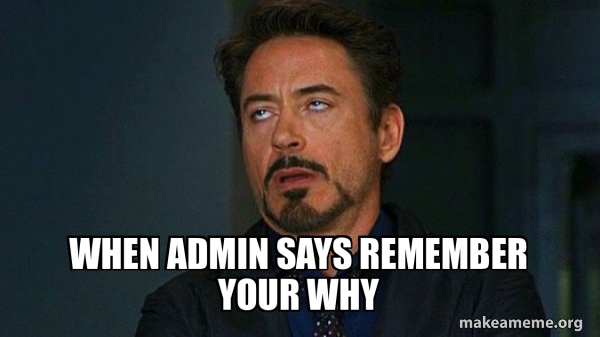
when admin says remember your why - Tony Stark Eye Roll Meme Generator

It’s inservice season!

Of course that should be the time of year, as the old joke goes, when we all get to hunt inservices, but it just means that this is the time of year when teachers go back to work in order to pre-game before the students arrive. (Yes, if you’re wondering, we’ll be drinking – but not enough. Never enough.)

If you are wondering – or, if you are one of my fellow teachers, which means your mouth is hanging open and you are cussing foully at the very thought of this – yes, this is absurdly early. In fact I am writing this at the end of the first half-week of inservice: this year I went back to school on July 16th. I kept seeing memes from teacher meme accounts that joked about our general outrage over Back to School sales happening now, with some kind of How-dare-you caption or comment that included the phrase, “It is JULY!” And though I share that outrage, every time I saw it I had to just sigh. Because not only am I back to work in the middle of July, but I will actually have students in July: classes this year start on Tuesday, July 29th. Thereby spelling the doom of that last vestige of the past advantages of being a teacher: it used to be a steady job, that was respected and appreciated, and which offered good benefits and a lovely, long summer vacation; now none of that is true, at least outside of the wealthier blue states.

But at least we’re still badly paid. So that tradition goes on.

Whenever I think about inservice – which I try not to do whenever I am not in the middle of it, but when I am in the middle of it, I always find myself stuck in uncomfortable chairs in rooms full of people who will look askance at me if they do not actually accuse me of disrespectful misbehavior should I have the audacity to distract myself from the pointless and condescending lecture being presented as helpful instruction, and so I end up spending quite a bit of inservice time pondering in silence the meaning of various available abstractions like this one – I wonder: What is inservice? (Also Why am I here? And Is there value in suffering?) It’s a strange word, after all: is it intended to differentiate this process from some other system called outservice? Which, frankly, if the only difference between inservice and outservice is that outservice is carried out in some place other than the school building, I’ll still take that one every time. And whether the service is in or it is out: who is being serviced? Am I and my fellow teachers the recipients of said service, like cars out of tune? Or are we the ones servicing something or someone else? If it is the teachers performing the service, what (who?) are we servicing, and why?

The ostensible answer is that inservice is meant to provide teachers with time and training to help us prepare for the upcoming school year; so essentially, it is the first one: we teachers are rolling into the garage like smoke-belching, backfiring, broken-down jalopies (Not entirely inaccurate), and the mechanics tune us up to get us ready for the race about to begin. I’m not sure what that makes the students, who are not the drivers and not quite passengers – maybe the cargo? Maybe the road we are driving on? – but I think that’s taking the metaphor too far. This lens does bring into clarity a number of obnoxious things that happen during inservice, not the least of which is: remembering my why.

There are themes that run throughout inservice everywhere, always, and which return every year, like a repeating motif in a Beethoven symphony, or like a recurring nightmare; one of these is the certainty that someone, almost certainly someone who does not teach, will ask the teachers to remember their why.

Why do we teach? Why do we take on this difficult and underappreciated job? Why do we come back to it year after year? Is it like returning to an abusive relationship? Is it like trauma that hides behind a memory block, as is supposed to happen with women who go through natural childbirth and then have to forget how incredibly painful the experience is or they would never have any more children?

As I have never given birth, nor been in an abusive relationship other than working in education, I cannot say. I will say that I remember, every year, how awful the previous year was – and also how wonderful it was, at times.

Which brings me to this year, and the current inservice season, and the direction – which was indeed delivered last week, by a presenter who is not a teacher – to remember my why.

Last year was bad. It wasn’t my worst year – that will always be 2011-2012, when I was working through a recession and a state investigation and a union contract negotiation in which I was the lead negotiator (And it says something that 2012 was the year I won Teacher of the Year for my school district in St. Helens, Oregon) – but it was bad. I spent a fair amount of time last year thinking about, and looking for, jobs that were not teaching jobs. That’s how bad it was: it changed my why into a What the hell am I doing here?, a question that is much less conducive to being a good teacher, and so not one that will be recognized at most inservice training sessions, even though surely many teachers at those sessions are asking that question, repeatedly, sometimes out loud, though under our breaths, so we don’t get dirty looks.

But here I am, one more time – my 26th – starting a new school year, about to teach high school English to a new (Well, partly new; partly familiar, which is at least part of the problem) cohort of students. And I found myself this past week thinking, genuinely wondering, Why?

Why am I teaching? Still? Why am I doing this to myself?

I don’t have an answer, not an immediate one. On some level, I don’t want to be here any more, don’t want to be teaching, don’t want to be teaching at the school where I have been teaching for the last 11 years. But that, too, is not the whole answer, and the whole answer is not immediately obvious in that context, either.

So let’s talk about it.

Why am I here? Why am I teaching?

First of all, most clearly and fundamentally, I’m here because I need a job. If I lived in a different kind of society – one that I think would be better in countless ways – that did not define a person’s value by their economic activity, then I would not be a teacher, at least not a classroom teacher. I have often thought I would like to teach the way Socrates did: at dinner parties, in conversations with interested parties, or out on the streets with random passersby; obviously I couldn’t do that for money, but I think I’d be pretty good at it. But I don’t live in that society, I live in this individualistic capitalist one, and so I must work for money so I can have a house and food and air conditioning, all the vital necessities of life. It’s possible I could survive without a job, but my level of misery would go up exponentially, even over what I went through, what I go through, as a teacher. So I work, rather than become homeless and starve on the street.

But does it need to be this job? At the moment, that answer is close to a definite yes, because my wife, who was also a teacher last year, and who had a far worse year than I did, lost her job to budget cuts at the end of last year; as she is working to build her entrepreneurial endeavors, it falls to me to provide a steady income and health insurance; because teachers are generally more valuable as we gain experience, our pay goes up every year and then drops precipitously if we change schools or school districts – I have done this twice, the first time losing about 20% of my annual pay and the second time 40% — so that means I need to stay in this job, rather than get another teaching position. That wasn’t an easy or a simple decision: I applied for, and could have gotten, a job teaching in a different school that would have earned me about 30% less than I make now; but I just couldn’t afford the drop in pay. So here I am. (It does help that I have many dear friends at this school, and that some of my students are lovely people. But it only helps, it doesn’t make the decision easy. It’s not the why.)

It is possible I could change jobs entirely, even change industries; but because most jobs pay more with experience, like teaching does, I would have to start at the bottom of the scale, and that is generally also less than I make as a teacher, even if the upper end of pay would be more. I am also painfully aware that the current political power structure puts continuing health insurance across changes in employers at serious risk of ending, which makes me doubly unwilling to leave my current job for a new one. Any job that would pay as much as or more than I make teaching would require additional training and/or certification, which makes them possibilities for the future, but not for now. (Also, I am 51, so starting a whole new career at the bottom and working my way up is both less attractive and also less likely than it would have been 20 years ago. Plus ça changeplus c’est la même chose.)

But of course, I could do those things. I could get a job in marketing, or in public relations, or in corporate training. (I could become one of the people who provide inservice to teachers, but I would really have to hate myself to do that.) Especially if I and my family moved states, to one that had a generally higher payscale for professional jobs, I could find something that provided the same approximate income. Yet here I am, back teaching again. So there’s more reason for my returning to teaching than just necessity, more than just money. I will also point out that, if I just wanted to receive my paycheck and cared about nothing else, it would be fairly easy for me to keep my job despite becoming a terrible teacher, because it is in fact quite hard to fire bad teachers. So long as I didn’t hit or harass one of my students, I could treat my job very differently from how I treat it now, how I have always treated it, so that even though it was the same job, it would be a very different experience.

Let me be a little specific. I teach English to high school students, and I do it well. I make literature both understandable and interesting to my students – or at least I create an opportunity for them to find literature both understandable and interesting. I make the class as valuable and entertaining an experience as I can, as much of the time as I can – and that’s a good amount of the time (though of course the experience of my class is subjective and I don’t doubt that some students think I do a terrible job of teaching, and/or that my class is boring as hell. But mostly, they don’t think that, not if they pay attention and try.). I work very hard to achieve that: I spend hours and hours thinking about what I am going to teach and how, hours and hours preparing materials and assignments and activities, and then when it is time to go and teach those things, I show up, every day, as ready as I can be to teach the material to the students I have. I ignore the inconveniences and frustrations of my daily work, of my classes and my situation, and do my best to treat every class period as an opportunity for both progress and also fun. I try to learn as much as I can about my individual students, both so that I can teach them better and so I can show them the respect they are due as human beings who are as wonderful and valuable as every other human being, despite being adolescents (That’s not a dig, not really; adolescence is miserable, and all of us react to that misery by inflicting misery on others. I did it too. I don’t blame them for it: but it can be very hard to deal with them while they work their way through it.). I try to be as honest and vulnerable and trusting with them with my own genuine self as I can be, again so that I can teach them better and so I can show them the respect of being real with them, so they can trust me, so they can work with me.

The fact that I do that, that I have done that every year, is part of the reason why I had a bad year last year, and part of why I don’t want to do this any more: because my students last year did not generally return my respect and my openness. They did not listen or value my honesty and vulnerability, and they did not show me the respect I deserve as a fellow human being, let alone as a teacher who has some ability to affect their lives, possibly for the better. They mostly didn’t disrespect me maliciously, just being teenagers in this modern world; but it was hard to remember that and to keep caring about them and keep trying to be the kind of teacher I want to be with them while they treated me with callous indifference. There were many times, for instance, when I would ask my students about something, and they would ask me what I thought or what my experience was in regards to that idea or situation, and while I was answering the question they asked me, they would not listen: they would turn away and have side conversations, or look at their phones or Chromebooks, or leave the room, because they were bored. Not because they hated me and wanted to insult me, but just because they didn’t care, and they didn’t feel like they needed to show me the respect of their attention, even as I answered the question or gave the explanation they asked for. So as I said, not malicious, but nonetheless hurtful, and hard to deal with. And this year, I will have many of those same students back again. Will they treat me more respectfully? Will they listen to me when I talk, either as their teacher or as a fellow human being?

Probably not. But I am willing to try.

I don’t have to: I could assign them readings, and questions, and maybe videos or audio files of literature – particularly non-fiction, which is what my administrators want me to focus on anyway, as it is the heart of the testing that produces the data that is the obsession of all administrators everywhere –  and I could sit at my desk and monitor their online activity to ensure they were on task. To my school, that would be considered teaching, to a degree sufficient for me to keep my job and my current pay, which is not really related to my success or failure in actually teaching my students. If I produced data that was better than what I currently engender with my involved, honest, human, active, interactive teaching, then I would be even more secure in my job. I might even get a little bonus money if their test scores went up. And it would be so easy. Especially if I just had AI design my “lessons” for me. And grade their assignments.

I choose not to do that. I choose to take the much more difficult path, which does not necessarily make my job more secure, and which definitely does not produce the best test scores. And why do I choose that, you might ask?

That’s the Why worth thinking about.

I teach the way I do because I don’t just teach for money, and I don’t ever teach for test scores. I think that my teaching methods help students to get better at understanding literature and at explaining their understanding in writing, and so higher test scores should be the result of my methods; but those test scores are not my why. If anything I sometimes, perversely and against my own best interests, want those scores to go down while my students’ knowledge and abilities improve, for the data to become less reflective of my students’ actual learning and abilities. Because I want my students – and also my school and my community and my society – to care less about test scores and measurable progress data. Ideally they would not care about it at all, ever; and my hope is that when students grow and learn in my class, and know that they grow and learn in my class, and everyone around them knows that they grow and learn in my class, and then those test scores don’t improve, or even go down, then it shows the truth: that test scores do not measure what matters in education. Test scores and measurable progress data are the wrong focus for educators, because they put the focus on the wrong thing, especially in my subject: English as a subject of study is not about measurable progress in discrete skills. There is no “mastery” in English. It is about growing: growing as a person, as a thoughtful person, as a person who thinks about the world and our place in it, who is curious about the world, who is appreciative of the world, and who cares about the humans who live in it with them.

I want my students to be that. It will make them better people, with better lives, in a better world. I want to make that happen. So I am willing to work for it. Even though it’s hard. I’ve worked for it, worked hard, every day and every week and every month and every year, for coming up on three decades.

Last year, and to a lesser extent the few years before that, it didn’t work as well as I thought it should. My students did not grow as much as I wanted them to. Partly because they did not pay attention enough and did not try enough to actually improve in the subject, to actually work and learn in the class; because they did not pay me the respect I deserve as their teacher and as a fellow human being with some ability to improve their lives and the world they live in, who is working hard to do that, who shows up every day and who is as honest and vulnerable and genuine and compassionate as I can be with them, as often as I can be, and regardless of how they treat me and the work I do and the subject I love. Part of what made last year bad, I think, was that I was not able to keep being patient with my students when they disrespected me and my class: it made me lash out in frustration, or it made me shut down, which then confirmed for them that this was not a class and I was not a person they needed to listen to or be respectful of. We spiraled, because of that, both my students and myself, more than once; it took extra effort to drag us out of those spirals – and very little of that effort came from my students. If anything the majority of them encouraged that spiral, because they know that if I give up, and they give up, then they can stop trying, and they can just do nothing for as long as I have given up, as long as I stop trying and do nothing. For many of my students, for much of the time, their goal is to do absolutely nothing, to put forth no effort, to achieve no ambitions – to have no ambitions – and to not care about anything at all. Because of that they put all of the requirement for effort and motivation on me: often consciously and intentionally, again so that they can give up by making me give up.

But I did not give up, not in the long run (though I did, too often, in specific moments with specific classes), no matter how annoying some of my students were to work with, to be honest and vulnerable with, no matter how disrespectful they were in not listening, in not trying to think or empathize with me or to connect to the material. And the reasons why I didn’t give up are another part of my why, and more of what brought me back to teaching again this year.

The first one, the simpler one, is that I love English. I love literature, I love poetry and plays and novels and stories and essays and screeds and letters and songs and – all of it. I love reading and writing, and I love talking about those things, and learning about them, and teaching about them. All of it is fascinating and beautiful and magical to me, as well as incredibly important, both practically and esoterically, concretely and abstractly. It would wound me, deeply, if I were to treat my subject as something not worthy of real attention and focus and thought and energy, if I were to reduce it to excerpts and handouts and multiple choice questions and AI-generated content. It would dishonor this area of knowledge, this way of living in and interacting with the world, that has meant so much to me, that has consumed so much of my time and effort, that has brought me so much joy and also so much power. And I won’t do that, not even though my students do it every minute of every day, in every class, to one extent or another. Part of my why, part of my reason for teaching, is to fight back against that apathy and indifference and cynicism, that belief, endemic among my students and my society and growing worse every year, that reading is boring and pointless unless it is reading the captions on a TikTok or the comments on a YouTube video or a SubReddit, that writing is something best done with a prompt to ChatGPT. Preferably one entered with talk-to-text. I don’t think I can change that attitude in all of my students; certainly not in the ones who never even try to get better in my class, the ones who prefer to do nothing, at least in this context, and to be nothing as a consequence, at least in this context; but I can help change it for some of them, at least. And because I have read and taught and thought about Ray Bradbury’s novel Fahrenheit 451 for so many years, I know that winning some people over to the side of the angels, to the side of the readers and the writers and the thinkers, the poets and the storytellers and the wordsmiths, is enough to save the soul of humanity and society – at least until we blow it up.

But then we will rebuild. If there are people who have not given up. The character Granger says it at the end of the book, after their world has, at least a little, blown up:

“There was a silly damn bird called a Phoenix back before Christ: every few hundred years he built a pyre and burned himself up. He must have been first cousin to Man. But every time he burnt himself up he sprang out of the ashes, he got himself born all over again. And it looks like we’re doing the same thing, over and over, but we’ve got one damn thing the Phoenix never had. We know the damn silly thing we just did. We know all the damn silly things we’ve done for a thousand years, and as long as we know that and always have it around where we can see it, some day we’ll stop making the goddam funeral pyres and jumping into the middle of them. We pick up a few more people that remember, every generation.”

That’s the other reason why I keep teaching, and again it is fairly abstract and idealistic, and again it is generally ineffective with the majority of my students: I want to make my society a better place. I want my students to understand the damn silly things we do, and that burn us up, so that they can help get us closer to that day when we stop jumping in the middle of our own goddamn funeral pyres. I want some of them to remember. To never give up.

I can’t fix all of it, of course, and so that makes it harder to keep coming back and trying again; just this year, I have had to sit through a conversation among teachers, who should all know better, about how AI is both inevitable and a valuable tool, and so we should not only accept it, but take part in it, contribute to its growth, tumor-like, on the collective mind of humanity; hearing that from my fellow teachers felt like being stabbed in the gut, and it makes me want to throw up my hands and cry out “A plague on both your houses!” I have for years chosen not to fight my students on their use of electronics, preferring to ask them to come along with me into the world of literature I make available and interesting and useful in my class; but I have watched as more and more and more of them have refused my kind invitation, my well-meaning passivity, and have failed to gain anything from me as a consequence. So now I will have to fight to make my classes available to my own students, and I don’t know how well that will work – and I don’t want to do it. I have no choice, so I will; but I don’t want to. That’s a why on both sides: I want to teach so I can fight for the souls of my students, and I want to let them do what they want, even if it destroys them.

But as I have learned from literature and from being a part of humanity and thinking about humanity, when some people are allowed to destroy themselves, they bring the rest of us down with them. I don’t want to allow that, not for a reason as stupid and worthless as laziness or fear of failure which creates failure, which are the main reasons why students don’t pay attention in class. Again, I don’t think I can save all of them – I don’t think I can save any of them, really, but I think I can help make a change in the paths for some of them, which will allow them to save themselves – but if I can save some, that will be enough. Not enough to make me happy, or to make my job easy; but enough to keep society moving mostly forward, and to allow humanity to continue to get better. If I can help them to empathize with others, as they might learn from To Kill a Mockingbird, or to think about the consequences of lies and self-serving fingerpointing, as they might start doing after reading The Crucible, or if I can just make them curious about the real value and power of reading, as they might learn from Fahrenheit 451, then I will accomplish that goal. I’ve done it before: and I hope to do it again. And again. Until I can’t do it any more.

That’s why.

Deep Breath — Now Hold It… Hold It… Keep Holding…

I bet this would work.

***

Wow. It’s been so long since I’ve written a post that I got logged out of my own website.

I would apologize, but first, you all are sick of hearing me apologize; as I say to my students when they offer an apology for their behavior, “I don’t need you to apologize, I need you to do better.” And I can’t promise that I will do better: because the reason I haven’t been posting is that I’m too busy drowning in work and responsibilities. I haven’t caught up on the work, and the responsibilities aren’t going away; so I won’t be writing much any time soon. Though I do have a break a week from now, so I may be able to find some time there to post some more; I do have several ideas for things I want to write.

But this one has to come first. Because, you see, a large part of my problem with keeping up this school year is that I am extra exhausted: and a large part of that problem is that my students are extra exhausting. I’m back teaching 9th grade English, for the first time in 8 years; and the last time, it was an Honors class. I don’t have my lovely fantasy/sci-fi elective this year; not enough students signed up for it — though I can’t imagine who wouldn’t want to take a class in which you get to read “The Fortress Unvanquishable Save for Sacnoth.” (And I BEG you, if you like swords and sorcery and epicness beyond the known realms of epic, click on that link and go read the story. It’s lengthy, but it’s SO good.) The class was fun, and therefore easier to teach; the classes I have now are mostly not fun, and mostly not easy. And though I don’t want to sound like an old man shaking his fist at a cloud, I have to say that part of the problem really is my students, their attitude about school, and the way they treat me and my class.

But another factor — a more difficult one — is how my administration directs me to deal with those students.

For the sake of this post, which I want to keep shorter and more to the point than my usual logorrhea, I’m just going to share the text of a … friendly lil email I got from my administration. Let me preface this by saying that I actually like my administrators very much, first on a personal level and then second (and somewhat less than the personal) on a professional level. They work very hard, even harder than I do; and they, like me, like everyone in education, have enormous and ridiculous demands on their time and energy. One of the demands on my administration is for them to implement the systems that the higher-up administrators want them to implement; and at my school, as at many schools, one of those systems is PBIS.

I have written before about PBIS. But there is nothing I could say about it that would communicate the full level of insipid uselessness that it imposes on teachers. The basic idea of it is that we need to praise students for the things they do right, more often than we need to criticize them for the things they do wrong; and that’s fine — but the idea of it being a system that we need to impose on teachers? Processes that require training? The idea that it will produce data which we will then analyze and use to form data-driven decisions that will surely improve school for everyone? My god, the pile of steaming bullshit in that is larger than Mount Olympus. I already praise my students when they do things right. I do it because I am a kind person, and I care about both my students and the work we are involved in, this pursuit of their best selves. So it already happens. Any system, any process, any practice that teachers are trained in, is inevitably going to be artificial, and therefore undermine the actual relationships that teachers form with students, and which are far and away the best chance we have of changing the way they act, changing their attitudes and reducing their misbehaviors. Relationships, guys. Not PBIS.

When my students are being resistant, or obstructive — or just little freaking jerks — they don’t really need me to be nice to them and find something in their behavior to praise. They need me to tell them to shut the hell up, and make it stick: they need me to have a relationship with them that means they will listen to me when I tell them they need to shut the hell up. That is 99% of the problem with student behavior. For the sake of contradicting the image of me as old man shaking my fist at a cloud, let me say this: students today aren’t worse than they were ten years ago, or twenty, or thirty, when I was a student (Okay, thirty-five…): but they aren’t any better. They are sometimes, some of them, intentionally cruel; that is a separate and more serious issue that has to be dealt with individually and more emphatically. They are frequently distracted and detached, and that sometimes has to be dealt with, though I still generally believe the best way to handle that is to let them not learn anything for a time, and point out to them that they have not been learning anything, and maybe they should do something about that. But really, the problem that comes up in every class, every single day, and which requires a reaction from me, a reaction I am VERY tired of giving, is: they make too much goddamned noise. They just need to shut the hell up. That’s it. Otherwise they are basically fine, and usually good.

Or, as my administration put it in an email I recently received:

As we continue working together to create a positive and productive learning environment for all of our students,

Off to a great start. Also, I thought I was teaching them English?

But please, go on.

I want to emphasize the importance of using Positive Behavior Interventions and Supports (PBIS) when addressing behaviors around our SSA campus. One key aspect that often impacts the success of these interventions is the tone we use when interacting with students. At times, incidents can escalate unnecessarily due to an improper or harsh tone. I encourage each of us to be mindful of how we address behaviors, focusing on de-escalation rather than confrontation. A calm, respectful approach can go a long way in turning potentially challenging moments into opportunities for growth and learning. It’s also crucial to remember that our students deserve the same level of respect we expect from them. When we address students with kindness and respect, we not only model the behavior we want to see, but we also build stronger relationships that can lead to more positive outcomes inside and outside the classroom. I’ve included some behavior interventions that can be helpful when dealing with defiant or disrespectful students.

Oof. Okay. First, I hope we all know that the least effective sentence in the English language is “Calm down.” It never, EVER, makes anyone calm. It is much more likely to piss the person off and add that to whatever agitation they are currently going through.

Second, I have to point out that I strongly suspect a particular interaction between one of my fellow teachers and one of our high school students, which happened the day before this email was sent out, was a large part of the impetus that led to this particular email: because that interaction was not positive, and was not de-escalated by the two people involved. So there was cause for some means of addressing that issue.

But — and this is third, but it should be first, last, and every number in between, when discussing how my administration works with their teachers in ways they should not — any particular issue with any particular teacher SHOULD BE HANDLED SPECIFICALLY WITH THAT TEACHER. Don’t talk to me about being calm; I am too calm. I need to lose my temper more often. Know how I know that? My students tell me that. Talk to me about not confronting my students when they misbehave: that is something I have trouble with. Don’t say that to my colleagues, several of whom are extremely good at addressing issues when they rise, and most of whom do it calmly.

Last, and best, don’t do what the email went on to do, and which it does in this first part as well: don’t tell us to be positive and respectful and several other handy pieces of trite advice, while doing none of those things in the email telling us to do them. Pedagogy experts are legendarily bad about this: almost every teacher training I have had in 25 years in this business has been largely about how to keep students connected to n involved with the learning, presented by people who fail to connect us to or involve us with the learning in any way. The most famous example is the trainers who teach teachers by showing us PowerPoint presentations with blocks of text on every slide, which the trainers then read to us verbatim while we are looking at the slides. Every teacher I know who assigns PowerPoint presentations would fail every one of those presenters. I myself just think about how much better it would sound if I read it for them.

So. Here are the specific pieces of advice this email then offered us. Ready? Here is How To Deal With Students Misbehaving 101. With notes by me, illustrating how I would put these nuggets of wisdom into practice. (If I ever put these into practice. [Not bloody likely. Not as they are worded here.])

Here is your hypothetical situation requiring my intervention: one of my students is talking too much, too loudly. That student needs to shut the hell up. Here is how I would say it, adopting my administration’s guidance. [Said guidance will be quoted preceding each example.]

– Stay Calm and Maintain Neutrality
Responding with a calm demeanor can prevent the situation from escalating. Take a deep breath before addressing the behavior to ensure you remain composed.

*Takes a deep breath, then, composedly,* “Shut the hell up.”

– Give Clear and Specific Directions
Sometimes students react negatively due to confusion or misunderstanding. Make sure your instructions are clear, direct, and specific.

“[Student name]: shut the hell up. Shut your mouth, with the words inside. Lock your throat into silent mode. Do not make the speaky-speaky noises. Am I being clear? Shut the hell up if you understand me.”

– Use Positive Reinforcement
Acknowledge and praise positive behavior when you see it. Often, recognizing what students are doing right can prevent future defiance.

“Good job shutting the hell up. Keep it up.”

– Provide Choices
Offering choices allows students to feel they have some control over the situation. For example, “You can either take a break for five minutes or finish your task quietly.”

“You can choose to shut the hell up, or you can accept that you have no control over this situation, and shut the hell up because I told you to. Your call.”

– Restate Expectations Respectfully
Respectfully but firmly restate your expectations, reminding students of classroom rules while remaining respectful and kind.

“I expect you to shut the hell up. Respectfully.”

– Active Listening
Take time to listen to the student’s perspective. Sometimes defiance comes from frustration or a lack of feeling heard. A few moments of active listening can de-escalate the situation.

“I am now prepared to listen to you shutting the hell up. I am actively listening for absolute silence.”

– Have a Private Conversation
Address the behavior in private whenever possible to avoid embarrassment or defensiveness. This can help maintain the student’s dignity and prevent power struggles in front of peers.

*Takes student out into the hall.* “Stay out here. Shut the hell up. Learn to have some dignity, and some respect for your fellow students, and for me.” *Returns to class where silence prevails. Teaches respectfully. Student’s embarrassment, standing alone in the hall while other students walk by and snicker, helps to enforce that their behavior was unacceptable. Student learns.*

– Teach Problem-Solving Skills
Help students reflect on their behavior and guide them in developing solutions for similar situations in the future.

“The problem with your behavior is that you are not shutting the hell up. Can you offer any potential solutions to this problem? Here’s a hint: it rhymes with ‘Butt the shell pup.'”

– Offer a Reset
Give the student an opportunity to reset their behavior without consequence by offering a short break or a moment to collect themselves.

“Let’s reset your volume to zero by shutting the hell up. Feel free to take a short break from talking. Collect your lips together into a single, unbroken unit.”

Look. At least some of this is valuable advice. For teachers who don’t know how to handle student misbehavior. Which is not all of us. More to the point, if all you had to do to teach somebody something they don’t know, and get them to adopt it as part of their pattern of behavior going forward, was show them a bulleted list, then *Takes a deep breath as advised* I WOULD HAVE GIVEN MY STUDENTS A LIST OF STATEMENTS THAT READ “SHUT THE HELL UP” AND WE WOULDN’T HAVE ANY MORE PROBLEMS. Also, I would give them a list of ways to write essays and read books, and how not to waste their lives and potentials and their very minds and souls on screens and social media, and a whole lot of things would be a lot better. (I have another list for Donald Trump. I’d really like for him to read my list, and absorb everything it says.)

And if you think I’m exaggerating about the prominence of the doesn’t-shut-the-hell-up problem, let me just say that the confrontation that might have led to this email was started by the student making loud noises in the hallway during class time. So.

I will end this by including the last paragraph of the email in question, which is almost everything I would want our administrators, or any colleague, to do when talking to their peers and coworkers. The only other thing I’d like to see with this is a statement that the administration will be working on these problems with both individual teachers, and all the students, who also clearly need to learn these steps in how to de-escalate a situation and treat people with the respect they expect to receive from those people. And for this whole email to never have happened at all.

Let’s continue to create an environment where respect and kindness are the foundation of all our interactions, and where every student feels valued and understood. Thank you for all you do for our school and our students. I appreciate all of you! 

“I appreciate you shutting the hell up.”

The Truth

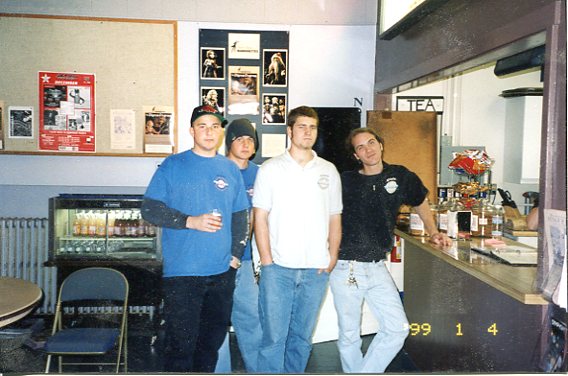
Me (far right) as a janitor
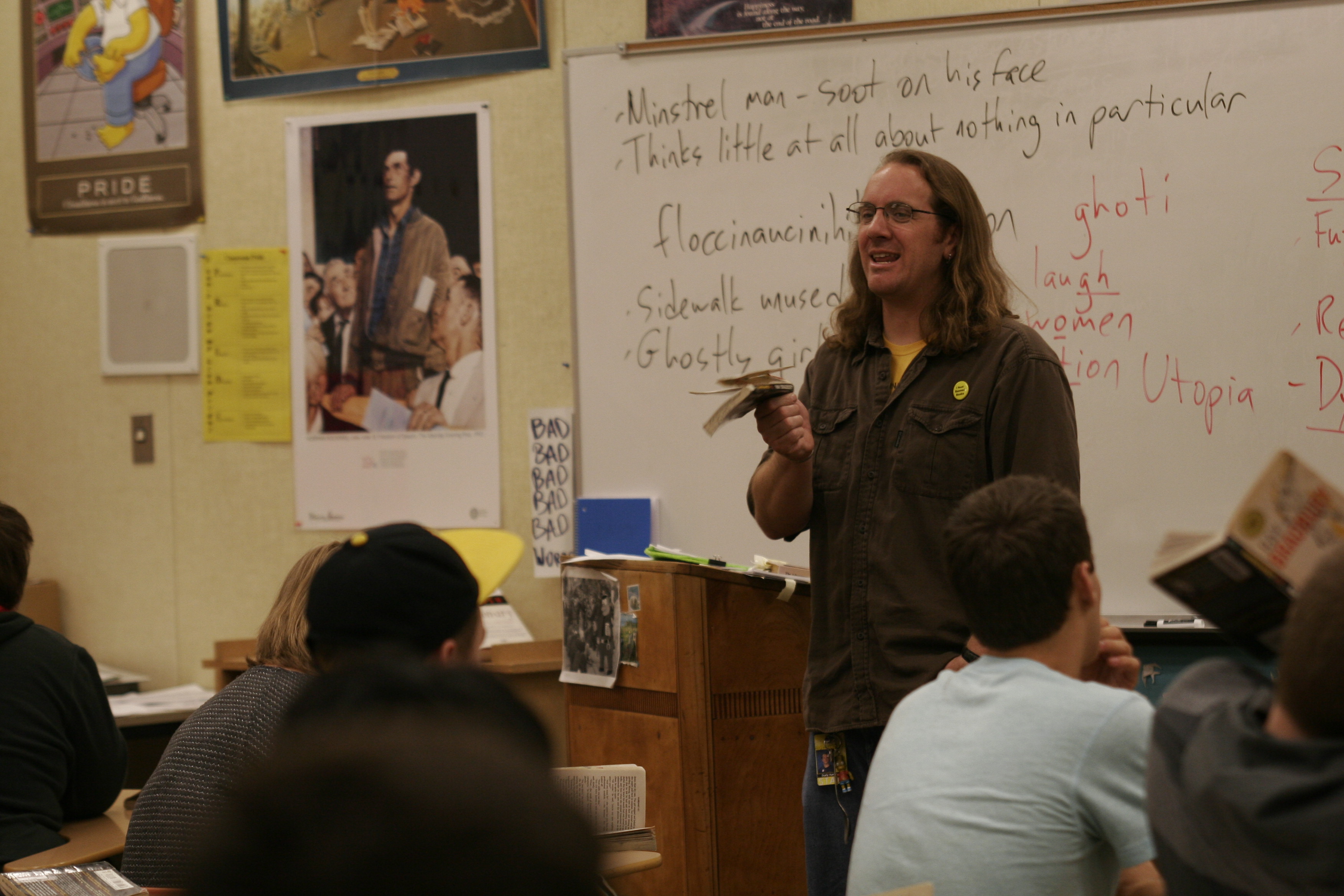
Me as a high school English teacher. Which one looks happier?

I have been a high school teacher for a very long time. Too long, in some ways, because I have watched education change enough in that time to make me very nearly obsolete, and if you stay in a job until your job doesn’t exist any more, that’s too long. I fear that the day is coming when English teachers will not exist: and possibly the day when teachers will not exist.

I’m here today to try to forestall that day. Not for myself – if I reach a point where I cannot teach, I will move into janitorial work, and be quite happy; probably happier than I have been as a teacher. After 25 years of cleaning up student writing, I would rather clean up public restrooms. It’s less work.

But it’s also less important work. Not unimportant work, it’s incredibly important because janitors keep our world working, and keep it livable – but for me, as someone who works in education, that work is more important. I’m just saying custodial work is a good backup for me. I worked in maintenance for five years before I became a teacher, and I liked it. In some ways more than teaching.

So if I liked being a janitor more, you may be thinking, why am I a teacher? And why do I still like and sometimes love being a teacher, despite the issues in education that I deal with every day?

It’s because I love humanity. I think we are incredible. I believe we have infinite potential for goodness, and infinite capacity for wonder. What we have achieved as a race is miraculous – and also sometimes terrible – and despite our almost limitless ability to dream and imagine, we can’t imagine how many more miracles we can achieve. And, hopefully, how many terrors we can avoid, or even eliminate, in the future.

And the key to that, the key to unlocking our potential and achieving progress and positive growth, and to actually making miracles real, is education.

That’s why I’m a teacher. Because my faith, my zeal, my heartfelt belief, is this: the best thing about all of us is that we are human, and the most important thing one can do is help us all become better humans. That’s what I try to do as a teacher. And that’s why I’m here today, speaking to all of you about school. Because I want to help you all to learn something about which you have been deceived – or at least misled. I don’t think any of you really understand what school is or should be – and what you think it is, what you have been told the purpose of school is? That’s a lie.

The lie is that school is about money. All of you students have been told that the purpose of school, the reason you are here and the reason you should try hard and do all of your work, is because that way you can get into a good college, get a good job, and make good money. You’ve been told that all along – though in elementary school it may not have been stated explicitly; but back then you were certainly told, with absolute sincerity, that the purpose of your schooling was to prepare you for the next step, which would be harder, and would matter more: 2nd grade is meant to get you ready for the rigors of 3rd grade, 3rd grade gets you ready for 4th; all of elementary school is preparation for middle school, which is preparation for high school. And all the way along, more often the farther you get in your thirteen years of compulsory schooling, you have been told that the goal of high school is to get you ready to go to college. So that you can get a degree, so you can get a good job, so you can make good money. And since schools also tell you that the next stage is always more important than the current one – “When you get to high school, things get serious, that’s when grades really matter” – the clear implication is that the final goal is the one that really, really matters: college, degree, money. Did you absorb the message in 2nd grade that everything then was intended to prepare you for college and a job and good money? Maybe not, but the cumulative effect of all of this is the same: the goal of school is – money.

Teachers, and especially administrators, you have said this. You have said it to all of your students, probably with certainty, certainly with absolute sincerity. All of you have lied. All of you have misled all of your students. Don’t feel bad: it’s what you were taught, what you were told, what the whole apparatus and engine of the educational system forced on you. So you didn’t know, you couldn’t even think, that it might be a lie. This is some of the power of education: it can influence our beliefs, and therefore our behavior, in pernicious ways as well as positive ones. As always, the pernicious influence is easier. The idea that school is intended to help students make more money is a pernicious lie, and I need to convince you to stop saying it, to stop thinking it.

Don’t take this as a personal attack, either, teachers: I’ve said this too. With certainty. With absolute sincerity. Because it’s what I thought, and it’s what I was taught. But luckily for me, I had an extra advantage that most teachers don’t have, something that helped me realize the truth: I’m an artist. And I’m married to an artist.

My wife and I both went to college to study art. And though I ended up studying education – one of the more useless endeavors of my life – I earned my degree in art, specifically in literature. My wife, who is stronger and braver and smarter and better than I am, stayed with art all the way through. And she had one of the most difficult undergraduate programs I’ve ever heard of; harder than any pre-law or pre-med program, I would be willing to wager, and with far less prestige.

And here’s the thing, the magic secret: she didn’t do it for the money. Neither did I – though I did sell out and become a teacher. Actually, it’s not the becoming a teacher that was selling out; I still reflect and promote the ideas of my art in my teaching, and I am proud of the career I have had, because it is a noble vocation, when it is done right. But I should have kept studying art while I was in school. I hate to think of the potential I lost, the opportunities I walked away from by switching from literature to education. And it’s funny: just as my time in public school didn’t prepare me successfully for college, my college education didn’t prepare me successfully for my career in public school education. The time I spent studying art was far more useful to my teaching than my training in how to be a teacher.

It was in teacher training that I was first trained in the Big Lie, though of course I heard it in some form or other all the way through my own K-12 schooling: the idea that the purpose of school is to get students higher incomes than they would get without it. I was shown the statistics, the data, the graphs, that argue that college graduates make more money, on the average, than non-college graduates. I was shown this, and told to use it on my students, because it’s one of the most effective ways to get students to take school seriously, to work hard and therefore (incidentally) to learn. I assume that’s why all trained educators in this country have been shown the same data: because scaring children with threats about their future is effective. It’s cruel, essentially abusive, and it has some quite severe secondary and unintended consequences, as we are now discovering; but it’s effective. It makes those lazy little punks – that’s you, students – work harder and try more. At least some of them. At least some of the time.

Look: you can’t blame us. Teaching is hard. Everything about it is hard. Organizing curriculum is hard, planning lessons is hard, finding and adapting materials is hard. It’s hard to stand in front of a room and command attention, let alone respect. It’s hard to manage a room full of individual people and get them all to focus, together, on one thing. It’s hard to communicate clearly, and hard to understand children who haven’t yet learned to communicate clearly.

(Let me just say one thing to all the students here: speak up. I’m old; I’ve lost some of my hearing. I cannot understand you when you whisper, when you mumble. Whatever you have to say to me: speak up, please.

(And I’ll try to talk slower.)

And then, after completing all of those difficult tasks, teachers run into the biggest difficulty of all, the one that feels insurmountable: getting the students to do the work. We create this curriculum, design these lessons to deliver it, gather the materials, summon all of our strength, invent positive energy from somewhere, and teach our hearts out: and then all of you students, just – don’t do it. There are many individual reasons why you don’t do it, but in a large number of instances, maybe more common than any other, the reason you don’t do the work is just because you don’t want to. You don’t feel like it. You don’t see the point. You don’t think it matters. You don’t care.

Confronted with that, over and over in student after student, day after week after month after year, teachers have reacted understandably: we try to MAKE you care, dammit! Sometimes we do it angrily, resentfully, with hurt feelings; because we care. And when you care, it hurts to try so hard and have somebody just say, “Nah.” That’s why teachers then try to scare students, that’s why we threaten.

“Your boss won’t accept this kind of work when you have a job.”

“Your college professor won’t care about you, so they won’t make exceptions for you: they won’t even know your name.”

“You think you can act like that out in the real world? Think again!”

Hurt people lash out. We may tell ourselves we’re doing it to be helpful, but we’re doing it because we’re hurt. It makes it easier for us to tell the lie, because the lie is hurtful, where the truth is just difficult – and we’re lashing out at those who hurt us. We shouldn’t do that, but also, maybe all you students should stop hurting your teachers. When a student comes to my class and says something like “This is boring. Can we do something fun instead?” to my face, every day, I definitely want to snap at them about how their attitude won’t be acceptable in the future. Because it’s just not right to insult someone’s passion the way students insult mine.

So it makes sense that teachers have done this, that we’ve told this lie. It makes sense that we’ve structured school, and thought about how we can teach our subjects, and explained this whole endeavor to students, on the basis of this fundamental assumption, this base falsehood, that the purpose of school is to prepare students for the real world, specifically for college, so they can get good jobs and make good money. It makes sense – though, teachers, I won’t take us off the hook entirely, because we really should have recognized the falsehood in this, and seen the hypocrites we make of ourselves, when we tell our students they should study hard specifically so they can make more money: because we are all so very well-educated, and worked so hard to become so, and we are so poorly paid for that effort and education. Did you all go to school, do all that work, and then take this very hard job, for the money?

Neither did I. (Though also, I expect and deserve and demand that I get paid what I am worth. So should we all.)

I do need to point out that we make this claim about the purpose of school in more ways than just talking about money. We do also talk about getting a “good” job, by which we mean a job you like and find fulfilling, a job that you feel has value, to yourself or to society or both. Teaching is all of those things for me, as it is for many of my colleagues; and the money has been generally sufficient, if not actually good, or representative of what I’m worth. We do also talk about getting our students prepared, with skills and knowledge, for the real world, beyond and apart from college. I think we do that, a little. Not enough, though also, here we run into a question of how much someone can be prepared, in school, for the world outside of school, and also how much someone should be prepared in advance of actually living. But regardless: our efforts to prepare students for the real world, as we call it, are founded on the same principle: we try to get them ready for their jobs. We want them to have work skills, and know how to find a job, apply for and interview for a job, succeed in a job. When we talk about our students’ future – other than some basic insincere lip service to the worn cliches “You can be anything you want to be!” and “You can do anything you want to do,” – it’s always the same basic idea. It’s all about the money.

Okay. So those are the lies. Now: are you ready for the truth?

Deep breath.

The truth is, you can not be anything you want to be. You can only be yourself.

The truth is, you cannot do anything you want to do: there are limitations on all of us, some internal, most external.

The truth is school does not prepare you for college or for work. Only you can do that, and no matter how well you do manage to prepare yourself, you will still be surprised, and sometimes unprepared and overwhelmed; and to some greater or lesser extent, you will fail.

The truth is, school is not preparing you for the real world: you are already in the real world, and you always have been. And no, it doesn’t get better. It doesn’t get easier.

The truth – the big truth, the last truth – is that the purpose of education is not, cannot be, and should not be stated as, helping students to get a good job or to make more money.

The purpose of education is to create more life.

***

Okay, that was a lot of truth. Take another deep breath, and then I’ll soften it up some, make it easier to swallow and to digest.

By the way: we absolutely should teach our students how to breathe. There’s nothing more important. Literally.

Okay: now for the softer side of the truth.

While it is true that you can only be yourself, that is also the very best thing you could ever be. Because every single one of you, of us, is as good and valuable and worthy as every one else; and there is also no other person you could be as successfully as you can be yourself. It’s also true that figuring out who exactly you are is incredibly difficult and complex, and the work we do on that project in schools is good work. You get to explore your self and your society and your skills and interests, even while we are barking at you that you need to master proper MLA format for your resume.

While it is true that there are limitations on all of us, which keep us from doing anything we want to do, limitations can be overcome. Muggsy Bogues played a full career in the NBA despite being only 5’3” tall. Also – and this may be even more important – a lot of things we think we want to do are actually really bad ideas. When I was 6, I wanted to be a stage actor, a fireman, and an astronaut. All bad careers for me, for the person I became – especially all at the same time.

The truth is that school does not prepare you completely for college or work: but the truth also is, it helps. We will, as I said, always fail, in college and career and life; but no failure needs to be total, or permanent. Failure always precedes growth. And – heh – school can prepare you for failure.

Unfortunately, the truth – and I cannot soften it – is still that school does not prepare you for the real world. But that’s because you’re in the real world, right now, while you are in school, and there’s no preparing for it, for any of us. There is only living it. Experiencing it. Learning from it. That’s all we ever do, whether in school or not. I do think it’s important that we teachers stop telling students there is some distinction between school and the real world, especially with the implication that the real world is somehow worse, harsher or harder, colder or crueller. People who really think that do not remember what it was like to be in middle school or high school. Or they do not understand the situations that many students, many children, live through. As I said: it doesn’t get better and it doesn’t get easier; but you will get better. And then, if you can, you will make your life better. And that process will continue for as long as you keep trying to learn and improve: always in the real world.

Last one – and, because I know my persuasive rhetoric, this is the important one. This is the point. This is what education is for.

Our world has, I believe, an objective reality. It’s not just in my mind, or in the Matrix. The world would – will – still be here when I am not here to perceive it; it will still be the same world when all of us are gone from it. Although it will be quieter, and less messy. No matter how I imagine the world to be, whether I think the Earth is round or flat, 6,000 years old or 4.5 billion, floating in space or resting on four elephants who are standing on a turtle – there is a truth, a real situation that I don’t change through my perception of it.

However: my perception of the world shapes my world, changes how I experience it, more fundamentally than I think we realize – certainly more than we think about very often. How we see determines what we see. We cannot perceive things that we cannot imagine existing; sometimes we cannot perceive them intentionally, consciously. Take the flat Earth example. If I believe, absolutely, that the world is flat, then there are things I will not do, places I will not go, because of my belief, because of my perception. I will not get on a plane that I think would fly off the edge of the world. I will not go to the world’s edge, let alone beyond it – so I will never see that there is no edge. So even though the world is in fact round, I will never perceive the world as round, because I will avoid – or more simply, deny – anything that would prove to me that the world is round. So for me, functionally, the world would be flat. And I will miss out on any experience associated with the round Earth. My world, shaped by my perception, would be less full: only two-dimensional.

Let’s take a more realistic and more common example. If I were a racist, and hated, let’s say, plaid people, then I would avoid, or dismiss as unworthy of my time, any and all plaid people. They would essentially not exist in my world except as an amorphous abstraction for me to hate and fear and blame. I would never get to know, never get to appreciate, never get to love, anyone who is plaid. And therefore my world, my life, would be smaller.

Because plaid people are some of the finest people there are.

And if you don’t know any plaid people – or, even more shocking, you somehow think that they don’t exist – I think you need to open your eyes and pay more attention. America’s no place for plaid-deniers.

But in all seriousness, this fact, that perception shapes reality, is true in all ways: things that we can’t understand, we avoid; things that we can’t conceive of, we don’t even perceive. And in contrast, when we have heightened understanding, we have heightened perception: my wife’s experience of an art museum is much richer, much fuller, than mine, because her knowledge of art, and her experience with creating art and the deep understanding of the artist’s craft she has thereby, lets her see the works on display in more ways than I can, who makes art only with words. My experience of literature is similarly fuller than most people’s. My dog’s experience of the world of smells is many thousands of times more complex and interesting than my experience of smells: which is why he chooses to sniff cat poop, which I simply avoid. Because he finds it interesting, and I just think it smells gross. But I have to assume that if I could smell what he can smell, I would interact with cat poop the same way he does: my nose would be riveted to every turd. Think how much more enjoyable it would be to live with cats, then. Having the litter box in the house would be a benefit. Maybe we’d put the box on the coffee table. Make it a conversation piece.

I know that sounds bizarre and insane. It sounds that way to me, too. But understand: it only sounds that way because of how we perceive cat poop. Or rather, how we don’t perceive it. How our experience of the world is limited by our range of perception.

Education can change that (Maybe not with cat poop.), because education can introduce us to things, and show us how to perceive them. I wasn’t born reading literature the way I do; I learned that. Because I learned it, my experience of reading is better than most people’s. My world of books is larger, more vibrant, more diverse, more entertaining, more inspiring, more challenging, than most people’s book world. Not because I’m better than other people, not because I’m just built different: because I have been educated. Because I learned. Because I learned how to read and understand what I read to an unusually high degree, I have a larger world to live in. It means I can find greater pleasure and fulfillment in the world of books. I will never get tired of reading books. I will never be bored, not as long as I can get my hands and my eyes on books. I can still perceive all the non-book things as well as all the rest of you can – though some people perceive individual pieces of non-book-reality better than I can, because I don’t know much about cars or sports or calculus, or about being a parent, or about traveling to other places or into other cultures – but in the areas where I learned well, my world is larger than the world of people who didn’t learn as well. In all the areas where I am not ignorant, my life is larger than the world of ignorant people. I live a larger life, in a larger world, than someone with less education with me.

That’s why I’m a teacher. Because I love humanity. Because I want to help people to live larger, fuller, richer lives. To have more chances to be human, to be more human. To make miracles. What else could I possibly do that would be as valuable, as important?

But, you see, my work has, of late, become less valuable. Less effective, and therefore less important.
Because my students are less willing to work with me, to listen to me. They are less willing to learn.

But that’s our fault, teachers, parents, adults in general: because we’ve been lying to them. And they have caught on. These are the unintended consequences of our choice to use the threat of future poverty and failure to scare our students into obedience. Rather than explain the real value of education, even though the idea is complicated, even though it is hard to accept, we have chosen to use the simple lie that the entire point of education is to prepare students for future work. We still tell them, as we have for years, that going to college is the best way, even the only way, to get a good job and make good money, and the point of compulsory public education is to prepare them for college and for jobs – and that’s it. It’s not all we think education is for, but when we are frustrated with difficult and disobedient students, we don’t usually talk about the wonderful benefits of education: we just threaten them. “If you drop out, or get expelled, how will you get a good job? You’ll be flipping burgers for your whole life!”

But, see, we have now gone through a pandemic, and more than one recession; today’s students are in the world of social media, which gives them access to people’s lives and internal thoughts. So they’ve seen behind the curtain, they’ve torn down the veil. They know that there are countless people who have good jobs without ever having finished college, and countless people with lots of education who have miserable jobs. And now college is so absurdly expensive that even those who would want a college-level job – for whom a job that required a college degree would be a “good” job – are not willing to accrue the debt to get that job, and so they’re looking for different jobs, ones that are easier to get, that have fewer requirements. Or, more often than I think we educators realize, they have come to the conclusion that life is not, and should not be, defined by a job: and so what job they end up with simply doesn’t matter to them, as long as they make enough to survive and do what they want to do. What they want to think about and plan for is all the non-job parts of life.

So here you are, students. You’ve been hearing for years, again and again, that school is necessary for getting into college and getting a good job. And you don’t want that. And you know that we are lying to you, that you don’t need college for many good jobs. You also know that life shouldn’t be only about a job.

What, then, is the value of this education we offer and demand, for a student who doesn’t want what we have claimed is the main and even the only goal of that education?

There isn’t any. So you don’t want it. Of course not.

And the more we try to threaten, and cajole, and cozen you into doing the difficult work of education anyway, the more you resist. Of course: you don’t like being lied to, and you don’t like having your time wasted. Wasting time is wasting life, and we all want all the life we can get.

So you ignore and evade and escape education that is nothing for you but life-draining, time-wasting oppression.

And therefore you remain more ignorant than you could be. Not totally ignorant, of course, because you learn on your own. But school could teach you so much more than you can easily learn on your own; and without putting effort into school, you will absolutely know less than you would if you could really do this the way it should be done.

And since you will know less, therefore you will have less life.

***

It has to stop. We need to stop telling students that school equals college equals job equals money. We need to stop focusing on money. I don’t teach literature because it makes money, either for me or for the students – or even for the authors, who I do think deserve money for their work; but that’s not why I want the book, and it’s not why I want to teach the book. I do it because literature expands and improves my experience of being human: and I want that larger life. And I want other people to have what I have. Especially now: because the world kinda sucks. And especially the kids I teach: because being in middle school and high school kinda sucks.

Teachers: we need to tell our students the truth: school sucks, but education will make your life suck less. It will give you more life, and a better life, because it will let you understand more, and therefore do more, and perceive more. And we need to believe this when we say it, and we need to want that for our students.

Otherwise we should all just give up and become janitors.

At least then the world would be cleaner.

Separate Has A Rat In It

All right: so I have two classes of College Readiness, and they both had to write a UChicago essay — and they both picked a prompt for me to write. (If you don’t know what I’m talking about, read this. If you want to see all the prompts, go here.)

The other class chose this one:

People often think of language as a connector, something that brings people together by helping them share experiences, feelings, ideas, etc. We, however, are interested in how language sets people apart. Start with the peculiarities of your own personal language—the voice you use when speaking most intimately to yourself, the vocabulary that spills out when you’re startled, or special phrases and gestures that no one else seems to use or even understand—and tell us how your language makes you unique. You may want to think about subtle riffs or idiosyncrasies based on cadence, rhythm, rhyme, or (mis)pronunciation.

Here is my response.

Language Separator

See the rat?

I am a dull man. 

I am utterly unspecial, solidly in the mainstream: I am a white American male, cis/het, raised vaguely Christian but now a non-practicing atheist. I am married. I am 49 years old. I own a car and a house, with a mortgage on the house. I have a Bachelor’s degree, more debt than savings, and I vote Democratic. All completely “normal,” in that people who look and live like I do have made sure that our culture believes that people who look and live like I do are the norm, the standard, the expectation – and therefore everyone else is a little weird, a little off, a little less than what they are “supposed” to be. Like most people who look and live like me, I am aware of my privilege, I oppose the unfair societal structures and institutions that promote it – but I don’t really do too much to change them, because after all, I do benefit from them. I feel guilty when I think about that, so I try not to think about it.

Sorry: that went too political. (I am keenly aware that some people find it awkward and uncomfortable – challenging – when I speak of political matters. I do not want to offend them, so I usually do not speak of political matters.) My real point is that there is very little about me that is, according to our society’s generally understood and accepted standards, abnormal.

Until I open my mouth.

My mouth itself is pretty normal (Though I have WAY more fillings than is normal, I think – over 40, with 5 crowns. I have abnormally bad teeth.), it’s what comes out that is abnormal. First of all, I have a weird accent: my parents (The most important influence on a person’s accent and dialect) are from the West Coast, Washington and California, so I speak somewhat in their accents; but I was raised first on Long Island, which has a distinct accent, and then in a suburb of Boston, which has a STRONG accent. I didn’t acquire or keep either of those accents in their entireties, but I did pick up a few pronunciations; and more, Boston’s speech patterns were strongly influential: I speak too fast, as Bostonians do, and I talk faster the more excited I get; and I cuss intemperately. So I sound like a mishmash of two coasts and four states.

It’s more than my accent and my speech patterns, though: it’s what I say.

Don’t get me wrong: I am a student and an artisan — a wright. A smith. — of language. I study literature and rhetoric, and have mastered them to a degree that allows me to teach, generally successfully. I possess linguistic capacity more than sufficient to enable the utilization of language both fanciful and ornate, drawing from the recondite and recherche realm of jargon as well as splashing through the filigree fountain of poetry.

I talk good, is what I’m saying.

 And, as you can see, because I can use language well: I can also abuse it.

My favorite form is mispronunciation. I enjoy completely destroying the actual sounds of words, especially foreign ones. Especially French. Because if any language has worse pronunciation than English, it’s French. That word I used between “recondite” and “realm?” I would enjoy saying that “ruh-churchy.” So I feel that we should pronounce La petite fromage, the little cheese, the way it is spelled: lah puh-teet froh-midge. I draw from classic influences to pronounce the K and the G in “knight,” and to describe for my students when they put the emPHAsis on the wrong syLLAble.

But mispronunciation alone is too simple; a little tame, really. Much more funner is improper forms of words, particularily when the wordination is constructicated of rootages and suffixery (Holy crap, autocorrect accepted that one!  Is that really a word?! Mmmmno, it’s redlined. I think I stunned the autocorrect.) that are close, almost recognizable — but also completely wrong. That’s the besterest. Though one step higher here is when I can corrupt a common usage of a modern slang term in order to make it seem more grammatical while also being deeply annoying: when I was on Twitter, for instance, I made a point of saying I twitted a twit, not tweeted a tweet – because after all, it wasn’t called “Tweeter,” was it? (Now it should be xitted a xit on Xitter, not xeeted a xeet on Xeeter. Though either one would presumably make Elon Musk apoplectic, and that’s a good use of language.)

I admit it’s a touch upsetting that I say these kinds of things and play these kinds of games with my students, because for some reason, they trust me to steer them right with their usage of English, the poor innocent fools; I’m sure I’ve given more than one a bad idea about words from some joke or other — though I will further admit that that’s funny. I do teach them the real insane trivia hidden deep in the pockets of the English language: the word floccinaucinihilipilification (WHICH I TYPED RIGHT THE FIRST TIME) and the sentence “Buffalo buffalo Buffalo buffalo buffalo buffalo Buffalo buffalo.” Both of which are real. And “Y’all’d’nt’ve,” which is not real, but should be. These all show actual facets of this mad and madcap and maddening language that I love, so they are all lessons, on some level, at some point. And I’ll bet you dollars to donuts that most English teachers do not teach those lessons.

Then there are the foreign accents (Or as I am fond of saying, the furrin accents, which we don’t talk here in ‘Murrica.). A number of them show up when I read aloud, when there is some identifiable speech pattern in the dialogue, or a clear setting in an accentish area. I’ll read British stories in my best London fog, and I’ve read ev’ry danged word of Huck Finn by that Mark Twain feller in my best countrified speechery. I do sometimes use my past exposure to New York and Boston accents to play those characters when reading, especially if someone needs to be a tough guy; but I don’t put on my Pepe Le Pew when I read Guy de Maupassant’s “The Necklace.” And I never use Apu Nahasapeemapetilon’s accent, not even when I read The God of Small Things. On the other hand, I will neither confirm nor deny that Neil Gaiman’s story “Truth is a Cave in the Black Mountains” retains a place in my Fantasy Literature elective specifically because I get to use my Scottish brogue.

Of course, none of these accents have the same color, force or frequency as my pirate accent. Not only because I dress up like a pirate for every Halloween, and dress up my voice like one on every September 19th (International Talk Like a Pirate Day, if ye be of the uninitiated). Also because I love doing that accent, and so it shows up whenever anyone makes a pirate reference around me, which is fairly frequent given my reputation and the assorted pirate paraphernalia which I have acquired over the years. If anyone tells me a pirate joke, I am honor-bound to respond in the appropriate manner: “AYE LAD, THAT WERE A FINE SALLY — I’LL SHARE IT WITH ME OWN CREW, THE NEXT TIME I WANT THEM ALL TO FALL ILL OF VILE PUN-ISHMENT! HAR HAAARRRRRRR!!”

Even this list, though, is not exhaustive, because it doesn’t include the character voices I use. In class there are a few definite ones; I am very fond of the voice of Gollum from The Lord of the Rings, as performed by Andy Serkis; it’s a bit rough on the throat, but so very taassssstttyy, precioussssss… And just to one side of that, almost two sides of the same coin, is the voice of Edna Mode from The Incredibles, which I also love using, as long as it is attached to the right character (NO! CAPES!). Those two are my favorites, though also I am not above talking like a Goodfella (“Do I amuse you? What am I, some kinda clown to you?”) or the Lennie of the cartoons (“And I will hug him and pet him and love him and squeeze him and call him George!”) though never when I read Of Mice and Men because that book makes me cry and I can’t make fun of it that way. 

And it goes on from there. When I am reading test directions aloud and I get to a portion that is capitalized or in bold print, I will shout those words at the top of my lungs (“DO NOT WRITE IN THE MARGINS OF THE ANSWER SHEET”), without any warning at all; partly because I like to make my students jump (and laugh, because breaking the tension is part of my job), and partly because I want to make fun of the directions, which are universally terrible. I can actually sing reasonably well, but when I sing in class I usually make my voice sound as awful as I possibly can, intentionally breaking and scratchy and missing all of the notes. I sometimes read as fast as I can, which thanks to my Bostonian upbringing is pretty damn fast, so that all the words run together into a completely indistinguishable fog of sounds.

So the question is: why? Why do I do this? Why am I like this? Especially given my responsibility as a teacher, and my deep and abiding love for my language, and for speech both written and spoken?

Honestly? I don’t know.

It might be because I don’t want to conform. I have to follow the rules in too many ways already; even worse, I have to fight for the rules, have to make other people obey them, have to get them in trouble when they break them: and I hate that. I also can’t stand it when people turn up their noses – or even worse, break into that violent, assaultive cackle that people put on – when they catch someone saying something “wrong,” and they take advantage to say, “It’s ‘wrongly,’ you pathetic dolt!” I hate the arrogance of that, the contempt of it. I hate the hard-edged insistence on rules: when we all know that in English, the rules don’t apply. Tell me the “I before E rule.” Go on. I dare you. 

There are no rules in English, other than the only rule that matters in any language, in any form of communication: if communication was successful among all parties, then the language was effective. That’s it. That’s the whole point. We speak and we write in order to communicate something. Sometimes there is a secondary purpose (or even a primary one) such as intimidation or seduction or persuasion; but in those cases, the goal of the intimidator or seducer or persuader is still a goal that must be communicated, even if only by achieving it. But if my audience can understand what I want them to understand, then nothing else matters: that’s the truth. That’s what I want people to understand, to absorb and believe. That’s why I tell my students (sometimes to the chagrin of my fellow English teachers) that you may start a sentence with “and” or “but,” and you may use “I” in a formal writing context, and you may use contractions, as well. And you may cuss: because sometimes the only word that properly communicates one’s message is “FUCK!!”

Oops. Got too offensive there. Now this document’s going to get flagged. A much worse F-word.

I love playing with English. That’s why I love ee cummings (Even though much of his poetry is political, and even more of it is offensive: but all of it is fun.), who wrote like this:

love is more thicker than forget

more thinner than recall

more seldom than a wave is wet

more frequent than to fail

it is most mad and moonly

and less it shall unbe

than all the sea which only

is deeper than the sea

love is less always than to win

less never than alive

less bigger than the least begin

less littler than forgive

it is most sane and sunly

and more it cannot die

than all the sky which only

is higher than the sky

 and why I admire and enjoy the novel Riddley Walker by Russell Hoban (Even though it is very political, and therefore quite offensive… but it’s okay, because Russell Hoban also wrote this), which looks like this:

Looking at the moon all col and wite and oansome. Lorna said to me, ‘You know Riddley theres some thing in us it dont have no name.’ 

I said, ‘What thing is that?’ 

She said, ‘Its some kynd of thing it aint us but yet its in us. Its looking out thru our eye hoals. May be you dont take no noatis of it only some times. Say you get woak up suddn in the middl of the nite. 1 minim youre a sleap and the nex youre on your feet with a spear in your han. Wel it wernt you put that spear in your han it wer that other thing whats looking out thru your eye hoals. It aint you nor it dont even know your name. Its in us lorn and loan and sheltering how it can.’ 

 and A Clockwork Orange by Anthony Burgess (Which is both extremely political and EXTREMELY offensive, so…maybe we shouldn’t talk about it.), which looks like this:

“What’s it going to be then, eh?” 

There was me, that is Alex, and my three droogs, that is Pete, Georgie, and Dim. Dim being really dim, and we sat in the Korova Milkbar making up our rassoodocks what to do with the evening, a flip dark chill winter bastard though dry. The Korova Milkbar was a milk-plus mesto, and you may, O my brothers, have forgotten what these mestos were like, things changing so skorry these days and everybody very quick to forget, newspapers not being read much neither. Well, what they sold there was milk plus something else. They had no licence for selling liquor, but there was no law yet against prodding some of the new veshches which they used to put into the old moloko, so you could peet it with vellocet or synthemesc or drencrom or one or two other veshches which would give you a nice quiet horrorshow fifteen minutes admiring Bog And All His Holy Angels and Saints in your left shoe with lights bursting all over your mozg. Or you could peet milk with knives in it, as we used to say, and this would sharpen you up and make you ready for a bit of dirty twenty-to-one, and that was what we were peeting this evening I’m starting off the story with.

and all the fantasy novels and science fiction movies and so on that make up entirely new languages, and then translate them into English: because language is fun. The more fun you have, the better it works. The more fun it is, the more you want to use it: and that makes more communication, which means more connection, which means more peace, love, and understanding.

And that would be the besteresterest.

The point of this essay was meant to be what in my language use sets me apart, divides me from other people; I do think it is the degree to which I mess with language, the number of games I play with it, the variety of ways I push the bounds of what is acceptable and what is normal. I do all those things more than most people; and that’s what sets me apart. What I don’t try to do, ever, is make my language harder to understand, to make communication fail: it is maybe my worst habit as a writer that I always try, over and over, to make my communication more clear, to explain further, to give another example, another synonym. As you can see. It makes me much too wordy in my writing. But it also makes me a good (if talkative and boring) teacher. It makes me a good friend, and a good husband, because I always try to explain what I am thinking and what I am feeling; I always try to communicate (And I realize that communication also requires listening, if you were thinking that I do all the talking. I don’t. It’s just that my turn takes three or four times as long.). My wife and I rarely fight because of that, and our fights usually end in compromise and agreement: because we communicate. (I don’t deserve all the credit for that. My wife is exceptionally good at understanding me, and herself, and she listens too. She is also very patient with me, which I appreciate forever.) I think it’s good that I am able to use humor to break up those long, repetitive speeches in which I try to explain everything I am thinking, over and over again.

I just wish other people enjoyed my portmanteaus as much as I do.

Oo! That’s one I forgot to mention! Portmanteaus: when you put two words together into a single word, like breakfast+lunch=brunch, or smoke+fog=smog. I love those things. I think of them constantly, and I bring them up all the time – here, wait, I have a list of my favorite ones.

What’s that? Oh – you have to leave? No time to discuss word nerdery with me? I understand. 

Maybe next time.

And then again: maybe not. 

Just know that I’ll always be here, ready to talk about words, ready to play word games – and ready to communicate. And whether that makes me different, or makes me just like everyone else, I don’t actually care. As long as we’re having fun. And not being … too offensive.

Oh and — fun being offensive? That’s offunsive. And that is a portmanteau.

What A Piece Of Work

Meeting Alien Astronaut On Mysterious Planet Stock Illustration 1796849164  | Shutterstock

So every year, I teach a class called College Readiness. It is intended, among other things, to help students apply to college and win admission; since I am an English teacher, that means helping them write application essays. I generally use the Common App prompts — which I recommend, if you’re looking for college admission essay topics — and they write several drafts over the year, with revisions and feedback about how to make their essays more interesting and more effective.

And then, for their last essay draft of the year, I have them pick one of the topics from the University of Chicago’s list of topics. They have two essay questions for their applicants: the first is a very standard, straightforward essay, about why you want to attend UChicago and what you are looking for there; and then the second — well.

They asked prior students and graduates for ideas for essay topics. And those students and alumni delivered.

You should go take a look at them — but here are some highlights.

Essay Option 1

Exponents and square roots, pencils and erasers, beta decay and electron capture. Name two things that undo each other and explain why both are necessary.
– Inspired by Emmett Cho, Class of 2027

Essay Option 2

“Where have all the flowers gone?” – Pete Seeger. Pick a question from a song title or lyric and give it your best answer.
– Inspired by Ryan Murphy, AB’21

Essay Option 3

“Vlog,” “Labradoodle,” and “Fauxmage.” Language is filled with portmanteaus. Create a new portmanteau and explain why those two things are a “patch” (perfect match).
– Inspired by Garrett Chalfin, Class of 2027

Essay Option 4

A jellyfish is not a fish. Cat burglars don’t burgle cats. Rhode Island is not an island. Write an essay about some other misnomer, and either come up with and defend a new name for it or explain why its inaccurate name should be kept.
– Inspired by Sonia Chang, Class of 2025, and Mirabella Blair, Class of 2027

Essay Option 5

Despite their origins in the Gupta Empire of India or Ancient Egypt, games like chess or bowling remain widely enjoyed today. What modern game do you believe will withstand the test of time, and why?
– Inspired by Adam Heiba, Class of 2027

Essay Option 6

There are unwritten rules that everyone follows or has heard at least once in their life. But of course, some rules should be broken or updated. What is an unwritten rule that you wish didn’t exist? (Our custom is to have five new prompts each year, but this year we decided to break with tradition. Enjoy!)
– Inspired by Maryam Abdella, Class of 2026

Essay Option 7

And, as always… the classic choose your own adventure option! In the spirit of adventurous inquiry, choose one of our past prompts (or create a question of your own). Be original, creative, thought provoking. Draw on your best qualities as a writer, thinker, visionary, social critic, sage, citizen of the world, or future citizen of the University of Chicago; take a little risk, and have fun!

So I require my students to choose one of the topics — there are over 40 others after these six — and write an essay on it. And I ask them if there is one topic they would like me to write an essay about.

This was their choice for this year:

You are on an expedition to found a colony on Mars, when from a nearby crater, a group of Martians suddenly emerges. They seem eager to communicate, but they’re the impatient kind and demand you represent the human race in one song, image, memory, proof, or other idea. What do you share with them to show that humanity is worth their time?

And here is my response.

Okay look. There are a bunch of assumptions in this question. First it assumes that I want to communicate with the Martians, when in reality I might just want to atomize them with my Blastotron 5,000,0000X Destructothunderation Disintegratorianator. And that does seem like a poor assumption since I am an American, after all. When have we ever talked first and slaughtered after? Then it assumes – even more strangely – that the Martians have the same senses we do, and would be able to appreciate something I could present to them at all, let alone having the same aesthetic senses or interest in what I would have to present. It assumes that I would have this thing on me at the moment I met them, or access to it (which probably shows an assumption based on the existence and ubiquity of smartphones, which is fine, I would no doubt have my phone with me on the Martian surface – but also, I bet the wifi signal there sucks.), and that I wouldn’t just be limited to what I would normally be able to produce on the spot – which now relies on my performance skills. (Which are, I grant, stellar. Out of this world, even. Especially my punnery.)

And worst of all: the question assumes I believe humanity is worth the Martians’ time. 

So, considering all these considerations, I have several answers, the specific choice between being reliant on the specific situation. 

First, I would not immediately blast the Martians, because of course it would be better to lull them into complacency and then carry out a sneak attack later, preferably on their home territory; that’s the proper American way.

Second, we’ll take it as a given that the Martians would have at least similar senses to mine – though I will say, if they do have a different set of senses, I would absolutely play to that, because a society focused on smell would be far more impressed by our greatest olfactory achievements than any symphony or art work or whatever I could present. (And in that case, the smell would be a Thanksgiving feast: the scents of turkey and gravy, fresh bread, and apple pie, with a delicate touch of the smell of candle wax burning, hickory wood burning in the fireplace, and a whiff of my wife’s perfume.) But for the sake of argument, we’ll accept that they would use primarily sight and sound to interact with their environment, otherwise they wouldn’t be able to communicate their intentions to me, and if they just came at me waving their tentacles or whatever, it’s Blastotron time. On sight.

So what would I show them to prove that humanity is worthwhile – or, in a more moralistic sense, that we are good? See, now we get into questions of aesthetics, for art, or into questions of values in general, and it becomes almost impossible to answer. I recognize that the goal of the prompt is to examine my aesthetics, my values, to find out what I think is the highest achievement of humanity; but since my area of interest and expertise is actually rhetoric, and that means I choose my communication with my audience in mind, I know better than to decide something like this only using my own criteria and nothing else. If you seriously just want me to pick the best thing in the world according to me with no other considerations at all, I’m going to go with the poetry of ee cummings, particularly “anyone lived in a pretty how town.” But see, much of the beauty in that poem comes from understanding both human society and the history of human poetry, and it wouldn’t translate quickly enough to the Martians; so that can’t be my answer.

If we imagine that the Martians have been watching us through Martioscopes for centuries – and why wouldn’t they? Don’t we watch fail videos constantly on YouTube? And what is human history if not one giant fail video? – then the background knowledge necessary to understand the context could actually be assumed; and in that case, I might go with something like cummings’s poetry. Or for visual art, I would probably select Michelangelo’s Pieta, or the Sistine Chapel ceiling. Or, for the sake of including multiple senses in my appeal for the value of humanity, I might go with a performance of an opera or a musical, because that can include singing, dancing, music and literature, all at once. In that case I would pick Hamilton, which I think is utterly brilliant  dramatically, musically, and poetically — though that thought process does lead me to consider movies as a way to include visual and auditory art, and to include many different kinds of aesthetic appeal: and in that case I would choose either Pleasantville, partly because it includes quite a bit of very beautiful art; or Fantasia, because it includes so much beautiful music.

But this all assumes that art is the highest achievement of humanity. I think there is an argument for that, because what is important for humanity, specifically, has to be the things that are unique to humanity; and the only things I believe are unique to humanity are the search for truth, and the creation of beauty, both for no reason apart from the intrinsic value of truth, and of beauty. Other creatures seek and discover truth – the best way to pull termites out of a mound, for instance – but they do it in pursuit of survival, not for the joy of discovery and the goal of understanding. Not that survival is less valuable than art for art’s sake and truth for understanding’s sake; but survival for survival’s sake is less human. So I do think that beauty is one of the crowning achievements of humanity: but I would have a much more difficult time arguing that it is the only, or the best, achievement of humanity, rather than truth.

So I have to also consider: what is our greatest truth?

Is it science? Perhaps; but the creation of the scientific method as a formula is pretty well associated with only one man – and I have a hard time accepting that a dude who died trying to freeze chicken is literally the one best person in the history of humanity. Especially when his name was Francis Bacon. But then, if it’s not science, what is it? What is the one greatest truth that humanity has ever known, which I could then speak to an alien race and show them what we have accomplished?

I can’t think of one. (Take it as a given that it is not math.) Mainly because so much of our truth-seeking has to do with ourselves: and we still don’t know jack about ourselves, not really. I could go with “The only thing that I know is that I know nothing,” from Socrates, or “Existence is suffering, and suffering is caused by desire” from the Buddha; but honestly, I think “All you need is love” by Sir Paul McCartney is just about as profound and valuable as either of those. 

That’s why I turn to art. But that’s not fair: because I’m biased. So my biased answer suits the intent of the essay prompt, as my choice says something about me; but it wouldn’t actually present the pinnacle of human achievement unless I assume that I am qualified to judge that – which implies that I am the pinnacle of human judgment. And I’m not: I ate Peeps dipped in salsa. That was not sound judgment on my part. This, of course, also implies that I should not be choosing the pinnacle of human artistic achievement (though I sure did that without hesitation, didn’t I?), as that too requires judgment.

So I think the best answer is this: I would not choose.

Because I know nothing, because I have great respect for humanity (And much respect for myself, don’t get me wrong; but more for humanity), and because I don’t actually accept the premise of this question, I think that what I would choose to present to show the worth of humanity is – humanity. 

All of it. All of us. Because part of the glory of humanity is how incredibly different we all are, how various, how multifarious; and yet at the same time, how similar: because my mom is nothing like your mom, and yet somehow, the way my mother used to kiss my head when she tucked me in is exactly how your mother kissed you when she tucked you in. Or maybe how your father did, or your grandparent. The way I look up into warm raindrops and smile is exactly the same way you do it, when we are dancing in the rain. The incredible pride I feel when I finish the project I’ve been working on – whether it’s a novel about vampires or pirates, or a bookshelf I built, or the successful sale of my mother-in-law’s house after her husband died – is the same as the incredible pride you feel when you finish what you’ve been working on, whether that is a sales presentation, a complete re-watch of every episode of Supernatural, or helping your child master their dance for the Christmas recital. And yet how much does your child’s dance recital routine resemble my pirate novel?

It depends: does your kid dance the hornpipe?

If I want to show humanity’s greatest achievement, I think I have to show humanity’s greatest strength: our diversity, our individuality, and our unique and personal ability to take almost anything and turn it into a work of art, a magnificent accomplishment, just because one human being – and often, no one else on the whole damn planet – saw that activity, that pursuit, that project, that idea, as worth all of one human being’s time and energy and focus: and thus that one human being accomplished something incredible.

Now, this would likely encounter some resistance from the Martians. Because, as the prompt says, these beings are impatient: they are the ones who asked me for one single piece of work to present to them to represent all of humanity.

But really? That’s just a request for a sales pitch. They’re asking me to convince them that one thing is the best thing in all of human history. (I would prove this by asking them to show me, first, the one thing that represents all of Martian culture. And by the way, if they could do so, then I would have an excellent idea of what their aesthetics or values are, and I could think of one wonderful example to show them in return. But I bet I’m right: because this seems like an absurd request with any race. I mean, show me the best cat of all time. The best horse. The greatest star. You see? There are too many criteria, too many options, in almost any collection of items as large as everything accomplished in an entire race’s history.) So I would first show them this:

And then express that here we have an example of nearly perfect writing, combined with – I wouldn’t necessarily call it nearly perfect acting, because I don’t want to judge; but it’s not only one artist, you see? The words have to be brought to life by the actor, and the end result – is that the accomplishment of one human? Or two? Or many, since directors and acting coaches and everyone else who contributed to these performances also participated in the creation of this moment. And since there are so many interpretations and versions of this particular speech written by William Shakespeare, it’s hard to say if this one is the best version of it – or maybe this one.

Or this one.

Or no. It’s this one.

(Actually, I can’t find a clip of my favorite version of this speech, which was my first encounter with it: when Nick Nolte gives the monologue in the movie Down and Out in Beverly Hills. Other than that one, I think I actually like Cumberbatch the best out of these.)

But the point is, I would argue, that because of the individual ability of humans to interpret reality, and to translate it, inculcating our own ideas and feelings into what we take in, blending what we learn with what we are – to understand one great accomplishment of one human, one also has to appreciate the other versions of the same idea, the same art, the same achievement. When I was young, I was deeply impressed by Thomas Edison – and then when I learned about Nikola Tesla, I was even more impressed by him, because of what I had felt about Edison; and then, honestly, I was once again impressed by Edison (Though I know that isn’t the popular interpretation, as the memes nowadays would have us believe that Tesla was all of the genius and Edison only stole it: but no, Edison was more than that. But this isn’t the argument I want to have with these Martians.).

If I got them listening with my versions of this speech as presented by different actors, I would then point out that every one of Shakespeare’s plays was based on a story written by someone else. That the Bard himself, whom I still consider the greatest wordsmith in the history of the English language, wrote adapted rather than original screenplays – and who knows, maybe the Boccaccio version was better. 

(Okay, that pun might be the greatest accomplishment of humanity. But probably not.)

So then, once I had them on the hook with this idea that different humans can create different versions of the same masterpiece and make it into entirely new and different masterpieces – then I would show them all of humanity that they could ever want to see.

I would show them the internet.

I would hand over my phone, and starting with the items that I have mentioned here – the poetry of ee cummings, and the art of Michelangelo, and the work of Shakespeare and of Lin-Manuel Miranda, and of Pleasantville and Fantasia, and also Mozart’s Requiem and the album In the Court of the Crimson King and Tolkien’s The Lord of the Rings and Arundhati Roy’s The God of Small Things and everything else that is perfect – I would show them everything that can be found on the internet that shows what humanity is and what humanity can do.

Including the wars. And the genocides. The atrocities and the errors and the destructions. The atomic bombs. The Holocaust. The history of holy wars around the world. Because those, the perfect masterpieces of evil that we have created: those are humanity too.

And the Martians should have some warning, at least.

And then, once they were all completely riveted by what they saw on the screen?

Blastotron.

Combat Fatigue

Say No To Standing In Que! Reduce Wait Times At Line Queue

(With apologies to those who have seen actual combat, because what I got ain’t that.)

I was going to write about Biden today.

I started the post and everything — jotted some thoughts down this morning, came up with a title (which I will probably change because unless the title is reeeeaaallll simple, I almost never like the ones I come up with. “The Adventures of Damnation Kane,” about a man named Damnation Kane having adventures. Good. “Brute,” about a brute. Nice. “Lesson,” about a teacher. Cool. “The Dreamer Wakes?” Mmmm, feels off somehow.), thought off and on today about what I wanted to write about. I feel bad, because I’ve been putting this one off, but I know that it’s important; and then also because I had the last week off, and I never got around to writing it. Of course, that’s partly because the week of Spring Break is when teachers get all of their life stuff done — I went to the dentist, the hair salon, and the tax accountant, in addition to donating blood, seeing friends I haven’t seen in a while, and doing hours of yard/housework — and partly because I spent part of the last three days grading student work. I could have spent those hours writing about politics instead, but — well, it’s my job, right?

It’s fine, I thought: I’ll write it Monday evening.

And now it is Monday evening. And I am too tired to write.

I’m so freaking tired.

Why, though? It was only ONE DAY. One day of classes — and Monday is my easiest day in some ways, because I have one extra prep period, because one of my classes only meets four days a week. One day, with one less class, after a whole week off?!? Why the heck am I so tired???

And then my wife, in recounting a conversation she had with one of her students today, put it into words.

“Miss,” one of her students asked her after she had snapped at some loud talking, “why are you so mad?”

“I’m not mad,” she replied, “I’m just annoyed.” (I wasn’t there, so I won’t argue with her characterization of her mood, but in my experience, every single time someone says “I’m not mad,” they’re actually mad. And “Annoyed,” for me, is “I’m mad but trying to control it.” So, respect to my wife for fighting back the rage.) And then she explained to the student why she was annoyed. “This? Teaching? It’s just a job. I didn’t get into it because it was some calling, it’s just a job. I should be able to show up and do my job and that’s it, no big deal.

“But you guys — you make everything so hard. Everything about this job is more difficult because of the students, and how you all act. Imagine,” she said, “if you had to go to work at a fast food restaurant, or whatever — and every customer was a problem. Every. One.”

The student nodded in understanding. My wife went about the rest of her day, and then when I came home she told me this brief story,

It spoke to me. Because that’s it: that’s why I’m so tired. That’s why this job, this teaching, is so damned exhausting all the time. Because every customer I have (Or nearly every customer, and I will also say that every one of them has good days when they are easy and even fun and rewarding to work with [when they order the food]) makes every damn thing so bloody difficult.

So picture this. Most people have worked in fast food; I actually never have, but I have sold concessions at a concert hall, and I have worked a register in a retail store, so I get the idea of this.

Imagine you’re behind the counter at a Popeye’s Chicken or a Five Guys or whatever. Someone comes in, bell on the door dings, you say, “Welcome to Five Eyes!” in your bright customer service voice.

They don’t say anything.

They walk slowly up to the counter — they do not look at the menu — and they stand directly in front of the register. They have a hoodie on, and the hood up, and Airpods in their ears. Phone in hand, they stand there, at the counter, in front of the register, and look at their phone.

“Hi, can I take your order?” you say.

They don’t say anything. They don’t look at you or acknowledge your existence. They keep scrolling through Instagram or Snapchat or whatever on their phone.

“Would you like some of our delicious Chickburgers? Or some fried ham?” you ask, naming two of your favorite items from the menu, two of the most popular orders, which you know all about how to make just right, and people have told you in the past you prepare perfectly.

No answer. Still scrolling. And now there is a line forming behind them.

“If you’d like some more time to look at the menu, maybe you could step to one side and consider, and I can help the people behind you. Whenever you’re ready I can take your order.”

They glance behind them, see the line of people waiting, and then go back to looking at their phone. They still have not looked at the menu, nor responded to you in any direct way. They have not yet acknowledged your existence.

Now you’re getting annoyed. “Sirma’am, I need to help the other customers. If you know what you want, I’d be happy to take your order right now.”

Now they laugh at something on the phone. They do not respond to you.

“Ma’amsir, if you could just look up at the menu and let me know what you want — or even just give me some idea of what you feel like eating, and I can help you pick something. Do you want biscuit fries? Maybe some gravy nuggets?”

Their phone rings. They answer it, and begin a conversation. They do not step away from the counter. They do not look at you, or at the menu. They are talking loudly and laughing, though what they are saying is mostly inane: “No, yeah, I know, yeah, right? I mean, for real, like for real for real. Yeah. Yeah, I know.”

Now you lean over the counter and stare into their eyes from six inches away. They look back at you when you do it, but their eyes are blank. “Ma’sir’am,” you say firmly, “You need to either order, or move aside.”

They stare at you, blankly. They do not respond. You see, out of the corner of your eye, your manager coming up behind you. So you try to remain calm. “Sma’amir,” you say calmly, though there is a growl in your voice that doesn’t seem right, and your heart is beating pretty fast and you seem to be kind of panting and maybe sweating a little — all of which would be normal if you were on the fryers, but not on register. Is something wrong with you? “Do you want to order anything?” You say it loudly, though also, you think, calmly, and slowly.

“Is there a problem here?” the manager asks.

“They won’t — ” you start, but then the customer cuts you off.

“No problem,” they say. They flash the manager a smile. They look at the menu.

You and your manager lock eyes. “Take it easy,” the manager says to you, “just take their order, okay?”

Flabbergasted, you can only nod. The manager walks away again.

The customer looks back at their phone.

You decide to just wait. They looked at the menu, they came in here and stood in front of the register: they surely want food, food that you have, food which you spend all day providing to hungry people. You can’t tell if this person looks hungry, exactly — but come on, everyone needs food. That’s what you sell here. Why would anyone come into this place if they didn’t want food? In the past people have come in already knowing exactly what they want, delighted and even grateful for what they get, for what you provide them with a smile. You brighten days. You provide vital nutrients, and you brighten days!

Minutes go by. They still don’t order.

You slap the counter. “COME ON!” you shout. “ORDER SOMETHING!”

The kitchen behind you goes silent. The people in line look around the person in front, and stare at you. The manager pokes their head out of the office and glares.

You take a deep breath. “Sorry about that. I would really like to take your order and get you some delicious food. Don’t you want delicious food?”

The person in the front is now staring at you, after your outburst. The phone is now in their pocket. But they still don’t order anything. They just stare at you, blankly. They don’t order anything.

Finally you shake your head. You lean close. “Okay, look. If you decide you want to eat something, then you go ahead and tell me what you want, and I will get it for you. But for now, I need to help the people behind you.” They don’t respond. You lean to one side, and look at the person right behind them. “Next, please! Can I help you?”

The second person in line is wearing Airpods. They are staring at a phone. They do not answer you, or look up.

They do not order food.

That’s what it’s like. All teachers want is to help: we know how to help, we have the help ready to give. Students need the help, and mostly even want the help. And yet they are difficult. All the time. One after the other, all day long. For no reason. Annoying their teachers constantly, just because they don’t think about what they’re saying or doing. Avoiding, at the same time, the one thing that would actually do them some good, the whole point behind school, behind teaching, behind all of it. They frequently apologize, especially when the teacher snaps angrily, or chews the students out for not doing enough work or caring enough about their own education. They say they’re sorry — and then they go right back to doing exactly what they were doing before. Nothing. Annoyingly.

My students want to learn. They should learn. But they don’t. Because they won’t try. I have to work five times harder, ten times, a hundred times, to get them to do the thing they should be doing, and they know they should be doing it; but they don’t.

All day long. Every day. For no reason. And that might even be the worst part: because I can’t explain why they won’t do it. I can’t understand why they won’t do it. Neither can they. I can empathize, because I didn’t want to do work in high school either; but I actually liked learning — and I recognized that I needed to do enough work, to do enough learning, at least to pass and move on.

In other words, when I went into the fast food restaurant, I ordered the goddamn food.

My students don’t. They just stand there. It’s not their fault, and they don’t do it intentionally — but my God, I am so very tired of fighting them just so they can eat a delicious meal.

Sure.

Tired Teacher GIFs | Tenor
Australian Teachers Share The Frustrating Reality Of Their Jobs

It’s been quite a week.

A few of the highlights:

*Two of my classes are reading To Kill a Mockingbird, and this week we read one of my favorite sections, the two chapters when Scout goes to first grade for the very first time, and meets her new teacher, Miss Caroline. These chapters are the first which show the novel’s dominant theme, the idea of empathy, that you don’t understand someone until you see events from their perspective; Miss Caroline, seen from Scout’s perspective, is a terrible person who treats Scout badly, shames a poor farm boy named Walter Cunningham, and has no idea how to teach or manage a class. But when you see these chapters from Miss Caroline’s point of view — she is a 21-year-old woman, this is her very first day teaching, and in addition to several other problems, one of her sweet lil angels calls her a snot-nosed slut. First graders, man. Freaking savages. — you recognize that this teacher has had the very worst day ever. I explain the chapters from Miss Caroline’s point of view, which I understand as a teacher, and I show students how she is not bad, she’s just having a bad day. A lot of times in the past, when I’ve taught this, they get it; my students understand how frustrating and soul-searing Miss Caroline’s day is, and they realize she shouldn’t be blamed or hated for her choices, even when she screws up, as she does a few times. 

Part of Miss Caroline’s bad day is that she reads her favorite children’s story to the class — and they don’t react at all, because they are, as Scout puts it, “immune to imaginative literature.” And I look out at my class, half of whom are looking at phones or computers, another third of whom are chatting or spacing out while I talk about this novel, which I have told them is one of my very favorite works of literature, and I say, “Can you imagine what that’s like, to share one of your favorite stories with a class full of students who just don’t care? Who aren’t paying attention? To whom the story makes no difference at all? Can you imagine what that would feel like?”

They couldn’t.

Falling Asleep In Class GIFs | Tenor

*Yesterday a student climbed up onto a metal stool in my room in order to unplug another student’s Chromebook, which was plugged into an outlet that for no good reason is about seven feet off the floor, near my whiteboard. The student then called out “CANNONBALL!”, jumped off the stool, kicking it out sideways, landing awkwardly as the stool shot out and crashed into a bookcase.

Falling Chair GIF - Falling Chair Man - Discover & Share GIFs

*One of my other classes, in reading through a passage from the novel Maud Martha, by Gwendolyn Brooks, commented “I didn’t think these characters were African-American. They don’t have African-American names.” The names in question were Maud Martha, and Helen. One student pointed out that Helen is a Greek name, as a way of proving to me that these were clearly not African-American names. (I refrained from pointing out that the student’s name is Roman in origin, though the student in question is Southeast Asian.) Another student told me that the activities the family pursue in the passage are rural, country kinds of activities — specifically gathering wood for a fire — and that made them think the characters were White. To which I responded “Because rural areas are only White? And African-Americans don’t gather firewood?”

Did I mention that my principal was observing me that class? He was. His comment later was that I had had “several teachable moments” in the period. (He also said I handled it well, so that was okay.)

*Today one of my students came back from the restroom, started talking to the other students about something (This was, by the way, while I was talking about Miss Caroline and how it feels when students don’t listen to your favorite story), and at some point I realized that what they were saying was that this student, on the way across the hall to the restroom, had seen someone they didn’t recognize outside the school door (Which is mostly glass and is at the end of the hall near my classroom — who needs that “security” stuff?), that my student had let them in, and that the person in question, referred to both as “kid” and “guy,” was wearing a mask, carrying a backpack, and was currently in the bathroom. Refraining from asking the student why IN THE NAME OF ALL THAT IS GOOD AND HOLY they had let some literal masked stranger into the school, I went to the bathroom to see who was in there. There was someone in the stall, but I could only see shoes. So I quickly went to get an administrator to check on the bathroom, and then I went back to my class — where I received the clarification that the student had not let the person in, a teacher had, which almost certainly moved this from “Possible crisis precipitated by a student who lacks critical thinking skills” to “A student went out to a car, with permission from a teacher, came back in, and my student didn’t recognize them.” And the second option is what it was, and a few seconds later the administrator gave me a thumb’s-up on the way back from identifying the person in the restroom as one of our students. 

But it was a fun five minutes.

Loosing-my-mind GIFs - Get the best GIF on GIPHY

None of this is what I wanted to write about tonight, however. (Actually I wanted to write about it last night, but another thing that happened this week is my phone stopped working, so I spent last night ordering a new phone.) What I wanted to write about tonight was the worst thing I’ve dealt with in the last week. One of the worst things I’ve had to deal with all year.

Data Day.

Last Friday was our first Data Day. And the big problem with this particular occasion was that it was our very first Data Day at this school. At least the first one involving my department. To be sure, we have looked at data before: data is inescapable in public schools today. We start every school year with a brief overview of the school’s test data from the year before. Which is all about students who have already left the classes in which the data was collected, which might seem to some people as though it reduces the value of the data.

Some people.

Anyway, we look at data all the time. But I work for a small charter school, which has a hell of a lot of turnover in the staff and the administration, and every year things get a bit discombobulated and confusticated and lost in the shuffle; and so we have never done a Data Day like this Data Day. Unfortunately, those in charge of Data Day thought we had all surely done Data Days before, and so didn’t think we would need specific instructions about how one carries out a Data Day. But since we have never had a Data Day before, we did need those instructions, and we didn’t get them, and so the day was — awkward.

But hold on. Before we even get to the awkwardness of the actual day, I can hear you asking “Wait — what even is a Data Day?” 

A Data Day is when teachers get together in groups and look at the data for our students — in other words, their test scores. This Data Day was scheduled after we gave our first major standardized test this year, a practice ACT. The ACT, a sort of West-Coast cousin of the SAT, has four parts: Reading, English (grammar, that is), Math, and Science. Now, as I assume that all my readers are among the most astute people in the population, so I assume you have noticed that this selection of tests leaves out a few of the usual departments in a high school: Art, PE, foreign language, computer science, ESS (or SPED) — and, of course, history and social studies.

But that’s fine! Even if not all teachers have data and so can participate in Data
Day, the thing to focus on is the subjects which do have data. And lucky for me, English has double the data! And EXTRA lucky for me, this is my first year as head of the English department. So not only do I have double the data — but I get to run the meeting!

Did I mention that my principal was observing my meeting? He was. He did not tell me that I handled this one well. I think I did okay. We had several teachable moments.

But we didn’t have everything. We should have had our individual class data, from the shorter single-subject quizzes we’ve been giving over the course of the semester; we should have all been looking at our individual laptops and comparing our individual data to the school wide data, so we could find where our specific classes were different from the school population as a whole — that is, what are my 10th grade students failing to learn in my class, which the school as a whole is mastering? Those are the areas where I can make changes in my class in order to improve the instruction and the learning in specific skills and knowledges, to help my students catch up. And that was where we were supposed to develop our Action Plan, building SMART goals (Specific, Measurable, Achievable, Relevant, and Time-bound) so that, when we have our next round of ACT practice tests in December, we can move straight into our second Data Day, and we can see what areas have improved and where we need to keep working, maybe finding new strategies that can make a difference in the scores. That is the goal of a Data Day.

I ran the meeting. Completely making it up as I went along, because I have never done a full Data Day. I didn’t tell everyone they needed to bring their laptops and individual classroom data. I didn’t have my individual classroom data. I had not examined the school wide data previously, and so while I pointed out a couple of obvious things — our students did better on reading and English than they did on math and science (I work at a STEM school, if you didn’t know.), better on English than on reading (which mystified me because they mostly can’t answer a single grammar question correctly — but I guess they can correct grammar on a multiple choice test?), and in some cases better, in others worse, when compared grade to grade. But everything I said was obvious. I didn’t know that we were supposed to create a SMART goal, or how to do that, and I didn’t take notes or guide the discussion or watch the time — or delegate any of those tasks. I did a bad job with the meeting. It was uncomfortable. That was my first Data Day.

So.

You all know that whole thing is a pile of horsepucky, right?

I knew you were all astute.

Okay, let me be clear: the basic idea of examining what my students know and what they don’t know, identifying areas where they have mastered the class content and where they still need work, and then strategizing methods to improve their learning? All of that is fine. None of that is horsepucky. We can get general ideas about how things are going, and we can find some ways to maybe make them better; that’s fine. It is a lot of work, for a questionable reward, and since I am already obscenely overworked, and still behind where I should be, I question whether or not this is the best way for me to spend my time; since I have 300 ungraded assignments turned in on my online education platform, I have a better idea of how I could spend a good couple of hours on a Friday afternoon.

Yup. Drinking.

I grade on Sundays. I shouldn’t. But I don’t have any other option. I’m not kidding about the 300 ungraded assignments, and that’s after I spend at least a few hours working every Sunday, and have done since the school year started August 1. A couple of hours on Friday afternoon, even if I hadn’t used that time as I deserve and gone drinking, would have helped make a dent in that pile — though of course it wouldn’t have eliminated the pile. But Data Day didn’t help at all. In fact it stressed me out so much that I didn’t even get my other tasks finished on Friday: I went home and collapsed uselessly on my couch. I did play some Minecraft, so that’s a win, I guess.

But let’s imagine that I did have some extra time, a couple of spare hours that I didn’t have to spend teaching class or working with students or grading essays. I could have done Data Day. I could have compared the results of a test which the students didn’t care about and didn’t try their hardest on, because they knew perfectly well they weren’t going to get graded on it, and that it wasn’t the official ACT, and therefore this test didn’t give them a chance to get a high score they could use to get into college or win scholarships; to the results of a series of short, five-question multiple choice assessments I give in my class, one for each standard they are supposed to master this school year. Those, also, the students didn’t care about and so didn’t try on. But hey, that makes the comparison more valid, right? The students taking it didn’t care, in both cases! Matching apathy! Also, neither set of tests was designed by me, or related directly to the content I used to teach the standards — none of them are on To Kill a Mockingbird, for instance. Oh, and also, the ACT is not broken down by standard, so I’m comparing a five-question multiple choice quiz on a single standard to a 40-question reading test and a 75-question English language test, on all of the standards taught in all four years of high school, and also quite a few that come up in middle school and a couple that are only used in college or adult life. Because one aspect of the ACT is that it is designed to be too hard, in parts, for any student to get a 100% on. Because the goal is to find the extent of a student’s knowledge and ability, right? If I give you a quiz on what you know, and you get 100%, I have not found the extent of your knowledge: those questions might cover every single thing you know on the subject — or they might only scratch the surface of your galactic levels of knowledge. To find out for sure, I have to make the questions get progressively harder until you cannot answer them correctly. That’s where I can assume your knowledge ends, when you can’t answer the questions any more. Which means the ACT tests, like all similar tests, is intended to get progressively harder until it becomes impossible for any high school student to answer the questions. 

Which means, of course, that there will always be gaps and areas for improvement, no matter how spectacularly I teach and the students learn, because of the way the test is designed. So if I take this concept seriously, that I need to teach my students enough for them to be able to score 100% on the test, I can never be complacent. Ever. I will always have more to teach. But of course, my students will move on out of my class before I finish teaching them; but that’s fine, they can learn the rest of everything in their next class.Right?

Sure.

More to the point, did you catch where I described how different the two tests are? Five questions on a single standard, compared to 115 on the general areas of reading and writing. Also, the standardized tests are given in very short timeframes, because the ACT’s base assumption is that the more you know about a subject, the faster you can answer the questions. An assumption that is so deeply flawed that it casts doubt on all of the ACT results — because of course speed has little if anything to do with knowledge or skill. A genius with bad eyesight or dyslexia or a headache the day of the test will not be able to answer all the questions within the time limit, which is 35 minutes for the 40 reading questions (which are about four different reading passages, with 10 questions each), and 45 minutes for the 75 grammar questions, which is just cruel. Oh wait, sorry: that’s only for the 11th graders. The 10th graders took shorter tests in shorter time limits — 24 reading questions in 30 minutes, and so on. But that’s fine, I’m sure we can compare the two classes and get some kind of useful idea of how much students know. Right?

Right?

Sure.

Here’s the part that killed me. Right at the start, when I’m trying to fumble my way through the schoolwide data we have about the ACT and Pre-ACT tests, and the middle school results from an entirely different assessment which the 6th-8th graders took, we were told to ignore the gaps in the test results that were caused by students who were having a bad day, or who had a headache the day of the test, or who didn’t care and so didn’t try. Because we can’t control those things. We need to focus on the places where we can have an impact, where we can raise those scores. 

Uhh — excuse me? How can we know which areas are lacking because of a flaw in the program, and which are lacking because students didn’t feel like trying their hardest? That’s right: we can’t. Just like we can’t see the specific standards for the questions on the ACT (I don’t think; there might be a way to break it down like that, but I didn’t know it, so.), and we can’t know if the five-question multiple choice quizzes give us good information, either, because in addition to being skewed by student apathy and also student humanity, five questions won’t do a good job of determining what the student knows and what they don’t. You can randomly guess on five multiple choice questions and have a not-insignificant chance of getting them all correct even if you couldn’t read at all. And also, let’s not forget that if a student learns all the material, but then fails the assessment because of a non-academic reason like a disability or an illness or a lack of motivation or a grudge against the school or the teacher or a bad testing environment or a bad breakup or a bad bit of potato they ate the night before which gave them vivid dreams in which they were visited by three different spirits of Christmas — that student did not succeed. They do not pass Go, they do not collect $200, because our system is based largely on high-stakes tests and the ability to pass them. And it doesn’t matter what I teach or how well I teach if a student who fails the assessment, despite knowing everything about my subject, is considered a failure. All of the things that I was told to ignore, because they are out of my control, are the entire reason why that hypothetical student could fail my class. 

But guess who would still get at least some of the blame for that student’s failure. And who would have to make SMART goals to try to improve that student’s test results. And who would have to examine that student’s data, again and again, to find the reason why the student was unsuccessful. But please, keep ignoring the aspects we can’t control, like a lack of motivation.

Right.

Sure.

And while we’re at it: who the hell told educators that we could control anything? Listen, you don’t know how hard I tried today, to make my students learn the lesson of Miss Caroline. And instead they were distracted by the possibility that someone had let in a school shooter — which was exactly where all their thoughts went when they heard that there was a possible stranger in the school, in a mask and carrying a backpack. Because of course that’s what they thought. And I’m supposed to teach those kids? To control their learning? To specifically assess the lessons that worked and the ones that didn’t, and to make adjustments which will ensure all the learning happens exactly as we want it to, which will then be shown clearly on the test?

Let me also say: if I go back tomorrow and try again to teach the same lesson, my students will say “We already went over this yesterday.” And if I say “Right, but you didn’t learn it as well as you should have, because you were distracted,” they will then reply, “That’s okay, we learned enough. We should move on.” And it wont matter how much I try to teach the lesson, how hard I want to reteach it, or whether I know exactly how to make that lesson more effective: it was ineffective because of events outside of my control. The opportunity was lost. We did not have a teachable moment today.

Here’s the truth. That neat, data-driven ideal, where teachers do the math and find the perfect way to help students reach mastery? School doesn’t work that way. Students don’t work that way, learning doesn’t work that way, even tests don’t work that way. None of it is scientific. None of it is precise. There are real benefits to teachers getting together and talking about what works and what doesn’t, and trading ideas and strategies; to that extent, Data Day was a real success. But otherwise? There is no data. Not anything real, not anything reliable. It’s all guesstimates, all gray area. Teachers do things that seem like they work, that seemed like they’ve worked in the past; students seem to learn things, and seem to get grades that reflect their learning. Somewhere in there, real learning happens, and part of it is probably because of what teachers do. But not all of it. And none of it for certain. Data Day is an attempt to pretend otherwise, to pretend that we can capture a mathematic truth about human beings, who are not by our nature quantifiable. And it just doesn’t work.

But hey, maybe that was just this time. All those things about human nature and whatnot? All out of our control. Let’s try to focus on what we can control, and we’ll circle back around in a few months and see what the data tells us.

Can’t wait.

Where Is This Going?

Last week, I had no words; it was the end of the school year: when I have to grade everything, when I am not sleeping, when I am frustrated with my students every damn day, when I have to say goodbye to people I like and appreciate, either for the summer or forever. So I posted pictures instead.

The week before that, I was sad; so I wrote about being sad — and I got some…reactions. I’m glad that my writing reached people, and affected people, so that is overall a good thing; and talking about being sad led to more conversations about sadness, which is also a good thing. But it was hard to write that post, and hard to have the conversations afterwards; this shows why it’s important to talk about emotions, particularly negative emotions, so those conversations can get easier for all of us — but I didn’t (and don’t) want to write about all of that again, which was also why I didn’t post last week. The end of the school year is depressing, and that’s not what I wanted to write about.

But now? Now it’s summertime. At last. I have been work-free for two days (Almost. I had one student write to ask why they had not gotten a grade on a paper they claimed to have turned in, and one student whom I have been asking to turn things in so I can give them a passing grade. But both of those are minor tasks, both resolved in a matter of minutes — and both finished, now.), and so I have read my book, and I have walked my dogs, and I have played Minecraft. I have napped. It has been lovely.

So now I feel like I can find some time to put together some words that aren’t just a cri de coeur, or packaged a thousand at a time into a picture. Some of those words are definitely going to go into my book: because by God I am going to finish my third pirate novel, and wrap up the Damnation Kane series — the first series I will complete in my writing career. But some of the words can come here, I think.

So. What shall I write about?

Part of me wants to write about how much nicer it is to be relaxed and happy than to be stressed and sad; but that’s really pretty stupid. Because of course it is nicer. Nobody needs to hear that from me. And some people would probably be bothered hearing that from me, because they might have to think about how they are not relaxed and happy, and then they might feel bad for not being relaxed and happy. Also, I’m not simply nor entirely relaxed and happy. So we won’t be talking about that.

Part of me thinks I should review the political book that I read, which I said I would be reviewing; but I’m not sure that’s important. I have noticed, in looking at the stats for this blog, that my old book reviews and essays are by far the most popular posts over time; that some of my personal weekly essays get a lot of views, but the book reviews (like this one) and essays about books (like this one) are the ones that people keep coming back for, month after month; but those are about popular books, not political books — and not political books that are almost two decades out of date, which didn’t change the power of the book’s message, but did leave me wishing it was more current. Which probably means that fewer people will want to read this particular book with each passing year. So I don’t know how many people want to read my thoughts on that book; and I don’t think I could have fun with the review, as I did with the two linked above. So I think I will probably let it go, and maybe write a review of the next book I’m going to read — Slaughterhouse Five, which I am re-reading for the first time in a decade or two, as part of a book swap with my former student, the one who got me to re-read and actually appreciate John Knowles’s A Separate Peace.

But that’s later. For now, right now, what have I got to write about?

I’ve got it. Let’s review this past school year.

This Should Be Good GIFs | Tenor

Now, I haven’t moved far enough past this school year to be able to judge it fairly and logically; also, I don’t think it a good idea to take an entire segment of either life or education and boil it down to a simple rating out of five. (Because grades are garbage…) I just want to give some of my thoughts and impressions of this past year.

First of all, some of the good things: my wife came back to work at my school again this year. That is one of the best things that could ever happen, because my wife is my favorite person in the world; every time I get to see her at work, it makes my day better. This year I got to ride in to work with her every single day. I got to walk her to her classroom. I got to help her with tasks at school. When she left (Early in the day, because she only worked part time, exactly as she wanted to), she would usually stop by my classroom to say goodbye; it made my morning better, every single time. It’s also good because my wife is an excellent teacher, and I’m happy for the students who got to take her classes; even though not all of them appreciated it. She’s coming back next year, but with an even better schedule, because for the first time in her five years of teaching (Not counting her years of work as a sub, or her summer school experience, or the internship program she helped run and the computer skills class she taught as part of that program — want to know why she’s an excellent teacher? Because in addition to being a brilliant and sensitive and honest person, and in addition to knowing every single little thing about her subject, she has a ton of actual experience teaching. Unlike the administrators who give us our performance evaluations every year. BUT ANYWAY.) she will not be teaching middle school students who are all shoved into a mandatory art class that most of them don’t want. It’s awful to try to teach a subject to someone who doesn’t care about it and so doesn’t care if they learn or not, or if they pass or not; it’s especially tough when you love the subject and know the great value it can bring to lives, as my wife loves art, and as I love English.

Another good thing: in addition to the mandatory English classes I’ve always taught to students who don’t always want to learn English (It’s not as bad for me as it is for her: because I teach high school, not middle school. Middle schoolers are demons. My students are just annoying.), I got to teach my first elective this past year. It was a class in fantasy and science fiction literature, and though there were definitely some missteps, overall it went wonderfully well. It was fantastic to be able to select books because they mean something to my world as a nerd and a writer, rather than because they have lessons I think are important for students to learn; and the books I chose, though something of a mixed bag, generally went over quite well. I actually got a whole class full of students to read four complete novels this year, something I haven’t been able to do in the last two decades. They wrote short stories, and they participated in both discussions and in reading — and I didn’t give a single test. For the whole year. It was wonderful. It was also outstanding to feel vindicated in my choice of M.T. Anderson’s fantastic dystopian novel Feed, which I wanted to teach to my regular classes but was told I could not (Because the book uses dirty words, though with a clear and effective purpose), so I taught it to this class — and they loved it. And were deeply affected by it. One of my better teaching experiences.

(Lessons learned, by the way, from my missteps: The War of the Worlds is a seminal science fiction classic, but it is also as boring as snail snot. And Octavia Butler’s Kindred is a fantastic book, and an important book: but it is not much of a science fiction book. And it’s damn hard to read, because it does such a good job of depicting American chattel slavery. I think next year I will teach The Time Machine, and maybe Fahrenheit 451, and maybe Alice’s Adventures in Wonderland.)

Another good thing: all of my best teacher friends were all around me this year, and they all helped support me; and they’re all coming back next year. I have an excellent group of teacher friends at the school, and that makes a world of difference in the teaching experience. As important as it was to me to have my wife there every day, these wonderful people are critical to my survival and stability as a teacher and a person. Thank you Lisa, Aleksandra, Danielle, Scott, and Toni (whom all the teachers refer to as “Not your Toni”) — and let’s add Carrie and Anasazi to the group, shall we? Thank you all for your friendship.

I also had a number of wonderful students this year, both academically and personally, and I think, despite my constant self-doubts, that I was able to help most of them to get better, to learn and improve, to grow as people and as readers and writers. Even though I teach because I need the income, it means quite a lot to me that I can teach well, that I can have an impact on my students, that I can make their futures better, their lives fuller, by imparting to them curiosity and insight and some of my passion for language and literature. That happened this year — it doesn’t always — and I am grateful that it did.

All right, so those are the good things.

YARN | you're still thinking about the bad news, aren't you. | The Office  (UK) (2001) - S01E06 Drama | Video clips by quotes | 7e789b6c | 紗

The main thing that went badly this year was something I’ve hinted at in the good news: my friends, my wife, and I are all returning to the same school next year. Which is remarkable (as in something about which I can remark) because there are so many others who are not returning. Out of a staff of 38, there are TEN people who are not returning. More than 25%. I don’t want to get into too much detail about this, about the reasons for people leaving, because it would cross a line I don’t want to cross, in that I would end up criticizing my school for things I think they have done wrong, and I would have to do it in a specific and even personal way; but the real essential reason for everyone who is leaving is the same: teachers are not valued commensurate with our effort and our worth. We are not paid enough, not supported enough, not cared for enough. Some of my fellow staff members are being actively devalued, and some have simply grown fed up with not being valued enough; but the result is clear: the school is going to change. Maybe in some cases the replacements will be better, sure — but not in all cases. In the years I have been at this school, and more broadly in the years that I have been a teacher, I have watched teachers and staff members come and go; and it seems to me that in all cases, over time, the staff replacements have been for the worse. Partly that’s because teachers who care get better with experience, all the way up to the point where we get so bitter and jaded that we give up, and then we become much worse; so improvement generally happens with teachers who stay, not teachers who leave and are replaced; but part of that is because good teachers quit when they aren’t valued, and new people coming into the profession are not always good teachers, just by the law of averages. Now they’re not even coming into the profession: we had one position that just never really got filled this year, instead being temporarily patched by a string of substitutes; maybe they’ll fill that spot with a full-time teacher next year. Or maybe they won’t, and the students will suffer again with subs. Maybe, if they find someone, that teacher will even be a good teacher, or someone who may become a good teacher over time.

And maybe they won’t.

It’s hard to watch your school get worse. I feel bad for the students who come here. Not because they get a bad education; I think we still provide what we always have, a generally good and useful education with some definite holes. Partly that’s because there are still teachers who are staying, and who have gotten better over their years of teaching — and yes, I am one of those — and partly it’s because there have always been holes, always been areas where we lack (Arts, along with CTE and practical skills classes, have always been the most glaring lack at my small charter school, and it is the reason why probably 10% of our students leave the school every year to go to larger schools with more programs. Our graduating class every year is half the size of our incoming class.), so the holes are shifting more than they are growing. When I came to the school, they had an incredibly strong math department; now we have an incredibly strong English department. I don’t think one or the other of those is better or worse: they’re just different strengths. (Okay, the strong English department is better. Because math sucks.)

But though we still do our jobs, it’s getting harder. Because the problems exist which are driving teachers away. Every year it gets more and more tempting to follow them, and that means that every year, it gets more strenuous to stay where I am. I’m getting tired of fighting to survive at my school, fighting to overcome the bad policies, the bad atmosphere, the bad personalities that all contribute to the decision so many people have made to leave. I hope things start to get better, at some point. I really do. But in the meantime, I feel bad for the students because their school is in a constant state of flux. It makes them uncertain, of course, and it takes away their relationships and replaces the familiar teachers with a string of new faces. It strikes me that, every year, the students ask me if I will be there next year. Even the seniors ask this, so it’s not only because they want to take my class, or even to see me in the hall; they just want to know that I will still be there, because I am part of their school as they understand it.

The second thing that was difficult this school year was the students. Hold on, hold on: I’m not going to complain about how the students are getting worse; they’re not. I’m also not going to complain about how the students are the root cause of every problem with education — though they are, of course; I say all the time that this job would be a breeze if it weren’t for the students.

Schools See Big Drop in Attendance as Students Stay Away, Citing Covid-19 -  WSJ
See how neat that room looks? How peaceful? Just a teacher by themselves, working on a computer. Bliss.

No, the trouble with students this year was that the students were troubled. I think I have to write about this in more depth, and before I do that I need to talk to a couple of my former students, and get their opinions on how school has been for them; but I think we don’t really know the harm that was done by the pandemic and the quarantine. I do also recognize that it’s too easy to point to that enormous black cloud, the crater that it left in our landscape, and blame it for all the problems we face; I don’t think the pandemic experience is the only factor influencing students today, or the root of all the problems in education, any more than I think students themselves are the root of all the problems in education today.

But it happened. And it happened to these kids. And I think for them, it changed — everything.

All students are different. I tend to think that the trends my fellow teachers always see in the students are generally false. For instance, it has frequently been observed to me that this class or that class is a “bad” class, or a tough class; and my experience has rarely been the same as what my colleagues have told me it would be, based on their experience. I’m sure it goes the other way, too: I have in the past warned my fellow teachers about students and classes I’ve had trouble with, and frequently those students and classes have been great for my colleagues. Because the problem is not that the students are bad: it’s that not every student works well with every teacher, and not every teacher handles everything the best way, nor does every student. Bad circumstances can sour a working relationship very quickly, and often it never really sweetens.

But see, I think that’s part of what happened with the pandemic and the quarantine. The schools didn’t handle it properly. I’m not sure there was a way to handle it properly: my Republican countrymen would argue that schools should have stayed open, but I think there’s no reasonable argument that such a policy would not have led to a hell of a lot more sickness, and that would have had a negative impact on students as well. So I don’t mean to find fault with what we did or how we did it; we did our best. But the reality is that it didn’t work. Teaching a class on Zoom is simply not effective: not when the teachers and students are familiar and comfortable with in-person learning. It’s a separate question whether Zoom made the situation better or worse; it seems to me that simply cancelling school entirely for six months or a year would have been worse — but there’s an argument to be made that giving everyone a break would have been better, and the students could have come back to where they left off, and simply graduated a year later, and so what? I’m a fan of gap years. If I could have used that year to prepare, on my own, for the next year’s classes, my God, what I would have achieved. On the other hand, in that scenario, social isolation would have been much, much worse; I can largely ignore that because I live with my best friend and my four favorite animal friends; but I recognize that many of my students would have suffered even more without being able to hear friendly voices and see friendly faces every day, even if it was just on a screen.

But the gap year, or bulling ahead through sickness, is not what we did. What we did was try our best to pretend that nothing was wrong: when everything was wrong. The students were miserable; the teachers were miserable; the entire world was miserable. The transmission of education online did not work: students were bored and constantly distracted. Teachers were frustrated and floundering. So the result is that teachers lost confidence, because we watched ourselves suck at our jobs for an entire year; students lost faith in schools, because they watched schools fail them for an entire year, and they also lost faith in themselves, because when they were entrusted with the responsibility of being at school while they weren’t at school, they pretty much all failed to live up to it. That is not an insult: there’s not a doubt in my mind that I would have spent the entire school year at home stoned and playing video games while pretending to do my work, if there had been a quarantine while I was a student. The point is that students should never have been given that responsibility. They weren’t ready for it, and so they were set up for failure: and they failed. At the same time, the schools failed: and the students were shown what was behind the curtain of the schools. They saw that their teachers are not wizards, but, too often, traveling salesmen trying desperately to maintain a facade. The advantage we teachers have always had is that, frequently, just like the Wizard of Oz, the facade is enough: students are able to learn enormous amounts on their own, so if I can give them a poem which I myself don’t understand, and then just seem wise when I say, “Well what do YOU think it means?” Students have been able to pull real knowledge and improvement out of that — which knowledge they frequently then teach me. So as long as students had faith that we were really guiding them in the right direction, we were able to move them in the right direction even if we didn’t actually know the path ourselves. Because students could find the way.

But students saw that we couldn’t always get it right, that we didn’t always know the answer: and I think they don’t trust us any more. Combine that with their knowledge, gained from a year so far out in the wilderness that a path forward didn’t exist, and so they couldn’t get anywhere no matter how fast they ran in circles, that they themselves can’t always come up to snuff (This is not true, by the way — but there’s a certain amount of faith, which requires a certain amount of innocence, and these kids don’t have it, for the same reason: they realized that their ruby slippers are just shoes, with no magic at all, and that means they don’t have the ability to make the magic happen. The magic is still there, where it always has been, inside them; but if they don’t believe in it, they’ll never achieve it.), and the constant drumbeat all around in our society these days about how school is maybe not necessary and maybe even bad, how college is maybe not necessary and definitely too expensive — and who could blame them for giving up a little? Or a lot?

So what we have, what we had this year, is a school full of students who maybe don’t see the point of school, and so maybe they don’t do their part. They don’t do their assignments. They don’t pay attention in school. What’s more — what’s made this year much harder — they don’t really care about their grades, or about passing and graduating, no matter what their teachers say. They maybe don’t care as much about what their teachers say, either about the subject matter or about what’s important in life. Because they lost faith in us, and in schools, and in themselves. This is not true of all of them, I have to say; we always have students who are successful, and those show that the school system is not lost, is not entirely broken; but there are a lot of students now who don’t seem to see the point. And as a teacher, there’s nothing harder to deal with than students who don’t see the point.

I would like to apologize to all of my former teachers for what I put them through: because I was one of those kids. I must have been hell to deal with, for a lot of them. I’m sorry for that. Believe me, I’m getting my just desserts now.

Payback GIFs | Tenor

So that has been this past year. It should be no wonder that I had a tough time with it. It should also be no wonder that so many of my colleagues are leaving now, that so many teaching jobs are hard to fill, and getting harder. I don’t mean to excuse my school, to put all the blame for the departures on the bad situation with the students; my school has made the problem much, much worse. But what’s more important is that the schools, and the teachers, and everyone else involved — including themselves — we all have to try not to make the situation worse for the students. Because they don’t have a lot of options. They don’t have a lot of opportunities to learn what they need to learn. If they can’t do it now, they may never get it right. And the more years they go through without succeeding, by their standards or ours, the harder it will get to actually succeed. If we keep failing them, we fail.

And then what?

How bad could it actually get?

Boy, good thing I didn’t write about sad things this week, huh?

It-will-be-fine GIFs - Get the best GIF on GIPHY

It’s Not Soup, It’s a Sandwich.

With many layers. Like an onion. (I’d say “Or an ogre,” but I love Shrek and I won’t bring him down to this level. [Spoiler: I am absolutely going to bring Shrek down to my level. And then sit on him.] But here’s the clip anyway:)

Because everybody likes parfait.

I love Shrek because I relate to everything about him, from his introversion, to his grudging love of humanity, to his deep love for his wife, to his lack of self-esteem combined with an awareness of his strengths and abilities. I appreciate Shrek because he’s a Republican. Honestly. At least, he’s what Republicans should be. (And I don’t mean to ruin Shrek for anyone with this comment, but also, if more Republicans were like Shrek, we wouldn’t have the partisan problems we have now. But noooo, we get the other, uglier, eviler ogre. Ah, well. This isn’t the point.) Shrek is definitely a conservative: he dislikes and distrusts big government, he doesn’t like change, and he wants to be left alone. He’s the NIMBY in all of us. Though that should be NIMS, No’ In Ma Swamp, of course; and I mean that for all cases and circumstances (Though again, the other ogre has sort of ruined the rhetorical use of “swamp.” What an ass. He’s like the anti-Shrek. He doesn’t even have any layers.), because if I ever go to a city council meeting to object to them building a prison in my neighborhood, I’m definitely going to channel Shrek defending his swamp.

I also have to note that Shrek takes action when his home is invaded by refugees: but he doesn’t go after the refugees, he goes after the evil people who took their homes and drove them to his swamp, namely Lord Farquaad. See what I mean? Anti-Shrek.

But if anything is likely to turn me from a progressive into a Shrekian conservative (Definitely not going to become a Republican right now: the party is just too toxic. But also, if Shrek ran for office, I’d vote for him over most mainstream Democrats I know of.), it’s the layers in the sandwich of modern education. The layers in the onion.

Definitely not a parfait.

See, here’s the thing. I’m a teacher, right? We all know this by now; I talk about little else on this blog but books and teaching. But what does that mean, being a teacher? I’ve fulminated and pontificated over this many a time, because if there’s one thing that is clear about teaching, it is that it isn’t clear what teaching is; but the basic concept is pretty simple: it’s right there in the name. I teach stuff. I stand in front of a bunch of people who don’t know some stuff, and I help them learn that stuff. In my case, the stuff is literature, which is another complicated, amorphous concept that isn’t easy to define; but once more, the basic idea is really quite simple: written stuff, words and stuff. So basically, I help people who don’t know word stuff to learn more about word stuff.

Gonna need that on a business card, please.

(I bitch about it a lot, but right now? I thank all the gods there ever were for the internet. Because check this out. I made this on an instant business card generator on the internet, and I love it.)

Eighty or a hundred years ago, this could basically have been my card. It wouldn’t have had Shrek, so it would have been much less awesome, and the font would be much more calligraphic; but basically, it could have said this, and everyone would have nodded and doffed their bowler hats respectfully.

But then in the last fifty or sixty years, things started changing.

Obviously I am taking too broad a view of the history of pedagogy and education to be able to clearly identify causes and effects; there have been far too many influences and impacts on the education system in that time for any one to stand out. But I’m still speaking simply, broadly, in fundamental ways: and sometime over the last two to three generations, educators realized something: education wasn’t working for everyone. And also, that that was a problem.

So they tried to fix the problem.

It makes perfect sense: prior to about the WWII era, the problem was that not everyone had access to education; so the major push in the country was to build schools and hire teachers and buy books and such. But in the war years and the post-war boom, most of that got accomplished; and so the focus changed, from spreading education, to improving education.1954 saw the Brown v. Board of Education of Topeka, Kansas decision from the Supreme Court, and that threw into stark relief the clear truth that not all schools were equal, and also that people who did not have access to an equal education were in trouble. Title IX in 1972, and the Education for All Handicapped Children Act of 1975, which then became the Individuals with Disabilities Education Act, along with the Americans with Disabilities Act, in 1990, helped to show that race was not the only reason why some people were denied equal access to education. And somewhere in there, we reached a point where everyone had access to school (Though obviously as this is still not true, particularly in rural areas and especially affecting indigenous and Native American children, I’m not covering the whole story: but I’m not covering the whole story.), and so at that point, where broadening inclusion into education became less of a concern, people started looking more at the quality of education that everyone in this country now had some sort of access to — part of that fight being the specific issues I have named, making sure that people of all races, genders, and abilities had equal access to education. Because once everyone gets something, which is always the first fight, then you try to make that thing better for everyone. Hence, reform.

In 1955, Rudolf Flesch published Why Johnny Can’t Read — and What You Can Do About It.

It was a bestseller for — no kidding — 37 weeks. In my own shallow understanding of the history of education in the U.S., I’m going to identify this as one of several flashpoints, points when people started looking seriously at the deficiencies in the education system, and started trying to plug the holes, fill the gaps, bandage the wounds. If you look at that image, you see one example of what I’m talking about: the top banner text there calls this “The classic book on phonics.” There: that’s one thing, one example of what I’m talking about. Not the first, I’m sure; if this isn’t the right era and the right flashpoint to identify, I should probably go back to John Dewey, who singlehandedly broke down and then rebuilt American education in the first half of the 20th century. But I think for quite a long time after that, people were still just — helping people who didn’t know word stuff to learn more word stuff. I don’t think they were doing as much to discover the gaps in some people’s learning of word stuff, and trying to figure out how to fill those gaps, or at least stop the wound from bleeding any more.

I’m using the wound metaphor because there’s a metaphor that I and all of my fellow teachers use all the time for this kind of stuff: bandaids. Which is actually where I came up with the metaphor that started this whole mess, this idea of layers, of a sandwich, or an onion. Or an ogre. (Sorry, Shrek.)

Not a parfait.

You see, the issue is, once someone identifies a problem, and then tries to diagnose it, and then proposes a solution to the problem, that leads to — repetition of the same process. Partly, I think, because most solutions proposed for most problems in education are bandaids only: they are a failure to understand the real underlying problem, along with two things: a refusal to admit that the underlying problem can’t be solved — and a refusal to throw up one’s hands and do nothing, since the problem has been identified. That last part is particularly insidious in education: because teachers, who are the ones most likely to become reformers, are used to attacking problems when we see them: and we’re also used to being right. (Look at me, spouting all this “history” without any source or evidence that my account is right. Forget about it: I know I’m right. Because I’m a teacher. So my idea for solving all of this is the right one. Now sit down and start taking notes.) So when we become aware of a problem, we immediately have a solution: and we are immediately going to put it into practice, even if we are running entirely on assumptions. I think that urge, to take action always, and that (generally misplaced — certainly true in my case) overconfidence in our abilities and ideas, means that education gets waaaaayyy more bandaids than other aspects of society that need fixing. Medicine, for instance (since I’m using the bandaid metaphor) is much more likely to investigate and analyze, using the scientific method to find real solutions, and to make change happen slowly, but effectively; schools are just like “That didn’t work? Oh well — here, I have another idea. No no, this is a good one!”

Flesch, an education theorist, had a pretty reasonable proposal here about reading instruction: having recognized that Dick and Jane books were a crap way to learn word stuff, he suggested an expansion of the use of phonics for reading instruction, rather than the “Look-Say” method that had been in common use prior to the publication of his book (Look at the word; now Say the word. “See Dick run. Run, Dick, run!”). Now, I haven’t read the book, but I’m confident that Flesch noted that there was a problem with literacy in this country, that too many people didn’t know how to read, or didn’t know how to read well enough. He identified that problem, and then after examining the education system, he diagnosed a cause for the problem, and suggested a solution. Phonics instead of Dick and Jane. Awesome.

And I bet it worked. Pretty well. In some cases. Maybe even a lot of cases. Which is wonderful, because it meant more students learned more word stuff, and of course that’s always good. Of course, it meant that teachers who had been teaching Dick and Jane for generations had to change: they had to learn better how to use phonics, how to teach phonics, how to explain to confused parents why their kids weren’t learning from Dick and Jane the way the parents had; but I bet it worked.

For a while.

But then they realized that people still didn’t know how to read. Not enough of them, or not well enough. Because then Flesch published this:

Why Johnny Still Can't Read by Rudolf Flesch | Goodreads

That one came out in 1981: because the problem persisted. And why did the problem persist, despite the gains that might have been made — that probably were made — in the area of child literacy, at least partly because of Flesch’s promotion of phonics, which is in truth a pretty good way to learn reading?

Because the problem wasn’t simply a lack of phonics training. It wasn’t just a problem with Dick and Jane. That was surely part of it — which I know because Dick and Jane are gone now, and have been gone for a long time; I don’t specifically recall learning to read with phonics, but I know I never read a Dick and Jane book when I was a child. And I was in 2nd grade in 1981; I could have been that kid on the cover of the sequel, with its “new look at the SCANDAL in our schools.”

I haven’t read this book, either, but I bet I know what the scandal was: it was that some people still couldn’t read, or couldn’t read well enough. And I bet this book has a new proposal for helping those people learn more and better word stuff; whole language instruction, maybe, which was one example of a backlash against phonics teaching. Flesch might have still been flogging phonics in this second book, but plenty of educational theorists have completely reversed their field and gone back on their own pedagogical theories when faced with new evidence that says their old theories were garbage. And that’s good, because you should be willing to change your ideas in the face of new contradictory evidence: but if you just make the same errors in trying to understand and address the problem, rushing ahead with your new idea (“No no, this one’s a good one! Seriously!”) you’re still not going to actually solve the problem, no matter how innovative the idea is you end up on: it’s just going to be a much more innovative bandaid, slapped on top of the other bandaid. And as bandaids are wont to do, it might slow the bleeding for a while: at least for as long as it takes for the blood to soak through the new bandaid just like it soaked through the last one.

But education gaps, and problems that real people face in trying to learn, are not like bleeding wounds, because problems in education don’t clot. They don’t have mechanisms to solve themselves. They do eventually disappear, but that’s because the people who have trouble learning leave school, and don’t show up on our graphs and charts any more. They are replaced by other people who have the same sorts of issues, often because of the same underlying problems.

But the people trying to fix education, trying to fill gaps and stop the bleeding — and also heal the wounds — never recognize the actual underlying cause of the gap, of the bleeding; or they recognize it, but can’t or won’t face the truth and try to at least name the problem, if not address it: which they avoid because they can’t address the problem. Teachers hate when we can’t fix the problem: and what we generally do is address the symptoms, just so we can do something. Like if students come to school hungry, rather than deal with whatever the home life issue is that leaves kids coming to school hungry — lots of teachers just buy and distribute snacks. So when education reformers, largely teachers and ex-teachers, can’t deal with the real issues, instead they find something else they can point to, and some other new bandaid program they can slap on top of the issue, to make it look like it’s going away.

Like this:

Writing in a Nation of Testing: Why Johnny Can't Write

I mean, my first theory is that Johnny can’t write because Johnny can’t read.

And please notice that we’re still not really talking about why Johnny can’t read, beyond the idea of More Phonics Training: which is only trying to address one symptom, and ignoring entirely the underlying cause of the gaps in literacy in this country.

Then that leads to this:

Why Johnny Can't Sit Still: Straight Talk about Attention  Deficit/Hyperactivity Disorder: Amazon.com: Books

Oof. That’s a big one. We still deal with this today. Still not well: I have many students with ADD or ADHD; many of them have had their issues addressed in a dozen different ways. But you know what?

They still have problems.

Because we’re not addressing the underlying issue. Just slapping on bandaids.

And that leads to this:

Why Johnny Can't Tell Right from Wrong | Book by William Kilpatrick |  Official Publisher Page | Simon & Schuster

And eventually, to this.

Thomas Sowell quote: The problem isn't that Johnny can't read. The problem  isn't...

And here we are, today. With conservative assholes like Sowell (Who, I must say, is clearly a brilliant man and an influential thinker and writer and teacher; but his mentor, when he studied economics at the University of Chicago, was Milton Friedman. The Fountainhead [In the Howard Roark sense] of assholes. And this quote here is an asshole quote.) making asshole pronouncements about what’s wrong with kids these days. And still not looking at the real, underlying problems. Just trying to find another way to slap a bandaid on the problem, and hope that it isn’t visible for a little while: long enough for the person who put forward the bandaid to get paid, or to win an award, or to get a cherry position in one thinktank or institution or another.

Okay: but I’ve strung this along too long without actually making my point. (There’s a reason for that.) So let me make the point, and then I’ll explain why I have done it this way — and also why I mentioned soup in the title of this post. (No, I haven’t forgotten that. It’s okay if you did. I know I am frequently confusing, and you kind people who read my nonsense are willing to put up with me, God bless you all.)

Again, I’m not versed enough on the history of education and education reform to have a strong argument about where this process I’m describing came from, how it got started, and how it came to dominate my profession. I just know what the actual answer is, which nobody ever seems willing to address: and because of that, for the last 23 years that I’ve been a teacher, I have had to deal with unending nonsense, while knowing it was nonsense. It is for this reason that I hate inservice: because I have to spend days being told how we are going to address the problems in education, and every single time, they don’t address the actual problem which is the cause of every difficulty in schools.

Here it is. Ready?

The actual answer is this: the problem is with school itself. And more broadly, with the human race.

You want to know why some people struggle in school? Because school is incapable of addressing everyone’s needs. The whole idea of it is to increase the efficiency of learning, through the use of specialization: that is, since I know a lot about word stuff, I can provide word stuff-centered learning to a large number of children, thereby sparing their parents or extended family members from having to teach their kids word stuff. In the past, those parents or family members did just fine, and better than me in a lot of cases, at teaching kids to read and write; but it’s more efficient if they can send their kids to school, and I can teach 100 or them at a time how to do word stuff. Or 200 at a time, at my last school. Those parents and family members of my 100-200 students can now spend their time and energy doing other things — in this country, mostly struggling to make ends meet while also providing a lavish lifestyle to the parasitic capitalist class who extract wealth from their labor. (I know a fair amount about Marxist stuff, too. I learned it in a class on word stuff in college. But since it was a word stuff class and not an economics stuff class, I can only give a basic overview of the economics stuff. You should find an expert in economics stuff to learn from instead of me. Specialization.)

Is this a better way to learn word stuff, in a classroom with several other students being taught by a word stuff expert? In some cases, yes. In some cases, no. Two of the best students I’ve ever taught were homeschooled up until 9th grade. But the advantage that public school has over homeschooling in whatever form is efficiency: parents can only teach their own kids, and that only at the cost of much of their time and energy. But I can teach a hundred kids all at once. See? Efficiency.

But the only way I can efficiently teach a whole bunch of people word stuff is if those people all learn word stuff in basically the same way, and all of them can learn it from me and the way I teach word stuff.

And of course they can’t.

Some of my students have obstacles to learning reading and writing, such as language disabilities, or simply language barriers because their first language isn’t English, which is the only language I teach word stuff in. I am an auditory learner, and an auditory teacher; and some of my students — many of my students, in fact — struggle with learning that way. But honestly, there isn’t a whole lot that can be done to help a kinesthetic learner, that is one who learns by moving and doing things, to learn word stuff, which is inherently a non-moving and non-doing kind of system. These days, the biggest obstacle to learning word stuff for my students? They don’t care about reading. They like watching videos and playing games. They like livestreams and YouTube and TikTok. They don’t see the point in reading and writing, which means they don’t want to learn word stuff.

What do I do with that?

Nothing, is the answer. It’s just going to get in the way of my students learning my specific subject. Which may not, of course, have any serious negative impact on their lives (Though I will always maintain that a person who cannot read well enough to enjoy reading is always going to be a disadvantage: doubly because they may never realize what they are missing); but it certainly creates a gap in their learning progress according to the measurements we use in this country, which focus on math and English. My students’ test scores will be lower than in past years, because these kids don’t really care. (Also, they don’t care about testing. Or grades, really. Or, well — education.) Also, because I have taught Fahrenheit 451 for decades, I have to restate the thesis of that book, which is: a society that doesn’t read is a society that doesn’t have empathy, and is therefore a dying society. There is truth there. Want to talk about the empathy crisis in this country? (I will write a whole post about this, I think. It will be depressing.)

Which leads me to the other half of the problem, as I stated above, that isn’t caused by the inherent nature of the school system: the human race in general. Not all of us want to learn. Not all of us can learn. That’s just the way we are: we are different, we have different capacities and interests, different wants and needs. When we, as educators ALWAYS do, act as though one size fits all, that one set of goals will work for every single individual and one system of achieving those goals is the best path for every single individual (Specifically, the one that I choose, as I am the expert here. Now sit down and take notes.), our measurements are always going to show gaps and holes and flaws and even bleeding wounds: because not everyone can learn. Not everyone wants to learn. Not everyone can learn or — here’s the big one — wants to learn from me, or from my fellow teachers, in a school setting.

And then there are the other problems that get in the way of people who can learn and want to learn, but can’t do it at a particular time in a particular set of circumstances, and so also show up on our measurements as an issue to be solved, a wound to be bandaged: problems like poverty. Hunger. Illness. Trauma. Abuse. A lack of physical safety or security. Institutional racism or other forms of discrimination. And on, and on.

All of which get in the way of someone’s learning. None of which can be addressed by increasing my use of phonics.

You can see, maybe, why people don’t want to talk about the real problems, or the real solutions to those problems: because often, the real problems don’t have solutions. At least not ones we can implement.

There are people we can’t help. There are people who don’t want help.

That is not to say we shouldn’t try to help. We should always try. If for no other reason, then simply to show people who need help that someone cares enough to try. To show people who don’t want help that, if their wants or their needs change, someone will care enough to try, and help might be available someday which will do some good.

But we have to accept that we can’t fix every problem, and especially not in education. There will always be disparities. There will always be gaps, and failures. It’s inevitable. That’s the truth.

75 Inspiring and Eye-Opening Truth Quotes | Reader's Digest

So what’s the soup?

It’s the alphabet soup. Though as my title states, it’s not soup: it’s a sandwich. It’s not soup because the old layers don’t go away: we just slap a new layer on top of it. If it were soup, all the layers would mix together in one thick broth, and that’s not how it goes: the individual layers tend to have enough cohesion to avoid mixing with other layers. So, a sandwich. Or an onion. Or an ogre.

Not a parfait.

Though that is the reason I put that title above, and held off on explaining it until here and now: because now you have been through the layers. And maybe, if you have been confused by my wandering through half a dozen layers that touch on entirely different perspectives and different paradigms and different strategies about different aspects, maybe you will understand what it is like, as a teacher, to try to work through all of these layers — to try to master and implement all of these layers — when I just want to teach word stuff, man. That’s all I want. But they have all these layers stuck on top of that word stuff I want to teach. Layer on top of layer.

Those layers are often called “alphabet soup” because the snake oil salesmen who put them forward in an attempt to enrich themselves by treating symptoms instead of addressing the real underlying conditions are inordinately, eternally fond of acronyms. Everybody in education loves a good acronym: nobody more than the people who imagine they have created a brand-new system whereby schools can solve the problems in education.

See, that’s why I’m not just a teacher who helps people learn word stuff. Because snake oil salesmen are very good at convincing one particularly vulnerable group, who themselves don’t ever want to address the insoluble underlying conditions (Which, to be fair, are so large and so insoluble that it would be like a doctor saying, “Well, the problem is that you’re mortal, and so you’re going to die. Here’s your bill.” On some level it’s worth looking at treating the symptoms. But that’s not what the layers are about. That’s what teachers and other adults in schools trying to help is about. I don’t think it’s a bad idea for teachers to buy snacks and give them to hungry students. I do it, too.), that this new program that the snake oilers have cooked up is the best way to address the problems in education.

Those vulnerable people? Adminstrators.

It’s not their fault; they don’t know any better. They are simple people. They don’t understand. They just want to make a difference and fix things (And also improve their own reputation as people who get results), and when they hear about this new program, with its new acronym, which will treat these symptoms with these provable results as presented in this bar graph? Well hell, sign us up! they say. And here, take this large sum of money, which of course is not the administrators’ money; it’s taxpayer money. It’s so easy to spend taxpayers’ money. After all, we’re just trying to address these learning gaps, these holes in our data, and the blood that just keeps flowing out of them. (Like I said, if anything would ever drive me to become a conservative, it’s this. Bureaucrats spending taxpayer money for no good purpose, with no real understanding of what they’re doing or why: that’s enough to make any liberal go crazy. And here we go.)

So: I’m not just a teacher. I’m also an expert in PLCs (That’s Professional Learning Communities.). And in AVID (Advancement Via Individual Determination — I’m going to a conference this summer to learn more about it!). And in PBIS (Positive Behavior Interventions and Supports — I was on the schoolwide committee for implementing that one.), which I insist on pronouncing “Peebis,” which makes everyone uncomfortable while it makes me laugh. And in SEL (Social-Emotional Learning). And in RTI, Response to Intervention. Naturally I’m an expert in ELA (English Language Arts) and in ELD (English Language Development — what used to be called ESL and then ESOL [English as a Second or Other Language]) and in SPED, which is now becoming ESS as SPecial EDucation becomes Exceptional Student Services (Which some places call ESE, Exceptional Student Education, but I wouldn’t be able to stop myself from saying “Orale, ese!” every time I thought about it. So it’s good my school uses ESS.). I won’t say I’m an expert in ADD and ADHD and ASD and ED (That’s Emotional Disturbance, not Erectile Dysfunction — these are kids, after all) and ODD (Oppositional Defiance Disorder — and while I’m not a Boomer bitching about how we used to walk to school through three miles of driving snow every day, I will say that when I was a kid, ODD was just called “Being an asshole.”), but I’ve been in enough IEPs and 504s and dealt with enough SLDs that I know as much about all of those as most, and more than many. Naturally I can’t get more specific, because I’ve been well trained in FERPA.

This is the result of all of this: I have been given so many additional duties, so many new processes to learn and programs to implement, that I don’t have enough time and energy left any longer to just — help people learn more word stuff. My specialization — the whole reason for a public school system — has been smothered under layers of new generalized knowledge that I have had to master and implement. Because people keep identifying problems, and then prescribing solutions that aren’t really solutions, but maybe have enough of an impact, or at least are convincing enough to make an administrator think the program will have an impact that they spend money on it and implement — which means telling me I have to become an expert in this, and I have to be trained in it and then implement it, and then follow up by collecting data to show how effective this new program is, in order to justify the administrator’s decision to implement it, and the money they spent on licensing it and hiring a trainer to teach me how to do it and a data processing firm to confirm how well it works: provided I can implement it with fidelity and then collect the data on implementation to show how effective that program is. And guess who gets blamed if I can’t do all that on my end: not the snake oil salesman who got my administrator to buy the program, and not the administrator who bought the program — and not the students who spend my whole class scrolling through TikTok.

And if I do manage to do all of that successfully, the snake oil salesman who sold it to my school will then use my example as proof of their program’s efficacy, and go on to sell it to a hundred more schools. And the administrator will either squat in their job for decades, buying new programs EVERY GODDAMN YEAR but never taking away the old ones, because it worked so well that one time and that success ensured the administrator’s retention in their position (Meanwhile my retention depends on my ability to keep up with each new year’s new layer on the onion…), or else the administrator will move up the ranks, and be replaced by a new administrator who will have to buy all new programs so they can make their own individual impact on the problems in school (Also, since most administrators are ex-teachers, they also believe they have diagnosed exactly what the problem is and how to solve it, with this new acronym they bought with taxpayer money).

And my students, and the students at all those other schools, will learn a little bit less word stuff. And other stuff. Which will just convince the students that school isn’t really useful, after all; they’d be better off learning how to make their own Twitch livestream and making a living off of that. Which means they won’t try as hard to succeed in school.

And there will be new learning gaps.

Fortunately, I just heard about this new program to address it.

It’s called GET OUT OF MA SWAMP.