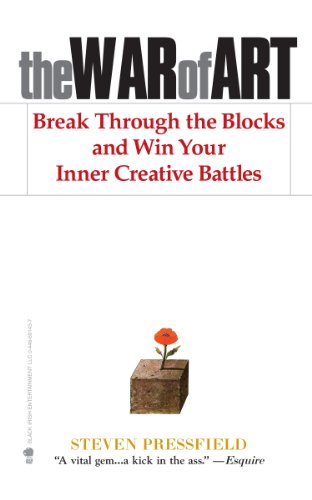
Book Review: The War of Art

Image result for the war of art

The War of Art

by Steven Pressfield

In retrospect, I should have known from the foreword that this was the wrong book for me: Robert McKee talks about art like it’s a war that Pressfield will help me to win; and while I think art is a struggle, I really don’t think it’s a war; indeed, as I am a pacifist, couching things in warrior’s terms is just going to push me away. He also references golf as evidence that Pressfield is a consummate professional (Pressfield wrote The Legend of Bagger Vance, which I have neither read nor seen; I guess it’s about golf? I guess Pressfield likes the game? But he writes anyway instead of playing, which – I guess is impressive?), and there’s the second best way to alienate me. He talks about tearing up over the Spartans’ death at Thermopylae, which was the subject of Pressfield’s other big book, Gates of Fire, which I did read, and did like quite a lot – but it didn’t make me weepy, and I don’t know what it has to do with inspiration to make art. So I’m really having trouble relating to this foreword author – and then he ends his intro with this:

“When inspiration touches talent, she gives birth to truth and beauty. And when Steven Pressfield was writing The War of Art, she had her hands all over him.”

Creepy sexual metaphors, especially about things that are not remotely sexual – like the act of putting words on a page – that is the number one way to make me say “Nope.” So I should have known.

Let me say this, though: this is a book intended to inspire artists, to help people break through creative blocks and create art they can be proud of. I can’t think of many more noble things to try to do, and I appreciate Pressfield’s earnest and genuine attempt to give people tools to do what they should be doing. So: if you do appreciate sports metaphors, and war metaphors, and you like a good, strong pep talk – or as the cover blurb calls it “A vital gem… a kick in the ass,” (which also should have been a warning sign for me) – then please ignore this review, and go get this book. I hope it helps.

It didn’t help me.

There are moments when I agree with Pressfield. He talks about questioning his writing, and feeling hopeless, and the strength and stamina it requires to push through all that and just keep working. He calls it work, and talks about how important it is to just keep putting in the hours, to keep trying, to keep seeking to hone your craft and do the best you can – but first and foremost, to just put the goddamn letters on the goddamn page, and to never give up. And I agree with that entirely. He talks about how he was in his 40’s before he found success, and how it came from an entirely unlikely source, which was, logical or not, simply the book he had to write at the time; and as a 44-year-old writer who is working on his second novel about a time-traveling Irish pirate, I appreciate everything about that.

But then there are the places where he talks about being a Marine, and how other servicemen in other branches are weaker than Marines because Marines love being miserable (This is a metaphor for how artists should be: willing to suffer and be miserable. I kind of see that. This whole Marines-have-bigger-dicks-than-other-soldiers? Nah.) and the other services are soft. Where he talks about writing and art like it is a war to be fought and won; or an animal to be hunted and then eaten; or a football game where you have to “leave everything on the field.” And I hate all of that. He talks about the urges and habits that get in the way of art as Resistance, and that’s pretty good, but he also talks about how like not cleaning your room is a way to lose to Resistance, and – what? And how golf is an art, and Tiger Woods is the greatest artist of all because he can be interrupted mid-swing, stop his swing, and then refocus and hit a golf ball really hard and – I fail to see the art in that. And he says that mental illness, depression and anxiety, are not real, but only a failure to combat resistance, which can be overcome by determination and the earnest pursuit of one’s true calling, and hey, fuck you, Pressfield.

He’s got a strange (And contradictory) section where he tries to talk about thinking territorially instead of hierarchically, and basically he means you should do what you think is right rather than worry about what other people think is right, and okay, sure – but first, he says elsewhere in the book that he knows he’s written well when his family is pleased and proud of him, which is hierarchical thinking by his own definition and explanation, so either he’s a REALLY bad editor who missed that continuity break, or he’s full of crap in one of these places; and second, his example of someone thinking territorially is Arnold Schwarzenegger going to the gym. Which is both weird and not at all artistically inspiring. It gets really weird in the third section, where the devout Christian Pressfield (Though he also admires the ancient Greeks so damn much that he seems to kinda want to worship Zeus and Apollo. I can’t really disagree with that, though I wouldn’t pick the same gods.) talks about angels who help inspire artists to work, because God wants us to create beautiful things for Him to admire, and how everything an artist is comes from God and we should understand that we contribute nothing, that we are only the vessel through which the divine will is worked. I mean, when we’re not being hardcore fucking Marines. Or hitting 310 yards off the tee. Otherwise, though, we should be all humble before God. It is not quite this Christian – he really does admire and know a lot about the Greeks – but it does read that way, as a repudiation of human accomplishment and a glorification of the eternal Whatever. And as an atheist and a part-time humanist, I am not at all down with that.

This thing reads exactly like what it is: a privileged Baby Boomer looking down on everyone else who doesn’t have all of his privileges; and by the way, he says some interesting and intelligent things that show me he really is an artist like me. Just way more of a shmuck. Hoo rah.

This Morning

This morning I am thinking about work.

It’s an interesting word, one that we use in many different ways: it is simple effort (“That looks like a lot of work!”), it is our profession (“I have to go to work. Please kill me.”), it means to stretch (“You have to work the joint”) or to exercise (“I have to go work out. Please kill me.”). It means to move or to move into place (“Her mouth worked furiously as she worked the Q-tip into her ear”), it means to control or manipulate or stress the emotions (“He worked himself into a tizzy, and then he went out on stage and worked the crowd like a pro.”). It means to maximize reward or response through confidence and panache (“Work it, girl!”) and it is the final product and achievement (“This is a work of art.”).

It is, for an artist, the goal. The purpose. We do this for the sake of the work. And not just the final product, because you can’t know going into it that what you will end up with will be a masterwork, will be your magnum opus (Magnum means great. Want to guess what opus means? Other than the most adorable cartoon penguin in history, that is?); we do what we do for the sake of doing it, for what doing it makes us feel, and what it makes us not feel; for who we are when we are doing the work and who we become after we do it and after we decide to keep doing it.

Sorry if that was too abstract. Let me be more clear. (Let me also give a modicum of credit to Steven Pressfield, because while he’s a toxic-masculine doofus who wrote a bad motivational book, he does talk about the value of artists simply doing the work, putting in the time and the effort, and so he has inspired me despite his doofery.) I write because writing brings me joy, and it gives me solace. When I am upset about something, particularly when the thing upsetting me is confusing or complex, my first urge is always to get out a journal of some form and write about it. When I have an idea, I always want to write it down; and then once I start writing about it, I want to keep writing about it until I have explored all of the possibilities. I am always happiest communicating through writing (Though I’m still, always, a little nervous when someone is reading what I have written.). This relationship with the page, the pen, the written word, along with my lifelong passion for reading, has led me to become a writer. That is how I define myself, how I view myself. It’s where the monogram that makes up my banner on this site came from (Also note: my brilliant wife, who is an artist and illustrator because everything I say about writing, she would say the same about drawing, made that banner for me.) My most important work, the thing that I was born to do, is write. Thus, when I write, both while I am in the act of writing and when I have done enough writing to have produced something worth reading, I feel most myself. I like myself best at those times. I like my life best at those times. That’s why I write: not for reward, not for applause or respect; but because of who I am when I write.

One of my favorite poems, We Are Many by Pablo Neruda, includes these lines:

While I am writing, I am far away;
and when I come back, I have already left.

I’ve taught this poem several times, and students always struggle to understand it (Not just because of these lines: the whole thing is about multiple selves, particularly perceived self vs. actual self, and it’s fantastically bizarre to read — “and so I never know just WHO I AM,/ nor how many I am, nor WHO WE WILL BE BEING.”). but I understand this part perfectly, and I think other artists would, as well, if they change the verb “am writing” to something appropriate to them, am dancing, am painting, am carving, am composing, am playing. Am working. While I am writing, I do not feel connected to the world; I am in my mind, sifting through words and phrases, images and metaphors, like the child I once was at the beach, when I would grab up handfuls of sand and pour them onto the ground, onto my legs, from one hand onto another, just to see how the sand piled up and how it fell, how it felt running through my fingers and sliding across my skin. I would thrust my hand, palm down, into the dry whispers of sand, and then I would lift my hand straight up to watch myself emerge from the Earth, and to see the way the sand would remain in skeletal ridges on the backs of my fingers; then I would drop my wrist and watch the sand blow away in a swirl of motes.

Just now, I forgot that I am sitting on my couch next to my dog, with a blanket around my shoulders and my laptop perched atop my crossed legs. I was remembering being on the beach and playing, and I was trying to dig for the right words to capture that moment. I was far away.  And now that I’ve come back, I’ve already left — which line I think has two meanings, both that the self that Neruda most clearly takes as his own, his writing self, the part of his mind that rises to find the words and put them in place, is only present while he is actually writing; and also that once he has written down what he was thinking, and he returns to awareness of the world and sees the words as a completed thought on the page, his writing mind is already off on another voyage through the clouds, soaring far above or below where he sits, suddenly aware that his ankles ache. It makes me want to just keep writing, to recapture that feeling of weightlessness, of timelessness, of pure and simple being; the fact that I can do it, and the fact that when I do it, I have this evidence, this product, this work that is my words, pleases me enormously. So much so that the potential rewards of that work, while I want them for the sake of my non-writing self, don’t matter so much as this: I did the work, and the work now exists because of me. It is both humbling in that I don’t matter nearly so much as the words do, and also flattering in that I am capable of making those words do what they do.

I am proud of my work.  I hope my work is proud of me.


I do have to note that this was not where I intended this entry to go; I was going to talk about the effort required to make art, and how it has to be done regularly, constantly, no matter how onerous it feels — and it does feel onerous sometimes; but I think I’ll save that for tomorrow. I am happy with this work.

This Morning

This morning I am thinking about art.

These thoughts were inspired by a book I just finished reading, Steven Pressfield’s The War of Art; I’ll be reviewing it later, (Sneak peek: IT SUCKS.) though after  yesterday’s post I’ve decided to keep the book reviews and This Morning separate. This Morning is what I think a blog should be, and what I haven’t been doing well despite my years of keeping a site for my writing: it should be a Web-log, a recounting of events, thoughts, feelings, etc. Part of me says “Then why the hell would anyone want to read it?” But that takes me to what art is.

Art is one of the two pursuits, ambitions, goals, that make humanity what we are, that set us apart. We share 99% of our DNA with chimpanzees, and everything we have — tools, technology, society, language, family, war — is echoed in the animal world. The only two things that make us unique (And they may not actually make us unique, as there may be other creatures on Earth with the same pursuits) are art, and truth. We  pursue truth for the sake of truth, and art for the sake of art, and I think there are no other creatures that can definitively be said to do the same. The argument could be made for birdsong and whale song, and for the way some animals play, and the way some animals dance; but I think all of those can be identified as survival traits in one way or another.

I think art  and truth can be seen as survival traits for humanity, as well, but the connection is more tenuous, more distant. Art and truth can be paths to personal success, financial or social, in society, and thus are they survival strategies; they can create pleasure in the individual, which makes us more likely to do other things that help us survive that we tend to do when we’re happy, and also helps us deal with the stress that kills us; they can be used to achieve pragmatic and temporal goals and to transmit and influence culture, which are all part of the survival strategies of the social animals that we are.

But the thing is, there are a lot of us who pursue art and truth despite those pursuits taking away from everything that would be seen as beneficial to Darwinian survival strategies. My art cuts me off from other people. It often makes me sad. It takes time away from the things that earn me money, that earn me social success. Art kills quite a few of us: Vincent van Gogh, Virginia Wolfe, Ernest Hemingway, David Foster Wallace, among others, by suicide; James Joyce and Jack London and Dylan Thomas, among others, by alcoholism. (I’m oversimplifying: they all suffered from various conditions that surely contributed to their deaths, particularly, in the case of the suicides, severe depression; but if you don’t think that the life of an artist was a factor as well, then you don’t do enough art. You should try to do more. I promise it won’t make you suicidal. Well, I don’t think it will.) Truth does a lot of the same things to scientists and mathematicians and philosophers, and where it has been used to have a direct impact on society, then sometimes lots of people die, particularly the one who speaks truth: this category, I would argue, includes Dr. Martin Luther King and Mohandas Gandhi and Martin Luther and Karl Marx. Also J. Robert Oppenheimer and the rest of the Manhattan Project, and Werner von Braun.

So art and truth are not, or not only, survival strategies; in some cases they are hazards — and yet we continue to pursue them. Because there is value in them, for society and for the individual, beyond survival, beyond life and death. That’s what art is: value beyond life and death. It’s something worthwhile even if we can’t say precisely why it is; we know it is. There are as many reasons why as there are people, but I think that for all of us, there is a reason why art is worthwhile beyond life and death. That’s not to say that we should die for art, nor that we should want to; it means the value of art is nothing to do with living or dying.

(I will say I think there is a biological evolutionary explanation for the pursuits of art and truth: I think our giant complicated brains evolved in order to keep us alive despite our essentially incompetent bodies, but then our brains got a jump on survival pressures when we created society, and gave ourselves an enormous lead in the race for survival — so strong a lead, in fact, that we’re probably going to kill ourselves off with the very things that help us survive, like the food we eat and the technology we create and the standard of living we uphold and the population  we sustain. But another aspect of this oversuccess is that we don’t actually need all of our brains in order to live; so we turn that excess energy into a pursuit that consumes brain power, and offers us some kind of valuable reward, but that doesn’t contribute to survival. Art. And truth.)

The difference between these two is the distinction between heart and mind, emotion and thought. Truth is thought, and art is emotion. That’s too glib and simplistic, of course; they almost always blend and combine and lead from one to the other and back. But one of my favorite quotes, from Vladimir Nabokov, is, “To call a story a true story is an insult to both art and truth.” The goal of fiction, which is Nabokov’s subject there, is not to depict the world, but to interpret the world; the same should be true for pictorial art, and for music, and for anything else that isn’t trying to capture and explain the world; that is the realm of truth-seekers, not artists.

When I think of the pursuit of truth, by the way, I think of my father. My father is a retired particle physicist, and for years, since before he retired, he’s been working on a physics problem in his free time. I can’t explain it; it has something to do with reconciling Newtonian physics with quantum mechanics. He had an inspiration years ago, and he’s been searching for the math to make it work ever since. He does this without expectation of reward; the best he can hope for is publishing an article in a physics journal, which would lead to no tangible reward. He has hit many stumbling blocks: he has had to look for math texts that can give him a formula or a method that he thinks he needs, and those are often dead ends. He has come close, only to find a flaw in his own math, which means he needs to start over again. He’s still working on it. He does it late at night when he can’t sleep, because simply working on it gives him peace. That’s the pursuit of truth, because all of those things would apply to someone, say, writing a novel, except my father is looking for an answer. That’s his goal even more than publication: he thinks this idea will work, and he wants to assure himself that it will. He is his own audience.

That, with the goal of capturing or creating a feeling, is art.

(To be continued. Because the pursuit of art never ends.)