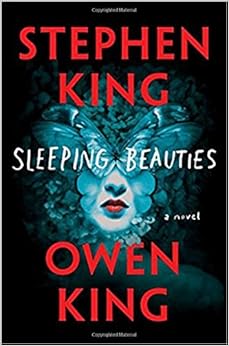
Book Review: Sleeping Beauties

Image result for sleeping beauties

Sleeping Beauties

by Stephen King and Owen King


To start with, I love Stephen King. I always have. I’ve read pretty much every one of his books, most of them more than once; I’ve been reading his work faithfully since I was 13, and my friend loaned me a copy of It to take with me to summer camp. (The Summer of Blood-Soaked Nightmares, I called that one. Subtitle, We all float down here. Sub-sub-title, Don’t ever use the bathroom in the middle of the night when you’re reading It.) I am a great admirer of his remarkable ability to create characters, to build suspense, and to squeeze a thousand details, all of which are both real and also unexpected, into the framework of a story.

So going into this one, I was already going to like it: there have only been two or three Stephen King books I haven’t liked – mostly the ones that have actual aliens invading, The Tommyknockers and Dreamcatcher. Didn’t like Hearts in Atlantis, either, which was too bad because I love the low men and the can toi from Desperation and The Regulators. Anyway, since the man has written like 75 books, the chances were good for Sleeping Beauties: something like 25 to 1.

And I liked it.

It wasn’t my favorite Stephen King book. It might be easy to chalk that up to the influence of his co-author, his son, Owen King; but to be perfectly frank, I couldn’t even tell that this was a collaboration: it just read exactly like a Stephen King book. You’ve got a supernatural being appearing within the very first few pages, and immediately diving into a bloodbath of murder and mayhem, without even the slightest explanation as to who or what they are, or why they are ripping people’s limbs off. You’ve got a large cast of characters, most of them good but flawed people; you’ve got a male lead with a troubled love life; it’s set in a dinky little town half in the wilderness and with one spectacularly creepy location – in this case a women’s prison – that plays into the story in some prominent way. You’ve got a character or two who act as a combination demogogue and Wormtongue, whispering in the ears of the populace, playing on their fears and hatreds to bring out their absolute worst traits; you’ve got a supernatural phenomenon growing more and more powerful, and more and more apparent, though never quite becoming easily explainable; and you’ve got some enormous fight scene at the end, in which at least a good third of the characters die. This one has all of that.

That is not to say Stephen King’s work is monotonous, nor that this book is just like any others of his. Neither statement is true. It’s just that he does have tendencies and preferences, and certain themes that he keeps coming back to: like the mob. Not the mafia mob, but the driven-crazy-by-fear, pitchfork-and-torch-carrying mob. Mr. King knows that mob well, and he recognizes that there is no better reflection of the evils of the 20th century and beyond – unless it is the slick-talking small-town salesman-and-politician which shows up in many of King’s works as well; though not this one.

But there are some real distinctions, as well, in all of King’s books, and in this one. The lead character, for instance, is an interesting man that King has never done before: he is a prison psychologist, married to the town sheriff – another new element for this book, because I can’t remember another woman cop; usually his cops are the bad guys, which is true of several of the cops in this book, but not the sheriff. But her husband, the prison psychologist – Clint Norcross – was a former foster kid with old anger issues from his youth, which was exceptionally violent. He was not the madman that Jack Torrance was in The Shining, and not the epic hero Everyman that, say, Stuart Redman is in The Stand, or Stuttering Bill Denbrough in It. Clint doesn’t save the day. Clint is a mostly good guy who does mostly good things. That’s all.

The real story here is not the Stephen King setting or the tropes; it is the question of sex. Gender. Men and women. Because the concept of this book, the supernatural event that throws everything into chaos, is this: all of the women in the world fall asleep, and they don’t wake up. The supernatural being who comes in and starts removing limbs in a shower of blood is a woman, perhaps Eve or Lilith or Wonder Woman or Pandora or all of the above – certainly Helen of Troy – and she represents a greater power that has decided to give women a chance at a better world, a world where they don’t have to be beaten or raped or killed by men. So whenever a woman falls asleep, she spins a mystical cocoon; and she remains in the cocoon until further notice, while her soul goes – somewhere else.

And meanwhile, without women to abuse and destroy, the men turn on each other.

That’s the basic story, and parts of it were tough to read: the stories of women suffering at the hands of men, fictionalized but by no means exaggerated by King, were often heartbreaking and enraging. I got a little frustrated with Clint Norcross, who reads sort of like the hero, but isn’t really the hero simply because he’s a man; I did like the main villain, who leads the mob into the final fight, because he was sort of the other side of the coin from Clint, which was interesting. But I certainly didn’t like the son of a bitch. One interesting thing, though: King has said that the quickest way for an author to get an  audience to dislike a character is to have the character hurt a dog. (A lesson King probably learned from Jack London). But the villain of this book? He is kind to dogs. Make of that what you will. In some ways, the hero is no specific person, and neither is the villain: the hero of this book is the better half of the human race. (Guess who the villain is.) And they’re not all perfect either, of course, because King doesn’t write perfect characters; but they’re a hell of a lot better than the men. It was a little tough reading 700 pages about why my gender sucks. But it certainly wasn’t news.

The suspense is great; the violence is savage and glorious, as always; the big fight at the end is wonderfully apocalyptic. I actually didn’t like the supernatural element as much, because I didn’t really like the resolution. Should have gone the other way. But I did like the fox. And the Tree.

This is a Stephen King book. It’s not for everybody, but if you like Stephen King, you’ll like this one. I did.

Book Review: Duma Key

Duma Key

by Stephen King


For some reason it took me a while to get to this one. My wife and I read every Stephen King book, and we generally get them and read them within a year or so of publication; this is one author we are willing to pay full hardcover price for.

Maybe that’s the reason, actually: maybe Duma Key sat on the shelf for so long because it’s not a hardcover; we bought it in mass market paperback, and what’s more, we bought one of those tall paperbacks – the “Summer beach read” edition, I’ve seen them labeled. And in terms of book format, I didn’t like it. It just seemed wrong. Off, somehow. Which, actually, is probably entirely appropriate.

Well, now I’ve read it, and: it’s not one of my favorites. It’s got some great elements to it. I loved that the main character, Edgar Freemantle, is an artist. I love when King is able to describe what it’s like to make art, to feel the need to make art, and especially the down side of it: the emptiness and exhaustion that come after working on art, the constant self-doubt and that nagging belief that these people only like your work because they like you. I also liked the scenery: set in the Florida Keys, in a salmon-colored beach house that the hero calls Big Pink, there are wonderful descriptions of the Gulf, of walks on the beach, of overgrown greenery, of grand old Florida houses. I liked the characters, for the most part, especially the key characters of Elizabeth and Wireman and Jack, the people that help Freemantle discover the solution to the mystery of Duma Key.

But I didn’t like the way the novel went bad. Now, all of King’s books go bad: the man writes horror, after all, and even when he’s not, he tends to put his characters in horrible situations. I’ve read The Dark Tower (No way that movie’s going to work, by the way. Not because of the casting, but because the beauty of The Dark Tower is the world that King built, this amazing world that has moved on. And it took King seven novels, ranging from 300 to 1000 pages each, to build that world. Make that into a movie, and it will be a month long. Which, actually, sounds pretty awesome, but I feel like those seats would get really uncomfortable after a while. And if you thought movie theater floors were sticky before . . .) and it’s definitely fantasy – but that is not a happy place, that world, and those are not happy lives those characters lead. So of course Duma Key would feature some terrible things. And like many of King’s books, this one starts off bad: because Edgar Freemantle was a builder, until he got crushed by a crane at one of his job sites. He suffered several crippling injuries, not least to his head, and his right arm was amputated above the elbow. The book starts with his recovery, and focuses on his troubles with speech and wild and violent mood swings while recovering from his traumatic brain injury. And like the other things that King has written since he himself got crushed by a car, this is vivid and detailed and very true to life. And then when Freemantle moves to Duma Key to continue his rehabilitation, it’s great: the Key is wonderfully depicted, and that’s where we meet all of the other good characters, and encounter the mystery, which is pretty cool. And then the majority of the book is Freemantle’s life as an artist on a Florida Key, and I liked it.

But then the horror comes in. And I feel like King got caught up in his own story as an artist in the Keys, whether he went there to write the book or only imagined them; because it’s almost like he forgot he was writing a horror novel. There is a sudden appearance of a horrible apparition, and it’s bad, but there doesn’t seem any reason for it. And then Freemantle is afraid of his mystical painting gifts (Those gifts, a result of both his injuries and the magic of Duma Key, were well done: but the change from being fascinated by that magic to being scared by it was not.), and I don’t see why. And then everything falls apart, as it often does at the end of King’s novels (and in life), but it all goes bad too quickly. It made me long for The Shining, or Insomnia: one of King’s books where the flow and the buildup of tension are just right, and you end up reading wide-eyed and dry-mouthed at three in the morning because you just can’t put it down.

Duma Key didn’t do that. It was good, I liked the ending and its solution to the evil mystery, and I loved the time on the Keys; but this wasn’t my favorite of King’s novels.

Mr. Mercedes

Mr. Mercedes

by Stephen King

I can’t decide if this is one of King’s least frightening books – or one of the scariest.

It lacks a number of the elements that King usually includes to create fear, most notably the supernatural. There are no demons in this book, no ancient mystical objects, no magic spells or incantations; nobody is possessed, nothing comes to life, nobody comes back from the dead. There is also no raving psychotic waving a bloody knife, and – though I don’t mean to spoil anything – the dog doesn’t die. (It was King who said in an interview that the fastest way to get the audience to hate a bad guy is to have the character hurt or kill an animal; this is true, but it also makes us hate the author – I’m looking at you, Richard Matheson!)

But what this book has instead is: reality. And in some ways, that’s even more frightening. The murderer uses a car to kill people. It’s so incredibly ordinary that I can’t believe it doesn’t happen more often, with results as horrific as what King describes (Because of course there’s gore: I said nobody comes back to life, not that nobody dies, or that nobody has their arm torn off or their skull caved in. It is still Stephen King.). In the past, King has come up with some of the most unique madmen I’ve ever read – the Trashcan Man in The Stand comes immediately to mind, and the sheriff in Desperation, and the whole cast of the Dark Tower series – but the bad guy in this one, Mr. Mercedes himself, really isn’t that crazy. Oh, he’s crazy; but it’s an everyday kind of crazy. And whereas King often steals his lunatics’ sanity through some particularly appalling supernatural experience – thinking of Henry Bowers in It – this guy is crazy for a very ordinary reason, and is a largely well-controlled crazy. He’s a high-functioning lunatic, and because of that, he is able to walk among us, and plot our deaths: and that is very, very frightening.

What you have here is a bit of a mystery: not a whodunnit – King introduces the villain as a point-of-view character, as he frequently does, and then proceeds to freak us out with him, as he frequently does – but a How-did-he-do-it? The prologue shows his initial crime, the murder of several people using a Mercedes sedan as his weapon; the main plot of the book is some time later, after the lead detective on the case has retired, leaving the Mercedes Killer case unsolved. The killer has since struck again, but he has changed his modus operandi; and his new target is the retired detective himself. The detective, no easy target, begins to backtrack through the attempt on his life (And I’m giving away less than you think, here), and through the unsolved questions about the original crime, and tries to catch the one who got away during his active career. That investigation is the core of the book. Until, as so often happens in thrillers, everything falls apart and the killer moves on to a new target: then it becomes a race to see if he can be stopped – if, that is, they can even figure out what he’s planning to do. King leaves their success or failure truly in question until the very end; you really don’t know how it’s going to end until it does, and even then, it’s a surprise.

If you’re looking for a Stephen King-style gore/horror fest like It or Carrie, I’d recommend Desperation or The Dark Half. But if you want a genuine thriller, combining both mystery and suspense, by the master-of-all-dark-genres, then this one is the one to grab.