Book Review: Mortal Engines, Hungry City Chronicles #1

Image result for mortal engines

(Also, see that hot air balloon on the cover, with the tiny gondola the two characters are in? Not at all how the airships are described.)


Mortal Engines (Book One of the Hungry City Chronicles)

by Philip Reeve


I kind of hated this book.

Not everything about it. Some things in here are wonderful. The concept is fantastic: a future world where cities are mobile, enormous steampunk structures on wheels, rolling around in the wasteland that is all that remains of our world, destroyed (of course) by World War III and hyper-advanced war machines. These cities follow a philosophy of “municipal Darwinism” (great name), which teaches that the largest, strongest city will devour the smaller cities. It’s a “town eat town” world, and the mobile towns do exactly that: they capture the smaller, slower towns, swallow them, tear them apart and use their raw materials as fuel and building materials to maintain and expand the larger town.

That’s a cool idea.

The main town in the story is London, and London is now governed by four Guilds: the Historians, the Navigators, the Merchants, and the Engineers. The Historians, who comprise both doddering old museum relics and Indiana Jones-style explorers who search through the wreckage of ancient civilizations to find useful artifacts from the time before the wars that ended everything (This is our time, of course, and the Frankenstein We-let-our-technology-advance-too-far-and-it-destroyed-us theme is vigorous in this book), are sort of the main protagonists, and the Engineers, who care about nothing but power and control, as those engineers would, are the antagonists. There is also the Anti-Traction League (the moving cities are called “traction cities”), which have settled in parts of the world not dominated by moving towns nor devastated by ancient wars, and they oppose the traction cities as a whole.

This is fine and good. I was a bit annoyed by the stereotypes of the heartless engineer and the hapless-but-wise-and-kind historian, but I like the plotline that involves the Lord Mayor of London and his megalomaniacal schemes, and the discovery of a new doomsday weapon that allows his city to destroy any other; the weapon is actually a rediscovery from the ancient times, and I thought the book handled that well, particularly at the end. (Though there are some pretty severe plot holes, especially regarding the time lapse between the ancients and the traction city era:  it’s been like two thousand years. So really, the ancient technology? It just wouldn’t work. At all.) I like the Anti-Traction League, and I particularly like the subset of non-city-dwellers who live in the air: this being a proper steampunk novel, there are airships galore, and even a flying city, and those parts were great.

No: I hated the characters. The specific characters who play the roles of hero in this book are half crappy, and by the end, half dead. I won’t say which group is which so as not to spoil, especially since this book is now being made into a movie by Peter Jackson, who probably won’t be able to save this thing, in my opinion. However, since the book won oodles of awards, I suppose most people liked the characters a whole lot more than I did. But really, they aren’t good characters: there’s one who should hate everything London is doing and all that it stands for, but at a crucial moment, this character freaks out on those who want to stop London from destroying everything good with its doomsday device; and then later the character realizes, “Hey, wait – London sucks! I should do something about that!” But this epiphany comes at an entirely random time, and is annoying because of that; I would think that the betrayal by a Londoner whom the character worships would have changed the character’s mind, or maybe when the two main characters are tricked and enslaved by a traction city; or maybe when they are captured and abused and threatened and nearly killed by a bunch of half-insane traction city pirates. No: it’s while the character is – climbing stairs. It’s ridiculous.

The other big problem for me was the writing. Half of the characters, good and bad, are entirely unbelievable; their emotions and motivations don’t make a lot of sense. There are a ton of cliches and platitudes, and some of the descriptions and action sequences are just not well done.

And then, at the end – he killed the fucking dog. That’s right: Philip Reeve kills the dog. No reason, either; we already hate the people who do it, and the character who I suppose is intended to be inspired to murderous vengeful rage by the death of the dog WAS ALREADY AT THE POINT OF VENGEFUL RAGE. It’s an entirely gratuitous dog-killing. And I don’t mean to overstate how much this bothered me, because I was already annoyed by the plot holes and the poor characterization and the mediocre writing – but really, that moment just took the cake. And then for the next thirty pages until the very end (when almost every other sympathetic character dies, too), Reeve kept mentioning the dead dog: the dog’s owner kept looking around for the dog, kept expecting to hear the dog’s footsteps, but no, because the dog was dead.

Screw you, Reeve. Dog killing crap writer.

No, that’s too strong. But really, I didn’t think much of the book. I wish someone else had thought of this idea and done a better job writing it. I hope the movie is better, but I won’t be watching it: because they’ll probably kill the dog.
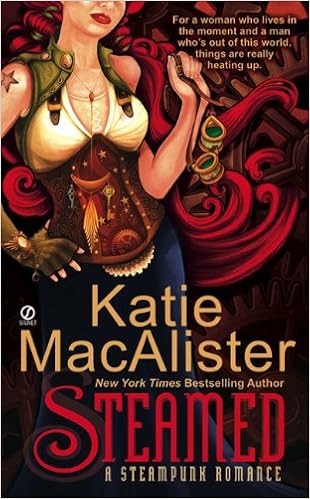
Steamed

Image result for katie macalister steamed

Steamed: A Steampunk Romance

by Katie MacAlister


Didn’t like it. Not because it was a romance, I generally like romances, especially with a fantasy twist; and I like the concept of steampunk quite a lot.

Though I have to say: does anybody know where the good steampunk is? The stuff has just exploded on the fantasy/sci-fi scene in the last ten years or so, and I have yet to find a steampunk book I really liked. Scott Westerfeld’s Leviathan book was the best I’ve hit so far – though only because Jim Butcher’s book The Aeronaut’s Windlass is pure fantasy despite it having airships, because anything Jim Butcher writes is better than almost anything else. I tried Cherie Priest and didn’t like the one book I read, though that doesn’t mean I wouldn’t like something else she wrote. But yeah: not impressed with the steampunk. I feel like authors aren’t using it to their advantage: they’re just like “Goggles and zeppelins are awesome! Yeah!” When they should be saying, “So I’ve got this fantasy idea, right? With epic heroes and a battle between good and evil that ends with good victorious? But wouldn’t it be awesome if I wrote it like H.P. Lovecraft or Arthur Conan Doyle?!?” Yeah. It would. Let me know when that happens, okay?

Maybe I’ll write it.

Anyway. The steampunk in this book was really just background, and it should have been, because MacAlister didn’t do much with it either. The steampunk background is not bad, though; the political structure is pre-World War I, with the Emperor of England and Prussia fighting with the Ottoman Empire while also dealing with a rebellion at home; the main heroine is an airship captain, which is cool, and they use steampunk aether guns, which was great; the manners and dress are Victorian, which was sometimes amusing, though that mainly just came out in discussions of bustles and corsets.

MacAlister had the somewhat interesting idea of taking her hero from the modern world and shifting him into a steampunk world; it’s a bit like the movie Kate and Leopold, but in reverse. The problem with that was she didn’t do it terribly well: the hero is a scientist who is working on a quantum something-or-other – let’s call it a flux capacitor – and his sister, joking around with her brother in his lab (because sometimes twenty-somethings act like they’re five [Though to be fair, the sister acts that way throughout the book, so it’s not an inconsistency; she’s just annoying]), drops it onto a live electricity source, and WHAM! The two of them are shifted into an alternate time stream – and 3,000 miles east of where they left, for no particular reason. I mean, okay, sure, it’s a romance; but I honestly don’t think there’s any reason to slack off on the non-romance aspects. The reason Diana Gabaldon’s Outlander series is so amazing is not just the romance; it’s because that woman is a hell of a historical novelist, almost too obsessive with her research and realistic details.

But the poor science-fiction and okay steampunk are not the issue: because this is a romance. No, the problem with this book is that the romance sucks. This guy, this Jack Fletcher, is freaking annoying. For a scientist in love with an airship captain, he is pretty much just a bro. He somehow has the idea that sexual harasssment equals flirting – and he pulls this, “Hey, I’m a man; of course I’m going to stare at your boobs and then make comments. That’s how men show appreciation!” all the damn time. And though there are some gestures towards Victorian sensibilities, which should have had either the woman herself or some of the men around her challenging this sexist oaf to a duel, really it boils down to a woman flapping her hand and saying “Oh, you!” while giggling after the guy pinches her ass.

The woman, Octavia Pye, is more interesting, because here is a good steampunk opportunity: she is a Victorian gentlewoman, but she can be an airship captain because the steampunk world is more modern and thus potentially more egalitarian; she can also be experienced romantically, and be interested in sex instead of having to swoon at the thought of a man unclothed. And MacAlister does that pretty damn well: Octavia pushes Jack away as a Victorian lady should, and then when they do get together, the sex scenes are actually quite good, both sexy and hilarious. But she puts up with too much of the bro-bullshit. There’s a point when they’re going to go into danger, and even though Octavia is a military officer, an airship captain, and Jack is a Quaker, this Bro actually says, “I grew up to believe a man must stand between a woman and danger.” And somehow the Quaker pacifism turns into, “Well, as long as I don’t kill the man, I can definitely beat the snot out of him with my mighty manly bro-fists.”

Anyway. They fall in love too quickly, as romances tend to do; the story sort of wakes up after the romantic scenes and is like, “Oh wait – wasn’t there supposed to be a plot line somewhere around here?” and then they live happily ever after, maybe setting up for a sequel which I will not be reading.

Suggestions for good steampunk are welcome.

Book Review: Japanese Steampunk

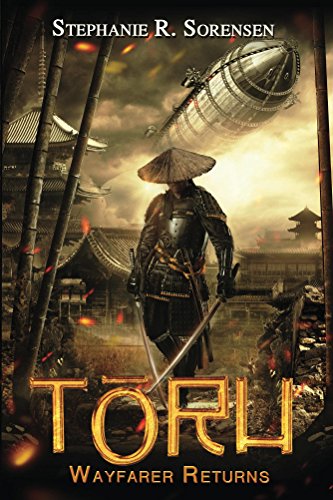
Toru Wayfarer Returns

by Stephanie R. Sorensen


(Full disclosure: I was invited to review this book and given a free copy so I could do so.)

Do you prefer ninjas, or pirates? How about history, or steampunk?

Here’s an idea: why not have both?

Okay, strictly speaking this isn’t a novel about either ninjas or pirates; it’s a story about Japan’s “opening” to the west when Commodore Perry of the U.S. Navy sailed into Edo Harbor in 1853 and threatened and insulted the Japanese into negotiating with him, or else face bombardment from his entire fleet, which he brought back in 1854. Japan was unprepared for this aggression, the country having been isolated and controlled by the Tokugawa Shogunate for the past two and a half centuries: their military was still mostly medieval, and could not fight back against modern warships, steamships, cannons, and rifle-carrying Marines.

But what if? What if Japan had found a way to be ready for that attack? What if the nation, alerted to the threat of the West by the actions of the British in opening and conquering China and India, had modernized and industrialized? What would have changed in world history if Commodore Perry had found the harbor blocked, and armed, the Japanese a growing world power, perhaps even a legitimate threat to the US?

I’ll tell you what: that would be a story worth reading.

And so it is. Stephanie Sorensen has found just what the alternate historian needs: a critical moment when world events went in this direction instead of that, and then thought of a way to make it go that way. The change is in one man (as history’s pivotal moments so often are): Himasaki Toru, a fisherman with something of a mysterious past, who is lost in a storm and rescued – by an American whaling ship. Toru spends two years in America, and while there, he realizes that the US, with its military and economic might, and its brash disregard for the slow grinding of polite diplomacy, could pose a threat to his motherland. A faithful son of Japan, Toru has only one choice: break the Shogun’s law that bans anyone from entering Japan from the West on pain of death, and find a way to convince his nation to adopt Western technology and industry so that when the US comes, Japan would be ready.

It’s an impossible task, made even more so by the fact that Toru is only a peasant, a fisherman; no nobleman, no daimyo, no samurai would ever listen to one such as he, let alone the entire nation. But only the efforts of the entire nation, working in concert, can possibly give Japan the chance to meet the West’s incursions from a position of strength. Toru works with the weapons he has: his intelligence and his passion; the books and machines he purchases in the West and tries to smuggle back into Japan; and a rebel’s greatest weapon: luck. Toru is lucky that the lord whose domain he lands in, Lord Aya, is himself unconventional, made so by his unconditional love for his unconventional only child – his beautiful daughter Masuyo. With luck, and with the help of Lord Aya and Masuyo, maybe Toru can save his country.

I liked this book. I mentioned pirates and ninjas above because this book combines some of the best features of both: Toru is a rebel, though one with a good heart and good intentions; he breaks the rules because he has to, to succeed. Like a pirate. Masuyo does this even more, as she refuses to meekly accept the role of women in her culture; she uses her brains and her courage to help Toru in his task, and takes her place in the forefront of this revolution against the status quo.

As for ninjas – well, the story is set in 19th century Japan. There are ninjas. There are samurai, and swordfights, and honor. And then, because it is steampunk, there are trains, and telegraphs, and Babbage Difference Engines, and dirigibles painted like dragons, powered by steam engines, swooping down out of the sky to awe and terrify allies and enemies alike.

Honestly, Sorensen, who has a background in Japanese and Asian culture and studies, does a better job with the Japanese aspects than the steampunk aspects; the steampunk isn’t bad, but it isn’t really the focus. The focus is on the culture of the Shogun’s Japan, and how change could come to such a rigid and traditional culture, and what would happen when that change did come. As a novel of alternate history, this is a good book. As a steampunk book? It’s okay. The dirigibles are really cool. The writing is generally good, though not spectacular. The industrialization of Japan within the timeline and despite the cultural roadblocks requires some suspension of disbelief, but I thought the political interactions were well done, both within Japan and then between Japan and the US.

But anyone interested in Japan, in samurai, in traditional cultures, or in the clash between tradition and modernity – you should read this book. And the sequels, when they arrive. And anyone who likes a well-written story of one man struggling both for and against society, anyone who is interested in the struggle to break out of a rigid class system and become more than the role created by one’s birth, you should read the book, too.

Oh – and if you like romance, there’s some of that, too.

Overall, I recommend it.

Book Review: The Aeronaut’s Windlass

The Aeronaut’s Windlass

by Jim Butcher

I’m tired, now.

I’m not tired because it’s Monday (Okay, no, I am tired because it’s Monday – but that’s not the main reason.), but because I just got finished being dragged along, like a dinghy tied to the back of a battleship, in the wake of probably the best action writer working right now.

Jim Butcher.

The Aeronaut’s Windlass is the first book in a new series, The Cinder Spires; it is science-fiction, and it is steampunk. It is set in a world where the people live in impossibly tall structures, called Spires, that stand miles into the atmosphere; people travel between Spires on airships that fly using electrical currents in the atmosphere which they catch with great webs of silken ropes, like solar sails. The main characters include the captain of the fastest air ship on the planet – which is not Earth; it seems to be a planet with a much denser atmosphere, as the ships are described as sinking down into the permanent mist, or sailing up out of it in order to navigate or to fight – as well as a pair of what might as well be called wizards, master and apprentice Etherealists with strange powers and the strange penalties that so often accompany power. There are also a selection of nobles of the main Spire in the story, Spire Albion; nobles both wealthy and poor, honorable and deceitful, beautiful and deadly. They duel, they backstab, they fight for position and prominence and power. There are several soldier characters, as well, as this is the story of a war between Spires, or at least the beginning of the war: and the first strike is not only the deadliest, but it carries deeper meaning, as well. There are wheels within wheels, here, and fires within fires. There are also some of the nastiest villains I’ve read in quite a while: an evil Etherealist and her bodyguard, and they are extraordinarily vicious and disturbing. All I’ll say is: their allies of choice are enormous alien arachnids that skitter up walls before they leap down and tear limbs off with their giant insectoid jaws, wrapping up their human opponents in strands of sticky web-silk. And those are the less-frightening ones.

But hold on: because all is not lost. As confused and desperate as these humans become – and the heroes really do sink pretty low, though I’ll spoil this: they don’t lose every fight – they still hold onto hope.

Because some of the characters in this book are cats.

That’s right: steampunk, airships, war, magic, battle, alien spider-monsters – and talking cats.

And because it’s Jim Butcher, the battle scene starts about a third of the way into the book: and then it. Does. Not. Stop. Even on the last page, we are finding out about new betrayals, new dangers, new challenges that face our heroes. It is enormous fun to read, because Butcher does it the right way: he has his characters face setbacks and surprises and even awful defeats; but then the right person with the right ability is in the right place at the right time, and out of that good fortune or good planning comes– victory. At least a small one. Sometimes a large one. And you’re cheering for them the whole way, because Butcher also writes wonderful characters, complex and intriguing and genuine, and of course, Butcher has that wonderful sense of humor, which sparkles through the whole book – particularly the scenes with the cat interacting with his human companions (and inferiors, as he sees them; he is, after all, a cat.).

It’s not flawless; the way the airships function was hard for me to follow at times, and the world is larger and more complex than could ever be covered in one book unless that book was nothing but history and atlas. This one isn’t, so there are things I want to know more about and things I don’t yet understand. But this was tremendous fun to read. And for the rest?

You’re durn tootin’ I’m going to read the next book to find out. And the one after that.