This Third Day Is Harder

I’m having a tougher time finding the positive space today. I didn’t sleep well last night, had a rough hour with one of my online classes today; and of course, the universe dropped this on us:

I tried to think of something I could share today that would be happy; but honestly, I’ve just been singing Bill Withers songs in my head all day. I won’t say I grew up listening to him (I kind of did, though, because “Lean On Me” is an anthem for me. First song I learned to play on the piano, back when I was still going to Sunday School. And that was a looooong time ago.) but the last few years I’ve come to appreciate his genius: once I found out just how many beautiful songs he wrote that I already knew. My favorite thing that I found out today, listening to his Best Of… album, was that one of my favorite R&B hooks was taken from Mr. Withers.

You just need to hear the first ten seconds — though of course, if you want to hear the whole song, it’s worth it. And it’s only two minutes.

And here it is again, from 1996:


But thinking about this is sad. So I can’t write about this.

At the same time, though, I can’t pretend even on my happiest day that the world isn’t caving in under the weight of sadness and fear and pain — I want to add “right now” at the end of that sentence, but it’s always like that for some of us, at least some days: every day is sad. Every day there is death and loss and sorrow and grief. And while I don’t want to dwell on that, I want to bring some joy even to people who are grieving right now — and any time — I don’t want to ignore it, either, don’t want to pretend that the pain isn’t real.

So while I will grieve for Mr. Withers’s passing, I will remember this, from another of my very favorite artists:

“Listen,” said Granger, taking his arm, and walking with him, holding aside the bushes to let him pass. “When I was a boy my grandfather died, and he was a sculptor. He was also a very kind man who had a lot of love to give the world, and he helped clean up the slum in our town; and he made toys for us and he did a million things in his lifetime; he was always busy with hishands. And when he died, I suddenly realized I wasn’t crying for him at all, but for the things he did. I cried because he would never do them again, he would never carve another piece of wood or help us raise doves and pigeons in the back yard or play the violin the way he did, or tell us jokes the way he did. He was part of us and when he died, all the actions stopped dead and there was no one to do them just the way he did. He was individual. He was an important man. I’ve never gotten over his death. Often I think, what wonderful carvings never came to birth because he died. How many jokes are missing from the world, and how many homing pigeons untouched by his hands. He shaped the world. He did things to the world. The world was bankrupted of ten million fine actions the night he passed on.”

Granger stood looking back with Montag. “Everyone must leave something behind when he dies, my grandfather said. A child or a book or a painting or a house or a wall built or a pair of shoes made. Or a garden planted. Something your hand touched some way so your soul has somewhere to go when you die, and when people look at that tree or that flower you planted, you’re there. It doesn’t matter what you do, he said, so long as you change something from the way it was before you touched it into something that’s like you after you take your hands away. The difference between the man who just cuts lawns and a real gardener is in the touching, he said. The lawn-cutter might just as well not have been there at all; the gardener will be there a lifetime.”

Ray Bradbury, Fahrenheit 451

I’m sure I’ve posted this before, but this is the passage that sticks with me. This is what I think of when I think of death, and when I think of memory, and of legacy. I don’t know if I believe in a soul, but I certainly know two things: the world has been bankrupted of uncountable fine actions, now that Mr. Withers has passed on; and, whenever we hear things like this, things that he shaped and touched, he will be there. His soul will live on in this.


And here, of course, is where Bill Withers’s soul will touch all of us: because Mr. Withers told us how we handle the unbearable weight of the world. With the help of others.

Thank you, sir. Rest well.

This Morning

This morning I understand why people talk about God.

Not why they believe in a god; that is, I think, an entirely personal choice, based on individual feelings, and it’s a choice I haven’t made and feelings I haven’t felt.

But I think I see why people use God in arguments, why they rely on God as an explanation, why they write books and sermons and songs that describe God as the answer. It’s because doing so is comforting. I don’t think it’s easy, because relying on God as the answer means you have to accept some stupid and disturbing answers — like killing is bad unless God does it, war is hell unless it is a holy war in God’s name, the suffering of innocents helps others to recognize the horror of sin — that’s a lot to swallow right there, and you need a whole lot of soul butter to get it down.

Okay, I only said that last  metaphor so I could use the phrase “soul butter.” One of my absolute favorite phrases. Mark Twain. So good. Really, though, it takes a lot of faith to accept those answers, and faith is generally hard to maintain. So I don’t think that God as an answer is easy. But I do think it’s comforting.

The world is large. It is large, and it is inevitable: things happen that are terrible, and they keep happening, and will always keep happening, because even if we conquer the world, the universe is larger still. Disease and disaster and death, disappointment and despair and devastation. And the worst part of all of this is that the world is not only large, but it comes into our small lives and crushes us and those around us intently, intensely, instantly. It would be one thing if the profound absurdity that is the U.S. government affected only those in Washington, only those who wanted to be movers and shakers; I could sit here in my living room, with my dogs beside me and my wife sleeping in the next room, and write my tiny blogs for my few dozen readers (if that), and work with my teacher-friends at my little school teaching literature to my young students, and everything would be fine. But it’s not like that: the government in Washington has a direct and substantial impact on me personally, on my wife, on my friends, on my students. Hell, it has an impact on my dogs: it has an impact on my literature. I keep seeing references to our current political situation in things I read; last night I was re-reading The Eye of the World by Robert Jordan, one of my absolute favorite fantasy epics, and I got to the chapter about  Aridhol, the city that had been great, one of the allied nations that fought back the tide of evil, until they grew too desperate, and a man came who whispered poison in the ear of the king, and the city grew dark and evil, paranoid and cold and harsh, until the people turned in on themselves and destroyed themselves out of fear and anger and mistrust, and now the city was Shadar Logoth, Where the Shadow Waits, and the evil is palpable and visible and able to kill anyone who comes inside its borders; and if that isn’t precisely what is happening in this country, right now, then I’m a devout Christian  and a Republican.

The world is large, and because it is large, the things that happen are beyond our control: we can’t stop the world from turning, I can’t stop famine and cancer and drug addiction and rape and death. But those things affect me and those around me directly, all the time. Even when I am insulated from the worst suffering because I am a white middle-class American. Famine, along with other terrible travails in Central America, makes people come to this country; the government cracks down, and one of my students loses his mother because she is deported. Another of my students, one of the smartest kids at the school, can’t get his visa for a month because he needs to be extremely vetted. Cancer and drug addiction are in my family. Rape culture and the violence in our society means that people cannot be vulnerable, they must be on guard at all times — and even then we are not safe from violation, from degradation. And death? How do we deal with death?

How do I tell my wife that things will be all right? How do I tell my students that their lives won’t be devastated by circumstances beyond their control? How do I tell myself those things?

That’s why it must be comforting to be able to say, in all of those difficulties: “God.” God is the answer. God is the reason, and God has a plan. It doesn’t change those terrible things, but it means you at least don’t have to think about them. God is a replacement for thinking, and though that clearly isn’t a good thing, it does sound relaxing, particularly when all the thinking in the world isn’t going to change the fact that we’re all going to die, and we’re not going to die at the same time, and that means all of us will be devastated by loss, one by one, until we are lost ourselves.

And wouldn’t it be nice to think that there is another place where we all get to go hang out together, forever, where everything is nice and nothing is inevitable because nothing changes.

Yes. I understand.

You know what, though? I still don’t wish I believed.

This Morning

This morning I’m thinking about sadness.

I woke up feeling blue. Not too sad, really; it’s Saturday, which is lovely, and though I had a long and difficult week, there were some excellent moments with friends, with writing, with my wife and our pets. But I was down; melancholy. I slogged around the house for a half an hour while the coffee cooked, and then I took my dogs for a long, slow walk. (Though they wanted to go for a long, fast walk, with many sudden stops for sniffies. I wouldn’t let ’em. Misery loves company. [Actually, I let  them have their sniffies. We just didn’t walk that fast. They didn’t seem to mind too much.])

While I was walking, I was thinking. Why do we get sad? I’m an atheist, so anything to do with metaphysics or God’s will or sin isn’t a good enough answer for me. I know the Buddhist answer is that suffering is a consequence of desire; I get that for anger, or grief, and certainly envy or jealousy; but melancholy? I don’t think I was desiring anything this morning other than not being sad — and being sad because I wish I wasn’t sad seems like much too cruel a cosmic Catch-22 to be reasonable. I suppose there could be an argument that the particular melancholy this morning was the result of an unfocused desire, that I wish my life was different in some ways and so when I woke up into the same life, as a steadily aging public school teacher who still hasn’t achieved success as a writer, it made me sad. Maybe so, but I wasn’t really thinking about any of those things; I was just — blue.

What about modern science and pyschology? As far as I know (And that bummed me out, too, because I realized that even though I don’t know what role sadness plays in our psyche or our evolution, somebody out there does; so this whole chain  of thought isn’t because I’m deep, it’s because I’m ignorant. I feel like that is pretty much always true: that any question I have, someone out there knows the answer, and if I just took the time to look, I’d learn the truth. Sometimes that makes me hopeful, and sometimes it makes me hopeless.) the model of emotions is that they are nothing but chemical reactions, hormones released in the brain and limbic system in response to stimuli. I think as well that the idea is that all aspects of human existence evolved as the result of some kind of survival pressure, because in some way it gives us an advantage. Anger makes us strong and aggressive; love helps us pair-bond for mutual cooperation and procreation; fear is a warning of danger. Even when those emotions are not targeted in an evolutionarily advantageous way, like when we get angry at video games, or fall in love with our cars, or when we’re afraid of moths (Don’t look at me like that: they are Satan’s butterflies.)

Image result for moth

Know what that is? That’s a moth DRINKING TEARS FROM A BIRD’S EYE. Fucking tell me they’re harmless. Bullshit.

But what evolutionary advantage does sadness give us? How does being blue help me to find food or evade predators on the savannah?

It’s possible that sadness is a misdirected emotional cue. Like modern food and eating habits make us fat because our bodies are geared towards craving sugar, salt, and fat, as all three of those have definite survival advantages if you’re living out on the savannah: sugar gives you quick energy to run away from lions, fat contains vitamins and gives long term energy storage, salt helps us BECAUSE ELECTROLYTES ARE WHAT A BODY CRAVES. It’s just that food today can be manufactured with so much fat, salt, and sugar, where foragers or hunter-gatherers on the savannah had a much harder time collecting them, that our reward system, geared  to give strong rewards for tiny amounts gained after strenuous work, overrewards us for just sitting around and horking down Cheez-Its. It’s a misdirected survival mechanism, because we didn’t evolve with 2019 in mind.

But sadness, I would argue, doesn’t always have a trigger. (As I’m writing this, though, I’m getting more and more tired, and curling up with a blanket and going back to sleep sounds absolutely wonderful, so suddenly I’m wondering if melancholy is simply a signal to slow down and have a snooze. Maybe so. I’m still going to finish my point.) Even when it does, when you see someone hurt, or hear about suffering and despair in the world, how does it help me to deal with that if I feel depressed because of it? What possible adaptive value could being in a funk present?

So there I am, walking my dogs, dragging my feet and hanging my head, and thinking about the value of sadness, and what it could possibly be good for. What could sadness do for us. What power does sadness have. Power. And then I thought: imagine if someone gained power from being sad. Like Samson and his hair, but with angst. Imagine if the Hulk  got stronger when he was sad, instead of when he was angry. Imagine if someone had to make themselves sad in order to be strong, and the sadder they got, the stronger they were. Imagine if someone was a sorceror, say, and instead of sacrificing a virgin to Baal, they had to break their favorite childhood toy, or watch a hurt animal try to walk.

Hmmm. Just imagine.

And just like that, I came up with an idea for a book  I’d like to try to write. I still need to flesh it out, work on the characters and build the world, and come up with a plot and all; but I really love the concept. Which  I came up with because I was feeling down.

So that, I think, is the value of sadness. It does help us to slow down and take it easy, too, because when we’re sad I think we don’t want to do anything but curl up and sleep, and particularly in our overworked overstressed world, that is very important and very, very good for us. But mainly, I think that sadness, by the simple fact that we generally don’t like it, makes us want to do something to change the way we feel. This is the same argument I make with my students about learning: they need to feel uncomfortable, they need to feel like they’re missing something, in order for them to learn; if they are perfectly content, then their brains don’t seek out a solution to the problem, because there’s no problem. So the brain just closes its eyes and takes a nap, so to speak, if the person is too comfortable. It’s when we are uncomfortable that the brain seeks out a new equilibrium, by observing and processing what is around ; that is how we learn best.

Maybe sadness does the same. Maybe sadness is an inspiration, a impetus, to get off our butts and do something to take the sadness away.

Or else it’s my brain and body telling me I really need to nap. I’m going to go lie down, now. And maybe think about my new idea.

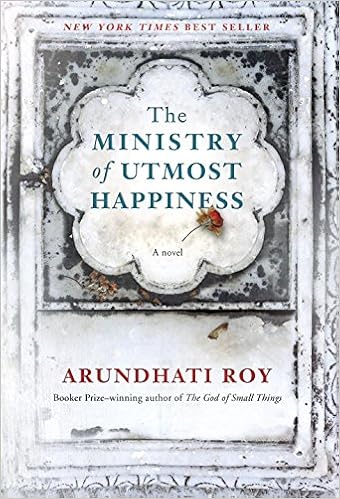
Book Review: The Ministry of Utmost Happiness by Arundhati Roy

Image result for the ministry of utmost happiness

The Ministry of Utmost Happiness

by Arundhati Roy


God damn Arundhati Roy.

God damn her and her beautiful books, which are so impossibly sad and so incredibly beautiful.

I have always thought, because I teach it to my AP students, that The God of Small Things ends with the most beautiful romantic scene I think I’ve ever read because Roy wanted to end the book on a happy note, that she wrote it intentionally out of chronological order specifically so that she could end it with hope, with the two lovers planning to meet again the next day, even though we know they won’t, or if they meet the next day, then they don’t meet the day after that, or ever again.

Now that I am reading The Ministry of Utmost Happiness (I am not finished with it, so I’ll need to stop writing this in a moment and go back to my sorrows), in which she has done nearly the same bloody thing, putting an exquisite lovely romantic scene near the end of a brutally heart-wrenching book, I think I may have to stop believing in the optimistic explanation of the incongruous, unchronological way Roy writes these books. I’m not sure yet, because this isn’t the very last chapter, so maybe other things will happen – and there actually is some hope in the novel that there will be some happiness, a fair number of good characters who could create a safe space to live and laugh in; but in God of Small Things two of the four good characters died and one ended up insane, leaving the fourth utterly alone, so… – but I am familiar enough with this feeling to know that Roy might have made the same play. This book is also out of chronological order, and since it is my first time reading it, that makes it difficult to follow, so there are parts I don’t remember well and maybe I should, to understand; which means maybe I don’t understand. I have to go read more.

But now I’m wondering: what if she put the happiest, most love-full part at the end of The God of Small Things because that makes it impossible to enjoy, since we’ve just been through 25 chapters of sorrows? What if she does it that way because she wants us to read the joyful part and think, “Well, this would be lovely, if my heart wasn’t already shattered into a million pieces by everything else I just read.”? And what if that is the point, because it makes the joyful part into a sad part, knowing that we can’t enjoy the joy because of the sorrows we’ve been through – which makes the sorrows even sadder?

Pardon me. Have to go finish the book. I just had to write down this theory when it hit me.

One hour and twenty minutes later –

All right. Okay. I was wrong: this book does actually have a happy ending. Of course it isn’t that simple, it isn’t all happy; there is death everywhere in the book, and it isn’t good death, not valuable, honorable, restful death. But the book is as much about those who live as it is about those who die, and the deaths make the life more precious, not the other way around.

So: to be clear. This book is about India and the war in Kashmir. At the end of the book, a character reads these words in a notebook: “How do you tell a shattered story? By slowly becoming everybody. No: by slowly becoming everything.”

That’s the book.

It has much of the same beauty that Roy put into The God of Small Things. The writing is, as always, brilliant: essentially beyond my capacity to even grasp, let alone describe. The book has a dense history of India, a complex exploration of the relationship between the present and the past, once again worked out through complicated family relationships and through appalling violence. The caste system is, as I suspect it always is, an indispensable element of the conflicts, though they are largely religious in nature: Muslim versus Hindu versus Sikh versus Christian. There is a terribly intricate narrative structure, with multiple interwoven plots and point of view characters, with no particular adherence to a timeline. There is another character that bears much resemblance to Roy herself, the child of a Syrian Christian woman from the state of Kerala, who studies architecture but does not become an architect, who is beautiful and strange and difficult. There is a beautiful romance, a number of broken romances, and an enormous, unbearable weight of violence and suffering and sorrow and alienation.

But there’s a lot in this book that wasn’t in the first book. The scope is wider: there are more characters, there are more conflicts, there are more settings. There is much more violence, and more villains who carry it out. And there is a lot more happiness at the end, a lot more peace, a lot more closure.

I don’t know if I recommend this book. I will need to read it again, and probably write a lot in the margins. But I feel much the same about this book as I felt about The God of Small Things after I had read it only once without writing anything in it, which was, I thought I should read it again; once I had, it became one of my all-time favorite works of literature. I suspect this one may follow the same path. So in the meantime, in-between time, this is a beautiful and difficult book, and if that’s your thing, I highly recommend it.