Okay, Now What?

Arguing has gotten me nowhere.


That’s not entirely true. I have had a metric fuck-ton of arguments in my life. It’s been a whole thing for me: it is a strong aspect of my teaching, mainly because it is a required essay format that all students have to learn, and so I always teach; it is largely what brought me online in a meaningful way, along with books, because my first two serious website interactions were with a book club and an argument site; it has taken up probably the majority of my online time (Though I don’t know how to measure that, really, so “majority” may be an exaggeration. But a lot of the time I have spent online, I have spent arguing.). I also argue with my students, but since they suck at arguing, that is closer to modeling good language use than it is an attempt to convince anyone of the truth. The online arguing is the larger issue. It has become a way I define myself, a point of pride; I tell my students, when I first introduce myself to them, that I am a pacifist — but I argue online all the time.


I mean that to be ironic. Why would someone who believes in peace and nonviolence and being nonconfrontational also go after people online?


And now I am thinking: maybe I should stop being ironic. Maybe I should just be who I think I should be, who I want to be. Someone who believes in peace, and nonviolence, and being nonconfrontational.
It’s not that simple, of course. Because one of the paradoxes of being a pacifist is that I have to live in a world in which people are violent and confrontational, and love fighting; so if I maintain my belief in being nonconfrontational and noncombative, all that happens is I get railroaded, and squashed flat, and violent people take advantage of me. The only way I can be a pacifist is, sometimes, to fight back against those who would create conflict, in order to maintain a larger peace. I believe that; I have accepted it. So I fight: I try to fight against those whose opinions would promote conflict and violence and abuse, both those who are bullies and those who work, intentionally or not, on creating a world where it is easier to bully.


So for the last few years, that has been my intent. I have fought against those whose political stance promotes the supremacist and fascist stances of the Republican party, particularly those who promote Trump and claim to oppose Covid-19 vaccines and climate change policies, because those three things — the devastation of the global climate, the suppression of medicine which prevents the spread of a deadly pandemic, and one orange-skinned motherfucker who wants to take over the world and make it dance for him and him alone — are the greatest threats we face, in my opinion. Trump is largely symptomatic, not causative, but the movement he represents is unquestionably an existential threat, particularly for marginalized and endangered communities. I do also argue against censorship, particularly in schools, and against the attempt to destroy public schools (both largely promoted by that same Trumpian movement), and I try to argue whenever I can for trans rights because I see trans people as the population currently suffering the most virulent and vituperative attacks, at least in my proximity.
I think it is a good thing that I have stood up for those causes, for those groups and those people, and against those groups and those people who would attack and do harm. It has not been good for me: that’s for damn sure. I get mad almost every time I get into an argument, and that is not healthy, neither mentally and emotionally, nor physically; it disrupts my sleep, spikes my blood pressure, distracts me from other things I want to do so that I am more often frustrated and unproductive, and therefore I take away from other things — like sleep, or relaxing downtime — so that I can accomplish my productive tasks. Because I already burned up my productive time arguing with some choad about how women’s sports do not need to be protected from trans women because trans women are women, goddammit.


But how much good have I actually done in all those years and years of arguments?


Probably none.


I hate that. But it is probably the truth.


I said last week that I have been persuaded, that I have read an essay by A.R. Moxon which showed me that my habit of fighting online is not only unproductive, but even damaging to the causes I believe in. Moxon pointed out that when someone — like me — says the same points that conservatives and fascists and transphobes and whoever have already heard before, it only shows those people that liberals and progressives have nothing new to say, all think the same things, only echo what we have been taught by our progressive liberal media sources.


The same things I believe about conservatives.


The more I argue, the harder this conviction sets in for my opponents. The more they believe that people on my side are fools, or liars, or mere puppets. I’ve seen this: I’ve seen people take my arguments as signs that I don’t understand the truth, or that I believe lies, or that I don’t care about truth because I have a political agenda; and even as I steadily disprove their points and prove mine, they simply become more strident in hollering that I am a liar and a fool and a sucker. Sometimes they do this while proving some of their points and disproving some of mine (Because while my stances are always right, my arguments are not always perfect, and sometimes I am mistaken), but whether they are right or wrong about their arguments, the point is that they become more adamant about never accepting my arguments, the more I argue with them.


My arguments, in other words, make people less persuadable.


This means that my arguing is bad for everyone. That cut out the last string that was holding up my need to argue. I already knew it was bad for me. I already knew I didn’t like it any more. I already knew I’m not actually as good at it as I thought I was, or told myself I was, in the past. But I still thought it was the right thing to do because I had to stand up for my causes: but not if I’m harming the cause by agitating the opposition, by making them harder to convince, not least because I almost always get mad and take that out by insulting my opponents, even though I know, and have taught my students for years, that insults lost arguments, that the second I mock my opponent, they stop listening to anything I have to say, even if everything else I say is deeply persuasive. All they focus on is the insult.


And rightfully so: because when my opponent insults me, I get so pissed off at that audacity that I no longer care about the argument: I care about showing that sonuvabitch that he’s not only wrong, he’s an idiot. I frequently prove that when I set out to do it – but it never helps. Of course. It just makes them madder and more smug, even while I keep getting madder and more smug. And of course, that leads to my worst habit: I am terrible about needing to get the last word. Even if it keeps me going back to a terrible argument, I keep doing it as long as the other person keeps replying to me. Even though I mock people for arguing simply to satisfy their need to win points and one-up people they disagree with.


Like I said. I need to stop being ironic.


It wasn’t just this essay that convinced me I need to stop. For one thing, I have walked away from arguing in the past – first when I finally escaped from the debate websites I started on, where I did the most harm to myself, wasting the most time, destroying the most sleep, wrecking my own mental health just because some asshat said something shitty about gay people or about public education in this country – or, God forbid, about gun control.


This was me. Of course.
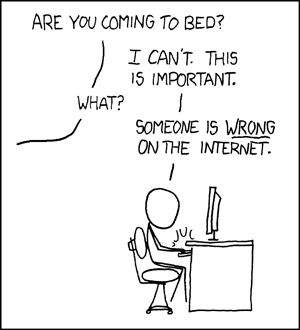
Duty Calls


Also this. My wife, who has been trying to gently persuade me to stop hurting myself with this stupidity for just about fifteen years, has always been able to tell when I am arguing because I type harder and faster and with an angrier expression on my face.

Rage Keyboard GIF - Rage Keyboard Angry - Discover & Share GIFs

Though I’ve never actually shed blood on the keyboard.

So I’ve known for years that I should stop. I’ve had my wife telling me so, and she’s always right. (I never argue with her, by the way. I know my limits. Sort of.) I have also, in the last few years, recognized that my teaching of argument has not actually helped my students learn how to write better arguments: they write terrible arguments, both before and after my instruction. And I suspect that some of that is because I go into the teaching of argument mainly looking to win arguments, which is one of my favorite things to do in the classroom. But it has definitely struck me that my students still make the same terrible arguments now that they did five, ten years ago. And I can’t take all the blame for that: much of it is because of the inherent problem with arguments, and the problems with social media, which is where they learn to argue, and where they find the topics they want to argue about.


I’ve recognized the problem with arguing on Twitter as Twitter has descended into the depths of Hell. I don’t even want to be on the site any more. Even worse, the more I interact with assholes on Twitter, the more money I make for them, because Musk pays them for their number of interactions. So why do I still go there to argue?


Okay, I tell myself that I am fighting the good fight: but a week or so ago, I was arguing about who was the greatest tennis player of all time. Which is – you may be surprised to hear – not one of the important arguments I need to take a stand on. I mean, it was related, because the original post had the pictures of four candidates for GOAT, and they were, as might be presumed, all white men – Pete Sampras, Roger Federer, Rafael Nidal, and Novak Djokovic. But the correct answer, of course, is Serena Williams. So I commented that, and like a few other comments that had made the same argument; and then I found this thread where someone had posted Serena’s unmatched statistics – better by far than any of those four losers – and someone else had replied that Serena would lost a head-to-head match to any of them.
But that’s dumb. Because that’s not how you decide who the best of all time is. Nobody arguing about Michael Jordan vs. Lebron James talks about which of them would win a 1v1. You talk about their impact on the game, on their team; their championships, their individual statistics.


So I joined the thread and fought for my side. I made a joke (It was a stupid joke, but I thought it was funny) in order to mock the guy who had said Serena would lose head-to-head. And another guy started arguing with me: saying that I was wrong and dumb, because the way you decide who is the best of all time is exactly to debate who would win head-to-head, and even Serena has said she would lose against a male champion.


We went back and forth. For less time than some of my arguments about more serious topics, but still, this went on too long. And somewhere in there I realized: who decided how you debate the GOAT of a sport? Who says it isn’t about a head-to-head matchup? Did I have some special knowledge? Of course not: because actually, half the fight about who is the GOAT is arguing over which methods of comparison make the most sense. And in lots of these arguments, none of which is ever meaningful, the key point is indeed head-to-head. Boxing, for instance (which I had even referred to, because I’m a dummy), is almost always about head-to-head matchups, not statistics. So I had a bad argument, and was arguing in bad faith. And the worst part was that the other guy was funnier than me with his insults and comebacks. Which just pissed me off more – but since it didn’t make my argument better, I finally just quit.


He got the last word. And it was funnier. (Not really funny, to be clear. It was still a sexist argument, which I have problems with. But I tried to end with a barb, and he threw one back, and his was better than mine. Dammit.) Now, I still believe that Serena Williams is the best tennis player of all time – because she was more dominant in her specific competitive circumstance than Sampras or Federer or Nidal or Djokovic – but what did I gain by arguing for it?


Nothing. I just wasted my time. And I’m still wasting it, because I’m still arguing my point here, now, with you.


This is why I need to stop arguing online. And also why I need to stop arguing with my students.
But then that brings me around to the title of this piece. What do I do now? If I’m not going to argue (And to be fair, I doubt I will ever stop arguing entirely; I still exist in this world, and people say some appallingly stupid shit; and also, I do think there is value in standing up for my beliefs and for the particular people I advocate for – but I have lately been stopping myself before I post, and deleting the comment, and scrolling away from the initial post that made me want to reply; so I’m getting better), what do I do? Nothing?


I don’t want to do nothing. I think there are fights that need to be fought. Even if I am a pacifist, because as I said at the top of this, even we pacifists need to fight bullies, or else we allow suffering and oppression and violence to grow and spread in the world. And I can’t abide that.


The obvious things I can do are: I can try to persuade people, without arguing; and I can take actual action, to try to create political change around the causes I believe in, to try to limit the power of fascists and bullies.


I plan to do both. The political action is going to wait, for now, because I have too much other shit going on; I’m writing a book, dammit. And one of the other facts that makes it easier for me to give up arguing now than it has been in the past is the fact that I have been fighting the good fight – victoriously or not – for a long time now. It’s like teaching: I still want to do it as well as I can, because my students today matter as much as those I taught twenty years ago; but in terms of my own sense of self-worth, I have already accomplished every good thing I could ever hope to accomplish as a teacher. I could retire now and feel satisfied with what I have done. (I can not retire now and continue eating and having electricity and so on.) So even if I don’t take action right away, I don’t feel bad, because I’ve done a lot of good things in my life. But causes today matter, so I do want to take an active role, in some small way; specifically, I hope to volunteer for the Democratic party, or simply for my local jurisdiction, to help with the 2024 election. Because make no mistake: the only way Trump and the Republicans can win is to cheat. Which doesn’t mean they will give up: it means they will cheat. And that means we need to stop them from getting away with it. I live in a battleground state with a strong pro-Trump Republican power structure; so my help is needed and important. I’m going to give it.


But right now, in my classes and on this blog and wherever I can, I’m going to try to do what I should have done a long time ago: I’m going to try harder to persuade people. Not to argue with them, not to prove them wrong and me right; not to get the best dig or the last word. To persuade them. A.R. Moxon persuaded me that persuasion is this:

“Preaching to the choir” is simply giving voice to an existing desire for truth, in a way that helps people see things in a way they already know to be true, but gives them the language, the pictures, the words, to keep knowing it. It brings the message to those receptive, rather than falling into the supremacist trap of viewing persuasion as proselytization, a competitive sport of one mind’s victory over another. It honors unpersuadable supremacists minds by leaving them eating the salad they’ve shat on, free to be persuaded any time they want to become persuadable.

I actually don’t think there’s much that is more persuasive than giving people language to understand things they already know are true, to help them in the real work of individual persuasion—new language, new frames, new pictures.

Having that picture helps to more clearly understand the things we already know.

Understanding it more clearly helps us believe it is possible.

Believing it is possible helps us expect it to happen, and understand that we can do it.

A.R. Moxon, Preaching to the Choir

That is my new goal.


It’s not entirely new: I think I’ve been doing that for a long time. I think I have sometimes done it effectively. But I also think I could be a lot better at it, and a lot more thoughtful in my attempts to do it well. After all, I study and teach rhetoric – the effective use of language to achieve a goal – and I teach my students to examine the relationship between speaker and audience and subject, and the context, in order to determine what makes a piece of text effective. So why don’t I do that with my own writing?
Because I’m busy telling that asshole that Serena Williams is a better tennis player than Novak Djokovic, who is just taller and stronger. Like that determines who’s better. Please. If that mattered, then Shaquille O’Neal would be a great basketball player, instead of the overlarge stooge I’ve been arguing he is for years.


Enough of that. Enough arguing. Enough fighting.


It’s time to try harder, and to think more. It’s time to do good.


At least it’s time to try.

This Morning

This morning I am thinking about thinking.

This morning I am thinking about the brain like it’s a computer. (Which means that this morning, I’m right. Also that I got the idea from the author Myke Cole. On Twitter.) The brain can do almost limitless work, but it isn’t actually limitless: there are a finite number of thoughts that I can think in my lifetime. It’s a large number, an imponderably staggering number — but still finite. When I give my brain a chance, it can think of some excellent creations. But too much of the time, I decide that my brain is tired, and that it could use some downtime.

I don’t think my brain actually gets tired. I’m sure it runs out of resources, runs low on fuel and energy; but usually, I suspect that the issue is that I am tired of my brain, and I want it to stop. I want to shut it off. I try to sleep, and sometimes I fall asleep with no trouble, the brain flipping into Sleep mode with the press of a button, the closing of my eyes; but sometimes, it keeps going, trying to finish a particular thought-cycle; it is worst when that cycle gets stuck in a loop. Around my anxieties, usually. But just the fact that my brain can keep going even when my body and soul are entirely exhausted tells me: my brain doesn’t get tired. It’s a machine. It runs for as long as I keep it plugged in — and though I don’t remember my dreams, I have them, which means it keeps running even when I shut it down.

This morning I suspect that my brain is most insistent in those thought-cycles when I have not spent enough time paying attention to useful thoughts: when I have spent too much time wallowing in trash thoughts.

A computer is a powerful machine, but it is only as efficient and effective as its inputs: GIGO is the word, Garbage In, Garbage Out. (I learned that at summer camp when I was ten. I took a programming class. My summer camp was cool.) And my problem is that when I decide that my brain is tired, I input garbage so that the thoughts will become — less troubling, maybe? Less effective, certainly, in that the thoughts have less effect on me. I’m tired of thinking. I want to relax, and somehow, that has taken on the definition of “thinking about garbage.” So I watch TV, I play idiotic video games, I scroll through social media. Purposeless, but enjoyable. It feels relaxing.

But this morning, I think these inputs are viruses. They put their own information into my brain-puter, (Compubrain? Combrainter? This is all bad. You know what I’m realizing this morning? “Computer” is an ugly word. “Brain” isn’t any better.) and then more often than not, my own thoughts, my own programs and content, get shunted aside in favor of the viral inputs. I get caught up in video games — “Just one more! Just one more!” — and I find myself wasting hours, staying up later and later, turning to the video games during the day even when I’m not tired of thinking. The same with the social media, which is simply an eternal scrawl, requiring an active decision to stop zombie-plodding through it, and while I’m taking in images and words, I’m not going to stop easily. Even if — especially if — they’re bad images and words, uninteresting ones, because then I keep seeking good posts, good information among the mounds and pools of shlock. The movies and TV are even more insidious, as they worm into my thought-files and corrupt them with their own information, so that my brain gets stuck making references to movies and TV, repeating lines and scenes and images and other bits of viral data. Then even my ideas replicate the viruses’ ideas: and that, I suspect, is why Hollywood has become so very good at remaking remakes and sequelling sequels.


This morning I’d like to say that I am going to stop watching TV and movies, and stop looking at social media, and stop playing video games. But I don’t want to lie. I’m not going to stop. Not only are they important to me — as downtime, which whether my brain needs it or not, the rest of me does, and I associate it with those things; though I may try some new kinds of downtime, like easy reading or writing, or listening to music while I drink wine, or something like that — but they are a part of my career, as social media is the best way to advertise as a self-published author, and also a part of my society, which is steeped in pop culture, and I want to stay connected and relevant. But I want to do some simple things that will mitigate the effects of these viral inputs, this malware. First, I will build firewalls: I will set limits as to when and how much I take in. Second, I will dedicate more time to using my computing cycles more productively; yesterday I spent my walk with my dogs thinking about things; last night I read; this morning I am writing. (I’m going to do it again tomorrow morning.)

I slept very well last night. I also took a splendid nap yesterday. So I’m thinking now that when I’m tired off thinking, I should sleep: and when I am not tired, I should keep thinking productively. My brain will keep running anyway; I’d rather it thought about truth and beauty, than about Candy Crush and reality shows.

What It Means to Be a Writer

Scrolling through my Twitter feed when I found a link to this piece.

I walk by accident into one of London’s über-bookstores to be taken over by a very familiar type of sadness—as a child I used to feel this way when thinking about the cosmos and my own insignificant place in it. This is London’s biggest bookshop: 6.5 km of shelves, the website proudly tells us, as if this particular length and not another were a reason to rejoice. Book after book after book thrown into this worded jungle—a hoard that could be a waking counterpart to a Borgesian wet dream. Fiction books and books on writing fiction. Photography and art books and books on photography and art. And so on: most forms of expression and myriad words of meta-dialogue, some of them even justified or at least nicely edited and with colourful covers. Nothing escapes this total library: no corner of the universe or the mind is left unaccounted for. It is a hideous totality for it is an ordered totality, filtered through the minds of who knows how many marketing specialists; it is effective as a selling platform but it is a desert of anonymity for the diminished names on the shelves. Were I ever to be asked for a writing tip, something born out of this experience would be my choice: walk into any gigantic bookshop and think whether you can face being one more name lost in this desert of words. If that ideal situation proves too much to bear do something else with your time (it is of course highly likely that if you go around asking for writing tips you will never make it on print).

Okay, first of all, that parenthetical comment at the end gets you a punch in your snooty little snoot with a fist labeled Fuck You. I presume you mean that true poetry, great writing, emerges from the soul as a fait accompli, like Athena cracking her way out of Zeus’s head fully-grown; if a would-be writer is too naive to recognize this immortal truth, and to think that one could simply ASK for a way to be a better writer, then that person is doomed to less than mediocrity. Or else it is the bourgeois feeling of the “writing tips,” the oversimplified, sanitized, pre-packaged saccharine packets that show up in ten-item numbered lists on the various clickbait websites advertised on Facebook. I am more understanding of contempt for those, as I am contemptuous of people who make a living on the internet by telling people how to make a living on the internet – by running a website telling people how to make a living on the internet, which is done (Spoiler alert!) by getting people who want to make a living on the internet to buy your secret to making a living on the internet; and the people who do this always seem to call themselves “writers.” But my contempt is for the people at the top of the pyramid: not for the people down on the ground, choking on dust and sand, dreaming of a way to climb. Those people who want writing tips because they want to be better writers deserve respect for their courage in trying to find a way to get what they want; and their desire to improve, whether or not they know a good path to improvement, is admirable and not at all an indication of their potential as writers. Fuck you in the snoot, sir.

Now let’s talk about the central issue here. You’ve got two problems with this bookstore and the despair it engenders in you. One is that your words will never be truly unique, because somebody out there will say pretty much the same thing you say – or in Borges’s universe that you reference later, with his infinite Library of Babel that holds all combinations of letters and thus every possible book, one of the other volumes on the shelves will say exactly what you say. And maybe Borges was right and it does repeat in a chaotic pattern for eternity, if such a thing can be said to exist. Right? All the kilometers of fiction books, the books about art and photography and writing; all been done before, nothing is new, nothing is original. Somebody get me a cigarette and a bottle of cheap red wine, and build a Parisian basement cafe around me for a tomb.

The second problem is that you will never be the one person whose words everyone reads, everyone knows, everyone talks about; because there will always be so many others putting words on the page, that it is impossible that your words would be the ones that capture every reader at once. Particularly not if you want to capture every non-reader as well. This problem seems to be the larger one, as you speak more of being lost in the noise than you do about repeating what has already been said.

The futility of writing is something I face up to every time I set pen on paper or hand to keyboard. Why am I doing this? My compulsion to write does not occlude the uselessness of filling pages with words. I know that what I do is pointless, one more message in a bottle in a moment when everyone else around me is also casting messages adrift.

This is a poor proof. Your message in a bottle being surrounded by other messages in a bottle does not make your message pointless. Not even in the metaphor: so long as one person finds your message and reads it, and – I suppose – comes to rescue you from your desert island of despair (Perhaps your bottle message is something entirely different, something like “If you let your eyes go unfocused, a Moen kitchen faucet starts to look like a snobbish sheep with a very long snout. But it’s hard to recapture the magic once your eyes go back to normal and the sheep turns back into a faucet, so don’t waste it.” In that case, you won’t be rescued, but somebody may spend a lot of time squinting at their kitchen sink because of you, which is pretty funny, really. I’d call that success.), then your bottle was a success. You won. You did what you set out to do. You made your point. Wherefore, then, does it become pointless? Is the idea that the thousand bottles around your bottle make it less likely that your bottle will be read? This is not true for the same reason your enormous bookstore should not lead to despair. Ready for the reason? Here it is.

There is more than one person reading. (Shocking, I know. Hold onto your snoot, Buttercup.)

Let’s start with the metaphor. There are a thousand bottles with messages in them, bobbing in the water by the seashore. If there was only one person walking by, and for some reason that person had sworn a sacred vow to read only one bottled message, then your chances of being read are a thousand to one. Agreed, and that would suck. But in the – ahem – “real world” of this fantasy, that one guy wouldn’t stop at one bottle: he’d keep opening bottles. Because if he was doing it out of curiosity, out of a need to see what was written on those messages; or if he was looking for the perfect message, the one that would speak directly to his soul, then reading one message would never be enough. He’d read another, and another, and another. He’d probably try to read them all. I would. Wouldn’t you? If you saw a thousand bottles bobbing in the water with message inside them?

And if it was more than one guy on the shoreline? If it was actually a crowded beach, with tourists, and beachcombers, and dogwalkers, and a tai chi group, and a bunch of hungover teenagers wrapped in sandy blankets and the stench of wet cigarette butts? The bottles would catch all of their interests. They would all want to open their own bottle, be the first to read a message. Then they would share the messages they found with each other. They’d be diving into the water, throwing bottles back onto the shore, shouting and laughing and waving their messages over their heads. The more bottles there were in the water, the bigger the spectacle would be, and the more those people would be drawn to where the bottles were. They might even come back the next day to look for more bottles.

Are you following me, sir? Those bookstores with the kilometers of shelves? They are not only filled with books, they are filled with people. People who read books. And those people never stop at just one book. I know: I used to frequent a very similar establishment, Powell’s City of Books in Portland, Oregon. Five floors of twelve-foot-high bookshelves, covering an entire city block. I never expect to see so many books on display in a single place in my life again. I could spend the rest of my life reading (Ah, bliss!) and not finish a single floor’s worth of books. I went there every month for the ten years I lived in Oregon, to buy books, and you know what? That place was always packed with people. With readers. Never mind the kilometers worth of shelves: how many kilometers of people do you think go through those stores on any given day? 3,000 people, on the average. [source] Average front-to-back measurement of a person is approximately ten inches; I’m an American and we’re thicc, so let’s bump that up to a round foot. (Screw the metric system, though I’ll convert for your convenience, sir.) 3,000 feet of human every day, which is very nearly one kilometer of human flesh – around 915 meters, to be precise. And that’s not even lying down head-to-foot. That means that in a week, if the London store has a similar number of visitors, the people looking at those books outdistance the books they are looking at. And I can tell you that the turnover rate for the people looking is far higher than the turnover for the books on the shelves.

There are an enormous number of books in the world, and it grows every day. It is impossible for one person to read them all, and realistically impossible that one of them will be read by all people.

But that doesn’t mean that my book won’t be read. It doesn’t mean that your words will never be seen.

I think about selling my books, which I have not yet succeeded in doing. But let’s imagine that I do so: imagine if my sales, by every measure of the publishing industry, are absymal. Let’s pretend that I only sell one thousand copies of my novel about a time-traveling Irish pirate. So lame, right? I am – what was your phrase? – “lost in this desert of words.”

A thousand people bought my book. Presumably that means a thousand people read it. (Some surely would cast it aside in disgust or disappointment, sure, but I think some of them would like it enough to share with someone else, or else resell it. Let’s just imagine that one sale equals one reading.) Think about that. I have never been in a room with a thousand people who all know me: not in the way that a reader knows at least an aspect of a writer. I have spoken to thousands of people in my life, but I doubt that a full one thousand of them cared about what I had to say: cared enough to sit down, in a quiet room, and spend hours just listening to my words, thinking about my thoughts. Hearing me. If I could sell just one thousand copies of my book, then I could achieve that. So what if at that same time a million people were listening to Stephen King, and ten million were listening to Kim Kardashian? So what if the world is larger than I can speak to at once? So what if all I can have is one small corner –with one thousand people listening to me?

Isn’t that enough?

Think about it in terms of time. I don’t know how many hours it takes me to write a book, but the pirate book was finished in about a year, so let’s use that. It’s a pretty fast read, I think; someone could finish it in maybe ten hours of reading at a leisurely pace, maybe even less. If a thousand people spend ten hours reading my book, then the year of my life spent writing it (And of course the vast majority of that year was spent sleeping, working, eating, singing in the shower, watching TV, playing The Sims, et cetera) has turned into ten thousand hours of other people’s lives spent – on me. There are 8,760 hours in a year (And 525,600 minutes), so even if I had spent every single one of them working on my book, that time spent is balanced by time spent reading my book if only a thousand people were to read it. More than balanced.

So the question is, what more could you possibly want?

If the only thing that would make writing worthwhile, that would give this endeavor a point, is if every single person on Earth read your work, and only your work, then I agree that writing would be pointless. But I can’t fathom a writer, a real writer, being that childish, that selfish, to think that the world must revolve around your work and your work alone. I mean, the only cultural phenomenon with that impact is Wyld Stallyns. Granted, you’re not them, and neither am I. And that stings a bit, I’ll bet. Yeah, it does me too.

I’ll comfort myself just thinking about how easy it would be to get a thousand people in the world to read a decent book. Shit, if all I want is readers, I could offer it for free and get that many readers without even trying. You wrote this obnoxious angsty piece of snobbery, and I read it, and then spent – mmm – more than an hour responding to it. See? The time you spent on this crud then earned for you this time spent out of my life. Time I could have been reading, ya selfish bastard.

And honestly, I think this is enough time spent on you. I am sorry that your life is so empty and meaningless, and sorry that I threw a couple of hours of my life into your black hole of an ego. Do us both a favor: gain some perspective, will you? Thanks.

(I have to say: the rest of the piece has some valid points about marketing on social media, and about the democratization and banalisation [His word] of writing that has occurred through the internet. There is some good thought here. If there hadn’t been, I wouldn’t have read all the way to the end, and then taken the time to write a response. I don’t disagree with everything he says. Just the central premise. I dream of having a thousand readers, and I am absolutely sure that, even in a world inundated with voluminous writers of every imaginable quality and a limited number of readers with a limited number of books they will read, still: I will hit that mark. And it will be worth it.

(Thank you for inspiring me to write this, sir. Now pull up your fucking pants.)