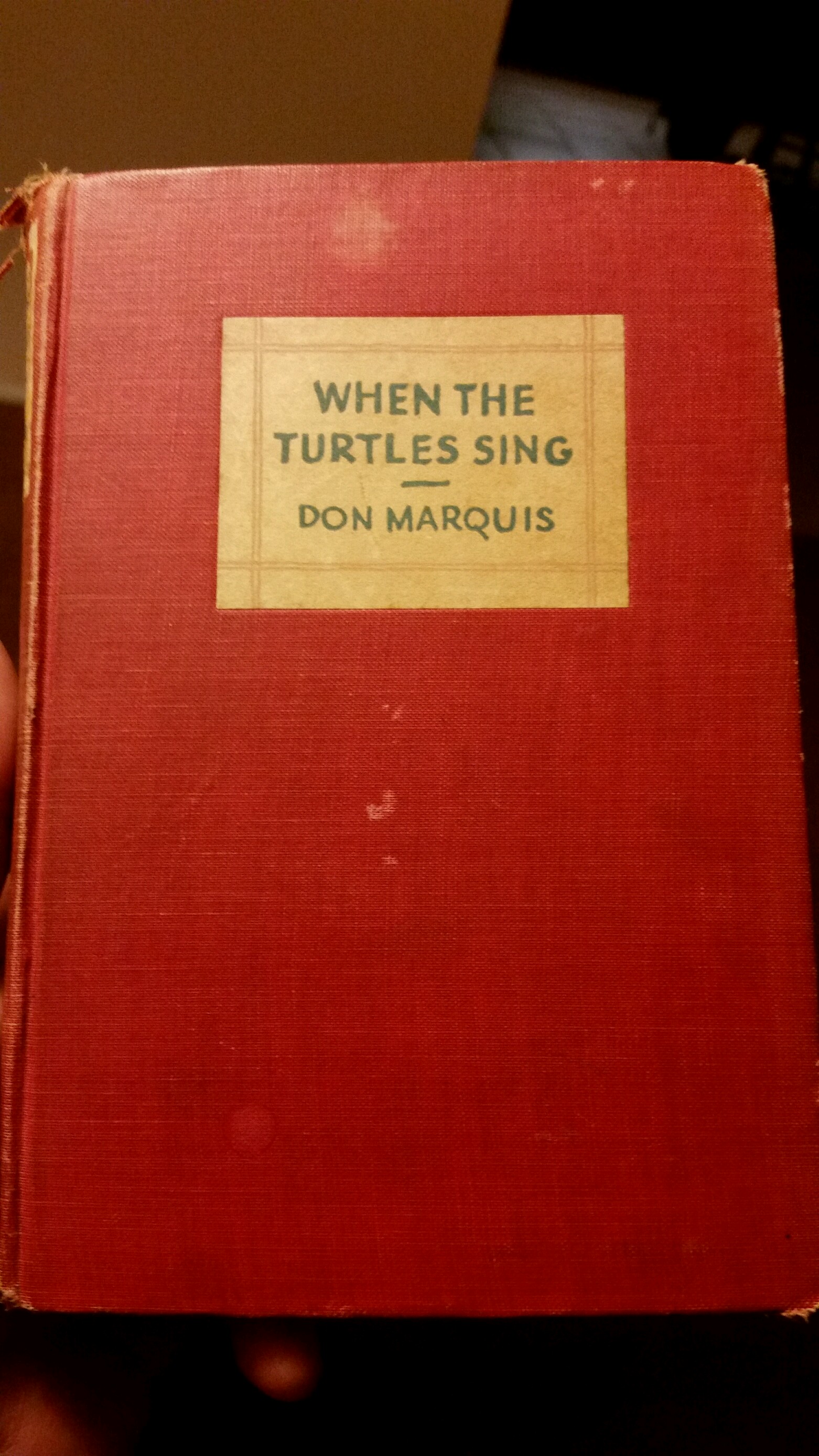
Book Review: When the Turtles Sing

When the Turtles Sing

by Don Marquis


This was a sweet book.

It’s ten short stories, published in 1928, by Don Marquis, a humorist and poet that I have been long acquainted with because my parents read and shared with the family Marquis’s collection Archy and Mehitabel, about a cat and a cockroach who are both reincarnated spirits; the cockroach was a poet, and he sneaks out at night and types poems on Marquis’s typewriter, one key at a time, without any capital letters because he can’t hold down the Shift key. I loved that book, and got my dad’s old copy of it a few years ago, whereupon I read it to my wife, who also loved it. So when I was at the Friends of the Library Book Sale, and I saw this lovely old hardback with a great title and a familiar author, I had to get it.

I’m glad I did. Marquis had a hell of a sense of humor, and more important, he had a hell of a sense of fun: these stories are mostly just fun. They’re good ideas, and they’re actually well-realized; a couple of them take really surprising dark turns, which fits the characters and plots, even if it doesn’t seem to fit the book. But it was an interesting choice, because you have what seems a parody, a caricature of human beings, who get into absurd situations – and then, for some of them at least, you have a fairly serious result, one which follows logically from the story’s events; but I didn’t think we were speaking logically.

The humorous stories are in two sets, one a trio of stories recounted to us by the Old Soak, an elderly gentleman who tells us stories about the strange residents of his small town, particularly the ones who live in a nearby swamp. One of the stories, the title one about the turtles singing (which is actually a quote from the Bible), has a mixed-up comic romance worthy of Shakespeare; but another of the Old Soak’s stories tells about a love triangle that might include a murder, as one man dies accidentally while in the presence of the second man. That story might get wacky, except it was much more about the woman’s attempts to become a full and complete version of herself despite the town’s bias against her, as she comes from the swamp and is therefore unclean and unacceptable. Her story is something of a triumph, as she finds a way to go to college and complete the education she had to begin herself, and then travels to Europe, unencumbered by marriage (She does marry both guys, but the second marriage is more open and free companionship than the sort of ownership that would have been common at the time) and child-rearing; all fine and good – except the story ends with her husband going mad with guilt over the death of the first man, and at the end he shoots himself. So, y’know – not funny.

The other funny ones are much funnier: a pair of tall tales told by an Irish father to his two sons; Marquis gives in to the temptation to write in Irish dialect, which isn’t my favorite thing to read, but he does it well and not too excessively. He does it with the Old Soak stories, too, which have a Twain-esque hillbilly style to them, with a number of malapropisms and strange spelling/pronunciations from a Southern American English dialect. More important, he doesn’t rely on the accent for humor: the stories are funny, and the narrator is hilarious, in both cases.

So I enjoyed the book, which was generally light-hearted and well-written. But now I’m sort of stuck: you see, I liked it, but I wasn’t inspired by it, so normally, I’d sell this book back into circulation so someone else could enjoy it. But this copy is actually from 1928, and it’s falling apart; the binding is broken, and the pages are coming loose from the spine. So I can’t sell it, and if I give it away, it will just get trashed. I can’t let Don Marquis get trashed. Not a book about singing turtles, either. I think that this book will get to sit on my shelf, hanging around like the Old Soak, just waiting for someone to sit for a spell and listen to his stories.

I like that.
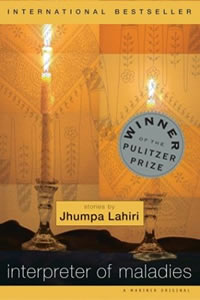
Book Review: Interpreter of Maladies


Interpreter of Maladies

by Jhumpa Lahiri

I didn’t love this book.

Some of the stories were beautiful. All of the writing was lovely, but some of the stories didn’t sing to me, where some did. I was a little disappointed that the title story was definitely not the best; it’s about a man who interprets for a living, who takes a group of American tourists (of Indian heritage) around on a tour of his hometown, which they visit every year or so from their home in New Jersey. The tourists are pretty delightfully obnoxious, and the ending of the story when one of them gets an Indian comeuppance, is delightful; but the major action involves this interpreter (who also works in a doctor’s office, translating people’s symptoms to the doctor – hence the title) developing a crush on the tourist woman. Which was pretty disappointing, really.

I did like about half of the stories. A Temporary Matter, the first one, was maybe the most touching; it’s about a couple trying to find their way after a stillbirth; they are mostly estranged and alienated, until the power company turns off all of the lights in the neighborhood around dinner time, and then these two people find that they can talk in the darkness in a way they can’t when the lights are on. The story doesn’t have a happy ending, which was also a letdown, though it did make sense. It was good, but not my favorite. The second story, When Mr. Pirzada Came to Dine, is pretty much the typical story for the collection: it features a mix of Indian culture and Western, which creates discomfort and conflict; the characters are interesting, the descriptions are lovely – and the story goes freaking nowhere. Ditto for A Real Durwan, Sexy, and The Treatment of Bibi Haldar (The first and last only differ in that they are purely Indian, and so have at least some appeal in showing something of the culture; Sexy is the only story in the collection with a Western main character, and she’s a dud, as is the story.), and, sadly, the title story. Which at least does have the best title, which is, I suppose, why Lahiri picked it for the collection. The other three I’ve listed here were all a little too strange, and a lot too dull: nothing really happens, nothing gets resolved, nobody goes anywhere. I’m sure that was the point, an attempt to show the futility and emptiness of modern life, but — whatever.

The good stories were The Third and Final Continent, This Blessed House, and especially Mrs. Sen’s, which was my favorite. They showed relationships that were fraught, but not doomed; the couple in The Third and Final Continent actually work out quite well, as does the most significant relationship in the story, between the Indian main character and his American landlady, who is 103 years old and is splendid. Say it! Say “Splendid!”

This Blessed House has the most interesting character, in the woman named Twinkle, who reminded me of the classic vivacious hostess, the sort of Katherine Hepburn energetic wit with grace and style who isn’t afraid to get her hands dirty; she was contrasted nicely with her dud of a husband, though I do have to say that, as an introvert, I was kind of on his side: he just wants a quiet house to come home to after work, and his wife keeps throwing parties and doing things. I have never been so glad to be married to a woman even more introverted than me.

Mrs. Sen’s was the sweetest story. It’s about an American boy who spends his afternoons at the home of his babysitter, the titular Mrs. Sen; seeing her through his eyes made her interesting but never offputting – other than the damned knife in the beginning of the story, which I could not for the life of me imagine; it’s apparently an Indian cooking tool, a blade fixed to the cutting board, and you move the vegetables over the knife to chop them. It’s a nice piece of Indian culture, but I just couldn’t grasp it. Still can’t. But I love how Mrs. Sen is so eager to get news from home, and I was heartbroken with her when the news is bad; I thought it was very sweet how she tries to learn to drive, and I actually liked her husband, which made this one of the few relationships in the book that isn’t depressing or disappointing. Plus, I used to have to go to my babysitter’s after school — Mrs. Bergstrom’s —  and so I bonded with the narrator right away, and I sort of wish that Mrs. B. had only had me to watch, instead of the five or six kids she took care of at once. I would have liked to get to know her the way we get to know Mrs. Sen in this story.

Overall, I don’t think it was really worth it; even the good stories aren’t among my favorites, really. If you are in the mood for a sort of gentle alienation, like looking through a soft veil at a surrealist painting, then go for it; if you feel like reading about romances that don’t have a whole lot of closeness in them, as well, then this one is right up your alley. I think it missed my alley.

Book Review: The Mighty Swordsmen

Isn’t that beautiful? Interesting how the men are in greater detail than the women, who are graphic and one-dimensional. Maybe there’s a reason for that . . .


The Mighty Swordsmen

Edited by Hans Stefan Santesson


A collection of Mighty Warrior swords-and-sorcery stories, this was like most of its kind: a couple of good ones, some that were okay, and a couple of stinkers.

The stinkers were “Break the Door of Hell” by John Brunner and especially “The Keeper of the Emerald Flame” by Lin Carter. The Carter story was too painfully derivative of Conan stories to be worth reading – though I admit I like the name Thongor – as well as too long and plodding, and the bad guy at the end was completely lame. The John Brunner story had some good bits: the concept is Ahura Mazda, the evil deity of Zoroastrianism, wandering Earth and granting people their wishes – which immediately makes those people regret their wishes. Some of those evil wish-grantings were great. The main city that Mazda goes to torment – and he sees himself as merely acceding to people’s wishes, not in any way working evil, and he’s probably right – has a great number of noblemen who would be sorcerers; they start casting their mojo, and even though they don’t really know what they’re doing, Mazda makes it so that their spells actually work: to their unspeakable regret and torment. That part was pretty fun, but also a bit repetitive; and at the end, the twist just irritated me. Bad story, overall.

The mediocre ones were the Elric of Melnibone story, “The Flame-Bringers,” and one of the two Conan stories, “The People of the Summit” by Bjorn Nyberg. The Elric story was actually fine, but exactly like every other Elric story I’ve ever read: he goes questing with Moonglum, brings out Stormbringer even though he doesn’t want to, chops up some enemies and eats some souls, and then calls out the damn dragons to save his bacon at the end. The one Conan story was also fine – better than Thongor – but it was overshadowed by the one that finished up the collection.

That last one, “Beyond the Black River,” along with the Roger Zelazny story “The Bells of Shoredan,” was by far the best. The Zelazny story was about his Dilvish the Damned character, who’s cool to begin with, and this was, for once, a self-contained story, with a good twist, and Zelazny’s usual beautiful prose and wonderful atmosphere. The last story was Conan as written by Robert E. Howard, and seeing that story along with a Conan by a different author, and the cruddy Thongor knock-off, really drove one point home: Robert E. Howard was a hell of a writer. That last story is the longest in the collection, but also the most exciting; Conan is the ultimate badass, and yet he is the most human and believable hero in the bunch. If you can find this collection – unlikely, as I picked up a faded copy with the cover falling off at a Goodwill in town – then it’s worth getting just for the Howard story. And the sweet 1970 pulp fantasy cover art. Good stuff.

Spring Break Book Review #4: The Troll Garden

Image result for troll garden signet classic

The Troll Garden

by Willa Cather


I found this one at a garage sale, put on by a former literature professor; he gave me a discount on this and the other two or three books I bought, including a nice paperback of Dracula, which I’ve never read all the way through but will be diving into soon.

I’ve never read Willa Cather, though I’ve always been surrounded by copies of O! Pioneers, a classic usually part of American literature classes, though never my own. I got this because I loved the cover, and because I held out hope that it would actually be about a garden full of trolls — I also got a copy of a Kenneth Grahame book of short stories, and if that man can write about moles and toads and badgers who own halls and motor cars, why couldn’t Willa Cather write about gardens full of trolls?

Because Willa Cather wrote about despair, that’s why.

The title actually comes from a cute little ditty:

“We must not look at Goblin men,

We must not buy their fruits;

Who knows upon what soil they fed

Their hungry thirsty roots?”

And the book is related: it is about people’s secret desires, often dark, and generally leading to bad places. These stories are about unrequited love; about poverty and working-class life and how such a daily grind wears away every noble impulse in a person; about how people want what they cannot have, and don’t recognize what they do have, and don’t want it when they do have it. It’s a book about hunger and thirst, and the darkness we turn to in order to feed that hunger and thirst, and what that darkness does to us.

The first story, Flavia and Her Artists, is about a woman who desperately wants to be chic, to run a top-shelf salon, packed with intellectuals and artists and the finest of people. But she doesn’t know how to pick the best types, and ends up with less enchanting guests, who all laugh at her behind their hands, because she herself is superficial and dim-witted, blinded to reality by her dreams of being the ultimate hostess. The story is only saved by her husband: who loves her despite knowing how pathetic she is, and who tries to do his best to protect her and make her happy, even though none of the angsty sophisticates can understand what he sees in someone so gauche.

The second story, The Sculptor’s Funeral, was my favorite: in it a great artist dies and has his body returned to the little crap town in farm country where he was born. The people there are absurd and grotesque, and the men who gather for his wake spend the evening deriding the artist as a weirdo who was clearly a failure because he didn’t stay in town and make money, as his father did, as they all did. But again, the love of one good man redeems the story: a lawyer who was a good friend, a real friend, and who understood the deceased sculptor, reams them all for their vileness. It’s a great speech, one I’d like to say myself to a few people I know.

Then we get to the Unrequited Love section: The Garden Lodge, about a woman who grew up poor, who held herself to a rigid and unbending regimen in order to get out of poverty, who married well and securely, and then — falls in love with an opera singer who stays at her home. She clings desperately to this one bit of irrational passion, but by the end, she returns to her sensible self, and has the garden lodge where she spent time with her singer torn down. A Death in the Desert is a double dose: a woman dying of tuberculosis is pining for the great composer who was her mentor; she lives vicariously through the man’s brother, who looks just like the great composer; and he keeps her company as she dies despite being in love with her himself. She dies without anyone ever being happy.

The Marriage of Phaedra is about an artist’s legacy being spoiled by his widow; A Wagner Matinee is about a woman who gave up both music and joy when she married a homesteader and then spent her life raising their children and caring for his house out on the frontier; and the last, Paul’s Case, is about a young man who dreams of a life of beauty and sophistication, but can’t find his way to it out of his lower-middle-class upbringing, other than through fantasy, which eventually destroys him.

I see glimmers of goodness in every story — Flavia’s good husband; the sculptor’s good friend; the essential goodness of the woman in The Garden Lodge and the almost inhuman humanity of the brother in A Death in the Desert, squashing his own heart, his own identity, in order to stand in for the fantasy of the woman he loves; and so on. The people longing for what they don’t have are not bad, are not at fault for their own desperation and sorrow; I see Cather’s villain as the society that pigeonholes us while showing us a dream we can’t have, telling us we can. Maybe we’re fools for believing it, but there are people who profit from our hopeless fantasizing, and then from our bereavement; they are the bad guys here, not the people who want more. Paul’s Case is not his fault. Not that that makes it better. Poor guy.

It is beautifully written. It is deeply depressing. I can’t tell if it says good things about my appreciation for fine literature that I was able to enjoy the book, or if it says bad things about my increased ability to relate to the desperation and sorrow of the characters. I want to say the first. I’m certainly going to read something more cheerful now — though more fool me, the very next thing I read after this was not cheerful at all. But at least the writing sucked. Hey, stay tuned for that review!


Roald Dahl

The Wonderful Story of Henry Sugar and Six More
by Roald Dahl
Roald Dahl is one of my favorites. How could he not be? The BFG, James and the Giant Peach, Charlie and the Chocolate Factory; “Lamb to the Slaughter” is one of my all-time favorite short stories. So of course I grabbed this one when I found it at a local thrift shop. Of course I did.

Sadly, it wasn’t quite as enjoyable as his other books that I’ve read.

Oh, it wasn’t bad. But unlike his other works, it was — well, boring. There wasn’t a whole lot of imagination in there. Three of the stories were non-fiction. One, “The Mildenhall Treasure,” was about a treasure discovered in England by two men plowing a field, which was interesting, except the ending is terribly frustrating. One, “Lucky Break,” was the story of how Dahl got started as an author, which was actually quite interesting but also a little frustrating for me as a long-time unpublished author, because here’s the story: he didn’t even know he wanted to be an author, until one day he was asked to tell the story of his experiences as an RAF pilot during WWII, and he offered to write the story down instead; the man who asked Dahl for the story? C.S. Forester, author of the Horatio Hornblower novels. A million-selling adventure writer at the time. So when he sent Dahl’s story on with his personal recommendation, guess what? Suddenly Dahl had a writing career. That is not to take anything away from Dahl’s ability and imagination, which were both prodigious, but — lucky sod. Anyway. Totally not jealous, I swear. The third non-fiction one, “A Piece of Cake,” was the best: it was the story he wrote for Forester, and it was both interesting and very imaginative, as the last half of it is essentially a long dream sequence, which took place while Dahl recovered in a hospital from an injury.

The other stories, the fictional ones, were also up and down. The Henry Sugar story is indeed wonderful. It’s also a story within a story within a story, which is pretty cool. “The Boy Who Talked With Animals” was absolutely one I wanted to live for myself. “The Hitchhiker” was okay, but it’s a bit long for only one gag; and “The Swan” was completely irritating because nothing happens to the bad guy — just like the Mildenhall Treasure story.

So overall, I still like Roald Dahl, but I didn’t think a whole lot of this book. Find another collection that has Henry Sugar, “The Boy Who Talked With Animals,” and “A Piece of Cake,” and give this one a miss.

The Mad Scientists’ Guide

The Mad Scientist’s Guide to World Domination
Edited by John Joseph Adams


This was a real treat to read. It’s a collection of short stories by various authors, including some of my favorites — Diana Gabaldon, Austin Grossman, Naomi Novik — and all about mad scientists or megalomaniacal supervillains trying to take over the world. Determined to show them all just who’s really mad.

Usually them.

Like any collection of stories, there are hits and misses. The Austin Grossman story that starts it off is, not surprisingly, one of the best — Grossman wrote the excellent “Soon I Will Be Invincible,” also about supervillains — and Seanan McGuire’s “Laughter at the Academy” was brilliantly constructed as a series of connected shorts. The Gabaldon story, which ties into her Outlander series, was only thinly connected to the theme of mad science — it’s about the Comte St. Germain and Master Raymond, who are alchemists and wizards in France in the 1700’s — but was superbly written nonetheless. On the other end is a crappy piece from L.A. Banks and a stupid attempt at a joke by Harry Turtledove, and two failed attempts to work an angle on classics, one about the daughters of classic mad scientists — Jekyll and Hyde, Frankenstein, and Moreau — and one about Superman and Lex Luthor; the first was boring and the second melodramatic and still boring.

Some are heartbreaking: one called “Mofongo Knows,” about the very tail end of a supervillain’s life; and one called “Instead of a Loving Heart,” about a robot built to serve a mad scientist, which is made of the brain of an artist trapped in a mechanical body. Some are genuinely funny, especially “The Angel of Death Has a Business Plan,” about a supervillain trying to save up for her own world domination scheme by working as a life coach for other would-be supervillains. Some had a really good twist, particularly “Letter to the Editor” by David D. Levine, “Rural Singularity” by Alan Dean Foster, and “Rocks Fall” by Naomi Novik, which had both a surprise in the supervillain’s mentality, and then a surprising ending. There’s some good action in Daniel H. Wilson’s “The Executor” and some nice romance in “Blood and Stardust” by Laird Barron. And there’s some frustrating and disappointing attempts, particularly “Homo Perfectus” by David Farland which is a little too dirty-old-man-y, “The Pittsburgh Technology” by Jeffrey Ford, which makes its point early on and then just keeps slapping you in the face with it, and “The Food Taster’s Boy” by Ben H. Winters which has nobody even remotely resembling a sympathetic protagonist: you want everyone in the story to fail and lose, and even when they do, they don’t lose enough.

The editing was good, though each story is prefaced by an introductory entry that completely spoils the story, and which I’d recommend skipping. But they were good stories, and the book as a whole had a generally good arc — though it does end on a down note, unfortunately. But maybe that is fitting, for a book about madmen who seek to destroy the world. Overall, I’d recommend it.