How Do I Say This Nicely?

So there I am, just minding my own business, right? It’s a Saturday morning, I just got out of the shower, so I need a minute to cool off because it’s June in Tucson and it’s already 94 degrees outside, so by the time I finish shaving and brushing my teeth my forehead is slicked with sweat, and I need to sit under the fan to return my temperature to equilibrium before I get one last cup of coffee.

  1. No, I should not drink hot coffee when it is 94 degrees. But I’m going to anyway. Forever.
  2. Yes, I should take cold showers — though I will point out that shaving really should be done with hot water, and that would make me sweat regardless because I am applying said hot water to my face. I do rinse with cold. It doesn’t fix the problem. Only sitting quietly under the fan does.
  3. All of this is beside the point.

I’m looking at my phone, trying to decide whether I want to read (I’m trying to get through four more books before the end of June, because I really want to read at least 52 books this year [and I’m at 22 and if I get to 26 before the first six months of the year are gone that will be meaningful, right?] since I have not done that for the last few years, and I know I shouldn’t worry about how many books I read or whether I’m reading books at all, but I’m not going to start another list) or if I should write, because I have really good ideas for blogs that I want to get to while it is summer and school is not destroying me, or if I maybe want to work on my audiobook (I’m recording myself reading Damnation Kane. It’s going slowly.), or maybe just keep building my ULTIMATE FORTRESS in Minecraft, which is what I’ve been doing to relax for the past week or so, because I spent the past week reading 546 essays about napping for the AP Language and Composition exam. And while looking at my phone, I check my email, and there’s a message from Substack (Which I will maybe start posting these essays to, as per my wife’s suggestion, which is a good one and maybe that would get me more readers — but also, can I handle more readers?), so because I’m considering posting to Substack, I go to check it out and see if it’s easy to put a post on there. So I open the email, and I see this teaser and headline:

“I have never felt very comfortable with the stance that writing, as an undertaking, is both very difficult and emotionally intolerable”

In this edition of the Weekender: vows of silence, teenage idols, and exploring whether writing is actually torture.

So I read it.

Now I need to sit under the fan for a minute.

Here, you can read part of what Monica Heisey wrote.

i have never felt very comfortable with the stance, held by some writers, that writing as an undertaking is both very difficult and emotionally intolerable. while i understand there is plenty about being alone with your thoughts, sharing your ideas in public, and attempting to take something from inside your mind and bring it into the physical realm that is uncomfortable, it is not difficult like digging a ditch. it is not intolerable like having your heart broken, or even like having a sunburn. when people say things like “writing is torture,” i often think, if you really feel this way, why not do something else?

i encountered this line of thinking so frequently in the early days of my career that it occasionally caused me to doubt myself. i loved writing. i couldn’t believe i got to do it for a living, and found it, often, actively fun. did this mean i was doing it wrong, somehow? was there a more arduous and therefore more correct method that would lead me to create stronger work? if suffering for one’s art provided no special benefit, why were writers i admired constantly tweeting or appearing on panels to say their working life was hellish and exhausting?

to this day there is a little voice in the back of my mind that pops up once in a while to suggest i am shirking “real work” by enjoying myself. i was immensely soothed to see ali smith, an objectively wonderful writer with a prolific output, call herself “immensely lazy” in an interview at the hay festival, holding a beer and suggesting she doesn’t really work until she has a deadline and a paycheque scheduled, adding that she “does basically nothing until she has to” and considers staring into space an important part of the creative process. there, i thought watching it, is someone who is enjoying their working life.

WORK: it’s supposed to be fun – by monica heisey

Okay, look. I don’t want to attack this person. To each their own (Which is why I’m also not going to comment on the choice this writer made not to use capital letters), and I understand that, indeed, that is the intended point of this piece: not every writer, not every artist, has the same experience as every other. Valid. In some ways I have a much easier time with writing than a number of my fellow wordsmiths because I have a style and a platform that coheres with single draft composition: I get an idea, I go to my computer, I write something close to stream of consciousness, and I hit “Post” without rewriting. I do not, like many of my fellow writers, suffer from anxiety or depression, or struggle with addiction, or trauma. I’m glad that this writer has a generally good time, a generally pleasant experience, both as a writer and with her professional work. I do not think enjoying herself makes her writing worse, and I do not think that it is necessary to suffer for one’s craft, either as an artist or as a professional of any kind.

But hey lady: writing is fucking hard. It is fucking. Hard.

Like I said, I don’t mean to attack, and I don’t mean to judge. The piece does go on to show that the initial stance taken here is not the whole story, because of course it isn’t.

this is not to say that i do not have bad days, or that i am immune from complex feelings about, in particular, the “putting it out into the world” part of writing. in the last week of editing my most recent novel i dreamt every night about dying or being murdered or murdering someone else. one night i physically felt the tip of my nose touch the lid of my own coffin as it closed over me. it was not, let’s say, “chill.” but the actual writing, in the day, sat up in bed and combing through pages, killing only my darlings, was almost pure pleasure.

Okay, that makes more sense. Yes, I agree: writing does feel good when it is flowing, when it is working, when you’re able to see the thing you want to create and you have a path to get there and you can put one metaphorical foot in front of the other on the way towards creating that thing you want. Yes, I do often have fun with my work. I like (sometimes — not lately) reading what I have written in the past. I like laughing at my own jokes: I think I’m funny. I think I have a decent gift for writing the occasional banger of a sentence, and I like reading those when I hit the bullseye. I think that I have sometimes had something valuable to say, and I have said it clearly and well on this blog, and I am proud of that. I am somewhat mystified, but definitely gratified, to see that, despite my lack of production over the last year or two, and despite my constant whinging when I do manage to write something, people are still finding my blog and looking at my old posts. I am equally gratified to have people buy my books from me, and then, as they sometimes do, come back to tell me that they liked reading them. There are many things about writing that are pleasant, and they are certainly part of the reason why I keep doing this.

So I won’t judge you for wanting to focus on similar parts of your own experience. I won’t assume that my writing life is anything like yours, and so I won’t use mine as a standard to lecture you about yours and what you are doing right or what you are doing wrong. As I said: to each their own, and there is no particular reason why someone would have to suffer for their art — but I do understand the cliche that tells us that we should be suffering for our art, and I appreciate the way you question yourself in those terms. No, you are not doing it wrong, and you are not writing inferior art just because you are not suffering.

Oh look, the essay goes on. What else do you have to say on this?

so! four paragraphs of bragging about how i loooove to work and have sooo much fun doing it… this is insufferable, you are probably thinking. i hope this bitch gets back into her own coffin and stays there! give me a minute. i have tips.

Okay. Now. Now you are indeed become insufferable, but not because you have been writing about how much you love work and how much fun you have doing it: now you are insufferable because you have fucking tips.

Let me be clear about a couple of things. One, although I found this piece irksome because it goes some way to invalidating or at least devaluing and minimizing my own experience, I meant what I said: I won’t judge anyone else based on my experience, whether that means thinking they have it better or thinking they have it worse than me. I don’t know enough about another person to even have any opinions about their lives, let alone judge them. Two, I have thus far resisted the temptation to get snotty about the fact that she is young, and talk about how my life as a writer has been harder than hers, because I don’t know her life and because I don’t think it’s fair to use my age and longer lived experience to discredit a younger person’s understanding; and also, as I said, suffering is not a requirement for art, and so the fact that I have had a harder time as a writer than she apparently has doesn’t make me more of a writer. Three, I haven’t wanted to try to flex my writing ability in comparison to hers, nor to humble myself as a writer in comparison to her, because obviously being a good writer doesn’t change someone’s experience of life as a writer, and isn’t necessarily related to one’s process: some artists have the gift of easy production of work, and some of us struggle with every single thing we do; none of that changes good art, and none of it makes any of us less or more of an artist.

But she has tips. She has a newsletter, too. And that means she is not giving anyone else the grace that I am trying to give her: she is specifically telling me (Well, she is speaking to a faceless audience, not to me personally) that I am doing it wrong, and that she knows how to do it better, and if I read her posts — or even better, subscribe to her newsletter — then I can learn to be the same kind of writer that she is. More importantly, this shows that she is not an artist. She’s a hack.

Hold on. Let me sit under the fan for a minute, and cool off.

Nope: it’s not helping.

Okay, it helped a little: I take back the “hack” comment. I’ll explain that first, because I want to be clear about why this angers me so much; and then I want to talk about my own experience of writing. (Right here. Mark this moment. I’ll explain.)

There is a trend in the modern world — maybe an old trend, I don’t know, this is the only world I’ve lived in and been an artist in and been married to another artist in — of people claiming to be artists who are not in fact artists at all. I’m not trying to gatekeep art, by any means; but I think the meanings of words are important, and “artist” is a particularly important word, and therefore the meaning needs to be clear, even while it must be broad enough and inclusive enough to include any and all kinds of art. So here it is:

An artist is someone who defines themselves by their art.

Okay? That’s it, but it’s important, so let me explain — and hold on until the end of this, because I may either confuse you or piss you off, but I’m going somewhere, so come with me until we get there.

Someone who paints or draws for fun is not an artist. Someone who paints or draws for money is not an artist. Someone who teaches painting or drawing is not an artist. Someone who paints houses, or fills in coloring books, or doodles in the margins, is not an artist. Someone who uses drawing and painting as therapy, for themselves or for others, is not an artist.

An artist can be a person who does any of those things. I would assume that most artists do most of those things — certainly making work for fun should be part of the experience of being an artist no matter what the art is. I would hope that everyone who is an artist has the opportunity to make money with their art; it is magical when it happens. As a teacher, married to a former teacher, I think every artist who has the chance to teach their art is doing a good thing both for themselves and for the world. Hopefully we all experiment with various related tasks somehow connected to our art — I would certainly include reading AP Lang essays about napping as connected to my art as a writer, and my wife makes amazing doodles and also is goddamn good at painting houses. And hell yes, my art is therapeutic: why do you think I’m writing this, so I can make money from it? So I can get you to subscribe to my newsletter?

But to be an artist, your identity has to be tied to your art. It has to mean so much to you that it means you. If it doesn’t, it can be a lot of good things, and you can do a lot of good things with it — but it’s not art and you’re not an artist. I will add one caveat to that last comment, which is that art can come from surprising places, so people who are not artists can absolutely produce art, and even great art; and also that people’s identities change, so someone can be an artist for a time, and then change how they identify themselves, how they define themselves, and cease being an artist; that temporary condition is no more or less valid than my lifelong condition (Now it sounds like a disease — Ooo, did you hear? Dusty caught art. Oh man, poor guy.). But during that time, for you to be an artist, you have to see yourself as defined by that art.

I’m not going to get into what is art here; it’s any creative endeavor that, as I’ve been saying, defines the person who pursues it. Art is defined as much by the artist as the artist is defined by the art. It’s the self-definition that matters.

So the trend that is prevalent in the digital world and might have always been present is people who want to make money by calling themselves artists — not people who want to make a living with their art, and not someone who defines themselves as an artist also calling themselves an artist: but someone who is posing as an artist in order to make money. And what these people do is they create a program: a guide, some kind of how-to instruction manual, that tells other people who want to make money by calling themselves an artist, how to do that. And the number one way to do that is to create a program, a guide, some kind of how-to instruction manual on how to make money pretending to be an artist, and then sell it to other people who want to make money by pretending to be an artist.

I see it constantly: any forum, any interaction that connects writing to money, has at least one shmuck trying to shill their system by which they made some remarkable amount of money, and if you pay them money they will tell you the secret how they did it: and that’s the secret. They made a sales pitch to get people to pay them money to find out how to make money “with art.” But, as should be abundantly clear, these people are not artists: they are marketers. They are salespeople. They are, in my own colloquial lexicon, hacks. So now, when I see someone trying to tell me how to be an artist, how to be either successful or happy as an artist, especially someone who has a newsletter, I think, Hack.

Looking through this woman’s tips, I think she may not be a hack. I think she may actually be a writer: one of her tips is to read, and another is to write, and she has some points about not being too hard on yourself, which is all genuinely good advice for other writers. Sharing your own experience as an artist, even selling your own experience as an artist or using your experience as an artist in order to gain a following, are all valid things to do. As I have no experience of this woman’s work other than this one piece, I will try not to judge her too harshly for what seems to me like hackery but might not be. If she is an artist, then my problem is not with her, it is only with what she said here; so we’ll assume that, and let it go for now.

Now let me tell you why she is wrong.

Let me tell you why writing is fucking hard.

Because I never know. Never.

I never know if I should be writing, or not. Sometimes I try, and it doesn’t work, and I get incredibly frustrated and also caustically self-critical — because why the fuck can’t I write? Am I not smart? Am I not wordly (Should I use that word which is not a word? Will people even see that word, or will they just think I wrote “worldly” and skip past it? Have I made this point too obvious by adding this parenthetical?)? Am I not literate? Am I not creative? Do I not have good ideas? At my most generous, I will think I guess this just isn’t the time to write, and at my least I will think: Because I am not a writer. And when I think that — which is fairly frequently — it hurts. I do not want to be not a writer. I define myself as a writer. It matters to me.

But even though I am a writer, I never know if my writing is good. I never know if it is done, which is why I tend towards one-draft posting; because if I write it fast and then publish it fast, I push it away from me, and that way I don’t have to think about it any more, it’s already out there, it’s already published, I can’t make it any better, it has to be good enough. I never finish: I only surrender. And as I said, I sometimes like reading what I have written; but I don’t like how I always find flaws, or at least things I could have improved. Because then I know that I gave up too soon, that I should have kept working; and maybe that’s why I’m not successful, because I give up too soon, because I don’t revise and polish my work enough.

Because I am not a writer.

I have a thousand ideas. I never know which one is the right one to be working on. I never know which one is the right idea, and I never know what is the right time, and I never know what is the right thing to say, and I never know if I have said it or if I have said it well enough. I never know who my audience is or will be, and I never know how they will accept my writing, whether it will seem good to them or not, whether it will be meaningful or not, whether it will be right or not. That’s why I told you to mark that spot, up above: that was the moment when I thought, Ahhh, nobody wants to read that. Nobody wants to know what your experience of being a writer is. They don’t care. They won’t understand. I think that, or some version of it, every single time I write. Am I right about that? Am I wrong? I never know. And if somebody reads my work, and they tell me it was good and meaningful and right, I don’t know why, and I don’t know how to do it again. I never know. I’m always guessing, always taking a chance, especially when I publish my work; because there’s always the chance that I’m wrong, that I did it wrong, that the work is bad or ineffective: that it is not the art I wanted to produce. And that matters to me, it matters to me if the work is not what it should have been, what it could have been if I had worked harder, or if I had thought more, or if I had greater innate skill or more training or more practice or — I don’t know what. I never know what is lacking. But I know that something always is.

Because I am not a writer.

That’s what I end up telling myself. If I were a writer, then I would know. Then I would be sure. Sometimes I think that’s a matter of innate skill or intelligence, because I didn’t do the thing that great writers do, and create THE GREAT AMERICAN NOVEL when I was in my 20s; sometimes I think it’s a matter of the choices I have made, and the choices I have not been able to make, in my life. I became a teacher because I didn’t think I could write successful novels fast enough to make a living with them right out of college, and I wanted to make a living, so I chose to do something other than writing: and for the last three decades, I have thought that maybe that was the wrong choice. Maybe I could have been a writer if I had tried to do that and nothing else.

But also, I know there are other factors. I couldn’t be a journalist, for instance, because I’m an introvert, so I suck at interviewing people and finding sources and networking and all the rest of that; I didn’t go into film or television writing because I grew up loving books even more than movies or TV. I don’t know if there’s any reason for that, but that’s been my experience, so my writing career has been slow, because I write novels. I have written six, and started several more. And I am still a teacher.

I tried to make a living out of my writing. I tried submitting stories to magazines, and I tried submitting my novels to agents and to publishers. I have never gotten anything other than rejection. Once — once — an agent liked the first six pages I sent them, and asked to see the first 50 pages of my novel; I sent them 50 pages… and they rejected it. (I first wrote “They rejected me.” Which should I say, here? Should I show the self-confidence to recognize that rejection of my work is not rejection of me as a person or as an artist? Or should I say what it felt like, what it always feels like? I know that everyone’s advice is to keep submitting, to never give up, to always send your work in and never take rejection personally. I know that. And I still wrote “They rejected me.” Because that’s how I feel. Should I not feel that way? Maybe I’m doing it all wrong. I guess it’s because I am not a writer.)

I don’t regret becoming a teacher; I am incredibly proud of what I have accomplished as a teacher, the difference I have made in the lives of my students, the ways I have had a positive impact on the world; if I had gone directly into writing and made a career of it, I think I would struggle with not having given back to the world in the way I think I have as a teacher. By the same token, I’m never sorry that I made the life I have: I do not regret moving to the places I have moved, even though I never moved to New York City so I could immerse myself in the writing life. I do not regret the time and energy I have put into being a pet parent, and I am absolutely and always happy with my choice of life partner, because my wife is the best thing in my world, followed by my pets.

But see, maybe if I didn’t have those things, I would be a better writer. Maybe I would have been able to focus more, or been more driven; maybe I would have spent more time, when I was younger and more energetic or more confident or didn’t sometimes struggle with words or didn’t have so many doubts or so many obligations or so many difficult things to deal with — maybe I could have succeeded. Maybe that’s why I am not a writer.

I never know. I never know what I am, or what I am not, or why I got to be this way, or how to change it. I have ideas, and I have feelings, and I have inspirations, and I have despairs: but I never know.

But I still keep trying to write. To be a writer.

That’s why I AM a writer.

That’s why I am an artist. I define myself by my art, by my work, by my ambitions to keep making work, to make better work, to make more work. But because I never know what I’m doing, it’s so goddamn hard to keep coming back to it and trying. I mean, if I had all the time and money in the world, maybe it wouldn’t be hard; and if I knew that a million people would read my work and love it no matter what I wrote, then it wouldn’t be hard; and if I didn’t fucking care, then it wouldn’t be hard.

But none of those things are true. What is always true is: I never know. So it’s always hard. It’s always hard to make myself do this. Even when it’s fun, which it often is, and even when I’m proud of my work, which I often am, and even when I have had some success, which I have had, at least a little, it is still hard to make myself write. Because I never know.

So spare me, Ms. Heisey. I don’t want to attack you, because all this means is that I wasn’t the right audience for your post. I hope the right audience finds it, and I hope it is good and meaningful and right to them. It was not, to me. And I would leave it at that, let your work fly past me to where it belongs — except you tried to tell me how I could live more like you, you tried to give me advice. But you don’t have any idea what this experience of being a writer is like to me, even though you presume to know, and I find that annoying. So spare me.

Let me also stick in here the part that really makes me angry about this, and the reason why I’m not just letting this go: it’s the privilege. I’m glad that this person doesn’t go through what so many artists go through: so many of us deal with depression and anxiety, with mental health issues, with trauma, with addictions; I have none of those, and my life as an artist is still hard. The simple fact of the stress in my life, which is not inconsiderable, makes everything to do with my art even more difficult on top of the difficulties of being an artist that I have tried to show here; I haven’t mentioned all the shit going on right now, which is making everything hard. To go through everything that I go through, AND to suffer as mental illness or trauma make us suffer? Those people, those artists, who deal with that are the strongest fucking people in the world. Everyone who has mental illness or trauma or both, and who nonetheless pursue their life’s goals, are the strongest fucking people in the world. And while that’s certainly not exclusive to artists, it is prevalent among artists, largely because artists are frequently more sensitive and observant and contemplative of the world and our place in it (Is that because we are artists, or are we artists because of that? Egg or chicken?), and I assume also because art is in fact excellent therapy, and because one of the most therapeutic aspects of art is the way it helps us to understand and to connect with our fellow humans so that we can feel less alone, which is so very necessary for someone struggling with mental health or trauma or both. So yeah, a lot of artists have trauma and mental health issues; a lot of people with trauma and mental health issues become artists. And for you to fucking sit there and pull out this, “Ummm, you guys, art is supposed to be fun! If it’s not fun you’re doing it wrong!” That makes me mad. That makes me want to say things to you, and about you, that are not nice. But all I will say directly is this: check your privilege.

Maybe when you have collected more experiences like mine, you will understand more why those of us who say that art is hard keep saying that; maybe when you do, if you do, you will want to read something written by someone who knows why art is hard, why it is always hard. Maybe you’ll even read this. Maybe it will be interesting, and meaningful, and right.

I’ll never know.
I’m Doing My Best

Yesterday was a bad day.

That’s why I didn’t get a post up; I had one, about half done, which I started last Thursday; but yesterday I couldn’t handle finishing it and posting it.

Because yesterday, I lost faith in myself.

It’s pretty easy to do, really; I’m human, I make mistakes. All the time. Sometimes those mistakes are easy to brush off — I’m terrible at estimating time and distance; I know this about myself, so usually I don’t trust my first instinct when I think, “Oh, that’ll only take ten minutes to drive there. What is it, five miles away?” Because I know both of those numbers are wildly inaccurate. So if I need to know the distance, I will look it up; if the time to get there is important, I will double my original estimate. Or triple it, maybe. So that means I generally leave early and arrive early: but that’s no problem, because I get up every day at the crack of dawn anyway, and if I arrive early, it just means I don’t have to search for parking or an empty seat, which I hate doing anyway.

What I don’t do, however, is get mad at myself for mistaking the time or distance, and decide that I’m an idiot who can’t do anything right, and I’m therefore doomed to a life of mediocrity and failure, and it’s my fault for not working hard enough, or learning enough, or making the right decisions in the past. No, I save that kind of existential crisis for when I’ve done the worst thing I do: screw things up for somebody else.

It doesn’t have to be a big thing. If I give bad advice, or advice that doesn’t help; if I teach badly, or fail to control my class, and get called out on it; if I try to do a thing and fail at it: any of those are enough to send me into a certain kind of shame-spiral, when I start thinking, Well, if I can’t do that right, then I probably can’t do those other things right; and that means everything I do is wrong, and I’m useless and stupid and I’ve wasted my life and harmed people by inflicting my stupidity on them when what they really need is someone who can help them. Basically, I think of myself as an intelligent person, and if I experience something that makes me feel unintelligent, then I doubt everything connected to my intelligence, and everything that I’ve ever done comes crashing down like a house of cards.

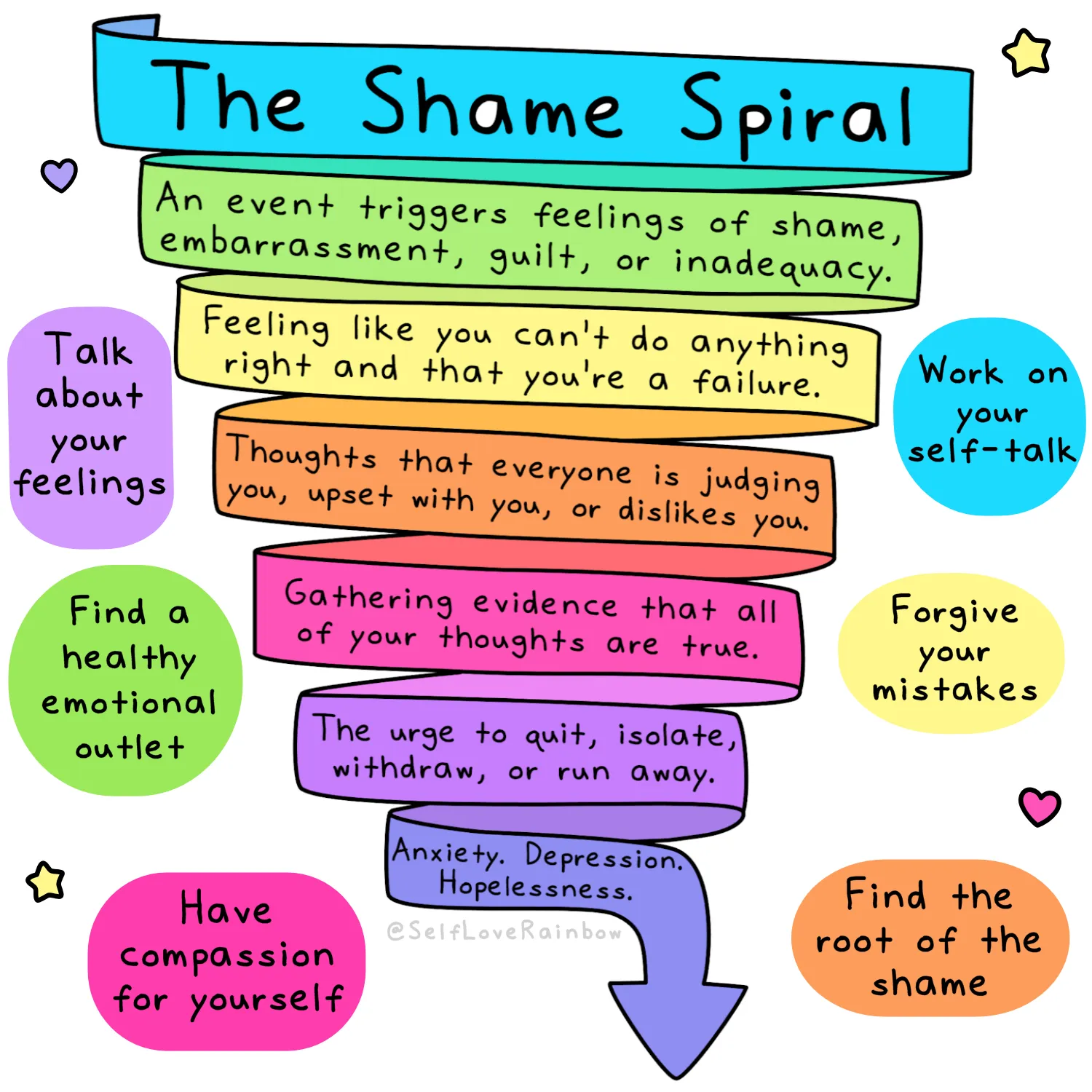
Of course, this is not a new phenomenon. And it is not unique to me. There’s a whole thing.

This came from this site, which looks quite delightful and helpful, so please go look if this speaks to you:

The bubbles around the edges are the ways to fight the downward spiral. I didn’t do those yesterday; I went straight to avoidance, and spent most of the day playing Minecraft. (I’m going to have to do a post on Minecraft, by the way, which I have only discovered this last year — that is, I knew about it, but I didn’t know that I would love it as much as I have grown to in the last year.) And so last night, I couldn’t sleep: because I was ashamed of having done nothing useful yesterday, including this blog, which I really do want to keep up with; and I failed. I blew it. I must be a terrible person…

Fortunately, my shame spiral this morning was interrupted by two things: first, I started writing this blog while I was eating my breakfast bagel, with the intent of finishing it tonight, because I can certainly accept posting one day late (Have I mentioned that I’m not real big on deadlines?), and so that reminded me that I can give myself one day of grace on my tasks without assuming that I am worthless; and second, I had to stop writing this blog so I could go to school. And while I was completely exhausted at school today — I was falling asleep while I was grading AP essays this morning (That is not a comment on how boring those essays were [Yes it is.] and also I surely did not lose focus on the essays while I was determining their final score […]) — and that made me cranky as hell, I also taught today. And I taught well. We went over the climactic end of the first act of The Crucible, and while my other class is not grasping the play, this class is. My AP Lit class is really getting into the details of Donald Barthelme’s amazing story GAME (Though they still haven’t figured out why Shotwell has the jacks). The Fantasy/Sci-fi class finished another chapter of The Hobbit, and I got to do a Mirkwood-spider voice, which was fun.

And now here I am, back trying once more to finish this blog.

So I am not stupid. I am not lazy. I am not incompetent, or incapable.

It is true that I’m not sure I have the level of expertise that makes this blog worth reading. Depending on the subject: when it is literature or teaching or writing, I’m fine; I understand those things better than most people, and anyone who understands them more than I do is always welcome to take issue with what I say. (Anyone is, really. Please feel free to comment on the post, or use the Feedback link on the bottom left of the screen, or go to the Contact link at the top. I’d love to hear from you, for whatever reason.) But the post I started last week is not about any of those things, so I’m more uncomfortable about it; hence, yesterday, when I was doubting myself and my abilities and my worth, I couldn’t gather the confidence to say what I want to say on the topic.

But, see, I don’t really write this blog as an expert. As I said, in literature and teaching and writing, I think I can at least hold my own, at my level — you will not find any doctoral theses on this page — but otherwise, when I write about politics or society or life, I’m not writing as an expert. I’m writing as a person. I have my perspective. I think the value I offer in this blog is not necessarily the brilliance of my insights: it is the clarity and the precision, and to some extent the humor, that I add in the writing of my insights. Basically, I’m just a guy with some ability to observe the world around me, and crystallize what I observe into a thought: and a genuine ability to put all that into words. And if that’s enough to make you read what I write, great: I hope my words on my perspective help you to have some thoughts of your own. I don’t think of it as advice.

If it hasn’t become clear, the specific problem yesterday was that I gave a student advice, and it wasn’t good advice. I mean, so it goes, right? I gave it my best shot, I didn’t make the best call. Nobody died, nothing was permanently broken. But I got into this thought pattern like: If I don’t give good advice, what am I doing teaching? If I don’t understand teenagers well enough to know what they should do in a certain situation, why do I work with them? Why should they listen to me? And if I’ve wasted 23 years of my life teaching when I shouldn’t be doing it in the first place, am I doing that only because I need to avoid being a writer for real? And I’m just fooling myself into thinking I’m a good teacher when actually I’m just kinda charming and easygoing, and so the students like me because I don’t make them work too hard, and that’s why I’ve kept my job even though I’m basically incompetent and, let’s face it, just pretty fucking stupid, right???

And what the hell am I doing offering my wisdom on this blog if I can’t even give good advice? Why would anyone listen to me?

I dunno. Why would anyone listen to anyone? Because sometimes, we get things right. Even if sometimes we don’t.

So here’s what I want to do. I don’t want to give advice: because I don’t know more than other people do, except in my small areas of expertise. But I do want to share some of the things I have figured out. I want to share my understanding, my perspective. And if it is helpful, or if it is interesting, then great: and if not, come back next week and see if I have anything better to say.

Okay?

Here we go.

#1: Love really does make the world go round.

Also The Beatles are even more wonderful than you think they are.

My greatest joy is my wife. Living with her, seeing her, talking to her; supporting her, cheering her on, protecting her, watching her be amazing. She is my everything: because I love her. That keeps me wanting to do more with her and for her, and keeps me from being tired of her or resenting her or any of that other shit that comes between people. I am incredibly lucky that I can still feel this strongly for her after almost 30 years: but if I didn’t, if she didn’t still love me, then I would hope we could amicably separate, and go find other people to love. Because love is the most important thing in our relationship, as it is the most important thing in any of our lives. That love is more important than the relationship: the relationship remains because the love remains (And if we fell out of love, we might have a companionable love that would remain, and we could stay in that kind of relationship, and that would be fine: as long as there is love. It doesn’t always have to be the same kind of love. [Though I hope it does stay. It’s awfully nice.]), and the love is what matters, more than the relationship.

I write because I love it. I read because I love it. I teach because, basically, I love humanity. I am a pacifist for the same reason (Even though sometimes I want to hit my — well, maybe not my students. But I want to hit things around them, you know?). Every important thing about me is based on what I love, or what I don’t.

Love is everything.

#2: Life is long — but never long enough to do everything you want.

I hear people talk about how fast time goes: and I don’t understand it. I mean, sure, my childhood is loooooong gone, and I don’t remember everything that happened between then and now; so that might seem like it was a shorter time than it should have seemed like; and I have definitely felt some dilation of time in the last few years: I cannot fathom that the pandemic and the quarantine were three years ago. So I definitely do that thing where I go “What?!? Three years??? Seriously? Where did the time go?”

But then I actually think about it: and the last three years have been — three years long. I’ve done a whooooole lot of stuff in that time. A lot of it is the same stuff over and over again, but it’s been different every time. And it’s always like that. Life is very long. I hear the cliches about how we only have a very short time on this Earth and in this life, and that’s true: but only from the perspective of mountains. From a human perspective, we have a very long time to live. My students are so goddamn young; and I am 30 years older than they are. And 30 years? That’s a long fucking time. If I have 30 years left to live, that’s a long fucking time left. A very long time.

At the same time: in those 30 or 40 or 20 or however many years I have remaining, there are more things that I will not do, than there are things I will do. Partly because I will have to spend a huge amount of those remaining years doing shit like — grading AP essays while I try not to fall asleep. And that time lost will be sad, because it won’t be spent doing things I love. And it should be. Because see #1.

So we have to pick and choose what we spend our time doing. It’s important to choose, and to do it intentionally, and thoughtfully, as much as we can. Don’t let time slip by without paying attention to it at all; because we have a lot of time — but we can still waste it, and we shouldn’t. We should love our lives, as much as we can. Because #1.

#3: There are three things you can have with any job, any task, anything you buy or hire for: you can have good, you can have fast, and you can have cheap. You can only have two of them at a time. So if it’s good and fast, it ain’t cheap; if it’s good and cheap, it ain’t fast; and if it’s fast and cheap, it ain’t good.

This is the best single piece of wisdom I ever got from my dad (Though there are a lot of other things he’s taught me, more than I could count. It’s just that this is the best.). I think about this all the time. I’ve written about it a lot of times, too. Hiring a plumber: not cheap. But usually they do good work, if they’re professionals; and it’s always MUCH faster than doing the repair yourself. Or you can think about it in terms of buying a car: you can get a POS rusted-out Mustang, that still might be fast, and it will be comparatively cheap: but that won’t be a good car. Or you can get a good, cheap car like a used Toyota — and it will not be fast. Or you can buy a good fast car: but it’ll cost you. Or getting music on the Internet: you can get free music without ads (That’s what I’m calling “fast” in this case: no download delays and minimal interruptions), if you don’t mind listening to shit on Soundcloud; or you can get good music fast (without ads) if you don’t mind paying for premium services; or you can get free good music on YouTube (I’m currently listening to this, which I find both beautiful and amazing, but I also genuinely feel bad for this guy’s forearms. It’s like you can smell the tendonitis in the air, like smoke.) if you don’t mind sitting through ads.

Also: you don’t always get two. You can get only one. Or you can get none: because you can buy expensive shit that takes a long time to get finished, and when it’s done, it still sucks.

#4: The most important thing in any relationship, from friendship to love to family to business to neighborhood association to — anything — is communication.

I’m teaching argument right now, and if my students are understanding it, they should be figuring out that the first key to any argument, to understanding what someone else is saying, is always to define your terms. And clarify your meaning. And show where you get your information from, and why it leads you to the conclusions it does. And the same is true in any interaction: I am a good teacher because I want to understand my students, and I’m good at making them understand me. My wife and I still have a strong relationship, apart from our love, which is irrational and magical and incomprehensible and the most powerful force in the universe, because we communicate: because we tell each other what we think and feel, and we listen when the other is talking. I get along with my coworkers because I talk to them and listen to them. My students don’t complain about my grades because I am clear about why I give students what I give them — and if they have opinions about those grades, I listen to them, fairly. And if their communication makes sense to me, I am willing to change the grade. Their parents don’t complain about me because whenever they have a question for me, I answer it, fully, completely, and honestly.

Corollary to #4: communication requires honesty, which is why honesty — not patience, not courage, not intelligence nor openmindedness nor anything else — is the most important virtue.

No, you don’t have to be honest all the time. Yes, you can lie and say someone looks good in that outfit, or the food was tasty when it was not. But understand the consequences of those lies. And be as honest as you can.

#5: Everybody should have pets.

I have no opinion for or against children: if you want them, I wish you the very best; if you don’t, I wish you the same. But everyone should get pets. They are pure love and they teach pure love.

I always use the dogs for this, so here’s a video of Dunkie the cockatiel whistling. He’s adorable, too.

#6: Everybody should exercise, even if it’s only walking. Or dancing.

When I was a kid, I rode my bike everywhere. So much better than driving. Now I walk my dogs every chance I get, and also go to the gym. Movement helps with everything physical, mental, and emotional. We were made to move: so do it. Make sure it is something you enjoy, or you won’t do it — but when you enjoy it, do it as much as you can. It’s always good for you.

#7: Doing it yourself is better than buying it: but see #2. And #3, because doing something yourself instead of buying it is cheap, which means you can’t have it be both good and fast.

I was thinking of this in context of making food. Cooking yourself is healthier, in this country; generally cheaper than food from a restaurant (If it’s not cheaper, it’s DEFINITELY healthier), and if you can do it right, it tastes better, too. My advice for cooking is to learn a couple of specific dishes, and really master those: I can’t make eggs, but I can make three different kinds of mac and cheese, and they are all AMAZING. Also I am good with sandwiches. And my wife says I make good salads, too.

But it goes beyond that: my wife and I (with my dad’s help when he came for a visit) painted our first house, the entire exterior, two coats; and we did a hell of a job, and it was an accomplishment I was proud of. It was worth doing. But it did take a damn long time, I will say. It was a lot of work. Because of that, it is certainly worth it to hire an expert to do things for you sometimes, rather than take the time to do it yourself, always, because #2 means you have to pick and choose where and how you spend your time.

But if it’s important to you, and if you love it, do it yourself, as much as possible. Learn how and then do it.

#8: Everybody should read.

More than we do, unless you already read as much as you possibly can. I’m not against watching TV and movies and playing video games, and all outside/physical activities are good too, as is just relaxing and doing nothing. But we all need to read. It does more for the mind than any other intellectual activity. It brings us closer to the world every time we do it, because good writing is about the world. And writing is communication, which allows us to build and strengthen relationships, every time we read. It’s just the best thing. We should do it more.

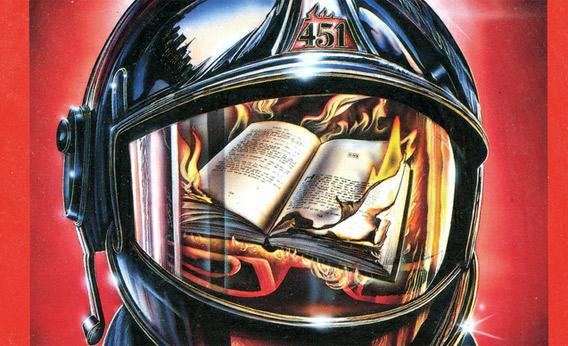
Also, it will prevent the arrival of the world of Fahrenheit 451, which is closer now than ever before, and getting closer all the time — and that is not a good thing.

Also: everything is better with music. So listen to lots of music.

Now I’m listening to this. And to be honest, I have something of a pseudo-crush on the singer/songwriter/rhythm guitarist for this band. Which I’m only saying because honesty is important. And nobody is 100% straight. And damn, he’s got a good voice.

Also, this is maybe my favorite love song. Though I don’t have a crush on this singer. But he does have an amazing voice. Damn fine piano player, too. And I have no idea how he made this gruesome concept into a romantic song — but he did.

And this is one of my favorite songs about life. Which I should listen to more. It makes me feel better about myself.

#9: Put your own mask on first.

When the oxygen masks fall from the ceiling in an airplane emergency, what do they tell us to do? Put your own mask on before helping anyone else. Because if you pass out from lack of oxygen, you can’t help anyone.

I suck at this. I sacrifice myself for others all the time. Not in the grand sense: there’s almost no one I would be willing to die for; and the ones I would be willing to die for, I don’t want to die for, because I want to stay alive so I can love them and be loved by them. But I give up way, way, WAY too much of my time and energy for other people. I fight for my political beliefs because I want to do good in the world. I spend too much time working on my teaching because I want to help my students. And I do these things even when I can’t find the strength to do it: because it’s important to me. And then, when I do take a day off to play some Minecraft, I feel guilty about it for days afterwards. I get mad at my wife when she does things that I was going to do — say, vacuum or wash the dishes — because I was going to do them, and she shouldn’t have to do my tasks. But one of my favorite things to do for her is to take a chore that she was planning on doing, and do it for her, so she can relax.

But the more I spend of myself on others, the less there is of me. We get used up. And we don’t realize it, because we think we’re happy helping others — and we are (At least I am [and maybe I should have included the statement Don’t Be a Selfish Asshole, but I feel like we all know that already. Right?]), but helping others takes energy. It takes time. It takes: when we give, we lose something, even if we get a little bit back from sharing joy and human kindness. Whereas if we would take the time to take care of ourselves, we would have more to spend helping the people we want to help, the more capable we would be to do the things we want to do, which would then give us more time and energy and satisfaction/happiness to be able to share more with others. Think of it in terms of #2: a low-stress life will let me live longer; and the happier and more content I am, the more energy and will I would have to do things that I want to do — like paint my own house. Or help my students learn how to write better arguments. Or learn how to cook eggs. But if I am stressed, then I don’t want to learn to cook eggs: I just want to order a pizza and watch TV.

So: take care of yourself first. And then take care of other people. Definitely do the second one: putting time and energy into other people helps with #1, and makes all of our lives better; but do it second. Put yourself first. When you don’t need any more attention, you’ll turn to others; and it won’t be a struggle. Happy people are helpful people. Helpful people are happy people.

And that explains the current state of the GOP.

Frank Thorp V on Twitter: "Randy Rigdon of Cincinnati wears a "TRUMP 2016 - FUCK  YOUR FEELINGS" shirt at Trump's rally at the US Bank Arena ==>  https://t.co/HFDnuJYdHJ" / Twitter
Look at ’em. Are those happy people? They are not.

#10: Be kind. Everybody deserves it — though not everyone deserves it twice.

Make sure you are kind to yourself, too, and that certainly means removing unkind people from your life: and don’t feel bad about it when you do it. But otherwise: start every interaction with kindness, and try to end every interaction the same way. Why? Because

This is hard.

I wanted to explain why I haven’t been blogging very often, and why I haven’t been talking about the effort to publish my book. Why I don’t  write about writing. As a writer, I should — shouldn’t I? If I’m a writer? And even now, while I am trying to find the words for this, I immediately want to start apologizing for it. I want to say that I know this is a cliché, that everyone who writes, and everyone who makes art, we all have this same problem: that things have been said before, and why would I think that my way of saying them would be any better? I want to say that I know this isn’t interesting to anyone, but I felt a need to write it, so I’m just going to go ahead and do it: unapologetically apologizing. I feel like I’m lost in a fog, and I keep bumping into things, into people; I’m clumsy, and blind, and — sorry. Sorry! Oh, that was your foot. Sorry about that.

I want to apologize a lot. I’ve done a lot of things wrong, as a writer: I’ve made a lot of clumsy mistakes, often fallen on my face. I want to apologize for my first book being too long, which kept it from being published; I want to apologize for giving up on seeking an agent to represent me, and I want to apologize for taking so long to get into self-publishing. I want to apologize for being a teacher, and for being good enough at it, and believing in it enough, to take time away from my writing; clearly I should have taken a shit job so I could focus entirely on accomplishing my dreams. I want to apologize for wasting my years being happily married and not having kids; because even though I never wanted kids, the best reason that I can give anyone who asks me why not is that I wanted to focus on my career; and after all this time, I haven’t done enough to earn justification for that decision. I’m sorry. (Still not sorry I didn’t have kids. Absolutely not sorry about my marriage.) I want to apologize every time I write on this blog, because my book reviews aren’t good enough, because I don’t socialize with other bloggers enough, don’t follow enough, don’t comment and Like enough. I want to apologize for my essay/rant/blogs because I’m sure I’m offending someone, either because what I say is offensive or because it isn’t offensive enough. I want to apologize for not having enough expertise to really teach a general audience something they didn’t know before, and therefore wasting their time with my mediocre insights and tired, angry humor. I want to apologize for not writing short stories and poems, for not getting published in literary journals, for constantly shifting my blogging style and my intent with this blog.

Basically, I want to apologize for being me, at least the me that I think I am, though I’m probably wrong, probably indulging in some ridiculous fantasy so as not to face the truth of my mediocrity. I’m sorry. All I can say is, this is hard.

I’m pretty well lost in the dark out here; I don’t know where I am, or the right way to go, or what’s at the end of the path — or even what’s the path. I think I know what it takes to be a writer, but it’s hard to remember what I think I know, and it’s hard to believe, still, in what I think is true, no matter how many times people, including people I respect and admire, say the same things: never give up. Write every day. Write what you know, and write what you want; don’t try to chase the latest trend or the hottest thing: just don’t give up. I want to hold onto those touchstones, follow that map laid out for me by those I would be honored to follow, whose footsteps I dream of walking in.

But see, those are great writers who say that. People who have found success, who have published books, who have sold books. Not me. They have an audience: people want to read what they have to say. They have interesting and useful thoughts, crafted from the perfect words. They know what they’re doing, they can see the way to go; they can see it all so well that they notice the tiny details, they see little moments of beauty, or oddness, or even horror. I can’t even see the ground under my feet, can’t even see my feet, when I start writing: what makes me think that my thoughts, my words, are the right words? And if they’re not the right words, what the hell am I doing? I could be getting ahead on my school paperwork, and I could be playing video games and binge watching all the shows I haven’t seen. I’d be more comfortable at my day job, and I could participate in the conversations about pop culture. I’d know where I was, and I’d know what I was doing. I’d know what was right.

But when I decide to write, I step away from that comfortable, familiar assurance, that life like an easy walk through a mall. Air conditioning, clear lighting, You Are Here maps. And I step into confusion. Every time I write, I have to wonder: What is the right thing to write?

Who is the right me to be?

Figuring that out is hard. Not that actual figuring: I think that’s pretty simple. I mean, I think I am a writer. But I don’t really know why I think it. Every reason I can think of to support the assertion that I’m a writer, I can instantly, with no trouble at all, think of a counterclaim to disprove it. I’m good with words: but I don’t do enough drafts, don’t spend enough time on the work. And . . .

Oops. Turns out I can’t even think of a second reason to call myself a writer. I can keep going with reasons why I’m not a writer: I haven’t had any success, never sold a story, never got accepted for anything, been blogging for ten years and never broke 100 followers. I have never written a way out of the darkness where I go when I try to find the words. Never reached the light.

It is very hard to keep thinking that I should in fact keep writing at all, let alone finish this blog, let alone keep writing books that I don’t believe anyone will want to read. I mean, really, what’s special about these words? I didn’t create anything new with them. I didn’t describe anything that’s never been described before; in fact, I don’t think I described anything. They’re just words, and they’re just from me. Who cares?

I’m sorry for wasting all of our time.

I’m trying to come up with a final epiphany, an affirmation that can sustain me, keep me writing, make people understand why I do this, and why every other creative should continue to do it, too. (But then the voice in my head says, I’m not that creative. My book concepts are entirely derivative: a vampire story? Really? You wrote a book about a pirate? TWO books? Oh, good Lord. Let me guess: your blogs are about you being an angry progressive who doesn’t understand why our country is so stupid, right?

Have you ever considered that maybe it isn’t the country that’s stupid?)

Sorry. It’s hard to keep that voice silent. Hard to think that all of that isn’t the simple truth.

It’s hard to think.

I also get afraid, sometimes. I don’t deal with depression, myself, but so many artists and writers do. Today is Virginia Woolf’s birthday, and she’d think everything I’ve ever written is absolute shit. She was one of the best writers who ever lived. She killed herself. So that means either that I can’t be a good writer because I don’t have the same problems that the good writers have and had; or if I ever get to be a successful writer, I’ll hate every second of it, and want to get back to where life was simple. I’ll want to walk away from writing, from the place I worked so hard to get into. I’ll get there, and I’ll want to run away.

Why the hell do I do this, again?

I’m sorry. I shouldn’t keep repeating myself. It’s a bad habit. I think I’m looking for something familiar. Safe. Known. Which writing is not. Really, I shouldn’t be writing at all: I have way too many bad habits, and I don’t spend enough time taking extra classes, and studying exactly what my favorite writers do,  and carefully scrutinizing every line of prose I’ve ever written to determine how it could be improved. That’s why I’m not a good writer, which is why I’m not a successful writer. Because writing is hard, and I’m too lazy, and too cowardly, to actually do it right. I’m also too old: all the great writers publish their first great books much younger than me. I’m 43: clearly time to get to work on finding some other hobby that would be better for me, that wouldn’t cause me as much consternation, that wouldn’t be so hard. I can’t keep doing this one. I can’t.

But I’m still writing. Doesn’t that show that I am, in fact, a writer? Maybe even a good one, because I don’t give up? Because I try to be honest? Share what I feel and what I see in the world?

Sure, if what I shared and felt wasn’t shit. But if it is, then people are just rolling their eyes and laughing at me. I mean, I guess I don’t care if people are laughing at me, but I also don’t see any reason to keep going if people aren’t appreciating and enjoying my work.

And yet I’m still writing. Still trying to find a way to finish this, to make a point. I think I may have written myself into a corner with this whole “I should stop doing this” thing. I think I already contradicted myself pretty badly, and I’ve probably confused the shit out of anyone who is reading this. I’m pretty lost, myself.

This is hard.

I don’t want to give up. I don’t want to need readers: I want to write for the sheer joy of writing. I feel that sometimes. I get excited about stories. There have been some moments when I’ve looked back over what I’ve written, and I’ve impressed myself. I want to feel that the thousands upon thousands of words that I have put together are an accomplishment, that they mean — I don’t know, something.

And in my best moments, I do think that. I do think that anyone who has written four books — Jesus, four books! And hundreds of blogs, book reviews, essays, along with two-thirds of two other books — I mean, that person has to be a writer. Right? I don’t know where the line is between writer and non-writer, but I’m pretty damned sure that nothing else I’ve done in my life compares to what I’ve accomplished as a writer. (Not counting the things that matter, but aren’t really accomplishments, like being happily married and taking good care of my pets and such. If those are accomplishments, I’m proud of myself for them. If those define me, I’m proud to be those things.)

Actually, that’s not an if. I am proud of the husband I am, of the marriage I have helped to build and keep. Toni and I have been together for 23 years, and she is still the one thing in the world that makes me happiest. She is my world. I have given a home to an iguana, a dog, and a bunny who have all passed on after long healthy happy years; I am currently taking care of a dog, a cockatiel, and a Sulcata tortoise who are also living happy, healthy lives. I am absolutely and unequivocally proud of that. I am happy to be defined as that man, that husband, that father of many pets. I have no doubt of that: knowing that is not hard. This is where I am comfortable, where I am — mostly — sure of myself, and of the ground on which I stand.

I wish writing was the same way. That art was the same way. Comfortable. Sure. Easy.

But the truth is, it isn’t. Art isn’t easy. Art is never sure. Art is never comfortable. We live on mostly solid ground, and we can see all around us; but art is off the edge of the map. It has to be, because it is created. It could be created out of familiar pieces, it may be shaped to resemble something that we’ve known, but — it’s not something we’ve known. It’s something new. To make something new, you have to go away from solid ground. Where everything floats, and nothing is clear. You can’t see where you are, can’t see where you’re going. That’s the only place you can make art: can make a new place to stand.

Art is too big, too impossible to define, too hard to understand. It’s larger than we are, you know; I mean, of course. Of course the English language, and every concept that can come from all the creative minds that have ever existed, of course that’s all larger than me. And when I compare myself to that, of course I am insignificant, a bug, a nothing. Nothing at all. Trying to find my way in that unending expanse, that eternally shifting and growing universe, that limitless world being created and re-created every day, by every artist? Of course that’s hard. It should be.

And I’m still writing. Goddamn it, I’m still writing. Not as well as some others do, maybe not even as well as I could, given the perfect circumstances: if I didn’t have to work, say, or if I had some perfect storm of idea, and passion, and time, and could burn through my own Fahrenheit 451, my own Bell Jar, my own God of Small Things. But given everything I carry with me when I go marching into this unknown, into this mysterious world where art exists, where I make art, where I am past the familiar, through the looking glass, where even the landmarks do not exist until I create them — I think I do as well as I can. I don’t know if it’s good enough. I don’t know what “good enough” means.

But I’m still writing. Maybe it’s even more impressive if it isn’t good enough, because if I can’t have enough talent to really be good, at least I can have enough courage to keep trying, to keep writing, to keep going out into that chaos of formless possibility, and deciding: choosing: determining: building; and then going back to where I was, to the real, solid, familiar world, and carrying with me the thing I made — which is never like the real world, and every time I compare it, I know that what I made is not as clear, not as solid, not as real as the real world. But still, I bring it back here with me, and I give what I write to other people, and I say, “Here, read this. Look at what I made. Tell me what you think.” That does take courage, to dive into the unknown, and try to build yourself a place to stand before you fall: and then to invite other people to stand there, too. That takes courage.

And I’m still doing it.

I’m still writing.