Book Review: The Forever War

The Forever War

by Joe Haldeman


Science fiction classic – check. Hard SF/military SF – check. Rocket ships, laser beams, weird alien races – check. Human lives ruined through time dilation – double check.

The Forever War is about humanity discovering a functional method of interstellar travel, using wormholes; we begin serious space exploration and colonization – until we encounter the aliens. Then we go to war. Haldeman was pretty optimistic, really: the novel was written in the 1970’s, and set (at first) in the late 1990’s; basically he gave us 25 years to discover interplanetary travel that could bring us up close to light speed, which gives us access to the wormholes. Damn – we’re 20 years behind schedule. Better get on that, guys.

The main character is a soldier named William Mandella. He is conscripted into the war, precisely because he is a college student; I’m sure this was used as a twist for the Vietnam-era audience Haldeman wrote this one for. Mandella is drafted out of his graduate physics program and sent to be a space-soldier. The first part of the book is his training, which was interesting; it happens on an ice-planet far out in the solar system, where it is so cold the surface is frozen hydrogen. The recruits, all of them superb specimens of humanity with high intelligence and excellent physical capabilities, are trained there to use the enhanced combat space suits that will be their standard war gear, and to build and maintain a base in even harsher conditions, which will happen when they deploy. The conditions are deadly, the weapons are deadly, a fair number of the recruits die before they even engage the enemy. Then they go into their first mission, and actually battle the aliens, becoming the first humans to actually see one of the aliens in person: the first encounters were all ship-to-ship. Once they get into actual combat, they quickly find that the biggest danger they face isn’t the enemy: it is their superiors.

Once that first battle – and the battle, as well as the lead-up to it, are an excellent example of hard military science fiction – is over, then the major theme of the book comes up: as these soldiers have flown to their mission, they have approached light speed; which means that time has gone slower for them than it has for the rest of the universe. While they have spent a few weeks or months in transit on the way to their battle, the Earth has moved forward twenty or thirty years. So when they rotate back home for leave after the fight, they find a different world than the one they left: and it isn’t a good world. They quickly discover that, though they have the option to leave the military after this, they don’t have any real options for getting a job other than to re-enlist in the military.

Which they do. And they go back into combat, even farther away – which means more time spent in sub-light travel (The trip through the wormhole is instantaneous, like teleportation; but getting to the wormhole’s entrance is the issue.), which means more time dilation. Repeat this experience: combat, where the aliens are rarely the actual threat to the soldiers’ life and limb; then return to a different home than they one they left; then back into combat, because at least they feel like they belong in the military.

This was a pretty good book. Like most hard science fiction, the ideas were fascinating, the science both realistic and interesting; the writing was okay. The blurbs on the back talk about what a wonderful character Mandella is, and sure, he’s fine; but he wasn’t extraordinary to me. He’s an Everyman, which fits the novel well, because he’s essentially a grunt. So the interest in the book wasn’t in watching Mandella go through this, it was watching the crap that – anyone – would have to go through in these circumstances. Point is, the story is good, the science is good, and surprisingly enough, I really liked the ending. If you’re a science fiction fan and you haven’t read this, you should. If you’re not a science fiction fan, then don’t sweat it.

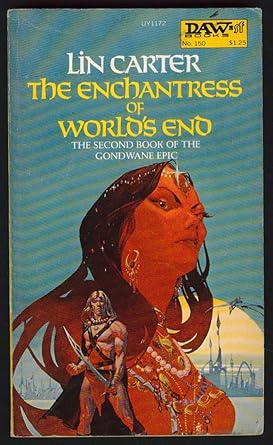
Book Review: The Enchantress at World’s End

The Enchantress at World’s End

by Lin Carter

Book 2 of the Epic of Gondwane, the tale of Ganelon Silvermane!

What ho, faithful companions! Fetch yourselves nigh to my heaving bosom, my bated breath, my excitement-tautened sinews, as I whisper the thrilling tale of the Construct, brought to quickening by the unfathomable will of the unknowable gods in the mist-shrouded halls of the future! He is Ganelon Silvermane, wielder of the Silver Sword, boon companion of the Illusionist of Nerelon and of Xarda, the Knightrix of Jemmerdy: together they will escape the mad city of Chx, defeat the grotesque Death Dwarves, the anti-life minions of the titular (pun intended) Red Enchantress, whose luxurious and tempting clutches they will slip through – only to find themselves in ever-greater peril! Zounds! What will come next?!

The best thing about this book, and the first one in the series, is that it’s all written pretty much like that. Breathless purple prose, ultimate pulp fiction. I thought there were some moments in this one where Carter slipped a little; he tried to make Xarda speak in even more archaic knight-errant language, but it didn’t really seem any different from his own narration, and so her self-conscious noticing of her own odd speech seemed – well, odd. There were also a few places where he crossed the line between fantasy and modernist fiction: he has a character, an ancient dragon who has existed (and hoarded treasure) since the dawn of time, reference some of the great swords of fantasy books past, including Orcrist and Sting and Anduril, and the twin swords Stormbringer and Mournblade; this was cool in that I know the books those swords came from – and a little weird in that the character in the book I was reading knew the books those came from, which felt off. But then the dragon also references ancient tales like Beowulf and the Ring Cycle, and the Bible’s Garden of Eden, and I thought: well, if the Bible can be part of ancient lore, why not Tolkien and Moorcock? So it wasn’t too bad. But it did jar a bit.

On the plus side: lots of action, lots of swashbuckling and derring-do, lots of bizarre names (Carter’s specialty, I think) and weird creatures and strange societies. Carter had a fertile imagination, and he chucks it all over the place in this book. There is an absolutely hilarious chapter when the Red Enchantress, a buxom seductress of the first order, attempts to tantalize Ganelon with her wiles; unfortunately, while Ganelon has the perfect physique of a god, he has the mentality of a bright 8-year-old, so the Enchantress’s wiles fail entirely to wile him, to her murderous frustration. There are definitely some silly parts – the Bazonga-bird, a goofy idea with a goofy name and a goofy character, springs nimbly to mind, and drags with her parallels to Jar-Jar Binks and, I dunno, Carol Burnett – and some moments of questionable writing; but it’s a fun book, just like the first one. I’ll read the next, too.

(Psst! Hey, want to read another time-traveling-fantasy story? Check out my serial about a 17th century Irish pirate who travels to the modern world! The Adventures of Damnation Kane)

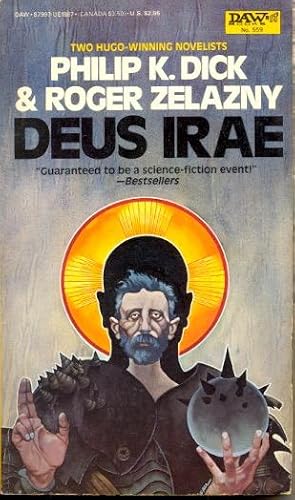
Spring Break Book Review #7 (The last one): Deus Irae

Image result for deus irae

Deus Irae

by Philip K. Dick and Roger Zelazny

What the hell did I just read?

I haven’t read a lot of Philip K. Dick; I’ve read almost everything by Zelazny. Dick was, according to everything that I’ve heard, a unique visionary when it came to science fiction: his ideas have become some of the most famous in sci-fi, among them the books that inspired the movies Total Recall, Minority Report, and Blade Runner; he was not, however, all that great a wordsmith. (He did win prestigious awards, so maybe this is not a fair description.) I would somewhat agree with this assessment based on this book, but of course the issue is clouded by the fact that it’s a collaboration. Zelazny was one of my favorite wordsmiths, and also had some fascinating ideas; but where is the line drawn in this book?

I dunno; so I suppose I can’t come to any definite judgments here. So let’s just talk about this book on its own merits, shall we?

This is a post-apocalyptic novel; the world has been destroyed by war, by the use not only of nuclear weapons, but also far more destructive devices, nerve gas, global killers that worked by changing the atmosphere and permanently altering the climate (You know, like we’re doing now, voluntarily. It’s saying something that truth not only resembles fiction, but that it also resembles science fiction. Even worse: it resembles the science fiction of Philip K. Dick. Who also wrote The Man in the High Castle, the alternate history novel about Nazis conquering the US during World War II. Just sayin’.). In the wake of this devastation you have both bizarre mutant lifeforms struggling to survive among the ruins, which still includes several artifacts of the pre-war era, and also the rise of a new religion, struggling to survive among the ruins of Christianity, several artifacts of which still exist. And though the book is somewhat about the mutants and war and survival, it’s really much more about religion. And about art.

The main character is a man named, unfortunately, Tibor McMasters, which is something I wouldn’t do to a character I hated, let alone my protagonist; but Dick and Zelazny also made this guy into an “inc,” an incomplete, because he lacks arms and legs. He is nonetheless, with the help of a mechanized cart that has extendible arms and gripping pincers, an artist. He is hired by the new religion, the Servants of Wrath, to paint a church mural depicting their God, the Deus Irae, in his human form: Carleton Lufteufel, the man who pushed the button, pulled the trigger, who started the war that destroyed everything. The Servants of Wrath see him as the manifestation of a god who is essentially evil, but evil for a potentially good purpose: by making humans suffer, the God of Wrath purifies them so that they can move up into a better existence after they escape this incarnation through the blessed relief of death. As a post-apocalyptic religious cult, it makes a whole lot of sense.

The book, unfortunately, does not. I mean, it does: Tibor goes on a quest to find the actual Carleton Lufteufel, hoping to see the man’s real face before he paints his likeness, and this quest goes through difficulties and revelations like the classic hero’s journey; they lift an element out of the Ring Cycle, when Sigurd drinks the blood of the dragon Fafnir and learns to understand the language of the birds; the same thing happens to Tibor, though it may be only a vision granted him by the God of Wrath – who may or may not be real. It’s impossible to say what is reality and what is vision and what is a lie: there seem to be miracles, but there are also some pretty funny absurdist jokes – there’s a race of sentient speaking dung beetles who worship a VW bug as their god; there’s an ancient pre-war automated mechanic that takes one character’s bicycle, turns it first into three tricycles, and then when asked to return the original bike, instead makes it rain pogo sticks. So are we to take the Deus Irae seriously? Or is that just a joke? Got me. There are some fairly straight but extremely unflattering depictions of Christianity, mainly through the Christian priest, who is a complete ass; but the priest of the Servants of Wrath is also an ass. Tibor’s a pretty good guy, and so is his opposite figure, a Christian named Pete Sands (Tibor is ostensibly a member of the SOW church, but he considers converting to Christianity – but is basically rejected by the Christian priest-ass), but these two don’t help us determine which way we should go in terms of religion, whether God is good, but perhaps too rigid in his rules; or if God is evil, but with perhaps good intentions in the end. It is possible that the point is that all religion rests on perception: both Pete and Tibor have religious visions, and maybe those give us real insights into faith and morality; but there is a critical lie that happens at the end of the book, which is never detected: and so maybe it means that all religion is a lie.

I really don’t know. I really don’t know what I just read. I enjoyed parts of it, was deeply confused by other parts, and annoyed more than once, by the setting, and by the characters, and even by the writing. Though I think I may know why: there is a point in the book when Tibor waxes poetic about the Impressionists and the quality of light they sought to capture, which he says is morning light that changes the way everything looks until it burns off around 11am; he mocks Rembrandt, who never painted in the morning light and so is unbelievably easy to imitate (sayeth Tibor), because his figures all have nothing but shadows in their eyes, because all the figures look at nothing, have nothing to see. See, the thing is, I love Rembrandt’s work, and am underwhelmed by the Impressionists; I don’t really think anyone has the skill to re-create Rembrandt, though sure, maybe it’s easier to try, and maybe people can even come close. But I think it would be a whole shitload easier to mix up some bright colors and slap them on a canvas so that they are shaped vaguely like water lilies. And I think a lot of people have been able to do that, and get famous for it, because I don’t know that there is really anything special to see in most Impressionist paintings – it just has a reputation for being something above and beyond what is actually on the canvas, and people are able to bluff their way into that same reputation. (I’m going to throw out the name Willem DeKoonig, though that’s largely an inside joke. And he wasn’t an Impressionist anyway, so I’m off topic.) Anyway: the point is that there seems to be something of a divide between people who paint what they see, and people who try to capture something unseeable. (And maybe some of them succeed. I don’t mean to denigrate the entire Impressionist movement. Or all of the authors I’m about to mention.) I would put Rembrandt in the first category, and the Impressionists in the second. And I think the same division is possible with writers: some try to describe the world exactly as it is, and some try to capture an intangible, unknowable element, try to craft their language in such a way that it creates a second impression, of a different reality, one that is wholly spiritual or intellectual, detached from the words, detached from the sensory impressions. I would put, say, Stephen King or John Steinbeck into the first category, and James Joyce and T.S. Eliot and Ezra Pound into the second.

I think Philip K. Dick would have wanted to be in the second category. And I absolutely, without doubt, would rather be in the first. I want nothing more than to be able to write like Stephen King or John Steinbeck, or Mark Twain, or even J.R.R. Tolkien, who was able to describe an entire fantastic world in humble, realistic prose, which is what makes his works so long-lasting and influential, because he started with the line “In a hole in the ground there lived a Hobbit.” I think that, like Rembrandt, the realism captured in the work of these sorts of authors is deceptively difficult to achieve, and wonderful when it is done right. I kinda think the great effects achieved in the works of Impressionists, and authors who write like the Modernists and their detachment from reality, or like the Post-Modernists and their detachment from meaning, are really just, well, bullshit.

So maybe Philip K. Dick should belong to those science fiction fans who also love James Joyce. And since I can’t stand James Joyce, you all can have them both.

Book Review: Darwinia

Darwinia

by Robert Charles Wilson


For the first 100, 150 pages, I really enjoyed this book.

The concept is intriguing: in an alternate history, in 1912, the continent of Europe vanishes and is replaced by a place soon dubbed Darwinia– maybe part of another planet. Wildlands, populated by plant and animal life that bears only a slight resemblance to Earth-life. No humans; no cities. France, Germany, Austria, England, Belgium – all gone. And there are, of course, many interesting repercussions from that, but perhaps most important: no World War.

The main storyline follows an American photographer, Guildford Law, who joins an expedition into the heart of the strange new continent, looking to explore and discover what lies behind the mystery. There are some good and bad parts here, honestly; the main character is a good guy, and the other explorers on the expedition are interesting, both good and bad. The new flora and fauna are very interesting, and the political turmoil that follows on the heels of the magical disappearance of every major power at the time are definitely intriguing. I was annoyed by the photographer’s wife, who struck me as a self-centered pain in the ass, and who has her own storyline, unfortunately. But that wasn’t too bad, really, because it gave me someone to dislike while I was cheering on her husband. The expedition runs into trouble, falling afoul of bandits (who may actually have hidden motivations, and surprising allies.) and harsh conditions. Then they find this abandoned city: completely empty, apparently ancient, certainly not a human artifact. It is something different, built of enormous square blocks of stone, piled together into buildings set into a perfect grid of square angles and straight lines. Cool: a mystery! There is still another story line, with a charlatan who has somehow become possessed with an actual paranormal power: he can channel a powerful spirit, which he calls a god, and maybe he’s right. He works his way into high society, where he begins living a life of debauchery at the urging of his “god.” Meanwhile Guildford Law is trying to survive the harsh winter, trying to keep his sanity despite extremely strange dreams, and his wife is off being a pain in the ass. Everything is going well.

And then Wilson went and screwed the whole thing up. In my opinion.

There’s a twist that comes around this time, between a third of the way and half way through the book. When we find out that none of this is actually true. Not only is the missing continent of Europe explained, but so is the charlatan’s “god,” and Guildford Law’s dreams, and the mysterious abandoned city. And the explanation is crap. It’s obnoxious. Sure, it explains how the European continent could vanish overnight, and what is going on, and it sets up the rest of the book, which is a struggle between Guildford Law and others like him and a terrifying and alien enemy; but it makes the whole book meaningless. It’s as if Law suddenly found out that he’s a character in a science fiction novel by some guy named Robert Charles Wilson. It’s annoying: it feels like the kind of thing that would really amuse a stoned person – though because Wilson is clearly up on his astrophysics, it would have to be a stoned astrophysicist. Unfortunately, I am not a stoned astrophysicist, and so I prefer my novels to be set in real places, with real human characters – even if the places are invented and the characters aren’t entirely human. I can take strangeness; I can’t take the revelation that everything I’m reading is a lie.

The story goes on from there, and there are some good parts; the final battle scene in the abandoned city is great, really. And there’s a wonderful poignant moment, when innocents are killed, and your heart breaks. Good stuff. Wilson’s a good writer.

But I hated this idea. And therefore didn’t really like this book.


Oh — and “Darwinia” is a stupid name.

Book Review: The Martian

The Martian

The Martian by Andy Weir

This was a fun book. A hell of a lot of fun. This is fairly unique because it’s quite definitely hard science fiction: set in the near future where we have made more advanced spacecraft, but nothing outside of our abilities, and used them to start a manned exploration program to Mars, this is the story of an astronaut who gets left behind accidentally. There is a storm on the surface of Mars, and he is hit by falling debris when the storm blows over parts of the mission’s base camp; his heart monitor is destroyed and he is thrown far out into the dust storm, so the rest of his crew think he is dead; they look for him, but have to leave in a hurry before the storm destroys their liftoff craft and strands them all on the surface to die.

So this guy, who happens to be the mission’s botanist and mechanical engineer, is not in fact killed, and he wakes up to realize they have left him behind. The book is then his attempts first to survive, and then to contact Earth so they can help him survive, until the next Mars mission lands in three years or so.

I know, I know, most people have seen the movie with Matt Damon; I haven’t, so the book was brand new for me, and therefore very exciting. I am normally not excited by hard science fiction, by talk about machines and rockets and physics and acceleration and mass and interstellar travel and such; but I have also found that most authors of hard science fiction tend to lean on science more than on storytelling or character development. (There are hundreds of sci-fi authors I have not read, so I’m sure there are plenty that do it well. No offense meant.)

Andy Weir doesn’t do that, however. He does have some very hard science: he is himself an astrophysicist who has worked for the space program; there are several characters who focus quite a bit on the math and the physics and the probabilities. But the main character is a joker, who doesn’t take anything too seriously; clearly it is something that is necessary to help him survive the ordeal — just the thought that he has been left behind on an alien planet, where he will have to be alone for years, without enough food or water or the means to save himself, would be enough to break anyone but an eternal optimist, so it makes sense that he is exactly that — and it makes his narration so much more fun to read than most sci-fi characters that I’ve hit upon. And though there are more serious scientist-characters at NASA, and some of them do take themselves too seriously, the book does not; it shows disagreements that lead up to insults sometimes, and several of the characters are described — often by themselves — as being bad with people. It makes them more human, and the science more palatable.

The last factor that made this interesting is the theme: it isn’t about the need for space exploration, or the value of science, or the future of mankind in the universe; all those things come up, but really, the book is about this: what is the value of one human life? If you could save a life, what would you do, what would you spend, what would you give up to do it? That is an interesting question, and this book provides an interesting answer. I hope it’s the same one that all of us would give.

Highly recommended. Dunno if it’s better than the movie, but it’s a damn good book.

The Spice . . .

Dune
by Frank Herbert

I’ve read this one before, of course (Though I have to say: this edition had a surprising number of simple typos for a “classics of modern literature.” Bette Gesserit? Seriously?). Of course I have: I’m a reader and a fan of fantasy and science fiction; who can be those two things and not read Frank Herbert’s masterpiece?

If you’re those two things and haven’t read Dune, go read it. Right now. Seriously. There are so many remarkable things about the book: the tangled intrigues and deceptions, and the way Herbert manages to keep the protagonists essentially on the up-and-up without making them seem self-righteous or superior is impressive; I’d call it the basis for Martin’s Game of Thrones books, with the Atreides filling in for the Starks, and the Harkonnens the inspiration for the Lannisters. Hell, Dune’s even got dragons, or at least an even larger subterranean version of them, in the sandworms. The book’s a wonderful ecological allegory, similar to the heart of Tolkien’s great tale, which is really about industrialism destroying the pastoral landscape; this book is about the exploitation of natural resources and the people who survive in those exploited places, who are exploited themselves — and it was only at this reading that I saw where Herbert surely got the name for his exploited desert people, the Fremen — who are Freemen if you just add an E. And those Fremen, by the way, are nothing less than the inspiration for Robert Jordan’s Aiel; and they’re just as awesome.

Really, this is a book that must be read. But now that I’ve re-read it, I’m wondering if it’s really a book that needs to be re-read. Because this time through, I noticed a few more flaws. I liked a lot of the same things, liked the overall plot very much, liked the ending quite a lot, loved the descriptions of the desert world and enjoyed a lot of the Wise Soldier characters (Gurney Halleck, Duncan Idaho, Thufir Hawat, Liet-Kynes, Stilgar, even Paul himself), the sort of great fighters who are reluctantly taking up the blade despite wanting something else out of their lives — all just like the first time I read it. But this time, I felt like the writing fell a little short, like it wasn’t quite as good as I remembered. I wonder if that’s because I really did like the ideas so very much that the voice used to describe them made less of an impression on me. And even now, I don’t think it’s bad; when an author’s voice can disappear, and leave only impressions made by the ideas themselves, that’s good work; but it isn’t brilliant work. I would call Tolkien brilliant work. Actually, the distinction is probably clearest in the Wheel of Time series: Robert Jordan was a brilliant writer. Brandon Sanderson was good enough to disappear into the story.

I didn’t like Paul quite as much. I really didn’t like the descriptions of his developing prescience (That’s a little spoiler, but not really.), or the lack of explanation as to where it really came from. Herbert tried to make it seem scientific, like Paul was just the greatest mind the universe had ever seen — but then he has Paul able to predict things he couldn’t possibly predict based on observation and extrapolation, no matter how smart. It irked me, a bit. I agreed with Paul’s wish to prevent the jihad of his visions, but I didn’t really feel like it was clear enough why he wanted to prevent that; I’m not sure, were I in his shoes at his age, I would want to prevent it. I guess the point is that a little too much rested on this idea of, “Well, he’s the messiah!” I didn’t like that as much.

Anyway, I did enjoy reading it, I will be trying to read the next book — the first time through I got as far as the fourth book before I just couldn’t take it any more, but I was told that I should give the whole series another try, so here we are. And yeah: everyone really does have to read this book at least once. The second time I will leave up to your discretion. Just remember: fear is the mind-killer.

The Maze Runner

The Maze Runner
by James Dashner


So I picked this book up because my students kept reading it for book projects, and I wanted to see what all the fuss was about –and not just from my students; there’s a list of accolades the book and series have earned right inside the front cover. Unfortunately, this may be the book that makes me lose faith in — no, wait. It was a NYT bestseller, but I already knew those weren’t all good . . . it was made into a successful movie, but that says nothing about the book . . . it was named a Best Teen Book, but by Kirkus Reviews, which I already lost faith in . . . and I already knew my students have frequently bad taste in books — okay, never mind; I haven’t lost any faith. I just need to read the blurbs and awards a little more carefully. I thought reliable people were of the opinion that this is a good book.

It isn’t.

It’s not terrible; the idea is interesting, the action is pretty good. But the writing is mediocre, the interesting idea requires far too many shortcuts and McGuffin miracles (That’s when a fantasy/sci-fi story has an insoluble problem, and they find a thing that simply solves the problem; that thing is the McGuffin. Star Trek does it almost every episode.), and the ending is a deep cliffhanger. It reminds me quite a lot of Hugh Howey’s Wool, which was pretty much the same, and which had equivalent commercial success despite its flaws; it makes me wonder if this is the new trend in science fiction, to world-build with more imagination than logic.

So you have these kids who are stuck in this maze. The maze has these monsters in it, that come out mostly at night; also at night, the center of the maze, where the kids are, is safely locked away from the maze. So every day these kids go out and run through the maze, trying to find a path to safety, a solution to the maze, a way out of the whole ordeal. Maze runners. Meanwhile, in the safe place in the center of the maze, the kids are proving that The Lord of the Flies wasn’t always right: they have created a highly organized and successful society, populated only by 17-and-under boys, in which pretty much everyone follows the rules, has a job, does their job, and is satisfied with their lot in life. It’s almost Utopian. Of course, the kids want to get out of the maze, but they’re not really sure why: because they don’t have many memories from before they got into the maze. They have some — they know their names, for instance — but not many.

Two years after these kids start trying to escape the maze, Thomas arrives. Thomas remembers a few more things than the other kids. Thomas is followed quickly by a girl — the only girl, named Teresa — who remembers a few more things than Thomas. It seems the people who put the kids in the maze, and who wipe their memories in this very specific and precise way before depositing them in the maze, want to change the situation. But only a little. And so Thomas, who spends most of his time being angry with everything around him, manages to change the society that has been so carefully and successfully created, and tries to lead the kids out of the maze.

How does it end? Why were they in the maze in the first place? Why does the situation change, but only enough to send Thomas and Teresa with a couple of clues, rather than just opening a door out of the maze? Who are these kids, and where do they come from? Believe me: you really honestly don’t want to know. Whatever enjoyment I got out of the book was pretty much ruined by the revelations at the end.

I would not recommend this book. And I’m going to stop letting my students read it for class. There are too many good books out there to waste time on this one.

The Mad Scientists’ Guide

The Mad Scientist’s Guide to World Domination
Edited by John Joseph Adams


This was a real treat to read. It’s a collection of short stories by various authors, including some of my favorites — Diana Gabaldon, Austin Grossman, Naomi Novik — and all about mad scientists or megalomaniacal supervillains trying to take over the world. Determined to show them all just who’s really mad.

Usually them.

Like any collection of stories, there are hits and misses. The Austin Grossman story that starts it off is, not surprisingly, one of the best — Grossman wrote the excellent “Soon I Will Be Invincible,” also about supervillains — and Seanan McGuire’s “Laughter at the Academy” was brilliantly constructed as a series of connected shorts. The Gabaldon story, which ties into her Outlander series, was only thinly connected to the theme of mad science — it’s about the Comte St. Germain and Master Raymond, who are alchemists and wizards in France in the 1700’s — but was superbly written nonetheless. On the other end is a crappy piece from L.A. Banks and a stupid attempt at a joke by Harry Turtledove, and two failed attempts to work an angle on classics, one about the daughters of classic mad scientists — Jekyll and Hyde, Frankenstein, and Moreau — and one about Superman and Lex Luthor; the first was boring and the second melodramatic and still boring.

Some are heartbreaking: one called “Mofongo Knows,” about the very tail end of a supervillain’s life; and one called “Instead of a Loving Heart,” about a robot built to serve a mad scientist, which is made of the brain of an artist trapped in a mechanical body. Some are genuinely funny, especially “The Angel of Death Has a Business Plan,” about a supervillain trying to save up for her own world domination scheme by working as a life coach for other would-be supervillains. Some had a really good twist, particularly “Letter to the Editor” by David D. Levine, “Rural Singularity” by Alan Dean Foster, and “Rocks Fall” by Naomi Novik, which had both a surprise in the supervillain’s mentality, and then a surprising ending. There’s some good action in Daniel H. Wilson’s “The Executor” and some nice romance in “Blood and Stardust” by Laird Barron. And there’s some frustrating and disappointing attempts, particularly “Homo Perfectus” by David Farland which is a little too dirty-old-man-y, “The Pittsburgh Technology” by Jeffrey Ford, which makes its point early on and then just keeps slapping you in the face with it, and “The Food Taster’s Boy” by Ben H. Winters which has nobody even remotely resembling a sympathetic protagonist: you want everyone in the story to fail and lose, and even when they do, they don’t lose enough.

The editing was good, though each story is prefaced by an introductory entry that completely spoils the story, and which I’d recommend skipping. But they were good stories, and the book as a whole had a generally good arc — though it does end on a down note, unfortunately. But maybe that is fitting, for a book about madmen who seek to destroy the world. Overall, I’d recommend it.

Two Bad Books In One!

Dark Planet
by John Rackham

The Herod Men
by Nick Kamin
I picked this up on a whim at Powell’s Books in Portland; it’s one of those Ace Double books, where there are two short novels in one paperback, with one printed from the front and one from the back — so you flip the book over, and it’s the front cover of the other book; the printing of each is upside down to the other. I also grabbed this one because I like the idea of The Herod Men, which teases with the line “Planned death vs. unwanted birth in the Overpop Era,” which sounded pretty sweet. And the Dark Planet cover features a terrible 70’s pulp illustration of a giant alien worm thing chasing a scared woman and a ragged man through a kaleidoscopic jungle. Good stuff.

But then I tried reading it, and I understood why I’d never heard of either of these writers before. Because they both suck.

I read Dark Planet first, actually figuring I was saving the best for last; Dark Planet was vaguely interesting in that it had a neat idea for an alien planet, and a great explanation as to why humans couldn’t colonize it and hadn’t found the alien race living there, despite having a manned military base on the planet’s surface: the atmosphere is dense clouds, and is filled with bacteria that devour anything that isn’t actually alive — metal, plastic, cloth, everything. The base is made out of a super-plastic alloy that can survive; everything else has to get in and get out quickly, or else start dissolving. But a rocket carrying Our Intrepid Hero crashlands in the miasma, and soon finds that though his equipment, clothes, and his ship all dissolve, he himself is perfectly healthy. He meets the alien races, and discovers that the planet has quite a lot to offer.

That’s all the good stuff. The bad is that the book is written in the late-Robert-Heinlein pulp mode, with the surly alpha male hero and the buxom helpless female who has no choice but to cling desperately to his arm in between screams, and who of course sleeps with her rescuer, as is only appropriate when everyone is necessarily naked on this planet that dissolves all clothing. The aliens, a la Edgar Rice Burroughs’s John Carter books, are inexplicably human, so human that they actually have sex with all of the human humans. There’s quite a long part where the enlightened angelic overlords of the alien races preach free love while having lots of sex with Our Intrepid Hero, and then he is reunited with the buxom scream queen, who even though she has been mated with an alien/human guy, is of course swooningly happy to run into Our Intrepid Hero again and clutches his mighty thews to her heaving bosom and — you get the picture. Basically it’s a story by a lonely nerd with Captain Kirk fantasies, a good concept for a planet, and not much talent.

And The Herod Men? Not only did it follow the same basic theme — surly alpha male who seduces all of the ladies in between killing bad things; lots of Free Love stuff (though that was almost cleverly done, put into context of a bizarre Catholic cult-like church that preached maximum fertility for all humans, and had priests sleeping with the novice nuns in an attempt to impregnate them); pretty good basic concept in this overpopulated post-global-climate-change Earth — but it added a whole new dimension: violent homophobia, as there is a gay character who comes on to Our Intrepid Hero, is rejected (Because our dude only likes chicks, bro. Don’t call him gay, bro. He’ll kick your ass, bro!), and then becomes a bitchy caricature that O.I.H. dreams of killing violently. It’s the second time I’ve seen this weird angry anti-homosexual theme in a book — the first time was in the Shaft novel, where pretty much exactly the same thing happens (Something about hotel clerks coming on to men? Was that a thing in the 70’s? Dunno.); but that book was surprisingly well written.

This one was not. This one, I didn’t finish reading.

Not recommended.

Book Review: Riddley Walker

Riddley Walker

by Russell Hoban

Russell Hoban wrote one of the fondest memories of my childhood: Bread and Jam for Frances. He wrote a number of books about an adorable young badger named Frances, actually, but Bread and Jam was the one I had, the one I remembered, the one that, as a picky eater, I related to.

So when I found out as an adult that Russell Hoban also wrote several acclaimed science fiction novels, well. There wasn’t really any question. Imagine if Dr. Seuss or Shel Silverstein wrote full-length novels. Wouldn’t you be curious?

So I looked them up, found out that the most famous one – the one that won the John W. Campbell award for best sc-fi novel in 1982 – was this one, and then I went out and bought a copy.

And then I tried to read it. And this is what I found.

“On my naming day when I come 12 I gone front spear and kilt a wyld boar he parbly ben the las wyld pig on the Bundel Downs anyhow ther hadnt ben none for a long tyme befor him nor I aint lookin to see none agen.”

That’s right: the book is written in gibberish.

And it’s absolutely brilliant gibberish.

The story is a post-apocalyptic coming-of-age novel. Very post-apocalyptic, as it turns out. Riddley Walker is a 12-year-old young man in the ruined aftermath of what used to be England, but is now a feudal society called Inland, people living in small walled communities, hemmed in by packs of wild dogs that hunt and eat any humans who stray too far from their fences. The language they speak and write is in fact English, but it’s an English that has changed as much from our language as our language did from Chaucer’s time. Their myths and legends are of us: the primary one seems to be about the discovery of atomic power with the splitting of the atom; though there is much more to it than that, as there always is in myths and legends. Their world cherishes these legends, but it is a largely oral society; the government, what is left of it, is primarily responsible for spreading the stories that are the basis of their mythology and morality, the Eusa story, which they share ritualistically through traveling puppet shows. The basic canon of the Eusa story is written down and therefore unchangeable, but with each puppet performance, the Eusa men find new aspects to focus on, new morals to be drawn from it, just like preachers with the Bible. The towns where they perform have their own interpreters of these hidden messages and allegories, called “connection men;” when the story begins, Riddley has just become one such, replacing his recently deceased father.

But Riddley only makes one connection: soon he feels an irresistible urge to travel outside the walls, where he seems to befriend a dog pack; this dog pack takes him to Cambry, where he discovers a secret: the Ardship of Cambry, one of the Eusa people. Born without eyes, isolated from all of society, the Ardship has a secret buried deep inside: the secret that brought down the old world, the world that had boats flying in the sky. And the current head of the loose government in Inland, the Pry Mincer Abel Goodparley, plans to tear that secret out of the Ardship, unless Riddley can help.

But maybe Riddley thinks that Goodparley is right. Maybe they have lost much that once existed, and maybe they should try to bring that back. But maybe those secrets are best kept hidden.

I realize now that the book is extremely well known, and that my discovery is not this forgotten novel but rather my own ignorance of it – the thing has over 5000 Amazon reviews, for cripes’ sake – but for me, this book was something of a revelation. It was also a real challenge. That language is freaking hard to read. It makes references to the society that preceded it, but that society, the society of the 1970’s, is in some ways lost even to us: it took me the whole book to realize that one of the phrases, used to describe thinking something through and coming to a conclusion, was “pull data and print out,” as in, “We discussed the matter, pulled data and printed out a plan.” We don’t even print out any more, so it was tough getting the meaning of that and a thousand other words.

But it’s beautifully done, nonetheless. Because the Ardship of Cambry is the Archbishop of Canterbury – but he’s also a man facing hardship, which point Riddley makes in the novel. And the Pry Mincer (Prime Minister) is a man who pries, but also one who minces words. Hoban didn’t just mess with the English language: he remade it. He created something new, and difficult as new things are, but also brilliant.

It’s a hell of a book. I need to keep it and read it again, and I want to do so. Maybe when I do, it will make more sense; on this first reading I felt like there were some pretty serious holes in the story, but there were parts that I just couldn’t understand. But hey: I couldn’t read Shakespeare and understand it all the first time, and the first time I read The Grapes of Wrath or Huck Finn or The God of Small Things, I didn’t fully appreciate them; great literature requires effort. I would call this book an example of that.