What A Piece Of Work

Meeting Alien Astronaut On Mysterious Planet Stock Illustration 1796849164  | Shutterstock

So every year, I teach a class called College Readiness. It is intended, among other things, to help students apply to college and win admission; since I am an English teacher, that means helping them write application essays. I generally use the Common App prompts — which I recommend, if you’re looking for college admission essay topics — and they write several drafts over the year, with revisions and feedback about how to make their essays more interesting and more effective.

And then, for their last essay draft of the year, I have them pick one of the topics from the University of Chicago’s list of topics. They have two essay questions for their applicants: the first is a very standard, straightforward essay, about why you want to attend UChicago and what you are looking for there; and then the second — well.

They asked prior students and graduates for ideas for essay topics. And those students and alumni delivered.

You should go take a look at them — but here are some highlights.

Essay Option 1

Exponents and square roots, pencils and erasers, beta decay and electron capture. Name two things that undo each other and explain why both are necessary.
– Inspired by Emmett Cho, Class of 2027

Essay Option 2

“Where have all the flowers gone?” – Pete Seeger. Pick a question from a song title or lyric and give it your best answer.
– Inspired by Ryan Murphy, AB’21

Essay Option 3

“Vlog,” “Labradoodle,” and “Fauxmage.” Language is filled with portmanteaus. Create a new portmanteau and explain why those two things are a “patch” (perfect match).
– Inspired by Garrett Chalfin, Class of 2027

Essay Option 4

A jellyfish is not a fish. Cat burglars don’t burgle cats. Rhode Island is not an island. Write an essay about some other misnomer, and either come up with and defend a new name for it or explain why its inaccurate name should be kept.
– Inspired by Sonia Chang, Class of 2025, and Mirabella Blair, Class of 2027

Essay Option 5

Despite their origins in the Gupta Empire of India or Ancient Egypt, games like chess or bowling remain widely enjoyed today. What modern game do you believe will withstand the test of time, and why?
– Inspired by Adam Heiba, Class of 2027

Essay Option 6

There are unwritten rules that everyone follows or has heard at least once in their life. But of course, some rules should be broken or updated. What is an unwritten rule that you wish didn’t exist? (Our custom is to have five new prompts each year, but this year we decided to break with tradition. Enjoy!)
– Inspired by Maryam Abdella, Class of 2026

Essay Option 7

And, as always… the classic choose your own adventure option! In the spirit of adventurous inquiry, choose one of our past prompts (or create a question of your own). Be original, creative, thought provoking. Draw on your best qualities as a writer, thinker, visionary, social critic, sage, citizen of the world, or future citizen of the University of Chicago; take a little risk, and have fun!

So I require my students to choose one of the topics — there are over 40 others after these six — and write an essay on it. And I ask them if there is one topic they would like me to write an essay about.

This was their choice for this year:

You are on an expedition to found a colony on Mars, when from a nearby crater, a group of Martians suddenly emerges. They seem eager to communicate, but they’re the impatient kind and demand you represent the human race in one song, image, memory, proof, or other idea. What do you share with them to show that humanity is worth their time?

And here is my response.

Okay look. There are a bunch of assumptions in this question. First it assumes that I want to communicate with the Martians, when in reality I might just want to atomize them with my Blastotron 5,000,0000X Destructothunderation Disintegratorianator. And that does seem like a poor assumption since I am an American, after all. When have we ever talked first and slaughtered after? Then it assumes – even more strangely – that the Martians have the same senses we do, and would be able to appreciate something I could present to them at all, let alone having the same aesthetic senses or interest in what I would have to present. It assumes that I would have this thing on me at the moment I met them, or access to it (which probably shows an assumption based on the existence and ubiquity of smartphones, which is fine, I would no doubt have my phone with me on the Martian surface – but also, I bet the wifi signal there sucks.), and that I wouldn’t just be limited to what I would normally be able to produce on the spot – which now relies on my performance skills. (Which are, I grant, stellar. Out of this world, even. Especially my punnery.)

And worst of all: the question assumes I believe humanity is worth the Martians’ time. 

So, considering all these considerations, I have several answers, the specific choice between being reliant on the specific situation. 

First, I would not immediately blast the Martians, because of course it would be better to lull them into complacency and then carry out a sneak attack later, preferably on their home territory; that’s the proper American way.

Second, we’ll take it as a given that the Martians would have at least similar senses to mine – though I will say, if they do have a different set of senses, I would absolutely play to that, because a society focused on smell would be far more impressed by our greatest olfactory achievements than any symphony or art work or whatever I could present. (And in that case, the smell would be a Thanksgiving feast: the scents of turkey and gravy, fresh bread, and apple pie, with a delicate touch of the smell of candle wax burning, hickory wood burning in the fireplace, and a whiff of my wife’s perfume.) But for the sake of argument, we’ll accept that they would use primarily sight and sound to interact with their environment, otherwise they wouldn’t be able to communicate their intentions to me, and if they just came at me waving their tentacles or whatever, it’s Blastotron time. On sight.

So what would I show them to prove that humanity is worthwhile – or, in a more moralistic sense, that we are good? See, now we get into questions of aesthetics, for art, or into questions of values in general, and it becomes almost impossible to answer. I recognize that the goal of the prompt is to examine my aesthetics, my values, to find out what I think is the highest achievement of humanity; but since my area of interest and expertise is actually rhetoric, and that means I choose my communication with my audience in mind, I know better than to decide something like this only using my own criteria and nothing else. If you seriously just want me to pick the best thing in the world according to me with no other considerations at all, I’m going to go with the poetry of ee cummings, particularly “anyone lived in a pretty how town.” But see, much of the beauty in that poem comes from understanding both human society and the history of human poetry, and it wouldn’t translate quickly enough to the Martians; so that can’t be my answer.

If we imagine that the Martians have been watching us through Martioscopes for centuries – and why wouldn’t they? Don’t we watch fail videos constantly on YouTube? And what is human history if not one giant fail video? – then the background knowledge necessary to understand the context could actually be assumed; and in that case, I might go with something like cummings’s poetry. Or for visual art, I would probably select Michelangelo’s Pieta, or the Sistine Chapel ceiling. Or, for the sake of including multiple senses in my appeal for the value of humanity, I might go with a performance of an opera or a musical, because that can include singing, dancing, music and literature, all at once. In that case I would pick Hamilton, which I think is utterly brilliant  dramatically, musically, and poetically — though that thought process does lead me to consider movies as a way to include visual and auditory art, and to include many different kinds of aesthetic appeal: and in that case I would choose either Pleasantville, partly because it includes quite a bit of very beautiful art; or Fantasia, because it includes so much beautiful music.

But this all assumes that art is the highest achievement of humanity. I think there is an argument for that, because what is important for humanity, specifically, has to be the things that are unique to humanity; and the only things I believe are unique to humanity are the search for truth, and the creation of beauty, both for no reason apart from the intrinsic value of truth, and of beauty. Other creatures seek and discover truth – the best way to pull termites out of a mound, for instance – but they do it in pursuit of survival, not for the joy of discovery and the goal of understanding. Not that survival is less valuable than art for art’s sake and truth for understanding’s sake; but survival for survival’s sake is less human. So I do think that beauty is one of the crowning achievements of humanity: but I would have a much more difficult time arguing that it is the only, or the best, achievement of humanity, rather than truth.

So I have to also consider: what is our greatest truth?

Is it science? Perhaps; but the creation of the scientific method as a formula is pretty well associated with only one man – and I have a hard time accepting that a dude who died trying to freeze chicken is literally the one best person in the history of humanity. Especially when his name was Francis Bacon. But then, if it’s not science, what is it? What is the one greatest truth that humanity has ever known, which I could then speak to an alien race and show them what we have accomplished?

I can’t think of one. (Take it as a given that it is not math.) Mainly because so much of our truth-seeking has to do with ourselves: and we still don’t know jack about ourselves, not really. I could go with “The only thing that I know is that I know nothing,” from Socrates, or “Existence is suffering, and suffering is caused by desire” from the Buddha; but honestly, I think “All you need is love” by Sir Paul McCartney is just about as profound and valuable as either of those. 

That’s why I turn to art. But that’s not fair: because I’m biased. So my biased answer suits the intent of the essay prompt, as my choice says something about me; but it wouldn’t actually present the pinnacle of human achievement unless I assume that I am qualified to judge that – which implies that I am the pinnacle of human judgment. And I’m not: I ate Peeps dipped in salsa. That was not sound judgment on my part. This, of course, also implies that I should not be choosing the pinnacle of human artistic achievement (though I sure did that without hesitation, didn’t I?), as that too requires judgment.

So I think the best answer is this: I would not choose.

Because I know nothing, because I have great respect for humanity (And much respect for myself, don’t get me wrong; but more for humanity), and because I don’t actually accept the premise of this question, I think that what I would choose to present to show the worth of humanity is – humanity. 

All of it. All of us. Because part of the glory of humanity is how incredibly different we all are, how various, how multifarious; and yet at the same time, how similar: because my mom is nothing like your mom, and yet somehow, the way my mother used to kiss my head when she tucked me in is exactly how your mother kissed you when she tucked you in. Or maybe how your father did, or your grandparent. The way I look up into warm raindrops and smile is exactly the same way you do it, when we are dancing in the rain. The incredible pride I feel when I finish the project I’ve been working on – whether it’s a novel about vampires or pirates, or a bookshelf I built, or the successful sale of my mother-in-law’s house after her husband died – is the same as the incredible pride you feel when you finish what you’ve been working on, whether that is a sales presentation, a complete re-watch of every episode of Supernatural, or helping your child master their dance for the Christmas recital. And yet how much does your child’s dance recital routine resemble my pirate novel?

It depends: does your kid dance the hornpipe?

If I want to show humanity’s greatest achievement, I think I have to show humanity’s greatest strength: our diversity, our individuality, and our unique and personal ability to take almost anything and turn it into a work of art, a magnificent accomplishment, just because one human being – and often, no one else on the whole damn planet – saw that activity, that pursuit, that project, that idea, as worth all of one human being’s time and energy and focus: and thus that one human being accomplished something incredible.

Now, this would likely encounter some resistance from the Martians. Because, as the prompt says, these beings are impatient: they are the ones who asked me for one single piece of work to present to them to represent all of humanity.

But really? That’s just a request for a sales pitch. They’re asking me to convince them that one thing is the best thing in all of human history. (I would prove this by asking them to show me, first, the one thing that represents all of Martian culture. And by the way, if they could do so, then I would have an excellent idea of what their aesthetics or values are, and I could think of one wonderful example to show them in return. But I bet I’m right: because this seems like an absurd request with any race. I mean, show me the best cat of all time. The best horse. The greatest star. You see? There are too many criteria, too many options, in almost any collection of items as large as everything accomplished in an entire race’s history.) So I would first show them this:

And then express that here we have an example of nearly perfect writing, combined with – I wouldn’t necessarily call it nearly perfect acting, because I don’t want to judge; but it’s not only one artist, you see? The words have to be brought to life by the actor, and the end result – is that the accomplishment of one human? Or two? Or many, since directors and acting coaches and everyone else who contributed to these performances also participated in the creation of this moment. And since there are so many interpretations and versions of this particular speech written by William Shakespeare, it’s hard to say if this one is the best version of it – or maybe this one.

Or this one.

Or no. It’s this one.

(Actually, I can’t find a clip of my favorite version of this speech, which was my first encounter with it: when Nick Nolte gives the monologue in the movie Down and Out in Beverly Hills. Other than that one, I think I actually like Cumberbatch the best out of these.)

But the point is, I would argue, that because of the individual ability of humans to interpret reality, and to translate it, inculcating our own ideas and feelings into what we take in, blending what we learn with what we are – to understand one great accomplishment of one human, one also has to appreciate the other versions of the same idea, the same art, the same achievement. When I was young, I was deeply impressed by Thomas Edison – and then when I learned about Nikola Tesla, I was even more impressed by him, because of what I had felt about Edison; and then, honestly, I was once again impressed by Edison (Though I know that isn’t the popular interpretation, as the memes nowadays would have us believe that Tesla was all of the genius and Edison only stole it: but no, Edison was more than that. But this isn’t the argument I want to have with these Martians.).

If I got them listening with my versions of this speech as presented by different actors, I would then point out that every one of Shakespeare’s plays was based on a story written by someone else. That the Bard himself, whom I still consider the greatest wordsmith in the history of the English language, wrote adapted rather than original screenplays – and who knows, maybe the Boccaccio version was better. 

(Okay, that pun might be the greatest accomplishment of humanity. But probably not.)

So then, once I had them on the hook with this idea that different humans can create different versions of the same masterpiece and make it into entirely new and different masterpieces – then I would show them all of humanity that they could ever want to see.

I would show them the internet.

I would hand over my phone, and starting with the items that I have mentioned here – the poetry of ee cummings, and the art of Michelangelo, and the work of Shakespeare and of Lin-Manuel Miranda, and of Pleasantville and Fantasia, and also Mozart’s Requiem and the album In the Court of the Crimson King and Tolkien’s The Lord of the Rings and Arundhati Roy’s The God of Small Things and everything else that is perfect – I would show them everything that can be found on the internet that shows what humanity is and what humanity can do.

Including the wars. And the genocides. The atrocities and the errors and the destructions. The atomic bombs. The Holocaust. The history of holy wars around the world. Because those, the perfect masterpieces of evil that we have created: those are humanity too.

And the Martians should have some warning, at least.

And then, once they were all completely riveted by what they saw on the screen?

Blastotron.

Pride Goeth Before… Something Something

I got stopped by a fellow teacher this past week and asked a question I had never thought about before: between the two most common science fiction future predictions, that is, that humanity will evolve and transcend in some way, or that humanity will destroy itself, which did I think was the most likely? And although I had never thought about that before, I have read enough sci-fi to have encountered both of these predictions — actually, in my new elective class on fantasy and science-fiction literature, we have read both a dystopian novel (Feed by M.T. Anderson — HIGHLY recommend) that predicts that humanity will destroy itself and the Earth’s ecosystem along with us; and a short story by Isaac Asimov called “The Last Question” (Asimov said this was his best story. It’s probably not — but it’s a cool idea, and it’s very well realized. Also recommend. But not as highly as Feed.) which depicts humanity evolving and transcending. Along with our computer intelligences, I might add; which is a nice element to include in this unusually hopeful story. So I was able to formulate an answer, quickly; one that responded to the question but also considered some of the complexities in the topic: I said, immediately, that the doom option is far more likely — but I also pointed out that said doom is certainly not going to be the actual end of the human race, because we are enormously adaptable and incredibly good at surviving, so some people would live through the end of the rest of us, and those people would end up being very different from the people who came before the doom; and therefore those people may be said to transcend. But also, I asked what was meant by “evolve” and by “transcend?” Humanity has largely stopped evolving physically, because we now evolve societally; our greater height and longevity, our now-selective fecundity but also our incredibly improved survival rate — all these are changes that have been wrought by society, and not by physical evolution through natural selection. So is evolution to be defined as something that happens naturally through the same process of environmental pressure which differentiated us from the other great apes? Then hell no, humans will not evolve. But is evolution simply about the changes wrought on the species by their — our — continued survival and our steady adaptation to differing circumstances? Then yes, we will continue to evolve. Also, does “transcend” mean changing who we are as a species? Being born different, as the kids say? Or is it about changing individuals after birth? That is, if I am born as a normal weak-ass human, but then I add machine elements to my body, and end by uploading my consciousness into a robot body: have I transcended? Have I evolved?

Is this an evolved human? I mean, other than because it is Patrick Stewart…

Anyway, the point is I talk too damn much. But also (And this is more the point): I’m very smart. I was able to start answering the question, and then think about both the question and my answer, while making my initial point. I thought of these two works I have named, and thought about how they fit into the spectrum of future possibilities. I could have kept going. I could have turned this into a lesson, or even a unit, without thinking too hard. (We should also include “Harrison Bergeron” by Kurt Vonnegut. Great story about evolution, and also dystopian doom. And “By the Waters of Babylon” by Stephen Vincent Benet is a nice example of people surviving past the cataclysm, and maybe becoming better? Maybe stronger?) I could have put this to students, and maybe helped them to recognize the importance of trying to become better, rather than worse, even though worse is MUCH easier. I have used it as an example here, but I could have turned this into a whole essay; it might have been a good one.

I am proud that I can do that. I am proud of my abilities. I read well and remember what I read; I think well and speak well and write well. Over the last 20+ years of teaching, I have actually learned to think like a teacher: surprising, considering that I didn’t even think like a student when I was growing up. Part of why I do that, why I think like a teacher? I’m proud of being a teacher. I’m proud of what I have done as a teacher. Not as proud as what I have done as a writer; I still think art is more important than education, because education has been co-opted and commodified, and also to some extent Balkanized (Meaning it has been broken up into small pieces, as the Balkan states were broken off of the Soviet Union; now there are lots of them, but they are individually much less than they used to be, partly because they are hostile to each other. Huh. I actually didn’t know that last part was in the definition. Now I have to think about whether that applies to teaching. Yeah, probably; I have often had conflict — beef, as the kids say [By the way: I do that “As the kids say” thing precisely because it is “cringe,” which is hilarious. I can actually make my students shiver with loathing when I say something like “No cap, for real for real.” I love it.] — with other teachers, and that probably is a result of the system, at least in part.); while that has definitely happened to art on the internet (which was where and how I discovered the term Balkanization, in a description of how the internet has affected art), art is able to — well, to transcend that process, and remain valuable, which education has struggled to do. So when asked what I have accomplished that I am proud of, the immediate answer is always: my books. I have written books. They are good books. I am proud of them. Only after I have said all of that — and probably much more — do I maybe add — “Oh, and I’m proud of teaching, I guess.”

And that’s why I’m writing this: because two weeks ago I wrote about value and worth and price, and I recommended that people stop buying stuff, which theme I wanted to expand on lest I be too holier-than-thou; and both that piece and this one are in response to the number of my friends who question their value and their worth: particularly in terms of their art and their accomplishments as artists. I do it too, and for some of the same reasons; but I do it less. Because I’m a proud man.

And Pride goeth before a fall.

Okay: so what is pride? What does it mean to be proud of something, or of someone? What does it mean to be proud of yourself — and is that the same as being proud as a person? Of having pride? Is pride good, or bad?

According to Christian values, pride is bad. We should instead be humble. But okay, what does that mean? My immediate thought is that humble means “Not proud;” so I should define “pride” first, and then “humility” in relation to it. I suspect we are more familiar with and have a better understanding of pride, especially we Americans. So we’ll start there.

I think of pride in two contexts: pride in one’s accomplishments, and the pride a parent feels about their child. That’s not to limit it to those: I am proud of my wife, I am proud of my brother, I am proud of my father (Maybe even more so than he is proud of me…), I am proud of my friends. I am proud (in a way) of things about me that I wouldn’t label as accomplishments, like my intelligence and my empathy. But the first things that come to mind are the first two I stated. When I talk about being proud of my accomplishments, I think that feeling is a sense that what I have done is good, is important, and is something I think is defining for me. I’ve done stuff that I’m not proud of (Which should be a simple statement describing things like “I drove to the post office today” but has a strong negative connotation, implying things that I have done which I am not only not proud of, but that I am ashamed of; those things also exist), and some of it is good and important — like food. I make dinner sometimes. I made dinner last night. Sandwiches. Pesto, tomatoes, mozzarella cheese. Potato chips on the side. (I didn’t make those.) Delicious. Food is good and important, the fact that I make the food sometimes so my wife doesn’t have to is good and important — but I’m not proud of that. Because I don’t see it as defining.

That’s another aspect of this we struggle with, I would guess. It’s hard for us to define ourselves. It’s particularly hard for artists to define ourselves, because most of us — almost all of us — have other jobs. Almost no one makes their living exclusively from their art. And here in our capitalist society, we define ourselves first and foremost by our jobs; that is, by our income-earning vocations. Even that word is misused: it means a career or occupation (One regarded as particularly worthy and requiring great dedication, the Google tells me, so the definition is closer to what I want it to be, and I’ve just been misusing it. But I wonder how many people who use the word use it to that full definition.), but it comes from the Latin word for “to call,” vocare, so it is a calling. Something we are summoned to, something we are compelled to do — no, even that doesn’t have the right feel, because honestly, I am summoned and compelled to earn a paycheck because I have a mortgage and because I need to buy tomatoes and pesto and mozzarella for my sandwiches. A vocation should be something that thrums the iron string of our soul that Emerson wrote about in On Self-Reliance. Something that makes sense of us, and by which we make sense of ourselves and our world. My father spent five years or so working as human resources director for a tech company in Boston; but his vocation was always particle physics, and when he went back to that, he made sense to himself. So he is proud of his work at SLAC [Stanford Linear Accelerator Center], and not as proud of his work at the tech company. Similarly, I am proud of my writing, and proud of my teaching — and I mean, I guess it’s cool that I have put a lot of work into home renovation projects over the years.

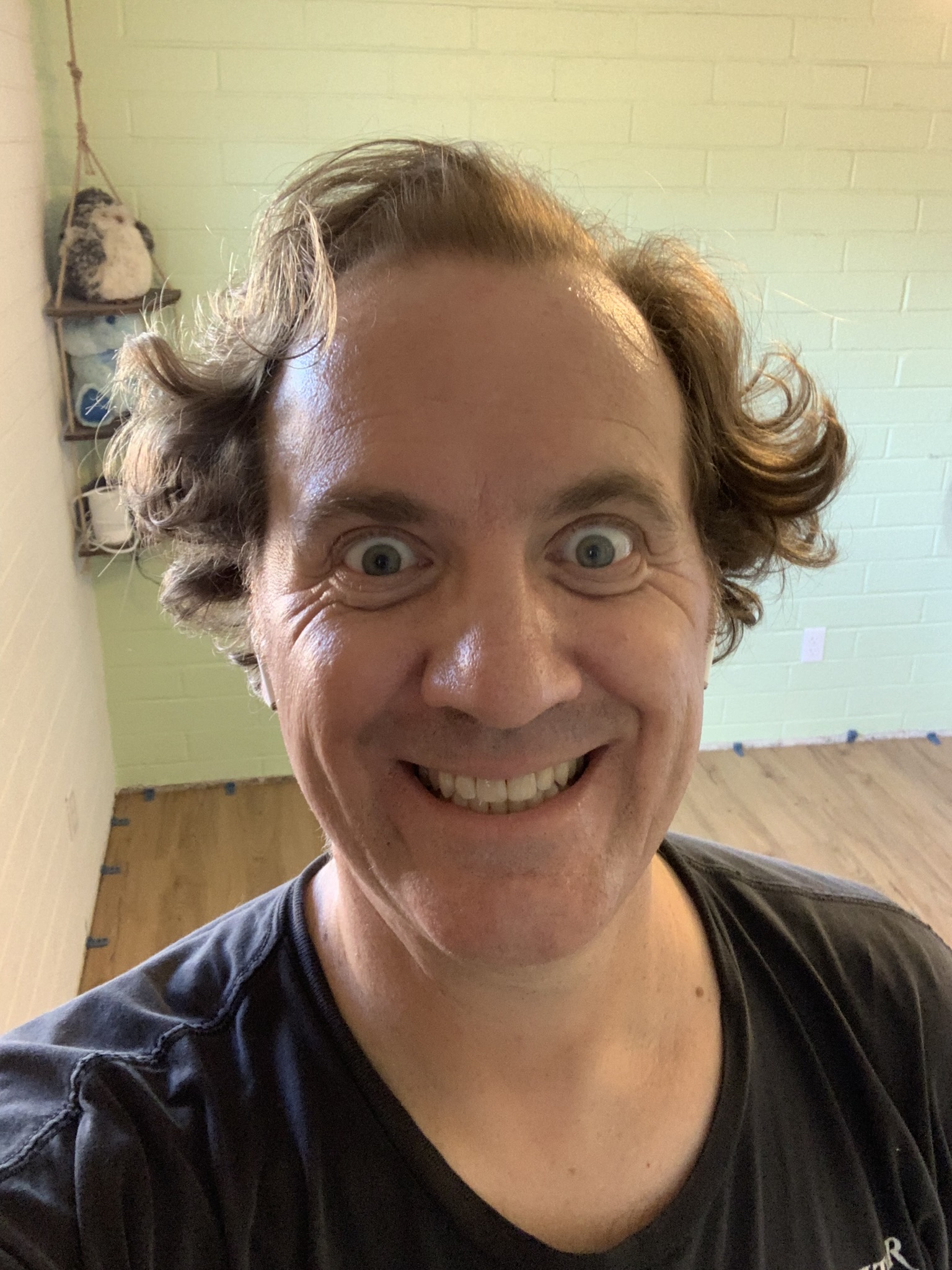
I’m quite proud of this image of me, which I captured after I spent several hours installing that floor. I guess I’m proud of the floor.

So that’s the first part of pride. When you do something that is good and important and defining, then you are (or should be) proud of that. “Important” is a word in there that probably needs defining too, though it is definitely subjective for me: there’s no real reason to think that my writing is important, as I have not been groundbreaking or influential or even particularly successful with my writing; but I think it is important. And I see a distinction between my important writing, like this blog I keep trying to keep up, and my books; and my unimportant writing, like my journal or the emails I send, stuff like that.

So if that is pride, I’m not sure why it’s a thing that Christianity would be against. Other than, of course, the cynical assumption that the faith wants to put all goodness into God so that people need to rely on the church; if God is the source of all good things, then there isn’t anything for any human to be proud of, because we didn’t do that stuff, God did; he just let us borrow it. Personally I don’t like that. But then I’m not a Christian. That may be exactly the mindset they’re going for.

But I don’t think that’s the source of the idea that “Pride goeth before a fall.” (Hang on, let me check on that, because I used “Spare the rod and spoil the child” in an essay I wrote once for school and claimed it was from the Bible, and later on I looked it up and it does not in fact come from the Bible at all. I am actually proud of that essay in a particularly perverse way: I think it’s one of the worst things I’ve ever written, which it was meant to be, and it has been an effective example for my classes because it is so bad. Okay, so this one is from the Bible but I’m misquoting: it is “Pride goeth before destruction, and an haughty spirit before a fall.” Proverbs 16:18, King James Version) I think — though I agree that my understanding of Christian ideology is a pretty laughable foundation for a discussion — that the pride spoken of there is a different kind of pride: and now that I have actually found the correct quote, I feel pretty well confirmed in that.

It’s the haughty spirit. That’s the point. That’s the bad pride, the one that leads to karmic justice in some way.

See, there are plenty of people who take enormous pride in things that they didn’t even do. So it’s one thing to take pride in something that isn’t good; I’m pretty damn proud of my longstanding hobby (One might even call it a vocation?) of stapling papers in the wrong corners in order to mess with my students:

Trigger warning: if you like things being done just so and being done right, you will not like what I did to these papers.

But there’s nothing good about that.

And then there are plenty of things I am proud of which are not important — like the video games I have beaten, that sort of thing. And I already spoke of things that aren’t defining, like cooking dinner for my family. Those things may not really deserve pride — and because of that it does make me question whether I feel proud about them — but regardless, there is no harm in being proud of things that don’t really matter much.

But then there are people who are proud of things they didn’t even do: like being American. Or male. Or tall. Or white. Don’t get me wrong, you can like those things, you can appreciate being those things (I’m not really sure why you would, but to each their own): but what on Earth would make someone proud of being born in this country? What did you do to make that happen? What time and effort did you put into it? Now, if you emigrated here, went through the enormous upheaval of moving to a whole new country; if you made a life and a home here, and created a place for yourself: that would be something to be proud of. But if you are proud of the fact that were born here, well. Bill Hicks has something to say about that: (**Please note: this clip is not safe for work.)

In To Kill a Mockingbird, Miss Maudie talks about Atticus’s shooting ability, once it is revealed that he was called One-Shot Finch, after he shoots the rabid dog. The kids can’t understand why Atticus never talked about how he was a dead shot, and why he never goes shooting if he is so good at it. Miss Maudie theorizes (Falsely, in a way, because he later says what he wanted his kids to think — that courage is not a man with a gun — but this point of Maudie’s also makes sense and might be part of his reasoning) that it is because Atticus recognizes that there’s no sense in taking pride in what she calls a God-given talent. She says that being born with a good eye and a steady hand is nothing that comes from hard work and dedication; it’s just a thing that is true about Atticus, like being tall.

I don’t entirely agree with Miss Maudie — I think that shooting a gun accurately would take a hell of a lot of practice, and therefore would be something to be proud of; but also, you would need to shoot in a good way, and also in an important way, for it to earn pride in my definition — but I see her point and I agree with the idea that taking pride in something you didn’t do, something you aren’t responsible for, is silly. That’s the idea of the Bible verse, too, I think.

See, if you put in the effort on something, if you really do the work, then it’s damn difficult to be proud of it. Because first of all, you’ve seen alllllll the mistakes you made in the process of learning; and if it is something hard to do, then you made a lot of mistakes. You also know, better than anyone, how much effort you have spent, and also you should know the difference that effort made: and that should pretty clearly show you that anyone else who put in the same effort would probably make the same progress — unless you were born with a gift of some kind that contributed to your ability, like having a sharp eye and a steady hand. But if it is something really difficult, then you also recognize that your sharp eye and your steady hand are not the things that make you good, or that make you great: they make it easier for you to be good or great — but only effort and dedication makes you good, or makes you great. The physical gifts are not something you did, so not something you should be proud of: the pride comes from what you put into making yourself into someone you can be proud of. Michael Jordan certainly has physical gifts that make him a great basketball player: but he’s Michael Jordan because he had the will and the drive, and he put in the effort. Therefore, I think he should be proud of what he accomplished. Shaquille O’Neal, on the other hand — well, he should be proud that he is apparently a very nice person. And then, of course, if you do what most of us do with our passions, and you look around at other people who do the same thing, what you are bound to find is people who do it better than you. Because nobody, not even Michael Jordan, is actually the greatest: there’s always somebody better. Knowing that keeps us humble, even if we have accomplished something to be proud of.

But even though it is difficult to take pride in what do, if that thing we do is a calling, if that thing is very difficult, if that thing takes years of dedication and effort to accomplish: then we have to take pride in it. We have to. Because there’s another aspect of pride.

The pride a parent takes in a child, that I take in my wife, my friends, my family, is not the pride of accomplishment. I mean, I’m proud that I support my wife in her art (and I’m proud I make her delicious sandwiches for dinner, without which she could not continue to make art), but otherwise? Her art isn’t my accomplishment. I did nothing to make her into the artist she is, not really. My support and sandwiches were helpful, but she could have done it without them, of course. But I am so incredibly proud of what she can do. So is that like the pride that dumb people take in being born between Canada and Mexico?

No: it’s something else.

The quality of an accomplishment that makes it pride-worthy, the aspects of it that make it (to one’s subjective viewpoint) good, and important, and defining, can be boiled down to one simple emotion: the most powerful emotion. Love. I write because I love what writing can do, and I love what writing is; and therefore I love writers — and therefore, when I write, I love myself. I love when I am able to create the effects that make me love writing. I am so very proud of those moments, of those effects, of what I did, and of myself for achieving them. And yes, it is entirely subjective: but then, often, so is pride. That doesn’t make it bad.

Pride is bad when it is not based on love. That’s the second half of the proverb, the “haughty spirit.” When one bases their pride on their contempt for others, then pride is bad. When one sets oneself above others, and is proud as a corollary to that, that is bad. That leads, in a righteous universe, to destruction: to a fall. (I know it doesn’t always. This is not a righteous universe.)

So really, it’s not that it’s dumb to be proud of being an American; it’s dumb to think that other people are lesser for not being Americans. (I knew that, actually. I am proud of my country. But also, I am humbled by it, because I can never do enough to make it the country that it should be, which means I am not fully worthy of it: so my pride does not create in me an haughty spirit. What a phrase that is. Don’t you just love the KJV?) It’s not that bad to be proud of being tall, or of being white; it’s bad to think that short people are worse off, or that people who aren’t white are somehow worse or less than white people. That’s where pride goeth before destruction: at least it is to be hoped that it does goeth before destruction. Because that kind of pride should be destroyed.

That’s not the pride that people have in their children, unless those people are really damn awful. Parents who put in a lot of work helping their kids to achieve something can take pride in their accomplishment, too, but mainly, parents are proud of their kids because they love their kids. And that love is pride; that pride is really just love.

I think that pride is love turned outwards. Love is generally directed into the person, or the pursuit, or the object, for whom/for which you feel the love; or it is turned into ourselves, as we enjoy the loved thing or the loved one being around us and bringing us joy. When we are proud of someone, as when we are proud of our accomplishments, we want to share that love with others: we want to express it, we want others to see it, we want everyone to know about it. That’s pride. I am proud of my books because I love my books. I am proud of my wife because I love my wife. I want to show off my books, I want to show off my wife, because I want other people to know of my love, and I want other people to understand how much I love, and why I love, and how lucky I am to have these loves in my life: both my accomplishments, and my incredible, incomparable wife.

Also: I am sometimes not proud of being an American. Because I do not always love my country. I am always proud of my wife.

But please remember this, whoever is reading this: if you work on something hard; if you think that thing is good; if you think it is important; if you think it defines a part of you: then be proud of it. Be proud of it like a parent is proud of their child. Notice that I have not spoken of the value or the worth or the price of the thing you do of which you are proud: love has no price, and so neither, therefore, should pride. You just feel it, and want to share it: and you should. Always. And if you are a parent: be proud of your child, especially when that child is proud of themselves. Love them for who they are and for what they do: and love yourself the same way. Don’t talk yourself out of it because you could have done better, or someone else could have done better, or it wasn’t exactly what you thought it would be: just love what you did, and love yourself for doing it. Be proud.

You deserve it.

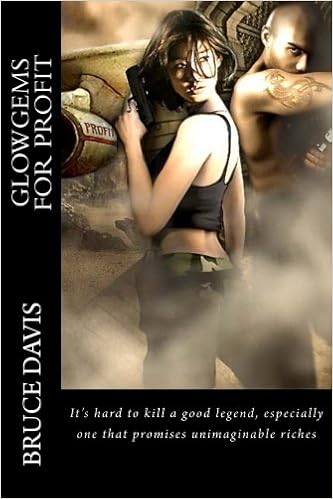
Book Review: GlowGems for Profit

GlowGems for Profit

by Bruce Davis


Okay, it’s kind of a funky title. Sounds like one of those get-rich-quick seminars you see signs for on the side of the road. Thing is, there’s a pun in there that you don’t recognize: the Profit is actually the name of the spaceship that carries our hero through the solar system; Davis is creating a series of adventures about the Profit and her crew and this is only the first – all of them (presumably) will have Profit in the title. So that’s part of the reason: and also, of course, the question of profit is one that runs through the book. The idea of a get-rich-quick scheme, especially one that isn’t really what it seems, is exactly what this book is about, and greed warring with caution is another theme that runs through the book.

And this book runs. That’s the first thing you should know: this is action from start to finish. Davis spends the first two chapters giving us enough exposition to understand who these characters are – and then starting with Chapter Three, the guns start blazing and the blood starts flowing, and it doesn’t really stop until the end. It’s got everything: hand to hand combat, gun battles, chase scenes, ship-to-ship space combat, locked door murder mysteries, betrayal, secrets – everything; and all of it is wonderfully well-done. I don’t know if it was hard to put down because I never really tried: I didn’t want to put it down, I wanted to keep reading, wanted to get to the next scene, the next fight, the next sticky situation, to see how the heroes could fight their way out of it.

That’s the next thing you should know: these are great heroes. Davis has created a fantastic hard-boiled sci-fi hero in Zack Mbele. He’s got a complicated past, remarkable abilities, good friends for whom he has fierce loyalty, a deep cynicism and an inability to trust strangers, and a lone wolf streak a mile wide: he’s Sam Spade and Harry Dresden and Simon Green’s John Taylor and all the rest of those kinds of guys. But he’s also thoroughly himself: I had no feeling at all that this was an imitation of any other author’s work; this world and this hero are entirely original.

In addition to the main character (I admit I didn’t like the other characters as much, apart from Deuce, who’s awesome – but then, I’m not supposed to.) and the action-packed plot, the intricacies of both the world Davis built and the intrigues that the characters get involved with were remarkable. Mbele is a disillusioned former revolutionary, and the way his past keeps rearing its head no matter how hard he tries to escape it was fascinating. And the characters and their complex, difficult motivations, all of them deciphered over the course of the novel by Mbele’s dogged investigating, was perfectly human and completely fascinating to me. You have no idea who’s telling the truth or why people are doing what they’re doing until Zack knows the truth, and you learn it along with him – it was excellent.

This was great stuff, an excellent sci-fi thriller/mystery – the sci-fi, too, by the way, was well done, just enough advanced tech to make the story complex and interesting, not so much that you get confused – and I highly recommend it.

Book Review: Time and Again

(Sorry about this; I know it’s been a month, and this is lame, but I wanted to make sure I posted something in the month of August. I’m teaching now, so therefore not doing enough of what I should be doing, reading and writing. I’ll try to get something better up soon. For now, here’s this.)

Image result for time and again jack finney

Time and Again

by Jack Finney

I bought this because Jack Finney wrote Invasion of the Body Snatchers, which is a science fiction classic, and one of my all-time favorite short stories, Contents of the Dead Man’s Pockets, which is just brilliant. Also, my copy of this is from the Fantasy Masterworks series; and, last but not least, it’s about time travel. I wrote a book – two, now – about time travel. Clearly I need to read this fantasy masterpiece by an excellent author about a theme similar to mine.

Now I’ve read it; I’m not sure I really needed to read it.

The book is the story of a government project to realize time travel. The concept is deceptively simple: based on Einstein’s theories that time is similar to space in that it is a dimension of the space-time continuum, which means it has an axis, and therefore just as you could move in either direction along one axis in space (up-down, right-left, forward-back), you should be able to move in both directions in time. I don’t want to get too far into it, but the government project is, I think, quite well done: they do things the government would do, in the way that government would do them. The main character is a graphic designer and illustrator living in New York City in the 1960’s or so (The actual date of the modern era is left vague), who eventually attempts to travel back in time to 1882. The key is to find a space that can be isolated from the modern era completely: in this case (though there are several different attempts going on at once), the central element is the Dakota, a residential apartment building/hotel in New York City that has remained unchanged from the 1800’s until now. It’s a clever idea, honestly, and Finney does it really well.

There are some things about this book that are incredible. The level of detail that Finney was able to summon and wield in order to capture the time frames, both the character’s starting point and the destination, is amazing. The world he describes is lovely, but not actually idealized – one of the very best scenes is a conversation the hero has with a wagon driver in 1882 who describes what absolute hell it is to have his job in the New York winters, and it’s a brilliantly dark moment – which just made its loveliness more impressive; reading the book feels like being nostalgic for an era that I never knew, and a city I have visited but never cared too much about. As much as anything else, this book is a love letter to New York City: the comparison between the Big Apple of the past and the modern one makes both cities seem glorious, from Central Park to St. Patrick’s cathedral to Madison Square, from the Museum of Natural History to the Dakota building to the Statue of Liberty. It’s all wonderful. The descriptions are specific and detailed and interesting, and Finney made liberal use of original photographs and drawings from 1882 New York, making his main character into an artist as a means of drawing the actual historical art into the narrative. Some of the reproductions in this paperback edition were a bit sketchy or blurry, but it did certainly bring the setting to life, and I loved that.

You know what I didn’t like, though? The characters. Not a one of them. The main character, Simon Morley, struck me as an arrogant putz, and they went downhill from there. The best people are the cast of characters in the past, but several of them are, as you might expect, a little too alien for me to relate to very well; I suppose I can appreciate gathering with the other roomers in my boarding house to sing songs together in the drawing room, but I can’t help but think it strange, too.

You know what else I didn’t like? The plot. The major conflict is resolved in the first 150 pages (of 400) when – spoiler – time travel works. After that it’s Simon Morley putzing around, making bad decisions and then following them up with worse decisions; it does, I admit, make him realistic, because I think most people would do a lot of the things he did – but they were stupid things to do, so I can’t like him for it. I do like his final decision, which I will not spoil here but which did surprise me; unfortunately, it made reference to an earlier detail that I had forgotten entirely, so the poetic denouement was lost on me. Part of that is because the book took me a long time to read: a slow plot and annoying characters, combined with the start of the new school year, dragged this one out for a couple of weeks, which is a long time for me.

Don’t let me ruin this one, though. The time travel idea is interesting, if in some ways far fetched (Yes, as compared to the far more realistic means of time travel from other books – like mine, where it is, y’know, magic. Reality squared, that’s what that is), the writing and the descriptions really are remarkable, along with the photos and the historical details. It’s a good book. I just wish Finney had written a better hero.

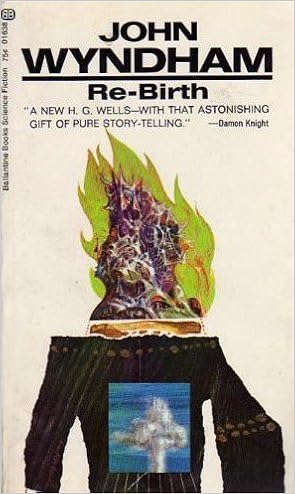
Two Books by John Wyndham

Image result for rebirth john wyndhamImage result for the secret people john wyndham

Two by John Wyndham: Re-Birth and The Secret People

I’ve gone up and down with John Wyndham. A couple of his books – The Midwich Cuckoos and Day of the Triffids – are outstanding; Chocky was just okay. Generally I like his storytelling, and his ideas are wonderful; but they can’t all be gems, no matter who the author is. No problem. Really, this fits in nicely to the Golden Age of Science Fiction, where Wyndham deserves a place, since even Heinlein and Asimov wrote some stinkers. I like Wyndham, though, and I like that I keep finding his books in cheap paperback editions from the 60’s and 70’s with interesting cover art. That cover art was what made me pick both of these.

So I had two of his novels to read, and once I read them, well – to be honest, my opinion of Wyndham went down. This has been mitigated now by the fact that one of these two, The Secret People, was one of his earliest works, written in 1935; my first book isn’t very good, either. But that’s not enough: because this book wasn’t just “not very good.” It’s a stack of crap in a cover.

We’ll start with the good one, though. (Warning: Spoilers ahead.) Re-Birth, from 1955, (Published in Wyndham’s native UK as The Chrysalids, which is a way better title but I assumed they changed it because the American public’s response was overwhelmingly, “Wut’s in tarnation’s a chrysalid?”) is a great book in two ways: it has a post-apocalyptic setting fully as interesting and disturbing as A Handmaid’s Tale, with the same kind of theocratic hypocrisy in full bloom. Told from the point of view of a young boy whose father is a pillar of the community, it has that excellent innocent perspective that makes social commentary novels genuinely effective, from The Giver to To Kill a Mockingbird. We learn how screwed up the society is as the protagonist does, and it works extremely well. There’s a nice twist, too: because we find out that the main character, David, is actually one of the forbidden people, one of the untouchables, as it were, but in a way that enables him to hide it. So we get the view of the society from both a child’s perspective and an outsider’s perspective, and it’s very well done.

The society is an agrarian theocracy after the world-shattering nuclear war; it is probably somewhere in Greenland, though that isn’t entirely clear. (That may be my poor grasp on world geography – or, honestly, it’s been a couple of months since I read it; I may just not remember.) The society has an absolute rule against genetic mutations, which are more common because of the radiation; anyone who is born with any kind of imperfection is essentially exposed to the elements. (Turns out they don’t always die, but that’s not for the society’s lack of trying.) David is a genetic mutation, but not with any physical alteration, and so he slips through the net, and eventually finds several others who are like him.

I don’t want to spoil it any more than that, because it is essentially worth reading. I didn’t really like the ending, though. We get two glimpses into other societies, one of the outcast genetic mutations who have survived on the fringes of the theocratic society, and one highly advanced society from another part of the world; and frankly, both suck. The book as a whole just made me dislike people. Which, I mean, that’s fair, but it’s not always the kind of book I want to read; I also felt that this one didn’t hold out any real hope for a better world or better people. I guess there’s a small chance that David and his friends are the hope, but they continue to be a part of the crappy societies, so I don’t really see it.

But I did like the characters a lot, and I thought the society and the central conflict over genetic “perfection,” with the underlying theme of questioning that very concept – what exactly is the “correct” genotype? Or more importantly, the correct phenotype? At what point does variation become too far from the “norm?” – all that was great. If you’re a Wyndham fan, go ahead and read this one.

Don’t read The Secret People. Not anyone, not for any reason – not even for that epically bizarre cover. Because the cover is a lie! There aren’t any weird dirt-people with mushroom horns! They’re just short! I wanted freaky gnomes and dwarves and stuff, but what I got was – crap. Racist crap.

So The Secret People, originally published in 1935, is a lot like an H. Rider Haggard novel, except Wyndham wasn’t as good a writer. And they both had crap ideas. This book starts with a couple of poorly explained technological advances to get us in the sci-fi mood; the main character is an international playboy with his own jet plane – and I mean, it’s a rocket ship with a cabin and everything, that flies in atmosphere – and at one point, he picks up his newest Bond Girl and flies over the inland sea that is being made where the Sahara used to be. Sadly, they crash into the water, and through a series of mishaps, they find themselves in an underground world peopled by strange beings! Living under the Sahara! SO WEIRD!

Except they’re not. They’re Pygmies, from Africa, who apparently wandered into underground caves centuries ago, and just kept wandering. And just like Haggard, who had a serious case of TheWhiteManIsTheRightMan-itis, Wyndham describes these “secret people” as essentially savages who have been unable to advance their civilization in any way past their original stone-tool-and-superstition society. The modern Eurotrash heroes get chucked into a prison cavern with all the other surface dwellers who have found their way underground now that the inland-sea-over-the-Sahara project has compromised the Secret People’s secrecy, and then they have to find their way out and back to the jet plane, which is their only hope of surviving. Because, you see, the inland sea has started leaking into this vast underground cavern world, and the whole place is going to drown.

But that doesn’t matter! What matters is who gets to the plane first: the heroes, our playboy and his Bond Girl, or the sinister criminal element, who were already in the cavern when our heroes arrive, and who are both rapey and swarthy – an unforgivable combination. But that’s okay, because they’re also stupid and cowardly and everything else you would expect from a swarthy criminal type, and so yes, our heroes are the ones who make it out alive before all of the Secret People drown. Which, y’know, is a happy ending.

Terrible book. Don’t read it. Go for Re-Birth/The Chrysalids – or even better, read The Midwich Cuckoos.

Book Review: Mortal Engines, Hungry City Chronicles #1

Image result for mortal engines

(Also, see that hot air balloon on the cover, with the tiny gondola the two characters are in? Not at all how the airships are described.)


Mortal Engines (Book One of the Hungry City Chronicles)

by Philip Reeve


I kind of hated this book.

Not everything about it. Some things in here are wonderful. The concept is fantastic: a future world where cities are mobile, enormous steampunk structures on wheels, rolling around in the wasteland that is all that remains of our world, destroyed (of course) by World War III and hyper-advanced war machines. These cities follow a philosophy of “municipal Darwinism” (great name), which teaches that the largest, strongest city will devour the smaller cities. It’s a “town eat town” world, and the mobile towns do exactly that: they capture the smaller, slower towns, swallow them, tear them apart and use their raw materials as fuel and building materials to maintain and expand the larger town.

That’s a cool idea.

The main town in the story is London, and London is now governed by four Guilds: the Historians, the Navigators, the Merchants, and the Engineers. The Historians, who comprise both doddering old museum relics and Indiana Jones-style explorers who search through the wreckage of ancient civilizations to find useful artifacts from the time before the wars that ended everything (This is our time, of course, and the Frankenstein We-let-our-technology-advance-too-far-and-it-destroyed-us theme is vigorous in this book), are sort of the main protagonists, and the Engineers, who care about nothing but power and control, as those engineers would, are the antagonists. There is also the Anti-Traction League (the moving cities are called “traction cities”), which have settled in parts of the world not dominated by moving towns nor devastated by ancient wars, and they oppose the traction cities as a whole.

This is fine and good. I was a bit annoyed by the stereotypes of the heartless engineer and the hapless-but-wise-and-kind historian, but I like the plotline that involves the Lord Mayor of London and his megalomaniacal schemes, and the discovery of a new doomsday weapon that allows his city to destroy any other; the weapon is actually a rediscovery from the ancient times, and I thought the book handled that well, particularly at the end. (Though there are some pretty severe plot holes, especially regarding the time lapse between the ancients and the traction city era:  it’s been like two thousand years. So really, the ancient technology? It just wouldn’t work. At all.) I like the Anti-Traction League, and I particularly like the subset of non-city-dwellers who live in the air: this being a proper steampunk novel, there are airships galore, and even a flying city, and those parts were great.

No: I hated the characters. The specific characters who play the roles of hero in this book are half crappy, and by the end, half dead. I won’t say which group is which so as not to spoil, especially since this book is now being made into a movie by Peter Jackson, who probably won’t be able to save this thing, in my opinion. However, since the book won oodles of awards, I suppose most people liked the characters a whole lot more than I did. But really, they aren’t good characters: there’s one who should hate everything London is doing and all that it stands for, but at a crucial moment, this character freaks out on those who want to stop London from destroying everything good with its doomsday device; and then later the character realizes, “Hey, wait – London sucks! I should do something about that!” But this epiphany comes at an entirely random time, and is annoying because of that; I would think that the betrayal by a Londoner whom the character worships would have changed the character’s mind, or maybe when the two main characters are tricked and enslaved by a traction city; or maybe when they are captured and abused and threatened and nearly killed by a bunch of half-insane traction city pirates. No: it’s while the character is – climbing stairs. It’s ridiculous.

The other big problem for me was the writing. Half of the characters, good and bad, are entirely unbelievable; their emotions and motivations don’t make a lot of sense. There are a ton of cliches and platitudes, and some of the descriptions and action sequences are just not well done.

And then, at the end – he killed the fucking dog. That’s right: Philip Reeve kills the dog. No reason, either; we already hate the people who do it, and the character who I suppose is intended to be inspired to murderous vengeful rage by the death of the dog WAS ALREADY AT THE POINT OF VENGEFUL RAGE. It’s an entirely gratuitous dog-killing. And I don’t mean to overstate how much this bothered me, because I was already annoyed by the plot holes and the poor characterization and the mediocre writing – but really, that moment just took the cake. And then for the next thirty pages until the very end (when almost every other sympathetic character dies, too), Reeve kept mentioning the dead dog: the dog’s owner kept looking around for the dog, kept expecting to hear the dog’s footsteps, but no, because the dog was dead.

Screw you, Reeve. Dog killing crap writer.

No, that’s too strong. But really, I didn’t think much of the book. I wish someone else had thought of this idea and done a better job writing it. I hope the movie is better, but I won’t be watching it: because they’ll probably kill the dog.

Book Review: Ship Breaker by Paolo Bacigalupi

Image result for ship breaker

Ship Breaker

by Paolo Bacigalupi


I wish I’d written this book. And not just because I wish my last name were Bacigalupi – though I do wish that, too. This is the kind of book I wish I could write: it’s an outstanding idea, it’s a fast-paced thriller, and it has a wonderfully relatable hero that made it possible for me to feel like I was in the story, along with characters that hint of far greater depth to the world, which makes me want to read the “companion” book, The Drowned Cities. And I probably will.

On the other hand: because there are hints of depth to the world-building, and especially to the most interesting character, the half-man Tool, which are left entirely out of the story, I feel like this book was just gutted by editors who wanted to pick up the pace and cut down the word count so it would sell better. I know that if I had written this book, it would be at least twice as long, and so I’m kind of glad that I didn’t write this book because I would hate to have my book cut in half – and then have it be successful? Have it be a finalist for the National Book Award? That would drive me crazy. I realize, of course, that the success and the accolades that accrue to a book this short with this rapid pace tells me something about my own writing – it’s too wordy and slow to ever enjoy this kind of sales in the modern market – but I still hate the idea of taking out all the good stuff to pander to a readership that gets bored inside of fifteen seconds.

(There’s a lot of background to this, by the way. I’ve written four novels, all of which have been repeatedly rejected by agents and publishers; the two times I’ve gotten interest in short samples and sent in longer portions of the work, I’ve been rejected both times after a second reading because my writing is too wordy and too slow. Rather than cut out half of my stories to make a book like this one, I’m self-publishing my long works, because fuck ’em if they like their books short. Yes, I’m an idiot. But I also wish that prizes like the National Book Award didn’t go to the short fast books. Though this one is probably good enough to deserve to be a finalist even in its presumably truncated form. And maybe I’m wrong all the way, and Bacigalupi wrote it exactly like this. But I wouldn’t have, so there it is. I’m bitter, and he’s successful. Moving on.)

The story is set in this wonderfully real and timely dystopia: climate change has raised sea levels and created Category 6 “city killer” hurricanes, and corporate capitalism has so run amok that it seems to be the only basis of social organization; all else is might-makes-right anarchy. The story mainly takes place in a beach – uh, I guess it’s a “community” – in the Gulf of Mexico; the beach is strewn with the rusted remains of the old steel ships, cargo ships and oil tankers and the like. Oil has now become rare enough that it is no longer how cargo is moved: the modern cargo ships are sleek hydrofoils called “clipper ships,” and they sail with wind power – jet stream winds, that is, since they have huge sails that they launch, with cannons, several miles up into the stratosphere. And the people in the book make a living by ripping the old steel ships apart for salvage. Hence the title.

The main character, Nailer, is a teenaged boy who lives a hard and brutal life among the ship breakers. This is where the writing really shines, because Bacigalupi has created a society where environmental and economic devastation has made life a thousand times worse than it is in our world today – and yet, the problems on the human level are exactly the same. (I have no doubt, as well, that there are places in the world that are pretty much exactly like this place, and it’s only science fiction to me because I live in the sheltered part of the world. Like Lucky Girl in the book.) Nailer’s mother is dead and his father is a violent drug addict; Nailer has to work to earn his own food and possessions, and he is constantly having to prove himself or else someone else will take his job and he will starve – he can’t take time off when he gets hurt at work, for instance, or he will get replaced. Nailer lives in a dog-eat-dog world, where everyone fights everyone else for everything they have, all the time. Almost no one is willing to help anyone else, because it puts themselves at risk; we see this early in the book, when Nailer, whose job in ship breaking is to crawl through the duct work and collect copper cable, gets trapped in the depths of a derelict ship, and when he turns to another person for help, he is refused and left to die. His death would be more profitable to the other person than his life, and so that means – Nailer is left to die. (Spoiler: he doesn’t.) Because that is his world, the most important thing to him is loyalty, and the greatest virtue is – kindness. Generosity. It is the rarest quality, and so it is prized.

That leads Nailer into the main conflict, when a modern clipper ship is wrecked on their beach, and Nailer discovers it – and the survivor aboard, one of the people from the other side of the world, where wealth protects and shelters you from all of the terrible conditions that Nailer lives with on a daily basis. And again, despite everything else that is going on in the world and around them, the things that matter at that point are loyalty, and kindness. That’s the story of the book.

There’s more: but not enough more. The story ends with the resolution of the main conflict, but it ends right there; you don’t get to know what comes next, even though a number of things change, in very important ways, for the main characters. The half-man, Tool, is a great creation; the half-men are genetically altered mixtures of human and canine DNA, and they are fanatically loyal to their owners, even dying, samurai-like, when their master dies – except for Tool, who has no master but himself. He’s a remarkable character, and I desperately want to know his backstory, but I never get it; he also vanishes at a certain point in the book, and we never find out what happens to him, which also drove me batty, and is the reason I think the book got the crap cut out of it before publication. And I understand the need for a book to be fast-paced and exciting, especially when it’s YA fiction like this one; but dammit, I want to know Tool’s story. I want to know what comes next in Nailer’s story. I want more of this book!

Ah, well. This is a good book, a fast read that I enjoyed quite a lot. I definitely recommend it. Though I hope that people also look for and buy the books that go more in depth, that give a reader something to think about beyond the bare essentials, that give you a world and characters you can sink your teeth into. (Maybe buy my books, for instance. They will be available soon. Don’t worry: I won’t turn every review into a sales pitch. Just this one.)

Book Review: The Purple Cloud

The Purple Cloud

by M.P. Shiel


I hated this book.

I did not hate everything about it, which is why I finished reading it; but while I liked the concept and the writing, I have rarely loathed a protagonist more than I hated this freaking guy. Since I recently read a trio of adventure novels by H. Rider Haggard, in which I also grew to hate the Great White Hunters who slaughter elephants for fun and mock the savage Africans, this was familiar but annoying territory. (Since I just, the same day I am writing this review, finished reading Gillian Flynn’s novel Gone Girl, in which I once more hated all of the main characters, I think I need to focus on books about likeable people for a while.)

Adam Jeffson is his name. Dr. Jeffson – for he is a medical doctor – begins the book married to a social climbing gold-digging beauty, who wishes her husband to become fabulously wealthy so that she may look down her nose at all of humanity. She pushes him to join an expedition to reach the North Pole, which no person has yet reached at the time of the story. It is unclear when the book is set; somewhere in the late 19th century, it seems, but the setting is unclear because Shiel insisted on using the now-familiar frame for science fiction stories around this time (Originally published in 1901 — H.G. Wells lauded it as brilliant!) namely that the manuscript was left mysteriously to Our Correspondent (also known as the author); this particular manuscript was created under the influence of that Mystery Science known as Mesmerism! Yes! A woman, under the influence of hypnosis, wrote out various strange manuscripts, one of which was this story. Is it true? A communication from another world? Who can say?!? The upshot of all of this humbuggery is that the book is an alternate universe story of the end of the world, which we living people can know about because of the mysterious transmission of the story, which can therefore also be a first person narrative told by someone who isn’t actually the author. But since it takes place in a world that is not quite ours, it is not clear what the timeline is, though the geopolitical world is the same as our own. Anyway.

Dr. Jeffson wishes to join the expedition to the Pole, at his wife’s behest, because there is a cash prize, an incredibly large cash prize, to be awarded to the person who first sets actual foot upon the top of the world. Unfortunately, the expedition already has a doctor signed up to go. Fortunately for Jeffson, and unfortunately for the other doctor, Jeffson’s wife – who has the absurd but suitably hideous name of Clodagh – isn’t above murder, and in fact, she poisons the other doctor (Whose name is Peter Peters. Yup.) so that Jeffson can take his place. Apparently so we can really enjoy our hatred for this couple, she does it slowly, pretending to nurse the sick man while actually dosing him with atropine. So Dr. Peters dies, Jeffson goes on the journey; but along the way, he is both frustrated and unpopular, because the ship is going to be stopped by the polar ice cap, and Jeffson is not intended to go on the final leg of the journey over the ice by dogsled; at the same time, he and his wife are suspected of putting an end to poor Pete Peters. Somehow, Jeffson is all freaking outraged by the accusations that finally get voiced, even though everyone involved knows they are true; he ultimately goes out to have a duel with one of the other members of the expedition, and even though the other guy is a better man and a better shot – and he’s right about Jeffson and Clodagh – Jeffson wins and kills the other guy, and takes his place on the final leg. So now I’m pissed that this ass is going to win the money and make his wife happy.

But wait, there’s more. The dogsled portion arrives, and the three men going don’t plan to bring enough food for the dogs. Why? Because THEY PLAN TO FEED THE DOGS TO EACH OTHER ON THE WAY. That’s right: not only does the dog die, but FORTY dogs are going to die, and be forced into cannibalism, all so these three pricks don’t have to bring more food. (Should I mention here that they originally meant to use reindeer to pull the sleds, but they didn’t bring enough fodder for the reindeer and all of them starved to death while still on the ship? Nah, I’ll leave that out.) This is all three of them, so we can’t blame Jeffson for that, but we can certainly blame Jeffson for this: he leaves the other two men to die of exposure, leaving camp early with extra supplies and dogs so that he can be the first to the Pole and claim the prize.

He makes it there first, indeed, but then a strange thing happens. How strange, we don’t yet know, but it is the titular Purple Cloud, so we know it’s got to be a big deal. Anyway, Jeffson heads back across the ice once more, and, because we don’t hate him enough, he makes it all the way back to the edge of the ice with only one surviving dog, his favorite: which he then FUCKING KILLS JUST BECAUSE HE DOESN’T WANT TO DEAL WITH GETTING THE DOG ON HIS KAYAK.

Stephen King once wrote that the fastest way to get an audience to hate a character was to have him hurt a dog. And this guy now, in my mind, has the blame for the deaths of forty dogs, a herd of starving reindeer, and several humans, as well. That’s why I hated him, and the lack of sufficient suffering in retribution is why I hated this book. Because no matter what else happens, Jeffson doesn’t die.

But here’s the thing: none of this is the actual story. The story began with the purple cloud: which was poisonous, and has killed all of humanity and pretty much all large animals. The bulk of the book is Jeffson realizing he is the last man alive on Earth. That’s right: none of this evil involved in the Polar expedition was actually the point; it was just intended to get Jeffson to be the only one alive at the north pole when the cloud hit – which, it turns out, is what saved his worthless dog-killing ass.

I won’t spoil the rest of the book, which is better than this beginning portion, though I will say that Jeffson continues to be a shithead: for the next twenty years (The book covers quite a number of years), whenever Jeffson gets bored or angsty, he goes to one of the great cities of the world, and burns it. To the ground. The whole city. (When he burns Paris, he takes 20 paintings out of the Louvre, and burns the rest.) Just for the hell of it. Just to make us hate him a little more.

The intended theme at the end of the novel is about good and evil, and how good will eventually win out in the end; in that struggle, Jeffson is the evil. And boy, is he evil. I’m not really sure why Shiel wrote it all this way, when there surely had to be an easier way to make his point. But considering his writing style, he is not a fan of making a quick and simple point. Here’s a sample sentence – one sentence.

Now I would not trudge back to the ship, but struck a match, and went lighting up girandoles, cressets, candelabra, into a confusion of lights among a multitude of pale-tinted pillars, rose and azure, with verd-antique, olive, and Portoro marble, and serpentine; the mansion large; I having to traverse a desert of brocade-hangings, slim pillars, Broussa silks, before I spied a doorway behind a Smyrna portiere at a staircase-foot, went up, and roamed some time about the house – windows with gilt grills, little furniture, but palatial spaces, hermit pieces of faience, huge, antique, and arms, my footfalls muted in the Persian carpeting; till I passed along a gallery having only one window-grating that overlooked an inner court, and by this gallery entered the harem, which declared itself by a headier luxury, bric-a-bracerie, and baroqueness of manner; from which, descending a little stair behind a portiere, I came into a species of larder paved with marble, in which grinned a negress in indigo garb, her hair still adhering, and here an infinite supply of sweetmeats, French preserved-foods, sherbets, wines, and so on: so I put a number of things into a pannier, passed up again, found in the cavity of a garnet some of those pale cigarettes which drunken, then a jewelled chibouque two yards long, and tembaki; with all I descended by another stair, deposited them on the steps of a kiosk of olive-marble in a corner of the court, passed up again, and brought down a yatag to recline on: and there by the kiosk-steps I ate and passed the night, smoking for hours in a state of lassitude, eying where, at the court’s center, the alabaster of a square well blinks out white through a rankness of wild vine, weeds, acacias in flower, jasmines, roses, which overgrow both it and the kiosk and the whole court, raging too far over the four-square arcade of Moorish arches round the court, under one of which I had hung a lantern of crimson silk; and near two in the morning I dropped to sleep, a deeper peace of gloom now brooding where so long the hobgoblin Mogul of the moon had governed.

All in all, I’d recommend reading The Stand. Randall Flagg is a lot more fun to hate. And he didn’t kill forty dogs.

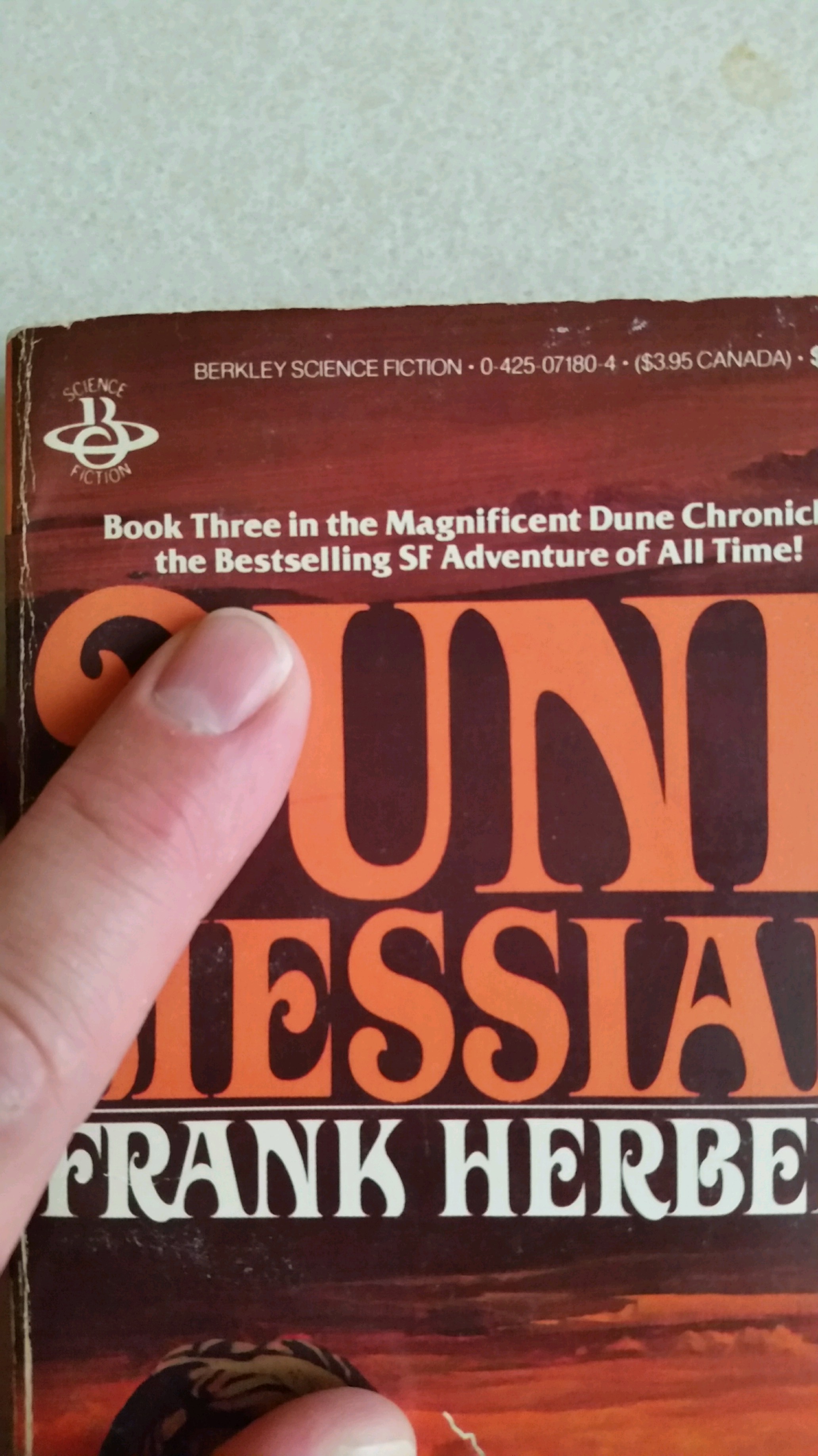
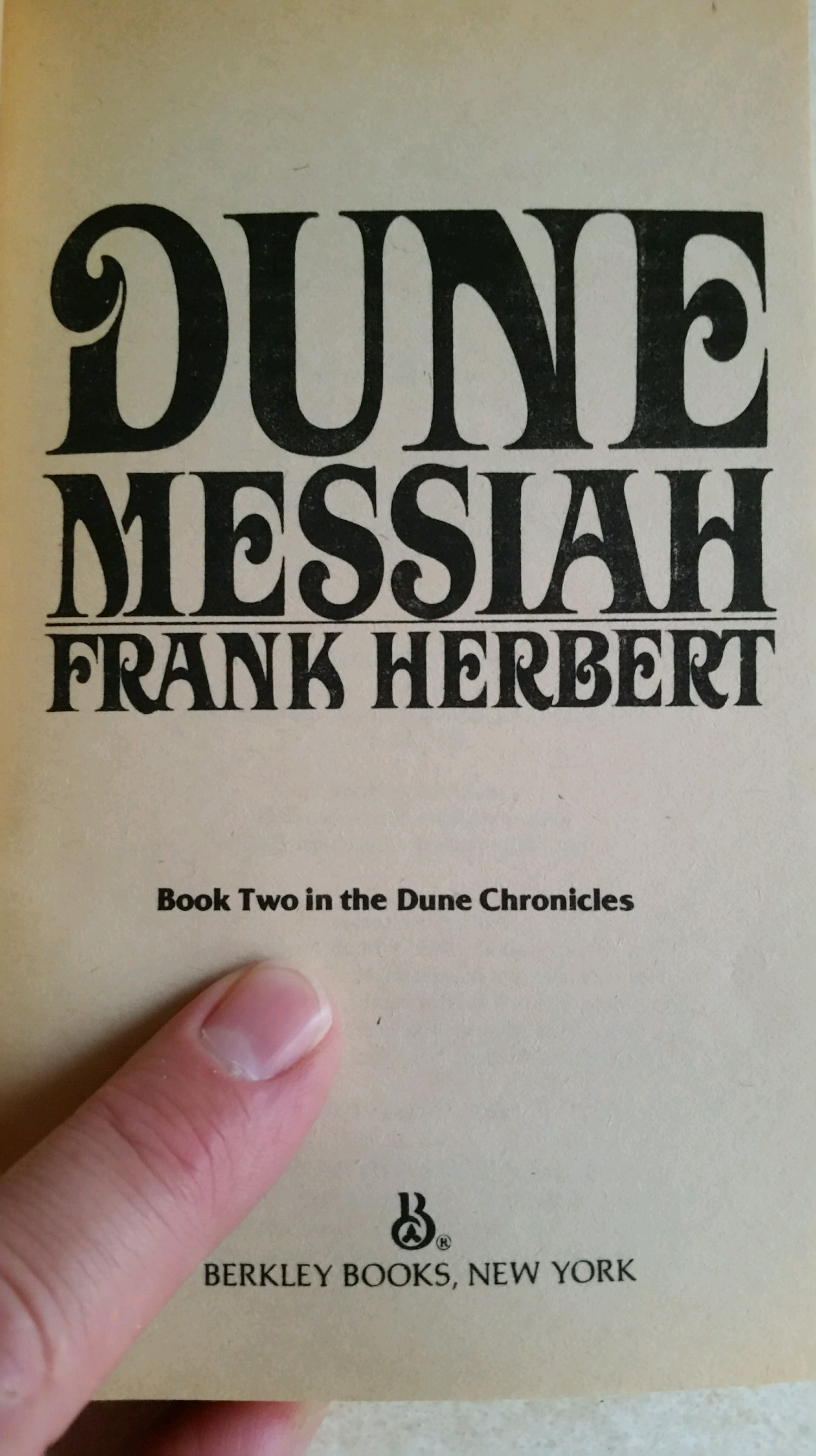
Book Rant — I mean, REVIEW: Dune Messiah

Dune Messiah

by Frank Herbert


What does it mean when you don’t understand a book?

This is something that has bothered me for a long time, now. Because back in grad school, I signed up for a class that was going to focus on James Joyce’s Ulysses; each student in the seminar was going to annotate one chapter of the thing. I had never read Joyce, and so I got Portrait of the Artist as a Young Man out of the library, and read it, to give myself some idea of what I was in for.

Couldn’t understand it at all.

Two weeks later, I dropped the class and dropped out of grad school.

Joyce wasn’t the only reason I did that, and that wasn’t the only book I couldn’t understand. But it’s bothered me ever since, both looking back on that period in my life, and also whenever I read books now that, like Portrait of the Artist, I just can’t really grasp. There’s a spectrum, of course: some books I get almost all of it, except for a certain section, or just a few paragraphs; some I can’t break into at all. Gabriel Garcia Marquez’s One Hundred Years of Solitude was one of the latter; Wuthering Heights, one of the former.

And Frank Herbert’s Dune Messiah, the sequel to the legendary classic Dune, is another one that, like Wuthering Heights, I couldn’t quite get all of it. And I’m not sure why. I don’t know if it’s because I’m not as smart as I think I am, or if Frank Herbert thought I (and the rest of his audience) was even smarter than I am, or if Frank Herbert wasn’t nearly as smart as he thought he was. All I know is, though I could follow most of the plot, and there are parts of this book that I actually really enjoyed, there were a number of sentences, paragraphs, and even chapters that I had to read over and over, and at some point, I said “Screw it,” and just skimmed those parts, thinking, “Yup, don’t get this. Don’t get this at all.”

So the general idea of the book: Dune is a story of intergalactic intrigue. There is a noble family, many millennia in the future, called the Atreides; they are put in charge of the most valuable planet in the galactic Empire, the planet Arrakis: known as Dune, because the entire planet is one huge desert. Dune is the most important planet in the galaxy because it is the sole source of melange, the spice; the spice is a drug that allows people to see into the future, which is the only way that spaceship pilots can steer through hyperspace. The spice has various other effects, too, not the least of which is that it extends human life (Unless you stop taking it, in which case, you die.). So the Atreides family gets to take over Dune, but unfortunately, they have enemies, and their enemies invade Dune and wipe the Atreides out. The wife of Duke Atreides escapes with her son Paul, and they find refuge among a group of desert nomads called the Fremen, who are, because of the incredibly harsh conditions of their life on Dune, the baddest-assed badasses in the whole galaxy. Paul and his mother are adopted by the Fremen, and over time, Paul comes to be their leader; he leads the Fremen back out of the deep desert and reconquers Dune, and from there, the entire galactic empire, because as soon as he controls Dune, he controls every powerful person who uses the spice, because if he cuts off their supply, they will all die. He threatens to do that, and he also blackmails the emperor, and hey presto, Emperor Paul Atreides. End Book One.

Now, that’s not the whole story. There is a crapton more, because Frank Herbert liked him some complicated universes, and there are various factions and issues wrapped up in the whole thing – the Landsraad and CHOAM, the Bene Gesserit, the Harkonnens, the Sardaukar, on and on it goes. There are also prophecies and religious ideas, and Paul becomes Muad’dib, and the Mahdi, and also Usul, and he’s the kwisatz haderach – it’s a lot. You wouldn’t want this guy’s life. But that’s the main plot: family gets destroyed, son comes back and takes revenge and seizes power for himself. Combination of Macbeth and Hamlet. No problem.

But then there’s Dune Messiah.

I would like to note here that my father, in discussing this series with me some years ago (This is my second time through the series; the first time I made it to Book 4, God-Emperor of Dune, before I gave up.), expressed his opinion that the first book was a fluke, that the other five books were the ones Herbert wanted to write, and the first book had somehow gone astray — and was, he said, the only book Herbert wrote that is worth reading. Just something to keep in mind.

In Dune Messiah, Paul Muad’dib has been Emperor for twelve years, and his legions of Fremen have been waging a successful jihad against the rest of the galaxy – there’s a point when Paul talks about Genghis Khan and Hitler, and the millions of people they killed; then he says that a conservative estimate would put his death toll at 90 billion humans. Paul and his sister, St. Alia of the Knife (If I ever had a daughter, that would be her name. St. Alia of the Knife Humphrey. And I wouldn’t let her shorten it, either.), have been turning themselves into religious idols, mainly because both of them are prescient: they can see the future. It doesn’t seem like this is a good idea, though, because neither of them want to be gods, and they have grown to distrust their own theocracy. Paul is also having trouble in his personal life because he has a sort of unofficial marriage with the Fremen woman he loves, Chani, but in order to become Emperor he had to officially marry the daughter of the former emperor, a woman named Irulan, whom he doesn’t care about but has to placate in order to keep his throne secure. Both of these women want to have Paul’s children. Paul only wants to have children with Chani, but he can’t cast aside Irulan; but for some reason (it isn’t an accident) he and Chani can’t conceive. Meanwhile he’s dealing with this whole issue of the Fremen turning on him, partly because they think he’s become corrupt, partly because they’ve become corrupt – it’s not clear. And then there are the Bene Tleilax, (Want to know how to pronounce all of these names? So do I. Guess. It’s what I do.) who resurrected one of Paul’s old friends and teachers, who was killed in the first book when the enemies overtook Dune, and have now sent that guy to — maybe kill Paul? Maybe help him maintain power? We don’t know. And then there’s a guy floating in a tank of orange gas, because he’s so addicted to the spice that he breathes the shit; and that makes him prescient, though not as prescient as Paul – because of the kwisatz haderach thing, in addition to the fact that Paul’s horking down spice by the bucketful; but the kwisatz haderach thing is why the Bene Gesserit are so obsessed with him, because the Bene Gesserit are a quasi-religious order who are basically eugenicists, who have been trying to breed the perfect human for like ten thousand years, and they finally did it, and it’s Paul. And now they want him to have kids and pass on his perfect genes – but Irulan, who is a Bene Gesserit, is their choice, while Paul only wants kids with Chani, but if he binds himself more closely to the Fremen then they will take the whole Messiah-Jihad thing waaay too far, and will kill Paul’s whole family and probably the universe, too. And Paul can pretty much see all of the possible futures, except for where another prescient person is involved because then they muddy up the timestream because they can see what’s coming and therefore can react to it, which changes Paul’s ability to see what comes next, and so he’s trying to pick the best future but he can’t really see which one it is, and every future kinda sucks.

And that’s not even what I couldn’t understand. Other than the Bene Tleilax, who literally make no fucking sense but are really cool anyway because they have these people called Face Dancers who can change their appearance at will and I love that name, I could follow all the political stuff. And most of the time stuff. The last ninety pages or so are the best part of the book, largely because the motivations become simple; also at one point Paul gets blinded – but it doesn’t matter because at that point he can see the future so completely clearly that he can see where everything around him is, in his visions; so he can point to people and describe their appearance, even though he has no eyes in his head, and it’s both cool and interesting.

No: the problem with this book is the way people talk. Herbert expects us to pick up on their subtleties, to understand not only what they say but what they really mean, so clearly that he never explains what the characters mean when they talk. It’s worst with two specific characters, both related to the Bene Tleilax: a Face Dancer named Scytale, and the resurrected friend of Paul’s, who was originally named Duncan Idaho and now goes by the unfortunate name of Hayt, which is much too much like a bad screamo band name. When these two guys talk, it just – it makes no sense at all. In the first chapter, Scytale is having a meeting with his other anti-Paul conspirators, and he says, “You wish to draw me into this fools’ fight? Very well. We’re dealing with a potential messiah. You don’t launch a frontal attack upon such a one. Martyrdom would defeat us.” I mean, okay, but you know what he left out? What their goal is. Kill Paul? Replace him? Take down his self-made religion, and his jihad? Bring back the old ways? We have no idea. They just – can’t have a martyr. And then one of his partners says “You think that’s the only danger?” And when Scytale doesn’t respond, and she says, “Well?” Scytale says, “I was enjoying the silence. Our hostilities are better left unvoiced.” And again: what hostilities? It’s never explained. You don’t like each other, sure, I don’t like you either, but – why not? If you don’t like each other, why are you working together? And why is it better if the hostilities are left unvoiced?

I guess we’re supposed to either figure these people and their goals out from subtle clues, or else just – know. Somehow. Herbert never explains what the Bene Tleilax want. He says that they create tools, but by the end of the book I don’t know if Paul is the tool, or if Hayt/Idaho is. Or both. Maybe neither. And it’s not just these people, though Scytale is the worst: we’re not clear what Paul wants, or what St. Alia of the Knife wants, or what the Fremen want, or anyone, really. Which made this book terribly annoying when it wasn’t talking about very simple things: by the end, Paul wants his wife Chani to live. We get that. St. Alia of the Knife wants to be loved. Sure, yes, good. Hayt wants to be Duncan Idaho again, and remember what that meant. I get that, and I approve. And if that had been what the whole book was about, I would probably like it; as I said, there were parts that I liked, and I did really like Dune.

But then there’s this kind of shit: (Note: Hayt is a ghola, a reanimated zombie, basically, who used to be Duncan Idaho; he is also a mentat, which is a human computer, like a Vulcan, pure logic, no emotion, super fast thoughts. There is no reason to think he would know the future, and yet somehow they all seem cool with him making predictions. Your guess is as good as mine. Oh – and he has steel eyeballs instead of normal ones.)

“Hayt,” Paul said, “are you the tool of my undoing?”

“If the substance of here and now is changed, the future is changed,” the ghola said.

“That is no answer!” Chani objected.

Paul raised his voice. “How will I die, Hayt?”

Light glinted from the artificial eyes. “It is said, m’lord, that you will die of money and power.”

Chani stiffened. “How dare he speak thus to you?”

“The mentat is truthful,” Paul said.

“Was Duncan Idaho a real friend?” she asked.

“He gave his life for me.”

“It is sad,” Chani whispered, “that a ghola cannot be restored to his original being.”

“Would you convert me?” the ghola asked, directing his gaze to Chani.

“What does he mean?” Chani asked.

“To be converted is to be turned around,” Paul said. “But there’s no going back.”

“Every man carries his own past with him,” Hayt said.

“And every ghola?” Paul asked.

“In a way, m’lord.”

“Then what of that past in your secret flesh?” Paul asked.

So. Dunno why Paul asked that first question when he’s the one who can see the future. Dunno what Hayt’s answer means. Dunno why Paul asks the second question, either; Chani wants to know what the hell he’s doing with this zombie thing that can’t be trusted, and Paul doesn’t fucking help at all, he just makes it more confusing – and he completely ignores Chani when she voices the same confusion that I’m feeling. Which I assume is why she changes the topic entirely in the middle of the conversation – maybe she’s offended by the money and power comment, though I can’t for the life of me understand why it’s offensive – but then Paul is the one whose answer makes no sense, but they slip right past that into this last exchange, ending with the “secret flesh” thing, which – huh? He’s no secret, you’ve known all along that he’s the reanimated zombie of your friend. Everybody knows it. What fucking secret flesh, Paul? WHY DON’T YOU MAKE SENSE, PAUL?!?

Anyway. Maybe it does all make sense, and I’m too dim to understand it. All I know is, I probably should have stopped after the first book. I don’t think I’ll read the third.


One last thing: I have a new theory why this book was so confusing for me. Here is the cover of my book (finger added for emphasis):

And here is the title page, also with emphatic finger. See the problem?

The Complete Douglas Adams

The Ultimate Hitchhiker’s Guide

by Douglas Adams


I don’t think the world needs me to say that these books are brilliant and wonderful. They are brilliant and wonderful, but I hope everyone already knows that. If anyone out there within sight of these words has not already read these books, then you absolutely must pick them up as your very next piece of reading – particularly since it is summer time, and there are no better beach reads than these.

There are a few things that I will add to the conversation.

First, this Omnibus edition is probably not the best way to read these books; it’s convenient to have them all together, but it’s much too large and unwieldy; this is the kind of book that you almost don’t want to read lying down in bed, because there’s no way to hold it up without your arms getting tired. And very little in life makes one feel more pathetic than watching your arms tremble from holding up a book. Also if you are, like me, prone to dozing off while reading, this book will do real harm if it falls on your face. I will also say that the bonus story here, Young Zaphod Plays It Safe, was almost entirely pointless. Not in a wacky Douglas Adams way, but in the way that I didn’t know why I had read it.

On the other hand, while I have seen the first three books everywhere for years in small convenient paperbacks, I have not seen the last two books, So Long and Thanks for All the Fish and Mostly Harmless in the same format with the same frequency. And just like Star Wars, while there are plenty of people who carp that the first three are the only good ones, I disagree; Mostly Harmless has some flaws, but So Long and Thanks for All the Fish not only fits in well with the others, but it has one of the best romances I have read in a light-hearted book. There aren’t a lot of comedic authors who can tell a good love story (Christopher Moore is actually the only one who comes to mind), but this book is a good love story. It is worth reading all by itself. Mostly Harmless probably is not, but it has some absolutely wonderful moments: Ford Prefect pulling a Mission: Impossible on the Guide central office; Arthur Dent as Master Sandwich Maker; the realm of The King; the planet of What Next. I hated the ending, predictably, as it is not funny; but it certainly puts a period on the series. I think fans of the books should read it, most definitely.

The second thing I would like to add is this: not only was Douglas Adams a creative genius and a hilarious man – probably the funniest author I know of – but he was, simply put, a hell of a writer. This is his description of the Vogon Constructor Fleet in the first book:

The great ships hung motionless in the sky, over every nation on Earth. Motionless they hung, huge, heavy, steady in the sky, a blasphemy against nature. Many people went straight into shock as their minds tried to encompass what they were looking at. The ships hung in the sky in much the way that bricks don’t.

That last sentence is pure genius. And for a simpler, beautifully done writerly trick, this is the way he describes the actual destruction of Earth (I can’t think that’s a spoiler: it happens at the end of the first chapter, for Pete’s sake.):

There was a terrible ghastly silence.

There was a terrible ghastly noise.

There was a terrible ghastly silence.


Some of my other favorites:

The first thing that hit their eyes was what appeared to be a coffin.

And the next four thousand nine hundred and ninety-nine things that hit their eyes were also coffins.


(Describing a paranoid military character practicing his menacing:)

Number Two’s eyes darted feverishly about the room again and then settled back on the mirror, like a pair of flies briefly distracted from their favorite piece of month-old meat.


From Life, the Universe and Everything:

“The dew,” he observed, “has clearly fallen with a particularly sickening thud this morning.”


This, from So Long…, is a description of the woman half of the romance, and this is why this book should be read and enjoyed.

She was tallish with dark hair which fell in waves around a pale and serious face. Standing still, alone, she seemed almost somber, like a statue to some important but unpopular virtue in a formal garden. She seemed to be looking at something other than what she looked as if she was looking at.

But when she smiled, as she did now, suddenly, it was as if she had just arrived from somewhere.


And what may be my favorite description of all time:

If you took a couple of David Bowies and stuck one of the David Bowies on the top of the other David Bowie, then attached another David Bowie to the end of each of the arms of the upper of the first two David Bowies and wrapped the whole business up in a dirty beach robe, you would then have something which didn’t exactly look like John Watson, but which those who knew him would find hauntingly familiar.


The last thing I will say about these books is a personal confession: when I was 12, I auditioned for a school production of Pirates of Penzance by reading the Vogon poetry from Hitchhiker’s Guide. And when the director tried to cut me off by saying, “Okay, thank you,” I held up one finger to signal that I wasn’t yet done, and went ahead and finished the piece.

I didn’t get the part.

But you should get these books.

Oh freddled gruntbuggly,
Thy micturations are to me,
As plurdled gabbleblotchits,
On a lurgid bee.
Groop, I implore thee, my foonting turlingdromes,
And hooptiously drangle me,
With crinkly bindlewurdles, mashurbitries.
Or else I shall rend thee in the gobberwarts with my blurglecruncheon,
See if I don’t!