This Morning

(Twenty mornings! Score!)

This morning I am thinking about yesterday afternoon.

Yesterday afternoon, following a full day of teaching, and right on the heels of a vapid and hollow staff meeting (“Let’s sing ‘Happy Birthday’ all at once to everyone who’s had a birthday in the last two and a half months! Then, as a special gift, the birthday people can cut this crappy cake we got for them! Also, teachers with high test scores win all the prizes! Yay math and English!” Except with less energy and verve.), we had an interesting and useful training. It was called Stop the Bleed, and it was about how to deal with critical bleeding, how to apply first aid, tourniquets and wound packing and pressure and the like. I was glad to get the training, because I learned things I hadn’t known before, things that could be useful in a crisis, and I learned them from actual medical professionals and first responders.

But there were a few things that bothered me. Apart from the graphic wound photos and the fake detached limbs with enormous puncture wounds for us to practice stuffing gauze into. Geesh.

The first was the audience participation; we were asked to identify some signs of critical blood loss, and also some consequences of it if left untreated; there’s nothing quite like hearing a bunch of teachers, who are all lovely people, and who also want to be the one to give the teacher the right answer, shouting out, “Spurting blood!” “Missing part of a limb!” “DEATH!” The flip side of this was the trainer’s comment that our practice hemostatic gauze lacked the chemical additive that is in actual hemostatic gauze, which helps cause blood clotting, because our gauze was “educational.” I love the idea that the crappy knock-off version, the one that doesn’t do the critical thing that the actual product does, is the educational version. It’s like school Chromebooks.

Then there were the trainers’ unintentionally strange comments. (At least I hope they were unintentional…) “We are fortunate to have the experience of the military, so we’ve seen tourniquets applied for up to two hours without loss of limb.” “They have tourniquets for the torso now so you can apply them to the lower abdomen, but unfortunately they’re only for the military at the moment.” (I think they had a different understanding of “fortunate” than I do. Is the military really fortunate to have the opportunity to field-test tourniquets for hours at a time without losing limbs? To have access to abdominal tourniquets? I mean, I’m all in favor of saving lives — but “fortunate?”) The better one was the trainer’s attempt at humor: when explaining that wounds to the “torso junctions,” where the limbs meet the trunk, at the shoulders, neck, and groin, the trainer said, “Now, you can’t apply a tourniquet at these places  — although I’m sure many of you would like to…” which is either, if she was talking about the groin, the weirdest and most inappropriate dick joke I’ve ever heard, or else she was joking about us strangling our students to death, ha, ha, ha. It’s especially disturbing that the murder joke is by far the more likely.

That’s especially disturbing because the impetus for this training? Sandy Hook. The program was put in place after the 2012 mass shooting in Newtown, Connecticut, because at that horrible scene, the paramedics could not reach the victims in time to stop their critical bleeding because the police had to secure the scene before the medical personnel could be allowed in to help. So that means two things: one, this training is being given to me because, if the worst happens, I’ll already be in the unsecured scene, and so will have nothing to lose  by applying first aid to people who are bleeding to death, because I will already be in mortal danger myself. And two, that means we were sitting in the library of my school, at the end of a day working with students, talking about when a psychopath brought an assault weapon to an elementary school and murdered more than twenty people, most of them under the age of seven: and at least some of those people died by bleeding to death because the paramedics couldn’t be permitted in to reach them.

And this, this, is how my nation and my school respond to those facts, those unspeakable horrors. Not with gun control, not, in the case of my school, with hiring a full-time security guard and nurse: no, no. With training for the teachers in how to apply a combat-tested tourniquet, and how to pack gauze into a wound — gauze that, I learned, comes with an x-ray opaque strip so that once multiple yards of it are shoved into the wound, the gauze can still be found and removed in the hospital. Where the firefighter teaching us pointed out that we had to be careful putting our fingers into the wound because there might be sharp shards of bone inside, or even a bullet — which, he said, would still be sizzling hot.

All I can say is, God bless America.
This Morning

This morning I am thinking about friendship. About making friends, and losing friends. About keeping friends.

I’ve said for years to my students that I don’t have any close friends except for my wife, who is my best friend; but that’s an exaggeration for effect. I say it because I’m trying to make them understand that I’m an introvert, that therefore I am most comfortable without a lot of people around; it usually comes out of conversations about my general lack of social life, because I don’t go to parties and I don’t go out with my friends very often. I also say things like this when they tell me that they NEED their friends, that they HAVE to socialize, usually in the middle of a lesson, or when they are talking about their class schedule for the next year and they say they can only take classes with their friends in them.

I say it to be a curmudgeon. It’s a lie; I do have friends.

I think I do. I mean, of course I do. Right?

This morning I am wondering what makes a friend.

If it is affection: having positive feelings towards someone, a desire to interact with them and a general happiness when you do, then I have lots of friends. There are many people I have warm, kind feelings towards, and even more who I enjoy interacting with, even if there isn’t a strong underlying connection. Presumably that means there can be friendships that are on-again off-again, as there are people — MANY people — whom I can stand for a short time. P.E. teachers, for instance. And math people. I like sitting next to the Coach in meetings so long as we don’t have to talk about football.

But does that make sense? Do you like your friends in fifteen-minute intervals? Can you dislike or be indifferent to your friends? I don’t think so. I don’t really need to define and delineate friendship in a scientific sense, but I do think your friends have to be your friends all the time, unless one of you is being an asshole, and then you can get past that and forgive and forget and be friends again. But if someone is only your friend for the length of the bus ride, I don’t know that I’d call that a friendship.

So there is something of an underlying connection that is needed, a stronger tie than just momentary affection. But where does that come from? Do you need to have things in common?

Almost all of my friends are teachers. Because I really don’t socialize very much, and never have, so I don’t make a lot of friends outside of work. But most teachers and I differ pretty strongly on a lot of matters to do with our work. I think grades don’t matter, and I don’t believe in disciplining students for rule infractions (Cheating, yes; rudeness or bullying, HELL yes — but dress code? Meh.), and I have some deep disagreements with the entire system of education which they generally do not; maybe the best way to sum it up is that most teachers were A+ students, and I most emphatically was not. I have only known a few teachers who were artists in the way that I am, and most of them are parents, where I most emphatically am not. None of them have my taste in music, really. Many of them are religious and though we agree on most political matters, there are certainly a few who do not, and none of them think about politics as much as I do. They think my pirate obsession is cute.

So we have some things in common, but not everything. I’m not discounting either of these qualities of friendship, because they are certainly true: the people who I would consider my friends do have a lot in common with me, and we do share affection for longer periods of time than the length of one meeting.

Shared experiences, then. There, I have much stronger ties to my friends. Because teachers, man: we’ve seen some shit. We’ve been through some shit. We’ve all had THAT ONE CLASS, and THAT ONE KID, and THAT ONE PARENT, and THAT ONE MEETING. We’ve all had days where we didn’t know what we were teaching, and days when the grand design came together into a moment of crystal-perfect education. We’ve all hated our job and loved our job, and none of us get paid enough for it.

But the P.E. teachers and I have those experiences in common, too. And even more shocking, most administrators have them, too. No, I can’t even think about that. Not them.

It’s starting to seem like there are layers, here. Affection that lasts, and traits/ideas in common, and shared experiences. That makes sense. It helps to explain some of my more unusual friendships, with people who are quite far from me in age, who have very different lives or personalities, and yet sometimes we get along famously, and the friendships are quite close.

What about when I move away?

I’ve moved a lot; I left Massachusetts and the East Coast when I graduated high school, and went to college in Santa Cruz, California; I started teaching in Escondido, California, and then I moved to St. Helens, Oregon, and then to Tucson, Arizona. I still have friends from all of those places — but in every case, I’ve never been back. My friends from St. Helens I haven’t seen in five years, the ones in Escondido I haven’t seen in fifteen years; the ones from Massachusetts it’s going on three decades. Thanks to the interwebs we can still be in touch, and so there can be new conversations and connections, new shared experiences — of a sort. But it seems like less of a friendship.

I don’t like saying that. I don’t mean to denigrate my friendships. I also, I confess, don’t really want to take a grand tour and visit everyone I have known; the introvert in me is wailing and crawling into a hole as I write these words, as I contemplate that trip. But it feels different when you can’t see someone face to face any more. Surely if shared experience brings us closer together, disparate experience does something to move us apart.

I’m scared of that. Because at some point, I’m going to move again, to be nearer to aging family, if for no other reason. And I don’t want to lose my friends I have now any more than I want to have lost my friends from before. But I don’t know how to keep them close if I am far away.

Maybe I should just stick to dogs.

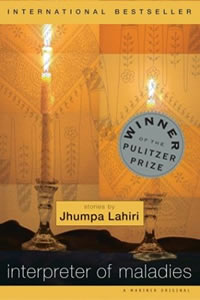
Book Review: Interpreter of Maladies


Interpreter of Maladies

by Jhumpa Lahiri

I didn’t love this book.

Some of the stories were beautiful. All of the writing was lovely, but some of the stories didn’t sing to me, where some did. I was a little disappointed that the title story was definitely not the best; it’s about a man who interprets for a living, who takes a group of American tourists (of Indian heritage) around on a tour of his hometown, which they visit every year or so from their home in New Jersey. The tourists are pretty delightfully obnoxious, and the ending of the story when one of them gets an Indian comeuppance, is delightful; but the major action involves this interpreter (who also works in a doctor’s office, translating people’s symptoms to the doctor – hence the title) developing a crush on the tourist woman. Which was pretty disappointing, really.

I did like about half of the stories. A Temporary Matter, the first one, was maybe the most touching; it’s about a couple trying to find their way after a stillbirth; they are mostly estranged and alienated, until the power company turns off all of the lights in the neighborhood around dinner time, and then these two people find that they can talk in the darkness in a way they can’t when the lights are on. The story doesn’t have a happy ending, which was also a letdown, though it did make sense. It was good, but not my favorite. The second story, When Mr. Pirzada Came to Dine, is pretty much the typical story for the collection: it features a mix of Indian culture and Western, which creates discomfort and conflict; the characters are interesting, the descriptions are lovely – and the story goes freaking nowhere. Ditto for A Real Durwan, Sexy, and The Treatment of Bibi Haldar (The first and last only differ in that they are purely Indian, and so have at least some appeal in showing something of the culture; Sexy is the only story in the collection with a Western main character, and she’s a dud, as is the story.), and, sadly, the title story. Which at least does have the best title, which is, I suppose, why Lahiri picked it for the collection. The other three I’ve listed here were all a little too strange, and a lot too dull: nothing really happens, nothing gets resolved, nobody goes anywhere. I’m sure that was the point, an attempt to show the futility and emptiness of modern life, but — whatever.

The good stories were The Third and Final Continent, This Blessed House, and especially Mrs. Sen’s, which was my favorite. They showed relationships that were fraught, but not doomed; the couple in The Third and Final Continent actually work out quite well, as does the most significant relationship in the story, between the Indian main character and his American landlady, who is 103 years old and is splendid. Say it! Say “Splendid!”

This Blessed House has the most interesting character, in the woman named Twinkle, who reminded me of the classic vivacious hostess, the sort of Katherine Hepburn energetic wit with grace and style who isn’t afraid to get her hands dirty; she was contrasted nicely with her dud of a husband, though I do have to say that, as an introvert, I was kind of on his side: he just wants a quiet house to come home to after work, and his wife keeps throwing parties and doing things. I have never been so glad to be married to a woman even more introverted than me.

Mrs. Sen’s was the sweetest story. It’s about an American boy who spends his afternoons at the home of his babysitter, the titular Mrs. Sen; seeing her through his eyes made her interesting but never offputting – other than the damned knife in the beginning of the story, which I could not for the life of me imagine; it’s apparently an Indian cooking tool, a blade fixed to the cutting board, and you move the vegetables over the knife to chop them. It’s a nice piece of Indian culture, but I just couldn’t grasp it. Still can’t. But I love how Mrs. Sen is so eager to get news from home, and I was heartbroken with her when the news is bad; I thought it was very sweet how she tries to learn to drive, and I actually liked her husband, which made this one of the few relationships in the book that isn’t depressing or disappointing. Plus, I used to have to go to my babysitter’s after school — Mrs. Bergstrom’s —  and so I bonded with the narrator right away, and I sort of wish that Mrs. B. had only had me to watch, instead of the five or six kids she took care of at once. I would have liked to get to know her the way we get to know Mrs. Sen in this story.

Overall, I don’t think it was really worth it; even the good stories aren’t among my favorites, really. If you are in the mood for a sort of gentle alienation, like looking through a soft veil at a surrealist painting, then go for it; if you feel like reading about romances that don’t have a whole lot of closeness in them, as well, then this one is right up your alley. I think it missed my alley.

We Are Pirates Review

We Are Pirates by Daniel Handler

That’s it. I’m never reading a sad book again.

I don’t know how people do it. How do you all read literary classics and modern mainstream novels, and enjoy them? How do you read them one after another? I mean, John Steinbeck is one of my favorite authors, but how do you go from Of Mice and Men to The Grapes of Wrath without reading, say, The Hobbit in between? I can’t do that. I’ve tried for years, I have a degree in literature, I’m an English teacher, I’m a book reader and reviewer, and an author: I know that there is a certain prestige that attaches to the great novels, and almost every one of them is sad, is tragic. But I just can’t do it any more.

I got this book because I loved the Lemony Snickett books, and because I love pirates. Stupid, I know; but why not? The Series of Unfortunate Events (Also sad — I’m aware that I should have paid more attention to the very obvious clues) was genuinely well written, and pirates are not only fun (But also sad: because the average lifespan for a Caribbean pirate was about two years, before they died of disease, alcoholism, or a “short drop followed by a sudden stop.” Like I said: many clues.) but also fascinating, because they represent savagery, and also egalitarianism, among other things. Escape, and rebellion, and a final middle finger to a cruel world.

This book was exactly that. Daniel Handler captured not only the world of the pirate, the anger, the pain, the fight against all conformity and thus against all society and even against humanity itself; he also captured the modern world — and thus made me long to be the pirate, even while I sorrowed for those following that path, pitied them their rage and their pain. And I raged against those who tried to contain the pirates; and then I felt their pain, as well. Because as Handler points out, with the title and with the entire book: we ARE pirates. We all are. We are.

The book is good, damn good, maybe even brilliant; I just finished it minutes ago and maybe don’t have the perspective to really grasp all of its insights and nuances. But I laughed at passages, I recognized people, I loved and hated and felt contempt and pity for the characters and their lives. It’s written the way a book should be written, and it’s about a great subject — not only pirates, but also family and children and growing up and careers and ambitions and dreams and, of course, disappointments. It’s got a wonderful twist at the end, which changes your understanding of things; more than one, actually. It is multi-layered and complicated, but nonetheless still easy to read, and it has some beautiful flourishes and original creations. This is a very impressive piece of work.

And it’s sad. And I’m done.