That Costs HOW MUCH??

A Twitterer (Tweeter? Just Twit?) I follow posted an observation about English:

“Price” and “Worth” mean the same thing, yet “Priceless” and “Worthless” are opposites.

They followed this with the usual metatags, you know, #DeepThought, #Philosophizin, #MindBlown, the identifiers that are much more “tag” than “meta,” in the sense that they are markers used to track things, clunky lumps sutured to one’s ear out in the wild; or perhaps they are a children’s game that seems designed to frustrate all the players but one. But just as those tags are really more prosaic, more obvious, and more concrete and direct than they are meta, so this conundrum of English is not that difficult to untangle: it’s a paradox like any other in English, meaning it is only contradictory, only interesting, if seen from one particular angle. Change the angle and it becomes clear. The answer, I posted in a reply to this Twitterer, is that “price” and “worth” are not actually the same thing at all: “worth” is something’s inherent value, its qualities that make it precious and/or coveted; and “price” is a measurement of what someone is willing to pay to acquire that value. So “worth” is set by the thing itself, and by the perceptions of the owner or coveter; “price” is set by the market, and determined much more by one’s available assets and one’s eagerness to possess: the depth of one’s coveting, that is. “Worth” is internal (though externally perceived), and “Price” is external (Though to some extent internally determined). In recognition of this, we use the antonyms, priceless and worthless, to name two different qualities: one describes an object you would never sell, and the other describes an object you would never buy.

This is why I don’t have more followers on Twitter. Because my posts, while free for all, are not valued by many, and are not coveted by any. So I don’t earn much of the modern currency of social media: attention. I could, of course; I could post nothing but #HotTakes, and maybe some #FunnyJokes, and throw some #Shade at some #Influencer; that would earn me more currency, more attention, and that could eventually translate into value for me: especially insofar as I would be able to sell copies of my books, and raise my #Profile by #EngagementFarming — and I don’t mean to mock or belittle the people who do that, because they do, as I said, find value in it: usually through price, because they market their products successfully to their circle of engaged followers, but sometimes through genuine connections made with people who reach out to them personally and build relationships, which I would consider worthwhile. Either way, more power to them, whether they draw in attention currency through the worth of what they create, or through using the market to raise the price (The key to engagement farming is not only to capture attention, it is too demand attention and receive it; since attention is the currency of the social media market, when an engagement farmer [If you’re unfamiliar with the term, this means one of those accounts that posts things intentionally for likes and follows and responses of any kind: either platitudes or intentional irritation are the most common paths] demands more of your attention and receives it, they are raising the price of their product, and you, the consumer, are paying it.) of what they offer. Either way, it is creating value, and it’s a fine thing.

But it’s not my thing. I’m bad at price. You can tell because I am a fantasy author, married to an artist, and both of us are public school teachers: nowhere in there did we find a way to get rich. And we’re not, subsequently. The things I do with my time have a low price: at least partly because I love doing them. But that doesn’t mean, at all, that they have a low worth: my writing, my wife’s art, and both of our teaching, are extremely worthy pursuits, and ones that are generally valued in our society: just not by the market. This is because markets value scarcity, not worth. Which is why, again, the comparison of “price” and “worth” is not good: not only are they not equal, but they are almost unrelated in the modern world.

Not entirely: I make a living, a decent living, through teaching, and I have for more than 20 years; this last week, I went to speak to my principal about something, and as I was leaving after saying my piece, he stopped me because he wanted to ask why I hadn’t signed my contract for next year: he wanted to know if there was a problem, or if, in the worst case scenario for him, I hadn’t signed it because I was leaving. I am not leaving, I assured him: I had actually just signed the contract the day before, he just hadn’t seen the notice yet. (I hadn’t signed it earlier not because I refused to sign it, but because when I looked at the online document awaiting my signature, it said that the contract start date was — my salary. I don’t know when “63,810” is, but I’m pretty sure it’s not this coming August, which is when I have to start teaching, so I thought I should double check that the contract was correct before I signed it. But when I went back to check again, it had resolved, and the correct start date was there, so I signed it. Or at least I typed my name into the text box and clicked on the blue button, a process that will never not be weird to me. At any rate, on hearing that I had signed and would be returning, my principal literally did this:
Phew GIFs - Get the best gif on GIFER

So that tells me my work has worth. Last week I Twitterered that I was struggling, on evening; I felt like my students didn’t value my teaching, and I didn’t want to stand in front of them and be ignored; it feels not only like a waste of my time and a waste of their opportunity, but also, it’s just damn insulting: first because my teaching is valuable, whether students recognize it or not; and second because their idea of value is so skewed that they would rather watch a video of someone falling down than listen to me teach them about reading and writing and literature. But one of my former students replied that I was her favorite teacher, the one who had the greatest impact on her; that I was damn good at teaching and she would always be grateful that she had been in my class. That, even more than my principal, tells me that my work has worth.

But it is not valued in our society as much as it is worth: and that is why my price is low, compared to, say, an engineer or a doctor or a professional athlete. When people talk about the teacher shortage, and how to fix it, this is how: we have to value teachers according to their worth; not according to their price. Teachers should not be paid at what the market will bear: partly because the market has intentionally been jiggered to keep all wages artificially low; and partly because teachers are generally passionate about our work, and therefore we are willing to do more work than we are paid to do. So we get exploited as workers, and we get exploited as people who care about children.

And then they call us indoctrinators. And fucking groomers.

And you wonder why there’s a teacher shortage.

There’s another issue going on today in our society regarding a disparity between value and worth; it’s inflation. Actually, it’s consumerism in general, but we’re seeing the making of the sausage right now, in a way we haven’t really seen for a long time: there’s been inflation, but not this much and not this quickly.

Inflation occurs when the worth of something is greater than its price: sometimes because of supply and demand, sometimes because of changes and innovation, but for whatever reason, if something is worth more than we are paying for it, as sure as sunshine in summer, that price is going to go up, until the price is equal to the value: which is generally above the worth. (By the way: I’m definitely not using the economics terms for these things correctly; but then, I’m not a trained economist. You can tell because I’m not evil.[#FMF]) It’s above the worth because we have always equated price with value: whenever something is expensive, we think it is a good thing, surely a better thing that that cheap knockoff, or that discount brand, or — God forbid — that used version. And so because expensive things automatically have more value, in order to increase both sales and profits, we mark up the high price even more: that draws more people in, and more people want to pay more for something they have to pay more for, even though it has no more value than it would if it were priced more reasonably. This is why there is premium gasoline. Or gasoline at all, for that matter.

The problem with inflation right now is that it is no longer being driven by the worth of the products being more than their price. It was initially: because during the pandemic, people needed something that could cheer us up. We also needed to adapt to our new circumstances. And we needed to stop putting things off for later, because we didn’t know if we would have a later. All of these things increased demand, which also increases the worth of something: if I need it more now than I would have last year, because I’m having an ongoing existential crisis right now, then the thing that will cheer my up out of my crisis is more valuable now than it would have been before, because it will have a better and more powerful impact on me. The same with equipment that will allow me to work from home, in a time when people are losing their jobs and their businesses left and right: I am more desperate to keep my job, and so I am more desperate for what I need to do my job in these trying times. In addition, as people lost jobs and businesses closed, the supply chain for our goods and services simply disintegrated. Which increased the scarcity of things we wanted just as we started really desperately wanting them. And although scarcity doesn’t actually increase worth, it does increase price, because people grow more desperate to get something they want when that thing is hard to get. (I suppose in some way it increases worth because if we want something very rare and we get it, then our satisfaction is greater than what we feel getting something common: but also, a root beer and a good tuna sandwich would make me happier than a limited edition copy of a novel by my favorite author.)

So when inflation started, it was because of that: people really, really wanted to buy stuff, and there was less stuff to buy: so prices went up. No, it was not the government giveaway of money: because prices went up around the world, and the US government only gave money to American households. U.S. inflation increased fourfold between 2020 and 2021, which put us — 19th out of the 44 most industrialized economies.

The problem since then has been that inflation has continued to rise: and there are two reasons for that. One is that the people who sell things to us very quickly realized that our desperation to buy things meant that they could charge us more, while the supply chain issues and the fanatical belief propelled by neoliberal economists that increases in the monetary supply are the only and inevitable cause of inflation (I mean, other than the many, many times this government has increased the money supply without affecting inflation; but those other times don’t count. This time was the one that proved their thesis. Certainly not the first stimulus checks that came to us in the middle of the quarantine shutdown, which affected inflation not at all. It was the other ones. You know: the Democrat ones. Damn those tax and spend Democrats. Totally their fault that a change in the monetary supply had a greater effect than any other similar change in the last four decades. Totally not other causes.) gave those companies cover. Because normally, if a company just raises prices because they can, there is a backlash: people get pissed that the stuff they want is more expensive now, and so they don’t buy it. This is why I don’t go to Starbucks any more, because their coffee is too damned expensive, without giving me any greater happiness from buying it.

But if companies are raising prices because they’re struggling, too, then it’s not their fault: and we grumble — but then we pay the higher prices. And somehow, we ignore the unbelievable increases in corporate profits for the last two years: and we just get madder and madder at — Joe Biden. (Please follow that link: not only is it a very reasonable explanation of what has actually driven inflation, but also it includes this AMAZING statement: “It is unlikely that either the extent of corporate greed or even the power of corporations generally has increased during the past two years. Instead, the already-excessive power of corporations has been channeled into raising prices rather than the more traditional form it has taken in recent decades: suppressing wages.” #DAMN.) So now, the price of goods and services is higher than the value we gain from them, and MUCH higher than the actual worth of those goods and services: which I’m going to say is lower than the value because the things we buy make us happy, which we need, but they aren’t actually making our lives better, which should be part of calculating something’s worth. Because the corporations and megacorporations that make the world economy move find value and worth in only one thing: money.
Money Gif - IceGif

So okay: here we are, watching prices go up and up, and still paying them, partly because we are still in need of comfort (And it’s getting even worse as our financial positions get harder thanks to how expensive everything is now! DAMN JOE BIDEN!), and partly because we don’t want to deal with the difficulties that would arise if we went looking for alternatives. I’m not sure I want to encourage everyone to look for alternatives: because that seems to me like accepting the prices and the inflation and the reasons for the prices and inflation. That is what the Fed is doing: having accepted without comment that corporations had started gouging Americans, the Fed did the only thing they can do: raise interest rates, fuck up the economy, and throw people out of work. If enough people are poor enough, they stop buying things, and that should make prices stop going up. But since the prices are going up out of alignment with the actual situation, simply because corporations decided to take all the money they could, it’s nearly impossible to say when enough will be enough, and people will stop buying things. Take cars, for instance. At what price point do people stop buying cars? New car prices will easily drive people to buy used cars, of course; but when used car prices are nearly at new car prices? Will people stop driving?

Of course not: not only are cars necessary for productive work across this bigass car-centric nation, but we see our car as part of our identity: it’s not even about buying a car to make ourselves happy, it’s about being utterly miserable without one. Nobody could abide that. My students still see getting a license and a car as more important than getting an education, which is why they let their work and grades slip so they can get an afterschool job: so they can buy a car. And they, and their families, will go into deeper and deeper debt in order to get a car. And then, if the Fed keeps raising interest rates, those car loans will become unsustainable: and they will lose their cars, and have to buy older used cars, which they will still be barely able to afford, but won’t be able to live without. So they’ll have to cut back on other things, or they’ll have to get a second job in order to afford their car in order to get to their first job — and probably their second job.

Hey, isn’t it a blessing that we’ve moved into a gig economy? It’s so much easier to get a second job!
So Easy GIFs | Tenor

Now let’s talk about rent, shall we? It’s the same thing, but worse: at what point can people stop paying rent? They can’t. They have to get second jobs. They have to cut back on everything else. Or else they have to live on the street. Which, of course, people are doing. In record numbers. (That is to say: people are struggling with rent more, not necessarily becoming homeless more often. This report gives the current state of affairs, which isn’t all bad — veteran homelessness, teen homelessness, and family homelessness are all down. But the most chilling bullet point here? This one:

This stability belies more serious issues among those most at risk of falling into homelessness, at
the time of the 2022 PIT Count roughly 50% of renters making less than $25,000 a year reported
being behind on rent.

So what do we do?

Honestly, I came into this intending to say that we should stop trying to find comfort in the act of purchasing material things. And I do believe that: I want to encourage more people to read, because reading is comparatively free and can take up literally every free hour of your life. The same with taking walks, or playing games with friends and family. I think there are wonderful things we can all do that will make us happier, and which don’t cost money; and I think that our society would be better off if we did more of those things. Not only because we’d be happier — and for a longer time because the joy we get from shopping is ephemeral and superficial — but also because it would be better for our planet to stop consuming everything available, and better for our economy to simply stop paying the prices that corporations are demanding of us: because if we stop buying, they won’t stop selling: they’ll start selling for less. It will happen, it will work; the Fed is doing the same thing, just by coercion and with a whole lot less choice and a whole lot more pain in the bargain.

But. I don’t mean to sound like a Boomer telling millennials to stop buying lattes and avocado toast, because the real problem is the system, specifically the way it is intended and designed to reward greed. The whole point is to push the exploitation of the masses as far as they possibly can, because that is how they extract wealth from us. That’s how it is supposed to work: and it does. Here we are, being pushed farther than ever before, while the wealthy capitalists get richer faster than ever before. I think we should try to escape consumerist culture for our own well-being and the well-being of the planet: but for the plutocrats who are destroying not only our world, but also us, in their pursuit of ever greater wealth? The ones who would drive people to live on the streets? Who would exploit people’s joy, and expand and then exploit people’s suffering, for the sake of profits?

I have a different answer. And I think it will certainly improve our moods — and probably help to bring prices down, pretty damn quickly. Because it will increase the cost to those who would increase the prices without increasing the value: and who would discard our worth as human beings in the process. Because whatever worth we can find in consumer goods, and whatever worth we can find in non-consumer goods, and whatever value our exploiters find in the wealth they hoard, it is nothing to the worth of people, nothing compared to the cost of people suffering so that other people can have money.

Here it is. Ready?
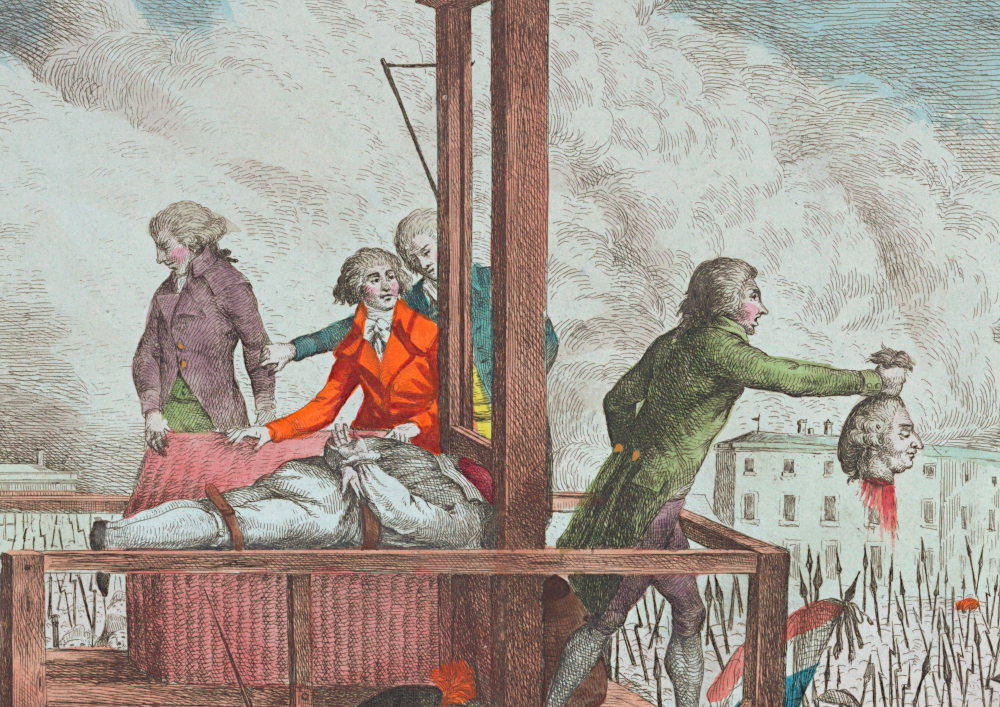
A Slight Freshness on the Neck”: Prints Depicting the Execution of Louis  XVI (ca. 1793) – The Public Domain Review
Please be aware: this video is good because it shows the lyrics of the (honestly terrible) audio of this unfinished recording, but it also shows EXTREMELY graphic footage of protests, specifically suicidal self-immolations, in Vietnam and in Czechoslovakia.

Book Review: Lloyd Alexander’s Westmark

Westmark

by Lloyd Alexander


I grew up reading the Chronicles of Prydain by Alexander, and I only discovered as an adult that, in fact, the man wrote several other books. It’s been a lot of fun discovering and reading those other novels, even though it makes me feel kind of dumb that I didn’t already know about them; after all, Alexander won two National Book Awards and was nominated for four more, so . . . I guess everybody but me knew about his broader legacy. I would like to blame my parents for not telling me about Alexander’s other books. And also Piers Anthony, who so captivated my youthful love of fantasy that I read every single one of his books. Including his genuinely crappy autobiography, Bio of an Ogre.

Blame and castigations aside though, this is a genuinely good book. It is more adult than the Chronicles of Prydain: it really only belongs in fantasy because it’s Lloyd Alexander. He never writes with too much magic, but this book has none; rather, it has – politics. It’s about a printer’s assistant, Theo, who goes on the run after his master Anton is killed by the military as part of an attempt to control the press. The printer’s assistant hooks up with a con man and snake oil salesman who is a mixture of Shakespeare’s Falstaff, and the King and Duke from Huck Finn; he’s a big, bombastic, lovable rogue who makes no bones about the fact that he’s in it for the money and will tell whatever lies he can in order to get it. He’s a lot of fun and he makes the book a lot of fun.

It isn’t all fun and games, though: the fear and anger over the printer’s death and the subsequent flight are quite serious. Theo eventually parts ways with the con man and joins up with a group of intellectuals leading a rebellion, who are a great set of characters; the last third of the book is a quite realistic portrayal of the beginnings of a revolution, including Theo’s efforts to print anti-royalist pamphlets as his own efforts to free the people. Yeah: definitely not a simple children’s book.

The book leans more fantasy in the royal aspect of the politics: although there is a definitely historical feel in the elements about revolution, the causes of the nation’s oppression come straight from a fairy tale. The king is bereft and despondent to the point of uselessness over the death, several years ago, of his beloved only daughter. An evil counselor – I definitely think of Jafar from Disney’s Aladdin, or Flagg from Stephen King’s The Eyes of the Dragon – has taken over running the kingdom, and is trying to consolidate power for himself, becoming a tyrant in the process. He is overcome not by the revolution, but by the direct actions of our hero, who essentially saves the day – though there is a twist I won’t give away.

It’s a good book. The characters are well-drawn, as is the setting; the plot is a little haphazard, which I think is because of the mix of fairy tale and historical novel, but it isn’t hard to follow. And the other reason for the somewhat complicated course of the story is: this is the first book of a series of three. So there are seeds planted here, paths started but not taken to their ends, because there is more story to tell.

I’m going to try to find the other two books. I recommend this one.

One last note: the biggest downside of this book, for me, was honestly the cover. I hated this image, and the way it depicted the characters, so much that I tried not looking at it while I was reading the book, and even now I can’t stop thinking bitter thoughts. Yech. But of course, don’t judge this good book by its crappy cover.

The Gouging Is Not Enough

Someone needs to explain this country to me. I don’t understand it.

I don’t understand how we can love freedom, and yet work like mules to take it away from others, from the jailed, from the people of other nations, from our own workers, our soldiers, our students. We so love leisure and relaxation that it seems this is the only time we work this hard: when we betray our own professed morals and ideals.

I don’t understand how we can love the beauty of nature, and yet build drilling rigs atop it and rip down the centuries-old trees like grass, strip mountains down to pits of poison. How can we spend weekends watering and mowing and fertilizing our lawns and yet never go for a walk in the woods, a swim in the river? How can we pollute our own countryside?

I don’t understand why we don’t love art. We coo over talent and beauty in our celebrities — even when it isn’t actually present — and we can’t throw our money at them fast enough; but we wouldn’t pay a dime for a painting instead of a poster, nor anything for a song so long as we can download for free; and people with vast talent, who spend years striving to create true, immortal beauty, are only given one commission: get a real job. We love memes and clever witticisms, revere the turn of phrase, the surprising insight, the genuine outpouring of passion in confessions and rants and the cri de coeur — so long as it does not last more than a paragraph. And God forbid the novel.

I don’t understand why we go to war. Why we fight to protect both life, and our right to own guns. Why we eat ourselves to death, drink ourselves to oblivion, and jail those who use marijuana. Why we mock people who shop at Wal-Mart, spit on those who hold a hand out for charity, and then fight tooth and nail to keep wages low, unions useless, and education ineffective. Why we profess to love our children more than anything else — will gather by the thousands to light a candle and pray for the safe return of a single missing child — but allow thousands of children to go hungry on the streets. Why we believe the government is corrupt, even antagonistic in its self-serving greed, but trust the profit motive to build honest and effective businesses; nor why we fear the amoral inhuman corporation, but trust the government to work itself out of its shady dealings with those same corporations and their bottomless pockets without a revolution.

I don’t understand why we have not had a revolution.

But today, I’m not thinking about any of those things. Today, there is only one thing I don’t understand, and it is this: why we pay for health care. Why insurance companies are allowed to exist, and to do business the way they do. Why people work for them, even knowing what that job costs, what it entails, in exchange for a paycheck that I can’t think is more than meager.

I wonder: do the employees of health insurance companies have better coverage? Do their claims get denied? If so, do they fight? Or is the answer to this the answer to my previous question — they work for the insurance company because it is better (in this allegedly Christian nation) to inflict on others exactly what you protect yourself from?

I’m thinking about this today because of my wife. (I confess: I think about most of these things because of my wife, who is an artist, who loves nature and animals, who actually loves freedom and desires it for all as much as for herself, who doesn’t understand the same things I don’t understand, no matter how much we talk about them and try to figure them out.) My wife Toni has glaucoma. Glaucoma is a condition of the eye: the liquid inside the eyeball doesn’t drain properly, but its production continues, and so the pressure inside the eye increases steadily, causing severe headaches and damaging the optic nerve, leading to vision loss and eventual blindness if not treated. It generally occurs in the elderly, but Toni inherited it, so now she gets to be the youngest person in the opthamologist’s waiting room every few months. And though it is appallingly ironic for an artist to face a disease that could blind her, glaucoma is eminently treatable: she puts drops in her eyes every night which reduces the pressure in her eyes, and even should the condition worsen, she would not be without options — there are other medications, there are surgical options, there is marijuana. (Actually, marijuana is not a wonder treatment for glaucoma; while THC does indeed lower intraocular pressure, this effect only lasts for three or four hours per dose, and it may cause other complications that would outweigh even that benefit. But personally, I love the idea that she could be prescribed marijuana, and I could get fired for using it — even if I was prescribed it. Well — “love” as in “don’t understand and actually really hate.”) And along with the glaucoma, Toni inherited thick corneas — about twice as thick as most people’s, and so even though her intraocular pressure is much higher than most people’s, her eyes can withstand it. As her doctor told her (I swear this isn’t my analogy, but oh, how I wish it was), where most people have balloon eyes, she has basketball eyes, and the thicker walls mean they can hold much greater pressure without, y’know, popping.

So while this is bad, it could be much, much worse. She could be dying. Glaucoma threatens her vision, but not her life. Even the worst case is decades off, rather than a few years, or even a few months.

But of course, there is one thing that makes this situation much worse than it has to be, more dangerous, more frustrating, more costly: Toni is an American. We live in this country, rather than in one of the civilized nations on this Earth: the nations that pay for health care. Instead, we have to deal with an insurance company. Which is why I’m thinking about this today, why this is what I don’t understand right now.

The Affordable Care Act is four years old, now, and it has helped: millions of people are insured that weren’t insured before; the costs of health insurance and health care, while still growing, are growing slower than they have in years. And people can no longer be denied coverage because of pre-existing conditions or lifetime maximum allowances. But the ACA — Obamacare — didn’t go far enough, and now Toni has to slog through the quagmire that is left, which is deep and dangerous, even if smaller than it has been in the past.

You see, while you can’t be refused coverage because of a pre-existing condition, insurance companies can refuse to cover health costs associated with a pre-existing condition for up to a year after the initial diagnosis. Toni has been aware of her high-pressure basketball eyes for quite some time, but the official diagnosis of glaucoma, and the accompanying need for more frequent tests and for daily eyedrops, only came last May. And then in June, we moved from Oregon to Arizona, and I took a new job.

And got new health insurance.

With that came the letter informing us that the company would not cover any costs associated with Toni’s pre-existing condition until ten months after her coverage began, which deadline will be June 30 of this year. For the intervening year, in which Toni would need to find a new opthamologist and undergo new diagnostic tests to monitor the progress of the disease, and of course take medication every day, the insurance company would not pay for any of it.

So here’s my first question. Why not? Why wouldn’t a company that exists to cover medical costs actually cover those medical costs? Is it because they are protecting themselves from fraud, from the danger that her previous physician, who was outside of this company’s circle of approved doctors, might have lied, so that Toni could bilk the company of the costs of treatment? First, why would that require anything more than a confirming diagnosis from a physician they trust? And second, why would anyone try that scam with glaucoma? The tests cost money, as does the medication, but we’re talking about hundreds of dollars over the course of a year, not hundreds of thousands, as can be true in other cases.

My assumption is that the company is merely taking the opportunity not to pay out money. Simple as that. They don’t even have an excuse that has any humanity or business logic to it: they just refuse to pay money. In the past, insurance companies have refused to pay any money for any pre-existing condition; now they can only do it for a year — so they’re doing it for the year. If the law allowed them to refuse payment for three years, they’d do it for three years.

That is madness. Absolute madness. An insurance company exists to pay money for claims. They profit by collecting more in fees than they pay out in claims, which they do by insuring a greater pool; the more healthy people they insure, and collect monthly fees from, the more they have to pay out in claims, and the more money they have for profits. So the way to increase their profits should be to get more members — preferably healthy members — and to raise fees. And they do both of these things, of course — but they also fail to provide the service they exist to provide to some of their members? While still collecting fees? It’s like a mechanic taking your car into the garage, charging you $300 for a repair, and then saying, “My profits will be lower if I actually spend time and money fixing your car. Instead I’m going to inspect three other cars that are in perfect working order and send your malfunctioning car back out on the street. Will that be cash or charge?” And then you give him the money.

Exactly what business are these companies in? What does their business model look like? And is there any way to see this as anything other than extortion? We need health insurance, thanks to the obscene costs of health care in this country and the fact that our health is the one thing we can’t go without — if the car in my analogy breaks down, you can carpool or walk or take public transportation; but you can’t borrow a new pair of eyeballs, you can’t leave your body in the garage and take the public body instead — and because we have to have the service they offer, they can cheat us, openly and repeatedly, and we just have to accept it.

The most important question of all is: why do we put up with it? Why was Obamacare fought as hard as it was, and why was the single payer option — the path to the only system of health care that actually makes sense, nationalized socialized medicine — removed from the law? Why do Americans choose to live like this? All of our voices, all of our influence, all of our votes and our money: all of it is serving literally no one but insurance companies, who extort and cheat and bilk us, while refusing us medical help. Why? I remember whistle blowers publicizing the fact that insurance companies had policies in place designed to delay the payment of claims until after the person died. They let people die for the sake of profit. And yet these companies still exist? And the Republican congress tries to repeal Obamacare? If the corporations were actually people, we would charge them with murder, and we’d probably execute them; but no, we pay them more, and fight to deregulate them.

Why?

Toni got sick this past spring. Nothing terrible, just a sinus infection, but it was an extremely nasty one: she’s always had allergies, she’s always had sinus trouble, but this time the pressure was so severe that she had constant debilitating headaches, a constantly blocked airway, and a fever; she felt awful. She went to the doctor, who quickly diagnosed her with acute sinusitis and prescribed an antibiotic. Toni took the antibiotic — no treat, that, as it had unfortunate side effects that made her feel even worse than the sinus infection had — and the sinusitis cleared up. Huzzah!

Then we got the bill from the doctor’s office, for the remainder of their fee after the co-payment (That’s another one, by the way. Co-payments? We pay them to provide a service, and then we pay for part of that same service? I’ve heard of passing costs on to the customer, but this is ridiculous.). Why were we charged? Because the insurance company had rejected the claim.

So Toni called them to ask why. She waited through a long time on hold, listening to one jazzy Muzac song on a loop (Toni: “I thought I was going to have to stick a poker in my eye.”), until she got to speak to a claims rep, and she asked her question. “It was automatically rejected,” the rep said, “Because of your pre-existing condition.”

Toni asked her what her glaucoma had to do with the sinus infection. The rep agreed that that didn’t make much sense, and said she would look into it, and call back by the end of the week.

She didn’t call back.

So Toni called again. Same wait time — same damn song, threatening the same eye-poking (which would, I suppose, make the whole thing irrelevant; maybe that’s the insurance company’s ultimate goal) — and the same question. And the same response: “No, you’re right, that doesn’t make any sense. Of course the inability of your eyes to drain properly had nothing to do with the bacterial infection that got into your sinuses, almost certainly because you moved to a radically different climate and Tucson had a comparatively wet winter, which gave bacteria a perfect environment to grow and get into your system. Let me fix that and send you a check.” Well, actually, it was, “I will look into that and get back to you.”

She didn’t call back, either.

In the intervening time (Each of these Calls-and-waits-for-response is about a week’s time), we got another bill from the doctor’s office. Toni will be attending the University of Arizona in the fall, working towards her Master’s in Visual Communication. Before she was allowed to register for classes, she had to present proof that she has been immunized against measles. There’s a whole story here which I’m going to leave out, but suffice to say, she went to the doctor’s office to get her sixth lifetime measles inoculation. And then the insurance company denied the claim.

So Toni called again, this time with two questions about two denied claims. (I should note that Toni can be rather tenacious, when she thinks something is unfair. And she has worked for banks, with all of their labyrinthine procedures, and also in Accounts Receivable, where she would call the company’s clients and try to cajole them into actually paying their bills; she has said that her job was to be on hold. The insurance company holds no fear for her. But frustration — oh yeah.) This time, the rep was neither conciliatory nor helpful; after several cycles of eye-poke-inducing Muzac, the woman said that the claim was automatically rejected because of her pre-existing condition. (On a Kafkaesque note: at no time did any of the insurance company employees state what that pre-existing condition is, nor does any of the billing paperwork or our account information. Toni wondered at one point if the pre-existing condition was in fact “She is human.”) Toni asked how glaucoma could be related to sinusitis. The woman interrupted, raising her voice to talk over Toni, repeating the same statement in effect: the claim was automatically rejected (She emphasized this as though it gave her argument weight: the computer said no. You can’t argue with the computer.) because of her pre-existing condition. Toni then calmly asked why the measles vaccination had been rejected, in what way that was related to her glaucoma. There was some fumbling, but then she received the final explanation of the denial of both claims: “It was rejected because of the way the visit was coded.” In other words, the doctor had made some mistake in recording the two visits, or in their invoice to the insurance company (And just imagine how Byzantine and maddening that process must be), and that’s why the claims were rejected.

So Toni, with a furious gleam in her eye — and yet a perfectly polished and polite phone manner, nonetheless; it was like watching James Bond call Blofeld and make an appointment to strangle him before popping out to the tennis court for a quick match with his beautiful secretary — called the doctor’s office, to confirm that they had not, in fact, coded the two visits as “Glaucoma treatment (sinus infection)” and “Glaucoma treatment (measles inoculation).” They had not. So once more, she called the insurance company. This time, the rep was polite, but was also clear: the claim had been denied. Toni asked about the appeals process, and the woman directed her to the online form and explained that either Toni would have to complete it or her doctor could file it.

Then she said, “But they’ll probably deny it anyway.”

Toni wrote to the NP who had diagnosed her sinusitis to ask, just in case the company has a point, if there could be any connection between her glaucoma and the infection, if the medication lowered her resistance or something similar; he responded that there was absolutely no relevance, as we suspected. We did get a phone call the next morning, from the second woman of the four Toni talked to; she left a message informing us that the matter had gone for medical review and they were working on it constantly, without pause for breath or sleep or food (Words to that effect) to resolve the matter. She said she would call us back.

We are considering the appeal, though we expect the company would deny it, to force us to hire a lawyer and take them to court; it is my assumption that the criteria for denial of this claim was, “Could our highly paid attorneys confuse the matter sufficiently to make a jury think that there could be a connection between glaucoma and the infection?” And the answer, based on proximity of the sinuses to the basketball eyes, and the similarity of symptoms, i.e., headache in both cases, is, I presume, yes. We are also generally against frivolous lawsuits, which this instance definitely would be, considering the amounts in question. So even if we appeal, we won’t take it to court; I think the value of appealing is to reverse what I believe is in fact their policy in these matters: I think they want to make the claims process as difficult, slow, and annoying as possible, in hopes that the customer will throw up her hands and simply pay the doctor, lest she be sent to Collections by her physician’s office, with all that entails regarding credit rating and reputation. The failure to call back, with repeated promises to do so, the long hold time, the need for further review despite the obvious absurdity of their argument — and the long and complex fine print attached to the Appeal form — all fit my theory. But the most interesting thing about the appeals process? The company reserves the right to deny any claim made while your appeal is being considered. What a wonderful and terrible implied threat that is: sure, you can appeal our decision — hope you don’t get sick while that’s going on. Maybe you should reconsider, hmmm?

Why do we put up with this? Who could possibly think that the government, no matter how inefficient they may be in some ways, would provide worse service than this? I know the fear with socialized medicine is that the government functionaries would deny people health care; what would you call this? Toni had a sinus infection. One doctor visit, one simple prescription — payment denied. How would the government handle this more callously, more indefensibly, than the company? And could you imagine that the government program would cost anything even approaching what our insurance company charges us — so that they can provide us with, quite literally, nothing of any value whatsoever? We have, in essence, no insurance; certainly no peace of mind.

Why do we allow this? Why do we accept this? I know the feeling of futility that the process brings to people; I feel the same thing. But it isn’t futile: Obamacare was passed. The situation was changed. We can take this further.

We must.

That’s why I’m writing this. Not for our sake; as I said, Toni’s infection is long gone, and the measles inoculation was successful — she is still measle-free, and now registered for her classes for the fall. Her glaucoma is being treated. All told, after they deny our appeals, we will be out just over $200, which we can afford. Her time with a pre-existing condition is almost up. We can handle our situation as it stands now.

But what if?

What if we decide to appeal, and Toni gets into an accident, and they deny her claim because she is in the middle of appealing a ruling?

What if that was the claim they had denied because of her glaucoma, and we were out thousands?

What if the pre-existing condition was life-threatening and expensive?

All of these things are true, for thousands if not millions of Americans.

Insurance companies are letting us die so that they can make money. They are not making our lives better, they are not improving either our medical care system nor our health outcomes.

It is time to stop allowing our government to help them make money from our suffering. It is time we stopped this nonsense, and did what we all know is the right thing.

Please: support candidates who support single-payer government-sponsored tax-funded health care. Write to your representatives. Join campaigns to push for single-payer health care. If you have your own story, tell your own story, in the comments below or on your own blog and then send me the link; otherwise, share ours, or share another that you know with the people you can reach. Let people know that this has to stop, and we have to stop it.

I want to understand my country again. I want my country to start making sense.

And Toni doesn’t want to listen to that song any more.