This night I am thinking about why I forgot to write this morning.
It’s because we’re looking for a place to live. It’s complicated, because there are several factors to consider and more than one possible way this could all shake out; but regardless, we will be moving out of our current rental within a few months. And that means we’re looking for a new place to live.
I hate looking for a place to live.
I hate renting.
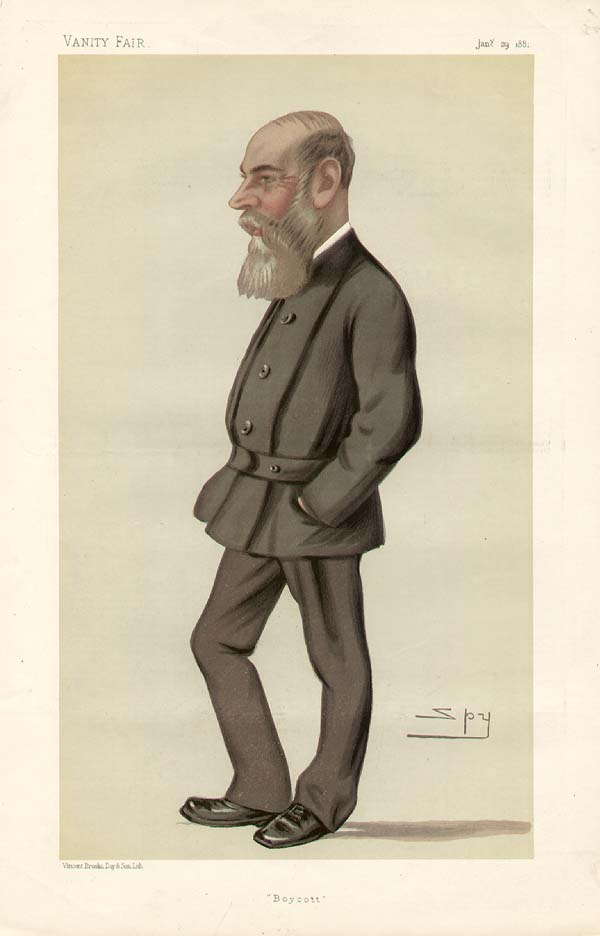
I know this is not new: plantation owners in the South used rents to create a new slave class, even after Emancipation, which we call sharecroppers; I have not doubt that many people are still stuck in that impossible cycle. Before that, the English landowners drained all of the wealth in Ireland through exorbitant rents; they also got the IRA, a centuries-long guerrilla war, and the very first eponymous boycott, named for Captain Charles Boycott, the land agent of an absentee English landlord.
Caricature of Capt. Boycott by Leslie Ward, published in Vanity Fair.
Plus, y’know, every colony that’s ever been taxed, and every serf who has fed his lord instead of himself, and, well, pretty much all of us who aren’t at the top of the capitalist feudal food chain, have dealt with this same issue.
Don’t you think it’s time we just cut the crap?
Look: I don’t own a house. It’s not by choice, it’s because I’m a public school teacher in the United States — and there’s another issue that I wish we would just figure out; the idea that the state where I currently live had been 49th in paying teachers, and then the teachers themselves walked out in order to bring attention to the issue, and now we’re like 47th, is just — it’s exhausting. Because I don’t own a house, I need to borrow someone else’s. I get that. I am perfectly willing to pay for the privilege of living in someone else’s house.
I am not willing, however, to make someone else rich by profiting off of my willingness to pay for the privilege of living in their house.
After all, I am asking nothing from my landlord but — well, land. I am a grown person: I am perfectly capable of carrying out minor repairs and performing general upkeep; if I cannot do a necessary thing, I am happy to call in a professional to do it for me, and if I didn’t have to fork over like 40% of my monthly income in rent, I would be happy to pay for said professional. Since I do need to fork over a ridiculous proportion of my income in rent, I am consequently not willing to wipe off the wall when I sneeze on it. (I’m exaggerating. I’d wipe off the wall. Or at least try not to sneeze in an obvious place.) And in exchange, because I am turned obstinate and intransigent by the extortionate rent, my landlord turns to the modern version of Capt. Boycott: the property management company. They, of course, require a certain percentage of my rent in order to manage me; and my landlord certainly isn’t going to sacrifice that amount from his profits: so the cost gets passed on to me.
So because I am charged too much, I have to be charged more; because I am resentful of how much I have to pay, everything gets done slowly, and poorly, because my landlord and the property managers look for the lowest bidder for any required repairs, and they are generally slow and incompetent as well as cheap. And the value and overall quality of the property goes down, and everyone suffers because of it. And all because my landlord can’t just rent out the property for enough to cover his costs for the property; he’s got to squeeze me dry. Just because he can.
From there we add the ridiculous application process, where I now have to hand over $55 or more per adult applying, and the obscene “security deposit” which is really just another wad of cash we hand over to the owners, because never have I ever gotten the full deposit back after moving out, regardless of how well I have kept the place up, and even added minor improvements; doesn’t matter, because the owners want to keep my money, so they find a way to charge me for the privilege of no longer living in their home.
I’m sorry this blog wasn’t funny. I’m sorry that I have nothing insightful or valuable to add to this whole issue. All I can ever think when I go out hunting a new rental is that I wish I could be a real estate tycoon, not so I could make billions, but just so I could go ahead and rent out my properties for a reasonable rate, based on a reasonable interview with a would-be renter, and the simple fact of trust between myself and my tenants. I just want to give people a chance to not hate everything about where they live. It would make everything so much nicer.
I walk by accident into one of London’s über-bookstores to be taken over by a very familiar type of sadness—as a child I used to feel this way when thinking about the cosmos and my own insignificant place in it. This is London’s biggest bookshop: 6.5 km of shelves, the website proudly tells us, as if this particular length and not another were a reason to rejoice. Book after book after book thrown into this worded jungle—a hoard that could be a waking counterpart to a Borgesian wet dream. Fiction books and books on writing fiction. Photography and art books and books on photography and art. And so on: most forms of expression and myriad words of meta-dialogue, some of them even justified or at least nicely edited and with colourful covers. Nothing escapes this total library: no corner of the universe or the mind is left unaccounted for. It is a hideous totality for it is an ordered totality, filtered through the minds of who knows how many marketing specialists; it is effective as a selling platform but it is a desert of anonymity for the diminished names on the shelves. Were I ever to be asked for a writing tip, something born out of this experience would be my choice: walk into any gigantic bookshop and think whether you can face being one more name lost in this desert of words. If that ideal situation proves too much to bear do something else with your time (it is of course highly likely that if you go around asking for writing tips you will never make it on print).
Okay, first of all, that parenthetical comment at the end gets you a punch in your snooty little snoot with a fist labeled Fuck You. I presume you mean that true poetry, great writing, emerges from the soul as a fait accompli, like Athena cracking her way out of Zeus’s head fully-grown; if a would-be writer is too naive to recognize this immortal truth, and to think that one could simply ASK for a way to be a better writer, then that person is doomed to less than mediocrity. Or else it is the bourgeois feeling of the “writing tips,” the oversimplified, sanitized, pre-packaged saccharine packets that show up in ten-item numbered lists on the various clickbait websites advertised on Facebook. I am more understanding of contempt for those, as I am contemptuous of people who make a living on the internet by telling people how to make a living on the internet – by running a website telling people how to make a living on the internet, which is done (Spoiler alert!) by getting people who want to make a living on the internet to buy your secret to making a living on the internet; and the people who do this always seem to call themselves “writers.” But my contempt is for the people at the top of the pyramid: not for the people down on the ground, choking on dust and sand, dreaming of a way to climb. Those people who want writing tips because they want to be better writers deserve respect for their courage in trying to find a way to get what they want; and their desire to improve, whether or not they know a good path to improvement, is admirable and not at all an indication of their potential as writers. Fuck you in the snoot, sir.
Now let’s talk about the central issue here. You’ve got two problems with this bookstore and the despair it engenders in you. One is that your words will never be truly unique, because somebody out there will say pretty much the same thing you say – or in Borges’s universe that you reference later, with his infinite Library of Babel that holds all combinations of letters and thus every possible book, one of the other volumes on the shelves will say exactly what you say. And maybe Borges was right and it does repeat in a chaotic pattern for eternity, if such a thing can be said to exist. Right? All the kilometers of fiction books, the books about art and photography and writing; all been done before, nothing is new, nothing is original. Somebody get me a cigarette and a bottle of cheap red wine, and build a Parisian basement cafe around me for a tomb.
The second problem is that you will never be the one person whose words everyone reads, everyone knows, everyone talks about; because there will always be so many others putting words on the page, that it is impossible that your words would be the ones that capture every reader at once. Particularly not if you want to capture every non-reader as well. This problem seems to be the larger one, as you speak more of being lost in the noise than you do about repeating what has already been said.
The futility of writing is something I face up to every time I set pen on paper or hand to keyboard. Why am I doing this? My compulsion to write does not occlude the uselessness of filling pages with words. I know that what I do is pointless, one more message in a bottle in a moment when everyone else around me is also casting messages adrift.
This is a poor proof. Your message in a bottle being surrounded by other messages in a bottle does not make your message pointless. Not even in the metaphor: so long as one person finds your message and reads it, and – I suppose – comes to rescue you from your desert island of despair (Perhaps your bottle message is something entirely different, something like “If you let your eyes go unfocused, a Moen kitchen faucet starts to look like a snobbish sheep with a very long snout. But it’s hard to recapture the magic once your eyes go back to normal and the sheep turns back into a faucet, so don’t waste it.” In that case, you won’t be rescued, but somebody may spend a lot of time squinting at their kitchen sink because of you, which is pretty funny, really. I’d call that success.), then your bottle was a success. You won. You did what you set out to do. You made your point. Wherefore, then, does it become pointless? Is the idea that the thousand bottles around your bottle make it less likely that your bottle will be read? This is not true for the same reason your enormous bookstore should not lead to despair. Ready for the reason? Here it is.
There is more than one person reading. (Shocking, I know. Hold onto your snoot, Buttercup.)
Let’s start with the metaphor. There are a thousand bottles with messages in them, bobbing in the water by the seashore. If there was only one person walking by, and for some reason that person had sworn a sacred vow to read only one bottled message, then your chances of being read are a thousand to one. Agreed, and that would suck. But in the – ahem – “real world” of this fantasy, that one guy wouldn’t stop at one bottle: he’d keep opening bottles. Because if he was doing it out of curiosity, out of a need to see what was written on those messages; or if he was looking for the perfect message, the one that would speak directly to his soul, then reading one message would never be enough. He’d read another, and another, and another. He’d probably try to read them all. I would. Wouldn’t you? If you saw a thousand bottles bobbing in the water with message inside them?
And if it was more than one guy on the shoreline? If it was actually a crowded beach, with tourists, and beachcombers, and dogwalkers, and a tai chi group, and a bunch of hungover teenagers wrapped in sandy blankets and the stench of wet cigarette butts? The bottles would catch all of their interests. They would all want to open their own bottle, be the first to read a message. Then they would share the messages they found with each other. They’d be diving into the water, throwing bottles back onto the shore, shouting and laughing and waving their messages over their heads. The more bottles there were in the water, the bigger the spectacle would be, and the more those people would be drawn to where the bottles were. They might even come back the next day to look for more bottles.
Are you following me, sir? Those bookstores with the kilometers of shelves? They are not only filled with books, they are filled with people. People who read books. And those people never stop at just one book. I know: I used to frequent a very similar establishment, Powell’s City of Books in Portland, Oregon. Five floors of twelve-foot-high bookshelves, covering an entire city block. I never expect to see so many books on display in a single place in my life again. I could spend the rest of my life reading (Ah, bliss!) and not finish a single floor’s worth of books. I went there every month for the ten years I lived in Oregon, to buy books, and you know what? That place was always packed with people. With readers. Never mind the kilometers worth of shelves: how many kilometers of people do you think go through those stores on any given day? 3,000 people, on the average. [source] Average front-to-back measurement of a person is approximately ten inches; I’m an American and we’re thicc, so let’s bump that up to a round foot. (Screw the metric system, though I’ll convert for your convenience, sir.) 3,000 feet of human every day, which is very nearly one kilometer of human flesh – around 915 meters, to be precise. And that’s not even lying down head-to-foot. That means that in a week, if the London store has a similar number of visitors, the people looking at those books outdistance the books they are looking at. And I can tell you that the turnover rate for the people looking is far higher than the turnover for the books on the shelves.
There are an enormous number of books in the world, and it grows every day. It is impossible for one person to read them all, and realistically impossible that one of them will be read by all people.
But that doesn’t mean that my book won’t be read. It doesn’t mean that your words will never be seen.
I think about selling my books, which I have not yet succeeded in doing. But let’s imagine that I do so: imagine if my sales, by every measure of the publishing industry, are absymal. Let’s pretend that I only sell one thousand copies of my novel about a time-traveling Irish pirate. So lame, right? I am – what was your phrase? – “lost in this desert of words.”
A thousand people bought my book. Presumably that means a thousand people read it. (Some surely would cast it aside in disgust or disappointment, sure, but I think some of them would like it enough to share with someone else, or else resell it. Let’s just imagine that one sale equals one reading.) Think about that. I have never been in a room with a thousand people who all know me: not in the way that a reader knows at least an aspect of a writer. I have spoken to thousands of people in my life, but I doubt that a full one thousand of them cared about what I had to say: cared enough to sit down, in a quiet room, and spend hours just listening to my words, thinking about my thoughts. Hearing me. If I could sell just one thousand copies of my book, then I could achieve that. So what if at that same time a million people were listening to Stephen King, and ten million were listening to Kim Kardashian? So what if the world is larger than I can speak to at once? So what if all I can have is one small corner –with one thousand people listening to me?
Isn’t that enough?
Think about it in terms of time. I don’t know how many hours it takes me to write a book, but the pirate book was finished in about a year, so let’s use that. It’s a pretty fast read, I think; someone could finish it in maybe ten hours of reading at a leisurely pace, maybe even less. If a thousand people spend ten hours reading my book, then the year of my life spent writing it (And of course the vast majority of that year was spent sleeping, working, eating, singing in the shower, watching TV, playing The Sims, et cetera) has turned into ten thousand hours of other people’s lives spent – on me. There are 8,760 hours in a year (And 525,600 minutes), so even if I had spent every single one of them working on my book, that time spent is balanced by time spent reading my book if only a thousand people were to read it. More than balanced.
So the question is, what more could you possibly want?
If the only thing that would make writing worthwhile, that would give this endeavor a point, is if every single person on Earth read your work, and only your work, then I agree that writing would be pointless. But I can’t fathom a writer, a real writer, being that childish, that selfish, to think that the world must revolve around your work and your work alone. I mean, the only cultural phenomenon with that impact is Wyld Stallyns. Granted, you’re not them, and neither am I. And that stings a bit, I’ll bet. Yeah, it does me too.
I’ll comfort myself just thinking about how easy it would be to get a thousand people in the world to read a decent book. Shit, if all I want is readers, I could offer it for free and get that many readers without even trying. You wrote this obnoxious angsty piece of snobbery, and I read it, and then spent – mmm – more than an hour responding to it. See? The time you spent on this crud then earned for you this time spent out of my life. Time I could have been reading, ya selfish bastard.
And honestly, I think this is enough time spent on you. I am sorry that your life is so empty and meaningless, and sorry that I threw a couple of hours of my life into your black hole of an ego. Do us both a favor: gain some perspective, will you? Thanks.
(I have to say: the rest of the piece has some valid points about marketing on social media, and about the democratization and banalisation [His word] of writing that has occurred through the internet. There is some good thought here. If there hadn’t been, I wouldn’t have read all the way to the end, and then taken the time to write a response. I don’t disagree with everything he says. Just the central premise. I dream of having a thousand readers, and I am absolutely sure that, even in a world inundated with voluminous writers of every imaginable quality and a limited number of readers with a limited number of books they will read, still: I will hit that mark. And it will be worth it.
(Thank you for inspiring me to write this, sir. Now pull up your fucking pants.)
Renting a home. It makes no sense at all. The basic concept of the capitalist exchange doesn’t work, here, because you’re not exchanging money for goods or services: the tenant does not own the home, and the landlord is not doing anything for the tenant. Yes yes of course, the landlord is selling the right to live on his property; but he’s not really selling it, because there are stipulations. (And how does one sell the right to live, anyway? I swear I read something once about inalienable, or some such.) Stipulations are only possible when ownership is not exchanged: a landlord telling a tenant he can’t have a dog is like someone selling you a car and saying, “But you’re not allowed to use Reverse. You can only drive forward.” That would make sense if someone was borrowing your car (and you had a pathological fear of moving backwards, or of mirrors, or of the letter R), because you still own it, and you can tell the borrower how to drive it. But that isn’t analogous to renting a home, either: because borrowing is done on a single-use basis, and only with people who know and trust the owner. I have lived in many homes whose owners I have never met, not even seen or in some cases known their names. Nobody would lend things like that. You’re giving someone a valuable thing (Because if it isn’t valuable enough to give back, then it isn’t borrowing — as we all remember from that guy in school who used to ask to “borrow” a sheet of paper every class, and who used to get crap for that verb. “Sure, Tad-Biff — you gonna give it back when you’re done?”) with the expectation that you will get it back after it has been used — generally used once. The borrower reads the book and gives it back; watches the movie and gives it back; makes punch and serves it in the bowl and then gives the bowl back. Unless you’re Ned Flanders and you’re giving your stuff to Homer Simpson, that is. But that just proves my point, because the Simpsons is a satire of modern life, with Homer as the man who does not ever abide by the social contract.
What does it say about landlords when their basic transaction makes them like Homer Simpson?
The real divergence, though, is in the money: if you let someone borrow your car, that person should certainly be responsible for the gas they use and any damage they do; but what kind of full-bore jackass would you be if you charged money just for the simple use, on top?
“Sure, you can use my car while yours is in the shop. Cost you $20 a day.”
You’d be a landlord kind of jackass.
Of course I’m oversimplifying in some ways. There are plenty of businesses that lend use-without-ownership of something valuable in exchange for money — cars, power tools, DVDs, electronics, furniture, even money; but a home isn’t a thing you “use.” Living somewhere is not using the home; we don’t say “Last year I used outside of Denver, but now I use in Colorado Springs.” It’s much more than that. A home is the place where we live: a home is where we spends time with our family; a home holds and protects all of our possessions, which shape and define our time, and therefore our lives, in all the spaces our families don’t. A home becomes a touchstone for almost everything — it’s where people find us, where they send things to us, where they bring us when we’re too drunk to get there ourselves. A home defines a person, in many ways, because it allows you to do the thing that defines you — you can’t be a gearhead without a garage, or a cook without a kitchen, or a gardener without a garden. You also can’t survive at all without shelter or safety or sleep, all of which become extremely difficult to acquire without a home — and therefore a home makes you human. Home is where the heart is, where life is.
How can I live in a place that doesn’t belong to me?
The answer is, I can’t; that’s why the laws defend the resident, the tenant, and even the squatter much more than the owner. Possession is nine-tenths, and our society recognizes that — though that last tenth, in the hands of the 1%, means that our government has done quite a lot to protect the landlord, too. But in essence, we know, deep down, that the person who lives in a place has some right to it, has some claim of ownership on it. It’s just too bad that we don’t actually live according to what we know to be right.
All right, enough: let’s pretend the basic concept is sound, and discuss the jagged little pieces of insanity that come with renting a home. First, landlords lie. The photos online do not in any way resemble the actual property; at best, they choose the one flattering angle and then stand on the garbage can in order to crop out the broken fence, the tumbleweeds, and the rusty nails and shattered beer-bottle glass spread across the yard like tinsel on the world’s worst Christmas tree. Why do they try to change the way the house looks in the pictures? Do they think we’re not going to see the place when we show up to look at the inside, or to rent it, or to take possession? Are they going to stand directly in our line of sight, holding up an enlarged copy of the photo from Craig’s List, saying, “Here, see? Here’s the house, you can see it right here. NO! Don’t turn your head. Close your eyes for a second and I’ll show you the other rooms, one at a time.” Or do they think that we’ll show up, see the reality, and think, “Well, it sure looked better in the pictures. Maybe this is just an off-day. Maybe the light is bad here. I’m sure once I’ve given the landlord money, it’ll look like it did online!”
Maybe landlords just do a lot of internet dating, and got into the habit of using fake pictures and hoping the other person doesn’t bolt when they see the truth.
Now, Toni and I have in fact rented two different properties from a distance, once when we moved to Oregon and then again when we came to Tucson; but for the second one, we had a local connection, a good friend of mine from high school who lives in Tucson, who went around and scouted out our prospects for us. This means that out of the times that we have rented a house, there is exactly one time that deceptive photos online would have taken us in. So then why?
It’s not just the photos, either. “Single-family home” in the ad becomes “Broken-down dirt-crusted center unit in a triplex” when you drive by. “Fenced yard?” Sure, if you think the row of old bent croquet wickets lining the dirt patch qualifies. “Great neighborhood” if you intend to get jumped into the local Crips — is it called a lodge? A chapter? Crips Country Clubhouse? Anyway. “Off-Street Parking” means you can park on the sidewalk between the dumpsters and the rats’ nests. “Cooling system” means you can open the windows and hope for a breeze. We all know the buzz words: “cute” and “quaint” and “cozy” all mean “small;” “character” means “old,” as does “traditional;” “easy maintenance” means “it’s already broken.” Sometimes things just vanish: the included washer and dryer, the recessed lighting, the covered patio “great for entertaining.” And in every case, I wonder: did they think we wouldn’t notice? It’s one thing if you sell a kid a toy in a cardboard box, and it’s only when he gets it home that he discovers that his new G.I. Joe Attack Helicopter doesn’t actually fly by itself — thanks for that emotional scar, Hasbro — but this is a home. The customer is going to live in it, for a very long time. They will notice that the front door is missing, and they will say something about it to the person who still legally owns the home.
But let’s say you find a place. The ad looks great, you drive by and the neighborhood seems acceptable — you know, drug deals happen in a BMW instead of a burnt-out Toyota shell, the graffiti is aesthetic, the local hoarders keep their piles inside instead of in the yard — the place has what you need. So you call: Sorry, that was rented seven years ago last July. Yeah, I need to remember to take down that Craig’s List post.
A moment about Craig’s List: all websites have their problems; some don’t filter well, some have too many ads or not enough information, some don’t have a good map or the photos are too small; but Craig’s List is special. Only there can a month-old listing be automatically renewed and then get labeled as “Posted six hours ago.” Only there can one person list the same property seventy-nine times, so that your search for a place turns up just that one freaking condo. Only there can people post an email address as their sole contact information, and then fail to return any and all correspondence. I’m glad that Craig’s List exists, because I prefer renting from individuals rather than property management companies with their own professional, polished websites; but I really wish someone could keep some individuals from using it.
But as I said, all websites have their problems. No pictures is one. That’s just absurd. Am I supposed to fall in love with the place based on your turgid prose? What is this, the nineteenth century? At least show me an etching. Another problem is failing to give particularly vital information — like the cooling system, here in Tucson. I don’t mean to be single-minded in my housing criteria, but you better believe I want to know about the air conditioning when the summer days regularly reach 110. (Side note: why the hell do all these houses have no air conditioning? Are you aware you live in the desert? And that extreme heat is uncomfortable? What is this, the nineteenth century? Shall I just sweat into my waistcoat and then bathe after a fortnight?) Another problem is when they don’t give the address unless and until you contact them and listen to a spiel about the place. It’s the same thing as the lies: you can say what you want, but I’m still going to drive by, and then insist on seeing the inside, before I give you a dime.
That brings me to a new problem we encountered on this search, but not in the past. There is a company here in Tucson that has two businesses related to rentals: they manage some properties, and they also offer a listing service — meaning they will sift through the dozens of websites and find listings that match your criteria and then send them to you, for a $60 fee for three months of emails. Fine and good. I don’t want to use the service, but I can see the value of it, particularly for very busy people, or those with the time and inclination to look for that one perfect needle in the haystack. The issue I have with them is that their listings, the properties they actually manage, are used as bait: they set the rents low, post listings on all of the regular sites, and conceal the addresses, offering their phone number for more information. Then you call and ask about that one place you saw online, and what do you get? A sales pitch for their listing service, which you need to sign up for before they will tell you a single thing about that one place you called for. Most annoying business model since the Jehovah’s Witnesses.
And by the way: did someone say rent? Did someone say the rent is too damn high?
I can’t go into numbers, because they vary too widely from place to place, but the fact is, the amounts we are expected to pay for housing are just absurd.
A recent report from the Joint Center for Housing Studies (JCHS) at Harvard, puts some numbers on just how bad this problem is: About half of all renters in the U.S. are using more than 30 percent of their income to cover housing costs, and about 25 percent have rent that exceeds 50 percent of their monthly pay.
How some of these people can stand to demand this much money for the broken-down shacks they offer is beyond me. I am extremely happy that we have moved to a place where there is enough inventory, and enough vacancy, to enable us to find a place for a decent price — which occurred partly because it was empty long enough for the landlord to bring the rent down — but sadly, the state where we live is one of the worst for paying teachers, so even with reasonable rents, the rent is still too large a piece of our income. But I know I am saying nothing that people don’t already know, and already bewail. Allow me just to point out that in Jonathan Swift’s famous essay A Modest Proposal, the one about eating Irish babies, the villains he names specifically are the landlords who take every penny that the poor Irish could earn or beg, leaving them no choice but to starve:
I grant this food will be somewhat dear, and therefore very proper for landlords, who, as they have already devoured most of the parents, seem to have the best title to the children.
Let me move on to something that not everybody will know about: renting with pets. The first problem is that this cuts your choices in half, if not by two-thirds — although (and this is even more annoying than the number of landlords who won’t allow pets) several of those just don’t have it listed as an option, but if you call them, they don’t mind pets at all. Jerks. The second problem is the types of pets that are allowed: cats OK, but not dogs. Dogs OK, but not cats. Dogs and cats OK, but not over 25 pounds. I had a landlady turn us down once when I told her I had an iguana in a terrarium. The biggest problem, though, is that owning pets seems to be seen as a license for landlords to demand stuff: additional clauses in the agreement. Pet deposits. Pet rent. I mean, pet rent? Are you assuming that my pet has an income, and therefore you deserve a piece of it? Let me tell you: he doesn’t. Nobody pays him to be cute. He gives it away for free. Which is what makes him a better person than you. Let me also note that this whole scheme is bunk: would you charge me different rent based on the number of people living in the place? What if I had two jobs — would I pay two rents? The whole thing is ridiculous. An additional pet deposit on top of the security deposit presumes not only that my pet will do damage to the home, but also that said pet damage will be on top of the damage that I will do to the home, which will consume the entire security deposit. Same thing with additional pet clauses in the agreement: can’t you just leave it at “Don’t mess the place up?” Do we need to describe the ways I am not to mess the place up? Thank you for your trust. Here is all of my money.
All of it, and not just for rent. I’ve seen places that want first and last and a security deposit and a cleaning deposit and a deposit for each pet. A new one this search was a place that actually said the deposit was non-refundable. So does that mean they’re just going to keep it when you move out? Not surprising, that happens more often than not, but to just say it like that takes a lot of brass. Then they want fees: application fees, up to $80 per adult (And again: why do you need both of us? If I can pay the rent with my income, aren’t we done talking?). Just to apply for the opportunity to give you all the rest of my money. They want a credit check, a background check, proof of income (which must be three times the monthly rent), proof of employment, rental history going back five years, references from your last landlord and from three trustworthy individuals who know your character. It’s insane.
Look. I just want a house. Not a big house. It doesn’t have to be brand new, and it doesn’t have to be in perfect condition, and it doesn’t need to have nine bathrooms and a spa and all chrome-and-platinum appliances. I just want a place where my family can sleep at night, and then get up in the morning and go about our day. A place where I can write, and my wife can paint, and our dog can play with his Wubba. Somewhere that has rooms that fit our furniture, with enough space left to walk around and between things. Somewhere I can put my books on shelves, instead of in plastic tubs in the storage shed in the backyard. A cute place would be nice, but I’ll take a place with potential. Somewhere we can feel safe. Somewhere to live.

 Just Dusty