Stop Apologizing For Hurting.

Hi me, this is yourself. You want to talk to me about something.

You weren’t going to talk to me about this today, or tomorrow, though you thought about it last week, when I posted yet another self-denigrating comment attached to a pair of links.

Listen, me. I don’t suck. I am sad.

I am sad for a number of reasons: the school year is ending, and my students don’t want to learn anything. There are a number of stressful things happening in my life, mostly around the end of the school year and graduation, but also with my writing, and with the summer, and with my house, and with family. People around me are hurting, and I want to help, and I usually can’t. All those things make me sad, and you know it.

But I also know that being sad when hard things and sad things are going on is not a failing. It is not a weakness, it is not a mistake: it is a reasonable response to a situation that I can’t control.

It is also bothering me that I can’t control the situation. I really, really want to. You do too. But I can’t. Not even the things I want to control.

I can’t control how my students feel about school. They don’t want to learn at the end of the year. This is neither new nor surprising, students kinda never want to learn anything (though they always want to learn interesting and useful things, and that should say something about the curriculum we teach in our schools, which they do not want to learn most of the time), especially not in the last month or so of school. I’ve always fought that, you know, because I hate wasting time, and I want the students to gain as much as possible from their opportunity to learn, particularly a love and appreciation of learning, and also a love and appreciation of literature and language. But I’ve always, always failed. No, that’s not true; I have instilled something of a love of learning and of literature into some of my students, and I have encouraged the love that was already there in a number of others. I have helped students get through difficult times, and made their lives easier and better. But I’ve never been able to do those good things with all of my students. Maybe that shouldn’t matter to me, but when I keep hearing about how children fall through the cracks and get forgotten, how every student is precious and none of them should get left behind — it makes me feel bad that I fail to reach all of my students.

And then I tell my friends and fellow teachers not to take it to heart when they can’t reach all of their students, when some of their students have issues and opinions that no teacher will ever be able to touch, or solve. Especially now: because the pandemic had long lasting effects on students, and they, like us, are sad. They are dealing with a whole lot of shit, and it’s hard, and they’re not good at it. It doesn’t help that the adults in their lives are dealing with our own shit, so have less time and energy to help deal with theirs: but we can’t be sorry for that. There’s only so much of our shit we can push aside in order to deal with someone else’s shit, before we just pile up too much shit of our own, and we can’t handle it any more. I think I’ve been doing that a lot for the last few years, and I don’t think I can do it any more. And I’m not sorry about that.

If I should be sorry for anything, it is not taking my own advice to heart. Because I really, really suck at that. But that doesn’t make me suck: it just makes me like everyone else. Which also makes me a little sad, because if I can’t even solve my own stupid issues, then how can there be any hope for humanity? My issues are stupid: I am smart. I should be able to solve those stupid issues, I tell myself all the time. And yet, here I am, feeling bad for feeling bad. Partly — but not entirely — because if I could simply solve all my issues, then I would have so much more capacity for helping those around me deal with their issues, which I really want to do. It’d be awful nice if I could do that. But I can’t. And I feel bad about that. For still feeling bad.

I was just talking to a student that struggles with depression, and I was telling them that they are not allowed to feel bad for feeling bad. Depression is a real thing, and feelings are not logical and cannot be reasoned with; we have essentially no control over them, and therefore should not feel bad about having them, because you shouldn’t feel bad for things that weren’t your choice, which you can’t control. And there I was, telling them they shouldn’t feel guilty for feeling bad, which they do because they are empathetic and intelligent enough to recognize that their sadness makes people around them sad, as well; but feeling guilty is useless, and trying to remove or reduce feelings because you don’t like them has not ever worked and will not ever work.

And only at the end of that conversation did I realize that I was telling them to stop being illogical with their feelings, that the feeling of guilt wasn’t reasonable and therefore they should be able to eliminate it, by reasoning with their feelings and taking control of them to eliminate them. Like the feeling of guilt is any different in essence from the feeling of depression.

And only this morning did I realize that I am doing exactly the same thing to myself.

I shouldn’t be sad. I have a good life: I am a respected and even beloved teacher, with complete job security and a sufficient if not entirely satisfactory income. I have my health: I have never been seriously injured or seriously ill, and I can pretty much do everything now that I could when I was 25. I am proud of my past accomplishments, and of the person I am. I am married to my soulmate, and I love our family of pets. I do not suffer from clinical depression, nor from past trauma. I should be fine. Sure, my country is currently mired in a political shitshow and an economic train crash, and the globe is filled with political unrest and violence, with hatred and suffering, with climate change that will make all of us and our feelings moot…

Sorry, I was going to say that none of those things should make me sad: but of course they should make me sad. They are sad and terrible things, and I am an intelligent and empathetic person, and I recognize the state of the world around me, and how it could and should be so much better than it is.

Also, my feelings aren’t reasonable, and don’t respond to logical argument. I can’t even say that the desperate state of the world is the reason for my sadness: it’s not clear to me that my sadness has a reason. It might, of course; I started this post off with a list of reasons why I am sad, and any or all of those might be the cause of my emotions. It also might in that there are things around me that create stress in me, and that stress, unresolved as it is, is more likely to bring my mood down, even if the thing itself isn’t necessarily sad; for instance, graduation stresses me out, because I have to be the MC for it (I don’t have to, but it’s expected of me and I agreed to do it, so that’s stressful), but I’ve been the MC for graduation for the last five years, and it’s always gone fine; and also, graduation is a happy day; and also, it’s not about me, so I could screw it up in a dozen different ways and nobody would care at all, because they’re focused on the graduates, not me. But I’m still stressed about that. And about renewing my credential. And about finishing my grades. And about all the other tasks I have to do in the next month or so. All of that might be what’s making me sad.

But it’s also entirely possible that I’m just sad. For no reason.

And the important thing is this: it doesn’t really matter what the reason is, because emotions are not logical. They do not necessarily come to me because of reasons. To be more clear, there may be reasons, in that there may be triggers, situations and thoughts and experiences that create despair or sorrow or grief or anxiety, which then transforms into sadness and depression; but it’s essentially impossible to know the single cause of my sadness and to therefore address the single cause of my sadness — and therefore remove the sadness. I can find the potential trigger, and I can address it; but that’s not necessarily going to remove the sadness. Because sometimes I’m sad for multiple reasons, and solving one might even highlight the others which I can’t solve. And sometimes, I’m just sad for no reason.

I just had to go through that last paragraph and change the pronouns: because I had written it, as I often do in these posts, using “we” and “one,” as in “We can find the potential trigger, and we can address it; but that’s not necessarily going to remove one’s sadness.” I started this post talking to myself so I could face the truth head on: I am sad. It’s affecting me. I can’t simply control it and remove it. That is the truth. I want to face that, and say it to myself, so I hear it, from me. (I’m just dragging you along into my internal dialogue for the hell of it.)

And, as I realized both from talking to my student and in reflecting on it with regards to myself, I can’t control the feelings of guilt and inadequacy that happen in me because (If these feelings are caused by anything?) of that sadness. See, I don’t think I should be sad. I try to talk myself out of being sad by telling myself there isn’t any good reason to be sad, that on the contrary I have many reasons to be happy. And I frequently am happy: though not as frequently of late. Too much sad time. But that sad time is getting in the way of the things I want and need to do: I should be writing blogs — I was supposed to write a book review of the excellent book Shock Doctrine by Naomi Klein, which I just finished reading and discussing with my book club — and I should be working on my novel and I should be working on my house and I should be grading my students’ work; and all of those things just sitting out there unfinished is stressful, and that’s not helping me.

And yet when I came in here, to my office, to write the book review, instead I spent half an hour scrolling idly through Facebook. I don’t even like Facebook that much any more. But I still look at it. Same thing with Twitter: I almost hate Twitter nowadays. But I still look at it. I tell other people that social media is probably not good for their mood; I tell myself that I should avoid getting into arguments online and reading negative and hateful things; but I still do both.

Because I’m sad. And I don’t have the energy or will to do the things I know I should be doing. Which, of course, makes me (Does it make me?) feel guilty and also pretty useless; and then I feel bad about myself, and that makes me (?) sad.

Or maybe I’m just sad in the first place, and these are reasons I’m applying to that feeling in some attempt to take control of my feelings, and change them through logic and reason and force of will.

Which, of course, doesn’t work.

My student told me that they have had other conversations about being depressed, and people have asked them why they were sad: and they can’t come up with a reason. They’re just sad. And then they felt stupid because they couldn’t explain reasonably why they were sad. I immediately responded that there doesn’t have to be a reason for sadness, sometimes sadness just is, and they should never feel bad about their feelings. (See how good I am at telling other people about their problems? This is why I needed to talk to myself about this.)

But I still asked why they were feeling sad, when they told me they were. Because even though I know that emotions don’t necessarily have reasons or reasonable causes, I still act like they should, and we should be able to deal with our emotions through considering those causes and then addressing them.

The problem, of course, is that sometimes it works. Sometimes talking about why we feel a certain way makes us recognize apparent causes for our emotions; and sometimes — more rarely, but still, sometimes — we can then address those apparent causes, and feel better. (Sometimes — often, even — simply talking about them makes us feel better.) Like, I worry a bit about my health. I am 48, and I am a bit overweight; not too much, but I have a pretty sizeable amount of body fat around my middle. Which is unhealthy for someone my age, as it puts stress on my cardiovascular system. I also eat WAY too much salt, drink WAY too much caffeine, and I have high blood pressure — for those reasons, and also because of stress from my job (and everything else) and also because I don’t sleep well. Because of stress and so on, and my tendency towards insomnia, which I inherited from my father. And also probably (definitely) because of the caffeine that I drink. So, okay, I should address these things before they become too serious — before they become risks to my health, before I have a heart attack or a stroke. (When I think about this, I think of my grandfather, whom I never met because he died of a massive stroke before I was born. But I try not to think about it too much. It might make [?] me sad.) So I started meditating, about two years ago. And I started going to the gym, which I have done off and on for years now, but I’ve been good about it for the last four months or so. I have also cut down my caffeine intake, though it hasn’t yet paid off in good, solid, consistent sleep.

But I have seen results. I have lost a little weight. I have gotten stronger, and I have more stamina. My sleep has improved, and the meditation has maybe had an effect on my temper, which I don’t lose as often or as intensely as I used to (Though that also may be because I am sad, and particularly because I am tired. But it may be the meditation.). My blood pressure hasn’t gone down and stayed down — but also, my measurements for that are from when I donate plasma at the Red Cross, and there are other likely reasons for my blood pressure to be high when I go to get stabbed with a needle and then drained of my precious bodily fluids. So the worry about my health has brought to mind issues that may contribute to my anxiety, and to my sadness, and I have acted to address the problem, and I have seen some results.

But then I look at the images of myself recorded by our video doorbell, and I think, “Jesus, I’m fat. When did I turn into a potato?” And then I’m sad.

And notice that my reason for feeling sad is nothing to do with the other reasons I mentioned for why I worry about my weight.

And realize, also, that my video doorbell is not a fair camera: because it is a fish-eye lens, intended to capture a wide field of view, and not intended to take flattering pictures of me as I water the plants. Reasonably speaking, I shouldn’t feel bad about either my health or the way I look.

Hey, maybe I don’t. Maybe I’m sad because my father is grieving, because he lost his wife of thirty years this past February, and though I can talk to him and support him, and he says often that talking to me makes him feel better, I can’t make him not be sad, which makes me sad. Also thinking about my health makes me think that I need to make sure I am as healthy as possible because I don’t want to die and put my wife through what my father is going through. Also I don’t want to die. Maybe thinking about that is making me sad.

Maybe I’m sad because I can’t go visit my mother this summer, because I have to do too many other things and my school shortened my vacation, and I have too many things I want to do.

Maybe I’m sad because I have too many things I want to do and not enough time, and that stresses me out, particularly when one of those things is write: because I need to define myself as a writer, or else I will only be a teacher, and that would make me sad because I can’t make all of my students learn all the time, and therefore that makes me feel like a bad teacher. Also teachers don’t get paid enough, and I don’t want to think of myself as undervalued. Not that I get paid as a writer, of course, or at least not much. I don’t sell that many books.

And maybe I’m sad because I don’t sell many books, and so it doesn’t matter if I write the next book or not, because even if — WHEN — I finish it, it won’t sell, and that’s because I’m not that good a writer, and I should just go ahead and accept being a teacher. Even if that means everyone who disparages me and my fellow teachers online will have a better case for criticizing me, and I may have more trouble ignoring their criticisms by telling myself I’m really a writer as well as a teacher.

Maybe I should stop arguing online with people who disparage teachers. Though I do feel like I should take action when I can to make our world, and especially our society, a better place, and that means standing up to people who say nasty things, and correcting and teaching people who don’t know the truth or don’t know the whole story — and that means arguing. Even though it frustrates me and makes me despair, sometimes, because people just don’t listen or don’t change their ideas or their feelings, and no matter what I say or how I fight, I can’t control their feelings.

Maybe I’m sad because I can’t change people’s feelings: not my dad’s, not my students’, not my friends’. Not mine. I want to help all of us: but I don’t have control over that, over any of it, because emotions aren’t something you can control with willpower and rational thoughts.

Maybe I’m just fucking sad.

But here’s the thing: and this is the point I’m trying to make, and the reason why I decided to write this instead of the book review (Which I will write — it’s a good book and one worth reading, even though it’s depressing [Hey, maybe that’s why I’m sad…]): because while we can’t control our feelings with our thoughts, and we can’t even really control our thoughts (Also, that’s why I’m bad at meditation, which is a stupid thing to think, and one that the teachers on the meditation app I use keep telling me not to think, but the truth is that I can’t focus my attention solely on my breathing: the thoughts keep coming, and I keep focusing on them, even after two years of practice. I feel pretty dumb about it, and also kind of desperate because of it, because if I can’t keep myself calm through meditating, then what can I do to control my blood pressure or my anger? [Hey, maybe that’s why I’m sad…]), what we can control is our behavior.

I don’t like that I’m sad. I have shit to do, shit that I know will make me happier, but I have trouble making myself do it — because I’m sad. I don’t think I deserve to be sad, which makes me think both that I’m not really sad, and also that I’m just being self-indulgent, having a little pity party, when actually my problems aren’t that bad and I shouldn’t be upset about them. People around me are much sadder than me, for much better reasons; I should be supporting them, not making their situation worse by being sad all over the place. (Also, I shouldn’t be talking about it on this blog. This is going to make people sad, and that’s a terrible thing for me to do. But I’m doing it. [Hey…])

But rather than telling myself that I shouldn’t be sad, or that I’m really not sad, what I should do is: give myself room to be sad. Maybe don’t worry about the weekends where I can’t bring myself to write a blog. But if I do worry about that and feel bad about it — because I can’t actually control my feelings — I can still do something: I can not apologize, or be mean to myself. I don’t deserve to be mean. I don’t deserve to suffer my meanness. Nobody who reads these blogs needs or wants an apology from me on the weeks when I can’t bring myself to post. If I don’t feel like writing a particular post, rather than trying to force myself, or getting mad at myself for it, maybe I can post something else, like good links. Or maybe I can write something else, like an overly personal babble about my feelings, instead of an insightful book review. Will those things make me feel better?

As of this very moment: yes.

Though maybe I feel better because I also just took a break, took my dogs outside, cleaned up the yard a bit and watered the grass so the tortoise will have something to graze. And stood out in the sunshine, which was warm but not too hot.

I don’t know why I feel a little better now. My feelings aren’t rational, and the causes aren’t clear. But the fact is, I do feel better, and so it’s reasonable to think that maybe I can do these same things again and feel better again. Maybe when I am sad, I can write about being sad, instead of trying to ignore it. Maybe when I can’t face doing a large task from my home improvement list, I can do a small one. Maybe when I think about the problems I am having, I can also remind myself of the things I’m doing to make them better — how I’m supporting my dad, even if I can’t “fix” him. How I told my student that they can always be sad, and can talk to me about it if they want to, even if I can’t rationalize their feelings and therefore eliminate the bad ones; and that made them feel better. How even if I haven’t lost all the weight I want to yet, I’ve still gone to the gym twice a week every week for four months now, and I can see and feel the results. How even if I can’t empty my mind like a Buddhist monk, it’s still good for me to sit quietly and breathe deeply for fifteen minutes or so a day.

And maybe I can stop looking at myself in the videos from that goddamn doorbell.

And what I can do, for sure, is to stop apologizing for my feelings. Because I didn’t choose them and I can’t simply control them: so they are not my fault. And while I can try to work around the limitations that my feelings put on me, the first thing I have to do is recognize both the feelings and the limitations, and accept them. Because by doing that, I accept myself — whereas apologizing for myself and my feelings tells me that I am wrong, that I have done something wrong, and that I should fix it.

That act sucks. But I don’t.

Thank you for reading this. Thank me for writing it. Let’s try being better to ourselves, first. We’re worth it.

Free to be Safe, Safe to be Free

A friend of mine posted this:

IMG_3831
And so, because this is what I do, I asked: why? Why is freedom more important than safety?

He couldn’t answer.

He replied that freedom was the very fabric that the U.S. was drawn on, which is a lovely statement of sentiment — but not an answer. That tells me why freedom might be so important to Americans, if we accept that freedom is indeed what the U.S. was drawn on; but it doesn’t say either why that is the foundational principle of this country, nor why that foundational principle (or this country) are especially important — nor does it answer my first question, about why freedom is more important than safety. (Heh — I just wrote “freedom is more important than slavery.” Not only pretty close to a tautology, but also a pretty good indicator that my subconscious is damned libertarian, if it equates safety with slavery. Actually, I was just listening to the 1619 Project podcast about the foundations of this country, and I have an argument against freedom being the fabric this nation was drawn on. But that’s another subject for another time.)

Understand that this is a good guy, a really good guy. A generous plenty of his posts are focused on telling his friends that he loves them, especially his male friends, explicitly using the word “love” and supporting them in every way he can; sharing his own struggles with depression and alienation; telling anyone and everyone that he is always willing to listen. Basically he is an antidote to toxic masculinity. He is masculine antitoxin. (Also hilarious. Also a frequent and fully self-aware shitposter. Also a boogaloo boi: his second response to my questioning was a citation of the Second Amendment as the only necessary source of safety. People are complex, aren’t they?) He wasn’t attacking me, calling me a coward or a libtard; he wasn’t even treating me as a troll commenter, which would be an understandable response to my asking philosophical questions on a meme. He was really trying to answer my question, and in so doing, revealing at least some of his ideals, if not his explicated arguments for his ideals.

And I don’t think they’re bad ideals. I think this country should be drawn on the fabric of freedom; and though I don’t agree with The Libertarian Cartoon Head (And I find it kind of hilarious and very telling that it is so very Nordic and square-jawed, with furrowed brow and shaped beard and curled ‘stache, blond hair and blue eyes), I also don’t agree with the woman with the sign. (I will give her slightly more credit in her argument because she put “freedom” in sarcastoquotes, which implies that the debate is set on false premises as these debates often are and maybe have to be by definition; but also, I have no idea where this picture is from or if it is even real, so I can’t say if she knows how to use sarcastoquotes or meant those for emphasis, or if she ever really held that sign in the image, or if it was Photoshopped. So.)

Let me tell you what I think: I think both safety and liberty are, quite simply, vital. They are necessary. Both. I’ll actually throw in the pursuit of happiness, too: all vital to our continued existence as thinking, feeling individuals. That’s why they are unalienable rights.

There’s a deeper and harder conversation about what rights are and where they come from, and what it means to have them, which I am not qualified to have; I have a lot more reading to do in the philosophy world before I can take that on. But for  this conversation, the layman’s understanding of rights should be just fine.

A right is what you have simply by virtue of being an individual, a specific human being: a person. Your rights are essentially a list of what is required for you to experience and explore that existence as a person, as an entity with reason and free will. You must have life, because if you’re dead, you can’t experience your existence as a person. You must have liberty, because liberty is essentially the opportunity to have your own thoughts and feelings, to express your own thoughts and feelings, and to act on your own decisions, which are based on your own thoughts and feelings. Without liberty of thought, of speech, and of action, you are not able to explore and experience your existence as a unique individual. It’s pointless to say you have reason if you are not allowed to think your own thoughts, and then express what you think (Because freedom that is only locked inside your head is not freedom: a human being is capable of expressing and communicating their thoughts, and that expression and communication of thoughts is a fundamental part of being a human; you cannot be a human if you can only think but never speak your truth.); it is untrue to say you have free will if you cannot act according to that will.

You must have life to be you, and so you have the right to life; you must have liberty to truly be you, and so you have the right to liberty. Either without the other is meaningless and empty. The pursuit of happiness, the third unalienable right listed in the Declaration of Independence, is the realization of these two rights extended forward in time: if I have life and liberty right now, I can be myself; and if I can be assured that I will still have life and liberty tomorrow, I can begin planning and acting with that understanding in mind, seeking most likely to achieve a greater happiness for myself according to my wishes. Also necessary, I would argue — although the argument for this one is a bit more fraught, not only because Thomas Jefferson, after cribbing these rights from John Locke, changed Locke’s third unalienable right into the pursuit of happiness; Locke said the third was the right to property, meaning the right to own the fruits of your own labor. That’s a different conversation. It’s also fraught because Jefferson was one of history’s greatest hypocrites, writing that all men are created equal while being attended by James Hemings, his wife’s half-brother — Jefferson’s own brother-in-law, who shared a father with Jefferson’s wife — whom Thomas Jefferson owned. Jefferson also, of course, owned James Hemings’s sister (And Martha Jefferson’s half-sister) Sally. And he owned his and Sally’s six children until his death. All men are created equal, eh?

Regardless of who wrote the words, though, the ideas are sound as written, if not as Jefferson embodied them and helped to codify them into the founding documents of this country. All people are created equal: each and every one of us is a unique individual, essentially capable of thinking and feeling, and in possession of free will. Therefore each and every one of us has the unalienable right to life and liberty, both.

Both.

That’s the trouble with this argument. It’s not that life (which I would argue is represented by safety; I’ll get to that in a second) is more important than liberty, nor that liberty is more important than life. It’s that you cannot separate the two.

Is safety the same as life, here? I don’t want to argue a red herring, to make a false equivalence between the safety in this argument and the right to life in the Declaration of Independence. But what do we mean by safety? Safety, I think, represents the assurance of continued life; like the pursuit of happiness, it is the right extended into the future. If I am safe, I not only know that I am alive right now, but I expect that I will continue to be alive in future, and so I am confident and comfortable in that expectation. In its essence, safety is about the preservation of life over time — and also the preservation of liberty, without which life is meaningless and so too is safety. I know that’s a circular argument, but really: if you were sure that tomorrow you’d be alive, but you’d be in jail, would you say that you felt safe?

And on the other side, if you were free to do as you wish, but you knew you would die tomorrow, would you really feel free?

I know the knee-jerk answer to that second question, from people who agree with the meme (probably my friend as well), would be a resounding HELL YEAH BROTHER! Because part of this argument is based on a quintessentially American/(toxically) masculine ideology that not only honors, but pursues and relishes, death, especially death by martyrdom on the altar of freedom. But while self-sacrifice is honorable and noble, and I am grateful for those who have sacrificed their lives for me  — those sacrifices did not ensure the continued existence of liberty. They (depending on the specific situation) may have helped to eliminate a present threat to liberty with their sacrifice — probably also a threat to life; while the Fascist regimes in WWII were certainly a threat to liberty, they were clearly a much more dire threat to the essential existence of millions if not billions of human beings — but that doesn’t ensure, cannot ensure, that liberty will continue into the future.

Only safety can do that.

Now: it is certainly true that some attempts to limit liberty are presented under the guise of promoting safety; those must be guarded against. But that is not, despite the fanaticism of some liberty-lovers, true of every single attempt to ensure safety, nor even every attempt to limit liberty — some are presented as morally correct, for instance, regardless of whether they create more safety; like certain White House occupants sending certain Federal troops to certain cities to, errr, safeguard statues. That is certainly an attempt to limit liberty, but there’s not really a way to claim that keeping Robert E. Lee atop his horse atop a marble pedestal will make us safer. (There is some attempt, in the name of law and order, to claim that those who would pull down statues are threatening to create — or actually creating — chaos and danger for Americans. But let’s not buy into the bullshit, yeah? The only safety really being promoted there is the safety of the monuments, and the comfortable white supremacy they generally represent.) It’s like the argument that every single gun law is an infringement on the right to bear arms: that’s not really true. The essence of the Second Amendment is to preserve the right of self-defense — which preserves both life and liberty — and so long as one is able to do that, the right is uninfringed. Slippery slopes are not an argument, they’re a rhetorical scare tactic.

It is also true that some attempts to create safety also bring an unacceptable limitation on liberty; I think that’s the argument against lockdowns as a measure against the pandemic. As I think this year has made clear, though, temporary limitations on liberty become more acceptable when they are more effective in preserving life; the way to avoid a restriction of liberty is to find a way to have your cake and eat it too, to ensure safety while also preserving liberty — which in this case would be: masks. Masks are a way to effectively preserve safety by stopping the spread of Covid-19 while also not infringing on liberty, because so long as everyone wears a mask, we can continue with almost all of our preferred activities.

Brief aside to squash this nonsense: Liberty does not mean an unlimited right to do whatever the hell you want, to say no just because someone else says yes, to insist that somehow you don’t need to wear a piece of cloth on your face just because you don’t wanna BECUZ THIS’S AMURRRRRRRICA. It means the ability to control your own actions based on your rational decisions, so long as those actions don’t harm anyone else’s ability to do the same. Anyone making a rational decision not to wear a mask — i.e., “I have claustrophobia and the masks cause panic attacks, so instead I MAINTAIN A STRICT SOCIAL DISTANCE AND MAYBE WEAR A CLEAR FACE SHIELD” or “I don’t enjoy wearing a mask SO I DON’T GO OUT IN PUBLIC” —  is fine; those are rational decisions, and I doubt anyone would have a real problem with those. That’s why exceptions for health reasons are written into every mask ordinance, and why no mask ordinance mandates people leave their homes.  Now, it is certainly true that, all else being equal, the individual should be the one to decide for themselves what is a “rational” basis for their own decisions; but in a pandemic, the actions of individuals have outsized impacts on the life and liberty of others, and therefore some limitation of an individual’s actions is reasonable. The outsized impact on others means that one cannot make a determination of a rational action depending only on one’s own individual will. It means a reduction of one’s ability to choose for one’s self.

To preserve safety. And liberty. Because that’s what it means to live in a society. People who want to be so fanatical about their liberty that they accept literally no restrictions on their liberty imposed by others can still make that choice: they just don’t get to be a part of our society. Society requires compromise. Them’s the breaks. Your right to swing your fist ends where my nose begins, so if you want to swing your fists without any boundaries, get the fuck away from my nose. And then go nuts. Feel free.

Benjamin Franklin gave us one of the more popular arguments about this issue. He said,

“Those who would give up essential Liberty, to purchase a little temporary Safety, deserve neither Liberty nor Safety.”

Now, this quote, like everything else from the Founding Fathers — and, well, everyone famous ever, in this age of disinformation inundation (™) — is pretty regularly misquoted. A Google search for this one gets me this meme, which changes the quote pretty appreciably:

Notable Quote - Benjamin Franklin - Granite Grok

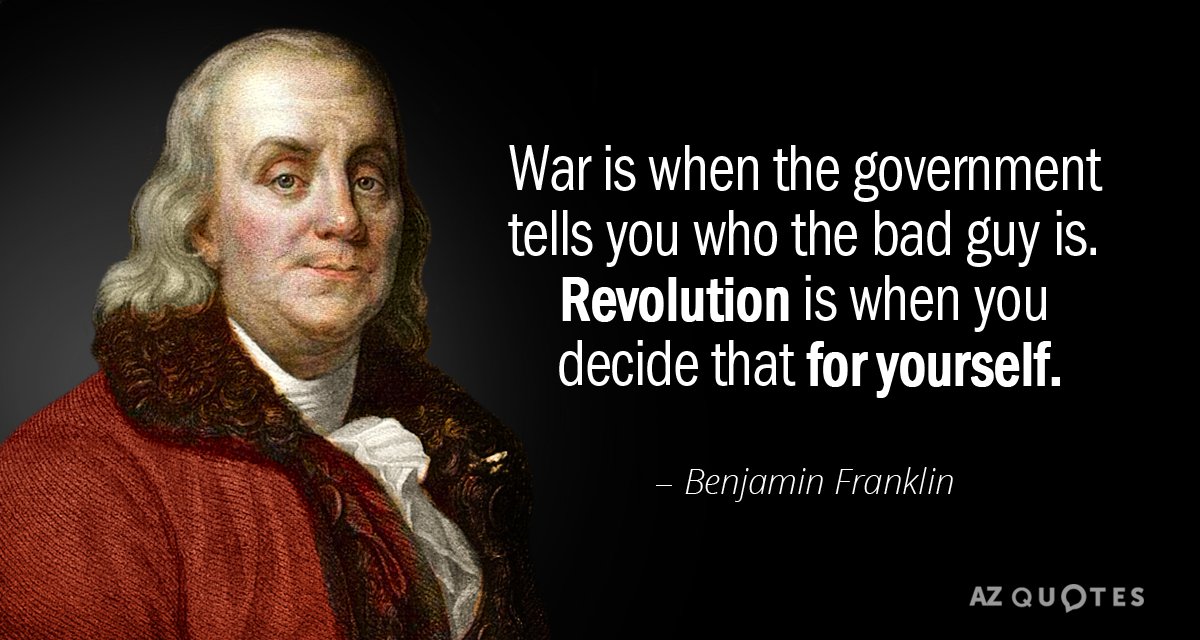
(It also gets me this one, which is hilarious because there’s absolutely no way Benjamin Franklin said this — and not just because “guy” was not commonly used to mean “that fellow over there” until around 1850, 60 years after Franklin’s death BUT MOSTLY BECAUSE OF THAT:)

TOP 25 BENJAMIN FRANKLIN QUOTES ON LIBERTY | A-Z Quotes

(I also really want that not to be a portrait of Franklin, but it probably is. Oh, well.)

But case in point, the comments on the meme that my friend shared had this image in them:

Image may contain: 3 people, beard, text that says '12:23 Kacey Elise Wheeler Kacey Elise Wheeler Yesterday Extreme Liberty 10:55 This shirt our Scofflaw collection has been really popular lately! Get while it's hot! [Link below] ...See More Those would upliberty purchase alety are bitches. Beajamin Franklin (probablyi Like Comment Share Whoolor ខ'

Which really represents what happens when people stop thinking about this stuff. Nothing wrong with wearing a t-shirt, of course; but this is not an argument, any more. Now it’s silly. Now it’s a meme.

But the best and most important thing about Franklin’s actual statement is this: it doesn’t mean what we think it means.

WITTES: The exact quotation, which is from a letter that Franklin is believed to have written on behalf of the Pennsylvania General Assembly, reads, those who would give up essential liberty to purchase a little temporary safety deserve neither liberty nor safety. [emphasis added]

SIEGEL: And what was the context of this remark?

WITTES: He was writing about a tax dispute between the Pennsylvania General Assembly and the family of the Penns, the proprietary family of the Pennsylvania colony who ruled it from afar. And the legislature was trying to tax the Penn family lands to pay for frontier defense during the French and Indian War. And the Penn family kept instructing the governor to veto. Franklin felt that this was a great affront to the ability of the legislature to govern. And so he actually meant purchase a little temporary safety very literally. The Penn family was trying to give a lump sum of money in exchange for the General Assembly’s acknowledging that it did not have the authority to tax it.

SIEGEL: So far from being a pro-privacy quotation, if anything, it’s a pro-taxation and pro-defense spending quotation.

WITTES: It is a quotation that defends the authority of a legislature to govern in the interests of collective security. It means, in context, not quite the opposite of what it’s almost always quoted as saying but much closer to the opposite than to the thing that people think it means.

SIEGEL: Well, as you’ve said, it’s used often in the context of surveillance and technology. And it came up in my conversation with Mr. Anderson ’cause he’s part of what’s called the Ben Franklin Privacy Caucus in the Virginia legislature. What do you make of the use of this quotation as a motto for something that really wasn’t the sentiment Franklin had in mind?

WITTES: You know, there are all of these quotations. Think of kill all the lawyers – right? – from Shakespeare. Nobody really remembers what the characters in question were saying at that time. And maybe it doesn’t matter so much what Franklin was actually trying to say because the quotation means so much to us in terms of the tension between government power and individual liberties. But I do think it is worth remembering what he was actually trying to say because the actual context is much more sensitive to the problems of real governance than the flip quotation’s use is, often. And Franklin was dealing with a genuine security emergency. There were raids on these frontier towns. And he regarded the ability of a community to defend itself as the essential liberty that it would be contemptible to trade. So I don’t really have a problem with people misusing the quotation, but I also think it’s worth remembering what it was really about.

Source

In the end, the things we need to remember are these: safety is important. Preserving life is important. The reasonable assurance of future safety is also important  — I don’t want to get into Maslow’s hierarchy of needs, but liberty is waaaay up at the top of the pyramid, around “self-actualization,” and safety is at the base, the second level just above food — and, dependent on circumstances, justifies a limitation on individual liberty. The preservation of liberty is equally important — but because liberty is more abstract than life, it requires more careful thought to reasonably determine what is, and what is not, a threat to liberty.

The whole reason we have the right to liberty is that we have the ability to reason. If we want to protect that right, then we must use that same reason to know when it is actually under threat. We have to think.

And stop taking memes too seriously. You know: like I just did.

Why?

The one question I ask more than any other is: Why?

I’ve done this to my students so much they get sick of me. “Why do you think that? Why do you think the author thinks that? Why does that evidence show what you think it does? Why do you think this is important?” I can keep going for an entire class period, really. And one of my favorite responses is when they try to turn it around on me, and start asking me “Why” over and over again: partly because I can usually answer the question for as long as they want to keep asking it (Well, almost: when they’re doing it to be perverse and mess with me, they ask “Why” without listening to the answers, and they’ll just keep asking it, and snickering, for as long as I let them, so I’ll cut it off after four or five repetitions. But if they’re actually listening, I’ll keep talking. Actually, that’s true all the time, and not just in my classroom.), which pleases the obnoxious competitive side of me, and partly because when they ask me “Why,” and I tell them my reasons — I often have the answer already in hand, especially if they’re questioning something like “Why are we reading this”; and when I don’t have the answer in hand, I can usually think quick enough, and speak confusingly enough (I just came across the word “obscurantist” to describe someone who intentionally obfuscates the meaning of things, and I aspire to it), to answer the question several times in a row — it helps me to figure out my reasons. I think best when I am putting thoughts into words; if I just try to think, without speaking or writing what I am thinking, I am too easily distracted by too many thoughts: what I’m doing right then, or seeing or hearing or feeling;  what I have to do, what I should be doing instead of whatever I’m doing, and so on.

I ask this question so much, and appreciate the answers no matter where or who they come from, because I like thinking about why. I think reasons are mysterious, and mystifying. I think we have them for almost everything we do, but we hardly ever know what our own reasons are. Think about that: it’s not that our actions are meaningless or purposeless; it’s that we have some fundamental disconnect between the determination of those meanings and purposes, and the actions themselves. Why is there this disconnect? Maybe because the same is true of the world around us: there are reasons and purposes for everything. There are reasons why trees exist, why the sky is blue, why scratching your back is satisfying; and purposes for electric fans and floors and nose hair. Sometimes one, either a reason or a purpose, exists without the other; sometimes they are one and the same: the reason something exists is to achieve a purpose. But  — and this is the important point — we don’t usually know what those reasons and purposes are. I mean, I sort of know why trees exist, but what about the tree outside my window? Was that one planted when my neighborhood was built? Or was it here before, and they chose not to tear it down when they built these houses? If it happened naturally, why did that tree thrive when other seedlings perished? If it was planned by the developer, why was that species of tree chosen? If it was planted as a seedling, why was that particular seedling picked out of all the others?

These reasons exist; but we don’t, and usually can’t (and maybe shouldn’t) know them. It’s maybe different with purposes, because we can deduce them pretty specifically based on evidence and logic: the tree across the way, if it was planted by a person with a purpose, is placed  to cast shade on a house, and it is an evergreen so it doesn’t drop leaves that need to be raked; I don’t know much about trees, but if we say it’s a pine, or a spruce, then maybe that would tell us if it was picked because it was cheap, or because it would grow fast, or because it would thrive in the Tucson heat. And so on. We mostly know what people want, and what they need, so we can sort of reverse engineer a lot of their choices, figure out the purpose of things that said humans have built or manipulated.

I’ve maybe made a distinction (and maybe lost it already) that doesn’t work well, in talking about reasons and purposes as if they are different things. I’m thinking of a reason as an explanation of how something came to be, the cause and effect that describes its origins; a purpose is here the justifications for a thing that exists, the goals behind the choices that led to its creation. A purpose, of course, requires a will and consciousness to make choices and have goals, and then the ability to cause something to be created. The reason for something can be just that purpose, especially if we think about things that exist as including simple actions: I made coffee this morning because I wanted to drink it. Then we can get into the reasons why coffee exists and why it came to be the thing I wanted to drink. And then, maybe I have larger purposes for wanting to drink coffee, things like wanting energy and focus, wanting to get things done that may require caffeine; if it’s something simple like “I like coffee and how it makes me feel” then I would argue there’s not a purpose for that coffee, but there is a reason.

I would also like to point out that my reasons for drinking coffee, my purposes if I have those, are probably not very interesting. Honestly, it’s a trio of reasons, only one of them purposeful: one, I don’t sleep well and am usually tired in the mornings, but I have to get up early because I have to walk my dogs before it gets hot, so I need caffeine to counteract my tiredness (Also I’m addicted to it, so I need coffee to keep myself from going through withdrawal, and to satisfy my psychological craving); two, I like the taste of coffee and am pleased by my reputation as a coffee drinker; three, I want to use my morning time to accomplish things, and coffee helps me do that. None of those are terribly interesting — though also, even those mundane things, when we get into the honest reasons and purposes, can lead to interesting conversations: why do I like my reputation as a coffee drinker? What does that mean to me? Why don’t I sleep well, and why do I use caffeine to deal with that, instead of solving the issues that ruin my rest?

See what can come of asking Why?

With human beings, I would argue that there are reasons why we exist, both as a species and as individuals, but not necessarily purpose. (I will note that people who believe in a God who created us think that there is a purpose for our existence — though again, we may not know that purpose. I’m not going to argue either way on that one. Not now, at least.)  What’s fascinating and unique about us as a species, because we are the only animal that can reason, is that we can find or create our own purpose, and thus redefine ourselves and our very existence. That’s amazing: that we can change who and what we are, by changing our Why. By turning reasons into purposes. And then past that, taking up something that was created for one purpose, or even no purpose, and finding a new purpose for it, one that serves our own goals regardless of whether or not that thing still serves its original purpose. What’s even more amazing is that we can take bad and terrible and evil things, and turn them into good things, or at least the causes of good things, by finding a positive purpose even in our suffering. As a minor example, I read constantly and ravenously when I was a child, because I was shy and awkward and therefore lonely and bored; books saved me from all of that. But now that I am a writer and an English teacher, that childhood spent reading has been turned to a valuable purpose. Two, really, because I have different purposes in those two pursuits, my vocation and my avocation. Though sometimes they serve the same purpose: because of course our purposes change, especially with those actions which we do continuously, repeatedly, and also always affirmatively: every day I go to work, I choose to continue teaching, and I have to choose, over and over again, how I will teach. As with my writing.

I have found that knowing why I teach, why I write, makes those choices easier. And that’s why I want to ask that question, and why I want to discuss it with my students and with my readers: so that they — you — can make choices as well, and achieve your purposes while helping me achieve mine. I forget my reasons sometimes, and lose them sometimes, and that makes it harder to keep choosing to do the same things. I wanted to be a successful novelist by the time I was 25; didn’t even come close. I realized that was actually a pretty dumb purpose for writing, because of the essentially randomly chosen age deadline, so moving past that reason wasn’t too hard. But twenty years later, I’m still not a famous novelist; (Notice how I changed that term, from “successful” to “famous?” I didn’t, not when I wrote these sentences; but I decided to add something, and looked back to see where the best place was to add it, and I realized what I did. This is also, I think, how we get confused about our purposes –or maybe it represents that confusion, that I haven’t defined well what “success” means, that I didn’t do that when I was 25. And maybe that’s why it didn’t happen, or at least why it didn’t hurt me much when it didn’t happen.)  and I’ve also realized, in learning more about what life is like for people who are successful and famous novelists, that maybe I don’t want to be that.

That’s fine. But then, why do I write? Why should I write?

On some level I have a reason now: I am a word guy, as I said; I think best when I put thoughts into words and sentences. And there are plenty of explanations for why I am this way, some interesting, some not. But I think we are not defined by our reasons. We are defined by our purposes. (Unless we don’t have a purpose, in which case we are defined by our reasons.)

So what’s my purpose? Why do I do what I do?

This piece actually started as  some kind of explanation for a thing I’ve started doing: I’ve started reading philosophy. Well, I guess I didn’t start; I’ve been reading philosophy for a very long time. Starting, I guess, with Jonathan Livingston Seagull, which I read in high school; I took a couple of philosophy classes in college, and I’ve been reading Bertrand Russell for quite a while, mostly because Ray Bradbury mentioned him in Fahrenheit 451, which I’ve read so many times that I got curious about who this Russell guy was — and then when my wife and I lived in Oregon, we made regular trips to Portland to go to Powell’s City of Books, I used to go wander through the FIVE FLOORS THAT COVER A FULL CITY BLOCK in search of things to buy and read, and Russell’s books of essays were short, and cheap. And interesting.

But I haven’t ever read philosophy purposefully: it’s interesting, and sometimes useful, but mostly I have had reasons but no definite goal with it. A couple of years ago, I started reading philosophy for a purpose, but I didn’t like the purpose, so I didn’t keep it up; the purpose was reinvigorated once or twice more, but never sustained the pursuit, so I kept dropping it.

I guess I’m looking for a sustainable purpose now. I’ve found another tool to help me with reading philosophy, because unlike Bertrand Russell, who was an amazing wordsmith, most philosophers are actually crappy writers. Well, I don’t know if it’s “most,” but it definitely seems a trend. I got a general philosophy book from my local Tucson used book store (Bookman’s, and they’re great — but they’re no Powell’s. I miss Powell’s.) and the writing is awful. But I found a podcast that explains the basics of philosophy, and it is both extremely easy to follow and understand, and also interesting–and, I’ve found, thought-provoking. So that makes me want to keep reading philosophy, and even read more; every episode I listen to makes me want to read more philosophy, because the show (It’s Philosophize This, with Stephen West) covers a new philosopher every episode, and so I keep adding to the list of books I want to read.

It’s a big list now. And, I’m afraid, it will be a hard list to get through. Hard to get through even one of those books, probably.

So is it worth doing? It’s a lot of time and energy I’m looking to dedicate to this. At this point, my reason for doing this is mostly — curiosity. And that’s probably not enough of a reason.

I tried  to explain my reasons to my wife the other day, and she pointed out that the reason I was giving, which I mostly made up on the spot, really just trying to figure out why I was doing it by putting it into words — it was a bad reason. I came to my blog here intending to work out a better reason why I want to do this difficult thing, why I want to spend my time on it; instead I have now been talking about why I want to ask why, for better than 2000 words.

(I hated those commercials, by the way. Even when they were first on, before I had read any philosophy or ever really thought about Why in any serious way. Why ask why? You just fucking asked it in the question, goddammit. Stupid Bud Dry. What the hell kind of product is that, anyway. Stupid name. Stupid beer.)

But you know what? I think that is the answer. I think that’s the reason, and the purpose, for reading philosophy. Because I love to ask why. Because I want to know why. And maybe the best way to figure out why, all my whys is — philosophy.

I’ll let you know what I figure out.

What are we fighting for?

HONK FER FREEDUM

Coronavirus: the US resistance to a continued lockdown

I want to understand the argument.

I don’t. And it’s vital that we understand the argument, even if we don’t agree with it; agreement is not necessary, compromise can be reached, solutions can be found even if we don’t agree.

But if we don’t understand? Then what do we do?

“We believe that the state governor has gone beyond his constitutional authority in shutting down businesses and ordering people to stay at home,” organiser Tyler Miller tells me from the grounds of the state capitol.

In mid-March Washington Governor Jay Inslee announced an emergency proclamation mirroring many issued around the world; closing restaurants and bars and banning large gatherings.

But protestors say that was unconstitutional.

“The state constitution says that the right of the people to peaceably assemble shall never be abridged. We believe that the (emergency coronavirus) proclamations that the governor here ordered violate that,” Mr Miller says.

Mr Miller said he was not protesting against the recommendations from the public health bodies and respected the need to ‘flatten the curve’.

“I even self-quarantined for 14 days back at the very beginning of this myself, when I had an illness that mirrored some of the symptoms,” he says.

“The fact I am protesting does not mean I think it is a good idea to have gatherings, I just believe that the government has no authority to prohibit them.”

Throughout the crisis, Mr Miller has also been able to continue his work as an engineering technician with the navy.

He says the thing that has angered him is what he feels it is an un-American overreach of power by the Democratic governor of Washington.

I don’t understand that argument.

There is a simpler argument, which is just that people are getting desperate: the country has been shut down in places for more than a month now, and people are facing another rent payment, another car payment, on May 1st, this coming Friday. I understand that desperation, that anxiety; I understand and (mainly) support the desire to let government officials know that you need and demand action. I think it’s a mistake to violate social distancing guidelines, and there are people in the article above and others I have seen who say things like “I have a strong immune system, I take care of myself,” who I think are somewhere between ignorant and idiotic: ignorant if they don’t know that Covid-19 has killed young and healthy people as well as older, sicker people; idiotic if they believe unfounded statements (Mostly from conservative “news” sources) that the novel coronavirus is no worse than the flu.

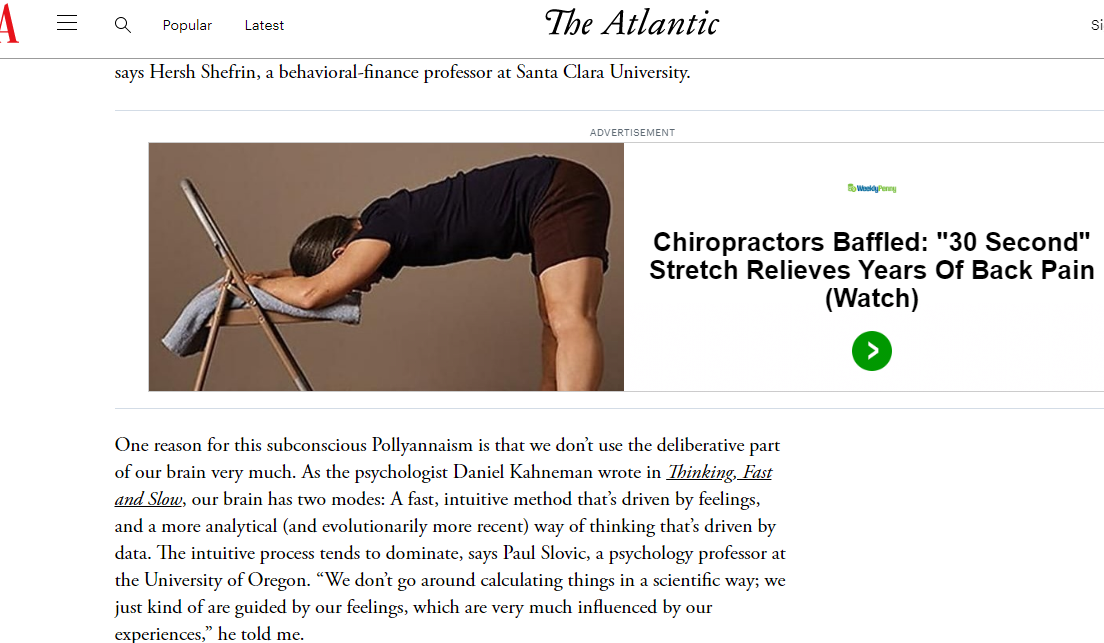
(This may be too harsh: this is an interesting article about how we are wired to be intuitive, and so underestimate the evidence that comes from outside our experience. I know I was telling my students in March that any shutdown of schools would only last a couple of weeks and would certainly not affect their graduation. On the other hand, I am not saying the same thing now, because I have learned better; I’m not sure why these people haven’t, but my two options above are certainly possibilities.

(Also, this ad popped up in that same article about people being too optimistic. Lol.

Screenshot (6)

(If you believe not only that a miracle stretch relieves years of back pain, but also that chiropractors are stunned by it, AND that chiropractors are the authority whose stunning represents a medical breakthrough, then you are unquestionably in this overly-optimistic bunch.)

But while I understand and sympathize with people who are desperate to get back to work and pay their bills, and I believe (and am infuriated) that the federal government has once again bailed out large corporations with deep political donation pockets and left average citizens to twist in the wind, I don’t understand the other argument. The freedom argument.

I don’t think it’s a reasonable argument.

Listen. I worry about government overreach. I won’t say I’m learned in history, but I know about the Japanese internment camps during World War II, and I know some things about the rise of the various authoritarian dictatorships that plagued the 20th century. I have hated the USA PATRIOT Act since it was imposed on us, during the paranoid jingoist nationalist fervor that swept the country after 9/11 and swept us into a neverending war. I know that it gets renewed every time it comes up because the government doesn’t like to give away power that it has seized. Because of that experience, I have been pointing out to my friends who argue against the lockdowns that the thing we need to worry about is the powers the government arrogates to itself after the crisis: the new regulations and limitations, and invasions of citizens’ rights, that follow a partial return to normalcy, and that are intended to prevent this kind of thing from ever happening again. We have to watch out for the permanent changes, or for the attempts, often subtle and underhanded, to make temporary changes permanent.

I don’t doubt those will happen. I think the first attempt will be by President Trump, when he decides to make his temporary limit on immigration permanent.

But see, I think that because Mr. Trump has a long history of a clearly established position to end immigration. I think that because I have read reports that Trump’s anti-immigration advisors have talked about this pause into something more long lasting. Because this article quotes DHS acting secretary, Chad Wolf, as saying to Fox News that

his agency will soon recommend a move to limit temporary work visas as well.

“That is something that the department has been looking at for the past several months, so we are well underway and look forward to presenting to the President those recommendations for additional steps,” said Wolf.

So there’s your government overreach, as part of an established pattern of behavior, aiming at known long-term targets. After the fact. Once the danger has passed. The current actions are not government overreach: they are government responding as government should to a crisis. The stay-at-home orders were issued during a crisis, and in line with scientific facts and the advice of experts. This is exactly when, and exactly why, people’s rights can and should be limited. We have the right to protest, but if you decided to walk into a burning building in order to protest the fire, people would stop you: and they would be right to. We have the right to freedom of speech, and of assembly, but you cannot gather with an army and plan the destruction of the United States: the right is to peaceably assemble, and free speech does not include sedition or criminal conspiracy. Individual rights are not limitless, not under any circumstances; even the most libertarian of us would state clearly that one person’s rights cannot be permitted to infringe on another’s, that your right to swing your fist stops where my nose begins. And of course individual rights are limited in an emergency, because the free exercise of one’s rights puts others into danger.

This is what government is for: to protect people from danger. Now, if you want to argue that the coronavirus is not that dangerous, then you’re in the wrong place. Start with this.

Then read this.

Then read this.

Then read this. 

(Especially that last one; it’s about the infectiousness of the coronavirus. And lest you think that the infectiousness of Covid-19 is lower than SARS or MERS, both of which caused fewer problems and killed fewer people, go back and read those other articles again, and then also pay attention to this quote from that last article:

“An R0 value of 1 means the average person who gets that disease will transmit it to one other person; in that case, the disease is spreading at a stable rate. An R0 of more than 1 means the disease spreads exponentially.”

And then read this essay about exponential growth.

Okay? Okay.

As I said, the government has the right and the responsibility to limit individual freedoms in response to a crisis, in order to protect the people from that crisis. (I’m aware that some people don’t agree with this: some because they don’t think the coronavirus is a crisis, and if you still think that, go back and read the above articles, but this time with your eyes open; and some because they think that nothing should ever limit individual rights under any circumstances: my above examples of protesting inside a burning building, or convening an army to overthrow the US government, are just fine, for them. I will be writing another blog about that. I’ll let you know when it’s done. The important thing is that, while I don’t agree with that argument, I understand it.) I think, though, that the basic argument behind the protests, the reason that President Trump tweeted support for people trying to “liberate” the states that have both lockdown orders and Democratic governors, is that the government is not trying to protect people from the crisis: the government is trying to control people. To take away their freedom. that’s the argument I don’t understand.

(I am also not going to write here about the elephant in the room, namely the upcoming election and the similarities — remarked on in the BBC article I linked first — between the anti-lockdown protests and Trump rallies. People who are going to the rallies just to support President Trump are certainly not reading this, and are not worth the time to put forward an argument. President Trump is probably trying to use the rallies as a way to hype his base up for the election, but he also said that he thinks Georgia Governor Brian Kemp is opening his state too soon, so I’m not going to jump on Trump today. We’ll see what happens tomorrow. Also: I understand this argument.)

But here’s the thing with tyranny: it makes sense. There is reason behind it.

That’s what’s missing from the freedom argument of the protests.

Break it down. Think it through. Okay, the government — pardon me, the govment (Read this article that I wish I wrote) — limits people’s rights to assemble and move freely, to run a business and participate in the free market economy. Because they want to establish tyrannical control over the free people of these United States.

Why?

I understand that the government has taken on, for most of the people who support these protests, the aura of Darth Sidious and the Sith: evil just for the sake of evil; power hungry just for the sake of power. But, see, that’s a character from a movie franchise, and it’s not a realistic one. I admit, if the Democratic governors were trying to raise a clone army from a mysterious source; or they were trying to corrupt a Jedi knight with incredible power but terrible self-control, then I would see the danger.

Why would the Democrats, or the government in general, want to lock people inside? I saw someone argue that the Democrats exaggerated the danger of Covid-19 in order to justify the lockdown expressly so they could destroy Trump’s economy, because that’s the only way they could beat him in the next election.

Come on.

(An argument I have seen but will not be rebutting is that Andrew Cuomo of New York exaggerated the need for ventilators so he could get…a huge excess of ventilators. Sure. As you do. He’s going to put them in one huge room and then go swimming in them like Scrooge McDuck. Swimming through the ventilators.)

First of all, there’s no way that an economy ruined by Democrats would be pinned on Trump. Trump is already positioning himself to argue that it was the Democrats who did the harm in this crisis. (Elephant in the room…) If this is provably true, if Covid-19 is really not that bad and the Democrats have exaggerated the danger, we’ll know it before November, and this Dem gambit will fail. Secondly, and more important, if they ruin the economy, they not only have no hope of winning the next election, but they lose access to the money. If  the Democrats, or the government in general, are corrupt,  they want money. Money does not come from enforcing a stay-at-home order. We are all losing money, including the government. I know they are flinging money around like it’s meaningless paper (…), but there is a limit to that because at some point the economy will actually collapse, and the more they spend now the closer that outcome gets: and why would anyone in power want that? To destroy the economy that underpins the entire system they are ostensibly seeking to control? Nonsense. There are people who want the government and the entire society to collapse, but they are not the ones in power: they are the ones without power. That’s why they want the system to collapse, because they don’t currently gain from it. The ones in the system, the Democrats in Washington and the state capitals, very much want this current system to survive, even if they are corrupt, because this system is how those corrupt people get what they want. The corrupt actions the Democrats take (And yes, many Democrats are corrupt; not all of them or only them, but yes they are.) are clearly intended to increase their wealth and their ability to stay in their current positions so they can continue increasing their wealth. That’s why we still don’t have term limits or meaningful campaign finance reform. Nobody wants to make the money go away, least of all corrupt Washington politicians.

So what’s the reasoning? Because the Democrats are secretly anti-American communists? Okay, let me try to address the idea of Dems seeking power for power’s sake; I still think that sounds like the Sith, but sure, let’s imagine that they are simply evil and that’s their reasoning. Communists, or anyone trying to overthrow the government, would be trying to seize the reins of power. They would be going after the sources of power, trying to control those so they could then get the next source of power, and so on; it’s like Risk. You conquer territory that lets you conquer more territory. You don’t just act arbitrarily, you seek the means of control. In this country, the means of control are (in no particular order): violence and force; the ballot; information; and money.

Which of those things are the Sith-Democrats gaining through the lockdown? Not money; I already talked about that. (Sure, the government is giving money to corporations, who paid the politicians. But those corporations make more money in an open economy. The same goes for people arguing that the government is trying to make people dependent on government handouts rather than their own paychecks: the money will run out if the economy doesn’t open. then the system collapses and the people in power lose.) Greater control over information? If there are secret things going on that we can’t see because we’re all staying home, then I take all of this back and apologize; let me know if the clone army executes order 66, or the Final Order fleet rises from Exegol. Otherwise the press has not seemed limited by the lockdown, and I don’t really see how it would be; limiting reporters’ physical movements seems a loser’s gamble in a world of the Internet and drones with cameras. The ballot? I mean, we’ll see when the election comes, but at the moment, the lockdown seems to play more into Republican hands because it limits voters’ access to the ballot box, which tends to favor conservative politicians.

Does the lockdown give the government more ability to commit violence, more ability to use force against the people? I honestly can’t see how. I mean, I guess they could be trying to force us to obey so we get more used to obeying, so that the next time they give us an irrational and arbitrary order, we’ll obey just because that’s what we do now. But if that were the case, they wouldn’t be using Covid-19 as their cover. Because that gives us a reason, and that means they’ll need to have another reason, as good as this one, to support their next attempt to tell us to stay home: that progression only works with weaker and weaker justifications. Using a global pandemic is not a weak justification; quite the opposite. (And notice that even this one isn’t working…)  Read 1984: O’Brien wants Winston to not only tell him he sees five fingers, he wants him to actually see five fingers; and that’s the only reason Winston gets for the months of torture he undergoes. He is very intentionally not given a reason to obey Big Brother: he just has to do it, or else he suffers. In this case, if we don’t obey, it’s not that we suffer the wrath of the government — it’s that we get sick. (And this is true.) If you want to create a totalitarian state, you need to create loyalty to the state without reason: loyalty to the state based on an emergency doesn’t cut it. Because the loyalty ends when the emergency does.

Now: if this lockdown turns out to continue past when the virus disappears. Or if the virus doesn’t disappear, either because the press is controlled and doesn’t report the true numbers of the disease (And I know people think that is happening, but I’m talking about the press saying there are thousands of cases when there are none, not the medical authorities miscounting the thousands of cases that are in existence; if anything we are undercounting the actual cases, and we all know it.), or because the government takes actions that continue the spread of the coronavirus (I mean, maybe tweeting support for protests that seem to be increasing the chances of the disease spreading would qualify as that?). Then I will agree that this is an attempt to establish tyranny. But you see what the actually despotic actions are there? Enforcing control over freedom of movement when there is no crisis. Controlling the press. Actually using biological warfare, directly or indirectly, against the people. Those are tyrannical actions.

Asking people to stay home is not tyranny. It’s concern. Even if you think it is unfounded concern, I don’t see any reasonable way to argue that it is anything other than concern.

But you know what really concerns me?

People are acting based on this argument. This argument that doesn’t seem to have any real rational basis. It honestly seems to be just “You can’t tell us what to do. Not even if it’s in my best interest.” Rebellion for rebellion’s sake. Cowboy shit. Cowboy shit that has no particular goal, no particular target; it’s just people wanting to act like cowboys. Rebels. March and wave flags. That doesn’t make any sense: but people are still doing it.

The fact that I can’t figure out the argument doesn’t concern me as much as the fact that people seem willing to act even though they don’t understand why they are acting. That’s irrational.

I don’t know how to argue with irrational people.

Even worse, I don’t know how to live in the same country with them.

People say this country is founded on the rule of law, or on the Constitution, or even on the will of God; none of that is true. It was founded on reason. The argument for the Constitution and the rule of law is reasonable, it is rational; it makes sense. The way the Constitution sets up our government is rational, every aspect of it. Hundreds of reasonable people argued — argued! Gave reasons and explanations! Appealing to the intellect of their opponents! — for years to write it. Some of the arguments were wrong, and some of the beliefs were wrong; the people making the Constitution were imperfect, and had some bad reasons, which should give way to better reasons over time — but that’s the system they set up, one in which better arguments, better reasons, will win out over worse ones. It’s all founded on reason.

The country can live through any danger, even the coronavirus. But it can’t live through the death of reason.

That’s what scares me. That’s why I want to understand, because if I can understand, I know that my opponents, even if they are wrong, are still listening to reason, and that means there’s hope.

I hope I can understand.

This Morning

This morning I am thinking about compromise.

When you compromise, when you meet your opponent halfway so that both of you get something but nobody gets everything, it feels like you — just didn’t win. Probably because humans focus more on our losses than on our gains, but maybe because ‘Merica, often it seems that all we care about is that one little bit, that minor surrender to the other side’s will. “If only I had held out longer or fought harder,” we think, “I could have won it all! I could have gotten everything I wanted!” We got some or even most of what we wanted, after all; the other party was willing to give on some things. It feels so close to victory that it hurts.

Compromise sucks. I hate giving in, and giving up something I want to the other side. I hate letting the other side have something they want, because, frankly, they don’t deserve it. They don’t deserve to win, they don’t deserve to get what they want, and they certainly don’t deserve to get what they want at the expense of what I want. Clearly what I want is more important, and if my opponent could just see that, and let me have it, that sure would be great.

But who deserves to win? I want that answer to be me, all the time, but of course that’s not true. I also want it to be the underdog, the little guy, the victim; but it’s hard to tell who’s actually a victim, sometimes. It’s easy to tell who’s the underdog, but I mean, Ted Bundy was an underdog when the State of Florida put him on trial for murder. That’s a case where it was easy to see who the victim was, and it wasn’t Bundy.

I think that the best answer is this: the one who deserves to win is the one who is right. Of course there isn’t always a right side, but if there is, if it’s me, if I actually deserve to win everything I’m asking for, and I can communicate that to the opposition — chances are they’ll let me have everything. Last week Minnesota repealed a law that shielded people guilty of raping their spouse (because marriage implies consent) with a unanimous vote at least partly because one woman brought her case to the public: Jenny Teeson’s husband drugged her and raped her — and filmed it — and then served 45 days in jail for invasion of privacy. The case was so clear, so obvious, that the right side won, completely, without compromise.

When I’m not clearly in the right, when I can’t communicate my rightness to my opponent, then maybe I don’t deserve to win outright. Maybe at that point, I should be willing to compromise. Even if I really don’t want to. Even if I still think I should win everything. There may be some advantage to compromise, then.

When I argue with my students, about an assignment, say, if I can tell them why I want it to be a certain length, and turned in on a certain day, they don’t argue with me.  And not because they respect my authority unquestionably; but because what I say makes sense. Because my assignments don’t have arbitrarily hard requirements, because I always use their assignments as teaching tools, never simply as busy work (Well, almost never), and because I know how to teach my subject, I can show them clearly why an assignment is what it is. My assignments make sense. They can see that it makes sense, and they don’t argue, and they rarely even complain.

The other reason they don’t fight me on assignments is because they recognize that when I am not right about an assignment, I am willing to compromise on it. When I give essays, I ask them how long they think they need to complete it, and when they want it to be due. If they need more time, they can ask me, and I give it. I don’t give length requirements — and I don’t then penalize them for not meeting the imaginary length requirements that were secretly in my head the whole time, which is a common enough thing for teachers to do.

So this is the other side: if there’s not a clear winner based on who’s right, then it has to follow with who’s reasonable. The reasonable side, the side that is more rational and more willing to consider both arguments rationally, is the one who will end up winning: precisely because that is the side that is more likely to compromise. Because really, everything I said about compromise feeling like a loss? Of course that’s only emotion speaking, and pissy, self-centered emotion at that. Reasonably speaking, if I go into an argument and end up agreeing with my opponent that both of us are at least partly right, that has to be considered a victory. Maybe even a better outcome than an absolute victory, because in an argument where my opponent is right and I recognize it, I will learn something, and change and grow. And then afterwards, if I have another argument with the same person, they will be more willing to meet me halfway, to recognize that my side is right at least partly, because I showed that I was willing to give up the things I wanted that maybe weren’t reasonable, or at least were less reasonable than the things the other side wanted.

The problem in this country, at least in politics, is that we stopped wanting to compromise. We decided that we wanted only to be right. Both sides — and it was both sides, regardless of which side you are on and therefore consider to be the right side, the reasonable side, the one that was still willing to work rationally on achieving workable compromises — realized that if they held out, then they could win everything from the side that was willing to compromise; and if their intransigence, their unwillingness to be reasonable and to compromise, led to a collapse of the conversation, which must be rationally considered a loss for both sides because nobody is right and nobody gets anything they want — then they could crow to their fans that they held out, that they stayed strong, and it was the other side who let everyone down because they weren’t willing to accept that MY side, the STRONG side, the side that WOULD FIGHT TO THE DEATH AND NEVER QUIT, was therefore the RIGHT side.

And irrationality wins, and everyone loses.

Compromise is the only way forward, the only way to fix this. We have to get back to a willingness to be reasonable, and a belief in the reasonable will of the other side. We have to be willing to give while we get, always, even with those who are irrational. There are principles one can’t compromise; but that’s not “all of them,” and we have to recognize that the other side also has principles that they can’t compromise, and we can’t simply say “Too bad” and go ahead with our victory dance because we let negotiations collapse.

I know. It kinda hurts me, too.

But I’m right.

Getting Deeper into Atlas Shrugged

This is the first of what may be a new category of post on this blog. As you’ve probably noticed if you’re a follower, I’ve been moving away from the usual ranting essay type of post and more into book reviews; this is intentional. But sometimes, I have more to say about a book, and when I do, I will write one of these. I’m going to call them DustNotes. (Maybe HumpNotes? No. Definitely DustNotes.)

I will also say that this one comes from requests that I got from friends, several of whom said they were glad that I had read this book because now they didn’t have to. This gave me an idea: I have plenty of TBR books of my own, of course — too many, really — but I would be willing to take requests, if there are any books that someone wants to get my opinion on. That includes new and unpublished authors, by the way; I’m willing to read and review pretty much anything you want my take on. You can email me at writeth@tonidebiasi.com if you’re interested.

For now, here are my DustNotes.


Book: Ayn Rand’s Atlas Shrugged

Concept: While the book was being written, the working title was The Strike; that is the concept. (Gotta say: Atlas Shrugged is actually an excellent title, and a clever way to describe the theme. Godlike being holding up the world, and the weight grows too much for him, so he – shrugs it off.) The Prime Movers (as Rand referred to them in her notes, though not in the novel), the most valuable members of society, withdraw from society – they go on strike – and society collapses without them. In general, these people are the Men (and the book is bloody sexist, though maybe a reflection of the times, as it was written between about 1946 and 1957) of the Mind; most of them are industrialists – an oil man, a steel man, a copper man, a man who makes cars and another who builds airplanes. Though there is also a physicist and a philosopher, a banker, and a token few artists. They are the Men of the Mind because they are extremely intelligent, extremely capable, extremely strong-willed; they are perfect rational beings, which Rand saw as the human ideal.

The reason the Men of the Mind go on strike is because they recognize that society only exists because of their contributions, but that society gives them nothing in return for what they provide to their fellow men. We need them, but they don’t need us. Not that people couldn’t live without them at all, but rather, without the Men of the Mind to prop up the society we have built which relies on them so heavily, will inevitably and rapidly destroy itself. According to this book, the Men of the Mind are good in all ways, and the rest of society are weak and lazy, incapable and, as Rand frequently states unequivocally, evil. Intentionally, utterly evil. Why? Because we don’t produce, we simply take what the Men of the Mind produce. We are looters.

Rather than get into a specific synopsis – which, considering how excessively long this book is, would be too dull to read – I’m going to break down the ideas in the book into the ones that are Interesting, those that are Silly, and those that are worth More Thought. I will probably not explain these too well; partly that’s because I’m trying to be brief about some complicated things, some of which I still need to think more about in order to understand and agree with or critique; partly it’s because the explication of these ideas came in the form of a novel that was too long by a factor of ten. I got tired of trying to understand, and Rand’s writing doesn’t make it easier. I will try to present them anyway. Here we go.

Interesting idea: man is a rational animal; a creature of “volitional consciousness.” The means of our survival is our reason, which is our ability to perceive reality and then act upon it and shape it through the application of our intellect. The “volitional” part is where Rand states that we must choose to use our rational faculty; if we do not choose to do so, then we are not human, or not good. It is interesting to state that our purpose is to think, and that thinking defines us; so many of our definitions have to do with chosen associations like nationality or religion or politics, or accidental ones like race or bloodline or family name. I like this idea.

Idea that needs more thought: the realization of man’s rational faculty is – production. Rand is very clear about this: because production is the means of our physical survival, it is the natural and correct result of our reason – which is the means of our survival, remember, so by using our reason, we produce, generally concrete value, preferably in the form of steel or coal or oil or a railroad. The pinnacle of our society, she says, our greatest accomplishment as a race—is New York City. This is also why the industrialists are the pinnacle of human achievement, because they are the most productive. I am not sure that everything that humans do qualifies as productive – if a scientific theory doesn’t lead to better steel or a faster car, is it productive? If not, does that make it evil or a waste of time? What about art? – and I am not sure that our purpose is to continue surviving through concrete productivity. More thought on this one, for me.

Silly idea: The United States of America is the greatest country in the history of the world because it was the only country founded on the idea that men should be free to use their reason and be independent individuals; all other countries are founded on random chance and evil institutions. Okay, sure, the Constitution is a genuinely special document, and the Founding Fathers were, in my opinion, some of the greatest political geniuses who ever lived, and we are the recipients of their genius; but that really doesn’t mean that every other country is a pile of shit, which is essentially what Rand says. Particularly not now, when a large number of modern nations have exactly the social and political structure that Rand claims is the only moral one – that is, capitalism (though of course, she wants it laissez-faire – but hell, America ain’t that, either.) and a foundation of individual rights. It’s American exceptionalism taken to an extreme, and it ignores both the flaws in this idealized nation and the successes of other nations. It’s silly. Though I guarantee that this is one of the reasons this book is so very popular among Americans. I should note that the book was written during the height of the Cold War, and Rand herself lived through the rise of the Soviet Union and suffered because of it; she was virulently anti-Socialist, and in the book, every other nation on Earth is socialist, and all of them are propped up by goods provided by the United States. So she might have been picking a very specific bone in a specific context; given the world of 2017, she might pick out a couple of other nations that are acceptable, the UK or Australia or Germany or South Korea or Japan.

Interesting idea: industrialists are the greatest contributors to our modern productivity. Through innovation and economic leadership, they add more to our productive capacity than anyone else, and therefore create more wealth and save more time, through freeing up people from menial labor, than anyone else in history. For this we should be grateful; instead we tend to castigate them as greedy, soulless robber barons. I hadn’t thought of industrialists this way, and I think there is validity to it (Note that you have to agree that the purpose of humanity is production to accept the full conclusion that Rand gets to, which is that the industrialist is the ideal human being, just as NYC is the ultimate achievement. I’m not there, but I can appreciate the things that industry has done for us. I’m glad I don’t have to spend my life behind a plow.). I know I have been hard on capitalists and industrialists and corporate men in the past, and this has made me realize I shouldn’t have been. Sure, of course some of them have been and are vile people; but just the fact of being a successful industrialist isn’t a crime, and shouldn’t be seen as morally reprehensible.

Needs more thought: the individual is better, in all ways, than the collective; altruism, which for Rand means sacrificing something of value for the sake of another person, is evil. This is the fundamental piece of the book’s philosophy that I have the most trouble with. The leader of the Men of the Mind has them all take an oath: “I swear that I will never live for the sake of another man, nor ask another man to live for mine.” The book argues that any gift is a sin, that the only moral interaction between people is voluntary trade, with value given for value and the consent of both parties. It is very clear that charity is evil: not only for those who ask for help, but also for those who grant help, unless it is part of a trade. Rand has to do some fancy stepping to make things like love and family fit into this ideal; she claims towards the end that giving aid to someone you deem worthy is a trade, because you as the giver gain the value of supporting someone you think worth supporting; this strikes me as a real stretch. She grants marriage the status of a trade largely because of sex; she says nothing about raising children. I don’t see how raising children can be anything but a gift from parent to child; I know I certainly can’t repay my parents for what they gave me. I suppose the possibility that I will care for them in their old age as they cared for me in my youth, but what if that doesn’t happen? Certainly it isn’t a debt that can be called in except under specific circumstances, and if it isn’t called in – isn’t that a gift?

Rand is also clear that only the person who owns a thing, a thought, an invention, a piece of property, should be permitted to judge what to do with it. Having any form of government or social control over an individual’s property is always theft. Only an individual can decide what to do with his mind, or the product of his mind; any attempt to coerce that individual is a denial of that individual’s rights, and also, interestingly, a denial of the coercer’s basic humanity: because when I claim that I need someone else to do something for me, to make a decision for me, then I am saying that I can’t make the decision for myself. I am denying my own rational capacity, which is, Rand says, what makes me human. (One of the unfortunate corollaries of this in the book is the idea that anyone who supports charity is actually a murderous, larcenous, amoral villain; everyone who isn’t a Man of the Mind in the book is essentially a caricature of a cackling mustache-twisting criminal. It gets a little tired.) The Men of the Mind in this book are always absolutely sure of their own individual decisions; everyone else can’t make a decision even when their lives depend on it. This theme is repeated so often that it turns first into a parody, and then into just repetitious drudgery. After 1070 pages of the non-awesome-people saying, “I don’t know what to do! I can’t decide! You decide for me!” and the awesome people lifting their mighty chins and saying, “No,” I wanted to freaking decide for them just to shut them up.

Point is: the idea that I have to choose what I do, that only I can choose for myself, that I must trust my own judgment over all others’; interesting idea. The argument that taxes, therefore, for any purpose other than police or courts or national defense are only theft of an individual’s property at the barrel of a gun – the libertarian ideal – still needs more thought for me, though this book did make me move a bit more libertarian and a bit less liberal, at least at the moment. The idea that this also means that I can’t ever give anything to anyone, that altruism is suicide, that EVERYTHING must be traded value for value – pretty freaking questionable.

Silly idea: All of the Men of the Mind are tall. All of them are slender, and all are white except for one Argentinian. Who’s pretty danged white, since he only speaks English, never spends time with anyone who isn’t a white American (Not when he’s in the actual narration. He does go back to Argentina, where he talks, presumably, to other Argentinians, but we never follow him there.), and has blue eyes. All of the Men of the Mind have light-colored eyes, blue or gray or green. A lot of ’em are blonde, though they are mostly tan, so not all white. But that doesn’t matter; we’re concerned with their abilities and their actions, not their appearance. Still, the book talks a whole lot about the good people being slender and the evil ones all being either pudgy or scrawny; the pattern is too consistent to be accidental, or anything other than specific intentional symbolism. And as a member of the House of Pudge, I found it annoying and distracting. Though I will note that Rand would have thought me evil. So maybe she was onto something.

Interesting idea: Happiness is the moral purpose of life. Our purpose in existing is to experience joy, the complete, fulfilling, guilt-free joy that comes with actually doing what we are meant to do. Now, this gets a little tangled around the idea of “purpose.” Our purpose as living things is to keep living, but that’s not enough for happiness; our means of living as humans is reason, but just thinking isn’t enough for happiness; our purpose in living is happiness. I’m not really sure how to parse those all out, but I like the idea that we exist to be joyful. Rand claims that our joy comes from the realization of our individual values, which I find more questionable – because in Rand’s eyes, we all have the same values, namely that we are all happiest when we are being productive, and I question that because Jeffrey Dahmer was happiest when he was murdering and eating people – but still: joy good. Rather than “sacrifice to a greater good” being our source of true fulfillment, or a specific thing like raising a family, living a good Christian life, whatever – we should live to be happy. There are interesting implications of the idea, but mainly, I just like it.

Needs more thought: Existence exists, reality is real, A is A. This comes apparently from Aristotle, so isn’t properly Rand’s thought; but it is a major theme of this book, because the book claims repeatedly (exhaustingly, just like everything else in this book) that contradictions cannot exist, that when we think we see a contradiction, we are mistaken in one of our premises – and I am very glad that I don’t have to read, again, about the Men of the Mind emitting some manly condescending chuckle and saying, “Check your premises.” Buncha know-it-all smug-butts. Apart from that, though, this is the foundation of Rand’s epistemology, and apparently has a lot to do with her criticism of modern society. It seems we make shit up a lot, and act as though it is real; in so doing, we create contradictions, and then either ignore them even as they break down our ability to progress, or use the contradiction we have created as evidence that there is nothing absolute in life, that everything is relative, which leads eventually to nihilism.

It isn’t so much that I question this tenet. It’s more that I question the converse which Rand is criticizing. It turns out a lot of this book is, for me, a straw man argument: a whole lot of the immoral collectivist thought that damages and imprisons the Men of the Mind is actually Christian thought – the idea of Original Sin, the doctrine that knowledge of good and evil led to man’s fall from paradise, the idea that suffering in life leads to bliss in the afterlife, and the basic sundering of spirit from body – and I don’t agree with any of that. So for a thousand pages, I was told that I’m an evil man who’s destroying what humanity could and should be – because of my Christian dogma. And, well: nope. I’m not a nihilist, either, so all the declarations that reality is knowable and that we can act based on our knowledge weren’t challenging for me. So I don’t know how much this philosophy changes my paradigm, and therefore how much it matters to me.

I also question the idea that there can’t be contradictions. I think maybe there can be. I get the idea that it is probably because of a mistaken assumption; when I teach paradox, I generally point out that most paradoxes rely on a specific perspective, and if you change the perspective you eliminate the paradox, which is that “Check your premises” shtick. But there are contradictions that, even if we know it is a mistake in perspective, we can’t resolve. Modern physics, for instance: Schrodinger’s cat leaps to mind. Telling me to check my premises isn’t going to fix that problem. So this one needs more thought.

Silly idea: all smart people think alike. Okay: Rand was trying to make a philosophical point about the ideal Man. Her ideal Man is an industrialist, an extremely productive person. Okay, sure. The thing is: none of the Men of the Mind are drunks. None of them are teetotalers. All of them smoke. (There is a TON of smoking in this book. Pretty funny, really.) None of them are bipolar, or manic-depressive, or have traumatic pasts. None of them are cantankerous, or impolite, or smelly; none of them habitually refuse to wear pants or eat nothing but cornbread. None of them are even gay, which would seem like the simplest way to have some variety in the characters, if you don’t go for the equally obvious choice of having a couple of them not be honkies. They all love classical music – not a jazz fan, or a blues fan, or a country and western fan in the bunch. They all believe in the value of money, and in the essential goodness of capitalism, and of productivity. They are all rationalists. When the leader tells them his secret, none of them disagree, or refuse to join the strike. (I should say: one of the real main characters, probably the most important character in the book, does refuse to join the strike. But she does it while agreeing with everything the strikers believe. Even she doesn’t think differently; she’s just more optimistic, or less beaten up by the world, than the rest of them. She’s also pretty much the only woman. Coincidence?!?) None of them are vegetarians. None of them have pets. All of them are open-minded about the same things. All of them feel the same way about everything. Now, that level of conformity follows logically from an ideal based only on a couple of very simple tenets – A is A, man is rational, only trading can be moral – but it really undercuts the message of individualism. I think it’s pretty well exemplified by the fact that at least four of the Men of the Mind are all in love with the same woman, the one female main character, the railroad tycoon Dagny Taggart. (By the way: Rand has some spectacular character names, particularly among the bad guys; but a lot of her heroes have really dumb names. Midas Mulligan is one of the dumbest. Ragnar Danneskjold and Francisco d’Anconia are fine, but a bit of a mouthful. Ellis Wyatt and John Galt are good. But Dagny Taggart? Yick.) And even though she chooses only one of them in the end, they are all perfectly happy for her, and perfectly at peace with all of their rivals for her affection. Come on: not one of them is petty? I mean, we’re all rational beings, sure, but we’re still human.

Idea that I want to label as silly but Rand seems really damn sure of it so maybe it needs more thought: compromise is evil. When John Galt speaks at the end of the book and reveals an encapsulated version of Rand’s philosophy which this book is supposed to represent, he talks about morality and right and wrong. And he says that the people in the middle of a moral argument are the worst people, the greatest evil. Someone who takes the wrong side is at least taking a side, even if they are wrong about it; people who want to compromise are the real villains. So for me, this is complete bullshit; compromise is how humans build society and survive with each other. But this book is one large slippery-slope argument; the looters – like me, with my support for taxes and public welfare – have survived as long as we have while leeching off of the Men of the Mind because the M.o.t.M. are willing to compromise with us. They give us a little; then we ask for a little more. They give us more; we ask for the rest. They give us the rest; we ask for their lives. The book depicts this as inevitable, and the only solution is what the M.o.t.M. do in this book: they stop it dead, they walk away, they say “No more!” and go on strike. Leaving all of us looters to die in chaos and bloodshed, whining pathetically that it’s all their fault.

Now, as a public school teacher, I understand the danger of a slippery slope. My school is always asking me for a little bit more, and a little bit more, and a little bit more. It does seem as though taxes just keep going up and up; the American Revolution was fought over a tax burden of about 1-3% of total income. But the fact that compromise shifts you off of your extreme position doesn’t mean that you can no longer make a stand: it means you have to select a new position somewhere more towards the middle, and stand there. Whether you stand on the far side or three steps in from the edge makes no difference; in either case, the strength of your stance is the same, whatever determination you can muster to maintaining that position. The difference is that a position somewhere in the middle acknowledges that other people have minds, as well, and probably have a point in their argument; believing Rand’s argument that I must trust my judgment above anyone else’s doesn’t mean I never listen to anything anyone else says, ever. And it doesn’t mean that I shouldn’t try to get along with other humans, which requires compromise. Rand seems to believe that life should be a constant competition, and if you aren’t the winner, then you should get the hell out of the way. Personally I think that damns the vast majority of humanity to essential worthlessness, which seems bad. But then, I don’t really like the majority of humans very much, so maybe there’s something to it.

Since I have to take an extreme position, though, I’m going to call this idea silly.


In the end I think there are better ways to get the same set of ideas, rather than reading this book. Then again, the book is still selling, still being read; maybe this really is the best form of the argument. Maybe there’s something good here that I missed, or didn’t appreciate. I will note that if you happen to be a tall, thin, money-loving independent American businessman, then accepting the ideas in this book would make you the pinnacle of humanity and the source of all good things in the world: that is a very attractive reason to think Rand has a point. If you are one of those.

But as a liberal, moderate, government employee, and member of the unproductive bourgeois, I guess I’m not one of the Men of the Mind. That’s okay: I don’t want to die, as every other character in the book does when society collapses and returns to the Dark Ages; but I also wouldn’t want to hang out with those people. They don’t read enough. And clearly, I read too much.


COROLLARY  DISCUSSION:

After I posted a link to this on Facebook, a friend and former teaching colleague of mine, who has spent far more time reading and thinking about Rand’s work than I have, commented on that link about this review/explanation of Atlas Shrugged. Her comments came in two parts because of the permissible size of Facebook comments (I had to do the same thing in my reply to her); I responded to the first half but not the second, and then she replied to me. All of that discussion is below; I’m appending it because her explanations of Rand’s thoughts and the corrections she made to my above explanations are both important and useful. There are still some things I disagree with, and still things that require more thought; the second half of her initial response requires more reading of Rand’s non-fiction, which I plan to get to eventually, and until I do there’s no point in continuing our discussion of compromise — but it’s going to end up being a sticking point, I think. At any rate, if you read this post, please do go on and read this discussion: it is very helpful. Any further discussion is entirely welcome in the comments.

The only formatting change I’m going to make is to mark quotations we both used. All her quotations are from me; I quoted myself and her response, and marked it as such. The name-links lead to our respective Facebook pages.


Jessica Porter Dusty, I enjoyed reading your take on Atlas Shrugged. Your review is more thoughtful than many I have read. I first read Atlas Shrugged about three years ago and have spent a considerable amount of time since then mulling things over and sorting through the different pieces of Rand’s philosophy to see if they stand. Your review is fair in some areas but off in others. There are several places in particular where the book’s big ideas are not quite accurately represented—and since many people are never actually going to read Atlas Shrugged but will look to reviews like this for a summary instead, I think it’s only fair to push back on a few things.
__________________


“The reason the Men of the Mind go on strike is because they recognize that society only exists because of their contributions, but that society gives them nothing in return for what they provide to their fellow men…. According to this book, the Men of the Mind are good in all ways, and the rest of society are weak and lazy, incapable and, as Rand frequently states unequivocally, evil. Intentionally, utterly evil. Why? Because we don’t produce, we simply take what the Men of the Mind produce. We are looters.”

-This summation is incorrect. It’s not that the producers are upset that society merely provides nothing in return for their contributions; it’s that what society does provide in return is contempt, derision, and threats. “Society” also steals from the producers, taking values through violence that were not offered freely, value-for-value. For the producers, this is a matter of justice. The framing of their motives is important, and your framing obscures the injustice that underlies the trade imbalance between the producers and the consumers. Your summary frames everyone who is not a producer as being a looter worthy of total contempt. For Rand, though, the label of evil is for the James Taggarts of the world: those whose entire mode of operation is looting and non-thought. Not all lesser-producers are this way in Atlas Shrugged, and Rand does not condemn all of the non-industrialists as she condemns James Taggart. What distinguishes good people from bad people, in Rand’s view, is essentially: are you trying to focus and think, or are you purposefully trying to do the opposite? Taggart seeks non-thought and non-production and is entirely happy to mooch off of others. A person could be weak, lazy, and incapable but yet still be seeking rationality, pursuing the full achievement of their values, and trying to be better. I think Rand would, in that case, not categorize that person as evil at all but as a person who is at least making a noble attempt.

“Note that you have to agree that the purpose of humanity is production to accept the full conclusion that Rand gets to, which is that the industrialist is the ideal human being.”

-This is not the case. First of all, I don’t think that Rand would even agree that there is a “purpose of humanity” at all. Individuals have purposes. Humanity as a collective does not. For each individual, though, Rand’s take is that each person’s purpose is not production, but rather the achievement of their personal happiness (which you discuss later in your post). Production of some sort is necessary for the achievement of values, but Rand is in no way stating or suggesting that industrial production is the purpose that every individual should pursue. She is also not suggesting that those who do not pursue industry are any less noble or valuable as human beings than those that do. Also, for Rand, the ideal human being is John Galt (and all of the characteristics that define him), not the “industrialist” in a disembodied, abstract sense. Galt’s skill set includes innovator, inventor, and philosopher. He is a man of thought and action, moral and practical. He is not a stand-in for Bill Gates or Elon Musk. Among other things, I think Atlas Shrugged was a thank you note from Rand to the industrialists who made the Western world great, and this is why many of the heroes in this book happen to be industrialists. In The Fountainhead, by contrast, Rand’s hero is a starving artist.

“The book argues that any gift is a sin.”

-No, the book does not argue that any gift is a sin. Rather, any sacrifice is a sin. A sacrifice, according to Rand, is “the surrender of a greater value for the sake of a lesser one or of a non-value.” For example, in the book, when Hank Reardon tolerates his wife’s denigration of his life and his values, he makes a sacrifice. Hank is giving up the full expression of his own pride and accomplishments for the sake of getting along with a wife who is an awful person. He does this merely because he assumes without giving it much thought that this is expected of him. Hank gives up (until he meets Dagny) the opportunity to be with people who actually value him for who he really is and respect him for what he values for the sake of keeping up appearances and doing what society expects a person to do. Rand would agree that sacrificial charity is evil, but she would not agree that all charity or gifts are evil.

“Rand has to do some fancy stepping to make things like love and family fit into this ideal [of love as being selfish rather than altruistic]; she claims towards the end that giving aid to someone you deem worthy is a trade, because you as the giver gain the value of supporting someone you think worth supporting; this strikes me as a real stretch.”

-It sounds like your trouble with this is that you don’t see how a love-based relationship like marriage or parenting could be fundamentally selfish and not altruistic. Ask a parent: Is your life richer for having had children? If their answer is no, then their experience of parenting would fit your framing and would be considered altruism. If their answer is yes, however, then the act of parenting, even though it takes a huge amount of work, also brings huge rewards. For many people, choosing to parent is a choice that is made in order to bring joy and fulfillment to life. By Rand’s definition, this is selfishness, not altruism. Your analysis neglects the fact that relationships do bring enormous values to many people. Watching a child you love grow up and experience the world, for example, is worth more than what it costs to be a parent for many people (which is not to say that being a parent doesn’t cost something). Same with marriage. Does marriage have a cost? Absolutely. But many people choose marriage because the rewards it brings outweigh the costs. This is not altruistic. For Rand, love is 100% a selfish act, according to her definition of selfishness, which may be worth looking into further.

“Anyone who supports charity is actually a murderous, larcenous, amoral villain; everyone who isn’t a Man of the Mind in the book is essentially a caricature of a cackling mustache-twisting criminal.”

-Be careful not to equivocate on the concept of charity as it is used in the book. If a person supports forced, sacrificial charity, then according to Rand, yes, that is bad. But if a person supports the trading of value for value, which includes non-sacrificial charity, then that is great. Also, Eddie Willers is not one of the leading industrialists but is also not characterized as a mustache-twisting criminal. What is different about Eddie that causes Rand to frame him in noble terms even though he is not in the ranks of Galt, etc? This matters. If you perceive one of Rand’s points as being that if a person is not a super star Superman industrialist, they are an evil, pathetic loser, you may be reading your own concerns into the book.

Jessica Porter

“Because in Rand’s eyes, we all have the same values, namely that we are all happiest when we are being productive, and I question that because Jeffrey Dahmer was happiest when he was murdering and eating people “

-A valid question, yet this overlooks the fact that rationality and reason are absolute requirements for true happiness. Galt sums it up well when he says, “Happiness is not to be achieved at the command of emotional whims. Happiness is not the satisfaction of whatever irrational wishes you might blindly attempt to indulge. Happiness is a state of non-contradictory joy—a joy without penalty or guilt, a joy that does not clash with any of your values and does not work for your own destruction, not the joy of escaping from your mind, but of using your mind’s fullest power, not the joy of faking reality, but of achieving values that are real, not the joy of a drunkard, but of a producer.” I am no expert on Jeffrey Dahmer, but I doubt very much that Dahmer’s actions fall into the category of non-contradictory, non-destructive joy. I suspect one would find a great number of contradictions in Dahmer’s personal philosophy.

“It turns out a lot of this book is, for me, a straw man argument: a whole lot of the immoral collectivist thought that damages and imprisons the Men of the Mind is actually Christian thought …. So for a thousand pages, I was told that I’m an evil man who’s destroying what humanity could and should be – because of my Christian dogma. And, well: nope. I’m not a nihilist, either, so all the declarations that reality is knowable and that we can act based on our knowledge weren’t challenging for me. So I don’t know how much this philosophy changes my paradigm, and therefore how much it matters to me.”

-If you don’t think that Rand’s label of evil applies to you, then why are you sure that throughout the entire book, she is saying you are a horrible person? I don’t think Rand’s criticism is so much against Christianity as it is against the altruist morality, which is 100% not exclusive to Christianity. Rand’s background was an atheist dictatorship rather than a Christian one, and as far as I know, she reviled and wanted to destroy socialism much more so than she did Christianity (although she hated Christianity as well). What makes you think that her philosophical criticisms are targeted primarily at Christian dogma?

“Compromise is how humans build society and survive with each other.”

-I recommend that you read the essay, “The Anatomy of Compromise” by Rand.

“Rand seems to believe that life should be a constant competition, and if you aren’t the winner, then you should get the hell out of the way. Personally I think that damns the vast majority of humanity to essential worthlessness, which seems bad. But then, I don’t really like the majority of humans very much, so maybe there’s something to it.”

-Where does Rand say that life should be a constant competition and that if you aren’t a winner, you should get the hell out of the way? That is not an idea I have encountered in my readings of Rand. Where are you getting this? She definitely does not shy away from judging people, but nowhere does she advise against thinking through other people’s ideas, having friends, acknowledging that other people have minds, and pursuing the values that are unique to you personally (not everyone is a steel magnate). You frame this as if Rand is some sort of non-human Nazi with a riding crop incapable of living any sort of thoughtful life with other human beings. That, I think, is a bit of a caricature. You have to take the whole of Rand’s philosophy into account, where there is plenty of room for love, connection, and thought. Compromise, not so much, but again, you should read “The Anatomy of Compromise” for more details.


Theoden Humphrey

Me in blog:'”The reason the Men of the Mind go on strike is because they recognize that society only exists because of their contributions, but that society gives them nothing in return for what they provide to their fellow men…. According to this book, the Men of the Mind are good in all ways, and the rest of society are weak and lazy, incapable and, as Rand frequently states unequivocally, evil. Intentionally, utterly evil. Why? Because we don’t produce, we simply take what the Men of the Mind produce. We are looters.”‘

You: -This summation is incorrect. It’s not that the producers are upset that society merely provides nothing in return for their contributions; it’s that what society does provide in return is contempt, derision, and threats. “Society” also steals from the producers, taking values through violence that were not offered freely, value-for-value. For the producers, this is a matter of justice. The framing of their motives is important, and your framing obscures the injustice that underlies the trade imbalance between the producers and the consumers. Your summary frames everyone who is not a producer as being a looter worthy of total contempt. For Rand, though, the label of evil is for the James Taggarts of the world: those whose entire mode of operation is looting and non-thought. Not all lesser-producers are this way in Atlas Shrugged, and Rand does not condemn all of the non-industrialists as she condemns James Taggart. What distinguishes good people from bad people, in Rand’s view, is essentially: are you trying to focus and think, or are you purposefully trying to do the opposite? Taggart seeks non-thought and non-production and is entirely happy to mooch off of others. A person could be weak, lazy, and incapable but yet still be seeking rationality, pursuing the full achievement of their values, and trying to be better. I think Rand would, in that case, not categorize that person as evil at all but as a person who is at least making a noble attempt.

Me now: You’re right, I should have included the concept of justice and injustice; it is critical to Rand’s explanation of this situation. I don’t know that I agree with her description of society’s treatment of producers, that the injustice of a trade imbalance, as you describe it, leads to contempt, derision, and threats; I suppose that is the distinction, that it is evildoers like Taggart who take us from – can I say “mere injustice?” I don’t mean to belittle the problem, but I do see a distinction between the injustice involved in taking the production of people, and doubling down on that injustice by offering them contempt, derision and threats. Taggart and his ilk take it to that point. Society – “only” – steals from the producers. I should have talked about the theft.

I don’t know that I saw that critical distinction about thought and focus being enough to earn Rand’s approbation. Yes, Taggart seeks non-thought, I saw that; but I’m not sure I agree that this book depicts a world where a lazy, weak, incapable person, who is seeking to get better, is valuable. There is a set of evildoers who are the real villains – but the workers at the 20th Century Plant, and the citizens of Starnesville who return to savagery as a result of what Jed Starnes’s heirs do, are not good. They are not as villainous as those heirs, and the guy at the end, the drifter with the clean collar – is it Jeff Allen? – whom Dagny gives a job to, is clearly one of those people who has done wrong by participating in the corruption of the 20th Century plant, but is trying to do better now, and he receives positive treatment from Dagny and from Rand. So I see what you’re saying. But he seemed the exception. I felt like the book was tremendously critical of everyone who was not on board with Galt’s ideas, in general. It seemed like ignorance was not much of an excuse. Maybe I was misreading suffering for villainy, since the villains suffer as well.

Me in blog: “Note that you have to agree that the purpose of humanity is production to accept the full conclusion that Rand gets to, which is that the industrialist is the ideal human being.”

You: -This is not the case. First of all, I don’t think that Rand would even agree that there is a “purpose of humanity” at all. Individuals have purposes. Humanity as a collective does not. For each individual, though, Rand’s take is that each person’s purpose is not production, but rather the achievement of their personal happiness (which you discuss later in your post). Production of some sort is necessary for the achievement of values, but Rand is in no way stating or suggesting that industrial production is the purpose that every individual should pursue. She is also not suggesting that those who do not pursue industry are any less noble or valuable as human beings than those that do. Also, for Rand, the ideal human being is John Galt (and all of the characteristics that define him), not the “industrialist” in a disembodied, abstract sense. Galt’s skill set includes innovator, inventor, and philosopher. He is a man of thought and action, moral and practical. He is not a stand-in for Bill Gates or Elon Musk. Among other things, I think Atlas Shrugged was a thank you note from Rand to the industrialists who made the Western world great, and this is why many of the heroes in this book happen to be industrialists. In The Fountainhead, by contrast, Rand’s hero is a starving artist.

Me now: I was confused by the idea of purpose in this book. The achievement of personal happiness comes from achievement of values, which requires some form of production; doesn’t that mean that productivity is, if not THE purpose of a human life, a critical element of it? I got lost in the idea of what is good and what is purposeful and what is valuable. I’m not explaining my confusion well, I know. I do understand that industrial production is not the key, but it is telling to me that the focus of much of Rand’s praise is related to industrial production. She talks about how innovators and inventors and industrialists have saved us time, and therefore life, along with providing the means of sustaining life, through increasing our productivity; she doesn’t say as much about the value of, say, medicine as a means of saving lives, or the value of producing art. She has a doctor character in Galt’s Gulch, so it isn’t that industrialists are the only good men – but it seemed like they were the best men. I see your point about Galt’s various qualities, but there is also the point that he specifically avoids academia to go work for a commercial, industrial concern; isn’t there a higher value, then, placed on that sphere of activity? You say it, too: “the industrialists who made the Western world great.” Did they? Is that who did it? Then doesn’t that mean that there is indeed a bias towards industrialists?

Theoden Humphrey Me in blog: “The book argues that any gift is a sin.”

You: -No, the book does not argue that any gift is a sin. Rather, any sacrifice is a sin. A sacrifice, according to Rand, is “the surrender of a greater value for the sake of a lesser one or of a non-value.” For example, in the book, when Hank Reardon tolerates his wife’s denigration of his life and his values, he makes a sacrifice. Hank is giving up the full expression of his own pride and accomplishments for the sake of getting along with a wife who is an awful person. He does this merely because he assumes without giving it much thought that this is expected of him. Hank gives up (until he meets Dagny) the opportunity to be with people who actually value him for who he really is and respect him for what he values for the sake of keeping up appearances and doing what society expects a person to do. Rand would agree that sacrificial charity is evil, but she would not agree that all charity or gifts are evil.

Me now: Okay, yes, but if a gift comes with a reward in return, then it isn’t a gift. If it is better for me to use the word “sacrifice,” so as not to taint the idea of gift-giving, then sure; I’m not trying to critique Rand by saying “She’s against BIRTHDAY PRESENTS!” I have an issue with the idea that all sacrifice is a sin, and I used the word “gift” to signify a sacrifice of value that doesn’t come with an equal return of value.

Me in blog: “Rand has to do some fancy stepping to make things like love and family fit into this ideal [of love as being selfish rather than altruistic]; she claims towards the end that giving aid to someone you deem worthy is a trade, because you as the giver gain the value of supporting someone you think worth supporting; this strikes me as a real stretch.”

You: -It sounds like your trouble with this is that you don’t see how a love-based relationship like marriage or parenting could be fundamentally selfish and not altruistic. Ask a parent: Is your life richer for having had children? If their answer is no, then their experience of parenting would fit your framing and would be considered altruism. If their answer is yes, however, then the act of parenting, even though it takes a huge amount of work, also brings huge rewards. For many people, choosing to parent is a choice that is made in order to bring joy and fulfillment to life. By Rand’s definition, this is selfishness, not altruism. Your analysis neglects the fact that relationships do bring enormous values to many people. Watching a child you love grow up and experience the world, for example, is worth more than what it costs to be a parent for many people (which is not to say that being a parent doesn’t cost something). Same with marriage. Does marriage have a cost? Absolutely. But many people choose marriage because the rewards it brings outweigh the costs. This is not altruistic. For Rand, love is 100% a selfish act, according to her definition of selfishness, which may be worth looking into further.

Me now: Correct, I don’t see how a love-based relationship can be fundamentally selfish and not altruistic. I suppose again I’m considering altruism as something other than sacrifice; I think of it as meaning “kindness.” Totally selfless kindness, if that is the definition (and according to Google it is, so I suppose I’m wrong on this), is not what I think of in regards to love-based relationships; I agree that we enter into those relationships because we gain rewards from them. I don’t think anyone thinks differently: I didn’t see Lillian Rearden as a realistic character. Is she? Is that really how people are in a marriage, demanding that the other person destroy themselves? So is there a marriage that isn’t the pure trading of value between Galt and Dagny, but isn’t the abusive marriage of the Reardens?

I think I’m having trouble understanding the distinction between trading value for value, and acting in a kind way in order to receive emotional rewards – or rather, I think there’s a distinction there that Rand maybe wouldn’t make. Maybe it is the harsh criticism of acting on feelings that runs throughout the book; I know that’s because the non-rational characters use “feelings” as an excuse for their irrational behavior, but it was hard – it is hard – not to feel incorrect whenever I talk about feelings. Like that last sentence: I see it as wrong because I said “to feel incorrect.” I know, happiness is the goal, and so if parenting brings true happiness, then that is value returned for the sacrifice (But it isn’t a sacrifice if it makes me happy. Still confused about which word to use.). But it doesn’t come from the kid, it comes from the existence of the kid; the kid doesn’t return value specifically. It’s not a trade. I think I see your point, but it is confusing.

Me in blog: “Anyone who supports charity is actually a murderous, larcenous, amoral villain; everyone who isn’t a Man of the Mind in the book is essentially a caricature of a cackling mustache-twisting criminal.”

You: -Be careful not to equivocate on the concept of charity as it is used in the book. If a person supports forced, sacrificial charity, then according to Rand, yes, that is bad. But if a person supports the trading of value for value, which includes non-sacrificial charity, then that is great. Also, Eddie Willers is not one of the leading industrialists but is also not characterized as a mustache-twisting criminal. What is different about Eddie that causes Rand to frame him in noble terms even though he is not in the ranks of Galt, etc? This matters. If you perceive one of Rand’s points as being that if a person is not a super star Superman industrialist, they are an evil, pathetic loser, you may be reading your own concerns into the book.

Me now: What exactly is non-sacrificial charity?

You’re right about Eddie Willers, and Cherryl Taggart is another one. I do not think that it is simply a dichotomy of John Galt and James Taggart. But Eddie and Cherryl both die when everything falls apart, so I dunno – didn’t seem like they were all that positive as role models for the reader. I had trouble discerning where the criticism of the looters ended and the – what, the pity? – for the regular folks who weren’t either the villains or the victims began. I wasn’t sure how much the regular folks should have been working to avoid the villainy of the looters. Are they villains to some extent because they allow the looters to control the government? Because they vote for the government officials, because they believe the propaganda, and they are not always properly grateful to the men of the mind? Because they don’t understand what the men of the mind understand?

And of course I’m reading my own concerns into the book; am I not supposed to? Am I not supposed to see how this relates to me, how I fit into this worldview? Was I supposed to read this book just as an escape, a pastime? Maybe I’m misunderstanding your comment. Are you saying that I am feeling my own guilt for my own actions and seeing Rand’s criticism of regular folk too harshly, is that it? I have no idea how to answer that, in any case. Don’t know how to step out of my own perceptions and critique them. I will say I have no idea how Rand would have seen me (I’m pretty sure I’m not a villain, but I am not a hero. I do not know if Rand would have seen me as rational. Please don’t answer that for me; I am going to continue reading Rand and figure it out for myself.), and that probably contributes to my overall confusion here. I did say a lot of this needs more thought.

Jessica Porter

1. “I’m not sure I agree that this book depicts a world where a lazy, weak, incapable person, who is seeking to get better, is valuable…. I felt like the book was tremendously critical of everyone who was not on board with Galt’s ideas, in general….Maybe I was misreading suffering for villainy, since the villains suffer as well.”

I agree with you that the book is not centered around lazy, weak, incapable people seeking to be better who are painted as noble. You are right about that. But Rand’s book is primarily a novel with a plot, and just because she doesn’t place many characters like that within this particular plot, that doesn’t mean anything in any moral sense about those characters. Atlas Shrugged is first and foremost a novel; it doesn’t seek to answer every question of Objectivism, cross every T, and refute every objection that could ever exist. There is much that goes unaddressed. Weak people trying to be better would be one of those things that Rand does not focus on in this book, although she addresses moral questions related to that in her other writings. But mostly, my point here is that just because Rand’s world in this particular novel does not include a specific thing that you are interested in or an idea that you want to see doesn’t mean that her philosophy rejects that thing. You probably wouldn’t write a pirate novel, for example, with large chapters focused on the pirate captain’s many children growing up alone without a father on an exotic island somewhere if their story didn’t contribute to the book you were trying to write. As a side note, Rand expressed in her theory of aesthetics that in any work of art, absolutely every element is and must be essential. And this, I think, is why weak yet noble characters are de-emphasized in A.S. They are just not relevant to the story Rand wanted to write, and I don’t think it’s useful to draw moral conclusions from their absence.

Also, you are right that characters like Eddie, the train hobo, and Cherryl are exceptions and that Rand expresses general criticism toward most of the Joe Schmos in the book. I think this is because Rand’s view of the average person is that most people just kind of go with the flow while the leaders set the tone for a society. Rand thought that most folks take their philosophical and political cues from the leaders and repeat whatever the leaders emit. But if the moral leaders of the day are James Taggart and his ilk and are setting the tone for the millions under them, people will likely behave badly. But that is more a tragedy of circumstance than it is a moral failing, I think. To what extent it is a moral failing, though—that is not addressed in A.S. as far as I can remember. I think the resentment you are reading in Rand’s tone has more to do with the worldview the common people have accepted from their leaders than with the fact that they are not industrialists or producers like Galt. There are two classes of people that I think you might be conflating: actual looters (people who actively contribute to and participate in stealing from the producers and create moral justification for doing so) and low-level producers (who don’t participate in politics and just do their low level jobs every day). It’s the first group, the people who forward along the looting meme, that Rand really has a hard time with.

And finally: “Maybe I was misreading suffering for villainy.” In Rand’s universe, unlike in the Christian moral universe, for example, people don’t necessarily get what’s coming to them in the moral sense. There is no karma (although her heroes always win—but that’s a different topic, I think). Rand’s point is not that what happens to people is what is just. I think her point is more that what happens to people is a combination of their personal effort, luck, their environmental circumstances, and the kind of society that they live in. So, when good people like Eddie suffer and die, Eddie doesn’t suffer because he is ignoble, he suffers because the society of Atlas Shrugged is impossible to live in.

2. “Doesn’t that mean that productivity is, if not THE purpose of a human life, a critical element of it?”

Well, yes. It is. I thought that you were trying to say that industrial production in a sterile, pre-selected, universal sense, is the collective purpose of humanity, and that industrialists are morally superior to every other kind of person in Rand’s view. I guess it really just depends on what you mean by production, and I was not sure what you meant. For Rand, production really just means, “the application of reason to the problem of survival.” Or, to quote her further (this is one of my favorite quotes on this subject), “Whether it’s a symphony or a coal mine, all work is an act of creating and comes from the same source: from an inviolate capacity to see through one’s own eyes—which means: the capacity to perform a rational identification—which means: the capacity to see, to connect and to make what had not been seen, connected and made before.“ So, yes. Production in this sense would be a necessary component of any full, human life.

3. “It is telling to me that the focus of much of Rand’s praise is related to industrial production. She talks about how innovators and inventors and industrialists have saved us time, and therefore life, along with providing the means of sustaining life, through increasing our productivity; she doesn’t say as much about the value of, say, medicine as a means of saving lives, or the value of producing art…..You say it, too: “the industrialists who made the Western world great.” Did they? Is that who did it? Then doesn’t that mean that there is indeed a bias towards industrialists?””

Rand’s point in A.S. is not that industrialists as human beings are morally superior to doctors and artists; rather, her point is that society does not recognize the enormous value that innovators have added to the world. In Rand’s view, all rational people are equally moral, but in a purely quantitative sense (entirely removed from the realm of morality) industrialists and innovators have been humanity’s greatest benefactors (after philosophers and perhaps artists). But people already know that philosophers and artists provide us with great ideas and inspiring works. Philosophers and artists are much less controversial than industrialists, who are painted as greedy, exploitative, unfeeling robber barons who love to watch children go hungry if it pads their wallets. Because of the efforts of a few great innovators (great in the sense that what they did was extraordinarily helpful to the lives of others, not great in the sense that they are more moral than any other rational person), the world is exponentially easier and more pleasant to live in. This is just a matter of economic fact, and it is a fact that was particularly important to Rand, as she saw society as completely overlooking this. Take for example, the person who invented modern agronomy: Norman Borlaug. Borlaug’s contributions, and others made billions of lives possible at the most basic level: he made it possible for them to eat. In Atlas Shrugged, Rand is trying to dramatize the millions of people starving that we in our non-Atlas Shrugged world didn’t have to see because of contributions like Norman Borlaug’s. So, yes, she does elevate industrialists, but she does so in order to reveal them as benefactors, not to christen them as the moral gods of humanity. And she does this because people do not commonly see it.

Jessica Porter

4. “But if a gift comes with a reward in return, then it isn’t a gift…. I have an issue with the idea that all sacrifice is a sin, and I used the word “gift” to signify a sacrifice of value that doesn’t come with an equal return of value.”

Really? Then is it not a gift if I treat my mom to a tour of the Japanese Gardens on Mother’s Day and then give her a gift card to the gardening store? I get a huge return of value from that—I love to see my mom feel loved and happy. Creating a situation where I get to make my mom’s life a little happier brings a lot of value to me because a world where my mom is happy is a world I want to be in. If I hated my mom, though, and if I bought her flowers for Mother’s Day even though I resent her for every moment of my childhood, would that be a proper gift according to your definition? If I were to take my mom to the Japanese Gardens and then say, “But you have to pay for lunch so that we are even,” then I would agree with you that that is not a gift. But in Rand’s world, it’s not that there is some God of Value-for-Value Payments hanging out in the sky calculating who owes what to whom. It’s more that each individual should act for her own benefit. She should do things that make the world more like a place she wants to live. If giving a gift to someone makes the world better for you, then giving that gift is not a sacrifice. It doesn’t matter where the “payback” comes from or what sort of currency it’s in. All that matters is that you receive some value from giving the thing and that you aren’t trading a higher value away to the universe for a lesser one. It does not matter where the value comes from (whether it comes from the exact person you gave the gift to or not).

5. “Correct, I don’t see how a love-based relationship can be fundamentally selfish and not altruistic. I suppose again I’m considering altruism as something other than sacrifice; I think of it as meaning “kindness.” Totally selfless kindness, if that is the definition (and according to Google it is, so I suppose I’m wrong on this), is not what I think of in regards to love-based relationships; I agree that we enter into those relationships because we gain rewards from them. I don’t think anyone thinks differently: I didn’t see Lillian Rearden as a realistic character. Is she? Is that really how people are in a marriage, demanding that the other person destroy themselves? So is there a marriage that isn’t the pure trading of value between Galt and Dagny, but isn’t the abusive marriage of the Reardens?”

I am a bit confused by your confusion. First you say that you don’t see how love-based relationships can be fundamentally selfish rather than altruistic. But then you say that you disagree with the definition of altruism in the dictionary, and you think of altruism as meaning something other than what Rand is saying that it means. (“Kindness” is not at all what Rand is talking about when she talks about altruism, just like a stingy lack of regard for others is not what she means when she talks about selfishness.) And then you say that people do enter into relationships because people gain rewards from relationships. And then you ask whether Lillian Rearden is a realistic character. I am not quite following. Rand is pretty clear about what she means by altruism and what she means by selfishness. And if people enter into love relationships because they gain rewards and they want to be kind to their loved one….then isn’t that an internally consistent way of framing selfishness? Why would the existence of a non-abusive, non-value-for-value marriage be relevant here?

6. “Maybe it is the harsh criticism of acting on feelings that runs throughout the book; I know that’s because the non-rational characters use “feelings” as an excuse for their irrational behavior, but it was hard – it is hard – not to feel incorrect whenever I talk about feelings.”

It’s not acting on feelings that Rand condemns, but acting on feelings as a primary. Emotions are supposed to be the shortcut to knowing how to respond to the world; there’s supposed to be reasoned-out values bolstering them from below. Rand condemns those who respond to the world from feelings that they themselves do not understand and do not want to understand. Feelings themselves are not being criticized. What’s being criticized is irrational action based on unexamined emotion.

7. “What exactly is non-sacrificial charity?”

Non-sacrificial charity would be the same thing as taking your mom to the Japanese Gardens and paying for lunch because her happiness makes you happy. Or giving money to a cause you believe in because doing so contributes to the world becoming more of the place you want it to be. It is giving away a value in order to receive an equal or greater value without expecting something in trade from the person who receives the gift.

8. “And of course I’m reading my own concerns into the book; am I not supposed to? Am I not supposed to see how this relates to me, how I fit into this worldview? Was I supposed to read this book just as an escape, a pastime? Maybe I’m misunderstanding your comment. Are you saying that I am feeling my own guilt for my own actions and seeing Rand’s criticism of regular folk too harshly, is that it?”

I don’t mean that you should not read the book with your concerns and worldview in mind, and I especially don’t mean to say that you must be expressing your own feelings of guilt. Not at all. I do mean that the concerns you (or anyone) brings to a book this challenging can obscure what Rand is actually getting at. If we take for granted, for example, that altruism is just kindness based on a sort of vague, culturally absorbed definition, then Rand’s treatment of altruism will probably seem contradictory or bizarre, but it isn’t either of those things. But it can be difficult to see what Rand is talking about at times if a person is not able to set aside the culturally-absorbed definition of altruism, for example. I say this after having personally struggled a lot with my own concerns clouding my ability to really follow some of Rand’s ideas all the way to the end at first. So, I did not mean any insult. If I offended, it was not intended.