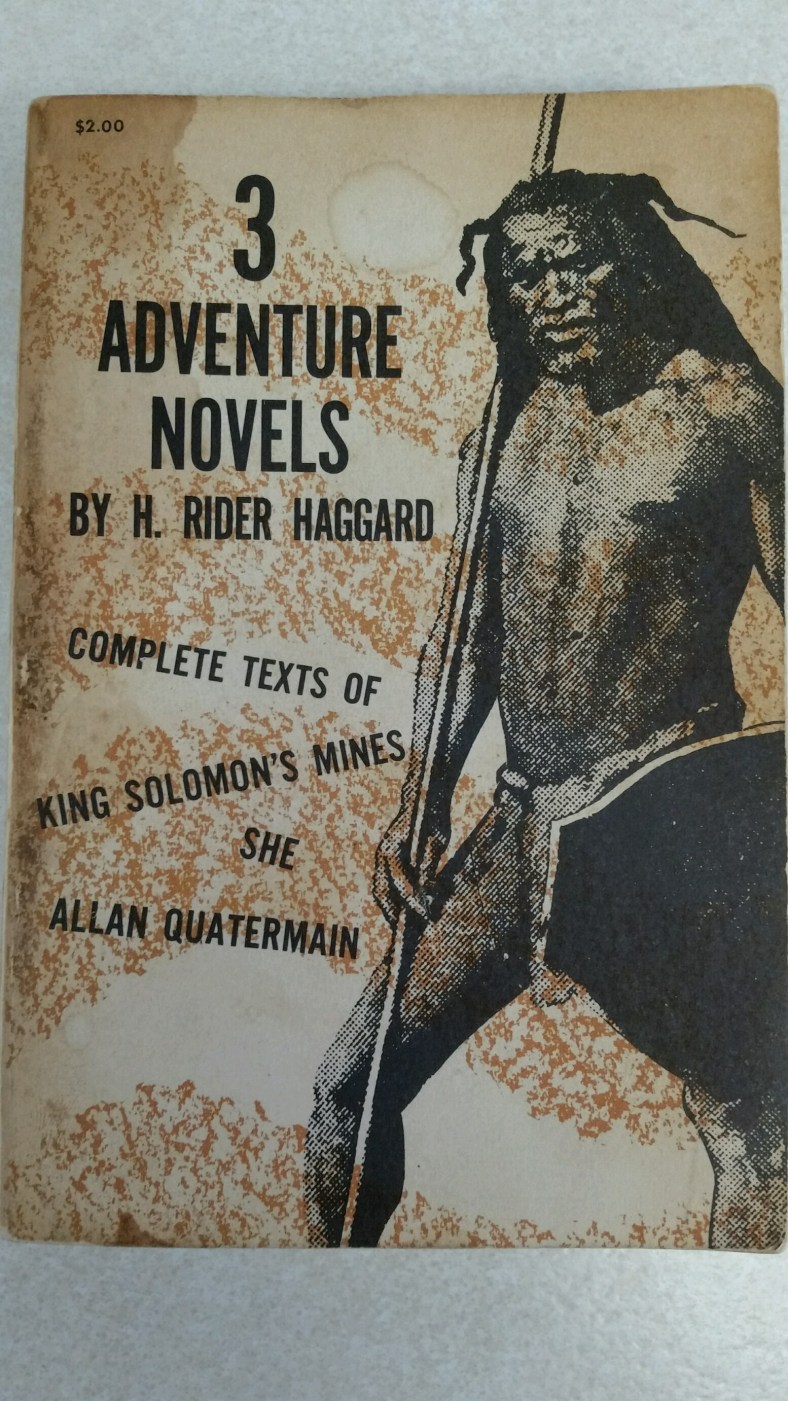
Triple Review: The Great White Hunters

20171028_085108

Three Novels by H. Rider Haggard:

She

Allan Quatermain

King Solomon’s Mines


These books made me feel bad.

First, I had some serious white guilt issues. I don’t go in for that normally; I have read Mark Twain’s Huck Finn several times, and Ralph Ellison’s Invisible Man, as well, not to mention the uncomfortable To Kill a Mockingbird. I read them, all three of those and others, out loud to my students. I admit I skip over the N-word: because I am of the opinion that, while an ideal world would lack any racial terms, or would at least have removed from the terms all power to hurt, we don’t live in that ideal world, and that word coming out of my white face as I stand at the front of the classroom with power over my students – that is not a powerless word, that is not a word that I can be sure won’t hurt anyone. But otherwise, I don’t mind reading either the silly caricatures of minorities, or the swaggering white titans (Whitans? Or all three words, and make it Swhitans?) who bestride the world like a colossus. While I want to include people of color in the authors my students read and that I read, I am not against reading a dozen great novels by dead white men. I am comfortable with being a honky.

But this book (It was all three novels in a single collection) made me uncomfortable. It was more to do with the unquestioned superiority of the white men than the savagery of the Africans; sure, the Africans were savages, described as ignorant, violent, often childish, having outlandish costumes and going in for cannibalism (With the completely absurd description in She of the tribe’s use of a heated metal pot, clapped over the head of the intended victim who is thus both tortured and killed, and then turned into stew. And they called it the Hotpot. And the goofy white character, the servant guy who played the role of Stan Laurel or Lou Costello or Kramer or Chris Farley – the guy who panics all the time – was constantly terrified of the Hotpot. “Don’t leave me alone with the savages! They will give me the Hotpot!” How do you say that with terror in your voice? I just couldn’t take it seriously.), but the bigger problem was the way the white men took over the ancient African societies they came across, simply assuming they had greater ability to lead. And not even for the usual reason of needing to bring Jesus to the heathens; no, this was usually because they had greater knowledge of guns and of how to win a battle. Which I think is, first, no good reason to assume power, and second, nonsense, at least in terms of battle: modern warfare uses modern weapons, and when you take away said modern weapons, the idea that a group of honkies who have never been in the area could lead their men to victory simply by virtue of their whiteness is absurd. Yet that is exactly what happens in both Allan Quatermain books (and it annoys me every time I see that name, because there should be another “r”), particularly King Solomon’s Mines, where the battle includes tens of thousands of African soldiers. Led by the white men to victory, just because they were white men – because the battle plan is “Get the high ground and send our best troops against their weakest.” Boy, thank god the crackers were there to explain that! No way that African civilizations that have existed for millennia could have figured that out without help. And guess who the mightiest single warrior is: well, there is much made of a particularly hardcore Zulu chieftain who travels with them; but right by his side is the biggest, strongest white man, who is better in hand-to-hand combat than people who have spent their lives doing just that – but, after all, he is British.

And then there was the penis factor. Not only did the whites win because they were whites – and in both She and Allan Quatermain, the rulers of the hidden African kingdoms were white people, mysteriously existing in the heart of Africa – but the men were worshiped as masters of all things because they were men. In King Solomon’s Mines, the rival rulers were men, so this was less of an issue; but in Allan Quatermain, there is a pair of sisters who are co-rulers of an ancient kingdom of great wealth and sophistication; and the minute that the Englishmen get there, the two queens both fall in love with the hunkiest of the three Great White Hunters; he chooses the whiter queen – the blonde one, of course; the one with the darker hair is both sluttier and witchier than the gooder, purer, whiter sister – and she not only marries him, she immediately swears to obey him in all things, stating categorically that he is her lord and he makes her feel safe and taken care of by his mighty manly parts. The queen, this is. Lifelong ruler of a hereditary monarchy, a completely self-sufficient kingdom that has been cut off entirely from the modern world. And she’s freaking swooning and mincing and clinging. Pathetic. Meanwhile, her badass witchy sister – also clearly the sexy one, though Haggard assiduously avoids even the hint of sex in all three books – denied the personal domination of the hunky honky, settles for the other white dude (Quatermain himself is somewhere around 70 in this book, and though there’s no particular reason Haggard couldn’t give him the virility claimed by all old white dudes who pretend they can have a real relationship with a hot wife half their age [TOTALLY NOT DIRECTED AT THE PRESIDENT OF THE UNITED STATES], I thought it a sign of marginally good taste that Quatermain is never considered a love interest.) who is fat and too old for her and entirely unattractive, not to mention annoying; but hey, he’s a white Englishman, so clearly a catch, right? Even for a queen? Sure, I guess so. She dies (Sorry for the spoiler – but you knew she couldn’t win; she’s the bad sister. The not-blonde one.) impaled on a ceremonial spear, which is totally not phallic. Totally not.

I have to say, I did like She. The goddess in that book is a genuinely strong female character. There is too much focus on her love life, as she chose immortality so that she could survive to see her true love reborn, which happens after a mere 10,000 years or so; but the goddess-queen character (Named She by her subjects, essentially like She Who Must Not Be Named, out of a perfect sense of awe) is the most interesting person in the story and, I thought, the most sympathetic, as the dude who is her love reborn has some ridiculous fling where he “falls in love” with a woman who nurses him when he is sick, even though he can’t communicate with her: she is humble and subservient and loyal to him, whom she loves because, errrrrrrm, because he’s a very handsome man, I guess, and so she becomes his ideal woman and he loves her. Sure, whatever. I thought he should have gone with She, who wielded power and wrath and majesty, along with being so achingly beautiful that the misogynistic protagonist falls in love with her after a single sight of her without her usual veils on, which led to a nice conflict between the white characters. I also liked the ending, and the strong implication that human power is nothing in the face of the mysteries of the universe. And there is this unbelievably warped element: the society exists inside a mountain that was hollowed out by an Atlantean-style vanished race of supermen; they still exist inside the mountain, because they had complicated and extensive burial preparations for their dead, which included a perfect form of embalming that leaves their bodies in perfect condition apparently forever: but it also makes them highly flammable. And She, the immortal goddess-queen who inherited and still rules their kingdom – uses them as torches. Their body parts. Regularly. It was gloriously twisted.

Overall, I see the draw of Haggard’s books; he wrote outstanding adventure and action scenes, from battle scenes to suspenseful travels through mysterious caves and rivers and jungles. The characters do at least inspire a response, even when it’s irritation or outright hatred. He had some really cool ideas, and amazing descriptions; I liked reading his words, which were interesting and often lovely. But seriously: tone down the Great White Hunters, like, ten notches, okay? Sheeesh.

Contempt and Hate

I don’t think most of us understand hate.

I know I don’t. I don’t think I’ve ever actually felt it.

We use the word often; I use it all the time. I hate voluntary ignorance; I hate violence and war; I hate BBQ potato chips. But we also say “love” more than, I think, we mean it: I love my dog and I love my wife, but I also say I love Ren and Stimpy (Ren more than Stimpy – though I still love Stimpy, the big goof!), and I love Cheez-Its. Obviously, the feelings aren’t the same, aren’t even similar, and I have written before about the absurdity of this language, with its incredible vocabulary and the multiple nuances and shades of meaning available in the specific words and the specific uses we can put them to, having only one or two words for a positive feeling – I “like” this, and I “love” that. Now, that actually isn’t true, we have a ton of words to describe good feelings; and it would make me ecstatic if we could start saying adore and cherish and esteem – I am fond of funny T-shirts! I hold napping in high regard! – but that’s probably not going to happen.

Considering, however, all of the talk that has been flying about regarding hate “lately,” with Charlottesville, and with the alt-right administration currently abandoning the White House like lice fleeing the comb, I think this particular word requires some serious attention. I fear we are misusing it, and therefore making a mistake in how we handle the people, the groups, and the actions to whom we apply it.

Now, as I am unsure that I’ve ever genuinely experienced the feeling of hate (which doubt makes me think that I can actually be sure that I have not, because I think if I had, I would know it), it would seem that I could not write about it; but I can speak from observation, and also from the similar emotions I have felt, as hate is on one end of a spectrum, and all of us have been somewhere on that spectrum. I also have expert testimony to draw from: because I talked to my wife about this subject, and I asked her, “Do you think you’ve ever experienced real hate?” She said “Yes” before I could even finish the question. Without hesitation, without equivocation. I don’t intend to air her dirty laundry here, but suffice to say that one of her parents is one of the best people I’ve ever known, and the other one is very much the opposite of that. (For those reading this who may actually know my wife and her family, be aware that you have never met the shitty parent; you know her step-parent, who is a fine person as well.)

Here is how she describes what she feels for that parent. Every time she thinks of this person, it makes her angry. Angry enough to do harm: to punch, to kick, to attack. Every single time. It follows her around, she said, this anger; it is a part of her, and it never goes away. This is partly due to the fact that the object of her hatred, as one of her biological parents, is also a part of her; she knows this, and she hates that it is so. Everything that she hates about this person, reflects in some way on her, either because of their connection, or because of how it makes her feel. Which just makes her angrier.

That is hate. Hate is anger that lasts, and that never goes away. Violent, intense anger, anger that taints everything around it, including one’s own self: to have something or someone in your life that you hate would make you upset with yourself for feeling this way, particularly in this culture that teaches forgiveness and resolution and closure. My wife cannot force this to heal, cannot close this wound; and so it festers and aches and weeps. This, of course, intensifies her negative feelings, because then she feels saddened that she has to continue dealing with this, that she can’t find a way to get over it or get past it; and then she naturally blames the source of that hate for bringing these other terrible feelings on her, as well, for being so hate-worthy that now she has to carry all the rest of it along with the hate.

(A final note: she is right. That parent is worthy of hate. It’s the closest that I feel to hate, as well, because of what my wife has had to suffer, and continues to suffer. The cultural trope that my wife should forgive and forget is nothing but nonsense. That person does not deserve forgiveness. Those of you who may feel the urge to say that she should turn the other cheek, that her feelings are only hurting her and will go away if she forgives: shut up. You don’t know what you’re talking about.)

I have felt anger that made me want to do violence. I have felt it several times for a single person or event, so I think I have felt some level of hate; but my hate, my anger, has always faded, and I’ve always been able to feel better afterwards. That fact has enabled me to call myself a pacifist, to say that I oppose violence in all forms at all times. Because I have always been able to escape my desire to do violence, so I have the luxury of thinking that people can always do that, can always turn the other cheek and just – calm down. (Also, I have never had to fight for my safety or my life, and so I can think that people never really need to do that.) This has made me incapable of understanding people who are members of what we blithely call hate groups: why, I think, can’t they just calm down?

There’s two answers, there, because I think there is more than one type of member in a hate group. Probably there is a spectrum as broad as the number of people in the group, but there are two categories at least we can put them into, and should. One is the group that is actually, genuinely filled with hate: every time they encounter the object of their hatred – let’s say, every time a Neo-Nazi encounters a Jewish person, or every time a Klansman meets an African-American – they are filled with a rage that brings them to violence. That rage never fades; they carry it with them, everywhere, always. It is a part of them. It is possible that they are upset with themselves, and saddened, as my wife is, that they cannot simply let that rage go; I would wager that if they lose loved ones, family members or friends that turn a cold shoulder because of the Klansman’s/Neo-Nazi’s hate, that they wish that they could just let the hate go. But they can’t: and every negative feeling that gets piled on someone who hates, gets added to the list of reasons to hate. The object of the hate receives the full blame for all of the consequences of hate. The Klansman thinks, “If those [African-Americans] wouldn’t be so awful, then my life wouldn’t be so terrible. I hate them even more for making me hate them, and for screwing up my life with that hate.”

This kind of conflict cannot be reasoned with. It cannot be cajoled away. I don’t know that it always lasts for everyone who feels it; surely some people change. But I don’t think there is a pattern to that, not a process that can be prescribed to end real, violent, hate. I think the only thing that can be done about it is my wife’s solution: separation. She never sees the person she hates, and never intends to. It doesn’t make her feel better, it doesn’t make the hate go away; but it keeps her from becoming violent. It minimizes the occasions when she has to think about it. (And I have to say: as important as I think this topic is, I feel terrible that writing this is going to drag my wife back down into everything she feels about her family. I really am sorry. She will of course read this before it is published and so it is possible, if she wishes it, that no one else will ever read it.) That’s the best we can do with the people who feel genuine hatred.

But for the rest of them – probably, I think, the majority of them – what they feel is not hatred. For them, it’s more like me saying I hate when my students ask me the same question three times in a row (“When is this due?” “Friday. It says it on the board.” “Wait – when is it due?” “Friday.” “What’s due on Friday?” “I hate you.”). That does drive me crazy; but it doesn’t make me feel violent, and it doesn’t make me feel sad. I don’t even know that it makes me angry, as such.

I think the word for what I feel at those times is: contempt. Maybe disgust, but I think disgust has a visceral, nauseous element; disgust turns one’s stomach. Students not paying attention doesn’t turn my stomach. What it does do is make me smirk at them, and think mean things about how dumb they are – after all, why can’t they read the due date on the board, right over there? Why weren’t they listening when I explained this to them not thirty seconds ago? They must be idiots. They’re not, not really: I’ve been a teacher for 17 years, and I don’t think I’ve ever had a student that I would call an actual idiot; every single one of them was either capable of doing what I asked, or had a reason (such as autism or developmental disabilities) why they couldn’t do it. The majority of them have not done the majority of what I have asked, but not because they were idiots. When I think that, it is a dismissal, a belittling, created from my contempt.

That, I think, is what most members of hate groups actually feel for the object of their “hate.” Contempt. I think their ideas are about as valid as my contempt for my students when they don’t listen, and I’d guess that every instance of contempt is similarly unfounded; it may be that their contempt is, like mine, largely projected: I get mad at my students for not listening at least in part because I know full well that I never really listened to my teachers when I was in high school. My irritation with them is certainly some irritation with my past teenaged self, seen reflected in their slack jaws and dull eyes, so like my own. It’s also true that they are most distracted when my class is most boring, and I know that when it is boring, it is mostly my fault, not theirs (though I will note that often the boring things I teach are unavoidable: somebody has to explain commas and apostrophes and the passive voice); when I taught John Knowles’s terrible novel A Separate Peace, boredom was the appropriate response. Maybe even contempt.

But I’m not all that interested in trying to understand why Neo-Nazis feel what they feel, whether it is contempt or it is hatred; I don’t really care. There isn’t a way to feel hatred for an entire race that is justified the way my wife’s hatred is justified, because an entire race of people cannot be guilty of heinous acts towards a single person. Contempt for an entire race is also moronic, as my contempt for my students would be if it lasted more than a few seconds; but after they all know what the due date is, we go back to discussion of George Orwell, and they have intelligent and interesting things to say, and I realize they’re not at all idiots, and I was being a jerk when I thought they were. I don’t understand why Neo-Nazis and Klansmen don’t have that same realization. I kinda think they’re idiots. That is the biggest difference: my contempt is only momentary, and never very serious; a Neo-Nazi feels a long-term, maybe even a permanent contempt for the contemptuous object. Enough to make him willing to join the swastika crowd. The Neo-Nazis that aren’t idiots – and of course there are some such – either feel hate, or they are those who can be turned away from their hate groups, those people who make a friend of a different race and realize they maybe shouldn’t be marching in the hate parade.

Here’s what matters. Contempt can frequently be dismissed as unimportant, because it does not incite violence. Nobody wants to hit someone they feel contempt for; the object of contempt is too pathetic, too insignificant, to go through all that trouble. You might shove them out of your way, but you would never pursue them and beat them; you would never run them down with your car, or hang them from the nearest tree. Those are acts of hate. Hate, obviously, should not be dismissed as harmless. That is not to say that everyone who hates is violent or murderous; but the emotion creates the chance of violence, where contempt does not.

I think a lot of our treatment of Neo-Nazis and Klansmen and other white supremacists is contemptuous. We make fun of them, we belittle them, we dismiss them. We feel contempt for them, because we think that all they feel for their victims is also contempt, so we don’t really worry about them doing harm. (Also: they’re idiots. I think.) By contrast, our treatment of terrorists is fearful: because we know that they feel hate, and therefore are they very dangerous. People who would set off a bomb in a crowded place are full of hate. People who would drive a car, or a plane, into innocents, are full of hate. And if and when we see white supremacists marching, at night, carrying torches, chanting “BLOOD AND SOIL!” we recognize that as more than contempt: that is hate. You watch video of police officers setting attack dogs on civil rights protesters, it is clear: that is hate. Hate, genuine hate, must be treated as something dangerous, because it is. Treating a person filled with hate as if they only felt contempt would make us vulnerable; we can turn our backs on people who feel contempt. We can get up in their faces during a rally, we can yell at them, we can follow them playing “Ride of the Valkyries” on a tuba. We can laugh at people who feel contempt. It is dangerous to treat those who hate as if they only feel contempt. That is the first mistake we have made in the past, and hopefully, the events of Charlottesville will remind us that ignoring, dismissing, belittling those who actually hate is never going to make them go away. For them, we must make them go away: we must enforce separation. Which probably means law enforcement.

But here’s the thing. When we treat those who only feel contempt as if they actually feel hate, that is ineffective, too. Because it isn’t justified: a guy who makes racist jokes doesn’t need to be on an FBI terror watch list. Some putz who hangs a Nazi flag on his house, or a Confederate flag on his truck, doesn’t need to be treated as if he is about to explode into violence. And if you confront that person and say, “You’re full of hate!” in whatever way you say that, they will say, “No, I’m not. I don’t hate anybody. I just think racist jokes are funny, and the Confederacy fought for Southern pride and state’s rights.” They may say, “I have plenty of [black/Jewish/female] friends.” And maybe they do, though I think it is hard to be friendly with someone for whom you also feel contempt. But regardless, they do not feel hate. They can reasonably deny any label that they are members of a hate group, or that they are a violent threat to a civil society. If you try to force that label on them, they can turn it around and call you intolerant, and a bigot; they can call you Communist or antifa or the alt-left. They can claim that you are limiting their freedom of speech by keeping them from speaking on your college campus. They can take the moral high ground. Then they can argue for greater freedom for their groups and their causes – and then that means greater freedom for the members of those groups and causes who actually feel hate, who are genuinely dangerous.

Then you get Charlottesville.

So the issue is, we have to make a distinction between those who feel contempt, and those who feel hate. And we have to treat them differently. The hateful must be watched, and prevented from doing harm; the contemptuous we should ignore.

Unfortunately, that’s as far as I’ve gotten in my plans for how to fix all of this. I do not know how to discern hate from contempt; they probably blend together for the observer, they may both be present in the same person. No reason why a Neo-Nazi couldn’t feel contemptuous of Jews and hate African-Americans, for instance. Or feel contempt for African-Americans and hate black policemen, specifically. A contemptuous person may get angry and sound just like someone full of hate, even if that feeling fades quickly, where it wouldn’t in someone who genuinely hates. But I do think that we will make more progress, and have better results, if we treat the two categories differently when it is clear which is which. That crying Nazi who got banned from OKCupid, for instance? That dude is not full of hate. A man who hated non-whites would hate them more after they got him banned from Tinder. He might lie about it, of course; but I think he probably would not cry.

Though maybe that thought is coming from my own contempt.

I hate that.

Lie For a Mockingbird

So I have this essay I wrote yesterday. It’s an example for two of my classes: my AP Literature students and my Honors Freshman English — the latter we enjoy calling HELA 9, while the former insists on “It’s Liiiiiiiiiitt.” I was going to write two essays, one for each class; but both are writing literary analysis, just on different works and using different prompts: HELA 9 is writing about To Kill a Mockingbird, using simple essay questions I came up with; the AP class  is writing about Macbeth, using old AP test prompts. I wrote this one about TKAM, using an AP prompt; I figured that way I could use it for both classes, without stealing anyone’s topic idea.

I don’t know if people want to read these essays I write for school; but right now, this is pretty much all I’m writing. And, as my wife pointed out when I talked to her about posting this, this is part of me, my life and who I am. And God, I love this book. Just reading the last scene to find the quotes I wanted actually made me choke up a little.

So, here you go. Enjoy. I’ll post another essay in a couple of days, and a book review as soon as I can get to it. You can always pop over and read my time-traveling pirate serial, Damnation Kane.


(2016) Many works of literature contain a character who intentionally deceives others. The character’s dishonesty may be intended either to help or to hurt. Such a character, for example, may choose to mislead others for personal safety, to spare someone’s feelings, or to carry out a crime.

Choose a novel or play in which a character deceives others. Then, in a well-written essay, analyze the motives for that character’s deception and discuss how the deception contributes to the meaning of the work as a whole.

There’s a lot to argue about in literature: was it the Lady or the Tiger, was Shakespeare one man or many (or a woman?), is it Gatsby’s fault or Daisy’s? But one thing we cannot argue about – for it is true beyond contestation – is that Atticus Finch is the best human being ever to exist. Best father, best lawyer, best person. Bar none. No question.

It says something, then, that at the end of Harper Lee’s classic, Atticus, the pillar of moral rectitude, the antithesis of all hypocrites and liars, the man who is the same on the public street as he is in his home – that man chooses to lie. And not only to lie, but to convince his young daughter, Scout – the second best person in all of literature – to lie, as well. It says that sometimes, in certain extraordinary cases, it is not only acceptable, but even good, to lie. Because sometimes, telling the truth would be like killing a mockingbird: harming someone who never did anything bad to anybody. And that, of course, is a sin.

Not all liars are good liars. Two other characters in To Kill a Mockingbird, Bob and Mayella Ewell, lie extensively, and perniciously. The court case the Ewells precipitate serves as the major conflict for the novel’s larger scope; the story is both about the children growing up, and also about this case, and how the Ewells attempt to take advantage of the prejudice of the time even as Atticus tries – unsuccessfully – to fight against it. The case is built entirely on lies, and Atticus shows the jury the truth – against their will, at least in part, because so many things would be so much easier if they could just believe that the Ewells are telling the truth. But they can’t believe that, because the Ewells are not telling the truth. Atticus shows the jury the truth, both about the specific case and also about the Ewells; and because he does, he becomes a target of Bob Ewell’s violent tendencies, his savage and furtive need for revenge; this then creates the need for Atticus’s own lie, and Scout’s as well.

Mayella, the victim of a series of family secrets, including her father’s alcoholism, his physical and mental abuse, and even his sexual abuse of his eldest daughter, tells a number of lies in the name of finding some small token of real affection – because what her daddy do to her don’t count, as we hear from her own victim. When Mayella, a 19-year-old white woman in the town of Maycomb, Alabama, in the 1930’s, decides she wants to kiss a man who is not her father, she seeks out a man she can manipulate and control: a black man. We can understand this, as Mayella has no control over her own life, which is spent taking care of her drunk father and her seven younger siblings; but Mayella wants something more than a life of filth and degradation, as we can see from the geraniums she grows and tends in the junkyard where her family lives in squalor. We appreciate this. Mayella is harmed, repeatedly, by those who are stronger and more violent than she; so when she looks for romance, she tries to protect herself from harm in this vulnerable moment – perfectly understandable. And, as far as it goes, this gives us a reason to at least forgive her various lies: she sends her siblings to town for ice cream, so that she can be alone with her would-be lover; she tells the man as he passes by that she needs help with a repair job inside the house,  so that he will come inside with her, which he would normally never do, knowing how impolite it would be considered for a black man to be alone with a white woman – and also, how dangerous. Then, when Tom Robinson, this kind-hearted man – chosen also because he is, as Scout sees, a fine figure of a man (or would be, if he were whole and not lacking the use of his left arm – and there can be little doubt of the symbolic value of that handicap for Mayella, who is frequently and savagely beaten by a left-handed man: Tom must be a man she does not need to fear), and chosen despite the fact that he is married with three young children – comes into the house, Mayella lies again to get him into her actual grasp, telling him to get her down something from on top of a tall bureau, and then grabbing him around the legs in an awkward and almost precious embrace.

All those lies for Mayella would be forgivable (Though the fact that she attempts to ensnare, through deception, a married man, makes all this much less sweet – a mood that is portrayed perfectly when Mayella tells Tom, “Kiss me back, nigger!” Ah, l’amour.) except for the most important lie, the lie that Mayella tells herself: that she can get away with this. It’s really quite absurd: we don’t know how long it would take the Ewell children to go to town and get ice cream, but neither does Mayella, and since Tom doesn’t see the children at all, they’re already on their way when Tom walks by after work. How much time does Mayella have, in the best case, for her tryst? Not even that long, of course, because her drunken abusive father returns home even sooner than the children – another circumstance she should have been able to foresee, but must have told herself was safely impossible – and catches her kissing Tom. In that moment, we see the truth of Bob’s twisted psyche: he does not rage against Tom, despite the obvious “sin” he has committed, the unforgivable sin of embracing a white woman; no, Bob yells, “You goddamn whore, I’ll kill ya!” at his daughter. Bob knows who is behind this, and we know a truth then about Bob. This truth, of his hatred of his daughter and his attraction to her, as well, leads him to beat her black and blue, even while Tom runs away.

But Tom doesn’t escape, as Mayella must have known he wouldn’t; she then turns him into her scapegoat, aided and abetted – perhaps provoked – by her father. It is not immediately clear to the reader why the Ewells do this, or even who is really behind it. Does Mayella insist that Bob help her create this fiction, in order to protect her virtue? Does Mayella see this as one small show of love she can actually garner from her father? Or does Bob run for the sheriff in order to teach Mayella a lesson? Maybe he does it to show Tom that he can’t get away with trying to put the moves on a white girl? Does Bob lie to himself about that? Do they seek only to gain the temporary approval of the white people of Maycomb, who are glad for a chance to put the blacks in their place, and might be a little grateful to the Ewells for creating that opportunity? That may be: Bob gets away with several small offenses against the elites of the town, including Atticus; he even, for a little while, gets a job, before turning back into the welfare-cheating drunkard he’s  always  been. But we don’t see any reward for Mayella. All she gets is a beating. Presumably more than one.

When Atticus argues this case in the Maycomb County Court, he describes Mayella’s act as something like what a child does when she breaks something: she puts the evidence of her crime as far away from herself as possible. Mayella, Atticus says, is putting Tom Robinson as far away from her as possible, in order to cover up her crime of lusting after a black man. Perhaps the childishness of that metaphor gives us our clue about Mayella’s role in this: perhaps she seeks only self-preservation. But I don’t think so: because it is Mayella, far more than the foolish and untrustworthy Bob, who seals Tom’s fate. After Atticus shows how much of her story is a fabrication, Mayella makes one last statement. She talks about another fiction of the time and place, Alabama in the 1930’s; a commonly accepted one. By calling up this fiction, she forces the men of the jury into a role that at least one of them (who argues for acquittal) does not want, but cannot escape. Mayella says,

“I got somethin‘ to say an’ then I ain’t gonna say no more. That nigger yonder took advantage of me an‘ if you fine fancy gentlemen don’t wanta do nothin’ about it then you’re all yellow stinkin‘ cowards, stinkin’ cowards, the lot of you. Your fancy airs don’t come to nothin‘—your ma’amin’ and Miss Mayellerin‘ don’t come to nothin’, Mr. Finch –“

In the next line of the book, Scout observes that “she burst into real tears.” Real tears, because Mayella is indeed distraught, as who wouldn’t be; but real, also, in contrast to the falsehood she just spoke. The men in the courtroom – and mostly, she is speaking to the jury, as Atticus and Judge Taylor and Sheriff Tate are unlikely to come to her defense – are not cowards, or at least not in this instance. But by insisting that she is the victim of a sexual crime, committed on her white self by a black man, those fine fancy gentlemen have no alternative but to act as Southern gentlemen would have acted at the time: they must kill the black man who defiled the innocent white girl. They cannot take the word of a black man over the word of two white people, not even when that word is the truth. And indeed, in the face of that universally accepted lie, Atticus’s fancy airs don’t come to nothin’. The jury convicts; Tom goes to jail; he is there shot and killed, supposedly while trying to escape – but that is another lie, as he is shot seventeen times, a number of wounds impossible to credit were he actually in the process of climbing the fence of the football-field-sized exercise yard. Tom was, of course, executed by the white prison guards, probably as revenge for his “crime.”

That’s a sin.

Bob Ewell tries to commit another sin, equally heinous; unable to directly harm his perceived enemies, Judge Taylor and Atticus, Bob goes after two other people who did him no harm: Atticus’s two children, Jem and Scout. Bob tries to kill them both as they walk home in the dark on Halloween. But Bob unwittingly chooses the worst possible place to make his attempt on the children’s lives: he attacks them near the Radley house, where lives the most dangerous man in the entire town: the mad boogeyman, Boo Radley. Boo Radley’s reputation is another lie, because the genuinely kind-hearted shut-in hears the struggle, and at great risk to himself, charges out of his hermit’s cave and saves the children by killing Bob Ewell with a kitchen knife. Sheriff Heck Tate investigates the scene once the children are brought home safe – by Boo, who may actually get to compete with Scout and Atticus for the title of Best Person in Literature (He’s certainly the dark horse candidate) – and then the sheriff goes to talk to Atticus about what he found. Atticus is trying to think clearly through his haze of terror about the near-murder of his children (At least partly his fault, both for opposing Bob Ewell and then underestimating the brutal drunkard’s willingness to cause harm), and trying to figure out how much red tape Jem will have to go through for having killed Bob in defending his sister, which is the story that Scout told them both. Not a lie, that one; she wasn’t able to see what really happened, and she’s guessing; Atticus takes her at her word.

But Sheriff Tate knows better: Sheriff Tate knows that Boo Radley brought out a knife from his kitchen and stabbed Bob Ewell with that knife. Tate knows this because he found Bob Ewell’s knife, a switchblade, at the scene, possibly in Ewell’s hand – he says he took the knife off of a drunk man. Tate pockets that knife, and then tells the Finches a lie: he says that Bob fell on his own knife, the kitchen knife, which Tate says Bob must have found in the dump. “Honed it down and bided his time… just bided his time.” Atticus thinks that Tate is trying to save Jem from having to go through the legal system, but that isn’t it. Tate is trying to save Boo. Because Boo is a shut-in, a deep recluse who is nervous just being in a room with other people; and if the truth comes out, then Boo will suffer.

“I never heard tell that it’s against the law for a citizen to do his utmost to prevent a crime from being committed, which is exactly what he did, but maybe you’ll say it’s my duty to tell the town all about it and not hush it up. Know what’d happen then? All the ladies in Maycomb includin‘ my wife’d be knocking on his door bringing angel food cakes. To my way of thinkin’, Mr. Finch, taking the one man who’s done you and this town a great service an‘ draggin’ him with his shy ways into the limelight—to me, that’s a sin. It’s a sin and I’m not about to have it on my head. If it was any other man, it’d be different. But not this man, Mr. Finch.”

Mr. Tate was trying to dig a hole in the floor with the toe of his boot. He pulled his nose, then he massaged his left arm. “I may not be much, Mr. Finch, but I’m still sheriff of Maycomb County and Bob Ewell fell on his knife. Good night, sir.”

And Atticus, finally understanding Tate’s point, makes the decision. He turns to Scout and says, “Scout, Mr. Ewell fell on his knife. Can you possibly understand?”

Atticus looked like he needed cheering up. I ran to him and hugged him and kissed him with all my might. “Yes sir, I understand,” I reassured him. “Mr. Tate was right.”

Atticus disengaged himself and looked at me. “What do you mean?”

“Well, it’d be sort of like shootin‘ a mockingbird, wouldn’t it?”

Atticus Finch – and Heck Tate, who is also a genuinely good man – decide to tell a lie in order to save Boo Radley from attention, which to him is equivalent to harm. The decision is surely made easier for them by the fact that Boo has not, in truth, done anything wrong; by the laws of our society, his act was justified, and no murder. But these men do not lie easily or willingly; throughout the book, Atticus has refused to contemplate saying something or doing something other than what he believes to be right. He won’t even tell little white lies: when his brother Jack explains to the very young Scout what a whore-lady is simply by putting her off with a distraction, Atticus says, “Jack! When a child asks you something, answer him, for goodness’ sake. But don’t make a production of it. Children are children, but they can spot an evasion quicker than adults, and evasion simply muddles ‘em.” And then when Scout asks Atticus what rape is, he responds by saying it is “carnal knowledge of a female by force and without consent.” Where most people would hem and haw, where even the otherwise bold and straightforward Calpurnia told Scout to ask her father what it meant, Atticus simply gives a clear and uncensored definition. He tells Scout the truth.

But in this case, in this one case, Atticus is willing to lie. He is willing to tell his daughter to lie, as well. Because Atticus knows that what makes an act a sin is not truth, or falsehood: it is harm. Because they do nothing bad to us, it is a sin to kill a mockingbird. It is not a sin to lie for one.

Never Stop! Never Stop Fighting Until the Fight Is Done!

Hey. HEY!

Stop being sad. Stop it.

I know: I feel the same way. This was not the result I was expecting. I was growing more and more stunned all last night as I watched  the results come in, and in, and in. I watched the commentators on CNN and then on BBC being just as stunned.

We didn’t think this was possible. We didn’t think this was our country.

It was possible. It happened.

And this is still our country.

It is not The Donald’s country. He did not win us. I know he thinks he did, and at some point today I’m going to have to watch a victory speech from that smug  asshole that is likely to make me vomit. He is going to have to start lying —

Wait. I honestly can’t believe I actually wrote that.

His lies, ongoing and ever more egregious, will now focus on trying to convince people he hates that he doesn’t hate them, right before he begins working to enact policy to prove that he hates them. The hypocrisy, and the assurance of our gullibility, will be infuriating. I’m already annoyed that my Republican friends are crowing over the victory. And I know I’m going to be mad a lot over the next four years, at least.

But this is still my country. And like it or not, that rotten son of a bastard is going to be my president.

My wife says he’ll never be her President. She said she may not be able to stand for the Pledge of Allegiance for the next four years.

Good.

We all know exactly what happened: millions of people looked at their options, and chose what was, to them, the lesser of two evils. Millions more of us think they chose wrong. And millions of us are racists, and sexists, and xenophobic bigots who want walls built, refugees interned, and immigrants deported.

Not everyone who voted for him. Not everyone. Millions, yes. But not everyone.

The thing that makes this worse is that we didn’t expect it. We didn’t realize this was coming. Neither did the media. This should tell us something: the discussions I have  seen of late that say that our world is turning into an echo chamber, where we only hear what we want to hear, where we only communicate with people who agree with us  and share our views, are correct. If you settled the election based on my  own Facebook feed, then Bernie Sanders would be president. If not Cthulhu.

This,  then, is our task. Tasks. There are several.

First, we have to start listening to each other. Even to people we disagree with. We have to be better than the hypocrite that just got elected, who will ignore the needs of millions of people who were not in the demographics who supported him, whom he campaigned against. We have to understand that there are millions of people who thought Donald Trump was the lesser of two (or four) evils. Millions. Those people must be heard, because the biggest reason that they voted for Trump was, I think, that they believe they have not been heard.

So listen. Take them seriously. They are people, and they are important. Not the racists and sexists and xenophobes: fuck them. But listen to the millions of rational, genuine people who believed Trump was the best choice, or at least the least-bad.

Second, we have to fix this government. Millions who voted for Trump, and millions who voted for third party candidates, and many, many millions who did not vote, believe our government is broken. It is. We have to fix it, because Trump won’t. He will take advantage of the breaks to break it more — for one thing, he’s going to nominate a hard-right pro-life conservative to the Supreme Court, and then perhaps another, since the liberal justices are aged and unwell. That means all three branches of government will be Republican, behind Donald Trump. So we must work. We must be vigilant. We must read the news — unbiased sources, if we can find them, because if the surprise on the newsmen’s faces last night says anything, it says that the liberal media bias has some validity, that the news channels, too, are become something of an echo chamber — and we must speak out, and we must organize, and we must march, and we. Must. Vote. 59,000,000 some odd votes  for Clinton, 58,000,000 some odd votes for Trump. 330 million people in the country. 219 million eligible voters.

This is broken. We must fix it. We can fix it.

Last,we have to deal with the worst part of this. Millions of Americans are sexist and racist and bigoted xenophobes. We have, it seems, spent too long considering them anachronisms and harmless cranks, and sweeping them under the rug. We pushed them out of the echo chamber. And then they found a  candidate who was just racist enough, but not too racist — “He was talking about illegal immigrants, not Latinos! He meant Syrian refugees that might be terrorists, not all Muslims!” — and sexist enough, but not too sexist — “He was just talking. He wouldn’t actually sexually assault anyone! He’s got a beautiful wife! He hires women!” — that millions of other people could stand to vote for him.

Remember that. Not everyone who voted for Trump is racist or sexist.

But there are millions who are. And we must deal with them. Not simply demonize and push them away: deal with them. Educate them. Argue with them. Fight them, if necessary: but we cannot continue to ignore them.


We can do this. We can. I mean it. We were hoping that Hillary Clinton and the Democratic party could save us, and they failed. They failed. Not us. Not those of us who voted for her, and not those of us who were too disillusioned to vote for her. We did not fail.

The only way to fail is to give up trying.

So don’t give up. Fight. Fight for the country you want, and you believe we can have. Be active: learn, and speak, and act, donate, protest, canvass, join a third party and run for political office. Always oppose Trump’s plans, if he ever actually makes any real ones. Listen to the people who voted for him, who aren’t terrible people. Fix our government. Fight the evil that has reared its head all the way into the White House: the evil of racism and sexism and bigotry.

Do something. Don’t be sad: be determined.

We  can do this.

Review: Clarence Olgibee

Clarence Olgibee

by Alan Kessler


I was asked to review this book and given a free Kindle copy in order to do so; I wish I hadn’t been. Because if this hadn’t been part of an agreement, I never would have finished this book.

This is not a good book. (If it is too presumptuous of me to actually pass judgment, then it is my opinion that this is not a good book.) The plotline makes no sense. It is purported to be a sprawling epic, and I suppose in that it covers about forty or fifty years and a dozen individual lives, it is. The problem is that there is no reason to connect all of those lives. You start with the title character, Clarence; he has a high school chum named Todd; Todd grows up to work for a man named Walters. So why do we need to hear about Walters? Or Walters’s son, Donald? Walters and Donald are certainly connected to Todd, but they are not in any way associated with Clarence – and the book is called Clarence Olgibee, not Todd Munson. Or perhaps this book is an examination of racism: then why do we spend a full third of the book watching Clarence duck his mother and try to get laid? What has that to do with racism? It seems to me that the author could not decide what his story was really about, and so he included everything that he thought of in relation to it, background material, character development, everything.

Don’t get me wrong: some of it is interesting. The part when Clarence is in the Navy was quite well done, overall, particularly the chapters in the Philippines. The author has a way with description, and also with dialogue, particularly hate speech, which enables him to create some very distasteful villains – and yeah, it was fun to see some of them get their comeuppance. But much of that is ruined by one simple fact: I can’t stand Clarence. He’s a jerk: he uses everyone around him, resents everyone, envies everyone, and complains constantly that he can’t do what he wants – when what he wants to do is nothing. As he gets older, it makes more sense, as people actually treat him badly; but for the first half of the book, when Clarence is a teenager and his only problem is that his mother wants him to do his chores and homework, and the girl he’s lusting after is a shallow, dim-witted bimbo, it’s hard to feel sympathetic as Clarence lies and cheats and manipulates the good people around him – both of his parents (because I agree with his mother) along with his friends Willard and Todd – simply because Clarence’s only influence is a cousin that crashed at his house for a few months. Now maybe that would happen, a teenager deciding to admire Cousin Ortis instead of his mother or father or friends or anyone else; but it’s hard to like him for it.

What drives me crazy, though, is the fact that the author uses this. The story is of Clarence’s redemption. He decides, at a very few times in his otherwise worthless life, to do the right thing; and when he does, it is – well, nice. I appreciated it. I thought, “Good for you, Clarence.” And then I watched him go right back into being a putz. At least when Huck Finn realizes he cares more about Jim than about his reputation, he goes about trying to free Jim. He learns his lesson. What’s the point of a redemption that doesn’t actually redeem the person? And again, if the point was that Clarence was broken by his ill-treatment in a racist society, why is the first half of the book about the villains Doing Your Chores and She Doesn’t Want To Have Sex With You? Any chance of redemption was shot for me in Clarence’s last scene with his parents. I just had to hate him after that. Because I really liked his dad. You putz.

I wasn’t going to give this book that low a rating, because I do definitely see some good things, and I think the author has potential. He needs to work on telling one story that makes sense; this book should either be about racism, or about Clarence. He also needs to work on editing: because I can overlook a lot of things, but the main character’s name is spelled at least four different ways in this book, and that’s just ridiculous. The first chapter comes back around at the end of the book, yes, but only because the first chapter is an entirely artificial situation: the protagonist at that point, Jimmy, has literally no reason to commit the crime that he does. So it’s not a mind-bending use of irony, it’s a stretch, it’s a moment that strains the reader’s suspension of disbelief. And when the ending comes back around to that beginning point, the book should end. I hit that point and my Kindle said 94%. And everything that happens after that, I found just ridiculous and maddening, in the way it completely changed the narrative and asked me to go places I neither expected nor wanted to go, and tried to redeem Clarence when it was much too late to do that. That guy, and this book, were already lost.

It’s Time for The Talk.

All right: so let’s be clear. Donald Trump is not the problem.

I didn’t want to write about this, you know. I’m trying to keep this blog focused on lighter subjects, funny things, and on books and reading and teaching. And  the Trump campaign is not funny. It hasn’t been since Iowa. Since we found out that people actually wanted to vote for him. People actually want Donald Trump to be the President of the United States.

That’s the problem.

Look — he denies that he’s a divisive incendiary racist demogogue. Who wouldn’t? I deny that I’m an subversive lazy egotist, but that doesn’t make it any less true. And one of the more disturbing things about Donald Trump (May I call him Drumpf? If you haven’t watched John Oliver’s splendid takedown of Mr. Drumpf, do so now. Though for the sake of clarity, I’ll use his actual name.) is that it seems impossible to tell if he is aware of the part he is playing, or if he is being as genuine as he can be. Because it could be that he’s playing a part, having learned how to act in this role of reality-TV-star-and-capitalist-mogul that has brought him fame and fortune; but it also could be that he is one of those lucky souls who has fit perfectly into his specific niche, and this is just who he is. The famed book of Hitler speeches by his bedside could go either way on this.

But it doesn’t actually matter if he really believes everything he says, and if he’s aware of the effect he is having on his followers and on this country, and if that effect is really his intent or if he is, as I have been arguing since the start of his campaign, just trying to increase his name recognition because that is the foundation of his wealth, himself as brand. It doesn’t matter because Donald Trump is not the problem.

The problem is that millions of Americans want to vote for Donald Trump.

And the larger problem is that the rest of us didn’t know this, and we are not doing what we should be doing to fix this.

I’ve argued with a number of Trump fans. And there are three things going on here. The first is the economy. This is the biggest reason why people want to vote for Trump: they believe that the problem with the economy is the government spending too much money, which piles up too much debt, which will bring our country crashing to its knees, just like an individual who owes too much money to credit card companies. They believe that Trump knows how to handle that, that he will stop the government from spending so much money, and he will reduce the debt, because he’s a businessman, and businessmen understand money and how to make a profit. The second thing is that Trump is a bully, and bullies are funny. People like things that make them laugh, and Trump makes people laugh. He also has a reputation for honesty, and honesty is something that Americans can’t make up their minds about.

Seriously. Let me just pause to talk about this for a moment. I ask my students every year, in one context or another, how they feel about honesty and lying. And every year, they say they prefer honesty, but think that lying is just fine in two circumstances: when the truth would hurt someone’s feelings, and when telling the truth would get you in trouble. What does that mean? That means they prefer lies, but don’t want to admit it (So they’re lying when they say they like honesty.). Because what other reasons, apart from those two, does anyone ever have for lying? People lie to spare someone else’s feelings, and they lie to cover their own butts. That’s the vast majority of lies, and if those are okay with you, then lying is okay with you. Sure, there are people who lie for profit, and people who lie for malice; I can accept those as categories of lies that even Americans don’t like. But for the most part: we prefer to be lied to. We like it. We like having our feelings spared.

And then Trump comes along and says things that most of us would never say, and would prefer never be said about us — and somehow he is admirable for doing it. He is “honest,” and we love him for it. My best understanding of this is that people believe that politicians are so dishonest and so corrupt that they lie with every word they say; and we are tired of it. So even though Americans personally would prefer some little white lies, we want a President who would never, ever lie to us. And I get that: I would prefer an honest politician, too.

There is also an impression of courage in the willingness to stand up and say ugly things. Makes the man seem tough. Comes back to the bully thing: we admire bullies. Always have. We like Sheriff Joe Arpaio, and we like mafia dons like Al Capone and John Gotti, and we love fictional characters that follow the same pattern. We like, as another Scarface would put it, a man with balls. And the willingness to offend, particularly in an arena — politics — where offending anyone in any way is shunned, and where people work very hard to twist themselves into knots  trying to please everyone all at once, saying offensive things seems like courage.

These two issues — Trump’s business acumen as a cure for the economy, and his crass rudeness as A) a source of humor, B) a sign of honesty, and C) a sign of courage — are reasonable enough, are understandable enough. Trump isn’t the first guy to earn our admiration for his crass rudeness: pretty much every famous radio DJ and half of the talk show hosts and stand-up comedians we love are exactly the same way. Why do we like Roseanne Barr? Howard Stern? Rush Limbaugh? Simon Cowell? All the same reasons we like Trump. As for the business thing, that has roots that go back probably as far as the United States: we have always believed that there is something special, some secret knowledge, that comes with wealth; we always think that someone who knows how to make money one way knows how to make money all ways. As if that first million — or billion — dollars is a key that unlocks the Midas touch. Carly Fiorina ran on exactly the same platform, as did Herman Cain in 2012, and Mitt Romney in every campaign he ran.

But then there’s the third reason why Trump is winning. And it’s the most disturbing. The third reason is that Trump is a bigot. He denigrates and objectifies women, an attitude that you can see reflected in the malice and bile that Americans direct at Clinton. He treats Muslims and Latinos, and women, like Untouchables: fine as long as they stay in their place and know who’s boss, but needing a lesson as soon as they get uppity and start breaking the rules that are meant to keep them in their place, separate from the nice white Christian American folks (Or, in the case of women, barefoot and pregnant in the kitchen.). And that message resonates. It resonates strongly. There are millions of Americans who feel exactly the same way, particularly about those two racial/ethnic groups. Never mind that illegal immigrants (the epithet Trump uses for Latinos, because that wording divides the “bad Latinos” from the “not so bad ones” — you know, the ones that stay in other countries instead of coming to this one) and legal immigrants, which comprise all racial groups and nationalities — but when Trump is talking about building a wall on the southern border, he isn’t talking about Asians coming to California on cargo ships or Europeans overstaying their visas — are actually good for the country, bringing a necessary labor force and a positive addition to the cultural mix. Never mind that Islam is no more violent or dangerous a religion than every other: that is to say, when fanatics use it to convince others to commit violence, it is a staggeringly effective tool; but if guns don’t kill people, neither does Islam. Never mind that women are better than men (That’s right. I said “better.” My wife is smarter and more talented than me. More organized, harder working, more reasonable and level-headed. Better.), and even though I personally support Sanders, I would dearly love to see Hillary Clinton debate Donald Trump. Because she’ll grind his bones to make her bread, and all he’ll be able to do is make a comment about menstruation.

The truth is, millions of Americans believe women should submit to men. The truth is, millions of Americans hate and fear Muslims and Latinos. They fear that Latinos will take over this country and make it different; and they fear that Muslims are terrorists. And they want a leader who thinks like they do.

The problem isn’t Donald Trump. It’s that despite all of the progress we have made since the Civil Rights era, despite all the political correctness and the affirmative action and everything else we have tried to do to achieve racial equality and a just society, we haven’t really done anything. We haven’t really changed anything. But we’ve convinced ourselves that we have: we elected a black President, after all. And the Ku Klux Klan is no longer hanging people by the side of the road in broad daylight. So surely we have improved; surely the problem is less now.

But it’s not. And the problem is still here because even those of us who want to try to fix the problem are not going about it the right way.

I said it above: I’ve been arguing with people who support Donald Trump. I’ve been doing it frequently, on Facebook; my students would never try to challenge a teacher on a political issue: they know how angry people get about politics, and while they don’t mind arguing with their teachers, they don’t want to make us mad for fear of grade-related consequences. And though I argue as reasonably and courteously as I can, people get angry about politics. I get angry about politics. No, that’s not true: I don’t get angry about the topics. But when someone I’m disagreeing with says, “Lol, your a retard. You need to grow the fuck up.” then I tend to get angry.

My wife can always tell. The volume and speed of my typing always goes up when I’m mad, as I start hitting the keys harder and faster. “Are you arguing again?” she asks. “Yup!” I say, pounding away. Telling someone that I don’t need to grow up, they need to learn how to think.

And that’s what we’ve been doing. Those of us who don’t support Donald Trump, who can’t believe that other people support Donald Trump, have begun every discussion with his supporters with “What the hell is wrong with you? Trump? Really? What are you thinking?!?” But they’re thinking what I listed above. They are thinking reasonable things.

You cannot convince people who are thinking reasonable things to change their minds by telling them they are unreasonable. Just like I get mad when someone says “Lol, your a retard.” That is no different from saying, “How can you support Trump? What is wrong with you!” You cannot win an argument by insulting your opponent.

To deal with Trump as a candidate, people need to treat him as a candidate: the people who support him for rational reasons need to be talked to like rational people. They need to be questioned fairly, and their answers listened to, and then, perhaps, argued with if we can do that without losing our tempers. I hope that the two people running against him (whichever wins the nomination) will behave like the long-time politicians they are, and focus on his ideas and qualifications, and refuse to go down to his level and have a bully-fight. If they can stay rational and courteous, I don’t doubt that Trump will lose the general election. The fact that gets lost in the uproar and hoopla is that he really doesn’t know what he’s talking about when it comes to running a country. Because he is not a politician, he is not a government worker, he is not an elected official: he has no experience. He does not know what he is doing. Businessmen can run businesses, but the country is not a business. But that is not our argument: that is either Bernie Sanders’s or Hillary Clinton’s argument.

What the rest of us need to focus on is going back to square one. There are bigots in this country. Millions of them. Our current system of affirmative action and token representatives (“The Oscars/Hollywood aren’t racist! Halle Berry won Best Actress in 2002!”), paying lip service to real understanding through nonsense like politically correct speech, have done nothing. If anything, we have pushed the problem underground, where it can fester and swell. And now it’s bursting out. Which means, as hard and uncomfortable and ugly as it is, now is our chance to clean out the infection.

We have to deal with racism. We have to fix this problem at the root: and the root is not Donald Trump. Donald Trump is not the problem.

We are.

Tell me about the rabbits again, George.

I’ve decided I want to be stupid.

If I were stupid, I couldn’t be a teacher. No, that’s not true: I couldn’t be a good teacher, but we all know there are plenty of bad teachers out there. So I wouldn’t be a good teacher any more, which is sad; but I wouldn’t know it, so there wouldn’t be any problem. What’s more, I wouldn’t ever worry about being a good teacher. I’d never have to worry about whether my students were really understanding the point I was trying to make, because I’d never have a point. I wouldn’t have to read their essays any more, and write comments on them trying to make them better, and feel the frustration when they don’t pay any attention to those comments but go right on making the same mistakes; I could start grading essays according to how many words they are and whether they follow MLA format perfectly and how many words over three syllables they use. I wouldn’t realize the damage that standardized testing does to students, and to education, because I wouldn’t understand the purpose or the power of education, and I wouldn’t know what an opportunity is lost when students are beaten down with tests; I’d just do what I was told, and teach to the test, and threaten my students with bad grades if they don’t pass. So I’d never have to worry about lesson plans ever again. I would swallow all of the snake oil that gets sold to teachers, and I’d believe everything the salesmen said about it, so I could change entirely my policies and lesson plans and teaching methods every three or four years; so I wouldn’t even get bored. Every day would be a PowerPoint presentation and a jigsaw lesson, followed by a standardized test. And you know what? I bet my students would love me. Because they’d never have to think, either.

If I were stupid, I couldn’t be a writer. But wait: that isn’t true, either. It just means I couldn’t write well. But – assuming I still wanted to be a writer, which I probably wouldn’t because I wouldn’t be able to see the world the way I do now and I wouldn’t care about what I couldn’t see; I wouldn’t believe that art could help make the world a better place, as well as making me a better person; I wouldn’t even believe that writing was an art, because I’d think that art was only painting pictures. So if I were a stupid writer, that would work out great: because my books wouldn’t take so long to complete, and I wouldn’t have to work so hard to write them well. I could just vomit out whatever drivel I wished about super-powered vampire werewolves who drive around at night in Lamborghinis (which I’d always call a “Lambo” because I couldn’t spell the full name) –

Dear God, I wouldn’t have to worry about spelling any more.

– fighting demons with their super-powered vampire werewolf kung fu and having sex with hot chicks at the same time. Then I could self-publish my e-books on the internet.

I bet they would sell a million goddamn copies.

I could stop reading challenging books: right now I am reading Arundhati Roy’s The God of Small Things because I will be teaching it to my AP class, and I am also reading Bertrand Russell’s Wisdom of the West (a condensed version of his three-volume A History of Western Thought) because I admire the hell out of Bertrand Russell and I am thirsty for more understanding of philosophy. But fuck that – sorry, screw that (if I were stupid, I’d believe that cursing is bad, especially the F-word): if I were stupid, I wouldn’t be teaching that strange and wonderful and ethereal and challenging novel; it’s got weird sexy stuff in it, and I’d know that was wrong to show to little kids like the high school juniors in my AP class. Plus I wouldn’t understand it because the story jumps around a lot and the plot is hard to follow. Plus I wouldn’t like it because it isn’t set in America and there aren’t any super vampire werewolves in it. Plus my class wouldn’t teach any full novels, because that takes too long and isn’t necessary to pass a standardized test that only asks you to read short passages and excerpts. And there’s no way I’d read philosophy, especially not a survey of philosophy starting in ancient Greece; I’d think the Greeks were homos and philosophy is gay. I’d get rid of every book like that and just read James Patterson. And books about sports. Though I’d prefer the audio books, because it’s easier and faster and not as boring.

Speaking of sports, I could watch football instead of spending my Sundays doing school work or reading or writing, and go to bars at night with my buddies and drink beer (and I’d just drink cheap American beer, instead of having to take the time to peruse the menu looking for good beer) and watch more sports and yell real loud when my favorite sports-squadron scored a goal-unit-basket. And I could wish that I had been good enough at sports to go pro, but known deep inside that it would never have happened, because I’m white and black people are better at sports. Which is why I would like baseball and hockey and NASCAR so much, because lots of white people are good at those sports. Though not hockey as much because they’re all Canucks and Russkies. Though watching the fights would be fun. And I could watch MMA and laugh when Kimbo Slice (That’d be a great name for one of my super vampire werewolves! Maybe I could change it to Jimbo, and then he wouldn’t sue me. Then I could make him white, too.) challenges his opponent to actually compare testicle size during a pre-fight interview.

Though I would have to worry about the size of my genitalia. And whether the size of my hands and feet gave an accurate representation of that size.

Speaking of hand and genital size, if I were stupid, I wouldn’t have to argue and debate and worry about politics: I could just vote for Donald Trump to make America great again, and go back to watching football. And then I could watch Fox News and never have to worry about reading or thinking about what is going on in the world: I could just be sure that America is the best country, that we have to have a strong enough military to keep everyone from invading us, but that if they did invade us, I’d be ready with all of my guns to fight them back, just like in Red Dawn, which would be one of my favorite movies. And maybe I’d have to worry about that socialist Bernie Sanders getting voted in, but I’d be pretty sure, in my heart of hearts, that America would never let that happen: I’d probably secretly believe that the Statue of Liberty and the statue of Rocky Balboa would come to life and drag Sanders down into New York harbor. And I’d never worry about that broad Hillary getting elected over The Donald: no way would America pick a woman over a man. We all know you can’t trust a woman with power – what happens when she has her period? She’d fire the nukes if she didn’t get enough chocolate ice cream! (I would have written Haagen-Dazs, but I can’t spell that, either. And Ben and Jerry are socialist hippies.)

I would believe that a wall on the border could keep out Mexican illegal immigrants. I’d believe that immigrants are bad. I could ignore uncomfortable irony like the history of my own family’s immigration to this country. Because I’m white.

I could chant “USA! USA!” without irony. And tear up when a small child or a crippled person sings the Star-Spangled Banner at my ballgames. And secretly hate that Beyonce sings better than anyone in country and western.

I could listen to country and western music. I wouldn’t have to change radio stations any more, because there’s only one country station here and I’d love every song because they all sound the same. I wouldn’t have to listen to challenging or depressing lyrics, or admire musical talent or songwriting ability; I’d just like the ones who say America is great and talk about drinking American beer and driving around in trucks. Which is all of them.

I could stop taking criticism to heart. I would think I was great because I am American, and a white male, and therefore I am the best people in the world, and everyone else is just jealous of what I have. Except for that genital thing. But I’m sure I could convince myself that there was no problem there. My hands are pretty big, after all. And it wouldn’t matter to me if people thought my writing was bad, or my teaching, or that I was behaving in any way wrongly: because I’d think they were haters, and Taylor Swift (who I would totally listen to, and try not to think about how hot I’d think she is because she’d be too young for me, but I’d know in my heart of hearts that she would totally have sex with me if I ever met her in a bar, because I am an American white male with not-too-small hands.) would have told me that haters gonna hate, hate, hate, and I just needed to shake it off. Man, that song is just so catchy! And that Kanye West guy is a racist. Though his wife is hot. And of course she married a black guy, because she’s got a huge butt and black guys like big butts. Sir Mix-A-Lot told us that.

If I were stupid, I would think that “were” sounds weird: because I wouldn’t know about the subjunctive mood and statements that are contrary to reality requiring a different verb; so I’d just say “was.”

If I was stupid, I wouldn’t worry about my diet. I wouldn’t care if animals suffered in factory farms, because they’re just animals and they don’t feel pain, plus the Bible says they’re here to serve us. I’d love bacon more than anything except steak, and best of all would be steak wrapped in bacon and topped with lobster. Wrapped in bacon. Maybe with a bacon milkshake on the side. I wouldn’t care about my cholesterol, because I’d know that America has the greatest health care system in the world and I could have all the triple and quadruple bypasses I needed when my ticker started giving out. And I wouldn’t care about my weight, because I’d lift weights – that is to say, I’d do it differently than I do now, because I would do bench presses and curls and maybe five sit-ups a week and call it good – because as long as my pecs and arms were big, I’d think I was hot, because check out these guns! Plus women don’t think the same way about appearance. Men are visual, they need chicks to be hot; but women just need them to be manly, so they feel protected and safe. And I’ve got all the guns I need. Get it? Get it? Because I meant my biceps AND the Glock on my nightstand!


Yes. I want this. Last night I went to see Of Mice and Men on stage, and it was lovely and heart-wrenching; but if I was stupid, I never would have gone to see it, and it wouldn’t have made me sad. And then afterwards, I spent a fair while writing an irritated response to a comment on Facebook from a woman who didn’t understand everything I was saying in my argument, but she was pretty sure I was a socialist and wanted to take tax money away from hard-working Americans to give to the junkies on welfare. But then I had to delete my reply. Because reasoned discourse is no longer acceptable in this country: all we care about is if people agree with us, and if they don’t agree with us, there must be something wrong with them; and if they tell us we are wrong, then we get offended. I had to delete the comment because I am a teacher, and teachers are not allowed – ever – to be offensive, even if the only reason we are offensive is because other people don’t like our arguments.

I had to delete my comment because six years ago, an offended woman on Facebook nearly got me fired and banned from teaching in Oregon by complaining about a comment I made, which led my employer to my blog, where I had written things that were true, but not polite, and not acceptable coming from someone who was supposed to love and protect and coddle all of the children while preparing them for the tests and cheering for them at football games, which is, I think, how most political entities view ideal teachers. I was called “morally reprehensible” for what I said. And the worst thing is this: that I have had to think about that, and whether it is true, and decide that to some extent it is, and then I have had to feel both shame and doubt because of it.

And last night, I realized: as long as I am a teacher in America, I will never be able to say exactly what I think, and I will never be able to argue, especially not about controversial issues like politics and guns and war and racism and religion and education, because telling someone that they are wrong, especially when they are, is offensive, and particularly for me because of my history, offending anyone, anyplace, anytime, could very easily get me fired. This means not only that I will always have to worry about what I write and post online, but also that I cannot use my abilities, my greatest assets – my intellect and my words – to do what I think is right, to try to make the world a better place through critical thought and reasoned argument, because I will never be able to argue, not as long as I teach. And probably not after that, because I’d like to be either a professional writer or own a small business, but if I make people mad at me by taking their bad arguments apart online, they will give me bad publicity, which will hurt my career, whatever career it is. I will always have to worry about what someone else will do to me if I tell them they are wrong. Because reasoned discourse is dead. We prefer circuses.

And I decided that I don’t want to worry about anything any more. I just want to do what I’m told and work hard and do the things that make me feel good.

I’d rather be Lennie than George. All the way to the end.