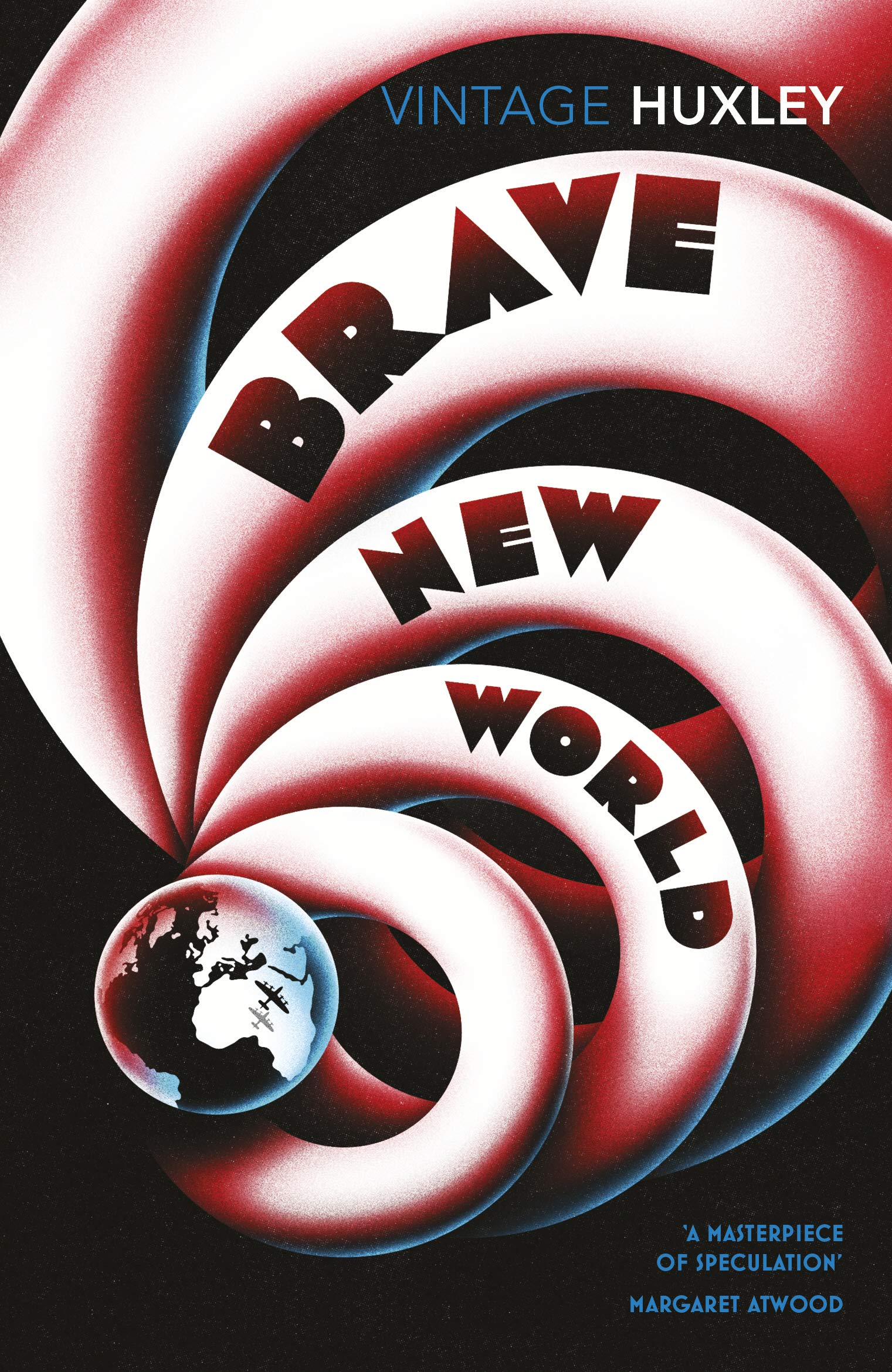
Brave New World Aftermath: Can’t we all just get along?

Image result for brave new world

Aldous Huxley’s Brave New World  is a classic dystopian novel.

In which everyone is happy.

It’s quite wonderfully insidious; usually a dystopian novel shows us a world where no one is happy, and challenges us to find a way to imagine happiness in it: in 1984, everyone suffers all the time, until Winston Smith tries to find a way to, well, live, laugh, and love; the jackboots of Big Brother and the Thought Police stomp that dream out of him. In Fahrenheit 451, the people are committing suicide and killing each other, while screaming at their television sets and cringing away from their devilish firemen; but when Clarisse McClellan tries to think for herself, she is vanished (and probably killed), and when Guy Montag wants to read books instead of burning them, he is arrested and forced to murder his former friend and then run for his life. In The Handmaid’s Tale, happiness is not the thing; purity is. Nobody gives a shit about happiness, and so that’s exactly what they get: shit happiness.

But in Brave New World, when John the Savage wants to be different from the people of the Brave New World, he demands the right to be sad and miserable and angry. And then he is chased out of society, because everyone there is happy, and no one has the freedom to frown, so to speak. Really, no one has the freedom to be alone, which is probably the more disturbing part; that is a common thread in all four books, and I think in all dystopias; everyone is watched, all the time, and it’s horrifying.

I should point out here that we are also watched all the time, and it’s no less horrifying for being real; but there is still some difference for us: the government has the ability to watch us all the time, but they don’t actually care about what 99% of us do.  And while our friends and neighbors are in our business every day, it’s usually because we put our business on social media, or on the grapevine. We still, generally speaking, have the option of privacy. Corporations building data profiles of us are involved in every second of our day that they can be, and that’s probably the most ominous; but really, they just want to sell us shit, so while it’s creepy that the Facebook ads reflect what we were just thinking or talking about, it’s nothing more than something to scroll past. At some point the corporations will realize that they can create markets for their products by screwing with us; that’s when it will get bad. It’s also incredibly dangerous that the data collected on each of us could very easily be turned over to the government (I was going to write “seized by,” but really, what corporation would ever say no to Uncle Sam come looking for intel? They can still sell things to people under NSA surveillance, after all. Maybe rotate some ads for firearms or “Don’t Tread On Me” flags into their feeds.), because the government is certainly willing to screw with us; but as of this moment, to quote the Doors, “They got the guns, but we got the numbers,” and so these tools are not yet  effective. Certainly something to watch out for.

But in the Brave New World, the people don’t have to watch out, they don’t have to suspect their government: they are happy. All of them. All the time. The Big Speech — another common thread through all these books, and perhaps in some form in all dystopian novels, as every dystopian novel has a message to give, and an important one, so the authors don’t want to take a chance on us missing it — given by World Controller Mustapha Mond (Huxley was a brilliant writer, but really, his names are lame. The use of Communist/Socialist names — Marx, “Lenina,” Trotsky — is annoyingly on the nose, and while it’s kinda clever that Mustapha in Arabic means “chosen” or “selected,” the fact that “Mond” means “world” and Mond controls the world… well.) at the end of the novel explains why the society of Brave New World chose happiness and stability over freedom and progress: because there was a terrible war, and afterwards, people wanted to be safe. So they chose to create a stable, safe society, and the only way to do that was to make everyone happy, all the time — or rather, maybe the goal was to achieve happiness for everyone, and the only way to do that was to make sure society was stable, was safe, was static. Every aspect controlled, nothing left to chance.

The result? A society where everyone is designed to be happy. Where the people are cloned, genetically and chemically modified, conditioned and trained from birth to have specific needs and specific wants and specific fears and specific aversions, all of that intended simply to make them happy with their life exactly as it is. They are built to do specific tasks in society, to enjoy simple things like sex, sports, and soma, the wonder euphoria drug that eliminates all chance negative emotions, and never to want to do or be anything other than exactly what they are.

And I read this, and I think: are they right?

Isn’t a happy, stable society better than one that has misery and suffering? Even if, as John the Savage (The one person in the society born to be a part of society, but not raised in it, so not controlled by it) argues — rightly, I think — that sorrow is necessary for tragedy, which is necessary for great art and great genius? Do we really need art and genius? It seems like a reasonable argument to say that most people would prefer to be happy, rather than great, and that happiness — contentment — seems much more likely to make us productive and useful members of society, and to ensure the continuation of the species. Aren’t those the goals?

Even if they aren’t, isn’t the loss of freedom worth the great benefit that the society actively seeks in the novel: the elimination of war? There is not a doubt in my mind that war is the greatest evil, the most abhorrent atrocity, that humanity has ever created or faced; what price should we be willing to pay to free us of it?

After reading this book — though it did genuinely give me pause and make me think twice, and then a couple more times after that — I think the answer is No. No, the price of safety and stability is not worth it. No, the goal is not simply happiness and contentment for all people at all times. Even, I think at least half of the time, if we achieved the end of war.

Because what makes war such an abomination is that it degrades our humanity. In addition to creating or multiplying every other horror we face — death, famine, pestilence, cruelty, greed, deception, hysteria, you name it and war is where you will find it more often and to a greater degree than anywhere else — war takes away everything that ennobles us. In the midst of famine, we can find unmatched ingenuity, and inconceivable endurance, and breathtaking altruism and generosity and self-sacrifice; in the midst of plague, we find kindness and grace and dignity in the midst of and because of the suffering; and so on, through all of it.

But war does quite the opposite. War makes kind people cruel, and healthy people sick, and civilized people into savages. War is the triumph of inhumanity over humanity.

But so is the Brave New World. Because whatever those people are, they are not human. Humans are not designed, and humans are not crafted and shaped like pottery on a wheel, and humans are not set into a groove out of which they will never skip. Humans cannot be perfectly ordered: we are chaos, we create chaos. It’s one of the reasons we are so good at war, because we are so very, very good at destroying things. Especially ourselves. We’re good at building — or else there wouldn’t be any targets for war to aim at — but we’re even better at burning it all down.

And that’s necessary. Because without destroying what is there now, you would never be able to build anything new. Creation implies destruction, but it is valuable  when destruction is for the purpose of creation, when it is part of a continuing cycle: whereas if we end destruction, and end creation too (The people in the book are not created as humans are, through the act of love and the processes of nature; they are built like machines, which is origination, but not, I would argue, creation — and I’m not even touching on the religious argument, which would be a much more poetic way to say the same thing), what we achieve is — stasis. The end of movement.

Death. And not a death that continues the circle of life, giving rise to something new to replace what is lost; here nothing is lost, and so nothing can replace it. Everything is just — still. Stopped. Perfectly motionless, without growth, without progress, without change. Which is no less dead than death itself. And while I will often argue that progress for the sake of progress is cancerous and absurd and deadly, I certainly wouldn’t prefer the final end of all progress.

Not even if it made me happy.


I do not think that this means we need to accept war. I still believe it is the extreme end, the Ultima Thule, of human malignancy; which means we can draw back from it, lessen it, even essentially eliminate it; though it is probably also true that some shadow, some residue, will always remain to harm and torment us. It is in our nature: not that we are made to war, but that we are made to try and reach and explore and find new ways to do things, and one of the ways to do things is to go to war; so even if we forgot it, we would rediscover it again, and again. Curiosity killed the cat, and we are forever curious. But just as more freedom and individuality is better than less, even if it is an imperfect freedom and individuality (which is what we have now), less war and more peace is better than the reverse. So I think there is a goal, and a way to achieve it, without also losing everything that we are.

I also recognize that there are events and actions that might be labeled war, but are not the horrors I’ve been describing; there are times when people have taken up arms to put an end to the horrors, when military intervention is the only way to save people. I don’t want to use the phrase “police action,” because Vietnam was a lie and the police as saviors is a fraught idea anyway; but there are times when force is both necessary and humanely applied. Someone who uses force to defend themselves or another from an attacking force has done nothing wrong. I don’t mean to either denigrate that, nor argue that even that should be (or could be) eliminated; that is the shadow and the residue of war that probably should remain — though ideally, since that sort of violence is triggered by the inhumane violence of dictatorship and oppression and vast chaotic upheavals, if we could end those, we wouldn’t need to send the Marines to intervene. But I’m not sure we could end those, either, because I think having the good and valuable tool of a defensive force can very quickly be turned to evil purposes (Which is why the Founding Fathers of this country pushed for a militia and abhorred the idea of a standing army — COUGH COUGH LOOKING AT YOU, MILITARY INDUSTRIAL COMPLEX), and then the solution becomes the problem. So it goes. We can’t close Pandora’s box.

So no. I don’t think we can live like the Brave New World. (And let me point out that, we discover, neither can they, not entirely, because there are people who don’t fit their molds, and who cause problems, and who are eventually exiled; Mustapha Mond is grateful that there are so many islands in the world to send misfit toys to — but that’s not a  solution, it’s just pretense.) I don’t think we can all just get along.

But I think we can get by. And get to be ourselves. And that’s probably better. Because that way we get to have art and beauty and truth — and that, I think, is really the point.

Shakespeare, as usual, (and as Huxley himself recognized) probably said it best:

O, wonder!
How many goodly creatures are there here!
How beauteous mankind is! O brave new world,
That has such people in’t!

The Brave New World, for us, is wondrous because of the people in it; it is brave because it faces turmoil and tribulation and suffering; it is new because it moves through the cycle of destruction and creation. It lives, and it changes, and it grows. Like us.

In the book, the quote is used ironically. We have to make it true.

This Morning

This morning I’m thinking, Well! That’s quite a line you’re following, there, Dusty! First you rail against science, and then you complain about the foundation of American exceptionalism, capitalism and the profit motive? Why don’t you go for the trifecta?

This morning, I say to my sardonic self (Who uses sarcasm to conceal the quiver in his lip): all righty then.

Capitalism and the profit motive have helped make this country the absolute powerhouse that it is militarily, culturally, and especially economically. The drive to succeed, to win, to gain the maximum benefit for one’s self from one’s labor, have been a powerful motivator for as long as this country has told us we can pull ourselves up by our bootstraps; though profit and competition haven’t made that particular impossible feat possible, they have allowed us to turn a thousand other impossible things into realities: they helped us get to the moon (because we had to beat the Commies there) and they helped us invent the first atomic bomb (because we had to beat the Nazis) and they helped us lead the way in the information revolution of the 1980’s (because Apple had to beat Microsoft, and Microsoft had to beat Apple). Our continuous growth, our continuous progress, have been driven largely by exactly this: by money, by profit, by competition for limited resources, whether those resources are time or money or fame or love or just food.

I can’t argue with that. I hate competition, hate the very idea of fighting other people in order to gain greater profit; but I can’t deny the results. America is an exceptional place, and our incredible speed forward has been increased again, and again, and again, by this essential underlying system: the one in front, the one on top, gets what he wants, and other people have to make do with what’s left over, with what’s left behind. Our system of government, our great and wonderful freedoms —  and they are great, and they are wonderful — are predicated on that idea, with this addition: anyone, in theory, can be the one on top, the one who gets all the stuff first. In practice it can’t be anyone, and it’s almost  always been the same type of people — mostly white Christian men — but in theory, it could be anyone, and our ability to pretend that that is true, and our desire to push for greater rights for other people mainly because we think those opportunities will reflect some benefit back on us, are what has allowed us as a society to spread those freedoms to more people, in more situations.

Just as long as we can pretend the people gaining the freedoms are like us. When they’re not like us, when they live on the other side of the world and speak a different language and live a different way, well. Then it’s probably all right if they have less freedom. Particularly if we profit thereby, with, say, cheap consumer goods.

Am I being too cynical? Look: the slaves were freed because it served the purpose of the white men who freed them. Woodrow Wilson changed his stance on women’s suffrage from opposition to support because he needed women to continue supporting the American effort in World War I. At least part of Lyndon Johnson’s intention in signing the Civil Rights Act of 1964 was to ensure the Democratic party would not fracture along racial lines — and that all of them would support his bid for election in November. And so on, so on. I do agree with Dr. Martin Luther King that those in power do not give up their power voluntarily, only when there is sufficient pressure on them to do so; I know that some of the progress we have made towards greater freedom has been because of grass roots movements and political and social pressure. The will of the people does sometimes prevail. Maybe even often.

But far more often, money talks, and people bend and crawl. And that’s capitalism.

Technology, meanwhile, has often been touted as a means of making life easier for the common man; but all too often, it has in fact made life harder. We have more technology, and we work longer hours and suffer more stress. We have longer life spans, now, that much is certainly true; but more of our lives is spent in misery, and often in ill health. We’ve gotten more quantity of life, but not more quality. And even more true is this: when progress has been made, it pushes us forward  —  off of another cliff. The Green Revolution of the mid-20th century, led by Norman Borlaug, saved at least a billion people from starving to death in Asia. A magnificent success, and a great leap forward.

How many billions are going to die now because of climate change? How much of that climate change was driven by the increase in human population made possible by the Green Revolution?

I don’t mean to say it was a bad thing. Lives were saved, and I am in favor of humans, and of living humans over dead humans. The same thing is true of our longer life spans: what I said about quantity but not quality is true, but also, the rise of lingering and terrible diseases that afflict us as we age has come at least partly because we are now still alive to age. We die of cancer now because we don’t die of sepsis like we used to. We have Alzheimer’s now because we’re not all dead at 65-70 from heart disease. Do you realize how many of the world’s greatest authors, along with millions of others, literally drank themselves to death before they were 50? Do you realize how much of that is attributable to a lack of understanding of and treatment for alcoholism? How much was, quite simply, due to the inability of medical science to perform a liver transplant? Medical advancements just mean we die in different ways, and after longer lives — and as a person who would like to live a good, long time before he dies, I see that as entirely positive.

But the problem is, the problem with all of this is, that we think of our temporary fixes, our incremental advances  — our progress– as a solution to the problem. But it never is. All we’ve been doing since the Industrial Revolution if not before, is treating the symptoms and not the real underlying problem. We are better at waging war: but we haven’t figured out how to stop fighting. We live longer lives: but not better ones. We make more profits: but we don’t get greater rewards. We live in a magnificent country: but it survives by exploiting and destroying other countries, other people, and it always has.

Progress is not our salvation. Progress is our drug. We’re not making real progress in our real problems — not much, and not quickly, and too often the real progress is swallowed up by backsliding; we have actually gotten more empathetic and more aware, and the backlash from that is the alt-right and Donald Trump. Which is making us less empathetic and less aware, as we draw deeper into our shells to avoid looking at the shit that is piling up outside. And I am entirely guilty of this, don’t think I’m not: I have stopped listening to or reading the news because I feel powerless to do anything about it. I’m not: I have as much power as any person, and more than most because I am a white Christian man, to help make the world a better place, and instead, I’ve done — well, nothing useful. I’ve probably made some progress. But I haven’t solved anything.


I don’t think I’ve been clear enough in this blog. I’ve been having trouble lately making my point clear; and this one is a tough one to get across. Let me boil it down and then I will see if I can explain it at greater length in future posts.

What we call progress, in technology, in the growth of our economy, in the expansion of this nation’s military and political power, are rarely if ever actual progress towards a useful goal, a valuable purpose. Almost always the goal is — motion. Like football: you try to get the first down, you try to move the chains. You hunker down and focus on the immediate task, convincing yourself that that one task, that one all-consuming goal, is a good thing. And in the immediate sense, in a single, narrow context, it is good: football players are successful when they get first downs. Soldiers are successful when they carry out assigned missions. Workers are successful when they bring home a paycheck. Scientists are successful when they complete an experiment as it was intended  — say, by injecting human brain DNA into macaques. We see immediate success as progress, especially when it is followed by another success. We’ve taken another step along the path.

But we rarely, if ever, think about where the path is leading. And too often, the successes right now cause even greater problems down the line.

That doesn’t mean we should ignore the problems, nor that we should try not to solve them; winning World War II was the right thing to do, even if it did start the Cold War and the nuclear arms race and so on. Norman Borlaug absolutely should have saved billions from starving, and Alexander Fleming absolutely should have deciphered penicillin, and Dr. King absolutely should have fought for civil rights.

But we need to stop thinking that progress, movement forward, is the answer, is the solution, is the goal. Movement for the sake of movement will not ever get you to where you need to go, to where you should be. Only purposeful, intentional movement can do that. A plan. Understanding.

So maybe, instead of bulling ahead ever farther, ever faster, ever harder, we should– slow down. And think. Even if it means we don’t solve the problems we’re dealing with right now. Maybe it will help us find a real solution, instead of a solution right now that leads to another problem tomorrow.

Out With The Old, In With The New. Well, Maybe.

Toni and I just got SlingTV a month ago, and for the first time in two years, we can watch HGTV. At last.

First, let me just say that this “a la carte TV” thing is starting to work out. We first killed our cable (though at that time it was Dish) in 2006, because we had been watching too much and paying far too much for the privilege. For two years, we got all of our news from the internet, and watched DVDs. It was good, for a time; this was when Blockbuster was still renting movies, and we had a store in our town, and they had their mail-order service working; so we would get DVDs of interesting movies in the mail, and then we would go and trade them in at the store for a free rental of another interesting movie. We watched some TV shows that way, too – Deadwood, if I recall, and The Sopranos, and the first season of Dexter. It was tough to manage the TV shows, though, because you only got them one disc at a time, and you had to space them well in the queue of discs you wanted to rent so that you could get the next one when you wanted it, but not be inundated with show discs.

But then Blockbuster went bankrupt, and the store in our town closed, and the mail-order service folded soon after; the go-to entertainment activity of my youth went away, to be replaced by “Netflix and chill.” (I have only recently discovered that this is the slang for “Come over and let’s have sex.” Back in my day, we just said “Come over and let’s have sex.”) We looked into cable again, because we had Comcast for internet, and we decided to get regular broadcast television again. It was nice, to go back to watching actual shows as they were broadcast instead of months or years after they had ended, though our movie consumption went down again as we didn’t have to fill up a queue with movies that we thought we might want to watch; on the plus side, we stopped watching so many bad movies. Plus we had HGTV, and Animal Planet, and Bravo and AMC; we got to watch The Dog Whisperer, and Millionaire Matchmaker, and The Amazing Race – and our beloved House Hunters. This period ended when Comcast just got too expensive for the package we wanted: it became our highest bill, and we just weren’t watching enough TV to justify it.

But we had heard of Hulu, and Amazon had TV now, and of course there was Netflix, that flimsy cover for teenage hormones. We had just bought a Playstation 3, and we decided we’d try out streaming all of our TV and movies. The price was wonderful, and the convenience, as well; there was also a Redbox, now, that we could walk to when our streaming TV had nothing worth watching – which frequently happened, as they didn’t have a lot of good stuff on there, none of the premium channel shows we had been watching on cable, no Nurse Jackie, no Shameless. But we knew we would be moving, and we didn’t want to get caught up in contracts.

So we moved, and because Comcast didn’t cover Tucson, we had to change internet providers; fortunately – I guess it was fortunate – Comcast had a sister company, another tentacle of its media juggernaut beast-parent company, that ran the cable business in southern Arizona. So we went to Cox and signed up for internet service – and they offered us a bundle with TV, for the same price. Only the basic channels, but with HBO and Starz, free for a year. Sure, we said, free TV? Why not? Well, because the basic service had about two channels that weren’t home shopping, religious, or local access, and those two channnels were generally filled with shows we didn’t much want to watch. And we still had the Playstation and subscriptions to Hulu and Amazon – we would have kept the Amazon Prime regardless, as it gave us free shipping on our frequent Amazon orders. Plus they had Downton Abbey and Sons of Anarchy.

But of course, Cox jacked up the price at the end of our free year of TV bundling (That’s what they used to call sex back when the Puritans had cable), and so we shut them off and went back to streaming. And now, after two years without HGTV or the Food Network, we found SlingTV, and signed up for a three months’ subscription which got us a free Roku. Now, once more, we can watch House Hunters. And see broadcast news on CNN, and even ESPN, if I ever decide to follow basketball again.

All of which is not the topic I meant to discuss. (Don’t worry; this will all come together in the end. Which is what they used to call sex back in the 60’s.) I was going to use House Hunters to introduce the conflict I am interested in: the tension between tradition and progress. So let me get to that. (That was how they asked for sex in the 70’s. At least that’s how Shaft did it. And his woman understands him, even if no one else does.)

House Hunters, if you are not a devotee, shows people, usually a couple, who are looking for a new home. The show and its spin-offs span the globe, though the majority are in the US; they have people looking to rent $500-a-month apartments, and to buy $5 million islands. There is no host, just a camera crew and some voiceovers and graphics added later, and the pattern is always the same: the realtor shows the client three places, and the client tours them, complains incessantly about minor deviations from perfection, and then makes a choice, first eliminating one and then picking between the other two. The last minute of the half-hour program shows them after a few days or months living in their new home and talking about how happy they are with their purchase. It’s a great show, and it will never run out of episodes, because there will always be people looking to buy homes and be on TV, and the only overhead is the camera crews (I presume there are several working all at once, as they pump out episodes at an amazing rate; you can watch two of these a night and never see a repeat.) and the one woman’s voiceover salary. No host, no script, no studio, nothing but homes. And carping clients.

The inevitable tension on the show comes from the different wish lists of the people buying the home; I presume the show prefers couples so they can have that drama, because they always play it up. And the conflict is almost always the same: he wants modern/contemporary, clean lines and open spaces, and she wants traditional, with historical charm and cozy comfort. He wants it to be move-in ready, and she wants a fixer-upper, or at least some projects, so she can put her stamp on it, make it her own.

Since we’ve been watching this show at least once a day since we got the Roku, I’ve been thinking about this conflict a fair amount. And it occurred to me that it related to the question a friend of mine posed after the last blog I wrote about education – You Have Been Weighed, You Have Been Measured – which was this: Trend v. tradition. The powers that be seem to thrive on pushing us deeper and deeper into proficiencies and standards, yet they cling to an archaic grading system of A-F? Once the dust settles from all the rubric scores we then assign a letter grade??? What gives?”

Why is that? Why is there a strain between conservative and progressive, between clinging to the past and reaching for the future?

I have at least something of an answer. (Thanks, HGTV.) Though I’ll have to stretch a bit to make it suit the actual question about education. Here goes.

When we are trying to do something that will last, like buy a home or teach a class, we look back to the experiences we have had ourselves: we buy homes based on the ones we lived in, we teach based on the way we learned. This probably goes for everything: I write the way I do because of the authors I have read; Toni paints the way she does because of the art she has seen. We raise Sammy the way we have because of our experiences with Charlie, and, I would assume, people raise their human children using their own parents as a model.

But not everything we have experienced is positive, and so we use our past experiences as both examples and warnings, things to do and things not to do. If I were to have children, my children would read the same way my parents had me read: they gave me the best children’s books in the world, Harold and the Purple Crayon and Where the Wild Things Are and of course Dr. Seuss, Green Eggs and Ham and The Fox in Socks and The King’s Stilts. My mother read me the books she had loved as a child, like The Land of the Lost and Uncle Wiggily and Freddy the Pig. When I was past that stage, my father read stories to the entire family: Sherlock Holmes and Edgar Allan Poe and J.R.R. Tolkien. My kids would have that same experience, with the addition of books that are more recent but also awesome – my kids would read Harry Potter. But on the other hand: my parents gave me the opportunity to participate in the classic team sports, soccer and baseball – which I absolutely loathed. So my child would not suffer through that experience. My child would do something more awesome, like rockclimbing or kayaking or hiking or martial arts. (My parents did put me in martial arts, which I liked but was no good at, so it didn’t last long.) Or fencing and sailing. I’d like to make my child into a pirate. But that’s not the point.

The point is that we try to keep the things we like, and replace the things we don’t like. I think it telling but not surprising that this plays out along gender lines on House Hunters: traditionally speaking, women have the role of nesters, seeking to make things comfortable and welcoming; hence traditional and cozy and charming. Men traditionally seek to build things and make things bigger and better and newer, to conquer new heights and expand into new territory, partly for the glory and partly to improve their family’s situation. And so, when looking for a home, men seek modern things, things that are new and don’t need to be patched up, things that require little maintenance – because they have to go out there and get to work bringing home the bacon, hunting down a mastodon, subjugating the neighboring tribes. You know – man stuff. And of course this isn’t always the way it breaks down: I hate modern and contemporary styles, and while Toni also dislikes the coldness of modern homes, she does like to have as little maintenance as possible: when we are watching someone coo over their enormous bathroom with its walk-in shower, Toni’s inevitable thought and frequent comment is “Do you know how long it would take to clean that?” There are sometimes couples that agree, or with the reversed preferences; because traditional gender roles are sometimes discarded for something more new, something that works better than what was done in the past.

So that explains both House Hunters and a la carte television, which allows us to watch the shows we’ve liked for years, and also try new things like Mozart in the Jungle and Orange is the New Black, which never appeared on broadcast television. But does it answer the original question?

I think it does. I think people teach based on the way they learned, and they keep what they liked and they try to replace what they didn’t. So those of us who didn’t like handwriting instruction embrace word processing, and those who write a lovely script bewail the demise of cursive. People who have fond memories of running track or making it to the state championships in softball argue that sports are an integral part of schooling, and people who eschewed jocks and embraced the arts consider music and drama and painting to be the linchpin of education. And even in the classroom: my favorite teachers used to discuss the subject matter at length; they would joke with us and tell stories. There were very few worksheets and not a lot of group work – I hated group work. I hated having to be teamed up with people I couldn’t stand, and I hated doing all the work for them. I didn’t mind doing all the work, but I hated the freeloaders getting a grade that I earned them, that they couldn’t have gotten without me – because it was unjust, and even worse, the pricks were never grateful enough to stop picking on me.

So what does my classroom look like? It’s fun; we discuss and tell stories; I love my subject and I show that to my students. And there is never, ever, any groupwork, and there are only worksheets when I’m angry and want to punish them. Other than vocabulary. I loved vocabulary. And silent reading, though that doesn’t work very well, since my students don’t really love to read.

This is not merely an emotional reaction to our own childhood (though I think the power of that should never be discounted): there is logic in keeping what works and replacing what doesn’t. The only question remaining, and it’s a difficult one with education, is – how do you decide what works? And when something doesn’t, how do you get rid of it? Because letter grades, as I argued before, don’t work: they really don’t work when, as my friend pointed out, we use more modern assessment methods, like rubrics and working portfolios and the like, which clash with the overly simplistic letter grades.

The answer, I think, is that those things stay because the people making the decisions like them, and think they work just fine. Because most of the people in charge are the ones who won their spots on top of the heap because they work well within the current system, the same one they came up through. When our current politicians and superintendents were in school, they were popular; they were elected to class office; they had great GPAs because they wrote neat papers and did well on multiple-choice tests. They were proud of their A’s, and they remember fondly how happy their parents were when they got that report card at the end of the semester, how they called Grandma to brag, and posted the grade printout on the fridge with a magnet. (This also describes the majority of teachers, by the way.) Those people think that system works beautifully, and so long as it continues to produce people just like them, and reward those people for doing those specific things well, then they will continue to believe the system works well. And as long as the system puts people like that into positions of authority, they will keep making the same decisions; and as long as people keep thinking that certain things have to be the way they’ve always been – as long as we keep telling our students, and they keep believing, that grades are a valid means of figuring out how well or how poorly one is doing in a class, and as long as we keep thinking of an A as a reward and an F as a punishment, and telling our students that they have to do the work in order to get the grade, the system will remain in place. I really don’t think the commercial education industry (which is the other major driving force behind changes in education, though that is only partly for the sake of improving what doesn’t work, with the other half coming from what is most profitable) cares at all about letter grades. But my students’ parents certainly do. So here we are.

And here I am. Facing the truth: that I don’t want either a traditional Victorian or a modern loft: I want a castle. On top of the Cliffs of Insanity, with a pirate ship docked below. I don’t want the past, or the future – I want the fantastic. I want the epic. I want the legendary.

I’m just not sure where to find it.