Book Review: City of Bones

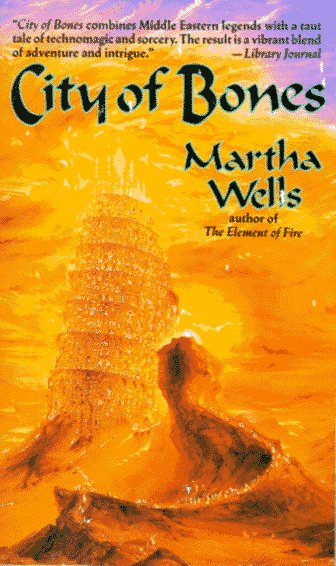
Image result for City of Bones martha wells

City of Bones

by Martha Wells


I don’t know why I’ve never heard of Martha Wells.

It’s clearly my problem; she’s written more than a dozen novels since the mid-90s, been nominated for Hugos and won a Nebula, along with several other awards. I mean, I’m not THAT deeply involved in the F/SF world; I don’t go to ComicCons, I don’t really belong to any fandom, I don’t dress up as any characters (Other than my generic pirate costume, which is the only costume I will ever wear for any appropriate occasion), I don’t obsess over Star Wars or Star Trek (And that might have been a way for me to learn about Ms. Wells, as she has written a Star Wars universe novel. But I haven’t read it.), I read things other than genre fiction. There’s a lot I don’t know.

The surprising thing is not so much that I’ve never heard of a fairly well-known and successful SF/fantasy author; the surprising thing is that I’ve never heard of her despite the fact that she’s so damn good. I guess I need more reader friends to recommend books and authors to me. Maybe I should go to some Cons. Get a new costume.

This book surprised me. I got it entirely at random; I found it in a local thrift shop when I was looking for fantasy and sci-fi books I did not know to give to a former student. The former student ended up not wanting the books, so I kept them and have been reading them slowly, and happily, it was this book’s turn. And what do you know: this is a damn good book.

It’s sorta post-apocalyptic in the sense that there were Ancients who might have been us, who destroyed the world but left relics and mysteries behind. Those relics and mysteries are magical more than technological, so it might be an alternate world entirely; it’s left unknown. Reminded me of the Wheel of Time, which of course means I liked it. The society that has managed to survive the cataclysms of the past is essentially city-states on the edge of a giant wasteland that is the result of a supervolcano eruption caused by the Ancients in some way. The book takes place in one of those city-states, and the society that Wells creates, as well as the world she builds, are excellent: detailed and complex, as well as believable and realistic. It’s a sort of a caste city; built in eight tiers, each of which is separated from the others by gates and guards, and mainly by social rules and expectations, the people range from the desperate beggars of the Eighth (bottom) tier to the hereditary monarchs and powerful government officials of the First Tier. The book ranges all the way from top to bottom. It also goes out into the Waste, where the largest relics of the Ancients are: buildings called Remnants, it is unclear what their purpose is, and since they are surrounded by deadly terrain filled with venomous predators and roving bands of cannibal pirates, most people leave them alone.

But not the characters in this book, which was the other great strength here: these are good characters. The main three are two sort of Indiana Jones-type adventurers, dealers in ancient relics, experts in identifying and valuing the objects that have survived since the cataclysm (They are also badasses, though Wells doesn’t go overboard with that, which I liked.), and a young woman from the First Tier, the daughter of a wealthy family who is also a newly trained wizard/guard for the city, called a Warder. She hires the two relics dealers to help her solve a mystery involving three ancient relics, along with a book, written apparently by the ancients, which explains the use of the relics and gives both a tantalizing hint of power, and also a dire warning. Guess which one the power elite of the city pays attention to, and which they ignore.

The book follows the quest of these three to solve the Ancient mystery, while also delving into the daily lives, the trials and tribulations, of the two relics dealers, who live on the Sixth tier – high enough to avoid beggary, but low enough to have to deal with thieves and gangs and organized crime, which touches them because there is a black market for relics, and they have to deal with it. The characters are well-developed, and are both sympathetic and also not, in a proportion that makes them seem very much like genuine people: the main character, the relics dealer Khat, is often sullen and secretive and obnoxious; but of course he is, because he lives a hard life surrounded by people he can’t trust, and he is also a member of a racial minority (A non-human race, that is, because this is a fantasy novel) and so he deals with constant prejudice, as well. His partner, Sagai, is a husband with four children, and so has to take fewer risks and also be assured of making enough money to support his family. The noble Warder, Elen, is somewhat sheltered and therefore naive, but has also put her trust in the wrong people, and suffers for it.

Overall, the book was great. Good characters, good world, good plot. It goes from feeling more like a historical novel, maybe set in Egypt or Baghdad in Biblical times; to feeling like a full fantasy novel with magic users and relics and magical creatures, as well. It’s impressive, and I highly recommend it.
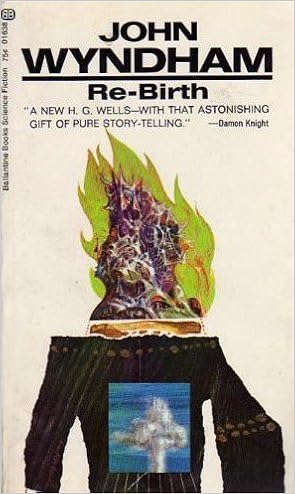
Two Books by John Wyndham

Image result for rebirth john wyndhamImage result for the secret people john wyndham

Two by John Wyndham: Re-Birth and The Secret People

I’ve gone up and down with John Wyndham. A couple of his books – The Midwich Cuckoos and Day of the Triffids – are outstanding; Chocky was just okay. Generally I like his storytelling, and his ideas are wonderful; but they can’t all be gems, no matter who the author is. No problem. Really, this fits in nicely to the Golden Age of Science Fiction, where Wyndham deserves a place, since even Heinlein and Asimov wrote some stinkers. I like Wyndham, though, and I like that I keep finding his books in cheap paperback editions from the 60’s and 70’s with interesting cover art. That cover art was what made me pick both of these.

So I had two of his novels to read, and once I read them, well – to be honest, my opinion of Wyndham went down. This has been mitigated now by the fact that one of these two, The Secret People, was one of his earliest works, written in 1935; my first book isn’t very good, either. But that’s not enough: because this book wasn’t just “not very good.” It’s a stack of crap in a cover.

We’ll start with the good one, though. (Warning: Spoilers ahead.) Re-Birth, from 1955, (Published in Wyndham’s native UK as The Chrysalids, which is a way better title but I assumed they changed it because the American public’s response was overwhelmingly, “Wut’s in tarnation’s a chrysalid?”) is a great book in two ways: it has a post-apocalyptic setting fully as interesting and disturbing as A Handmaid’s Tale, with the same kind of theocratic hypocrisy in full bloom. Told from the point of view of a young boy whose father is a pillar of the community, it has that excellent innocent perspective that makes social commentary novels genuinely effective, from The Giver to To Kill a Mockingbird. We learn how screwed up the society is as the protagonist does, and it works extremely well. There’s a nice twist, too: because we find out that the main character, David, is actually one of the forbidden people, one of the untouchables, as it were, but in a way that enables him to hide it. So we get the view of the society from both a child’s perspective and an outsider’s perspective, and it’s very well done.

The society is an agrarian theocracy after the world-shattering nuclear war; it is probably somewhere in Greenland, though that isn’t entirely clear. (That may be my poor grasp on world geography – or, honestly, it’s been a couple of months since I read it; I may just not remember.) The society has an absolute rule against genetic mutations, which are more common because of the radiation; anyone who is born with any kind of imperfection is essentially exposed to the elements. (Turns out they don’t always die, but that’s not for the society’s lack of trying.) David is a genetic mutation, but not with any physical alteration, and so he slips through the net, and eventually finds several others who are like him.

I don’t want to spoil it any more than that, because it is essentially worth reading. I didn’t really like the ending, though. We get two glimpses into other societies, one of the outcast genetic mutations who have survived on the fringes of the theocratic society, and one highly advanced society from another part of the world; and frankly, both suck. The book as a whole just made me dislike people. Which, I mean, that’s fair, but it’s not always the kind of book I want to read; I also felt that this one didn’t hold out any real hope for a better world or better people. I guess there’s a small chance that David and his friends are the hope, but they continue to be a part of the crappy societies, so I don’t really see it.

But I did like the characters a lot, and I thought the society and the central conflict over genetic “perfection,” with the underlying theme of questioning that very concept – what exactly is the “correct” genotype? Or more importantly, the correct phenotype? At what point does variation become too far from the “norm?” – all that was great. If you’re a Wyndham fan, go ahead and read this one.

Don’t read The Secret People. Not anyone, not for any reason – not even for that epically bizarre cover. Because the cover is a lie! There aren’t any weird dirt-people with mushroom horns! They’re just short! I wanted freaky gnomes and dwarves and stuff, but what I got was – crap. Racist crap.

So The Secret People, originally published in 1935, is a lot like an H. Rider Haggard novel, except Wyndham wasn’t as good a writer. And they both had crap ideas. This book starts with a couple of poorly explained technological advances to get us in the sci-fi mood; the main character is an international playboy with his own jet plane – and I mean, it’s a rocket ship with a cabin and everything, that flies in atmosphere – and at one point, he picks up his newest Bond Girl and flies over the inland sea that is being made where the Sahara used to be. Sadly, they crash into the water, and through a series of mishaps, they find themselves in an underground world peopled by strange beings! Living under the Sahara! SO WEIRD!

Except they’re not. They’re Pygmies, from Africa, who apparently wandered into underground caves centuries ago, and just kept wandering. And just like Haggard, who had a serious case of TheWhiteManIsTheRightMan-itis, Wyndham describes these “secret people” as essentially savages who have been unable to advance their civilization in any way past their original stone-tool-and-superstition society. The modern Eurotrash heroes get chucked into a prison cavern with all the other surface dwellers who have found their way underground now that the inland-sea-over-the-Sahara project has compromised the Secret People’s secrecy, and then they have to find their way out and back to the jet plane, which is their only hope of surviving. Because, you see, the inland sea has started leaking into this vast underground cavern world, and the whole place is going to drown.

But that doesn’t matter! What matters is who gets to the plane first: the heroes, our playboy and his Bond Girl, or the sinister criminal element, who were already in the cavern when our heroes arrive, and who are both rapey and swarthy – an unforgivable combination. But that’s okay, because they’re also stupid and cowardly and everything else you would expect from a swarthy criminal type, and so yes, our heroes are the ones who make it out alive before all of the Secret People drown. Which, y’know, is a happy ending.

Terrible book. Don’t read it. Go for Re-Birth/The Chrysalids – or even better, read The Midwich Cuckoos.

Book Review: Mortal Engines, Hungry City Chronicles #1

Image result for mortal engines

(Also, see that hot air balloon on the cover, with the tiny gondola the two characters are in? Not at all how the airships are described.)


Mortal Engines (Book One of the Hungry City Chronicles)

by Philip Reeve


I kind of hated this book.

Not everything about it. Some things in here are wonderful. The concept is fantastic: a future world where cities are mobile, enormous steampunk structures on wheels, rolling around in the wasteland that is all that remains of our world, destroyed (of course) by World War III and hyper-advanced war machines. These cities follow a philosophy of “municipal Darwinism” (great name), which teaches that the largest, strongest city will devour the smaller cities. It’s a “town eat town” world, and the mobile towns do exactly that: they capture the smaller, slower towns, swallow them, tear them apart and use their raw materials as fuel and building materials to maintain and expand the larger town.

That’s a cool idea.

The main town in the story is London, and London is now governed by four Guilds: the Historians, the Navigators, the Merchants, and the Engineers. The Historians, who comprise both doddering old museum relics and Indiana Jones-style explorers who search through the wreckage of ancient civilizations to find useful artifacts from the time before the wars that ended everything (This is our time, of course, and the Frankenstein We-let-our-technology-advance-too-far-and-it-destroyed-us theme is vigorous in this book), are sort of the main protagonists, and the Engineers, who care about nothing but power and control, as those engineers would, are the antagonists. There is also the Anti-Traction League (the moving cities are called “traction cities”), which have settled in parts of the world not dominated by moving towns nor devastated by ancient wars, and they oppose the traction cities as a whole.

This is fine and good. I was a bit annoyed by the stereotypes of the heartless engineer and the hapless-but-wise-and-kind historian, but I like the plotline that involves the Lord Mayor of London and his megalomaniacal schemes, and the discovery of a new doomsday weapon that allows his city to destroy any other; the weapon is actually a rediscovery from the ancient times, and I thought the book handled that well, particularly at the end. (Though there are some pretty severe plot holes, especially regarding the time lapse between the ancients and the traction city era:  it’s been like two thousand years. So really, the ancient technology? It just wouldn’t work. At all.) I like the Anti-Traction League, and I particularly like the subset of non-city-dwellers who live in the air: this being a proper steampunk novel, there are airships galore, and even a flying city, and those parts were great.

No: I hated the characters. The specific characters who play the roles of hero in this book are half crappy, and by the end, half dead. I won’t say which group is which so as not to spoil, especially since this book is now being made into a movie by Peter Jackson, who probably won’t be able to save this thing, in my opinion. However, since the book won oodles of awards, I suppose most people liked the characters a whole lot more than I did. But really, they aren’t good characters: there’s one who should hate everything London is doing and all that it stands for, but at a crucial moment, this character freaks out on those who want to stop London from destroying everything good with its doomsday device; and then later the character realizes, “Hey, wait – London sucks! I should do something about that!” But this epiphany comes at an entirely random time, and is annoying because of that; I would think that the betrayal by a Londoner whom the character worships would have changed the character’s mind, or maybe when the two main characters are tricked and enslaved by a traction city; or maybe when they are captured and abused and threatened and nearly killed by a bunch of half-insane traction city pirates. No: it’s while the character is – climbing stairs. It’s ridiculous.

The other big problem for me was the writing. Half of the characters, good and bad, are entirely unbelievable; their emotions and motivations don’t make a lot of sense. There are a ton of cliches and platitudes, and some of the descriptions and action sequences are just not well done.

And then, at the end – he killed the fucking dog. That’s right: Philip Reeve kills the dog. No reason, either; we already hate the people who do it, and the character who I suppose is intended to be inspired to murderous vengeful rage by the death of the dog WAS ALREADY AT THE POINT OF VENGEFUL RAGE. It’s an entirely gratuitous dog-killing. And I don’t mean to overstate how much this bothered me, because I was already annoyed by the plot holes and the poor characterization and the mediocre writing – but really, that moment just took the cake. And then for the next thirty pages until the very end (when almost every other sympathetic character dies, too), Reeve kept mentioning the dead dog: the dog’s owner kept looking around for the dog, kept expecting to hear the dog’s footsteps, but no, because the dog was dead.

Screw you, Reeve. Dog killing crap writer.

No, that’s too strong. But really, I didn’t think much of the book. I wish someone else had thought of this idea and done a better job writing it. I hope the movie is better, but I won’t be watching it: because they’ll probably kill the dog.

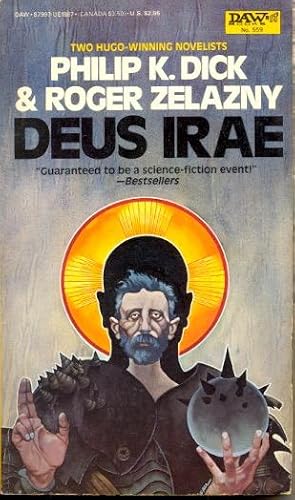
Spring Break Book Review #7 (The last one): Deus Irae

Image result for deus irae

Deus Irae

by Philip K. Dick and Roger Zelazny

What the hell did I just read?

I haven’t read a lot of Philip K. Dick; I’ve read almost everything by Zelazny. Dick was, according to everything that I’ve heard, a unique visionary when it came to science fiction: his ideas have become some of the most famous in sci-fi, among them the books that inspired the movies Total Recall, Minority Report, and Blade Runner; he was not, however, all that great a wordsmith. (He did win prestigious awards, so maybe this is not a fair description.) I would somewhat agree with this assessment based on this book, but of course the issue is clouded by the fact that it’s a collaboration. Zelazny was one of my favorite wordsmiths, and also had some fascinating ideas; but where is the line drawn in this book?

I dunno; so I suppose I can’t come to any definite judgments here. So let’s just talk about this book on its own merits, shall we?

This is a post-apocalyptic novel; the world has been destroyed by war, by the use not only of nuclear weapons, but also far more destructive devices, nerve gas, global killers that worked by changing the atmosphere and permanently altering the climate (You know, like we’re doing now, voluntarily. It’s saying something that truth not only resembles fiction, but that it also resembles science fiction. Even worse: it resembles the science fiction of Philip K. Dick. Who also wrote The Man in the High Castle, the alternate history novel about Nazis conquering the US during World War II. Just sayin’.). In the wake of this devastation you have both bizarre mutant lifeforms struggling to survive among the ruins, which still includes several artifacts of the pre-war era, and also the rise of a new religion, struggling to survive among the ruins of Christianity, several artifacts of which still exist. And though the book is somewhat about the mutants and war and survival, it’s really much more about religion. And about art.

The main character is a man named, unfortunately, Tibor McMasters, which is something I wouldn’t do to a character I hated, let alone my protagonist; but Dick and Zelazny also made this guy into an “inc,” an incomplete, because he lacks arms and legs. He is nonetheless, with the help of a mechanized cart that has extendible arms and gripping pincers, an artist. He is hired by the new religion, the Servants of Wrath, to paint a church mural depicting their God, the Deus Irae, in his human form: Carleton Lufteufel, the man who pushed the button, pulled the trigger, who started the war that destroyed everything. The Servants of Wrath see him as the manifestation of a god who is essentially evil, but evil for a potentially good purpose: by making humans suffer, the God of Wrath purifies them so that they can move up into a better existence after they escape this incarnation through the blessed relief of death. As a post-apocalyptic religious cult, it makes a whole lot of sense.

The book, unfortunately, does not. I mean, it does: Tibor goes on a quest to find the actual Carleton Lufteufel, hoping to see the man’s real face before he paints his likeness, and this quest goes through difficulties and revelations like the classic hero’s journey; they lift an element out of the Ring Cycle, when Sigurd drinks the blood of the dragon Fafnir and learns to understand the language of the birds; the same thing happens to Tibor, though it may be only a vision granted him by the God of Wrath – who may or may not be real. It’s impossible to say what is reality and what is vision and what is a lie: there seem to be miracles, but there are also some pretty funny absurdist jokes – there’s a race of sentient speaking dung beetles who worship a VW bug as their god; there’s an ancient pre-war automated mechanic that takes one character’s bicycle, turns it first into three tricycles, and then when asked to return the original bike, instead makes it rain pogo sticks. So are we to take the Deus Irae seriously? Or is that just a joke? Got me. There are some fairly straight but extremely unflattering depictions of Christianity, mainly through the Christian priest, who is a complete ass; but the priest of the Servants of Wrath is also an ass. Tibor’s a pretty good guy, and so is his opposite figure, a Christian named Pete Sands (Tibor is ostensibly a member of the SOW church, but he considers converting to Christianity – but is basically rejected by the Christian priest-ass), but these two don’t help us determine which way we should go in terms of religion, whether God is good, but perhaps too rigid in his rules; or if God is evil, but with perhaps good intentions in the end. It is possible that the point is that all religion rests on perception: both Pete and Tibor have religious visions, and maybe those give us real insights into faith and morality; but there is a critical lie that happens at the end of the book, which is never detected: and so maybe it means that all religion is a lie.

I really don’t know. I really don’t know what I just read. I enjoyed parts of it, was deeply confused by other parts, and annoyed more than once, by the setting, and by the characters, and even by the writing. Though I think I may know why: there is a point in the book when Tibor waxes poetic about the Impressionists and the quality of light they sought to capture, which he says is morning light that changes the way everything looks until it burns off around 11am; he mocks Rembrandt, who never painted in the morning light and so is unbelievably easy to imitate (sayeth Tibor), because his figures all have nothing but shadows in their eyes, because all the figures look at nothing, have nothing to see. See, the thing is, I love Rembrandt’s work, and am underwhelmed by the Impressionists; I don’t really think anyone has the skill to re-create Rembrandt, though sure, maybe it’s easier to try, and maybe people can even come close. But I think it would be a whole shitload easier to mix up some bright colors and slap them on a canvas so that they are shaped vaguely like water lilies. And I think a lot of people have been able to do that, and get famous for it, because I don’t know that there is really anything special to see in most Impressionist paintings – it just has a reputation for being something above and beyond what is actually on the canvas, and people are able to bluff their way into that same reputation. (I’m going to throw out the name Willem DeKoonig, though that’s largely an inside joke. And he wasn’t an Impressionist anyway, so I’m off topic.) Anyway: the point is that there seems to be something of a divide between people who paint what they see, and people who try to capture something unseeable. (And maybe some of them succeed. I don’t mean to denigrate the entire Impressionist movement. Or all of the authors I’m about to mention.) I would put Rembrandt in the first category, and the Impressionists in the second. And I think the same division is possible with writers: some try to describe the world exactly as it is, and some try to capture an intangible, unknowable element, try to craft their language in such a way that it creates a second impression, of a different reality, one that is wholly spiritual or intellectual, detached from the words, detached from the sensory impressions. I would put, say, Stephen King or John Steinbeck into the first category, and James Joyce and T.S. Eliot and Ezra Pound into the second.

I think Philip K. Dick would have wanted to be in the second category. And I absolutely, without doubt, would rather be in the first. I want nothing more than to be able to write like Stephen King or John Steinbeck, or Mark Twain, or even J.R.R. Tolkien, who was able to describe an entire fantastic world in humble, realistic prose, which is what makes his works so long-lasting and influential, because he started with the line “In a hole in the ground there lived a Hobbit.” I think that, like Rembrandt, the realism captured in the work of these sorts of authors is deceptively difficult to achieve, and wonderful when it is done right. I kinda think the great effects achieved in the works of Impressionists, and authors who write like the Modernists and their detachment from reality, or like the Post-Modernists and their detachment from meaning, are really just, well, bullshit.

So maybe Philip K. Dick should belong to those science fiction fans who also love James Joyce. And since I can’t stand James Joyce, you all can have them both.

Book Review: Riddley Walker

Riddley Walker

by Russell Hoban

Russell Hoban wrote one of the fondest memories of my childhood: Bread and Jam for Frances. He wrote a number of books about an adorable young badger named Frances, actually, but Bread and Jam was the one I had, the one I remembered, the one that, as a picky eater, I related to.

So when I found out as an adult that Russell Hoban also wrote several acclaimed science fiction novels, well. There wasn’t really any question. Imagine if Dr. Seuss or Shel Silverstein wrote full-length novels. Wouldn’t you be curious?

So I looked them up, found out that the most famous one – the one that won the John W. Campbell award for best sc-fi novel in 1982 – was this one, and then I went out and bought a copy.

And then I tried to read it. And this is what I found.

“On my naming day when I come 12 I gone front spear and kilt a wyld boar he parbly ben the las wyld pig on the Bundel Downs anyhow ther hadnt ben none for a long tyme befor him nor I aint lookin to see none agen.”

That’s right: the book is written in gibberish.

And it’s absolutely brilliant gibberish.

The story is a post-apocalyptic coming-of-age novel. Very post-apocalyptic, as it turns out. Riddley Walker is a 12-year-old young man in the ruined aftermath of what used to be England, but is now a feudal society called Inland, people living in small walled communities, hemmed in by packs of wild dogs that hunt and eat any humans who stray too far from their fences. The language they speak and write is in fact English, but it’s an English that has changed as much from our language as our language did from Chaucer’s time. Their myths and legends are of us: the primary one seems to be about the discovery of atomic power with the splitting of the atom; though there is much more to it than that, as there always is in myths and legends. Their world cherishes these legends, but it is a largely oral society; the government, what is left of it, is primarily responsible for spreading the stories that are the basis of their mythology and morality, the Eusa story, which they share ritualistically through traveling puppet shows. The basic canon of the Eusa story is written down and therefore unchangeable, but with each puppet performance, the Eusa men find new aspects to focus on, new morals to be drawn from it, just like preachers with the Bible. The towns where they perform have their own interpreters of these hidden messages and allegories, called “connection men;” when the story begins, Riddley has just become one such, replacing his recently deceased father.

But Riddley only makes one connection: soon he feels an irresistible urge to travel outside the walls, where he seems to befriend a dog pack; this dog pack takes him to Cambry, where he discovers a secret: the Ardship of Cambry, one of the Eusa people. Born without eyes, isolated from all of society, the Ardship has a secret buried deep inside: the secret that brought down the old world, the world that had boats flying in the sky. And the current head of the loose government in Inland, the Pry Mincer Abel Goodparley, plans to tear that secret out of the Ardship, unless Riddley can help.

But maybe Riddley thinks that Goodparley is right. Maybe they have lost much that once existed, and maybe they should try to bring that back. But maybe those secrets are best kept hidden.

I realize now that the book is extremely well known, and that my discovery is not this forgotten novel but rather my own ignorance of it – the thing has over 5000 Amazon reviews, for cripes’ sake – but for me, this book was something of a revelation. It was also a real challenge. That language is freaking hard to read. It makes references to the society that preceded it, but that society, the society of the 1970’s, is in some ways lost even to us: it took me the whole book to realize that one of the phrases, used to describe thinking something through and coming to a conclusion, was “pull data and print out,” as in, “We discussed the matter, pulled data and printed out a plan.” We don’t even print out any more, so it was tough getting the meaning of that and a thousand other words.

But it’s beautifully done, nonetheless. Because the Ardship of Cambry is the Archbishop of Canterbury – but he’s also a man facing hardship, which point Riddley makes in the novel. And the Pry Mincer (Prime Minister) is a man who pries, but also one who minces words. Hoban didn’t just mess with the English language: he remade it. He created something new, and difficult as new things are, but also brilliant.

It’s a hell of a book. I need to keep it and read it again, and I want to do so. Maybe when I do, it will make more sense; on this first reading I felt like there were some pretty serious holes in the story, but there were parts that I just couldn’t understand. But hey: I couldn’t read Shakespeare and understand it all the first time, and the first time I read The Grapes of Wrath or Huck Finn or The God of Small Things, I didn’t fully appreciate them; great literature requires effort. I would call this book an example of that.