Book Review: The Naked Ape

The Naked Ape

by Desmond Morris

I’ve been carrying this one around for a while, never sure how much I actually wanted to read it; the cover talks about how explosive and controversial the book is, and that’s cool, but it was published in 1967, so it’s unlikely the controversy would still feel controversial, and might not even feel interesting. I had no idea what to expect from a book about human sexuality and interpersonal relationships from an evolutionary standpoint.

Turns out it was what I should have expected: this book (I’m sure it’s not the only source) was where the ideas were codified that people still repeat in terms of the evolution of humanity. This is where you can read about how men are hunters, while women are caregivers, so that humans have created pair-bonds of unusual strength so that the men can go out and hunt while the women stay home and care for the children, and both can trust that the other won’t go out pair-bonding with some tramp or the hunter next door.

This is where you can read about everything about humans is designed specifically for sex: we have tiny hair (Despite the title, we actually aren’t less hairy than other apes; it’s just that our hairs are mostly really tiny – at least for Caucasians like me. Africans, Asians, and Native Americans are indeed less hairy than monkeys. Maybe instead of Honkies, we should be Hairies. Heh.) so that we can enjoy touching each other more; we have earlobes so that we can enjoy more variety of erogenous zones; women have breasts because men can’t see their butts from the front, and poofy red lips because – never mind. He also comments (and this little factoid is repeated in the Wikipedia article on the book —  can’t imagine why this one should be the one people pick out in describing the book) that humans have the biggest penises out of all the primates. Fancy that.

This book explains everything. Unfortunately, almost every single word of it is speculative. It’s funny, because there’s a point in the beginning when Morris scoffs at one particular theory which was made without direct evidence; and then he proceeds to spin theory after theory without even a scrap of direct evidence for any of them. (Because I thought it was interesting: the theory Morris scoffs at is the explanation that we lost our coarse body hair because in between the fruit-eating monkey we once were and the savannah-living hunter/gatherer hominid we became, there might have been a coastal/aquatic stage, when the monkeys discovered the abundance of rich food at the seashore. This might explain the evolution of hairlessness, as a means of streamlining in the water; this fits because the body hair that remains actually mimics the pattern of water flowing over a swimming body. It also explains our hands being wide and flat and paddle-like. It’s an interesting theory. It’s a better one than “We have earlobes so we don’t cheat on each other when we’re out hunting!”) Morris has a fair amount of negative evidence that he derives from the animals he knows so well (Morris was a zoologist and zookeeper); so the explanation that human women’s breasts don’t need to be large for the sake of nursing, because chimpanzees breastfeed but have essentially flat chests, makes sense; but the idea that they are therefore specifically erogenous because breasts, nipples, and areolae swell during sexual excitement, and particularly the idea that they are meant to imitate the buttocks because humans mate face-to-face, are entirely speculative and really pretty ridiculous. (I have to recommend this song, particularly the last verse; beware, it is not safe for work.)

Probably the most amusing thing in reading this book – other than the smutty dirty parts, which are always fun to read (and this book talks A LOT about sex) – was the glib way Morris plays up his own ethnocentrism. He mocks other ethnologists and anthropologists who study small, extraordinary populations, claiming that the real information should come from a study of the mainstream, “most successful” version of humanity – which, he assures us, is clearly the Western European and American culture. Just look how many of us there are! Obviously we’re the best and most normal human. (And again there is a remarkably oblivious hypocrisy in this, because Morris goes on to talk several times about rare and unusual ape behavior or traits as analogous explanations of human behavior; the breasts-as-front-facing-buttocks thing comes partly from one particular type of baboon that has a similar adaptation. One type of one species of ape. “Who would think it was a good idea to study small and atypical populations to understand a whole species? Ridiculous!”) It was fascinating because I know that at the time, the book was seen as incredibly radical and liberal and offensive, arguing as it did that our tendency to pick a single mate for life is evolved, not set down as right and good by Almighty God, et cetera; but now, the stances it espouses are become almost entirely conservative: American is the best kind of human; the family should stay as a single unit; the man should work outside the home (modern version of hunting, Morris tells us several times — and describes how men are always competitive, seeking “the kill” in their business lives because we don’t hunt mammoths any more. Not sure what “the kill” is for a high school teacher…) while the woman raises the children; the best sexual position is face-to-face, probably missionary style – “Good old-fashioned, man-on-top-get-it-over-with-quick,” to quote George Carlin. I wonder what Morris would have made of the current ideas about gender. Since he talks about how homosexuality is an evolutionary failure and therefore anomalous, I have a guess.

Overall, it was more interesting in terms of what it said about the author and the culture he was writing in, than in what the book actually purports to explain. As an ethnologic artifact, it’s not bad; as an explanation of humanity, I wasn’t impressed.
The Soul of an Octopus: Book Review

The Soul of an Octopus
by Sy Montgomery
I got this one for my wife, for two reasons: first because we both read and loved Montgomery’s book The Good Good Pig, and second because she loves octopuses. (By the way: Montgomery makes this clear in the first pages, that the correct plural is not “octopi;” the word “octopus” is from the Greek, which doesn’t pluralize -us ending words with -i. That’s a Latin plural. The correct English plural is octopuses. The correct Greek plural, used only by painfully awkward British nerds, is “octopodes.” But we’re not talking about that. Watch this if you want more word-nerdery.) How much does she love octopuses? You tell me.

(Oh yeah — she also likes doll heads. This book isn’t about that, though.)
So I got her the book, she read it, loved it. And I put it on my To Be Read shelf so I could read it, too. And now I have. And here’s what I found out:

I don’t love octopuses.

I don’t know why. I have something of a fear of the ocean, as I am afraid of drowning; I didn’t much like reading about the octopus’s strength, how one could easily pull a human into its tank, how one two-inch sucker could lift and hold 20 pounds or so, and the average octopus has about 1600 suckers. I admit I don’t really like slime, and there is quite a bit of slime involved with octopuses. I don’t much like the idea of being tasted, and the octopus’s entire skin is a sensitive tasting/smelling organ. So there was quite a bit of creepiness in the book for me, which tended to reduce the enchantment of it, an enchantment that is obviously shared by my wife, and by the author, and by the other people who go through this octopus journey with Montgomery, mostly biologists and volunteers at the New England Aquarium, where Montgomery met and made friends with several octopuses over several years.

Now: I do find cephalopods fascinating. I am amazed by their intelligence and by their multifarious abilities — octopuses can camouflage, can change shape and color and texture in less than a second; they have these remarkable arms with remarkable suckers; they can squirt ink; they can squirt water as either a weapon or as a means of locomotion; their bite is venomous. They can squeeze through any space that can fit their beak, the only hard thing in their bodies. Octopuses are badass and incredibly interesting because of it. So in terms of the science aspect of this popular science memoir, it was great; Montgomery writes well, and obviously knows her stuff, and the information was interesting. The parts about the idea of consciousness, and how an octopus may have an intelligence no less than our own, but totally different from our own, were fascinating to me. (I want to write a story now about an ancient octopus civilization at the bottom of the ocean. Except Lovecraft beat me to it. Hey — maybe he’s why I don’t like octopuses.)

But when Montgomery waxes rhapsodic about the softness of an octopus’s head, or the peace and beauty of time spent communing with an octopus while its tentacles wrap around your arms — nope. Gave me the shivers.

If you, like my wife, love the octopuses, then get this book and read and enjoy it. If you find octopuses interesting and they don’t make you feel all squirmy, then go ahead and read it; you’ll learn a lot. (There is also a lot of information about fish, about aquariums, about raising sea cratures, about keeping them in captivity, and about scuba diving. Oh — and about octopus sex.) If eight-legged sucker-wielding boneless deep-sea creatures make your eyes wide and your mouth small, then go read The Good Good Pig.

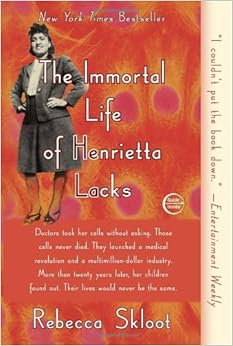
Book Review: Henrietta Lacks

The Immortal Life of Henrietta Lacks

by Rebecca Skloot

I liked this book. I didn’t love it.

Which leaves me a little puzzled as to why this book did quite so well as it did. I mean, it’s popular science, so it makes an otherwise esoteric subject – in this case, the intertwined subjects of cellular research and medical ethics – more accessible to people; that, it does remarkably well. Skloot humanizes Henrietta Lacks, whose tissue was used to start the HeLa line of cells, which have been in constant and widespread use in medical research since the 1950’s when the cells were first collected, without Mrs. Lacks’s informed consent. The book is very good at helping us to understand the woman and her family and the impact that the medical research community had on them.

However, it doesn’t do a terribly good job of explaining the impact the Lacks family – or at least Henrietta – had on medical research. Which feels like a missed opportunity.

It’s an interesting story at the start: Mrs. Lacks had an aggressive form of cervical cancer, and was treated for free at Johns Hopkins Medical Center. The treatment, appropriate at the time, is horrifying to think of now; not much less horrifying is the idea that as part of it, doctors took tissue samples from Mrs. Lacks, one from a healthy spot on her cervix and one sample from the actual tumor, without informing Mrs. Lacks why they would be doing so. The sample from her tumor turned out to be the perfect cellular replicator, and it became a standard research tool over the next several decades; any time anyone needed some cells, they just had to order some HeLa samples from one of the several businesses that eventually made a fairly sizable profit from – well, from farming cells from Mrs. Lacks’s sample. The HeLa cells were used in all kinds of things from polio vaccine research to the Human Genome project; the science and the scientists behind it were the most interesting part of the book, at least for me. The woman herself died from her cancer, leaving behind a husband and five children; none of them had any idea that their mother had been turned into a medical experiment.

But from there, the story sort of goes off the rails. It’s understandable, because Henrietta Lacks died in the 50’s, and so cannot be a part of the current story; Skloot goes to the next best source: the Lacks family. And she tries very hard to humanize them, to allow us to understand how they feel knowing that their mother was used to supply labs with human cellular material for research, for profit, for decades after her death. The problem is that the Lacks family is kind of freaky.

I don’t mean to cast aspersions; anyone coming in to probably any family to get to know us and talk to us would likely have a strange view of the family; especially if the topic is, “So did you know that thousands of scientists have used cells grown fro your mother’s tumor in experiments?” But the Lacks family, while I sympathize with their situation, was hard to relate to. They are strangely religious, for one (At least more religious than me, which on a scale of 1-10 would be “Nuh-uh”), and have some ideas about their mother living on through her cells that I couldn’t relate to. They switch between wanting to get their share of the money made from their mother, since they all live in some level of poverty and ill health, and just wanting their mother recognized for her vital contributions to medical science, to wanting all of the doctors to pay for what they did. It made me jump around from agreeing with them to raising an eyebrow, and so it made them seem strange, to me. Then I felt guilty (still do) about finding the family strange. The biggest factor is that the family is just – kind of strange. They are entirely standoffish half of the time, and the other half of the time, they are breaking down in tears or erupting in anger, or in gales of laughter. Maybe it was just the way it was written, focusing on the most dramatic moments in what was actually a long period of research for this author, but the whole family seemed manic to me.

Then there was one other issue: I read this book because it was featured in the Engage NY curriculum, which the school where I teach has informally adopted as – well, they’re not rules so much as “guidelines.” The curriculum is online, free, and incredibly detailed and extensive. It also annoys me endlessly because it uses almost exclusively excerpts. The students don’t actually read Romeo and Juliet, for instance; they read a few key scenes and speeches, and analyze those bits. The analysis is great, but I’m a literature teacher: which means I want my students to read literature. You know, to the end of the story. One exception to the excerpt rule is – The Immortal Life of Henrietta Lacks. The students read the whole thing in 10th grade as a jumping-off point for a research project. And I saw this (I should note that I may have misunderstood the curriculum map, and this novel is also excerpted; that makes more sense, but I think it said the whole book.) and thought, “Well, if they’re not going to read all of Shakespeare, but they DO read all of Skloot, this must be the best book ever!”

It’s not. It’s pretty good. But it’s no Shakespeare. And in terms of actually teaching this book, there is some cussing and language, and a fairly graphic scene of child molestation, so I wouldn’t recommend it. If it was brilliant, the scenes could be taken out or glossed over; but it’s not brilliant enough to fight over.

All in all, I’d rather read Frankenstein.

DOUBLE REVIEW! SO MUCH SCIENCE!

Death from The Skies by Philip Plait
Guns, Germs, and Steel by Jared Diamond


I normally don’t review two books at once. There are reasons not to do it now: these two books have more in contrast than they do in common, and my reading of both was quite different: Death From the Skies I read over the course of a couple of months, a little here and a little there; Guns, Germs and Steel I tried to read straight through, and failed to complete — at least partly because that is not, for me, the best way to read popular science.

But these books do have some important things in common: they are both popular science non-fiction, DFTS in the hard science of astronomy, GGAS from the social science of anthropology. Both are about death, destruction and the end of civilization as we know it. I finished one only a few days before I gave up on the other, which proximity promptly juxtaposed them in my mind (YES! Been waiting for a chance to say “juxtaposed.” That alone is enough reason to review them both together.). Both have, for me, an interesting premise. Neither includes zombies.

Now let’s get to the more extensive and interesting list of the differences. DFTS is about future death and destruction: the book is a list of all of the ways that the universe could wipe out all life on Earth: asteroid impact, massive solar flare, black hole fly-by, gamma ray burst, supernova, even alien invasion. GGAS is about the death and destruction that has happened in the past, specifically to the human race, caused by the rest of the human race. It asks one essential question: why is it that some civilizations have been able to thrive and grow, and others have not? And when civilizations come into contact with each other, and one or the other is destroyed or subsumed, what determines which civilization survives and which dies?

It’s an interesting subject, I think. Diamond takes as his prime example the conquest of the Incan empire by the conquistador Francisco Pizarro. Why was it that the Spanish empire managed to overcome the Incan empire? Why wasn’t it the other way around — Incan ships crossing the Atlantic, Incan soldiers wiping out hordes of Spanish troops, and an Incan general capturing the Spanish king, demanding an entire room full of gold for ransom, and then executing the king anyway, as Pizarro did to Atahualpa, the Incan emperor? Or why couldn’t the Incas fight off the Spanish, and establish their own hegemony over the Americas? Diamond examines this and every other contact between civilizations that he can, and in exhaustive — and I mean exhaustive, fatiguing, meticulous, infinite as well as infinitesimal, and finally brain-numbing — detail, he explains.

Here’s the spoiler: it’s the title. The Spanish conquest of the Incas was accomplished not by Pizarro, but by smallpox, which had been dropped off on the coast of Mesoamerica ten years before, by Hernan Cortes and his troops in Mexico, along with the various explorers and traders who followed Columbus’s lead to the New World. Atahualpa wasn’t even supposed to be the Emperor of the Incas: the emperor of the Incas for thirty years before Pizarro’s attack was Huayna Capac, who led the empire to the height of its size and power — until he died of a fever, probably either smallpox or measles. Along with his successor, his eldest son Ninan Cuyochi. The empire was the divided between Atahualpa and his brother Huascar, who proceeded to wage a civil war for control which Atahualpa won after several years of fighting — right before he was captured by Pizarro. The battles that did occur between the Spanish and the Incas were won by the use of guns, steel weapons and armor, and mounted cavalry, none of which the Incas had.

Diamond actually explains every reason why the Incas didn’t have cavalry, why the Europeans had the deadlier diseases, why they had better weapons, why they had guns, why they had better ships, why they had writing; it has everything to do with the ecology, the geography, and the histories of the two areas of the world, the Americas and Eurasia. And honestly, it’s pretty interesting.

The problem is that Diamond writes sometimes like a popular science writer, but much more often like a scientist, which he is. And that’s fine. But like all scientists writing treatises about their research, his goal is to be meticulous and scrupulous in explaining how he came to his conclusions, rather than to make the book interesting. And I think he succeeds in that: because I felt like he asked the same question ten or twelve times, from different angles — why didn’t the Incas have cavalry horses? Why didn’t they have large domesticated mammals? Why didn’t they have the same agricultural productivity? Why didn’t they have the same population? Why didn’t they have the same specialization of professions within society? Why didn’t they have writing? — and every time gave a complete answer, but every time it was the same answer: geography, ecology, and history. Over and over and over again.

And then he moved on to Australia. And then Africa. And at that point, I just couldn’t take it any more, and I stopped reading it.

Now Phillip Plait: that man knows how to make a popular science book interesting for the average reader. Every chapter describes a new way that the universe could kill us all. Each chapter begins with a hypothetical description of that death, how it would arrive, how it would progress, and specifically how it would kill us (Generally speaking, Robert Frost was right: fire, or ice.); then the chapter describes the science behind the cataclysmic event; then it describes the probability of that event happening, based on our knowledge of the universe. He goes from the most concrete elements to the most abstract, and because of that, by the time you get to the abstract stuff, you’re ready for it, and you understand what he’s talking about, and you want to know more — generally because the description of the deaths is pretty horrific, but the probability of any of them happening is “Pretty danged small,” or else it’s a certainty — but not for billions of years. Like when the sun dies. Definitely going to happen; definitely going to kill us; definitely not due for about 7 billion years. It’s comforting, really.

(Not all of it. The first chapter, on asteroid impact, is actually pretty scary, as is the second, about massive solar flares wiping out our power and communications. The solar flares couldn’t kill us directly — but I’ve read enough post-apocalyptic fiction to know that if the power and communications go, Road Warrior and cannibalism are not far behind. And I would not do well in that world. The alien invasion one is much more speculative — but it’s creepy as hell. Robot spiders. That’s all I’m going to say.)

And here’s how Plait handles the science: he makes jokes — good ones, including a Spinal Tap reference. He explains the science, but he also makes it clear why we should or should not know the details. An example: before Plait gets into the chapter about the end of the universe, he takes a few pages to discuss scientific notation (And I apologize for the formatting — the exponents were superscript in my draft, I swear. Don’t know how to make it happen on WordPress.) — our planet is 4×10^9 years old, the universe 1.3×10^10. The end of the universe will come sometime around 10^70 years from now. And Plait was smart enough to know that people would think, “Wow — that’s sixty times the current age of the universe. That’s a really long time.” But the thing is, it’s not. 10^15 years is not six times as long as 10^9 years: it’s 1,000,000 times as long. That’s the age of the Earth lived over again one million times. And I’m thinking about my summer break in four months, and it seems a long way off. 10^70 years is so absurdly far into the future we can’t even fathom it. And Plait explained that, in a way I could understand. It helped.

Plus he explains all the awesome stuff about the universe. I feel like I understand black holes better now — just in time for me to watch Interstellar on Hulu. And now I know that spaghettification is a thing. My new favorite thing, in fact.

So here’s the point: I’m glad I read part of GGAS. I’m glad I didn’t spend any more time reading the rest. If you are terribly interested in prehistory and the rise and fall of civilizations, you may want to read it — it is very clear and easy to understand, and yep, it’s thorough. But for me, I’d rather read about the Milky Way colliding with Andromeda in a few tens of billions of years. GGAS just made me want to play Civilization on my computer.

Which I may just go do now.