
Sure.

Tired Teacher GIFs | Tenor
Australian Teachers Share The Frustrating Reality Of Their Jobs

It’s been quite a week.

A few of the highlights:

*Two of my classes are reading To Kill a Mockingbird, and this week we read one of my favorite sections, the two chapters when Scout goes to first grade for the very first time, and meets her new teacher, Miss Caroline. These chapters are the first which show the novel’s dominant theme, the idea of empathy, that you don’t understand someone until you see events from their perspective; Miss Caroline, seen from Scout’s perspective, is a terrible person who treats Scout badly, shames a poor farm boy named Walter Cunningham, and has no idea how to teach or manage a class. But when you see these chapters from Miss Caroline’s point of view — she is a 21-year-old woman, this is her very first day teaching, and in addition to several other problems, one of her sweet lil angels calls her a snot-nosed slut. First graders, man. Freaking savages. — you recognize that this teacher has had the very worst day ever. I explain the chapters from Miss Caroline’s point of view, which I understand as a teacher, and I show students how she is not bad, she’s just having a bad day. A lot of times in the past, when I’ve taught this, they get it; my students understand how frustrating and soul-searing Miss Caroline’s day is, and they realize she shouldn’t be blamed or hated for her choices, even when she screws up, as she does a few times. 

Part of Miss Caroline’s bad day is that she reads her favorite children’s story to the class — and they don’t react at all, because they are, as Scout puts it, “immune to imaginative literature.” And I look out at my class, half of whom are looking at phones or computers, another third of whom are chatting or spacing out while I talk about this novel, which I have told them is one of my very favorite works of literature, and I say, “Can you imagine what that’s like, to share one of your favorite stories with a class full of students who just don’t care? Who aren’t paying attention? To whom the story makes no difference at all? Can you imagine what that would feel like?”

They couldn’t.
Falling Asleep In Class GIFs | Tenor

*Yesterday a student climbed up onto a metal stool in my room in order to unplug another student’s Chromebook, which was plugged into an outlet that for no good reason is about seven feet off the floor, near my whiteboard. The student then called out “CANNONBALL!”, jumped off the stool, kicking it out sideways, landing awkwardly as the stool shot out and crashed into a bookcase.
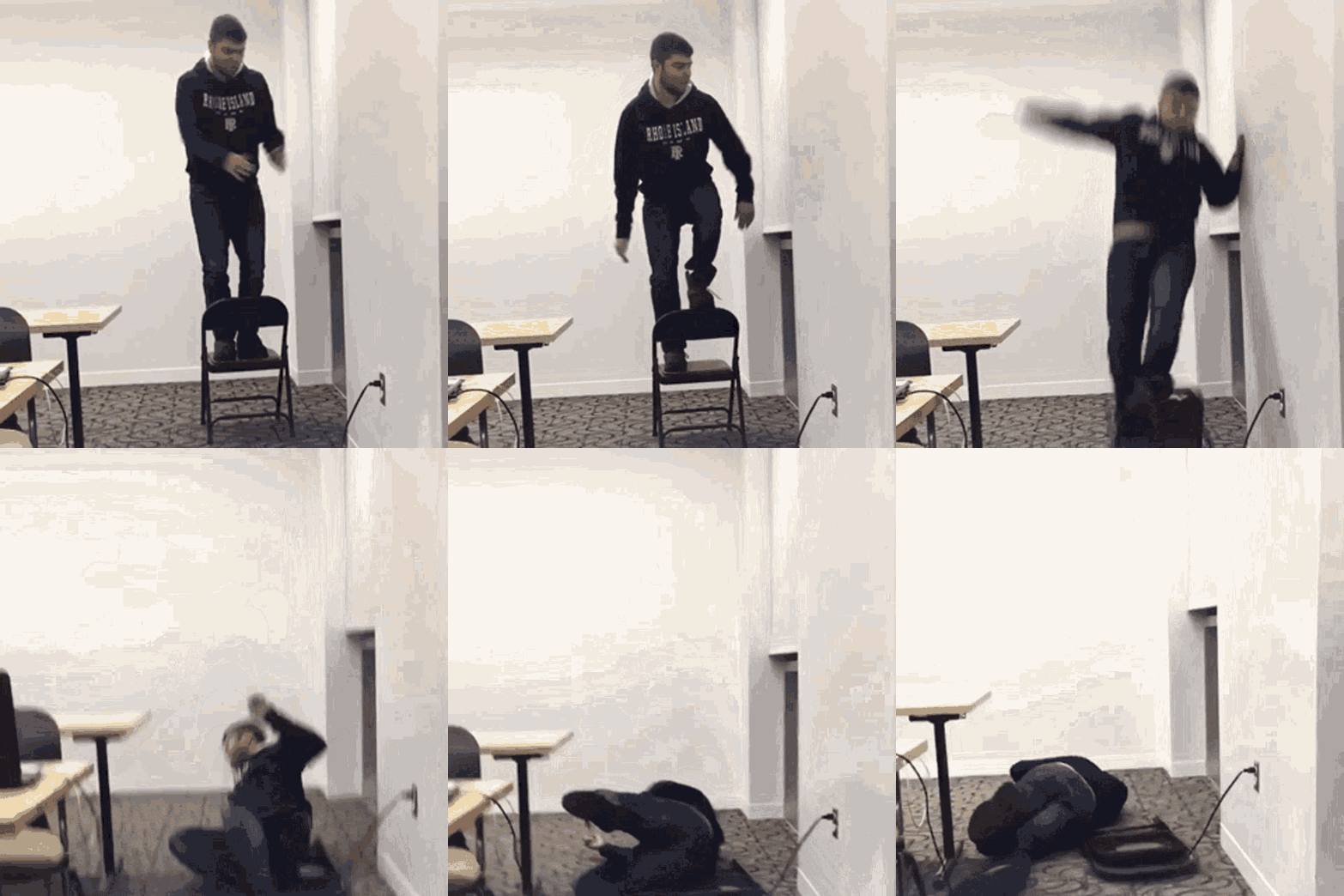
Falling Chair GIF - Falling Chair Man - Discover & Share GIFs

*One of my other classes, in reading through a passage from the novel Maud Martha, by Gwendolyn Brooks, commented “I didn’t think these characters were African-American. They don’t have African-American names.” The names in question were Maud Martha, and Helen. One student pointed out that Helen is a Greek name, as a way of proving to me that these were clearly not African-American names. (I refrained from pointing out that the student’s name is Roman in origin, though the student in question is Southeast Asian.) Another student told me that the activities the family pursue in the passage are rural, country kinds of activities — specifically gathering wood for a fire — and that made them think the characters were White. To which I responded “Because rural areas are only White? And African-Americans don’t gather firewood?”

Did I mention that my principal was observing me that class? He was. His comment later was that I had had “several teachable moments” in the period. (He also said I handled it well, so that was okay.)

*Today one of my students came back from the restroom, started talking to the other students about something (This was, by the way, while I was talking about Miss Caroline and how it feels when students don’t listen to your favorite story), and at some point I realized that what they were saying was that this student, on the way across the hall to the restroom, had seen someone they didn’t recognize outside the school door (Which is mostly glass and is at the end of the hall near my classroom — who needs that “security” stuff?), that my student had let them in, and that the person in question, referred to both as “kid” and “guy,” was wearing a mask, carrying a backpack, and was currently in the bathroom. Refraining from asking the student why IN THE NAME OF ALL THAT IS GOOD AND HOLY they had let some literal masked stranger into the school, I went to the bathroom to see who was in there. There was someone in the stall, but I could only see shoes. So I quickly went to get an administrator to check on the bathroom, and then I went back to my class — where I received the clarification that the student had not let the person in, a teacher had, which almost certainly moved this from “Possible crisis precipitated by a student who lacks critical thinking skills” to “A student went out to a car, with permission from a teacher, came back in, and my student didn’t recognize them.” And the second option is what it was, and a few seconds later the administrator gave me a thumb’s-up on the way back from identifying the person in the restroom as one of our students. 

But it was a fun five minutes.

Loosing-my-mind GIFs - Get the best GIF on GIPHY

None of this is what I wanted to write about tonight, however. (Actually I wanted to write about it last night, but another thing that happened this week is my phone stopped working, so I spent last night ordering a new phone.) What I wanted to write about tonight was the worst thing I’ve dealt with in the last week. One of the worst things I’ve had to deal with all year.

Data Day.

Last Friday was our first Data Day. And the big problem with this particular occasion was that it was our very first Data Day at this school. At least the first one involving my department. To be sure, we have looked at data before: data is inescapable in public schools today. We start every school year with a brief overview of the school’s test data from the year before. Which is all about students who have already left the classes in which the data was collected, which might seem to some people as though it reduces the value of the data.

Some people.

Anyway, we look at data all the time. But I work for a small charter school, which has a hell of a lot of turnover in the staff and the administration, and every year things get a bit discombobulated and confusticated and lost in the shuffle; and so we have never done a Data Day like this Data Day. Unfortunately, those in charge of Data Day thought we had all surely done Data Days before, and so didn’t think we would need specific instructions about how one carries out a Data Day. But since we have never had a Data Day before, we did need those instructions, and we didn’t get them, and so the day was — awkward.

But hold on. Before we even get to the awkwardness of the actual day, I can hear you asking “Wait — what even is a Data Day?” 

A Data Day is when teachers get together in groups and look at the data for our students — in other words, their test scores. This Data Day was scheduled after we gave our first major standardized test this year, a practice ACT. The ACT, a sort of West-Coast cousin of the SAT, has four parts: Reading, English (grammar, that is), Math, and Science. Now, as I assume that all my readers are among the most astute people in the population, so I assume you have noticed that this selection of tests leaves out a few of the usual departments in a high school: Art, PE, foreign language, computer science, ESS (or SPED) — and, of course, history and social studies.

But that’s fine! Even if not all teachers have data and so can participate in Data
Day, the thing to focus on is the subjects which do have data. And lucky for me, English has double the data! And EXTRA lucky for me, this is my first year as head of the English department. So not only do I have double the data — but I get to run the meeting!

Did I mention that my principal was observing my meeting? He was. He did not tell me that I handled this one well. I think I did okay. We had several teachable moments.

But we didn’t have everything. We should have had our individual class data, from the shorter single-subject quizzes we’ve been giving over the course of the semester; we should have all been looking at our individual laptops and comparing our individual data to the school wide data, so we could find where our specific classes were different from the school population as a whole — that is, what are my 10th grade students failing to learn in my class, which the school as a whole is mastering? Those are the areas where I can make changes in my class in order to improve the instruction and the learning in specific skills and knowledges, to help my students catch up. And that was where we were supposed to develop our Action Plan, building SMART goals (Specific, Measurable, Achievable, Relevant, and Time-bound) so that, when we have our next round of ACT practice tests in December, we can move straight into our second Data Day, and we can see what areas have improved and where we need to keep working, maybe finding new strategies that can make a difference in the scores. That is the goal of a Data Day.

I ran the meeting. Completely making it up as I went along, because I have never done a full Data Day. I didn’t tell everyone they needed to bring their laptops and individual classroom data. I didn’t have my individual classroom data. I had not examined the school wide data previously, and so while I pointed out a couple of obvious things — our students did better on reading and English than they did on math and science (I work at a STEM school, if you didn’t know.), better on English than on reading (which mystified me because they mostly can’t answer a single grammar question correctly — but I guess they can correct grammar on a multiple choice test?), and in some cases better, in others worse, when compared grade to grade. But everything I said was obvious. I didn’t know that we were supposed to create a SMART goal, or how to do that, and I didn’t take notes or guide the discussion or watch the time — or delegate any of those tasks. I did a bad job with the meeting. It was uncomfortable. That was my first Data Day.

So.

You all know that whole thing is a pile of horsepucky, right?

I knew you were all astute.

Okay, let me be clear: the basic idea of examining what my students know and what they don’t know, identifying areas where they have mastered the class content and where they still need work, and then strategizing methods to improve their learning? All of that is fine. None of that is horsepucky. We can get general ideas about how things are going, and we can find some ways to maybe make them better; that’s fine. It is a lot of work, for a questionable reward, and since I am already obscenely overworked, and still behind where I should be, I question whether or not this is the best way for me to spend my time; since I have 300 ungraded assignments turned in on my online education platform, I have a better idea of how I could spend a good couple of hours on a Friday afternoon.

Yup. Drinking.

I grade on Sundays. I shouldn’t. But I don’t have any other option. I’m not kidding about the 300 ungraded assignments, and that’s after I spend at least a few hours working every Sunday, and have done since the school year started August 1. A couple of hours on Friday afternoon, even if I hadn’t used that time as I deserve and gone drinking, would have helped make a dent in that pile — though of course it wouldn’t have eliminated the pile. But Data Day didn’t help at all. In fact it stressed me out so much that I didn’t even get my other tasks finished on Friday: I went home and collapsed uselessly on my couch. I did play some Minecraft, so that’s a win, I guess.

But let’s imagine that I did have some extra time, a couple of spare hours that I didn’t have to spend teaching class or working with students or grading essays. I could have done Data Day. I could have compared the results of a test which the students didn’t care about and didn’t try their hardest on, because they knew perfectly well they weren’t going to get graded on it, and that it wasn’t the official ACT, and therefore this test didn’t give them a chance to get a high score they could use to get into college or win scholarships; to the results of a series of short, five-question multiple choice assessments I give in my class, one for each standard they are supposed to master this school year. Those, also, the students didn’t care about and so didn’t try on. But hey, that makes the comparison more valid, right? The students taking it didn’t care, in both cases! Matching apathy! Also, neither set of tests was designed by me, or related directly to the content I used to teach the standards — none of them are on To Kill a Mockingbird, for instance. Oh, and also, the ACT is not broken down by standard, so I’m comparing a five-question multiple choice quiz on a single standard to a 40-question reading test and a 75-question English language test, on all of the standards taught in all four years of high school, and also quite a few that come up in middle school and a couple that are only used in college or adult life. Because one aspect of the ACT is that it is designed to be too hard, in parts, for any student to get a 100% on. Because the goal is to find the extent of a student’s knowledge and ability, right? If I give you a quiz on what you know, and you get 100%, I have not found the extent of your knowledge: those questions might cover every single thing you know on the subject — or they might only scratch the surface of your galactic levels of knowledge. To find out for sure, I have to make the questions get progressively harder until you cannot answer them correctly. That’s where I can assume your knowledge ends, when you can’t answer the questions any more. Which means the ACT tests, like all similar tests, is intended to get progressively harder until it becomes impossible for any high school student to answer the questions. 

Which means, of course, that there will always be gaps and areas for improvement, no matter how spectacularly I teach and the students learn, because of the way the test is designed. So if I take this concept seriously, that I need to teach my students enough for them to be able to score 100% on the test, I can never be complacent. Ever. I will always have more to teach. But of course, my students will move on out of my class before I finish teaching them; but that’s fine, they can learn the rest of everything in their next class.Right?

Sure.

More to the point, did you catch where I described how different the two tests are? Five questions on a single standard, compared to 115 on the general areas of reading and writing. Also, the standardized tests are given in very short timeframes, because the ACT’s base assumption is that the more you know about a subject, the faster you can answer the questions. An assumption that is so deeply flawed that it casts doubt on all of the ACT results — because of course speed has little if anything to do with knowledge or skill. A genius with bad eyesight or dyslexia or a headache the day of the test will not be able to answer all the questions within the time limit, which is 35 minutes for the 40 reading questions (which are about four different reading passages, with 10 questions each), and 45 minutes for the 75 grammar questions, which is just cruel. Oh wait, sorry: that’s only for the 11th graders. The 10th graders took shorter tests in shorter time limits — 24 reading questions in 30 minutes, and so on. But that’s fine, I’m sure we can compare the two classes and get some kind of useful idea of how much students know. Right?

Right?

Sure.

Here’s the part that killed me. Right at the start, when I’m trying to fumble my way through the schoolwide data we have about the ACT and Pre-ACT tests, and the middle school results from an entirely different assessment which the 6th-8th graders took, we were told to ignore the gaps in the test results that were caused by students who were having a bad day, or who had a headache the day of the test, or who didn’t care and so didn’t try. Because we can’t control those things. We need to focus on the places where we can have an impact, where we can raise those scores. 

Uhh — excuse me? How can we know which areas are lacking because of a flaw in the program, and which are lacking because students didn’t feel like trying their hardest? That’s right: we can’t. Just like we can’t see the specific standards for the questions on the ACT (I don’t think; there might be a way to break it down like that, but I didn’t know it, so.), and we can’t know if the five-question multiple choice quizzes give us good information, either, because in addition to being skewed by student apathy and also student humanity, five questions won’t do a good job of determining what the student knows and what they don’t. You can randomly guess on five multiple choice questions and have a not-insignificant chance of getting them all correct even if you couldn’t read at all. And also, let’s not forget that if a student learns all the material, but then fails the assessment because of a non-academic reason like a disability or an illness or a lack of motivation or a grudge against the school or the teacher or a bad testing environment or a bad breakup or a bad bit of potato they ate the night before which gave them vivid dreams in which they were visited by three different spirits of Christmas — that student did not succeed. They do not pass Go, they do not collect $200, because our system is based largely on high-stakes tests and the ability to pass them. And it doesn’t matter what I teach or how well I teach if a student who fails the assessment, despite knowing everything about my subject, is considered a failure. All of the things that I was told to ignore, because they are out of my control, are the entire reason why that hypothetical student could fail my class. 

But guess who would still get at least some of the blame for that student’s failure. And who would have to make SMART goals to try to improve that student’s test results. And who would have to examine that student’s data, again and again, to find the reason why the student was unsuccessful. But please, keep ignoring the aspects we can’t control, like a lack of motivation.

Right.

Sure.

And while we’re at it: who the hell told educators that we could control anything? Listen, you don’t know how hard I tried today, to make my students learn the lesson of Miss Caroline. And instead they were distracted by the possibility that someone had let in a school shooter — which was exactly where all their thoughts went when they heard that there was a possible stranger in the school, in a mask and carrying a backpack. Because of course that’s what they thought. And I’m supposed to teach those kids? To control their learning? To specifically assess the lessons that worked and the ones that didn’t, and to make adjustments which will ensure all the learning happens exactly as we want it to, which will then be shown clearly on the test?

Let me also say: if I go back tomorrow and try again to teach the same lesson, my students will say “We already went over this yesterday.” And if I say “Right, but you didn’t learn it as well as you should have, because you were distracted,” they will then reply, “That’s okay, we learned enough. We should move on.” And it wont matter how much I try to teach the lesson, how hard I want to reteach it, or whether I know exactly how to make that lesson more effective: it was ineffective because of events outside of my control. The opportunity was lost. We did not have a teachable moment today.

Here’s the truth. That neat, data-driven ideal, where teachers do the math and find the perfect way to help students reach mastery? School doesn’t work that way. Students don’t work that way, learning doesn’t work that way, even tests don’t work that way. None of it is scientific. None of it is precise. There are real benefits to teachers getting together and talking about what works and what doesn’t, and trading ideas and strategies; to that extent, Data Day was a real success. But otherwise? There is no data. Not anything real, not anything reliable. It’s all guesstimates, all gray area. Teachers do things that seem like they work, that seemed like they’ve worked in the past; students seem to learn things, and seem to get grades that reflect their learning. Somewhere in there, real learning happens, and part of it is probably because of what teachers do. But not all of it. And none of it for certain. Data Day is an attempt to pretend otherwise, to pretend that we can capture a mathematic truth about human beings, who are not by our nature quantifiable. And it just doesn’t work.

But hey, maybe that was just this time. All those things about human nature and whatnot? All out of our control. Let’s try to focus on what we can control, and we’ll circle back around in a few months and see what the data tells us.

Can’t wait.

But You Get Summers Off!

[Read Part One: Money Talks]

[Read Part Three: Walking Out]

The day begins at 8:15. That’s when class starts.

But of course that’s not when the day begins. Students come inside at 8:05, and as soon as they do, I am teaching. That’s when the day begins.

Unless I have morning duty: then it starts at 7:45, when I have to show up, unlock the two gates, and then stand in the parking lot and make sure nobody gets run over while all the parents are dropping their kids off at school, and the high schoolers are whipping into the parking lot, trying to make sure that no one took THEIR SPACE. That’s work. 7:45 is when it starts, some days.

Although it might be fair to say that my day begins at 5:20, when my alarm goes off and I get up and take a shower; because in that shower, I am thinking about school. Always. Planning what I will teach, thinking about what I have to grade, trying to remember what meetings I have this week – is this Wednesday a faculty meeting, or grade-level teams? Do I have an IEP meeting today, or is that next week?

But if we begin with the thinking, then the day begins around 2:30 am. Because that’s when my insomnia kicks in, and I start thinking about school. Trying to go back to sleep, of course, but that isn’t always possible; it depends on whether I’ve done anything wrong. Did I lose my temper and snap at a student who asked for the fifth time if we could watch a movie? Did I have to explain a grade to a student who thinks they are a brilliant writer, but really they’re not, and I had to find a way to let them down easily while still encouraging them – but also making it crystal clear that they aren’t as good as they think they are, because otherwise they will get their parents to file an official complaint about the grade, and I’ll have to have three meetings, at least, to iron it out? Do I have a class that’s misbehaving, and I need to explain to them all, again, why they shouldn’t act that way? Because if I do, I will start working on my script at 2:30, and I won’t be done until 3:30 at the earliest. 4:30 is more common, on the days when I have a controlled-anger lecture to give.

That’s when my day begins.

Then, 5:20, alarm, and I have my morning; I have sometimes taken advantage of my early rising to get some correcting done, because I’m fresher first thing in the morning with that first coffee jolt, and I can get through eight or ten vocabulary assignments in under an hour. My vocab assignments are tougher than some, because I make them define the word and then use it in an original sentence, so I have to make sure that the definition is correct, that the sentence uses the word correctly, and that the sentence is grammatically acceptable; that’s also why I can’t let TAs grade the vocab, because they don’t know enough grammar and can’t always pick out which of several similar definitions of the word is the best one. I also give them credit for the sentence even if they got the definition wrong, but the sentence can make sense anyway; and I don’t trust teenagers to do that. So I do it. There are between ten and twenty words per assignment, so it takes me between five and ten minutes for each student to check the whole thing over – longer if I want to give feedback on why the sentence is incorrect, maybe offer a correct alternative so they can see what it looks like to use an adjective properly. 97 times, every two weeks. (I know, only 97 students? I have such small classes! At my last school I hit 180 students, some years! I’m lucky, now. Oh – and I do have more students than that, but two of my classes don’t do vocabulary assignments.) Then it’s breakfast, walking the dog, getting lunch ready, making sure I have all the papers and materials I need for the day. Then it’s off to work.

Morning duty. Usually I’m just a presence; the parents who drive badly (A good 30-40% of them) assiduously avoid eye contact. If it’s a student who speeds through the parking lot or swerves too close to a 6th grader crossing their path, I can yell at them to watch where they’re going and they’ll at least give me an apologetic shrug, but mostly my job is to scowl at the drivers and wave at the students. And watch the clock: because at 8:05 I have to unlock the school door and let the students in; and then I’m supposed to stay out there until 8:15 – but my class starts at 8:15. Do I open the classroom door while I’m outside, let my students hang out in my room until I get in there? If I leave them unsupervised they may get in a fight, or steal something, or break something valuable; I better leave the door locked. Which means they will stand in a loud, obnoxious clump outside my door, and block the hall for everyone else. Oh, well, can’t be helped.

I fudge the end of morning duty, go in about 8:13; usually my boss is coming down the hall to make sure the door is locked, so he sees me. Damn. I’ll be getting an email later about how important duty is, how we need to make sure our students are safe. Well, anyway: into the classroom, 21 freshmen for Honors English, and here we go. I need to:

*Log onto my computer, start Chrome, open the email program and make sure I don’t have any emails with subjects like “EMERGENCY: BOMB THREAT HAS BEEN RECEIVED,”

*Start the attendance program, log in, take attendance (If I don’t do this in the first three minutes, the front office will call to remind me.), mark the tardy students absent (We don’t mark them tardy during first period; if they come in late, they have to go to the front office for a note, and then we mark them Present; the front office changes their attendance to Tardy for us.), change the Absent students to Present as they walk in late with notes

*Start Internet Explorer (Because that’s where I have the Bookmark) and open the morning announcements.

*Get the students’ attention: impossible because they are too busy chatting and visiting and teasing each other.

*Stand for the Pledge of Allegiance when it comes over the PA

*Go over the morning announcements: a witty quote that is either over the students’ heads, or strange and offputting, or both; the same five announcements that have been on there for a week; a new video from the Character Education class about Inclusion, this week; God forbid a new episode from the journalism class with this week’s school news (They do a fine job, but my students love nothing more than criticizing, and so every week when the new episode is posted, I’m in for several minutes of snark and sass, and then indifference and distraction when I stop them from being crappy.); and then sports scores that none of them want to know about unless they were on the team that won, and then they want to make sure that the scores are seen and they get congratulated.

*Start class.

What am I teaching again?

Oh, right, To Kill a Mockingbird. Well, at least these students get their own books off the shelf – though I have to remember to tell them to stop throwing the books across the room to their friends, because somebody’s going to get hurt, most likely the book; I’ve been able to pick up a few used copies to replace the worst ones, but I already can’t tell the difference between the ones I bought and the ones I got from the English teacher next door when I took over this class: covers are falling off, spines are snapped, chunks of the book are falling out. Okay, so now I’ve got them on the right page (Mostly: there are four different editions, all with different page numbers, so someone is always lost), and it’s time to start reading. They’re still chatting, and I shush them. I start reading.

They’re still talking. I shush them again, louder, and add “Quiet, please!” I start reading again.

Still talking. Now the students have gotten annoyed with their peers, and one of them cries out, “SHUT UP!” I should tell her to be more respectful, but I’m on her side. Plus, it worked. So now I read. It’s a good class, the Honors class, so they pay attention, mostly; there are only three or four who are still scrolling through their phones behind their books or under their desks while I’m reading aloud; when I stop to ask a question, I get several kids willing to answer. Actually, they might be too involved: the one kid who loves to talk has his hand in the air every five minutes, often starting his comments with, “This is a little off-topic, but…” And the one precocious girl always wants to share when she has had some insight, when she has spotted a thematic connection; it’s great, but her classmates are tired of her being a know-it-all, as they see it, so as soon as she starts talking, they start making noises, having small side conversations; and the girl speaks too quietly and I can’t hear her.

But I read, enjoying every minute of it, because it’s Harper Lee and every page is brilliant. The kids like it too, and everything is going great – except now it’s 9:09, and the class is almost over (First period is longer to allow for the morning announcements.) and DAMMIT, I forgot to give them their reading project assignment, again. I’ll have to remember to change the due date on the assignment sheet and make a new set of copies. I stop reading with a minute left, they put the books back on the shelf; the precocious girl and the talkative boy both come up to my desk to talk to me, at the same time, and I try to listen to both as the bell rings and the room empties. By the time I have laughed at the boy’s joke and heard the girl’s last insight, my next class has started coming in: they are juniors, so they drop their bags on their desks and then go back out in the hallway, to the bathrooms and the water fountains. I check the email, make sure there aren’t any bomb threats; I have an email from a parent and one from the Special Ed teacher, both of which I have to open immediately. (I also have eight assignments from students, two communiques from the principal, and seven pieces of spam.) The parent email is asking about a student’s grade in their class, so I mark it Unread and try to remember to read and respond later; the special ed teacher is reminding me that we have an IEP meeting this afternoon. Crap.

The bell rings and it’s time for 2nd period: College Readiness. A required elective which the juniors all resent; it’s intended to help them succeed on SATs and ACTs and college applications; they split the week between math, college counseling, and me for English. It’s annoying to them because most of them are already in more advanced math classes than what is on the tests, and they already have me for English some other time during the day, but they still have to take this class. They are all late, either because they took too long coming from first period or because they’re in the bathroom, expecting their bags to count as attendance placeholders; sometimes I mark them absent and then change it as they trickle in, sometimes I mark them all here and forget about it. But when I do that, I always remember my college professor telling us that the attendance record is a legal document, and if I mark a student here when they’re absent, it could be used as evidence in court, say if that student is actually off robbing a Kwik-E-Mart while I said they were in my 3rd period class. And if I mark them absent while they are present, that makes the automated system call their parents and say the kid is absent from this class; then the parent texts the student to ask where the hell they are, and I get an email. And if I don’t get the attendance taken in the first three minutes of class, the front office will call and remind me.

So what were we doing in here? Oh, right, they are practicing their college application essays. So I want them to make their rough drafts twice as long, and then they will cut them down to 650 words max, the recommended max length from the Common App. So I could use one of the samples that I wrote, and show the students where I would add more details, more information, more words just to hit the target length (Even though I hate writing for length, as all that should matter is purpose and audience; this is the only class where I assign minimum and maximum lengths for essays, because college applications expect that), but I think it would be better to get one of them to tell me a story, and I’ll type it up on the projected screen while they all watch. I’m lucky; the class clown is in this group, and he always has a story, and the one today actually isn’t that bad – though it is about running off campus to buy snacks from the Circle K in between classes, which isn’t allowed and I should say something about it. But I get the story down, which takes about half of the class time; and then I start talking about where the essay thus created could be added to.

Nope: they’ve stopped listening. Well, after all, it’s not a real class; the assignment isn’t due today; the story on the board isn’t theirs, and though it was entertaining, they already heard it when the clown told it to me the first time. So they have no reason to pay attention. I give up, and let them do nothing; I sit at my computer and start answering that parent email –

Fire drill. The loudest damn siren in the world, makes me jump every time. Fortunately the students know what to do, so they head outside; if it was a lockdown drill, they’d be anxious and awkward and unsure, and I’d have to guide them where to go and what to do. I grab my attendance folder off the wall, shut off the lights, go back for my sunglasses because the sunlight makes me sneeze, and then lock the door and go out. I have to hold my hands over my ears as we pass the outside siren, because the noise is actually painful. Then we’re outside, and I have to direct the students to the right place after all, because we’ve changed protocol this year (They used to go through the locked gate, which meant they all piled up until I got there to open the lock; now they go through the parking lot to the far side), and tell them not to mess with the parked cars, and no, they can’t run down to Circle K for some snacks. Not even if they bring me some. Take attendance again outside, hold up the green card because they’re all there, and then wait for the signal to take them back inside. Still waiting. Still waiting. “Hey Student X, put Student Y down, please. Student Z, stop spitting sunflower seeds on people.” Still waiting. Okay, there we go: back inside. They file back in just in time to get their things, and then the bell rings to end the period. My third period students already left their second period, so they’re coming in even before second period ends, asking, “What are we going to do today?”

What are we – oh, crap! I need the Chromebooks. They’re doing research for their argument essays this period. Race to the computer (Unlock it because it timed out while I was outside), bring up the Staff Forms page, open the Chromebook Cart Reservation page, check the three carts – Cart #3, okay. Dammit, it’s all the way down at the other end of the school. Pick out two students and send them to get the cart. Then it’s time for attendance, and I have a minute or so to remind them of their tasks before the computer cart arrives, at which point they stop listening to me because they now get a computer to play with, and they all swarm the cart and grab Chromebooks.

Except there aren’t enough. The last teacher didn’t manage to collect them all, because of the fire drill. So I send some students down to fetch them. They do, but there still aren’t enough, because this is my big class, 26 sophomores (Well, 25 sophomores and one senior taking Sophomore English for the third time, bless her heart. She won’t pass this time, either.) and the cart only carries 24 Chromebooks. So I send two more students on a quest for random Chromebooks, which they track down in only 20 minutes of roaming the halls. But no great loss, because that same time has been spent in the classroom watching YouTube videos and finding ways to play free online video games, or else bringing up Google and then looking at a phone. The rest of the class period goes the same, and at the end, they ask if they will also have tomorrow to do research. I shake my head, unable to muster any better answer, and send them away when the bell rings. Then I have to collect all the Chromebooks they left on their desks, return them to the cart, make sure all of them are plugged in –

No, wait, that has to wait for a minute: I haven’t been to the bathroom in three hours. I race down to the teacher’s lounge, because the boy’s room across the hall is filthy and usually occupied, and I have bashful kidneys. By the time I get back to my classroom, the Chromebook cart is gone; hopefully to the right place. I don’t know: this is my prep period, the best time of the day. No students for fifty – no, forty-one glorious minutes.

I have to:

*Actually read all of the emails that came in today, and any I didn’t get to yesterday.

*Respond to all emails that need a response, in the following order of importance (most to least): parents, special ed, other teachers, administration, students.

*Check that I have the right handouts for the three classes after lunch, that I know what I’m teaching, that I know what assignments I have to collect and what due dates I have to remind them of

*Make any copies I may need this afternoon or tomorrow morning, as I won’t have time to make copies in the morning (Xerox machine is always tied up before first period) and I have an IEP meeting after school

*Make more coffee before I collapse into a stupor

*Use the bathroom at least one more time

*Do as much grading as possible. Usually not very much. Today, none: because one of my colleagues stops in to ask me if I’ve heard the latest absurdity the admin’s gotten up to, and I haven’t, so we need to discuss it. We do. It’s infuriating.


Now I have eight minutes left. Didn’t get any grading done.

But that’s okay, because the next class is lunch; not quite as satisfying as prep, because there are students in here, mostly hanging out (with their terribly smelly food) but some looking for help or to check on due dates or to ask if I’ve graded that essay they turned in late. The students who are hanging out want to talk to me, because they want to tell me what they did yesterday, or show me that meme or the video they found that was hilarious and I’ll like it because there are dogs in it, or they want to ask my advice, or for me to settle an argument (Is cheesecake a pie or a cake? Have I seen the trailer for the new Fahrenheit 451 adaptation, and what do I think of it? Should they move into the dorm for college next year, or live with their parents to save money? Should they even go to college? Don’t I think the new math teacher is an asshole?) [Answers: I say cake, because of the name, but really it’s a tart; yes, and I think it will be a good movie but not the wonder that the book is; they should move out if they can afford it; yes unless they have a different plan that is as useful as a college education would be; and no, because I like the teachers more than the students, even though I agree that math is evil. Yes, these are all things I have said to students.].

I eat my lunch, finally make my coffee while also finishing up the copies I need for class after lunch, and spend a few minutes talking to my wife. (On the phone for the first sixteen years of my career, in the next classroom for the last two years, as she has been teaching at the school where I work. It’s lovely to have her there. It makes my blood absolutely boil to see the way they treat her, the goddamned admin and the obnoxious students and the entitled parents. Drives me nuts.) Then it’s time for 6th period: Advanced Placement Literature and Composition. Today I am teaching Julius Caesar by Shakespeare, which is nice, because I’ve taught it for years and I know everything about it; I also worry that I’m not seeing it with fresh eyes for the same reason, and so there are things that I’m missing. I need to help them see through the text, because this class is struggling with the AP expectations for analysis; they write well, for the most part, but they don’t always get what they’re reading. Because with one or two exceptions in this class of twelve seniors, they don’t ever read outside of what is assigned for school. They never have. They tell me, half ashamed and half proud, how few books they’ve read this year, or the last four years, or their entire lives.

People wonder why I read books out loud to my high school students. It’s because it is literally the only way I can be sure they will read at least one book in my class.

This is one of the factors that makes English an impossible subject to teach: the students don’t read. I have to find a way to keep them interested in books, which they believe, with all of their hearts, are boring and obsolete; I have to find a way to make them want to put thought into the books, because that’s the only way they’ll see the value of literature. I have to both know everything about the books I’m teaching, so I can answer their questions and ask them good ones in return, and also improvise constantly, and use whatever I can to relate the literature to this class, these students, this point in time and place; because of that, I generally can’t re-use old lesson plans, and I have to constantly learn everything there is to know about new literature. Teaching writing is even more difficult, because it has all of the same inherent feel of being boring and obsolete to students who are never disconnected from the internet; and also because it makes the students feel inadequate, because they know they don’t write well, and they don’t want to be embarrassed, and they don’t want a bad grade – and so they try not to write, which means they don’t practice and they don’t get better. When I do ask them to write, they often put as little effort into it as possible, and then they confirm for themselves that they don’t write well.

18 years teaching, and I don’t know how to fix that. I try something new every year. Sometimes it works. With some of them. I think.

But I can’t really say that English is harder to teach than other subjects: we all have individual difficulties, and mine aren’t worse. At least I have stories, with sex and violence and beautiful language; math teachers need to constantly think of ways to keep students interested in abstractions, thinking in ways they don’t normally think; history and science teachers have to present an enormous amount of information, and somehow make it digestible; arts and technical teachers have to constantly circle the classroom, never sitting down for a second all day, looking over students’ shoulders and trying to figure out what they’re doing wrong and help them do it right, all while the students are incessantly calling out the teacher’s name – if you’ve never been in a high school arts or tech classroom, just imagine 20-30 hungry baby birds in different nests, with one bird trying to feed them all while also keep them from falling out of the tree or pecking each other to death, while they just keep crying out, crying out for attention. It’s quite the dance.

Elementary school teachers have to do all of this at once. Though with a lot fewer students, admittedly. Still: it’s not a job I’d want; the one day I subbed in an elementary school was one of my worst as a teacher. I prefer high school, and Language Arts. At least I think I do. A lot of the time, I’d rather just be a janitor.

6th period goes well; they’re great kids. Almost graduated now. I worry about some of them. Especially the one student who recently had a death in the family. I worry a lot about that one, because the death hit hard, and all plans have changed, and I don’t know if that’s a warning sign or just the normal healthy grieving process. I’ve been a teacher for eighteen years, and I’ve had three of my students commit suicide: I don’t want to have a fourth. I’ve also had to make reports to social services twice, once for an abusive parent and once for a girl who had a “boyfriend” who was twenty years older than her. Neither report led to a good outcome. I don’t need to report this one: everyone knows the whole situation, which means everyone treats this student like they’re kryptonite. I try to be normal with the student. I try to talk to them every day, to be present for anything that needs to be said, to be as honest and open as I can be, always, no matter what. I don’t know how well I do. I don’t know if it will make any difference. But it’s all I can do. So I do it.

When I have time.

We don’t get through much Julius Caesar, because they constantly distract me and the class with their jokes and their stories and their questions; I encourage that, because I think it helps make the class more meaningful and more useful, and also because there are pedagogical theories that encourage students to associate knowledge with their own lives, their own experiences, and so letting them voice all of their thoughts encourages that sort of association. Or maybe it just wastes time; I don’t really know. I know they like my class. I know we don’t cover half as much material as most other teachers. I don’t know any other way to teach.

Speaking of teaching: now it’s time for 7th period. AP Language and Composition.

What the hell was I doing in this class?

Oh right: they’re halfway through “Shooting an Elephant” by George Orwell. We’re talking about imagery. I find my copy under the pile of papers by my podium, and I tell them to get out theirs; I remember to take attendance then, and go to my computer to do it – and realize I forgot to take attendance for the senior class last period. Dammit. Huh, well, at least the front office didn’t call. I mark attendance for both classes, then hand out replacement copies to the two students who lost their packets since yesterday and one to the kid who has it but doesn’t want to dig through his backpack and find it, and then we’re off: to Burma, in the 1920’s, when a young George Orwell is about to slaughter an elephant because he doesn’t know how to let the elephant live and still be a white police officer in a British colony. He hates everything, especially himself. I can kinda relate.

I get into it, reading the piece; Orwell was such a damn good writer. I wish I could write like that. I know it’s because he was able to live his writing, almost all of it: when he wrote Homage to Catalonia, about the Spanish Civil War, it was after he went to Spain and joined the anti-fascist militias, and actually fought on the front lines. I wish I could do that. Not fight in a war, but go to where I am needed, and do what I believe needs to be done, and then write beautiful, crystal-perfect books about what I had done. Though I’d rather not die at age 48 of tuberculosis: I’m 43 now, so that’s not much time left. Still haven’t published a book. Not that much time in my day to write; certainly no time to do anything worth writing about.

I can’t get too into it, though, because this is my annoying class. This is the class with the one student who likes to irritate everyone, and so says intentionally sexist or racist things, and then says, “I’m just kidding.” He knows I’m a vegetarian, so he likes to bring up how he slaughters his own meat. He likes to make the stories as disgusting as possible, and then smile at me. And there’s that other student who can’t sit still: she will stand up and dance right in the middle of class, while I’m reading. Or she will make hand gestures and funny faces at other students in the class, laughing loudly while we’re trying to have discussion. She’s the smartest one in the room, so if I call her on it, she’ll apologize, share some insight to mollify me – and then go right back to disrupting the class, while also making some passive-aggressive statement about how limiting and controlling school is, how that’s unhealthy for a growing mind. Then she’ll stare at her phone for half an hour, turning it around to show funny memes to students across the room. And the rest of the students in here would rather be studying for their math class which they have next period, or grumbling about the history class they had last period. The class often feels like a complete waste of time.

Speaking of not much time left: class is almost over now. I cut the article off with one paragraph left; we’ll finish it tomorrow, but the mood will be ruined, because they won’t remember tomorrow what we read today, other than the bare facts: Orwell shot the elephant. Now it’s time for 8th period: the second AP Lang class, the big one – twice as many students as 7th period. Fortunately, this is the one time when I don’t have to remember what we were doing, the one time when I have the same class twice in a row; unfortunately, the two classes don’t go at the same pace, so I don’t remember where we were in the Orwell article with this class. When I remember, I mark the paper where each class stops. When I remember.

Unfortunately, fighting through 7th period has put me into a bad mood, and worn me out entirely. Well, at least I have four minutes to recover. I take deep breaths, try to shake it off, try to treat the new class fairly, not take out the last class’s misbehavior on these kids. It’s tough. Especially at the end of the day.

The class goes by in a blur, but also, because it is the end of the day and I am exhausted, it crawls by. The clock doesn’t move and doesn’t move and doesn’t move, and then suddenly there are only 20 minutes left and we haven’t finished the reading. We get through it, the whole thing (so now they’re ahead of 7th period), and I’m about to lead them into the analysis: when the bell rings. 3:30. Day’s over. They swarm out, and silence descends.

Then my classroom phone rings: I forgot the attendance again. I apologize, and take it now. I fall into my desk chair, open my email. Oh right: I have an IEP meeting. Down I go to the special ed room to talk about how well that student is doing in my class (or how poorly) despite learning disabilities or physical disabilities or autism spectrum challenges. Or all three.

An hour later, and it’s all I can do to gather my things and leave. Home, to dinner, and dog walking, and family time, and some relaxation; then, around 8:00, after dinner is done, I remember: I haven’t actually graded anything all day. I grab up the laptop, sit on the living room couch, open my email, and start grading vocab assignments that students sent to me online. If I’m lucky, I can get a whole class done before I have to go to sleep, sometime between 10:00 and 11:00.

I need to get a few hours of sleep before I wake up at 2:30. I’m worried about that kid in my 6th period class. Seemed … off today. I hope there’s nothing going on. I hope nothing happens. I hope I didn’t say or do the wrong thing. I hope.

This is no exaggeration. This is what I do, what I have done for 18 years. I don’t always have fire drills, or adventures with the Chromebook carts; sometimes it’s a lockdown drill. More than once in my career it has been a bomb threat, and an evacuation. Oftentimes I realize I don’t have the copies I need to teach the lesson I wanted to teach, and I have to do something I make up on the spot. More than once I have gone to the computer lab and found another class using the computers. Schedules change, students are out for field trips or athletic events. I don’t always grade at night; sometimes I get more done at school, and then I let myself do something else in the evening. I pretty much always grade on weekends, and during vacations; I’m an English teacher. I have essays to read. A single essay takes between 20 and 30 minutes to grade and comment on, and I have 100 students, and I assign multiple drafts.

Ask me to communicate regularly with parents. Or to stay until 7:00 or 8:00, three or four times a year, for parent conferences.

Ask me to have extra meetings with troubled students.

Ask me to plan and organize curriculum, or to discuss pedagogy with other teachers, or interventions for students who aren’t successful.

Ask me to plan, organize, and run extracurricular events, on evenings or on weekends. To coach teams, to run clubs, to offer extra tutoring to students who need it. Ask me to be the department chair, and the community liaison, and the head of the recycling program.

God forbid you ask me to raise my own children on top of all of this. I don’t know how teacher-parents do it.

Now ask me how much I get paid for the job I do. Ask me how much I should get paid.

Then ask me why teachers are going to be walking out across Arizona tomorrow.

You can ask. But I think you already know the answer.