#500 is #3

So I noticed, not too long ago, that I was getting pretty close to 500 posts on this blog. That’s a lot of writing, over the last nine years I have had this blog, especially since there have been a couple of fairly lengthy hiatuses — hiati? — lacunae in those years. The majority of those posts are pretty substantial, some running to several thousand words and hours and hours of effort; though some are just short comments or jokes or links. But still, 500 posts seemed like a lot, and also a number worth celebrating.

And then I hit a wall, when my family crisis happened in October. That last post before the crisis was #497. And a month or so ago, I posted an explanation as to what was going on and why I hadn’t been following the carefully established once-a-week-new-post pace that I had maintained fairly well for about 16 months at that point; that explanation was #498.

Last week I posted about politics, and my desire to take up the fight. I will have more to say about that — but also, I couldn’t help but notice (though of course I already knew) that that was post #499. Which meant this one was the big one.

So what to post about? More politics? Teaching, which has been the bulk of the last 499 blog posts? I thought about a book review, because I have a good one to write.

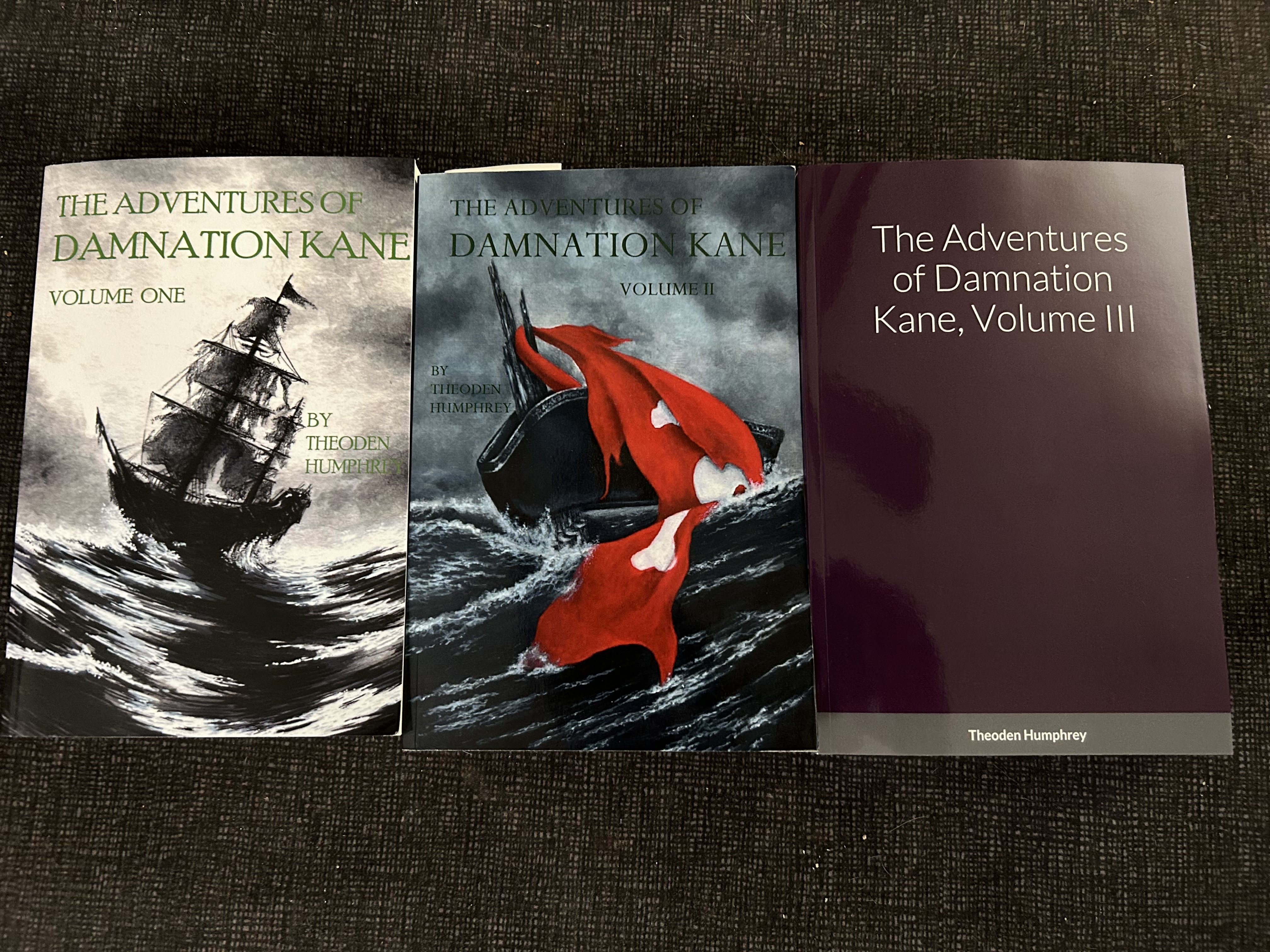
But then this happened. I did it. It came in the mail.

Volume III of The Adventures of Damnation Kane.

It’s bizarre to me that this is such a clear mirror: but I had to take advantage.

This is not, of course, the finished book, because that will not be the cover image; my wife had a great idea for it, and she is prepping the board for the painting. (**Please note: if for any reason she is not satisfied with her image, then I will use something else for the cover; probably some old painting of pirates which is in the public domain. I’m just trying to say that the plan is for all three books to have original Toni DeBiasi covers, but if they don’t then they don’t, and so be it.) I printed one copy with a nothing cover as a galley proof so I could do one last edit of the text, which I find easier when it is printed on actual paper.

But the book is written. The story is done. This is the end of the Adventures of Damnation Kane.

Here they all are.

So this is my 500th post: it is announcing to all of you that the book is done, and it will be published and available within the next two months. And I am very, very proud of me.

Thank you for reading, to all of you who read, for whatever you read. If you are reading my pirate books, you’ll have one more to buy pretty soon.

Pirate!

So, hey, here’s a thing.

The Adventures of Damnation Kane, Volume II

That is my new book.

The Adventures of Damnation Kane, Volume II is now complete.

I will be in a booth at the Tucson Festival of Books on March 14 and 15, ready to sign and sell copies, if anyone will be in town.

If you will not be in town, the book will be available online.


Hope to see you in two weeks.


(By the way, if you haven’t bought and read my first book, I would highly recommend it. It’s available here:)

The Adventures of Damnation Kane, Volume I

Book Review: Mortal Engines, Hungry City Chronicles #1

Image result for mortal engines

(Also, see that hot air balloon on the cover, with the tiny gondola the two characters are in? Not at all how the airships are described.)


Mortal Engines (Book One of the Hungry City Chronicles)

by Philip Reeve


I kind of hated this book.

Not everything about it. Some things in here are wonderful. The concept is fantastic: a future world where cities are mobile, enormous steampunk structures on wheels, rolling around in the wasteland that is all that remains of our world, destroyed (of course) by World War III and hyper-advanced war machines. These cities follow a philosophy of “municipal Darwinism” (great name), which teaches that the largest, strongest city will devour the smaller cities. It’s a “town eat town” world, and the mobile towns do exactly that: they capture the smaller, slower towns, swallow them, tear them apart and use their raw materials as fuel and building materials to maintain and expand the larger town.

That’s a cool idea.

The main town in the story is London, and London is now governed by four Guilds: the Historians, the Navigators, the Merchants, and the Engineers. The Historians, who comprise both doddering old museum relics and Indiana Jones-style explorers who search through the wreckage of ancient civilizations to find useful artifacts from the time before the wars that ended everything (This is our time, of course, and the Frankenstein We-let-our-technology-advance-too-far-and-it-destroyed-us theme is vigorous in this book), are sort of the main protagonists, and the Engineers, who care about nothing but power and control, as those engineers would, are the antagonists. There is also the Anti-Traction League (the moving cities are called “traction cities”), which have settled in parts of the world not dominated by moving towns nor devastated by ancient wars, and they oppose the traction cities as a whole.

This is fine and good. I was a bit annoyed by the stereotypes of the heartless engineer and the hapless-but-wise-and-kind historian, but I like the plotline that involves the Lord Mayor of London and his megalomaniacal schemes, and the discovery of a new doomsday weapon that allows his city to destroy any other; the weapon is actually a rediscovery from the ancient times, and I thought the book handled that well, particularly at the end. (Though there are some pretty severe plot holes, especially regarding the time lapse between the ancients and the traction city era:  it’s been like two thousand years. So really, the ancient technology? It just wouldn’t work. At all.) I like the Anti-Traction League, and I particularly like the subset of non-city-dwellers who live in the air: this being a proper steampunk novel, there are airships galore, and even a flying city, and those parts were great.

No: I hated the characters. The specific characters who play the roles of hero in this book are half crappy, and by the end, half dead. I won’t say which group is which so as not to spoil, especially since this book is now being made into a movie by Peter Jackson, who probably won’t be able to save this thing, in my opinion. However, since the book won oodles of awards, I suppose most people liked the characters a whole lot more than I did. But really, they aren’t good characters: there’s one who should hate everything London is doing and all that it stands for, but at a crucial moment, this character freaks out on those who want to stop London from destroying everything good with its doomsday device; and then later the character realizes, “Hey, wait – London sucks! I should do something about that!” But this epiphany comes at an entirely random time, and is annoying because of that; I would think that the betrayal by a Londoner whom the character worships would have changed the character’s mind, or maybe when the two main characters are tricked and enslaved by a traction city; or maybe when they are captured and abused and threatened and nearly killed by a bunch of half-insane traction city pirates. No: it’s while the character is – climbing stairs. It’s ridiculous.

The other big problem for me was the writing. Half of the characters, good and bad, are entirely unbelievable; their emotions and motivations don’t make a lot of sense. There are a ton of cliches and platitudes, and some of the descriptions and action sequences are just not well done.

And then, at the end – he killed the fucking dog. That’s right: Philip Reeve kills the dog. No reason, either; we already hate the people who do it, and the character who I suppose is intended to be inspired to murderous vengeful rage by the death of the dog WAS ALREADY AT THE POINT OF VENGEFUL RAGE. It’s an entirely gratuitous dog-killing. And I don’t mean to overstate how much this bothered me, because I was already annoyed by the plot holes and the poor characterization and the mediocre writing – but really, that moment just took the cake. And then for the next thirty pages until the very end (when almost every other sympathetic character dies, too), Reeve kept mentioning the dead dog: the dog’s owner kept looking around for the dog, kept expecting to hear the dog’s footsteps, but no, because the dog was dead.

Screw you, Reeve. Dog killing crap writer.

No, that’s too strong. But really, I didn’t think much of the book. I wish someone else had thought of this idea and done a better job writing it. I hope the movie is better, but I won’t be watching it: because they’ll probably kill the dog.

Book Review: MacHugh and the Faithless Pirate


MacHugh and the Faithless Pirate
by William S. Schaill


First, let me say something about the publisher: because this book is from Fireship Press, (Website is here) a small independent press here in Arizona that specializes in nautical and historical fiction. I found this press, and this book, at the Tucson Festival of Books, a glorious local event that celebrates the printed word, and because I am a pirate fanatic, this book jumped out at me immediately. But Fireship has a number of authors, with a number of titles, and the books themselves are top notch, good printing, good binding, good cover art. The copy editing was imperfect — but honestly, I just read another book published by Bantam Spectra which had as many typos if not more, so I won’t split hairs. This is a good press that makes good books.

And this is a good book. It’s not a great book, I’ll say that; the characters are a little too simply drawn, and the main character annoyed me a little at certain places (Largely because he thinks of younger women as romantic interests, which was entirely accurate for the time period, but still a little weird to read — a grown man going over to the home of a friend and checking out his daughter is just too funky for me.) and I wish the Faithless Pirate could have been more than just a villain, because I do love pirate narratives.

But this is, bar none, the best nautical action/adventure I’ve read, in terms of its accuracy and its verisimilitude and its author’s encyclopedic knowledge of the sea and tall ships and marine combat. Reading about these men struggling with this ships on these seas, fighting weather and currents and politics, searching for pirates, finding them, fighting them, winning and losing various battles in various ways — it was just great fun to read. The suspense is excellent, the action is exciting, and the historical and nautical details are as accurate as any I’ve known. For the sake of enjoyment, and for the sake of reading about cannons blasting and cutlasses slashing and blood spurting and everything else, this book was excellent. I hope the author continues to write MacHugh stories — because whenever he isn’t creeping on 18-year-olds, I thought this Scottish wine merchant/privateer was a great character (Though he did seem to have a whole lot of “In his younger days” adventures that made me wonder: just when did this guy start living this life of adventure? And did he ever, I don’t know, take a week or two off?) and I’d love to read more.

Smells Like Dog

Smells Like Dog
by Suzanne Selfors
Here’s what I love: I love books. I love dogs. I love pirates. How could there be anything more perfect for me than a book about a boy and his dog who go seeking pirate treasure? Well, it could also have secret rooms in a museum (I love both secret rooms and museums), and a secret society! And a goat farm! That would be even better than perfect.

Unfortunately, it wasn’t perfect.

The elements were all there, and parts of it were excellent.There are some twists that were particularly surprising in a young book like this, which are often extremely predictable, though still enjoyable. The main character, Homer, and his relationship with his sister were both nicely done; in the beginning, I wished Homer would stand up for himself a bit more, be a little less passive, and over the course of the book, he becomes able to do that, and that was nice to see — he would have made a good hero for a kid like me, like Homer, who reads a lot, doesn’t have many friends, and has dreams quite apart from what his family expects of him. I liked Homer’s whole family, in fact.

The other characters, though (Apart from Lorelei — Lorelei was fantastic), were a lot less real, and therefore a lot less interesting to me. They seemed too much like they were lifted straight out of A Series of Unfortunate Events, including the freakish grotesqueness of them and the strident imperiousness of the principal villain. Maybe this suits a young book, but I would think that if some characters could be complex and interesting — the secret of Homer’s father, for instance, revealed a whole other side to him, and in one moment, changed my perception of him entirely; that is good writing, and a good character — then they all could. They weren’t. It was too bad.

My biggest complaint about this book, though? It didn’t smell enough like dog. Dog is a lovely fella — though really, that’s a terrible name, even if it does come from children — with a nice uniqueness about him. But there isn’t enough of him: he and Homer bond, and there’s no real reason for it. Maybe that’s the way it works with kids and dogs, they grow to love each other for no reason at all, but I want there to be some affection, some connection, before they are willing to fight and die for each other. There wasn’t. Dog did not have nearly enough of a personality for such a vital character to the story, and one so important to drawing me into the book. He’s just there for Homer to love and protect, and to serve as a plot device at a particular moment.

Overall, good stuff and bad. I liked Lemony Snickett better.

We Are Pirates Review

We Are Pirates by Daniel Handler

That’s it. I’m never reading a sad book again.

I don’t know how people do it. How do you all read literary classics and modern mainstream novels, and enjoy them? How do you read them one after another? I mean, John Steinbeck is one of my favorite authors, but how do you go from Of Mice and Men to The Grapes of Wrath without reading, say, The Hobbit in between? I can’t do that. I’ve tried for years, I have a degree in literature, I’m an English teacher, I’m a book reader and reviewer, and an author: I know that there is a certain prestige that attaches to the great novels, and almost every one of them is sad, is tragic. But I just can’t do it any more.

I got this book because I loved the Lemony Snickett books, and because I love pirates. Stupid, I know; but why not? The Series of Unfortunate Events (Also sad — I’m aware that I should have paid more attention to the very obvious clues) was genuinely well written, and pirates are not only fun (But also sad: because the average lifespan for a Caribbean pirate was about two years, before they died of disease, alcoholism, or a “short drop followed by a sudden stop.” Like I said: many clues.) but also fascinating, because they represent savagery, and also egalitarianism, among other things. Escape, and rebellion, and a final middle finger to a cruel world.

This book was exactly that. Daniel Handler captured not only the world of the pirate, the anger, the pain, the fight against all conformity and thus against all society and even against humanity itself; he also captured the modern world — and thus made me long to be the pirate, even while I sorrowed for those following that path, pitied them their rage and their pain. And I raged against those who tried to contain the pirates; and then I felt their pain, as well. Because as Handler points out, with the title and with the entire book: we ARE pirates. We all are. We are.

The book is good, damn good, maybe even brilliant; I just finished it minutes ago and maybe don’t have the perspective to really grasp all of its insights and nuances. But I laughed at passages, I recognized people, I loved and hated and felt contempt and pity for the characters and their lives. It’s written the way a book should be written, and it’s about a great subject — not only pirates, but also family and children and growing up and careers and ambitions and dreams and, of course, disappointments. It’s got a wonderful twist at the end, which changes your understanding of things; more than one, actually. It is multi-layered and complicated, but nonetheless still easy to read, and it has some beautiful flourishes and original creations. This is a very impressive piece of work.

And it’s sad. And I’m done.

The Last of Bloody Jack

Bloody Jack

Wild Rover No More: Being the Last Recorded Account of the Life and Times of Jacky Faber
by L.A. Meyer

This was the book I wanted to read, and I loved it.

I’ve been an avid Bloody Jack fan for several years, now, along with my wife, who discovered the first book while searching for pirate-themed books for me (I have a bit of a thing for the pirate life and the yo-ho-ho.) and found that she loved these as much as I do. There are not many characters in the world like Jacky Faber: so human, so likeable, and so very, very frustrating. I have for years now felt just like Amy Trevelyne and Ezra Pickering, and I have nothing but the deepest admiration for Mr. John Higgins, the unflappable, dependable, and eternally reliable friend to our dear girl.

Jacky Faber makes me wish I had done one-hundredth of the things she has done — and at the same time, she makes me very glad that I have never suffered one-hundredth of the things she has suffered. That’s why I love these books: I love the adventures, love the chances Jacky takes (even while I keep saying to myself, “No, Jacky, no — for the love of God, why do you keep doing this?”), and I love the way reality comes crashing down on her, again and again — and yet she never gives up. And in this book, here she goes again: within the first fifty pages, she is on the run from the law (Not an uncommon occurrence) and she hides out, meeting yet another historical figure — in this case, one of my personal favorites, even though Meyer had to fudge the history a bit to make it happen. But it is subtly done, this time, possibly because of that; and I can’t blame him for taking this opportunity, because if I could write that person into my story, I’d do it in a heartbeat. (I don’t want to spoil who it is because it is subtly done, and the moment when the hints build up to the epiphany was fun for me, and I want it to be fun for everyone who hasn’t read it yet.)

Jacky also joins the circus, in this book. Because Jacky does that: Jacky takes the opportunities that the rest of us would shy away from, and she lives out the dreams that all of us cherish, up to and including running away with the circus and being, at the same time, a Russian princess. Hell, it almost made me want to be a Russian princess in the circus — though I don’t think I should do the fan dance.

And the end of this one — hoo boy, the end. It is the end, the last book, and it is the finish of Jacky’s adventures. I won’t spoil this one either. I genuinely didn’t know until the final moments which way it was going to go: Meyer managed to do it perfectly, with as much suspense as any novel I think I have read. It made it hard to put it down.

And I am truly sorry that I now have to put these down. The saddest part of this book is not within its pages: it is on the dust jacket, because now the biography of the wonderful L.A. Meyer says “was.” You are a loss to the world, sir, both the world of letters and the world of imagination. Your books were a gift to us all, and I am deeply grateful for them. I may have put them down for now, but rest assured: I will pick them up again and again. Thank you for that. Rest in peace. You and Miss Mary Jacky Faber.