
Arguing has gotten me nowhere.
That’s not entirely true. I have had a metric fuck-ton of arguments in my life. It’s been a whole thing for me: it is a strong aspect of my teaching, mainly because it is a required essay format that all students have to learn, and so I always teach; it is largely what brought me online in a meaningful way, along with books, because my first two serious website interactions were with a book club and an argument site; it has taken up probably the majority of my online time (Though I don’t know how to measure that, really, so “majority” may be an exaggeration. But a lot of the time I have spent online, I have spent arguing.). I also argue with my students, but since they suck at arguing, that is closer to modeling good language use than it is an attempt to convince anyone of the truth. The online arguing is the larger issue. It has become a way I define myself, a point of pride; I tell my students, when I first introduce myself to them, that I am a pacifist — but I argue online all the time.
I mean that to be ironic. Why would someone who believes in peace and nonviolence and being nonconfrontational also go after people online?
And now I am thinking: maybe I should stop being ironic. Maybe I should just be who I think I should be, who I want to be. Someone who believes in peace, and nonviolence, and being nonconfrontational.
It’s not that simple, of course. Because one of the paradoxes of being a pacifist is that I have to live in a world in which people are violent and confrontational, and love fighting; so if I maintain my belief in being nonconfrontational and noncombative, all that happens is I get railroaded, and squashed flat, and violent people take advantage of me. The only way I can be a pacifist is, sometimes, to fight back against those who would create conflict, in order to maintain a larger peace. I believe that; I have accepted it. So I fight: I try to fight against those whose opinions would promote conflict and violence and abuse, both those who are bullies and those who work, intentionally or not, on creating a world where it is easier to bully.
So for the last few years, that has been my intent. I have fought against those whose political stance promotes the supremacist and fascist stances of the Republican party, particularly those who promote Trump and claim to oppose Covid-19 vaccines and climate change policies, because those three things — the devastation of the global climate, the suppression of medicine which prevents the spread of a deadly pandemic, and one orange-skinned motherfucker who wants to take over the world and make it dance for him and him alone — are the greatest threats we face, in my opinion. Trump is largely symptomatic, not causative, but the movement he represents is unquestionably an existential threat, particularly for marginalized and endangered communities. I do also argue against censorship, particularly in schools, and against the attempt to destroy public schools (both largely promoted by that same Trumpian movement), and I try to argue whenever I can for trans rights because I see trans people as the population currently suffering the most virulent and vituperative attacks, at least in my proximity.
I think it is a good thing that I have stood up for those causes, for those groups and those people, and against those groups and those people who would attack and do harm. It has not been good for me: that’s for damn sure. I get mad almost every time I get into an argument, and that is not healthy, neither mentally and emotionally, nor physically; it disrupts my sleep, spikes my blood pressure, distracts me from other things I want to do so that I am more often frustrated and unproductive, and therefore I take away from other things — like sleep, or relaxing downtime — so that I can accomplish my productive tasks. Because I already burned up my productive time arguing with some choad about how women’s sports do not need to be protected from trans women because trans women are women, goddammit.
But how much good have I actually done in all those years and years of arguments?
Probably none.
I hate that. But it is probably the truth.
I said last week that I have been persuaded, that I have read an essay by A.R. Moxon which showed me that my habit of fighting online is not only unproductive, but even damaging to the causes I believe in. Moxon pointed out that when someone — like me — says the same points that conservatives and fascists and transphobes and whoever have already heard before, it only shows those people that liberals and progressives have nothing new to say, all think the same things, only echo what we have been taught by our progressive liberal media sources.
The same things I believe about conservatives.
The more I argue, the harder this conviction sets in for my opponents. The more they believe that people on my side are fools, or liars, or mere puppets. I’ve seen this: I’ve seen people take my arguments as signs that I don’t understand the truth, or that I believe lies, or that I don’t care about truth because I have a political agenda; and even as I steadily disprove their points and prove mine, they simply become more strident in hollering that I am a liar and a fool and a sucker. Sometimes they do this while proving some of their points and disproving some of mine (Because while my stances are always right, my arguments are not always perfect, and sometimes I am mistaken), but whether they are right or wrong about their arguments, the point is that they become more adamant about never accepting my arguments, the more I argue with them.
My arguments, in other words, make people less persuadable.
This means that my arguing is bad for everyone. That cut out the last string that was holding up my need to argue. I already knew it was bad for me. I already knew I didn’t like it any more. I already knew I’m not actually as good at it as I thought I was, or told myself I was, in the past. But I still thought it was the right thing to do because I had to stand up for my causes: but not if I’m harming the cause by agitating the opposition, by making them harder to convince, not least because I almost always get mad and take that out by insulting my opponents, even though I know, and have taught my students for years, that insults lost arguments, that the second I mock my opponent, they stop listening to anything I have to say, even if everything else I say is deeply persuasive. All they focus on is the insult.
And rightfully so: because when my opponent insults me, I get so pissed off at that audacity that I no longer care about the argument: I care about showing that sonuvabitch that he’s not only wrong, he’s an idiot. I frequently prove that when I set out to do it – but it never helps. Of course. It just makes them madder and more smug, even while I keep getting madder and more smug. And of course, that leads to my worst habit: I am terrible about needing to get the last word. Even if it keeps me going back to a terrible argument, I keep doing it as long as the other person keeps replying to me. Even though I mock people for arguing simply to satisfy their need to win points and one-up people they disagree with.
Like I said. I need to stop being ironic.
It wasn’t just this essay that convinced me I need to stop. For one thing, I have walked away from arguing in the past – first when I finally escaped from the debate websites I started on, where I did the most harm to myself, wasting the most time, destroying the most sleep, wrecking my own mental health just because some asshat said something shitty about gay people or about public education in this country – or, God forbid, about gun control.
This was me. Of course.
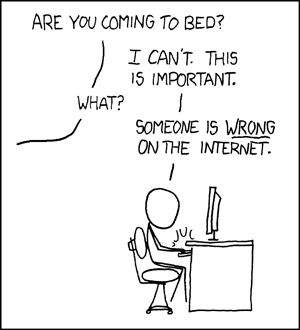
Also this. My wife, who has been trying to gently persuade me to stop hurting myself with this stupidity for just about fifteen years, has always been able to tell when I am arguing because I type harder and faster and with an angrier expression on my face.

Though I’ve never actually shed blood on the keyboard.
So I’ve known for years that I should stop. I’ve had my wife telling me so, and she’s always right. (I never argue with her, by the way. I know my limits. Sort of.) I have also, in the last few years, recognized that my teaching of argument has not actually helped my students learn how to write better arguments: they write terrible arguments, both before and after my instruction. And I suspect that some of that is because I go into the teaching of argument mainly looking to win arguments, which is one of my favorite things to do in the classroom. But it has definitely struck me that my students still make the same terrible arguments now that they did five, ten years ago. And I can’t take all the blame for that: much of it is because of the inherent problem with arguments, and the problems with social media, which is where they learn to argue, and where they find the topics they want to argue about.
I’ve recognized the problem with arguing on Twitter as Twitter has descended into the depths of Hell. I don’t even want to be on the site any more. Even worse, the more I interact with assholes on Twitter, the more money I make for them, because Musk pays them for their number of interactions. So why do I still go there to argue?
Okay, I tell myself that I am fighting the good fight: but a week or so ago, I was arguing about who was the greatest tennis player of all time. Which is – you may be surprised to hear – not one of the important arguments I need to take a stand on. I mean, it was related, because the original post had the pictures of four candidates for GOAT, and they were, as might be presumed, all white men – Pete Sampras, Roger Federer, Rafael Nidal, and Novak Djokovic. But the correct answer, of course, is Serena Williams. So I commented that, and like a few other comments that had made the same argument; and then I found this thread where someone had posted Serena’s unmatched statistics – better by far than any of those four losers – and someone else had replied that Serena would lost a head-to-head match to any of them.
But that’s dumb. Because that’s not how you decide who the best of all time is. Nobody arguing about Michael Jordan vs. Lebron James talks about which of them would win a 1v1. You talk about their impact on the game, on their team; their championships, their individual statistics.
So I joined the thread and fought for my side. I made a joke (It was a stupid joke, but I thought it was funny) in order to mock the guy who had said Serena would lose head-to-head. And another guy started arguing with me: saying that I was wrong and dumb, because the way you decide who is the best of all time is exactly to debate who would win head-to-head, and even Serena has said she would lose against a male champion.
We went back and forth. For less time than some of my arguments about more serious topics, but still, this went on too long. And somewhere in there I realized: who decided how you debate the GOAT of a sport? Who says it isn’t about a head-to-head matchup? Did I have some special knowledge? Of course not: because actually, half the fight about who is the GOAT is arguing over which methods of comparison make the most sense. And in lots of these arguments, none of which is ever meaningful, the key point is indeed head-to-head. Boxing, for instance (which I had even referred to, because I’m a dummy), is almost always about head-to-head matchups, not statistics. So I had a bad argument, and was arguing in bad faith. And the worst part was that the other guy was funnier than me with his insults and comebacks. Which just pissed me off more – but since it didn’t make my argument better, I finally just quit.
He got the last word. And it was funnier. (Not really funny, to be clear. It was still a sexist argument, which I have problems with. But I tried to end with a barb, and he threw one back, and his was better than mine. Dammit.) Now, I still believe that Serena Williams is the best tennis player of all time – because she was more dominant in her specific competitive circumstance than Sampras or Federer or Nidal or Djokovic – but what did I gain by arguing for it?
Nothing. I just wasted my time. And I’m still wasting it, because I’m still arguing my point here, now, with you.
This is why I need to stop arguing online. And also why I need to stop arguing with my students.
But then that brings me around to the title of this piece. What do I do now? If I’m not going to argue (And to be fair, I doubt I will ever stop arguing entirely; I still exist in this world, and people say some appallingly stupid shit; and also, I do think there is value in standing up for my beliefs and for the particular people I advocate for – but I have lately been stopping myself before I post, and deleting the comment, and scrolling away from the initial post that made me want to reply; so I’m getting better), what do I do? Nothing?
I don’t want to do nothing. I think there are fights that need to be fought. Even if I am a pacifist, because as I said at the top of this, even we pacifists need to fight bullies, or else we allow suffering and oppression and violence to grow and spread in the world. And I can’t abide that.
The obvious things I can do are: I can try to persuade people, without arguing; and I can take actual action, to try to create political change around the causes I believe in, to try to limit the power of fascists and bullies.
I plan to do both. The political action is going to wait, for now, because I have too much other shit going on; I’m writing a book, dammit. And one of the other facts that makes it easier for me to give up arguing now than it has been in the past is the fact that I have been fighting the good fight – victoriously or not – for a long time now. It’s like teaching: I still want to do it as well as I can, because my students today matter as much as those I taught twenty years ago; but in terms of my own sense of self-worth, I have already accomplished every good thing I could ever hope to accomplish as a teacher. I could retire now and feel satisfied with what I have done. (I can not retire now and continue eating and having electricity and so on.) So even if I don’t take action right away, I don’t feel bad, because I’ve done a lot of good things in my life. But causes today matter, so I do want to take an active role, in some small way; specifically, I hope to volunteer for the Democratic party, or simply for my local jurisdiction, to help with the 2024 election. Because make no mistake: the only way Trump and the Republicans can win is to cheat. Which doesn’t mean they will give up: it means they will cheat. And that means we need to stop them from getting away with it. I live in a battleground state with a strong pro-Trump Republican power structure; so my help is needed and important. I’m going to give it.
But right now, in my classes and on this blog and wherever I can, I’m going to try to do what I should have done a long time ago: I’m going to try harder to persuade people. Not to argue with them, not to prove them wrong and me right; not to get the best dig or the last word. To persuade them. A.R. Moxon persuaded me that persuasion is this:
“Preaching to the choir” is simply giving voice to an existing desire for truth, in a way that helps people see things in a way they already know to be true, but gives them the language, the pictures, the words, to keep knowing it. It brings the message to those receptive, rather than falling into the supremacist trap of viewing persuasion as proselytization, a competitive sport of one mind’s victory over another. It honors unpersuadable supremacists minds by leaving them eating the salad they’ve shat on, free to be persuaded any time they want to become persuadable.
I actually don’t think there’s much that is more persuasive than giving people language to understand things they already know are true, to help them in the real work of individual persuasion—new language, new frames, new pictures.
Having that picture helps to more clearly understand the things we already know.
Understanding it more clearly helps us believe it is possible.
Believing it is possible helps us expect it to happen, and understand that we can do it.
A.R. Moxon, Preaching to the Choir
That is my new goal.
It’s not entirely new: I think I’ve been doing that for a long time. I think I have sometimes done it effectively. But I also think I could be a lot better at it, and a lot more thoughtful in my attempts to do it well. After all, I study and teach rhetoric – the effective use of language to achieve a goal – and I teach my students to examine the relationship between speaker and audience and subject, and the context, in order to determine what makes a piece of text effective. So why don’t I do that with my own writing?
Because I’m busy telling that asshole that Serena Williams is a better tennis player than Novak Djokovic, who is just taller and stronger. Like that determines who’s better. Please. If that mattered, then Shaquille O’Neal would be a great basketball player, instead of the overlarge stooge I’ve been arguing he is for years.
Enough of that. Enough arguing. Enough fighting.
It’s time to try harder, and to think more. It’s time to do good.
At least it’s time to try.




 Just Dusty