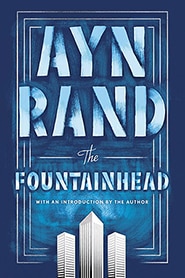
The Fountainhead

The Fountainhead

by Ayn Rand


I don’t think I understood this book.

I understood parts of it. The hero, Howard Roark, is intended, I think, to represent the ideal man in Ayn Rand’s terms: he is self-made, dependent upon no one else, answers to no one but himself, acts for no other reason than his self-interest. He is not selfish in that he does not take things that he does not earn, does not steal from others nor hoard things that others would find valuable; he does not seek to impose his ideas on anyone else. He is a mix of what I would call an artist and what Rand would call an artist, in that she puts a higher premium on production and industry than I do, and thus Roark’s art – architecture – is seen as grander, by Rand than it is by me, because Roark erects man’s greatest achievement, in Rand’s view: the skyscraper. The city. I don’t know that I see cities as the ideal human creation, but I agree that architecture is an art with a particularly elemental aspect, in that architects build our homes, build our places, and thus have great influence on our lives. I can live with that as a sort of pinnacle of value.

(By the way: it isn’t that I would argue that architecture is a lesser art than, say, literature or music or painting; it’s just that art has to have an impact on the viewer to achieve its highest, or deepest, effect, and for me personally, a building doesn’t have the same magic as the perfect poem or song or painting. Totally subjective. Speaking of subjective, Rand keeps trying to pawn off Roark’s architectural style as the perfect ideal, and I don’t see it that way; she’s clearly a fan of Modern architecture, and I like several styles. Unimportant but kind of annoying while I was reading.)

The villain, Ellsworth Toohey, is the opposite of Roark. He lives entirely through others, but focused on himself in a purely selfish, greedy, and therefore evil manner: Toohey seeks to control others, to force them to obey his whims, for no other reason than because he desires that control (Rand hints, as she states more clearly in Atlas Shrugged, that by denying his own self-interest, what Toohey really wants both for others and for himself, is death. Okay.). He uses public opinion, which he can sway, to intimidate or extort others until they obey him; if they will not, he tries to use it to destroy them. He tries to destroy Roark because Roark can’t be controlled, because Roark doesn’t care about public opinion. (One of the best exchanges in this book is when Toohey, having used his manipulative wiles to screw up Roark’s life, catches Roark alone and says, “You can tell me what you think of me,” because he thrives on hatred and envy and bile. To which Roark responds, “But I don’t think of you.” That was a great line.) But because Roark doesn’t care about public opinion – because he lives only for his own happiness, using only his own reason to determine his value – Toohey’s attempts to destroy Roark do not work. Roark, like the honey badger, doesn’t give a shit. I appreciate that. I can even admire it.

The other character I understood was Peter Keating. Keating is not the opposite of Roark, but the negative of Roark: he cares only for public opinion. He never uses his own standards, nor even his own ability to accomplish anything; like Toohey, he excels at manipulation, and Keating uses that manipulation to worm his way into people’s trust and then take credit for their work. He is supremely successful because of that, and absolutely miserable: the opposite of Roark. (Keating too is an architect.)

I got all of that. I could appreciate that story, of Keating competing with Roark and not really understanding why he feels like he’s losing even though he wins every award, every contract, every accolade that he and Roark both try for. I could appreciate the story of the evil Ellsworth Toohey trying to destroy the good Howard Roark, and Roark essentially winning that fight even though Toohey is appallingly effective at manipulation, just because Roark doesn’t care what anyone else thinks, and because he is good enough at what he does for the quality of his work to show through despite what the critics have to say about it (Among other things, Toohey is the premiere critic of architecture in the book.).

What I didn’t get, though, was the love story. The female protagonist is named Dominique Francon: she is the daughter of Peter Keating’s boss and predecessor as most-successful-but-least-actually-talented architect, and she is, like Toohey, a critic of architecture. She is also, like Roark, a Randian ideal in that she thinks for herself and cares not at all what others think of her. She enters into relationships as a self-interested party offering value for value, which is how Rand says that love should work.

The problem is that she loves Howard Roark. It wouldn’t be a problem, because Roark is the ideal man and therefore of course she loves him, except: their relationship starts when Roark rapes her. Straight up, not simply according to my overly-sensitive interpretation; Roark breaks into her house at night and rapes her, and when she refers to it later, she says “He raped me.” And then they love each other. They love each other so much, in fact, that Dominique leaves Roark and marries Peter Keating. Who, because she does not at all love him, she does not respond to, turning into a lifeless mannequin whenever he touches her (A particularly distasteful element that Rand also played up in Atlas Shrugged, with one of the female villains in that book.). Now, Dominique does this ostensibly because she can’t stand to watch Roark go through the crap he has to deal with from Toohey and all of his allies as they try to destroy his reputation and therefore the man himself, but I really don’t get it. I don’t get why she marries Keating, I don’t get why she then leaves him and marries Gail Wynand (who I also don’t get), and I don’t get why she loves Roark after he raped her. I don’t get what Rand is trying to say with all of this. I don’t get why Dominique is the ideal woman when her major quality seems to be her unearthly beauty (Which, as an unimportant side note, I also couldn’t see simply because Rand’s idea of beauty is not mine: Dominique is tall and thin and pale and cold and has hair that is repeatedly compared to a helmet complete with metallic sheen. But that’s neither here nor there: if she had been described as my ideal imaginary woman, I still wouldn’t understand her actions or role in the book.) and her determination to leave the man she loves and marry a man she loathes. I don’t get how that’s good.

My problem with the book is that the parts I didn’t get took too much away from the parts I did get. I can’t root for Roark when he’s a rapist. I can’t root for Dominique when I don’t know why she does what she does. I can’t root for Toohey or Keating when I do understand that they’re scum. I would actually root for Gail Wynand, who is a badass and also a Randian ideal: he is self-interested, motivated, hard-working, and entirely self-made. It seems that his failing that makes him a flawed character is that he has built an empire based on public opinion rather than his own ideals and reason. Wynand sought power, and he found it along with wealth by becoming William Randolph Hearst: he owns all of the trashiest, most sensational, and most successful newspapers in the country. In the second half of the book, Toohey goes after Wynand (Because Wynand has power that Toohey wants), and Wynand is finally destroyed by Toohey, though Wynand makes it a Pyrrhic victory for Toohey. I’m not sure why Wynand loses, though. Rand shows how manipulating public opinion, and really socking home the idea that altruism is the only good and anyone who is wealthy is greedy and therefore vile and selfish, can destroy an empire; that’s how Toohey takes Wynand down. But I think Wynand is not supposed to be a victim, here: he is somehow partly responsible for his downfall. He used his papers to manipulate public opinion in order to garner power, and that is finally turned against him; I suppose that is his evil, his tragic flaw. But I feel that undercuts the message of Toohey’s villainy, and it made me unsure if I should be mad at Toohey or Wynand. And then there’s the fact that Wynand falls in love with Dominique, and she marries him and loves him on some level – but then drops him like a hot rock and goes back to her rapist. (And I feel like I’m supposed to appreciate how Dominique can look past the fact of her rape, and therefore I’m being like a stick in the mud or a prude or something by harping on this. And if so, well, bite me.) So is this more evidence that Wynand is flawed and I’m supposed to admire Roark more than Wynand? I don’t. I see Wynand’s evil side, in his abuse of power; but I see Roark’s evil side in his abuse of Dominique. And Dominique’s evil side in her betrayal of – well, everyone, in one way or another; particularly herself.

Basically, I dislike everyone in this book, and so I can’t see the ideal aspect I’m supposed to appreciate and try to emulate. I was not made happy by the happy ending.

So I figure, either I didn’t understand the book well enough to appreciate it, or I did understand it, and it’s pretty much evil crap. Either way, I can’t recommend it.

I invite anyone who feels they can explain the book to me to do so. I completely accept that I am not a fair judge of it because I didn’t really get it, and I would like to understand it even if I still don’t agree with it, should that be the case.
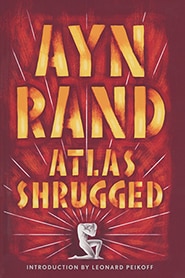
Book Review: Atlas Shrugged

Atlas Shrugged

by Ayn Rand


My god.

Now: I’m a word guy, a writer and a literature teacher, so I read quickly. I enjoy it, so I dedicate a lot of my free time to it. I’m a high school teacher and it’s summertime, so I have a lot of free time. I’ve been averaging about a book a day since school ended.

Until I hit this one.

1070 pages of some of the smallest print I’ve seen outside of User Agreements. 562,000 words, according to the Indefeasible blog. For scale, that is 25,000 words less than War and Peace by Tolstoy, and 400,000 words more than The Grapes of Wrath, the longest book I’ve ever tried to teach. It is equivalent to 12.186 Fahrenheit 451s.

This took me eight days to read. I spend at least 3-4 hours a day reading, too. It was a tough slog, too; because it is a philosophical treatise as much as it is a novel, I had to concentrate on the ideas harder than I would on, say, a book from The Wheel of Time or Harry Potter. I did it because the book was recommended as an important first step in understanding a former colleague and debate opponent’s worldview, which he describes as Aristotelian and bears a lot of resemblance to Rand’s philosophy, which she called Objectivism. I wanted to understand his worldview because his ideas are different from mine, and he is very, very sure of his positions and opinions; so I wanted to know from whence came his surety, and if I could and should be thinking along the same lines. So I read the book.

It made me think lots of interesting things. It really did: it made me realize that there are some things that I have done (like mock and castigate industrialists – in my case my favorite target was Bill Gates) that I shouldn’t have done, some things that I do that I shouldn’t do (like use words ambiguously, or symbolically, with little concern for their actual meaning), and some things that I haven’t done that I should do (like think about what my purpose in life really is, and why). There are some parts of the philosophy espoused and exemplified that I find interesting, and that I plan to investigate further and perhaps even adopt, if I can verify that they work for me.

However: reading this book was not worth it. Even with my personal interest in knowing what it has to say, I got so bloody tired of reading it that for the last three days, I had to work twice as hard to pay attention – and since I had to work twice as hard as normal to pay attention in the first place, this has been a mentally draining task. I did it, though, and now I’m here to tell you: don’t do it.

Rand was not a good writer. I’ve read three of her books now, and while this one was leagues better than Anthem, that’s like saying that shaving with a chipped-flint spearhead is better than shaving with sandpaper: you still wouldn’t want to do it. I read The Fountainhead in high school, so I don’t remember it well; once I’ve recovered sufficiently from this one, I may read that one. I dunno, though. It’s only 311,000 words, but that’s still two Grapes of Wrath.

That’s the biggest problem. She used too many words. And I say that as a wordy writer, which I am; my first book was 200,000 words. But she repeats things too many times, unnecessarily, as though using five words to describe something makes up for the fact that she is telling and not showing; and when she explains them, she uses too many synonyms and appositives. As a random sample from a page I just flipped to:

The scream of an alarm siren shattered the space beyond the window and shot like a rocket in a long, thin line to the sky. It held for an instant, then fell, then went on in rising, falling spirals of sound, as if fighting for breath against terror to scream louder. It was the shriek of agony, the call for help, the voice of the mills as of a wounded body crying to hold its soul.

So there was an alarm, then. You know, just the word “alarm” implies that it was bad, and “scream” implies fear; you could basically say this same paragraph in three words:

An alarm screamed.

Now of course repetition creates emphasis, which is presumably the point of the extended description; but there doesn’t seem to be anything in this book that Rand doesn’t want to emphasize – which means, of course, that nothing is really emphasized, because all of it seems almost like – well, like a screaming alarm siren fighting for breath, crying to hold its soul. By the end of this book I was very tired of being yelled at. I can’t imagine how fatiguing a conversation with this woman must have been.

In addition, the level of rage leveled at people like me – political liberals, that is, which means Rand saw me as a looter, a moocher, a liar, a coward, a fool, a murderer, a thug, and the destruction of humanity – was just as exhausting. I knew going in that there was a critical speech at the end, when John Galt speaks (No spoilers – that’s the name of the chapter, “This is John Galt speaking.”), which explained the whole worldview being dramatized in this book; but the problem was that most of what Galt says had already been said by the narrator or one of the other characters. I probably could have just read Galt’s speech and skipped the rest of the book. I would have been happier, too, because Galt carries the deepest anger, the most righteous condemnation of anyone who would support, you know, taxes and welfare and stuff. So I had to read that after reading another 900 pages of pretty much the same stuff, just not quite as angry as when Galt says it. I got really tired of being insulted so many times, and with such bile.

I will also say that, while the story itself is interesting (though much too long) and, I think, disturbingly realistic, the characters are not. Not that I think Rand’s idealized hero-industrialists are absurd; I mean, they are, but they are absurd the same way that Tom Brady or Michael Jordan is absurd, or William Shakespeare, or Isaac Newton, or Michelangelo or Mozart: nobody should be that good at what they do. But as all those names (Just the first few to come to mind. Of course there are many more examples.) show, people really are that good at what they do. It is possible. No, these characters are unrealistic in the way they read each others’ expressions. Like this:

The suggestion of a smile on Mrs. Hastings’ face held sadness, but the face had no imprint of tragedy, only a grave look of firmness, acceptance and quiet serenity.

Picture that face, that smile, in your mind. Okay, that’s good, just the suggestion of a smile . . . No! No imprint of tragedy. That’s better – but it needs a little more firmness in that look of quiet serenity. Got it, now? Or this:

There was the faintest coating of mockery spread, like shellac, over the smooth notes of her voice.

I mean, I like that, it’s a nice phrase – but what the hell does that sound like? And how would someone pick up on it?

These aren’t the best examples, the best examples are when someone heroic looks into the face of one of the villains and sees what they intend to show, along with what they’re hiding, and also what they are unaware they are really feeling; but I didn’t want to spend the time looking through the book to find one. It took me long enough to find these examples.

There are thoughts worth thinking in this book. I intend to spend more time thinking about those ideas. But good grief: I have already spent enough time reading this book. No more.

Spring Break Book Review #5 (With bonus rant!): Anthem

Image result for ayn rand anthem book cover

Anthem

by Ayn Rand

This one was interesting for me. Politically, at least, which is probably the only way that Ayn Rand can be interesting to most of us. I read The Fountainhead in high school, on my (overly intellectual) brother’s recommendation; I didn’t think a whole lot of it. That was it for me and Ayn Rand, other than seeing her name and ideas associated with various smug libertarians; I didn’t think a whole lot of them, either. But recently, I’ve been involved in more serious political discussions with a fellow who has opened my eyes in several ways (Though honestly, I don’t think a whole lot of him, any more), and he has recommended Ayn Rand as the philosopher, and her Objectivism as the philosophy, for the future of this country. And so I plan to re-read The Fountainhead, and add in Atlas Shrugged, and see if I want to go forward from there. And while I was cleaning out my classroom bookshelves, I came across a copy of Anthem, which, like Willa Cather’s O! Pioneers, I have seen taught to high school lit classes in the past, though I’ve never taught it or read it myself. But heck, I’m going to be reading Ayn Rand quite a bit, soon; and this one’s short, so let’s give it a try.

Okay, Ms. Rand. I get it. The perfect man, perfect in all ways – tall, strong, handsome, ever so Aryan, dominant and masterful, intelligent, courageous, and perfectly logical and rational – exists purely out of nature, regardless of upbringing or environment. In a dystopian future, a society degraded and debased by the horrors of COLLECTIVISM, there is no hope for the ennoblement of humanity: until a noble man is born. Once born, he cannot be restrained: he will discover his own perfection, he will stand up to the forces of evil and oppression; he will choose his mate – who will, of course, offer herself up in perfect submissive surrender to the perfect man’s perfectness, because who could resist that perfect man? – and then he will forge on into the wilderness and the chaos and conquer all that lays before him. This is his destiny.

That’s the book.

I’m being a tad too critical, however, so let me pull back. Anthem is the story of a future dystopia where everyone lives for the common will of mankind, and individuality in any form is forbidden and savagely squashed. One man is born different, and he struggles against what he is taught: that there is no truth other than what the collective holds to be true; that there is no good other than what the collective holds to be good; that the purpose of his life is to serve his brothers in all things. In his rebellion, he discovers first that there is a better way to live, one found through his own individual efforts, his own individual genius; he discovers an ancient subway tunnel, and in it he performs experiments on the forgotten relics of our own time, buried and intentionally suppressed as not for the benefit of the collective, who do not want life to be easy, as it is the purpose of man’s life to toil in service of his brethren. The individual man re-discovers electricity – because he’s a genius – and tries, in the most noble and altruistic way, to share his discovery with the collective so that life can be improved for his brethren. And he is mocked, and shunned, and driven out for his crime, for discovering things that are not known to all of the collective – and so therefore, they cannot be true.

I see the point here, I do; and it is worth thinking about. Much of our society relies on shared ideals, on shared standards of truth and goodness; we still believe things because “Everybody knows it’s true.” We do think that what is good for all is good for one, and that a person who lives purely for himself is selfish, and therefore sinful and bad and wrong. We don’t believe it to the extent portrayed in this book, but that’s the point of dystopian satire: to take our flaws and magnify them in order to draw attention to them now, before they reach that terrible future point. And living purely for a collective, which destroyed Ayn Rand’s native Russia under Stalin and the communists, can surely become a great evil. I get that. I do. I see where we should keep this in mind when we attack each other for not holding to the orthodox view: the need for liberal orthodoxy leads to the movement against GMOs, which almost certainly hold no harm in and of themselves; and from there it’s a short step to the anti-vaccination movement, which has taken the distrust of Western medicine and pharmaceutical corporations to such an extreme that now it has become a hazard to the health of us all. And we liberals, with our elitist snobbery and disdain for those who are “ignorant,” as we call them – mainly those who hold other views (and not, ironically, we liberals ourselves, even in those areas where we cannot explain our positions but merely cling to them because they are the orthodox dogma, despite our own ignorance) – we are to blame for this sort of thing, to the extent it is really happening. Ray Bradbury makes a similar point in Fahrenheit 451 when he points out that the desire to remove any and all offensive material leads to the destruction of all literature and art and creative thought; another slippery slope that liberals tend to ride down in our worst moments.

And all that’s fine: but this book is not. The warning is somewhat valid, but the solution offered, the belief that one single epic hero-man-god – Harrison Bergeron, if you will – can solve all problems through his own heroic efforts, is disproved by the story itself, no less than is the pure goodness of life for the collective. This dude doesn’t save the world by himself; he re-discovers what other men already knew, using their artifacts. He doesn’t run off into the wilderness by himself; he takes a mate with him, and even though he says the only happiness he has found is what he has discovered by himself, the most happy moment in the book is when he first kisses that woman he rescues – or rather, that woman who rescues herself, as she leaves the collective and tracks him down in the wilderness. And then she submits herself entirely to his will: and while he chooses a manly individual name for himself, he then gives a name to her – and it’s a name that keeps her in a subservient position, valuable only as breeding stock for the continuation of his manly genes, as he becomes Prometheus, the Fire-Bringer, and she is – Gaea. The Mother. Of the sons (not daughters) he plans to raise to be manly men just like him. And he doesn’t forge a new life with the strength of his own arms; he discovers a house built by other men, and books written by other men. And once he has built himself a mighty army of like-minded individualists, what does he plan to do? Go back into the collective society and save those of his brethren he happens to like and wish to help.

So the idea that a single man acting alone is the only source of all good things? Nope. The idea that happiness can only come from individual action, without reliance on other people? Still nope. The idea that every man must live only for himself, that no man should impose his will on another, that violence can only be used in self-defense? Nope: he uses his will to suppress the will of his Gaea, and intends to commit violence against the collective in the name of his fellow men.

In terms of the writing, meh. She had the clever idea to write the story in the first person, but without the singular, because the collective has eliminated the concept of “I,” allowing only “we.” Watching the narrative then twist itself into knots trying to describe single individuals while only calling those individuals by “we” or “they,” that was pretty interesting. Did a better job than the actual plot of showing how vital is the individual human ego. And I believe the individual is vital: but not because Ayn Rand convinced me of it.

I realize this is only a novella, and not one of Rand’s key works; but so far, all I can see is that her philosophy is self-defeating – though certainly attractive, in that if I follow her advice and refuse to allow my individual energy and accomplishment to be taken from me for the good of others, then I get to see myself as one of these perfect epic heroes who understand the truth, that only egotism is right and good. But apart from appealing to the selfish, so far it seems like a whole lot of hooey.

Didn’t like the book, would not recommend.