Book Review: Cloud Atlas

Cloud Atlas
by David Mitchell


Okay, there are two possibilities here.

Possibility one is that I missed the intricate interweavings of the finest filaments of this novel’s plot. I saw some of them: there is a theme of reincarnation and rebirth that is fairly easy to spot, and also a connection based on storytelling. And maybe that’s the whole point: that we live new lives over and over again, and those lives are connected by the stories we tell, the words we write down. That’s a fairly interesting idea, but while I believe in reincarnation of a sort, I don’t believe in straightforward rebirth/transmogrification of the soul from one body to the next, so that connection was lost on me — and without it, the story connection becomes just kinda precious and clever.

Possibility two is that this novel is too precious and clever.

I am inclined, honestly, to believe possibility one. I think I’m a fairly perceptive reader, but — not always; most of my life has been spent reading genre fiction rather than seriously dense literature, which I’ve really only picked up since I’ve been a teacher. The book has a lot of blurbs by pretty impressive people, including A.S. Byatt and Michael Chabon; everyone says this is a magical, unbelievable work of magnificence. So it is entirely possible that I read right past the lyrical wonders of this novel, that this is one of the books which, as I tell my students, can’t be read, but can only be re-read.

But since the first possibility is not the only one, I’m not going to be re-reading this.

So the idea is that the book is a series of nested stories. It starts with an American traveling through the South China Sea in 1850; then it goes to a British composer in Belgium in 1931; then an investigative reporter in California in the 1970’s; then England in 2004; then a near-future Korea, and finally a post-apocalyptic Hawaii. Then it goes back: Korea, England, California, Belgium, South China Seas. Each story is in some way recorded — the first guy wrote a memoir, the second a series of letters to a friend, the third story was novelized, the fourth turned into a movie, the fifth recorded an interview. And each person in the following story encounters the recorded story of the person before; and each of them, it seems, is the reincarnation of the one before. But my trouble with this book is: that’s it. That seems to be the only logical link. I was looking for more; I was hoping that the South China Seas/Korea/Hawaii connection would be meaningful, but I don’t think it was. I was hoping that there would be a causative link, that the revolution hinted at in the Korea story leads to the apocalypse which the Hawaii story is post-. That the composer in Belgium would have something to do with the modern-day England story, in terms of the plot of one connecting to the plot of the other.

And maybe those links were there. But if they were, I missed them.

So it seems to me that the novel is a set of short stories, without a common theme, with dissimilar main characters — because they may each be the reincarnation of each other, but that’s all they have in common — and no real plotline that runs through the whole thing. They are interconnected only the way a book of short stories set in the same town might be interconnected, which is — not really at all. Though of course, with Joyce’s Dubliners (which I’ve never read) and Faulkner’s Abercrombiewhateverthehellit’scalled County novels (which I’ve never read) and Anderson’s Winesburg, Ohio (Which I did read, and liked) all having that sort of connection, I guess that’s enough to make this a tour-de-force that lives up to its blurbs. But for me, it was not terribly exciting.


I probably should have taken the hint when I mentioned to my wife that I was reading this, and she said, “Yeah, it was a movie. We watched it.” Even though I have absolutely no memory of watching this movie. I’m pretty sure I slept through it. I should have slept through the book, too.

On the Third Day of Blogging, Just Dusty Blogged for Me — A Book Review of Maguire,Gregoryyyyy!

After Alice

by Gregory Maguire


(If you don’t know: Gregory Maguire writes new novels set in classic fantasy worlds — Oz, mostly, but this one is in Lewis Carroll’s Wonderland.)

So the thing with Gregory Maguire seems to be: you have to absolutely love the original.

The man writes an excellent homage. I’ve read Alice in Wonderland and Through the Looking Glass, and the style and feel of this book is remarkably similar. He has the same imaginative twists (though not as many), the same absurdist humor mixed with Victorian understatement, the same satire of upper class manners and fashions, and of everything else that the author can think of. The writer’s voice is an excellent imitation, and I mean that as sincere flattery.

But I don’t love Lewis Carroll. I think the man was brilliant, and what he wrote was a watershed that led to Douglas Adams and Monty Python and Mel Brooks and Christopher Moore, all of whom I love or have loved – honestly, more than Carroll. So while I’m grateful for the existence of an Anglican mathematician with more imagination than either of those descriptors would imply, a whole world of imagination, I’d rather read (or watch) the others than him.

Consequently, I’d rather read them than Gregory Maguire.

I think this book also suffered for being too much outside of Wonderland. I mean, really: that’s the point of Carroll’s books. That’s why they’ve survived and are still beloved enough for Maguire to turn his hand to them. And half of this book by the chapters, and more than half of it by the pages, is set in Oxfordshire in 1861, following around Alice’s and Ada’s families as they search for the missing girls: and though Darwin is present, no time at all is spent with him; all that happens is that his old man’s needs – for help to the privy, to leave early – screw the day up for everyone else. Everyone else is just as annoying: it made me understand completely why Alice would want to follow a white rabbit down a hole, and why the heroine of this book,Alice’s friend Ada, would want to do the same.

If the book was just Ada in Wonderland, maybe finding new places and people rather than just following in Alice’s footsteps, I think I would have liked it more. But the Wonderland stuff was less about imagination and more about following a path, and that made it less interesting than the original. As I said, if I dearly, deeply loved the original, I’d probably like this book just for the sake of going back there again; but I didn’t love the original, and so I didn’t really like this book.

Well done, just not interesting.

Book Review: Japanese Steampunk

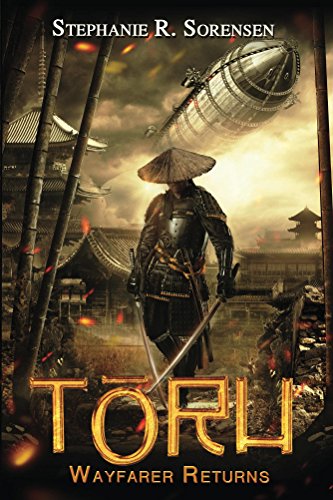
Toru Wayfarer Returns

by Stephanie R. Sorensen


(Full disclosure: I was invited to review this book and given a free copy so I could do so.)

Do you prefer ninjas, or pirates? How about history, or steampunk?

Here’s an idea: why not have both?

Okay, strictly speaking this isn’t a novel about either ninjas or pirates; it’s a story about Japan’s “opening” to the west when Commodore Perry of the U.S. Navy sailed into Edo Harbor in 1853 and threatened and insulted the Japanese into negotiating with him, or else face bombardment from his entire fleet, which he brought back in 1854. Japan was unprepared for this aggression, the country having been isolated and controlled by the Tokugawa Shogunate for the past two and a half centuries: their military was still mostly medieval, and could not fight back against modern warships, steamships, cannons, and rifle-carrying Marines.

But what if? What if Japan had found a way to be ready for that attack? What if the nation, alerted to the threat of the West by the actions of the British in opening and conquering China and India, had modernized and industrialized? What would have changed in world history if Commodore Perry had found the harbor blocked, and armed, the Japanese a growing world power, perhaps even a legitimate threat to the US?

I’ll tell you what: that would be a story worth reading.

And so it is. Stephanie Sorensen has found just what the alternate historian needs: a critical moment when world events went in this direction instead of that, and then thought of a way to make it go that way. The change is in one man (as history’s pivotal moments so often are): Himasaki Toru, a fisherman with something of a mysterious past, who is lost in a storm and rescued – by an American whaling ship. Toru spends two years in America, and while there, he realizes that the US, with its military and economic might, and its brash disregard for the slow grinding of polite diplomacy, could pose a threat to his motherland. A faithful son of Japan, Toru has only one choice: break the Shogun’s law that bans anyone from entering Japan from the West on pain of death, and find a way to convince his nation to adopt Western technology and industry so that when the US comes, Japan would be ready.

It’s an impossible task, made even more so by the fact that Toru is only a peasant, a fisherman; no nobleman, no daimyo, no samurai would ever listen to one such as he, let alone the entire nation. But only the efforts of the entire nation, working in concert, can possibly give Japan the chance to meet the West’s incursions from a position of strength. Toru works with the weapons he has: his intelligence and his passion; the books and machines he purchases in the West and tries to smuggle back into Japan; and a rebel’s greatest weapon: luck. Toru is lucky that the lord whose domain he lands in, Lord Aya, is himself unconventional, made so by his unconditional love for his unconventional only child – his beautiful daughter Masuyo. With luck, and with the help of Lord Aya and Masuyo, maybe Toru can save his country.

I liked this book. I mentioned pirates and ninjas above because this book combines some of the best features of both: Toru is a rebel, though one with a good heart and good intentions; he breaks the rules because he has to, to succeed. Like a pirate. Masuyo does this even more, as she refuses to meekly accept the role of women in her culture; she uses her brains and her courage to help Toru in his task, and takes her place in the forefront of this revolution against the status quo.

As for ninjas – well, the story is set in 19th century Japan. There are ninjas. There are samurai, and swordfights, and honor. And then, because it is steampunk, there are trains, and telegraphs, and Babbage Difference Engines, and dirigibles painted like dragons, powered by steam engines, swooping down out of the sky to awe and terrify allies and enemies alike.

Honestly, Sorensen, who has a background in Japanese and Asian culture and studies, does a better job with the Japanese aspects than the steampunk aspects; the steampunk isn’t bad, but it isn’t really the focus. The focus is on the culture of the Shogun’s Japan, and how change could come to such a rigid and traditional culture, and what would happen when that change did come. As a novel of alternate history, this is a good book. As a steampunk book? It’s okay. The dirigibles are really cool. The writing is generally good, though not spectacular. The industrialization of Japan within the timeline and despite the cultural roadblocks requires some suspension of disbelief, but I thought the political interactions were well done, both within Japan and then between Japan and the US.

But anyone interested in Japan, in samurai, in traditional cultures, or in the clash between tradition and modernity – you should read this book. And the sequels, when they arrive. And anyone who likes a well-written story of one man struggling both for and against society, anyone who is interested in the struggle to break out of a rigid class system and become more than the role created by one’s birth, you should read the book, too.

Oh – and if you like romance, there’s some of that, too.

Overall, I recommend it.

An Oldie but a Goodie

Front Cover

Castle Rackrent and The Absentee

by Maria Edgeworth

I bought this book at a library book sale really just because it was beautiful. I loved the binding, the endpapers, the fineness of the pages and the print. Reading into the introduction, I found out that Maria Edgeworth was one of the first female novelists, as well as a crusader for education and for Irish rights under English rule; and her novel Castle Rackrent is one of the first historical novels written in English, and is actually considered groundbreaking and influential for some of the choices the author makes – one of the first novels set in Ireland; covering multiple generations of one family, making this a “Big House” novel, with a servant as a narrator; having that servant be biased, describing the family as noble and honorable and beloved even as they act like a pack of crazed, starving weasels, etc. So hey, awesome! I picked a good one.

Then I read it. Okay, it may be groundbreaking and influential, but it’s also terribly annoying. Those people, the Rackrents, really are obnoxious, and so, therefore, is the servant, Honest Thady, who describes them to us, pining for the long-gone days when the lord of the manor would throw enormous parties that he couldn’t afford, passing the debt onto his heirs – you know, the good old days. I was struck particularly by the rather ridiculous refusal of the Rackrent men to actually deal with reality: they spend too much damn money, and when it comes to their debts, they just shake their heads and refuse to discuss such plebeian matters, disgusted that anyone would even think of asking them to honor their obligations – and there’s Honest Thady, saying, “How could they ask my noble master something so callous! How could they ask him to lower his noble visage, to consider their peasant-concerns. We should all just drink to My Lord’s health!” Another thing that struck me: they drink a whole lot of health in this book. There’s one scene when they celebrate the elevation of a new Rackrent heir by drinking his health for the entire evening; I can’t even picture that. Every time they get a new drink, it’s just “To my lord’s health! Wot wot huzzah!” and down the hatch. Then twenty minutes later, “Long life to my Lord Rackrent! Pip pip hullabaloo!” And this, to Honest Thady, at least, is a good evening.

But on the plus side: it has a glossary, which together with the narrative offers some interesting insights into the time and place; and it’s really short.

The majority of the volume is actually taken up by a later book by the same author called The Absentee. That book was much, much better, even without being so innovative and groundbreaking. It’s the story – again, which is a tad annoying for the repetitiveness – of the Clonbronys, an Irish lord who can’t handle thinking about money affairs, and his wife, who also refuses to think about money, but really loves spending it; she is trying to get in good with English society by being the most fashionable and throwing the best parties, and so she has forced her Irish nobleman husband to leave his country estate in Ireland and live in London so she can be one of the girls. Sadly, the people she wants to hang out with – well, they suck. It’s a lot like a two-hundred-year-old version of Mean Girls: they mock Lady Clonbrony’s accent and heritage behind her back (She was born in England, but is from an Irish family and married to an Irishman), they roll their eyes at how hard she’s trying to be cool, which of course prevents her from being cool; they titter at her attempts to be fashionable which are all so yesterday. Meanwhile her husband is running around with an English military man who seems like a lot of fun, but is apparently uncivilized according to Milady, who can’t stand to be in the same room with his gaucherie without getting a case of the vapors. Though his every appearance in the actual novel makes him seem like a perfectly nice man and a very good friend to her husband. I suppose we’re just supposed to know the distinctions made by the upper classes between what’s acceptable and what’s not.

Meanwhile, the son of this couple, Lord Colambre, is just about to come of age and inherit his part of the family estate, and he is in a bit of a pickle. You see, he can’t decide who to marry. Which is, of course, really the only decision that people of this class ever have to make on their own, and so naturally it is fraught with weighty momentousness. This guy has the following options: he could marry his cousin, whom he actually loves, but she doesn’t think of him THAT WAY; he could marry Lady Sophia, who seems the perfect gentlewoman but whose mother is a crass boor; he could marry an extremely wealthy young heiress whom he respects but does not love. What, OH WHAT! Is Lord Colambre to do!

Well first, he goes back to Ireland and visits his father’s estate, and the neighboring estate that is soon to be his. And though this part is probably a little too on the nose in its social critique, I thought it was by far the most interesting, as it gets into people’s real, actual lives, the troubles that the Irish people faced when their lords lived in England and simply demanded money be sent to them so they could buy their fashionable doodads, without worrying about where exactly the money was coming from or how it was hurting the little people to have to come up with it. Lord Colambre finds that there are two important factors: one, having a good agent, or manager, a guy who actually wants people to do well versus one who is corrupt and only interested in maximum profit with minimum cost – a slumlord, in essence; and two, having the lord actually live on the estate, rather than too far away to oversee matters and keep an eye on things. Lord Colambre, who’s actually a pretty good protagonist, determines that he will not be an absentee lord, and that he will convince his father to fire the bad agent he currently has and hire the good one.

All of this comes about, and Colambre even overcomes the most difficult challenge, that of convincing his stubborn and dimwitted mother to give up her dream of being the belle of London society – I call her dimwitted because as she is ripping through her husband’s money, forcing him to squeeze the little people back on the estate for more to cover her debts, all she says about money is, “Well, when I married him he had plenty, and I brought even more into the marriage! So surely there’s no problem! Now order me that ivory-handled backscratcher with the gold trim!” – and just go back to Ireland where they can live within their means and with some shred of dignity. She finally agrees, and the bad agent is driven off so that the good agent can take over. Everything’s great! So hooray! A happy ending!

But wait (gasp): who will Lord Colambre marry?!?!?!?!?!?!? So he gives up on the rich heiress, even though his mother is disappointed that he fails to carry on the family tradition – and apparently the national pastime of the upper class – of marrying money to solve all overspending problems, because he doesn’t love her and a friend of his does (and that’s the guy she marries); and he finds out that the seemingly lovely girl with the crude mother is in fact a bitch, so she’s out too. So now it’s his cousin. But horror of horrors! He found out that – that – oh, I can’t even bear to write the words . . . she was born –out of wedlock! Her mother was NOT BEYOND REPROACH! She was a FALLEN WOMAN! Don’t you understand?!? She had THE SEX WITHOUT THE MARRIAGE! Gasp! Shudder! The vapors! Oh, pardon me while I faint dead away. There are several conversations where Lord Colambre is convinced that he can’t even consider marrying a woman whose mother was of less than perfect morality, as that same nature will surely appear in his bride. And this seems to be a given, which means that alas, his love is off the table as a marriage prospect. But then, through a series of rather absurd coincidences (but what the hell? It’s basically a romance novel, anyway.), it turns out that her parents WERE married, and therefore her blood is not tainted with whorishness – and what’s more, she actually stands to inherit money, and isn’t even his cousin! Huzzah!

So yeah, happy ending all around. And it was cheesy and all, but very sweet. I liked it quite a bit. Pip pip and all that folderol.

Book Review: MacHugh and the Faithless Pirate


MacHugh and the Faithless Pirate
by William S. Schaill


First, let me say something about the publisher: because this book is from Fireship Press, (Website is here) a small independent press here in Arizona that specializes in nautical and historical fiction. I found this press, and this book, at the Tucson Festival of Books, a glorious local event that celebrates the printed word, and because I am a pirate fanatic, this book jumped out at me immediately. But Fireship has a number of authors, with a number of titles, and the books themselves are top notch, good printing, good binding, good cover art. The copy editing was imperfect — but honestly, I just read another book published by Bantam Spectra which had as many typos if not more, so I won’t split hairs. This is a good press that makes good books.

And this is a good book. It’s not a great book, I’ll say that; the characters are a little too simply drawn, and the main character annoyed me a little at certain places (Largely because he thinks of younger women as romantic interests, which was entirely accurate for the time period, but still a little weird to read — a grown man going over to the home of a friend and checking out his daughter is just too funky for me.) and I wish the Faithless Pirate could have been more than just a villain, because I do love pirate narratives.

But this is, bar none, the best nautical action/adventure I’ve read, in terms of its accuracy and its verisimilitude and its author’s encyclopedic knowledge of the sea and tall ships and marine combat. Reading about these men struggling with this ships on these seas, fighting weather and currents and politics, searching for pirates, finding them, fighting them, winning and losing various battles in various ways — it was just great fun to read. The suspense is excellent, the action is exciting, and the historical and nautical details are as accurate as any I’ve known. For the sake of enjoyment, and for the sake of reading about cannons blasting and cutlasses slashing and blood spurting and everything else, this book was excellent. I hope the author continues to write MacHugh stories — because whenever he isn’t creeping on 18-year-olds, I thought this Scottish wine merchant/privateer was a great character (Though he did seem to have a whole lot of “In his younger days” adventures that made me wonder: just when did this guy start living this life of adventure? And did he ever, I don’t know, take a week or two off?) and I’d love to read more.

Book Review: The God of Small Things

The God of Small Things
by Arundhati Roy

I don’t know what I can say about this book that hasn’t already been said. It’s a prize winner, an internationally acclaimed best seller, and has been for twenty years. But I read it for the first time in 2014, when I moved to Arizona and started a new teaching position with new materials, including this book; I liked it then, liked the style of it, liked the way Roy wrote and the things she had to say, but it was one of several books that I read in an awful hurry, and with a whole lot on my mind at the time.

I read it again, this past two weeks, just finishing it this morning. And this time, because I am encouraging my AP Literature students to read books actively, that is, with a pen in hand and the margins of the book’s own pages as their paper, to comment and question and interact with the text, I did just that: I used my new purple ball point (Which may be the best thing about the gym that my wife and I joined last October: it has good equipment, but not great, and it had been fairly uncrowded until our last work out when a visiting college baseball team came in en masse and inundated us in jockery: but at least they give away ballpoint pens with purple ink!) so that the ink would stand out against the black typeface, and I underlined and I arrowed and I added everything I thought that I thought was worth thinking and adding to the text.

I read it more, this time. More carefully, more attentively, more thoughtfully. I was invested in the text, this time.

And this time, I didn’t just like the book. I loved it.

I was actually enlightened by it. Roy made me think about my own society, and particularly my own family, in a way that I never had before. She crystallized some thoughts for me that might never otherwise have come clear. She also showed me an elegance and a musical grace in words that I never would have seen: words written backwards, and words broken up in new ways — there is a Bar Nowl that lives in the warehouse and hunts mice on silent wings — and a poetry that I don’t ever see in prose. She showed a depth of perception, both in descriptions of environment and of character and of humanity as a whole that I don’t know that I’ve ever seen done better. And she wrote this book on the other side of the world. In her second language. I don’t know if that shows the grandiosity of her genius or if it reveals the power of an outsider’s perception, both hers of my mother tongue and mine of her world and how it parallels my own; I think perhaps she was writing about what she knows, and I see the same things in what I know because people are people all around the globe — but regardless, this book is magic. It is going up on my Very Top Shelf, with Fahrenheit 451 and To Kill a Mockingbird and Of Mice and Men and Shakespeare and ee cummings.

And that’s what I have to say about this book.

Book Review: Duma Key

Duma Key

by Stephen King


For some reason it took me a while to get to this one. My wife and I read every Stephen King book, and we generally get them and read them within a year or so of publication; this is one author we are willing to pay full hardcover price for.

Maybe that’s the reason, actually: maybe Duma Key sat on the shelf for so long because it’s not a hardcover; we bought it in mass market paperback, and what’s more, we bought one of those tall paperbacks – the “Summer beach read” edition, I’ve seen them labeled. And in terms of book format, I didn’t like it. It just seemed wrong. Off, somehow. Which, actually, is probably entirely appropriate.

Well, now I’ve read it, and: it’s not one of my favorites. It’s got some great elements to it. I loved that the main character, Edgar Freemantle, is an artist. I love when King is able to describe what it’s like to make art, to feel the need to make art, and especially the down side of it: the emptiness and exhaustion that come after working on art, the constant self-doubt and that nagging belief that these people only like your work because they like you. I also liked the scenery: set in the Florida Keys, in a salmon-colored beach house that the hero calls Big Pink, there are wonderful descriptions of the Gulf, of walks on the beach, of overgrown greenery, of grand old Florida houses. I liked the characters, for the most part, especially the key characters of Elizabeth and Wireman and Jack, the people that help Freemantle discover the solution to the mystery of Duma Key.

But I didn’t like the way the novel went bad. Now, all of King’s books go bad: the man writes horror, after all, and even when he’s not, he tends to put his characters in horrible situations. I’ve read The Dark Tower (No way that movie’s going to work, by the way. Not because of the casting, but because the beauty of The Dark Tower is the world that King built, this amazing world that has moved on. And it took King seven novels, ranging from 300 to 1000 pages each, to build that world. Make that into a movie, and it will be a month long. Which, actually, sounds pretty awesome, but I feel like those seats would get really uncomfortable after a while. And if you thought movie theater floors were sticky before . . .) and it’s definitely fantasy – but that is not a happy place, that world, and those are not happy lives those characters lead. So of course Duma Key would feature some terrible things. And like many of King’s books, this one starts off bad: because Edgar Freemantle was a builder, until he got crushed by a crane at one of his job sites. He suffered several crippling injuries, not least to his head, and his right arm was amputated above the elbow. The book starts with his recovery, and focuses on his troubles with speech and wild and violent mood swings while recovering from his traumatic brain injury. And like the other things that King has written since he himself got crushed by a car, this is vivid and detailed and very true to life. And then when Freemantle moves to Duma Key to continue his rehabilitation, it’s great: the Key is wonderfully depicted, and that’s where we meet all of the other good characters, and encounter the mystery, which is pretty cool. And then the majority of the book is Freemantle’s life as an artist on a Florida Key, and I liked it.

But then the horror comes in. And I feel like King got caught up in his own story as an artist in the Keys, whether he went there to write the book or only imagined them; because it’s almost like he forgot he was writing a horror novel. There is a sudden appearance of a horrible apparition, and it’s bad, but there doesn’t seem any reason for it. And then Freemantle is afraid of his mystical painting gifts (Those gifts, a result of both his injuries and the magic of Duma Key, were well done: but the change from being fascinated by that magic to being scared by it was not.), and I don’t see why. And then everything falls apart, as it often does at the end of King’s novels (and in life), but it all goes bad too quickly. It made me long for The Shining, or Insomnia: one of King’s books where the flow and the buildup of tension are just right, and you end up reading wide-eyed and dry-mouthed at three in the morning because you just can’t put it down.

Duma Key didn’t do that. It was good, I liked the ending and its solution to the evil mystery, and I loved the time on the Keys; but this wasn’t my favorite of King’s novels.

Mr. Mercedes

Mr. Mercedes

by Stephen King

I can’t decide if this is one of King’s least frightening books – or one of the scariest.

It lacks a number of the elements that King usually includes to create fear, most notably the supernatural. There are no demons in this book, no ancient mystical objects, no magic spells or incantations; nobody is possessed, nothing comes to life, nobody comes back from the dead. There is also no raving psychotic waving a bloody knife, and – though I don’t mean to spoil anything – the dog doesn’t die. (It was King who said in an interview that the fastest way to get the audience to hate a bad guy is to have the character hurt or kill an animal; this is true, but it also makes us hate the author – I’m looking at you, Richard Matheson!)

But what this book has instead is: reality. And in some ways, that’s even more frightening. The murderer uses a car to kill people. It’s so incredibly ordinary that I can’t believe it doesn’t happen more often, with results as horrific as what King describes (Because of course there’s gore: I said nobody comes back to life, not that nobody dies, or that nobody has their arm torn off or their skull caved in. It is still Stephen King.). In the past, King has come up with some of the most unique madmen I’ve ever read – the Trashcan Man in The Stand comes immediately to mind, and the sheriff in Desperation, and the whole cast of the Dark Tower series – but the bad guy in this one, Mr. Mercedes himself, really isn’t that crazy. Oh, he’s crazy; but it’s an everyday kind of crazy. And whereas King often steals his lunatics’ sanity through some particularly appalling supernatural experience – thinking of Henry Bowers in It – this guy is crazy for a very ordinary reason, and is a largely well-controlled crazy. He’s a high-functioning lunatic, and because of that, he is able to walk among us, and plot our deaths: and that is very, very frightening.

What you have here is a bit of a mystery: not a whodunnit – King introduces the villain as a point-of-view character, as he frequently does, and then proceeds to freak us out with him, as he frequently does – but a How-did-he-do-it? The prologue shows his initial crime, the murder of several people using a Mercedes sedan as his weapon; the main plot of the book is some time later, after the lead detective on the case has retired, leaving the Mercedes Killer case unsolved. The killer has since struck again, but he has changed his modus operandi; and his new target is the retired detective himself. The detective, no easy target, begins to backtrack through the attempt on his life (And I’m giving away less than you think, here), and through the unsolved questions about the original crime, and tries to catch the one who got away during his active career. That investigation is the core of the book. Until, as so often happens in thrillers, everything falls apart and the killer moves on to a new target: then it becomes a race to see if he can be stopped – if, that is, they can even figure out what he’s planning to do. King leaves their success or failure truly in question until the very end; you really don’t know how it’s going to end until it does, and even then, it’s a surprise.

If you’re looking for a Stephen King-style gore/horror fest like It or Carrie, I’d recommend Desperation or The Dark Half. But if you want a genuine thriller, combining both mystery and suspense, by the master-of-all-dark-genres, then this one is the one to grab.

Book Review: The Patron Saint of Lost Dogs

By the way: that cute dog isn’t even in the book. So disappointing.


The Patron Saint of Lost Dogs

by Nick Trout

So it turns out the author of this book is a real vet. And it reads like it.

I don’t mean to be too critical: this was a sweet book, with a genuinely happy ending; I was rooting for several of the characters – hoping for rewards for some, and comeuppance for the others – and pretty much everybody got just what they deserved. And, not to spoil anything, but there is no terribly sad animal death, as there is in nearly every other book about pets, from Where the Red Fern Grows to Marley and Me. It was lovely to read about animals who come into a vet’s office not feeling well, and then leave feeling better. It made me smile, and if that would make you smile, the book is worth reading.

But the hero, Dr. Cyrus Mills, is just such a weenie. There are reasons for it, and he deals with them and improves; but it takes him so long to dig his way out of his weenie-ness that first the book feels annoying, and then a little unrealistic, because how could a guy who’s that deep in the ween-pit finally turn it around that quickly? And while not all of the small-town Vermont characters were obnoxious, there were several who were, and when the hero-weenie can’t deal with them beyond getting tongue-tied and scratching at the back of his head, which is quite literally how every conversation ends for the first half of the book, it makes you want to crawl into the book and start punching. Which is less sweet than the feeling you get from cured animals.

Mills is not a people-person: I get that. I’m an introvert myself, and I don’t handle confrontation well, either; but the trouble is, he’s not even good at not being a people-person. Mills is a veterinary pathologist by trade who finds himself in a small-town vet practice, trying for the first time to deal with actual living pets and their owners, rather than slides of tissue and the remains of deceased pets in a quiet, sterile lab. He is cold and clinical and tends to hide in scientific jargon. All of that makes sense. But he is also tender-hearted: being around the animals is almost instantly emotional for him, breaking through his shell; this is what makes him tongue-tied, because he is aware that he is cold and harsh-seeming, and he tries to change that for the sake of communicating successfully with the pets’ owners. I don’t buy that. If he has spent fifteen years in a basement lab with dead things, and liked it enough to do anything he can to get back to it (which is the basic conflict in the plot), then he would be indifferent to the feelings of the humans who come to see him, and probably of the animals, too. Sure, the sweet puppy faces might break through that hard exterior, but it wouldn’t happen with the first one. If, on the other hand, he’s a big softie who loves the animals – a position I fully support – how could he have been happy sitting in his basement lab for fifteen years, never even owning a pet?

All the reader is left with is the determination that this guy is a weenie who either doesn’t know what he really wants, or doesn’t have even a little of the gumption needed to go out and get it. By the end of the book, he sorts this out – but I disliked him enough in the beginning to not really care that he wins by the end. I was happy that his victory works out well for a lot of other people in the book, who I actually liked better than Cyrus himself.

Especially Frieda Fuzzypaws.

Overall, it’s not a bad book. There are probably better.

Yup. I read it.

Go Set a Watchman

by Harper Lee. Duh.

The answers to your questions: it is not as good as To Kill a Mockingbird. You don’t have to read it. That is not to say you shouldn’t, or you won’t enjoy it – I did – but you don’t HAVE to read it.

It is precisely what it is purported to be: the story of Scout Finch, all – or almost all – grown up. It is also a rough draft of sorts of Mockingbird; there are passages that were taken straight from this book and put into that one, some descriptions of Aunt Alexandra, the history of Maycomb’s founding, that sort of thing. It is not the same book, retold at a different time; it is also not the sequel, as there are several small details that do not mesh with Mockingbird — Cousin Francis is Alexandra’s son, not her grandson; the Radley family is missing entirely, but there is a reference to another boogeyman who sneaks out at night and eats cats.

For someone who has never read To Kill a Mockingbird, this would likely be a good, but probably not a great book. This is me theorizing, of course, because I’m a high school English teacher, and I’ve taught Harper Lee’s masterpiece (It gave me a laugh to look inside the front cover and see “Also by Harper Lee:”) and read it a dozen times. I think the reality, the tangible, concrete weight of the characters and their personalities was already in me from Mockingbird, and I’m not sure it would be present for someone who didn’t read that book. This book’s central conflict climaxes with more speechifying, as if Atticus’s closing argument were moved to the final chapters and combined with the conversations about Boo Radley and Jem: more slow buildup and a longer period of talking through it. But the writing is still Harper Lee, and it is still wonderful: there is the same elegant prose, the same remarkable ability to switch from formal to casual, the same ironic humor, the same incisive understanding of the people and history of the South, and it’s still a joy to read. So I would recommend it.

For those who, like me, have read Mockingbird and loved it, you should think carefully. This book is good, but it is not a masterpiece. The wonder of Mockingbird hinges on the choice to make Scout a child. That simplified the story, and enabled Lee to treat race and hate and human nature with innocence and simplicity – through a child’s eyes. The adult Scout – now Jean Louise, an emblematic change – doesn’t have it so easy. She is much more reflective, thinking about what people say and whether they actually meant it or not; trying to decide whether their words and their character are a match to what she remembers of them from the past; trying to decide for herself where she belongs, and what she loves and what she can’t stand. The characters that were simple are now not, particularly – and most tryingly – Atticus. In Mockingbird, Atticus is the perfect father-hero. But now, Scout is older, and in this book, she finishes growing up. And it hurts to see Atticus the way she is forced to see him. It made this book hard to read. And, to tell the truth, so did Lee’s erudite references to Victorian authors and 1950’s historical and cultural icons, several of which I did not understand.

I would absolutely recommend this book as an exercise in the writer’s craft to those who teach Mockingbird, and to those who write themselves and know Lee’s classic. It is fascinating to see the changes between this earlier book and the later one, to see the author’s choices that made that book great, and this one less so.

For those who love Mockingbird for its own sake? If you think you can handle it, I would highly recommend this book to you, too. Because just like Scout, I think we need to grow up, and see our heroes in a more human light. And even though this book is more complex, more troubling, it is the difference between idyllic, idealized childhood and murky, gray-shaded adulthood; and this is still Scout. It’s still Atticus. It’s still Maycomb. It’s still Harper Lee. It was wonderful to go back and see it all again.