Justice

Once again, I found myself faced with an opportunity to write an essay in response to a student. One of my AP Language students argued against the death penalty. The assignment asks someone in the class to respond with a different perspective, generally but not necessarily in direct opposition to the original argument — so in this case, someone needed to argue for the death penalty, in some way. Now this should not have been a hard one to get: there is a ton of evidence and resources out there on this subject, many of my students are in favor of the death penalty, and as I have told them many times, you don’t have to believe in an argument to present a case for it. But this time, no one volunteered.

So I wrote it.

Here it is.

The death penalty? 

That’s all? Just death? Weak sauce. Pathetic. Unimaginative. I bet you want it to be painless, too. Or, well — apparently painless. Like lethal injection, right? Give them a sedative first, so they don’t show their suffering and you can pretend it’s not cruel or unusual. Right?

Wrong.

That’s not justice.

Justice is giving serial killers what they deserve. We (Because we are the best people) all know what the worst people – the worst people –  in all of human history deserve: they deserve the worst suffering we can impose. Every time I talk about this subject, people have to suggest the most awful punishments they have been able to dream up, often apparently trying for extra style points awarded both for savagery and for originality. This, then, is clearly what we think serial killers deserve: to be the canvas on which we paint our very best, most aesthetic, most barbaric cruelty. 

You know. Justice.

I have heard that we should bring back hanging. Or the guillotine. Or the rack. A very kind-hearted friend of mine said they should be put, naked, into a full suit of metal plate armor, and then sent out to wander in the desert. I’ve heard that we should abandon murderers on a desert island so they can turn cannibal. Or that we should bring back the Colosseum and gladiator combat, or even better, the Hunger Games. A fine idea, I say. Murderers deserve it. They deserve to be raped and murdered and then brought back to life and raped and murdered again. They deserve to be tortured by a specialized cadre of CIA waterboarding experts (I’m confident we have these people working for the US government. We should be proud of that. We should make use of them.), deranged sadists personally descended from Spanish Inquisitors, who also learned from the torturers in the deepest dungeons of every brutal dictatorship in history how to cause the most inconceivable pain. MURDERERS DESERVE TO BE SLOWLY DIPPED INTO BOILING OIL AND THEN BREADED AND CUT INTO PIECES OF KENTUCKY FRIED MURDERER SO WE CAN EAT THEM AND THEN PUKE THEM BACK UP AND THEN RECONSTITUTE THEM AND REBREAD THEM AND REFRY THEM INTO MURDERER NUGGETS SO WE CAN FEED THEM TO OTHER MURDERERS WHO WILL THEN BE EXECUTED BECAUSE YOU ARE WHAT YOU EAT AND THAT WAY THE FRIED NUGGET MURDERERS WILL BE EXECUTED AGAIN WHEN THE NUGGET-EATING MURDERERS ARE THEMSELVES DIPPED INTO BOILING OIL.

Because the goal of the justice system is justice. And we know what justice is: it’s vengeance. It’s blood. Rivers of blood pouring down our collective throats, and symphonies of screams, resounding in our collective ears. Slaking our thirst. Thrilling our nerves, raising goosebumps of rapture. We long to be filled with their suffering. We hunger for it. We need it: need to see them die, and to see them wracked with pain before they die, arching their backs until their spines snap, pulling with all their strength at their limbs, until they gnaw off their own hands and feet in a futile attempt to escape the pain that we inflict. We want them to feel it, and we want to see them feel it. And when we watch the spark fade from their eyes, we will laugh and laugh, for we will be righteous, and strong, and we will have won. We will have shown that we are better than them, because we are stronger, and so we don’t have to be afraid of them. They’ll be afraid of us.

That’s why it should be televised. Also performed live in front of a large audience. We should bring our children, and have picnics. That way, not only can we all shiver ecstatically as we watch the blood pour down – the red, red blood, so hot and sticky, so delicious – but also it can serve as a lesson to everyone else who would be a murderer, everyone else who wants to end a human life, everyone who wants to make someone suffer and die, that murder is wrong. The lesson will be clearest when we all cheer as their heads are at last lopped off and the blood inside them geysers out, heated by the boiling oil that they are immersed chest-deep in, a steaming blood fountain of vengeance and joy and savagery.

And justice, of course.

There are some people out there – weak people. Soft people. – who think that justice is “restoring balance.” Not imposing more suffering on a perpetrator in response to the suffering that perpetrator imposed on their victims: that moves us farther away from balance. These people actually think – if you can believe it – that the right thing to do is to reduce suffering: which, while it should definitely include some kind of reparation or restoration for the victims, including when society itself is the victim, will also most likely include some measure of restoration or reparation for the perpetrator: who is, most likely, also a victim of suffering, prior to their crime. Now, it is certainly clear to all of us that the first task of society is to ensure that the imbalance doesn’t continue and worsen, which means the perpetrator must be prevented from committing crimes again; which likely means something like incarceration: but if we consider the case of a drug addict, suffering from the disease of addiction and all of the terrible consequences of that disease, committing a crime, then while incarceration may prevent that addict from committing a crime in the short term, if the addiction is not addressed during that incarceration, then after the criminal’s release, they will almost certainly re-offend. Because the original source of the imbalance – the drug addiction – was not addressed. Address the source of the imbalance, and alleviate suffering on all sides, and not only will crime be actually reduced in the long term, but also, justice will be restored, because balance will be restored; and let’s also be clear that a former offender who has been made whole is very much the most likely to then feel remorse and to try to atone for their crimes, which may help to reduce the suffering and restore the balance for their former victims. 

There are people who think that is the best possible outcome of the criminal justice system, that a mindset of restoring balance and reducing suffering, reducing harm, will lead to a better outcome for all, and only requires a cool head not inflamed with ideas of payback and vengeance and just desserts examining the facts to arrive at this paradigm.

But that’s just ridiculous. That’s no way to show that we are tough on crime. Being tough on crime is the only way to prevent future crime. We know that because it’s always worked in the past. Back when the only penalty for pretty much any crime was death – back in the Middle Ages – there was no crime. It worked perfectly. QED.

Also, that “restoration of balance” stuff is hard. Payback is easy. It’s so much easier to think of someone “guilty” as “someone who deserves punishment.” Right? And there’s nothing wrong with us as regular, fallible, ignorant people deciding what someone deserves. Especially when we decide that someone deserves an irrevocable and terrible punishment. Surely we are qualified to decide that.

Because murderers definitely deserve it. Most murderers on death row are people who committed murder in combination with other crimes, like robbery, because that’s the most common “aggravating factor” to a murder, that it is committed in the process of committing another felony. In fact, 

Historically, the death penalty was widely used for rape, particularly against black defendants with white victims. When the death penalty was reinstated in 1976, the Supreme Court left open the possibility of imposing the death penalty for offenses other than murder, such as rape or even armed robbery…

Many states allow all those who participated in a felony in which a death occurred to be charged with murder and possibly face the death penalty, even though they may not have directly killed anyone. The case of unarmed accomplices in a bank robbery in which an employee is killed is a typical example of felony murder. Since the death penalty is supposed to be reserved for the “worst of the worst” cases, legislatures or the courts could restrict its use only to those who directly participated in killing the victim. Prisoners have also raised claims that the aggravating circumstances that make a crime eligible for the death penalty are too broad, with some state death-penalty laws encompassing nearly all murders, rather than reserving the death penalty for a small subset of murders.

(Death Penalty Information Center, https://deathpenaltyinfo.org/facts-and-research/crimes-punishable-by-death)

But we don’t talk about those cases: we talk about the famous ones. The most interesting ones, the ones whose crimes we make movies and books and TV shows and podcasts about, the ones we discuss endlessly, the ones who fascinate us: serial killers. Mass murderers. Psychopathic sexual sadists. There’s nothing we love more than examining their crimes in minute detail, looking at graphic photos, where you can see the blood, so you can imagine the screams…

Sorry, I got lost in my fantasies there. Oops — little drool. Excuse me. Where was I?

Anyway, surely the worst people imaginable in all of history – the ones who are portrayed by Zac Efron in Netflix movies (And definitely not cases like the Scottsboro Boys) – deserve to suffer as much as they made their victims suffer. It’s only fair, right? That’s sort of what justice is, isn’t it? Fairness? It sure feels like making the perpetrator suffer exactly what their victims suffered would be “fair.” And sure, the innocent victim of a serial killer experiences something unimaginable, something impossible to recreate (And maybe it’s true that the suffering caused by violent and terrible people should not ever be the model for our own behavior, that to do what they did requires us to be much too much like them); the victims of crime suffer fear and shock and regret, and a serial killer being bludgeoned to death by men wielding spiked clubs soaked in acid as part of a sentence imposed by the courts and carried out legally wouldn’t feel any of those same emotions, often because those serial killers are suffering from some form of psychopathy that limits or eliminates their ability to feel normal human emotions: but forget all that.  Emotions are hard. Hard to understand and hard to create. Pain, we can understand. We can see the pain on their faces. And we can see the blood. And the death. And we can understand the power inherent in watching another person die at our hands. We can experience that. We can enjoy it. We wants it. 

That’s how we get justice on serial killers: by becoming them. 

It’s totally different, of course. The victims of serial killers are innocent, and serial killers are guilty. Which is what makes it okay to make them suffer as much as possible: guilt. We are, of course, entirely confident in our determination of who is guilty and who is innocent. We know that people convicted of capital crimes are guilty. You just know, you know? You can just look at them, and you can see how guilty they are. Especially if there’s a documentary about their crimes. Sure, there have been hundreds of cases of people on Death Row who were innocent, and several executions in the modern era of people who were possibly innocent; and since the death penalty goes back for millennia, back to when humans were little more than animals clubbing each other to death so we could steal their food, there have been countless examples of innocent people killed by a judge and jury; but as long as we don’t talk about those, as long as we talk only about the most extreme, unusual outliers like serial killers, we won’t have to think about abstract ideas like “guilt” and “innocence” in “specific cases.” We can totally trust the justice system, which is in no way “prejudiced” nor “biased,” and never makes “mistakes.” We can just remember that someone who is on Death Row surely deserves the same punishment as the worst people in history: people who have been executed for crimes against the state. 

Like Jesus.

Hey, there’s a thought: crucifixion. 

But anyway, they deserve it because they are guilty. And we are righteous. Plus, this is how you prevent murder. You show everyone that you are the absolute worst murderer that will ever exist. Then you win. And that’s what justice means: winning. Killing them worse than they could ever kill any of us.

That’s what the death penalty is for. 

Justice.
The Court of Public Opinion

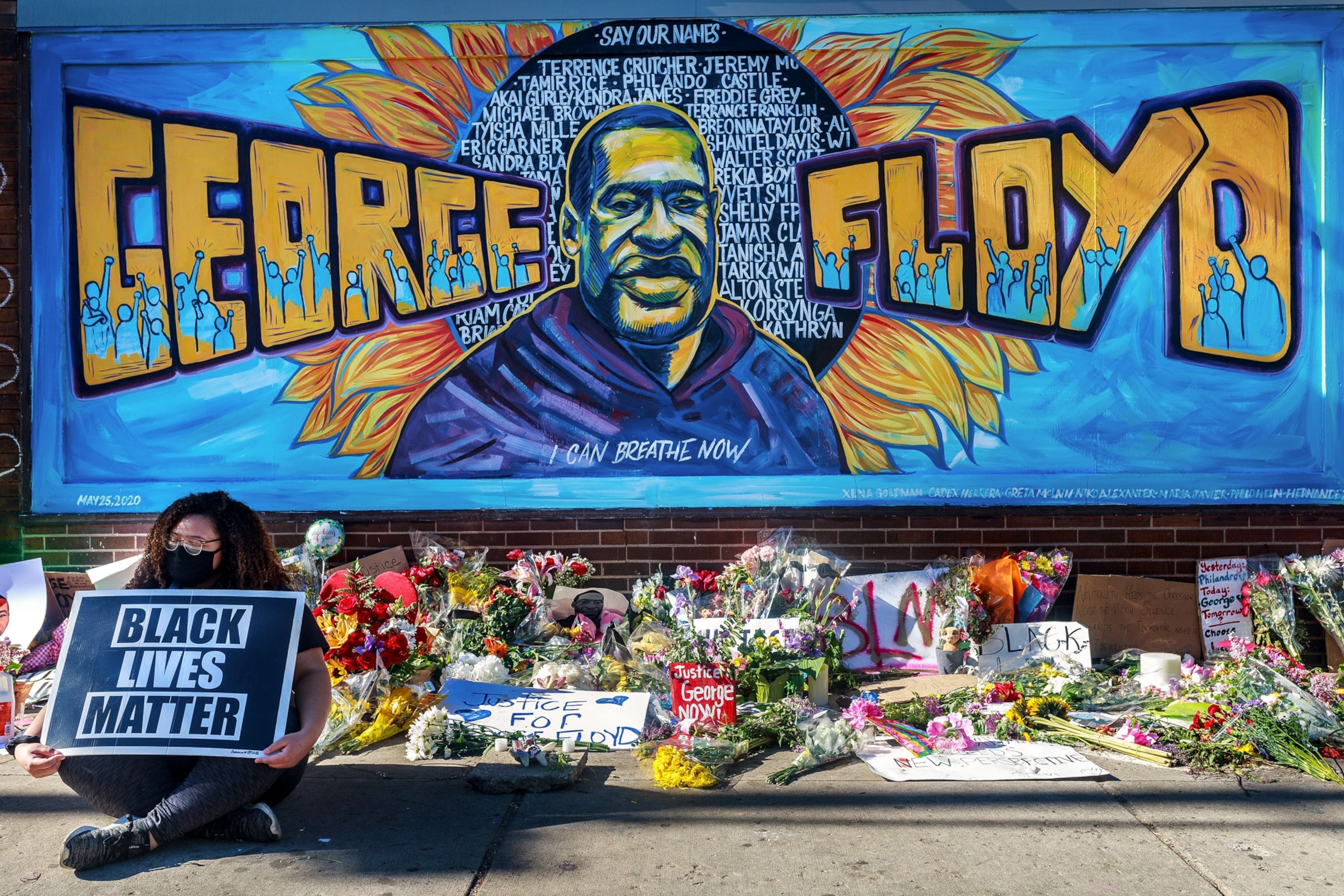
George Floyd's mother was not there, but he used her as a sacred invocation
I want to open with this because I don’t want to center the discussion on me or on my erstwhile opponent in this debate: the real focus here is on the police murder of George Floyd. Rest in peace, sir.

Let’s get this out of the way first: I don’t like Ben Shapiro.

It’s not hard to understand why: he is deeply conservative and I am liberal; I believe in the value of real argument and he’s the definition of a sophist; I strive to be honest and a rational intellectual (Meaning someone who uses reason and thought to discern and communicate truth; I’m not necessarily trying to be seen as super-smart and therefore an authority — though I admit I wouldn’t mind being seen as super-smart), and he’s a manipulative liar who hides behind the trappings of pseudo-intellectualism (meaning he is trying to be seen as super-smart and therefore an authority, regardless of the actual merits of his position — and I think he is intelligent enough to know what he’s doing and why, which implies that he is either deeply cynical or tragically self-deluded).

Basically, he’s a stinky poopoo head. Just know that going in.

As a brief aside, let me address the likely counterjab from any Shapiro fans who happen to be reading this: no, I don’t hate Shapiro because he’s a conservative; I have deep respect for many conservatives. No, I’m not simply jealous; I freely admit I would love to have Shapiro’s platform, his fame and money and success, but frankly, I could get it the same way he did, the same way Glenn Beck and Tucker Carlson and Rush Limbaugh and Steven Crowder did: I could loudly proclaim myself a prophet of outrage and amplify conservative grudges, and use my skills as a writer and a speaker to build a following. As to whether or not I dislike Ben Shapiro simply because he’s right and he proves my liberal ideas wrong, I’ll let this argument address that.

The argument I want to address specifically is this one:

I want to take this slowly: because one of Shapiro’s signature techniques is talking fast and overwhelming his opponents with words that have the appearance of sound, logical arguments. So, right from the beginning: his main claim here, as presented by the title of the video and the first 13 seconds, is that the real reason Derek Chauvin was convicted of murder in the killing of George Floyd was because he had already been convicted in the court of public opinion of being a racist. He expands this in the following 45 seconds by describing Chauvin as “emblematic of an American system of racism,” and uses as evidence the claim that if you asked Americans today if Derek Chauvin was a racist, Shapiro guarantees that a majority of Americans would say yes.

I don’t want to spend too much time exposing Shapiro’s logical failings; the fact that he is a poor debater who wins with sophistry is an issue I have with him and not the central problem with this argument. But it is necessary to identify the places where his argument shifts, because one of the most common manipulations of a discussion is changing the topic, or changing the focus, or changing the argument. We all know it: one of the classic cliches is that arguments between spouses start out with one problem, but then turn into an argument about whose turn it is to do the dishes.

Shapiro does this here. Whether or not Derek Chauvin is personally a racist has nothing at all to do with whether or not he is emblematic of an American system of racism. Whether he is a racist or an emblem of racism has nothing at all to do with whether the majority of Americans perceive him as a racist. And none of that has anything to do with whether or not he is guilty of the murder of George Floyd. Again, because Shapiro is a sophist, he doesn’t seem to argue here that Chauvin was innocent of murder; he argues that Chauvin was unfairly convicted of racism, and simply implies that this unfair conviction of Chauvin for the “crime” (Shapiro’s description) of racism was the “real” reason Chauvin was convicted of murder. He also says, between about 1:00 and 1:30, that America was convicted of being racist because of this one “data point,” Chauvin killing George Floyd; he seems to be implying that America has also been unfairly convicted of that crime of racism, because the conviction of the country was dependent on the conviction of Chauvin for racism, and that conviction was unfair, and also convicting the entire nation because of this one crime is also unfair. Not the conviction for the crime of murder, again, but Chauvin’s conviction for the crime of racism. Which was unfair because it was never brought up in court, never alleged, and never proven, as he says, strongly, several times in this video.

This is what I mean about shifting the argument, and why I call Shapiro a sophist. He’s saying that racism was the reason for Chauvin’s conviction, and in almost the same breath (I don’t know if it was the same breath because I’m not sure that Ben Shapiro breathes: it is genuinely impressive how many words he can get out in a minute, without ever seeming to pause. Sorry; off-topic.) he states that race was never brought up in the trial. How on Earth is the lack of evidence supposed to serve as evidence? It’s not: his evidence is that “we all know” that Chauvin’s conviction was for racism, not for murder. His evidence is that if you asked Americans if Chauvin is a racist, the majority would say that he is. Or at least, Shapiro says (in fact he guarantees) that the majority of Americans would say that Chauvin is a racist.

What Shapiro is really relying on here is the resentment in his audience — generally a white conservative audience — about being called a racist. His audience doesn’t like to be called racist when there is not crystal clear evidence of racist action and intention presented: evidence that would meet the standard in a court of law. That is, unless you can point to the Nazi tattoo on my forehead, and the sworn statement I signed that my Nazi tattoo represents my genuine conviction that the white race is supreme, AND my conviction in a court of law for a hate crime committed in pursuance of the achievement of those white supremacist views — then it is not fair to call me a racist. And since that is his audience’s definition of a racist, calling someone a racist who does not have all of that evidence of racism is deeply offensive. Of course it is: who would want to be accused of that kind of atrocity?

This is, by the way, one of the central conflicts in our society, and it is a subject I will keep coming back to again and again: we have never had a real national conversation about what the word “racism” means, about what it is to be racist. We have not had that conversation because too many people, like Ben Shapiro and also like a much greater number of people on the left, garner too much political power out of misusing accusations of racism, which is easier if they don’t carefully define their terms. It is also much easier to continue maintaining a racist society if the definition of racism is unclear.

Shapiro points out that the evidence of Chauvin’s racism is the death of George Floyd. He says (About 1:00) that is not evidence of racism, it is evidence of a bad cop, of bad police procedure, of recklessness; it is not evidence of racism. But what is his evidence of this claim? That racism was never brought up in the court during Chauvin’s trial. As I said, the charge of racism can only be proven with evidence presented in a court of law: not in the “court of public opinion.” And in another amazing piece of sophistry, starting about 1:45, he says “Let us be real about this,” and then goes on to describe how the presentation of evidence to the public would have shifted public opinion, and therefore the verdict. He says that if the bodycam footage had broken at the same time as the video captured by Darnella Frazier, and if all of the evidence had been presented, and there had not been “20 million people in the streets declaring that America was systemically racist and that this case was and that this case was a case of racism” then it is “highly doubtful” to Ben Shapiro that the jury would have convicted Chauvin of murder.

I honestly don’t know if Chauvin is guilty of murder. I watched the video, and I saw the bodycam footage. I recognize that Shapiro is arguing here that the bodycam footage starts earlier, and shows the struggle between Mr. Floyd and the police before the officers put Mr. Floyd on the ground and before Chauvin knelt on him, and therefore it shows justification (Shapiro is alleging) for the use of force because Mr. Floyd was resisting arrest and so on, whereas the video that helped make this case so famous just starts with Chauvin applying force without giving us the justification for that force, and therefore prejudiced people against Chauvin. I did not see the extended footage as justification. I thought it showed that the police, who probably should not have been called in the first place (I don’t think passing a counterfeit $20 is evidence of criminal action requiring a police response), should not have approached a man in his car, unaware that he had been reported for passing a counterfeit $20, from out of his line of sight, startling him, scaring him and provoking an agitated response, and then using that response to justify pointing a gun at him, scaring him further and provoking an even more agitated response, and then continuously escalating the interaction until it becomes an argument about how much force is required to restrain someone who is resisting being restrained. In fact, I think the extended footage implicated the three other officers in the murder. Not because I know in my liberal heart that Derek Chauvin is racist, but because I don’t presume that George Floyd was a threat, as the police clearly did, and I don’t think that violence is justified in ending a threat, and certainly, without a question, the use of force should end when the resistance ends. If Mr. Floyd was fighting or running away, force might have been called for — but as soon as he stopped fighting, the use of force should have ended. Period. Not gone on for nine and a half minutes. Did the police see Mr. Floyd as a threat because of his race? Was his race the reason why the store’s owner called the police on him for passing a counterfeit $20? I think the answer is definitely yes, but I can’t say for sure. What I can say is that the full footage does not clearly, undeniably sway public opinion towards vindicating Chauvin’s actions, because it doesn’t exonerate Chauvin for me. Though I recognize that other people disagree with me, and think his actions were justified. I see Shapiro’s point, that the full footage might have moved people differently than just the witness’s video did; the death of Ma’Khia Bryant seems to be showing that: but that is a question of how you can move (or manipulate) public opinion, not an argument for how you can find the truth in this case: which is why this extraordinary sophistry. Just watching the videos does not prove Chauvin’s guilt or innocence, which is why I say I can’t know for sure if he was guilty or not.

But this I can say for sure: the best evidence that I know, on either side, is that 12 American citizens, after hearing weeks of evidence and argument, found Chauvin guilty on three counts including second degree murder. Shapiro has not one single argument here that is better or more reliable than that verdict. Nor do I. So I will accept that verdict as the answer, over the doubts of one Ben Shapiro. I suspect that Shapiro, who is in fact incredibly intelligent and both educated and experienced, having graduated from Harvard Law and worked as an attorney before going full time into conservative punditry, also recognizes that he does not have one single argument that is better or more reliable than that verdict. But he doesn’t say that, because he is a sophist and a manipulative pseudo-intellectual who profits from stoking the flames of outrage and partisan division, and convincing his white conservative audience that Chauvin is not guilty of racism, and therefore neither are they, and that the accusation of racism is much worse than the actual murder of George Floyd by Derek Chauvin, because that false accusation of racism caused the wrongful conviction of Chauvin for murder, when at best he was just a bad cop following bad police procedure and acting recklessly. And why those three descriptors, Shapiro’s own, should not be sufficient to show that the killing was in fact murder is beyond me: clearly those reasons, which were presented in the trial and supported by video evidence and expert testimony, were sufficient to make the jury convict Derek Chauvin of murder.

Of course, because Ben Shapiro is a sophist and a manipulative pseudo-intellectual who profits from stoking the flames of outrage and partisan division, he builds from his claim (presented without evidence beyond his own opinion and “what we all know to be true,”) into greater assumptions and accusations, namely that this case has been entirely political, that it has been used by Democrats to build the narrative that America is racist. Again, not to get too deep into flaws in the argument and logical fallacies and such, because the focus here is simply that Ben Shapiro is wrong, but I have to revel in the towering house of cards he has built here: starting with (1) Derek Chauvin was innocent of murder; then (2) Chauvin was convicted because the public decided he was racist, along with (2B) The public would not have decided Chauvin was racist if they had seen George Floyd resisting arrest and being visibly agitated. Then you have (3) Because it was not proven in the court that Chauvin was racist, Chauvin was therefore not racist; (4) America was accused of racism because Chauvin was accused of racism, while simultaneously, (-4) Chauvin was accused of racism because America is and was and has been accused of racism; then (5) since Chauvin is not racist, America is not racist — and also (-5) since America is not racist, Chauvin is not racist — and then (6) the Democrats have taken up this issue because they use false accusations of racism for political gain. All assumptions, many of them contradictory and even absurd on their face, yet we’re just supposed to accept them as true (Because Shapiro’s audience does accept them as true, I would guess). As an example of this, Shapiro, starting at 3:28, begins talking about Philonise Floyd, George Floyd’s brother, who gave a statement about Chauvin’s conviction in which he compared his brother to Emmett Till. Shapiro gets very exercised about this, taking offense on behalf of Emmett Till’s family — and also revealing his (Shapiro’s) additional faulty reasoning for the justification of George Floyd’s death — but there are several problems with this. One is that he gets some of the details of Emmett Till’s murder wrong, but I don’t want to nitpick; I’m only pointing that out because if you want to get self-righteous about the truth, you should present the whole truth. The big problem is that he argues that the analogy is wrong because the circumstances surrounding the death of Till and the death of George Floyd were entirely different, and therefore it is a bad analogy intended to make the murder of George Floyd as tragic and abominably racist as was the murder of Emmett Till. And therefore, of course, the murder of George Floyd was not as tragic and abominably racist as the murder of Emmett Till.

But here’s the thing: that is not the analogy that is being made.

Frankly, I’m not going to speak for Philonise Floyd. His brother was killed, the murderer was convicted; Mr. Floyd is welcome to say whatever the hell he wants in the aftermath of that tragedy. He can say that his brother was the Second Coming, or the greatest American since Abraham Lincoln, or that he was cooler than Napoleon Dynamite: none of that is evidence of any of the accusations that Shapiro makes about the Democratic party using Floyd’s murder to make political hay. (I will say that Shapiro does not directly criticize Mr. Floyd: he rather goes after the more famous men standing in support of Mr. Floyd, namely Rev. Al Sharpton, Rev. Jesse Jackson, and Ben Crump — who, weirdly, I guess have to name as the head of George Floyd’s family’s legal team, which one would think could be the explanation for Mr. Crump’s presence at Philonice Floyd’s press conference, rather than the political agenda Shapiro seems to ascribe to him. Shapiro calls them all racebaiters, of course without any evidence whatsoever, allowing that ad hominem attack to support his house-of-cards assumptions about the political agenda being expressed here.)

But others have made the same connection between Emmett Till and George Floyd, so let me address that: the argument has not generally been that Floyd was murdered in the same way that Till was. Nobody has made that claim, other than Till’s cousin, Ollie Gordon, who did say that she felt the same way watching the video of Floyd’s murder as she did when her cousin was lynched. The point that has been made repeatedly is that Till’s murder, and even more importantly, his mother Mamie Till’s decision to publicize the horrifying details of her son’s murder, with an open casket funeral and published pictures of his wounds, galvanized the civil rights movement and helped bring about the changes the movement wrought over the ten years after the 14-year-old was killed; similarly, George Floyd’s murder, which was not unique but was certainly more publicized than most similar murders, galvanized the protests that happened in 2020, and may lead to some changes — potentially including the conviction of Derek Chauvin. And that is a reasonable analogy; but it does support the idea that the country is in fact racist, which is why Shapiro has to argue against it.

In the process of arguing against it, Shapiro does go after George Floyd: he describes Emmett Till with a list of negatives, all of which are points Shapiro wants to make about George Floyd. He says that Emmett Till was not someone passing counterfeit bills, that he was not a repeat drug offender, that he was not a repeat criminal who had done jail time, that Till did not hold up a pregnant woman at gun point and rob her house while her kid was in the house. And perhaps the most important point (though it is not the most emotionally manipulative point), Till did not resist arrest. Of course: none of these things matter in the slightest. George Floyd was not killed because he was a repeat drug offender, nor because he was high when the police detained him. He was not killed because he had a criminal record. He was not killed because he was passing counterfeit bills (There is no evidence, of course, that he even knew that he was passing counterfeit bills). He was, and this is the crucial point, not killed because he was resisting arrest.

George Floyd was killed because Derek Chauvin murdered him. As was proven in a court of law.

Now, I do have to point out again that Shapiro doesn’t actually say that Chauvin did not commit murder; he said that he doubted a jury would convict Chauvin of murder had it not been for the court of public opinion convicting Chauvin of racism. I don’t agree, clearly, but I will say there is some argument to be made that the jurors were swayed by the events of last summer, and by the protestors showing up in great numbers outside the courthouse throughout Chauvin’s trial. It may be that the jurors convicted because they were afraid that there would be riots if they acquitted Chauvin. That may be true, though of course it may not be; there is just as much reason to think that the jury, or at least some members of the jury, would acquit in defiance of that pressure, would even seek out the violence that may have followed an acquittal. It is extremely likely that some members of the jury would fear the consequences that might have come, that still might come, from the police because Derek Chauvin was convicted. In any case, it is not true that the jury convicted Chauvin only because of the accusation of racism. Since, as Shapiro states, race was never brought up in the trial, the only way the jury could have convicted based solely on the accusation of racism would be if they came in with that idea already in their heads, that they were prejudiced against Chauvin and no amount of evidence would ever sway them. But since 46% of Republicans and 25% of independents think it was the wrong verdict, based on the same public opinion evidence that Shapiro claims is the reason for the conviction, it’s far more likely that, if public opinion actually held such sway over the minds of the jurors, some of the jury would have voted to acquit. It’s practically impossible that the jury would be all Democrats (Also, 10% of Democrats think it was the wrong verdict, so at least one juror on an all-blue jury would have thought that, statistically speaking), and hard to believe that Republicans would overcome their prejudices while Democrats would not, based on the same evidence. One pro-police Republican voting to acquit would have led to a hung jury and a mistrial, and that has historically been exactly what happened in even the most egregious cases of police violence. Instead all twelve jurors, some of them likely sympathetic to pro-police ideas if not personally in support of them, all of them surely feeling pressure from conservative friends and neighbors as much as from liberal friends and neighbors, voted to convict. On all three counts.

Because Derek Chauvin murdered George Floyd. As was proven in a court of law. Without race being brought up once.

Now: is America racist? Was Derek Chauvin’s murder of George Floyd emblematic of that systemic racism? Might the video, the case, the public response both from 20 million people on the streets and from politicians and political pundits, all potentially have had, or will have in the future, an impact on the racism in this country?

The answer to those questions is the same as the answer to this one: Is Ben Shapiro a sophist and an annoying twerp?

This Morning

This morning I am thinking about ending gun violence.

Really, the solution is quite simple: after the apocalypse, when we’ve all reverted back to Stone Age savagery (Well, mostly died; those few who remain will revert), guns will be nothing but strangely-shaped clubs that occasionally explode. But since I seek to save lives, the idea of letting things go their course until the majority of people have died (My same solution would work for climate change, too, I’ll note) is antithetical to the purpose. So let’s be serious.

For simplicity’s sake, because I want this to be a short blog, let us assume that the Second Amendment is worth preserving. I’ll come back to it tomorrow and discuss it at length  (Hopefully not too-long length) but for now, let’s just agree that it’s part of our Constitution, that it’s the accepted law of the land, and that fighting against it or arguing against it directly is going to be counterproductive. I hope we can also agree that there is value in it — I think there is — but we’ll save that for tomorrow.

Because the first thing I want to say about this cause, preventing gun violence, particularly trying to put an end to gun violence in schools (This post is a continuation of this one, if you haven’t been reading along.), is this: it doesn’t begin in our schools.

It begins with the military.

There are two reasons. Three, really, but one of them will wait for tomorrow. The first is that we live in a culture soaked in violence, steeped in blood; that culture influences us to see violence as an answer. The military is the first and most prominent source of this idea, that violence is a solution to problems; because not only does our diplomacy start and end with force, but we laud it, incessantly, as the best thing about us: we are the world’s superpower, we are the global police force, we are the shining light on the hill — which we think is the Bat signal. Anyone anywhere needs help, one of the first things we do is send the Marines. Hoo rah. All of our military veterans are heroes, everything good about this country — our freedoms, our values — are due to the military.

And what does the military do? The military kills people.

Of course that’s not all the military does; and the other tasks, I would gladly maintain. I would cherish a global rescue force that sent in manpower and superior engineering knowledge to help with natural disasters. I would absolutely adore a massive collection of dedicated, patriotic men and women who actually lived and worked among real people in terrible places, and helped them, and got to know them; I think those soldiers, the ones who win hearts and minds, are indeed heroes, and the best possible face that we could put on America to people around the world.

But only if those same soldiers don’t kill the people they have gotten to know.

That’s the second reason why the military has to be the first place we do something to end gun violence: because an Iraqi child’s life is not worth less than an American child’s life, and while we grieve sorely for the school children we have lost to gun violence, I don’t hear the same outpouring for the tens of thousands of children in Iraq and Afghanistan whom we killed.

I don’t blame soldiers for the violence they commit and represent; that is their job, and it is we, the people, who ask — who insist  — that they do it. So this is the first place to start, if we’re serious about ending gun violence. Anything else, any attempt to remove firearms from the hands of our civilian populace, while we pay a million men and women to circle the globe with their fingers on the trigger, is absurd. First we have to put down the nation’s gun.

In a practical sense, I’d suggest keeping a massive and essentially unbeatable National Guard, with as much of it as practicable as Reserves: let’s go back the Minutemen, one of the first and most important ideas of the founding fathers, and one of the first that they lost, because a standing army is just such a useful tool. You can use that hammer to smash anything. Or anyone. I’d also suggest that as many of our current assets as possible be transferred to the UN for their peacekeeping forces — or to another similar body if we’re not happy with the United Nations specifically. I do recognize that force is necessary at times, to stop atrocities around the globe; but I also recognize that we are too reluctant to commit our own troops to that cause. So we should participate in the cause, but not be in charge of it. Frankly, we could use the humility.

That’s first. The second step in ending gun violence for real is something that should happen in this country, and it is this: legalize all drugs.

I don’t know that drug users and drug dealers are the biggest source of illegal activity that includes gun violence, but I know they are one of the worst, and also one of the easiest to put a stop to. Legalize drugs, control them, build a market for them, and not only does the majority of crime in this country stop (or take on a different tenor, which is certainly likely; the other thing we need to do to stop crime is reduce income inequality — but that’s a different blog and also a societal issue that leads to property crime more than violent crime. Drugs tend more towards violence, especially between and among dealers.), but also the majority of violent crime and societal instability in Mexico.

Are you listening, Trump? You want to make Central and South America a better place, with fewer gangs and less violence, and therefore less reason for people to emigrate to the US? Here’s your chance. Legalize drugs. Problem — not solved, but certainly ameliorated.

But the legalization of drugs, while it would stop some of the worst gun violence we face, would actually contribute somewhat to what is possibly the saddest cause of gun violence, and the hardest to fix: domestic violence and abuse. This is the third step we have to take. Not only because the thousands of women who are killed by their partners every year are not worth less than the school children we grieve so sorely, but also because it has to be obvious by now that one of the potential causes of school shootings is a violent, unstable home life, generally one cause by abuse and neglect. (And inasmuch as drugs and alcohol contribute to abuse and neglect, my second solution makes this one harder; however, I would hope that legalized drugs would have less stigma attached to seeking help, and maybe that would make some difference, too. There would need to be stiff penalties for crimes committed while under the influence. That’s probably another blog.)

I don’t know how to stop this, to be honest. I can’t understand someone turning in anger and attacking their own loved ones — and I also can’t understand someone living with people they don’t love. Of course desperation is part of it, especially for people who stay with abusers; so maybe solving our income inequality and poverty problems are more imperative in this cause than I thought. I do feel like this one is the hardest and the longest-lasting problem, one that will take at least a generation of hard work to reduce if not eliminate; because the only way to solve this is to break the cycle of abuse. Abusers are broken people; and they break the people they abuse. (Not everyone. But it’s no shame to be broken by someone who seeks to do it, and it does happen, far too often.)

That is, when the abusers don’t simply murder them. Often with guns.

So these are the first three steps we must take. And I’m fully aware that just that first step is essentially impossible in this country in this day and age; everyone in politics is beholden to the military, forced to kowtow to them in a country where even the NFL, a bastion of American spirit if ever there was one, was humbled by the rumor of disloyalty to the military. And of course there is the very real possibility that the military would not allow itself to be dismantled: there are a number of very powerful people with a vested interest in maintaining our addiction foreign wars, and if we think a military junta couldn’t overthrow our government simply because this is America, then we haven’t been paying attention. There’s also the awesome might and influence of the military-industrial complex, and they have less than no morals. I kinda feel like, if this blog were to go viral, they would murder me just for suggesting this.

That’s all right, I’m not scared of them.

I’m scared of someone coming to my school with a gun to kill people. To kill my students, my friends. To kill me. But despite my fear, despite the immediacy of it, if we don’t start with these three steps, then anything we do claiming to reduce gun violence is just hollow.

Let’s do this right.

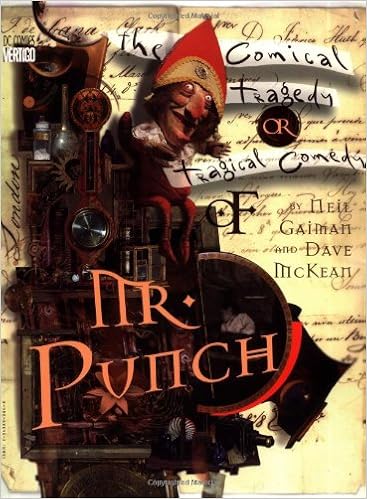
Book Review (Graphic Novel) Mr. Punch by Neil Gaiman and Dave McKean

Image result for neil gaiman mr. punch

The Comical Tragedy or The Tragical Comedy of Mr. Punch

by Neil Gaiman and Dave McKean


This is the second book I’ve read (Riddley Walker by Russell Hoban was the first) that focused on the traditional Punch and Judy show. That one was disturbing because it’s post-apocalyptic, and written in a language that is not quite English and is very difficult; this one is disturbing because it’s Neil Gaiman and Dave McKean. Both are disturbing because Punch and Judy? That’s one messed up story.

So the basic plotline, if you can call it that, of the traditional Punch and Judy puppet show follows the story of Punch. Punch is a sinner: a violent, horny, drunken lout who is clever enough and evil enough to get the better of everyone else in the show – if by “get the better” we mean “beat to death with a stick,” which is basically what Punch ends up doing to everyone, including Judy, who attacks Punch after he throws their baby off the stage to its presumed puppety death. Punch also murders a doctor, a police officer, a crocodile, and the Devil himself; I assume there are variations performed by different people, but both novels tell the same basic story about the murderous Mr. Punch.

Both also describe the traditional puppeteers who tell the story. They are strange people, with an unhealthy and almost religious, even zealous, respect and devotion to the show, especially to Mr. Punch himself. In Russell Hoban’s book, the Punch puppeteer is still doing the same story from medieval England, even though the book is set hundreds of years after the nuclear holocaust that wiped out our civilization; all that remains are some broken fragments of language (the book is written in a very strange invented patois), some relics and buildings and such, and the Punch and Judy show, which is retained in exactly the same form.

In this one, the puppeteer seems to be mystical, in that he talks about an old man, one of the other characters, as having been his apprentice long ago, which would make the puppeteer unnaturally long-lived, it seems. Though it’s hard to say, because the story is told from the point of view of a young boy with a strong imagination, and there are other elements of almost magic realism: the main setting is in a carnival at the seashore in England, and the narrator’s grandfather (the one who used to be the puppeteer’s apprentice) has employed a woman to perform as a mermaid, sitting in a costume on a rock in an indoor pond, brushing her hair and singing. The boy takes her as a real mermaid, so maybe the longevity of the puppeteer is imagined, too.

But there’s also the puppets. The puppeteer talks to the boy and tells him about the Punch show, and he seems to imply that once you put the puppets on your hand, then you gain secret knowledge – and lose something, as well, mainly the ability to take the puppets off again, metaphorically, at least. The boy puts on the crocodile puppet and comments on how magical it is that a puppet can come to life once your hand is inside it; the puppeteer offers him the Punch puppet – the one that is the key to the show, and the only puppet that never comes off the hand, as the Punch and Judy show is a one-man act, so there are never more than two puppets on stage at a time (And the narrator points out that this helps to explain all the murders, as the puppeteer has to keep getting rid of the left-hand characters so he can introduce a new one), and one of them is always Mr. Punch. Who, after he kills another puppet, says, “That’s the way you do it!” Freaking weird. And this is a children’s entertainment. I think knowing that he grew up watching Punch shows helps to explain Neil Gaiman, and maybe a lot of other English authors and creatives.

To add to the weirdness, the book is not only about the Punch puppet show; the boy’s grandfather is losing the last vestiges of his sanity, and also about to lose his carnival house, since nobody goes to the seashore to go inside and see a sad mermaid or a weirdass Punch show. The boy is shy and awkward, and not treated well by his maddening grandfather; there is also some tension between the grandfather and his brother, who helps out with the show and who has a hunchback, though the reason for his deformity is a bit of a mystery commented on by the narrator. There is also an unfortunate love affair involving the mermaid girl, though the boy doesn’t understand it and so neither do we, since the story is told from his point of view.

Overall, it is strange and depressing, but also utterly fascinating, like most Neil Gaiman books. And if there were no other reason to read this graphic novel, it would be worth it just for the art: because Dave McKean is a freaking genius, and the way he mixes painting and drawing and collage and photography in the images of this book make the entire experience twice as fascinating as it would be without him; and it’s fascinating enough already.

Highly recommend, though with a warning about the creepiness and the sadness, which is not resolved neatly at the end. Like life.

That’s the way you do it.

Book Review: Platinum Magic by Bruce Davis

Davis Platinum 150

Platinum Magic

by Bruce Davis


I recently bought four small-press novels at the Tucson Festival of Books; I’ve read three of them so far, and though I don’t want to throw anyone under the bus, I have to say: I’m one for three. Two of those books are clearly self-published, because no publishing house, agent, or editor would take these books on: the writing isn’t good, the stories aren’t very good, the characters are terrible.

This one, however, is the good one.

All of those elements are, in this book, well done. The writing is quite good, the story is a lot of fun, the characters are excellent if a bit cliché. The best part of this book, actually, is the world-building: that’s often a sort of weak praise, as many authors – of all levels, professional, amateur, self-published or NYT bestsellers – specialize in the world-building more than the writing. I understand; the world-building is the fun part: you get to make stuff up, fix the problems you see in our world, add interesting things. It’s great, and a lot of authors let their imaginations run wild, usually without considering whether or not the world they create is at all realistic or plausible, or a good place to put a story – the Eragon series is a prime example of this, I think. Christopher Paolini wrote the first book when he was a teenager, and it reads like it: dragons are cool! Magic is cool! Sword-fighting is cool! And the hero (a teenaged boy – weird how that works) masters all three things in short order, and then flies off on his dragon to kick the world’s ass. Cool!

But also, lame.

Anyway, enough of other, worse books: Davis has done an excellent job with this world he’s created. He’s turned our world into a magic world – or perhaps a magic world into our world. The main characters are cops, investigating a murder case that has larger implications; and while those cops are dwarves and half-elves, and they use repeating crossbows rather than firearms, they still function like cops, in a world with precinct politics and public pressures and corruption and everything else that cops actually deal with. In some ways, this reads like a police procedural, just in a fantasy world. It reminded me quite a bit of Glen Cook’s Garret, P.I., series, in that the familiar tropes are put into an unfamiliar situation, and bring those old cliches to new life by doing so.

And just like the Cook series, this book has deep roots: there are political implications to the case these cops are investigating, and the political tensions between races and nations are built on a long history which slowly unfolds over the course of the book, just as it would in a novel with a real-world setting; that was well done. Though I will say that this element was also the source of my one complaint: though I appreciated Davis’s ability to avoid pages and pages of explication of his world’s history and politics, I was also quite confused early on in the story, as there were references made to old political alliances and upheavals that had strong implications in the story’s present, and I didn’t know what the hell the characters were talking about, which was annoying for a while. But it did all become clear in the end, so it was only a temporary annoyance.

I liked the mystery, particularly the twist Davis puts on it – no spoilers, but the perpetrators were involved with interdimensional travel and smuggling, which allowed Davis to step outside his own world, and gave a great surprise in the final conflict – and I really liked the characters, especially the main two cops, Simon Buckley and Haldron Stonebender. I thought the romance was a little too pat, a little too cliché, but it was sweetly written, nonetheless; Davis makes a nice point about love between different races which I liked. And I loved the use of orcs in this as second-class citizens, despised by the more powerful races, treated with deep suspicion and contempt by the cops, forced into ghettoes and menial labor and crime. Davis does what good fantasy should do: make a point about our world through the use of a fantasy lens that focuses our attention in a way that a more familiar setting might not be able to. He does it well, without making his allegory too on-the-nose; he just writes a good story, with some themes that should ring true even to those of us who aren’t part elven.

This book alone was worth the purchase of all four. I would definitely recommend it.


(The book is available here, if you’re interested; since this is the publisher, I expect the author gets the biggest return from this site’s sales.)