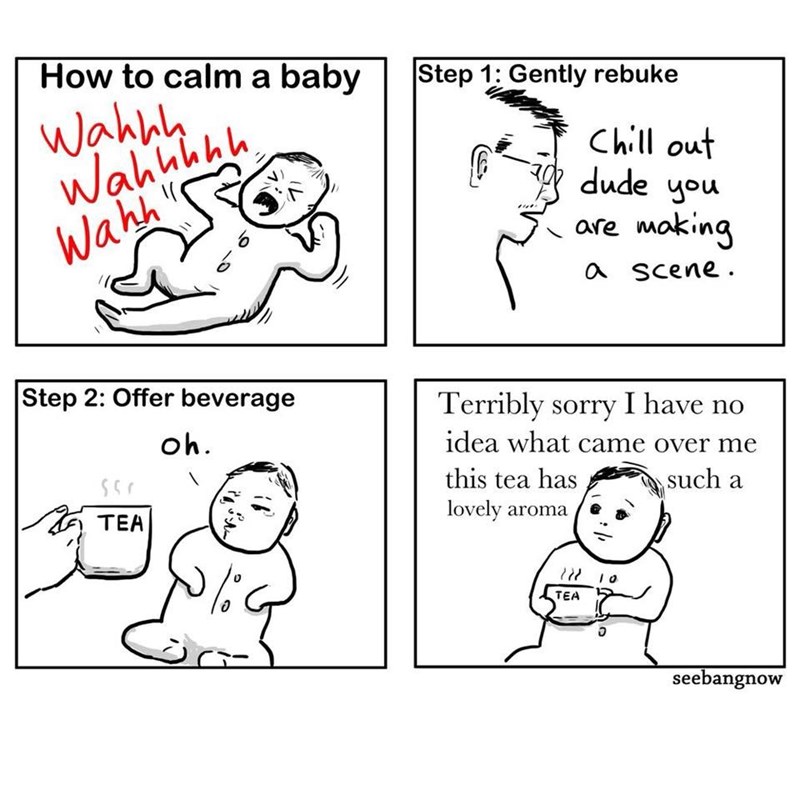
Deep Breath — Now Hold It… Hold It… Keep Holding…

I bet this would work.

***

Wow. It’s been so long since I’ve written a post that I got logged out of my own website.

I would apologize, but first, you all are sick of hearing me apologize; as I say to my students when they offer an apology for their behavior, “I don’t need you to apologize, I need you to do better.” And I can’t promise that I will do better: because the reason I haven’t been posting is that I’m too busy drowning in work and responsibilities. I haven’t caught up on the work, and the responsibilities aren’t going away; so I won’t be writing much any time soon. Though I do have a break a week from now, so I may be able to find some time there to post some more; I do have several ideas for things I want to write.

But this one has to come first. Because, you see, a large part of my problem with keeping up this school year is that I am extra exhausted: and a large part of that problem is that my students are extra exhausting. I’m back teaching 9th grade English, for the first time in 8 years; and the last time, it was an Honors class. I don’t have my lovely fantasy/sci-fi elective this year; not enough students signed up for it — though I can’t imagine who wouldn’t want to take a class in which you get to read “The Fortress Unvanquishable Save for Sacnoth.” (And I BEG you, if you like swords and sorcery and epicness beyond the known realms of epic, click on that link and go read the story. It’s lengthy, but it’s SO good.) The class was fun, and therefore easier to teach; the classes I have now are mostly not fun, and mostly not easy. And though I don’t want to sound like an old man shaking his fist at a cloud, I have to say that part of the problem really is my students, their attitude about school, and the way they treat me and my class.

But another factor — a more difficult one — is how my administration directs me to deal with those students.

For the sake of this post, which I want to keep shorter and more to the point than my usual logorrhea, I’m just going to share the text of a … friendly lil email I got from my administration. Let me preface this by saying that I actually like my administrators very much, first on a personal level and then second (and somewhat less than the personal) on a professional level. They work very hard, even harder than I do; and they, like me, like everyone in education, have enormous and ridiculous demands on their time and energy. One of the demands on my administration is for them to implement the systems that the higher-up administrators want them to implement; and at my school, as at many schools, one of those systems is PBIS.

I have written before about PBIS. But there is nothing I could say about it that would communicate the full level of insipid uselessness that it imposes on teachers. The basic idea of it is that we need to praise students for the things they do right, more often than we need to criticize them for the things they do wrong; and that’s fine — but the idea of it being a system that we need to impose on teachers? Processes that require training? The idea that it will produce data which we will then analyze and use to form data-driven decisions that will surely improve school for everyone? My god, the pile of steaming bullshit in that is larger than Mount Olympus. I already praise my students when they do things right. I do it because I am a kind person, and I care about both my students and the work we are involved in, this pursuit of their best selves. So it already happens. Any system, any process, any practice that teachers are trained in, is inevitably going to be artificial, and therefore undermine the actual relationships that teachers form with students, and which are far and away the best chance we have of changing the way they act, changing their attitudes and reducing their misbehaviors. Relationships, guys. Not PBIS.

When my students are being resistant, or obstructive — or just little freaking jerks — they don’t really need me to be nice to them and find something in their behavior to praise. They need me to tell them to shut the hell up, and make it stick: they need me to have a relationship with them that means they will listen to me when I tell them they need to shut the hell up. That is 99% of the problem with student behavior. For the sake of contradicting the image of me as old man shaking my fist at a cloud, let me say this: students today aren’t worse than they were ten years ago, or twenty, or thirty, when I was a student (Okay, thirty-five…): but they aren’t any better. They are sometimes, some of them, intentionally cruel; that is a separate and more serious issue that has to be dealt with individually and more emphatically. They are frequently distracted and detached, and that sometimes has to be dealt with, though I still generally believe the best way to handle that is to let them not learn anything for a time, and point out to them that they have not been learning anything, and maybe they should do something about that. But really, the problem that comes up in every class, every single day, and which requires a reaction from me, a reaction I am VERY tired of giving, is: they make too much goddamned noise. They just need to shut the hell up. That’s it. Otherwise they are basically fine, and usually good.

Or, as my administration put it in an email I recently received:

As we continue working together to create a positive and productive learning environment for all of our students,

Off to a great start. Also, I thought I was teaching them English?

But please, go on.

I want to emphasize the importance of using Positive Behavior Interventions and Supports (PBIS) when addressing behaviors around our SSA campus. One key aspect that often impacts the success of these interventions is the tone we use when interacting with students. At times, incidents can escalate unnecessarily due to an improper or harsh tone. I encourage each of us to be mindful of how we address behaviors, focusing on de-escalation rather than confrontation. A calm, respectful approach can go a long way in turning potentially challenging moments into opportunities for growth and learning. It’s also crucial to remember that our students deserve the same level of respect we expect from them. When we address students with kindness and respect, we not only model the behavior we want to see, but we also build stronger relationships that can lead to more positive outcomes inside and outside the classroom. I’ve included some behavior interventions that can be helpful when dealing with defiant or disrespectful students.

Oof. Okay. First, I hope we all know that the least effective sentence in the English language is “Calm down.” It never, EVER, makes anyone calm. It is much more likely to piss the person off and add that to whatever agitation they are currently going through.

Second, I have to point out that I strongly suspect a particular interaction between one of my fellow teachers and one of our high school students, which happened the day before this email was sent out, was a large part of the impetus that led to this particular email: because that interaction was not positive, and was not de-escalated by the two people involved. So there was cause for some means of addressing that issue.

But — and this is third, but it should be first, last, and every number in between, when discussing how my administration works with their teachers in ways they should not — any particular issue with any particular teacher SHOULD BE HANDLED SPECIFICALLY WITH THAT TEACHER. Don’t talk to me about being calm; I am too calm. I need to lose my temper more often. Know how I know that? My students tell me that. Talk to me about not confronting my students when they misbehave: that is something I have trouble with. Don’t say that to my colleagues, several of whom are extremely good at addressing issues when they rise, and most of whom do it calmly.

Last, and best, don’t do what the email went on to do, and which it does in this first part as well: don’t tell us to be positive and respectful and several other handy pieces of trite advice, while doing none of those things in the email telling us to do them. Pedagogy experts are legendarily bad about this: almost every teacher training I have had in 25 years in this business has been largely about how to keep students connected to n involved with the learning, presented by people who fail to connect us to or involve us with the learning in any way. The most famous example is the trainers who teach teachers by showing us PowerPoint presentations with blocks of text on every slide, which the trainers then read to us verbatim while we are looking at the slides. Every teacher I know who assigns PowerPoint presentations would fail every one of those presenters. I myself just think about how much better it would sound if I read it for them.

So. Here are the specific pieces of advice this email then offered us. Ready? Here is How To Deal With Students Misbehaving 101. With notes by me, illustrating how I would put these nuggets of wisdom into practice. (If I ever put these into practice. [Not bloody likely. Not as they are worded here.])

Here is your hypothetical situation requiring my intervention: one of my students is talking too much, too loudly. That student needs to shut the hell up. Here is how I would say it, adopting my administration’s guidance. [Said guidance will be quoted preceding each example.]

– Stay Calm and Maintain Neutrality
Responding with a calm demeanor can prevent the situation from escalating. Take a deep breath before addressing the behavior to ensure you remain composed.

*Takes a deep breath, then, composedly,* “Shut the hell up.”

– Give Clear and Specific Directions
Sometimes students react negatively due to confusion or misunderstanding. Make sure your instructions are clear, direct, and specific.

“[Student name]: shut the hell up. Shut your mouth, with the words inside. Lock your throat into silent mode. Do not make the speaky-speaky noises. Am I being clear? Shut the hell up if you understand me.”

– Use Positive Reinforcement
Acknowledge and praise positive behavior when you see it. Often, recognizing what students are doing right can prevent future defiance.

“Good job shutting the hell up. Keep it up.”

– Provide Choices
Offering choices allows students to feel they have some control over the situation. For example, “You can either take a break for five minutes or finish your task quietly.”

“You can choose to shut the hell up, or you can accept that you have no control over this situation, and shut the hell up because I told you to. Your call.”

– Restate Expectations Respectfully
Respectfully but firmly restate your expectations, reminding students of classroom rules while remaining respectful and kind.

“I expect you to shut the hell up. Respectfully.”

– Active Listening
Take time to listen to the student’s perspective. Sometimes defiance comes from frustration or a lack of feeling heard. A few moments of active listening can de-escalate the situation.

“I am now prepared to listen to you shutting the hell up. I am actively listening for absolute silence.”

– Have a Private Conversation
Address the behavior in private whenever possible to avoid embarrassment or defensiveness. This can help maintain the student’s dignity and prevent power struggles in front of peers.

*Takes student out into the hall.* “Stay out here. Shut the hell up. Learn to have some dignity, and some respect for your fellow students, and for me.” *Returns to class where silence prevails. Teaches respectfully. Student’s embarrassment, standing alone in the hall while other students walk by and snicker, helps to enforce that their behavior was unacceptable. Student learns.*

– Teach Problem-Solving Skills
Help students reflect on their behavior and guide them in developing solutions for similar situations in the future.

“The problem with your behavior is that you are not shutting the hell up. Can you offer any potential solutions to this problem? Here’s a hint: it rhymes with ‘Butt the shell pup.'”

– Offer a Reset
Give the student an opportunity to reset their behavior without consequence by offering a short break or a moment to collect themselves.

“Let’s reset your volume to zero by shutting the hell up. Feel free to take a short break from talking. Collect your lips together into a single, unbroken unit.”

Look. At least some of this is valuable advice. For teachers who don’t know how to handle student misbehavior. Which is not all of us. More to the point, if all you had to do to teach somebody something they don’t know, and get them to adopt it as part of their pattern of behavior going forward, was show them a bulleted list, then *Takes a deep breath as advised* I WOULD HAVE GIVEN MY STUDENTS A LIST OF STATEMENTS THAT READ “SHUT THE HELL UP” AND WE WOULDN’T HAVE ANY MORE PROBLEMS. Also, I would give them a list of ways to write essays and read books, and how not to waste their lives and potentials and their very minds and souls on screens and social media, and a whole lot of things would be a lot better. (I have another list for Donald Trump. I’d really like for him to read my list, and absorb everything it says.)

And if you think I’m exaggerating about the prominence of the doesn’t-shut-the-hell-up problem, let me just say that the confrontation that might have led to this email was started by the student making loud noises in the hallway during class time. So.

I will end this by including the last paragraph of the email in question, which is almost everything I would want our administrators, or any colleague, to do when talking to their peers and coworkers. The only other thing I’d like to see with this is a statement that the administration will be working on these problems with both individual teachers, and all the students, who also clearly need to learn these steps in how to de-escalate a situation and treat people with the respect they expect to receive from those people. And for this whole email to never have happened at all.
Let’s continue to create an environment where respect and kindness are the foundation of all our interactions, and where every student feels valued and understood. Thank you for all you do for our school and our students. I appreciate all of you! 

“I appreciate you shutting the hell up.”

Follicular Analogy

I have to get my hair cut.

Ugh.

I hate getting my hair cut. I don’t like spending money, or making appointments and keeping them — actually, making appointments is no problem at all; I enjoy being flexible with my time, since I have few commitments that occur at determined dates and times, and I like feeling accomplished because I did an organizing thing. But I hate keeping them. And I hate small talk, which is almost inescapable with a hair stylist; fortunately they are incredibly nice people most of the time, but that just makes me feel guilty for not wanting to chat about my day, and not having a dozen insignificant topics to draw from. Hey, what can I say? I don’t watch sports, I don’t pay attention to awards shows or The Bachelorette, I don’t go out on the town, I don’t have children. Unless you want to talk about my dogs, or the annotated edition of J.R.R. Tolkien’s The Hobbit which I am currently reading, I don’t want to talk about whatever you want to talk about.

Is it wrong to say that I like it when I find hairstylists who don’t like talking? It feels mean. I don’t mind the ones who like talking, because they tend to carry the conversation for me, and I can react to other people talking about their kids or their sports teams or what have you. But it’s nice when I can just be left to my own thoughts. It’s rare, though, which is part of why I don’t like getting my hair cut.

I used to have the perfect system: I had very long hair when I was young.

No photo description available.
Me in high school with my dad
No photo description available.
Me in college with my iguana Carmalita. Who never kicked my ass at Gin Rummy like my father was doing in the above photo.

It was easy! I just never got my hair cut. If you look at the end of my ponytail in the second one, you can see all the split ends; but if you just don’t care about things like that, then you never have to worry about getting haircuts.

I used to get grief for the long hair, in high school when they used to call me a hippie, and in college when they used to call me Fabio; but it was worth it to avoid the haircuts. (Also, my hair was one of the things my wife noticed when she first spotted me, so it was part of the reason I found the love of my life — so there, all you long-hair-haters) But as I got older, and my hair got thinner on top, it started looking really bad when it got too long; so my perfect solution eventually stopped working.

I found another solution during the pandemic: I shaved my head.

No photo description available.
I shaved my beard off this last summer; I like saying that I shaved the top half of my head in 2020, and the bottom half in 2022.

That also meant I didn’t have to get a haircut for quite a while; but on the other hand, shaving it was a pain — I also don’t particularly like shaving, though for different reasons; I don’t have to worry about small talk when it’s just me with a razor. Then again, I never worry about shedding blood when I go to a hairstylist, so. — and I decided there will come a day when I will have little choice but to shave my head, and I might as well enjoy my hair while I still have it. I do recognize that I am lucky to have most of my hair at 48, and that it is mostly still my original color and texture. All of which I like.

I originally started growing my hair long not actually for the sake of growing my hair long: but because I got a terrible haircut. (This is not a good comparison, but there’s a meme about people being complimented for their maturity, and they say “Oh, thanks, it was the trauma.” I did that not long ago, with one of my students who is very mature and extremely self-aware; after I complimented them on it, I realized that it was because of the severe anxiety they have always dealt with, which makes them hyperaware of their own emotional state, and the years of therapy they have gone through because of that anxiety, which has taught them coping mechanisms. I adjusted my compliment.) It was during 8th grade, when I had been growing my hair out somewhat intentionally because my friends had long hair and liked heavy metal music, as I did; but at the end of the school year I signed up for a class trip to Italy, led by my Italian language teacher, and my mom took me to get a haircut before my passport photo. The stylist she brought me to was an Italian-American man (Not unusual in Boston, of course), and when I mentioned during my awkward small talk that I was going on a trip to Italy, the stylist said, “Oh, well, Italian girls like short hair.” And he cut all my hair off. Even worse, he poofed it up in front, which was very much the style at the time — and very much not my style, ever. I went out to the car while my mom paid, and I looked in the mirror, and I actually cried.

06.02.2014: Happy 48th Birthday, Mr. Rick Astley! | Rick astley, Peliculas  en cartelera, Cantantes de los 80
I looked a little like this. Not as cool, though.

(By the way, if you’re hoping for a photo of Bad Pompadour Dusty, no such photo exists. The poof washed out of my hair, and I just had short hair in my passport photo. And a sad look in my eyes.)

So after that, I just stopped going to hairstylists. And as I said, it worked for me very well for almost twenty years. (I will also note that the last decade of those twenty years, my wife trimmed my hair for me when the split ends got too bad.) And now that I can’t do it any more, I’m a little sad; but also, I have a stylist I like a lot, and when my hair gets too long, as it is now, I make an appointment, and I go. I don’t want to, and I bitch about it — but I go.

Just like the dentist: though that didn’t work as well when I didn’t go to one during my first years of college. Now I go regularly, even though I hate it even more than getting haircuts: it’s even more money, and far more discomfort, and now somehow I am supposed to make small talk while my mouth is cranked open and filled with dental instruments and dental fingers. And sometimes, just as I dream of shaving my head permanently, maybe with lasers, so I never have to get another haircut, I dream of just pulling out all my teeth and getting dentures: so that when those teeth break, I can just order new ones without ever having to sit in one of those torturer’s chairs ever again.

This last week has been a bad week, so when I thought about this topic — when I remembered that I had an appointment this afternoon — I thought it would be nice to write about something superficial and simple, like hair, and how much I liked having long hair and how much I dislike having to get haircuts. I had been thinking about writing on an education-related topic — namely the argument I had on Twitter (The brief one; the long one is also vaguely education related, but much more bigotry-focused and education-adjacent, and that will get its own full length post, because the topic deserves it as hair does not) about how to address behavior problems in students at school. An education “pundit” named Daniel Buck — who is really just a troll who wants to make himself a name as a right-wing education pundit, and has succeeded to the extent that he’s already gotten a book published and been called in for at least one interview on Fox, where he repeated his talking points without offering a single scrap of evidence, as he is wont to do — commented about how good students prefer to be in classrooms where discipline is strictly maintained. Another person replied to his Tweet with the observation that 80% of misbehavior comes from 20% of students, and recommended expelling those students so the rest of the kids could learn and teachers could focus on teaching.

I have a lot to say about that. But I had trouble yesterday, when I generally sit down to write these posts, and then again this morning; I was much more tempted to just dash off something quick about how much I liked having long hair and how much I hate paying both money and time to get my hair cut short. It didn’t help that I went to the gym this morning — and came out to a flat tire on my bike, which made me have to walk home. I don’t mind walking, of course, and the travel either by foot or by bike is good cardio and cooldown regardless; which I definitely need because I have high blood pressure which ain’t gonna get any better the more I deal with student misbehavior (or arguments on Twitter) — but it did take longer to walk home, and at the end of it I was tired.

But somewhere on that walk, I realized: these are the same topic.

(That’s right, folks — I’ve trapped you into reading about education all this time with another long-winded analogy. Though the title of the post should have given it away. I will also note here that my first attempt at a title for this post was AnaloJollies, trying to make a funny portmanteau out of the word “analogy” that had a lighter tone to it; but seeing the word written out like that made me realize it had a whooooooole different impact based on what it looks like I would be talking about in a post titled that. I will not be writing THAT post.)

(At least not until I get my colonoscopy next summer.)

You see, the argument for expelling the 20% of students who are responsible for most misbehavior is flawed for a number of reasons. The first and most important is that the identification of those — let’s call them “troublemakers” for the sake of the argument — is fraught. Very fraught. Let’s start with the fact that the 20% responsible for 80% of misbehavior are dependent on the misbehaviors being measured: they are not the same students across the board. In other words, while 20% of students or so are responsible for 80% of tardies, and 20% of students are responsible for 80% of disrespectful defiance of teachers, those 20% of the students are not the same. It’s a Venn diagram: there is some crossover, some number of students who are mainly responsible for tardies and for defiance; but the slice is not the whole circle. So in determining which 20% of students we want to expel, we need to start by deciding which behavior is the one that deserves expulsion: and first, we need to realize that violent behavior, or drug use or sexual assault or theft or anything really severe, generally already results in expulsion; and second, we need to realize that expelling the 20% of students mainly responsible for defiance will not reduce tardies by 80%, but by some much smaller number — and so for the rest of the behaviors we don’t like.

Furthermore, identifying the behaviors that “disrupt learning” for the “good” kids is not so simple. If a student is habitually noisy, if they speak loudly and often out of turn during independent seatwork, if they ask constant irritating questions of the teacher — but also they are generally respectful of others, especially of teachers, and are never late to class or what have you — which misbehavior expulsion will catch that kid? Which expulsion net will remove the distraction of a kid who just likes to make loud noises with their mouths while they work? (This example, by the way, was brought to you by a middle school student I have been acquainted with, a straight-A student who could not be quiet for more than 30 seconds at a time. Very respectful. Very smart. Deeply fucking annoying. But I don’t think “This kid annoys the shit out of me” is reasonable grounds for expulsion, do you? Particularly not if our goal is to isolate the students who want to learn, because this kid very much wanted to learn. They just wanted to do it noisily.)

And lastly, the big issue here (Actually there are two, I’ll get to the other big issue in a sec) is the false assumption that misbehavior is static. That the 20% who are responsible for 80% of misbehaviors are always the same kids, and that once you remove them, the problem will be solved. Obviously that’s not true, simply because new students come to the school, to every school, with every new school year; but to this the supporters of 20% expulsion rates would simply say that we would need to identify the bad 20% in the new class and chuck them to the curb as quickly as possible. But even more than new students, the problem is this: nature abhors a vacuum — and so do students. If you remove a child who is disruptive of a learning environment, there will be others who will begin to act up in much the same way that the removed child did. I’ve seen it happen several times. Often the most disruptive student is intimidating to other students, who then feel free to act out when the #1 student is no longer there to intimidate them; even more often, at least in high school, students enjoy the disruption, even if they sometimes get mad about losing learning time, because school is boring, and watching a teacher get mad and a kid get in trouble is interesting. So if the #1 troublemaker vanishes, other students will likely fill in by becoming more disruptive, to break up the boredom, because then they will get the attention and even the admiration of their peers. Or, in an even more likely scenario, a student’s behavior will change over the school year: because misbehavior is not actually static, because kids act out for many reasons, very few of which are their immutable personal characteristics. Tardies are probably the best example of this: if you look at school-wide data, you will find that many tardies come from the same small group of students, who are frequently late to class because they walk slowly, or they hang out with their friends, or they avoid class for any one of a hundred reasons — but you will also find that many students are late only to one class, maybe because the two rooms are too far away from each other, or maybe because their ride to school won’t leave early enough to get them there on time. My freshman year of high school I had some obscene number of tardies — because my ride to school was my older brother, who didn’t give a shit about getting there on time. So I never got there on time. And you can see this behavior frequency change overnight, if a kid changes parent custody, or if they move farther away from school, or if there’s a sudden issue with a car, or a change in parent job status, and so on. And though it is a good example, it’s not just tardies: students often, if not usually, if not always, act out at school because of what’s going on at home. You can bet that, after you expel the troublemaking 20%, some other kid’s home life will fall apart due to divorce or a parent losing a job or some other unforeseeable circumstance, and that child will begin to act out in class.

The point is, you can expel the worst troublemakers, and you will still have trouble. Trouble is inevitable. It is school: they are children. Anybody who pretends there weren’t problems in the past exactly like the problems today is lying, or privileged. Sure, there were very few gang fights when I was in high school: but it’s not because the school expelled all the gangsters before they could start fights; it was because I went to a wealthy suburban high school where the student body was 90% White, and there were no gangs. And I can state for an absolute fact that we had the same number of students who were disruptive because they had ADHD, because I was friends with several of them; they were just undiagnosed, and frequently self-medicated with marijuana by the time they reached high school. When they were kids we called them “hyper,” and laughed at their antics in the classroom. Listen to the immortal George Carlin do his routine on being a class clown, in the 1940’s and 50’s in New York, and you will quickly recognize that young Mr. Carlin was bright, respectful — and deeply, constantly disruptive. Wouldn’t surprise me at all to hear that he had ADHD. I guarantee that Robin Williams did.

Listen closely around 7:45 when Carlin gets his audience to make one of the best group-based noises I’ve ever heard.

The other big problem here is the idea that expelling children from school is a good thing. The idea that the children you expel are deserving of expulsion — or that they are not deserving of an education. This is false, and it is a travesty. Again, while I recognize that some children are genuinely dangerous to their peers — I have been in public education for 23 years, after going through 13 years of public school myself; of course I realize that some children cannot be trusted to respect the safety or the rights of others — I expect that children who are actual threats to others will be expelled from school, and probably should be. But even those, even the worst troublemakers, even the ones who harm others: they are still children. And children both need and deserve an education. Some should not receive their education in the same place as other children; but accommodations can be made for that. Particularly now that we can offer many students the option of remote learning. Even if that weren’t an option, we should all realize that the best thing that could possibly be done for most students who have and cause trouble in school is — an education. If those students cause trouble because they are struggling, then finding a way to help them learn will eliminate the struggle and thus the misbehavior. If someone misbehaves because they are on a bad track, which may lead them to more serious issues in life, such as addiction or criminal behavior, then again, the best thing a school can do for them is help them gain an education and more positive and productive skills and knowledge. Expelling students does none of these things: it simply tells the student that they are less important and less valuable than the other students, less deserving of education and all the things that come with it; and that’s not going to help anybody get better at anything.

No: expulsion of problem students is not the answer. The answer has much more to do with all of the ideas that Mr. Buck and most right-wing edupundits find anathema: restorative justice and social services and educational supports for students in need, despite (or even because of) their disruptive behavior in class. As I have now said several times, students who are dangerous to others should be removed from a classroom of potential victims; but even there it is more useful to think of that process as isolating those students, while maintaining their status as students, as children with the right to an education, who will benefit from an education. We should remember that isolation does have negative impacts on the students who are isolated, but the basic goal of educating all members of our society is not lost with isolation, as it would be with expulsion. (I do realize, as well, that students who are expelled are given further opportunities to learn and improve; I support those systems. I’m just responding to the argument as it was presented to me: the final response was expulsion. The reason was to “save” the “good” students from having their learning “ruined” by the “bad” students.

(Here is where I bring it back to the analogy. That’s right: time to talk about cutting hair. It’s okay if you forgot.)

Expelling students to solve the problem of behavior is seeking a permanent solution to an ongoing problem. It is exactly like trying to fix one’s hair by yanking out the bad hair. In order to avoid the difficult work of handling students who misbehave, trying to find why they act as they do and then addressing the underlying issue, we simply remove the students: it’s like shaving your head to avoid having to get your hair cut. Or, I suppose, plucking out the long hairs, keeping the short ones. Though I suppose “long hair” is not the analogous problem; I should talk about hair that causes problems — you know, the hair in the cowlick, which won’t lay right no matter how you try to comb it; that one hair that curls around and tickles the inside of my ear, or pokes me in the eye. Those hairs should definitely be plucked. Doing so will solve the problem entirely. Then I can focus on the good hairs, and keeping them on track where I want them. And if any of those good hairs step out of line — I’ll pluck them, too.

Rather than seeking simple, permanent solutions to complicated problems like student misbehavior, we should think of addressing student misbehavior the way we think of maintaining hair, or working out, or doing anything that requires long term effort: the key is to build a routine. To find the right tools and resources, to recognize the roots of the issues (No pun intended), and to realize that long term, incremental changes are most likely to have positive effects. If one has high blood pressure, say, the answer is not to remove the angry blood causing the problems, as they would have in Shakespeare’s time (Which I hope we can agree was not a good system); and it is not necessarily to expunge all the causes of stress instantly and without consideration. I would have much less stress if I quit teaching: but the new situation I found myself in would cause me new problems, which would give me all new stress. If one has bad hair, one should look at one’s shampoo, one’s hair care routine, one’s hairstylist and relationship with one’s hairstylist, and try to work through all of those concerns to fix the bad hair — rather than just yanking out 20% of one’s hair and throwing it away to concentrate on the other 80%. The answer is also not to do what I did when I was young, and simply accept that bad behavior exists, like split ends, like cavities in teeth; the analogy falls apart here because an individual hair is not important, and an individual child is. But the prescription for all of these issues is the same: address the problem. Slowly. Carefully. But address it, don’t just ignore it or remove it and throw it all away.

If we want to address student misbehavior, the key is not to expel the “bad” students; it is to work, over the long haul, to turn “bad” students into “good” students. To help the problematic students to solve their problems, and to make progress instead of trouble.

Now I have to go get a haircut.