“Adventures” with My “Pets”

I enjoy frequenting thrift stores — as who doesn’t? — and one of my favorite things to do is peruse the books, especially the older ones. This is not my wife’s favorite thing for me to do, so usually while I am geeking out over some 100-year-old grammar textbook (I swear one of these days I’m going to teach my class out of one of those and then WATCH OUT), she comes up behind me and says, “Are you ready?”

I am not. I am never ready to leave the books. I always want to spend more time looking at them. It’s a little frustrating because I don’t always want to spend as much time READING them, so they tend to pile up. (Another reason why my wife interrupts me, and she’s right to do it.) But my wife is right to interrupt me, so I say I am ready, and I leave. Usually without any books. Which is probably good, as they are often more curiosities than books I want to actually read and own.

But sometimes, when I am quick and lucky, I get to find something genuinely awesome. I have a collection of hundred-year-old romances by my favorite pirate author, Jeffery Farnol, some acquired at thrift stores and library book sales, which I am very proud of and love reading.

And a few months ago, at the local Human Society thrift store here in Tucson, I found — this.
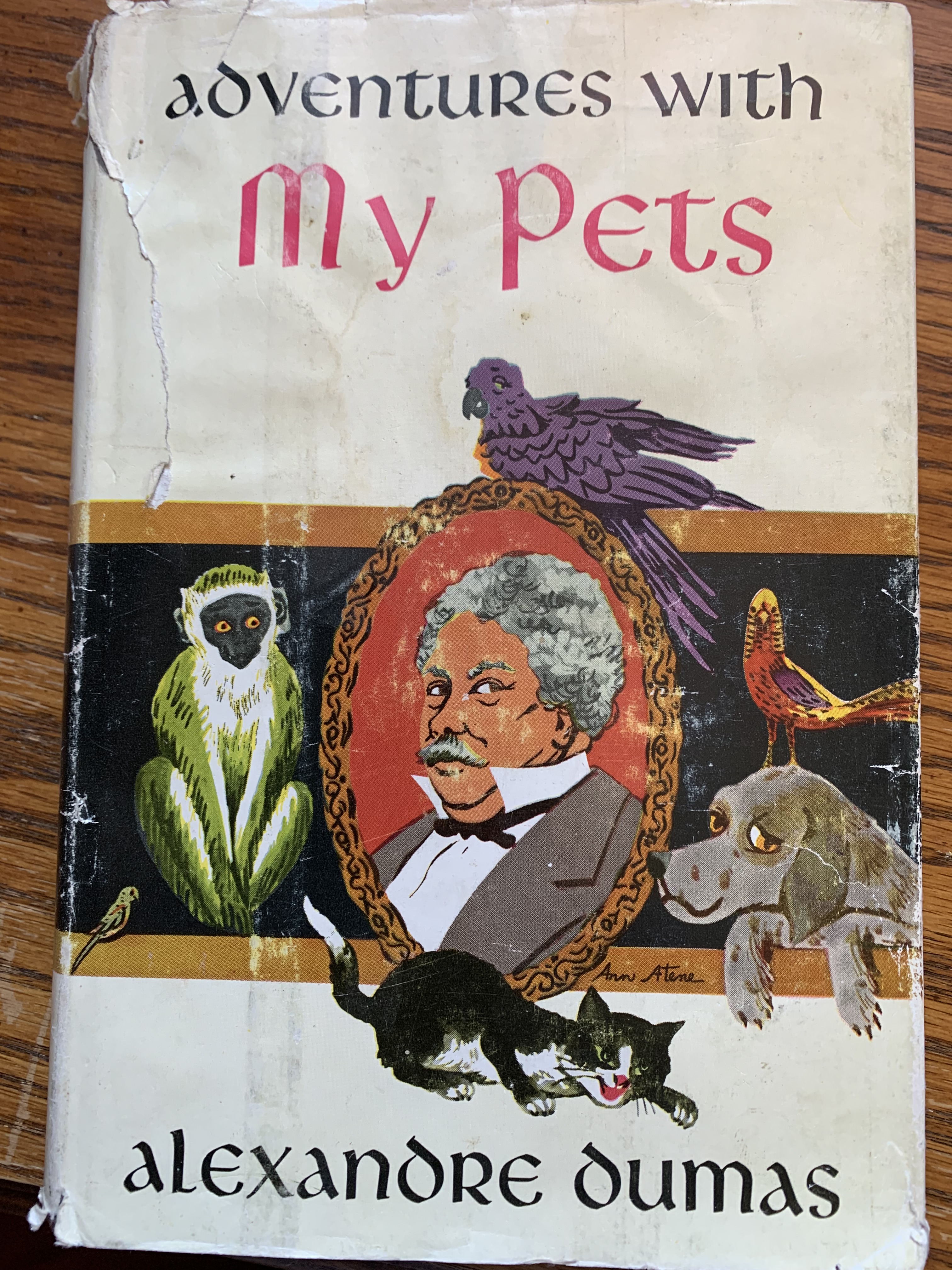
Doesn’t the picture of Dumas look a little like this cat? Or maybe this picture is the one that looks like the cat…

This is a memoir written by the author of The Three Musketeers and The Count of Monte Cristo. Now, Dumas was a badass, particularly as a writer. I’ve read Monte Cristo, and it’s bloody brilliant; and pets are absolutely my thing — so I had to get this. Plus it was only $5.

Unfortunately, as Dumas lived in the 19th century, the times they have been a-changin’: and Dumas did not think of pets the same way that I do — and neither, honestly, did he think of adventures in the same way I do. I was hoping for, I dunno, hiking in beautiful mountains with dogs, who run off the trail and then make friends with an elk and bring it back to get a scratch behind the ear and take a treat from Dumas’s hand; that would be an adventure! With a pet!

Instead I got a whoooooooole lot of hunting. Dumas surely did like to shoot him some animals. Particularly rabbits and birds. The title, you see, comes from the fact that one of the main characters in the memoir is Dumas’s hunting dog, his English pointer Pritchard. And if you count all the times Dumas blasted a bunch of small helpless creatures with a shotgun while Pritchard pointed at them, then you betcha, there were plenty of adventures with his pets. But as you can probably tell, it was not my cup of tea.

It was interesting. Dumas was still a hell of a writer, and he does manage to make a lot of the little anecdotes come to life. Some of them were even fun: the man had a lot of pets, some of which he treated well; while many of Pritchard’s stories are about hunting, there is also one about how Pritchard often brought home many other dogs from the neighborhood to share in his lunch, because Dumas spoiled his animals and therefore Pritchard’s friends wanted the same good food he provided his dog. There are many conversations between people, often but not always about the animals, which were interesting and amusing. There’s a great secondary character, Michel, who was Dumas’s groundskeeper/animal expert, and he is interesting and amusing; Dumas presents a bunch of ridiculous folklore legends as coming from this guy, and clearly we’re supposed to laugh at them (there’s a chapter where Michel asserts that frogs act as midwives to other pregnant frogs, and so either frogs must have taught this to OBGYNs, or OBGYNs must have taught this to frogs — and as a fan of frogs, I’m good either way), but Dumas never makes Michel seem like a fool or a doofus, which I enjoyed. I appreciate that Dumas was, as he was described in one chapter, one of the most arrogant and self-centered of men (Which, not to be stereotypical, but I feel like saying that about a Frenchman is saying something) — but also one of the most generous and compassionate. He is completely ridiculous about handing out money left and right, usually, in this book, to acquire more animals, and I like that. I love the chapter where Dumas is described: because he reprinted a letter from a friend of his who defended him in Parisian social circles, with a letter to the local newspaper, which is fantastic; the letter basically says, Yes, he is arrogant, but also generous — and the real difference is, he’s arrogant because he actually is the greatest author in France, and that makes him a better person than all the rest of us.

I loved that.

But I did not enjoy all the killing of animals. I liked the cat Mysouff, but not when Mysouff killed all the pet birds. I liked the dog Mouton, but not when Dumas kicked Mouton in the rear, as hard as he could, for digging up his garden, and Mouton bit the crap out of Dumas’s hand — and the point of the story was that Dumas therefore had trouble writing for a while, because it was his right hand. I liked Pritchard, but not when Pritchard went hunting, or just killing and eating animals for fun — and especially not when Pritchard gets hurt and Dumas plays it basically for laughs: the dog gets shot by a hunter friend of Dumas’s, and the joke is that the pellets hit Pritchard in the testicles — but not to worry, one of the testicles is still functional! So all is well! And I was just like, “MOTHERFUCKER, SOMEONE SHOT YOUR FUCKING DOG, GO KILL HIS ASS!”

Plus: the dog dies in the end. And not of old age, surrounded by the family that loves him.

So nope: this was definitely not the book I was hoping for, and I would generally not recommend it. If you are a huge fan of Dumas, then you might enjoy it; it gives more insight into him and his lifestyle than it does into his pets or his attitudes towards his pets — but if you, like me, are a pet person, give this one a pass.

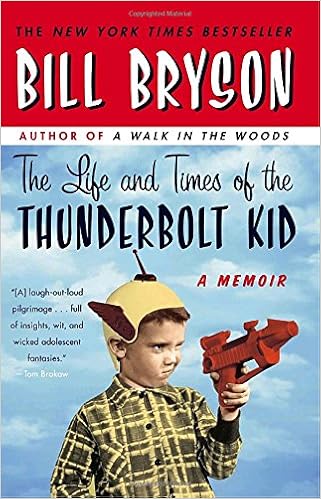
Double Book Review: Bryson and Bryson

A Walk in the Woods

The Life and Times of the Thunderbolt Kid

by Bill Bryson


Bill Bryson and I have nothing in common.

Mr. Bryson has four children; I have three, but they have fur and feathers and shells. He moved to England after only a year in college, and spent the next twenty years or so in Europe; I haven’t been out of the United States since I was 13, and that was only for a week. He grew up in the 1950’s, when America was ostensibly at its peak; I grew up in the 70’s when America had disco. He grew up in, and has a deep nostalgic love for, the Midwest; I’m strictly coastal, and have never even driven through Iowa, where Bryson spent his entire childhood, in the same house in Des Moines. We are both the youngest, he of three and me of two, and we come from literary traditions: his parents were both journalists, his father one of the best sportswriters (Bryson the Younger tells us, but he has a valid argument) in the history of baseball; though neither of my parents are terribly literary, my grandmother and great-grandmother were both authors, teachers, and librarians. But of course, Bryson is an award-winning and best-selling author, and I just cracked 60 followers on my blog. (I thank and adore every one of you, don’t think I don’t.)

And perhaps most importantly, Bryson is a man who would, one, walk the Appalachian Trail, or at least a lengthy segment of it, and two, write a memoir about his American Heartland youth; and I am a man who would – read about both of those things.

Bryson’s writing is beautiful. This is why I keep reading his books, despite having no real common ground with him; this was never truer than with The Life and Times of the Thunderbolt Kid, when Bryson waxes poetic for nearly 300 pages about an America I know nothing about. I mean, he was the archetype: he loved baseball, did crappy in school, and had a freaking paper route, for the love of Clark Kent. Me? I played D&D and Nintendo. Hated sports. Straight A’s until I got to high school, when my grades slipped – to mostly B’s. (I did get a few D’s and F’s, and another thing Bryson and I had in common was a whole lot of truancy in high school.) He writes wonderfully about how simple and perfect was that world, a world I didn’t know and therefore don’t long for. And honestly, even Bryson’s excellent writing didn’t make me long for it. Even though the freedom of unsupervised playtime and the Golden Age of comic books do call to me, as do the unique character of a city made up entirely of local businesses, run by local people, catering to the specific needs and wants of their neighbors, whom they know personally: the department stores, the grocery stores, the restaurants, they all sound lovely indeed. But I don’t want ’em.

The same for the Appalachian Trail, the focus of A Walk in the Woods. I had two friends who walked the whole thing one college summer, and I have always envied them their experience; no more, man. No chance. I wouldn’t even do the abbreviated hike that Bryson writes about. He talks about the exhaustion, the misery, the crappy food, the monotony of the scenery, the irritating other hikers – even a little about the murders that were committed near where he was hiking while he was there, when two female hikers were killed on the trail. Never solved, at least not by the time Bryson wrote the book. It all adds up to a great big No Thanks: even with Bryson’s excellent descriptions of the glorious vistas, the fascinating (Seriously) history of the trail and the regions it meanders through, the sense of accomplishment so palpable you can feel it coming off the page.

Actually, I thought that was the best thing about both of these books: while Bryson does talk sincerely and at length about the good things about these two experiences, he doesn’t shy away from the negative side. His mother was a crappy cook, and that experience is made much worse by the total lack of culinary adventurousness of the era. His parents didn’t worry about anything, giving him great privacy and freedom – but they also painted everything with lead, asbestos, and radiation; Bryson lived through the end of the polio era, and in a time when people, who grew up in the Depression, were frequently missing limbs. In A Walk in the Woods, as I said, he goes through every painful, plodding step, making them even more vivid through the inclusion of his out-of-shape former-alcoholic friend Katz, who walks the trail with Bryson, but slower and with even more suffering. And that’s a lot of suffering.

You hear all about the bad parts, which really does serve to make the good parts seem more genuine and more warmly appreciated. It’s easy to understand how much Bryson loved his family’s unexpected road trip to a still-new Disneyland when he also talks about the usual family vacation to visit family that nobody wants to see, not even the family themselves. It’s easy to see how happy Bryson was to go home when he finished his Appalachian Trail hike when he takes you through every terrible day before that; it’s easy to see the beautiful woods he walks through when he talks about the rain and the mud and the cold.

So even though we’re nothing alike, and Bryson writes personal non-fiction, which should make it hard for me to relate to and understand his work, I am going to keep reading it: because Bryson is a hell of a writer, and he makes me like his books even if I doubt I would like him very much. Nothing personal, Bill. But thank you for everything personal you have shared with me. You keep writing it, and I’ll keep reading it.

Pretty Rough Going

Roughing It

by Mark Twain

I’m a big fan of Mark Twain’s writing, and usually of his views and perceptions of the world. But this book, I’ll confess, was not one of my favorites.

It was bigoted, for one thing. It’s a younger Twain writing about his own life experiences, essentially in memoir form but with some exaggerations (a few stretchers) and finding humor in some places that were worth a good laugh, and some others that were not. Mormons, for instance. He’s pretty hard on the Church, accusing them of recruiting the most ignorant and degraded people, and then getting them to treat Brigham Young as an absolute monarch. He mocks Joseph Smith for his revelation, and then mocks Young harder for adding the doctrine of polygamy, which Twain claims Smith was always against. And then he tells an extended joke about Brigham Young’s hundred plus wives – so many that the man can’t remember who they are, and refers to them by numbers. Now, I’m not a Mormon; I don’t think much of organized religion, nor of polygamy, nor of men who claim to be prophets who have received the word of God inscribed on golden tablets, delivered directly by angels. But I don’t know that any of it is a good source of humor.

And then he gets going on the Indians.

There were some genuinely funny parts, particularly when he mimics the Western slang, as he did so well with Missouri slang in Huck Finn; and there are some absolutely wonderful descriptions, of the desert, the mountains, and of course rivers; he talks at length about the volcanic craters in Hawaii, which he visits in the last few chapters, and which were great fun to read about. There’s some interesting information, particularly when he describes the process of mining silver, as the book is about Twain and his older brother traveling to the territory of Nevada, where his brother was named Secretary to the Governor of the territory, and young Mark Twain tried to get rich along with everybody else off of the Comstock Lode. (Twain failed, of course – otherwise he may never have become a writer.) He’s quite self-deprecating for most of it, describing so miserably his opportunities to become rich, at least two of which he wasted or lost through his own mistakes, that it made me want to cry – or maybe to dope-slap the poor guy.

But the biggest problem I had with this book?

Actually kinda boring.

So: good if you really love Twain’s writing, especially semi-wacky humor about fools and blackguards in the Old West; good if you are interested in frontier living, and the world of silver mining in Nevada, and then life as an itinerant journalist in San Francisco; otherwise, let this one pass.

Book Review: Silver Screen Fiend

Silver Screen Fiend

by Patton Oswalt

I never wanted to be a standup comedian. Too introverted. Which is good because I’m also not that funny.

But after reading Patton Oswalt’s memoir of his early years as a standup, mostly in California, now I’m even surer that standup comedy is never a profession I would pursue. (Sorry, Midlife Crisis. Maybe there’s an over-the-hill grunge cover band you can try out for.) And I’ve also learned that I never want to be a film addict, what Oswalt calls a sprocket fiend and what I would probably call a cinema snob: someone who’s seen every movie starting with the 1920’s, only watches them in the theaters, prefers French and Swedish existentialist cinema, and knows the genesis of every film, the backstory of every director, the influences of every nuance. Someone who would tell you that Bruce Willis’s movie Last Man Standing is basically a remake of Clint Eastwood’s spaghetti westerns, which are basically remakes of Kurosawa’s Yojimbo, which are based on a novel that nobody has read. Except that guy.

You know that guy?

Patton Oswalt was that guy. The above paraphrase is actually from a conversation he relates in the book.

But here’s the thing: That Guy is generally insufferable because he believes that everyone else thinks like he does, or at least should; he can’t imagine why you wouldn’t want to know the reason why a movie uses certain angles and certain shots, why certain lines are delivered in certain ways: he can’t imagine just wanting to watch a movie and enjoy it. And while Oswalt was that guy for a while, he actually recognized that it wasn’t a good thing. He describes his film habit as an addiction, and the description is apt: it was taking over his life, ruining his relationships, everything that an addiction does to a person while they are in the throes of it and sinking towards their bottom. He got into it with good intentions: he was going to become a director, a brilliant filmmaker, and he wanted to study his craft before he dove into it. But very quickly, it went too far.

This memoir is about that addiction. It is also about the other side of Oswalt’s life, becoming a working standup and then a television comedy writer during the 1990’s. And honestly, because I am neither a standup nor a sprocket fiend, there was a fair amount of this book that I couldn’t relate to. I don’t understand the experience of doing a good set of comedy and making an audience laugh; I don’t understand the pleasures of finding a new and different way to perform that doesn’t necessarily wow an audience, but impresses the hell out of the other comedians watching you. But it was nonetheless interesting to read about those experiences, as well as the life of a creative person, and about an unusual form of addiction – but still a harmful one.

My favorite aspect of the book was this wonderful analogy that Oswalt uses: the Night Cafe. The Night Cafe is a piece by Vincent Van Gogh, and for Van Gogh, it represents the beginning of his transition from talented painter to mad genius: and the beginning, too, of the madness that eventually destroyed him, while it produced some of the greatest art in history. Oswalt talks about the Night Cafe as a place that you can’t leave unchanged, that once you go in, once you see it, you cannot be the same person. He talks about the different Night Cafes he has experiences, at least three of which happen during the time period this book covers (He mentions two others, and references the final Night Cafe that we all enter but never return from, the clearing at the end of the path), and how those experiences jarred him so seriously that he changed the course of his life. I thought that was brilliant, and even if I couldn’t connect to the comedian or the sprocket fiend, I could definitely connect to the guy whose life was wrenched from one path to another by a single experience – and the guy who uses art to understand his world. I liked that guy a lot.

I liked the book, too. And I plan to give my copy to a young man I know who is already on his way to becoming a sprocket fiend just like Oswalt. Maybe it can be his Night Cafe.