Pirate Book Review: Silver

Silver

by Edward Chupack

I’m not sure why I didn’t like this book more.

I love pirate stories (I mean, I LOVE them. I am writing a pirate story that is most of the way through its second book now. I dress as a pirate every Halloween, and talk like a pirate every Septembarrrr 19th, which is International Talk Like a Pirate Day. Some of my favorite authors, my favorite books, are pirate stories.). I love villains, especially when they are the protagonist. I love riddles and puzzles and the very idea of treasure maps. So I should have loved this book: which is about Long John Silver, who is a villain of the first order, a pirate, and the protagonist; and he also spends most of the book talking about riddles that point the way to buried treasure. When he’s not talking about killing people, that is, which he does quite a lot.

But I didn’t love this book.

Part of it is that I am not a serious fan of Treasure Island, the story that spawned Long John himself; I have read it once, in the last couple of years, but never as a kid, when the story really could have captured my imagination. Thus the references in this book didn’t really have much of an impact on me. I recognized some, missed others, and didn’t really care about any of them. Part of it is that the author makes a strange choice to have the entire story be a flashback, which is fine – but Long John is flashing back on his life from his current situation, which is imprisoned in the Captain’s cabin on his own ship, which has been taken from him, and he is being held until he gives up the location of his treasure. It was a letdown that Long John starts off the book having lost. There are some great moments when Silver makes fun of the cabin boy who is constantly bringing him food, which Silver refuses, presuming it is poisoned; and the life he flashes back on was fascinating and supremely piratey; but I hated that he was getting weaker and weaker, starving to death and suffering from a fever the whole time.

I was also disturbed that I couldn’t solve the riddles that led the way to the treasure. There are many hints dropped, and eventually the secret is revealed – or at least, one of them is – but not everything is explained, and I couldn’t get the clues by myself. There’s this one image that is reprinted at least six or seven times, which is supposed to be this fascinating clue that unlocks the secret path to the big treasure: but the whole time, other than the small details that Silver explains, which were pretty apparent from looking at the thing, I got nothing from it. And it is also true that the big treasure was not terribly interesting to me, even though it has some historical accuracy, which is great; but I kind of didn’t care about this one.

Overall, I think it was a good book, and well-written; I think it was just a little off the mark for me. I think someone else who loves pirates – especially someone with a particular love for Robert Louis Stevenson – would really enjoy this one. Though I will note that the Goodreads reviews of this book say that the connection between this book and Treasure Island is tenuous at best, and a shallow marketing scheme at worst, so maybe that wasn’t the problem; maybe it really just isn’t that good a story. I’m going to recommend giving this one a miss. Try Jeffrey Farnol: now that man could write a pirate story!
Book Review: Interpreter of Maladies


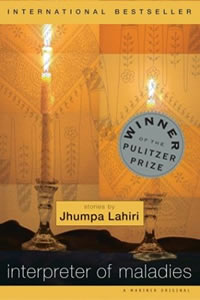
Interpreter of Maladies

by Jhumpa Lahiri

I didn’t love this book.

Some of the stories were beautiful. All of the writing was lovely, but some of the stories didn’t sing to me, where some did. I was a little disappointed that the title story was definitely not the best; it’s about a man who interprets for a living, who takes a group of American tourists (of Indian heritage) around on a tour of his hometown, which they visit every year or so from their home in New Jersey. The tourists are pretty delightfully obnoxious, and the ending of the story when one of them gets an Indian comeuppance, is delightful; but the major action involves this interpreter (who also works in a doctor’s office, translating people’s symptoms to the doctor – hence the title) developing a crush on the tourist woman. Which was pretty disappointing, really.

I did like about half of the stories. A Temporary Matter, the first one, was maybe the most touching; it’s about a couple trying to find their way after a stillbirth; they are mostly estranged and alienated, until the power company turns off all of the lights in the neighborhood around dinner time, and then these two people find that they can talk in the darkness in a way they can’t when the lights are on. The story doesn’t have a happy ending, which was also a letdown, though it did make sense. It was good, but not my favorite. The second story, When Mr. Pirzada Came to Dine, is pretty much the typical story for the collection: it features a mix of Indian culture and Western, which creates discomfort and conflict; the characters are interesting, the descriptions are lovely – and the story goes freaking nowhere. Ditto for A Real Durwan, Sexy, and The Treatment of Bibi Haldar (The first and last only differ in that they are purely Indian, and so have at least some appeal in showing something of the culture; Sexy is the only story in the collection with a Western main character, and she’s a dud, as is the story.), and, sadly, the title story. Which at least does have the best title, which is, I suppose, why Lahiri picked it for the collection. The other three I’ve listed here were all a little too strange, and a lot too dull: nothing really happens, nothing gets resolved, nobody goes anywhere. I’m sure that was the point, an attempt to show the futility and emptiness of modern life, but — whatever.

The good stories were The Third and Final Continent, This Blessed House, and especially Mrs. Sen’s, which was my favorite. They showed relationships that were fraught, but not doomed; the couple in The Third and Final Continent actually work out quite well, as does the most significant relationship in the story, between the Indian main character and his American landlady, who is 103 years old and is splendid. Say it! Say “Splendid!”

This Blessed House has the most interesting character, in the woman named Twinkle, who reminded me of the classic vivacious hostess, the sort of Katherine Hepburn energetic wit with grace and style who isn’t afraid to get her hands dirty; she was contrasted nicely with her dud of a husband, though I do have to say that, as an introvert, I was kind of on his side: he just wants a quiet house to come home to after work, and his wife keeps throwing parties and doing things. I have never been so glad to be married to a woman even more introverted than me.

Mrs. Sen’s was the sweetest story. It’s about an American boy who spends his afternoons at the home of his babysitter, the titular Mrs. Sen; seeing her through his eyes made her interesting but never offputting – other than the damned knife in the beginning of the story, which I could not for the life of me imagine; it’s apparently an Indian cooking tool, a blade fixed to the cutting board, and you move the vegetables over the knife to chop them. It’s a nice piece of Indian culture, but I just couldn’t grasp it. Still can’t. But I love how Mrs. Sen is so eager to get news from home, and I was heartbroken with her when the news is bad; I thought it was very sweet how she tries to learn to drive, and I actually liked her husband, which made this one of the few relationships in the book that isn’t depressing or disappointing. Plus, I used to have to go to my babysitter’s after school — Mrs. Bergstrom’s —  and so I bonded with the narrator right away, and I sort of wish that Mrs. B. had only had me to watch, instead of the five or six kids she took care of at once. I would have liked to get to know her the way we get to know Mrs. Sen in this story.

Overall, I don’t think it was really worth it; even the good stories aren’t among my favorites, really. If you are in the mood for a sort of gentle alienation, like looking through a soft veil at a surrealist painting, then go for it; if you feel like reading about romances that don’t have a whole lot of closeness in them, as well, then this one is right up your alley. I think it missed my alley.

Steamed

Image result for katie macalister steamed

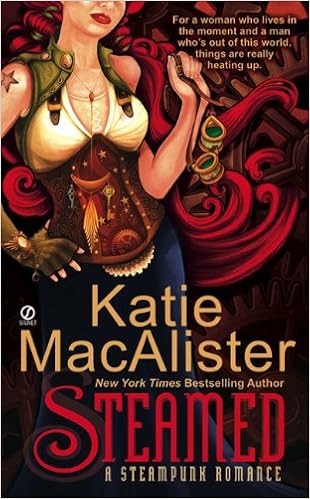
Steamed: A Steampunk Romance

by Katie MacAlister


Didn’t like it. Not because it was a romance, I generally like romances, especially with a fantasy twist; and I like the concept of steampunk quite a lot.

Though I have to say: does anybody know where the good steampunk is? The stuff has just exploded on the fantasy/sci-fi scene in the last ten years or so, and I have yet to find a steampunk book I really liked. Scott Westerfeld’s Leviathan book was the best I’ve hit so far – though only because Jim Butcher’s book The Aeronaut’s Windlass is pure fantasy despite it having airships, because anything Jim Butcher writes is better than almost anything else. I tried Cherie Priest and didn’t like the one book I read, though that doesn’t mean I wouldn’t like something else she wrote. But yeah: not impressed with the steampunk. I feel like authors aren’t using it to their advantage: they’re just like “Goggles and zeppelins are awesome! Yeah!” When they should be saying, “So I’ve got this fantasy idea, right? With epic heroes and a battle between good and evil that ends with good victorious? But wouldn’t it be awesome if I wrote it like H.P. Lovecraft or Arthur Conan Doyle?!?” Yeah. It would. Let me know when that happens, okay?

Maybe I’ll write it.

Anyway. The steampunk in this book was really just background, and it should have been, because MacAlister didn’t do much with it either. The steampunk background is not bad, though; the political structure is pre-World War I, with the Emperor of England and Prussia fighting with the Ottoman Empire while also dealing with a rebellion at home; the main heroine is an airship captain, which is cool, and they use steampunk aether guns, which was great; the manners and dress are Victorian, which was sometimes amusing, though that mainly just came out in discussions of bustles and corsets.

MacAlister had the somewhat interesting idea of taking her hero from the modern world and shifting him into a steampunk world; it’s a bit like the movie Kate and Leopold, but in reverse. The problem with that was she didn’t do it terribly well: the hero is a scientist who is working on a quantum something-or-other – let’s call it a flux capacitor – and his sister, joking around with her brother in his lab (because sometimes twenty-somethings act like they’re five [Though to be fair, the sister acts that way throughout the book, so it’s not an inconsistency; she’s just annoying]), drops it onto a live electricity source, and WHAM! The two of them are shifted into an alternate time stream – and 3,000 miles east of where they left, for no particular reason. I mean, okay, sure, it’s a romance; but I honestly don’t think there’s any reason to slack off on the non-romance aspects. The reason Diana Gabaldon’s Outlander series is so amazing is not just the romance; it’s because that woman is a hell of a historical novelist, almost too obsessive with her research and realistic details.

But the poor science-fiction and okay steampunk are not the issue: because this is a romance. No, the problem with this book is that the romance sucks. This guy, this Jack Fletcher, is freaking annoying. For a scientist in love with an airship captain, he is pretty much just a bro. He somehow has the idea that sexual harasssment equals flirting – and he pulls this, “Hey, I’m a man; of course I’m going to stare at your boobs and then make comments. That’s how men show appreciation!” all the damn time. And though there are some gestures towards Victorian sensibilities, which should have had either the woman herself or some of the men around her challenging this sexist oaf to a duel, really it boils down to a woman flapping her hand and saying “Oh, you!” while giggling after the guy pinches her ass.

The woman, Octavia Pye, is more interesting, because here is a good steampunk opportunity: she is a Victorian gentlewoman, but she can be an airship captain because the steampunk world is more modern and thus potentially more egalitarian; she can also be experienced romantically, and be interested in sex instead of having to swoon at the thought of a man unclothed. And MacAlister does that pretty damn well: Octavia pushes Jack away as a Victorian lady should, and then when they do get together, the sex scenes are actually quite good, both sexy and hilarious. But she puts up with too much of the bro-bullshit. There’s a point when they’re going to go into danger, and even though Octavia is a military officer, an airship captain, and Jack is a Quaker, this Bro actually says, “I grew up to believe a man must stand between a woman and danger.” And somehow the Quaker pacifism turns into, “Well, as long as I don’t kill the man, I can definitely beat the snot out of him with my mighty manly bro-fists.”

Anyway. They fall in love too quickly, as romances tend to do; the story sort of wakes up after the romantic scenes and is like, “Oh wait – wasn’t there supposed to be a plot line somewhere around here?” and then they live happily ever after, maybe setting up for a sequel which I will not be reading.

Suggestions for good steampunk are welcome.

On the Third Day of Blogging, Just Dusty Blogged for Me — A Book Review of Maguire,Gregoryyyyy!

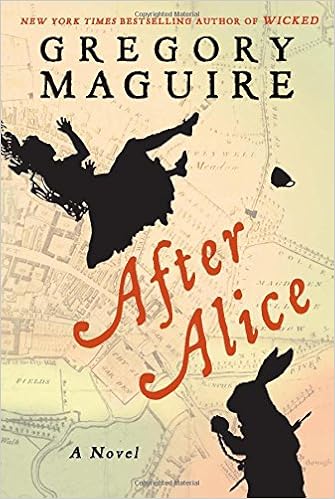
After Alice

by Gregory Maguire


(If you don’t know: Gregory Maguire writes new novels set in classic fantasy worlds — Oz, mostly, but this one is in Lewis Carroll’s Wonderland.)

So the thing with Gregory Maguire seems to be: you have to absolutely love the original.

The man writes an excellent homage. I’ve read Alice in Wonderland and Through the Looking Glass, and the style and feel of this book is remarkably similar. He has the same imaginative twists (though not as many), the same absurdist humor mixed with Victorian understatement, the same satire of upper class manners and fashions, and of everything else that the author can think of. The writer’s voice is an excellent imitation, and I mean that as sincere flattery.

But I don’t love Lewis Carroll. I think the man was brilliant, and what he wrote was a watershed that led to Douglas Adams and Monty Python and Mel Brooks and Christopher Moore, all of whom I love or have loved – honestly, more than Carroll. So while I’m grateful for the existence of an Anglican mathematician with more imagination than either of those descriptors would imply, a whole world of imagination, I’d rather read (or watch) the others than him.

Consequently, I’d rather read them than Gregory Maguire.

I think this book also suffered for being too much outside of Wonderland. I mean, really: that’s the point of Carroll’s books. That’s why they’ve survived and are still beloved enough for Maguire to turn his hand to them. And half of this book by the chapters, and more than half of it by the pages, is set in Oxfordshire in 1861, following around Alice’s and Ada’s families as they search for the missing girls: and though Darwin is present, no time at all is spent with him; all that happens is that his old man’s needs – for help to the privy, to leave early – screw the day up for everyone else. Everyone else is just as annoying: it made me understand completely why Alice would want to follow a white rabbit down a hole, and why the heroine of this book,Alice’s friend Ada, would want to do the same.

If the book was just Ada in Wonderland, maybe finding new places and people rather than just following in Alice’s footsteps, I think I would have liked it more. But the Wonderland stuff was less about imagination and more about following a path, and that made it less interesting than the original. As I said, if I dearly, deeply loved the original, I’d probably like this book just for the sake of going back there again; but I didn’t love the original, and so I didn’t really like this book.

Well done, just not interesting.

Redshirts Review

Redshirts

by John Scalzi

When I bought this book, which is loudly proclaimed on its cover as a NYT bestseller that is a joy to read, with gushing blurbs from two authors I respect quite a lot (Joe Hill and Patrick Rothfuss), I was excited; but the clerk who sold it to me said something that cooled my ardor a little. “Yeah, I didn’t love this as much as everyone else did. I don’t really know why.” As I had been unaware that there was such a lot of buzz about this book, I was a bit puzzled by the comment; but now that I have read it, I completely agree.

I didn’t love this as much as everyone else did.

There’s something about John Scalzi’s writing that doesn’t speak to me. I don’t know what it is. I’ve read a book of his non-fiction, excerpts from his blog; and now I’ve read this Star Trek-themed novel; and I didn’t love either one. I feel like Scalzi is similar to what I’ve encountered in a lot of science fiction writers: their ideas are brilliant, but their prose leaves something to be desired. It makes for disappointing reading experiences, because I get excited about the book based on the concept, but then reading it leaves me a bit cold. Though it is entirely possible that this is my own subjective response, and not something that anyone else would experience. On the other hand: there are some real holes in the plot of this one, and even the short pieces at the end, the three codas that come after the main novel, don’t really spackle those holes in very well.

The idea behind this book is great. For those who know Star Trek, I don’t even need to explain it: the book is written from the point of view of the Redshirts. For those who don’t know the original Star Trek series, I wouldn’t recommend the book; it makes far too many inside jokes and references for those not in the know (And maybe, considering how much we nerds love a good reference, that’s really the appeal of the book.). But essentially, imagine you were a low-ranking officer on a starship sailing grandly through the universe, going where no man has ever gone before, and you realized that every time the command crew went down to a planet’s surface, or over to a ship that had sent out a distress call, somebody died: and it was always, always, somebody like you. The low-ranking officer. The captain and First Officer, the head of engineering and the ship’s doctor – they always went on the away missions, always got in danger, sometimes got hurt; but they never died. It was always somebody else that caught the laser blast or the alien monster attack or stood too close to the explosion. Once you realized that, what would you do? And if you were assigned to the ship that had this record of chewing up and swallowing people just like you – how would you handle it?

That’s a great set up. And the first half of the book, while the main characters are figuring it out while trying to stay alive, really is hilarious. It’s when they figure out the answer that this book lost me. The last half of the book, when they find a way to solve the problem and their own lives, just kept going downhill. There are some funny moments, particularly when crew members meet their own doppelgangers from another universe, but the basic concept really didn’t work. It’s too unnecessarily complicated: the book is clearly, obviously a reference to Star Trek, and Scalzi goes away from that, connecting it to a different fictional universe based on Star Trek but not Star Trek. That was a mistake. The way the Redshirts get their way was too deus ex machina for me, even though that’s the point of it; I would have preferred an actually clever solution, and I didn’t think that was it. And then the protagonist’s final realization of the layers of truth and fiction in his universe was far too precious for me. I feel like Scalzi was a stage magician waving his hands to distract me from seeing how the trick worked – but really, it wasn’t that great a trick. The same went for the codas, which were not as clever as I think they were intended to be, and just ended up annoying me more than the book itself did.

So I don’t know if it was just this book, which suffered from being an idea that is brilliant but probably too difficult to pull off well; or if it’s John Scalzi’s writing; or if it’s just me. At any rate, I didn’t think much of it.